If you’ve ever been on a date at a cinema inside a shopping mall, done your weekend shopping in the basement of Royal City, or simply escaped the Saigon heat inside a cool Vincom tower, then you’ve directly contributed to the revenue of Vincom Retail JSC (HOSE: VRE) — perhaps without ever knowing it. This is Vietnam’s number-one shopping-mall developer and operator, with 90 malls covering 31 of 34 provinces and about 1.91 million m² of retail floor space as of end-2025 — a scale no domestic rival comes close to, and a gap you should keep in mind when weighing the core question: should you buy VRE stock, and what kind of investor does it suit?
What makes VRE special in an investor’s eyes isn’t that it “sells goods,” but that it leases space. Vincom Retail doesn’t sell clothes, food or movie tickets — it builds “prime covered land” and leases it out to thousands of retail brands. This model is essentially a disguised REIT (real-estate investment trust): cash flow comes from long-term leases, repeating steadily month after month, with very high margins because the cost of running a finished mall is nearly fixed. When you invest in a landlord company, you don’t buy the luck of a single selling season — you buy stability, predictability and the right to collect “ground rent” on the most prime locations in Vietnam’s cities.
But VRE’s 2025–2026 story isn’t only about stability. It’s the story of a historic “leaving home.” In September 2024, Vingroup — the “parent” that birthed and raised Vincom Retail for two decades — formally divested its controlling stake, taking in about 1.54 billion USD and booking a gain of over 21,300 billion dong. VRE went from a piece of the Vingroup empire to an independent company, with a new shareholder group taking over and Vingroup keeping only about 18.8%. In its very first “self-reliant” year, the company reported after-tax profit of 6,446 billion dong — up 57%, the highest in its history, while opening 3 new malls. As of 19 June 2026, VRE traded around 29,350 dong.
In this full analysis, you and I will peel back each layer of Vincom Retail — from its history, the new leadership, the business model, financial health and valuation to the investment scenarios. And like every good story, let’s start from the roots: the two-decade journey that built Vietnam’s largest mall empire.
VRE market data (updated 19 June 2026)
| Current price | 29,350đ | 2025 leasing revenue | 8,399 bn (+6.6%) |
| Change (June) | −5.93% | 2025 after-tax profit* | 6,446 bn (+57%) |
| P/E | System | ~10–11x | 90 malls | 2026 dividend | Proposed 10% cash (first in 7 years) |
*2025 profit includes a ONE-OFF gain (transfer of Vincom Center Nguyen Chi Thanh + interest income); CORE leasing profit is ~4,700–4,900 bn. Source: VWealth price data + VRE 2025 reports. For reference only.
History and evolution
To understand why Vincom Retail today can set a “covered ground rent” on nearly 2 million m² of floor space, you need to rewind more than two decades — to a time when the concept of a “modern shopping mall” barely existed in the Vietnamese consumer’s mind. VRE’s story isn’t the story of a lucky startup, but the story of a long-horizon strategy funded with big capital, going from a single building in Hanoi to a network blanketing the country.
From Vingroup’s retail arm to the first brick: Vincom Ba Trieu (2004)
Vincom Retail wasn’t “born” in the sense of being founded in a single day. Its predecessor was the retail real-estate arm of Vingroup — back when the group still bore the shape of Vincom and Vinpearl before merging into Vingroup. The first step into retail-space development was marked in 2004, with the opening of the first mall: Vincom Ba Trieu in Hanoi, floor area about 42,000 m².
You need to place that 42,000 m² figure in context to see how bold it was. In 2004, Vietnam’s per-capita income was still very low, and shopping happened mostly at traditional markets and street-front shops. Pouring capital into a giant glass-and-concrete block in central Hanoi, betting that an urban middle class would form and would flock to a clean, air-conditioned shopping space concentrating many brands — that was a wager on the future of Vietnamese consumption. Vincom Ba Trieu won that bet, becoming an urban-consumption icon of its era and the foundation stone for the whole later empire.
Shaping the legal entity and the Warburg Pincus foreign-capital turning point (2012–2013)
It took nearly a decade after the first brick for this retail arm to be “packaged” into a dedicated legal entity. The company was first established on 11 April 2012 as a limited-liability company, then converted into a joint-stock company from 14 May 2013. Also from 2013, Vincom Retail was clearly directed by the group as the unit specializing in developing and operating the entire “Vincom”-branded mall system — cleanly separated from the residential-development arm (later Vinhomes).
But the event that truly lit the fuse for the “explosion” phase came from outside. Also in 2013, the world-leading private-equity fund Warburg Pincus invested heavily in Vincom Retail. This wasn’t merely a sum of money — it was a “quality seal.” Warburg Pincus brought both abundant capital and deep retail-real-estate expertise from global experience, betting on the long-term foundation of Vietnamese consumption. With this backing, Vincom Retail entered a dizzyingly fast expansion phase.
The lesson for investors: high-quality foreign capital (Warburg Pincus, and later GIC, Credit Suisse, Templeton) has accompanied VRE from very early. This implies the company’s business model was vetted and bet on with real money by the market’s most demanding “players” — a signal you shouldn’t take lightly.
Building a modern mall chain: the four-model strategy
What gives Vincom Retail its hard-to-copy strength isn’t building lots of malls, but tiering the product into four models, each aimed at a different customer segment and a different type of urban area. This is the “coverage secret” that lets VRE set foot in both megacities and small provincial towns without a “mismatched” product. Let’s run through them:
| Model | Floor scale | Target segment |
|---|---|---|
| Vincom Mega Mall | Over 100,000 m² | The system’s largest, in densely populated integrated townships; gathers major domestic and foreign brands, where new shopping trends debut |
| Vincom Center | 50,000 – under 100,000 m² | Combined with offices/apartments, prime big-city locations, many high-end international brands |
| Vincom Plaza | ~5,000 – under 50,000 m² | Mid-size, families in young cities and peri-urban areas |
| Vincom+ | Under 5,000 m² | Launched 2016; towns, districts, small cities with populations from 30,000 up |
Picture this strategy as a fishing net with many mesh sizes. Vincom Mega Mall and Vincom Center are the “large mesh” cast over the megacities, both generating enormous cash flow and building a luxurious brand image. Meanwhile, Vincom Plaza and especially Vincom+ are the “small mesh” weaving into the provinces — where rivals hesitate to invest because populations are thin, but also where VRE almost monopolizes the market with no competition. It was thanks to Vincom+ launching in 2016 that the company could set foot in towns of just 30,000 people, turning geographic coverage into an absolute competitive advantage that only Vincom Retail’s capital scale could pull off.
In 2013–2014, two superprojects — Vincom Mega Mall Royal City and Vincom Mega Mall Times City — went into operation, giant underground malls in Hanoi that redefined the Vietnamese shopping experience. And 2018 became a record year with 19 new malls opened in a single year — a deployment pace only an apparatus with top-tier capital and construction capacity could sustain.
The “one-stop shoppertainment” model: from a place to shop to a destination
There’s an important philosophical shift you need to grasp to understand why Vincom Retail’s malls stay busy even in the age of e-commerce ascendancy. It’s the concept of “one-stop shoppertainment” — combining shopping and entertainment in a single destination.
The logic here is sharp: if a mall is only for buying goods, it will gradually get “eaten alive” by Shopee, Lazada, TikTok Shop, because buying online is more convenient and cheaper. But if the mall becomes the place you take the whole family out for the weekend — eating, watching movies, letting the kids into the play zone, strolling in air-conditioned space, meeting friends — then it sells something e-commerce cannot deliver to your door: experience and time. Guests stay longer, spend more on F&B and entertainment, and most importantly for VRE, the tenants get more foot traffic and so are willing to pay higher rents. This is the “economic moat” that kept system-wide foot traffic in 2025 up as much as 21% year on year, despite pressure from online channels.
HOSE listing 2017: one of the largest IPOs in Vietnamese history
The peak of the “under Vingroup” phase was the listing event. On 25 October 2017, HOSE granted Vincom Retail its listing decision, and by 6 November 2017, VRE officially began trading on HOSE. This wasn’t an ordinary IPO: with a total offering size of over 740 million USD, it was the largest listing deal in Vietnam at the time, drawing prestigious institutional investors like GIC (Singapore’s sovereign wealth fund) and Franklin Templeton.
The deal was so successful it won FinanceAsia’s “Best Private Equity Deal” of 2017. For you — the investor — this event carries three implications: first, VRE stepped into the transparent “stage lights” of the listed market, obliged to disclose information periodically; second, the participation of top foreign funds is a certification of asset quality; and third, from here VRE became one of the most closely watched real-estate blue chips on HOSE.
The September 2024 turning point: Vingroup divests, Vincom Retail “leaves home”
And then came the event that changed the entire nature of the VRE investment story — the event you must understand thoroughly before putting money down. In September 2024, Vingroup formally divested its controlling stake in Vincom Retail.
The deal structure was fairly intricate, so let me untangle it for you. Vingroup didn’t sell VRE shares directly on the exchange, but divested 100% of its capital in SDI Trade and Development Investment Co., Ltd. SDI owns over 99% of Sado Trading JSC, and Sado is in turn a major shareholder holding 41.5% of Vincom Retail’s charter capital. In other words, by selling SDI, Vingroup indirectly transferred control of the 41.5% VRE stake to the new owner group. The total deal value was 39,100 billion dong (~1.54 billion USD), and Vingroup booked a gain of up to 21,333 billion dong from the transaction.
After completion, the ownership picture changed fundamentally: Vingroup directly holds only about 18.8% of Vincom Retail’s capital, no longer the controlling parent. VRE formally split from the Vingroup ecosystem to become an independent enterprise.
Who is Vincom Retail’s new owner?
This is the question every serious investor must chase to the end — because when the owner changes, you’re betting on a leadership and a direction that could be entirely new. Per disclosures, the capital block at SDI (and through it, control of VRE) was taken over by a group of four new investment entities, backed by businesspeople with names on Vietnam’s financial and real-estate market:
| New entity (at SDI) | Ratio | Key figure behind |
|---|---|---|
| Thien Phuc Investment | 16% | Luong Phan Son (Chairman of CapitaLand Tower, investor in The Sun Tower) |
| NP Investment | 16% | Nguyen Hoai Nam (CEO of Berjaya Vietnam, nominated to Vincom Retail’s Board) |
| Falcon Investment | 12.5% | Kieu Huu Dung (former Chairman of Sacombank, now leading KDI Holdings) |
| Emerald Investment | 10.5% | Phuong Anh Phat (CEO of Jeep Vietnam) |
Note this point: the new owner group is not a set of wave-chasing speculators, but businesspeople with deep roots in finance (Sacombank, KDI Holdings) and real estate (CapitaLand Tower, Berjaya). Mr. Nguyen Hoai Nam’s nomination to the Board shows the new owners intend to genuinely participate in management, not stand aside. This is a reassuring signal, though — as we’ll analyze closely in the leadership section — “new owner” also means a strategic unknown you need to watch.
What “leaving home” means for investors
So is splitting from Vingroup good or bad for VRE shareholders? The honest answer is: it both opens opportunity and creates new risk, and you need to weigh both sides.
- Strategic autonomy. As a “subsidiary,” VRE’s big decisions had to more or less serve the overall interest of the Vingroup ecosystem. As an independent company, leadership is now free to plan its own strategy — where to open malls, how much to invest, how to pay dividends — based purely on Vincom Retail’s and its shareholders’ interests.
- Freedom to expand the land bank. Previously, most of VRE’s mall land came from Vinhomes megaprojects (Royal City, Times City, Ocean City, Grand Park…). As an independent company, VRE can in theory seek and develop land outside the old ecosystem, widening its “playground.” This is both opportunity (diverse supply) and challenge (having to fend for land that used to be “prepared in advance”).
- A change in dividend policy. A clear change after the ownership change: VRE began paying cash dividends again. In 2026, the company plans to spend about 2,270 billion dong on a 10% dividend (1,000 dong/share) from accumulated profit, expected to be paid in Q3 2026. For investors who favor steady cash flow, this is a welcome shift.
- The risk of “losing the brand pedestal.” On the other hand, the “Vingroup” label was once an intangible guarantee of execution capacity and credibility. In splitting off, VRE must prove its own apparatus still runs excellently — and this is the test that the 2025 results answered very convincingly.
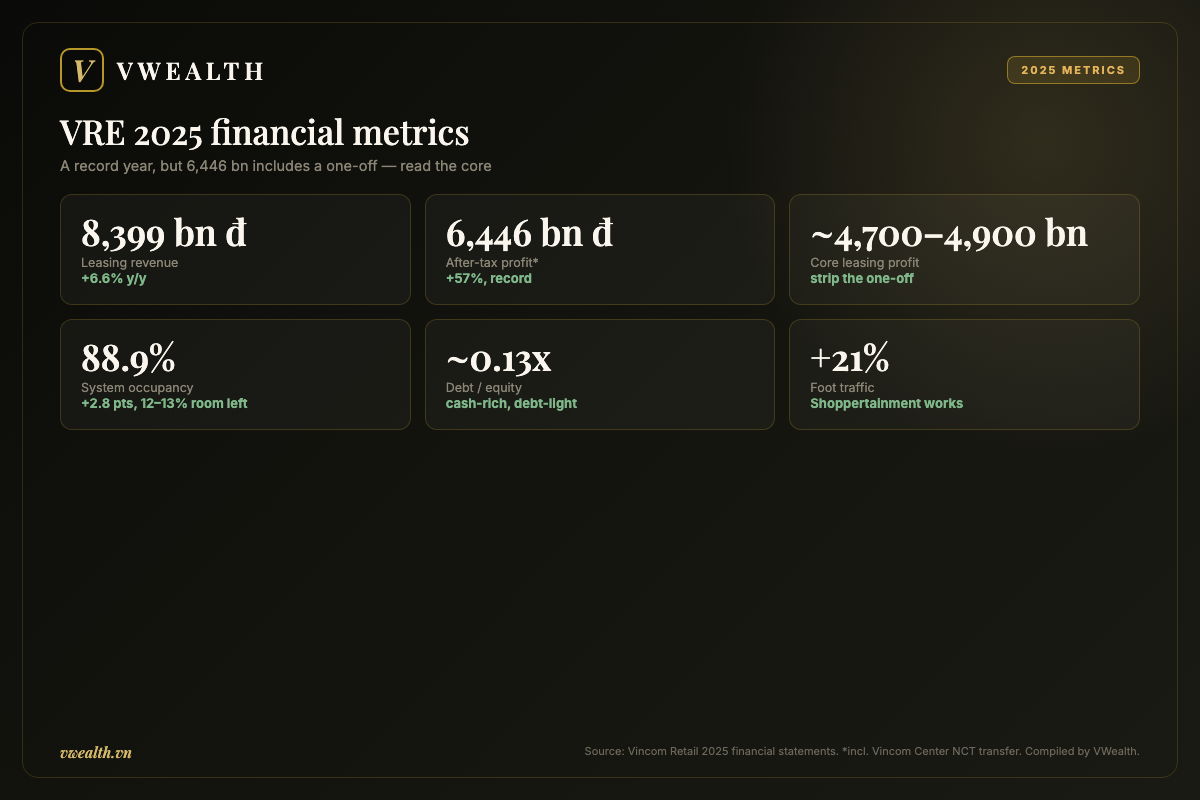
And what was that result? Right in its first independent year (2025), Vincom Retail reported after-tax profit of 6,446 billion dong, up 57% and reaching 137% of the annual plan — the highest profit in the company’s history. Leasing and related-service revenue reached 8,399 billion dong (up 6.6%), foot traffic rose 21%, and the company opened 3 new malls (Vincom Mega Mall Ocean City, Vincom Mega Mall Royal Island, Vincom Plaza Vinh) with about 120,000 m² of added floor space, lifting coverage to 90 malls. This is an emphatic affirmation that the “child” has fully matured and did not wobble on leaving the parent’s arms.
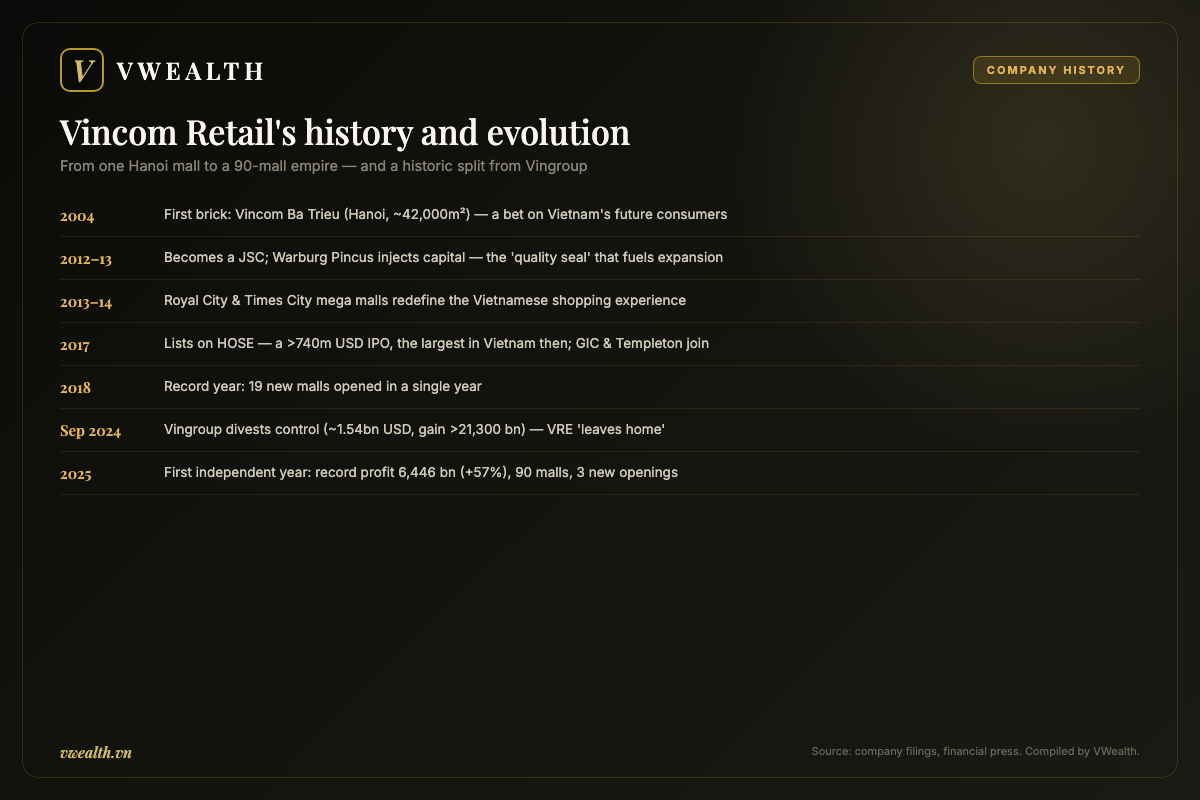
Looking back over the whole journey, you’ll see Vincom Retail passed through four clear chapters: the founding chapter with the Vincom Ba Trieu brick in 2004; the explosion chapter thanks to Warburg Pincus capital and the four-model strategy blanketing the country; the listing chapter with the record 2017 IPO putting the company on HOSE; and the independence chapter opened by the 2024 Vingroup divestment, crystallized in the record 2025 profit. A business that has proven excellent operating capacity across many economic cycles and through an ownership change — that’s a solid foundation to dig into the next question.
But however solid the foundation, it still depends on the people at the helm. For a company that has just changed its controlling shareholder, the question “who is really running Vincom Retail, and where are they steering this ship?” becomes more important than ever. Let’s examine Vincom Retail’s leadership closely in the next section.
Leadership and ownership structure post-divestment
If you’re used to the image of Vincom Retail as a “beloved child” tucked safely in parent Vingroup’s arms, then from Q3 2024 you need to seriously update this ownership picture. This is perhaps the biggest shareholder-structure shift in VRE’s listing history, and it fundamentally changes how you should read the business: from an absolutely controlled subsidiary, VRE moves into a state of “both more legally independent and tightly symbiotic in business” with the Vingroup ecosystem. Grasping this dual nuance is the key to valuing VRE correctly — neither exaggerating the “orphan” risk nor naively believing everything stays exactly as before.
The historic divestment: Vingroup is no longer the parent
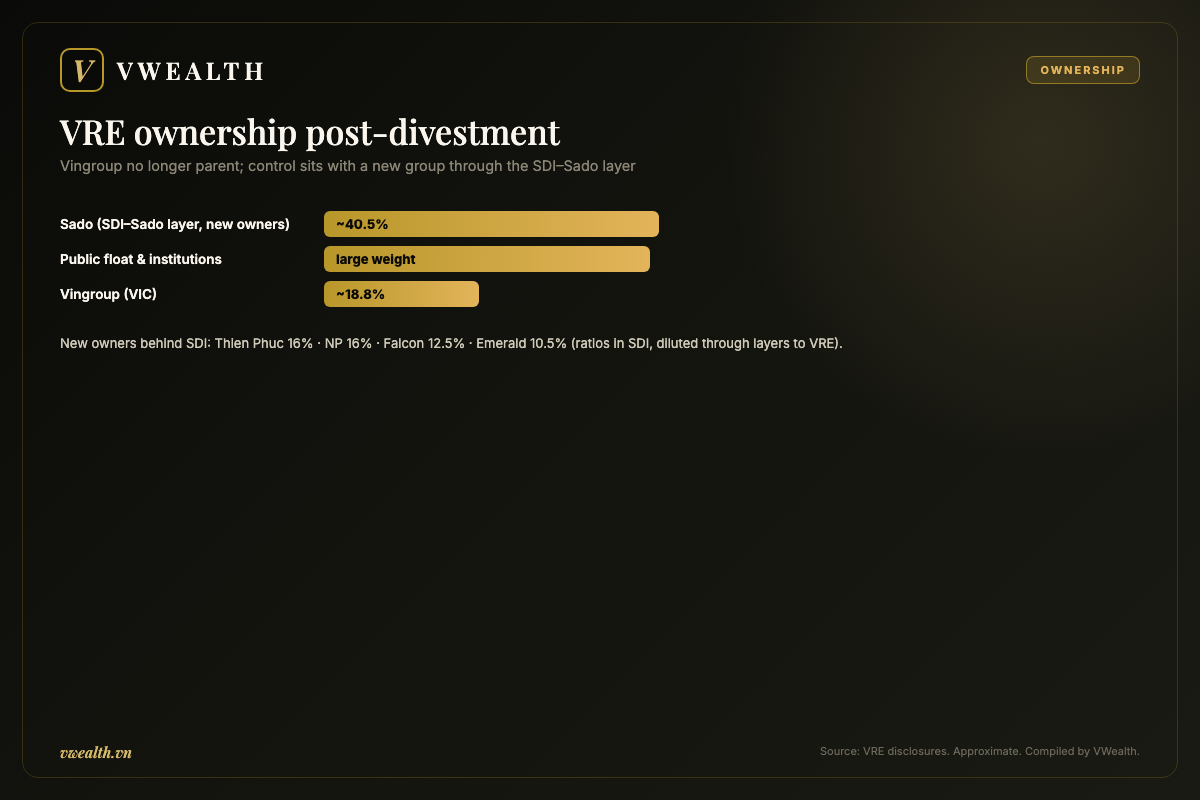
On 18 March 2024, Vingroup and a member company signed an agreement to sell up to 100% of the charter capital of SDI — the unit holding over 99% of Sado Trading JSC. The crux you need to grasp: it’s Sado that is Vincom Retail’s largest shareholder, holding about 943.2 million VRE shares, equal to 40.5% of charter capital and 41.51% of voting rights. In other words, Vingroup didn’t sell individual VRE shares on the exchange, but “divested” by releasing the whole intermediate SDI–Sado ownership layer. This is a way to transfer control of a large share block without creating a supply shock on the listed market.
By the end of Q3 2024, Vingroup completed the entire transaction and took in about 39,100 billion dong. At the parent-group level, Vingroup (ticker VIC) booked a very large financial gain — per financial-press sources, the group received the equivalent of about 1.54 billion USD and recorded tens of thousands of billions in gains from the deal. For an investor reading the report, that number says two things: first, Vingroup “took profit” on a matured asset to reallocate resources toward higher-growth areas (electric vehicles, large-scale residential real estate); second, the valuation the buyers accepted for this retail-asset block is not small at all, implying faith in VRE’s stable leasing cash flow.
The most important legal consequence: from the completion date, Vingroup is no longer Vincom Retail’s parent. VRE is no longer consolidated into VIC’s financial statements as a subsidiary. On the real-estate sector’s market-cap rankings, VRE is henceforth seen as an independent standalone entity — and you’ll see this reflected right in how securities firms reclassify the stock.
Who are the major shareholders now? Read the transferees cautiously
This is the part you need to be most careful with, because post-divestment, information about VRE’s “true new owners” is not at all as transparent as a business with a publicly declared strategic shareholder. Per disclosures, the SDI block Vingroup sold was transferred to four companies: Thien Phuc (16% of SDI), Falcon (12.5%), Emerald (10.5%) and NP (16%). Note a technical detail: these ratios are ownership in SDI — the intermediate layer — not the direct ratio at VRE. Because SDI indirectly holds controlling ownership at Sado, and Sado is the direct ~40.5% shareholder of VRE, the actual power of these four companies at VRE is “diluted” through many layers of legal entities.
As a veteran analyst, I advise you to read this list with a clear head. The four names Thien Phuc, Falcon, Emerald, NP are all little-known entities, and the nature of their relationships with one another and with the Vingroup ecosystem has not been fully disclosed. This creates a “gray zone” in governance: you cannot yet be sure whether the new owner group are fully independent investors, or still parties closely tied to the Vingroup system or friendly partners. In investment analysis, the lack of transparency about “who’s really at the helm” is itself a risk factor to note — not to panic, but so you watch governance reports, related-party transactions and management changes closely in the coming periods.
Alongside the new owner group, one key piece of information gives some reassurance: Vingroup (VIC) still retains about 18.82% of voting rights at VRE after the transaction, remaining the second-largest shareholder. That is, the old parent hasn’t pulled out entirely. A near-19% stake is large enough for Vingroup to maintain a significant voice in VRE’s big decisions, while also showing the group still has economic interest tied to the prosperity of this mall chain. For you, this is a reassuring signal: Vingroup hasn’t “abandoned” VRE, but shifted from controlling owner to major shareholder and strategic partner.
With the current ownership structure — Sado ~40.5%, Vingroup ~18.8%, the rest institutional and public investors — VRE’s free float is in practice still heavily influenced by the two key shareholder groups behind Sado and VIC. You shouldn’t confuse “breaking away from the parent” with “widely dispersed ownership.”
“Both independent and symbiotic”: the vital relationship with the Vingroup ecosystem
This is the central thesis you must engrave in memory when valuing VRE post-divestment. Legally, VRE is more independent: no longer consolidated, with its own management and board, responsible for its own results. But in business, VRE remains deeply symbiotic with Vingroup — and this symbiosis is both a precious asset and a binding tie.
Look at the on-the-ground model. Most Vincom malls — especially the Vincom Mega Mall line and many Vincom Plazas — are placed inside or adjacent to Vinhomes megatownships developed by Vingroup: Vinhomes Ocean Park, Vinhomes Grand Park, Vinhomes Smart City… This relationship gives VRE two advantages few retail chains in Vietnam have. First, a natural customer source: hundreds of thousands of megatownship residents are a “captive” customer base walking over to shop, helping malls fill their tenant space and maintain stable traffic from opening day. Second, a project pipeline: tying to Vinhomes land gives VRE a “pipeline” of future retail space, synchronized with the pace of new-township launches.
To preserve this continuity after divestment, Vingroup signed a management contract with Vincom Retail to maintain the organization model, operations and tenant rights at the malls as previously committed. At the same time, VRE’s leadership affirmed it would not rebrand — the chain still carries the “Vincom” name. For you, this means that although ownership has changed hands, the “soul” of the brand and the ecosystem advantage are fundamentally preserved.
However, a clear-headed analyst must also point out the other side of the medal. That symbiosis means VRE’s long-term growth fate still depends significantly on the pace and scale of Vinhomes/Vingroup’s megatownship development. If Vingroup slows or narrows its large-scale residential projects, VRE’s retail-project “pipeline” is affected in a chain reaction. Moreover, related-party transactions — land leases, joint project development, management contracts within the Vingroup system — require you to watch financial-statement notes closely to ensure terms are executed on a market basis, fair to minority shareholders.
Leadership: a professional retail-operations team
You’ll see a clear positive in the quality of the executive team — traditionally one of VRE’s strengths. Heading the Board is Ms. Tran Mai Hoa, appointed Chairwoman of Vincom Retail, effective 23 April 2024. Ms. Hoa, born 1974, holds an accounting degree (National Economics University) and a foreign-language background, joined Vincom Retail in 2014 and rose from project management — that is, a “commander” who grew up in the very trade of mall operations, not an outsider. The press often refers to her as the person behind managing the chain of over 80 Vincom malls nationwide.
At the executive level, the CEO seat went through some turbulence in 2023–2024 — a detail you should note as a sign of the transition period. Ms. Tran Mai Hoa once concurrently held the CEO role, but on 22 April 2024, the Board relieved her of the CEO title (so she could focus on the Chair role) and appointed Ms. Pham Thi Thu Hien as replacement CEO. Ms. Hien, born 1977, holds a finance-banking degree (Banking Academy), an MBA, has over 20 years of experience and is especially versed in retail real estate. She joined VRE in 2014, rising from Sales Director in charge of chain, large and international tenants, then Deputy CEO for Sales and Marketing.
The takeaway I want you to draw: both the Chair and the CEO are people who have stuck with VRE for a decade, grown up in leasing and retail-operations expertise. This continuity in senior leadership is a very important stabilizing factor amid the ownership change — it reassures tenants, partners and investors that the “engine” of the business is intact even though “the car’s owner” has changed.
The debated dividend issue: 6 straight years without cash dividends
No topic at VRE’s AGMs has sparked such persistent debate as the dividend story. For many years, Vincom Retail steadfastly retained all profit, not paying cash dividends to shareholders — a streak so long that at the 2025 AGM, the company entered its 6th straight year without a dividend. The last time VRE paid a cash dividend was for fiscal 2018 (a 10.5% rate), meaning the actual gap is even longer if counting to the resumption point.
The reason was frankly explained by Chairwoman Tran Mai Hoa at the meeting. According to her, the company faces a big opportunity to increase its land-bank value, so the Board decided to retain all profit to invest in expanding the asset portfolio, raising asset value and preparing for revaluation under new accounting standards. In investment language: leadership chose to use retained earnings as internal capital to buy/develop more retail land and open new malls, rather than pay cash out.
“The company faces a big opportunity to increase its land-bank value. Therefore, the Board decided to retain all profit to invest in expanding the asset portfolio, raising asset value and preparing for revaluation under new accounting standards.” — Ms. Tran Mai Hoa, Chairwoman of Vincom Retail (2025 AGM)
You should weigh this policy from two opposing viewpoints, because both have merit:
The positive angle — accumulating capital for growth. For a business in a land-bank expansion and mall-chain growth phase, retaining profit lets VRE self-fund growth without borrowing heavily or diluting shares through new issuance. If each dong of retained profit generates new assets with a return above the cost of capital, then in theory enterprise value — and thereby your share price — grows faster than in a scenario of paying cash then borrowing to invest. This is the “reinvest and compound” logic many growth stocks pursue.
The negative angle — shareholders receive no cash. The downside is that after 6 years, investors who hold VRE expecting a steady income stream (like a leasing-real-estate bond-like asset) have received not a single dong of cash dividend. All profit sits only “on paper” as assets and retained earnings, forcing shareholders to trust absolutely in leadership’s capital-allocation ability and to realize profit by selling shares. For funds that need cash flow, or small shareholders who favor income, this is a real minus — and the reason this topic stays hot at every AGM.
What’s notable — and a signal you should register — is that this policy has shown signs of softening very recently. In 2026, VRE unexpectedly reversed its 2025 profit-distribution plan: from retaining all profit to paying a 10% cash dividend, totaling about over 2,272 billion dong, expected in Q3 2026 — marking the first cash dividend since 2018. The stated reason is that the company is “cash-rich” because some projects adjusted their schedules versus the original plan, so it distributes the surplus to shareholders. Leadership also affirmed the future direction is a reasonable balance between retaining profit to reinvest and ensuring an appropriate payout. For you, this event carries two messages: first, VRE has the ability and willingness to share cash when resources are abundant; second — and to read cautiously — “cash-rich because projects slipped” also quietly signals that the expansion pace may not be as fast as originally hoped, a variable you should watch in the growth-analysis sections ahead.
Wrapping up: governance, related-party transactions and the bridge to the business model
To summarize this section, the leadership and ownership picture of VRE post-divestment gives you a business in a delicate balance: a professional, long-tenured executive team led by Ms. Tran Mai Hoa (Chair) and Ms. Pham Thi Thu Hien (CEO); an ownership structure that has broken away from parent Vingroup but still has VIC holding ~18.8% and a new owner group through the SDI–Sado layer whose transparency still needs time to verify. The governance factor you most need to monitor is transactions with the Vingroup system — land leases, joint project development in Vinhomes megatownships, and operating-management contracts — because these are both a lifeline (customers and projects) and a zone of potential conflict of interest if transparency is lacking.
It’s precisely that “both independent and symbiotic” relationship that leads us to the next core question: how does the Vincom mall system actually operate and make money? How does land tied to Vinhomes megatownships create leasing cash flow, and how sustainable is that model? That’s what you’ll dissect with me in the “Mall system and business model” section next.
Mall system and business model
Before you decide to put money into VRE stock, there’s a question to answer very clearly: what does Vincom Retail actually sell to survive? Many newcomers assume this is a “retail company” because the name has “Retail” in it. That’s the first and biggest misunderstanding. Vincom Retail sells almost no goods to the end consumer. They don’t sell clothes, coffee or movie tickets. What they sell is space. And they sell it over and over, month after month, to thousands of brands renting spots in their malls. In short, Vincom Retail is a “landlord baron” — the owner of prime space collecting rent from anyone who needs a place to do business.
Once you grasp this, every figure in VRE’s financial statements becomes naturally easy to read. This section explains in detail how that “rent-collecting” model works, why the margins are unbelievably high, how the 90-mall system is organized into “lines,” and where the real “moat” protecting this business from rivals lies.
The business model: a “disguised REIT” with rent-steady cash flow
The easiest way to picture Vincom Retail is to see them as a leasing real-estate trust — a REIT (Real Estate Investment Trust). Imagine a wealthy person spending money to build a whole large street-front building, then dividing it into hundreds of small kiosks, then leasing each to a brand. That person doesn’t need to sell goods. They just need to own the asset and collect rent. Vincom Retail does exactly that, but at nationwide scale with over 1.91 million square meters of retail floor.
The process is very simple and repetitive:
- Step 1 – Build or own the mall. Vincom Retail uses capital (and the land-bank advantage of the Vingroup ecosystem) to build large malls in prime locations.
- Step 2 – Subdivide and lease. Each mall is divided into hundreds of stores, leased to retail brands: fashion (Uniqlo, Zara, domestic labels), food and beverage (F&B), cinemas (CGV, Lotte, Beta), supermarkets (WinMart), children’s play zones, bookstores, phone shops…
- Step 3 – Collect rent steadily. Each month, every brand pays rent plus operating service fees (electricity, security, cleaning, shared marketing). This is the core revenue source.
This structure creates three financial traits investors must remember. First, cash flow is very stable. Lease contracts usually run many years, with periodic rent-increase clauses. Revenue doesn’t dance by season like a retailer’s; it flows steadily like “ground rent” from farmland — you own the land, others farm it, you take your share. Second, margins are very high. Once the building is finished, the marginal cost of maintaining leasing is relatively low versus the rent collected. Rent flows almost straight to profit. Third, profit has “operating leverage” — when occupancy rises a few percent, that added revenue is nearly all net profit because fixed costs don’t change.
Remember this principle reading VRE: their revenue doesn’t come from selling goods to shoppers, but from leasing space for others to sell goods. Whether crowds are big or thin matters, but it matters because it decides whether tenants will pay high rent and renew contracts — not because VRE takes a cut on each item sold.
The 2025 figures illustrate this clearly. Leasing and related-service revenue reached 8,399 billion dong, up 6.6% year on year. But full-year after-tax profit hit 6,446 billion dong, up over 57% — the highest since listing. Note the gap: leasing revenue nudged up only 6.6%, but profit exploded 57%. That’s the essence of a high-margin, fixed-cost, low-working-capital model — once assets run stably, most added revenue turns into profit.
Four mall lines: one formula, four customer segments
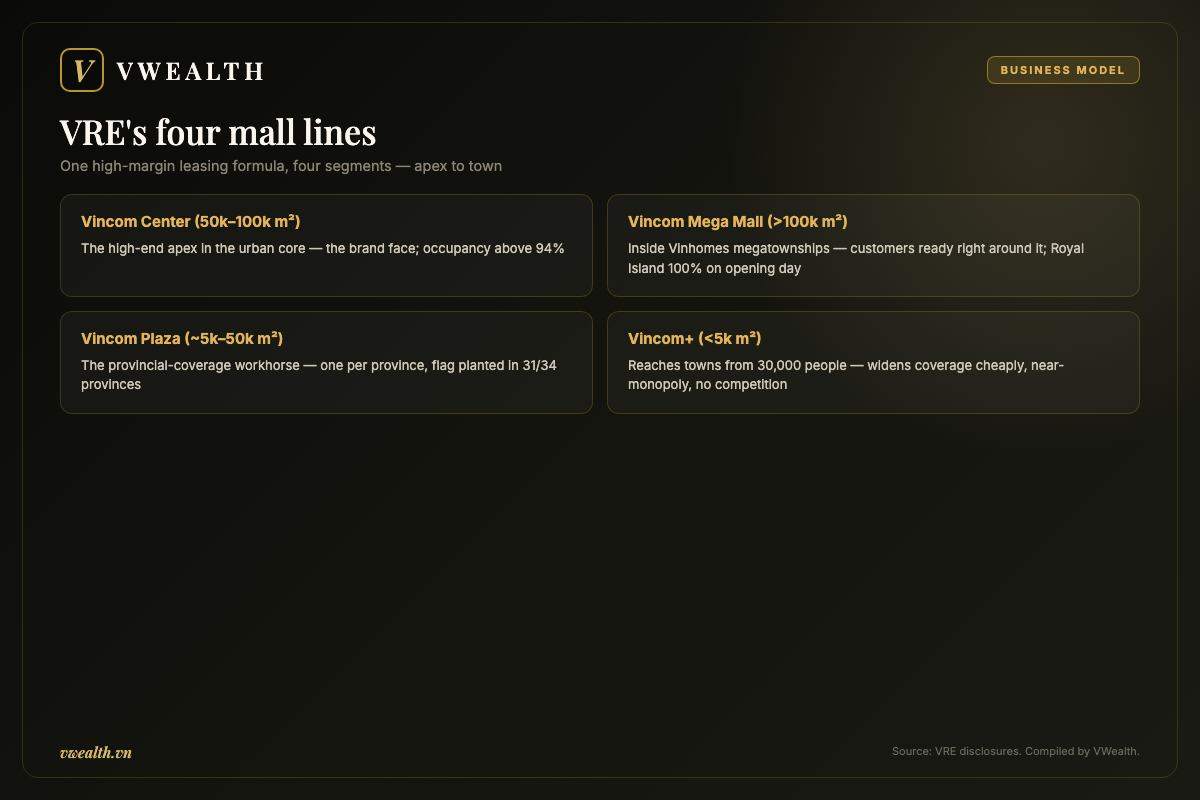
To cover 90 malls across 31/34 provinces, Vincom Retail doesn’t use a single template. They split the portfolio into four product “lines,” each aimed at a different terrain and a different customer type. Understand these four lines and you’ll understand why VRE is present both in glamorous central Saigon and in small provincial towns.
Vincom Center – the high-end apex in the urban core
This is the “flagship” line — the grandest malls, placed in the core of big cities (like Vincom Center Ba Trieu, Dong Khoi, Landmark 81). Target customers are the upper-middle class and above, who favor international brands and are willing to pay for premium experience. Vincom Center gathers luxury fashion and cosmetics labels and high-end F&B. This line’s strategic role isn’t just revenue but the brand face — positioning “Vincom” in the consumer’s mind as the standard of modern shopping, thereby lifting value for the lower lines too. The occupancy of Vincom Center and Mega Mall in 2025 held above 94%, showing very firm demand in the top segment.
Vincom Mega Mall – the “superstore” inside Vinhomes megatownships
This is the line Vincom Retail is pouring the most effort into developing, and also where the deepest competitive advantage lies — one you need to understand well. Vincom Mega Malls are giant complexes placed inside Vinhomes megatownships — like Ocean Park, Grand Park, Royal Island (Vu Yen). The core difference: an ordinary mall must “pull” customers from outside; a Mega Mall has customers already right around it — the tens of thousands of residents of that very township. This is what I’ll analyze deeper in the “megatownship advantage” section below.
The strength of this line shows clearly in three malls newly opened in 2025: Vincom Mega Ocean City, Vincom Mega Mall Royal Island and Vincom Plaza Vinh, adding nearly 120,000 m² of retail floor. Notably, the opening-day occupancy of Mega Mall Royal Island (Vu Yen) hit 100%, while Ocean City reached 95–96%. A mall opening nearly full on its first day is rare in the industry — it shows tenants trust the customer volume the megatownship brings.
Vincom Plaza – the provincial-coverage workhorse
If Vincom Center is the apex, Vincom Plaza is the widest body of the pyramid. This is the mid-tier mall line, placed in second- and third-tier provinces and cities nationwide. Moderate scale (Vincom Plaza Vinh, or the planned Vincom Plaza Dan Phuong at about 25,000 m²), with a pragmatic tenant mix: supermarket, mass fashion, cinema, children’s play zone, mass-market F&B. The Plaza line is precisely the tool that lets VRE plant its flag in 31/34 provinces — one Vincom Plaza per province makes brand coverage nearly overwhelming, and for provincial consumers, “going to Vincom” becomes synonymous with “going to the mall.”
Vincom+ – reaching towns and peri-urban areas
Vincom+ is the most compact line, weaving into towns, district seats and lower-density areas — where a large mall isn’t yet viable customer-wise. Vincom+ is usually anchored by a supermarket as the “puller” plus some service and play stores of moderate scale. This line’s role is to widen coverage at low cost, while “getting acquainted” with markets in urbanizing areas — so that when the area matures, VRE already has a foothold. Recently Vincom Retail has also piloted a “commercial street” model, Vincom Collection, to broaden its approach, but the four lines above remain the portfolio’s backbone.
The table below summarizes the four lines’ roles and the key operating metrics for you to watch the health of this leasing machine.
Three operating metrics you must watch every quarter
Since this is a leasing model, don’t just look at revenue and profit. There are three operating metrics that decide whether this machine is still healthy or tiring, and they usually foretell the financial results a few quarters ahead.
- Occupancy rate. This is the vital metric. A mall at 95% occupancy and one at 80% have nearly the same fixed costs, but the latter “leaks” profit terribly. In 2025, VRE’s system-wide occupancy rose to 88.9%, up 2.8 percentage points year on year — and leadership said clearly there’s still 12–13% room to fill, meaning still room to grow revenue without building anything new. When you read the quarterly report, look at this number first.
- Rent per square meter. High occupancy isn’t enough; you must see how much VRE collects per floor meter. The ability to raise rent on renewal (especially at “hot” malls above 94% occupancy) is precisely the natural, capital-free growth engine. A mall that’s already full yet still raises rent is a sign of very good pricing power.
- Foot traffic. This is the “upstream” metric. Big crowds mean tenants sell more, tenants who sell more will pay higher rent and renew contracts. To keep traffic, VRE pushes the “Shoppertainment” model — combining shopping with entertainment: cinemas, play zones, events, F&B, experience spaces. This is the strategic weapon against e-commerce, which we discuss right below.
“Shoppertainment” – the shield against e-commerce
The question every retail-real-estate investor must ask: As people shop online more and more, who still goes to malls? Is VRE’s leasing model being eroded?
Vincom Retail’s answer is to shift the mall from “a place to buy things” to “a place to go out.” You can order a shirt on your phone, but you can’t order online a family movie outing, a hotpot with friends, an afternoon of the kids in the play zone, a weekend strolling through an events space. Those experiences must be physically present. That’s why the share of F&B, entertainment and experience in Vincom malls’ tenant mix keeps growing, while the share of easily-onlined categories (like pure electronics) shrinks. The Shoppertainment model turns the mall into a weekend destination for families — and a family that comes to watch a movie will eat, stroll, shop, generating revenue for a host of other tenants. That’s the mechanism that retains customers, retains tenants, and thereby holds leasing cash flow steady.
The megatownship advantage: VRE’s deepest moat
Now back to the most important point promised above — also what makes Vincom Retail fundamentally different from any other mall owner in Vietnam: the symbiotic position inside the Vingroup ecosystem.
Compare two situations. An independent retail-real-estate developer wanting to build a mall must: (1) go find and buy land in a good location at a high price, (2) build it and then pray customers will find their way there. The big risk lies in “will there be customers” — a mall with thin traffic loses tenants, occupancy drops, losses mount.
Vincom Retail is different. Many of their Mega Malls are placed right inside Vinhomes megatownships — Ocean Park, Grand Park, Royal Island, Global Gate. That means:
- Land readily available from the Vingroup ecosystem — no need to gather scattered plots on the open market at high prices with complex procedures.
- Customers readily available — when a Vinhomes megatownship fills with tens of thousands of residents, the mall inside naturally has a base of walk-in customers, every single day. Tenants don’t have to gamble on “will there be customers” — they see the residents right in front of them. That’s why Mega Mall Royal Island filled 100% on opening day.
- Whole-ecosystem resonance — Vinhomes residents, WinMart supermarkets, schools, Vingroup services… all form a closed loop where the Vincom mall is the consumption gathering point.
Vincom Retail’s “economic moat” isn’t a single thing, but the sum of three layers: the high-margin leasing model generating thick cash flow; the overwhelming coverage of 90 malls across 31/34 provinces, making it hard for rivals to squeeze in at national scale; and the symbiotic position inside Vinhomes megatownships bringing cheap land plus ready customers. These three layers stack up to create an advantage a new player almost cannot replicate within a few years.
Where does growth come from in the coming years?
A good model still needs a growth engine to make the stock attractive. For VRE, you should picture three clear growth sources, from easiest to most ambitious:
- Filling the remaining vacancy. This is the most “free” growth — the system still has 12–13% occupancy room. Each added percentage point flows almost straight to profit because fixed costs don’t change.
- Raising rent. At full, popular malls, each renewal cycle is a chance to raise rent. This is an internal growth engine requiring no new capital.
- Opening new malls on existing land. Vincom Retail targets exceeding 100 malls, continuing to track new Vinhomes megatownships (like Global Gate) and expanding the Plaza line in the provinces. Each new mall is a new leasing cash flow added to the portfolio — and thanks to the ecosystem land advantage, the investment rate is usually lower than gathering land oneself.
In sum, what to remember closing this section: Vincom Retail is a space-leasing machine with very high margins and rent-steady cash flow. Four product lines — high-end Vincom Center, Mega Mall inside megatownships, Plaza covering provinces, Vincom+ reaching towns — combine to both hold the top brand position and achieve overwhelming nationwide coverage. The Shoppertainment model makes them relatively immune to the e-commerce wave, while the symbiotic position in the Vinhomes ecosystem brings cheap land and ready customers — forming the deepest moat. Three factors — high-margin leasing, national coverage and the megatownship advantage — add up to a solid business foundation. Next, we’ll examine how that solid foundation is reflected on the balance sheet — that is, VRE’s real position and financial health.
Position and financial health
When you ask “is VRE a healthy business,” you shouldn’t stop at the after-tax profit figure of 6,446 billion dong — though it’s a beautiful record, up 57.4% year on year and beating the plan by 137%. A serious analyst must split that number into two parts: the profit from leasing space — the real “machine” of Vincom Retail — and the profit from non-core items like divestment gains and financial interest on the mountain of cash. Because only by understanding which part is muscle and which is the fat of a special year can you value this stock correctly. This section walks you through exactly that “dissection”: industry position, profit quality, the balance sheet, and the risks you shouldn’t turn a blind eye to.
An almost absolute number-one position in the mall industry
The first and most important point about VRE’s health isn’t on the financial statement, but in market structure. Vincom Retail ended 2025 with 90 malls spanning 31/34 provinces, total retail floor exceeding 1.91 million m². This isn’t a number to show off; it’s a number that redefines the whole industry. In Vietnam, no rival — not even foreign retail groups like Aeon, Lotte or Central Retail — owns coverage and scale close to VRE. They have beautiful, expensive malls, but countable on the fingers and concentrated in a few big cities. VRE is present from central Hanoi and HCMC to provincial towns and cities.
This scale difference creates what investors call an “economic moat.” For VRE, that moat comes from two sources:
- The coverage-and-land-bank moat. A mall is a type of asset where location decides nearly everything. VRE has captured the most prime locations in most provinces, especially those tied to the Vinhomes megatownship ecosystem. A rival wanting to copy this model would have to spend tens of thousands of billions and take a decade to gather an equivalent land bank — and the best locations are already taken.
- The ecosystem-and-negotiating-scale moat. When you’re the largest chain, big retail brands are compelled to be in your system to cover the market. This gives VRE the power to negotiate rents and select quality tenants that a standalone mall could never have.
In 2025, VRE continued opening 3 more malls with about 120,000 m² of new retail floor. Continuing to expand even amid a retail-demand environment that hasn’t truly boomed shows the company is still reinforcing its moat, grabbing more market share while many small rivals must hold back.
Profit quality: which is muscle, which is one-off?
This is the part you need to read most carefully, because it’s where you’re most easily “fooled” by the 57% growth figure.
Start from the core. Leasing revenue and related services in 2025 reached 8,399 billion dong, up 6.6% year on year. This growth is modest, but what matters is its character: this is leasing cash flow — steady, repeating monthly by contract, with very high gross margins (usually above 50% for VRE’s mall segment). This is the true “money printer,” and its positive growth in a weak-demand year, while also carrying added depreciation from newly opened malls, is already a commendable result. Total consolidated net revenue reached 8,837 billion dong, at 92.8% of plan — the shortfall versus plan mainly because the shophouse-sales segment (largely handed over in 2024) no longer contributes as much as before.
Now to the part that makes the profit figure “balloon.” If leasing revenue rose only 6.6% but after-tax profit rose as much as 57.4%, you must ask: where did that enormous gap come from? The answer lies mainly in financial activity:
- Gains from capital-stake transfers. In Q4 2025, VRE booked profit from a share transfer related to Vincom Center Nguyen Chi Thanh, contributing about 1,891 billion dong of profit. This is a non-recurring item — next year there won’t be one.
- Financial-activity revenue surged. Total financial-activity revenue for the year exceeded 2,647 billion dong, about 4.8 times the prior year. Most came from interest on the large cash balance and the divestment gain noted above.
The lesson: if you exclude the gain from the Vincom Center Nguyen Chi Thanh transfer alone, VRE’s “clean” after-tax profit reaches only about 105% of the annual plan — around the 4,700–4,900 billion mark. This figure is still very good, but it paints a much more realistic picture than the striking 6,446 billion.
So where should you look? My advice: take core leasing profit as the true gauge of operating health, and treat that 1,891 billion as a “one-time reward.” When you value VRE for the coming years, don’t multiply the 6,446 billion figure by a P/E and imagine that’s the sustainable profit level — you’ll overvalue. Core profit of ~4,700–4,900 billion is the base for a cautious calculation.
The balance sheet: a “cash-rich, debt-light” business
If the income statement has spots to beware of, VRE’s balance sheet is where you can be most at ease. This is one of the healthiest balance sheets you’ll find among listed Vietnamese real-estate companies.
Read the chart above with the logic of a hard-nosed lender. Total assets reached about 61,279 billion dong, up 11% in the year. More important is the capital structure: equity is nearly 49,975 billion dong, about 82% of total capital. In other words, VRE funds most of its enormous mall asset block with its own money, not with borrowed debt. Total outstanding loans are only about 6,389 billion dong — a very small number versus the scale of equity and assets. The debt-to-equity ratio is about 0.13x, a level most other real-estate businesses can only dream of.
During the year, VRE also proactively cleaned up its debt structure: short-term borrowings dropped sharply from 2,009 billion to only about 20 billion dong after redeeming bonds in August 2025, while long-term borrowings were rearranged to about 6,380 billion. This is a healthy move: pushing repayment pressure further out, reducing short-term liquidity risk. Cash and cash equivalents at year-end were about 4,434 billion dong, and total short-term cash holdings (including deposits) rose nearly 52% to nearly 4,600 billion dong, directly reflecting the abundant cash flow after the divestment.
On return on capital, with 6,446 billion after-tax profit on nearly 49,975 billion equity, the 2025 ROE is about 12.9%. But remember: this number is “pushed up” by the one-off divestment gain. Counting core profit of ~4,800 billion only, ROE actually falls back around 9–10%. This is a point to note — VRE’s ROE isn’t impressively high, partly because of its very “low-debt, high-equity” structure: using low leverage is safe but also dilutes return on capital.
A distinctive trait: a business retaining all profit — “cash awaiting use”
There’s a VRE trait you can’t ignore in assessing financial health: the company has gone 6 straight years without a cash dividend and continues to retain all of its 2025 profit. For many shareholders used to receiving dividends, this is irritating. But analytically, you need to view it neutrally, with two sides.
The positive side: retaining profit over many years, plus the large sum from divestment, turns VRE into a business with a very large “ammunition store” of cash and accumulated capital. This is “cash awaiting use” — the resource to keep expanding the mall system, acquire land in new locations, or pursue M&A when opportunities arise, without depending on borrowing or new share issuance (which would dilute existing shareholders). In an industry where the land bank is the survival factor, “cash awaiting use” is a real strategic advantage.
The side to question: retained cash only truly creates value if reinvested at a return above the cost of capital. If most of that large cash pile merely sits in interest-bearing deposits, then over the long run it drags ROE down and raises the question: why not return some to shareholders to invest themselves? Notably, into 2026, leadership signaled preparation to pay a dividend — a change worth watching, possibly a catalyst for the share price. As an investor, you should track closely whether leadership uses this “ammunition” to expand and create real growth, or lets it sit idle earning financial interest.
The risks you shouldn’t turn a blind eye to
A balanced analysis mustn’t tell only the pretty story. Below are VRE’s real risks you need to weigh:
- Weak retail demand. This is the biggest and most direct risk. VRE’s core revenue depends on retailers’ ability and willingness to pay rent — which in turn depends on consumers’ wallets. If purchasing power stays weak, tenants will press to lower rent, renegotiate terms, even return space, pressuring occupancy and rent — the two drivers of leasing revenue. The leasing-revenue growth of only 6.6% partly reflects a consumer environment that hasn’t truly brightened.
- Competition from e-commerce. The long-term online-shopping trend is a structural threat to the physical-space model. VRE is responding by turning malls into experience destinations — dining, entertainment, services — things e-commerce can’t easily replace. But this is a long race and you need to watch whether the tenant mix successfully shifts toward the “experience” group.
- Dependence on Vinhomes megatownship progress. VRE’s biggest advantage — tying to the Vinhomes ecosystem — is also its point of dependence. Many new malls are placed inside Vinhomes megatownships; if the handover pace and resident occupancy of these projects slow, the traffic and appeal of the corresponding malls slow too. This is a concentration risk you must quantify.
- The “profit illusion” risk. As analyzed, the 6,446 billion figure contains a one-off. If the market values VRE based on the abnormally high 2025 profit, forgetting that 2026 will have no similar divestment gain, then when profit “comes back to earth,” the share price may correct even though the core operation hasn’t worsened.
All told, VRE’s financial-health picture is that of an absolute industry leader by scale, with an extremely solid balance sheet (little debt, much cash, much equity) and sustainable high-margin leasing cash flow — but having a profit year embellished by a one-off divestment gain, and a long-term question about how to use the accumulated cash pile and how to weather weak demand. It’s a solid foundation, but one that requires you to dissect carefully before valuing. And precisely how the market digests those two sides — a solid base but partly “lucky” profit — will shape VRE’s share-price behavior, which we’ll look at next: Market reception.
Market reception
By now, you’ve probably grasped Vincom Retail’s “skeleton”: a business owning Vietnam’s largest mall chain, with steady leasing cash flow and margins among the highest on the exchange. But a good business isn’t necessarily a good stock at every price. The question you need to answer before putting money down isn’t “is VRE a good business” — the answer is almost certainly yes — but “at today’s price of 29,350 dong, is the market pricing VRE expensively or cheaply, and what does that price reflect about the crowd’s expectations?” In this section, you and I will sit down and dissect how the market is “pricing” every dong of profit, every square meter of Vincom Retail’s assets.
Let me tell you one thing straight from the start: VRE is one of the hardest stocks on HOSE to value, not because the data is complex, but because it has three “skins” layered on top of one another. The first is a genuine leasing real-estate business — REIT-like, with stable, discountable cash flow. The second is an ownership story that just changed at its roots after Vingroup’s divestment. The third is a huge one-off profit in 2025 that makes every P/E ratio look “falsely beautiful” at a glance. If you just look at a P/E of 10x and conclude “cheap,” you’ve fallen into exactly the trap I’m about to warn about.
Today’s price and the core valuation numbers
At the close of 19 June 2026, VRE stood at 29,350 dong/share (real data from the VWealth plugin). This isn’t a happy price: in June 2026 alone, the stock fell 5.93%, and over the 52-week range, VRE once touched a peak of 45,200 dong then fell to a bottom around 23,500 dong. That is, from peak to now, the price has evaporated about 35%. A stock once considered a “pillar” of the VN-Index is now trading in the lower half of its one-year range — the first signal that the market is quite cautious, or bluntly, is suspicious of something.
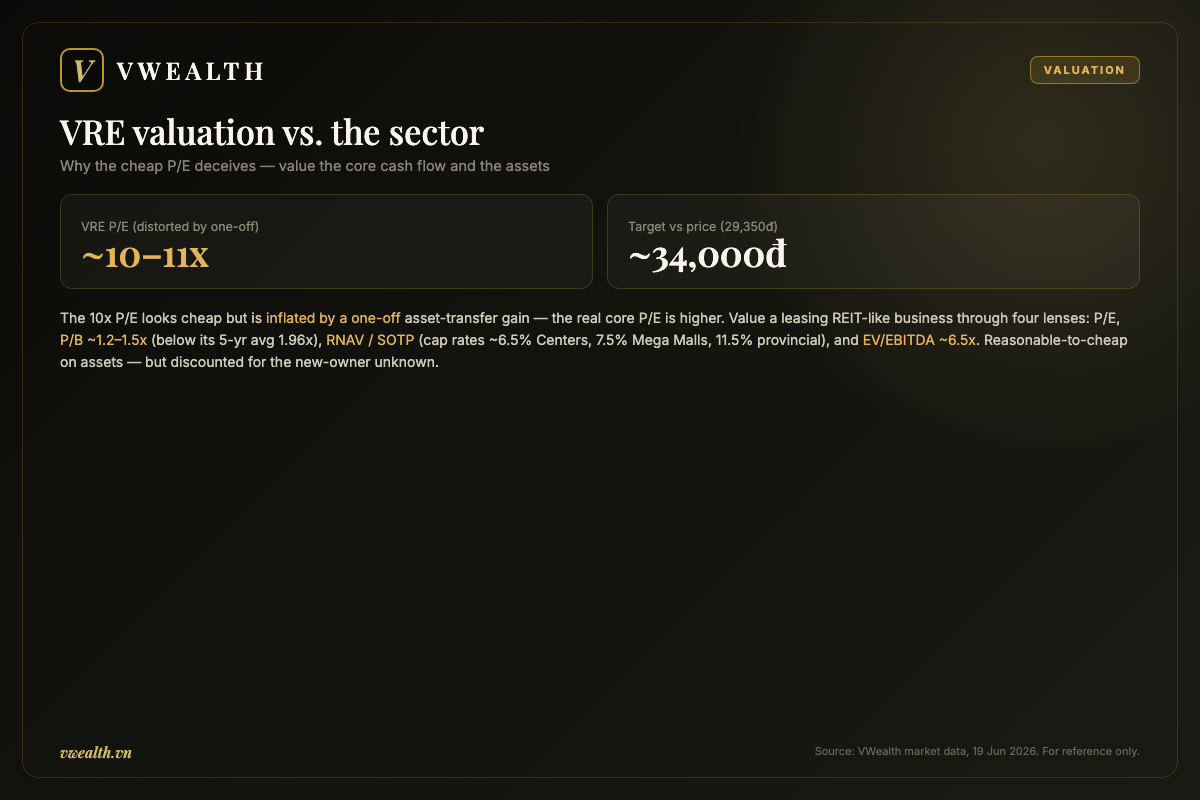
Let’s put the numbers together. Vincom Retail’s 2025 after-tax profit reached 6,446 billion dong — a record, up as much as 57% year on year and beating the plan by 37%. With about 2.27 billion shares outstanding, earnings per share (EPS) fall around 2,800 dong. Set against the price of 29,350 dong, you get a P/E around 10–11x. This matches the market data almost exactly: trailing-12-month sources record VRE’s trailing P/E at 10.1–10.2x. On P/B, large equity means the ratio is only around 1.2–1.56x — clearly below its own 5-year average (about 1.96x) and much below the real-estate sector average (around 2.47x).
If you stop here, the picture looks attractive: an industry leader, high margins, trading at only 10x P/E and P/B under 1.5. But this is exactly where I want you to stop and breathe slowly. Because both these “cheap” numbers have a crack underneath.
Why the “cheap” 10x P/E is a deceptive number
The problem lies in the word “abnormal.” The 6,446 billion profit of 2025 didn’t come entirely from leasing space. A very large part came from an asset-transfer deal — specifically, the transfer of the project/shares related to Vincom Center Nguyen Chi Thanh. In Q4 2025 alone, net profit jumped to 2,650 billion dong, up 145% year on year and 93% versus the prior quarter, mainly thanks to this one-off. In other words, a significant chunk of the record profit is “asset-sale” money, not “monthly rent-ticket-counting” money.
This matters enormously for you in valuation. When the numerator (profit) is inflated by a non-recurring one-off, then the P/E in the denominator will look falsely low. If next year Vincom Retail has no similar asset transfer — and you shouldn’t expect it to recur every year — then profit will fall back to the core level, EPS drops, and the “real” P/E of the core leasing operation will jump well above 10x. This is why I always remind you: with real-estate businesses, never trust a P/E figure without peeling back where the profit came from.
The good news is that the core segment is not at all weak. Excluding the transfer, 2025 core profit still grew about 105% versus 2024 — a very healthy growth figure thanks to high occupancy and a strong leasing recovery. The leasing gross margin improved from about 53.9% to 55.5% thanks to higher occupancy and energy-saving measures. 2025 leasing revenue is estimated around 8,516 billion dong, up 8%. This is VRE’s true “perpetual engine” — and it’s still running well. The only issue is: the glamorous P/E is hiding the truth that most of this year’s profit jump was a one-off.
My advice: with VRE, value by core leasing profit and cash flow, don’t value by the 2025 accounting profit figure. The “real” P/E of the core operation is higher than the 10x you see on the board — but in exchange, that core cash flow is far more stable and durable than one-off profit.
Valuing a leasing-asset business: look through many lenses
Vincom Retail is essentially a “disguised REIT” — it owns and operates leasing real estate to collect steady cash flow. For this type, looking at P/E alone isn’t enough. You need at least four lenses at once, and I’ll explain each so you’re not led by a single number.
- P/E (price-to-earnings): fast, easy to compare, but as said, distorted for VRE in 2025 by the one-off. Use for reference, not for the decision.
- P/B (price-to-book): especially useful for an asset-heavy business like VRE, because most value sits in the malls on the balance sheet. P/B around 1.2–1.5x, below its historical and sector averages, shows the market pricing this asset block quite cautiously. But note: real-estate book value is usually recorded at historical cost, which may be below true market value — so a low P/B is partly an “accounting illusion.”
- RNAV (Revalued Net Asset Value): this is the most “standard” lens for a leasing-real-estate business. Instead of book value, we revalue each mall by its own cash flow and capitalization rate (cap rate). Securities firms valuing VRE usually use the sum-of-the-parts (SOTP) method, applying different cap rates to each asset group — for example, around 6.5% for high-end Vincom Centers, 7.5% for Vincom Mega Malls, and 11.5% for provincial Vincom Plaza/Vincom+. This reflects the “real-estate value” far better than the accounting-profit figure.
- EV/EBITDA (enterprise value to earnings before depreciation): removes the effect of large asset depreciation — very heavy for a real-estate business — so it reflects true cash-generating ability. VRE’s EV/EBITDA is around 6.5–6.6x, a level seen as not at all expensive for a business with strong, steady cash flow.
Putting all four lenses together, the picture is fairly consistent: VRE is valued in the reasonable-to-slightly-cheap zone if judged by assets and cash flow, not expensive at all. Many analysis reports set a one-year target price around 34,000–34,200 dong, implying upside of about 14–16% versus the current price. But “cheap on assets” doesn’t mean “will rise immediately” — and that’s where market psychology takes the stage.
Price behavior: from “pillar stock” to ownership-uncertainty worry
To understand why a reasonably valued stock is sitting in the lower half of its one-year range, you need to trace VRE’s price story through three phases.
Phase one — the “Vingroup darling” era. For many years, VRE was a pillar stock of the VN-Index, moving closely with the Vingroup ecosystem’s story. When investors still saw VRE as a link in the Vingroup empire, the stock enjoyed a “brand premium”: people trusted the project-development capacity, trusted that Vincom spaces would always be filled by the linked retail ecosystem. The price moved on faith in the whole parent group.
Phase two — the 2024 divestment shock. This was the biggest turning point. In 2024, Vingroup divested its entire controlling stake in Vincom Retail through transferring shares in intermediate companies (SDI, Sado), with a total deal value of about 39,100 billion dong, equal to 1.54 billion USD. After the transaction, SDI, Sado and Vincom Retail were no longer Vingroup subsidiaries; the old parent held only about 18.8% of charter capital. The market reacted just as you’d guess: an early-2024 phase where the price surged from January to early February, then a prolonged correction streak. When “the mother” left, the “Vingroup premium” evaporated, replaced by a big question mark over the ownership future.
Phase three — living with the new-owner unknown. To date, VRE’s shareholder structure has changed at its roots. 55% of shares (initial phase) fell into the hands of four new entities — Thien Phuc, Falcon, Emerald and NP — with individuals behind them of quite diverse backgrounds. The problem is: the market still hasn’t truly “read” this new owner group. Which way will they run Vincom Retail? Keep expanding the mall chain, or optimize to extract cash? Pay dividends or not? This is the “new-owner unknown” I place as one of VRE’s two biggest risks — and it’s the direct reason the stock trades at a valuation discount versus its asset quality.
There’s an interesting paradox here you should remember. By business nature, VRE is a defensive stock: leasing cash flow flows like water, little dependence on the home-selling cycle, high margins, stable occupancy. Such a stock should be “sticky” against market swings. But in practice, VRE is quite sentiment-sensitive — because the ownership story isn’t settled, it’s easily sold off whenever the market worries, and easily “forgotten” when money chases stocks with clearer stories. You own a defensive asset in a still-sensitive stock shell.
Zero dividends for six years: a minus you can’t ignore
If you’re an investor seeking steady income, I must say it straight so you don’t waste time: VRE is almost certainly not for you. Vincom Retail’s 2025 dividend yield is 0.00%, payout ratio 0.00% — and this isn’t a one-year thing. The business hasn’t paid a cash dividend for about six straight years.
For a business with strong cash flow and near-46% margins, retaining all profit and paying not a single dong of dividend is a clear strategic choice. Let’s weigh both sides of this choice:
- The minus: For income investors — those who want the stock to “produce” annual cash to spend or reinvest — VRE is a round zero. You receive nothing while waiting for the price to rise. If the price moves sideways for years as it has recently, you bear a real opportunity cost, because the same money in a bank or in high-dividend stocks would still generate cash flow.
- The plus: All profit is retained to reinvest in building and upgrading malls and expanding the leasing land bank. In theory, each retained dong becomes a future cash-generating asset, pushing intrinsic value (and hopefully the share price) higher. This is the “accumulate capital for growth” model rather than “milking the cow” — suited to young, patient investors betting on long-term price appreciation.
But here’s where the “new-owner unknown” resonates with the dividend story and makes it more interesting. When Vingroup was still in charge, retaining profit to expand was easy-to-understand logic. Now with the new shareholder group, the question opens up: will they want to start paying dividends to recover cash on their billion-dollar investment? If so, that would be an unexpected positive catalyst for the share price, because it both generates cash for shareholders and signals that the new owners are confident in the core cash flow. But if they keep the zero-dong policy, income investors should stay out. You see — every road at VRE leads back to the same question mark: what do the new owners want.
Foreigners and liquidity: who’s holding, who’s selling
On liquidity, VRE remains a very busy stock — average matched volume around 11.2 million shares/session. This is an important plus for you: whether buying or selling, you won’t be “stuck,” and this liquidity level is enough for big funds to enter and exit without distorting the price. Compared with many other real-estate stocks on the exchange with anemic liquidity, VRE is among the easiest to trade.
On foreign flows, this is an area you need to watch closely rather than pin down in one sentence. After Vingroup’s divestment, VRE’s ownership shifted mainly to domestic entities (the new four-company group). As a large-cap pillar stock, VRE has long been in the portfolios of many ETFs and foreign funds tracking the VN-Index, so foreign net-buy/sell moves have significant short-term price impact. Amid foreigners generally net-selling on the Vietnamese market recently, pillar stocks like VRE usually face double pressure: pulled by the general foreign outflow, and separately doubted for the ownership story. This helps explain why a “reasonable-to-cheap” stock is still bottom-fishing in the lower half of its year range.
Practical advice: when you watch VRE, put these three things on the same screen — weekly foreign net-buy/sell, any dividend-policy announcement, and any move by the new shareholder group (senior personnel changes, expansion plans, further asset transfers). These three will be catalysts — good or bad — far stronger than a static P/E figure on the board.
Summary: reasonably valued, but what are you paying for?
Putting it all together, I want you to leave this section with a clear positioning line. VRE is a high-margin leasing-asset stock, reasonably valued but with no dividend and a new-owner unknown. Let’s peel each clause:
- “High-margin leasing asset”: the country’s largest mall chain, leasing gross margin around 55%, net margin near 46% — a “money printer” in the true sense, with defensive cash flow.
- “Reasonably valued”: P/E around 10–11x (but remember to strip out the one-off), P/B 1.2–1.5x below its historical average, EV/EBITDA around 6.5x — by all four lenses, this is not an expensive stock. Target prices set by many parties around 34,000 dong, implying upside of about 14–16%.
- “No dividend”: six straight years at zero — removing VRE from income investors’ portfolios, making it a pure bet on price appreciation and intrinsic-value accumulation.
- “New-owner unknown”: the biggest risk, also the biggest catalyst. The direction of the post-divestment shareholder group will decide whether the current valuation discount gets filled or prolonged.
Put simply for easy memory: you’re not buying an expensive stock, and you’re not buying a weak business. You’re buying a good asset block at a reasonable price, in exchange for accepting two soft costs — no dividend cash in hand, and living with a question mark about who’s at the helm. Whether VRE is attractive, ultimately, depends on whether you can bear that uncertainty to wait for the asset value to be recognized again by the market. And to answer “how big is that uncertainty,” we need to place Vincom Retail in its proper arena — the big picture of Vietnam’s leasing-and-retail real-estate industry, where both opportunity and competitive pressure are reshaping the rules of the game.
Economic and retail-mall industry context
To value a retail-real-estate stock like VRE, you can’t just look at the business’s own profit figure. A mall lives or dies by the flow of people through its doors each day, by the purchasing power in the middle class’s wallets, and by how Vietnamese change their shopping habits as e-commerce booms. This section places VRE in that macro picture: a rapidly urbanizing economy, a recovering but uneven consumer market, and an online–offline competition reshaping the entire modern-retail industry.
Purchasing power and domestic consumption: recovering but polarized
The good news first. Vietnam’s total retail sales of goods and consumer-service revenue in the first nine months of 2025 rose about 9.5% year on year, and stripping out the price factor still rose 7.2% — a substantial number, not an inflation illusion. The government targets average retail growth of 11–11.5%/year to 2030. Per-capita GDP touched about 4,293 USD in 2024, and average per-capita retail spending is around 2,488 USD. This is the demand foundation for every mall: Vietnamese have more money to spend, and they spend more on experience rather than just necessities.
But read this number clear-headedly. The consumption recovery after 2023–2024 is real, but it’s uneven across segments. The well-off class in big cities spends freely on dining, entertainment, fashion; while the middle-to-low-income group still tightens its belt, prioritizing low prices and promotions. For VRE, this has two sides: the luxury mall and mega-mall chains in big cities benefit from the high-spending group, but small provincial malls are more sensitive to weak demand. The consumption recovery is a necessary condition for the VRE investment thesis, but it’s a conditional recovery, not a straight line up.
The middle class and urbanization: the long-term structural driver
If short-term purchasing power is a cyclical factor, then the middle class and urbanization are the structural driver — and this is precisely what makes the VRE story attractive long-term. About 56% of Vietnamese households are now in the ABCD income group (income above 15 million dong/month), and this ratio keeps expanding each year. This isn’t an abstract number: it’s the count of families with enough disposable income to bring each other to the mall on weekends, watch movies, eat at restaurants, buy fashion — exactly the customer base VRE’s model serves.
Urbanization amplifies this trend. As people crowd into cities and megatownships, demand for a modern retail “destination” — bundling shopping, dining, entertainment and services under one air-conditioned, parking-equipped, safe and convenient roof — grows exponentially. Traditional markets and street-front shops can’t provide this integrated experience. VRE’s unique advantage lies in this: most of their new malls are embedded straight into Vinhomes megatownships — where there are already tens of thousands to hundreds of thousands of residents as a “ready-captive” customer base. When Vinhomes builds a 230,000-resident township, VRE almost has a ready in-township demand that rivals would spend years of marketing to build.
Here’s the crux to remember: VRE isn’t just a mall operator, but an “urbanization-riding retail” model, with demand partly guaranteed by the Vinhomes ecosystem. That’s both a strength and a dependence.
E-commerce: rival or unexpected friend?
This is the question anyone considering a mall stock must answer frankly: does e-commerce kill the mall? The numbers make many people worried. Vietnam’s e-commerce market in 2025 exceeded 27.7 billion USD, up about 19–25% year on year. Shopee leads with about 56% market share, while TikTok Shop exploded with revenue growth of about 69% and rose to grab about 41% share. The number of TikTok Shop sellers surged 96% in just the first half of 2025. Online is growing much faster than traditional offline retail.
If you stop here, the conclusion would be “malls are over.” But that’s a wrong conclusion — and understanding why it’s wrong is the key to valuing VRE correctly. E-commerce kills the types of retail that can be fully digitized: buying a box of milk, a lipstick, a phone charger — online is always cheaper, faster, more convenient. But there’s one kind of demand online can never replace: experience.
- Food and beverage (F&B): You can’t “ship” a hotpot with friends, a coffee with a nice view, a date at a restaurant. F&B takes an ever-larger share of the mall tenant mix, and this segment is “immune” to Shopee.
- Entertainment: Cinemas, children’s play zones, ice rinks, game centers — this is why families flock to malls on weekends. Online has no cinema.
- Offline “Shoppertainment”: Ironically, the very concept of “entertaining while shopping” that TikTok Shop exploits online is exactly what malls have done well for years in the real world. People come to malls not just to buy, but to “hang out” — and buy along the way.
- Try-and-touch experience: For luxury fashion, cosmetics, furniture, large electronics, customers still want to try directly before spending. Many brands use mall stores as image-building showrooms, even if the order closes online.
Notably, mall occupancy in HCMC still held around 94% in Q1 2025, with leasing demand mainly from F&B, entertainment, household goods and furniture. In other words, right amid the e-commerce storm, quality mall space still isn’t idle. Tenants are shifting their own mix: fewer pure retail stores, more F&B and experience. The “Life-Design Mall” and mega-mall model VRE pursues is precisely a bet on this trend — turning the mall from “a place to buy” into “a place to live and experience.” This is VRE’s strategic defense line against e-commerce, and so far it’s holding.
Modern retail-space supply: still plenty of room
Another factor investors often overlook: Vietnam is still short of modern retail space, not oversupplied. Vietnam’s per-capita modern retail area is still notably low versus regional peers like Thailand, Malaysia or Singapore. In HCMC, total retail area is only about 1.6 million m² (Q1 2025), with new supply growing very slowly, about 1% versus the prior quarter. This scarcity creates two positive consequences for quality mall owners: high occupancy and the ability to raise rents.
This is why a string of foreign “big players” like Aeon Mall, Central Retail, Lotte still aggressively expand in Vietnam — they see room, not saturation. The gap between Vietnam’s modern-retail penetration and that of more developed regional countries is precisely the long-term growth “runway” for the whole industry, and VRE — with the widest coverage — is the biggest beneficiary if that gap gets filled.
Industry risks you shouldn’t turn a blind eye to
The picture isn’t all rosy. There are two real industry risks you need to weigh:
- Prolonged weak demand: If the economy slows and household incomes erode, consumers will cut experience spending first — eating out less, watching fewer movies. Then F&B and entertainment tenants struggle, directly hitting mall revenue and the ability to raise rent. This is the clearest cyclical risk for VRE.
- Saturation in big cities: In central cities, mall density is quite high and competition among developers is increasingly fierce. The easiest growth room now lies in provinces and new megatownships — where purchasing power is lower and occupancy risk is higher. VRE must go farther, open in harder places, to sustain its expansion pace.
To summarize the context: Vietnam’s mall industry stands on a solid structural demand foundation (middle class + urbanization), is protected from e-commerce by the experience factor, and still has plenty of supply room. But it must face polarized purchasing power and urban-saturation pressure. VRE is the strongest player in this industry — the remaining question is how it will leverage that position in the coming years.
Trend prediction
After dissecting the business and the industry context, now you need a framework to project the future. No one predicts the exact share price, but you can fully map out scenarios based on the company’s strategy and the deciding variables. This section sketches VRE’s roadmap and three plausible scenarios — for you to weigh the probabilities by your own appetite.
VRE’s strategy in the coming years
VRE’s leadership has set a clear ambition: from 90 malls with about 1.9 million m² of floor now, expand to about 110 malls with total floor of about 3.5 million m². This is nearly a target to almost double the leasing area. To understand where this stock is headed, you need to grasp four strategic pillars:
- Expanding within Vinhomes megatownships + pushing into provinces: VRE’s main expansion axis is embedding malls in new Vinhomes megatownships (Wonder City, Green Paradise Can Gio, Global Gate Ha Long…), where residents are ready as a customer base. In parallel, VRE keeps covering the provinces to seize the “crown” before rivals can set foot.
- Raising rent: With high occupancy and scarce supply, VRE has room to raise rent at central malls and popular mega malls. This is a revenue growth engine that needs “no more m² built” — that is, high margin.
- Using accumulated cash to acquire land / M&A: VRE’s balance sheet is very healthy, cash abundant. The company can use these resources to gather retail land in prime locations, or pursue M&A to accelerate coverage — an advantage thinner-capital rivals can hardly match.
- Potential dividend resumption: After years of retaining all profit to reinvest in expansion, when the big investment machine gradually completes and leasing cash flow stabilizes, VRE fully has room to resume cash dividends in the future. This is a “hidden option” in the investment story the market may not have fully priced.
The core point: VRE is in a “growth-by-reinvestment” phase. They sacrifice short-term dividends to bet on doubling scale. The stock’s future depends almost entirely on whether this expansion gamble is profitable — and on how the new post-Vingroup owners run that gamble.
Three scenarios for VRE
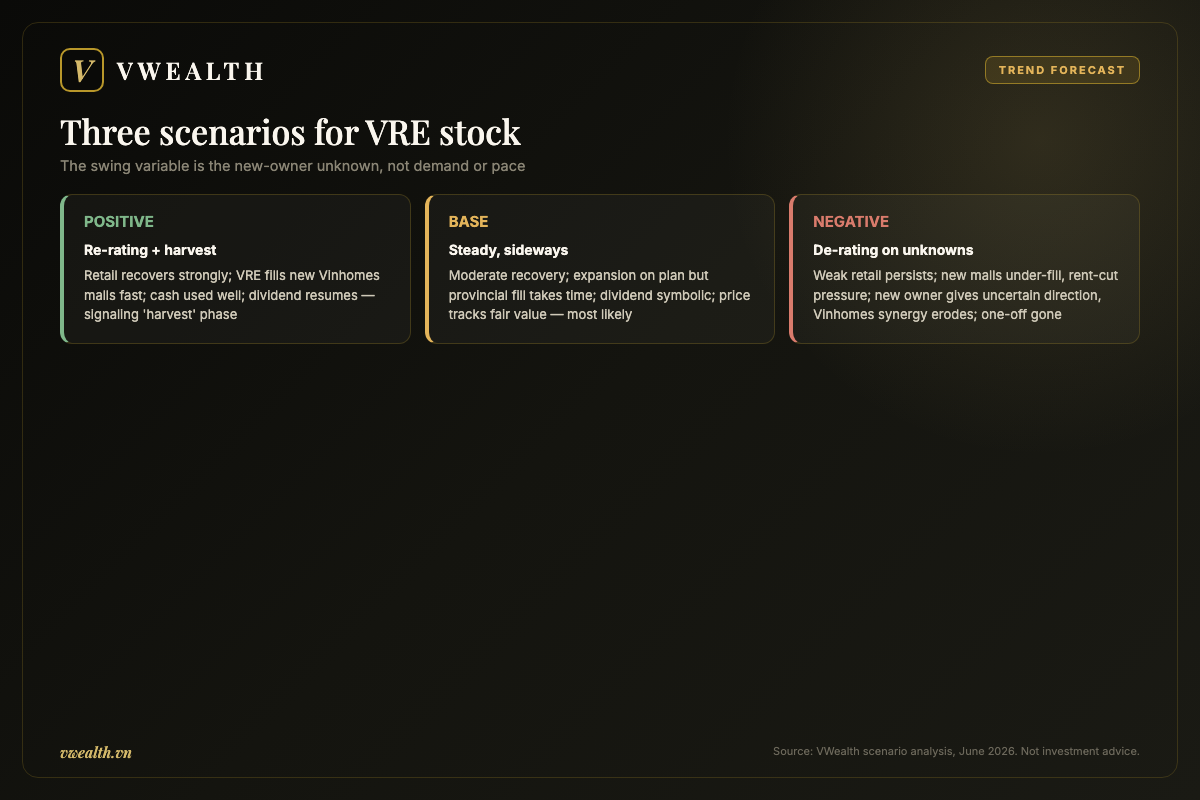
Positive scenario
Conditions: Retail demand recovers strongly and durably thanks to an expanding middle class; VRE expands quickly on schedule, filling new malls in Vinhomes megatownships well; the new leadership uses cash efficiently (acquiring good land, M&A at the right price); and importantly — VRE resumes cash dividends, signaling that the “burn cash to expand” phase has shifted to the “harvest” phase.
Price consequence: In this scenario, core profit grows durably in double digits, leasing cash flow widens with floor area, and the dividend helps attract more institutional and income-fund money. The P/E valuation may be re-rated by the market above the current 10–11x, lifting the share price notably. This is the “gem revealed” scenario.
Base scenario
Conditions: Demand recovers moderately, neither too hot nor recessionary; VRE expands on plan but occupancy at provincial and new-urban malls takes time; cash is used mainly for reinvestment, with dividends not yet resumed or only symbolic; the new leadership maintains the old direction without creating a breakthrough jolt.
Price consequence: Core profit grows steadily, leasing cash flow rises with m² but is diluted by expansion costs. The stock trades around the current reasonable-valuation zone, swinging with general market flows and sentiment about the “new-owner unknown.” This is the most likely scenario if everything unfolds “by the book.”
Negative scenario
Conditions: Retail stays weak for long due to a slowing economy and deeply polarized demand; occupancy at new malls drops, rent-cut pressure appears; and the biggest risk — the new post-Vingroup strategic owner gives uncertain direction, changes strategy, or erodes the synergy advantage with the Vinhomes ecosystem. On top of that, if the abnormal profit in the 2025 results doesn’t recur, later-year profit may look like it’s “going backward” in absolute terms, causing psychological disappointment.
Price consequence: Core profit stalls, the market worries about governance and strategy, valuation is discounted below the current level (de-rating). The stock may move sideways for long or correct downward. In this scenario, even though the underlying assets remain quality, the market will “penalize” the stock for uncertainty about who’s at the helm.
Note this: the variable that swings all three scenarios isn’t purchasing power or expansion pace — things relatively forecastable — but the unknown about the new owners and their strategy. This is the hardest factor to quantify, and also what makes VRE an investment requiring you to watch closely rather than “buy and forget.”
Should you buy VRE stock?
We’ve reached the part you’ve been waiting for most. But let me be clear from the start: this section does not give a “buy” or “sell” recommendation. Instead, we’ll place everything analyzed onto a scale — pros on one side, cons on the other — then match it against each investor type, so you yourself draw the decision fitting your goals and risk appetite.
Weighing the pros: why VRE is a high-quality asset
- Absolute number-one position: With 90 malls and wide nationwide coverage, VRE is Vietnam’s number-one mall developer and operator — no domestic rival matches it in scale and coverage. The land bank and locations it holds, especially tied to the Vinhomes ecosystem, are almost impossible to copy short-term. This is a real “economic moat.”
- Sustainable, high-margin leasing cash flow: Leasing revenue of about 8,399 billion dong comes from thousands of long-term leases — a stable, predictable cash flow with very high gross margins (around 50%). This is the kind of cash flow value investors dream of: steady like house rent, but at corporate scale.
- Healthy balance sheet, abundant cash: VRE has a sound financial structure and a large cash balance — the weapon to acquire land, do M&A, weather hard cycles, and the base to resume dividends in the future.
- Reasonable valuation: With a P/E of about 10–11x at 29,350đ, VRE isn’t “expensive” versus its asset quality and industry-leading position. This is a valuation that doesn’t require you to expect too much to profit.
- A model defensive against e-commerce: As analyzed, the experience-leaning “Life-Design Mall” model (F&B, entertainment) makes VRE relatively immune to the Shopee/TikTok Shop wave — setting it apart from pure-goods retailers.
- Long-term expansion room: The target of growing to ~110 malls, ~3.5 million m² of floor, on top of a modern-retail-area-per-capita still low versus the region, creates a growth runway lasting many years.
Weighing the cons: the risks you must accept
- No dividend for 6 straight years: This is the price of growth. If you’re an investor who needs steady cash flow, VRE has been disappointing you — all profit is retained to expand, none returned to shareholders in cash.
- The new-owner unknown post-Vingroup divestment: This is the biggest and hardest-to-quantify risk. When the ownership structure changes, strategic direction, governance quality, and especially synergy with the Vinhomes ecosystem all become question marks. VRE’s biggest advantage (tied to Vinhomes) is also its most vulnerable point if that link weakens.
- 2025 profit contains a one-off: The 57%-plus after-tax profit growth to 6,446 billion dong is impressive, but you need to separate the abnormal part from core profit. If this item doesn’t recur, later-year profit may look like it’s “going backward,” even though the underlying operation is still good.
- Weak retail demand is a cyclical risk: If consumption declines, rent and occupancy — the two lifelines of malls — both face pressure, especially at provincial and new-urban malls.
- Dependence on Vinhomes megatownship progress: VRE’s main expansion axis clings to Vinhomes megatownship progress. If these projects slow, stall, or fill with residents slower than expected, VRE’s mall-expansion plan is dragged along too.
Which kind of investor does VRE suit?
There’s no absolutely “good” or “bad” stock — only a stock that fits or doesn’t fit you. Hold VRE up against four common investor types:
| Investor type | Fit with VRE | Why |
|---|---|---|
| Value investor / seeking long-term quality assets | Very suitable | VRE is an industry-leading asset with sustainable, high-margin leasing cash flow and reasonable valuation. Exactly the “buy good assets at a fair price and hold for years” style. |
| Long-term growth investor | Suitable | The expansion runway to ~3.5 million m² and the large industry room offer many years of growth potential — as long as you accept the new-owner unknown. |
| Dividend / steady-income investor | Less suitable | 6 years without a cash dividend. If you live on dividend cash flow, VRE doesn’t yet meet the need — at least until they resume payments. |
| Short-term / wave-trading investor | Depends on volatility | VRE isn’t a “hot-story” stock. Short-term swings depend on market flows and new-owner news, requiring close monitoring. |
In sum, VRE especially suits those seeking quality assets and sustainable cash flow tied to long-term growth, willing to accept two prices: no dividend in this phase and a significant unknown about the new ownership structure. Conversely, if your top priority is immediate dividends or absolute certainty about who’s at the helm, VRE may make you uncomfortable.
The final decision rests with you — with your financial goals, holding horizon and personal risk tolerance. Place VRE alongside other options in your portfolio, ask yourself whether the expansion story and the new-owner unknown fit your beliefs, then decide.
Disclaimer: This article is produced for informational and reference-analysis purposes, and is not a recommendation to buy, sell or hold VRE or any security. The figures, projections and scenarios above are based on information at the time of writing and may change. Investing in stocks always carries risk of capital loss. You should research thoroughly, weigh your own financial situation, and/or consult a licensed investment advisor before making any decision. Every decision and its attendant risk is your own.
Research Vietnamese stocks in English with vwealth. Our AI-powered platform turns Vietnamese market data into full English analysis reports — with international payment support and a free 2-month trial for new accounts. Create your free account and read the latest reports.