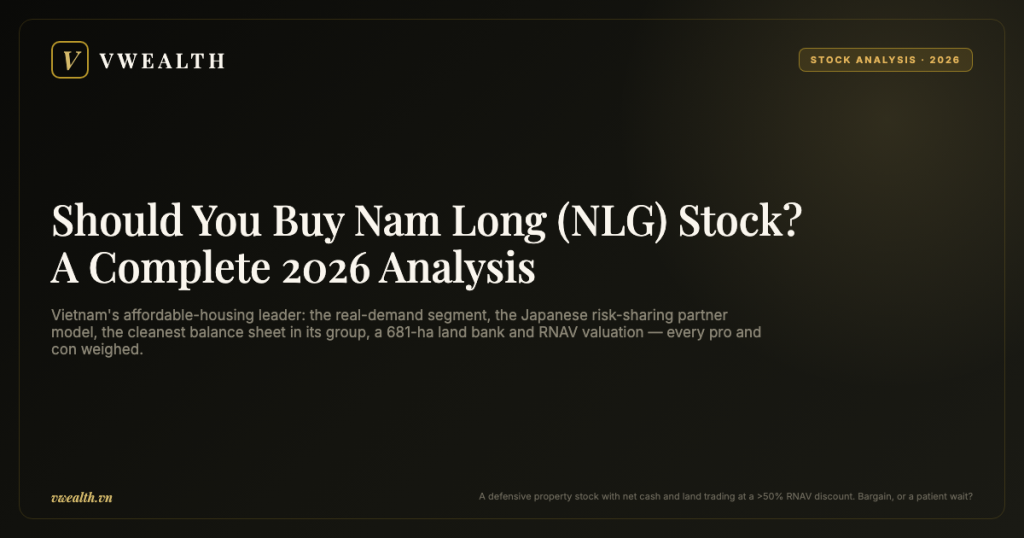
When you look at the real-estate stocks on HOSE, most names tell you the same story: land plots, resort villas, luxury apartments, revenue figures swelling in an up-wave then collapsing when the cycle reverses. Nam Long Group (HOSE: NLG) tells a different story. This is Vietnam’s leading developer of “affordable” (mid-tier) residential real estate — that is, they bet their whole career on the real-demand segment: apartments and townhouses a young family, a civil-servant couple, or someone who has just saved a few hundred million to over a billion dong can actually buy to live in. It’s the least glamorous segment, with thinner margins than luxury, but also the safest when the market cools, because it’s supported by a demand that never disappears: people always need a place to live.
If that were all, NLG would just be a builder of cheap homes. What makes this business special — and worth your time to analyze — lies in two keywords: integrated township and Japanese partners. Instead of building scattered apartment towers, Nam Long assembles hundred-hectare land banks to create “miniature cities” with schools, parks, retail and water — like Mizuki Park in South Saigon, Akari City in Binh Tan, or the 355-ha Waterpoint by the Vam Co Dong River in Long An. And in most large projects, Nam Long doesn’t shoulder all the capital and risk itself: they invite Japanese conglomerates to contribute capital project by project — Hankyu Hanshin Properties, Nishi Nippon Railroad, and later Keppel, Tokyu, IFC. This model brings Nam Long three things at once: cheap and long-term capital, international governance standards, and most importantly the risk-sharing that keeps its balance sheet in a health rare in the industry.
So buying NLG stock is essentially betting on three very concrete things: the real housing demand of millions of Vietnamese, the quality of the clean land bank Nam Long accumulated, and the credibility enough for foreign partners to inject capital into each project. At a price of 27,050đ (close of 19 June 2026), the question this full analysis wants to answer with you is not just “is NLG cheap or expensive,” but deeper: should you buy NLG, and if so, which kind of investor does it suit? To answer thoroughly, you need to understand one thing: Nam Long’s business philosophy isn’t the product of a quarter or a year, but the crystallization of over three decades staying firm on one road. Let’s start from that very journey.
NLG market data (updated 19 June 2026)
| Current price | 27,050đ | 2025 presales | 11,855 bn (+128%) |
| Change (June) | +1.12% | 2025 parent profit | 701 bn (+35%) |
| P/B | RNAV | ~0.9–1.1x | ~56,000đ | Net cash | Dividend | Positive | 5% |
NLG is affordable residential (real-demand) real estate, the CLEANEST BALANCE SHEET in its group (negative net debt). P/E distorted by lumpy profit → value by RNAV (price discounts >50%). Source: VWealth + NLG reports. For reference only.
History and evolution
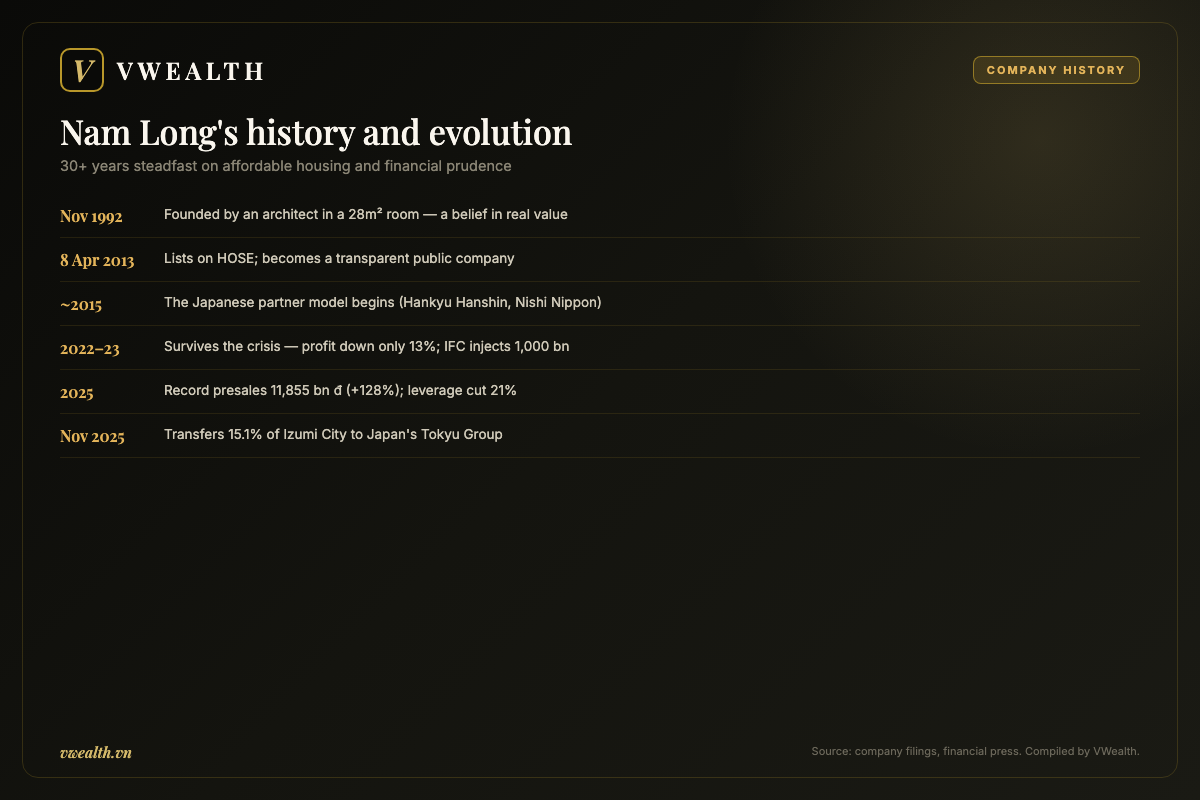
To understand why NLG stock behaves differently from the rest of the real-estate industry — why it “burns” less in up-waves but also “dies” less in down-waves — you need to go all the way back to 1992, a time when the concept of a “private real-estate business” in Vietnam barely existed. Nam Long’s history isn’t a chain of scattered events; it’s a strategy held firm for over 30 years, and that very steadfastness is the biggest intangible asset you’re about to pay for.
The 1992 start: a 28m² room and an against-the-grain belief
In November 1992, when the State had just opened the door to the private economy, a group of 7 people sitting in a mere 28m² room on Dinh Tien Hoang Street, District 1, HCMC, founded Nam Long Construction Company Limited. Its head was Mr. Nguyen Xuan Quang (born 1960), an architect who graduated from the HCMC University of Architecture in 1983. This isn’t a biographical detail for fun: the founder being an architect — not a land trader or financier — shaped the business’s entire DNA later on. A land trader thinks about price gaps; an architect thinks about living space and community. It was that second mindset that led Nam Long out of the short-term speculation vortex most peers plunged into.
By 1996, Nam Long became one of the first large private real-estate businesses in the South — a pioneering position. From there, Mr. Quang and his associates expanded into Binh Duong, Can Tho, Ba Ria–Vung Tau, Dong Nai. But what’s notable to you isn’t the expansion pace, but what they refused to do. While the 2000s market boiled with subdivided land plots and luxury apartments, Nam Long chose to stay with the segment few wanted to touch because margins were thin and it “wasn’t fancy”: affordable housing for those with real needs.
The “real value” philosophy: why Nam Long chose the real-demand segment
This is the core point you must grasp to value NLG correctly. Nam Long’s throughline philosophy was distilled by Mr. Quang into a plain sentence: “sell what the market needs”, not what the business wants to push at a high price. Nam Long early separated itself from short-term speculative waves and took a different road: developing housing based on methodical planning and people’s real needs.
The word “affordable” in international real-estate terminology doesn’t mean “cheap.” It refers to a product designed to match people’s purchasing power — they can buy quality housing with the best value for the money spent, and that money is proportional to their earning ability.
Why is this choice durable through cycles? Its logic is very solid, and you should remember it when assessing the stock’s risk:
- Real demand doesn’t vanish when credit tightens. Genuine owner-occupiers still buy when the market cools, as long as prices are reasonable and they can access loans. Meanwhile, speculative demand in the luxury segment evaporates almost instantly when cheap money withdraws.
- Higher liquidity. Products under a few billion dong have a customer base many times wider than ten-billion villas, so even in a tough market Nam Long still sells — which the crisis years proved.
- Less dependent on buyers’ leverage. Owner-occupiers usually have real needs and clear financial plans, reducing the risk of mass “deposit forfeiture” when rates rise.
- Fitting Vietnam’s long-term trend: a young population, fast urbanization, rising middle-class income — all concentrate demand into exactly the segment Nam Long serves.
Nam Long concretizes this philosophy into a three-brand “pyramid,” covering from low to mid-high, which you’ll meet again many times in this report:
| Brand | Segment | Reference price | Target customer |
|---|---|---|---|
| EHome | Affordable / social housing | Around 1 billion dong (with a cheaper EHomeS line) | First-time buyers, modest income |
| Flora | Mid-tier apartments | From about 1.5 billion dong | Young families, saving professionals |
| Valora | Townhouses / villas | From about 3 billion dong up | Upgraders with decent savings |
This trio gives Nam Long a subtle advantage: within the same township, they can sell many product lines for many budgets, both optimizing the land bank and “defending” sales — when the upper segment stalls, the EHome and Flora lines keep flowing.
2013: HOSE listing and the shift to a public company
On 8 April 2013, NLG shares officially listed on the Ho Chi Minh City Stock Exchange (HOSE). For you — an investor — this is a double milestone. First, it turned a family business into a transparent public company, forced to disclose information, subject to shareholder and market scrutiny. Second, and more importantly, listing opened the way for Nam Long to attract capital from large financial institutions. Nam Long’s list of shareholders and strategic partners over the years reads like a gold roster of international capital: Nam Viet Ltd. (a Goldman Sachs subsidiary), IFC (a World Bank member), Ibeworth (of Keppel Land), Mekong Capital, Dragon Capital, TBS Group… The presence of these names brings not only money but governance discipline — what keeps Nam Long from falling into reckless leverage gambles.
The Japanese partner model: Nam Long’s biggest differentiator
If you had to choose one thing that fundamentally sets NLG apart from the rest of the industry, it’s the model of inviting Japanese partners to contribute capital project by project. From around 2015, Nam Long began a more-than-10-year journey alongside two Japanese conglomerates: Hankyu Hanshin Properties and Nishi Nippon Railroad — businesses with hundreds of years of experience developing urban areas tied to transport infrastructure in Japan. This differs entirely from taking bank loans or issuing bonds, and it gives Nam Long a “trio of benefits” you need to understand clearly:
- Cheap, long-term capital. Japanese partners contribute equity to the project rather than lending at high interest. This reduces cash-flow pressure and financial costs — the key reason Nam Long’s balance sheet is “lighter on debt” than the norm.
- Japanese governance and technology. The partners not only put in money but directly join design, planning, and transfer of construction and operating standards. Product lines like EHome/EHomeS and the townships are lifted in quality thanks to this.
- Risk sharing. This is a survival factor. When a multi-thousand-billion project is 50%-50% funded (like Akari City) or 65.1%-34.9% (like Izumi City), then if the market worsens, Nam Long bears only its share of risk. The business doesn’t go “all-in” on any single gamble — and that’s what helps it survive the storms.
To picture how “deeply rooted” this model is, look at the funding structures of a few key projects:
| Project | Typical funding structure | Japanese partner |
|---|---|---|
| Akari City (Binh Tan) | Nam Long 50% – Japanese partner 50% (total capital ~7,676 bn dong) | Hankyu Hanshin + Nishi Nippon Railroad |
| Izumi City (Dong Nai) | Nam Long 65.1% – partner 34.9% | Hankyu Hanshin Properties |
| Waterpoint Phase 1 (Long An) | Nam Long 50% – Nishi Nippon 35% – TBS 10% – Tan Hiep 5% | Nishi Nippon Railroad (with Japanese Government’s JOIN funding) |
| Nam Long Dai Phuoc (Nhon Trach) | Transferred part of the capital to a Japanese partner | Nishi Nippon Railroad |
Pause here for a beat, because this is the key to reading the stock’s “risk appetite” correctly. A typical Vietnamese real-estate business usually holds 100% of a project itself, borrowing to the max to “eat” all the profit when the market rises — but for that reason it falls first when the market drops. Nam Long accepts sharing half the profit with Japanese partners in exchange for half the safety. That’s the trade-off of a long-game player. For you, this means: NLG can hardly give you the flash “x-fold” profit of a speculative stock, but in exchange it’s much less likely to bring you to the “brink” like businesses using maximum leverage.
The integrated-township era: from selling homes to creating “miniature cities”
Nam Long’s biggest maturation step was shifting from developing standalone projects to building large-scale integrated urban areas — where residents have housing, schools, parks, retail and green space all in one complex. The philosophy behind it is “creating a living ecosystem” rather than just “building homes to sell,” and it resonates perfectly with the real-demand segment: genuine owner-occupiers highly value the amenities and living environment around their home. This chain of townships is the “reserve” generating cash flow for Nam Long over many years:
- Mizuki Park (South Saigon) — an international-standard integrated urban area with over 5,000 products of apartments, townhouses and villas; a building ratio of only ~29%, the rest for amenities and nature.
- Akari City (Binh Tan) — a township developed with two Japanese partners, on the Vo Van Kiet boulevard axis.
- Waterpoint (Ben Luc, Long An) — a 355-ha “miniature city” by the Vam Co Dong River, three sides fronting the river with 5.8km of riverbank, complete with housing, an international school, parks, sports and retail.
- Izumi City (Dong Nai) — a large-scale integrated township (about 170ha) developed with Hankyu Hanshin.
- Southgate — a subzone within the Waterpoint ecosystem, tied to the EHome Southgate line serving real demand.
This model creates a self-reinforcing value loop: the more complete a township’s amenities, the higher the value of later-sold subzones; a large land bank lets Nam Long “spread” sales over many years instead of lumping into one round; and the presence of Japanese partners helps projects keep their credibility, selling even when market confidence weakens.
Surviving the 2022–2023 crisis: the test of a healthy balance sheet
Every philosophy must pass through fire. For Vietnam’s real-estate industry, that fire was the crisis of the second half of 2022 extending into 2023 — when credit was tightened, the bond channel froze, and a series of southern “big players” struggled with maturing bond debt. This was precisely the period Nam Long proved the value of all three strategic pillars you just read — the real-demand segment, risk-sharing partners, and financial discipline.
The result: in 2023, Nam Long recorded net profit of nearly 484 billion dong, down only 13% from 2022 — an astonishingly modest decline versus the scene of many peers reporting losses or near-paralysis. Why did Nam Long hold on?
- Not recklessly reliant on bonds. Nam Long’s borrowing structure balanced bank credit and bonds, rather than concentrating on bonds — so when the bond channel froze, they weren’t choked on cash flow.
- Still raised capital amid the storm. In late 2022, Nam Long was one of very few real-estate businesses able to issue bonds to institutions that prize governance, raising about 1,973 billion dong total — of which IFC (World Bank) injected 1,000 billion dong. An institution of IFC’s caliber choosing to inject capital amid a panicked market is a “quality stamp” money can’t buy.
- Products fitting real demand still sold. While luxury apartments went unsold, Nam Long’s affordable lines still had owner-occupier buyers, keeping cash flow unbroken.
- A large clean land bank (announced at ~685ha at one point) as a cushion, letting the business control its pace rather than dump assets.
The meaning of this period, for you, goes far beyond a single year’s number. It’s real-combat evidence that Nam Long’s model isn’t just pretty on paper: when the whole industry shrank, NLG still profited, still raised foreign capital, still sold. That’s the “defensive character” you’ll later see reflected in how the stock moves — usually milder than the speculative real-estate group.
Entering a new cycle: record sales and reduced leverage
After a challenging accumulation phase, 2025 marked a breakout. Nam Long recorded presales of 11,855 billion dong — the highest in over 30 years of operation, up as much as 128% year on year. After-tax profit attributable to parent-company shareholders reached 701 billion dong, completing 100% of plan; consolidated revenue reached 5,645 billion dong. More notable than the sales figure is how Nam Long simultaneously sharply reduced leverage: by end-2025, outstanding debt was about 5,522 billion dong, 37% of total capital and down 21% from 2024. In other words, the business set a sales record while making its balance sheet healthier — a rare combination in the industry.
Nam Long extends this momentum with big ambition for the new cycle: a 2026 sales plan of over 23,400 billion dong, consolidated revenue of 7,630 billion dong (up ~35%), parent after-tax profit of about 720 billion dong, alongside announcing a 2026–2031 Board and expanding land-bank search to the North (Quang Ninh, Hai Phong). All this shows Nam Long shifting from “defending to survive” to “disciplined acceleration.”
Summing up the 30+ year journey: you’re buying a “character”
Looking back over the whole road, from the 28m² room in 1992 to the chain of integrated townships and record 2025 sales, you see an unbroken red thread: Nam Long stays firm on one road — affordable housing for real demand, developed through integrated townships, financed by a risk-sharing partner model, and managed with financial discipline. This business isn’t a hot-growth player, nor a leverage gambler. It’s a long-distance walker, choosing certain profit over dazzling profit.
That character — forged over three decades and holding firm through the very crisis that felled rivals — is what you truly “buy” when you place an order for NLG, not merely an EPS or P/B number. But a strategy, however good, only works thanks to the people behind it. Who has held the wheel steady for 30 years, and does the successor team have the stature to carry Nam Long through the new cycle? That’s the question we dissect in the next section — Leadership.
Leadership and ownership structure
When you analyze a Vietnamese real-estate business, there’s a question you must put first, even before looking at the land bank or margins: who’s at the wheel, and for whose interest do they steer? The domestic property industry is a playground of high leverage, perpetually negative cash flow and no small number of cases where leadership uses a listed company as a capital-raising machine for group interests. It’s precisely this context that makes Nam Long (ticker NLG on HOSE) a case worth your time to dissect. It’s one of very few developers whose governance quality, financial discipline and shareholder structure can almost stand alone as an investment thesis.
This section takes you deep into three layers: the founder and his philosophy, the management running the company today, and the ownership picture bearing the strong imprint of foreign partners. You’ll see these three layers aren’t separate but bound into a consistent value system — and that’s what’s truly hard to copy.
Nguyen Xuan Quang — the founder and the “affordable home” philosophy
Nam Long’s story begins with an architect. Per disclosed corporate records, Mr. Nguyen Xuan Quang was born in 1960 in Binh Thuan, graduated from the HCMC University of Architecture in 1983, and founded Nam Long in 1992. So as of this analysis, he has been attached to the business he built for over three decades — a durability rare among Vietnamese property owners, where no few founders left the game after one or two market cycles.
What makes Mr. Quang notable isn’t just his tenure, but his steadfast philosophy. From the earliest days, Nam Long chose to pursue “affordable housing” serving real owner-occupier demand, rather than chasing luxury real estate or speculation — the segment that profits fast but also dies fast when the market reverses. In a recent press exchange, Mr. Quang still stressed that the market recovers “selectively” and sustainable opportunity lies in the affordable segment, tied to the real housing need of the expanding middle class. You should note this: a founder keeping the same strategic compass through many cycles is a signal of long-term vision, not turning with speculative waves.
For a real-estate business, a founder persisting with one product philosophy for over 30 years — rather than chasing the hottest segment of each moment — is a kind of “soft economic moat”: it creates brand, customer base and credibility rivals struggle to buy with money.
The second layer of Mr. Quang’s legacy is the vision to invite foreign partners and apply international governance standards. This is a point to note especially, because it shaped Nam Long’s entire DNA today. Instead of keeping the company as a closed “family empire” — the common model at Vietnamese private businesses — Mr. Quang proactively opened the door to external capital and governance knowledge. Per the company’s introductory materials, as early as 2008–2014, Nam Long welcomed a series of top-tier shareholders and strategic partners: Nam Viet Ltd. (tied to Goldman Sachs), the International Finance Corporation (IFC) of the World Bank group, Mekong Capital, and other international funds. A Vietnamese business convincing demanding institutions like IFC or Goldman Sachs to invest so early is itself a “quality certificate” of transparency and governance.
The third layer — and perhaps the most precious to you as an investor — is the financially prudent style. In an industry where high leverage is almost an “unwritten rule,” Nam Long has long been known for a policy of controlled debt, prioritizing cash flow and the ability to stand firm through credit-tightening periods. You’ll see this prudence isn’t a slogan but seeps into the business model — especially through the strategy of selling per-project stakes to Japanese partners we’ll analyze later. Of course, to be frank so you don’t misunderstand: “prudent” doesn’t mean Nam Long is immune to the real-estate cycle. The business still faces cash-flow pressure and has had to delay dividend payments, as we’ll mention. But versus the industry norm, Nam Long’s financial discipline is a clear plus.
Management: when the “hot seat” is handed to international professionals
One of the clearest distinctions between Nam Long and most Vietnamese property businesses is the separation of ownership and management. Mr. Quang holds the Chairman role — setting strategic direction — but the CEO seat has been handed to professional managers, including foreigners. This is a sign of governance maturity you don’t easily find at domestic family conglomerates.
Per disclosures, in March 2024, Nam Long appointed Mr. Lucas Ignatius Loh Jen Yuh (born 1966, Singaporean) as CEO, replacing Mr. Tran Xuan Ngoc at term’s end. This is a very notable choice: Mr. Lucas has over two decades of experience in finance and real estate in Asia, having held senior leadership positions at CapitaLand — one of the region’s leading real-estate groups, including a role related to CapitaLand China. The market reacting positively to this appointment (NLG shares rose strongly around the CEO-change announcement) shows investors value the international governance capacity he brings.
The vision of a “hybrid” management blending domestic experience and international capability continues to be institutionalized at the Board level. Per the business’s disclosure on the 2026–2031 term, Nam Long strengthened its Board with 9 members, of which about 5 are Vietnamese and 4 foreign — a very high “foreign blood” ratio versus Vietnamese listing norms. This leadership frame continues to include:
- Mr. Nguyen Xuan Quang (born 1960) — founder, holding the Chairman role, with over 35 years of real-estate development experience.
- Mr. Tran Thanh Phong (born 1966) — founding member, Vice Chairman.
- Along with foreign members representing international governance experience and practice.
You should read this structure as a strategic message: Nam Long isn’t building a team to “run a family’s company,” but to run an urban-development institution by standards that can dialogue with international capital. When the stated goal is to double sales in the coming term, placing people who managed billion-dollar regional real-estate portfolios in the executive seat is a decision consistent with that ambition. For a long-term investor, a smooth handover to a professional leadership layer — while the founder stays in a directing role — is a signal of reduced “key-man risk,” which is very valuable.
Ownership structure: foreign institutional shareholders as governance “anchors”
This is the part you should linger on longest, because Nam Long’s ownership structure is the clearest mirror of the business’s governance quality.
Start with the founder. Per disclosed trading data, Mr. Nguyen Xuan Quang holds a considerable personal stake and is usually the company’s largest individual shareholder — at various points recorded around 9–10.5% of charter capital (for example, at one point recorded holding about 40.45 million shares, equal to 10.51%; at a later update, ownership was cited around 9.47%). Note two things here. First, ownership figures change with each trading round, so understand them as snapshots at a point in time, not constants. Second — and more importantly — this is a just-right stake: large enough for the founder to bind his interests tightly to shareholders, but not so overwhelming that he alone absolutely dominates every decision. The rest of the shareholder register is filled by institutions — and that’s where the governance story gets interesting.
Nam Long’s institutional ownership bears a strong international imprint, having passed through many layers of strategic partners over time. In the recent flow (2025 period), the ownership picture has a few big moves worth grasping:
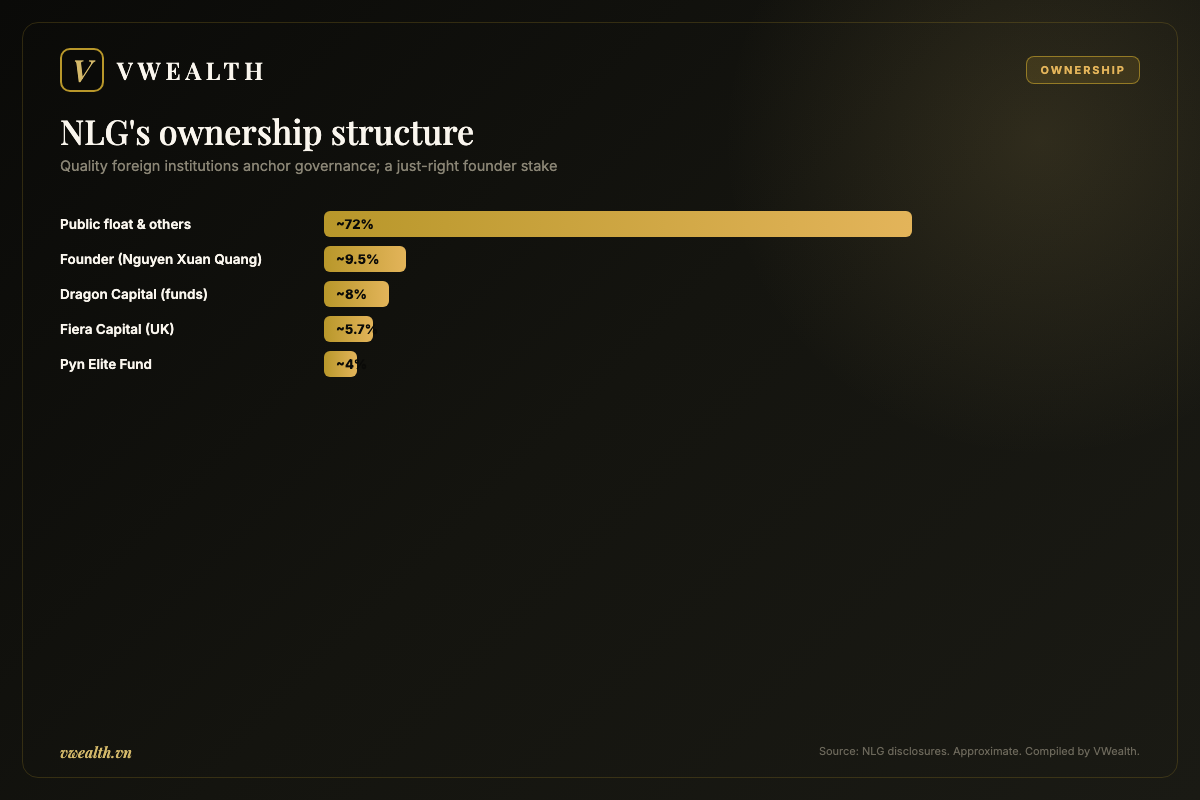
Keppel Land exits after a decade. In July 2025, Ibeworth Pte. Ltd — an entity of Singapore’s Keppel Land — sold over 29.4 million NLG shares, about 7.64% of capital, fully divesting an investment held since 2015. You shouldn’t read this as a “bad signal” about Nam Long; it’s part of Keppel’s regional portfolio restructuring. Still, a long-time strategic shareholder leaving is always worth watching, because it shifts the institutional-shareholder balance.
New capital filled the gap immediately. What’s notable — and reflects the appeal of a quality stock — is that the gap Keppel left was filled almost instantly by large financial institutions. Fiera Capital (UK) Limited bought about 10 million shares (late July 2025), raising its holding to about 5.71% and becoming a new major shareholder. At the same time, the Dragon Capital group — a foreign fund long attached to many Vietnamese blue chips — returned to major-shareholder status, raising its stake above 5%. At earlier points, Dragon Capital-related funds held over 6% of NLG.
Besides these, Nam Long’s shareholder history bears names heavy in governance credibility: IFC (a World Bank group member), Nam Viet Ltd. (tied to Goldman Sachs), funds of Mekong Capital, and many other international funds that participated across periods. The table below summarizes some representative shareholders/partners for you to picture (note: ratios change over time and some parties have divested):
| Shareholder / related group | Role | Recorded (as of) |
|---|---|---|
| Nguyen Xuan Quang | Founder, Chairman | ~9.47% – 10.51% (largest individual shareholder) |
| Ibeworth Pte. Ltd (Keppel Land) | Strategic shareholder (divested) | ~7.64%, fully sold July 2025 |
| Fiera Capital (UK) | Foreign fund, new major shareholder | ~5.71% (July 2025) |
| Dragon Capital (fund group) | Foreign fund | Above 5%, once held over 6% |
| IFC / Goldman Sachs / Mekong Capital | Historical strategic partners | Participated across 2008–2014 |
So what should you take from this picture? A quality-rich shareholder structure — with a large weight belonging to professional foreign institutions — is a form of self-governing oversight mechanism. Funds like Dragon Capital, Fiera, or earlier IFC and Keppel don’t invest passively; they demand transparency, standard reporting and capital-allocation discipline. When a business maintains such a shareholder base for years, that’s indirect but strong evidence that leadership respects minority-shareholder interests. At the same time, new foreign capital ready to replace an exiting old shareholder shows NLG remains a “coveted” asset in institutional investors’ eyes — no small psychological anchor for public shareholders like you.
The distinctive partner model: selling per-project stakes to the Japanese
If you had to choose one thing that fundamentally distinguishes Nam Long’s business model, it’s the strategy of per-project cooperation with Japanese conglomerates. This isn’t merely capital-raising — it’s a risk-management philosophy institutionalized into a deal structure, and you need to understand it well.
The two pillar Japanese partners are Hankyu Hanshin Properties (Osaka) and Nishi Nippon Railroad (Fukuoka). This relationship has lasted over a decade. Per company disclosures, from 2015 to now, the joint venture between Nam Long and the two Japanese partners has developed about 9 real-estate projects with a total scale over 400 ha, supplying the market with over 20,000 housing products. The way it operates is very distinctive: instead of holding a project entirely from start to finish, Nam Long sells part of the capital of each project entity to the Japanese partner. A classic example is Mizuki Park (26 ha), where Hankyu Realty and Nishi Nippon Railroad participate with a 50–50 capital-sharing structure and total investment of about 8,000 billion dong; or the case of Nam Long transferring part of its capital at the Nam Long Dai Phuoc urban project to Nishi Nippon Railroad, and cooperating with Hankyu Hanshin Properties at a ratio of Nam Long 65.1% and the partner 34.9%.
Why is this strategy so important to you? Let’s dissect the three core benefits:
- Realizing profit early. By selling part of a project’s capital to a partner right from the early stage, Nam Long records part of the land bank’s value gain without waiting until all products are sold. Cash flow and profit come earlier, reducing the risk of “burying capital” for years.
- Risk sharing. Real estate is a game where one large project missing a beat can drag down the whole business. By bringing Japanese partners in to share capital and risk, Nam Long doesn’t put all its eggs in one basket. If the market worsens, the burden is shared.
- Reducing capital and leverage pressure. This is the link that connects directly to Mr. Quang’s “financial prudence” philosophy. Capital from Japanese partners replaces part of bank borrowing, helping Nam Long keep debt ratios controlled even while developing large-scale townships.
You can picture this model as Nam Long “co-financing” each project rather than shouldering it alone. Japanese partners bring not only money but also urban-planning standards tied to transport infrastructure — the very forte of groups like Hankyu Hanshin (with over 100 years developing satellite towns along the rail lines around Osaka, Kyoto, Kobe). It’s a resonance of capital, credibility and know-how.
Of course, you should view the flip side fairly: sharing project capital means sharing profit. Nam Long gives up part of the “pie” in exchange for safety and faster capital turnover. This is a deliberate trade-off — and it reflects the business’s prudent risk appetite. For an investor who prefers sustainability over one-time explosive profit, this is a reasonable trade-off.
Dividend policy: steady but prudent
A well-governed business usually leaves a “fingerprint” on its dividend policy, and Nam Long is no exception. The throughline philosophy here is paying dividends steadily but at a prudent level, combining cash and (by period) stock, rather than pouring out all profit as dividends or overspending.
Specifically, for FY2024, Nam Long’s Board approved a cash dividend of about 4.99% (499 dong per share), with a very notable bonus mechanism: if parent after-tax profit exceeds plan by 30%, the cash dividend can be raised, up to 10% of par. In 2025, the company continued to orient toward maintaining a cash dividend of about 5% (500 dong per share) and set the record date to execute.
Read this policy both ways. On the positive side, a steady cash-dividend stream shows the business generates real cash and respects shareholders. The “bonus when beating plan” mechanism also binds shareholder interests to business efficiency. On the caution side, you should note Nam Long has delayed dividend payment/advance (the 2024 dividend was pushed to 2025) — a reminder that despite discipline, the business still prioritizes keeping cash to serve project development in tough market periods. This isn’t a sign of weakness, but a manifestation of prioritizing liquidity over “beautifying” its image with high dividends — true to the prudence throughline from the start.
Summary: a governance frame as the foundation for the ecosystem
To close this section, take away this overall picture. Nam Long is a rare combination of: a founder steadfast on the affordable-housing philosophy and financial prudence for over 30 years; a management professionalized with an international-caliber CEO and Board members; an ownership structure anchored by quality foreign institutions playing a governance-oversight role; and a per-project cooperation model with Japanese partners that turns prudence into a structural advantage. Combined, these aren’t four separate factors but a self-reinforcing value system.
It’s precisely this solid governance and ownership frame that is the foundation for Nam Long to build what truly creates long-term value: an ecosystem of projects and brands stretching across many integrated townships. And that’s what we analyze in depth in the next section — “Project ecosystem and brands.”
Project ecosystem and brands
When you hold a real-estate stock, what you truly own isn’t the NLG ticker on the board. You indirectly hold part of very concrete things: hundreds of hectares of land on Saigon’s outskirts, a set of housing brands imprinted on buyers’ minds for three decades, and a portfolio of Japanese partners few Vietnamese property businesses can assemble. This section dissects that very “core” — Nam Long’s project ecosystem and brands — because this is where the stock’s real value is created, not in the daily up-and-down waves.
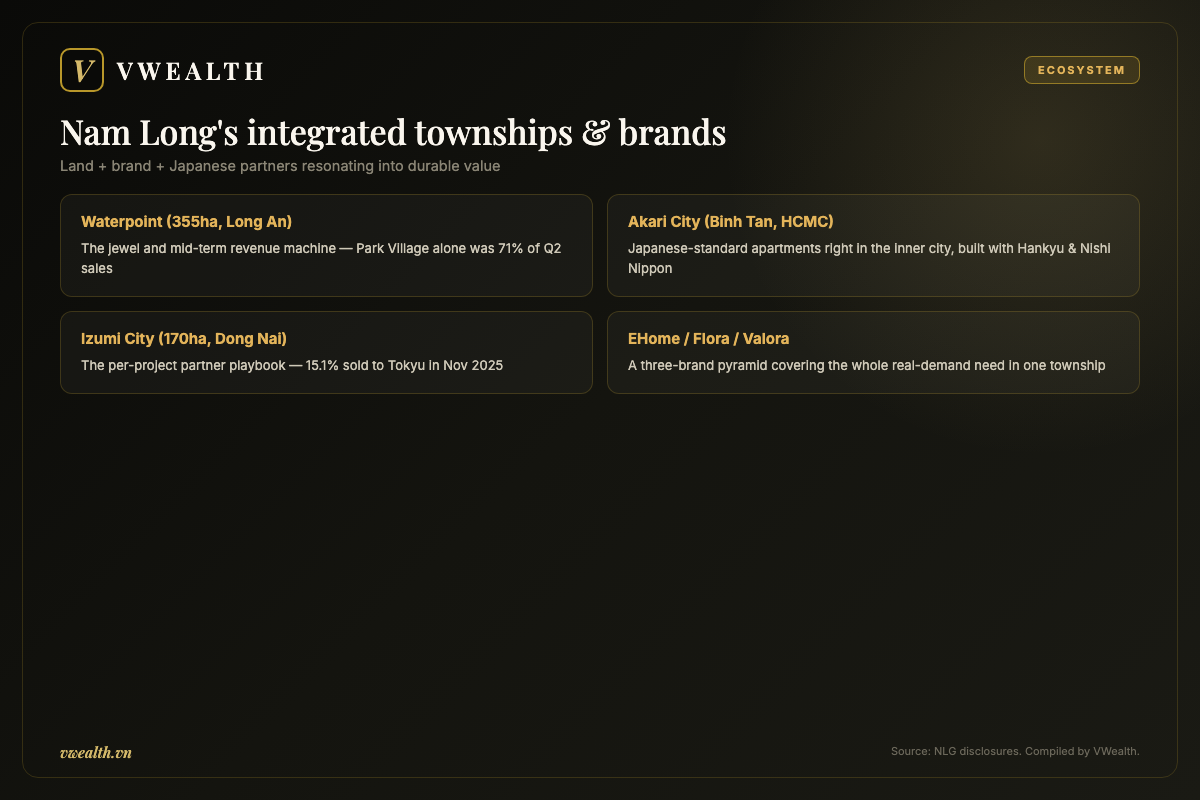
2025 is a pivotal year for you to see that strength through. Nam Long recorded presales of 11,855 billion dong, up as much as 128% year on year and the highest in over 30 years of operation. Consolidated handover revenue reached 5,645 billion dong. The Park Village subzone of the Waterpoint township alone contributed about 1,980 billion dong — equal to 71% of Q2 sales. And the peak of the partner story: in November 2025, Nam Long completed transferring 15.1% of the Izumi City project to Japan’s Tokyu Group. These three facts aren’t separate — they’re three faces of the same business model we’ll dissect right after.
The three-brand set: how Nam Long “covers” the entire real-demand need
The first thing a new investor needs to understand: Nam Long doesn’t sell homes “whatever’s on hand.” They divide products into three brands, each targeting a different income tier. This is a very refined strategic decision, because it lets the same plot of land in a township serve both salaried workers and well-off families — and more importantly, it anchors the business to “real demand” rather than speculation.
- EHOME — affordable housing. This is Nam Long’s oldest brand and its “real-demand core.” EHOME targets middle and lower-middle income earners: young couples buying their first home, workers, civil servants. The traits are soft prices, moderate area, but still within an urban area with full amenities (pool, park, school). Because it hits real demand and the market’s widest segment, EHOME sells even when the market is tough — this is precisely the liquidity “cushion” that helped Nam Long weather the property freezes that battered many luxury developers.
- FLORA — mid-tier apartments. This apartment line targets the growing middle class in satellite towns. Flora has a more modern design than EHOME, fuller amenities, a price a notch higher but still within reach of a stable-income family. The Flora Mizuki, Flora Panorama projects are classic examples.
- VALORA — townhouses, premium villas. This is the top tier: detached villas, commercial townhouses (shophouses), serving high-income customers. Valora has the best margin of the three lines and is usually released in a township’s later phase, when infrastructure and amenities are formed, helping push value higher.
Picture this strategy as an inverted pyramid: EHOME is the wide base, selling much, fast liquidity, generating cash and “pulling” people in to really live; FLORA in the middle; VALORA at the top, fewer products but each earning more. When all three lines coexist in a township, Nam Long can “release goods” flexibly by market purchasing power — a weak market pushes EHOME, a strong market releases Valora. That’s why their sales are more stable than developers playing only one segment.
The crux for investors: these three brands don’t compete, they complement. “Covering” all three real-demand segments helps Nam Long depend less on the speculative cycle and keep sales cash flow steady through harsh market years.
The integrated townships: where your real assets lie
If brands are how Nam Long sells, the integrated townships are the asset store that creates value. “Integrated township” is a concept you must grasp firmly: instead of building a lone apartment tower and selling it, Nam Long master-plans a whole large area with full schools, malls, parks, hospitals and internal roads. When amenities form and people really live there, land prices in the area rise — and Nam Long sells later phases at prices far higher than the early phase. This is a “riding one’s own coattails” model: the developer self-creates value gains for the land bank it holds.
Waterpoint — the 355ha jewel
Waterpoint in Long An is Nam Long’s largest and most important project, a riverside integrated township of 355 hectares. To picture the size: 355ha equals about 500 football pitches. This isn’t a project but a miniature city built gradually over many phases across a decade. The Park Village subzone within Waterpoint was the “star” of 2025 — alone contributing 1,980 billion dong, 71% of Q2 sales. The Southgate subzone (Waterpoint’s early phase) alone contributed about 1,975 billion dong of handover revenue in the year. Analysts forecast Waterpoint could account for up to a third of Nam Long’s sales in 2025–2026, making it the business’s mid-term revenue “machine.”
Akari City — Japanese-standard apartments right in HCMC
Unlike the outer-fringe townships, Akari City sits right in Binh Tan District, HCMC. This project bears a strong imprint of cooperation with Japanese partners (Hankyu Hanshin and Nishi Nippon Railroad), with Japanese-style design, management standards and amenities. In 2025, Akari contributed about 1,037 billion dong of handover revenue. Akari’s strategic value is that it gives Nam Long a premium “frontage” right in the inner city — where land is increasingly scarce.
Izumi City — and the Tokyu chess move
Izumi City is a 170-hectare township in Dong Nai, developed within the cooperation framework with Hankyu Hanshin and Nishi Nippon Railroad. This project best illustrates a Nam Long financial “signature move” we’ll discuss in detail: inviting Japanese partners to fund each project. In November 2025, Nam Long completed transferring 15.1% of Izumi to the Tokyu Group, bringing its own stake to around 50%. This deal is estimated by analysts (VDSC) to bring about 470 billion dong of financial revenue in Q3. Right after “closing the deal,” Nam Long launched Izumi’s Canaria subzone — proof that selling capital isn’t a “fire sale” but a way to raise money and share risk to keep developing the project.
The remaining pieces
- Mizuki Park (South Saigon, Binh Chanh): a township of about 26ha, where all three brands converge — EHOME Mizuki, Flora Mizuki and Valora Mizuki — a perfect “showroom” for Nam Long’s segment-covering strategy.
- Southgate / EHome Southgate (Long An): part of the Waterpoint complex, an early-phase subzone already handed over and generating large revenue.
- Nam Long II Central Lake (Can Tho): Nam Long’s step into the Mekong Delta market. In 2025, projects in Can Tho (including starting handover of EhomeS Can Tho) contributed about 1,388 billion dong of revenue — showing the strategy of “bringing the integrated-township model to provincial cities” is genuinely profitable.
The business model: how money flows through this ecosystem
By now, you need to understand the mechanism turning land and brand into profit — because it decides how to read Nam Long’s financials. There are three flows you must distinguish:
- Presales → handover → revenue recognition. When Nam Long launches a project, customers deposit and pay by progress. This is called presales — it shows current “selling strength” but is not yet booked as revenue on the report. Only when the home/apartment is completed and handed over is revenue booked. This is why 2025 presales (11,855 billion) far exceed handover revenue (5,645 billion): the difference is the “reserve” that will flow into results in later years. For investors, presales up 128% is an extremely positive signal — it foretells 2026–2027 revenue.
- Inviting Japanese partners to fund each project. Instead of holding 100% of a 170ha project and bearing all the capital risk, Nam Long sells part of the project stake to Japanese partners (Hankyu Hanshin, Nishi Nippon, Tokyu). This both brings money in immediately, shares risk, and “borrows” the credibility and development standards of centuries-old Japanese groups. The Izumi–Tokyu deal of 2025 is the latest in a chain of nearly ten “handshakes” with Japanese giants.
- Integrated townships self-increase value. As said, the more amenities and residents, the more expensive land in the township. Nam Long sells phases in sequence to “squeeze” maximum value gain from the land bank.
The implication when reading the numbers: don’t look only at one quarter’s revenue. Track presales (foretelling the future), the value of capital-transfer deals (creating surging financial profit), and the handover progress of large subzones like Park Village or Canaria.
The land bank: a “reserve” of over 680ha right where infrastructure is arriving
The foundational asset of any property business is the land bank, and this is where Nam Long truly excels. The group holds a total land bank of over 680 hectares, spread across HCMC’s satellite areas: Long An (Waterpoint), Dong Nai (Izumi, Paragon Dai Phuoc), Can Tho (Nam Long II Central Lake), plus expansion steps northward (Hai Phong). What makes this land bank especially valuable isn’t just scale, but its location and timing.
Connect two threads. On one hand, a series of major transport infrastructure projects are being built around these land banks: Ring Road 3, Ring Road 4, expressways, Long Thanh Airport, the Metro. When a major road runs through, travel time from the outskirts to the center shortens, and land prices in that area jump. On the other hand, HCMC is under population-dispersion pressure — the inner-city population is overloaded, inner-city home prices exceed most people’s affordability, so real owner-occupiers migrate to satellite towns. Nam Long “bet” its land bank exactly on the corridors that will benefit doubly from both infrastructure and dispersion. That’s why the strategy of accumulating land around key transport nodes (Long Thanh, Ring Roads 3 and 4, Metro Line 2) is emphasized by leadership as the focus.
For a real-estate stock, a cheap land bank bought years earlier in exactly the appreciating area is the “hidden asset” — book value is usually lower than true market value, creating profit room when projects are developed. Nam Long’s 680ha+ land bank, combined with the sharp debt reduction in 2025 (debt down to around 5,522 billion, 37% of capital, down 21% year on year), shows the business in an “enough ammunition, enough land” stance to exploit the new cycle.
Why this trio is the core value of NLG stock
Let’s close by tying everything together. Nam Long stock’s real value lies not in any quarterly EPS number, but in the three pillars you just walked through, and their strength comes from how they resonate:
- Real-housing brands (EHOME–FLORA–VALORA) ensure Nam Long always sells, through every market phase, because they serve real living need not speculation. This is the liquidity machine.
- Integrated townships (Waterpoint, Akari, Izumi, Mizuki…) turn the land bank into a self-appreciating asset, and let Nam Long “release goods” in many phases with gradually improving margins. This is the value-add machine.
- Japanese partners (Hankyu Hanshin, Nishi Nippon, Tokyu) bring capital, credibility, development standards and a flexible financial release valve (selling project stakes when needed) — as the Izumi 2025 deal just proved. This is the capital-and-confidence machine.
When these three machines run in sync, the result is a 2025 with record sales of 11,855 billion, sharply reduced debt leverage, and a project portfolio with room to develop for years. That’s why many analysts call this the moment Nam Long “enters a new cycle.” You — as an investor — shouldn’t value NLG like a stock riding short-term waves, but should value it as a business sitting on over 680ha of good land, with brands that sell in any condition, and Japanese partners ready to inject capital.
Of course, a strong ecosystem, however strong, is only half the story. A large land bank comes with capital pressure; record sales must be verified by real cash flow and margins; and dependence on a few mega-projects like Waterpoint is a concentration risk. To know whether this ecosystem stands on solid financial ground, we need to examine the next section: Financial position and health — where the numbers of debt, cash, margins and valuation will give you the final answer.
Financial position and health
When you look at a real-estate business in the 2022–2025 period — a time when the whole industry passed through a real storm: a series of developers defaulting on bonds, frozen projects, exhausted cash flow — the most important question you should ask isn’t “how much did this business earn,” but “can this business survive and rise.” For Nam Long Investment Joint Stock Company (ticker NLG, HOSE), the answer comes from the balance sheet itself — the place that tells the most honest story about a business. And this is also the part you need to read most carefully if you want to understand why NLG is seen by many analysts as a “rarity” in the southern residential real-estate group.
This section dissects three layers: where NLG stands in the market (position), how healthy its balance sheet is and why that’s a real competitive advantage, and finally the true quality of the profit figure — because in real estate, not every number says the same thing. You’ll see a fairly bright picture, but I’ll also point directly to the risks you shouldn’t overlook.
Position: the leader of the southern “affordable” housing segment
Nam Long isn’t the loudest name on the market, but it’s one of the most durable and clearly-branded. For over three decades, the company stayed firm on one positioning: developing affordable housing and products serving real living need, rather than chasing luxury or speculation. This is an important strategic choice, because the real-demand segment is the market’s most durable demand — buyers to live in, not to flip, so less vulnerable when credit tightens or speculative sentiment cools.
Nam Long’s product brands — like the EHome line (affordable), Flora, Valora — along with a chain of large integrated townships like Mizuki Park, Southgate, Izumi City, Akari City, Waterpoint, Paragon Dai Phuoc, have helped the company build what’s very hard to buy in real estate: handover credibility and the trust of real owner-occupiers. In 2026, Nam Long continues to be ranked in the Top 2 reputable real-estate developers — no small recognition amid a context where many names have fallen.
What makes NLG’s position distinctive is the capital-sharing model with foreign partners. Instead of holding a large project entirely with borrowed capital, Nam Long invites Japanese and Singaporean conglomerates to co-fund each project: Hankyu Hanshin Properties, Nishitetsu (West Japan), Tokyu Corporation, or Keppel Land. This brings three things at once: capital (reducing borrowing pressure), international development standards (raising product quality), and most importantly risk sharing. When the market is tough, the burden doesn’t fall entirely on Nam Long alone. This isn’t just capital-raising — it’s a risk-management philosophy pre-installed in the business model.
The biggest bright spot: a rare healthy balance sheet
If I had to choose one reason to explain why NLG stood firm through the crisis, I’d point directly at the balance sheet. And to help you feel its true value, place it in the right context.
The 2022–2023 period was a brutal cleansing. When the corporate-bond channel was tightened, a series of developers used to “borrowing short to fund long,” piling debt to hoard land, fell into insolvency. Bond-maturity pressure became a nightmare for the whole industry. In that environment, a business with low leverage and much cash isn’t just “safer” — it has a real competitive advantage, because it can keep developing projects while rivals must dump assets to repay debt.
Nam Long belongs to that small group. The company’s debt-to-total-assets ratio stayed low — around the 20% mark — among the healthiest in the industry. Nam Long itself also faced pressure: in 2023, the company had about 450 billion dong of maturing bonds and at one point negative operating cash flow. But the difference is that the scale of its debt obligations was under control and balanced by a thick cash cushion. By the end of the 2025 cycle, NLG’s cash and cash equivalents exceeded 5,000 billion dong — a liquidity “mattress” letting the company repay debt on time, support home buyers, and keep investing in projects without being cornered.
In real estate, leverage is a double-edged sword: it amplifies profit when the market rises, but also amplifies bankruptcy risk when the market falls. Nam Long proactively keeping low leverage means it accepts slightly slower growth in good times, in exchange for the right to survive and stay proactive in harsh times. Through the 2022–2023 test, that choice proved its value.
This cash cushion, combined with the capital-sharing partner model, creates a financial structure I want you to see as a strategic asset, not merely a few pretty accounting numbers. It let Nam Long do what many rivals couldn’t in 2023–2025: not sell assets below value to save liquidity, not stop projects midway, and importantly keep its on-time handover credibility with customers — the kind of credibility that, once lost, is very hard to regain.
The 2025 financial picture: a sales breakout, profit meeting plan
2025 was a pivotal year for Nam Long, and the numbers show a clear recovery after the quiet period.
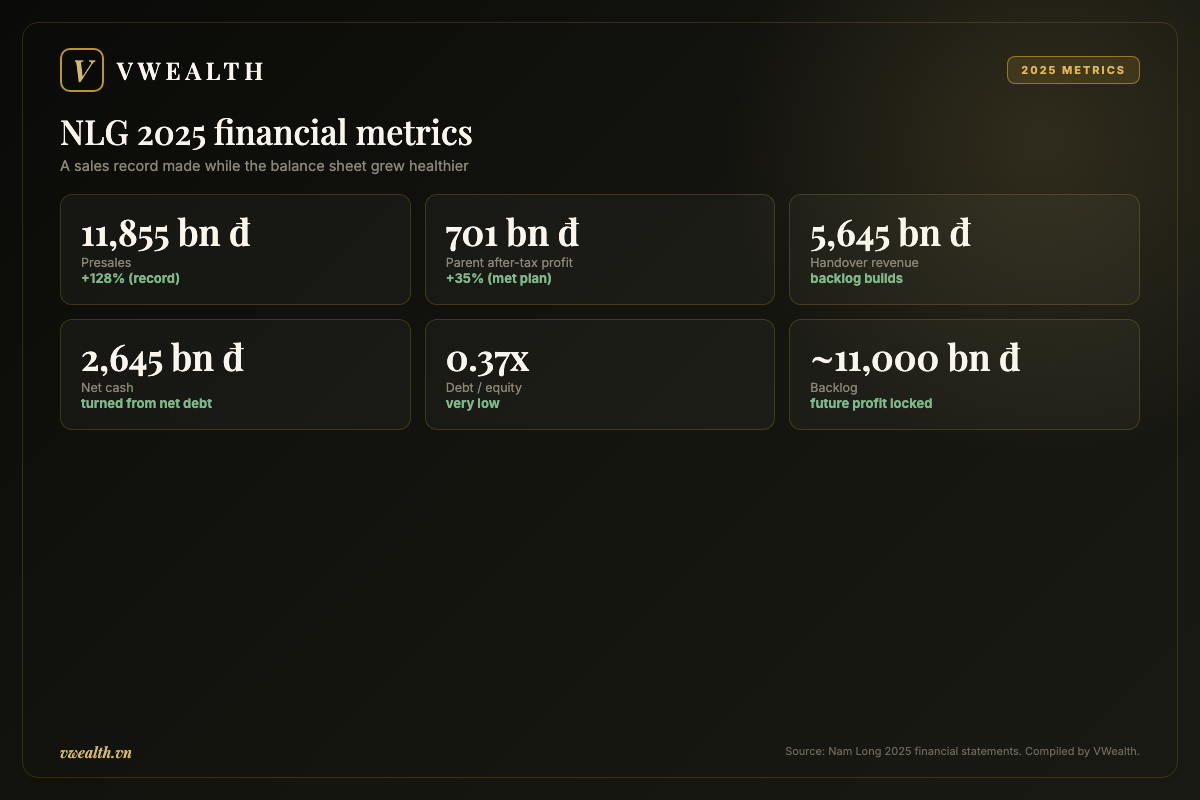
Read the chart above carefully, because each line tells a different part of the story. Presales reached 11,855 billion dong, up as much as 128% year on year — the most impressive figure, and I’ll explain why it matters most later. Handover revenue (booked on the income statement) reached 5,645 billion dong. Parent after-tax profit reached 701 billion dong, up 35% from 2024 and meeting exactly the plan the AGM assigned. And as said, the period-end cash balance stayed above 5,000 billion dong.
A detail to remember: in 2025, Nam Long completed transferring 15.1% of the Izumi City project to Japanese partner Tokyu Corporation, cutting its stake in that project to 50%. This deal brought a profit booked in Q4 2025 (securities firms estimate a few hundred billion dong of after-tax profit). This is an important point for assessing profit quality, which I’ll dissect right below.
Profit quality and why “presales” is what you need to watch
This is the part most prone to confusing new investors, so I want you to read it slowly. For a project-developer real-estate business like Nam Long, there’s a fundamental difference between two concepts:
- Presales: the total value of products customers have signed contracts to buy, deposited on, paid for — even before the home/apartment is handed over. In 2025, this figure for NLG was 11,855 billion dong.
- Accounting revenue (handover): the part booked on the financials, and per accounting standards, it’s only booked when the product is actually handed over to the customer. In 2025, this figure was 5,645 billion dong.
Why do I stress this? Because in real estate, presales are the leading indicator reflecting real selling strength and the “backlog” — the revenue and profit already locked but not yet booked, to be recognized gradually in coming years as projects are completed and handed over. When you see 2025 presales up 128%, it means Nam Long is accumulating a very large backlog for 2026–2027. This year’s accounting revenue being lower than presales isn’t because they sold poorly, but simply the lag between selling and handover. In other words, today’s revenue reflects what was sold many quarters earlier, while today’s presales reveal the revenue of the future.
The direct consequence of this mechanism is that NLG’s profit is “lumpy” — jerky by handover pace. One quarter may profit big because many projects finish at once, the next quarter is quiet because handover time hasn’t come. This is the industry’s nature, not a sign of instability. But it means you shouldn’t assess Nam Long by a single quarter’s result, or mechanically compare this quarter’s profit with another. You must view it across the project cycle, and cross-reference profit with presales and backlog progress.
The second point about profit quality — and here you need to stay clear-eyed: in the 2025 profit structure, part comes from the project-stake transfer deal (Izumi City to Tokyu). This is a one-off profit, non-recurring, different in nature from core profit from selling and handing over products. When assessing the business’s true health, you should separate: core profit (sustainable, recurring) versus one-off profit (lifting this year’s result but not a long-term driver). The good news is this one-off profit isn’t “beautification” to hide weakness — it comes from the very partner-cooperation strategy, and NLG’s core is still solid thanks to booming presales. But separating them helps you not wrongly expect this profit level to automatically repeat identically each year.
When reading a real-estate business’s report, don’t stop at the “after-tax profit” line. Ask three more questions: How much are presales this year (real selling strength)? How much backlog remains (locked future revenue)? And in the profit, how much is one-off, how much is core? Answer those three, and you’ll understand the business far more deeply than most of the market.
The “reserve”: clean land bank, backlog and the RNAV story
There’s a nice concept in Vietnamese real-estate investing circles: “the reserve.” For Nam Long, the “reserve” consists of two resonating parts: the clean land bank and the sales backlog.
On the land bank, Nam Long holds a large clean land bank — estimated at nearly 700 ha, most of it with legal procedures completed and most of the financial obligation on land-use fees fulfilled. I want you to note the phrase “clean land”: in an environment where legal snags are the industry’s number-one barrier, owning land with legal clearance and ready to develop is an extremely valuable competitive advantage. This land bank was accumulated years earlier at low cost, so its current market value is usually much higher than book value — a “hidden asset” not obvious on the balance sheet but very real.
It’s precisely because of this that analysts usually don’t value NLG by conventional methods like P/E (easily distorted by lumpy profit), but by RNAV (Residual Net Asset Value). This method values each project and each cash-generating asset of the business, sums them, subtracts debt, to arrive at true intrinsic value. For a land-rich business like Nam Long, RNAV gives a picture far closer to reality than metrics based on one year’s profit. Per some securities firms’ RNAV valuations, NLG stock at many points traded at a considerable discount to estimated RNAV — that is, the price below intrinsic net asset value — which supporters see as room, though you should also remember RNAV depends heavily on assumptions and the discount can persist if the market stays cautious.
Rebalancing: the risks you shouldn’t overlook
The picture so far is fairly bright, but an honest analyst must show you the other side too. Good financial health isn’t immune to risk, and NLG has points you need to watch:
- Lumpy profit: as analyzed, results depend heavily on handover pace. A project delayed in legality or construction can push a whole year’s profit down, causing share-price volatility and making impatient investors easily misread the business’s “form.”
- Dependence on real-estate market demand: though the real-demand segment is more durable, it’s not immune. If homebuyer confidence weakens or the economy slows, the absorption (sales) rate can slow, dragging back both presales and future revenue.
- Project legal risk: this is a systemic risk of Vietnam’s real-estate industry. A policy change or procedural snag at a key project can derail the schedule and skew the revenue-recognition plan.
- Interest rates and home-loan credit: Nam Long’s products serve real owner-occupiers, most of whom buy with borrowed capital. When home-loan rates rise, buyers’ affordability falls, directly affecting selling strength. The rate level is thus a macro variable you need to watch closely when investing in NLG.
- Dilution from share issuance: to fund growth, Nam Long has plans to issue more shares. This strengthens capital and reduces debt pressure — fitting the low-leverage philosophy — but simultaneously dilutes existing shareholders’ ownership, so it needs weighing in the valuation.
The most balanced view is this: Nam Long isn’t a stock to expect steady, smooth quarter-by-quarter profit growth — the industry’s nature doesn’t allow it. But if you seek a real-estate business with a solid financial foundation, durable product positioning, an abundant clean land bank and a swelling sales backlog, then NLG is a candidate worth serious study. Its strength lies in the ability to live well through the cycle, not to shine in one quarter.
When financial health meets market confidence
To summarize: Nam Long’s position is the leader of the southern affordable-housing segment with proven handover credibility; its financial health — low leverage, cash over 5,000 billion dong, the capital-sharing partner model — is a real competitive advantage that passed the industry’s harshest test; the +128% 2025 presales foretell a large backlog for the future; and the “reserve” of clean land bank and backlog forms the basis for RNAV valuation. Counterbalancing are the risks of lumpy profit, demand dependence, legality and interest rates.
A healthy financial foundation is a necessary condition, but the share price is ultimately decided by how the market receives and values that foundation. Will the market price Nam Long’s “reserve” correctly, or keep a cautious discount? That’s the story we dissect in the next section: how the market has been and is receiving NLG stock.
Market reception
If you follow real-estate stocks long enough, you’ll notice something interesting: the market doesn’t value Nam Long’s NLG the way it values the rest of the industry. In the 19 June 2026 session, NLG closed at 27,050 dong per share (real data from the VWealth plugin), and in June alone the stock edged up +1.12% — a swing so modest it’s almost “dull” if you’re used to the 6-7% daily jumps of the speculative real-estate group. But that very “dullness” is what many institutional investors and foreign funds seek in NLG. They don’t buy Nam Long to ride a wave; they buy it to sleep well. In this section, you and I dissect why the market treats NLG as a “defensive real-estate stock” — and why conventional P/E valuation easily leads you astray with this business.
Why NLG’s P/E easily fools you
Start with the calculation anyone opening the price board does first. Nam Long’s 2025 parent after-tax profit reached about 701-710 billion dong. The number of shares outstanding — and here’s a point to re-verify versus the initial estimate — actually rose to about 485 million shares (precisely 485,097,376 units) after the 2,500-billion-dong capital-raise issuance in 2025. So basic earnings per share (EPS) is only about 1,445-1,465 dong, not the 1,700 dong if you still use the old share count. Divide the price of 27,050 dong by this real EPS, and you get a P/E of about 18-19 times — higher than the earlier ~16-times estimate.
And this is the trap. If you look only at a P/E near 19 times, you easily exclaim: “This stock is too expensive!” But for a project-developer real-estate business like Nam Long, P/E is almost a meaningless, even misleading, measure. The reason lies in the “lumpy” — rugged, lumped — nature of this industry’s profit.
A real-estate company’s profit doesn’t flow evenly like a coffee chain’s revenue. It lumps into large batches when projects qualify for handover and recognition, then goes “flat” in quarters that only sell without handing over. Valuing this kind of business by any single year’s P/E is like judging a person’s lifetime income by their Tet-bonus month alone.
You can see this ruggedness clearly in Nam Long’s numbers. Core property profit in 2026 is forecast to rise up to 132% versus 2025 — not because the business is suddenly twice as good, but mainly because the revenue-recognition schedule of projects falls in this year. Conversely, if you remove the 489-billion-dong extraordinary income from the Izumi City stake transfer in 2025, the profit picture of two adjacent years looks entirely different. A business whose profit can dance between years just because of the handover schedule and one capital-sale deal clearly can’t be “boxed” by a static P/E number.
The right way to value: RNAV and P/B
So if not P/E, what should you value NLG by? Professional analysts almost consensually use two tools: RNAV (Revalued Net Asset Value) and P/B (price to book).
RNAV answers a very everyday question: “If Nam Long sold off its entire land bank and projects today at current market prices, repaid all debt, how much would be left per share?” This is the way of valuing that truly reflects a real-estate company’s real value — because their biggest asset isn’t a quarter’s profit, but the 681-hectare land bank scattered in prime locations of the southern key economic region.
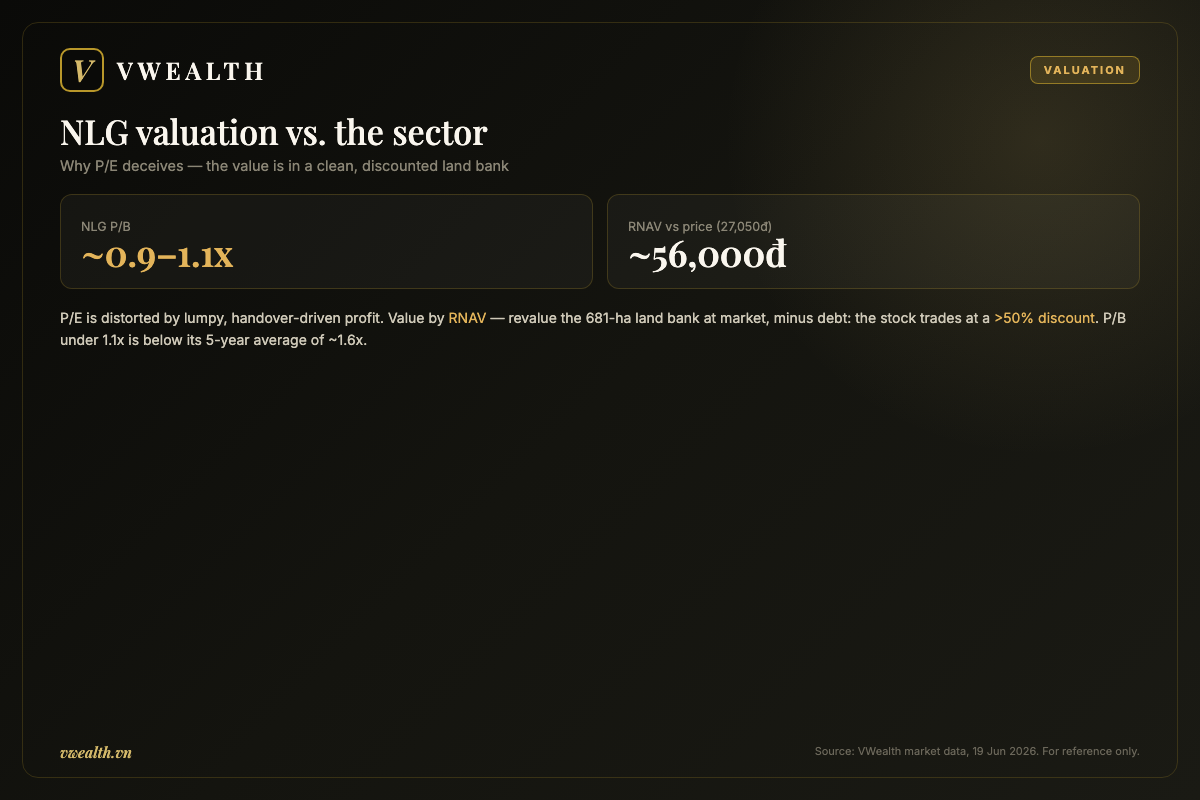
The RNAV figures analysts give are worth remembering. Some reports estimate NLG’s RNAV around 56,000-56,640 dong per share. Against the market price of 27,050 dong, this means the stock trades at a discount deeper than 50% versus the revalued real asset value. In other words, the market is valuing Nam Long’s land bank at less than half what it deserves. For a business with a healthy balance sheet and a legally-clean land bank, this discount is what many value investors see as an attractive “margin of safety.”
On P/B, at current prices, NLG trades around 0.9-1.1 times book value. This is notably below the stock’s own 5-year average of about 1.6 times. When a business trades below book value and below its own historical average, while its financial internals aren’t worsening but strengthening, that gap usually reflects the market’s wariness toward the whole industry rather than a problem with the business itself.
“Defensive real estate” — why the market favors NLG
The phrase “defensive stock” is usually tied to power, water, essential consumer goods — few use it for real estate, an industry famous for cyclicality and risk. But for NLG, many analysts willingly apply this label. Let’s look at four reasons.
First, Nam Long sells homes for real living need. Unlike developers betting on luxury, resort or speculative segments, most of Nam Long’s products — through brands like Ehome, Flora, Valora — target the real housing need of the swelling middle class. This is the most durable demand, least likely to “evaporate” when the market struggles. When speculators retreat, owner-occupiers still need a roof. This durability of the customer base creates a “cushion” for NLG’s sales through cycles.
Second, and most important, is the clean balance sheet. This is what makes Nam Long stand out amid an industry just through a real-estate-bond storm. Look at the end-2025 numbers:
- Nam Long shifted from a net debt of 3,121 billion dong (end-Q3 2025) to net cash of 2,645 billion dong by end-2025.
- The debt-to-equity ratio is a very low 0.37 times.
- The net-debt-to-equity ratio is negative 18% — meaning the company has more cash than debt.
- Total outstanding debt fell sharply 21% year on year, to about 5,524 billion dong.
- The current ratio is 3.0 times — rated “very safe” for real estate.
Amid many peers struggling to roll over bond debt, bearing interest and dumping assets for liquidity, a real-estate developer with positive net cash is an almost luxurious advantage. It gives Nam Long the leisure to choose when to release goods, not forced to sell products or land cheaply just to survive. For you — the shareholder — this means the risk of dilution from rescue issuance, default risk or insolvency risk are all very low.
Third, Nam Long has quality foreign shareholders. NLG’s ownership has long featured reputable financial institutions. Dragon Capital-group funds hold about 8%, Finland’s Pyn Elite Fund holds around 4%, and at many points there was the presence of Keppel Land-linked entities. More important than the presence on the register is the strategic partnership with Japanese conglomerates — Hankyu Hanshin, Nishi Nippon Railroad, and recently Tokyu — at key projects. A Singaporean fund, Ibeworth (tied to Keppel), fully divesting its 7.64% in 2025 sounds like bad news, but set in the context of the seller’s portfolio restructuring and that block being absorbed by the market, it doesn’t change the Japanese-partner story that is Nam Long’s long-term pillar.
Fourth, steady dividends. A defensive stock needs to pay patient shareholders, and Nam Long does. The Board approved a 2025 cash dividend of 5%, equal to 500 dong per share, with a record date of 15 June 2026 and payment 30 June 2026 — a total outlay of over 240 billion dong. This cash dividend isn’t high in yield if you look only at the absolute number, but its steadiness and the business maintaining payment during a tough industry period is a financial-discipline signal long-term investors cherish.
These four factors combined explain why on many analysis forums, NLG is often called “the safest real-estate stock in its group.” Not because it rises fastest, but because it’s least likely to be blown away.
Price action: why NLG is less “crazy” than the rest
If you plot NLG’s price chart next to a typical speculative real-estate stock’s, you’ll see two entirely different characters. NLG moves, but its rhythm is tied to fundamentals rather than rumors or hot money. Specifically, NLG’s price usually moves along three axes.
The first axis is the real-estate cycle and home-loan rates. Because Nam Long sells to real owner-occupiers, the stock’s health depends directly on the middle-class base’s home-loan ability. When home-loan rates cool, demand is activated, presales improve, and the stock reacts positively. Conversely, whenever the rate level twitches up, NLG faces pressure as buyers hesitate.
The second axis is the sales and handover progress of the backbone projects. The three names to remember are Waterpoint (Southgate), Akari City and Izumi City. Full-year 2025 sales reached a record 11,855 billion dong, up 128% year on year, of which Southgate/Waterpoint contributed up to 44% and Izumi City 17%. The backlog value — signed but not-yet-handed-over contracts — at end-2025 reached about 11,000 billion dong, ensuring abundant revenue and profit for 2026-2028. Every piece of news on the legal progress, new-subzone launch or handover batch of these three projects directly impacts price expectations.
The third axis is legal and infrastructure news. This is where NLG stock truly “rides” the planning map. Most of Nam Long’s land bank is in Long An (Waterpoint) and Dong Nai (Izumi, Paragon Dai Phuoc) — exactly the areas benefiting directly from HCMC’s Ring Road 3. When there’s news that Ring Road 3 is expected to close its full loop by end-2026 and the Dong Nai 2 bridge breaks ground, Nam Long’s land-bank value is re-rated positively, because inter-regional connectivity infrastructure raises the commercial value of each plot.
The crux for you is: because all three axes are fundamental, long-term and trackable factors, NLG’s price action is less wildly speculative than the hot real-estate group. This stock isn’t suited to those seeking to double their account in a month, but is very suited to those wanting to invest on a basis, able to explain why they buy and on what.
Catalysts and risks: two sides of a coin
Every serious investment thesis must weigh both sides. Look at the drivers that could push NLG up, then what could pull it down.
On the catalyst (upside) side:
- Real-estate recovery plus low rates: When the industry cycle reverses and home-loan costs stay low, real housing demand is strongly stimulated — exactly the segment Nam Long dominates.
- Infrastructure lifting land value: Ring Road 3, expressways and connecting bridges raise land value in Long An and Dong Nai, where Nam Long holds a large land bank. Izumi City’s future phases (phases 4-9, about 13,000 apartments) are seen as a “strategic value reserve.”
- Selling project stakes to Japanese partners: The model of transferring part of a project to Japanese partners (like the Tokyu deal, or transferring 15% of Izumi estimated to bring about 470 billion dong) both helps Nam Long realize profit early and reduces capital risk while sharing development costs.
On the risk side:
- Weak demand: If the macroeconomy slows or homebuyer confidence weakens, sales may fall short of the ambitious plan, directly affecting later years’ revenue.
- Profit lumpiness: This is both an industry trait and a risk. Lumped profit makes each quarter’s and year’s result swing strongly, easily disappointing if a handover batch is delayed by legal or construction snags. Impatient investors may dump just because of one “empty” profit quarter.
The bottom line: which kind of investor does NLG suit?
Having gone through all the data layers, let me wrap up the NLG story as frankly as possible for you. Nam Long isn’t a stock to “hit fast, win fast.” A P/E near 19 times will make you hesitate if you use the wrong measure; but viewed through the RNAV lens with a discount over 50% and P/B below 1.1 times — lower than its own historical average — this stock appears as an asset the market values overly cautiously.
NLG is a defensive real-estate stock: based on durable real living demand, a clean balance sheet with positive net cash, an attractive RNAV-valued land bank, and a quality foreign shareholder structure. The downside is rugged profit by handover batch. This is a stock suited to long-term, quality-oriented investors who accept patience — not to short-term wave-chasers.
In other words, if your portfolio needs a real-estate “anchor” — a name that reassures you that even if the industry hits storms, this business still has cash in the vault, still has a clean land bank, still has owner-occupier buyers — then NLG deserves a place on your watchlist. And to fully understand why “defensive real estate” is such a valuable positioning in this period, you need to place Nam Long’s own story in the bigger picture of the whole industry — which we dissect together in the Industry context section right after.
Economic and residential real-estate context
You can’t correctly value a real-estate stock if you separate it from the cycle it’s drifting in. With Nam Long (NLG) at 27,050 dong, a P/E of about 16 times, 2025 parent after-tax profit of 701 billion dong and full-year sales of up to 11,855 billion dong, you’re looking at a business that just passed the bottom of a harsh cycle and is rising on a financial foundation swept clean. But to understand why that sales figure rose up to 128% year on year, you must look back at how low the whole industry fell before.
From the 2022–2023 crisis bottom to the recovery cycle
The 2022–2023 period was one of the deepest downturns Vietnam’s residential real-estate industry ever experienced. Three pressures squeezed at once. First, tightening the corporate-bond market’s discipline after a series of shocking events, freezing the most important capital-raising channel for developers. Second, the interest-rate level pushed high to fight inflation and stabilize the currency, spiking businesses’ cost of capital while cutting off people’s home-loan ability. Third, backlogged legal bottlenecks left a series of projects unable to develop, sell or hand over.
The consequence was a vortex: businesses couldn’t sell so had no cash flow, no cash flow so had to dump assets or reschedule debt, homebuyer confidence collapsed, liquidity dried up. Many highly-leveraged businesses paid dearly. It was precisely in that context that the difference of a clean balance sheet became clearly exposed — and this is the point to remember when returning to assess NLG later.
Into 2024–2026, the picture reversed. Per market analyses, Vietnam’s real-estate industry is gradually regaining growth momentum thanks to three props improving together: a rate level lowered and stable in a zone much below the 2022–2023 peak, a new legal framework unclogged, and new project supply expected to recover strongly in 2026–2027.
The new trio of laws and the wave of legal unblocking
The most profoundly game-changing factor is the trio of laws effective from 2024: the Land Law, the Housing Law and the Real Estate Business Law. All three were applied earlier than planned, aiming to make procedures transparent, clarify the land-pricing mechanism, tighten discipline on future-formed sales, and unclog the legal knots that were the root cause leaving thousands of projects “frozen.”
Then came a series of specific unblocking resolutions: Resolution 170/2024/QH15 and Resolution 265/2025/QH15 expanded the mechanism to handle difficulties for projects nationwide; Resolution 29/2026/QH16 created a corridor to handle land violations arising before the 2024 Land Law took effect. You should understand this chain of documents in its practical sense: each “frozen” project unblocked returns to supply, each land-financial obligation clarified lets a business release goods. For a developer with a large land bank and most financial obligations completed like NLG, this is a favorable environment.
Legal unclogging isn’t an abstract matter. It’s the valve that decides whether a land bank on paper turns into recognizable sales or not. This is why, for the same land bank, its value in 2023 and in 2026 can be very different.
Interest rates: a double-edged sword
Interest rates are a variable to view in balance, not gilded. The positive side: housing-support policy has been widened — the income ceiling to access social housing was raised to 25 million dong a month for individuals, and the social-housing loan rate at the Vietnam Bank for Social Policies fell to about 5.4% a year. The general rate level below the crisis peak lets both businesses and homebuyers breathe easier.
But the other edge of the blade has begun to show: many banks sharply raised home-loan rates in Q1 2026. This is a signal you must watch closely, because the housing segment’s demand depends heavily on the actual home-loan rate people must bear. Home-loan rates rising again can erode the very recovery driver the whole industry is counting on.
Real housing demand: the most durable foundation
If I had to choose the most durable reason for the affordable-housing segment, it’s real living demand. Vietnam’s urbanization rate is around 40% with large room to grow; a young population and a labor force continually shifting to large cities create new housing demand each year. This isn’t speculative “flipping” demand — it’s living demand, tied to starting families, settling careers, sending children to school.
The problem is a serious supply mismatch. The luxury segment makes up a large weight of new goods, while affordable and social housing remain in shortage. Market analyses describe this with a very evocative phrase: real estate accelerates its recovery but affordable housing is still “thirsty” for supply. For a business with a core positioning in the affordable segment like NLG, this supply-demand mismatch is exactly the market gap it fills.
Infrastructure: a boost for satellite areas
The final driver layer of the context is infrastructure, and this is where the industry story fits directly onto NLG’s land-bank map. A series of key works around HCMC are heading to the finish line in 2026:
- HCMC Ring Road 3 is expected to open the full route in 2026. When operating, the distance from Ben Luc (Long An) to HCMC’s center or to Binh Duong, Dong Nai shortens to just 30–45 minutes — and Ben Luc is precisely where the Waterpoint township, NLG’s key project, is located.
- Long Thanh International Airport (total investment about 16 billion USD) is expected to begin commercial operation from late 2026 with an initial-phase capacity of about 25 million passengers a year, creating a new growth pole for eastern HCMC and Dong Nai — where NLG has the Izumi City and Paragon Dai Phuoc projects.
- The expressway and connecting-road network (HCMC – Long Thanh – Dau Giay, Bien Hoa – Vung Tau, Ben Luc – Long Thanh, routes 25B, 25C, the Nhon Trach bridge) is expected to be basically synchronized by end-2026.
The economic mechanism here is very clear: infrastructure shortens travel time, turning distant “satellite” areas into feasible living places for those working in the center, thereby pulling demand and land value in Long An, Dong Nai up. Most of NLG’s strategic land bank sits exactly on these benefiting axes.
The context’s risks
For balance, you need to note the picture’s dark side. First, the demand recovery may be slow and uneven — the industry’s recovery so far leans heavily toward Hanoi, HCMC and certain segments, not yet spreading evenly. Second, high home prices combined with home-loan rates edging up create double pressure on real buyers’ affordability. Third, when legality is unclogged, new supply bursting out also means fiercer competition — NLG’s satellite-area projects will compete directly with many other developers targeting the same segment and area. Finally, the 2026 real-estate price forecast of about 5–8% is concentrated in infrastructure-served areas — meaning the reward is real but not a vertical surge, and it requires the business to sell goods, not just “hold land waiting for prices.”
Trend prediction
This section doesn’t aim to guess a price. The goal is to point out the real drivers that will decide NLG’s result over the next 2–3 years, then place them in three scenarios for you to weigh the probabilities.
The main drivers
Aggregating from the industry context and business specifics, there are six interwoven drivers:
- Durable real housing demand in the affordable segment — the least volatile demand base through the cycle, and NLG’s home turf.
- The interest-rate level generally below the crisis peak, supporting both the business’s cost of capital and home-loan ability — though home-loan rates edging up need watching.
- Legal unclogging thanks to the 2024 trio of laws and the chain of unblocking resolutions, letting the land bank convert into sellable products.
- Infrastructure reaching the finish line (Ring Road 3, Long Thanh Airport, expressways) lifting the value of Long An, Dong Nai where NLG holds land.
- The model of selling stakes to Japanese partners — Hankyu Hanshin Properties holds 34.1% at Izumi City; project-stake transfer deals (like the Tokyu deal, and selling part of the Izumi stake) both help realize profit early and share development risk.
- Handover backlog — unrecognized revenue (backlog) at end-2025 reached about 10,878 billion dong, a profit “reserve” for 2026–2027 as Waterpoint/Southgate, Central Lake and Izumi City enter handover (Akari is an apartment project already contributing cash flow in western HCMC).
The crux to remember: the 11,855-billion sales of 2025 aren’t yet profit. In real-estate accounting, sales are customers’ purchase money, while profit is only booked upon handover. The over-10,000-billion backlog is precisely the bridge connecting today’s sales to coming years’ profit — and that’s why NLG’s profit outlook leans bright if the handover pace goes smoothly.
Three scenarios
Positive scenario. Real estate recovers strongly and broadly, home-loan rates stay low, affordable-segment demand springs up. Infrastructure reaches the finish on time (Ring Road 3, Long Thanh Airport late 2026) triggering a new price level in Long An, Dong Nai. NLG sells well at Waterpoint/Southgate, Izumi, Central Lake and hands over on schedule, while closing more capital-sale deals with Japanese partners. Consequence: profit clearly exceeds the 701-billion 2025 base (analysts forecast 2026 after-tax profit possibly around the trillion mark or above), RNAV gradually recognized by the market, valuation with room to improve. Some recommendations set an RNAV target price in the 38,600–58,600 dong range depending on method and assumptions — notably above the current 27,050 dong, but you should view it as a favorable-scenario reference range, not a promise.
Base scenario. The market recovers steadily but doesn’t boom, prices rise around 5–8% in well-infrastructured areas. NLG sells and hands over on plan, but profit is lumpy — jerky by year depending on which project finishes and which capital-sale deal closes. Some years profit high thanks to booking a large project or a capital sale; the next year may stall before the next handover batch. Consequence: the share price swings around intrinsic value, P/E “distorted” and hard to compare directly year by year, the reward accruing to the patient who view across a multi-year cycle rather than each quarter.
Negative scenario. Weak demand persists, home-loan rates rise again eroding affordability, new supply bursting out fiercens competition in satellite areas, and handover progress slows due to remaining snags. Consequence: profit falls short of expectations, thousand-billion property inventory lingers, cash flow slows. Fortunately, the clean balance sheet and net-cash-turned-negative-debt status give NLG a “buffer” to withstand this scenario far better than highly-leveraged businesses — but the share price can still face correction pressure.
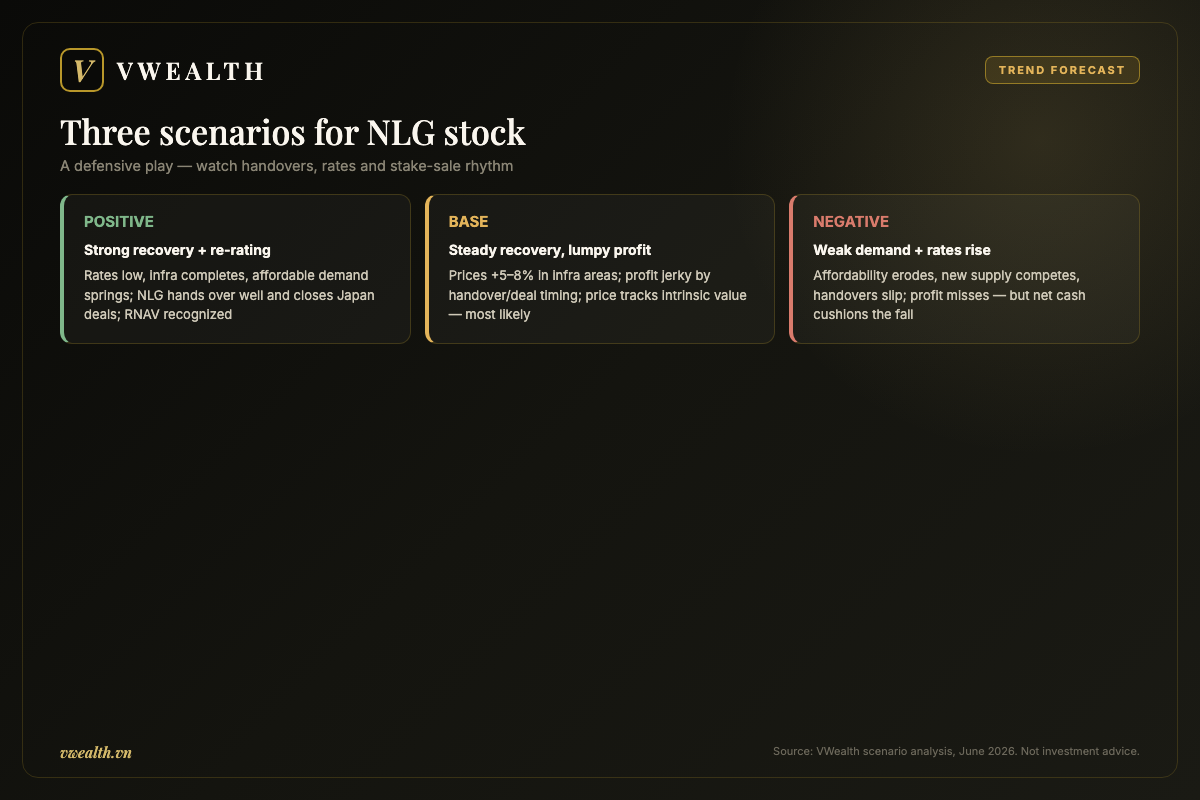
Probability leans toward the base scenario: recovery is a confirmed trend, but its pace still depends on home-loan rates and demand — two variables not yet entirely clear. What you should anchor to isn’t a target price number, but tracking the right indicators: actual handover progress, new sales volume each quarter, home-loan rates, and the rhythm of capital-sale deals.
Should you buy NLG stock?
This is the part you’ve awaited, and also the part I won’t answer for you with a single “buy” or “sell.” An analyst’s job is to put both sides fully on the scale, then point out which kind of investor suits this stock. The final decision — and its risk — belongs to you.
The pros
- A segment durable through the cycle. NLG lives on affordable housing — real demand, tied to urbanization and a young population, less volatile than luxury or speculation. This is the industry’s most durable demand cushion.
- A clean, among-the-safest balance sheet. The business sharply reduced leverage, shifting from positive net debt to negative, with abundant cash (over 5,000 billion dong at a point in 2025). In an industry where many rivals nearly collapsed on debt, this is a real defensive advantage.
- A Japanese partner model that shares risk and realizes profit early. Joint ventures with Hankyu Hanshin, Tokyu… help NLG both standardize governance and collect money early via project-stake sales instead of bearing all development costs and waiting until handover.
- A large land bank in infrastructure-benefiting areas. Waterpoint (Long An), Izumi/Paragon Dai Phuoc (Dong Nai) sit exactly on the Ring Road 3 and Long Thanh Airport axes, with most land-financial obligations completed.
- Quality foreign shareholders and good governance. The long-term presence of Japanese conglomerates is a proof of operational discipline and transparency — NLG is also among Vietnam’s most valuable real-estate brands.
- Attractive RNAV valuation and steady dividends. Many analysts value NLG by RNAV in a range above the current price; the business maintains a steady cash dividend (5% for both 2025 and 2026), suiting those wanting stable cash flow.
The cons
- Lumpy, hard-to-forecast profit. This is the biggest analytical risk. Profit is jerky by handover pace and capital-sale deals, making year-over-year comparison easily misleading and impatient investors easily spooked.
- Dependence on the real-estate cycle, demand and home-loan rates. When loan rates rise or purchasing power weakens, both sales and handover progress can slow.
- “Distorted” P/E. A P/E of about 16 times based on a specific year’s profit can mislead, because the profit denominator swings strongly by year. For this kind of stock, RNAV reflects value better than P/E, but RNAV depends heavily on assumptions.
- Growth bound to handover progress and legality. A project slow to unblock or hand over can push a whole year’s profit to the next.
- Part of profit comes from project-stake sales — non-recurring. Gains from transferring capital to Japanese partners improve short-term results but are one-off, not to be extrapolated as a durable trend. NLG was also once penalized related to bonds and still holds thousand-billion property inventory — points to watch.
Which kind of investor does NLG suit?
A neutral stock isn’t inherently “good” or “bad” — it suits or doesn’t suit each person’s goals. Hold NLG up against four investor types:
| Investor type | Fit with NLG |
|---|---|
| Long-term / quality investor — believes in real housing demand, prefers a business with a clean balance sheet, accepts lumpy profit and views across a multi-year cycle | High fit. This is almost NLG’s “ideal customer” portrait: financial safety, an infrastructure-benefiting land bank, steady dividends, RNAV room remaining. |
| Income / dividend investor — prioritizes stable cash flow | Moderate fit. The steady 5% cash dividend is a plus, but the yield isn’t high, so it’s a bonus rather than the main reason. |
| Fast, steady growth investor — wants next year’s profit smoothly higher than this year | Low fit. Lumpy profit by handover directly contradicts the expectation of smooth growth. |
| Short-term speculator / hot wave-chaser — seeks strong volatility with news | Low fit. NLG is a multi-year cycle and handover story, not a “wave-riding” stock; the 2026 context is also described as hard to “ride waves.” |
In short: if you’re a long-term investor who believes in real housing demand, likes a real-estate business with a safe balance sheet and is willing to endure lumpy-profit years in exchange for asset quality and sustainability, NLG is a name worth studying carefully. If you need fast, steady growth, or seek short-term waves, NLG will most likely make you impatient.
The most important thing I want you to carry away: don’t judge NLG by one year’s P/E, and don’t expect a straight upward profit line. Assess it as a portfolio of land and projects passing through cycles — track handover progress, selling strength, home-loan rates and the rhythm of stake sales to partners. Those are the indicators that reveal this business’s true health.
Disclaimer
This article is produced for informational and reference-analysis purposes, and is not a recommendation to buy, sell or hold NLG or any security. The figures, valuations and scenarios are compiled from public sources at the time of writing and may change with the market. Every investment decision is your own and carries the risk of capital loss. You should do your own thorough research, weigh your risk appetite and financial situation, or consult a licensed investment advisor before deciding. vwealth.vn and the author bear no responsibility for any losses arising from the use of information in this article.
Research Vietnamese stocks in English with vwealth. Our AI-powered platform turns Vietnamese market data into full English analysis reports — with international payment support and a free 2-month trial for new accounts. Create your free account and read the latest reports.