There are stocks you look at on the price board and immediately understand their story. VIC is not one of them. Standing in the VN30 basket, the ticker of Vingroup is one of the most controversial names on HOSE: both a source of pride and a question mark; both hailed as “the locomotive of Vietnam’s private economy” and suspected of being a money-burning gamble with no clear ending. In the 19 June 2026 session, VIC closed at 205,500 dong per share — the most expensive of the pillar stocks, so expensive that many individual investors, seeing the triple-digit price, hesitate to touch it. But behind that number is the country’s largest private conglomerate, belonging to the country’s richest man: Mr. Pham Nhat Vuong, whose personal wealth was at times tied to every up-and-down beat of an electric-vehicle stock on the other side of the world.
The appeal — and the discomfort — of VIC lies in the fact that it’s two opposite stories wrapped in one ticker. On one side is Vinhomes, the cash-cranking real-estate machine, contributing most of the profit and the reason the group crossed nearly 333,000 billion dong of revenue for the first time in 2025. On the other is VinFast, the industrial child devouring billions of dollars a year, listed all the way on the US Nasdaq, carrying the dream of bringing a Vietnamese brand to the world but also carrying losses that keep no small number of shareholders awake at night. Buying VIC, what are you betting on — the certain cash flow from sold-out urban areas, or the global EV chess game that could win big but could also collapse? And more importantly: what kind of investor suits a stock like this?
To answer, you can’t just look at the latest quarterly report. You have to go all the way back to an instant-noodle workshop in Ukraine thirty years ago, where it all began. Because to understand why VIC dares to burn billions of dollars on cars, you must understand who’s at the wheel — and how he has placed such large bets throughout his business life. That’s what the section below will tell you.
VIC market data (updated 19 June 2026)
| Current price | 205,500đ | 2025 revenue | 332,770 bn (+76%) |
| Change (June) | +0.29% | 2025 after-tax profit | 11,146 bn (+111%)* |
| VinFast 2025 | Loss ~$3.9bn | P/E | P/B | ~136x (distorted) | ~10.7x |
*2025 profit was propped by a one-off gain (VRE divestment) + a Vinhomes handover peak. Source: VWealth price data + VIC 2025 reports. For reference only.
History and evolution
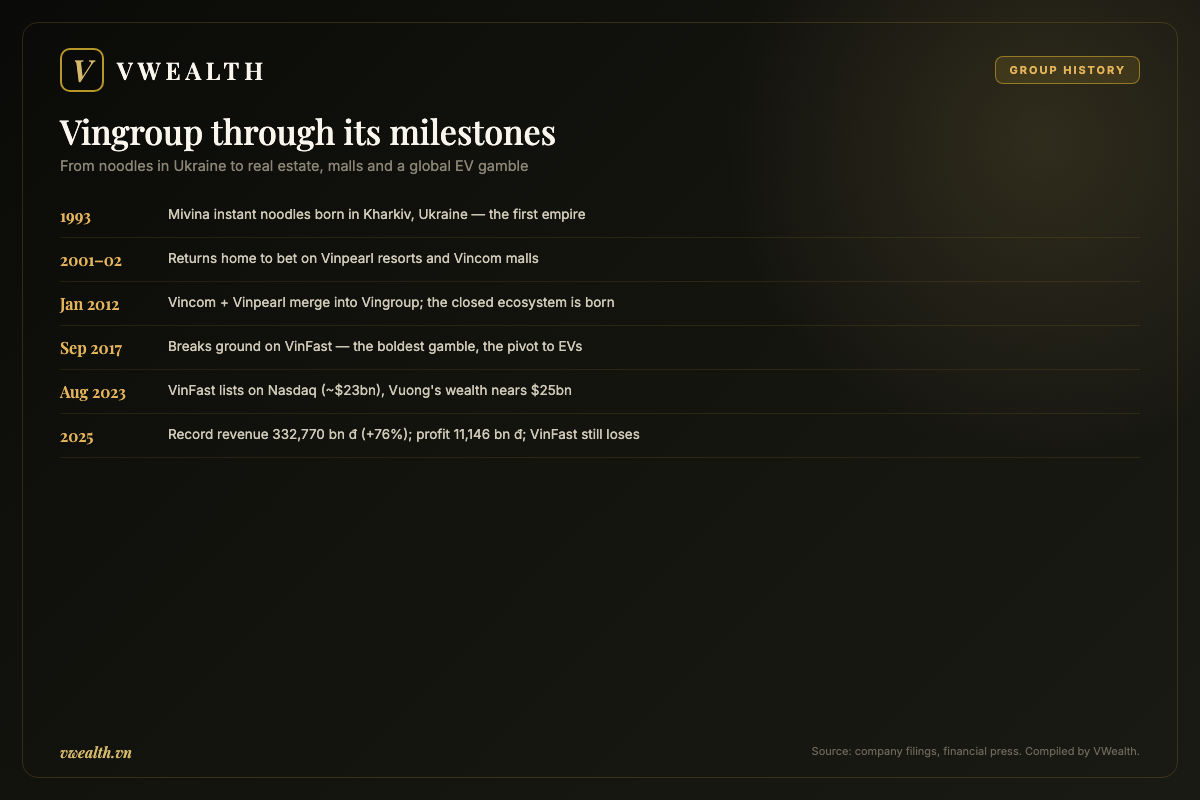
Every empire has an origin myth, and Vingroup’s begins not in Hanoi or Saigon, but in the frigid Ukrainian city of Kharkov in the early 1990s. The Soviet Union had just collapsed, supermarket shelves were empty, and a young Vietnamese engineer with a geology degree from Moscow saw what most others didn’t: a market hungry for essential goods. In 1993, Mr. Pham Nhat Vuong and his wife Ms. Pham Thu Huong borrowed 10,000 USD from friends to found Technocom and open a restaurant. On 8 August 1993, the first packet of Mivina-branded instant noodles was born.
This is a detail to remember, because it shaped his entire later business style. Vuong didn’t sell noodles to Vietnamese in Ukraine — a tiny niche market. He sold to all of Ukraine, turning an everyday product into a national consumption habit. By the mid-2000s, Mivina dominated to the point that one source records up to 97% of Ukrainian consumers had used it; “instant noodles” was almost synonymous with “Mivina.” From noodles, Technocom expanded into seasonings, instant mashed potatoes, and built its own factories. That was the first and most important lesson in the group’s “gene”: choose a mass market, dominate it by scale, build your own factory instead of just trading.
In 2010, Mr. Vuong sold Technocom’s entire fast-food business to Nestlé — the Swiss food giant — in a deal many sources valued around 150 million USD. For you, an investor, this is a pivotal moment: he wasn’t in love with his instant-noodle “child.” When a business segment peaked and someone offered a good price, he sold decisively to raise capital for a bigger game. This “close fast, cut clean” decisiveness would recur many times, and it’s the key to understanding Vingroup’s shocking later decisions.
Returning home to bet on resort real estate and malls
Interestingly, Vuong didn’t wait until he’d sold Technocom to return home. From the early 2000s, while noodles were still cranking cash in Ukraine, he quietly shifted capital back to Vietnam and placed it in two areas seemingly unrelated to noodles: resort tourism and urban real estate.
In 2001, Vinpearl was born with a resort project on Hon Tre island, Nha Trang — an island that at the time was still wild, which many considered crazy to pour money into. In 2002, Vincom Joint Stock Company was founded, its centerpiece Vincom Ba Trieu in Hanoi — one of the capital’s first modern malls. Why these two fields? Because Mr. Vuong saw what the macro data was revealing: a Vietnam growing richer, a rising middle class about to crave decent housing, luxury shopping, and class resorts previously only available abroad. He no longer sold noodles to the poor; this time he sold a lifestyle to the soon-to-be-rich.
And once again, the old formula repeated at a larger scale: don’t do it small, do it huge to define a whole segment. Vincom Ba Trieu set a new standard for Vietnamese malls; Vinpearl Nha Trang, with an over-sea cable car once the world’s longest, turned an island into a national destination. This was the phase where Vingroup learned to create demand rather than merely meet it.
The 2012 merger and the closed-ecosystem model
In January 2012, the two pillars Vincom and Vinpearl formally merged, operating under one roof named Vingroup Joint Stock Company. (The stock had actually been on HOSE since 2007 under the ticker VIC, formerly Vincom shares.) The merger wasn’t just an accounting maneuver. It marked the moment Vingroup shifted from “a few companies doing real estate and resorts” into a multi-industry conglomerate with the ambition to cover the entire lifecycle of a Vietnamese consumer.
This is when the most famous concept tied to the Vin brand was born: the closed ecosystem. Picture the life of an urban middle-class family through the “Vin” lens: you live in a Vinhomes apartment, on weekends shop at the Vincom mall right beneath your building, in summer the whole family vacations at Vinpearl, the kids study at Vinschool (founded 2013), when sick you go to Vinmec hospital (founded 2012), and if you want an elite university there’s VinUni (founded 2020). Each piece is both a business segment and a reason for customers to never step outside the Vin universe.
The implicit philosophy is very clear: if you control a customer class’s entire living experience, you don’t just sell to them once, you keep them for life. For investors, that’s a competitive “moat” — but also an enormous capital-devouring machine because everything must be self-built.
During this phase, Vinhomes — the residential real-estate brand — became the main profit machine. Mega-townships like Vinhomes Riverside, Times City, and later the “super-projects” Ocean Park, Smart City, Grand Park at thousand-hectare scale made Vingroup Vietnam’s largest residential developer. It’s the surging cash flow from Vinhomes that funded every subsequent adventure. Remember this point: in VIC’s structure, real estate is the “money printer,” while the other segments are mostly places to spend money. Balancing those two sides is the whole investment story of this stock.
The boldest turning point: VinFast and the 2017 EV gamble
If you had to choose one moment that splits Vingroup’s history in two, it’s 2017. In September that year, the group broke ground on the VinFast plant in Hai Phong with an ambition most observers considered unrealistic: a Vietnamese making cars, and not just for the domestic market but aiming at the global market, then quickly pivoting entirely to electric. A country that had never had a real auto industry, a group born from noodles and real estate, intending to compete with Toyota, Tesla, BMW. It sounded like fantasy.
But that was the old “gene” at its largest scale ever: choose a mass field, bet on enormous scale, build your own factory. The difference this time was that the bet was so large it could drag down the whole group if it failed. VinFast quickly launched its first models, then decided to “kill off” its entire gasoline line to concentrate on electric — an extremely bold move.
The gamble peaked in August 2023: VinFast listed on the US Nasdaq via a merger with a SPAC, with an initial valuation around 23 billion USD. On its first trading day, VFS shares exploded, at one point pushing market cap to enormous figures and bringing Mr. Vuong’s wealth close to 25 billion USD, cementing his position as the richest man in Vietnam and the region. VinFast became the first Vietnamese business to successfully list on a US exchange — a historic symbolic milestone.
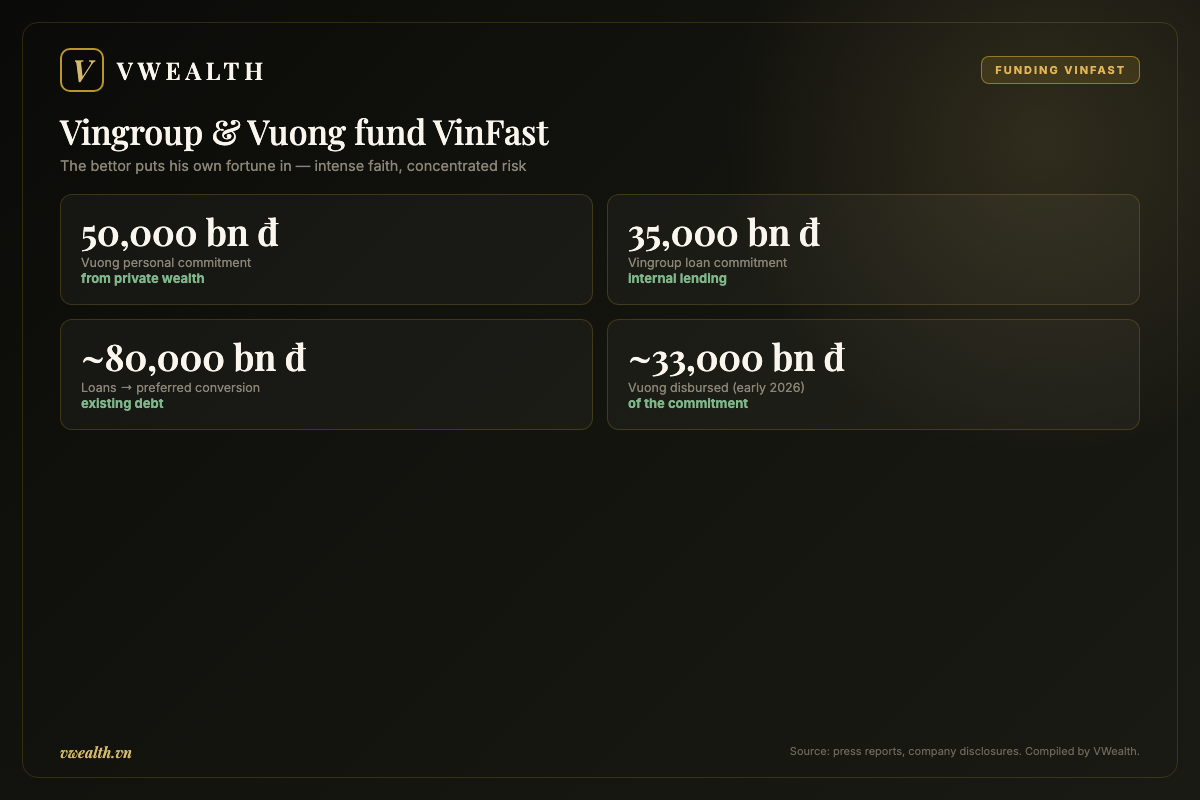
But symbolism doesn’t pay the bills. VinFast lost billions of USD a year, and to feed it, Mr. Vuong did something rare for a billionaire: he signed a Funding Agreement announced in April 2023, committing to inject money from his own personal wealth into VinFast. By end-September 2023, VinFast had received about 30,000 billion dong, of which 7,000 billion was Mr. Vuong’s direct funding, the rest from Vingroup-disbursed loans. This is what makes VIC both appealing and controversial: the man at the wheel is willing to put his whole fortune into the game — intense conviction, but also extreme concentration of risk.
Exiting retail and phones: the art of “close fast, cut clean”
To understand the seriousness of the VinFast gamble, look at what Vingroup was willing to throw away for it. This is the part of the story that most reveals Mr. Vuong’s character — and the part that splits investors into two camps.
In December 2019, Vingroup shocked the market by transferring the entire VinMart supermarket chain, VinMart+ stores (under VinCommerce) and VinEco agriculture to the Masan Group. A nationwide retail chain, expensively built, “let go” cleanly. In the same period, the VinPro electronics chain and the Adayroi e-commerce platform were also dissolved. Then in May 2021, it was VinSmart’s turn — the Vsmart phone brand that had just climbed into the domestic market-share top tier — declared halted, to shift engineering resources into building infotainment and software for VinFast cars.
| Withdrawn segment | Timing | How handled |
|---|---|---|
| Mivina instant noodles (Technocom) | 2010 | Sold to Nestlé (~$150m) |
| Adayroi, VinPro | 2019 | Dissolved quickly |
| VinMart, VinMart+, VinEco | 2019 | Transferred to Masan |
| Vinpearl Air (aviation) | 2020 | Halted before takeoff |
| Vsmart phones (VinSmart) | 2021 | Halted, staff moved to VinFast |
For one camp of investors, this is evidence of vision and discipline: Mr. Vuong doesn’t let emotion cling to segments no longer fitting, ready to “cut losses” to concentrate all resources on the strategic priority. For the other camp, this chain of continuous “U-turns” is a question mark about stability: doing phones today, dropping them tomorrow; VIC shareholders can hardly predict which segment the group will “close” or “open” next. The truth is in the middle, and that very ambivalence is why VIC is always a stock that divides investors.
2025: a pivotal year and record numbers
After years of doubt, 2025 delivered the strongest riposte yet for the supportive camp. Vingroup recorded consolidated net revenue of 332,770 billion dong, up 76% year on year — the first time the group crossed nearly 13 billion USD in revenue in a single year. After-tax profit reached 11,146 billion dong, more than double (up 111%) 2024; pre-tax profit crossed the billion-dollar mark for the first time. Total assets at year-end exceeded 1.12 quadrillion dong, up 34%.
The driver came from both sides of the story: a series of real-estate mega-projects launched simultaneously nationwide (the “money printer” side), and the outstanding growth of the industrial segment — VinFast delivered 196,919 vehicles globally in 2025, double the prior year, with Q4 alone setting a record of 86,557 (the “gamble” side beginning to show real output). For the first time, people saw that the road Mr. Vuong drew was no longer entirely on paper.
Still, the picture isn’t free of controversy. The impressive consolidated profit, but VinFast still loses money; most of the profit “weight” still comes from real estate. The core question for you remains intact: are you buying a real-estate group carrying a risky EV project, or a future EV maker fed by today’s property cash flow? The answer depends on whether you believe VinFast is a “money-burning abyss” or a “gold mine before its harvest day.”
That’s also why the 205,500-dong price on 19 June 2026 reflects both faith in the enormous scale and a “risk premium” for the undecided chess game. And to weigh those two sides — bold vision and financial discipline, global dream and present cash flow — it all depends on the people in the executive seats. Who are they, what are their abilities and “risk appetite,” and should you entrust your faith (and money) to them? That’s the subject of the next section: Leadership.
Leadership

There are stocks where, when analyzing, you can cleanly separate the business from the person in the chairman’s seat. VIC is not that kind. With Vingroup, if you try to set Pham Nhat Vuong the individual aside to “objectively analyze the numbers,” you’ve missed the very variable that most decides whether this stock rises or falls. Because in this empire, the founder isn’t just the operator — he’s the engine of faith, the bettor, the shield and simultaneously the Achilles’ heel. In this section, you and I will sit down and dissect a paradox few HOSE stocks display so sharply: one person is both the biggest competitive advantage and the biggest systemic risk of the VIC investment.
The man from the noodle packets in Kharkiv
To understand why the market both worships and holds its breath every time Pham Nhat Vuong speaks, you need to return to the starting point. He was born in 1968 in Hanoi, into a family with no business roots. His path to the world was a degree at the Moscow Geological University — a field unrelated to the real estate, cars or phones to come. In the early 1990s, when the Soviet Union collapsed and a whole region fell into an economic vacuum, he didn’t return home but stayed in Ukraine, opened a small restaurant then entered instant-noodle production with the Mivina brand in the city of Kharkiv.
The “noodle king” story in Ukraine isn’t an embellished anecdote — it’s a foundational lesson about his business character. In a hungry market, he read demand correctly, produced at scale, captured market share then sold this segment to Nestlé to bring capital home in the late 1990s and early 2000s. That pattern — spot a large gap, concentrate all resources, move fast, go big, then withdraw or double the bet — would repeat throughout the next three decades, from Vinpearl, Vincom, Vinhomes to VinFast.
In 2013, Forbes first named him to its world billionaires list with wealth of 1.5 billion USD, ranked 974th globally. It was a milestone beyond the individual: for the first time in history, a Vietnamese businessman stood on the same table as the planet’s richest. Throughout 2013–2016, he was Vietnam’s only dollar billionaire recognized by Forbes — a “lone warrior” position. More than a decade later, per the Forbes 2026 ranking, he remains in the top 100 richest in the world, at 93rd with wealth of about 27.7 billion USD; his fortune has multiplied more than fifteenfold since the start.
Why does this biographical detail matter to your decision to buy VIC or not? Because it shapes something intangible yet priceable: execution credibility. When someone has twice built an empire from nothing — once abroad, once at home — the market has reason to believe his promises aren’t empty slogans. This very faith is the “premium” investors are willing to pay for VIC, above pure book value.
Double “skin in the game”: both wealth and honor
In investing, people often talk about “skin in the game” — whether leadership puts their own money into the business they run. With Pham Nhat Vuong, this concept isn’t just true but doubled, in both financial and spiritual senses.
Financially, his family’s attachment to VIC is among the highest on Vietnam’s stock market. Per disclosures and press-cited statistics, Mr. Vuong personally holds a large weight of VIC; his wife — Ms. Pham Thu Huong — also holds a significant portion; and most importantly is the indirect ownership layer through Vietnam Investment Group Joint Stock Company, an entity he chairs and Ms. Huong vice-chairs. Combining direct and indirect, financial sources estimate Mr. Vuong’s family group controls most of Vingroup’s charter capital. You should understand the specific figure can change after each internal transfer or restructuring, so don’t anchor to a fixed percentage; what matters is its direction: this is a business controlled almost absolutely by the founder, not a dispersed public conglomerate.
| Ownership / related layer | Role | Meaning for VIC shareholders |
|---|---|---|
| Pham Nhat Vuong (individual) | Founder, Vingroup Chairman | Absolute control; every major direction comes from one person |
| Pham Thu Huong (wife) | Major shareholder, Vice Chairwoman | Reinforces the family control bloc; “household” decisions |
| Vietnam Investment Group JSC | Large indirect-ownership entity | Raises the controlling weight; a channel for internal ownership restructuring |
| Relatives, family siblings | Related shareholders | Widens the control ring; note when assessing real free float |
The meaning of this structure for you is very two-sided. The upside: there’s no “quick-salary” leader selling bonus shares then leaving the seat. When Mr. Vuong’s personal wealth moves in sync with VIC’s price, his interests and yours — a small shareholder — are fundamentally in the same boat. That’s something many other listed businesses can only dream of. The caution: a high controlling weight means minority shareholders’ voice can hardly change the outcome at the AGM. Buying VIC is placing faith in one person, not in a counterbalancing governance mechanism.
But Mr. Vuong’s “skin in the game” has a second layer the balance sheet can’t record: national honor. In many public statements, he stresses the aspiration to build a Vietnamese brand reaching the world, to prove Vietnamese can master industry and technology. This isn’t harmless PR; it’s a real motivation, and it creates an emotional bond that makes it hard for him to abandon gambles even when financial logic advises stopping. For a clear-eyed investor, “honor” is both a durable strength and a factor that makes risk hard to cut at the right time.
The VinFast gamble: where faith and concentrated risk meet
If you had to point to one place where Pham Nhat Vuong’s “all-in betting” character shows most clearly, it’s VinFast. And this is also where the “advantage-is-simultaneously-risk” story becomes most vivid for VIC shareholders.
Mr. Vuong has, many times, publicly and directly, committed to injecting personal wealth into the EV maker. At the 2024 Vingroup AGM, he declared he would arrange personal wealth to fund VinFast further, leaving behind lines widely quoted by the press:
“We will never let go of VinFast; this is not just a business story.”
“Just as 70 years ago in the historic Dien Bien Phu campaign we had the slogan ‘all for the front, all for victory,’ VinFast is the same.”
And most famously, he said he would support VinFast “until the money runs out.” These statements didn’t stop at words. Per financial reports, he committed large-scale funding to VinFast (the figure cited at tens of thousands of billions of dong for the commitment period through end-2026 alone), alongside Vingroup’s plan to lend to VinFast. Cumulatively across quarters, the amount disbursed from his personal pocket and from the group was recorded by the press at tens of thousands of billions of dong — a real cash flow, flowing steadily, quarter after quarter.
Pause and weigh the two sides of this same fact, because it’s the crux of the whole analysis.
The bright side — intense faith turned into action. Very few businessmen dare take personal wealth to prop up a still-loss-making project burning cash at high speed. This action sends an extremely strong signal to the market: the person who understands VinFast best, who has the most to lose, is still betting more. For shareholders who believe in the long-term vision, this is living evidence of commitment. It also partly isolates the burden: Mr. Vuong and the group repeatedly stress the funding is arranged from personal wealth, deliberately to avoid harming Vingroup and VinFast shareholder interests. If that’s true, it’s a conscious shielding of small shareholders.
The dark side — concentrated risk and the specter of dilution. But you can’t naively believe VIC’s and VinFast’s fates are entirely separate. They share a brand, share a customer ecosystem, and most importantly share one bettor. When resources — including the chairman’s personal wealth — are concentrated on a single front, every other asset in the empire lives under VinFast’s shadow. The line “until the money runs out” sounds heroic to admirers, but to a risk analyst, it’s a warning of a gamble with no natural stopping point. And in periods needing large capital raises, Vingroup’s history shows ownership restructuring, further issuance or internal transfers are always tools that can be used — and each time, the question a small shareholder must ask is: will my ownership ratio and the value of my share be affected?
This is the core paradox of VIC: what makes the stock strong — a leader daring to bet all-in with iron faith — is also what makes it riskiest. You can’t buy only the “reward” of that faith while refusing the accompanying “bill” of risk. The two are one.
Key-man risk: the biggest governance weakness
Any honest analysis of Vingroup’s leadership must name the biggest issue directly: a tens-of-billions-of-dollars empire tied tightly to one person. In governance language, this is “key-man risk.”
Try a cold thought experiment: if tomorrow, for any health reason or event, Pham Nhat Vuong is no longer in the executive position, what happens to VIC? The honest answer is no one knows for sure — and that very not-knowing is the risk. Vision, risk appetite, the ability to raise capital on personal credibility, and the “all for the front” will — none of these transfer easily. A successor CEO can run operations well, but few can replace the role of the honor-guarantor the market prices into the stock.
This doesn’t mean Vingroup lacks a professional executive team. On the contrary, the group has a seasoned senior leadership. Mr. Nguyen Viet Quang has long been Vingroup CEO, rising through executive roles at member companies like Vinhomes and other development entities. In EVs, Ms. Le Thi Thu Thuy — Vingroup Vice Chairwoman, former VinFast CEO then Chairwoman — is one of the most internationalized faces, who directly led VinFast through the listing and overseas expansion. Alongside are a “corps of female generals” and leaders of the real-estate, retail, healthcare and education segments the press has mentioned for years.
| Person | Representative role | Note for investors |
|---|---|---|
| Pham Nhat Vuong | Founder, Vingroup Chairman | The absolute center of all direction; the biggest key-man risk |
| Pham Thu Huong | Vice Chairwoman, major shareholder | Reinforces the family control bloc |
| Nguyen Viet Quang | Vingroup CEO | The axis running the group’s operations |
| Le Thi Thu Thuy | Vingroup Vice Chair, VinFast leader | The internationalized face, tied to the EV gamble |
But you must clearly distinguish operation and soul. This team can run the machine very well, yet the astonishing “steering pivots” — from VinCommerce retail, VinSmart phones, aviation, to concentrating everything on VinFast — all come from one mind. Every Vingroup “pivot” in the past bears Mr. Vuong’s personal imprint: decisive, fast, and sometimes surprising even the market. That’s a strength when the bet is right, but a risk when there’s no counterbalancing mechanism to “brake” a wrong decision. As a small shareholder, you have almost no tool to influence these turning points; you can only choose to trust and ride along, or stay out.
Governance, transparency and internal transactions: what investors must read carefully
Here I want to speak frankly, because this is where many individual investors skim. Vingroup is an enormous ecosystem of many related companies, and the group’s history is tied to rounds of restructuring, internal transfers and related-party transactions. The circulation of cash, assets or shares among Vingroup, VinFast, Vinhomes, family entities and the chairman is common in a group controlled by a founding group.
Related-party transactions themselves aren’t bad — they’re legal and common. But as a small shareholder, you need to be aware of three things. First, when control is highly concentrated, the line between “group interest” and “controlling-shareholder-group interest” needs close monitoring via audited financials and the related-party note. Second, commitments like “funding from personal wealth, no shareholder impact” are commendable goodwill signals, but you should verify via the period-by-period report note rather than only trust AGM statements. Third, every large capital raise or ownership restructuring can affect the free-float ratio and cause dilution — watch Board resolutions and extraordinary disclosures closely, because that’s where dilution risk surfaces earliest.
In other words, VIC isn’t a stock to “buy and forget.” The concentrated governance structure requires you — if holding — to be an active-reading shareholder: read the reports, the resolutions, the internal transactions. Vingroup’s transparency at the disclosure level generally complies with listing standards, but the ecosystem’s complexity makes truly understanding the flow of value a real challenge.
Section summary: one person, two faces of the same bet
So what should you retain? Pham Nhat Vuong is VIC’s biggest intangible asset: a founder with execution credibility proven twice across two empires, with national aspiration large enough to dare bet both wealth and honor, and with controlling ownership that ties his interests to shareholders’. That’s why the market is willing to pay a “faith premium” for this stock.
But those same three things — credibility concentrated in one person, aspiration that makes the gamble hard to stop, and near-absolute control — create the three biggest risks: key-man dependence, concentrated risk on VinFast with the specter of dilution, and the inherent weakness of minority shareholders before “steering” decisions. Advantage and risk here aren’t two separate lists for you to add and subtract; they’re two sides of the very same coin named Pham Nhat Vuong.
When you weigh VIC, the real question isn’t “is this business good” but “are you willing to ride along with this person’s gamble, fully understanding you’re sitting in the passenger seat, not the driver’s?” That answer, no spreadsheet can give for you — and it leads us to the next section, where we dissect the very machine this man built: The Vingroup ecosystem.
The Vingroup ecosystem
If you see VIC only as a real-estate stock, you’re looking at the wrong animal. Vingroup isn’t a company — it’s a federation of empires, each large enough to list on its own, woven together by a single financial logic: take the enormous cash flow from won segments to feed the not-yet-won gambles. Total consolidated 2025 revenue reached 332,770 billion dong — this figure didn’t fall from the sky, it’s the sum of four or five machines running at very different speeds, some spewing cash, some sucking it in like a black hole.
To value VIC, you must dissect each pillar: which prints money, which burns money, which is just a brand, and most importantly — whether the financial thread connecting them is a strength or a breaking point. Let’s go one by one, not a dry list but digging to the bottom.
Vinhomes (VHM) — the money-printing machine feeding the whole group
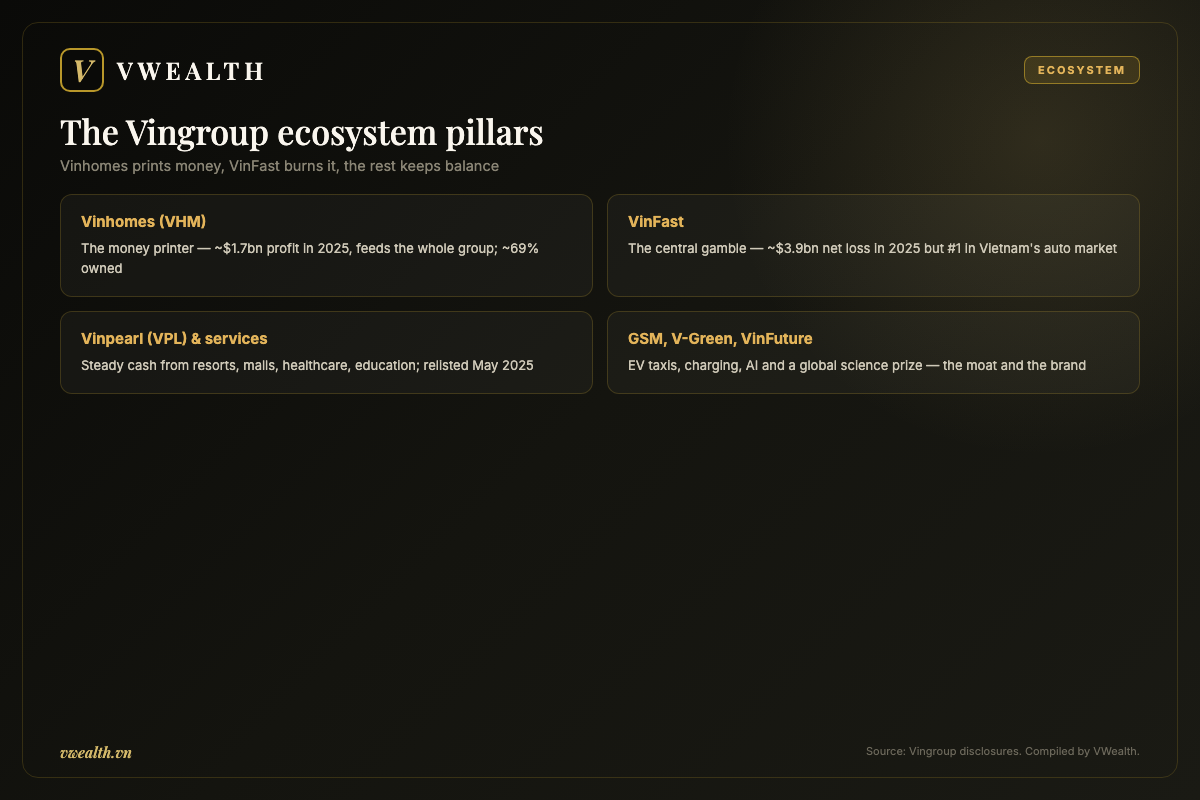
If you had to choose one number to understand why Vingroup still stands after billions of USD in losses elsewhere, it’s this: in 2025, Vinhomes recorded presales (value of newly signed contracts) of 205,300 billion dong — double the prior year, plus an unrecognized backlog of about 186,400 billion dong. Vinhomes’ 2025 after-tax profit hit 43,300 billion dong. To picture it: while VinFast net-lost nearly 4 billion USD, Vinhomes alone earned the equivalent of over 1.7 billion USD. This is the crux of the VIC story.
Vinhomes is Vietnam’s largest residential developer, and “largest” here isn’t empty praise. They don’t sell apartments piecemeal — they create mega-townships. Look at the real sales machines behind the 205,300-billion figure:
- Vinhomes Ocean Park 1-2-3 (Ocean City, Hanoi/Hung Yen): a thousand-hectare urban complex east of Hanoi, with an artificial saltwater lake-sea, the main handover driver making profit explode.
- Vinhomes Royal Island (Vu Yen, Hai Phong): the “billionaires’ island” — a mega-project on an island, one of the largest revenue-recognition sources in 2025.
- Vinhomes Grand Park (HCMC): a mega-township east of Saigon, a 36-ha park, a sales springboard in the southern market.
- Vinhomes Smart City & Vinhomes Royal City, Times City (Hanoi): inner-city urban areas that reshaped Vietnam’s premium-housing face over a decade.
Vinhomes’ model is a fearsome closed pipeline: they buy enormous land banks on the outskirts, self-invest in infrastructure — roads, schools, parks, malls — then sell homes at prices “value-activated” by that very infrastructure. Vinhomes’ gross margin on property sales is regularly 30-50%, among the industry’s highest. When you hold VIC, understand that most of the “intrinsic value” you’re paying for lies in this 69% stake Vingroup holds in Vinhomes.
Vinhomes is to Vingroup like the heart to the body: it pumps cash flow to feed every other organ. When Vinhomes coughs, the whole group catches a cold.
What’s your risk here? Cyclicality. Vietnamese real estate rises and falls with waves of credit, legality and confidence. In 2023 the market froze, Vinhomes’ sales shrank, and all of VIC wobbled with it. The record 2025 sales are wonderful news, but they also remind you this money printer doesn’t print evenly — it prints by the handover rhythm of a few mega-projects. If a legal or credit cycle tightens just when Vinhomes needs money to carry the rest of the group, that’s a scenario to guard against.
Vincom Retail (VRE) — the rental cash flow that left the shared roof
This is a point you especially need to update, because many old analyses still list Vincom Retail as a Vingroup “pillar.” Reality has changed: Vingroup fully divested from Vincom Retail, completed in September 2024. The deal was done by transferring shares in the SDI company (the entity indirectly controlling VRE), bringing in about 1.54 billion USD and recording a financial gain of over 21,300 billion dong for Vingroup. After the transaction, VRE is no longer a subsidiary, no longer consolidated into VIC’s report.
Vincom Retail remains Vietnam’s largest mall operator — the Vincom Center, Vincom Mega Mall, Vincom Plaza system spanning provinces, with a stable, steady rental cash-flow model, 2024 after-tax profit about 4,096 billion dong and targeting a record 4,700 billion in 2025. But — and this is the important “but” for you — that cash flow no longer flows into VIC shareholders’ pockets.
The meaning for you is very practical: divesting VRE gave Vingroup an immediate enormous cash sum (the “fuel” poured into VinFast and debt repayment), but at the same time the group sold off one of its most steady, lowest-risk recurring income sources. When valuing VIC today, you must strike VRE from the consolidated asset list, and understand Vingroup’s structure has shifted: shedding a “defensive” segment (steady rentals) to concentrate on a risky “offensive” one (EVs). That’s a deliberate strategic choice, not an accident — but it tilts VIC’s risk profile decidedly toward the venturesome.
VinFast — the central gamble, or the art of burning money for the future
This is the heart of every VIC debate. VinFast is both a national pride and the largest budget hole a Vietnamese business ever self-dug. You need to see both sides at once, without dodging.
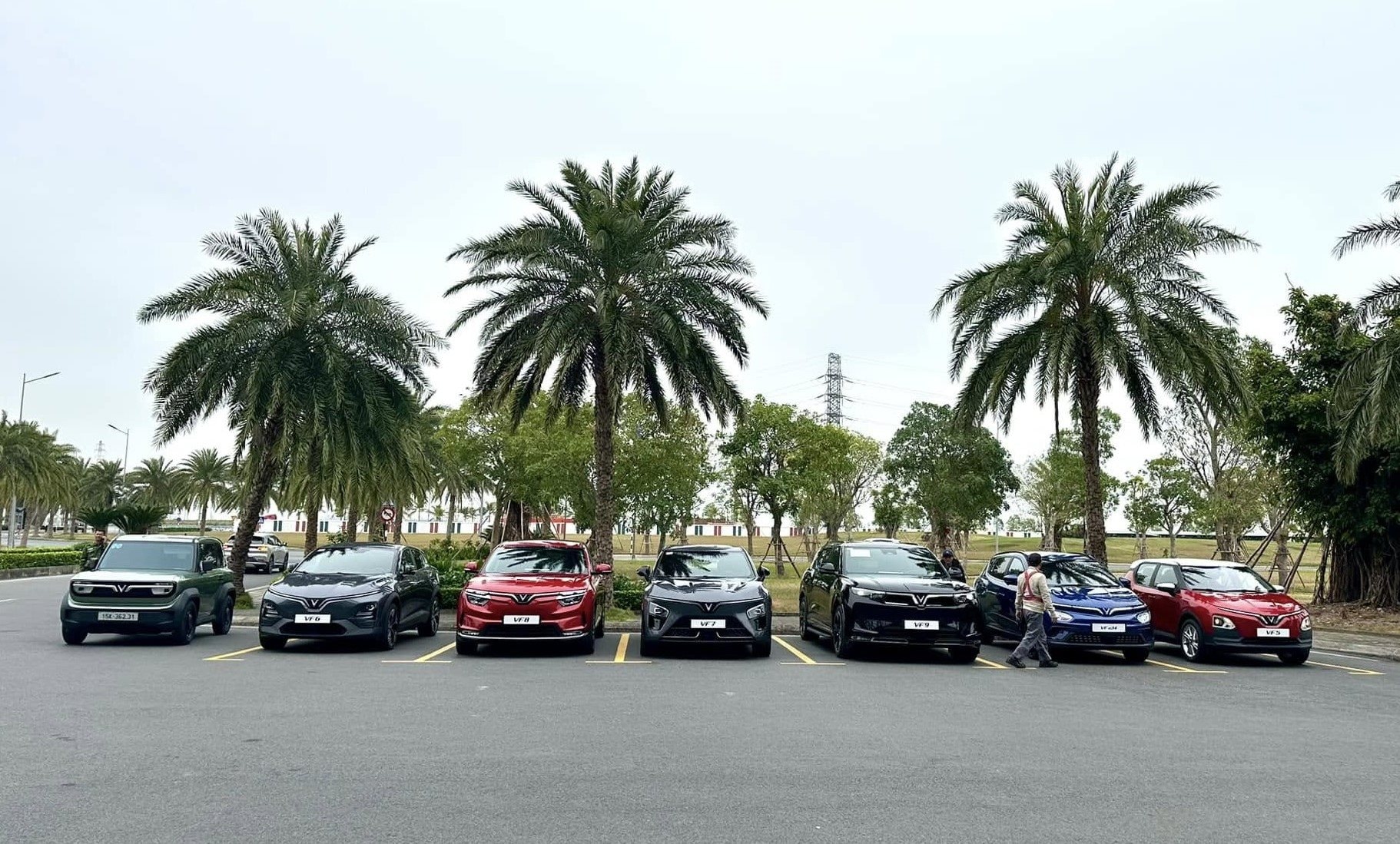
The bright side — the scale is now real: In 2025, VinFast delivered nearly 197,000 electric cars (crossing 175,000 in the domestic market, rising to number one across Vietnam’s entire auto market — surpassing even Toyota and Hyundai by delivery volume). Revenue nearly doubled to about 3.97 billion USD (from 2.05 billion in 2024). In Q4 2025 alone, the maker delivered a record 86,557 vehicles. This is no longer a slide-drawing startup — the Hai Phong plant has a design capacity of up to 600,000 vehicles a year, and VinFast has expanded production to a plant in Indonesia and one under construction in India, plus unfinished ambitions in the US. By operating scale, this is the largest industrial story in modern Vietnam.
The dark side — the bleeding never stops: Also in 2025, VinFast net-lost 3.87 billion USD, higher than the 3.08 billion loss of 2024. Read that number again to let it sink in: 3.97 billion in revenue, 3.87 billion in loss. That means for every dong of revenue, the company burns nearly another dong. Every car sold is still at a loss. This is characteristic of an early-stage EV industry — Tesla also lost money for a decade — but VinFast’s absolute loss scale, versus the financial capacity of a group in an emerging economy, is what makes every analyst hold their breath.
| VinFast metric | 2024 | 2025 |
|---|---|---|
| Vehicles delivered | ~97,000 | ~197,000 |
| Revenue | $2.05bn | ~$3.97bn |
| Net loss | $3.08bn | $3.87bn |
| Domestic position | rising | market number one |
So where’s the money to carry this loss? The answer is VIC’s risk knot. In November 2024, billionaire Pham Nhat Vuong committed 50,000 billion dong from personal wealth to VinFast, while Vingroup committed to lend VinFast up to 35,000 billion dong, and to convert about 80,000 billion dong of existing loans into preferred shares. As of early 2026, Mr. Vuong had disbursed about 33,000 billion of the personal commitment. The stated target: VinFast self-balances financially, breaks even by end-2026.
When you buy VIC, you’re not buying a profitable automaker. You’re betting that the cash flow from Vinhomes and Mr. Vuong’s personal pocket is deep enough to keep VinFast alive until the day it can stand on its own — and that that day will come.
What should your faith rest on? On vehicle volume still doubling each year, the loss margin per car narrowing, and the brand having taken the number-one home spot. And what should the fear rest on? On the possibility a macro event (interest rates, recession, cheap Chinese-EV competition) pushes the break-even point back several more years — each year of delay is several more billion USD to inject. This is the biggest decisive variable of this stock.
Vinpearl (VPL) — resort tourism back on the exchange
Another important update to grasp: in May 2025, Vinpearl relisted on HOSE under the ticker VPL (first trading day 13 May 2025), with over 1.79 billion shares, charter capital of 17,933 billion dong. On its debut, VPL hit the ceiling, pushing market cap to nearly 5-6 billion USD, immediately entering the top 10 most valuable businesses on Vietnam’s stock market. Vingroup remains the controlling shareholder, so this is a “market-valued asset” you can use to gauge VIC’s value.
Vinpearl is Vietnam’s largest tourism–hotel–resort segment: a chain of 5-star hotels and resorts in Nha Trang, Phu Quoc, Hoi An, Ha Long; golf courses; and especially the VinWonders amusement-park system and safari zoos. This segment targets 14,000 billion in revenue and 1,700 billion in after-tax profit for 2025 — a modest figure versus Vinhomes, but it genuinely profits, and that’s precious in a group carrying the VinFast loss.
Vinpearl’s role in your picture: both an independent income stream, on the tourism cycle (strongly recovered after the pandemic), and a potential cash reserve — listing Vinpearl gives Vingroup a flexible “valve” to raise capital or partially divest if it needs cash, like it did with VRE. The more “listable gems” a group has, the more capital-raising options when VinFast thirsts for money.
Healthcare and education: Vinmec, VinUni, Vinschool — both brand and mission
This is a group you shouldn’t value by profit, because they’re inherently run on a non-profit model — since 2017, Vingroup declared Vinmec and Vinschool shifted to non-profit, committing to reinvest 100% of profit for society. So what do they contribute to VIC stock if not money?
- Vinmec: Vietnam’s leading premium private hospital and healthcare system, with facilities in Hanoi, HCMC, Nha Trang, Phu Quoc, Ha Long, Da Nang. Positioned to international standard, a symbol of high-quality healthcare.
- Vinschool: an inter-level education system from preschool to high school, tens of thousands of students, embedded in the Vinhomes mega-townships themselves.
- VinUni (VinUniversity): an international-class private university, partnering with Cornell and Pennsylvania, an ambition to put Vietnamese higher education on the world map.
The real value of this group for you is intangible but real: they create a “living ecosystem” for the Vinhomes mega-townships. When a family buys a home at Ocean Park, they buy with it a Vinschool in the area, a Vinmec hospital nearby — this very completeness pushes property selling prices up, indirectly thickening the Vinhomes money printer’s margin. At the same time, they build the “Vin” brand as a guarantee of premium quality, helping both VinFast and Vinhomes sell more easily. View the healthcare-education group as marketing and brand-building cost paid in the form of social mission.
Future infrastructure: GSM, V-Green, technology and industrial parks
This is Vingroup’s “long-term bet” layer — the pieces born to reinforce and close the EV ecosystem, turning VinFast from a standalone automaker into a closed mobility platform.
- GSM — Xanh SM (electric taxis): the sharpest strategic strike. Born in 2023, by Q2 2025 Xanh SM held 44.68% of Vietnam’s taxi and ride-hailing market, surpassing Grab to lead, with over 20,000 EVs and a network of nearly 100 transport partners across 61 provinces (in HCMC alone up to 83% of taxis). Xanh SM both generates transport revenue and is VinFast’s largest customer — a smart way to absorb plant output and prove vehicle durability to the public.
- V-Green (charging stations): a charging-infrastructure company, 90%-owned by Mr. Pham Nhat Vuong, spun off to specialize in the charging network. V-Green partners to deploy thousands of chargers (targeting 5,000 via the Fast+ partner alone by end-2025) covering malls, residential areas, highways. This is the “track” without which the EV train can’t run — and an entry barrier rivals struggle to copy in Vietnam.
- Technology (VinAI, VinBigData): AI and big-data research institutes, providing autonomous-driving tech, virtual assistants and recognition for VinFast cars and digital products. This is the most ambitious “softwarization” part, turning cars into smart devices.
- Vinhomes industrial parks (Vinhomes IZ): industrial real-estate development, creating factory land banks — both a new revenue source and serving VinFast’s own supply chain.
The point to remember: most of this infrastructure layer is either not yet profitable, or organized outside VIC’s consolidated balance sheet (like V-Green owned personally by Mr. Vuong, GSM a separate entity). That means part of the EV ecosystem’s “future value” is not directly in the VIC stock you buy — this is both a way to isolate loss risk from Vingroup shareholders, and a point where you need to read the financial-report note carefully to know which part truly belongs to you.
VinFuture — a global calling card
VinFuture is a global science-and-technology prize founded in 2021 by Mr. Pham Nhat Vuong and his wife’s fund, with a total annual prize value of 4.5 million USD — a Grand Prize of 3 million and three special prizes of 500,000 each. It’s one of the largest cash-value science prizes on the planet. The 2025 season (awarded December 2025) received over 1,700 nominations from more than 70 countries — 2.8 times the first season, with the Grand Prize going to work on developing the HPV vaccine.
VinFuture generates not a dong of revenue, but as an investor you shouldn’t overlook it. It’s an investment in brand capital and global relationships: it puts the “Vin” name on the same table as Nobel laureates and leading research institutes, opening diplomatic and tech-partnership doors for the whole group — especially useful when VinFast needs to build credibility in demanding markets like the US and Europe. View VinFuture as the cost of building “goodwill” at the national level, an intangible asset hard to quantify but real.
The bottom line: the “Vinhomes feeds VinFast” model and cross-risk
Now assemble it all into a single picture, because that’s the right way to understand VIC. Vingroup’s financial logic can be summed in one sentence: Vinhomes prints money — VinFast burns money — the rest keeps balance and opens the capital-raising valve.
The flow goes like this: Vinhomes generates tens of thousands of billions in profit a year and a backlog near 200,000 billion; Vingroup divests VRE for 1.54 billion USD, lists Vinpearl for a capital-raising “valve”; all these resources — plus Mr. Vuong’s 50,000 billion of personal wealth and Vingroup’s 35,000-billion loan — are converted into fuel keeping VinFast alive and growing until break-even day. Around VinFast, GSM buys cars, V-Green builds chargers, VinAI makes software, forming a self-reinforcing closed loop.
This closed ecosystem is an enormous competitive advantage: no rival in Vietnam can sell homes, make cars, run taxis, build chargers and provide internal funding all at once like Vingroup. That synergy creates value the sum of separate parts doesn’t have.
But — and this is what you must engrave — that very closedness creates cross-risk. When every segment relies on the same cash source and one person, a single faulty link can spread across the whole system. If the property market freezes just when Vinhomes needs to pump money to VinFast, if VinFast is late to break even by several years, if a rate shock spikes the cost of capital — the risks don’t add, they multiply. VIC’s health is therefore not the average of its pillars, but is governed by the weakest link at the most stressful moment.
That’s why to value VIC honestly, you can’t stop at listing the sub-empires. You must move to the next question: where is the revenue structure really tilting, which segment is carrying, which is dragging, and where is the market valuing VIC in that picture — the subject of the “Position & revenue structure” section right after.
Position and revenue structure
When you look at Vingroup’s 332,770-billion-dong consolidated 2025 revenue, up 76% in a single year, the first reflex is usually a “wow.” This is the group’s record revenue, putting Vingroup far ahead of every other private business in Vietnam by scale. After-tax profit of 11,146 billion dong, up 111%, further paints a “peak-beating” picture. But if you stop at these totals, you’ve only read the cover of a thick book. The interesting part, more important for your wallet, is inside: where does that revenue come from, how sustainable is that profit, and which machine is quietly carrying which.
This section dissects three stories VIC’s financials don’t state directly, but which decide entirely how you should value this stock: the “Vinhomes feeds VinFast” model, the true quality of the billion-dollar profit, and the weight of a project devouring nearly 4 billion USD a year.
Vinhomes – the money printer of the whole ecosystem
To understand Vingroup, you must understand that by accounting nature this group is still a real-estate business wearing an industrial dream. The heart pumping blood to the whole body is Vinhomes (VHM). In 2025, Vinhomes recorded after-tax profit of about 42,000–43,300 billion dong, equivalent to 1.6 billion USD, the highest ever. Presales (value of newly signed contracts) reached about 205,300 billion dong, nearly double 2024. In Q4 2025 alone, Vingroup’s property-transfer revenue reached 102,044 billion dong, 3.7 times the year-earlier period – precisely the handover wave of the Vinhomes Ocean Park, Vinhomes Royal Island, Vinhomes Global Gate mega-projects lumped into recognition.
Let this number sink in: Vinhomes alone generates profit of about 42–43 trillion, while the whole consolidated group keeps only 11,146 billion. Simple subtraction shows what’s happening. Vinhomes’ enormous profit doesn’t flow straight to Vingroup’s bottom line – it’s severely eroded along the way, the main culprit being VinFast. Vinhomes isn’t just a profitable subsidiary; it’s an internal funding source, the fresh cash feeding Mr. Pham Nhat Vuong’s EV ambition.
You can picture Vingroup as a family where the eldest brother Vinhomes goes to work and brings home 43 dong a year, but most of it is used to repay debt and cover the losses of the younger brother VinFast starting out. At month’s end, the family has only 11 dong left to report.
The “Vinhomes feeds VinFast” model is a bold strategic choice, but it creates a structural weakness you must not overlook: Vingroup’s entire industrial ambition is betting on a single market – Vietnamese residential real estate. As long as Vinhomes sells and hands over on schedule, the machine turns smoothly. But real estate is a deeply cyclical industry. If the housing market stalls – due to credit tightening, project legal snags, weakening demand – the cash flow feeding VinFast will dry up just when VinFast needs the most pumping. That’s not a theoretical risk; it’s a scenario anyone holding VIC long-term must account for.
VinFast – the financial black hole swallowing consolidated profit
If Vinhomes is the heart, VinFast is the open wound the group must continually transfuse. In 2025, VinFast reached revenue of about 90,420 billion dong (equivalent to 3.59–3.97 billion USD), up over 105% thanks to delivering nearly 197,000 EVs globally – a respectable sales feat, double the prior year. But behind that impressive figure is a number that makes every analyst shudder: a full-year net loss of about 97,240 billion dong, equivalent to 3.87 billion USD, widened from the 77,350-billion loss of 2024.
Read that number once more: VinFast lost nearly 3.9 billion USD in a year, while for every 100 dong of revenue, cost of goods devoured over 142 dong (gross margin of negative 42.5%). That means the more cars VinFast sells, the deeper it loses in absolute value. This is characteristic of an EV startup burning cash to grab market share, but VinFast’s burn scale is among the terrifying even by industry standards.
The issue for you – a VIC shareholder, not a VFS shareholder – is this: VinFast is a consolidated Vingroup subsidiary. That nearly-3.9-billion-USD loss isn’t outside Vingroup, it flows straight into VIC’s consolidated report, eroding the profit Vinhomes toils to create. That’s why Vinhomes earns 42–43 trillion but consolidated Vingroup has only 11 trillion left. That enormous gap evaporates into VinFast’s loss and the interest expense of a heavily indebted group.
- Profit erosion: VinFast’s loss directly drags down consolidated after-tax profit, turning a group with a subsidiary earning 1.6 billion USD into a group earning under 0.5 billion USD.
- Swelling debt: Because the business can’t yet feed itself, VinFast needs continuous capital from borrowing and from injections by Mr. Vuong and Vingroup. This pushes the whole group’s debt and leverage high.
- Dependence on personal injections: Mr. Pham Nhat Vuong has repeatedly committed and executed personal funding for VinFast. A business model dependent on one individual’s pocket, however rich, is structurally fragile.
Calling VinFast a “financial black hole” isn’t to deny its long-term vision. EVs may be the future, and if VinFast succeeds, this bet will enter business textbooks. But as the money-holder, you must stay clear-eyed: currently, in 2025, VinFast is still a capital-sucking machine with no known stopping point, and every dong of Vinhomes’ profit stands at risk of being swallowed by it.
Profit quality – don’t let the “billion-dollar profit” figure fool you
This is the most important part of the whole analysis, and where a careful-reading investor differs from one who only skims headlines. The after-tax profit of 11,146 billion dong, up 111%, sounds beautiful. But you need to ask: how much of that is sustainable core profit, repeatable year after year, and how much is one-off gain that never returns?
To answer, we must return to September 2024, when Vingroup completed its Vincom Retail (VRE) divestment by selling all its shares in the SDI company. This deal brought in 39,076 billion dong in cash (about 1.54 billion USD) and recorded a one-off financial gain of up to 21,333 billion dong. This gain came from three transfers between March and September 2024. It’s an enormous accounting gain, but its nature is selling an asset – you can’t sell Vincom Retail again. Next year, it’s zero.
Because the 21,333-billion gain lands in the 2024 comparison base, it creates two distorting effects you must dissect:
- Distorted comparison base: 2024 profit was “inflated” by the VRE divestment gain. When comparing, the year-on-year growth figure is distorted and doesn’t reflect true business momentum.
- Real-estate handover peak: 2025 profit was in turn strongly “propped” by the simultaneous handover wave of Vinhomes mega-projects – a revenue-recognition cycle peak, not a normal baseline. Q4 2025’s property-transfer revenue at 3.7 times the year-earlier period is proof of this lumpiness.
In other words, Vingroup’s profit in the two most recent years was propped by time-bound events: asset sales (VRE) and lumped handovers (Vinhomes). Neither is steady recurring income. True core profit – earned from regular operations after deducting the VinFast loss burden and removing one-offs – is far thinner than the “11-trillion profit” figure the press headlines hail.
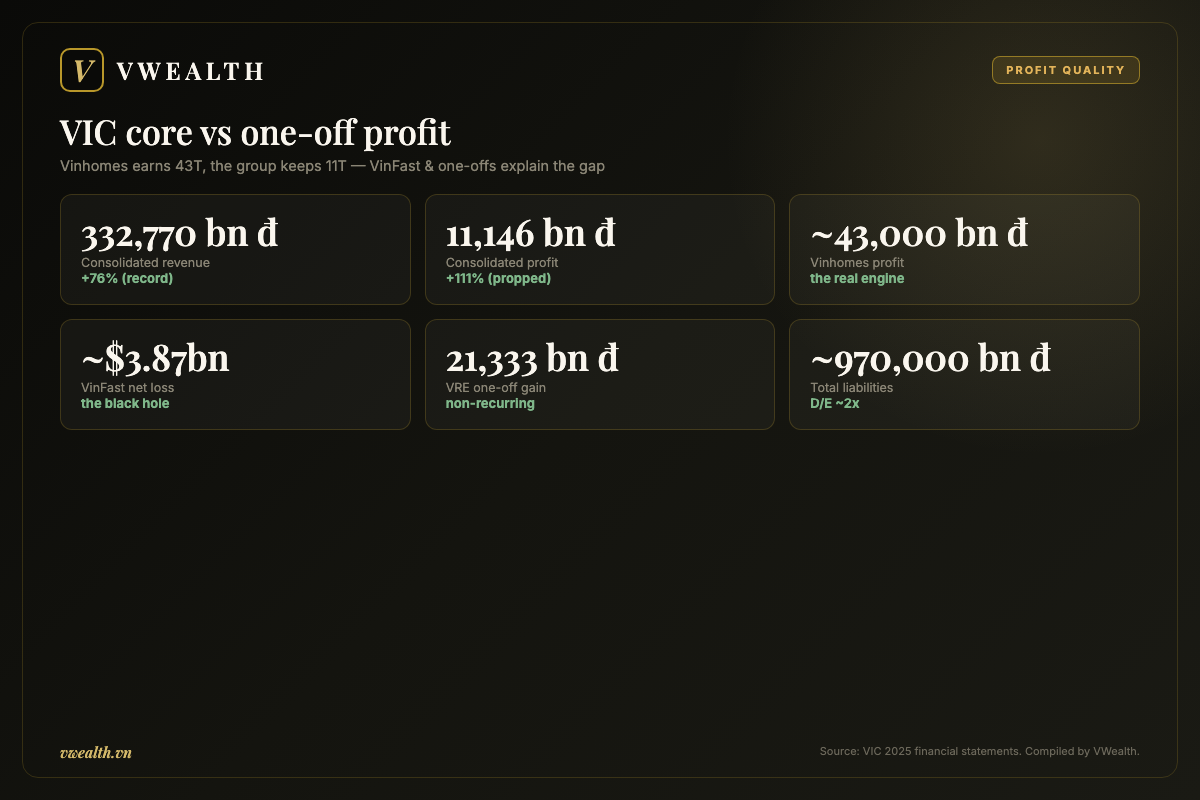
The lesson for you is clear: when a group reports billion-dollar profit, always trace the gain’s origin. Profit from steadily selling cars and homes year after year is good profit. Profit from selling off a subsidiary, or from one surging handover quarter, is “pretty once” profit. For Vingroup, most of the 2024–2025 figure’s beauty belongs to the second kind. That doesn’t mean Vingroup is weak – Vinhomes is still a real, enormous profit machine – but it means you should adjust expectations: don’t extrapolate a cycle-peak year’s profit into a new normal.
2025 revenue structure – a four-faced group
When you dissect the 332,770-billion consolidated revenue by segment, Vingroup’s true portrait appears far clearer than the vague “multi-industry conglomerate” label.
| Business segment | Role in the structure | Cash-flow & profit traits |
|---|---|---|
| Property transfer (Vinhomes) | The overwhelming pillar, most of revenue and nearly all profit | High margin, strong cash flow but cyclical and lumped by handover pace |
| Manufacturing (VinFast & industry) | The hottest-growing segment by revenue | Large revenue but heavy gross loss (margin −42.5%); the source eroding consolidated profit |
| Leasing & services (retail, healthcare, education, infrastructure) | The steady, recurring cash-flow segment | Relatively durable margin and cash flow, less cyclical |
| Hotel – tourism – entertainment (Vinpearl, VinWonders) | A supplementary segment, modest contribution to total revenue | Seasonal and tourism-demand-dependent; improving margin but small versus the two pillars |
This picture shows a deliberate imbalance. Real estate generates money and profit; manufacturing generates revenue but burns money; while the service and tourism segments act as “shock absorbers” creating steady cash. Vingroup isn’t four equal businesses, but a real-estate machine using its profit to fund an industrial gamble, with a few service segments as a stable backdrop.
Position – the private king carrying an enormous debt load
Vingroup’s position is undeniable. As of end-2025, group total assets reached about 1.12 quadrillion dong, up 34% from end-2024 – a “sole-throne” scale among Vietnamese private businesses. VIC is a top market-cap stock on HOSE, heavy enough to lead the VN-Index alone in many sessions. When you buy VIC, you’re not buying an ordinary stock; you’re buying a piece of the nation’s largest private group.
But a large position comes with a large burden. Vingroup’s liabilities exceeded 900,000 billion dong, financial debt alone about 320,000-plus billion dong as of Q3 2025. The debt-to-equity ratio (D/E) is near 2 times – a high leverage, especially in an environment of still-volatile rates and economy. High leverage is a double-edged sword: it amplifies profit when all goes well, and amplifies risk when cash flow hits trouble. For a group that must simultaneously hand over mega-projects and pump money to VinFast, every additional percentage point of interest is a real burden on the bottom line.
The consolation is that Vingroup still has a considerable “reserve” – unrecognized revenue from Vinhomes’ sold contracts running to billions of USD, ensuring cash flow and profit for coming years. This is a cushion helping the group maintain internal-funding capacity even if the market has a short-term stall. But that cushion isn’t infinite, and it too depends on the very health of the real-estate market – the risk circle returns to its starting point.
To summarize the position and structure picture: you’re looking at a true giant, with record revenue and an unrivaled asset scale. But behind the “billion-dollar profit” is a dependent structure – Vinhomes feeds VinFast, core profit propped by one-offs, and the whole machine running on high debt leverage. Understanding this, you won’t be dazzled by headlines, but see VIC for what it is: a stock of a big dream carrying big risk, demanding you read every line beneath the total. And how the market prices all those expectations and risks into the share price is the story we discuss next.
Market reception
If you open the price board on 19 June 2026 and look at VIC at 205,500 dong, you’re looking at the most expensive of Vietnam’s pillar stocks — and one of the hardest to value an ordinary investor can encounter. “Expensive” here isn’t just the absolute number per share. It’s expensive because when you try to ask yourself “is this price worth it or not,” you’ll find the familiar tools — P/E, profit, dividends — almost can’t answer that question. And that’s why this section exists: for you to understand why VIC is a special financial creature, why its price dances violently by multiples not by percentages, and why buying VIC is fundamentally a very different decision from buying an ordinary manufacturing or bank stock.
Start with a number that startles many new investors. Per market valuation data, VIC trades at a P/E around 136 times and P/B around 10.7 times. To picture it, Vietnam’s market norm is only around 12–14 times P/E. That means, textbook-style, VIC is about ten times more expensive than the market. A newcomer would immediately conclude: “too expensive, a bubble, stay away.” But a careful reader would pause and ask a wiser question: does this 136-times P/E actually say anything? The answer, as you’re about to see, is almost nothing.
Why VIC’s P/E is almost meaningless
P/E — the price-to-earnings ratio — is useful only when a business’s profit is relatively stable, comes steadily, and accurately reflects core business health. For a bank, a utility, or a consumer business, this year’s profit is a fairly good forecast for next year, and P/E becomes a reliable measure. But VIC isn’t that kind of business. VIC is a multi-industry holding company whose consolidated profit is distorted by three things at once, making every “price / profit” division give a misleading result.
First is VinFast’s loss. The EV manufacturing segment is still in an expansion and cash-burning phase. In Q3 2025 alone, VinFast’s manufacturing recorded a gross loss of about 7,289 billion dong because cost of goods was still very high versus revenue. When consolidated into VIC’s report, this loss erodes the profit of well-performing segments like real estate. In other words, the consolidated profit you see is a number already dragged down by an enormous loss-making segment — it can’t reflect the true earning power of the “healthy” part of the group.
Second is one-off gains. VIC’s 2025 after-tax profit reached 11,146 billion dong — double the prior year, very impressive. But if you dissect it, a considerable part comes from non-recurring financial deals: recording gains from divestments and ownership restructuring, prominently the transactions involving Vincom Retail and VinFast. Some statistics show deals outside the core business contributed nearly 40,000 billion dong in financial gains for the group. One-off gains are real money, but they don’t recur next year. A P/E computed on profit with a surging gain looks falsely “cheap”; a P/E computed on a year with VinFast’s heavy loss looks falsely “expensive.” Same business, the number jumps erratically by year.
Third is the holding nature. Most of VIC’s value lies not in the profit it self-generates, but in the shares it holds in subsidiaries already or separately listed. When a business’s value is mainly the value of the assets it owns, not the cash flow it generates, forcing it into the P/E mold is like measuring a building’s height with a kitchen scale — the wrong tool from the start.
For VIC, a 136-times P/E doesn’t mean “ten times more expensive than the market.” It only means: don’t use P/E to value this stock. You need a different lens.
The right lens: the sum-of-the-parts (SOTP) method
The right lens to view VIC is called SOTP — Sum-Of-The-Parts, roughly “value each piece then add them up.” Its idea is beautifully simple, and once you understand it you’ll never view a multi-industry conglomerate the old way again.
Imagine VIC not as a company, but as a wallet holding many assets. In that wallet: a large stack of Vinhomes shares (residential real estate), a portion of Vinpearl shares (resort tourism, listed as VPL), a portion of VinFast shares (EVs, listed on the US Nasdaq as VFS), plus some other assets. Instead of trying to value the whole “wallet” by one aggregate profit number, SOTP does the opposite: it opens the wallet, values each item separately at market price or by a method suited to each industry, then adds them all up, then subtracts the parent’s net debt. The result is the fair value of the whole wallet — VIC’s fair market cap.
This approach is sound because each business segment has an entirely different financial “character.” Vinhomes’ residential real estate is a money printer, large and stable profit, so value it by P/E or net asset value. Vinpearl’s resort tourism has its own cycle. And VinFast is a cash-burning growth story, loss-making now but with enormous future expectation — you can’t value it by profit (it’s negative) but by revenue, market share and potential, like the market valued Tesla in its early years. Lumping these three opposite characters into a single P/E is meaningless. Splitting them to value each part is right.
The chart below illustrates how an analyst “opens VIC’s wallet.” Read it as a thinking framework to understand where VIC’s value originates, rather than an absolute number — because each piece’s market price changes daily.
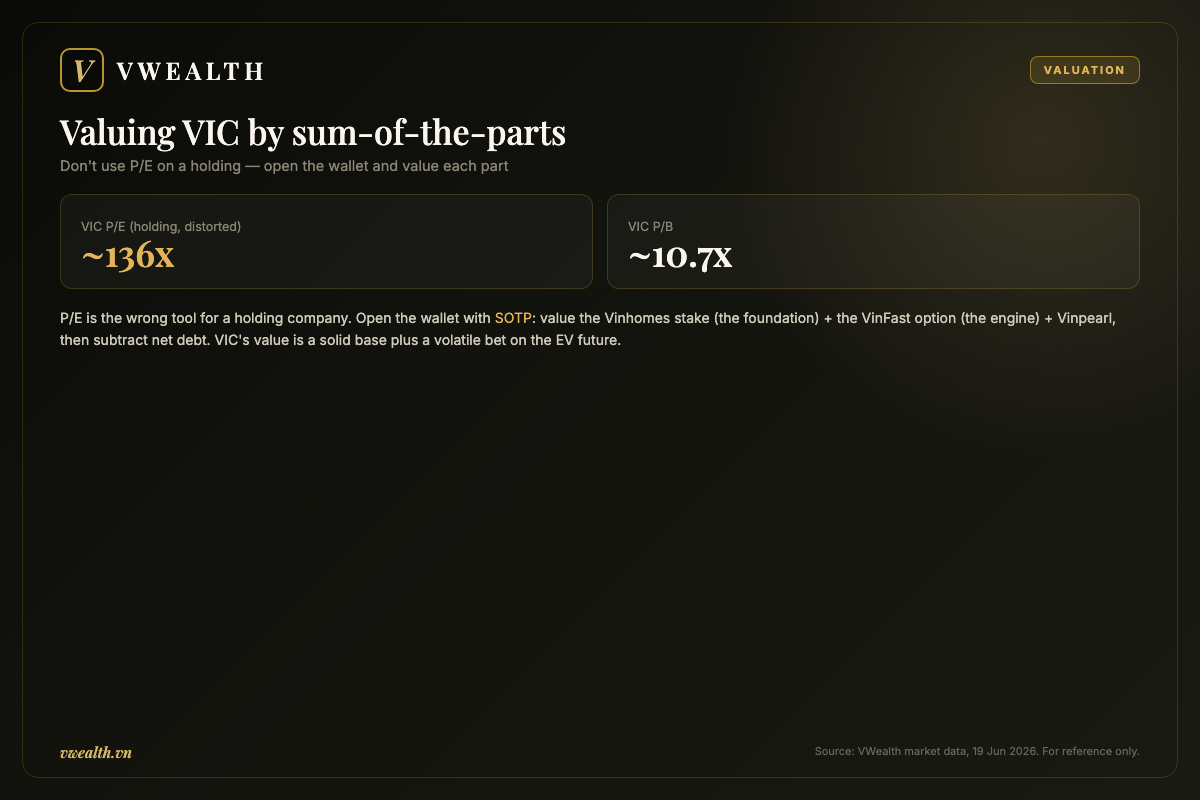
When you look at this structure, an important truth appears immediately: VIC’s value mostly lies in the Vinhomes stake plus the VinFast “option”. Vinhomes is the solid foundation — the “known” part, with real profit, valuable with relative confidence. VinFast is the “unknown” part — an enormous option on the global EV future, worth a lot or a little depending on whether it captures market share and profits. It’s precisely this blend of a solid foundation and a volatile option that is the source of everything strange about VIC stock.
Why VIC’s price jumps with the “story” not the profit
Now you have enough tools to understand this section’s most important point. Because VIC’s value lies in the Vinhomes stake and VinFast expectation — not current consolidated profit — VIC’s price jumps with the story more than the numbers. Specifically, it jumps with two things: faith in Mr. Pham Nhat Vuong’s vision, and the development of the VinFast story on the international stage.
The evidence is right in the price action. From the start of 2025, VIC stock rose by multiples — various statistics record gains from about 6.5-fold to nearly 8-fold (some sources even cite cumulative gains around 1,000% through mid-2026), bringing the price to a historic peak around 270,000 dong before the group issued a 1:1 bonus share (issuing about 3.85 billion more shares) in December 2025 — that very bonus brought the share count to about 7.7 billion and diluted the per-share price to around 135,000 dong, then it kept climbing to 205,500 dong. This surge pushed Mr. Pham Nhat Vuong’s wealth into the top 100 richest on the planet — at one point Bloomberg ranked him around 71st, surpassing names like Jack Ma. VIC’s market cap crossed over 1.5 quadrillion dong, making it the largest-cap stock on the exchange and alone “carrying” most of the VN-Index’s gains in many sessions.
The key question: 2025 profit only doubled (up about 111%), but the share price rose 6–8 fold. What fills the vast gap between “profit doubled” and “price octupled”? The answer is expectation. The market isn’t paying for the profit VIC earned in 2025. The market pays for a future scenario: VinFast succeeds, Vinhomes keeps printing money, and Mr. Vuong keeps turning seemingly impossible ambitions into reality. When you buy VIC at this valuation, you’re not buying today’s cash flow — you’re betting on tomorrow’s story.
This is the core distinction: VIC trades like an “expectation-speculation” stock more than a “value” stock. Its price is a vote of faith, not a receipt of profit.
The flip side of the story: extreme volatility and reversal risk
A stock that runs on expectation also falls on expectation. This is what you must engrave if you plan to touch VIC. When the price is propped mainly by faith not by certain cash flow, any crack in the story can cause a very sharp drop. VinFast is the biggest variable: a disappointing delivery quarter, a recall, a capital-raising difficulty, or simply international market sentiment turning on VFS shares on Nasdaq — all can make the “VinFast option” in VIC’s valuation evaporate quickly.
History shows this isn’t theory. Before the 2025 boom, VIC went through long years languishing near a deep bottom in 2022–2024, when the market doubted the financial burden from VinFast. A stock that can go sideways dispiritingly for years then rise eightfold in a year can just as fully reverse and fall deeply when speculative money exits. The higher the valuation versus real profit, the thinner the “margin of safety,” and the more violent the swing range. For VIC, by-multiple volatility in both directions is a trait, not an exception.
- Story risk: the price depends on VinFast progress and faith in Mr. Vuong — hard-to-quantify things changing fast with news.
- Dilution risk: the group continually needs large capital to feed VinFast, so further share issuances/capital raises may recur.
- High-valuation risk: at a P/B above 10 times, even a slight cooling of expectations can sharply correct the price, because the current price has “borrowed” heavily from the future.
- Index-concentration risk: the Vingroup group alone accounts for nearly 30% of the VN-Index’s weight — when VIC reverses, it drags the whole market, creating a resonance effect.
Dividends: don’t buy VIC waiting for cash to your account
There’s a question income investors always ask: “Does buying this stock get me steady cash?” With VIC, the frank answer is almost none. VIC’s most recent cash dividend goes all the way back to 2014 (ratio 21.49%). Since then, over a decade, the group has paid almost no cash to shareholders. Instead, VIC pays bonus shares — like the 1:1 bonus at end-2025 — that is, issuing more shares, not money.
This is entirely consistent with VIC’s nature. A group concentrating everything on feeding VinFast — a cash-burning machine needing billions of USD to expand production, research and sell globally — can’t both feed that ambition and pull cash to distribute to shareholders. Every dong retained is a dong poured into the big bet on the future. So if you’re an investor needing a steady dividend stream to live on — the “dividend-eating” shareholder type — VIC is not for you. VIC is only for those who believe asset value (especially VinFast and Vinhomes) will grow enough in the future to compensate for not receiving a single dong of cash for years.
VN30 status, ETFs and foreign flows
As the largest-cap stock on the exchange, VIC is an indispensable VN30 component and in the portfolios of most ETFs tracking Vietnamese indices. This creates a “passive” money flow: whenever new money enters index funds, part must flow into VIC by weight, whether or not the fund likes its valuation. This is amplified by expectations of Vietnam being upgraded to emerging-market status (FTSE Russell) — an event that would pull more foreign capital into pillar stocks like VIC. This index weight is a double-edged sword: it creates base buying when the market rises, but also amplifies selling when money exits.
With foreigners, the relationship with VIC is far more complex than with an ordinary stock. On one hand, foreigners are drawn by VIC’s scale and liquidity, and by the VinFast story that’s easy to tell international investors (EVs, Nasdaq, a Vietnamese billionaire reaching the world). On the other, the very concerns about the VIC–VinFast complex’s financial risk have made many foreigners take profit and cut weight during the hot rally. When you watch VIC, foreign flows are a signal worth reading — but read it as a measure of sentiment toward the story, not a verdict on profit.
The bottom line: what are you buying when you buy VIC?
Let’s wrap this section with a sentence to remember before touching this stock. When you buy VIC at 205,500 dong, you’re not buying a current profit stream — because that profit is distorted by VinFast’s loss and noised by one-off gains. You’re not buying dividends — because VIC hasn’t paid cash for over a decade. You’re not buying a cheap valuation by P/E — because a 136-times P/E is simply the wrong tool. What you’re really buying is a faith: faith in the Vinhomes stake as the foundation, in the VinFast option as the growth engine, and above all faith in Mr. Pham Nhat Vuong’s vision — the man who has repeatedly turned the impossible into reality.
Buying VIC is buying faith in the future, not buying today’s cash flow. That’s why it can rise eightfold in a year, and also why it can reverse violently if the story cracks. To understand whether that story has a solid basis — whether VinFast truly captures a foothold, whether Vinhomes property maintains its money-printing form, and where the whole group stands in the industry picture — you need to move to the next section: Industry context, where we dissect the very growth engines and headwinds shaping the fate of the wallet named Vingroup.
Economic and core-industry context
No stock lives outside its industry context, and VIC is the clearest proof of this. When you buy a Vingroup share at 205,500 dong, you’re not buying a single business but simultaneously buying two gambles on two entirely different economic waves: Vietnam’s real-estate cycle probing a bottom and rising, and the survival war of the global EV industry. Vinhomes is the money printer helping the group survive; VinFast is the ambition that could make history or incinerate the capital. Understand these two industries, and you can value the real risk you’re bearing.
Vietnamese real estate: the wave supporting Vinhomes
Start with the easier part, which is also carrying profit for the whole group. After the 2022–2023 freeze from tightened credit and the bond crisis, Vietnam’s real-estate market in 2025–2026 is shifting from “technical recovery” to “structural stability.” In 2025, the country recorded over 580,400 successful real-estate transactions, a number showing liquidity has clearly returned, no longer just faint glimmers.
What matters for you is that this wave’s driver differs entirely from prior cycles. This isn’t a rampant speculative price frenzy, but a selective recovery, concentrated in products with real demand, clear legality and reasonable prices. Three pillars form this foundation:
- Legal reform. The revised trio of the Land, Housing and Real Estate Business laws taking effect from 2025–2026 is the biggest turning point. Electronic identification for real estate, effective from 1 March 2026, makes data more transparent and monitoring tighter. Notably, authorities are reviewing and unblocking about 2,200 stalled projects on 347,000 ha, with total estimated investment of about 235 billion USD. For a developer with clean land and complete legality like Vinhomes, a more transparent environment is a competitive advantage, because it weeds out small rivals stuck on legality.
- Credit and public investment. From 2026, the State Bank abolishes the hard credit-growth ceiling, replacing it with efficiency-based management standards, a structural reform in monetary management. Even so, the credit-growth target is lowered to about 15% (versus 19% in 2025), meaning capital into real estate will be more cautious rather than gushing out. In parallel, the wave of public investment in transport infrastructure keeps expanding the urbanized zone, right where Vinhomes mega-projects like Ocean Park, Royal Island or Green Paradise are located.
- Real demand. In 2026, real housing need is forecast to lead the market, and analysts don’t expect broad hot price gains. This is both good and bad news for Vinhomes: good because durable liquidity helps steady sales, bad because margins can hardly swell abnormally like the land-fever era.
Vinhomes has proven it captures this wave fully. Presales in 2025 reached a record 205.3 trillion dong (about 7.91 billion USD), double 2024, thanks to launching four mega-projects in Hanoi, HCMC, Hai Phong and Tay Ninh. More important for the near future, unrecognized sales (sold but not handed over) at year-end reached 186.4 trillion dong, up 98% year on year. This is “locked” revenue that will flow into 2026–2027 profit, a rare safety cushion. In other words, the most stable part of the VIC story is riding a tailwind.
Global EVs: the bloody battlefield where VinFast must survive
If real estate is the supporting wave, then global EVs are the most turbulent sea a Vietnamese business ever dared set out on. To picture the challenge’s scale correctly: in 2025, Chinese factories produced over 70% of the world’s EVs, and about two-thirds of EVs sold were also there. This isn’t a market, it’s an enormous industrial machine with excess capacity pushing prices down globally.
BYD has surpassed Tesla in global EV output, selling over 2 million in 2025. But what’s scary for VinFast isn’t their scale, but the price war. China’s five best-selling EVs are in the 10,000–12,000 USD range, while the average new-car price in the US is 51,456 USD. BYD sells the Dolphin in Europe for about 23,000 USD, half of a Tesla Model 3. When China oversupplies to the point of shipping whole boatloads of EVs to Latin America, Brazil, Mexico to clear inventory, any young maker wanting to squeeze in must sell below cost or accept losses to hold share. That’s exactly VinFast’s situation: a gross margin of about negative 43% in 2025, meaning for each car sold, the company loses more money even before operating costs.
So what’s VinFast’s opening? The answer lies in geopolitics and an avoidance strategy:
- The tariff wall inadvertently becomes a shield. Chinese EVs face a US import tariff of 100% (from the Biden era, kept by Trump), making BYD and compatriots almost unable to retail directly in the US. Amid the “Great Electric Wall” 2026 wave of tariffs and subsidy cuts reshaping the market, arenas like Southeast Asia and India become places where VinFast can compete without being immediately crushed by Chinese cheapness.
- Southeast Asia and India are the new gamble. After trimming its US ambition, VinFast concentrates on Asia. The Subang plant (Indonesia) was inaugurated in December 2025, just 17 months after groundbreaking, with initial capacity of 50,000 vehicles a year and design expandable to 350,000. In India, the Tamil Nadu plant with 150,000-vehicle-a-year capacity is operating, and VinFast committed a further 500 million USD (of a total 2-billion commitment). These are populous, electrifying markets where the brand isn’t yet clearly formed and the arena is still open.
- Prolonged cash-burn risk. This is the dark side. Expanding three or four plants at once requires enormous money. VinFast has pushed its break-even target beyond 2027 to prioritize growth, and analysts think gross-profit break-even may only appear around 2027–2028. Each year of delay is another year the group must pump capital.
Three macro risks weighing on both pillars
Above these two industries are three layers of macro risk you must not overlook:
- Interest rates. VND rates are edging up on high credit demand (market rates about 4.8–5.1% at end-2025). As a heavily leveraged group, every percentage point of rate increase erodes profit and raises the cost of capital for both Vinhomes and VinFast.
- Exchange rate. This is an especially dangerous risk because VinFast borrows in USD. The VND is forecast to depreciate 2–3%, with some forecasts up to 4–5% against the USD in 2026 (UOB projects the rate around 26,100–26,400 VND/USD). When the VND weakens, VinFast’s USD debt-repayment burden swells when converted to local currency, right when the company is deeply loss-making.
- High group debt. Vingroup’s total liabilities reached about 970 trillion dong (37.39 billion USD) at end-2025, of which financial debt about 335.42 trillion dong (12.93 billion USD), more than double equity. This leverage is a double-edged sword: it amplifies profit in favorable times, but also amplifies risk if property cash flow stalls while VinFast keeps devouring money.
Trend prediction
Predicting a stock like VIC isn’t drawing a price line, but sketching possible turns and the probability of each. Because VIC’s value lies not in the present but almost entirely in future expectation, especially the VinFast story. Look at the ambition first, then set out three scenarios.
The ambition on the scale
Vingroup’s leadership doesn’t hide its ambition, and 2026 is a pivotal year. The group targets a record net profit of about 949 million USD in 2026. VinFast aims to deliver 300,000 vehicles (versus 197,000 in 2025), with the Indonesia plant starting to roll out MPV and e-scooter models, the India plant accelerating. Long-term, the capacity system aims for 600,000 vehicles when the plants are combined. Vinhomes has a far more solid foundation: core property revenue in 2026 is forecast to rise 26% to about 159 trillion dong (6.0 billion USD), of which about 64% comes from unrecognized sales of projects like Green Paradise, Royal Island and new handovers at Wonder City, Green City.
The crux to grasp: the Vingroup ecosystem is designed to feed itself. Vinhomes generates cash flow, that cash flow (plus loans and issuance) feeds VinFast until EVs can stand on their own. The whole VIC investment thesis revolves around the question: is the property cash flow strong and long enough for VinFast to reach break-even before it burns through the capital market’s confidence?
Three scenarios
Positive scenario. Conditions: VinFast delivers close to the 300,000 target, the gross-loss margin narrows fast thanks to scale and localization in Indonesia and India; the Southeast Asian market receives it well; and Vinhomes hands over on schedule with 186 trillion of unrecognized sales flowing strongly into profit. Then the “VinFast option” begins to be re-rated positively by the market, and VIC can be seen as a real growth story, not just expectation. Price effect: strong upside room, because most VinFast risk is removed from the valuation.
Base scenario. Conditions: Vinhomes remains the solid profit pillar, benefiting from the selective real-estate recovery cycle; VinFast grows output but still loses money, break-even pushed beyond 2027 as leadership admits. The group manages to raise capital, debt high but under control. This is the most likely scenario. Price effect: VIC swings strongly around the current valuation, up and down with each piece of delivery, capital-raising or Vinhomes-sales news, without a clear breakout or collapse.
Negative scenario. Conditions: VinFast burns cash persistently, break-even continually delayed, the loss margin not improving as the global price war spreads to Southeast Asia when cheap Chinese EVs flood in; at the same time real estate stalls due to tightened credit or weak demand, so Vinhomes cash flow can’t compensate. A sharp VND depreciation swells the USD debt burden. In this scenario, dilution pressure (further share issuance to raise money to save VinFast) and debt-liquidity concerns weigh heavily. Price effect: deep-fall risk, because the market will re-rate toward “VinFast is a burden” instead of “a valuable option.”
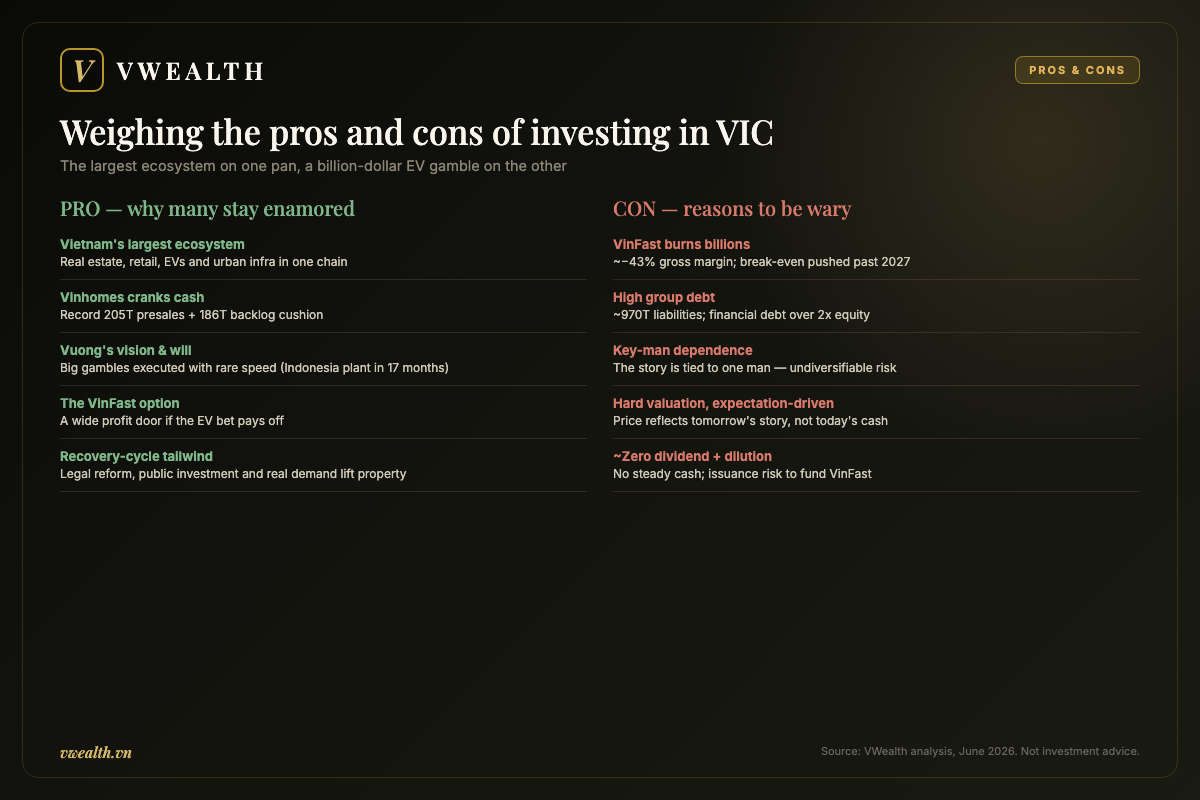
Important note: these three scenarios don’t have equal probability, and no one, not even the best analysts, knows for sure which will win. That’s the nature of an expectation-valued stock. VIC’s volatility will therefore remain extreme, reacting instantly to every VinFast news item.
Should you buy VIC stock?
This is the question you truly want answered, and also one no one can honestly answer for you. The best an analyst can do is put the pros and cons on the same scale, sharp enough that you’re not swept along by the story, balanced enough that you don’t miss out from fear.
The pros: why many are still enamored with VIC
- Vietnam’s largest ecosystem. Vingroup owns a value chain from real estate, retail, EVs to urban infrastructure no domestic private group can match. The pieces support and amplify one another.
- Vinhomes cranks cash. Record presales of 205 trillion dong in 2025 and 186 trillion of unrecognized sales are a tangible profit cushion, supported by the recovering property wave.
- Mr. Pham Nhat Vuong’s vision and will. Vingroup’s history is a chain of big gambles executed with rare speed and determination, like the Indonesia plant taking just 17 months from groundbreaking to inauguration.
- The VinFast option. If VinFast succeeds, the reward is enormous, a global EV brand originating from Vietnam. You hold an option with a very wide profit door if the positive scenario plays out.
- Benefiting from the recovery cycle. Legal reform, public investment and real demand are laying a foundation for real estate, exactly Vingroup’s strongest segment.
The cons: reasons to be wary
- VinFast loses billions of USD and burns cash. A gross-loss margin of about negative 43%, break-even pushed beyond 2027. Each year of delay is another year of pumping money.
- High group debt. Total liabilities about 970 trillion dong, financial debt more than double equity. Large leverage amplifies both gains and losses.
- Key-man dependence risk. The story is tied too tightly to Mr. Pham Nhat Vuong’s vision and credibility. This is a concentrated risk you can’t diversify away.
- Hard valuation and expectation speculation. VIC’s price reflects future expectation more than present value, making every valuation model fragile and easily swayed by crowd psychology.
- Extreme volatility. The price jumps with each VinFast news item. Your account must withstand large jolts.
- Near-zero cash dividend and dilution risk. You don’t receive steady cash flow, and may be diluted if the group issues more shares to raise money for VinFast.
Four investor types and whom VIC suits
Instead of declaring buy or sell, hold yourself up against this frame:
- The safety-and-capital-preservation seeker: VIC is almost certainly not for you. High leverage, strong volatility, results depending on an undecided EV gamble — this is a harsh environment for those afraid of losing capital.
- The cash-flow-and-dividend seeker: Also unsuitable. VIC pays a near-zero cash dividend, with profit fully reinvested in ambition. If you need steady income, look elsewhere.
- The pure value investor: Will find VIC very hard to swallow, because valuation rests on expectation rather than certain discounted cash flow, and the margin of safety is very thin.
- The high-risk-tolerant, growth-story believer: This is the only investor type VIC can truly suit. If you clearly understand and accept the possibility of losing most of the investment, while believing VinFast will reach the finish line, then VIC is an option with large profit room, provided you allocate only the capital you’re willing to risk.
VIC isn’t a stock to entrust with retirement money or savings you can’t afford to lose. It’s a calculated gamble, for those who understand what they’re betting on and can bear the price if they bet wrong.
In sum, VIC is one of the most polarizing stocks on Vietnam’s market: on one side, the country’s largest ecosystem with the Vinhomes profit machine genuinely running well, on the other, an EV gamble burning billions of USD a year on the world’s most brutal battlefield. The final decision depends on which kind of investor you are, how much risk you can bear, and how large your faith in the VinFast story is.
Disclaimer
This article is produced for informational and reference-analysis purposes, and is not a recommendation to buy, sell or hold any security. All figures are cited from public sources at the time of writing and may change. Investing in stocks always carries the risk of capital loss, especially with a highly volatile stock like VIC. You should do your own thorough research, weigh your personal financial situation and consult a licensed advisor before making any investment decision. vwealth.vn bears no responsibility for any gains or losses arising from the use of information in this article.
Research Vietnamese stocks in English with vwealth. Our AI-powered platform turns Vietnamese market data into full English analysis reports — with international payment support and a free 2-month trial for new accounts. Create your free account and read the latest reports.