Search for the best stocks to invest in Vietnam and you will find no shortage of lists. What you will not find is the four things that determine whether a name on one of those lists is any use to you: the price the writer paid, the horizon they hold for, the reason, and what would change their mind.
This article contains no list. Not out of caution — because a ticker without those four things cannot be acted on, and more importantly cannot be exited, since you have no condition that tells you when the reasoning stopped applying.
What follows is a six-filter screen, four questions for each surviving name, and an explanation of why valuation belongs last rather than first.
How do you find the best stocks to invest in Vietnam?
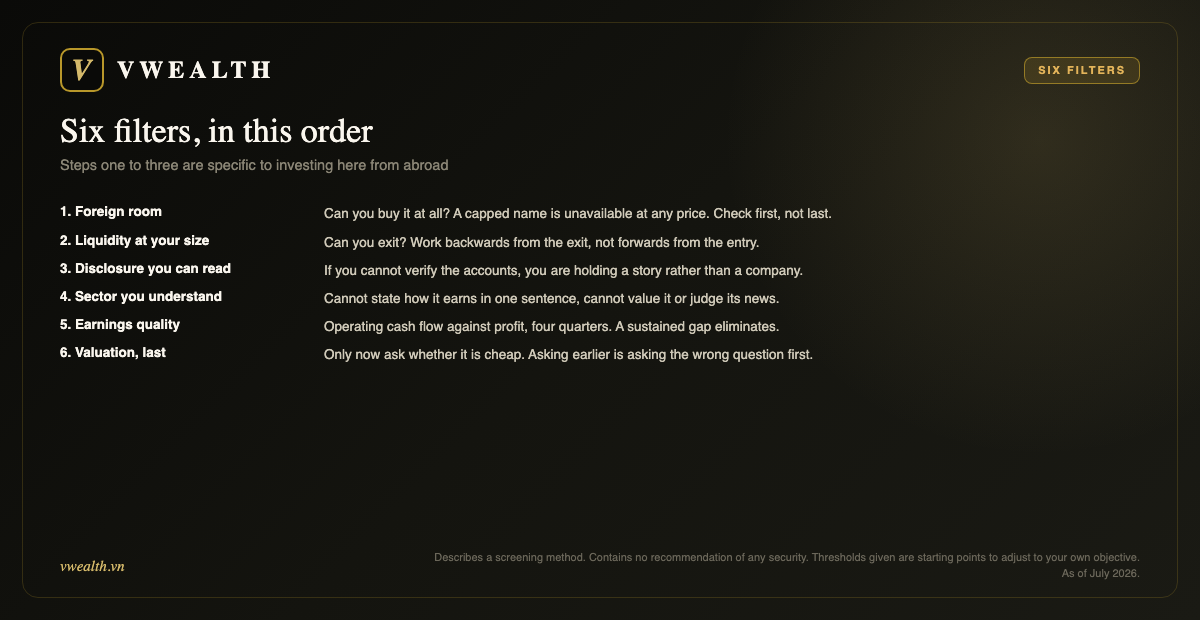
Short answer: Not by taking someone’s list. The transferable part is the process — filter by foreign room, then liquidity at your size, then whether you can read the disclosure, then sector understanding, then earnings quality, and only then valuation. The first three filters are specific to investing here from abroad.
Six filters, in this order
Filter 1 — foreign room
First, because it is binary. A company at its foreign ownership ceiling cannot be bought by any foreign investor at any price.
Ordinary commercial banks are capped at 30%, with an exception allowing up to 49% for banks receiving mandatory transfers as part of restructuring where the state does not hold control. Most ordinary sectors permit up to 100%.
Checking takes two minutes per name and prevents the most frustrating outcome in this market: a thesis built around a stock you cannot access. Mechanics in foreign room and the cap that blocks foreign money.
Filter 2 — liquidity at your size
Work backwards from the exit rather than forwards from the entry.
Compare your intended position against average daily traded value. If the position equals several normal sessions, you can build it slowly and you cannot exit it quickly — and exits tend to be needed precisely when liquidity is worst.
Filter 3 — disclosure you can actually read
The filter most foreign investors skip and later regret.
English publication by Vietnamese listed companies is voluntary. If you cannot read the accounts and the notes, you are holding a narrative rather than a business, and you have no way to verify anything you were told.
Where to find the documents is covered in reading a Vietnamese company’s accounts.
Filter 4 — sector you understand
If you cannot state in one sentence how the business earns money, you cannot value it and you cannot tell which news matters.
Removing sectors you do not understand is not a lost opportunity. It moves your time to where your judgement has any weight.
Filter 5 — earnings quality
Operating cash flow against profit after tax, four quarters.
A gap in one quarter is normal. A sustained gap means profit on paper is not becoming cash, typically because receivables or inventory are absorbing it.
Filter 6 — valuation, last
Now, and not before.
Valuation is a question about price, and price only means something once you know what you are buying. Computing a precise valuation for a business you do not understand, or whose earnings do not convert to cash, is accuracy applied to the wrong foundation.
Method in how to tell if the market is actually cheap.
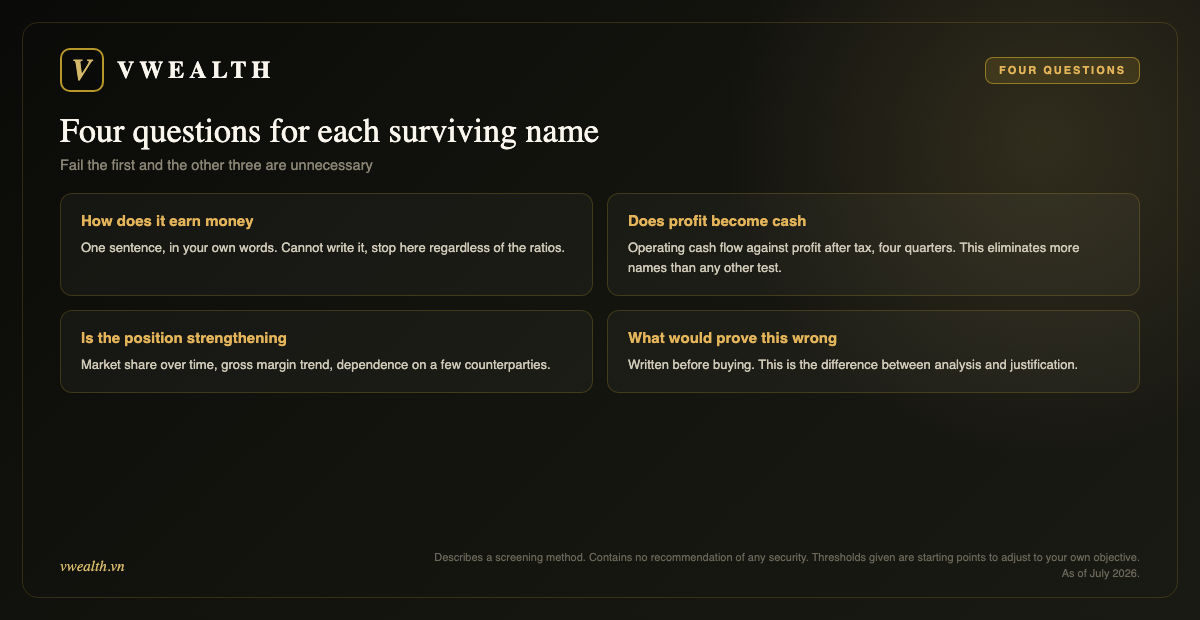
Four questions for each surviving name
How does it earn money?
One sentence, written down. If you cannot produce it, stop — regardless of how attractive the ratios look.
That sentence also determines the right valuation approach, since a business that rents assets is valued differently from one that sells goods or collects fees.
Does profit become cash?
Already covered in filter five, repeated because it eliminates more candidates than any other test.
Is the competitive position strengthening or weakening?
The hardest question, because no single number answers it.
Three indirect indicators: market share over time, gross margin across several years, and dependence on a small number of customers or suppliers.
A company holding its margin through a competitive period is telling you something no ratio summarises.
What would prove this wrong?
Written before buying, not after.
This separates analysis from justification, and it is also the only thing that tells you when to sell — because when the condition you wrote occurs, the decision is already made.
Why published lists do not work
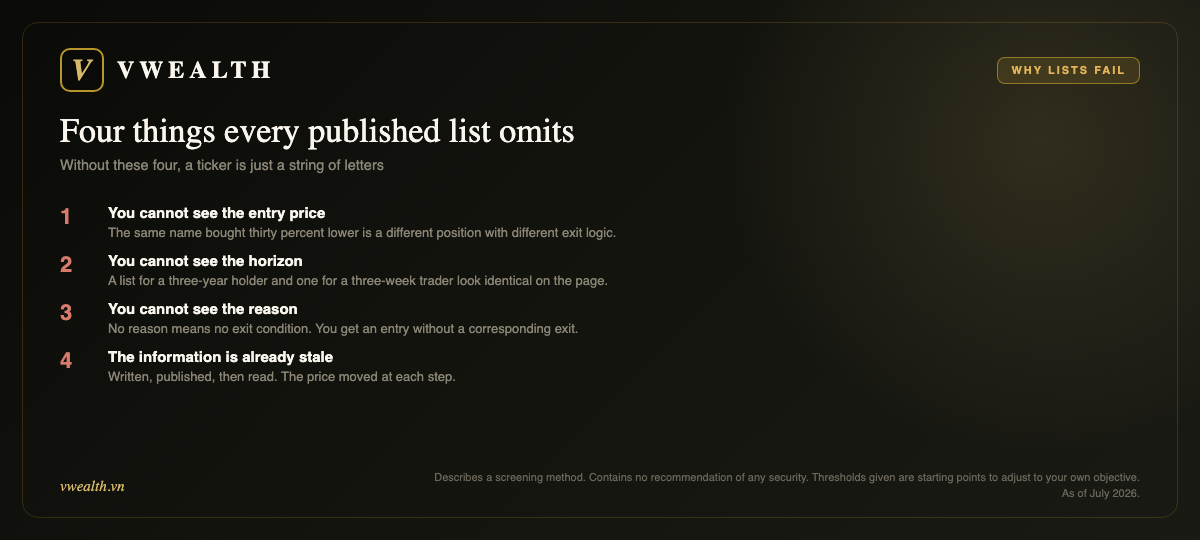
Not because the authors are careless. Because the list format cannot carry the necessary information.
The entry price is invisible. The same company bought substantially lower is a different position, with a different tolerance for decline and a different exit logic.
The horizon is invisible. A list for someone holding three years and one for someone holding three weeks look identical on the page.
The reason is invisible. And without the reason there is no exit condition — you inherit an entry without the corresponding exit.
The data is stale. Written, then published, then read. The price moved at each stage.
The 2026 context worth building in
One factor this year belongs inside filters one and six rather than alongside them.
Vietnam moves to Secondary Emerging status under FTSE Russell’s classification effective 21 September 2026, with inclusion phased into 2027. FTSE estimated the country weight at roughly 0.22% of FTSE Emerging and 0.34% of FTSE Emerging All Cap at the April 2026 review.
In filter one: names with foreign room remaining and adequate liquidity are the ones index flow can actually reach. Capped names receive almost none of it, regardless of index membership.
In filter six: if part of the current price already reflects anticipated index flow, separate that from the part supported by the business. The first component is bounded and will end; the second is not.
Detail in which stocks foreign funds must buy and what actually changes in September.
Running the screen in an evening
Preparation. A list of listed companies with average daily traded value, and a decision about your intended position size.
Filters one and two — twenty minutes. Foreign room and liquidity. Together these usually remove the majority of the market for a foreign investor, and they remove exactly the part you could not have acted on.
Filter three — fifteen minutes. Check whether English statements exist. Faster than it sounds once you know where to look.
Filter four — twenty minutes. Mark the sectors you understand. Be honest rather than generous; the cost of pretending appears later.
Filter five — fifteen minutes per name. The six-line triage from the accounts. Spread across several sessions if the list is long.
Filter six and the four questions — hours per name. By now the list is short enough that this is worth it.
Recording the decision: four lines per name
This is what converts the screen from a one-off exercise into something that improves.
Line 1 — ticker and date. The date of the decision, not of the purchase.
Line 2 — how the business earns. One sentence, your own words.
Line 3 — why this price. The value range you computed and the main assumption behind it.
Line 4 — what would prove it wrong. Two or three specific conditions, checkable in published data.
Why this matters more than it appears
Memory of why you bought shifts rapidly with the price. When a position rises, people recall thorough analysis. When it falls, they discover additional reasons to hold.
The record made at the time of the decision does not move. Six months later it answers a question that is otherwise easy to avoid: has the condition I wrote down actually occurred?
If it has and you are still holding, that is a new decision requiring a new reason — not a continuation of the old one.
After a year
Ten or twenty records. Read together, they reveal something no book teaches: which step you personally get wrong.
Some people fail at question one, buying businesses they never really understood. Others fail at filter six, paying up because the price was moving. Those are different errors with different remedies, and you only learn which is yours from the record.
What an individual can do that an institution cannot
The screen deliberately exploits three advantages you hold and a fund does not.
You may do nothing. If nothing survives the screen, you hold cash. A fund must deploy according to its mandate regardless of what it finds.
You can reach smaller companies. Filter two removes names too thin for your size — and your threshold is far lower than an institution’s. The part of the market available to you is wider than the part available to them.
You are not measured quarterly. You can hold something that takes three years to be right without explaining the interim to anyone.
The constraints institutions face are set out in what foreign funds actually hold in Vietnam.
Adapting the screen to your situation
If you are starting out
Run all six filters, and expect few survivors. With a small allocation the sensible conclusion is often a fund as the core plus one or two names you genuinely understand.
The value at this stage is not finding names. It is building the habit of rejection — most attractive-looking candidates fail at filter four or five, and noticing that early is the lesson.
If you already hold Vietnamese equities
Run the screen backwards against your existing positions. Any holding that would not survive filters one to five today is worth re-examining, and the exercise is more useful than screening for new ideas.
If you are allocating institutional size
Filter two becomes the binding constraint rather than a preliminary step, and filter one narrows further because the amount you need may exceed available room even in names that are not full.
At that size the practical question shifts from stock selection to whether the market can absorb your allocation at all.
A worked pass through the filters
Illustrative, to show how the filters interact rather than to describe any specific company.
Filter 1. A large listed company, foreign ownership at 29.6% against a 30% cap. Headroom of 0.4%. Converted to money against its market capitalisation, that is a small figure — equal to a handful of normal trading sessions.
Verdict: technically passable, practically not. Any position of size would meet the cap quickly, and you would be paying the foreign premium to get it.
Filter 2. Suppose instead a mid-cap with substantial headroom but average daily traded value well below your intended position.
Verdict: fails. You can build it over weeks; you cannot exit it in the same way, and the exit is the constraint that matters.
Filter 3. A company with room and liquidity, but no English statements and no English annual report.
Verdict: passable only if you can work with the Vietnamese documents. The primary statements translate acceptably; the notes are where translation risk lives, and the notes are where filter five’s answer sits.
Filters 4 to 6. Now the ordinary work begins, and by this point the candidate list is short enough for it to be feasible.
The pattern worth noticing
The first three filters eliminate on grounds that have nothing to do with company quality. An excellent business can fail all three.
That is uncomfortable and it is correct. A business you cannot buy, cannot exit, or cannot verify is not an investment opportunity for you, however good it is for someone else.
Accepting that early saves the specific frustration of researching a company thoroughly and then discovering the position is not available.
Three mistakes
Starting from valuation
Sorting a screen by price-to-earnings and taking the top names produces a list of companies that are cheap for identifiable reasons — usually cyclical earnings at a peak, or a business in decline.
Valuation is filter six for a reason.
Holding too many names
Beyond eight or ten, you cannot follow each business, and the portfolio becomes an expensive index fund.
If breadth is what you want, a fund delivers it more cheaply. Routes compared in which Vietnam ETF you can actually buy.
Skipping filters because the price is moving
The recognisable symptom of buying on fear of missing out. If three of the six filters were skipped, the decision was not the output of a process.
A note on where lists come from
Worth understanding, because it explains why so many exist.
Lists are cheap to produce and easy to read. They are also the format most likely to attract attention, which means the incentive to publish them is strong regardless of whether they help anyone.
None of that makes the authors dishonest. It means the format is selected for by demand rather than by usefulness — and that a reader who wants something actionable has to reconstruct the missing four elements themselves, at which point they have done the work anyway.
Frequently asked questions
How many names should I start with?
One or two, researched properly, rather than ten researched superficially. Add names as the time you genuinely spend monitoring allows.
Should I follow the sectors that are performing?
A sector performing well means expectations are already in the price. That does not preclude opportunity, but it raises the bar: you need a reason to believe you see something the market does not.
Can I automate any of this?
Filters one, two and five can be partly automated from published data. Filters three and four cannot, and the four questions certainly cannot. The automatable half narrows the field; the manual half decides the outcome.
How often should I revisit?
Quarterly, when accounts update. Reviewing between reporting periods mostly means reacting to price.
Why does this article name no companies?
Because the answer depends on your capital, horizon and risk tolerance — and because a ticker without an entry price, a horizon and a reason cannot be used.
Company-level analysis lives in separate pieces covering banking, consumer and the other sectors individually.
Does this work for short-term trading?
No. It is built for horizons measured in years. Over weeks, price is driven by flow and positioning rather than by business fundamentals.
Should the upgrade change my filters?
It changes the weighting inside filter one rather than the filters themselves. Names with foreign room are where index flow can land, so room matters more than usual this year. The rest of the sequence is unaffected — inclusion does not alter earnings, liquidity or disclosure quality.
What if nothing passes?
That is a valid result, not a failure. It means nothing currently meets your standard at current prices. Holding cash and rerunning next quarter is a decision an individual is permitted to make and a fund is not.
What the screen deliberately excludes
Three things it does not attempt, so the limits are explicit.
Timing. Nothing here tells you when to buy. A name that survives all six filters may remain unattractively priced for a year, and the screen has no view on that.
Macro. Interest rates, currency, credit conditions — these shape the environment and the screen ignores them entirely. The framework for reading them is in reading the cycle without guessing.
Governance quality. Filter three catches disclosure availability; it does not catch whether the disclosure is trustworthy. Ownership concentration and related-party dealings require separate work, covered in corporate governance in Vietnam.
A screen is a filter, not a decision system. It removes what you should not consider, which is a different job from identifying what you should own.
One honest observation
Nothing in this framework will find you the best-performing stock of the year. No framework does.
What it reduces is the frequency with which you buy something you do not understand, at a price you cannot justify, with no exit condition. Those three errors cost considerably more over time than any missed opportunity.
That is a modest claim, and it is the honest one.
Two structural realities behind the ordering
The filter sequence is not arbitrary. It reflects two features of this market that do not exist elsewhere.
Availability is not guaranteed
In a developed market, any listed company can be bought by anyone at the prevailing price. Screening therefore starts with quality and valuation, because availability is assumed.
Here it cannot be assumed. Ownership caps make availability the first question rather than an afterthought, and reversing that order wastes the most research effort.
Verification is not guaranteed either
English disclosure is voluntary. A foreign investor may find a company that passes every quality test and still be unable to read its notes.
That is not a small inconvenience. The notes are where one-off gains, related-party dealings and receivable concentrations are disclosed — the three things most likely to change a conclusion.
What this means in practice
The screen front-loads the constraints that are absolute and cheap to check, and defers the analysis that is expensive and only meaningful once the constraints are cleared.
Any screening process for this market that does not do this will repeatedly produce well-researched conclusions about companies you cannot act on.
Summary
Finding the best stocks to invest in Vietnam has no universal answer and does have a transferable process.
Foreign room, liquidity, readable disclosure, sector understanding, earnings quality — then valuation. The order carries as much weight as the content of each step, and the first three exist because you are investing here from abroad.
And the most valuable of the four questions is the last one: what would prove this wrong. Answering it before buying means you already own your sell decision, which is the one thing no list will ever give you.
Further reading: the complete guide to the Vietnamese market, an honest assessment of the risks, and what foreign funds actually hold.
This article is for information and education. It is not a recommendation to buy, sell or hold any security. As of July 2026.