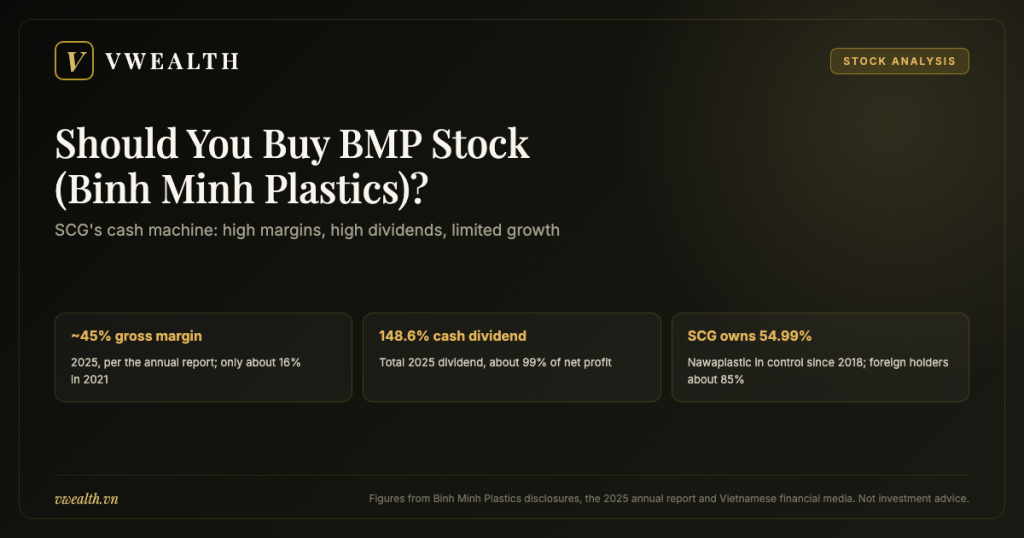
Should you buy BMP stock? BMP is the ticker of Binh Minh Plastics Joint Stock Company, listed on the Ho Chi Minh City Stock Exchange (HOSE) since 2006, and it makes one of the dullest products imaginable: the plastic pipes buried in walls, under floors and beneath roads. Yet in 2025 Binh Minh kept roughly 22 dong of net profit for every 100 dong of net revenue, posted a record net profit of about VND 1,229 billion, held cash and bank deposits equal to about 60% of total assets, and paid out almost all of its earnings as cash dividends — a total 2025 dividend of 148.6% of par value. The biggest recipient of that cash is Nawaplastic Industries, a subsidiary of Thailand’s Siam Cement Group (SCG), which owns about 55% of the company. Vietnamese financial media call BMP the “golden goose” of its Thai owner, and the label fits: a high-margin, high-dividend cash machine with limited volume growth. Understanding what drives that machine, and what could slow it down, is the first step in deciding whether to buy BMP stock.
A word on method before we begin, as with every company analysis in the vwealth series. Dates, names, plant capacities and financial figures in this article come from published sources: Binh Minh’s own website and investor relations pages, its 2025 annual report, audited consolidated financial statements, shareholder meeting documents, and reporting by Vietnamese financial media such as CafeF, VnExpress, Cong Thuong (the Ministry of Industry and Trade’s magazine), Vietstock, Vietnambiz and VietnamFinance, plus brokerage research where cited. Where sources disagree, we show both. Any figure vwealth derived by dividing or multiplying published numbers is labelled “vwealth estimate”. We deliberately do not quote today’s share price, current P/E or P/B, current market capitalization or the latest quarterly profit, because those change daily; for current numbers, open the latest vwealth analysis report. Amounts are in Vietnamese dong (VND); as a rough guide, VND 1,000 billion is on the order of USD 40 million, but exchange rates move, so treat any conversion as approximate.
If you are new to the market, our pillar guide on how to invest in the Vietnam stock market explains the basics foreign investors need — trading accounts, T+2 settlement, daily price limits and foreign ownership limits (the “foreign room”). If you have read our analyses of other building-materials names such as HPG (Hoa Phat), HSG (Hoa Sen) or NKG (Nam Kim Steel), you will find Binh Minh a very different animal. Steel is a game of scale, blast furnaces, tens of trillions of dong in debt, and boom-bust earnings. Binh Minh’s plastic pipe business is far smaller by revenue, carries almost no debt, and lives mainly on the spread between the price of plastic resin going in and the price of pipe going out. For a wider view of the sector, see our overview of Vietnam manufacturing and industrial stocks.
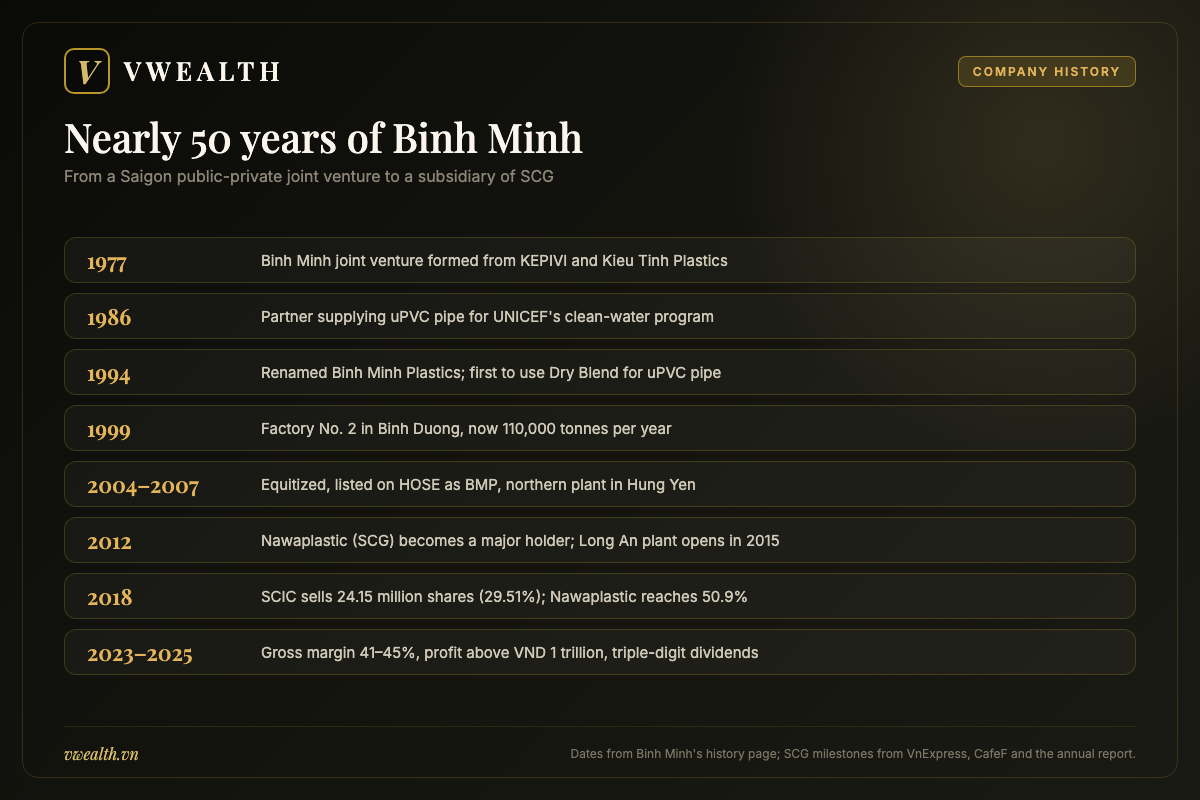
From a 1977 Saigon Joint Venture to SCG’s “Golden Goose”: Nearly 50 Years of Binh Minh Plastics
Some companies’ histories explain almost all of their present. Binh Minh is one of them. It was born from the merger of two private plastics workshops in Saigon after 1975, grew up as a state-owned enterprise under the Ministry of Light Industry, found its core product thanks to a UNICEF clean-water program, was equitized (Vietnam’s term for partial privatization), listed on the stock exchange, and then passed into the hands of a Thai conglomerate. Each turning point left a mark on today’s numbers: a powerful brand in southern Vietnam, a debt-free balance sheet, a policy of paying out almost all profits, and a controlling shareholder with near-total say over major decisions. Let us walk through each stage.
1977–1986: KEPIVI, Kieu Tinh and the UNICEF Pivot to Pipes
According to the company’s history page, on 16 November 1977 the Binh Minh Plastics public-private joint venture factory was formed by merging the Vietnam Chemical Plastic Pipe Company (KEPIVI) and the Kieu Tinh Plastics Company. The “public-private joint venture” model was the standard way at the time to bring private manufacturers into the state economy. The factory reported to the Consumer Goods Corporation under the Ministry of Light Industry, and in its early years it made all kinds of household plastic goods — the items every family needed in the era of central planning — plus a small range of pipes and fittings.
The real turning point came in 1986. The company says that in that year UNICEF selected Binh Minh as its official partner to manufacture and supply uPVC pipe for its rural clean-water program in Vietnam. Consider what that contract meant: a household-plastics factory suddenly had an international customer demanding technical standards, large and steady volumes, and a product tied to infrastructure — something Vietnam’s opening economy would need more of every year. The company itself writes that the moment opened “a strategic awareness” about shifting its product mix toward industrial and technical plastics, mainly pipes and pipe fittings.
In hindsight, this decision shaped everything that followed. Household plastics are easy to enter, crowded with competitors, and fought over on design and price. Water pipes are different. They sit inside walls and under the ground for decades; if they fail, walls must be broken and roads dug up. Buyers — homeowners, plumbers, contractors, water utilities — fear risk more than they fear price. They choose a brand they trust. A company that entered pipes early and did the job well would accumulate the hardest asset to copy in the industry: the trust of the plumber. Forty years later, that trust remains the foundation of Binh Minh’s margins.
1990–2002: Trademark, Dry Blend Technology and Factory No. 2 in Binh Duong
In 1990, Binh Minh registered exclusive protection for its trademark, brand and logo in Vietnam, and its distribution network began to take shape. At a time when many state enterprises had barely heard of branding, registering early showed that management understood the name “Binh Minh” printed along each pipe was worth protecting. Fighting counterfeits is still part of routine work today; the 2025 annual report has a dedicated section on intellectual property protection.
In 1994 the unit was renamed Binh Minh Plastics Company, a state enterprise under the Ministry of Light Industry. That same year, according to the company, Binh Minh became the first in Vietnam to use Dry Blend technology to produce uPVC pipe up to 400 mm in diameter directly from compound powder. Put simply, Dry Blend mixes PVC powder and additives into a uniform dry blend before extrusion, which improves quality control and makes larger pipe sizes possible. The technical detail matters because it opened the door to large-diameter pipe for construction projects, a more demanding segment than household pipe.
In 1999, the company opened Factory No. 2 in Binh Duong province, initially 20,000 square meters with European equipment. It was expanded to 30,000 square meters in 2002 and 50,000 square meters in 2004. Today, according to the company’s capacity page, the plant in Song Than 1 Industrial Park (now part of Di An ward, Ho Chi Minh City, after Vietnam’s 2025 administrative reorganization) has capacity of 110,000 tonnes per year, making it Binh Minh’s largest production base. In 2002 Binh Minh launched smooth HDPE pipe and double-wall corrugated PE pipe — two lines aimed at drainage infrastructure and cable protection. In 2000 it received ISO 9002 certification.
2004–2007: Equitization, the HOSE Listing and a Push North
On 2 January 2004, after equitization, the company began operating as Binh Minh Plastics Joint Stock Company. The company describes this as “an extremely important milestone” that fundamentally changed how it operated. The state’s remaining stake was later placed under the State Capital Investment Corporation (SCIC), Vietnam’s state investment holding company — a detail that matters in the next chapter, because SCIC’s block of shares is what opened the door to Thai control.
In 2006, Binh Minh’s shares began trading on HOSE under the ticker BMP. The Vietnamese market was still young, and BMP was among the early batch of manufacturers with a recognizable consumer-facing brand that caught the attention of investors, particularly foreign ones.
Also in 2006, Binh Minh set up a wholly owned subsidiary, Northern Binh Minh Plastics (NBM). On 21 December 2007, NBM’s factory in Pho Noi A Industrial Park, Hung Yen province, was inaugurated, marking — in the company’s words — the brand’s official entry into “conquering the northern market”. That conquest remains unfinished. The north is the home turf of Tien Phong Plastics (ticker NTP), and in the industry chapter you will see why Binh Minh’s market share still leans heavily south. In 2008 Binh Minh also bought 29% of Da Nang Plastics (DPC), which now serves as its transit warehouse for central Vietnam and the Central Highlands.
2009–2016: Large-Diameter Pipe, the Long An Plant and Leaving 240 Hau Giang
In 2009, Binh Minh launched heat-resistant PP-R pipe and began producing PVC-U pipe up to 630 mm in diameter. In 2010, according to the company, it became the first in Vietnam to produce HDPE pipe of 1,200 mm diameter — the largest in the country at the time — at its northern plant. Also in 2010, it signed a lease for more than 155,000 square meters of land in Vinh Loc 2 Industrial Park, Ben Luc, Long An province, for a new factory.
Why move to Long An? The answer lies at the company’s headquarters: 240 Hau Giang Street, in the former District 6 of Ho Chi Minh City (now Binh Tay ward). That was the site of the original Factory No. 1. The 2025 annual report states that Binh Minh “had to relocate Factory No. 1 in line with State policy”. To convert the use of the Hau Giang land, a company called Binh Minh Viet Real Estate Investment JSC (BMV) was set up, in which Binh Minh contributed VND 54.6 billion for a 26% stake after a capital increase in December 2016. The same report says BMV “is currently undergoing procedures to terminate operations”. In other words, the idea that Binh Minh sits on a prime downtown plot that could become a property windfall — once a popular topic on investor forums — has not produced any profit in the financial statements to date. Treat it as a closed chapter unless the company announces otherwise.
In 2012 the company adopted ISO 14001 and rolled out an Oracle E-Business Suite ERP system; in 2013 its charter capital rose to about VND 454.78 billion. Construction of the Long An plant began in 2014, and the plant was inaugurated on 18 November 2015, with phase II started in 2016. According to the current capacity page, the plant (whose address is now Tay Ninh province after the provincial merger) covers about 156,000 square meters with capacity of 55,000 tonnes per year. At an October 2023 investor meeting reported by KB Securities Vietnam, management said the 16-hectare site was using only about 10 hectares, with three production lines and one warehouse, and planned to build out the remaining 6 hectares (one more line and one warehouse) in 2028–2029. That is Binh Minh’s real “land bank” — not for real estate, but for expanding production when demand justifies it.
2016 was also a profit peak: according to financial statement data compiled by CafeF, net profit reached about VND 627 billion on net revenue of about VND 3,309 billion. It would take six years to beat that peak.
2012–2018: SCG Arrives and “Swaps” Tien Phong for Binh Minh
The Thai story began in early 2012. The Nawaplastic Industries (Saraburi) Co., Ltd. — part of SCG’s chemicals arm — simultaneously became a major shareholder in both Binh Minh and Tien Phong, Vietnam’s two biggest plastic pipe brands. CafeF describes this as SCG’s first steps toward controlling the value chain of Vietnam’s plastics industry: a large stake in both leading brands, one in each half of the country.
At the end of 2017, Nawaplastic sold its entire stake of nearly 24% in Tien Phong, ending almost six years as a shareholder. Almost immediately came SCIC’s divestment from Binh Minh. In late February 2018, SCIC announced a competitive offering of its entire 24.15 million BMP shares, or 29.51% of voting shares, at a starting price of VND 96,500 per share, according to VnExpress. A few months earlier the State Securities Commission had approved lifting Binh Minh’s foreign ownership limit to 100%, and the company had said Nawaplastic wanted to raise its stake to take control. The outcome was as expected: in March 2018 Nawaplastic spent about VND 2,330 billion on more than 24 million shares, lifting its stake to 49.91% and becoming the largest shareholder; in early April it registered to buy another 818,609 shares. In late April 2018, SCG’s then president and CEO, Roongrote Rangsiyopash, confirmed at the group’s first-quarter 2018 results briefing that Nawaplastic owned 50.9% of Binh Minh, VnExpress reported.
Vietnamese media called it a “classic swap”: sell Tien Phong near its peak, buy Binh Minh when its profits were falling. Indeed, BMP’s 2017 net profit had dropped to about VND 465 billion, well below 2016, and VnExpress noted at the time that, amid fierce competition from newer players, the company had “gradually lost market share”. The Thais bought when the story looked unattractive. In 2018, Binh Minh’s history page records a single line: “Completed State divestment.” (SCIC registered to sell a final residual lot of about 19,983 shares in 2023.)
2019–2022: Restructuring, the 2021 Slump and the 2022 Rebound
The first years under SCG were not an instant success. Net profit in 2018 and 2019 was about VND 428 billion and VND 423 billion — flat, and below the 2016 peak. The company restructured its organization and distribution network “to be more dynamic and better suited to a competitive environment” and adopted a supply chain management (SCM) model in 2020–2021. In 2020 profit recovered to about VND 523 billion, and according to CafeF, that was the year Binh Minh’s revenue first caught up with and overtook Tien Phong after many years in second place.
Then came 2021. The pandemic froze construction sites across southern Vietnam — Binh Minh’s core market — for months of lockdown, just as global PVC resin prices climbed. The result: gross margin in 2021 fell to about 16% according to the company’s annual report, and net profit dropped to about VND 214 billion, the lowest in more than a decade. Remember this year well, because it exposes the flip side of Binh Minh’s model: when raw material costs rise faster than selling prices can follow, and volumes fall at the same time, profit can shrink by more than half in a single year.
2022 was the rebound. Net revenue reached about VND 5,808 billion, still the highest in the company’s history, and net profit about VND 694 billion — more than triple 2021 and above the 2016 peak. Gross margin recovered to about 28%. According to CafeF, this was also the year Binh Minh’s gross margin overtook Tien Phong’s after many years. The 2022 dividend was 84% of par in cash (a 31% interim at the end of 2022 plus 53% in June 2023) — the opening act of a run of “triple-digit” dividend years.
2023–2026: The Era of High Margins and Triple-Digit Dividends
From 2023, Binh Minh’s story shifted into a rhythm few had predicted: revenue fell while profit soared. In 2023, demand for building materials collapsed — management told investors that market-wide demand in the third quarter of 2023 was down 40–50% year on year — and Binh Minh’s net revenue slipped to about VND 5,157 billion. But PVC prices also fell sharply on Chinese oversupply and weak global construction demand, while Binh Minh held its selling prices. Gross margin jumped to about 41%, and net profit crossed VND 1 trillion for the first time, at about VND 1,041 billion.
Revenue fell again in 2024 to about VND 4,616 billion and profit to about VND 991 billion, but gross margin edged up to about 43%. In 2025, revenue recovered to about VND 5,510 billion and net profit reached about VND 1,229 billion — the highest in nearly 50 years — with basic earnings per share (EPS) of about VND 15,010. The annual report puts the 2025 gross margin at about 45% and net margin at about 22%. Alongside came the dividends: 126% for 2023, 119.9% for 2024 and 148.6% for 2025, nearly all of each year’s profit.
2025 also brought a change of chief executive: Chaowalit Treejak, CEO since August 2022, stepped down effective 1 June 2025, and Niwat Athiwattananont was appointed in his place. 2026 opened with a new raw-material shock — tensions in the Middle East pushed up the price of ethylene-based PVC — and Binh Minh proactively adjusted its selling prices, the CEO told the 28 April 2026 AGM. Even so, the second-quarter 2026 report released in July showed another record quarterly profit, according to VnExpress. In August 2026, the company sought shareholders’ written approval to drop a registered business line that had never generated revenue, in order to keep its foreign ownership limit at 100%, and the resolution was passed on 21 August 2026. Both points are analyzed in later chapters.
| Year | Milestone | Why it matters to shareholders today |
|---|---|---|
| 1977 | Binh Minh public-private joint venture formed from KEPIVI and Kieu Tinh Plastics | Saigon roots; brand tied to the south |
| 1986 | Partner supplying uPVC pipe to UNICEF’s rural clean-water program | Pivot to technical plastic pipe |
| 1990–1994 | Trademark registered; renamed Binh Minh Plastics Company; Dry Blend adopted | Brand and engineering underpin margins |
| 1999–2004 | Factory No. 2 in Binh Duong, expanded to 50,000 m² | Largest plant, 110,000 tonnes/year |
| 2004 | Equitized; operating as a joint stock company from 2 January 2004 | Paved the way for listing and state exit |
| 2006–2007 | Listed on HOSE as BMP; northern plant in Hung Yen opened 21 December 2007 | Start of the northern contest with Tien Phong |
| 2012 | Nawaplastic (SCG) becomes a major holder of both BMP and NTP | Thai strategic shareholder appears |
| 2015 | Long An plant inaugurated | About 6 ha reserved for expansion in 2028–2029 |
| 2018 | SCIC sells 24.15 million shares (29.51%); Nawaplastic reaches 50.9% | Binh Minh becomes an SCG subsidiary |
| 2021 | Lockdowns and rising PVC: net profit falls to about VND 214 billion | Illustrates margin risk |
| 2023–2025 | Gross margin 41–45%, profit above VND 1 trillion, dividends 119.9–148.6% | The “cash machine” era |
| 2026 | PVC spikes on Middle East tension; price increases; record Q2 profit; line 4290 dropped to keep 100% foreign room | A test of pricing power |
If you had to compress those nearly 50 years into one sentence, it might be this: Binh Minh never grew fast, but it learned how to hold its prices. In the pipe business — where rival products look so alike that outsiders can barely tell them apart — the ability to hold price is the most valuable skill of all.
Who Runs Binh Minh: SCG, a Thai–Vietnamese Management Team and the BMP Shareholder Structure
For most Vietnamese listed companies, the question “who is in charge?” leads to a founder, a family or a state agency. For Binh Minh, the answer is a century-old multinational in Bangkok. That changes how you should read every company decision, from dividend policy and pricing strategy to whether to build a new plant. Binh Minh does not need to impress Vietnam’s capital markets in order to raise money, because it hardly ever needs to raise any. Its first answer is to its parent.
Nawaplastic and SCG: The Parent Behind BMP Stock
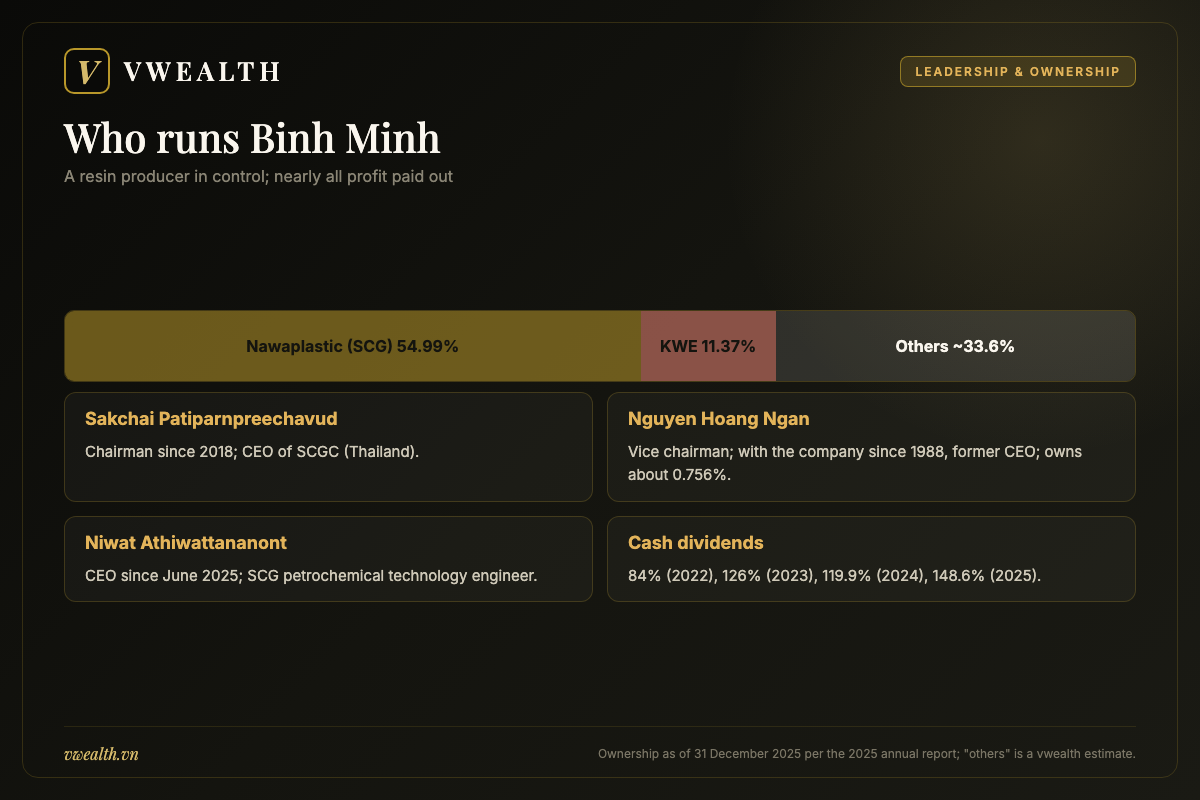
According to the list of major shareholders in the 2025 annual report, as of 31 December 2025 Nawaplastic Industries Co., Ltd. (1 Siam Cement Road, Bangsue, Bangkok) held 45,015,911 BMP shares, or 54.99% of the company. That percentage has barely moved since 2023, when Nawaplastic bought another 426,100 shares to reach 54.99%, according to major-shareholder trading data compiled by CafeF. From about 50.9% in 2018, SCG gradually bought more on the market to reach this level.
SCG (The Siam Cement Group) is a Thai conglomerate more than a century old, operating in cement and building materials, packaging and chemicals. According to VnExpress, it has invested in Vietnam since 1992 in areas such as plastic packaging, petrochemicals and ceramic tiles. Nawaplastic is an SCG subsidiary, and Binh Minh’s annual report shows that several of its directors come from the group’s chemicals and plastics businesses (SCG Chemicals, Thai Plastic and Chemicals). When the 2018 deal closed, VnExpress wrote that, having already owned a resin producer in Vietnam (TPC Vietnam), SCG was signalling its ambition to build an integrated plastics value chain in the country by taking over Binh Minh. The implication for investors is: Binh Minh is a downstream link in SCG’s plastics value chain, from resin to finished product.
Estimates of SCG’s total investment in BMP differ slightly: VnExpress (April 2026) put it at about VND 2,750 billion, while CafeF (April 2024) said about VND 2,800 billion. Both agree that dividends have already exceeded the original outlay. VnExpress calculated that from 2012 through the 2025 dividend, Nawaplastic received more than VND 3,200 billion in dividends, about 18.5% more than it invested — before counting the market value of the shares themselves. That is why the Vietnamese press calls BMP the Thai owner’s “golden goose”.
The Board: Sakchai Patiparnpreechavud and Nguyen Hoang Ngan
The chairman since 2018 is Sakchai Patiparnpreechavud (some outlets spell it Patiparnpreechawud), a Thai national born in 1967 with an MBA. According to the annual report, he previously ran a petrochemical company in Iran (2005), SCG Plastics (2009) and SCG Chemicals (2015), served as vice president of SCG’s Polyolefin and Vinyl business (2017), and is currently chief executive of SCGC Public Co., Ltd. — SCG’s listed chemicals arm. He holds no BMP shares directly. In other words, the head of Binh Minh’s board is one of the most senior executives of the very business that supplies Binh Minh’s raw materials. That is both an advantage (he understands the resin market from the inside) and something to monitor (related-party transactions).
The vice chairman is Nguyen Hoang Ngan, born in 1962, a mechanical engineer with a management master’s degree. He is a rare “old hand” at the top: he joined Binh Minh as a technical staffer in 1988, became head of engineering in 1992 and deputy director in 1997, then served as vice chairman and deputy CEO, CEO from November 2012, and vice chairman and CEO from 2014 to July 2022. In April 2025 he was reappointed vice chairman. According to the annual report, he owns 618,550 shares, about 0.756% of the company. At the 2026 annual general meeting (AGM), he made the remark that perhaps best sums up Binh Minh’s philosophy: chasing revenue by cutting prices would be easy, but the real task is to balance growth and profit to protect shareholders’ interests.
The other board members, per the 2025 annual report, are Krit Bunnag (CEO of Nawaplastic since 2023, on BMP’s board since April 2024); Chatri Eamsobhana (vice president, CFO and chief commercial officer of SCG Chemicals, on the board since April 2025); and Nguyen Thi Minh Giang, an independent member since April 2023, currently managing director of TIM Vietnam JSC and formerly an investment analyst at Dragon Capital. The picture is clear: most seats belong to SCG executives, with one independent seat held by someone with an investment-analysis background.
Management: A Thai Petrochemical Engineer and a Vietnamese Technical Team
Since June 2025, Binh Minh’s CEO has been Niwat Athiwattananont, a Thai national. His profile in the annual report is that of a technologist: engineer at Thai Polypropylene from 1991, research and technology director in 2004, managing director of a petrochemical company in Iran in 2011, chief technology officer of SCG Chemicals’ Polyolefins and Vinyl business in 2018, and head of technology and product development in 2022. He owns no BMP shares. His predecessor, Chaowalit Treejak, was a commercial specialist — export sales, procurement and marketing at Thai Plastic and Chemicals, Binh Minh’s deputy CEO for finance and administration (2021–2022), then CEO from August 2022 — and stepped down to retire effective 1 June 2025.
The shift from a commercial leader to a technology leader matches what management said at the 2026 AGM: Binh Minh’s competitive edge is “gradually shifting from scale to technology and operational efficiency,” including automation and even AI in production. On its website the company lists projects such as three-axis robots for picking and cutting pipe, a robotic ball-valve assembly line, automatic material feeding at two plants, and IoT sensors for equipment monitoring. The 2025 annual report says automation investment carried out during the year totalled VND 153 billion, 79% of plan, and that 79 improvement projects generated benefits of about VND 47 billion.
Beneath the CEO are two deputy CEOs: Nguyen Thanh Quan (born 1968, chemical engineer, with Binh Minh since 1994, former director of Factories No. 1 and No. 2, in charge of engineering and production since 2013) and Asada Boonsrirat (Thai national, chemical engineer, in charge of finance and administration since 2023, previously with Siam Cement and Nawaplastic). The chief accountant, Phung Huu Luan, has been with Binh Minh since 1998. This setup is typical of Thai-owned subsidiaries in Vietnam: the CEO and finance roles go to group executives, while plant operations, engineering and accounting stay with long-serving Vietnamese staff who know the company intimately.
Shareholder Structure: 85% Foreign, a Thin Free Float and 100% Foreign Room
As of 31 December 2025, Binh Minh had 81,860,938 common shares outstanding, charter capital of about VND 818.6 billion, no change in capital during the year and no treasury shares. The shareholder breakdown in the annual report is worth pausing on:
- Foreign shareholders: 355 holders owning 69,746,133 shares, about 85.2% of the company.
- Domestic shareholders: 3,148 holders owning about 14.8%.
- Institutions own about 88.4%; individuals about 11.6%.
- Two holders above 5%: Nawaplastic with 54.99% and KWE Beteiligungen AG (Switzerland) with 11.37%.
The two major holders alone account for about 66.4% (vwealth estimate). Most of the rest is also held by institutions, many of them long-term funds. As a result, the genuinely tradable free float is thin, and BMP often trades far less than stocks of similar market value. For individual investors, thin liquidity means buying is easy enough, but selling a large block in a single day may require accepting a worse price.
Vietnam caps foreign ownership in many listed companies — the “foreign ownership limit” or “foreign room” — and a stock whose room is full can only be bought by foreigners when another foreigner sells. Binh Minh won approval from the State Securities Commission (SSC) to raise its foreign room to 100% in 2017. In 2026, a regulatory change nearly shrank that room. According to the board’s 6 August 2026 submission for a written shareholder vote, Decree 96/2026/ND-CP, which implements the Investment Law, caps foreign ownership at 50% for companies registered in business line code 4290 (“construction of other civil engineering works”, specifically water supply and drainage works, yards and warehouses). Binh Minh still had this line on its enterprise registration certificate (as updated on 17 May 2022) even though, per the submission, it had “generated zero revenue” historically. The company said it had consulted the SSC and received a reply in Official Dispatch No. 5212/UBCK-PTTT dated 10 June 2026. Keeping it would cut the whole company’s foreign room to 50% — below Nawaplastic’s own stake — and, in the company’s words, directly affect foreign shareholders’ rights and the stock’s liquidity. The board therefore proposed removing the line. According to the shareholder resolution dated 21 August 2026 posted on the company’s investor page, the proposal passed with 63,666,536 shares in favour, equal to 77.77% of all shares; there were no votes against, a tiny number of abstentions or invalid ballots, and about 22.07% of shares did not return a ballot. The resolution took effect on 21 August 2026.
This small detail answers a question many investors ask: does SCG want to take BMP private? As of writing, vwealth has found no official announcement of a tender offer aimed at delisting BMP. The fact that the company proactively cleaned up its business registration to preserve 100% foreign room suggests — this is vwealth’s reading, not a company statement — that management currently intends to keep the stock listed and open to foreign investors.
Dividends: Paying Out Nearly All Profit, Twice a Year
If one feature sets BMP apart from most Vietnamese stocks, it is the dividend. According to CafeF, Binh Minh typically splits each year’s dividend into two payments: an interim in the fourth quarter, and the remainder in the second quarter of the following year after the AGM approves it. Recent AGM resolutions set a floor of “at least 50% of net profit,” but in practice the company pays out almost everything. Note that in Vietnam dividends are quoted as a percentage of par value, which is VND 10,000 per share; a 148.6% dividend therefore means VND 14,860 per share.
| Fiscal year | Total cash dividend (% of par) | Payment schedule | Net profit (VND billion) | Payout ratio |
|---|---|---|---|---|
| 2022 | 84% | 31% interim + 53% paid in 2023 | ~694 | ~99% (vwealth estimate) |
| 2023 | 126% | 65% interim in 2023 + 61% in 2024 | ~1,041 | ~99% (vwealth estimate) |
| 2024 | 119.9% | 57.4% interim in 2024 + 62.5% in 2025 | ~991 | ~99% (vwealth estimate) |
| 2025 | 148.6% | 65% interim Dec 2025 + 83.6% paid 10 June 2026 | ~1,229 | ~99% (per the 2026 AGM resolution) |
Total dividends for 2024, per the annual report, were about VND 981.5 billion, or VND 11,990 per share. For 2025, VnExpress calculated that Binh Minh needed more than VND 1,216 billion, about 99% of net profit; the dividend was VND 14,860 per share, according to Cong Thuong. VnExpress also noted that since the Thai shareholder arrived in 2012, Binh Minh has never paid less than 20% in cash, and the last three years have all been in triple digits.
How can a company pay out nearly 100% of its profit without running dry? There are three reasons, which the financial chapter makes clearer. First, the pipe business needs little new capital while plants still have spare capacity. Second, Binh Minh has almost no debt, so it need not retain profit to repay loans. Third, it already holds a very large cash pile — about VND 2,057 billion in cash and deposits at the end of 2025, according to the consolidated financial statements (cash and cash equivalents plus held-to-maturity deposits). But precisely because it pays out everything, Binh Minh accumulates almost no new capital for big growth investments. That is the core trade-off of this stock: you get cash today in exchange for fairly modest growth tomorrow.
One more angle: because Nawaplastic owns about 55%, roughly 55 dong of every 100 dong Binh Minh pays out flows to Bangkok. The high-payout policy serves the controlling shareholder, and fortunately for minority investors, here its interest coincides with theirs: everyone receives the same dividend per share. Foreign investors should also note that Vietnam applies withholding tax on cash dividends paid to individuals (5%); check the treatment that applies to you.
Binh Minh’s Business: A Boring Product Protected by a Real Moat
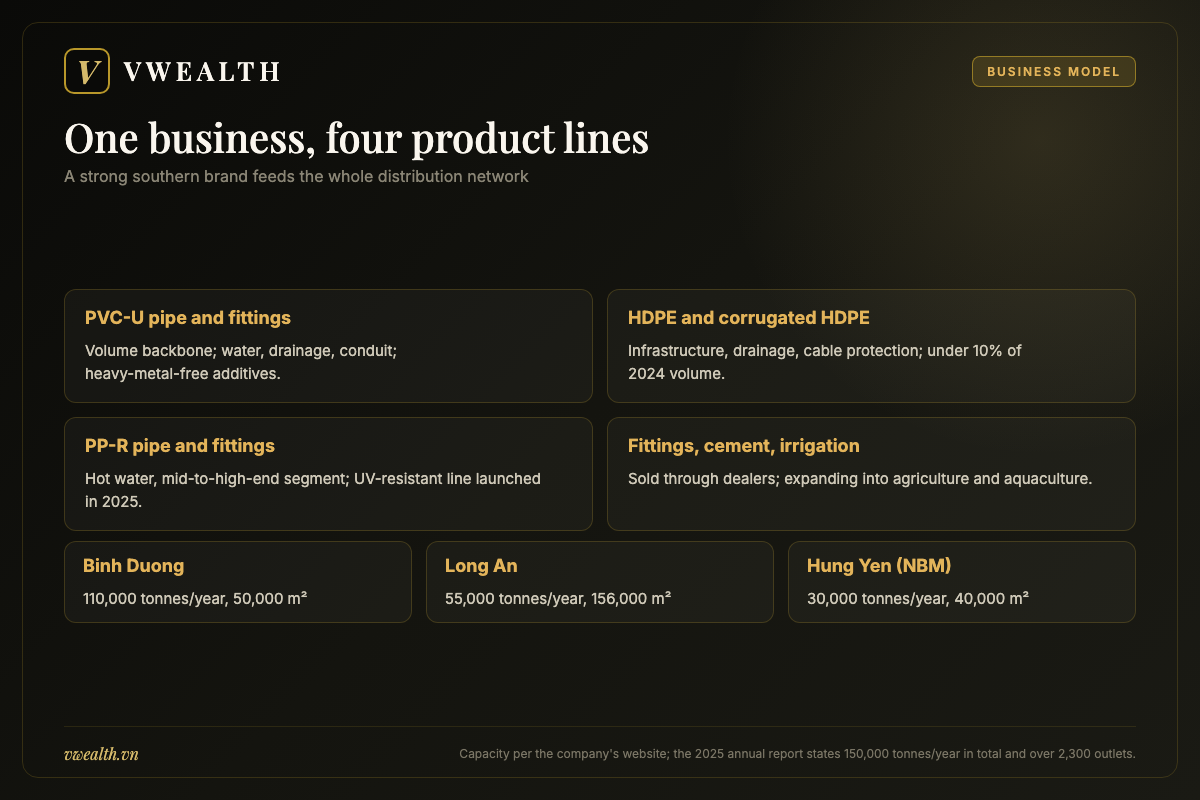
Walk into a building-materials shop in Tan Binh district of Ho Chi Minh City, or a dealer in Can Tho in the Mekong Delta. You will see bundles of grey pipe printed with blue “Binh Minh” lettering, boxes of elbows, tees, couplings and valves, and tins of solvent cement. The plumber who comes in does not compare technical specifications; he asks for the brand by name. That is Binh Minh’s entire business model: making plastic pipes and fittings, selling them mainly through a network of distributors and shops, to people who cannot afford to get it wrong. According to its website, the company’s main lines are PVC-U, PP-R, HDPE and double-wall corrugated HDPE pipes and fittings, irrigation fittings, PVC cement and sprayers.
PVC-U Pipe: The Backbone of Revenue
PVC-U (also written uPVC) is unplasticized PVC — rigid, cheap and resistant to many chemicals — used for cold-water supply, drainage and electrical conduit. It is Binh Minh’s oldest product and the backbone of its volume, from small household pipes to 630 mm pipe for construction projects. The company also sells a “Tiger” PVC-U line for a different price segment, and in 2025 added PVC-U pressure classes PN6 and PN12, according to its annual report.
One differentiator Binh Minh emphasizes: since 2017 it has been, by its own account, the first to successfully adopt a heavy-metal-free additive system (replacing lead-based stabilizers) in PVC-U pipes and fittings, and all its products now use it. In 2024, Chairman Sakchai told shareholders the company was “currently the only supplier of products free of heavy metals” — a company claim you should read as self-description. Binh Minh’s PVC-U and PP-R lines hold Singapore Green Building Product (SGBP) certification at the top “Leader” level. Homeowners may not care, but for developers of premium projects, foreign-invested industrial parks and green buildings, such certifications are a ticket onto approved-materials lists.
PVC resin is the largest cost of this product line — and of the whole company. So whenever you read about “Binh Minh’s margins,” most of the story is really about the gap between the price of PVC resin and the price of PVC-U pipe.
HDPE and Corrugated HDPE Pipe: The Door to Infrastructure and Public Investment
HDPE is high-density polyethylene — flexible, impact-resistant and heat-fused at the joints, so it is watertight — used for large water mains, drainage and underground cable protection. Double-wall corrugated HDPE pipe (smooth inside, ribbed outside) is used for sewage and stormwater, where high ring stiffness is needed at low weight. Binh Minh has made HDPE since 2002 and, by its own account, was the first in Vietnam to produce 1,200 mm HDPE pipe in 2010. Its capacity page lists landmark projects that have used Binh Minh pipe, including the Hai Van, Deo Ca and Thu Thiem tunnels, Phu Quoc International Airport, the Ca Mau gas-power-fertilizer complex, the Dung Quat economic zone and several expressways.
But here is a key fact: HDPE is not where Binh Minh’s volume is. In 2024, Chairman Sakchai explained to shareholders that infrastructure projects use more HDPE pipe, and that this product accounted for “less than 10% of sales volume,” according to Cong Thuong. He also said Binh Minh focuses on real-estate customers rather than infrastructure, unlike many rivals, and that this was one reason it lost national market share in 2023–2024, when the north — with higher infrastructure spending — did better than the south. Keep this in mind whenever you read upbeat pieces about “stocks that benefit from public investment”: Binh Minh does benefit, but far less directly than it first appears.
PP-R and UV-Resistant PP-R: Hot Water and the Premium Segment
PP-R (polypropylene random copolymer) is heat-resistant pipe used for hot-water lines inside homes — water heaters and solar hot-water systems. It is joined by heat fusion rather than glue. Binh Minh launched heat-resistant PP-R in 2009 and in 2025 introduced UV-resistant PP-R for outdoor hot-water installations, according to the annual report. PP-R has a higher value per meter than PVC-U and fits the strategy CEO Niwat laid out at the 2026 AGM: focus on the mid-to-high-end segment “where margins are better,” and gradually move from being a “pipe manufacturer” to a “solutions provider.”
In early 2026, when raw-material prices rose on Middle East tensions, Binh Minh proactively adjusted its selling prices, CEO Niwat told the AGM on 28 April 2026. Each product line uses a different resin (PVC for PVC-U, polyethylene for HDPE, polypropylene for PP-R), so each is affected differently by oil and gas prices — one reason to read the company’s price notices line by line when they are issued.
Fittings, Cement, Irrigation — and a New Push into Agriculture
A piping system is more than pipe. Every project needs hundreds of fittings — couplings, elbows, tees, valves, end caps — plus solvent cement. Fittings are where brand matters most, because one leaking joint can ruin a whole wall, and plumbers tend to buy pipe and fittings from the same brand so sizes match. Binh Minh makes a full range of fittings for PVC-U, PP-R and HDPE, as well as PVC cement, gaskets and irrigation products.
The newest direction is agriculture. At the 2026 AGM, deputy CEO Asada Boonsrirat said that beyond traditional segments, the company is supplying pipe for aquaculture and large-scale farming and has signed contracts with several large partners in the Mekong Delta — while remaining selective about partners and projects. This is worth watching because the Mekong Delta is Binh Minh’s home turf, and demand from irrigation and high-tech shrimp farming could add a source of demand less tied to the property cycle.
Three Plants and About 2,300 Points of Sale: The Production and Distribution Machine
Binh Minh runs three plants. According to the company’s capacity page: the Binh Duong plant in Song Than 1 Industrial Park (50,000 m², 110,000 tonnes per year), the Long An plant in Vinh Loc 2 Industrial Park (156,000 m², 55,000 tonnes per year), and the northern plant of subsidiary NBM in Pho Noi A Industrial Park, Hung Yen (40,000 m², 30,000 tonnes per year). That adds up to 195,000 tonnes per year (vwealth estimate from the website figures). The 2025 annual report, however, states total capacity of 150,000 tonnes per year and NBM capacity of 40,000 tonnes per year. The published figures therefore do not reconcile; a plausible reading is that the website lists maximum design capacity by plant while the annual report states usable capacity, but that is vwealth’s inference — ask investor relations directly if the number matters to you.
Whichever figure you use, the plants are running well below capacity. Vietcap once forecast Binh Minh’s 2024 sales volume at about 76,500 tonnes; against 150,000 tonnes, that implies utilization of roughly half (vwealth estimate). In 2023 management said the Long An plant was running at about 70% of its then design capacity and would take three to five years to fill. At the 2026 AGM, management said the plant serving the northern market had reached only about 60% of capacity amid stiff competition in the project segment. Spare capacity cuts both ways: it is why Binh Minh needs little new investment — and can therefore pay out nearly all profit — but it also shows that volume growth, not production capacity, is the real bottleneck.
On the sales side, the 2025 annual report says Binh Minh has a network of more than 2,300 distributors and shops nationwide. The company holds quarterly distributor conferences and runs workshops for dealers, contractors and plumbers across provinces. Da Nang Plastics (DPC), in which Binh Minh took a 29% stake in 2008, acts as a transit warehouse for central Vietnam and the Central Highlands. Direct project sales exist — the company has set up a dedicated team — but management made clear at the 2026 AGM that project sales “usually come with low margins and significant receivables risk,” so it chooses partners cautiously. Read that alongside short-term trade receivables of only about VND 129 billion at the end of 2025 (per the audited consolidated financial statements) against revenue of more than VND 5,500 billion, and you can see that Binh Minh sells mainly through dealers, collects cash quickly and extends almost no long credit to customers.
What Feeds What, and Where Binh Minh’s Moat Really Lies
Unlike many companies in the vwealth series, Binh Minh does not have several “divisions” in the sense of different industries. It has one business — construction plastic pipe — split by material. No property arm, no financial arm (apart from bank deposits), no subsidiaries outside the industry. So the question “which segment feeds which” really means: the brand and distribution network built on household PVC-U in the south feed everything else. They allow Binh Minh to sell PP-R, HDPE and fittings through the same network at low incremental cost, and to enter premium segments that a new brand would find very hard to crack.
Binh Minh’s moat — its durable competitive advantage — therefore does not lie in proprietary technology (extrusion machines can be bought) or in scale (there is a larger rival in the north). It lies in three harder-to-copy things: (1) the trust of plumbers and homeowners in the south, built over nearly 50 years; (2) a dense dealer network willing to stock Binh Minh even when its discounts are not the highest; and (3) a controlling shareholder that makes plastic resin, giving Binh Minh market information and raw-material access that small rivals lack. According to Cong Thuong, in 2023 management said its raw-material mix was about 70% imported and 30% domestic, with an advantage in sourcing from the SCG group, and that it planned to buy more PVC domestically, including from Duc Giang Chemicals once its Nghi Son project came online (see our analysis of DGC Duc Giang Chemical).
The moat has limits. It is strong in the south and weaker in the north. It protects margins, but it cannot stop rivals from competing on discounts — in 2025, according to BIDV Securities (BSC), Binh Minh’s discounts plus selling expenses reached about 19.7% of revenue, a five-year high, to defend market share. And it does not create volume growth when the market stands still.
| Product line | Material and main use | Typical customers | What to watch |
|---|---|---|---|
| PVC-U pipe and fittings | Unplasticized PVC; cold water, drainage, electrical conduit | Households, plumbers, housing projects | PVC resin price; dealer discounts |
| HDPE and corrugated HDPE | Polyethylene; large water mains, drainage, cable protection | Infrastructure, utilities, industrial parks | Under 10% of volume (2024); fierce project competition |
| PP-R pipe and fittings | Polypropylene; hot water, heat-resistant | Mid- to high-end housing, hotels | Higher-margin segment; new UV-resistant line in 2025 |
| Fittings, cement, irrigation | Couplings, valves, PVC cement, irrigation parts | Dealers, agriculture, aquaculture | Agriculture push from 2025–2026 |
Financial Health: Read the Numbers Before Deciding Whether to Buy BMP Stock
Binh Minh’s financial statements are among the easiest to read on the exchange: no complex subsidiaries, no opaque business cooperation contracts, no half-built property, almost no debt. But easy to read is not the same as easy to interpret correctly. The biggest trap with BMP stock is that its most impressive numbers — gross margin above 40%, return on equity above 40% — were produced in an unusually favourable period for raw-material prices. This chapter helps you separate “business quality” from “cyclical luck.”
Eleven Years of Revenue and Profit: Flat Volume, Soaring Margins
The table below summarizes net revenue, gross profit and net profit from Binh Minh’s consolidated financial statements (as compiled by VNDirect’s financial database, rounded). The gross-margin column is a vwealth estimate, calculated as gross profit divided by net revenue; the company’s annual report calculates margins on total revenue, which gives figures about one percentage point lower (for example, 45% for 2025).
| Year | Net revenue (VND bn) | Gross margin (vwealth estimate) | Net profit (VND bn) | Note |
|---|---|---|---|---|
| 2015 | ~2,792 | ~31.9% | ~519 | Long An plant opens |
| 2016 | ~3,309 | ~32.1% | ~627 | Old profit peak |
| 2017 | ~3,825 | ~24.1% | ~465 | Fierce competition, share loss |
| 2018 | ~3,920 | ~22.2% | ~428 | SCG takes majority |
| 2019 | ~4,337 | ~22.8% | ~423 | Distribution restructuring |
| 2020 | ~4,686 | ~26.6% | ~523 | Revenue overtakes Tien Phong |
| 2021 | ~4,553 | ~15.5% | ~214 | Lockdowns, PVC spike |
| 2022 | ~5,808 | ~27.7% | ~694 | Record revenue |
| 2023 | ~5,157 | ~41.0% | ~1,041 | First year above VND 1 trillion |
| 2024 | ~4,616 | ~43.1% | ~991 | Revenue trough, margin still rising |
| 2025 | ~5,510 | ~46.1% | ~1,229 | Record profit, EPS ~VND 15,010 |
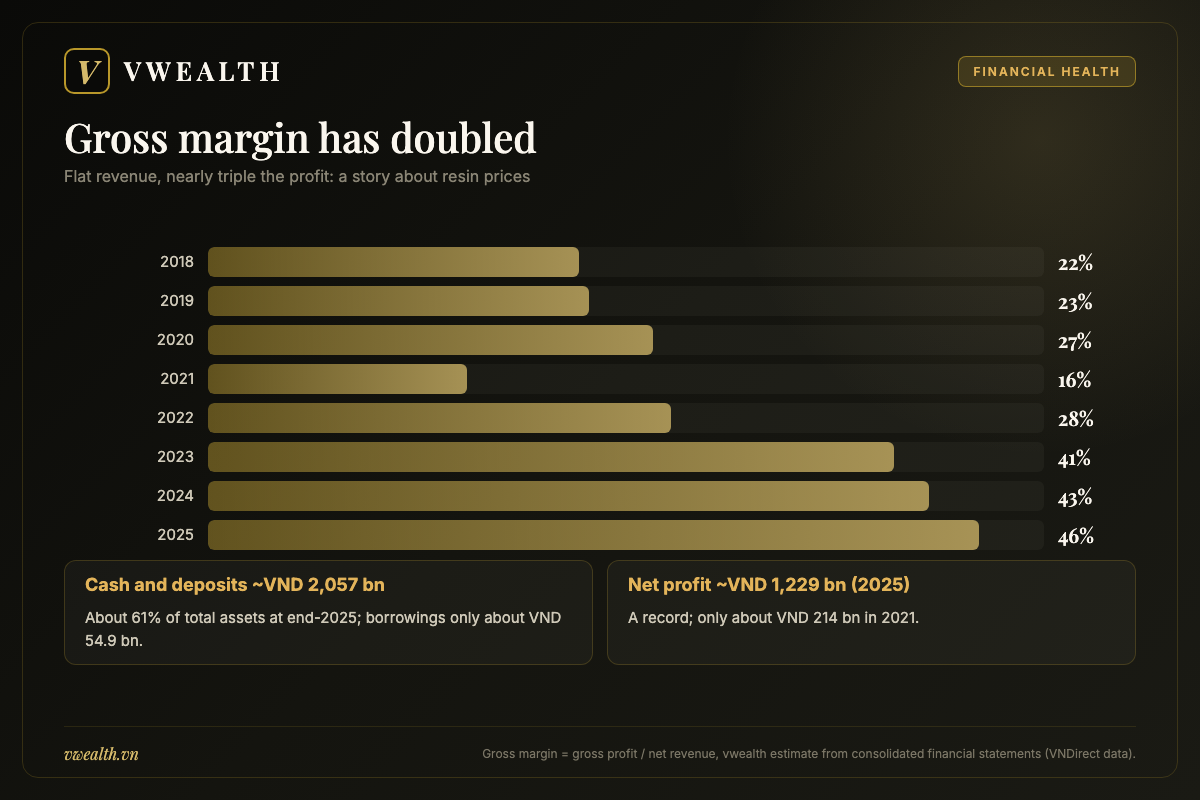
Read this table in two directions. First, revenue: from 2018 to 2025, net revenue rose only from about VND 3,920 billion to about VND 5,510 billion, with three down years along the way. 2025 revenue was still below 2022. After seven years under SCG, Binh Minh’s scale has grown modestly — and part of that growth came from price rather than volume. Second, profit: from about VND 428 billion in 2018 to about VND 1,229 billion in 2025, nearly triple. Almost the entire gap between those two directions sits in one column: gross margin, from about 22% to about 46%.
A note on comparisons: calculated directly from the financial statements in the table, 2025 net revenue rose about 19% and net profit about 24% from 2024 (vwealth estimate). VnExpress reported revenue up 12% and profit up about 12.4%. vwealth uses the financial statement figures; when you see discrepancies like this, prefer the audited statements as the primary source.
The 2025 figures are also what the annual general meeting approved on 28 April 2026. According to the AGM resolution, 2025 total revenue (including financial income and other income) was about VND 5,601.8 billion, profit before tax about VND 1,538.9 billion and profit after tax about VND 1,228.7 billion. The profit distribution plan set aside about VND 1,216.5 billion, or roughly 99% of net profit, for a cash dividend of VND 14,860 per share, with the remaining roughly 1% (about VND 12.3 billion) going to bonuses for the board and the supervisory board. Every item passed with 100% of the shares represented, just over 65.35 million shares.
For 2026, the AGM approved targets of VND 6,053 billion in revenue, VND 1,597 billion in profit before tax, VND 1,278 billion in profit after tax and a capital expenditure plan of VND 279 billion. Against 2025 results, the revenue target is about 8% higher than total revenue and about 10% higher than net revenue, while the net profit target is about 4% higher (vwealth estimates). The VND 279 billion capex plan stands out next to roughly VND 126 billion spent on fixed assets in 2025: if fully disbursed, 2026 would be a year of noticeably higher investment than usual, though still small relative to operating cash flow. Cong Thuong reported that, while acknowledging raw-material volatility, management remained “confident of meeting the annual plan”.
The first quarter of 2026 went in that direction. According to the consolidated first-quarter 2026 financial statements, net revenue was about VND 1,457 billion, roughly 5% above the first quarter of 2025 (about VND 1,383 billion), and net profit about VND 304 billion, roughly 6% above the prior-year quarter (about VND 287 billion) — growth rates are vwealth estimates. Notably, selling expenses in the quarter rose to about VND 244 billion, the highest of recent quarters, suggesting the company still had to spend heavily on its distribution channel as prices were adjusted. CafeF put total assets at 31 March 2026 at about VND 3,815.5 billion, up about 19% from the start of the year, mainly because cash built up ahead of the second dividend payment in June. In the second quarter of 2026, VnExpress reported another record quarterly profit, and after six months the company had completed more than half of its annual profit target. The latest quarterly figures and progress against plan are updated in vwealth’s BMP research report.
Why Gross Margin Jumped from About 16% to About 45%: Resin Prices and Pricing Power
The basic arithmetic of a pipe maker is simple: the selling price per tonne of pipe, minus the cost of resin and additives per tonne, minus conversion costs (power, labour, depreciation). Resin is by far the largest item. When resin prices fall and selling prices do not fall as much, gross margin expands; when resin prices rise and selling prices cannot keep up, margin contracts.
2021 illustrates the contraction: lockdowns cut demand, resin prices rose, and gross margin fell to about 16%. From 2023 onward we see the expansion: Asian PVC prices sank to multi-year lows on Chinese oversupply and weak global construction. In 2025, BSC noted that PVC resin prices in China had fallen a further 14.3% or so from the start of the year. Meanwhile, Binh Minh kept its selling prices relatively steady. As a result, most of the fall in raw-material costs was retained as profit.
At the 2026 AGM, CEO Niwat described the approach quite plainly: when input costs rise, selling prices are adjusted accordingly; when costs fall, price adjustments are “considered cautiously” — and, according to company leaders, this is how an industry leader with relative pricing power operates. In other words, Binh Minh’s prices go “up fast, down slow.” That is the textbook definition of pricing power, and it is the main reason Binh Minh’s recent margins are well above its own history.
But pricing power has a limit, and that limit is market share. If Binh Minh holds prices high for too long while rivals cut theirs, customers — especially project contractors — will switch. In the next section, you will see signs of that cost in the financial statements themselves.
Discounts, Selling Expenses and the Price of Defending Market Share
There is a part of Binh Minh’s income statement that skimmers tend to miss: the costs of getting goods sold. They are scattered across three lines. “Revenue deductions” (mainly trade discounts) rose from about VND 16 billion in 2022 to about VND 92 billion in 2025. “Selling expenses” rose from about VND 503 billion to about VND 711 billion over the same period — about 8.7% of net revenue in 2022 and about 12.9% in 2025 (vwealth estimate). And “financial expenses” in 2025 were about VND 231 billion, while interest expense was only about VND 14 million. A company with virtually no borrowings that books more than VND 200 billion of financial expenses — most likely these are early-payment discounts for customers who pay quickly, a cost BSC also mentions in its analysis. That is vwealth’s reading; the notes to the financial statements give the detailed breakdown.
According to BSC (as reported by CafeF in November 2025), Binh Minh’s total discounts and selling expenses reached about 19.7% of revenue in the third quarter of 2025, the highest in about five years. BSC attributed this to industry oversupply — actual demand estimated at only about 40% of total industry design capacity — and fierce competition in the south from players such as Hoa Sen and Stroman. According to ACB Securities (ACBS), thanks to a more flexible pricing policy, Binh Minh’s market share improved to about 27% in the third quarter of 2025, after falling to about 23% at the end of 2024.
The lesson: a high gross margin is not the whole story. Part of it is being “handed back” to the distribution channel through discounts and selling costs. When judging the quality of Binh Minh’s earnings, look at pre-tax margin — about 6% in 2021, 15% in 2022, 25% in 2023, 27% in 2024 and 27% in 2025, per the annual report. Gross margin rose from 43% to 45% in 2025, but pre-tax margin was flat, precisely because discounts and selling expenses increased. If raw-material prices turn up while competition stays fierce, Binh Minh will be squeezed from both sides.
Balance Sheet: Deposits Worth About 60% of Assets, Virtually No Debt
At the end of 2025, Binh Minh’s consolidated total assets were about VND 3,379 billion. Cash, cash equivalents and bank deposits totalled about VND 2,057 billion, nearly 61% of total assets (vwealth estimate from the financial statements). Inventory was about VND 525 billion and short-term receivables about VND 129 billion. On the funding side, total liabilities were only about VND 501 billion, of which short-term borrowings and finance leases were about VND 54.9 billion, with no long-term debt. Equity was about VND 2,877 billion, made up of VND 818.6 billion of paid-in capital, an investment and development fund of about VND 1,157 billion and retained earnings of about VND 855 billion. The annual report puts debt-to-equity at about 14.8%.
You can read this balance sheet two ways. The first: it is a fortress. No meaningful debt, no liquidity risk, no damage from higher interest rates, and enough cash to ride out a few bad years while still paying dividends. The second: it is idle capital. Roughly VND 2,000 billion is earning bank interest — financial income was about VND 102 billion in 2025 — while the core business earns far higher returns. The three options for that money are to keep it as a buffer, pay a special dividend, or fund expansion (a new plant or an acquisition). So far Binh Minh has chosen the first, combined with paying out almost all annual profit. The investment and development fund, unchanged at about VND 1,157 billion between the start and end of 2025, is another sign the company has no major investment plan that requires building up capital.
Cash Flow and ROE: Why Paying Out Everything Doesn’t Drain the Vault
According to the 2025 consolidated cash flow statement, net cash from operating activities was about VND 1,219 billion (about VND 901 billion in 2024), close to net profit. Capital expenditure on fixed assets was only about VND 126 billion (about VND 109 billion in 2024), roughly in line with depreciation of about VND 93 billion. Free cash flow in 2025 was therefore about VND 1,093 billion (vwealth estimate). Dividends actually paid during the year were about VND 1,044 billion. Free cash flow just about covers the dividend — which is why the cash pile does not shrink even though the company pays out nearly all its profit.
Return on equity (ROE) in 2025 was about 44% (vwealth estimate: net profit divided by the average of opening and closing equity). That is among the highest of any listed Vietnamese manufacturer. But remember: in 2021, on the same basis, ROE was below 10%. Today’s high ROE has three sources: high margins (dependent on raw-material prices), stable asset turnover, and a near-100% payout that keeps equity from growing. The third is the most durable; the first is the most volatile.
Six Questions to Ask Every Time Binh Minh Reports
- How does this quarter’s gross margin compare with last quarter and a year ago? If gross margin falls two quarters in a row, look for the cause in PVC resin prices and price-adjustment announcements.
- Is revenue growing because of price or volume? The annual report and investor meetings often disclose tonnes sold; revenue up with volume down is fragile growth.
- What share of revenue goes to discounts and selling expenses? Add revenue deductions, selling expenses and the early-payment discounts inside financial expenses.
- Is inventory rising or falling, and why? Binh Minh may deliberately stock up on cheap resin; rising raw-material inventory ahead of price increases is positive, while rising finished-goods inventory because of slow sales is negative.
- How much cash and deposits remain after each dividend payment? A sharp drop without a new investment project deserves a question.
- Are there large raw-material purchases from related parties within the SCG group, and on what price terms? The related-party note in the financial statements is where to look.
You do not have to calculate everything yourself. The latest vwealth analysis report tracks BMP’s quarterly margins, cost structure and cash flow — you can create a vwealth account to follow each reporting period.
How the Market Has Treated BMP Stock: From “Overpaid” Deal to Sought-After Dividend Play
BMP has an unusual personality among Vietnam stocks: little speculative drama, but long stretches of neglect punctuated by sharp re-ratings. The share price has tracked the margin story from the previous chapter fairly closely — with a lag of a few quarters. This chapter does not say whether today’s price is high or low; it helps you understand how the market has valued BMP in the past, and why.
Memorable Price Milestones
A few historical price markers, as reported by the financial press at the time (not adjusted for dividends):
- Late February 2018: SCIC announces the sale of its 29.51% block at a starting price of VND 96,500 per share; BMP had just risen from around VND 84,000 to about VND 94,100, according to VnExpress.
- Late March 2020: at the Covid bottom, CafeF noted that both BMP and NTP had lost about 50% from the time of the Thai “swap.” Many concluded that SCG had overpaid.
- May 2023: CafeF noted BMP had reached an all-time high, about 60% above the level at which the Thai owner paid for control.
- Late December 2023: a limit-up session took BMP to VND 100,000 per share for the first time, according to CafeF.
- Late December 2024: a new all-time high of VND 135,200, the 18th record of 2024 and about 43% above the start of the year, according to CafeF.
- 2025: according to the annual report, the year’s high was VND 188,800 and the 31 December 2025 close was VND 175,000, for a market value of about VND 14,326 billion.
- Mid-April 2026: about VND 148,100, per VnExpress when valuing Nawaplastic’s stake.
These milestones tell a clear story: the market took nearly five years (2018–2023) to believe that SCG had made Binh Minh better, and only believed it once profits actually exploded. The share price followed earnings; it did not anticipate them. For investors that has two implications. First, BMP is rarely valued on a “future story”; it is valued on real cash coming in. Second, if earnings turn down, the share price will likely follow earnings too — there is no narrative to cushion it.
Valuation: P/E, Dividend Yield and the “Peak Margin” Trap
The price-to-earnings ratio (P/E) is the most common yardstick. For BMP, consider an illustrative example using historical numbers: at the price of about VND 148,100 in mid-April 2026 reported by VnExpress, and 2025 EPS of about VND 15,010, the P/E at that moment was about 9.9 times; the 2025 dividend of about VND 14,860 implies a dividend yield of about 10% at that price (vwealth estimate). This is not today’s number — the price has changed since — but it shows the structure: for a company that pays out nearly 100% of profit, the dividend yield is close to the inverse of the P/E.
The trap is in the denominator. EPS of VND 15,010 was earned in a year with a gross margin of about 45–46%, the highest in the company’s history. If you believe that margin is the “new normal,” a P/E of around 10 for a debt-free company with ROE above 40% is cheap. If you believe margins will revert toward the 2015–2022 average (about 22–28%), “normalized” earnings are much lower, and the P/E on normalized earnings is much higher. The entire valuation debate on BMP comes down to one question: is today’s margin a cyclical peak, or a new plateau built on pricing power? Chapter 7 offers an illustrative example of this sensitivity. Price-to-book (P/B) is less useful for BMP, because paying out all profit keeps book equity small relative to earning power.
Stock Personality: Thin Liquidity, Foreign Dominance and Ex-Dividend Drops
Three behavioural traits to know before trading BMP. First, liquidity is thin, as noted in chapter 2: most shares sit with SCG, KWE and funds, so daily matched volume is usually small, and intraday moves can be large when unusual buy or sell orders arrive. Second, foreign investors own about 85% of the company; their trading — including ETFs — has a significant effect on the price. Third, because cash dividends are so large, the reference price is adjusted down by the dividend amount on the ex-dividend date. Illustrative example: the 83.6% dividend in 2026 equals VND 8,360 per share, so the reference price on the ex-date dropped by VND 8,360. Newcomers looking at an unadjusted chart sometimes think the stock “crashed,” when the value has simply moved from the share price into the dividend.
VNDiamond, ETFs and Why Foreign Room Matters
In April 2024, BMP was added to the VNDiamond index — according to CafeF, the benchmark for four ETFs with total assets of about VND 16,000 billion at the time. VNDiamond tracks stocks that foreign investors favour, many of them at or near their foreign ownership limits, and it is the benchmark for several large ETFs. BMP’s inclusion reflects its ownership reality: most of its shares are in foreign hands.
This is also why the August 2026 shareholder vote on business line code 4290 matters more than it looks. If foreign room had been cut to 50% while foreigners already held about 85%, the stock would have been “out of room” — foreigners could only buy when another foreigner sold — and, in the company’s own words, liquidity would have suffered directly. Keeping 100% room keeps BMP open to foreign capital, which matters for long-term liquidity. Our guide to investing in Vietnam stocks explains how foreign room works in practice.
Catalysts That Could Change How the Market Sees BMP
- Dividend announcements: the interim rate (usually Q4) and the final payment (Q2) are what dividend investors watch most closely.
- PVC price trends: in mid-September 2026, Asian PVC prices hovered near four-month highs as oil and ethylene costs climbed on Middle East tensions, according to ChemOrbis and ICIS data cited by Vietnambiz. That raw-material level will show up in margins over the coming quarters.
- A housing recovery in the south: Binh Minh’s core customers are homes and residential projects in southern Vietnam.
- Use of the cash pile: an expansion (the remaining 6 hectares at Long An) or an acquisition would change the “pay it all out, don’t grow” story.
- SCG’s decisions: any change in the controlling shareholder’s stake or strategy is the biggest potential catalyst of all.
Industry Context: Vietnam’s Construction Pipe Market Between Housing, Public Investment and Oil Prices
To understand a pipe maker, picture three nested circles. The inner circle is Vietnam’s plastic pipe industry: who sells to whom, and where. The middle circle is construction: residential housing, property projects, public infrastructure. The outer circle is the global petrochemical market, which sets the price of resin. Binh Minh is affected by all three, but in different ways.
The Industry Map: Tien Phong in the North, Binh Minh in the South
Vietnam’s plastic pipe market has a feature few industries share: a sharp geographic split. Pipe is bulky — light but space-hungry — so long-distance freight is expensive relative to its value, and plumbers’ habits in each region are sticky. Tien Phong Plastics (NTP, listed on the Hanoi Stock Exchange, headquartered in Hai Phong) dominates the north; Binh Minh dominates the south. According to Vietcap Securities, as cited by Cong Thuong in 2024, Binh Minh held up to about 50% of the southern plastic pipe market. Nationally, ACBS put Binh Minh’s share at around 23–27% over 2024–2025. These market-share figures are brokerage estimates using different methods; what they agree on is that Binh Minh is number one in the south, while Tien Phong is strong in the north.
Nationally, Binh Minh’s share has fluctuated. ACBS estimated it fell to about 23% at the end of 2024 and recovered to about 27% in the third quarter of 2025. In 2024, Chairman Sakchai attributed the national share loss to macro factors — the north had a healthier property market and higher infrastructure spending than the south — rather than to the company itself. That is the company’s explanation; the way to test it yourself is to watch Binh Minh’s sales volume against industry growth in coming years.
An interesting historical detail: in 2022, according to CafeF, both Binh Minh and Tien Phong posted record revenue of more than VND 5,800 billion, running neck and neck, but Binh Minh’s gross margin (about 28%) exceeded Tien Phong’s (about 24%) for the first time in many years. The two companies are nearly equal in scale but differ in ownership: Tien Phong has not had SCG as a shareholder since late 2017, while Binh Minh became an SCG subsidiary. vwealth does not yet have a dedicated analysis of NTP; when we do, this will be the most instructive pairing in the industry.
Competitors and Oversupply: Why Competition Never Lets Up
Beyond Tien Phong, Binh Minh competes with many others. BSC names Hoa Sen and Stroman as tough rivals in the south. Hoa Sen is notable: a major steel-sheet producer that added plastic pipe and leverages its existing retail network — see our HSG stock analysis for more. There are also a great many small and mid-sized manufacturers: at the 2026 AGM, Vice Chairman Nguyen Hoang Ngan said Vietnam has close to 200 plastic pipe producers, even though people usually mention only a few big names such as Dat Hoa, Hoa Sen, Phuc Ha, Tien Phong and Binh Minh. He used the figure to push back against the view that the industry is an “oligopoly”, Vietstock reported.
The industry’s core problem is oversupply. According to BSC, actual demand is only about 40% of total industry design capacity (2025). Barriers to entry are relatively low — extrusion machines are not very expensive and the technology is widespread (vwealth’s view). When demand is weak, smaller players use price to win orders. In 2023, Binh Minh’s management said many small producers were operating intermittently, some even seeking to sell out, because competition was so fierce, according to Cong Thuong. That is the upside of an oversupplied market for the leader: hard years weed out financially weak rivals. The downside is that price competition never truly disappears.
The Housing and Property Cycle: Binh Minh’s Main Customer
Plastic pipe goes into every building, but residential housing and property projects are Binh Minh’s biggest source of demand. Its volumes therefore track the southern housing cycle closely. In 2023, when Vietnam’s property market froze, management said market-wide building-materials demand in the third quarter was down 40–50% year on year, with the rainy season making things worse. Binh Minh’s revenue fell two years running in 2023–2024 largely for this reason.
Binh Minh’s 2025 annual report calls 2025 “the year of legal consolidation,” as the amended Land Law, Housing Law and Real Estate Business Law took full effect, helping unblock many stalled projects and supporting steady demand for pipe in mid-range and affordable housing. But the report also notes the negatives: severe weather in the third and fourth quarters of 2025, with numerous storms and floods, disrupted the building-materials supply chain.
Public Investment: A Long-Term Driver, but Not Binh Minh’s Main Arena
At the 2026 AGM, management argued that 2026 marks a return to growth for construction plastics, driven by recovering foreign direct investment (FDI) and manufacturing, a gradually warming property market, and a wave of public infrastructure investment — railways, metro lines and about 5,000 km of expressways. According to company leaders, demand for construction plastics “no longer depends mainly on real estate as before, but is increasingly tied to the infrastructure investment cycle.” They also noted that after severe floods in 2025, demand for water supply and drainage systems and high-durability pipe is rising noticeably. The company’s 2025 annual report says Vietnam went through 19 storms and tropical depressions that year, with estimated economic losses of more than VND 85 trillion — creating demand for rebuilding materials while also disrupting distribution.
That makes sense at the industry level. But as chapter 3 showed, HDPE — the main infrastructure material — was under 10% of Binh Minh’s volume in 2024, and project sales carry low margins and high receivables risk that the company deliberately avoids. So public investment is a genuine driver for Binh Minh, but mostly indirectly: new infrastructure brings new residential areas, industrial parks and factories, and with them demand for residential and industrial pipe — Binh Minh’s strength. When you read a list ranking BMP among “direct beneficiaries of public investment” alongside contractors, quarry operators or asphalt suppliers, remember this distinction.
The Global PVC Market: China, the Middle East and a “New Equilibrium”
The outer circle — resin prices — is what decides Binh Minh’s margins. PVC resin is made by two main routes: from ethylene (derived from oil and gas) or from coal via acetylene (common in China). Binh Minh’s 2025 annual report states a long-term commitment not to use PVC derived from coal and acetylene, to protect consumer health and the environment. The implication vwealth draws from that commitment: Binh Minh’s PVC comes mainly via the ethylene route, so its raw-material costs are more sensitive to oil and gas prices than to coal.
Vietnam is especially sensitive to world PVC prices. According to estimates published on 18 September 2026 by ICIS, the UK-based commodity data provider, and cited by Vietnambiz, Vietnam produces only about 350,000 tonnes of PVC a year while importing more than 1 million tonnes annually in recent years — making it the world’s second-largest PVC importer, with more than three-quarters of domestic supply coming from abroad. ICIS expects Vietnam to remain a net PVC importer for years, since prospects for new integrated chlor-alkali complexes are limited. From 18 September 2026, ICIS also began publishing a dedicated spot import price assessment for PVC into Vietnam — a new tool BMP investors can watch.
On prices, ChemOrbis reported that in mid-September 2026 Asian PVC prices were hovering near four-month highs. Brent crude topped USD 100 a barrel in early September, at times exceeding USD 110 on Middle East tensions, pushing up naphtha and ethylene costs; ethylene CFR China reached USD 1,200 per tonne on 18 September 2026. Polymerupdate reference data showed suspension PVC trading at about USD 820–920 per tonne CFR Southeast Asia, with offers into Vietnam at about USD 820 per tonne for ethylene-based grades and USD 745 per tonne for carbide-based grades (made from coal and limestone). That gap matters for Binh Minh: the company has committed not to use coal- or acetylene-based PVC, so it buys the more expensive grade. There are also forces pulling prices down: China’s property market remains subdued, and after India imposed a minimum import price and then anti-dumping duties on PVC, some cheap cargoes may be redirected to Southeast Asia, where Vietnam is the largest destination, according to ICIS.
At the 2026 AGM, CEO Niwat said raw materials, especially PVC, are the biggest variable and are unlikely to return to earlier lows; even if geopolitical factors ease, the cost base is thought to have shifted to a “new equilibrium”. Chairman Sakchai was more specific: once the conflict ends, selling prices will not return to pre-conflict levels within one to two years, because many links in the supply chain have been affected and need time to recover, Vietnambiz reported. So far the financial statements still look good: according to VnExpress, second-quarter 2026 gross margin stayed high, selling expenses fell the most of any cost line, and quarterly profit set a new record. The real question is the quarters after that, once low-cost raw material stocks run out. The oil and gas shock also affects companies that use gas as feedstock, such as DPM (Phu My Fertilizer) or DCM (Ca Mau Fertilizer), in very different ways.
For BMP investors, the lesson is this: 2023–2025, with PVC prices at multi-year lows, was a near-ideal environment for Binh Minh’s margins. The environment from 2026 on may be less favourable. The question is not whether raw-material prices rise, but whether Binh Minh can pass the increase through to selling prices without losing more market share.
How Binh Minh Compares with Other Building-Materials Stocks
The table below compares Binh Minh qualitatively with several listed building-materials companies vwealth has analyzed. The goal is not to rank them, but to show what “type” of stock BMP is.
| Company | Main products | Financial leverage | Profit driver | Stock type |
|---|---|---|---|---|
| Binh Minh Plastics (BMP) | Plastic pipes and fittings, strongest in the south | Virtually no borrowings | Resin-to-pipe spread, pricing power | High dividend, low growth |
| Tien Phong Plastics (NTP) | Plastic pipes and fittings, strongest in the north | Varies by period (no vwealth report yet) | Similar to BMP, more infrastructure projects | Direct rival |
| Hoa Phat (HPG) | Construction steel, HRC, multiple businesses | Large debt for capex | Steel, iron ore and coal prices; scale | Cyclical, growth via big investment |
| Hoa Sen (HSG) | Coated steel sheet, steel pipe, plastic pipe | Moderate, varies with cycle | HRC prices, exports, retail | Strongly cyclical |
| Nam Kim Steel (NKG) | Coated steel sheet, steel pipe | Moderate to high with cycle | HRC prices, exports, trade defence | Strongly cyclical |
Looking at the table, BMP is closer to a “defensive consumer-style stock within building materials” than to a pure cyclical like steel. But it is not fully defensive: 2021 showed profit can fall by more than half when raw-material prices and demand both move the wrong way.
Outlook: Three Scenarios for BMP Stock and What Would Make Each Happen
vwealth does not publish price targets. Instead, this chapter sets out three scenarios — bull, base and bear — with concrete conditions you can track yourself. For BMP this is easier than for most companies, because the key variables are few and most can be observed every quarter.
Five Variables That Will Decide Binh Minh’s Future
- Resin prices, especially ethylene-based PVC. The biggest variable, as the CEO himself acknowledges. It depends on oil prices, Middle East tensions and China’s capacity policy.
- The ability to pass costs through to selling prices. Can Binh Minh keep its “up fast, down slow” pricing discipline when rivals use price to win customers?
- Sales volume in the south. Driven by the housing cycle, property, FDI and weather — and by whether Binh Minh gains or loses share.
- Selling expenses and discounts. Total discounts plus selling expenses reached about 19.7% of revenue in Q3 2025 per BSC; whether that ratio rises or falls tells you if competition is heating up or cooling down.
- SCG’s capital allocation decisions. Keep paying out almost everything, or deploy the roughly VND 2,000 billion of deposits for expansion, acquisitions or a different ownership structure.
Bull Case: Margins Hold, Volume Recovers with Housing and Infrastructure
This scenario requires three things to go right at once. First, PVC prices rise only gradually rather than spiking for a long period, and Binh Minh passes most of the cost increase through — as it did when it proactively adjusted prices in early 2026. Second, the southern housing market recovers clearly after the legal overhaul, supported by demand from FDI industrial parks, post-flood water and drainage upgrades, and the new agriculture and aquaculture segment. Third, the mid-to-high-end strategy (PP-R, green-certified products, solutions for developers) protects margins without requiring bigger discounts.
In this scenario, revenue grows through both price and volume, gross margin stays near 40–45%, profit keeps setting records in line with the company’s 2026 plan (revenue of VND 6,053 billion and net profit of VND 1,278 billion), and dividends stay in triple digits. The northern plant lifts utilization from about 60%, and the company starts developing the remaining 6 hectares at Long An. Signs to watch for: sales volume rising for several consecutive quarters, gross margin falling no more than a few points despite higher raw-material prices, and the discount-plus-selling-expense ratio flat or declining.
Base Case: Margins Ease Gradually, Volume Is Flat, Dividends Stay High
This is the scenario vwealth considers closest to “normal” absent a major shock. Raw-material costs settle at a new, higher level than in 2023–2025; Binh Minh raises prices but cannot recover all of it, so gross margin drifts down from its peak toward the middle of its recent range. Volume grows slowly with the housing market, and competition stays intense, so discounts do not come down. Profit is flat or moderately lower than the 2025 peak, but still well above pre-2022 levels.
In this scenario, cash dividends remain high because the company keeps paying out almost all profit and holds plenty of cash, but the total rate may fall below 2025’s 148.6%. BMP then behaves like a “bond with a variable coupon”: steady income, limited share-price upside. Signs to watch for: gross margin easing quarter by quarter without collapsing, volume around previous levels, no major expansion announced.
Bear Case: A Raw-Material Shock, Price Competition and Weak Demand All at Once
This is a new version of 2021. It happens if PVC and PE prices rise sharply and stay high (for example, if the Middle East conflict escalates or China cuts capacity faster than expected), while southern construction demand weakens because of a slow property market or bad weather, and rivals refuse to follow price increases in order to grab share. Binh Minh would then have to choose between holding price (losing volume) and holding share (losing margin). Either choice cuts profit sharply.
An extra risk: the cheap stockpiled raw material runs out, so input costs fully reflect new prices. In this scenario gross margin could fall back to the 20–30% range of 2017–2022 or lower, profit could drop steeply, and dividends — which follow profit — would fall too. Because the market values BMP mainly on actual earnings and dividends, the share price would be hard-pressed to avoid a correction. The consolation: a debt-free balance sheet and around VND 2,000 billion in deposits would carry the company through a bad period without financial risk. Signs to watch for: gross margin falling sharply for two consecutive quarters, rising finished-goods inventory, higher discounts, and falling revenue despite price increases.
Illustrative Example: How Sensitive Is Binh Minh’s Profit to Gross Margin?
To see why gross margin is the key variable, here is a simple calculation based on 2025 figures. This is an illustrative example, not a forecast. Assumptions: net revenue stays at about VND 5,510 billion; total selling, administrative and financial expenses net of financial income and other income stay at about VND 1,001 billion, as in 2025; the effective tax rate is about 20%; and the company pays out about 99% of profit as dividends. All figures in the table are vwealth estimates.
| Assumed gross margin | Gross profit (VND bn) | Net profit (VND bn) | vs. 2025 | Earnings per share (VND) |
|---|---|---|---|---|
| ~46% (as in 2025) | ~2,534 | ~1,225 | roughly unchanged | ~14,960 |
| 40% | ~2,204 | ~961 | down ~22% | ~11,740 |
| 35% | ~1,928 | ~741 | down ~40% | ~9,050 |
| 28% (as in 2022) | ~1,543 | ~433 | down ~65% | ~5,290 |
The sensitivity is large: each percentage point of gross margin is worth about VND 55 billion of gross profit and about VND 44 billion of net profit, or about 3.6% of 2025 profit (vwealth estimate). A fall in gross margin from 46% to 35% — still higher than any year before 2023 — would be enough to cut profit by about 40%. Conversely, if revenue grew 10% with margins unchanged, net profit would rise only about 17%. The calculation simplifies reality (selling costs usually move with revenue and competition), but it makes one point clear: with BMP stock, watching margins matters more than watching revenue.
The same arithmetic explains why the market is cautious about BMP’s P/E despite its very high ROE: investors are unsure whether profit from the highest-margin year in history can be repeated. If you believe in pricing power, you look at the top row. If you believe in the raw-material cycle, you look at the bottom two. The truth probably lies somewhere between those two beliefs.
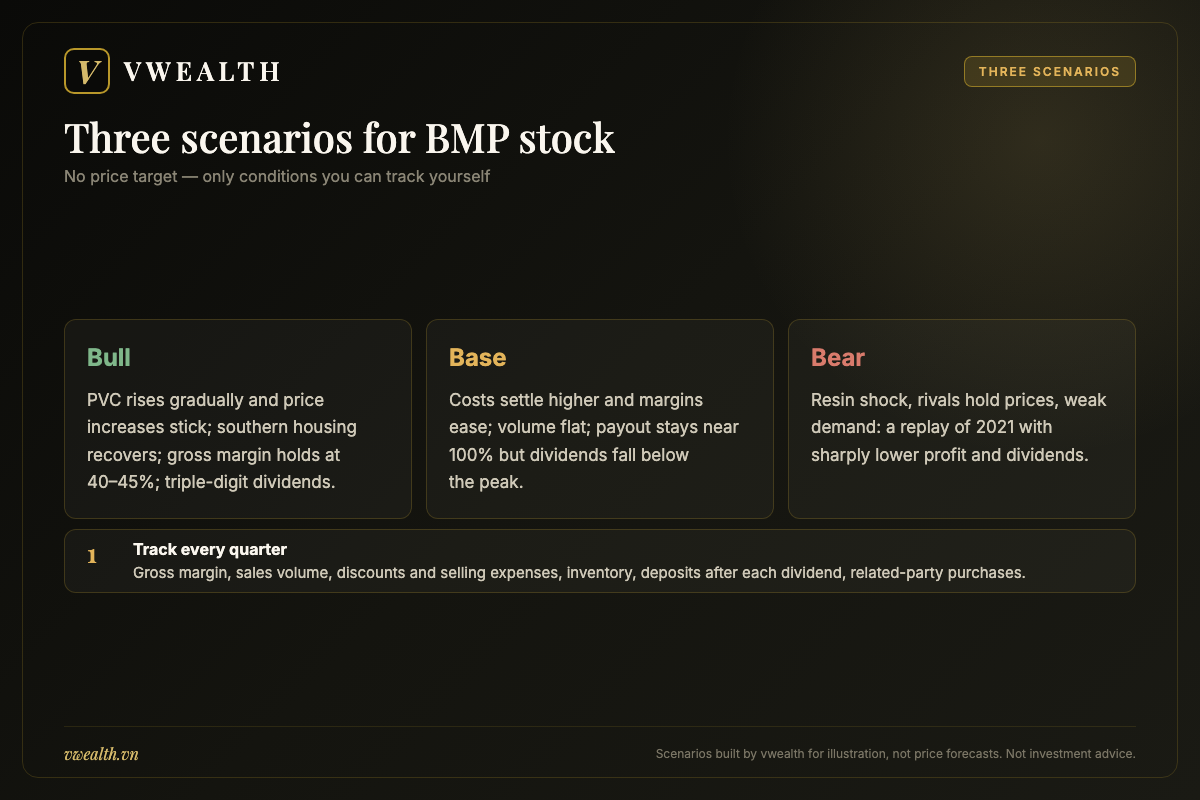
So, Should You Buy BMP Stock? Weighing the Pros and Cons Honestly
By now you have everything you need to answer the question yourself. This final chapter pulls the main points into a balance sheet of pros and cons, then matches BMP stock against different investor types. One more reminder: this is not a buy or sell recommendation. The right answer to whether you should buy BMP stock depends on your goals, your risk tolerance and the price you pay.
The Compelling Positives
- Number one in the south, with a brand nearly 50 years old. Vietcap once estimated its southern market share at about 50%. The trust of plumbers and homeowners is hard to replicate.
- Proven pricing power. Over 2023–2025, gross margin rose from about 41% to about 46% while revenue fluctuated; prices go “up fast, down slow.”
- A fortress balance sheet. Virtually no borrowings and about VND 2,057 billion in cash and deposits at the end of 2025, roughly 60% of total assets.
- Very high, regular cash dividends. 126%, 119.9% and 148.6% of par for 2023–2025, a payout ratio of about 99%. Free cash flow of about VND 1,093 billion in 2025 (vwealth estimate) is enough to fund it.
- A controlling shareholder that is a leading regional resin producer. SCG brings raw-material market insight, governance discipline and a direct interest in high dividends — an interest aligned with minority shareholders on payouts.
- 100% foreign room and VNDiamond membership. Supportive of long-term foreign inflows, and the company has acted to preserve that room.
The Negatives You Cannot Ignore
- Limited growth in scale. 2025 revenue was still below 2022; plants run at roughly half capacity (vwealth estimate); paying out almost everything leaves little for large investments.
- Profit depends on raw-material prices. 2021 profit was only about VND 214 billion. Current margins are the highest in the company’s history, and the 2026 PVC environment is less favourable than 2023–2025.
- Rising cost of defending share. Discounts plus selling expenses reached about 19.7% of revenue in Q3 2025 (BSC), a five-year high; national share fell to about 23% at end-2024 (ACBS).
- Weakness in the north and in infrastructure. HDPE is under 10% of volume; the northern plant runs at about 60% of capacity; infrastructure projects are not its main arena.
- Minority shareholders have little say. SCG holds about 55%, and together with KWE about 66%; all major decisions rest with the controlling shareholder. Raw-material purchases from related parties are worth monitoring.
- Thin liquidity and dividend tax. Large blocks are hard to trade quickly; cash dividends to individuals are subject to 5% withholding tax. In 2023 the company was also fined and required to pay back taxes totalling nearly VND 8.7 billion for incorrect tax declarations, according to a disclosure reported by CafeF — small relative to its profit, but public information you should know.
Which Investors BMP Stock Suits
Income investors and dividend hunters. This is the group BMP serves best. If your goal is a steady annual stream of cash from a debt-free company with a strong brand and a controlling shareholder that also wants high dividends, BMP is a natural candidate. The condition is that you accept dividends that move with profit — not a fixed coupon like a bond.
Patient value investors who like buying when sentiment is poor. History shows the best times to buy BMP were when profits were depressed and the market was sceptical (2018–2020, or early 2023), not when profits hit records. If you have the discipline to wait for periods when margins are squeezed by raw-material costs, BMP can be a stock to “accumulate on bad news.”
Investors wanting a defensive piece within a materials allocation. If your portfolio already includes strongly cyclical names like steel, BMP’s debt-free balance sheet can balance the risk — although, as discussed, it is not immune to the raw-material cycle. Other stocks with stable major shareholders and regular cash dividends that vwealth has analyzed, such as GVR (Vietnam Rubber Group) or DPM, can serve as comparisons when building an income basket.
Who It Does Not Suit
Growth investors. Binh Minh has no story of doubling in size within a few years; 2025 revenue had not yet surpassed the 2022 peak. If you want a company that reinvests profit to grow fast, BMP is almost the opposite.
Short-term traders. Thin liquidity makes getting in and out costly; the price reacts mainly to quarterly results and dividend dates, with little speculative momentum. The sharp reference-price drop on ex-dividend dates also confuses those who do not track the calendar.
Investors who want a voice. With SCG holding about 55%, minority shareholders have little influence over pricing, investment or related-party dealings. You are essentially riding along with the controlling shareholder.
Buyers who look only at last year’s dividend yield. A yield calculated on peak earnings can be an illusion. If margins ease as in the base or bear case, dividends fall too, and the yield you actually receive will be lower than the one you saw when you bought.
Final Thoughts
Binh Minh Plastics is a rare story in Vietnam’s market: a brand born in Saigon in 1977, turned into a pipe maker by a UNICEF clean-water program, and nearly 50 years later a cash-generating machine for a Thai conglomerate. The machine has three gears: a strong southern brand that lets it hold prices, a debt-free balance sheet that lets it pay out all its profit, and a controlling shareholder that wants exactly that. In 2023–2025, with resin prices at the bottom, all three gears meshed perfectly: gross margin around 45%, record profit, triple-digit dividends.
The question of whether to buy BMP stock therefore comes down to two questions. One: do you believe Binh Minh’s pricing power is strong enough to keep most of today’s margin as raw-material costs shift to a “new equilibrium”? Two: are you comfortable with a stock whose main reward is the dividend, with growth secondary? If both answers are yes, BMP deserves a place on your watchlist among Vietnam stocks. If either answer is no, you may want to look elsewhere — or wait for a year when margins are squeezed and sentiment is gloomy, as the Thais did in 2018.
This article is not a recommendation to buy or sell. Before deciding, check current data — price, P/E, dividend yield, latest quarterly profit and gross margin, the PVC price trend and progress against the annual plan — in the vwealth analysis report, and consider your own risk tolerance. To compare BMP with other Vietnam stocks, start with our guide on how to invest in the Vietnam stock market and our overview of Vietnam manufacturing and industrial stocks. You can create a vwealth account to follow BMP’s report each quarter.
Research Vietnamese stocks in English with vwealth. Our AI-powered platform turns Vietnamese market data into full English analysis reports — with international payment support and a free 2-month trial for new accounts. Create your free account and read the latest reports.