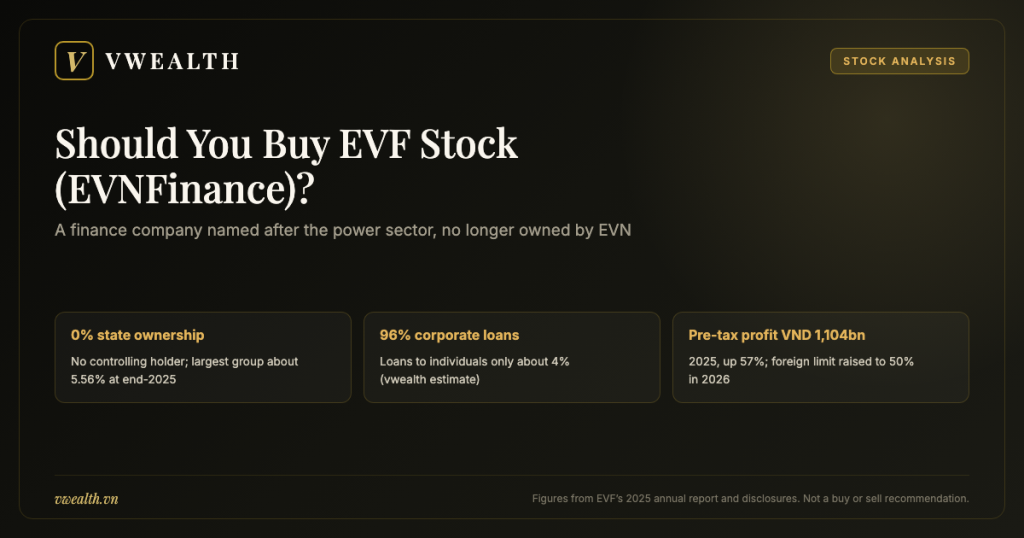
Should you buy EVF stock? The ticker belongs to EVF General Finance Joint Stock Company — still widely known in Vietnam by its old brand, EVNFinance — and it is one of the most misunderstood names in the Vietnamese financial sector. The word “Electricity” in its Vietnamese legal name leads many investors to assume it is a subsidiary of Vietnam Electricity (EVN), the state power utility, quietly backstopped by the government. The word “Finance” leads others to assume it is another consumer lender in the mold of FE Credit, living off high-interest cash loans. Both assumptions are wrong. According to the company’s own 2025 annual report, state shareholders own 0% of EVF; the largest disclosed shareholder group — Hoa An Financial Investment JSC together with related parties — only crossed the 5% threshold at the end of 2025, so nobody is large enough to control the company; and loans to households and individuals were only about VND 2.46 trillion out of more than VND 61.7 trillion in customer loans. This article tells the 18-year story of a finance company that still carries the power sector’s name but is no longer EVN’s child, shows you how to read EVF’s own numbers, and ends with a straight answer: who EVF stock suits, and who should stay away.
First, a note on names. EVF is the ticker on the Ho Chi Minh City Stock Exchange (HOSE) of the legal entity now called Công ty Tài chính Tổng hợp Cổ phần Điện lực — in English, EVF General Finance Joint Stock Company. For almost 17 years the company traded as Electricity Finance Joint Stock Company under the brand EVNFinance (sometimes written “EVN Finance”). In 2025 (approved by the State Bank of Vietnam on August 19, 2025) it added the word “General” (Tổng hợp) to its name to match the new classification in Vietnam’s 2024 Law on Credit Institutions, rebranded to EVF, and moved its head office out of the EVN tower at 11 Cua Bac Street to 11A Cat Linh Street in Hanoi. So when you search for EVF stock, you will see three names — EVNFinance, EVN Finance and EVF — for the same business. Its consumer-lending brand is called EasyCredit.
Second, a note on method, consistent with every company analysis in the vwealth series. Dates, names, ownership percentages and figures come from published sources: EVF and EVNFinance annual reports from 2016 through 2025, the audited 2025 and reviewed first-half 2026 financial statements, regulatory disclosures, company press releases, shareholder meeting resolutions and Vietnamese financial media. Closed financial years are used as historical reference points. We do not quote today’s share price, current P/B or P/E, or the latest quarter’s profit, because those change every trading session; for live numbers, open the latest vwealth analysis reports. Any figure we calculated ourselves from published data is labelled “vwealth estimate”. Amounts are in Vietnamese dong (VND); for rough orientation, VND 1 trillion is on the order of USD 40 million at mid-2020s exchange rates. If you are new to the market, our guide on how to invest in the Vietnam stock market covers accounts, T+2 settlement, daily price limits and foreign ownership rules.
From the Power Sector’s In-House Lender to a Public Finance Company: EVF’s 18-Year Story
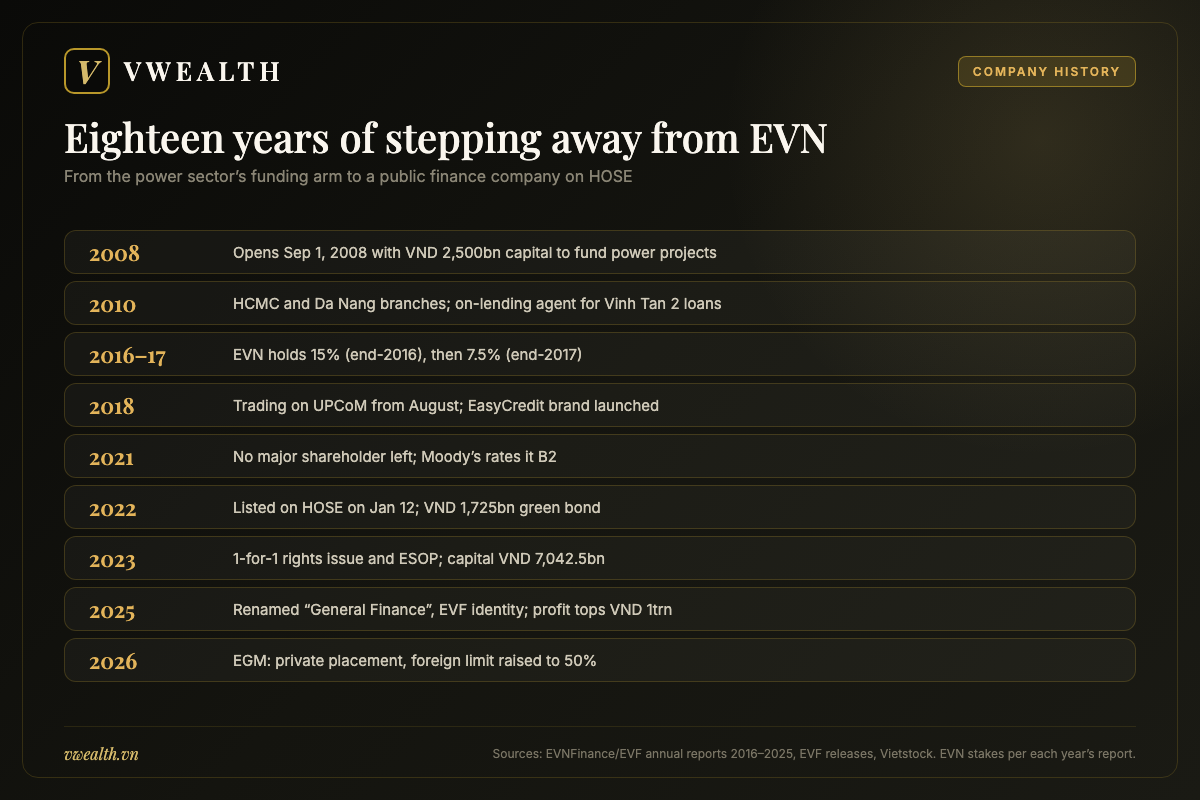
To understand EVF stock, start with a paradox: the company was created to serve a state conglomerate, yet its value today lies in having learned to stand without it. There was no single dramatic deal in this story. It is a sequence of slow departures — from its role as EVN’s treasury arm, from a shareholder base with a sponsor, from the EVN building, and finally from the EVNFinance name itself. Each departure left a mark on the balance sheet.
2008: Born to Arrange Funding for Power Projects
The company’s first general meeting of shareholders was held on May 29, 2008. On July 7, 2008, the Governor of the State Bank of Vietnam (SBV) signed License No. 187/GP-NHNN allowing it to operate, and on September 1, 2008, Electricity Finance Joint Stock Company officially opened its doors. Initial charter capital was VND 2,500 billion — among the largest of Vietnam’s finance companies at the time, according to the company’s own annual reports.
Its mission, spelled out in company materials, was to act as the focal point for arranging and managing capital for power projects of EVN and its member units, while also offering financial services to power-sector businesses and the wider economy. The context of 2008 explains why. It was an era when many Vietnamese state conglomerates set up their own finance companies to manage internal cash flows. A group building hundreds of generation and grid projects, each needing thousands of billions of dong in loans, wanted an in-house specialist that understood power projects, could pool funds, disburse them and monitor repayment. Think of early EVNFinance as the finance department of a very large family, spun out into a licensed credit institution.
Yet from day one it was a joint-stock company with tens of thousands of individual shareholders. The 2016 annual report shows more than 57,000 shareholders at year-end, with domestic individuals holding about 69% of the capital. In other words, EVNFinance was never a wholly owned EVN subsidiary; it was a public company in which EVN was the anchor shareholder and an important client.
2009–2012: On-Lending Agent and Power-Sector Specialist Work
In April 2010, branches in Ho Chi Minh City and Da Nang opened. The same year marked what the company calls its first on-lending and disbursement-control mandate: the government appointed it as the on-lending agency for concessional loans to the Vinh Tan 2 coal-fired power plant. In plain terms, when a large power project borrows foreign money through a government channel, someone domestic must receive the funds, re-lend them to the project owner, verify every disbursement and collect repayments. EVNFinance played that role.
A year earlier, in 2009, the company signed a memorandum with the Danish Embassy on implementing Clean Development Mechanism (CDM) projects in Vietnam’s energy sector. In 2012 it adopted an ISO 9001:2008 quality management system. These details sound dry, but they reveal the company’s DNA: appraising energy infrastructure projects and working with international capital and environmental standards. Fifteen years later, that DNA would become an advantage when EVF started borrowing from European development funds to finance solar and wind projects.
It is worth pausing on what this early period built. Appraising a power plant is not like appraising a shop or a trading company. Investment budgets run into thousands of billions of dong, construction takes years, revenue depends on tariffs and power purchase agreements, and technical and environmental risks can delay everything. A lender that learns to live with those risks develops a habit of multi-layered appraisal — looking at short-term cash flow and long-term macro risk at the same time. That habit is hard to copy quickly, and it is exactly what international climate lenders look for in a local partner a decade later.
By its 2025 report, EVF said every on-lending project it managed had closed disbursement and moved into principal repayment, with no bad or overdue debt. The business line that once justified the company’s existence is now a small legacy book running off.
2016–2019: EVN Steps Out of the Major-Shareholder List
This is the most important chapter for understanding what makes EVF unusual. According to the 2016 annual report, at December 31, 2016, the company had exactly one shareholder owning 5% or more: Vietnam Electricity, with 37.5 million shares, or 15% of charter capital. The chairman at the time, Mr. Hoang Van Ninh, represented EVN’s stake.
One year later, the 2017 annual report showed EVN holding 18.75 million shares, or 7.5%, with An Binh Commercial Joint Stock Bank (ABBank) also listed as a shareholder above 5%. At the end of 2018, the annual report listed two major shareholders with 39.75 million shares, or 15.9% — which, by our reading, matches EVN’s 18.75 million shares plus 21 million shares held by the other major shareholder (a vwealth inference). By the end of 2019, the annual report listed only one major shareholder, with 21 million shares (8.4%) — a number that does not match EVN’s 18.75 million shares. Reading the consecutive annual reports together, our inference (a vwealth estimate, not a company statement) is that EVN was no longer among holders of 5% or more by that point.
Why did EVN step back? The business newspaper Bao Dau Tu wrote that EVN divested from EVNFinance “in line with Government regulations” and dated the exit to 2018; the consecutive annual reports show EVN’s stake leaving the major-shareholder list somewhere in 2018–2019. The two sources differ on the exact year, so treat it as a process that took more than twelve months. The backdrop was a 2016–2020 policy requiring state conglomerates to focus on their core business and exit non-core stakes in banks, insurers, securities firms and real estate. EVNFinance’s own 2018 annual report, in its section on the business environment and risks, mentions the “divestment from non-core sectors, especially finance and banking” as a feature of the market that year. EVN was far from alone; many state groups sold out of financial institutions in the same period. The remaining major shareholder also dropped below 5% later; the press describes this period as the time when “EVN and ABBank withdrew their capital.”
By December 31, 2021, the annual report recorded no major shareholders at all. And the 2025 annual report confirms it in one short line of the shareholder table: “State shareholders: 0 shareholders, 0 shares, 0%.” The word “Electricity” remains in the name. The ownership link to EVN does not.
2018–2022: UPCoM, EasyCredit and the Move to HOSE
In August 2018, EVF shares began trading on UPCoM, Vietnam’s venue for unlisted public companies, which has looser disclosure requirements and wider daily price limits than the main boards. The same year, the company launched the EasyCredit brand for consumer lending — its first step outside the comfort zone of corporate clients in the power sector.
In 2021, Moody’s Investors Service assigned the company a B2 rating for the first time. On January 12, 2022, EVF shares moved from UPCoM to a full listing on HOSE, the larger of Vietnam’s two exchanges; according to Vietstock and Nguoi Quan Sat, more than 304.7 million shares began trading with a first-session reference price of VND 19,050 and a ±20% band for that first day. In June 2022, EVNFinance issued its first green bond, worth VND 1,725 billion (about USD 75 million according to the company’s press release), partially guaranteed by GuarantCo. The company described it as the first partially guaranteed local-currency green bond issued in Vietnam. The deal won FinanceAsia’s “Best Frontier Market Deal” and “Deal of the Year” at the IJGlobal Awards 2022.
The move to HOSE mattered more than it might seem. HOSE listing brings stricter disclosure, eligibility for many investment funds that cannot hold UPCoM stocks, and inclusion in the benchmark VN-Index universe. For a company with no sponsor, a broader pool of potential investors is a form of insurance for future capital raising.
2023: Doubling Capital in a Single Year
Before that, in 2022, the company paid two stock dividends that took charter capital from VND 3,047 billion to VND 3,510.6 billion (the year-end 2022 figure in the 2022 annual report and financial statements). 2023 was the pivotal year for capital. The company offered nearly 351.1 million new shares to existing shareholders on a 1-for-1 basis at VND 11,000 per share — a plan approved by the 2022 AGM. Demand from existing holders was limited: according to Vietstock, by the October 31, 2023 deadline they had subscribed for only about 124.4 million shares, or 35.43%; the roughly 226.7 million unsubscribed shares were placed with other investors at the same price, subject to a one-year lock-up. According to VnEconomy, the offering was completed with proceeds of nearly VND 3.9 trillion. Together with ESOP shares for employees, charter capital reached VND 7,042.5 billion (the SBV issued the amended license on May 20, 2024). In one year, charter capital more than doubled. The effect showed immediately in the capital adequacy ratio (CAR), which reached 18.29% at end-2023 — the highest in the data series we compiled.
That same year, pre-tax profit fell to VND 409.3 billion, down from VND 455.3 billion in 2022 and only 73% of plan. Remember this detail: fresh capital does not turn into profit overnight. It took a year for the company to lend out the new money.
2024–2026: New Name, New Address, and a Trillion-Dong Profit
In 2024, charter capital rose to VND 7,605.7 billion through another stock dividend (the SBV issued the amended license on January 20, 2025). Forbes Vietnam named the company among its Top 25 Leading Brands of 2024. In 2025, as noted, the company renamed itself EVF General Finance, adopted the EVF identity, moved its head office to 11A Cat Linh (approved by the SBV on July 29, 2025) and opened a Hanoi branch — its first northern branch outside head office.
2025 also brought a governance event investors should know about. On August 8, 2025, the Chief Inspector of the State Bank of Vietnam issued Inspection Conclusion No. 55/KLTT-TTNH5 on the company (then still called EVNFinance), published on August 15, 2025. As reported by CafeF and the Ministry of Finance’s newspaper Thoi bao Tai chinh Viet Nam, the conclusion acknowledged that the company had sufficient governance personnel, a full set of internal rules and rising results over the years, while identifying shortcomings and violations in governance, management and lending — including high credit concentration in large customer groups, lending to customers who did not meet conditions, loan classification and provisioning not in line with rules, and foreign-currency lending not in line with rules. The company was fined a total of VND 635 million for three administrative violations and paid on June 6, 2025; the inspectors issued 5 general and 27 specific recommendations with deadlines of 1 to 12 months. The conclusion also cited the objective impact of Covid-19 on borrowers. On the day of publication, the company announced senior management changes (see Chapter 2). For investors, the point is that credit concentration is no longer just an analyst’s concern; the supervisor has put it in writing, and it is worth tracking in future reports.
Operationally, 2025 was the biggest year in the company’s history: total assets of VND 83,058 billion (up 39%) and pre-tax profit of VND 1,104.2 billion (up 57%), crossing the trillion-dong mark for the first time. CafeF named it “Finance Company of the Year” at the FChoice 2025 awards.
In 2026, an extraordinary general meeting on August 21 approved three items: a private placement of up to 85 million new shares (up to VND 850 billion at par, lifting charter capital to a maximum of about VND 8,455 billion); raising the foreign ownership limit from 15% to no more than 50%; and electing Mr. Nguyen Canh Anh — chairman of Eximbank from April 2024 to December 2025, according to the candidate profile the company published — as an independent board member. On September 22, 2026, the State Securities Commission (SSC) issued Official Letter 9371/UBCK-PTTT on EVF’s notification of a 50% foreign ownership limit; according to Nguoi Quan Sat, it asked the Vietnam Securities Depository and Clearing Corporation (VSDC) to update the new limit. The same day, the SBV issued Official Letter 4357/QLGS6 approving EVF’s charter capital increase (disclosed by the company on September 25, 2026) — the regulatory green light needed before the private placement can proceed.
| Date | Event | What it means for investors |
|---|---|---|
| Sep 1, 2008 | Opens with VND 2,500 billion charter capital | Created as a funding arm for the power sector |
| 2010 | HCMC and Da Nang branches; on-lending agent for Vinh Tan 2 concessional loans | Builds energy project appraisal skills |
| Dec 31, 2016 | EVN is the only major shareholder, at 15% | Still has a state sponsor |
| Dec 31, 2017 | EVN down to 7.5%; ABBank among major holders | State exit from finance under way |
| Aug 2018 | Trading on UPCoM; EasyCredit launched | Liquidity; first test of consumer lending |
| Dec 31, 2021 | No shareholder at 5% or above | Dispersed ownership |
| Jan 12, 2022 | Listed on HOSE | Access to funds, more disclosure |
| Jun 2022 | VND 1,725 billion green bond, partly guaranteed by GuarantCo | Long-term, international funding |
| 2023 | 1-for-1 rights issue at VND 11,000 and ESOP; charter capital VND 7,042.5 billion | Capital doubles; CAR 18.29%; existing holders took up only about 35% |
| Aug 2025 | SBV inspection conclusion published (VND 635 million fine); CEO change | Credit governance and customer concentration become a watch point |
| 2025 | Renamed with “General”; EVF identity; pre-tax profit VND 1,104 billion | Brand fully separated from EVN; first trillion-dong profit |
| Dec 2025 | Hoa An group and related parties disclose 5.56% | First group above 5% in years |
| Aug 21, 2026 | EGM: private placement of 85 million shares, foreign limit to 50% | Preparing for new capital and foreign shareholders |
| Sep 22, 2026 | SBV approves the capital increase; SSC acknowledges the 50% limit | Placement cleared to proceed |
The table shows one pattern: almost every turning point in EVF’s history is another step toward independence. That is both a strength and a question. A finance company with no controlling strategic shareholder and no parent group — who ensures it has enough capital and funding when markets tighten? The next chapter takes that question head on.
Leadership and Ownership: Dispersed Shareholders, No State Stake, a Lean Team
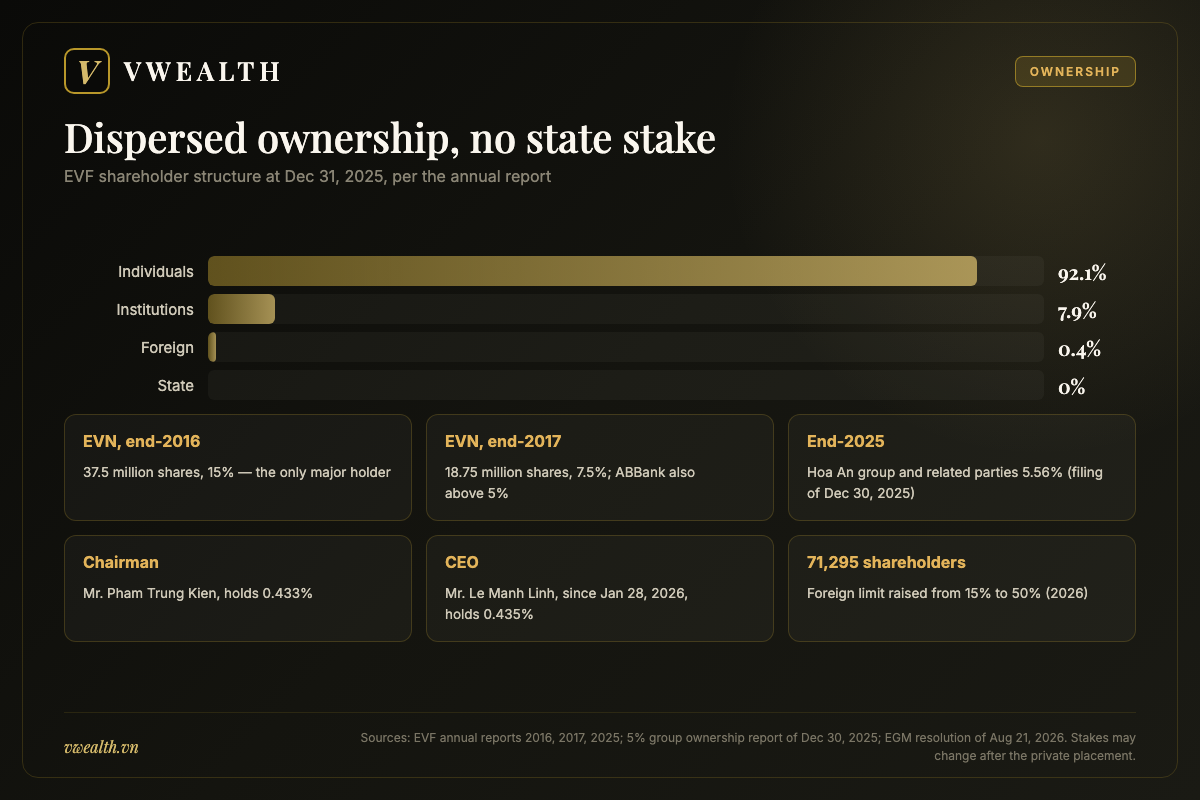
For most Vietnamese banks and finance companies, the question “who owns it?” has a clear answer: a conglomerate, a family, a parent bank or a foreign partner. For EVF, the answer on paper is: nobody large enough to control it. The largest disclosed group holds about 5–6%; the rest is spread across more than 71,000 shareholders. That is rare for a credit institution, and it should shape how you think about the stock.
Who Owns EVF: Reading the End-2025 Shareholder Table
According to the 2025 annual report, at December 31, 2025, EVF had 760,565,802 common shares outstanding, no treasury shares and no preferred shares. It had 71,295 shareholders. The ownership table reads as follows:
| Classification | Group | Shareholders | Ownership |
|---|---|---|---|
| By stake size | Major shareholders (5% or more) | 0 | 0% |
| Minority shareholders | 71,295 | 100% | |
| State vs. other | State shareholders | 0 | 0% |
| Other shareholders | 71,295 | 100% | |
| Institutions vs. individuals | Institutions | 59 | 7.9% |
| Individuals | 71,236 | 92.1% | |
| Domestic vs. foreign | Domestic | 71,222 | 99.6% |
| Foreign | 73 | 0.4% |
Three numbers stand out. First, individual investors own more than 92% — EVF is, in substance, a retail investors’ stock. Second, 59 institutions own just 7.9% combined — and two entities in the Hoa An group alone (Hoa An Financial Investment JSC and Amber Fund Management JSC) held about 34.7 million shares according to their December 30, 2025 report, more than half of the institutional total (vwealth estimate). Other professional funds are largely absent. Third, foreigners held only 0.4% even though the limit was 15% at the time. When you read headlines about “EVF opening foreign room to 50%,” keep this base in mind: the door has been widened by 35 percentage points, but foreign investors are still standing at the threshold. (Foreign ownership limits — “foreign room” — are explained in our guide to foreign room in Vietnamese stocks.)
One caveat: the table counts each shareholder on the register separately. The 2024 Law on Credit Institutions defines a major shareholder to include indirect holdings, while ownership reporting aggregates related parties. So although the year-end table shows zero major shareholders, a disclosure from the same week shows a group crossing 5%. According to a report filed with the SSC on December 30, 2025, Hoa An Financial Investment JSC bought 16.32 million EVF shares on December 25, 2025, taking its stake to 31.65 million shares (4.16%); together with related parties Amber Fund Management JSC (3.06 million shares, 0.40%) and Mr. Nguyen Van Canh (7.54 million shares, 0.99%), the group held 42.25 million shares, or 5.56%. The report states that Hoa An and Amber are both controlled by Ms. Nghiem Phuong Nhi, chair of Hoa An. The press calls this the “Amber Capital group” and reports that after buying another 3.4 million shares on December 29, 2025, the group’s stake rose to about 6%. The list of shareholders owning 1% or more that EVF published on January 8, 2026 contains only this group. At 5–6%, it remains far below the 15% cap for a shareholder and its related parties and is not large enough to control the company; real decision-making power still sits mainly with the board and management.
The Board: Chairman Pham Trung Kien and Independent Directors
According to EVF’s website and 2025 annual report, the current chairman of the board is Mr. Pham Trung Kien. At December 31, 2025, he owned 3,295,927 shares, or 0.433% — small in percentage terms but among the largest individual holdings on the insider list. The board comprises Mr. Kien, Mr. Le Manh Linh (board member and CEO) and three independent directors: Mr. Nguyen Van Hai, Mr. Le Hoai Nam and Mr. Nguyen Canh Anh (elected at the August 21, 2026 EGM).
Having three of five board seats held by independent directors is a structural feature worth noting. At credit institutions with a controlling shareholder, boards are typically dominated by that group’s representatives. At EVF, no group is large enough to nominate many directors, so independents carry more weight. According to the candidate profile EVF published on August 20, 2026, Mr. Nguyen Canh Anh (born 1979, with a master’s in international financial management from France) began his career at PwC in 2006 and worked at HSBC Vietnam, Techcombank, Viettel and Vingroup; he also worked at EVF itself from October 2020 to July 2023, most senior as head of the treasury and funding division. He chaired Eximbank from April 2024 to December 2025 and since April 2026 has been chairman and CEO of Amber Capital Holdings JSC. According to the company’s press release, he was nominated by shareholders; the candidate list was approved by the SBV before the meeting, and his profile states he has no related interests in EVF.
The same EGM accepted the resignation, for personal reasons, of vice chairman Mr. Mai Danh Hien after more than 15 years with the company. Mr. Hien is a familiar face: chief accountant in the 2017 annual report, later CEO. In August 2025 the board announced it had accepted his resignation as CEO (effective August 21, 2025, the same period in which the inspection conclusion described in Chapter 1 was published) and elected him vice chairman; at the same time, Mr. Le Manh Linh stepped down as vice chairman to become acting CEO. Mr. Hien submitted his resignation from the board on August 20, 2026; the 2025 annual report says he spent 14 years at EVF, while the company’s press release refers to “more than 15 years” with the company. When a long-serving figure leaves the board, investors should watch for any change in strategic direction, though the official press release gives no sign of one.
Management: CEO Le Manh Linh and a Team of Fewer Than 300 People
Mr. Le Manh Linh became acting CEO on August 21, 2025 and was formally appointed CEO on January 28, 2026 for a five-year term (after the SBV approved the appointment on January 23, 2026), also replacing Mr. Pham Trung Kien as legal representative. According to the 2025 annual report, he holds a master’s degree in law and economics, specializing in international business law, from a French university, and previously held management roles at several financial and credit institutions.
The deputy CEOs include Mr. Le Anh Tuan (22+ years in the power and finance sectors, 17 of them at EVF), Ms. Ton Thi Hai Yen (25+ years in legal affairs, 17+ at EVF), Mr. Nguyen Xuan Diep (19 years in finance and banking, appointed April 8, 2025) and Mr. Tong Nhat Linh (chief accountant from April 1, 2021, appointed deputy CEO by the board effective May 15, 2026). It is a team with many long-tenured members — common at institutions with state-sector roots. The chief accountant post changed twice in 2026: Ms. Dao Thi Lan was appointed from May 15, 2026 and resigned on September 17, 2026; from September 21, 2026, Mr. Luong Ngoc Huan, with EVF since 2010, was put in charge of accounting. At a credit institution, the person signing the financial statements is a role worth keeping an eye on in coming reporting periods.
One figure surprises many readers. According to Nguoi Quan Sat, EVF generated more than VND 1.1 trillion of pre-tax profit in 2025 with fewer than 290 employees; at June 30, 2026 it had 284 staff. The annual report puts the cost-to-income ratio (CIR) at just 12.67%. Compared with a retail bank running hundreds of branches, or a consumer finance company employing thousands of point-of-sale agents, EVF looks more like a wholesale lender: few clients, large tickets, very low cost per dong of loans.
How Much Insiders Own and Why It Matters
The 2025 insider ownership table shows the three largest holders are Mr. Le Manh Linh (3,310,980 shares, 0.435%), Mr. Pham Trung Kien (0.433%) and Mr. Mai Danh Hien (2,947,529 shares, 0.388%). Ms. Ton Thi Hai Yen holds 0.114%. Everyone else holds under 0.02%. In total, insiders own roughly 1.4% (vwealth estimate from the published table). On September 16, 2026, Mr. Le Manh Linh registered to buy another 4 million shares between September 21 and October 20, 2026; if completed, his holding would rise to 7.31 million shares, or 0.961%. At the time of writing, the result had not been reported.
The ownership structure also explains some of the company’s recent behavior. Without a parent to fund it, EVF has had to raise equity from the market — through stock dividends that retain profit and the large 2023 rights issue — and to diversify its lenders internationally. The rebrand from EVNFinance to EVF in 2025 can be read in the same light: a company that no longer belongs to EVN choosing an identity that stands on its own, while keeping the recognizable letters.
That 1.4% cuts both ways. On the plus side, the people running the company have skin in the game. On the other hand, nobody owns enough to treat EVF as a family asset in the way controlling shareholders sometimes treat Vietnamese banks. That can be good — there is no dominant shareholder to impose lending decisions — but it can also be a risk: when capital is needed urgently, there is no anchor shareholder ready to write a big check. Vietnamese law also bars board members, supervisors and the CEO of a credit institution from transferring their shares while in office, which is why the annual report shows “restricted” shares.
The New Law and Ownership Caps: Why EVF Is Unlikely to Get a Traditional “Owner”
The 2024 Law on Credit Institutions tightened ownership caps: an individual may hold at most 5%, an institution at most 10%, and a shareholder together with related persons at most 15%. For EVF, even an investor wanting control cannot exceed 15% with related persons, barring special cases defined by law. A 50% foreign limit therefore does not mean one foreign firm can own half the company; it means all foreign investors combined may own up to 50%. The 2026 EGM resolution spells out the per-investor caps: no more than 5% for a single foreign individual, 15% for a single foreign institution, and 20% for a foreign investor together with its related parties.
The most realistic path for EVF is a base of several institutional shareholders, each holding a few percent, possibly including development finance institutions or foreign financial groups. The up-to-85-million-share private placement approved in 2026 is the first test: who buys, how much, at what price. The plan sets some ground rules: the offer price equals book value per share at December 31, 2025 multiplied by (1 + an adjustment rate), with the adjustment negotiated and capped at 15% — at the EGM, management put book value at about VND 12,900 per share at end-2025 and about VND 13,500 at June 30, 2026; buyers must be professional securities investors and may not become major shareholders through the placement; timing is 2026 or the first quarter of 2027. On September 22, 2026, the SBV approved the capital increase. At the time of writing, specific investors had not been disclosed; watch EVF’s disclosures when the placement closes.
Dividends: Almost Entirely in Shares
EVF’s capital history is a history of stock dividends. Charter capital went from VND 2,500 billion to 2,649.8 billion (March 2020), 3,047.1 billion (August 2021), then 3,244.9 billion and 3,510.6 billion in two steps during 2022 — all four through stock dividends, according to the annual reports. (The capital-history section of the 2025 annual report dates the last two steps to April and September 2023, but the 2022 annual report and financial statements already show charter capital of VND 3,510.6 billion at December 31, 2022, and the milestones page of the 2025 report itself places the increase in 2022.) After the 1-for-1 rights issue and ESOP took it to 7,042.5 billion, another stock dividend in 2024 lifted it to 7,605.7 billion. Based on capital before and after, these payouts equate to roughly 6% (2020), 15% (2021), 6.5% and 8.2% (two issues in 2022) and 8% (2024; the 8% matches the company’s announced plan, with an October 18, 2024 record date) — the other ratios are vwealth estimates, not per-event figures announced by the company.
Cash dividends are negligible: the 2025 cash-flow statement shows VND 828 million paid to shareholders, and VND 1.74 billion in 2024 — most likely odd-lot or residual payments. For a credit institution growing assets 30–40% a year, retaining profit to build capital makes sense: equity is the foundation that determines how much it can lend. The April 3, 2026 AGM continued that approach: after appropriations to reserve funds, all of 2025’s profit together with earlier retained profit — about VND 1,121 billion — was kept in the business, with no dividend. If you need steady income, EVF is not a cash-dividend stock.
How EVF Makes Money: A Corporate Lender, Not “the Next FE Credit”
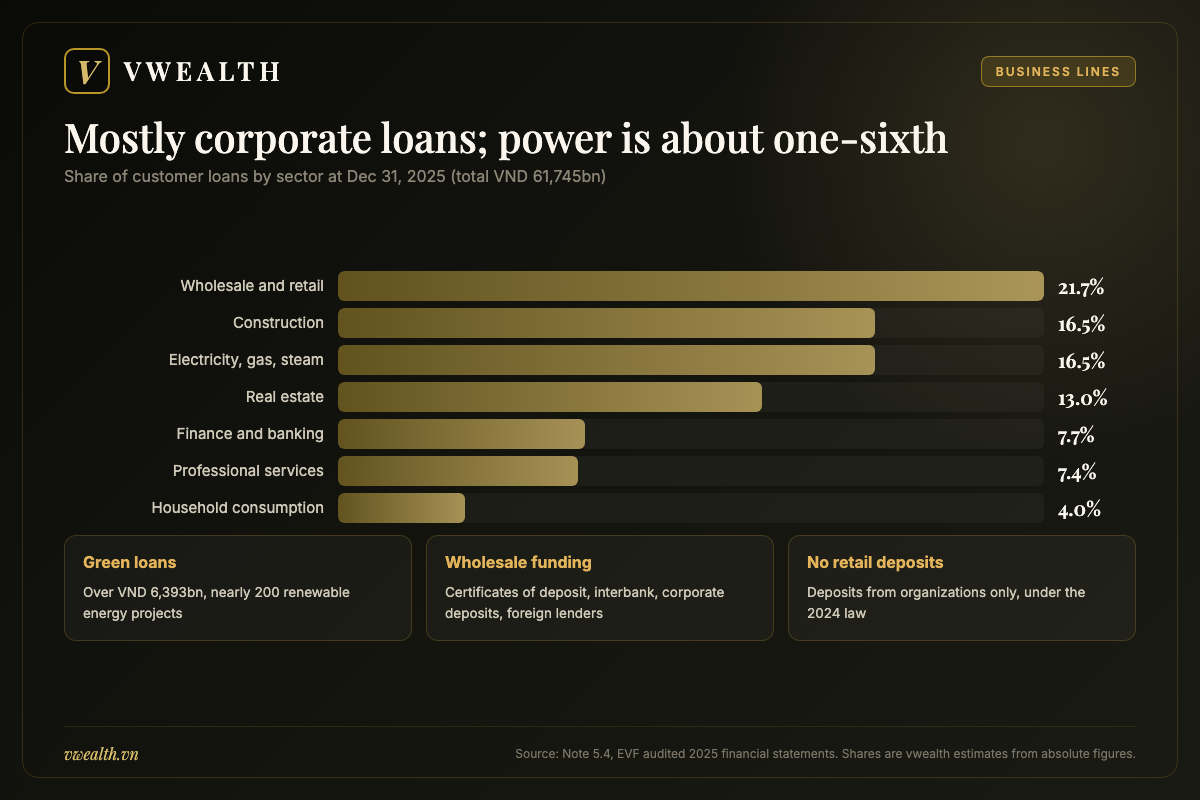
If you remember one number from this chapter, make it 4%. According to the notes to the 2025 financial statements, loans to “business households and individuals” totaled VND 2,463.8 billion out of VND 61,745 billion in customer loans — about 4% (vwealth estimate). The remaining 96% or so went to companies. Yet when Vietnamese investors hear “finance company,” most think of FE Credit, HD Saison or Home Credit — lenders that make small cash and installment loans to workers. EVF is a different animal. To understand it, you first need to understand how a finance company differs from a bank in Vietnam.
Finance Company vs. Bank: What EVF Can and Cannot Do
Vietnam’s Law on Credit Institutions classifies finance companies as “non-bank credit institutions.” Since the 2024 law, they are split into general finance companies and specialized finance companies (such as consumer finance or factoring). EVF is a general finance company — hence the word “General” added to its name in 2025.
EVF’s current charter (as amended in 2026, Article 5) lists the banking activities it may conduct under the 2024 law: accepting demand and term deposits from organizations; issuing certificates of deposit to raise funds from organizations; lending; bank guarantees; discounting and rediscounting; factoring; financial leasing; and issuing credit cards and other forms of credit as permitted by the SBV Governor. It may also borrow from the SBV via refinancing, borrow from, lend to and trade valuable papers with other credit institutions, and borrow abroad in line with regulations.
Read “from organizations” carefully. It is the crucial difference: EVF cannot take savings deposits from the public the way a bank does. Nor does it provide payment accounts to individuals — you cannot open an EVF account to receive your salary or make everyday transfers. The consequence is that EVF has no CASA (current and savings accounts — cheap, sticky deposits from millions of retail customers), the weapon that gives Vietnam’s big banks low funding costs. Instead, EVF must “buy” funding from companies, other credit institutions, international funds and the debt market. In exchange, finance companies can run activities some banks neglect, such as leasing and factoring, with a much leaner cost base.
On capital, EVF’s annual reports state that its minimum capital adequacy ratio is 9% — higher than the 8% required of commercial banks. Regulators demand a thicker cushion precisely because a finance company’s funding is less stable than a bank’s.
| Feature | Commercial bank (VPB, HDB, SSB…) | General finance company (EVF) | Consumer finance company (FE Credit, HD Saison…) |
|---|---|---|---|
| Retail deposits | Yes | No — deposits from organizations only | No |
| Personal payment accounts | Yes | No | No |
| Main clients | Individuals and companies | Companies (about 96% of loans in 2025) | Individuals, small loans |
| Main funding | Customer deposits, CASA | Certificates of deposit, interbank, corporate deposits, international lenders | Parent bank, interbank, international lenders |
| Minimum CAR | 8% | 9% (per EVF’s annual report) | 9% |
| Risk profile | Diversified | Concentrated large loans, funding liquidity risk | High NPLs, high yields |
The Core Business: Corporate Lending — and Who Borrows From EVF
Note 5.3 of the 2025 financial statements breaks down loans by borrower type: other limited liability companies VND 32,522 billion (about 52.7%), other joint-stock companies VND 23,580 billion (38.2%), wholly state-owned single-member LLCs VND 3,034 billion (4.9%), joint-stock companies with more than 50% state ownership just VND 146 billion (0.2%), and business households and individuals VND 2,464 billion (4.0%). The percentages are vwealth estimates from the absolute numbers.
This matters for the “power sector” narrative. If EVF still lent mainly to EVN units, state-owned companies would dominate the book. In reality, state-owned and state-controlled borrowers together account for only about 5% of loans. Today’s EVF lends mostly to private companies — limited liability and joint-stock firms.
By tenor, short-term loans made up about 41.7%, medium-term 40.5% and long-term 17.7% (vwealth estimates from Note 5.2). Long-term loans rose from VND 7,078 billion to VND 10,950 billion during 2025, consistent with more financing for renewable energy projects, which have long payback periods. This is worth remembering when we discuss funding: if you lend long, you need to borrow long, or you create a maturity mismatch.
Loans by Sector: Power Is Now About One-Sixth, Real Estate Is Growing Fast
Note 5.4 lists loans by economic sector. Anyone asking whether to buy EVF stock should read it, because it answers the question “where is the company’s money?”
| Sector | Dec 31, 2024 (VND bn) | Dec 31, 2025 (VND bn) | 2025 share (estimate) |
|---|---|---|---|
| Wholesale, retail, vehicle repair | 12,083 | 13,413 | 21.7% |
| Construction | 5,727 | 10,215 | 16.5% |
| Electricity, gas and steam supply | 7,289 | 10,172 | 16.5% |
| Real estate | 3,513 | 8,002 | 13.0% |
| Finance, banking, insurance | 4,832 | 4,784 | 7.7% |
| Professional, scientific and technical | 3,556 | 4,562 | 7.4% |
| Accommodation and food | 2,104 | 2,860 | 4.6% |
| Household consumption activities | 2,592 | 2,446 | 4.0% |
| Manufacturing | 603 | 1,561 | 2.5% |
| Other sectors | 4,504 | 3,730 | 6.0% |
| Total | 46,803 | 61,745 | 100% |
Three takeaways. One: power and gas remain one of the three largest groups at about VND 10,172 billion, roughly one-sixth of loans — the power-sector DNA is still there, but it is no longer the whole story. Two: real estate loans jumped from VND 3,513 billion to VND 8,002 billion in one year, lifting their share from about 7.5% to 13%, and construction loans nearly doubled. Both sectors are cyclical and are often where bad debt appears in a downturn. Three: wholesale and retail is the largest group, but its share fell from about 25.8% to 21.7%. Overall, this is a diversified corporate loan book gradually shifting toward more cyclical sectors. Watch the real estate line in future reports.
The next report confirmed the trend. According to the notes to the reviewed first-half 2026 financial statements, at June 30, 2026 real estate loans had risen to about VND 12,272 billion, making real estate the largest sector at roughly 18.3% of total loans of VND 67,201 billion; construction was about VND 10,580 billion, wholesale and retail about VND 10,722 billion, while electricity and gas fell to about VND 8,019 billion (shares are vwealth estimates). Together, real estate and construction made up about 34% of loans at mid-2026, versus about 29.5% at end-2025. These are point-in-time figures and the mix can shift quickly from quarter to quarter, so compare them with the latest data in the vwealth analysis reports.
Green Finance and Energy: Where the Power-Sector DNA Becomes an Edge
According to the 2025 annual report, EVF’s green loan book exceeded VND 6,393 billion, financing nearly 200 renewable energy projects such as solar and wind; through EVF loans, more than 8,000 electric motorbikes and more than 8,000 electric cars have been put into service. The company offers rooftop solar financing and an ESG credit package with preferential rates for energy-transition and emissions-reduction projects. Green loans equal roughly 10% of total customer loans (vwealth estimate).
Why is this an edge and not just marketing? Because it unlocks funding. Development finance institutions such as Proparco (part of the French Development Agency group), Swedfund (Sweden), OeEB (the Development Bank of Austria) and the OPEC Fund for International Development are mandated to channel money into climate projects, small businesses and financial inclusion in emerging markets. They do not lend directly to every rooftop solar project in Vietnam; they need a local intermediary with appraisal capacity and transparency. EVF — with 15-plus years of energy project appraisal, an internationally guaranteed green bond and a Moody’s rating — fits the profile. On September 10, 2026, EVF signed a USD 20 million senior loan with Proparco, with 50% earmarked for climate projects and 50% for small and medium-sized enterprises led or owned by women; Proparco had previously lent EVF USD 10 million in 2021. On April 7, 2026, the OPEC Fund announced a USD 25 million senior term loan to EVF to expand lending to micro, small and medium-sized enterprises and climate-related investments; CafeF described it as the fund’s first financing for a non-bank financial institution in Vietnam. Earlier, at the end of 2025, according to Nguoi Quan Sat, Swedfund provided USD 20 million of a USD 40 million package arranged together with the Development Bank of Austria. The 2025 annual report also lists new funding partners during the year such as INCOFIN, Triodos, EMF Microfinance Fund and Lombard Odier Gateway.
For foreign readers, it may help to see EVF’s role through a familiar lens. In many emerging markets, development finance institutions work through local “on-lenders” — mid-sized banks or finance companies that know local borrowers and can report on environmental and social impact. EVF has positioned itself as that kind of partner in Vietnam. The benefit is funding with long tenors; the cost is extra reporting, covenants and, often, currency hedging, as discussed below.
In short, green finance is both where EVF lends and its ticket to borrowing long-term money at reasonable cost. The two sides feed each other.
EasyCredit, Buy Now Pay Later and Earned Wage Access: A Small but Deliberate Retail Arm
EasyCredit, launched in 2018, is EVF’s consumer lending brand. The company’s website lists retail products including EasyCredit consumer loans, preferential loans for power-sector employees, secured loans, loans against savings books and discounting of valuable papers. According to an article about the FChoice 2025 award published on EVF’s website, the company offers buy-now-pay-later (BNPL) through partnerships with Fundiin and Viettel Money, and in 2025 partnered with Gimo to provide earned wage access to employees of its corporate clients.
This approach is the opposite of FE Credit in its heyday: instead of building a sales force of thousands in electronics stores, EVF rides on its fintech partners’ ecosystems. It is cheaper, but also far smaller: the entire household and individual segment is only about VND 2,464 billion, slightly down from VND 2,592 billion in 2024 (and about VND 2,020 billion at June 30, 2026, according to the half-year report). For investors this cuts both ways. The good: EVF does not carry consumer credit risk — the problem that crushed profits at several Vietnamese consumer lenders after the pandemic. The less good: EVF also lacks the fat margins of consumer lending; its profits must come from scale and low costs.
Treasury, Securities Investment and Debt Purchases
Beyond lending, EVF runs an investment portfolio. According to the 2025 annual report, investments totaled VND 9,689 billion at year-end, or 11.7% of total assets: certificates of deposit issued by other credit institutions VND 4,935 billion; bonds VND 2,422 billion (government bonds 246, credit-institution bonds 935, corporate bonds 1,241); equities VND 487 billion; and long-term equity investments VND 1,844 billion. Notably, the equity portfolio shrank from VND 1,662 billion to VND 487 billion; the company says it restructured cautiously and realized gains. As a result, net gains on investment securities were about VND 170.8 billion in 2025, versus a loss of about VND 49.7 billion in 2024.
Separate this line when you read profits: the 2025 securities gain is opportunistic, not a recurring stream like interest income. In 2025, EVF also started buying debt, with VND 1,988 billion of principal purchased and classified as standard. The on-lending management business from the Vinh Tan 2 era remains, but only as a run-off book.
One often overlooked item is foreign-currency swaps. Off-balance-sheet commitments at end-2025 included swaps with a notional value of about VND 17,892 billion. The reason: EVF borrows substantially in foreign currency from international funds (foreign-currency funding and entrusted capital of about VND 8,637 billion) but lends mostly in dong (VND 58,666 billion of VND 61,745 billion). Swaps lock in the exchange rate. The income statement shows a net foreign-exchange loss of about VND 49 billion in 2025 — best understood partly as the “insurance premium” for borrowing in foreign currency.
Which Business Feeds Which — and Where EVF’s Moat Lies
Put together, EVF’s model is simple: raise wholesale funding (certificates of deposit, interbank borrowing, corporate deposits, international loans) and lend to companies in large tickets at low operating cost. In 2025, net interest income made up about 85% of total operating income (VND 1,892 billion out of VND 2,214 billion — vwealth estimate). Net fee income was under VND 50 billion. In other words, EVF lives almost entirely on the interest spread.
The moat, if there is one, has three parts. First, energy-project appraisal capability and credibility with international lenders, giving access to long-term funding many finance companies lack. Second, exceptionally low operating costs: a CIR of 12.67% in 2025 per the annual report, versus more than 30% at many banks. Third, a brand and long relationships with power-sector businesses. But let’s be honest: it is a narrow moat. Corporate lending competes head-to-head with commercial banks, which enjoy cheaper funding thanks to retail deposits. EVF wins only when it picks clients or niches that big banks do not serve quickly or flexibly. That is why margins and asset quality decide the EVF story — the subject of the next chapter.
Financial Health: Read the Numbers Before Deciding Whether to Buy EVF Stock
Reading a finance company’s accounts is different from reading a manufacturer’s. There is no sales revenue, no inventory. Instead there are four questions: where does the money come from and at what cost; how much is lent out and at what yield; how much of it might not come back; and is equity thick enough to absorb a shock? This chapter walks through each, using EVF’s own figures.
Nine Years of Profit: Flat for a Long Time, Then a Sharp Jump
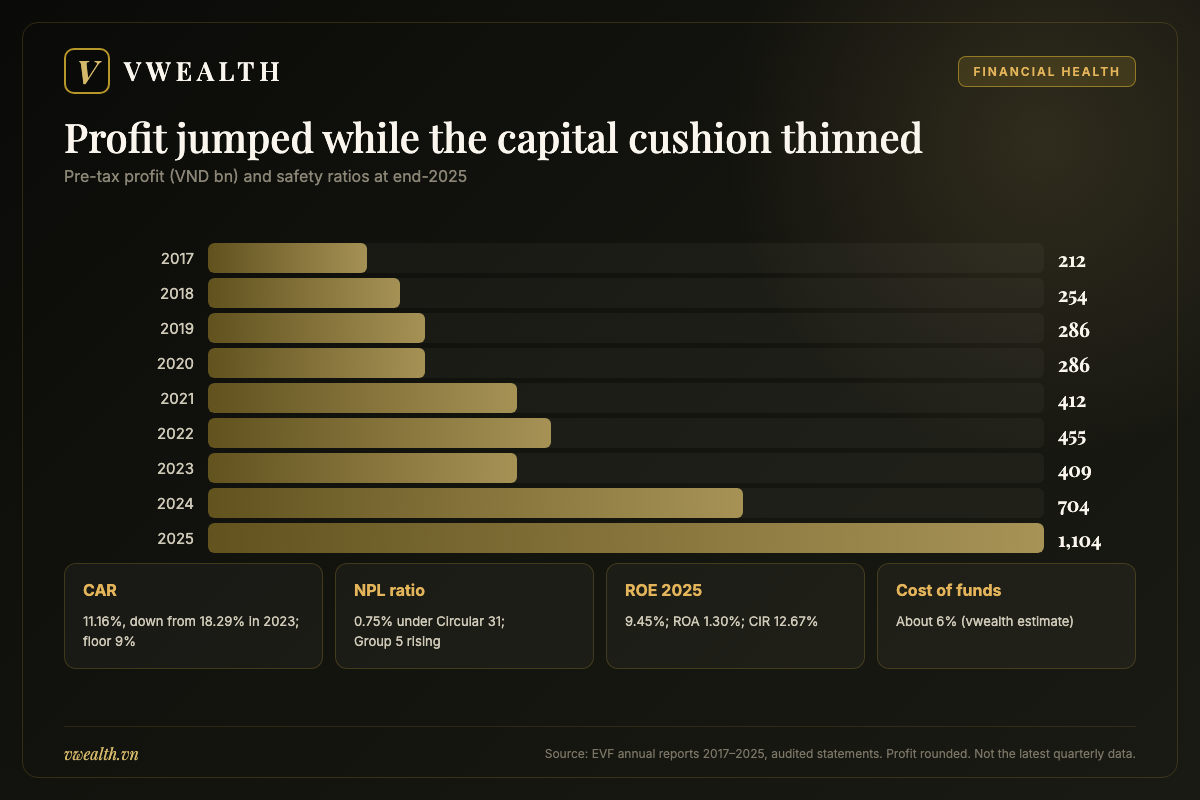
| Year | Total assets (VND bn) | Pre-tax profit (VND bn) | CAR | NPL ratio |
|---|---|---|---|---|
| 2017 | 19,342 | 212 | 14.5% | 2.09% |
| 2018 | 20,057 | 254 | 13.5% | 2.04% |
| 2019 | 22,124 | 286 | 12.2% | 1.98% |
| 2020 | 28,805 | 286 | 11.04% | 1.32% |
| 2021 | 32,387 | 412 | 12.64% | 1.75% |
| 2022 | 42,197 | 455 | 11.5% | 1.64% |
| 2023 | 49,221 | 409 | 18.29% | 1.08% |
| 2024 | 59,598 | 704 | 12.47% | 0.72% |
| 2025 | 83,058 | 1,104 | 11.16% | 0.75% |
Source: EVNFinance/EVF annual reports for 2017–2025 (many are image-only files that vwealth read with text recognition) and audited financial statements; profit rounded to the nearest billion (VND 285.5 billion in 2019 and VND 285.7 billion in 2020). The 2025 NPL ratio follows Circular 31/2024; earlier years follow older rules, so they are not strictly comparable.
The story is clear. From 2017 to 2023, pre-tax profit went from about VND 212 billion to about VND 409 billion — roughly double in six years — while charter capital nearly tripled. Profit per share barely moved in that period. Then in 2024 and 2025 profit jumped to VND 704 billion and VND 1,104 billion — nearly triple the 2023 level in two years. Basic earnings per share (EPS) per the income statement were VND 704 in 2024 and VND 1,123 in 2025.
What drove the jump? Mostly scale. The capital doubled by the late-2023 rights issue let EVF grow total assets from VND 49,221 billion to VND 83,058 billion in two years. The new capital was fully deployed into earning assets. That is also why CAR fell from 18.29% to 11.16%: the cushion was spent on growth.
2025 Under the Microscope: Peeling Back Profit Layer by Layer
The 2025 income statement lets you peel profit apart:
- Interest income: VND 5,502 billion; interest expense: VND 3,610 billion; net interest income VND 1,892 billion (2024: VND 1,444 billion, up about 31%).
- Net fee income VND 47.7 billion; FX loss VND 49.2 billion; trading securities gain VND 19.4 billion; investment securities gain VND 170.8 billion (2024: loss of VND 49.7 billion); net other income VND 86.1 billion; dividends and equity income VND 47.2 billion.
- Total operating income VND 2,214 billion; operating expenses VND 280.5 billion.
- Credit loss provisions VND 828.8 billion (2024: VND 645.3 billion).
- Pre-tax profit VND 1,104.2 billion; net profit VND 894.3 billion.
Two observations. First, net interest income grew about 31%, roughly in line with average total assets (also about 31%) but slower than average customer loans (about 35%). Measured against loans, the margin slipped only slightly, from about 3.6% to 3.5% (vwealth estimate; see the funding section below) — not a sharp squeeze, but a trend to watch when a company lends this fast. Second, the swing in investment securities, from a loss of nearly VND 50 billion to a gain of over VND 170 billion, added about VND 220 billion to pre-tax profit — around half of the roughly VND 400 billion increase in 2025 pre-tax profit (vwealth estimate). If markets are less kind, this may not repeat. In future reports, separate “core profit” (net interest income minus costs and provisions) from investment gains.
The first half of 2026 was the first test of that point, and the answer was clear. According to the company’s explanatory letter accompanying the reviewed half-year financial statements, net interest income in the first six months of 2026 was VND 1,102.8 billion, up about 36% year on year, while gains on investment securities shrank to VND 8.5 billion, down about 94% from VND 142.2 billion a year earlier, and the net FX loss widened to VND 95.6 billion. Provisions were VND 279.2 billion, down about 4%. The result: pre-tax profit of VND 699.3 billion (up about 17%) and net profit of VND 556.2 billion (up about 15%), or roughly 53% of the full-year target. In other words, the “one-off” securities gain of 2025 did not repeat, but interest income more than filled the gap — a better-quality kind of growth. Six months is only a snapshot; full-year and later quarterly results are in the vwealth reports.
Provisions of VND 828.8 billion equal about 1.5% of average customer loans (vwealth estimate) — this is the “cost of risk,” the share of income set aside for loans that may be lost. It consumed about 43% of pre-provision profit. For EVF, provisions are the single biggest swing factor in annual profit, far bigger than operating costs.
Asset Quality: NPLs Under 1%, but Read the Written-Off Book Too
The 2025 annual report shows an NPL ratio of 0.75% (on total credit exposure under Circular 31/2024), bad debt of VND 573 billion, and an overdue ratio (Group 2 plus NPLs) of 1.37%, down from 2.3% in 2024. The loan-quality note is more granular: special-mention (Group 2) VND 469.7 billion, substandard VND 141.3 billion, doubtful VND 148.4 billion and loss VND 282.9 billion. On customer loans alone, NPLs (Groups 3–5) are about 0.93% (vwealth estimate) — higher than 0.75% because the denominator differs. It is a small but important lesson: the same company can report two “NPL ratios” depending on the base; always check which one is used.
Relative to the industry, sub-1% NPLs are low, especially for a finance company. Two details balance the picture. Loans classified as “loss” (Group 5) rose from VND 62.3 billion to VND 282.9 billion in 2025, even though total NPLs stayed low. And the off-balance-sheet line “bad debts written off” reached VND 3,241.8 billion at end-2025, up from VND 2,837.8 billion. These are loans already removed from the balance sheet using provisions but still pursued for recovery. In 2025 EVF used VND 450.5 billion of specific provisions to write off debt (VND 609.6 billion in 2024). In other words, the low NPL ratio partly reflects regular provisioning and write-offs. That is prudent, but it shows the true cost of risk sits in the provision line, not the year-end NPL ratio.
Loan-loss reserves at end-2025 were VND 859.7 billion — VND 461 billion general and VND 398.8 billion specific. Against Group 3–5 customer loans, coverage is about 150% (vwealth estimate) — a decent buffer if NPLs rise modestly.
Six months later the picture shifted a little. According to the reviewed half-year 2026 report, at June 30, 2026 special-mention (Group 2) loans rose to about VND 710 billion, substandard to about VND 343 billion and doubtful to about VND 121 billion, while loss loans fell to about VND 199 billion. Groups 3–5 together were about VND 662 billion, or roughly 0.99% of customer loans (vwealth estimate), up from about 0.93% at end-2025; reserves for customer loans were about VND 811 billion. Still under 1%, but Group 2 — the queue for future NPLs — rose quickly, and that is the line to watch in coming reports. If you want a refresher on reading financial statements, the principles in our Vietnam banking sector guide apply directly to finance companies.
Capital and Leverage: A CAR of 11.16% and Why EVF Must Raise Capital
At end-2025, EVF’s equity was VND 9,876 billion against total assets of VND 83,058 billion — assets of about 8.4 times equity, or equity at about 11.9% of assets (vwealth estimates). Commercial banks typically run assets at 10–12 times equity, so EVF is less leveraged on that simple measure. But CAR — the regulatory measure based on risk-weighted assets — fell from 18.29% (2023) to 12.47% (2024) and 11.16% (2025), approaching the 9% floor.
This is the key bottleneck in the growth story. According to the capital-raising plan EVF published on August 22, 2026, the company aims to lift customer loans to about VND 97,487 billion and total assets to VND 118,000 billion by 2028. Growing that fast without new capital would push CAR to the floor — Moody’s, in its July 2026 review, also put EVF’s CAR at 11.2%, above the 9% minimum. Hence the up-to-85-million-share private placement. In parallel, EVF has already used subordinated debt: according to its issuance disclosures, it sold the full VND 1,000 billion of privately placed Tier 2 capital bonds, with eight-year terms, in two tranches on March 23, 2026 (VND 450 billion, code EVF12601) and May 20, 2026 (VND 550 billion, code EVF12602) — the maximum size of the plan the board approved in March. For existing shareholders, the translation is simple: higher future profits will be “paid for” with dilution or with more expensive subordinated debt. The most durable Tier 1 capital is retained earnings — which is why EVF pays almost no cash dividends.
Funding and Cost of Funds: The Structural Weakness of a Finance Company
At end-2025, EVF’s total funding was about VND 71,040 billion, up 44.7%. Its composition, estimated by vwealth from the balance sheet:
| Source | Dec 31, 2024 (VND bn) | Dec 31, 2025 (VND bn) | 2025 share |
|---|---|---|---|
| Valuable papers issued (mainly certificates of deposit) | 18,556 | 30,842 | 43.4% |
| Deposits and borrowings from other credit institutions | 11,734 | 17,009 | 23.9% |
| Customer deposits (organizations) | 10,211 | 14,552 | 20.5% |
| Funding and entrusted capital (mainly foreign currency, from international lenders) | 8,588 | 8,637 | 12.2% |
| Total | 49,089 | 71,040 | 100% |
Of the VND 30,842 billion in valuable papers, VND 28,432 billion are certificates of deposit, mostly with maturities of 12 months to five years (VND 25,847 billion); bonds total VND 2,410 billion, including VND 1,515 billion maturing beyond five years (consistent with the 2022 green bond) and VND 895 billion issued in 2025. Customer deposits of VND 14,552 billion are almost all term deposits, mainly from joint-stock companies (VND 11,895 billion) — exactly as the law requires. Demand deposits are a mere VND 2.4 billion or so.
The result is a higher cost of funds. Dividing interest expense of VND 3,610 billion by average funding gives a 2025 cost of funds of roughly 6% (vwealth estimate). Interest income on customer loans of VND 5,127 billion over average loans implies a yield of about 9.4%. Net interest income over average total assets is about 2.65%. These are well below consumer lenders and not much above retail banks — because corporate borrowers demand competitive rates while EVF pays more for funds than a bank with CASA. EVF’s profitability therefore rests on three levers: low operating costs, controlled credit costs, and the ability to raise enough long-term funding at a reasonable price.
It helps to picture what this funding mix means in a stress scenario. A bank facing withdrawals can lean on millions of small depositors who rarely move their money at once. EVF’s creditors are fewer and more sophisticated: corporate treasurers, other banks and international funds. They watch credit ratings, capital ratios and market conditions, and they can decline to roll over certificates of deposit or interbank lines when conditions worsen. That is why EVF’s long-dated certificates of deposit (most maturing in one to five years) and multi-year loans from development lenders matter: they reduce the amount that must be refinanced in any single month. When you read future reports, check whether the share of short-dated funding is rising or falling.
One more liquidity note: the 2025 annual report shows a loans-to-funding ratio of 91.5%, down from 95.3% in 2024.
The funding mix can also change quickly. According to the reviewed half-year 2026 report, at June 30, 2026 customer deposits had fallen to about VND 8,630 billion (from VND 14,552 billion at end-2025), while deposits and borrowings from other credit institutions rose to about VND 28,185 billion (borrowings alone about VND 22,078 billion), valuable papers reached about VND 32,833 billion and funding and entrusted capital about VND 9,175 billion. Interbank funding tends to be shorter and more sensitive to system liquidity than corporate deposits, so this is a line to recheck in every report.
Seven Questions to Ask Every Time EVF Reports
Rather than memorizing every figure, use these seven questions as a quarterly checklist. Updated numbers for each are in the vwealth EVF report.
- Is net interest income growing as fast as loans? If loans grow 30% but net interest income only 15%, margins are being squeezed.
- How much profit comes from investment securities? Strip out “net gains on investment securities” to see core profit.
- What is the provision charge as a share of average loans? About 1.5% in 2025 (vwealth estimate); above 2% would signal rising risk.
- Where are Group 2 and Group 5 loans heading? Group 2 is the queue for future NPLs; Group 5 is largely lost.
- How large are real estate and construction loans? Together about 29.5% of loans at end-2025 (vwealth estimate).
- How far is CAR from 9%? Has the private placement closed, and at what price? (The VND 1,000 billion of Tier 2 bonds was completed in mid-2026.)
- Is funding getting longer and cheaper? Track long-term certificates of deposit, international funding and interest expense over funding.
Return on equity (ROE) per the annual reports was 6.43% in 2024 and 9.45% in 2025; return on assets (ROA) 1.08% and 1.30%. An ROE below 10% says that despite strong profit growth, each dong of equity still earns a moderate return compared with Vietnam’s leading private banks.
How the Market Treats EVF Stock: Retail-Driven, Heavily Diluted, With a Wider Door for Foreigners
A good company is not always a good stock, and vice versa. This chapter is not about the business but about the share: who buys and sells it, what the price tends to react to, and which yardstick tells you whether EVF looks cheap or expensive.
From UPCoM to HOSE: A Low-Priced Stock With a Retail Shareholder Base
EVF shares began trading on UPCoM in August 2018 and moved to HOSE on January 12, 2022, with a first-session reference price of VND 19,050 according to Vietstock and Nguoi Quan Sat. After the broad market correction of 2022, EVF spent long stretches trading around the VND 10,000 par value — for instance, Vietstock reported a close of VND 11,000 on October 31, 2023, the rights-subscription deadline, exactly the offer price. That is why it is often grouped with what Vietnamese retail investors loosely call “cheap stocks” (although a low nominal price says nothing about valuation). Combine that with individuals holding over 92% and institutions only 7.9%, and EVF has the personality of a retail-driven stock: volumes surge in hot markets, thin out in quiet ones, and the price reacts sharply to news.
That personality has practical consequences. First, the price can drift away from fundamentals for long periods, in either direction. Second, headlines such as “foreign room opened,” “private placement” or “profit tops one trillion” can trigger short-term rallies. Third, when the broader market falls and margin accounts are force-sold, retail-heavy stocks often fall harder. Note also Vietnam’s market mechanics: HOSE stocks have a ±7% daily price limit and trades settle on a T+2 basis, so sharp moves can stretch over several sessions. Decide in advance whether you are a long-term fundamental investor or a short-term trader; the two require very different discipline.
Dilution and EPS: Share Count Tripled in Six Years
This is a calculation anyone considering EVF stock should do. At end-2019, EVF had 250 million shares outstanding; at end-2025, 760.6 million — about 3.04 times as many. Over the same period, pre-tax profit rose from about VND 286 billion to VND 1,104 billion — about 3.9 times. Profit grew faster than the share count, but not by a wide margin. From 2019 to 2023, the share count rose about 2.8 times while profit rose only about 1.4 times — the period when dilution ate into EPS (vwealth estimates).
An illustrative example: suppose you held 1,000 EVF shares at end-2019 and took part in every stock dividend and the 2023 1-for-1 rights issue. By end-2025 you would have about 3,000 shares, but you would have paid extra cash to subscribe to the rights (roughly 1,400 shares at VND 11,000, or about VND 15.4 million, by vwealth’s calculation). If you skipped the rights, your percentage stake in the company would have been cut nearly in half. With a stock that raises capital this often, your “total return” must include the extra money you put in, not just the share price.
Looking ahead, the private placement of up to 85 million shares would increase the share count by about 11.2% if fully sold. A private placement dilutes differently from a rights issue: existing shareholders cannot participate, and the placement price determines whether book value per share rises or falls. The approved formula uses book value at December 31, 2025 (about VND 12,900 according to management) plus at most 15%. But by June 30, 2026 book value had already risen to about VND 13,500. If the negotiated adjustment is low — below roughly 5% — the price could be below book value at the time of issue, mildly diluting existing holders on a book basis; near the 15% cap, the opposite (vwealth estimate). Read the offer price carefully when it is announced.
Foreign Room: From 15% to 50%, While Foreigners Hold 0.4%
SSC Official Letter 3900/UBCK-PTTT dated June 24, 2024 confirmed EVF’s maximum foreign ownership at 15%. The August 21, 2026 EGM approved raising it to no more than 50%, and on September 22, 2026 the SSC issued Official Letter 9371/UBCK-PTTT on the 50% notification; according to Nguoi Quan Sat, it asked VSDC to update the new limit in its system. Meanwhile, at end-2025 foreign investors held only about 3 million shares, or 0.4%.
Why does a wider limit matter if foreigners have barely bought? It opens two doors. A foreign financial partner could buy into the private placement without hitting a 15% ceiling. And international funds — which often avoid stocks with tight limits for fear that “the room fills up” when they want to add — may take a look. But an open door does not guarantee visitors. For a mid-sized finance company whose liquidity comes mostly from retail and whose CAR is approaching the minimum, foreign investors will do thorough due diligence. For context on how foreign limits work across the market, see our guide to foreign ownership limits in Vietnamese stocks.
Valuation: Use P/B With ROE, Not P/E Alone
For banks and finance companies, the most common valuation yardstick is P/B — share price divided by book value per share. Their assets are mostly cash and loans carried close to real value, while annual earnings swing with provisions. At end-2025, equity of VND 9,876 billion divided by 760.6 million shares gives book value of about VND 12,985 per share (vwealth estimate; management cited a rounded figure of about VND 12,900 at the 2026 EGM). That figure changes every quarter with retained earnings and new issuance — at June 30, 2026, equity of VND 10,414.6 billion works out to about VND 13,690 per share (vwealth estimate).
P/B goes hand in hand with ROE: a business generating a higher ROE deserves a higher P/B. Illustrative example (not the actual price): if a stock has a 10% ROE and you buy at 1.0x book, your return on the money you invested is roughly 10% a year before dilution; buy at 1.5x book and it drops to about 6.7%. With EVF’s 2025 ROE at 9.45%, ask yourself whether the current P/B implies a future ROE much higher than history. If so, the growth story must actually happen. EVF’s current P/B and P/E, and how they compare with banks, are in vwealth’s updated report.
Book value itself deserves a second look. EVF’s book value per share has been shaped by repeated issuance: stock dividends move retained earnings into charter capital without changing total equity, while the 2023 rights issue added fresh cash. A private placement priced above book would lift book value per share for existing holders; one priced below would reduce it. So when you track “book value growth,” track it per share, and note the effect of each new issue.
A warning on comparisons: do not mechanically compare EVF’s P/B with that of big banks. Banks have CASA, diversified fee income and balance sheets in the hundreds of trillions of dong, so their ROE is more durable. A corporate-lending finance company has costlier funding and a more concentrated book, so the market usually applies a discount. How large a discount is fair depends on your confidence in EVF’s ability to keep NPLs low and lift ROE.
Catalysts the Market Tends to React To
From the company’s disclosures, five kinds of events could move EVF stock over the next 12–18 months:
- Outcome of the 85-million-share private placement: who buys, at what price, and whether a foreign partner participates. The SBV approved the capital increase on September 22, 2026; at the EGM, management said the offering targets financial institutions and foreign investors to “improve the quality of the shareholder base.”
- Actual foreign ownership: whether foreigners become net buyers after the limit rises to 50%.
- Credit ratings: according to Vietstock and Nguoi Quan Sat, in July 2026 Moody’s affirmed EVF at B2 with a stable outlook for the sixth consecutive year (while raising its profitability assessment from Ba3 to Ba1), and EVF began rating processes with FiinGroup and S&P Global Ratings in early July 2026. A new or higher rating could lower funding costs.
- The 2026–2028 profit path: each quarterly report will be measured against the VND 1,325 billion (2026), VND 1,750 billion (2027) and VND 2,200 billion (2028) pre-tax targets in the capital-raising plan published on August 22, 2026. At the EGM, management expected nine-month 2026 results at about 75% of the annual plan and the full year to meet or slightly exceed it.
- The market cycle: Vietnam’s market upgrade process and overall liquidity in financial stocks.
It is also worth separating “company catalysts” from “market catalysts.” The first group — the placement, ratings, quarterly profit — depends on EVF’s own execution and can be checked against disclosures. The second group — index flows, market upgrades, overall liquidity — depends on forces outside the company, and tends to lift or sink all financial stocks together. A disciplined investor gives more weight to the first group, because it says something lasting about the business.
None of these guarantees a higher price. They are simply moments when the market tends to “re-price” the story. If you buy on a catalyst, decide in advance what would make you sell — including after good news is out.
Industry Context: Between Banks, Consumer Lenders and the Green Energy Wave
EVF does not compete in a neat, separate industry. It sits where three worlds meet: commercial banks (direct rivals in corporate lending), consumer finance companies (same license type, different model), and the capital market for the energy transition (where EVF has found its own niche). Understanding all three tells you how big EVF can become. For a wider view of Vietnam’s listed lenders, start with our Vietnam banking sector guide.
Non-Bank Credit Institutions: Small in the System, Large in Some Niches
Vietnam’s credit system is dominated by commercial banks. Finance and leasing companies hold only a small share of total assets, and most finance companies are subsidiaries of banks or owned by foreign groups. That makes EVF a rare case: an independent finance company with no parent bank and a HOSE listing. An article about the FChoice 2025 award on EVF’s website claims the company has the largest total assets among Vietnamese finance companies — that is the company’s own statement, so treat it as a reference point rather than an independent ranking.
The built-in weakness of non-banks is funding. Without retail deposits, they depend on interbank markets, debt securities and foreign money. When system liquidity tightens — as in late 2022, when Vietnam’s corporate bond market froze and interbank rates spiked — finance companies usually feel the pressure before banks. That is a structural risk EVF shareholders must accept.
Compared With FE Credit, HD Saison and the Wave of Japanese Buyers
Vietnam’s consumer finance market has been both a gold mine and a minefield. FE Credit — VPBank’s subsidiary — was once the country’s largest consumer lender, then suffered heavy bad debts after the pandemic; VPBank sold 49% of FE Credit to Japan’s SMBC group (see our analysis of whether to buy VPB stock). HD Saison belongs to HDBank, with Japan’s Credit Saison as its partner. SeABank sold its finance company PTF to Japan’s AEON Financial Service — a story told in our SSB stock analysis.
The common thread: Vietnamese banks used consumer finance subsidiaries as a high-margin business, and when risk surfaced or capital was needed, they sold to Japanese partners experienced in consumer credit. EVF is not part of that story. With only about 4% of loans to individuals, it barely competes with FE Credit or HD Saison. A better comparison is the SME lending arms of mid-sized banks such as OCB or MSB. EVF should also not be confused with pawn chains such as F88, which lend against collateral under a pawn-services business model and are not SBV-licensed credit institutions like EVF; their legal framework, funding and safety requirements are entirely different.
| Feature | EVF | Bank-owned consumer lenders (FE Credit, HD Saison) | Mid-sized banks (OCB, MSB, SSB) |
|---|---|---|---|
| Controlling shareholder | None; state ownership 0% | Parent bank and Japanese partner | Usually a dominant group |
| Main clients | Private companies | Low- and middle-income individuals | Individuals and companies |
| Funding | Certificates of deposit, interbank, international lenders | Parent bank, interbank, international lenders | Retail deposits, CASA |
| Margins | Moderate | High | Medium |
| Typical NPLs | Low (under 1% in 2025) | High | Medium |
| Separately listed | Yes (HOSE) | No (inside parent bank) | Yes |
The table is a qualitative comparison of business models, not company-specific data.
The 2024 Law on Credit Institutions: New Rules for Finance Companies
Law No. 32/2024/QH15 on Credit Institutions, effective from mid-2024, changed a lot for finance companies. As noted, it splits them into general and specialized types, lists permitted activities for each type explicitly and tightens ownership caps. According to the minutes of the 2026 AGM, following the 2025 AGM resolution the board issued charter amendments number 14, 15 and 16, and in April 2026 amendment 17 — bringing everything from the name to the list of activities, equity-investment rules and the central-bank account in line with the new law.
For investors, the impact has two layers. The first is transparency and governance: the law requires disclosure of shareholders owning 1% or more and tightens related-party rules, helping minority shareholders see who influences the business. Thanks to that rule, EVF published its list of shareholders owning 1% or more on January 8, 2026 — which contains only the Hoa An group and its related parties described in Chapter 2. The second is a limit on growth: finance companies may take deposits only from organizations, must hold a higher minimum CAR than banks, and must observe single-borrower lending limits. For a book of large loans like EVF’s, single-borrower limits are set against own capital — the bigger the capital, the bigger the maximum loan. Another reason EVF needs to raise capital.
The Energy Transition and Green Finance: A Tailwind for EVF
Vietnam has pledged net-zero emissions by 2050, and the capital needs for renewable generation, grids, electric vehicles and energy-efficient manufacturing are enormous. According to VnExpress, Vietnam’s domestic carbon exchange officially started trading on June 29, 2026; on the first day, emission allowances traded as high as VND 136,000 per tonne of CO2 equivalent before closing at VND 130,000. When emissions reductions have a price, green projects gain an extra revenue stream, and lenders experienced in appraising them gain an advantage.
This is where “Electricity” in the name regains meaning — not because EVN owns the company, but because 18 years of working on power projects built specialized appraisal skills. International development lenders are looking for channels to deploy climate finance in Vietnam, and EVF is one of the proven ones, through its 2022 green bond, Proparco loans in 2021 and 2026, and relationships with Swedfund, OeEB, the OPEC Fund and microfinance funds. But remember that Vietnam’s renewable sector has gone through hard times over tariffs and power purchase arrangements for projects without official prices. Project lending in energy is long-term and exposed to policy risk; “green” does not automatically mean “safe.”
Interest Rates, Bonds and Competition With Banks
A corporate-lending finance company walks a tightrope between two forces. When system deposit rates fall and liquidity is abundant, EVF can issue certificates of deposit more cheaply and margins widen. But at the same time, cash-rich banks cut lending rates to win good corporate clients, pushing EVF toward riskier borrowers or thinner rates. When liquidity is tight, the reverse happens: EVF’s funding becomes more expensive, but companies squeezed by banks look to channels like finance companies.
There is also a quieter competitive threat: as Vietnam’s banks digitize and push harder into SME lending with fast online approvals, the speed advantage that a lean finance company once had narrows. EVF’s answer so far has been partnerships — BNPL with fintechs, earned wage access, supply-chain financing — and a focus on sectors where its appraisal skills are genuinely differentiated, such as renewable energy. Whether that is enough to defend margins against larger rivals is one of the open questions for the next few years.
The corporate bond market cuts both ways too: EVF is an issuer (the green bond and VND 895 billion of private bonds in 2025) and an investor (VND 1,241 billion of corporate bonds at end-2025). A healthy bond market means extra funding and extra income; a crisis like 2022 pressures both sides at once.
Outlook: Three Scenarios for EVF Stock and the Conditions Behind Each
Nobody knows where EVF’s share price will be next year. What you can do is identify the variables that drive the story and build scenarios around conditions. This chapter offers no price target; it gives you a framework to track and adjust as new information arrives.
Six Variables That Will Decide EVF’s Future
- Loan growth and the ability to keep NPLs low. Targets in the capital-raising plan published on August 22, 2026: customer loans of about VND 73,000 billion (2026), VND 84,449 billion (2027) and VND 97,487 billion (2028); the actual figure at mid-2026 was about VND 67,201 billion. Rapid growth with NPLs still under 1% is the good outcome; rapid growth followed by NPLs “catching up” one or two years later is the familiar pattern in credit businesses.
- Cost of funds. The ability to raise long-term certificates of deposit, international funding and corporate deposits at reasonable prices. New ratings (S&P, FiinGroup), if obtained, would matter directly.
- Capital raising. Whether the up-to-85-million-share placement succeeds, at a good price, on time. The subordinated-debt leg is done: VND 1,000 billion of Tier 2 bonds were issued in March and May 2026.
- New shareholders. Whether the 50% foreign limit attracts a foreign financial institution or a large fund.
- The property and construction cycle. Together about 29.5% of loans at end-2025 and about 34% at June 30, 2026 (vwealth estimate).
- Investment gains. A volatile component: meaningful in 2025, almost gone in the first half of 2026.
On guidance, note a small discrepancy between sources: the CEO’s letter in the 2025 annual report sets 2026 targets of VND 94,500 billion in total assets and VND 1,332 billion in pre-tax profit, while the resolution of the April 3, 2026 AGM approved VND 93,000 billion in total assets and VND 1,325 billion in pre-tax profit (up about 12% and 20% on 2025) — figures kept unchanged in the August 2026 capital-raising plan. The resolution is the official plan; check the latest meeting resolution in case it is revised.
Bull Case: Capital Raise Succeeds, a Strategic Shareholder Arrives, Profit Stays on Track
Conditions: the private placement closes at a price above book value, with a foreign financial institution or development fund participating; CAR rises clearly; loans grow according to plan while NPLs stay below roughly 1% and provisions hold around 1.5% of loans; long-term international funding keeps expanding and funding costs fall; profit tracks the VND 1,325–1,750–2,200 billion path without relying on securities gains.
In this scenario, ROE could improve beyond 2025’s 9.45%, and the market would have reason to value EVF closer to mid-sized banks. Foreign ownership could gradually rise from 0.4%. This is the case in which the “independent, green, low-cost finance company” story is recognized by the market.
Base Case: Steady Growth, Slower Capital Raising, Valuation Tracking Earnings
Conditions: the private placement is partly completed or delayed; loans still grow but below plan because CAR constrains them; NPLs drift into the 1–1.5% range; profit rises but misses plan in some years; foreign room opens but foreigners buy only small amounts.
The base case is, in many ways, a continuation of EVF’s history from 2017 to 2023: assets grow, profit grows more slowly, share count grows alongside, and the stock trades largely with the market. It is not a disaster, but it is not the re-rating story that recent headlines imply either.
In this scenario, EVF remains profitable with moderate growth. The share price tends to follow book value and retained earnings, with short-term swings driven by the broader market. Long-term investors earn mainly from growth in book value, with no meaningful cash dividends.
Bear Case: Lagged NPLs, Tight Capital, Rising Funding Costs
Conditions: after two years of very fast loan growth (2024–2025), some loans — especially in real estate, construction, or renewable projects stuck on tariff issues — turn bad; provisions exceed 2% of loans; system liquidity tightens, lifting the cost of certificates of deposit and interbank funding; the private placement proves difficult or must be priced low; CAR nears 9%, forcing slower growth; securities gains flip to losses.
None of these conditions is exotic. Vietnam’s credit market has seen each of them within the past decade: property-linked bad debt after rapid credit growth, a corporate bond freeze in 2022, and stress in parts of the renewable sector over pricing. The question is not whether such shocks can happen, but whether EVF’s capital, provisions and funding structure are thick enough to absorb them when they do.
In this scenario, profit could fall as it did in 2023, EPS could decline from both lower earnings and dilution, and the stock — given its retail-heavy base — could fall further than the fundamentals deteriorate. This is not a forecast; it is a risk you should price before you buy.
Illustrative Example: 11% Dilution and 20% Profit Growth — What Happens to EPS
This illustrative example uses round numbers and is not a forecast. Take 2025 net profit of VND 894 billion over 760.6 million shares: EPS of about VND 1,176 (the company reports VND 1,123 because it first deducts about VND 40 billion provisionally set aside for bonus and welfare funds). If net profit then rises 20% to about VND 1,073 billion and the company issues the full 85 million new shares (845.6 million in total), EPS would be about VND 1,269 — up roughly 8%, not 20%. If profit rises only 10%, EPS is essentially flat (about VND 1,163). The lesson: with a stock that keeps raising capital, always look at profit growth per share, not total profit growth.
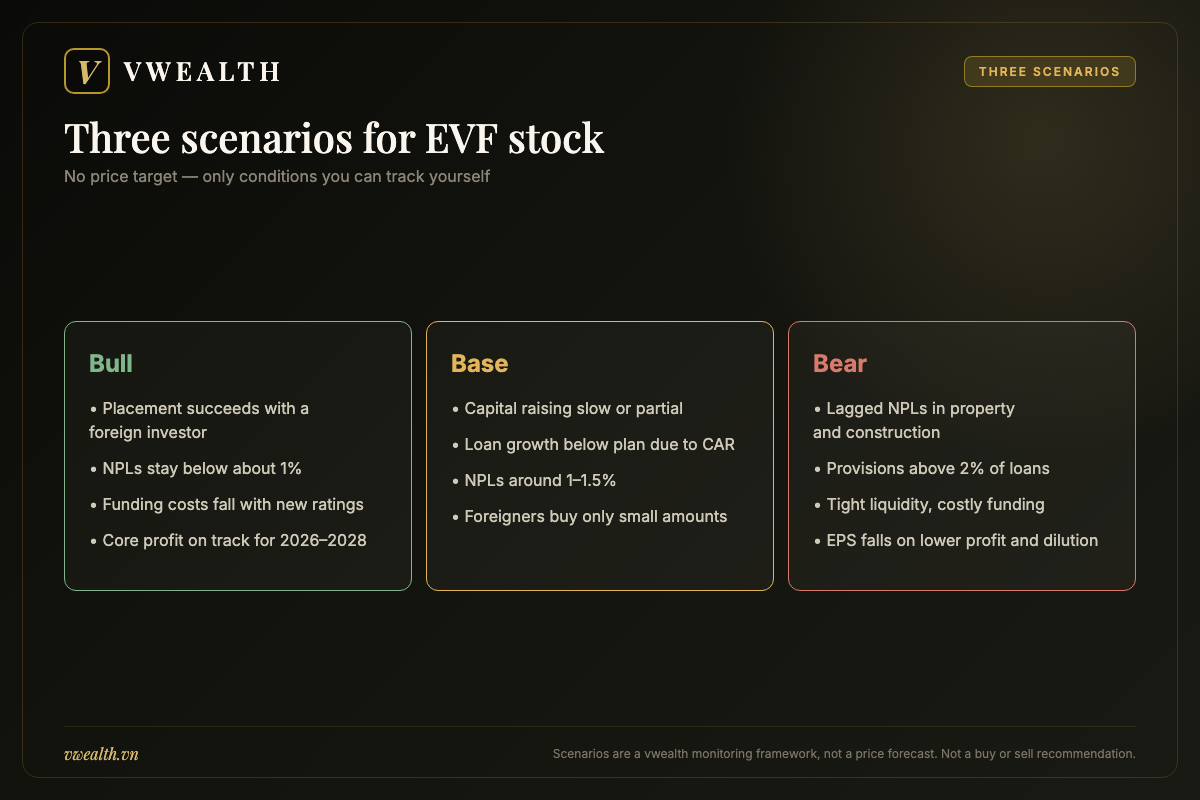
So, Should You Buy EVF Stock? A Straight Answer for Each Type of Investor
After seven chapters, it is time to pull things together. “Should I buy EVF stock?” has no single answer for everyone. It depends on what you believe about the company’s future and what kind of risk you can live with. Below is the balance of pros and cons as vwealth sees it, based on published figures.
The Compelling Positives
- Strong profit growth two years running: pre-tax profit rose from VND 409 billion (2023) to VND 704 billion (2024) and VND 1,104 billion (2025), crossing the trillion-dong mark for the first time.
- Good asset quality for its model: an NPL ratio of 0.75% at end-2025 on the company’s basis; reserve coverage of Group 3–5 customer loans around 150% (vwealth estimate).
- Unusually low operating costs: a CIR of 12.67% in 2025 and fewer than 290 staff (284 at June 30, 2026, according to the press).
- No dependence on high-risk consumer lending: about 96% of loans go to companies, sidestepping the consumer-credit minefield that hurt several finance companies.
- A green-finance and international-funding edge: more than VND 6,393 billion in green loans, an internationally guaranteed green bond, relationships with Proparco, Swedfund, OeEB and the OPEC Fund, and a Moody’s B2 rating for six consecutive years (2021–2026).
- A door to new capital: the 50% foreign limit and the private placement could bring institutional and foreign shareholders.
- No controlling shareholder or parent group: the largest disclosed group holds about 5–6%, far below the 15% cap, and three of five board members are independent.
- Core profit carrying the growth: in the first half of 2026, net interest income rose about 36% and offset the near-disappearance of securities gains, so pre-tax profit still grew about 17%.
The Negatives You Cannot Ignore
- Costlier, less stable funding than a bank: no retail deposits, no CASA; a 2025 cost of funds around 6% (vwealth estimate).
- A falling CAR: from 18.29% (2023) to 11.16% (2025), close to the 9% floor — further growth depends on raising capital.
- Persistent dilution: the share count roughly tripled from 2019 to 2025, with up to 85 million more shares coming.
- Almost no cash dividends: profits are retained or paid in shares.
- A moderate ROE: 9.45% in 2025, below Vietnam’s leading private banks.
- Some non-recurring profit in 2025: about VND 170.8 billion from investment securities after a loss the year before.
- Fast growth in property and construction loans: together about 29.5% of loans at end-2025 and about 34% at June 30, 2026 (vwealth estimate); real estate is now the largest single sector.
- The 2025 inspection conclusion: the SBV flagged high credit concentration in large customer groups and violations in lending and loan classification; the company was fined VND 635 million and must implement 5 general and 27 specific recommendations. Progress on those fixes is worth tracking.
- No sponsor: in a crisis there is no parent group or parent bank obliged to inject capital.
- A retail-driven share price: institutions held 7.9% and foreigners 0.4% at end-2025.
| Factor | Upside | Downside | What to watch |
|---|---|---|---|
| Growth | 2025 profit up 57% | Partly from securities gains | Core profit each quarter |
| Asset quality | NPL ratio 0.75% at end-2025, under 1% at mid-2026 | Group 2 loans rising in 2026; written-off book growing | Provisions / average loans, Group 2 loans |
| Capital | Equity about 11.9% of assets | CAR 11.16%, near the 9% floor | Private placement (Tier 2 bonds of VND 1,000 billion done) |
| Funding | Long-term international money, Moody’s rating | No retail deposits | Interest expense / funding |
| Ownership | No controlling shareholder; 50% foreign limit | No sponsor; foreigners at 0.4% | List of shareholders above 1%, 5% group filings |
| Governance | Three of five directors independent; fine paid after inspection | 2025 inspection flagged credit concentration; chief accountant changes in 2026 | Implementation of inspection recommendations, large-customer exposure |
| Shareholder returns | Book value grows via retained profit | No cash dividend; dilution | EPS and book value per share |
Who EVF Stock May Suit — and Who It Does Not
It may suit investors who want exposure to Vietnamese financials without consumer credit risk; those who believe in the green-finance story and in international capital flowing into Vietnam; those comfortable with no cash dividends and who measure returns by growth in book value; and those patient enough to read quarterly reports and check the variables in Chapter 7. For such investors, EVF could be a small position within a financials allocation, alongside banks with stronger deposit franchises.
It does not suit investors who need regular cash income; those looking for a low-volatility “defensive” stock; those unwilling to track new share issues and dilution; and anyone buying because they believe EVF is an EVN subsidiary and “nothing can go wrong.” As shown above, state ownership in EVF is 0% according to the 2025 annual report — if the company runs into trouble, no group is obliged to step in.
For short-term traders, EVF has enough liquidity and volatility to trade during active markets, but it can drop hard in corrections because retail investors dominate. If you trade it, set clear stop-losses and avoid heavy margin.
For foreign investors, a few mechanics matter. You need a trading code from the VSDC and an account with a licensed Vietnamese broker, and you trade in dong through an indirect investment capital account. EVF trades on HOSE with a ±7% daily limit and T+2 settlement. Until recently, the 15% foreign limit was far from full, so foreign buyers did not face a “room premium”; with the limit rising to 50%, that is even less of an issue. The bigger practical constraints are liquidity during quiet markets and the fact that company disclosures are primarily in Vietnamese, although EVF’s website has an English version. Our guide on how to invest in the Vietnam stock market walks through account opening and the rules in more detail.
Frequently Asked Questions About EVF Stock
Is EVF a subsidiary of EVN? No. According to the 2025 annual report, state shareholders own 0% of EVF. The largest group in end-2025 disclosures is Hoa An Financial Investment JSC and related parties, at about 5.56%. EVN was a major shareholder with 15% (end-2016) and 7.5% (end-2017) before leaving the major-shareholder list. “Electricity” in the name is a historical legacy.
Are EVF and EVNFinance the same company? Yes. EVNFinance was the former brand; in 2025 the company renamed itself EVF General Finance Joint Stock Company and adopted the EVF identity, which is also its HOSE ticker.
Does EVF take savings deposits from individuals? No. Under the 2024 Law on Credit Institutions and its charter, EVF may accept deposits and issue certificates of deposit only to organizations. Be wary of any offer to “save with EVF” aimed at individuals; the company’s website has also warned about scams impersonating the EVF and EasyCredit brands.
Does EVF pay cash dividends? In recent years dividends have been mostly in shares; cash paid to shareholders in 2025 was only about VND 828 million, and the April 3, 2026 AGM retained all of 2025’s profit after fund appropriations. Check each year’s AGM resolution for the latest profit-distribution plan.
How is EVF different from FE Credit? FE Credit mainly makes consumer loans to individuals and is a subsidiary of VPBank; EVF mainly lends to companies (about 96% of loans at end-2025), has no parent bank and is separately listed.
What is EVF’s foreign ownership limit? The August 21, 2026 EGM raised it from 15% to no more than 50%, and on September 22, 2026 the SSC issued a letter on the notification (according to Nguoi Quan Sat, asking VSDC to update the system). Actual foreign ownership at end-2025 was about 0.4%.
What credit rating does EVF have? Moody’s has rated EVF B2 with a stable outlook since 2021; press reports say the rating was affirmed in 2026 for the sixth consecutive year, and that EVF began rating processes with FiinGroup and S&P Global Ratings in July 2026.
Final Thoughts
EVF is one of the stranger stories on Vietnam’s stock market: a finance company that carries the power sector’s name but is no longer EVN’s child, with no controlling shareholder, no retail deposits, a business built on corporate lending at very low cost, and a genuine edge in green finance. Over the past two years, that story has turned into numbers: profit above one trillion dong, total assets above VND 83 trillion, and NPLs under 1%.
But that very speed raises the questions for the next phase: capital is thinning, funding is still costlier than a bank’s, real estate loans are growing quickly, the supervisor has flagged credit concentration, and shareholders will keep being diluted so the company can fund growth. So the answer to “should I buy EVF stock?” does not lie in the 2025 profit figure. It lies in three things to watch over the next 12–18 months: whether the capital raise succeeds and brings in quality institutional shareholders, whether core profit grows faster than the share count, and whether NPLs stay low after two years of very rapid loan growth. If all three go right, EVF could be one of the more interesting financial stories of the new cycle for Vietnam stocks. If not, it remains a profitable business whose stock struggles to outperform.
This article is for information and analysis only and is not a recommendation to buy or sell. Before deciding, check the latest data — price, P/B, the most recent quarter’s profit, NPLs and CAR — in vwealth’s analysis reports, and weigh your own risk tolerance. If you are researching Vietnamese financials, our analyses of VPBank, SeABank, OCB and MSB are useful points of comparison.
Research Vietnamese stocks in English with vwealth. Our AI-powered platform turns Vietnamese market data into full English analysis reports — with international payment support and a free 2-month trial for new accounts. Create your free account and read the latest reports.