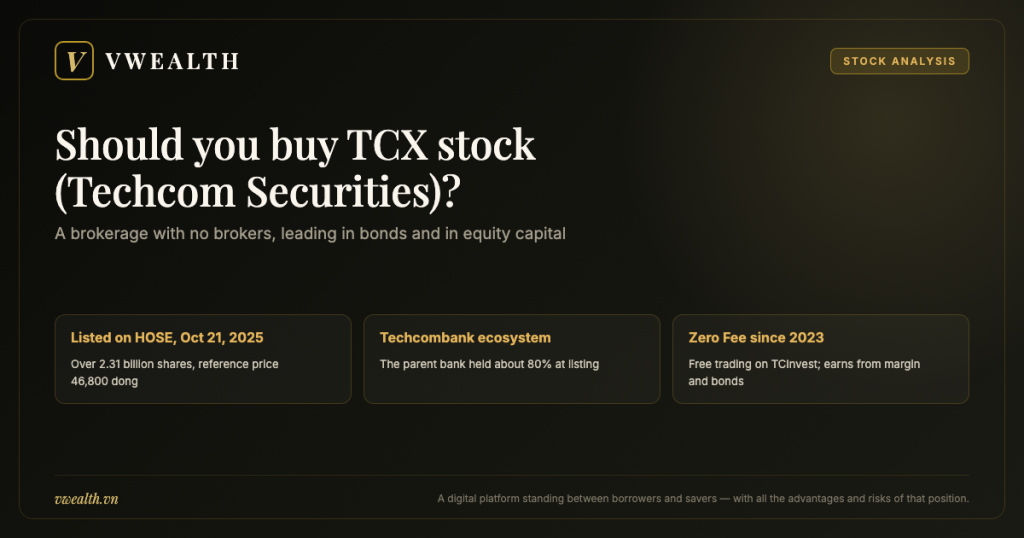
Should you buy TCX stock? The question has followed Techcom Securities — the brokerage arm of Techcombank, known in Vietnam simply as TCBS — ever since October 21, 2025, when more than 2.31 billion of its shares began trading on the Ho Chi Minh City Stock Exchange (HOSE). TCBS is an unusual securities firm. It has no traditional sales force of brokers, it has charged zero trading fees on its TCInvest app since the start of 2023, and for most of its history it made its money in a corner of the market that many retail investors barely understand: arranging and distributing corporate bonds. That business carried TCBS to the top of Vietnam’s brokerage industry, and it is also the reason the Techcom name came under the harshest scrutiny during the country’s corporate bond shock of late 2022. This analysis walks through the whole story — from a small limited-liability company founded in 2008 to the securities firm with the largest equity base in Vietnam, and from its intimate ties with Techcombank to the risks those ties create. By the end you will have a straight answer to the only question that matters: who TCX stock suits, and who should stay away.
First, a ground rule that applies to every company analysis in the vwealth series. This article uses many dates, names, deals and scale figures, all taken from publicly disclosed information: announcements by TCBS and Techcombank, shareholder meeting resolutions, HOSE notices and mainstream Vietnamese financial media. Full-year results for completed fiscal years, such as 2022 or 2025, are used as historical markers so you can see the trajectory. What you will not find here is the latest quarter’s earnings, today’s share price, or the current P/E or P/B multiple. For a brokerage, results move with market turnover almost week by week, and a number that is correct today can be misleading ninety days from now. Instead, this article shows you where to look and how to read what you find. For up-to-date figures, open the latest vwealth analysis reports, which are available in English.
If you are new to the Vietnamese market, a few pieces of context will help. Vietnam has three exchanges — HOSE for larger companies, HNX and UPCoM for others — and a daily price limit (plus or minus 7% on HOSE, wider on a stock’s first trading day). Foreign ownership in many companies is capped by “foreign ownership limits,” which matter for how international funds can invest. And in September 2026, FTSE Russell formally reclassified Vietnam from a frontier market to a secondary emerging market. Our guide to investing in the Vietnam stock market covers these mechanics in detail. For this article, the key point is simpler: TCX is a listed subsidiary of a large private bank, and you need to understand both the subsidiary and its parent. If you have read our Techcombank (TCB) stock analysis, you met TCBS as the “crown jewel” of the bank’s ecosystem. Here we look from the other side. When you own TCB, TCBS is an asset that feeds the bank’s profits. When you buy TCX stock, you become a minority shareholder in a company whose controlling shareholder holds roughly four-fifths of the equity — and that shareholder shapes everything from dividend policy to how customers flow between the bank and the brokerage.
From a Small Firm in 2008 to Vietnam’s Best-Capitalized Brokerage: The TCBS Story
Most of Vietnam’s large securities firms grew up along a familiar path. They hired armies of brokers, opened branches in the big cities, won market share through personal relationships, and then used their balance sheets to lend to clients on margin. SSI, HSC and VNDirect all followed some version of that playbook. TCBS did not. It grew first out of bonds, then out of technology, and only turned to fight head-on for equity brokerage once it had a digital platform strong enough to do something no rival was willing to do: trade for free. Understanding that unusual route is the key to understanding why TCX behaves differently from other Vietnamese brokerage stocks — and why its risks sit in different places.
2008: A Brokerage Born Into a Crash
Techcom Securities Limited Company was established under Securities Business License No. 98/UBCK-GP, issued by Vietnam’s State Securities Commission on September 18, 2008. Pause on that date for a moment. September 2008 was the month Lehman Brothers collapsed. In Vietnam, the VN-Index had already fallen hard from its 2007 peak and would keep falling into early 2009. Launching a brokerage then was a contrarian move, and, as you might expect, TCBS spent its first five years as a small player with little voice in the equity market.
Its legal form also says something. A limited-liability company is the typical structure for a bank-owned brokerage built to serve the parent’s ecosystem: a single or near-single owner, no need to raise money from the public, no pressure to report to tens of thousands of shareholders. At this stage TCBS looked more like an extended department of Techcombank than an independent business. That was not a weakness so much as a starting point — and it is a trace you can still see, eighteen years later, in TCX’s shareholder register.
Around 2013: A Fund Manager Takes the Chair and Bets on Bonds
The real turning point came around 2013, when Nguyen Xuan Minh became chairman of TCBS. According to published profiles, Minh is a CFA charterholder with more than twenty-five years in investment and fund management. He was a senior vice president at Franklin Templeton Investments in Singapore and later co-founded and ran Vietnam Asset Management for about eight years before joining TCBS. In a 2022 profile, Vietnam Investment Review noted that TCBS was founded in 2008 but remained a small company until 2013.
What is striking is that the new chairman chose not to fight where everyone else was fighting — equity brokerage. He chose corporate bonds, a market that was then embryonic, mostly traded between institutions and largely unknown to retail investors. The logic becomes clear when you place TCBS next to its parent. Techcombank had deep credit relationships with many large companies, especially along the real estate value chain. Those companies needed long-term funding that a bank could not keep extending within its lending limits. Corporate bonds solved that problem. The company issues; TCBS advises and arranges; then TCBS sells the bonds on to individuals with idle savings — many of them Techcombank depositors. It was a closed loop connecting those who need capital with those who have it, with TCBS in the middle collecting fees.
The formula worked. TCBS became the leading adviser on corporate bond issuance in Vietnam, and, according to the company’s own profile, it was named “Best Bond House in Vietnam” by Alpha Southeast Asia across several consecutive award periods. By 2022, Vietnam Investment Review described TCBS as the bond market leader for six straight years.
2018: Conversion, iConnect and the Shift to a Fintech Identity
In 2018 the limited-liability company converted into a joint-stock company and took the name Techcom Securities Joint Stock Company. The same year, TCBS launched iConnect, an online bond-matching system that lets a bondholder sell to another investor who wants to buy, rather than waiting for maturity. That sounds modest, but it changed investor psychology. Before iConnect, buying a corporate bond meant locking money away for years. With iConnect, bonds began to feel like a savings deposit you could break early — even though, legally and economically, their risk is nothing like a bank deposit.
In parallel TCBS built TCInvest, which it describes as a single-login platform for trading and managing multiple asset classes: stocks, bonds, fund certificates, derivatives and covered warrants. According to Vietnam Investment Review in 2022, about 65% of TCBS staff were technology engineers, organized into around 32 scrum teams that completed roughly a thousand projects of various sizes each year. That staff mix tells you how TCBS sees itself: not as a brokerage with an IT department, but as a technology company that happens to hold a securities license. The company calls its model “WealthTech.”
2020–2021: A Wave of New Investors and a Jump in Market Share
The pandemic produced an unprecedented wave of new retail investors in Vietnam. Millions of accounts were opened, mostly online, by younger people far more comfortable with a smartphone than with a phone call to a broker. That was exactly the customer TCInvest had been built for. According to Vietnam Investment Review, TCBS’s equity brokerage share rose from about 0.6% at the start of 2020 to about 5.5%, putting it among the four largest brokers on HOSE. In 2021, the same publication reported, TCBS earned more than 165 million US dollars in pre-tax profit.
Those two years were also the peak of Vietnam’s corporate bond boom, and most of the issuance came from property developers. Bonds were sold widely to individuals through banks and brokerages, at yields well above deposit rates. For TCBS — the leader in both advisory and distribution — it was a golden age. And like every golden age built on fast credit growth, it planted the seeds of the correction that followed.
2022: The Year Bonds Broke and Reputation Was Tested
Any serious analysis of TCBS has to look squarely at 2022. From early that year, regulators began tightening the corporate bond market. In April 2022, the cancellation of bond issues by the Tan Hoang Minh group shook confidence. In September, Decree 65/2022 tightened conditions for issuing and distributing privately placed bonds. In October, criminal proceedings involving the Van Thinh Phat group began. Retail investors rushed to sell bonds, and bond funds faced heavy redemptions.
The Techcombank ecosystem drew particular attention for two reasons: it was the largest bond distributor, and its roster of issuers leaned toward real estate. The Techcom Bond Fund (TCBF) — an open-ended fund managed by Techcom Capital, a fund management company within the Techcombank group, and widely distributed through TCInvest — faced heavy outflows from early October 2022. In early December 2022, the newspaper Dan Tri reported that the fund’s net asset value had fallen sharply and that some investors complained of losses of 10–20% on their accounts. TCBS’s own results reflected the pressure: for full-year 2022 the company still reported pre-tax profit of 3,052 billion dong on total revenue of 5,212 billion dong, but fourth-quarter pre-tax profit shrank to just 313 billion dong, compared with 1,176 billion dong in the first quarter of the same year.
In January 2023, the State Securities Commission announced administrative fines against TCBS totaling a little over 400 million dong for bond-related violations uncovered in an inspection covering January 1, 2021 to September 5, 2022. According to press reports, the largest single fine, 250 million dong, was for failing to ensure the accuracy of information in the offering documents of a private bond placement — relating to TCBS’s role as adviser on a 2021 bond issue by Wealth Power JSC — with smaller fines for late reporting. Keep the numbers in proportion: these were administrative penalties, tiny relative to the company’s size, and not criminal cases like some others in the industry. But reputationally they confirmed what the market feared — that advisory processes during the boom years had gaps.
The other side of the story deserves equal fairness. According to TCBS, the company processed more than 75,000 billion dong in bond principal and interest payments to investors during 2022, including 35,500 billion dong of scheduled payments in the fourth quarter alone. It also said that across the seven crisis months from November 2022 to May 2023, iConnect kept providing liquidity, with more than 165,000 transactions and about 17,785 billion dong of repurchase value. There was no wave of defaults carrying the TCBS name, as there was elsewhere. In short, TCBS came through 2022 scratched in reputation and with a sharp dip in profit, but not broken. How it came through that shock shaped every strategic choice afterward.
2023: Zero Fee and the Pivot Toward Equities
While the bond market was still frozen, TCBS made a move that jolted Vietnam’s brokerage industry. From January 1, 2023, it introduced “Zero Fee”: free trading in stocks, derivatives, covered warrants and listed fund certificates for clients using TCInvest, applied to both new and existing customers. It also launched promotional margin rates starting at a very low level for selected products. The immediate effect was a drop in brokerage revenue: in 2023, brokerage and custody revenue came to 528 billion dong, down 44% from 2022, which the company attributed to the Zero Fee policy.
Why would a company cut off its own revenue? Because TCBS never intended to earn money from trading commissions. It wanted to earn money elsewhere — interest on margin loans to a larger customer base, and fees from distributing products to more engaged customers. Free trading was the price of acquiring customers. In 2023, despite lower brokerage revenue, TCBS reported pre-tax profit of more than 3,028 billion dong, about 1.5 times its plan for the year (the initial plan had assumed a 22% decline). Capital-raising and bond distribution revenue reached 2,099 billion dong, up 60%, and TCBS advised on more than 70,000 billion dong of corporate bond issuance, holding the number-one position with a disclosed advisory market share of 52%.
2024–2025: The Margin Engine, Capital Raising and the IPO
In 2024 TCBS reported pre-tax profit of more than 4,802 billion dong, up 59% from 2023, with margin lending at a record high. 2025 was the pivotal year. In June 2025, the company completed a private share offering to 25 insiders — board members, executives and key managers — totaling more than 118.8 million shares and raising about 1,376 billion dong; Chairman Nguyen Xuan Minh alone bought more than 106 million shares at 11,585 dong each. From August 19 to September 8, 2025, TCBS offered 231.15 million shares to the public at 46,800 dong per share, raising more than 10,800 billion dong. On October 21, 2025, over 2.31 billion TCX shares began trading on HOSE.
For full-year 2025, TCBS reported record pre-tax profit of 7,109 billion dong, 123% of plan and up nearly 50% year on year. After the IPO, it became the Vietnamese securities firm with the largest charter capital and the largest shareholders’ equity at that time.
The first year as a listed company was anything but quiet. In March 2026, TCBS approved an unsecured international syndicated loan with commitments of up to 488 million US dollars, arranged by a group including Cathay United Bank, CTBC Bank, Landesbank Baden-Württemberg, Mizuho and Taipei Fubon, with participation from institutions across Asia, the Middle East and Europe. In April 2026, the first annual general meeting after listing approved a pre-tax profit target of 7,535 billion dong and a 20% stock dividend for 2025. Over the year, charter capital rose through several issuances — shares distributed to existing shareholders in June, employee share awards, and the 20% stock dividend with a record date of September 18, 2026 — which is expected to take charter capital from 27,744 billion dong to about 33,293 billion dong. That came as SSI lifted its own charter capital above 30,000 billion dong in August 2026. Meanwhile the Techcom Crypto Asset Exchange (TCEX), founded and funded by TCBS, was among the first applicants under Government Resolution 05/2025 on a pilot crypto asset market, and in May 2026 announced that the Ministry of Finance had confirmed its first-round application documents as complete and valid.
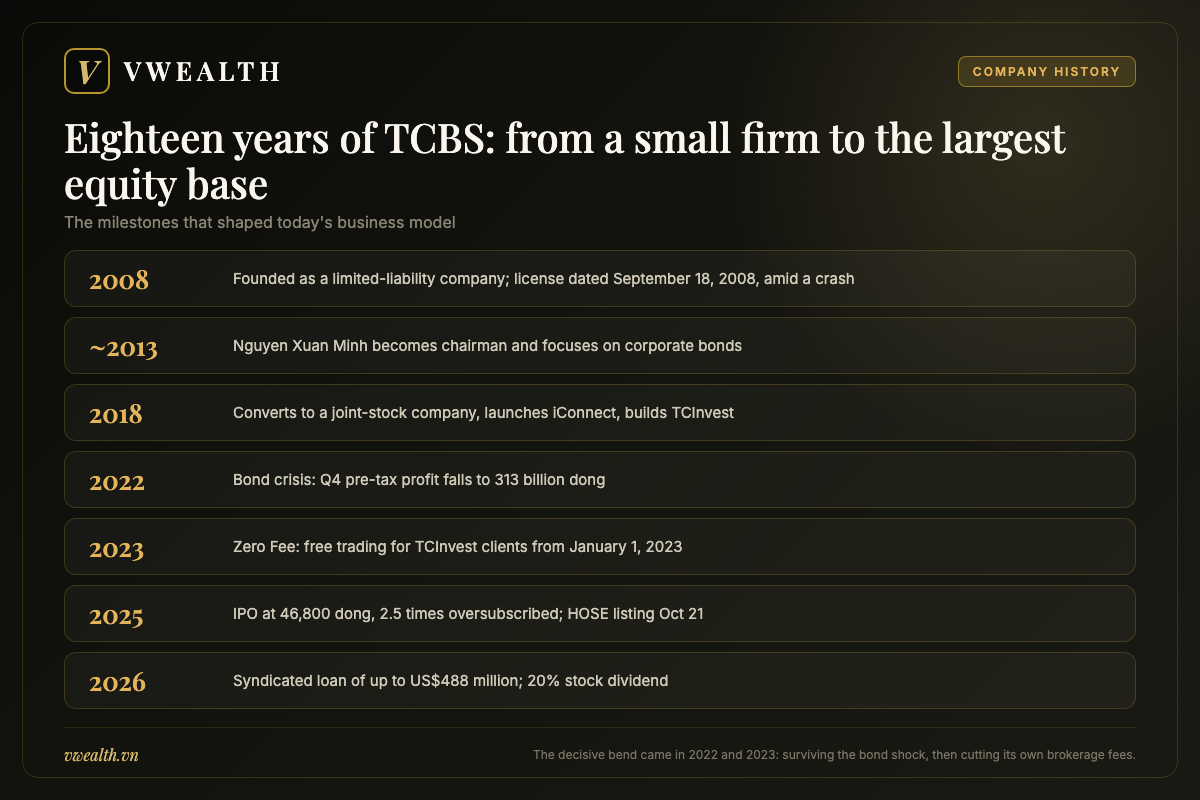
| Year | Milestone | Why it matters to a TCX investor today |
|---|---|---|
| 2008 | Founded as a limited-liability company; license dated September 18, 2008 | Its roots are as a bank subsidiary, not an independent brokerage |
| ~2013 | Nguyen Xuan Minh becomes chairman and focuses on corporate bonds | Start of bond leadership — and of concentration risk |
| 2018 | Converts to a joint-stock company; launches iConnect; builds TCInvest | Positions itself as a fintech firm without a broker force |
| 2020–2021 | HOSE brokerage share rises from about 0.6% to about 5.5% | Proves a digital model can win equity clients |
| 2022 | Bond crisis; Q4 pre-tax profit falls to 313 billion dong; administrative fines announced in early 2023 | A reputational test that shows how sensitive profits are to the bond market |
| 2023 | Zero Fee from January 1, 2023 | Trades commission revenue for customers and margin balances |
| 2025 | IPO of 231.15 million shares at 46,800 dong; HOSE listing on October 21, 2025 | First chance for small investors to own TCBS on the exchange |
| 2026 | Syndicated loan of up to 488 million US dollars; 20% stock dividend; TCEX crypto exchange application | More funding for margin lending and bets on new products |
Who Runs TCBS and Who Really Owns TCX Stock
One quick way to read a company’s character is to look at who chairs the board and for how long. At many bank-owned brokerages in Vietnam, the chair rotates with the parent bank’s management cycle, and strategy shifts accordingly. TCBS is different: the same person has led it for more than a decade, from obscurity to the largest equity base in the industry. That continuity is valuable, but as you will see, it also raises questions specific to minority shareholders.
Nguyen Xuan Minh: A Fund Manager Who Built a Product Factory
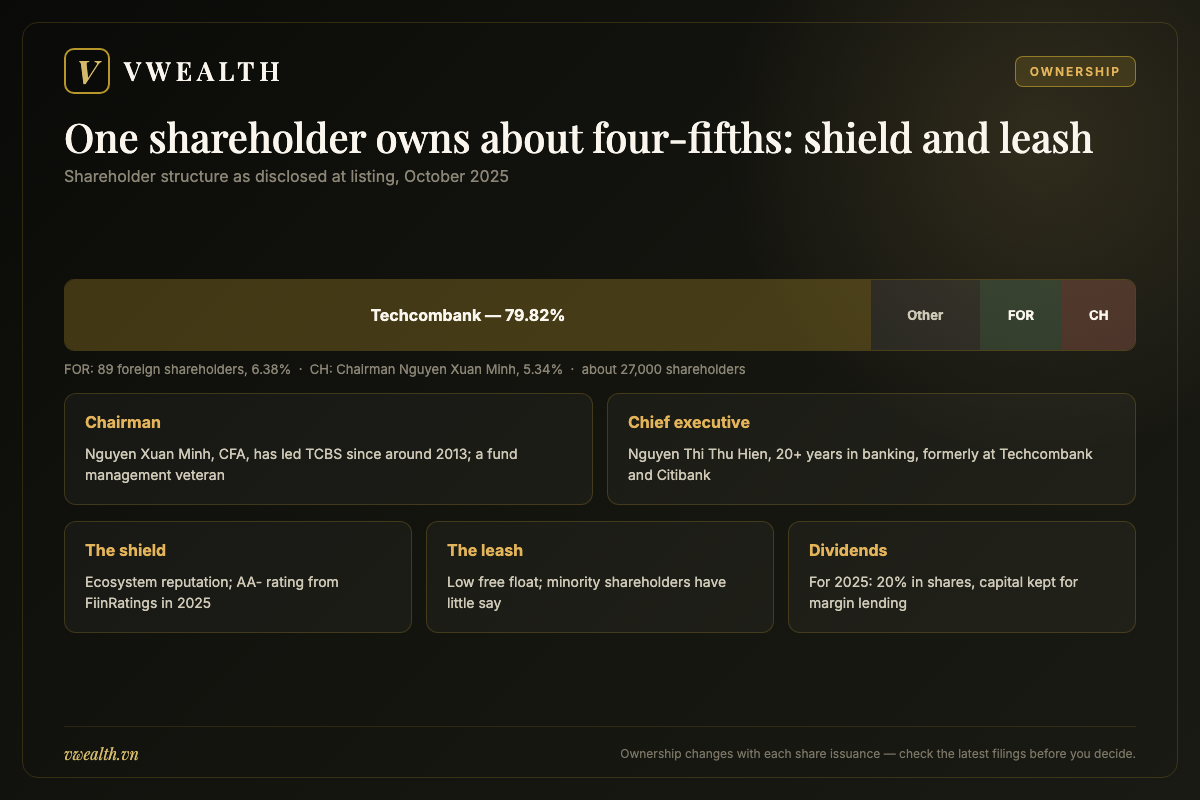
Nguyen Xuan Minh, CFA, has chaired TCBS since around 2013 and was still chairman at the 2026 annual general meeting. His background is entirely in asset management — years at Franklin Templeton in Singapore, then co-founding and running a Vietnamese fund manager. That explains why TCBS under his leadership was not built as a “brokerage house” but as a manufacturer and distributor of investment products. Bonds were packaged into iBond products with different tenors, coupons and resale options. Fund certificates and savings-style products followed, and more recently copy-trading (iCopy), structured products, gold and crypto-related offerings.
One notable detail is how Minh has put his own money into the company. In June 2025, ahead of the IPO, he completed the purchase of more than 106 million TCBS shares in the insider offering at 11,585 dong per share, worth over 1,200 billion dong in total, taking his stake to 8.09% of charter capital at the time. According to the information disclosed when TCX was approved for listing, he held 5.34% after the IPO. How should you read these two numbers? The positive reading: the chairman is a major individual shareholder with real skin in the game — he wins when shareholders win. The more critical reading: the insider price was far below the IPO price of 46,800 dong set just a few months later. To be fair, the two prices are not perfectly comparable, since the insider round happened before later capital changes and such placements usually carry transfer restrictions. But for anyone who bought at the IPO price, that gap is worth remembering when judging future executive compensation and insider share schemes.
The Executive Team: Techcombank Veterans, Global Bankers and an AI Engineer
The chief executive of TCBS is Nguyen Thi Thu Hien, who has more than twenty years in banking and finance, including roles at Techcombank and Citibank Vietnam, with particular expertise in debt markets. According to leadership profiles compiled by the Vietnamese press around the IPO, the deputy CEOs have backgrounds that fit the model closely. Pham Dieu Linh has spent more than fifteen years at Techcombank and TCBS, focusing on corporate debt and institutional relationships. Tran Thi Thu Trang has led many large corporate bond issues. Ngo Hoang Ha brings a corporate finance background from Techcombank and PwC. Bui Thi Thu Hang has twenty years in securities, including time at MB Securities. Nguyen Tuan Cuong previously worked at Societe Generale and VNDirect. Nguyen Dang Minh comes from technology, having worked on AI and cloud computing at FPT.AI.
Read the list and you will see three kinds of capability: debt and bonds (the historical core), corporate finance and banking (the risk culture), and technology (the competitive edge). What you mostly will not see are big names from traditional equity broking — consistent with a model that does not rely on brokers. You will also notice that most senior managers have long ties to Techcombank. That is a strength for bank-style risk discipline, but it is also a reason to ask: when the interests of TCBS and its parent diverge, which way will management lean?
Techcombank Owns About Four-Fifths: Shield and Leash
Before the IPO, TCBS was almost entirely Techcombank’s. According to 2024 shareholder data cited by the press, the bank held 94.07%, Minh 3.18%, foreign investors about 1.03% and others about 1.72%. After the insider offering and the IPO, the picture changed. According to the listing disclosures, Techcombank owned 79.82% of TCBS, Minh 5.34%, 89 foreign shareholders together held 6.38%, and the company had about 27,000 shareholders. In announcements about the September 2026 stock dividend, Techcombank’s stake was cited at about 79.81%.
For minority shareholders, that near-80% stake cuts both ways. It is a shield: TCBS has behind it one of Vietnam’s largest and most profitable private banks. In a liquidity shock it is hard to imagine the parent letting a subsidiary worth billions of dollars fall into crisis. The ecosystem’s reputation is also part of why FiinRatings assigned TCBS an AA- credit rating in 2025 — described as the highest among rated Vietnamese securities firms — and why TCBS could raise a large unsecured international syndicated loan.
It is also a leash. TCX’s free float is thin. Add Techcombank and the chairman together and more than 85% of the shares sit with two long-term holders; the portion that genuinely trades is in the low-to-mid teens as a percentage. A low free float affects index and ETF weightings and makes the price more volatile when large flows move in or out. More importantly, with nearly 80% of the votes, Techcombank decides virtually every resolution at shareholder meetings. You have a vote, but not the power to change an outcome.
| Shareholder | 2024 (pre-IPO) | At listing (October 2025) | What to monitor |
|---|---|---|---|
| Techcombank | 94.07% | 79.82% | Any sell-down to widen the float; related-party dealings with TCBS |
| Nguyen Xuan Minh (Chairman) | 3.18% | 5.34% | Insider buy and sell filings |
| Foreign shareholders | About 1.03% | 6.38% (89 holders) | Foreign flows after the FTSE Russell upgrade |
| Other shareholders | About 1.72% | Remainder; about 27,000 holders | Liquidity and free float |
Sources: 2024 data from TCBS leadership profiles compiled by Vietnam Business Insider; listing data from Vietstock’s report on the listing approval. Ownership changes with each share issuance — check the latest filings before you decide.
The Techcombank Relationship: Shared Clients, Related-Party Deals and Dependency Risk
The relationship between TCBS and Techcombank is not just about ownership; it is an everyday business relationship. On the client side, many people arrive at TCInvest via Techcombank’s app or branches, and bank and brokerage accounts are linked for instant transfers. On the product side, bonds that TCBS arranges often come from companies that also borrow from the bank. On the funding side, the two entities transact directly — for example, in May 2026 Techcombank’s board approved foreign-exchange and interest-rate derivative transactions between the bank and TCBS, which makes sense for a brokerage that has just borrowed in US dollars and needs to hedge currency risk.
All these links create synergies that independent rivals struggle to copy: low customer-acquisition costs, a ready pipeline of bond issuers and seamless payments. But try a thought experiment. Suppose Techcombank decides to push its own in-house investment products harder, or limits referrals to its subsidiary for risk reasons. Or suppose regulators and public opinion scrutinize bank cross-selling of investment and insurance products even more closely — a trend Vietnam has already seen since 2022–2023. In either case, part of TCBS’s advantage shrinks. Dependency risk does not mean something bad will happen; it means part of TCX’s value lies outside TCBS’s own control.
Dividends: More Shares Than Cash
If you are looking at TCX for regular cash dividends, study its short but clear record. For 2024 profits, TCBS paid a 5% cash dividend (500 dong per share, about 1,155.8 billion dong in total; record date April 8, 2026, paid May 8, 2026) and issued additional shares to existing shareholders at a 20% ratio — a distribution of more than 462 million shares completed around June 2026. For 2025 profits, the 2026 AGM approved a 20% stock dividend (one new share for every five held), record date September 18, 2026, with nearly 555 million shares to be issued from retained earnings.
Why favor shares over cash? The answer lies in the business model. Under current Vietnamese rules, a brokerage’s outstanding margin loans may not exceed 200% of its equity. Every dong retained adds two dong of lending headroom. For a company where margin lending is a major income source, paying out lots of cash means tying its own hands. A stock dividend does not change equity; it simply converts part of retained earnings into charter capital, and — as one Vietnamese report pointed out — it does not mean the company receives any new money from shareholders. In value terms you are not immediately richer when you receive bonus shares, because the share price is adjusted down on the ex-rights date. You only get richer if the retained capital keeps earning good returns.
One more detail is worth noting. At its own 2026 AGM, Techcombank said it planned not to pay a dividend during 2026. Two decisions at two levels — the parent retaining profits and the subsidiary paying mostly in shares — show an ecosystem prioritizing capital accumulation over cash distribution. That is sensible if the capital is deployed well, but it is a drawback for investors who need steady income.
TCBS also uses employee share plans to retain engineering talent, which matters for a company that calls itself a technology business. On March 2, 2026, it completed the distribution of 275,475 ESOP shares to 22 employees at the par value of 10,000 dong, and in July 2026 it distributed a further 556,522 shares to 28 employees. These tranches are tiny relative to the share count, so dilution is negligible. What you should watch is the trend: if ESOP programs grow over the years, especially at prices far below market, that becomes a real cost borne by minority shareholders.
How TCBS Makes Money: A Brokerage Without Brokers
Picture walking into a traditional Vietnamese brokerage in 2015. You would see a trading floor lined with screens, brokers juggling phone calls and placing orders for clients, and a price board flickering on the wall. Most of that firm’s revenue came from commissions — a fraction of a percent on every matched order — and from interest on money clients borrowed to buy more shares. Now picture TCBS. According to its listing materials, it is the first securities company in Vietnam to operate entirely on a technology platform, with no traditional brokerage team. Clients place their own orders on TCInvest, pay no trading fees, and the company earns its money elsewhere. This chapter takes apart that “elsewhere.”
If you want a general map of how brokerages make money in Vietnam, our overview of the leading securities companies in Vietnam is a useful companion. Placed on that map, TCBS has all the usual business lines — margin lending, investment banking, brokerage and proprietary investment — but the weights and the way they feed each other are very different from the norm.
Margin Lending: The Biggest Engine, and Why It Needs So Much Capital
Margin lending means a brokerage lends clients money to buy shares, using those shares as collateral. The firm earns interest on the loan. If prices fall to a threshold, the client must add cash or face a forced sale (a “margin call” leading to liquidation). In substance, it is a bank-like business — and one where TCBS, with the industry’s largest equity base, has a natural advantage.
In 2025, according to TCBS, interest income from margin lending reached 3,664 billion dong, up 43% from 2024 and about 37% of total net revenue. Outstanding margin loans and advances on sale proceeds were close to 44,000 billion dong at the end of 2025, the highest in the market. At the April 2026 AGM, management said the book had grown to about 46,000 billion dong even as the market slowed, and press statistics for the second quarter of 2026 showed TCBS still leading the industry in margin balances. Those numbers change every quarter, so check the latest report.
The single most important thing to understand is the regulatory cap: margin loans may not exceed 200% of equity. For a Vietnamese brokerage, equity is therefore not just a safety cushion but a raw material. That is why TCBS keeps raising capital, retaining earnings and borrowing abroad. Equity sets the ceiling; borrowed money funds lending up to that ceiling. At the 2026 AGM, management said it had set “very cautious” net interest margin (NIM) targets given the interest-rate environment — in other words, it is willing to accept thinner margins to keep growing the loan book. Remember that trade-off: TCBS’s margin growth relies more on scale than on spread.
Illustrative example, not TCBS’s actual figures: imagine a brokerage with 40,000 billion dong of equity. Under the 200% cap it could lend up to 80,000 billion dong on margin. If it actually lends 50,000 billion dong at an average rate of 10% a year and funds part of that with borrowings costing 6%, the gross interest income is 5,000 billion dong, and the net contribution depends on how much of the book is funded by its own equity versus debt. Now suppose competition forces the lending rate down by one percentage point. On a 50,000 billion dong book, that is 500 billion dong of income lost each year — which the firm can only recover by lending more. This is why, for TCBS, the size of the book and the cost of funding matter as much as the headline rate.
Investment Banking: Arranging Bond and Equity Issues
Investment banking (IB) helps companies raise money: advising on bond issues, IPOs, capital arrangement and underwriting. The firm earns advisory and arrangement fees, usually as a percentage of the amount raised. This is the line TCBS has led the longest. In 2023 it advised on more than 70,000 billion dong of corporate bond issuance with a disclosed market share of 52%. In 2025 investment banking revenue reached 2,018 billion dong, up 50%; TCBS said it had advised on more than 85,000 billion dong of corporate bond issuance, a 38% share. At the April 2026 AGM, management said that in the first four months of the year advisory volume had already reached nearly half of the previous full year’s volume.
Notice the change in share: from 52% in 2023 to 38% in 2025, even as absolute volume rose. The bond market has recovered and attracted more players, and TCBS no longer enjoys the near-monopoly it had before the crisis. IB is high-margin because it needs little capital, but it depends on two things: companies that want and qualify to issue, and a legal framework that lets them do so smoothly. Both froze in 2022, and both could freeze again.
Bond Distribution: iBond, iConnect and the Bridge Between Borrowers and Savers
If IB is the input — helping companies issue — bond distribution is the output: selling those bonds on to investors, mostly individuals. TCBS packages bonds as iBond products, in variants such as fixed-plan iBond and iBond ProX. Clients buy online in TCInvest and can resell through iConnect. The company earns the spread between the bond’s coupon and the yield paid to the investor, plus service fees. TCBS has explained publicly why its bond yields are often lower than elsewhere but investors still choose them; its main argument is issuer selection standards and the liquidity offered by iConnect.
In 2025, according to the company, TCBS distributed more than 70,800 billion dong of bonds to individual investors, and this line accounted for about 40% of total revenue. Our TCB analysis cites 2025 net revenue from bond distribution of 3,966 billion dong, up 42%. In the first quarter of 2024, Vietnamese media also reported that TCBS held about 70% of the corporate bond brokerage market. Add IB and distribution together and the corporate bond franchise is still TCBS’s largest source of revenue — a fact the 2023 pivot toward equities did not change.
This is where you should think hardest before deciding whether to buy TCX stock. Distribution revenue depends on retail confidence in corporate bonds. That confidence collapsed in 2022 and took almost two years to recover. In a bad scenario — a large issuer that TCBS advised running into repayment problems — the damage would not stop at one revenue line. It would hit the credibility of the whole platform, because the bond investors and the equity investors on TCInvest are the same people.
It helps to see how the economics of distribution work in principle. Illustrative example, not an actual TCBS product: suppose an issuer sells a three-year bond with a 9% coupon. The distributor buys the bond and resells it to individuals as a packaged product paying, say, 7.5% a year, with the option to sell back through a matching platform. The 1.5-point difference, minus the cost of holding inventory and providing liquidity, is the distributor’s margin. On tens of thousands of billions of dong a year, a spread of that kind adds up to a very large revenue line. The catch is that the individual investor now holds the credit risk of the issuer — and when confidence breaks, as in 2022, the liquidity promise of the platform is tested all at once.
Equity Brokerage With Zero Fee: Free to Win Clients, Not to Earn Commissions
TCBS’s brokerage business is a fascinating paradox: market share has soared while fees are close to zero. In 2025, brokerage and custody revenue rose 63%, and the firm’s HOSE brokerage share in the fourth quarter of 2025 reached 9.0%. According to second-quarter 2026 statistics, TCBS ranked third on HOSE with 9.36%, behind VPS (12.61%) and SSI (11.17%). That is a remarkable result for a firm with no brokers.
But do not read TCBS’s brokerage share the way you would read a traditional broker’s. For SSI or HSC, higher brokerage share means more commission revenue. For TCBS, it mainly means more clients actively trading on the platform — and therefore more potential margin borrowers, bond buyers and fund investors. Brokerage here is the funnel, not the till. The comparison many investors will recognize is with zero-commission trading apps in the United States: TCBS does not sell trades; it sells everything around the trade.
Proprietary Investment and the Bond Book: Where the Balance Sheet Sits
Proprietary trading means a brokerage invests its own money. At many Vietnamese firms this is the most volatile line, because they hold large equity portfolios — big gains in rising markets, heavy losses in falling ones. TCBS long ago chose not to bet heavily on equities; Vietnam Investment Review described it in 2022 as not trading stocks on its own account and focusing instead on bonds and funds.
Even so, TCBS’s balance sheet carries one large item you need to watch: bond holdings. To distribute bonds, the firm often buys them from the issuer and sells them down over time; in between, the bonds sit on TCBS’s books. At one point the Vietnamese press reported TCBS holding close to 15,000 billion dong of bonds. That exposure carries credit risk — if an issuer struggles, TCBS takes the hit directly. When you read TCBS’s financial statements, separate the financial assets clearly: bonds awaiting distribution, deposits, equities, and the quality of each. This is where a brokerage that is “clean” on equity trading can still carry significant risk.
New Products: iCopy, Gold, Structured Products and Crypto Assets
At the 2026 AGM, TCBS presented a pipeline of new products: the iCopy copy-trading platform with roughly 30,000–40,000 users, structured products, commodity trading, a gold exchange, and products related to crypto assets and asset tokenization. Management said it was deliberately not setting profit targets for new products through roughly 2027–2028, focusing instead on user growth and market education. According to listing-time disclosures, the company’s roadmap to 2030 also includes digital assets, digital gold, peer-to-peer lending and crowdfunding.
The most notable piece is TCEX, the Techcom Crypto Asset Exchange founded and funded by TCBS. TCEX was among the first companies to apply under Government Resolution 05/2025 on a pilot crypto asset market, and its strategic shareholders have committed to lift its charter capital to 10,000 billion dong. For a TCX investor, TCEX is an option: if a regulated crypto market takes off in Vietnam, TCBS has an early foothold; if it develops slowly or suffers an incident, it is capital and effort without returns. Treat it as potential upside, not as the main reason to buy.
Which Business Feeds Which, and Where the Moat Lies
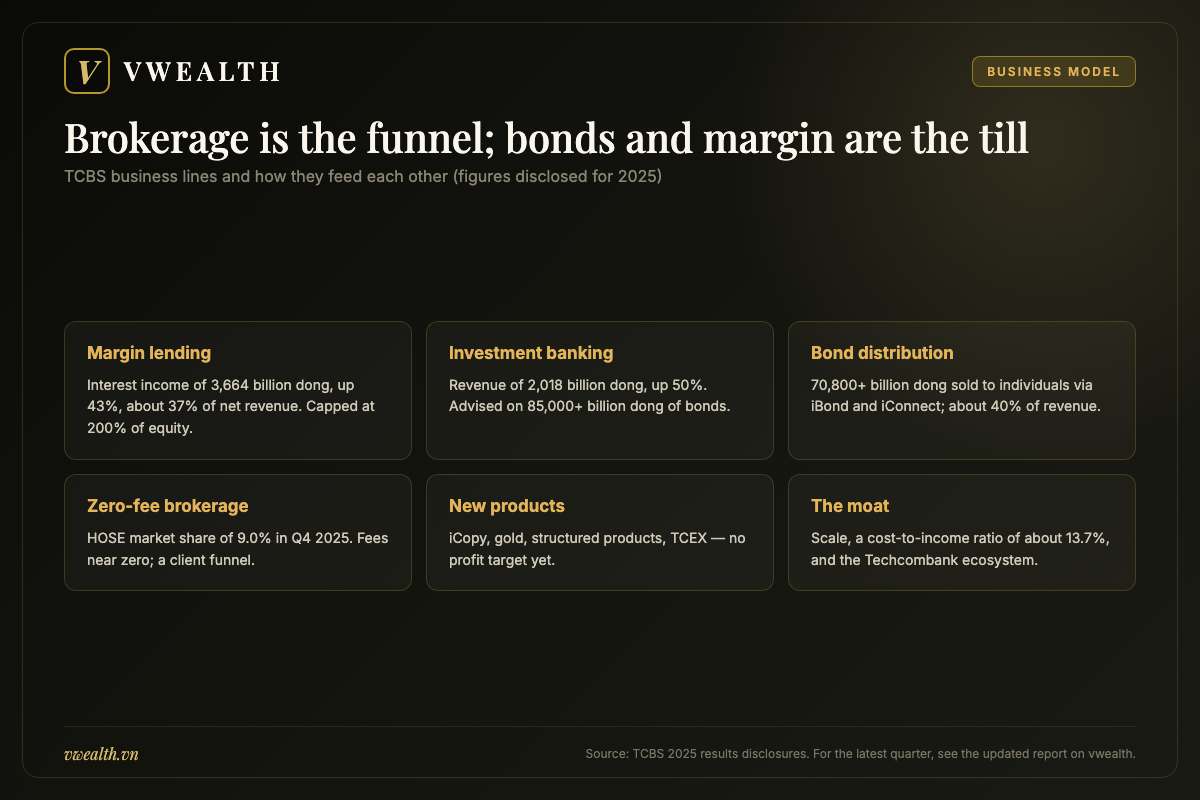
Put the pieces together and you get a loop. Free brokerage pulls clients onto TCInvest; those clients borrow on margin and buy bonds; the bonds come from issuers the IB team advised; profits from everything are retained as equity, raising the lending ceiling; and Techcombank supplies clients and credibility at every step. TCBS’s moat therefore does not sit in any single business line, but in the combination: capital scale, a low-cost technology platform — the company reported a cost-to-income ratio of only about 13.7% in 2025 — long-standing bond issuer relationships, and the bank ecosystem.
| Business line | How it earns | Disclosed 2025 figures | Depends on | Main risk |
|---|---|---|---|---|
| Margin lending | Interest on loans | Interest income 3,664 billion dong, +43%; about 37% of net revenue; balance near 44,000 billion dong at year-end | Equity (200% cap), funding, market turnover | Sharp market falls, forced liquidations, margin compression |
| Investment banking | Advisory and arrangement fees | Revenue 2,018 billion dong, +50%; advised 85,000+ billion dong of bonds, 38% share | Corporate funding demand, regulation | Bond market freeze |
| Bond distribution | Yield spread, service fees | Distributed 70,800+ billion dong; about 40% of total revenue | Retail investor confidence | Issuer default, reputational damage |
| Brokerage and custody | Low or zero fees; client funnel | Revenue +63%; HOSE share 9.0% in Q4 2025 | Market turnover, app experience | Free-trading competition |
| New products (iCopy, TCEX, gold) | No profit target yet | User-acquisition stage | Pilot regulatory frameworks | Unprofitable investment, new legal risks |
Sources: TCBS 2025 results as reported by CafeF, Vietstock and other Vietnamese media; revenue shares rounded as disclosed.
Financial Position and Health: Read the Statements Before You Buy TCX Stock
Many investors open a brokerage’s financial statements and do exactly what they would do with an industrial company: check revenue, check profit, compute a P/E, done. With TCBS, that approach misses nearly everything that matters. A securities firm is a financial institution. Most of its assets are loans and securities held; its liabilities are short- and long-term borrowings; and its profit is the result of lending and investing that money. This chapter walks through what to look at, in the order an analyst would.
Scale: What the Industry’s Largest Equity Base Really Means
According to disclosures at the IPO, as of September 30, 2025 TCBS had charter capital of 23,113 billion dong and shareholders’ equity of 42,478 billion dong. Press statistics for the end of the second quarter of 2026 still placed TCBS first in the industry by equity, ahead of SSI, VPBank Securities (VPBankS), VIX and VPS. Total assets at the end of 2025 were 80,632 billion dong, up 51% from the end of 2024.
A large equity base has three meanings. First, it is a ceiling: as noted, margin loans can reach at most 200% of equity. Second, it is a cushion: when markets crash and some loans go bad, equity absorbs losses before creditors are affected. Third — and this is often forgotten — it is the denominator of return on equity (ROE). A firm with twice a rival’s equity must earn twice the profit to match its ROE. So as TCBS keeps raising capital, ask not only “is profit growing?” but “is profit growing as fast as capital?”
The Profit Trajectory: Read 2022 to Understand 2026
The table below collects full-year profit figures disclosed by TCBS. These are historical numbers for closed fiscal years, meant to show the trajectory — not to forecast the next quarter.
| Year | Reported pre-tax profit | Context |
|---|---|---|
| 2021 | More than 165 million US dollars (per Vietnam Investment Review) | Boom in new investors and corporate bonds |
| 2022 | 3,052 billion dong; Q4 alone 313 billion dong | Bond crisis in the second half; sharp equity sell-off |
| 2023 | More than 3,028 billion dong, about 1.5 times plan | First Zero Fee year; bond market gradually reopens after Decree 08/2023 |
| 2024 | More than 4,802 billion dong, +59% | Record margin balances |
| 2025 | 7,109 billion dong, up nearly 50%, 123% of plan | IPO, strong market turnover, all four business lines growing |
| 2026 (plan) | 7,535 billion dong, +18% (revenue plan 13,227 billion dong, +26%) | Approved at the AGM on April 25, 2026 |
Sources: TCBS disclosures via CafeF, Bao Dau Tu and Tin Nhanh Chung Khoan. For 2026 quarterly results, see the updated report on vwealth.
One thing stands out. In 2022 — the year the bond market broke — TCBS still earned more than 3,000 billion dong thanks to three strong opening quarters. But the fourth quarter of 2022 shows what happens when bonds and equities freeze at the same time: quarterly profit shrank to roughly a quarter of a good quarter’s level. That is the real sensitivity of the model. When you read future results, do not just compare with the same quarter last year; ask yourself: if this quarter looked like Q4 2022, what would profit be?
For readers used to US dollar figures: at exchange rates prevailing in 2025–2026, very roughly 26,000 dong to the dollar, 7,109 billion dong is on the order of 270 million US dollars. Treat that as an illustrative conversion only; the dong has moved over time, and TCBS reports in dong.
Earnings Quality: How Much Comes From Bonds?
Two firms with identical profits can have very different earnings quality. For TCBS the critical question is how much revenue comes from the corporate bond franchise — advisory plus distribution. In 2025 those two lines together were the largest block of revenue, bigger than margin lending. That is not bad in itself: IB and distribution need little capital, so returns on capital are high. But it means TCBS’s profit is more sensitive to the bond market than that of most Vietnamese brokerages, which rely mainly on equities.
A practical way to read it: each quarter, split revenue into three buckets. Bucket one, margin interest — driven by loan balances and rates. Bucket two, bond-related revenue — driven by issuance and distribution volumes. Bucket three, everything else (brokerage, custody, deposit interest, other). If bucket two jumps in a quarter, check whether market-wide issuance rose correspondingly, and who the issuers are. If bucket two rises while the market is flat, TCBS may be gaining share — or loosening standards. The annual report and the notes to the financial statements help you tell the difference.
Leverage and Funding: From Bank Deposits to a 488 Million Dollar Loan
According to 2025 disclosures, TCBS kept its total debt-to-equity ratio at about 0.77 times. Compared with many Vietnamese brokerages that run higher leverage, that is conservative — partly because equity jumped after the IPO. The trend is what to watch. To grow margin lending faster than equity, the firm must borrow more. The unsecured international syndicated loan with commitments of up to 488 million US dollars in 2026, together with a three-year 60 million dollar loan (with an option to increase to 120 million dollars) arranged by Standard Chartered, signals that direction.
Foreign-currency borrowing offers two benefits: longer tenors and diversification away from domestic funding markets. But it also brings currency risk. Borrowing in US dollars to lend in dong must be hedged, and hedging costs eat into margins. When you read the statements, look at whether debt-to-equity is rising or falling, the maturity profile of borrowings, and how fast interest expense is growing relative to margin interest income.
Efficiency: ROE, ROA, Cost-to-Income and Capital Adequacy
According to 2025 disclosures, TCBS’s ROE was 16.7% and its return on assets (ROA) 8.4%; the company said this was the best capital efficiency in the market for many consecutive quarters. Its cost-to-income ratio (CIR) was about 13.7% — for every 100 dong of income, only about 13.7 dong went to operating costs. That is very low compared with brokerages that maintain large sales forces, and it is the clearest evidence of the cost advantage of the technology model.
But read the 16.7% ROE in context: it was achieved in a record-profit year. An ROE in the mid-teens is good but not exceptional compared with some leading banks. The reason is the sheer size of equity. For ROE to rise, TCBS needs to use capital more efficiently — more margin lending per dong of equity, or more growth in capital-light lines like IB. If ROE drifts down quarter after quarter while equity keeps swelling, the company is accumulating capital faster than it can deploy it.
Vietnamese brokerages must also maintain a liquid capital ratio above a regulatory minimum — broadly similar to a bank’s capital adequacy ratio. TCBS reported that in 2025 its ratio was about 1.8 times the minimum. And in 2025, FiinRatings rated TCBS AA-. These metrics rarely appear in popular stock commentary, but they tell you how easily the firm can borrow more at a reasonable cost — a decisive factor for the margin business.
Seven Checks to Run Every Time TCBS Reports
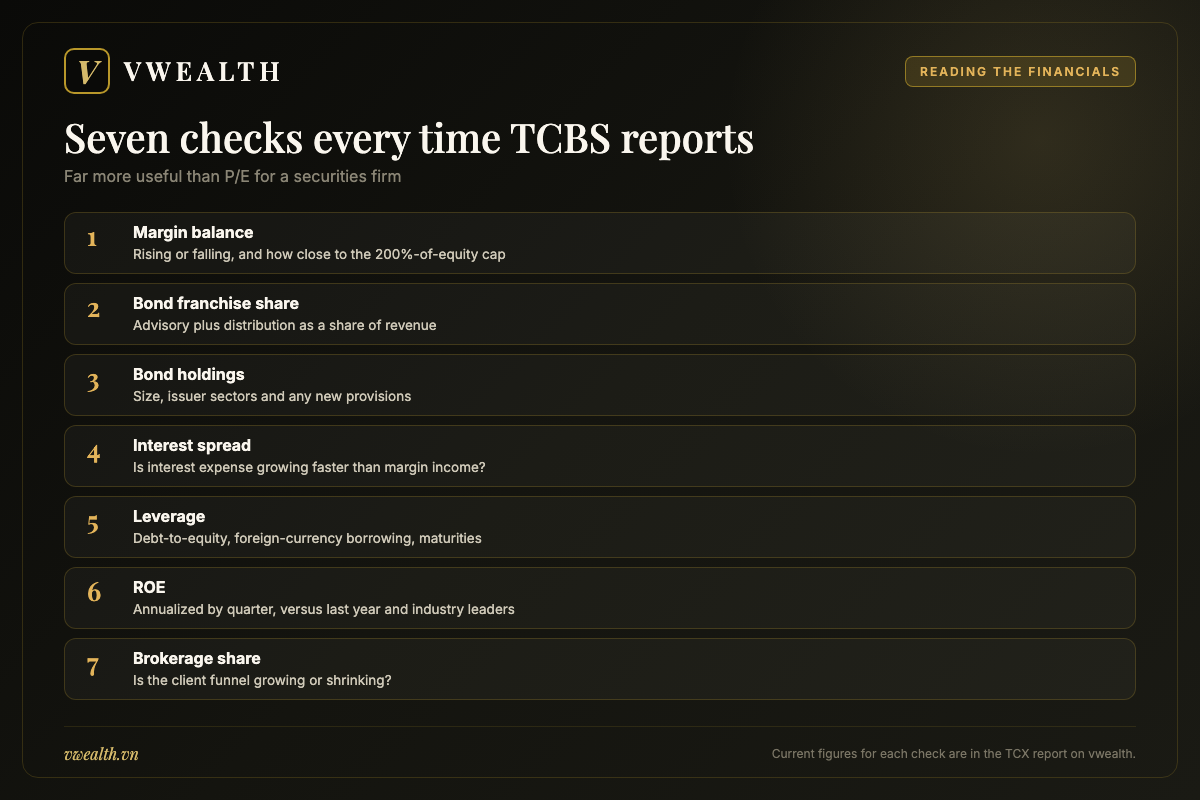
So you do not have to remember the whole chapter, here are seven questions to carry into each quarterly report:
- Margin balance: rising or falling, and how close is it to the 200%-of-equity cap?
- Bond franchise share: what percentage of revenue comes from advisory plus distribution, and which way is it trending?
- Bond holdings: how large, which sectors the issuers are in, and are there any new provisions?
- Interest margin: is interest expense growing faster or slower than margin interest income?
- Leverage: debt-to-equity, foreign-currency borrowing and maturities.
- ROE: annualized by quarter, versus the prior year and versus industry leaders.
- Brokerage market share on HOSE: not for commission revenue, but because it tells you whether the client funnel is growing or shrinking.
For a company like TCBS, these seven questions matter far more than P/E. Current figures for each are available in the TCX report on vwealth, and our guide to Vietnam stock market data in English shows where else to find reliable numbers.
How the Market Has Received TCX Stock: From a 2.5-Times Oversubscribed IPO to Year One on HOSE
The market grades a company in two ways: once when it lists, through the price investors are willing to pay in the IPO, and many times afterward, through every trading session. TCBS’s first grade came in the autumn of 2025, and the verdict was clear. The grades since then are more nuanced — and that is the part you need to understand if you are weighing whether to buy TCX stock.
The IPO: 26,000 Investors, 78 Institutions and 90% of Orders via the App
From August 19 to September 8, 2025, TCBS offered 231.15 million shares to the public at 46,800 dong each. According to post-offering disclosures, subscriptions exceeded 575 million shares, about 2.5 times the amount offered, from more than 26,000 investors, including 78 financial institutions and investment funds, with total subscriptions above 500 million US dollars. Roughly half of the demand was reported to have come from foreign funds. The company raised more than 10,800 billion dong. On September 18, 2025, the State Securities Commission recognized TCBS as a public company.
One detail speaks volumes about the business model: about 90% of IPO subscription orders were placed online through TCInvest. In other words, TCBS used its own platform to sell its own shares to its own clients. That demonstrates distribution power, but it is also a reminder that many of TCX’s retail shareholders are TCBS customers — loyal to the brand, but capable of reacting sharply if the brand is damaged.
The 46,800 dong price implied a valuation of roughly 4.1–4.2 billion US dollars, which Vietnamese media noted could put TCBS ahead of SSI as the industry’s most valuable firm. That is a high valuation for a Vietnamese brokerage, reflecting the expectation that TCBS is not just a securities firm but a fintech platform.
On October 21, 2025, 2,311,308,021 TCX shares debuted on HOSE at a reference price of 46,800 dong, with a first-day trading band of plus or minus 20% (compared with the usual 7% on HOSE). According to the Vietnam Financial Times (Thoi bao Tai chinh Viet Nam), the stock opened higher, quickly broke above 50,000 dong with typical gains of more than 5%, and traded over 10 million shares in the morning session alone; foreign investors were net buyers of about 150 billion dong in that session, placing TCX among the top three stocks for foreign net buying. Market capitalization at the reference price exceeded 108,000 billion dong, about 4.2 billion US dollars — the highest in Vietnam’s brokerage sector at the time.
Since then, TCX has remained one of the most valuable securities firms on the exchange by market capitalization. This article does not quote today’s price or market value, which change every session. What matters more is understanding what that valuation is made of and what it is sensitive to.
Valuing a Brokerage: Why P/B Matters More Than P/E
Brokerage profits swing too much through the cycle for P/E to be a reliable anchor. In a hot market, P/E looks cheap because earnings are inflated; in a quiet market, P/E jumps because earnings shrink — even though the underlying value of the business has not changed nearly as much. That is why analysts usually treat price-to-book (P/B) as the primary yardstick and read it alongside ROE.
The logic is simple: if a firm generates sustainably high ROE, the market will pay more than one times book value; if ROE is low, P/B tends to be low. For TCX, run three comparisons. First, today’s P/B versus TCX’s own range since listing — where are the highs and lows? Second, TCX’s P/B versus leading peers such as SSI, HSC (HCM), Vietcap and VPS — firms with different models, so different multiples are normal. Third, P/B divided by ROE — a rough measure of how much you pay for each percentage point of profitability. If TCX trades at a higher P/B than peers without a correspondingly higher ROE, the market is paying extra for the technology and ecosystem story, and you need to believe that story will turn into profit.
Illustrative example, not TCX’s actual numbers: suppose a brokerage has book value of 20,000 dong per share and an ROE of 16%, so it earns about 3,200 dong per share a year. At a share price of 40,000 dong, P/B is 2 times and P/E is 12.5 times. If the market cools the next year and ROE falls to 10%, earnings drop to 2,000 dong; at the same price, P/E jumps to 20 times even though the price has not moved. That is why a low P/E at the top of the cycle should not seduce you.
The Stock’s Personality: High Beta, Low Free Float
Brokerage stocks in general are highly sensitive to the market — rising faster when the market rises and falling harder when it falls — because the companies’ profits track turnover and their valuations track sentiment. In financial terms they are “high-beta” stocks. TCX inherits that personality. But it adds a feature of its own: a low free float, since most of the equity sits with Techcombank and the chairman. The number of shares that genuinely trade is much smaller than the 2.3 billion-plus originally listed, so large inflows or outflows can move the price more than you might expect.
A second feature: a large group of TCX’s retail shareholders are TCBS clients. That usually creates loyalty in normal times, but in a brand-related shock — a bond incident, a system outage — selling pressure could come from the very people who were most attached. For foreign investors, it is also worth knowing that Vietnam settles equity trades on a T+2 basis and that retail flows dominate daily turnover, which can amplify short-term moves.
Foreign Investors and the FTSE Russell Upgrade
From September 21, 2026, Vietnam’s stock market was officially reclassified by FTSE Russell from frontier to secondary emerging status, after FTSE Russell confirmed the timetable it first announced in October 2025. For brokerage stocks, the upgrade has two effects. The direct effect: money from FTSE-tracking index funds and active funds benchmarked to emerging markets can flow into eligible stocks; how much TCX benefits depends on its free-float market capitalization and liquidity. The indirect effect, probably larger: higher market-wide turnover lifts revenue at every brokerage.
At listing, 89 foreign shareholders held about 6.38% of TCBS, and foreign investors were net buyers on day one. TCX’s foreign ownership and remaining foreign room are metrics to track regularly; brokerages with ample room and good liquidity tend to be preferred by foreign funds.
For individual foreign investors, practical access is also part of the picture. To buy Vietnamese shares directly, a foreign investor generally needs a securities trading code issued through the Vietnam Securities Depository and Clearing Corporation, then an account with a licensed local brokerage; many investors instead gain exposure through funds. Among the reforms FTSE Russell cited when confirming the upgrade were the removal of the pre-funding requirement for foreign institutional investors and the introduction of a mechanism for handling failed trades. Changes like these make it easier for global institutions to trade Vietnamese stocks — and, by extension, raise the potential for institutional turnover that benefits large brokerages. Whether TCBS captures a meaningful share of that institutional business, which has traditionally been a strength of firms like SSI, is one of the open questions for the next few years. If it does, it would diversify TCBS away from its retail-heavy client base; if it does not, the upgrade will help TCBS mainly through higher overall market turnover rather than through new institutional clients.
Catalysts That Could Change How the Market Sees TCX
Several events could lead the market to re-rate TCX, up or down. On the positive side: TCEX receiving a full license and operating smoothly; market turnover staying high after the upgrade; TCBS continuing to gain brokerage share; international loans expanding the margin book at a reasonable cost; or Techcombank choosing to sell down part of its stake to widen the free float. On the negative side: a large bond issuer that TCBS advised getting into trouble; a deep equity correction bringing liquidation risk; fiercer fee and margin-rate competition from other bank-owned brokerages; or regulatory changes tightening the distribution of investment products to retail investors.
The Industry Backdrop: When Vietnam’s Banks All Took Their Brokerages Public
To understand TCBS, you have to understand the field it plays on — and that field has changed very quickly over the past two years. Before 2025, Vietnam’s brokerage industry could be summed up as “a group of established leaders”: SSI, HSC, VNDirect and Vietcap. From 2025 onward, the game has been reshaped by brokerages tied to banks and large conglomerates, all raising capital and listing their shares at around the same time. This chapter focuses on the shifts that directly affect TCX.
The 2025 Wave of Brokerage IPOs
TCBS kicked off the brokerage IPO wave with its October 2025 listing. Shortly afterward, VPBank Securities (VPBankS, ticker VPX) — the securities arm of VPBank — listed on HOSE in December 2025 after a deal the local press described as the largest IPO in the brokerage sector. VPS, the long-time leader in brokerage market share, officially listed on December 16, 2025 under the ticker VCK after raising capital through an IPO and private placements. Other bank-linked brokerages, such as MB Securities (MBS) and Tien Phong Securities (ORS), linked to TPBank, have also stepped up capital raising.
The wave cuts both ways for TCX. The good side: several large brokerage stocks raise the sector’s profile, and funds have more options for allocating to it. The harder side: TCX is no longer the only listed way to play the “bank-backed tech brokerage” story. Investors who want that exposure can now compare TCX with VCK or VPX, and money will flow to whichever looks cheaper for the growth on offer.
The Capital Race: Who Is Biggest, and Why Capital Matters
In August 2026, SSI completed a 5-for-1 bonus share issue, lifting its charter capital above 30,032 billion dong and temporarily reclaiming the title of the brokerage with the largest charter capital. TCBS responded with its 20% stock dividend, expected to lift charter capital to about 33,293 billion dong. By shareholders’ equity — the more meaningful measure — TCBS remained first as of the end of the second quarter of 2026. Vietnamese media have called this “the race for the capital crown.”
Why race for capital? Because, as the previous chapters explained, equity sets the ceiling on margin lending, which is the industry’s most stable profit engine. According to press statistics for the second quarter of 2026, TCBS led the industry in margin balances at about 51,500 billion dong, with SSI second at about 40,500 billion dong. But the capital race has a downside: when every firm has more money to lend, competition on margin rates intensifies and industry-wide spreads get squeezed. TCBS management’s talk of “cautious” NIM targets suggests it sees this coming.
Brokerage Competition: Zero Fee Goes From Weapon to Norm
When TCBS launched Zero Fee in 2023, it was a controversial move. Within a few years, free or near-free trading became a trend adopted in various forms by many Vietnamese brokerages. That shifts the whole brokerage business: market share no longer comes from having the lowest fees, since fees are close to zero in many places, but from app experience, speed, bundled products and the size of the margin book.
According to second-quarter 2026 statistics, the combined HOSE share of the top ten brokerages fell to 65.19%, the lowest since the fourth quarter of 2022. VPS remained first but its share dropped to a 22-quarter low; SSI and TCBS closed in; and VPBankS reached a record high and entered the top eight. The market is fragmenting, and bank-linked brokerages are taking share. For TCBS, this is both validation — other banks are following the path it opened — and a warning that its first-mover advantage will narrow. Our analyses of VIX Securities and Saigon-Hanoi Securities (SHS) show how smaller firms are responding.
The Corporate Bond Market After the Crisis
After the 2022 shock, Vietnam’s corporate bond market went through a period of paralysis and restructuring. Decree 65/2022 tightened conditions for private bond issuance and distribution; then Decree 08/2023 postponed some of those provisions and allowed issuers to negotiate extensions with bondholders, to avoid a wave of defaults. Only in 2024–2025 did new issuance recover clearly, with banks among the largest issuers alongside real estate companies.
For TCBS, this means the bond franchise has revived, but in a different environment: stricter rules on who counts as a professional investor, higher disclosure standards, and more cautious retail buyers. The drop in TCBS’s advisory share from 52% in 2023 to 38% in 2025 reflects a market with more players. The question for the coming years is not “will bonds come back?” but “can TCBS keep its leadership now that the bond market is more standardized?”
New Infrastructure: The KRX System, the Upgrade and Crypto Assets
In 2025, HOSE switched on its new KRX trading system, paving the way for new products and trading mechanisms. TCBS said it deployed a KRX-compatible trading platform able to handle about three million orders a day, alongside more than 1,350 technology projects in 2025. In September 2026, FTSE Russell’s upgrade of Vietnam took effect. And from September 2025, Government Resolution 05/2025 opened a pilot framework for a crypto asset market, with TCEX among the first applicants.
Every infrastructure change like this is an opportunity for technology-strong firms. A company with a large engineering team and self-built platforms can launch new products faster than rivals relying on outside software vendors. But remember that a technology edge is not permanent — the parent banks of VPBankS and MBS are also investing heavily in technology.
How TCBS Compares With Its Main Rivals
The table below deliberately avoids current financial figures, which change every quarter, and compares business models instead, so you can see where each firm is strong.
| Firm | Backing | Distinctive strength | What to watch |
|---|---|---|---|
| TCBS (TCX) | Techcombank, about 80% | Largest equity base, leading margin book, corporate bonds, broker-free digital platform | Dependence on bonds and on the parent bank; low free float |
| SSI | Widely held, no controlling bank | Long-established brand, institutional and foreign clients, fund management | Capital competition with bank-owned rivals |
| VPS (VCK) | Large individual shareholders | HOSE brokerage share leader for years, large retail base | Market share gradually eroding in 2026 |
| VPBankS (VPX) | VPBank | Aggressive capital raising after IPO, fast-rising brokerage share | Newly listed; short track record at scale |
| VNDirect (VND) | Widely held | Early retail and digital franchise | A major system incident in 2024; fierce share competition |
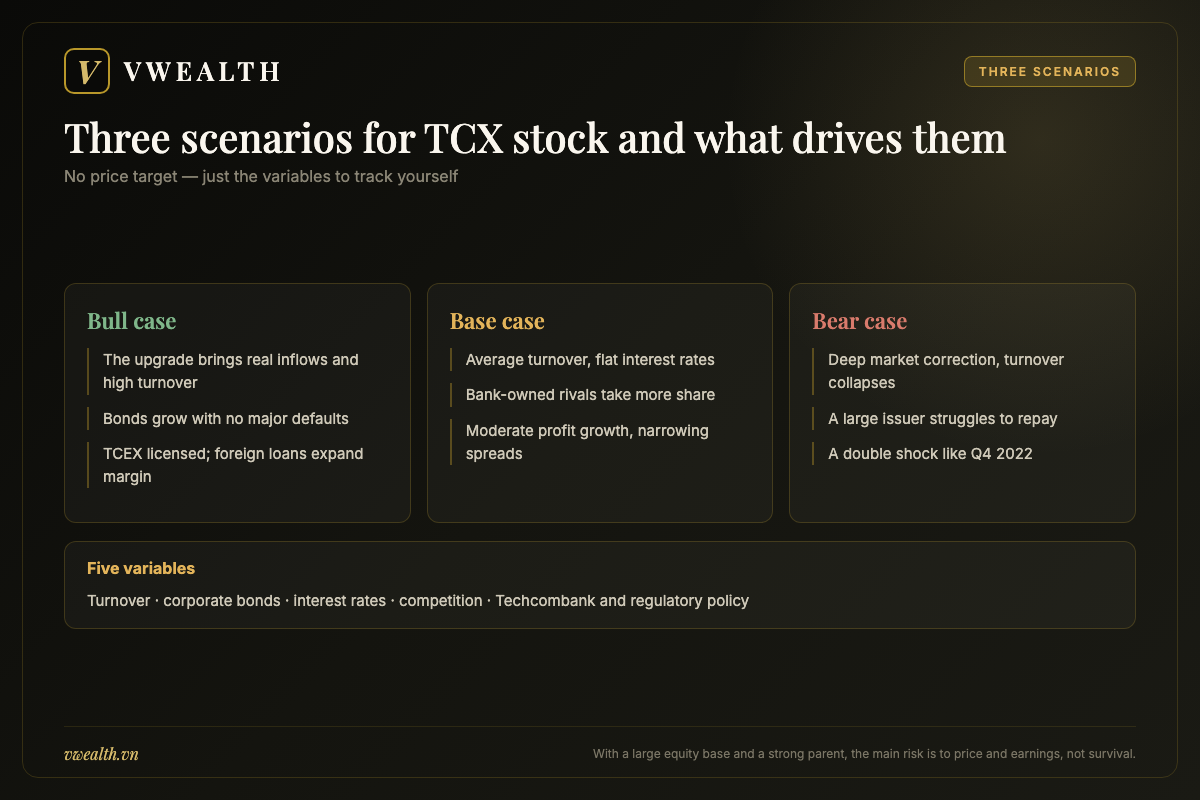
Outlook: Three Scenarios for TCX Stock and What Would Have to Happen
Nobody knows where TCX stock will be in two years, and you should be wary of anyone who claims to. What you can do is identify the variables that will decide the outcome and build scenarios from combinations of them. This chapter offers no price target. It gives you a framework for tracking the story yourself: when news breaks, you will know which scenario it pushes toward.
Five Variables That Will Shape TCBS’s Future
First, equity market turnover. This drives every brokerage: it determines margin demand, brokerage revenue and valuation sentiment. The FTSE Russell upgrade helps, but turnover also depends on interest rates, economic growth and domestic retail flows. Vietnam’s retail investors account for the bulk of daily trading, so their mood matters as much as foreign inflows.
Second, the health of the corporate bond market. For TCBS this is the most important company-specific variable. A healthy bond market with quality issuers is a major profit engine; a new credit shock is the biggest risk.
Third, interest rates and funding costs. Low rates encourage margin borrowing and make bonds more attractive than deposits, but they also compress spreads. Rising rates increase TCBS’s funding costs, especially on foreign-currency loans if the exchange rate moves. Vietnam’s State Bank has kept policy rates relatively low to support growth in recent years; any reversal would ripple through brokerage earnings.
Fourth, the intensity of competition. Newly listed bank-owned brokerages, with large capital and their own ecosystems, can use TCBS’s own tactics — free trading and cheap margin — to win clients.
Fifth, Techcombank’s choices and regulatory policy. Will Techcombank keep channeling clients to TCBS? Will it sell down its stake? Will regulators change the rules on margin lending, bond distribution or crypto assets?
Bull Case: The Upgrade Brings Real Money and Bonds Grow Healthily
Conditions: after the upgrade takes effect, foreign money flows in steadily and market-wide turnover stays high; interest rates remain stable and low; the corporate bond market keeps growing without any major default involving issuers TCBS advised; TCEX is licensed and attracts users; and international loans let TCBS expand its margin book at a reasonable cost.
In this scenario, TCBS’s profit keeps rising and may beat plan as it did in 2023–2025. ROE holds or improves despite the growing equity base. The market may be willing to pay a P/B premium to peers, treating TCX as a fintech platform rather than just a brokerage. The risk inside the bull case is valuation itself: when everything goes right, prices usually anticipate it, and late buyers carry the risk if any single factor turns.
Base Case: Moderate Growth, Gradually Narrowing Spreads
Conditions: market turnover is average, with busy stretches and quiet ones; interest rates move sideways; the bond market grows but becomes more competitive; bank-owned rivals take more brokerage and margin share; and Techcombank keeps its stake unchanged.
In this scenario, TCBS grows profit at a single-digit to low-double-digit pace, driven mainly by margin book scale while spreads narrow under competition. ROE may slip slightly as equity grows faster than profit. The stock moves with the broader market, with more volatility than the index. Dividends remain mostly in shares, so cash returned to shareholders stays modest. Long-term holders earn returns roughly in line with growth in book value, without big surprises either way.
Bear Case: A Double Shock From Equities and Bonds
Conditions: the equity market suffers a deep, prolonged correction, perhaps from an external shock or rising rates; turnover collapses; one or more large bond issuers struggle to repay, turning retail investors away from corporate bonds again; or regulators sharply tighten the distribution of investment products.
In this scenario, TCBS is hit on both main engines at once — exactly what happened in the fourth quarter of 2022. Margin balances shrink, liquidation risk rises, bond revenue drops and the brand is tested. Quarterly profit could fall steeply from its peak. The stock could fall harder than the market, because TCX’s valuation contains a premium for growth and technology — the part most easily erased when sentiment sours. Still, with a large equity base, leverage low relative to the industry and a strong parent bank, the likelihood of an existential threat to TCBS is very low. The risk here is to the share price and earnings, not to survival.
How do you tell which way the story is heading? Each quarter, use a simple tracker. The bull case is being confirmed when market-wide average turnover rises, TCBS’s brokerage share rises, the margin book grows without a rise in problem loans, bond advisory volume increases and ROE holds. The bear case is drawing closer when turnover falls for several months in a row, news emerges of issuers delaying principal or interest, TCBS books new provisions on bond holdings, or debt-to-equity climbs quickly while profit stalls. No single signal is enough; look for several at once.
So, Should You Buy TCX Stock? A Straight Answer
You have now been through eighteen years of history, the leadership, the business lines, the financial health, how the market values the stock, the industry backdrop and three scenarios. The answer to “should I buy TCX stock?” is not a blanket yes or no. It depends on who you are, what you need from the investment and which risks you can live with.
The Strongest Arguments For
Industry-leading scale and capital. TCBS has the largest shareholders’ equity among Vietnamese brokerages, leads in margin lending and can borrow internationally without collateral — advantages that are hard to replicate quickly.
A low-cost model. A cost-to-income ratio of about 13.7% in 2025 is something broker-heavy firms struggle to match. As revenue grows, most of it flows straight to profit.
Leadership in corporate bonds. Although its share has fallen from the peak, TCBS remains the leading name in bond advisory and distribution, with iBond and iConnect infrastructure that was tested through a crisis.
The Techcombank ecosystem. The parent’s client base, reputation and financial backing form a shield few Vietnamese brokerages have.
Stable leadership with aligned interests. The chairman has led the company for more than a decade and is a major individual shareholder.
Growth options. The market upgrade, TCEX and new products offer additional upside if they succeed.
The Arguments Against You Cannot Ignore
Concentration in corporate bonds. A large share of revenue comes from the bond franchise. 2022 showed that when this market is shocked, quarterly profit can shrink dramatically and reputation suffers.
Dependence on Techcombank. With nearly 80% of the equity, the parent decides everything important. Minority shareholders have no real voice, and part of TCBS’s advantage lies outside its own control.
High cyclicality. Like all brokerage stocks, TCX swings hard with the market. Buying at the top of a cycle can mean waiting a long time to break even.
Low free float and little cash dividend. Liquidity may not be what you expect when you need to sell, and dividends paid mainly in shares do not provide steady cash income.
Rising competition. Other bank-owned brokerages are following the path TCBS pioneered, with plenty of capital and comparable technology.
A valuation that embeds expectations. The market tends to pay extra for TCX’s fintech story; if that story does not translate into commensurate profit, the premium can vanish quickly.
| Criterion | For | Against |
|---|---|---|
| Scale and capital | Largest equity base, leading margin book | Large equity makes ROE hard to lift |
| Business model | Low cost, digital platform, no broker dependency | Revenue concentrated in corporate bonds |
| Governance | Stable leadership; chairman is a major shareholder | Controlling parent; little voice for minorities |
| Dividends | Capital retained for growth | Mostly in shares; little cash |
| The stock | Attention after the FTSE upgrade; foreign interest | High volatility; low free float |
| Future | TCEX, new products, international funding | Competition from other bank-owned brokerages; new regulatory risks |
Who TCX Stock Suits
Investors who believe in an upcycle for Vietnamese equities and want high-sensitivity exposure to that cycle, but prefer a company with a strong capital base and low costs over a small, volatile brokerage. If you think the upgrade will usher in several years of high turnover, TCX is one of the “safer” ways to make that bet within the brokerage sector — safer, not safe.
Investors who understand and accept corporate bond risk. If you follow the bond market, know how to read issuer lists and believe the market will develop more soundly after the crisis, you have an edge in assessing TCBS compared with most investors.
Medium- to long-term investors willing to hold through several volatile quarters and to accumulate on corrections rather than chase the stock when the market is euphoric. For international investors, that also means accepting currency risk on the dong and understanding the practicalities of holding Vietnamese shares, which our guide to investing in Vietnam’s stock market explains.
Who Should Stay Away
Investors who need steady cash dividends. TCBS’s dividend policy clearly prioritizes retaining capital.
Investors who cannot tolerate volatility. If a drawdown of several tens of percent would make you panic-sell, brokerage stocks in general — and TCX in particular — are not for you.
Investors who would put their whole portfolio in one name. TCX is tightly tied to the market cycle. If your portfolio is already full of financial stocks, adding TCX doubles the same risk.
Investors looking for a “cheap version” of Techcombank. If you believe in the whole Techcombank ecosystem, buying TCB is the more direct route; buying TCX means owning one part of the ecosystem, with more concentrated risk and no control.
Final Thoughts
TCBS is one of the most interesting corporate stories on Vietnam’s stock market: a small firm born into a crash, grown on bonds, survivor of the bond crisis, willing to cut its own commission revenue to win customers, then listed at a multi-billion-dollar valuation with the industry’s largest equity base. Its strengths — scale, technology, ecosystem — are real. Its weaknesses — bond concentration, dependence on its parent, high cyclicality — are real too.
The question of whether to buy TCX stock therefore breaks down into two smaller ones. One: what do you expect from Vietnam’s equity and bond markets over the next two to three years? Two: which of the three scenarios above is today’s price already paying for? If you believe in the bull case and the price only reflects the base case, there may be an opportunity. If the price already reflects the bull case, the risk outweighs the reward. Answering the second question requires current data — valuation, quarterly profit, margin balances — which this article deliberately leaves out. Open the report, compare, and decide for yourself.
If, after weighing all this, TCX fits your profile, a few practical habits can help. Decide in advance what share of your portfolio a single high-beta financial stock should occupy, and stick to it. Consider building a position gradually rather than all at once, since brokerage stocks can move sharply within weeks. Put the seven checks from Chapter 4 on your calendar for each quarterly release. And write down, before you buy, which developments would make you change your mind — a major bond issuer in trouble, a sustained fall in market share, ROE sliding while equity swells. Investors who define their exit conditions in advance tend to make calmer decisions when the market turns. None of this is advice to buy; it is simply how disciplined investors approach a cyclical, high-volatility stock like TCX.
This article is meant to help you understand the business; it is not a recommendation to buy or sell.
Research Vietnamese stocks in English with vwealth. Our AI-powered platform turns Vietnamese market data into full English analysis reports — with international payment support and a free 2-month trial for new accounts. Create your free account and read the latest reports.