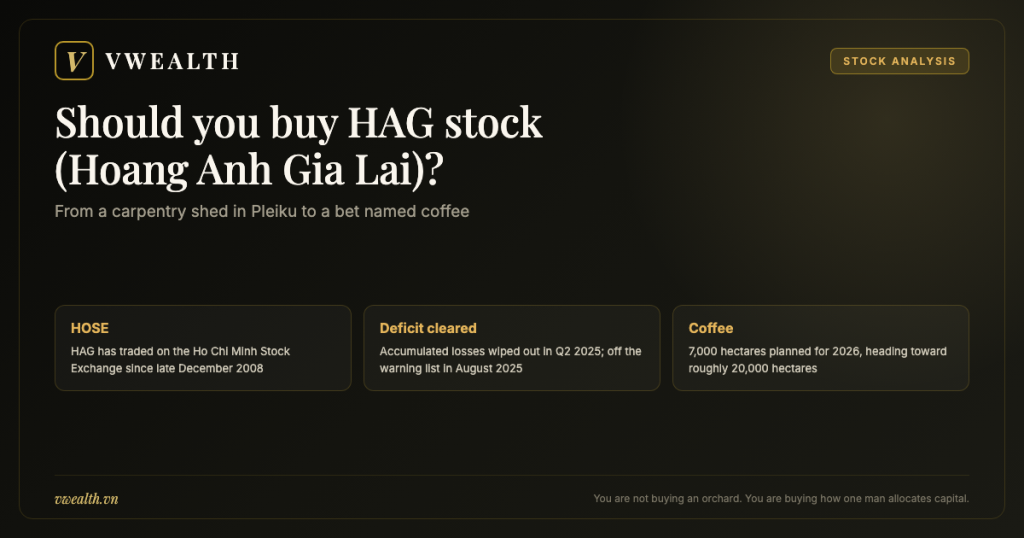
In 1990, in a village on the outskirts of Pleiku in Vietnam’s Central Highlands, a twenty-eight-year-old man opened a small carpentry workshop and started making desks for local schoolchildren. Eighteen years later the same man was the richest person on the Vietnamese stock exchange. Seven years after that, the group carrying his name owed more than VND 35 trillion and was being discussed in the same sentence as the word bankruptcy. And in mid-2025 that company finally wiped its accumulated losses down to zero — the thing its chairman had once called his obsession. This is Hoang Anh Gia Lai Joint Stock Company, ticker HAG on the Ho Chi Minh Stock Exchange, and Doan Nguyen Duc, the man an entire country knows simply as “bau Duc”. If you are wondering whether to buy HAG stock, no single screen of ratios will answer the question. You have to understand what thirty-five years of decisions built.
This article is not a recommendation to buy or sell. It is a slow walk through the whole file: what this company actually sells to stay alive, where the cash comes from and where it goes, who is steering and how much of the company they own, why its financial statements are harder to read than almost anything else on the exchange, what the market is really paying for, and what could prove the current story right or wrong over the next five years. By the end you should be able to answer a question more useful than “is HAG a good company” — namely, is HAG a good fit for an investor like you.
A note on the numbers, because it matters for how you read what follows. Every historical marker here — founding dates, the listing, deal values, disclosed shareholdings, plans approved at annual general meetings — comes from company filings and mainstream Vietnamese reporting and is verifiable. But the live metrics — last quarter’s profit, today’s P/E, the debt balance at the most recent reporting date — move every ninety days, and a long analysis is the wrong place to pin them down. When you need current figures, open the analysis reports on vwealth rather than trusting a number embedded in an article written weeks earlier.
All amounts are in Vietnamese dong. As a rough mental conversion, one US dollar bought somewhere around VND 26,000 during 2026, so a trillion dong is on the order of forty million dollars and the VND 35 trillion debt pile mentioned above was roughly US$1.3 billion. Treat those conversions as arithmetic shortcuts, not as precise translations; the dong rate drifts, and the company reports in dong.
One more warning, specific to this ticker. HAG is tied to a single individual’s name to a degree that almost nothing else on the Vietnamese market matches. That makes every conversation about it slide toward one of two poles: hero worship or ridicule. This article tries to stand at neither. The hardest years are recounted exactly as they were disclosed, without varnish and without mockery; the achievements are placed next to the question “achieved how?”. For an investor, an emotional position on a management team is the most expensive thing you can carry onto a trading screen.
If Vietnam itself is new to you, it is worth reading this alongside our guide to investing in the Vietnam stock market, which covers the mechanics — account opening, foreign ownership limits, settlement, daily price bands — that shape how a foreign investor can actually own something like HAG.
From a carpentry shed in Pleiku: the three reinventions of Hoang Anh Gia Lai
For most listed companies the history section is decoration — you can skip it and still build a valuation. Hoang Anh Gia Lai is not one of those companies. Everything about the group’s shape today, from why its most valuable assets sit in Laos and Cambodia rather than Vietnam, to why the line item called “other income” matters far more here than it does elsewhere, is the direct consequence of a chain of decisions stretching back thirty-five years. You have to walk the chain to understand why HAG behaves like no other ticker on the board.
1990–1993: school desks, sawdust and a name
Doan Nguyen Duc was born in 1962 in Binh Dinh province and grew up in Gia Lai, in a large family with very little money. In 1982 he travelled to Ho Chi Minh City to sit the university entrance exam and failed it. Vietnamese newspapers have retold that detail so often it has become folklore, but for someone reading financial statements it carries a practical meaning: the founder of HAGL did not come up through a management education, did not come up through state capital, and did not come up through an inherited network. He learned by doing, and his decision-making ever since has carried the fingerprints of that — fast, decisive, intuitive, and drawn to scale.
After years of working for others and saving, in 1990 he opened a small carpentry workshop in Chu Hdrong commune on the edge of Pleiku city, making desks and chairs for schools. It was an extremely modest business: small orders, thin margins, customers limited to the province. But it gave him three things that later became foundations — knowledge of timber, relationships across the Central Highlands raw-material belt, and a first stream of cash.
In 1993 the workshop was formally upgraded into Hoang Anh Pleiku Private Enterprise. From school furniture it moved into interior joinery, then into timber for export. The 1990s were a favourable window for Vietnamese wood: raw material was still abundant, export markets were opening, and any private firm quick enough on its feet could grow. Hoang Anh Pleiku was one of them.
What matters about this period is not the size — it was tiny by today’s standards — but the mental model that formed. Duc never settled for selling one product. He walked backwards up the chain: if you have timber, make furniture; if you make furniture, fit out buildings; if you fit out buildings, become the developer. That logic of “move up the chain to capture the fattest margin” repeats itself precisely thirty years later, when he grows bananas and feeds the rejects to pigs, and then plans to turn coffee cherries into extract.
2002–2007: from timber to property, and a decision about football
In 2002 HAGL set up Hoang Anh Construction and Housing Development Joint Stock Company, formally entering real estate. This was the first major pivot. A manufacturer became a developer — a shift from “sell goods on thin margins and turn the inventory fast” to “assemble land, bury capital for years, harvest a thick margin at the end”.
You need to feel the difference, because it explains a great deal of what came later. Manufacturers live on turnover; property developers live on leverage and the cycle. Once a management team gets used to borrowing heavily to accumulate assets and waiting for prices to rise, it is very hard to go back to capital-thrifty thinking. The entire 2008–2015 stretch of HAGL’s story is what happens when a company carries that habit into completely different industries.
HAGL Resort Quy Nhon opened in 2004, HAGL Resort Da Lat in 2005. In 2006 the business converted into Hoang Anh Gia Lai Joint Stock Company, taking on the shape of a diversified group with interests spanning minerals, timber, rubber, hydropower, real estate and football.
Football is the detail most foreign investors skip and probably should not. In 2007 HAGL partnered with Arsenal FC and the JMG academy network to create the Hoang Anh Gia Lai Arsenal JMG Football Academy at Ham Rong in Pleiku. Its first intake produced names that Vietnam now knows by heart: Nguyen Cong Phuong, Luong Xuan Truong, Nguyen Tuan Anh, Tran Huu Dong Trieu. On 17 November 2012, four of those players travelled to train with Arsenal’s youth side — something no Vietnamese club had achieved before.
In pure financial terms the academy and the club were never a profit source. In brand terms it was one of the most far-reaching investments any Vietnamese company has ever made. It turned “Hoang Anh Gia Lai” and “bau Duc” — the honorific “bau” is what Vietnamese football fans call a club patron, and it stuck to Duc permanently — into a name that tens of millions of people recognised, and felt warmly about, long before they knew what the ticker HAG stood for. For a stock, that kind of brand equity is a double-edged instrument, and we dissect it properly in chapter five.
2008–2013: the listing, the peak, and the rubber gamble
On 15 December 2008 the Ho Chi Minh Stock Exchange approved Hoang Anh Gia Lai’s listing of 179,814,501 shares. HAG began trading in late December 2008, right at the trough of the global financial crisis.
Then markets recovered and HAG exploded. By 2009 Duc’s personal wealth, measured by his HAG holding, was around VND 13 trillion, making him the richest man on the Vietnamese exchange — ahead, at that moment, of Pham Nhat Vuong of Vingroup. He held more than 55 per cent of the company. In the same year, property revenue reached roughly VND 3.4 trillion, or 77 per cent of group turnover.
This was the period in which HAGL redefined the public image of a Vietnamese businessman. Duc bought a private jet — the first Vietnamese to do so. He spent tens of millions of dollars on a football academy. He announced targets that sounded, at the time, like science fiction. And the market believed him.
Viewed analytically, the 2009 profit mix contained the seed of the trouble. Nearly four-fifths of revenue came from an intensely cyclical industry dependent on credit conditions and sentiment. When a company posts an exceptional year on the back of an exceptional cyclical, the right question is not “how much will it grow next year” but “if this industry turns, can the rest of the business carry the weight”. For HAGL in 2009 the honest answer was no.
Then came the rubber bet.
Between 2009 and 2011 HAGL poured enormous sums into rubber and oil palm, planting tens of thousands of hectares across the Vietnamese Central Highlands, southern Laos and north-eastern Cambodia. The logic was easy to follow at the time: world rubber prices were at historic highs, land in Laos and Cambodia was cheap, leases were long, and a hectare of mature rubber can generate steady cash for twenty years.
But rubber has a characteristic that is lethal to anyone impatient with capital: it takes roughly six to seven years from planting to first tapping. Everything spent in 2009–2011 would therefore only begin producing cash somewhere around 2016–2018. For those six or seven years the plantations had to be fed with borrowed money — and interest is payable monthly, regardless of how tall the trees are.
The worst case duly arrived. World rubber prices peaked in 2011 and then fell for years, to the point where many plantations lost money on every kilogram tapped. HAGL found itself in what finance calls the double trap: invested at the wrong point of the cycle, and funding long-duration assets with short-duration money. This is the textbook lesson every reader of agricultural financial statements should memorise: the biological clock of a tree does not care about the repayment clock of a bank.
In parallel, minerals and hydropower — the businesses that were supposed to deliver steady cash — did not perform as modelled. In 2013–2014 HAGL announced its withdrawal from domestic real estate, divesting assets and shrinking minerals and hydropower, keeping agriculture and one large property project abroad: the HAGL Myanmar Center complex in Yangon.
2015–2018: peak debt, a VND 6,596 billion bond, and the edge of the cliff
At the end of 2015 total liabilities were around VND 33 trillion. By 2016 they peaked above VND 35 trillion, while the list of subsidiaries and associates ran past fifty entities. Very few private Vietnamese companies have ever carried debt on that scale, and it sat on top of a group structure so complex that even insiders struggled to hold it in their heads.
At the centre of the pile was a single bond, code HAGLBOND16.26: face value VND 6,596 billion, coupon 9.7 per cent a year, issued on 30 June 2016 with maturity on 30 December 2026, held by BIDV, one of Vietnam’s four large state-controlled banks. Look closely at that coupon and that tenor: nearly ten per cent a year for more than a decade, on a principal of several thousand billion dong. The accruing interest alone was a snowball that no orchard’s profit could push back up the hill.
In 2016 the government approved, in principle, a comprehensive restructuring of HAGL’s debts. This detail needs to be stated at exactly its true weight, no heavier and no lighter: it was approval for a restructuring mechanism that let the company stretch out its obligations and avoid the worst outcome. It was not a cash bailout. What it bought HAGL was the most valuable commodity available at that moment — time.
In 2017 the company began shifting its centre of gravity toward fruit. Bananas, passion fruit, dragon fruit and chillies started going to China and Cambodia. Fruit has an advantage rubber does not: a short cycle. Bananas yield nine to ten months after planting and then keep yielding. For a company starving for cash, the difference between waiting seven years and waiting ten months is the difference between dying and surviving.
2018–2021: Thaco arrives, HAGL Agrico departs
In August 2018 Truong Hai Auto Corporation (Thaco), controlled by Tran Ba Duong, became HAGL’s strategic partner. Thaco injected capital into Hoang Anh Gia Lai Agricultural Joint Stock Company — HAGL Agrico, ticker HNG — through a capital increase and bond conversion, ending up with 26.29 per cent of HNG.
In 2019 HAGL transferred a series of agricultural companies, plus the Yangon property project, to Thaco, raising thousands of billions of dong to cut borrowings. In mid-2020 HAGL Agrico transferred four more subsidiaries to Thaco for VND 9,095 billion — partly for the capital, partly to book the profit needed to avoid a forced delisting.
The deal did not go smoothly. HAGL Agrico ran into problems with banks over repaying debt in order to release the legal files of those four companies, and Thaco ended up taking over HAGL Agrico itself rather than simply buying assets. On 9 January 2021 Thaco formally assumed control of HAGL Agrico and Tran Ba Duong became chairman of HNG. Several Vietnamese outlets described it as a takeover Thaco had not wanted: it entered as a financial investor and left as an operator.
This is the single most important cut in HAGL’s history, because it divides the company in two. The bulk of the large-scale farmland, and the bulk of the debt, went with HNG to Thaco. What stayed with HAG was much smaller — and much tidier. From more than fifty subsidiaries and associates in 2016, by the end of 2022 HAGL was down to around ten entities. If you are comparing HAG today with HAG in 2015, remember you are comparing two fundamentally different companies.
HNG’s own story afterwards was not an easy one: continued accumulated losses, negative equity, delisting from HOSE and a move to the UPCoM over-the-counter board. On 5 January 2026 HAG announced the sale of its entire remaining stake of 91.38 million HNG shares — 8.24 per cent of HAGL Agrico’s charter capital — by negotiated transaction between 8 January and 6 February 2026. After that trade, HAG had no ownership connection to HNG at all. For shareholders, it closed a chapter that had run for nearly a decade.
2021–2023: bananas feeding pigs, the Bapi brand and an expensive lesson
In 2021 HAGL reported a profit of VND 128 billion after a run of heavy loss years. A small number, but the sign was right. That same year the company launched what Duc called the “closed loop”: grow bananas, and take the fruit that fails export grading and blend it into pig feed.
The idea is economically sound. In an export banana plantation only about half to two-thirds of output meets the size and appearance standards required for Japan, Korea or China. The remainder, sold locally, fetches almost nothing. Turning it into animal feed converts waste into a valuable input — textbook circular economy.
In March 2022 the “banana-fed pork” brand Bapi was launched. On 26 May 2022 Bapi Hoang Anh Gia Lai Joint Stock Company was incorporated to handle distribution. The announced plan was ambitious: around 200 stores by the end of 2022 and 1,000 by the end of 2023, concentrated in Hanoi and Ho Chi Minh City, selling pork, beef and chicken with on-site preparation. In the first eleven months of 2022 HAGL earned net profit of roughly VND 1,115 billion — the first time it had cleared the trillion-dong mark since 2014.
Then retail reality arrived. From late 2022 into 2023, live hog prices fell continuously. By the end of the first quarter of 2023 Duc himself admitted HAGL was making no money from pigs because prices had sunk too far. The Bapi Food chain never scaled: competition in Vietnamese fresh-food retail is brutal, rents and operating costs are high, and consumers do not readily pay a premium for a brand story.
On 29 December 2023 HAGL completed the sale of its entire 44.5 per cent stake in Bapi Hoang Anh Gia Lai to a third party for VND 27.5 billion. Measured from incorporation, the venture lasted 583 days. Keep that number in mind whenever you read a new plan from this company: HAGL is genuinely good at large-scale agricultural production, and has not yet demonstrated capability in selling to end consumers. A beef brand called Lamon was introduced in November 2023 and likewise never became a pillar.
2024–2026: paying down, wiping out the deficit, and the coffee bet
The last three years have been about one thing: getting out from under the debt.
At the end of 2024, after repaying more than VND 1,000 billion to BIDV, HAGL’s outstanding bond debt at that bank was down to about VND 766 billion — against an original face value of VND 6,596 billion, a long road travelled. During the first half of 2025 the entire VND 2,000 billion principal plus more than VND 2,022 billion of accrued interest on another obligation was transferred from BIDV to a new creditor. By the end of 2025 BIDV had sold the exposure in full to Debt and Asset Trading Corporation (DATC), which became the single creditor inheriting all associated rights.
DATC is worth a sentence of explanation for readers outside Vietnam. It is a state-owned enterprise under the Ministry of Finance whose mandate is to buy and work out bad debt and distressed assets, particularly where restructuring serves a broader economic purpose. Selling a legacy exposure to DATC is a recognised route in Vietnam for a bank to clean its book while giving the borrower a counterparty with a mandate to negotiate rather than merely collect.
In the course of that workout, HAGL had more than VND 1,500 billion of interest forgiven and settled the 2016 bond early by paying less than VND 900 billion of principal and interest combined. This kind of transaction needs to be understood precisely: when a creditor agrees to write off part of the interest, the written-off amount flows into the borrower’s profit as a reversal of financial expense or as other income. It is real profit in the accounts, entirely legitimate, but it is not profit from operating the business, and it happens once. We come back to this at length in chapter four, because it is the key to reading HAG’s numbers correctly.
On the operating side, first-quarter 2025 net profit was VND 360 billion, up 59 per cent year on year, cutting the accumulated deficit to just VND 82 billion. In the second quarter of 2025 the company formally cleared it: at 30 June 2025 undistributed after-tax profit stood at nearly VND 400 billion positive, with half-year net profit of nearly VND 834 billion, up 74 per cent. Third-quarter 2025 net profit was VND 432 billion, up 23 per cent.
Clearing the accumulated deficit was not merely symbolic. Under Vietnamese exchange rules, a company showing an accumulated loss in its audited accounts is placed on the warning list and its shares become ineligible for margin trading. In August 2025 HAG came off the warning list and hit its highest price in roughly a decade. For a stock with as large a retail shareholder base as HAG, regaining margin eligibility is a meaningful liquidity catalyst.
In 2026 the story turned another page. At the annual general meeting on 17 April 2026 HAGL put forward a plan for revenue of VND 8,624 billion and net profit of VND 4,202 billion — which, if achieved, would be the highest in the company’s history, up about 16 per cent on revenue and nearly 88 per cent on profit versus 2025. Management stated that roughly 50 per cent of the planned profit would come from financial reversals as the debt-purchase company writes off obligations, with the remainder from operations and from divesting subsidiaries. First-quarter 2026 net profit was estimated at around VND 1,280 billion.
And the investment focus has changed. HAGL is not expanding banana acreage, holding it at roughly 7,000 hectares; durian stays at roughly 2,000 hectares. Instead, the 2026 programme is 7,000 hectares of new coffee, 1,000 hectares of mulberry and 700 hectares of additional durian, aiming at roughly 20,000 hectares of coffee over the long run. Alongside that sit plans for four wet-processing mills in the growing regions, one coffee extraction plant, and a 75-hectare industrial cluster in Gia Lai with total investment of around VND 400 billion.
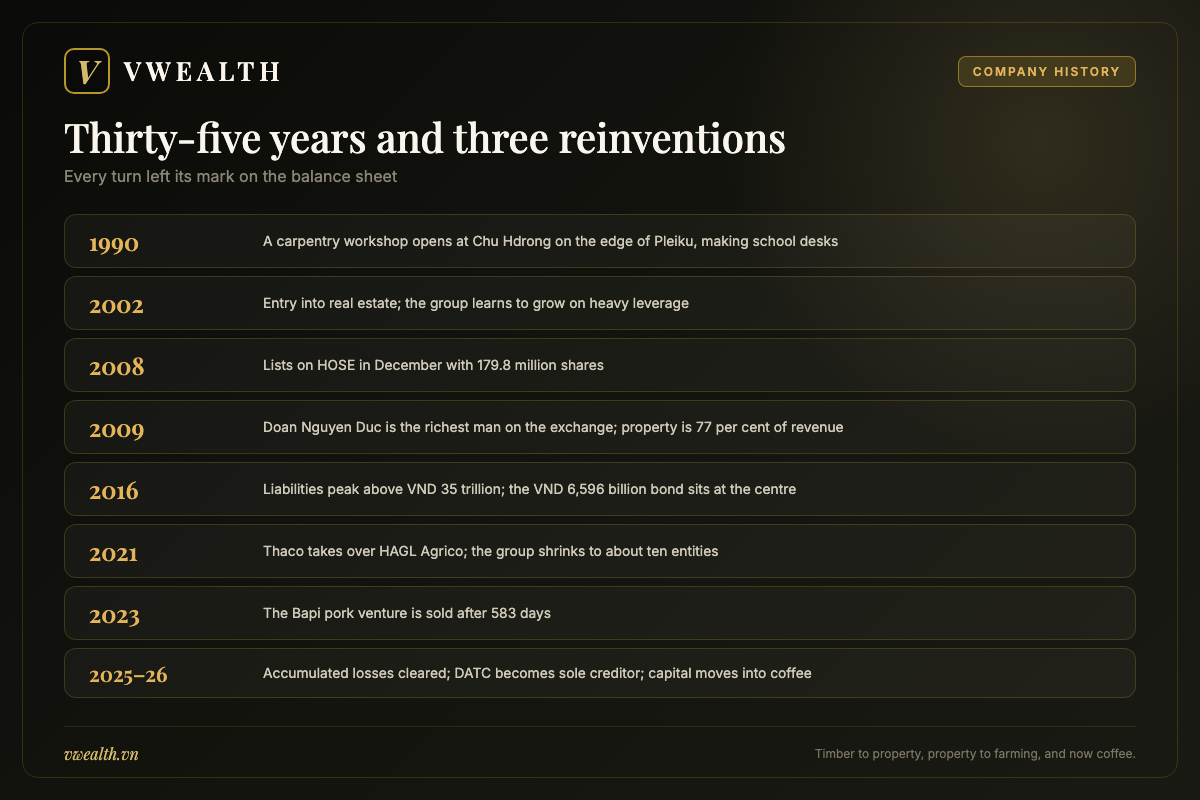
Put another way: having reinvented itself from timber to property, and then from property to agriculture, HAGL is now attempting a third reinvention — from bananas and pigs to coffee. The table below compresses the whole journey.
| Period | Key events | What it means for an investor today |
|---|---|---|
| 1990–1993 | Carpentry workshop at Chu Hdrong; Hoang Anh Pleiku Private Enterprise established (1993) | The origin of a habit of moving up the value chain |
| 2002–2006 | Entry into real estate (2002); Quy Nhon resort (2004), Da Lat resort (2005); conversion into a diversified joint stock company (2006) | Where the taste for heavy leverage was formed |
| 2007–2008 | HAGL Arsenal JMG academy founded (2007); HOSE listing of 179.8 million shares (December 2008) | A personal brand becomes the largest intangible asset |
| 2009–2011 | Duc is the richest man on the exchange (2009); property is 77 per cent of revenue; capital poured into rubber and oil palm in Vietnam, Laos and Cambodia | The classic lesson in investing at the wrong point of a commodity cycle |
| 2013–2016 | Exit from domestic property; liabilities peak above VND 35 trillion (2016); HAGLBOND16.26 issued at VND 6,596 billion, 9.7 per cent coupon | The source of every unusual financial line item that follows |
| 2017–2021 | Shift into fruit; Thaco becomes strategic partner (2018); Thaco takes over HAGL Agrico (9 January 2021) | Today’s HAG is a different company from 2015’s HAG |
| 2022–2023 | Bapi banana-fed pork launched (March 2022); entire Bapi stake sold after 583 days (29 December 2023) | Strength lies in production, not in retail |
| 2024–2026 | BIDV repaid; DATC becomes sole creditor; accumulated deficit cleared in Q2 2025; full HNG exit (January 2026); resources redirected into coffee | A cleaner balance sheet, but earnings quality needs close inspection |
Leadership and ownership: when a company and a man share one name
There are a few dozen companies on the Vietnamese exchange attached to a famous founder. There is almost none where the fusion of company and individual runs as deep as at HAG. People do not say “Hoang Anh Gia Lai shares”; they say “bau Duc’s shares”. That creates an investment characteristic you have to price in, whether or not you happen to like the man.
The man at the wheel, and why Vietnam knows his nickname
Doan Nguyen Duc, born 1962, is chairman of the board of Hoang Anh Gia Lai Joint Stock Company. He has held that seat continuously from the company’s conversion into a joint stock company through both the peak and the deepest part of the crisis. That deserves objective acknowledgement: a great many founders leave the chair when the company gets into trouble, and at HAGL that did not happen.
For readers outside Vietnam, a word on the nickname, because it is genuinely load-bearing. “Bau” is the informal Vietnamese term for a football club patron — the businessman who funds a team. Duc’s investment in the HAGL Arsenal JMG academy, and the national-team careers that came out of it, made “bau Duc” a household name in a country where football commands enormous emotional attention. The result is a level of public recognition that no financial statement captures: millions of Vietnamese have an opinion about this company before they have seen a single number. Retail order flow into HAG is partly an expression of that. It is a real, measurable force on the share price, and it cuts both ways.
His management style has three characteristics an investor should be able to name, because each one is a double-edged blade.
The first is the speed of decision-making. Duc changes direction fast and without hedging. Timber to property took a few years; property to rubber the same; rubber to fruit was quicker; and bananas-and-pigs to coffee took barely a couple of AGM cycles. The upside: the company never gets stranded in a business that has run out of room. The downside: a long-term shareholder cannot easily say what business they will own a share of five years from now.
The second is how targets get announced. He states very large numbers, very early, before there is any operating evidence behind them. A million pigs, ten million chickens, twenty thousand hectares of coffee — all publicly declared goals. The upside: it creates momentum and attention. The downside: when a plan does not land, the market remembers the gap between statement and outcome, and it applies a discount to everything announced afterwards.
The third is the degree of personalisation. He answers shareholders directly, speaks to the press directly, and personally defends the offer price of a subsidiary. At the April 2026 AGM he described 2026–2030 as the “most beautiful period” in the company’s history and said he would keep buying HAG shares, in a line the Vietnamese press quoted widely: “I will buy as many shares as I can buy.” The upside: retail shareholders feel heard. The downside: the share price reacts more strongly to a personal remark than to a financial report — and that is a risk characteristic, not an advantage.
Ownership: one family and the rest of the market
HAG’s ownership structure has one feature you should get exactly right: the founding group holds effective influence without holding an outright majority, and the remainder is spread very widely among individual investors.
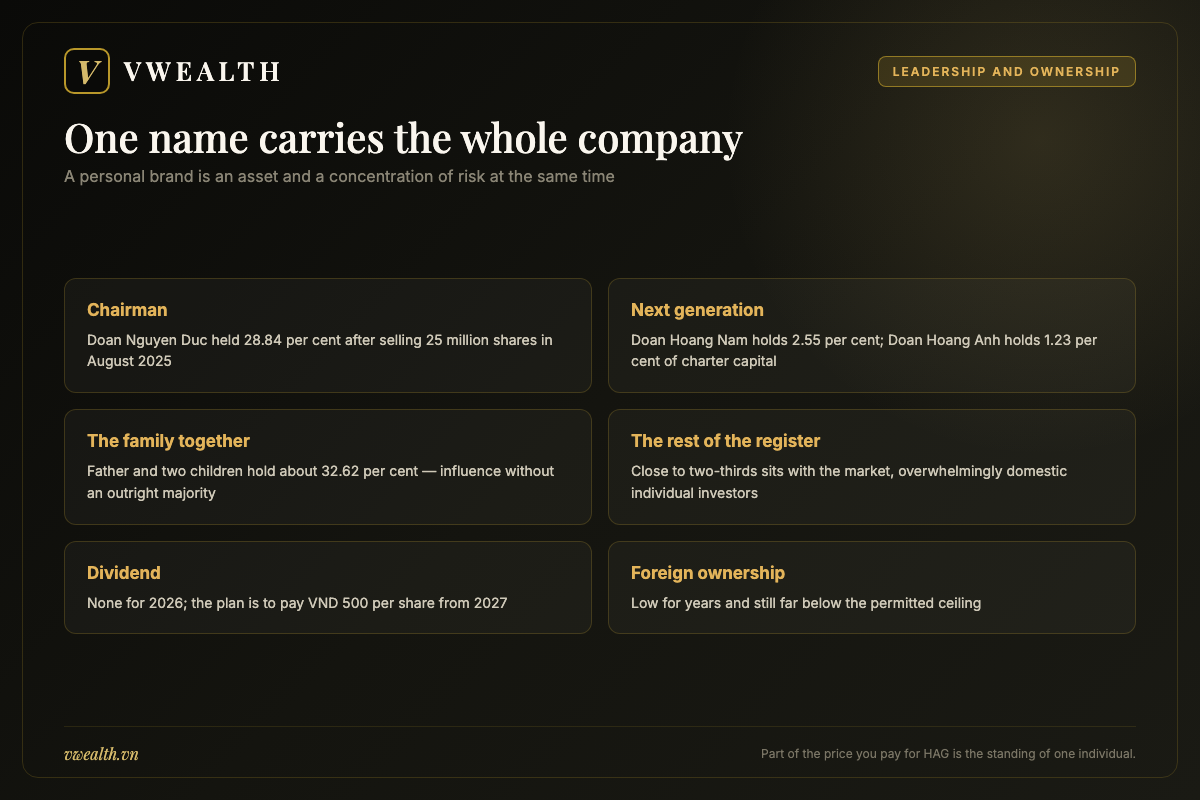
According to insider trading disclosures, between 18 and 22 August 2025 Doan Nguyen Duc sold 25 million HAG shares by negotiated transaction, cutting his stake from 31.2 per cent to 28.84 per cent, or just under 305 million shares. At the same time, on 22 August 2025, his son Doan Hoang Nam bought 27 million shares, also by negotiated deal, taking his holding from zero to 2.55 per cent. The corporate governance report for the first half of 2025 also records his daughter, Doan Hoang Anh, holding 13 million shares, or 1.23 per cent. Together, father and two children held roughly 32.62 per cent of charter capital.
The market read this as an intra-family transfer. From a governance standpoint there are two valid readings, and you should hold both.
The constructive reading: the family’s aggregate stake did not fall — it edged up — which suggests commitment is intact, and moving a slice to the next generation is ordinary succession preparation at a family business.
The cautious reading: when a founder sells a large block, even to his own child, personal cash moves, and outside shareholders have no way to know the purpose. In a stock with high speculative content, any large insider transaction is a data point to monitor rather than to interpret quickly.
Dispersed ownership and what it does to the stock’s personality.
With the family at roughly a third, close to two-thirds of the shares sit with the market, overwhelmingly domestic individual investors. HAG has one of the largest retail shareholder counts on the exchange.
That produces a pattern you can see plainly on the tape: HAG has extremely high turnover relative to its market capitalisation, and a wide trading range. A stock with many retail holders, plenty of news flow and an easy story to tell will always attract short-term money. That is good if you want to trade in and out, and bad if you want to sleep well.
A quick comparison makes the contrast concrete. A consumer name with a large institutional register, such as VNM of Vinamilk, has a stable shareholder base, low volatility, and a price that mostly tracks operating results. HAG is the mirror image: a mobile shareholder base, high volatility, and a price that reflects results plus expectations plus rumours plus remarks.
The board and the question of bench strength
For companies bolted to one individual, the most important governance question is not “is the person at the top capable” but “if that person were not there, would the company keep running”.
At HAGL the answer is not yet clear. Company communication revolves almost entirely around one figure. Senior operating executives rarely appear in public and are largely unknown to the market. The second generation beginning to hold shares from 2025 may be a signal of succession planning, but holding equity and running operations are two different things.
This is not an accusation; it is a structural risk you need to quantify in your own head. When you buy HAG, a meaningful part of what you are paying for is the capability and standing of one individual born in 1962. For some investors that is a positive — they are backing a specific person. For others it is reason enough to pass. Both positions are defensible, provided you know which one you are taking.
Dividends: more than a decade without cash, and a promise for 2027
If you came to HAG for dividend income, you can stop here.
Throughout the long debt restructuring, HAGL paid no cash dividend. The reason is straightforward and, frankly, correct: Vietnamese rules prohibit distributions while a company carries an accumulated deficit, and while large debts remain, every available dong should go to reducing them. Paying a dividend while servicing double-digit interest destroys value.
At the April 2026 AGM management confirmed no dividend for 2026, because resources are being committed to expansion — 2026 investment needs were put at VND 5,000–5,600 billion, against working capital of roughly VND 4,000–5,000 billion. The stated plan is to begin paying from 2027 at VND 500 per share.
Read that VND 500 correctly. It is a modest dividend, symbolic more than material — a declaration that “we are normal again” rather than a meaningful income stream relative to the share price. If you need reliable annual cash flow, you belong in names with a long, uninterrupted payout history: the branded consumer group, or a stabilised retail model such as FRT of FPT Retail, rather than HAG.
A compliance record with several near misses
Part of HAG’s governance file that you should not skip is the stretch when the company had to deal with listing-eligibility problems.
In early 2022, after the 2017, 2018 and 2019 financial statements were retrospectively restated and showed three consecutive loss years, HAG faced the possibility of mandatory delisting under Vietnamese rules. The company filed an explanation and a request for reconsideration, arguing that the losses arose from retrospective adjustment rather than reflecting operations at the time, and the shares continued trading on HOSE.
Subsequently, because an accumulated deficit remained in the audited accounts, HAG was placed on the warning list and lost margin eligibility for an extended period. It had to file explanations and remediation commitments repeatedly. That situation ended only in August 2025, when the deficit was cleared and the stock came off the warning list.
Why does this matter? Because it tells you something about the technical risk in this name: through 2022–2025, HAG shareholders carried not only business risk but listing risk and a liquidity penalty from the margin ban. Those risks have now largely gone, and their disappearance is part of why the stock re-rated from 2025. But it also reminds you that this company’s compliance history is not a blank page.
One final habit to adopt when reading news about this management team.
HAG carries an unusually high density of rumour. For years, every few months a piece of false information about the leadership has circulated on social media and the company has had to publicly deny it. The stock frequently moves hard intraday on such items.
The practical rule for you: with HAG, set a higher evidence threshold than normal. Believe only what appears in official disclosures on the HOSE website or the company’s own filings. Everything else — including material that sounds highly detailed and highly persuasive — belongs in the “unconfirmed” bucket. The more retail a stock’s register, the more destructive rumour becomes, and the people who lose money are always the ones who react fastest to something untrue.
The core businesses: bananas fund the present, coffee funds the future
If someone asks you what HAGL sells, the most accurate answer today is: fresh produce and livestock products, mostly for export, grown on farmland spread across three countries. But that answer will be different in three to five years, and it is precisely that difference the market is currently pricing. This chapter takes the segments apart so you can see which one generates cash, which one consumes it, and where the genuine advantage sits.
The foundation of everything: farmland in three countries
HAGL’s root asset is not a factory and not a brand. It is land — specifically, long-term use and lease rights over contiguous agricultural blocks of thousands of hectares in Vietnam’s Central Highlands, in the Attapeu and Champasak provinces of Laos, and in Stung Treng province in Cambodia.
You need to understand why this is hard to replicate. In Vietnam, assembling a contiguous growing area of several thousand hectares is close to impossible: land was allocated to smallholder households long ago, the cost of consolidation is extreme, and the paperwork takes years. HAGL acquired these blocks during 2008–2012, when Vietnamese companies were expanding into Laos and Cambodia in the rubber investment wave. They are long-tenor leases signed when land costs were far below today’s.
Large contiguous blocks deliver three very concrete benefits in agriculture. First, mechanisation: machinery on a thousand-hectare field is several times more efficient than on scattered plots of a few hectares. Second, quality control: when you manage a closed growing area you control the seed stock, fertiliser, chemicals and cultivation logs — the precondition for the growing-area codes required for formal export channels. Third, collection cost: produce never passes through traders, spoilage is lower, and the time from cutting to packing is short.
But foreign farmland carries its own risks, and you must price them: host-country policy risk, currency risk, overland logistics risk, and renewal risk when the leases come due. None of these appears on the balance sheet as a number, yet any one of them could erase a business line.
Bananas: the current cash machine
Bananas are what brought HAGL back from the edge. The company maintains roughly 7,000 hectares and confirmed at the 2026 AGM that it will not expand the area further.
Why were bananas the right call in 2017–2018? Three reasons.
First, the short cycle. A banana plant yields a bunch roughly nine to ten months after planting, and then produces continuously in successive cycles. For a company that urgently needed cash to service interest, bananas were almost the only industrial-scale crop that turns land into money in under a year.
Second, the market next door. China is a large banana importer, and Vietnam has an overland transport advantage over South American or Philippine supply. Bananas are fresh cargo; short transit is a direct competitive edge on both quality and cost.
Third, scale sufficient to negotiate. Japanese, Korean and Chinese importers need steady year-round supply of consistent quality. Very few Vietnamese suppliers can deliver that; HAGL, with concentrated growing areas, can.
The weakness of the banana business sits inside its strength. Bananas are a basic commodity with no consumer brand, priced by supply and demand. When supply runs long, the price falls fast. At the end of 2024 banana prices dropped sharply on oversupply, then recovered through 2025 to roughly VND 12,000–25,000 per kilogram at the farm gate depending on grade and timing. HAGL’s margin in this segment swings across exactly that band, and the company has essentially no tool for holding price.
There is a second operational exposure. Formal-channel banana exports depend on growing-area codes and packing-facility codes granted by the importing country. A single consignment that breaches phytosanitary rules can get a code suspended, and an entire growing area then loses its outlet for months. This is a very real risk that has already hit multiple Vietnamese agricultural exporters.
Durian: high margin, long cycle
HAGL holds roughly 2,000 hectares of durian and is planting around 700 hectares more in 2026.
Durian is the inverse of bananas. Margin per hectare is many times higher, the price per kilogram is far above bananas, and Chinese demand in recent years has been enormous. But a durian tree needs roughly four to five years from planting to first fruit, and seven to eight years to reach stable yield.
What does that mean when you read the accounts? It means HAGL’s durian acreage today is not yet reflected in revenue. Most of the segment’s value sits in the future, and between today and that future lie four years of maintenance cost. This is exactly the kind of asset that makes agricultural financial statements hard to read: the cost of tending an orchard that is not yet bearing gets capitalised into the value of biological assets rather than expensed in the period, which makes profit look better than cash.
Durian carries substantial risk too. It is exceptionally sensitive to phytosanitary enforcement: China has tightened residue testing and suspended consignments from multiple exporting countries. On top of that, durian acreage is expanding quickly in Vietnam, Thailand, Malaysia and Cambodia at the same time. A commodity with unusually high margin always attracts new supply, and new supply always pulls the margin down. The only question is how fast.
Pigs: from media star to side dish
This is the segment with the widest gap between initial expectation and realised outcome — and therefore the one that teaches you the most about how to read this company.
The circular livestock model — using export-reject bananas as a feed input — theoretically gives HAGL an input-cost advantage over producers who must buy all their feed. In livestock, feed is the largest component of cost, so any edge there is worth having.
But an input-cost edge does not save a seller when the output price collapses. Live hog prices are among the most volatile commodities in Vietnam. In the recent stretch alone, the price moved from a trough of roughly VND 45,000–46,000 per kilogram in October–November 2025, up nearly 39 per cent to around VND 66,500 by the end of 2025, and then into the VND 75,000–80,000 band in the first quarter of 2026. A business whose selling price swings 70 per cent in six months cannot be the foundation of a long-term investment case.
HAGL’s own operating record reflects that. After selling out of Bapi at the end of 2023, the company steadily shrank the herd. In the third quarter of 2025, pig sales revenue was just over VND 40 billion — a very small figure against group turnover, confirming that the segment has retreated to a supporting role.
The transferable lesson, and it applies to every agricultural producer: a model that is technically elegant can still fail economically if the output price is set by the market and the producer has no pricing power. Bananas, pigs and durian all sit in that category.
Coffee: the biggest bet, and the longest
This is the segment that determines the HAG story for the next five years.
The 2026 plan is to plant 7,000 new hectares of coffee — against roughly 3,000 hectares planted during 2025 — heading toward roughly 20,000 hectares over the long term. Alongside it sit four wet-processing mills located in the growing regions and one coffee extraction plant.
The terms “wet processing” and “extraction” are worth pausing on. Wet processing means pulping the fresh cherry, then fermenting and washing it, producing green beans of higher and more consistent quality — and a higher price — than ordinary dry processing. An extraction plant goes further still: it turns green beans into instant coffee or liquid extract, which moves the company into food manufacturing, where margins are structurally better than raw agriculture.
This is the same “walk up the chain” logic Duc has applied for thirty years, now pointed at coffee. If it works, HAGL stops being a seller of undifferentiated commodities and becomes a processor — a category with far steadier margins.
But three large questions remain open, and you should keep asking all three.
The first is time. Coffee needs roughly three years from planting to first harvest, and four to five to reach stable yield. The area planted in 2026 will only contribute meaningful revenue from around 2029–2030. Throughout that window the orchards must be fed by cash from bananas and other sources. This is structurally the same model that caused the rubber disaster of 2009–2011 — the one crucial difference being that this time the company is entering with a far lighter balance sheet.
The second is price. In 2025, Vietnamese coffee exports reached 1.59 million tonnes worth more than US$8.9 billion — a record, up 18.3 per cent by volume and 58.8 per cent by value on 2024. But in 2026 the trend reversed: over the first seven months, exports were 1.2 million tonnes, up 10.8 per cent by volume, yet worth only US$5.45 billion, down 11.2 per cent, as the average export price fell nearly 20 per cent to an estimated US$4,537 per tonne. In other words, HAGL is expanding hard into a commodity that has just come off its price peak. That is not automatically wrong — planting into weak prices and harvesting into strong ones is a rational strategy — but it does mean you are betting on the coffee price cycle of 2029–2032, which nobody can forecast.
The third is processing capability. HAGL has never operated an industrial-scale food extraction plant. The Bapi episode showed how wide the gap is between “good at producing” and “able to make something consumers will buy”. You should treat the downstream processing plan as an option with value if it works, not as part of your base case.
What about mulberry and the smaller lines?
The 2026 plan also includes 1,000 hectares of mulberry. This is a new line, small next to bananas and coffee, attached to the silk value chain. Mulberry’s advantage is a very short cycle and steady harvesting; its disadvantage is that the downstream chain requires reeling and weaving industry — which brings you straight back to the processing-capability question.
The company also plans a 75-hectare industrial cluster in Gia Lai dedicated to agricultural processing, with total investment of around VND 400 billion. This is infrastructure serving HAGL’s own chain rather than a separate business, and it should be read as a logistics-cost investment rather than a new revenue source.
HGI: the subsidiary and a new listing story
In August 2026 an important component of HAGL stepped into the light: Hoang Anh Gia Lai International Investment Joint Stock Company (HGI) offered 18.8 million shares at VND 60,600 each, raising roughly VND 1,139 billion. The subscription deadline was 7 September 2026 with payment by 14 September 2026; the plan is to trade on UPCoM in the third or fourth quarter of 2026 and to target a HOSE listing in early 2027.
For readers unfamiliar with Vietnam’s market structure: UPCoM is the exchange’s third board, a lighter-disclosure venue often used as a staging post before a company qualifies for a main-board listing on HOSE or HNX. Moving from UPCoM to HOSE is a meaningful upgrade in visibility, liquidity and eligibility for institutional mandates.
HGI’s disclosed 2025 figures: revenue of VND 4,885 billion, up 20.83 per cent; net profit of VND 1,486 billion, up 74.63 per cent; return on equity of 44.37 per cent; total assets of VND 10,657 billion. Strategically, HGI is expanding Arabica coffee sharply, from 2,464 hectares to 6,323 hectares by 2028, with first commercial harvest expected from late 2027, and management expects coffee to become the largest profit contributor within two years.
The offer price, at roughly 2.5 times book value, drew debate. Chairman Doan Nguyen Duc’s explanation was that HGI is currently farming only about 40 per cent of its cultivable land, with the remainder to be brought into production during 2027–2029 to generate additional revenue and profit.
For an investor weighing HAG, this event has three implications worth thinking through carefully. First, it gives the market a valuation reference for the core agricultural assets — something that was previously very hard to estimate. Second, raising capital at the subsidiary level lets HAGL fund investment without adding debt at the parent, which is a plus for the balance sheet. Third, and this is the cautionary point, when a subsidiary issues new shares to outsiders the parent’s ownership percentage is diluted, meaning less of each dong of HGI profit reaches HAG shareholders. Track HAG’s stake in HGI after the offering closes: it feeds directly into consolidated profit attributable to the parent.
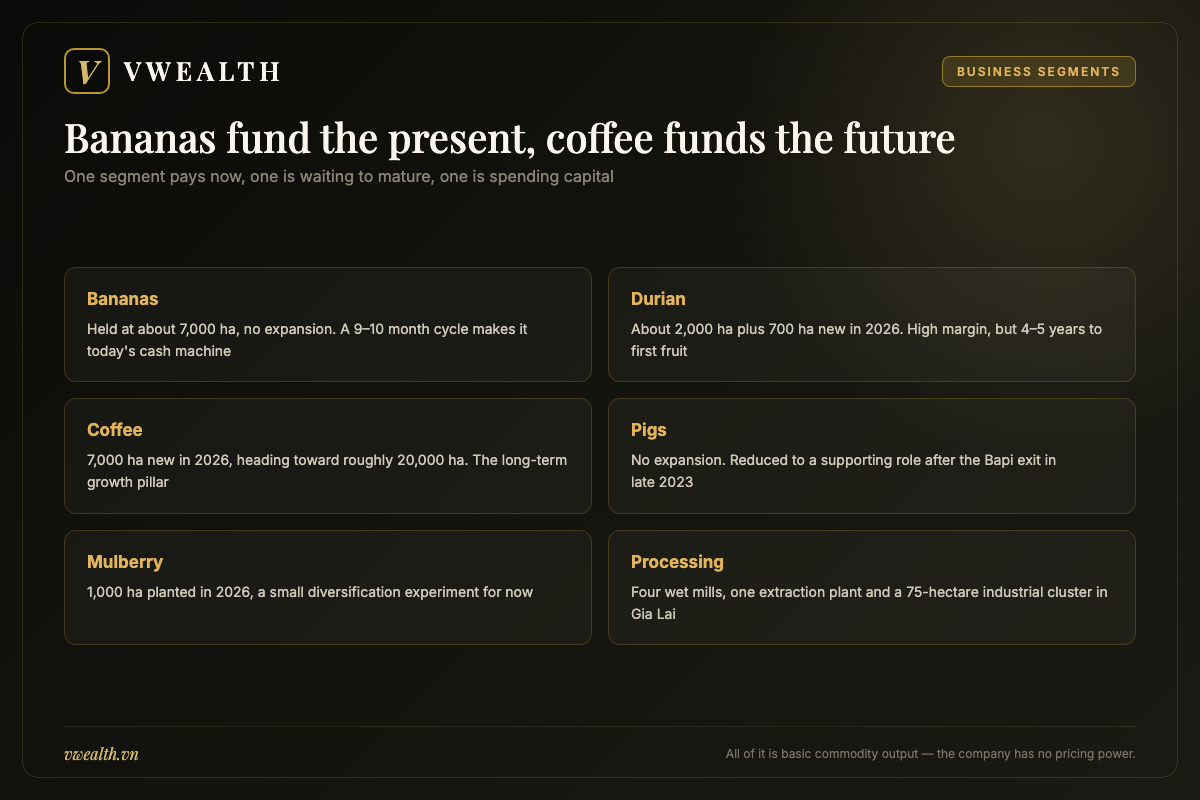
The table below sets the segments side by side so you can see which one feeds which.
| Segment | Target scale | Planting-to-harvest cycle | Role in the portfolio | Biggest risk |
|---|---|---|---|---|
| Bananas | Held at roughly 7,000 ha, no expansion | 9–10 months, then continuous | Cash machine; funds the long-cycle segments | Price falls on oversupply; suspension of growing-area codes |
| Durian | Roughly 2,000 ha, plus 700 ha new in 2026 | 4–5 years to first fruit, 7–8 to stable yield | High-margin line with value in the near future | Tighter phytosanitary enforcement; fast regional supply growth |
| Coffee | 7,000 ha new in 2026, targeting about 20,000 ha | About 3 years to first harvest | Long-term growth pillar, currently consuming capital | Coffee price cycle; unproven downstream processing capability |
| Pigs | No expansion | A few months per cycle | Side segment using reject bananas | Extreme hog price volatility; African swine fever |
| Mulberry | 1,000 ha new in 2026 | Short, harvested by leaf cycle | Diversification experiment | Small scale; depends on downstream processing chain |
| Downstream processing | 4 wet mills, 1 extraction plant, 75 ha industrial cluster | Follows construction schedule | The only route out of selling raw commodities | The company has no operating experience here |
Read that table vertically and you see HAGL’s real structure today: one segment producing cash immediately but not growing, one high-margin segment waiting to mature, one enormous segment consuming capital and repaying only after several years, and one side segment in retreat. If you are used to businesses with simple arithmetic — MWG of Mobile World, for instance, where every store opened is a countable revenue unit from day one — HAG is a completely different problem in the time dimension.
Financial position and health: how to read a company that just climbed out of a mountain of debt
This is the most important chapter in the article, and the one where skimming will lead you astray in both directions at once — too optimistic or too pessimistic. The reason is that HAGL’s financial statements through 2024–2026 contain line items most listed companies simply do not have, and if you apply the standard reading you will reach a distorted conclusion.
This chapter does not quote last quarter’s numbers. It teaches you how to open the statements and find what matters. For current figures, use the analysis reports on vwealth.
The central problem: two kinds of profit sitting on the same line
When you look at HAG’s net profit line for the last two years, you are looking at the sum of two things with completely different natures.
The first is operating profit: sell bananas, durian and pigs, subtract cost of goods sold, selling expenses, administrative expenses and interest. This is repeatable profit. If the company earned a dong this way this year, it has a chance of earning a similar dong next year.
The second is profit from one-off financial events: a creditor forgiving part of the interest, reversing provisions taken in earlier periods, selling a subsidiary and booking the difference, revaluing assets. This is genuine profit in the accounts and entirely legitimate under accounting standards, but it appears once and says nothing about the company’s future earning power.
At HAGL the second category is not a rounding error. The company had more than VND 1,500 billion of interest written off during the settlement of the 2016 bond. And at the April 2026 AGM, management said plainly that roughly 50 per cent of the VND 4,202 billion net profit plan for 2026 would come from financial reversals as the debt-purchase company writes off obligations, with the balance from operations and from divesting subsidiaries.
Read that slowly. It means that if HAGL delivers its plan, about half of a record profit figure will not be money earned from selling agricultural produce. There is nothing improper about it — the company disclosed it openly and transparently. But it means that if you take 2026 profit, divide by the share count to get earnings per share, and then divide the price by that number to get a P/E, you will produce a multiple that looks very cheap and is very wrong.
So how do you separate the two?
You do not need to be an accountant. Open the consolidated income statement and do four subtractions.
Step one: take the line “net profit from operating activities”. Note that in many Vietnamese filings this line still includes financial income and financial expense, so it is not yet clean.
Step two: go to the note for “financial income” and read the detail. Anything described as a reversal, a debt write-off, a gain on disposal of an investment, or a gain from loss of control of a subsidiary is one-off. Note the total.
Step three: find “other income” and “other expenses”. This is where the genuinely unusual items live — asset disposals, debt forgiveness, compensation. Note the net figure.
Step four: subtract the totals from steps two and three from net profit after tax. What remains is an approximation of core operating profit. That is the number you use for year-on-year comparison and for valuation multiples.
Do this exercise across three consecutive years of HAG accounts and you will see the company’s real trend line — and it will look materially different from the net-profit trend line quoted in the press.
Revenue: read the mix, not the total
For a multi-crop agricultural company, total revenue is close to meaningless. The mix is what carries information.
In the notes, HAGL discloses revenue by product group. Follow four lines: fruit, livestock products, goods and other services, and — in due course — coffee. Then ask yourself three questions.
Question one: is fruit’s share of revenue rising or falling? If it is falling and coffee is not replacing it, the core is weakening.
Question two: is fruit revenue growing on volume or on price? If the company discloses volume, divide revenue by volume to get an average selling price. Revenue growth driven by price is good news in the short run but not durable; growth driven by volume is real growth.
Question three: has coffee revenue appeared yet, and at what scale? This is the earliest indicator of whether the big bet is on schedule. If by late 2027 or early 2028 that line is still near zero while the company has spent thousands of billions, you have a signal worth interrogating.
Biological assets: where profit and cash go their separate ways
This is the most important technical point in reading any long-cycle grower, and the one most often missed.
When HAGL plants a hectare of coffee, all the seedling, fertiliser, labour and irrigation cost during the first three years — while the plant bears nothing — is not expensed in the period. Instead it is capitalised: added to the carrying value of “biological assets” or “construction in progress” on the balance sheet. Only when the orchard starts producing is that value amortised into cost of goods sold over subsequent years.
This treatment is entirely compliant with accounting standards. But its consequence is that during a heavy expansion phase, a company can spend a great deal of cash while the income statement barely registers it. Profit looks stable while cash flow is deeply negative.
So for HAG during 2026–2029 — the years of planting thousands of hectares of coffee annually — you must follow three lines in parallel rather than one:
Line one is net profit after tax, to know what the company is reporting. Line two is net cash flow from operating activities, to know whether the core business funds itself. Line three is net cash flow from investing activities, to know how much is going into the ground. If line two is positive and large enough to fund most of line three, the company is expanding with its own money — a healthy state. If not, the gap must come from borrowing or from issuing equity, and both have a price.
Debt: from VND 35 trillion to today, and how to verify it
HAGL’s debt story is the longest thread in the company’s history and the one that has travelled furthest.
The starting point: total liabilities of roughly VND 33 trillion at the end of 2015, peaking above VND 35 trillion in 2016. Bank borrowings alone were around VND 28 trillion in 2016, falling to roughly VND 8 trillion by the end of the third quarter of 2022, with total liabilities then around VND 14.4 trillion.
Then came the workout of HAGLBOND16.26. At the end of 2024, after more than VND 1,000 billion was repaid to BIDV, the bond balance at that bank was around VND 766 billion. In the first half of 2025, VND 2,000 billion of principal plus more than VND 2,022 billion of accrued interest on another obligation moved from BIDV to a new creditor; by the end of 2025 BIDV had sold the exposure entirely to DATC, which became sole creditor. HAGL had more than VND 1,500 billion of interest forgiven and settled the 2016 bond early by paying under VND 900 billion of principal and interest combined. At the April 2026 AGM, management stated the company no longer carries interest-bearing debt.
That is a very large change in kind, and it deserves recognition. But you should verify rather than believe, and verification is simple: open the most recent balance sheet and add four lines — short-term borrowings and finance leases, long-term borrowings and finance leases, convertible bonds if any, and the portion of long-term debt due within twelve months. That is the true borrowing figure. At the same time, look at “interest expense” in the income statement: a company genuinely free of debt will show interest expense trending toward zero in subsequent periods.
The audit opinion: the paragraph almost nobody reads
There is a section of the financial statements most retail investors skip, and for HAG it is the single most worthwhile paragraph: the auditor’s commentary.
On the reviewed consolidated half-year statements for 2025, the auditor continued to include an emphasis noting a “material uncertainty that may cast significant doubt about the entity’s ability to continue as a going concern”, citing two grounds: current liabilities exceeding current assets by more than VND 2,700 billion, and breaches of certain bond-related covenants.
Understand this paragraph at exactly its true weight, no more and no less. It is not a qualified opinion, and it is emphatically not a conclusion that the business will cease operating. It is an emphasis-of-matter paragraph that auditors are required to include when certain technical indicators are present. Plenty of companies have carried one and moved past it without incident.
But it is also not something to wave away. Current liabilities exceeding current assets means that if every short-term creditor demanded payment simultaneously, the company would not have enough quickly convertible assets to pay. For an agricultural business — where most of the asset base is orchards, which are long-term and cannot be sold fast — this state is fairly common, but it remains a point of fragility.
Your practical task is specific: in each audited or reviewed report, find the “Emphasis of matter” or “Material uncertainty” section and read it verbatim. If it disappears in subsequent periods, that is a genuinely positive milestone — more meaningful than one high-profit quarter. If it persists even after the company has declared itself debt-free, read the reasons closely.
Receivables quality: the easiest place to hide a problem
At a company with a complex restructuring history, receivables are the second place to inspect after borrowings.
Three things to do. First, compare the growth rate of receivables with the growth rate of revenue. If receivables outgrow revenue for several consecutive periods, the company is shipping product but collecting slowly. Second, read the notes on lending receivables and other receivables — in groups with many related entities, this is where cash can flow outside the consolidation perimeter. Third, look at the provision for doubtful debts and how it moves: if the company reverses provisions across multiple periods, those reversals are flattering profit, and you need to know by how much.
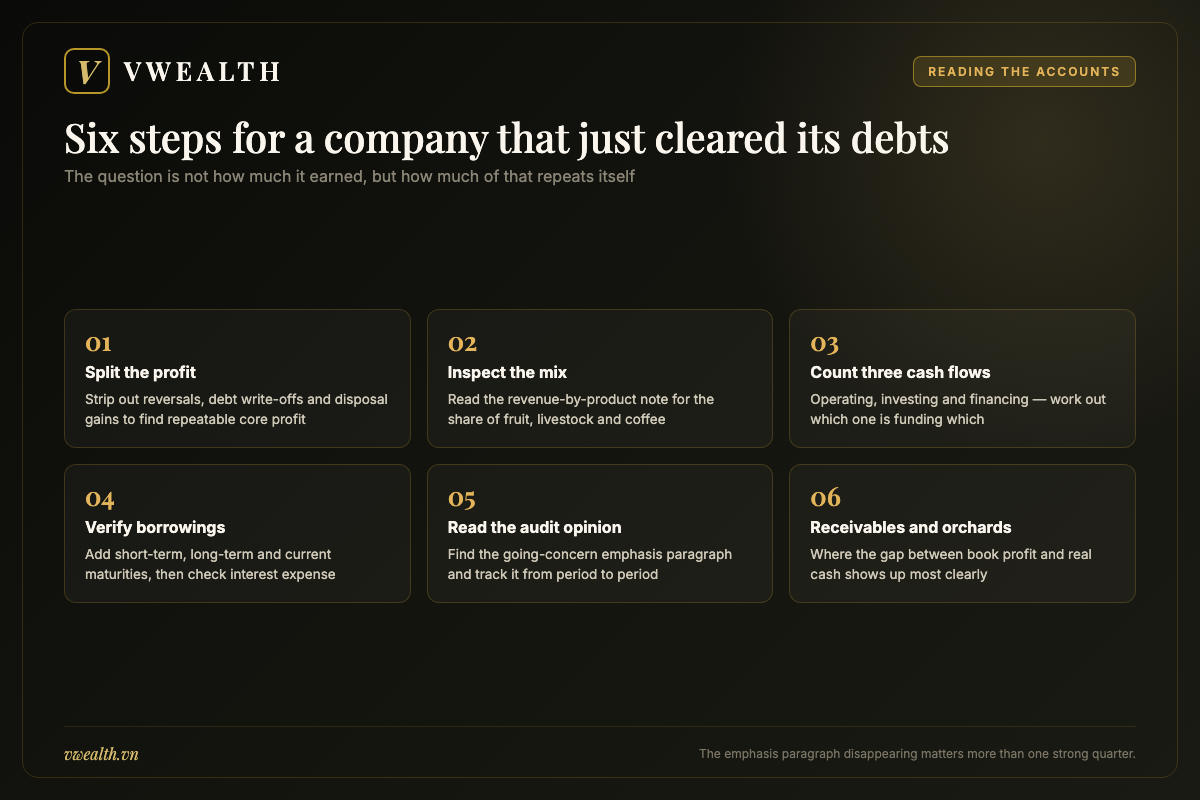
The whole process of reading HAG’s accounts compresses into the six steps below.
| Step | Where to look | What to find | How to interpret it |
|---|---|---|---|
| 1. Split the profit | Income statement plus notes on financial income and other income | Reversals, debt write-offs, disposal gains | Subtract them to get genuinely repeatable core profit |
| 2. Inspect the revenue mix | Note on revenue by product group | Share of fruit, livestock and coffee | Shows which segment funds the company and whether coffee has arrived |
| 3. Count three cash flows | Cash flow statement | Operating, investing and financing cash | Is expansion funded internally or by borrowing and issuance |
| 4. Verify borrowings | Balance sheet plus interest expense | Short-term debt, long-term debt, current maturities, period interest | Confirms the debt-free claim with numbers rather than words |
| 5. Read the audit opinion | Front pages of the audited or reviewed report | The going-concern emphasis paragraph | Its disappearance matters more than one strong quarter |
| 6. Inspect receivables and biological assets | Notes on receivables, biological assets, construction in progress | Growth rates, provisions, capitalised costs | Where the gap between book profit and real cash shows up |
Competitive position: where HAGL actually stands
A fair question: is HAGL Vietnam’s leading agricultural company?
The answer depends on your definition. Measured by contiguous fruit-growing area directly managed by a listed company, HAGL is in the leading group. Measured by a complete value chain running from field to branded consumer product, HAGL is a long way behind companies such as Masan Group, where the value sits in brands and distribution rather than in raw material zones.
This is the point to face squarely: HAGL’s advantage is an advantage in production cost and land scale, not an advantage in pricing power. A company with pricing power is one whose customers accept a higher price because of the name on the packaging. HAGL sells bananas to importers; the importer is the one who sells to the supermarket. In that chain, the thickest margin does not sit with the grower.
That is precisely why the downstream coffee plan matters so much. It is not simply an expansion of scale — it is an attempt to shift the company’s position within the value chain. If it succeeds, the investment case for HAG changes in kind. If it does not, HAGL remains a large, efficient producer of agricultural commodities, permanently subject to world price movements.
How the market prices HAG stock
Some stocks are valued with a spreadsheet. Some are valued with emotion. HAG belongs more to the second group than the first, and if you refuse to accept that, every valuation model you build will keep coming out wrong.
The personality of the stock: a speculative name with real assets underneath
Start by naming it accurately. HAG is a stock with a high speculative content. That does not mean the business is fake or the assets are imaginary — HAGL has thousands of hectares of real orchards, real revenue and real customers. But the way the market trades this ticker is unmistakably speculative.
Three signs let you recognise it.
The first is liquidity that is unusually high relative to market capitalisation. HAG is regularly among the most heavily traded names on HOSE by matched volume. A stock where many millions of shares change hands every session is a stock whose holders mostly do not intend to hold.
The second is the amplitude of moves. HAG has a history of rising and falling very sharply over short periods, usually in step with news. The stock travelled from deeply depressed levels during the debt crisis to a ten-year high in August 2025 when it came off the warning list. Moves of that shape are not the moves of a stock priced by discounted cash flow.
The third is sensitivity to statements. For most stocks, a chairman’s remark at an AGM produces a reaction of a few per cent. For HAG it can produce a run of sessions. This is the direct consequence of a personal brand fused to a ticker.
The practical conclusion: if you buy HAG, be prepared for your position to swing hard for reasons that have nothing to do with the price of bananas or the pace of coffee planting. That is the cost of owning a stock with an easy story to tell.
One mechanical point specific to Vietnam is worth adding here. HOSE applies a daily price band — shares can only move within a fixed percentage of the previous session’s reference price — which means a high-conviction move in a heavily retail name often plays out as several consecutive limit sessions in the same direction rather than one large gap. For a foreign investor used to continuous markets, that changes what “getting out” looks like on a bad day: on the way down, the limit can trade with very little size against it. The mechanics of bands, settlement and foreign ownership limits are covered in more depth in our Vietnam stock market guide.
Why P/E is nearly useless for this stock
This is where a lot of investors walk into a trap, so let us be explicit.
The price-to-earnings ratio only carries meaning when the denominator represents the company’s normal earning power. For HAG across 2024–2026, that denominator is distorted by three forces at once.
The first force is the reversals and debt write-offs discussed in the previous chapter. Half the 2026 profit plan comes from that source. Using profit containing one-off items to compute a P/E produces an artificially low number.
The second force is the comparison base. The company has just emerged from a period of accumulated losses, meaning the prior-year profit base is very low or negative. Every growth rate computed off that base looks spectacular and tells you very little.
The third force is the agricultural cycle. Even core profit swings with banana, hog and durian prices. A good price year and a bad price year can differ by a multiple. Applying the P/E of a good year to a commodity business is the classic error: you buy at the most expensive point precisely when the ratio looks cheapest.
The contrast is clearer if you set it against a company with steady earnings such as SAB of Sabeco, where P/E is a reasonable tool because profit fluctuates little and unusual items are rare. For HAG, P/E should be treated as a rough reference only, and always accompanied by the question: what exactly is in the denominator?
If P/E does not work, what does? Three approaches fit better, and none is perfect.
The first approach is price to book. For a company whose assets are mostly land and orchards, book value carries some meaning. Its weakness: the carrying value of orchards depends on how costs were capitalised, and the value of long-term foreign land leases is very hard to reflect properly. The HGI offering at roughly 2.5 times book is itself an illustration — both the company and the buyers implicitly agreed that book value does not capture the whole asset value.
The second approach is sum of the parts. You estimate the value of each component — the cash-generating banana business, the stake in HGI, the coffee acreage not yet bearing, the durian acreage — add them up and subtract net debt. This fits HAGL’s structure better than anything else, particularly now that HGI will have a market reference price. Its weakness: you must assume a great many variables, and every assumption is a place to be wrong.
The third approach is value per hectare. Take market capitalisation plus net debt, divide by total cultivated area, and you get the market value being ascribed to each hectare of the company’s farmland. Compare that with what it would cost to create an equivalent hectare from scratch. This is crude, but it has one large virtue: it does not depend on accounting profit at all, so it is immune to one-off items.
All three need current data to compute. That is exactly when you should open the reports on vwealth rather than working from a number you half-remember.
Margin, the warning list, and a lesson about technical risk
One driver of HAG’s price that few investors factor in is its margin status.
For years, because of the accumulated deficit in its audited accounts, HAG sat on the warning list and was ineligible for margin trading. For a name with a high retail share and strong speculative content, losing margin eligibility materially reduces the pool of money that can flow in.
In August 2025, once the deficit was cleared, the stock came off the warning list. That event coincided with the share price reaching its highest level in roughly a decade. The coincidence is not accidental: a stock that has just had the leverage door reopened attracts leveraged money, and leveraged money moves prices quickly.
The two-sided lesson matters. On the constructive side, a technical risk has genuinely been removed, and that is a real change. On the cautionary side, part of the price appreciation in that period came from the reopening of leverage rather than from improvement in core earnings. And leverage works in both directions — when the price turns, forced selling makes the decline far faster than in a name without margin.
Foreign and institutional ownership
HAG’s shareholder register is heavily tilted toward domestic individuals. Foreign ownership in this name has been low for years, far below the permitted ceiling.
Why are foreign funds uninterested? There are several plausible reasons, and you should know them because they double as screening criteria you can apply yourself.
First, foreign funds generally require a clean and stable financial history across several consecutive years. Accumulated losses, debt restructuring, retrospective restatement and going-concern emphasis paragraphs are all things that get a name eliminated at the screening stage, regardless of how attractive the outlook may be.
Second, foreign funds value predictability. A company that has changed strategic direction repeatedly across two decades is a company that is hard to model.
Third, volatility. Many funds operate portfolio volatility limits, and a name that swings this hard consumes a disproportionate share of the risk budget.
This is a neutral data point rather than a verdict. Stocks with little foreign ownership can perform extremely well — and HAG did exactly that through 2025 without foreign participation. But it tells you that when you buy HAG you are not buying alongside disciplined long-horizon capital; you are buying alongside domestic flow, and domestic flow arrives fast and leaves fast.
The catalysts currently on the table
Four catalysts are being watched at present. You should know them, not in order to trade them, but in order to understand why the price moves.
The first is the debt-free story. If forthcoming reports confirm borrowings at close to zero and the going-concern emphasis paragraph disappears, that is a substantive re-rating event: the company moves from the high-risk bucket to the medium-risk bucket, and the risk discount the market applies should shrink.
The second is the HGI listing. The offering of 18.8 million shares at VND 60,600, the plan to trade on UPCoM in the third or fourth quarter of 2026, and the intention to list on HOSE in early 2027 will create a public reference price for the core agricultural assets. If the market prices HGI well, HAG’s stake there has a clearer valuation basis.
The third is the 2027 dividend. VND 500 per share is not large, but resuming payment after more than a decade is a strong symbolic signal, and it opens the door to a class of investor previously unable to hold a non-paying stock.
The fourth is coffee progress. This is the slowest catalyst and the most durable. Every reporting period that adds information about planted area, wet-mill construction and eventually first-harvest volume is another piece of the long-term case.
So what is this stock actually being priced on?
If it has to be compressed into one sentence: the market is pricing HAG on belief in a transition, not on the current earnings stream.
That means three groups of information will drive the price over the next few years, in descending order of influence. Group one: the pace and quality of the shift into coffee and downstream processing. Group two: output prices for agricultural products, particularly bananas and coffee. Group three: financial events such as debt reversals, divestments and issuance at the subsidiary level.
The interesting part is that group three produces most of the accounting profit in the short run, while group one determines long-run value. That phase difference is why HAG is so easily misread. Investors see a record profit figure and conclude the business is booming; the reality is that the company is clearing up its past and planting for its future, while the main body of the story — a durable stream of core profit — is still being written.
The economic and sector backdrop: four markets that decide the fate of an orchard
An agricultural company does not live in a vacuum. The price HAGL gets per kilogram of banana is decided in the wholesale markets of Guangxi far more than in a meeting hall in Pleiku. This chapter walks through each market the company depends on, so you know what to monitor.
Vietnamese bananas on the road to the billion-dollar club
The picture for Vietnam’s banana sector has been broadly positive in recent years. In 2024 national output was roughly 3 million tonnes with export value of nearly US$380 million, placing Vietnam in the world’s top ten banana exporters. In the first half of 2025, banana export value reached US$233 million, up nearly 55 per cent year on year.
By 2026, according to sector data, bananas had risen to roughly 8 per cent of Vietnam’s total fruit and vegetable export value, overtaking dragon fruit to take second place. That is a notable reshuffle: dragon fruit was Vietnam’s number one produce export for years.
What is driving it? Three things. First, crop switching in the Central Highlands and the south-east, as farmers and companies abandon underperforming crops for bananas. Second, the expansion of growing areas holding the codes required for formal-channel export. Third, steady demand from East Asian markets.
But read sector data with a clear head. When a crop earns a good margin, acreage expands, and when acreage expands fast enough, prices fall. That is exactly what happened in late 2024, when banana prices dropped sharply on oversupply before recovering through 2025. The cycle will repeat; nobody knows when.
China: the largest market, and the least predictable
Roughly 70 per cent of Vietnam’s banana exports go to China. That is simultaneously the sector’s opportunity and its structural weakness — and HAGL’s in particular.
The opportunity is obvious: a large consuming market, geographically close, with low transport cost and short delivery times, so fruit quality holds up better than cargo shipped from South America or the Philippines.
But depending on one market for seven-tenths of your output creates three very specific risks. First, phytosanitary policy risk: a tightening of residue testing, or a suspension of one growing-area code, cuts the flow immediately. Second, competing-supply risk: China also imports bananas from the Philippines, Cambodia and Laos, and grows its own in Yunnan and Hainan; when those sources have a good season, import prices fall. Third, non-tariff trade risk: customs procedures, packaging rules and traceability requirements can change with little notice.
For durian, dependence on China is even more extreme — essentially the entire export volume goes to that one market. This is why any news about tightened durian inspection produces sharp moves in the shares of related companies.
Japan and South Korea: smaller markets with strategic value
Japan is the interesting case. In 2024, Japan imported roughly 33,000 tonnes of Vietnamese bananas, close to fourteen times the 2019 figure. In July 2025 alone, Vietnamese banana volumes into the greater Tokyo area doubled year on year.
The absolute numbers are small next to China, but the significance is not. Japan operates some of the world’s strictest phytosanitary and residue standards. Selling into Japan is a quality certification with real commercial value: it opens doors in South Korea and Taiwan and improves the negotiating position with Chinese buyers.
For HAGL, the ability to supply Japan and Korea is a genuine advantage, because it requires closed growing areas, complete cultivation logs and rigorous residue control — things a concentrated large-scale model can deliver and an aggregation model built on thousands of smallholders can barely attempt.
The pig sector: price cycles and the shadow of disease
Pigs have retreated to a supporting role at HAGL, but the sector picture is still worth holding, because it explains why the company is not expanding.
On price, the recent range says everything: a trough of roughly VND 45,000–46,000 per kilogram in October–November 2025, then a rise of nearly 39 per cent to around VND 66,500 by the end of 2025, with some northern provinces touching VND 70,000, and then VND 75,000–80,000 in the first quarter of 2026.
The main driver of that rally was not a demand boom but a supply shortage caused by disease. African swine fever broke out strongly in the north and centre from the second quarter of 2025, spread south from the third quarter, and continued into early 2026. What makes the current virus situation worrying is the emergence of recombinant strains that make symptoms hard to identify by eye, so animals die in ones and twos, quietly, while infection spreads.
A structural shift is running alongside it: the number of small household producers has fallen sharply, from roughly 1.4 million households in 2023 to around 900,000 in 2025, while industrial producers took roughly 49–50 per cent of market share by the end of 2025.
For HAGL, this backdrop explains the decision not to grow the herd. Industrial pig farming demands heavy biosecurity investment, disciplined operations, and competition against specialists with years of experience. It is not a field where a crop grower wins on the strength of a cheap feed input.
Coffee: betting on a commodity that just came off its peak
This is the most important sector backdrop for HAG in the long run, and the most complicated.
2025 was a record year for Vietnamese coffee: exports of 1.59 million tonnes worth more than US$8.9 billion, up 18.3 per cent by volume and 58.8 per cent by value against 2024. That level had never been reached before, and it was driven mainly by price rather than volume.
In 2026 the direction reversed. Over the first seven months, exports were 1.2 million tonnes, up 10.8 per cent by volume, but worth only US$5.45 billion, down 11.2 per cent. The average export price was estimated at US$4,537 per tonne, down 19.9 per cent year on year. Analysts see full-year 2026 value struggling to beat the 2025 record of US$8.9 billion, with the price support gone.
Two further details about the coffee market are worth carrying.
The first is a genuinely rare phenomenon: export robusta has been trading above arabica, with robusta in the US$5,200–5,500 per tonne area while arabica ranged from US$4,000–5,200 depending on grade. Normally arabica commands the premium. The inversion reflects a global robusta shortage and rising demand for instant coffee. For HAGL — which is expanding arabica aggressively through HGI — this is a data point to track, because the relative price of the two types feeds directly into varietal choice and investment returns.
The second is the European Union Deforestation Regulation, or EUDR. The rule requires that agricultural goods entering the EU demonstrate they were not produced on land deforested after a specified cut-off date, with traceability down to the individual plot. EUDR has been postponed by a further year, and that delay, combined with forecasts of ample supply, put downward pressure on robusta prices on the London exchange.
For a company with concentrated, large-scale, digitally mapped growing areas such as HAGL, EUDR is in theory an opportunity rather than a barrier: a large operator can satisfy traceability requirements far more easily than a collection chain built on thousands of smallholders. But theory only becomes advantage when the company actually invests in certification systems and actually sells into the EU. For now that remains potential, not result.
Macro and policy: the forces working at the base
Four macro forces are acting on HAG’s investment profile.
The first is the widening list of agricultural products approved for formal-channel export. Each protocol signed with China for a new product opens a valve for the sector. The trend in recent years has been toward expansion, which favours companies with certified growing areas.
The second is logistics infrastructure. Upgraded border gates, expressway links between the Central Highlands and the seaports, and the build-out of cold-chain transport all cut cost and spoilage for fresh cargo. This is the kind of improvement that arrives slowly and compounds substantially.
The third is the exchange rate. HAGL sells for foreign currency and holds assets in Laos and Cambodia. A relatively weaker dong raises the converted value of export revenue — a supportive factor. But imported inputs such as fertiliser and equipment become more expensive at the same time.
The fourth is climate change. This is a long-horizon risk that is hard to quantify and entirely real for any agricultural producer: prolonged drought in the Central Highlands, irregular storms, shifting seasons. For long-cycle crops such as coffee and durian, one bad weather season can affect output for several years.
Competition: who HAGL is actually up against
You need to distinguish three separate competitive fronts, because HAGL occupies a different position on each.
The first front is competition for domestic raw-material supply. Here HAGL is strong, because very few Vietnamese companies hold contiguous land banks of comparable size or have experience running large growing areas.
The second front is competition in international export markets. Here HAGL is a mid-sized player, up against global agribusiness groups with established supply chains and long-standing customer relationships. HAGL’s advantages are cost and geography; its disadvantages are scale and distribution reach.
The third front is competition in value-added products and branding. Here HAGL is weakest, as the Bapi episode demonstrated. Winning on this front requires marketing, distribution and retail operating capability entirely different from agricultural capability. Branded consumer businesses such as PNJ of Phu Nhuan Jewelry — a very different industry, but the same principle — spent decades building the machinery that lets a name command a premium.
A blunt assessment: HAGL should be evaluated as a large-scale, cost-competitive agricultural producer, not projected as a consumer goods company. Any valuation that assumes the business will become a consumer brand is a valuation built on hope.
Looking forward: three scenarios before you decide whether to buy HAG stock
This section contains no price target. Anyone who hands you a specific number for HAG three years out is selling you manufactured certainty, because the two most important variables — world agricultural prices and the pace of the coffee transition — are both beyond reliable forecasting.
Instead it does something more useful: it identifies the forces already in motion, then builds three scenarios with concrete triggering conditions, so you can mark for yourself which way reality is drifting.
Four forces already in motion
The first force is a lighter balance sheet. This one has already happened and is evidenced: borrowings down from tens of trillions of dong to very low levels, the accumulated deficit cleared, the stock off the warning list. Its effect on valuation is to lower the risk discount the market applies. Most of that effect is probably already in the price from 2025–2026, but if the going-concern emphasis paragraph disappears from the audit report there is still room left.
The second force is the crop shift into coffee. This one has not happened in terms of results — it is still in the investment phase. It will take three to five years to appear in revenue. It is the force with the widest range of possible impact, in both directions.
The third force is ownership restructuring and capital raising at the subsidiary level. HGI’s share offering and listing path brings in investment capital without adding debt and creates a valuation reference. But it also dilutes the share of profit attributable to HAG shareholders.
The fourth force is the agricultural price cycle. This is the one the company controls not at all. Bananas, coffee, durian and pigs are each at a different point in their own cycle, and no phase lasts forever.
Before you read the scenario table, answer three questions for yourself.
These three answers determine which scenario carries the higher probability in your own head, and no table can do that work for you.
Question one: at which stage do you believe in this company? If you believe HAGL is good at large-scale cultivation but not at downstream processing and branding, your base case is the middle scenario. If you believe in both, you lean bullish.
Question two: how do you read a company that has changed strategic direction repeatedly? Some see flexibility; some see a lack of persistence. Both readings have historical evidence behind them, and your answer sets the discount you apply to every announced plan.
Question three: how much volatility can you carry? This is a question about you rather than about the company, and it is the most important of the three, because a high-volatility stock only produces returns for someone able to sit still through the drawdowns.
The bull case: the transition works and the company moves up a class
In this scenario everything runs to plan, with a little help from the market.
Necessary conditions: new coffee acreage is planted on schedule with a high survival rate; the wet-processing mills come on stream on time; the extraction plant runs and its output finds buyers; coffee prices during 2029–2032 sit in a high range; bananas keep generating steady cash to fund the investment; HGI lists successfully and is priced well; the going-concern emphasis paragraph disappears from the audit report; and the company starts paying cash dividends from 2027 and keeps paying.
If those conditions are met, HAGL moves from the pure-commodity bucket into the value-added agriculture bucket. Core profit becomes more durable and less hostage to world prices. At that point the multiple the market is willing to pay for HAG would be materially higher than today’s, and the stock could re-rate fundamentally.
Early signals that this scenario is forming: coffee revenue appears and grows steadily from around 2028; group gross margin improves durably rather than jumping with prices; the share of profit coming from one-off items falls toward zero.
The base case: a healthy agricultural producer, still riding the cycle
This is, in my assessment, the highest-probability outcome — and it is not a bad one at all.
In this scenario HAGL holds the financial ground it has gained: no interest-bearing debt, no accumulated deficit, banana cash flow sufficient to fund operations. Coffee gets planted but more slowly than planned — entirely normal for large agricultural projects. Downstream processing is implemented at a basic level: the wet mills operate and lift the quality and price of green beans, but the extraction plant and any consumer products do not contribute materially.
The result is a company whose revenue grows steadily with harvested area, whose profit swings with agricultural prices, and which pays a modest but regular cash dividend from 2027 onward. The stock trades in a wide band tracking the commodity cycle, with some years of strong gains and some years of deep declines.
Under this scenario, HAG suits an investor who can buy when agricultural prices are near a cyclical trough and sell near a peak — which means active monitoring. It is not a stock to buy and forget.
The bear case: the coffee bet repeats the rubber lesson
Nobody enjoys reading this part, and skipping it is the fastest way to lose money.
The bear case begins with two things coinciding: a prolonged decline in agricultural prices, and a transition running well behind commitments.
The chain of events could run like this. Banana prices fall on regional oversupply, cutting the cash flow of the segment that funds the entire group. At the same time, the cost of tending thousands of hectares of coffee not yet in production must still be paid every year. The gap between cash in and cash out forces the company to borrow again or to issue equity — either of which erodes the financial gains just achieved. Add a shock such as tightened durian inspection or extreme weather in the Central Highlands and the pressure multiplies. And when the coffee orchards finally reach harvest around 2029–2031, world coffee prices happen to be in the low phase of their cycle.
That is precisely the shape of what happened with rubber during 2009–2015: heavy investment in a long-cycle crop at the top of the price range, harvest at the bottom, with interest accruing throughout the wait.
One important difference deserves fair acknowledgement: this time the company enters with a far lighter balance sheet than in 2009, and the investment programme is relatively smaller. Which means that even in the bear case, a repeat of a 2016-scale debt crisis is unlikely. But the stock can still fall a very long way, because most of today’s price is being paid for expectation rather than for existing profit.
Early warning signs to watch: operating cash flow turning negative for several consecutive quarters; borrowings starting to rise again; planting plans quietly revised down without clear explanation; and the company announcing an entirely new business direction before the previous one has produced results.
The three scenarios sit side by side in the table below.
| Scenario | Conditions that must hold | What the company becomes | Early recognition signals |
|---|---|---|---|
| Bull | Coffee planted on schedule; processing plants operating; coffee prices high in 2029–2032; HGI listed and well valued; going-concern emphasis removed | A value-added agricultural producer with durable core profit and a regular dividend | Coffee revenue appears and grows steadily; gross margin improves durably; one-off profit share falls toward zero |
| Base | Debt-free status maintained; bananas keep generating cash; coffee planted but behind schedule; processing limited to primary stages | A large, healthy commodity producer whose profit swings with the price cycle | Revenue grows with harvested area; modest but regular cash dividend from 2027 |
| Bear | Prolonged decline in agricultural prices; coffee behind schedule; a phytosanitary or weather shock; renewed borrowing or new equity issuance | Back to burning capital while waiting for a harvest, with recent financial gains eroded | Negative operating cash flow across quarters; borrowings rising; planting plans cut; a new business direction announced early |
The right way to use this table is not to pick a scenario to believe. It is to pin it up and, each quarter, mark which column the evidence is drifting toward. Good investing is not about being right at the outset; it is about updating quickly when the evidence changes.
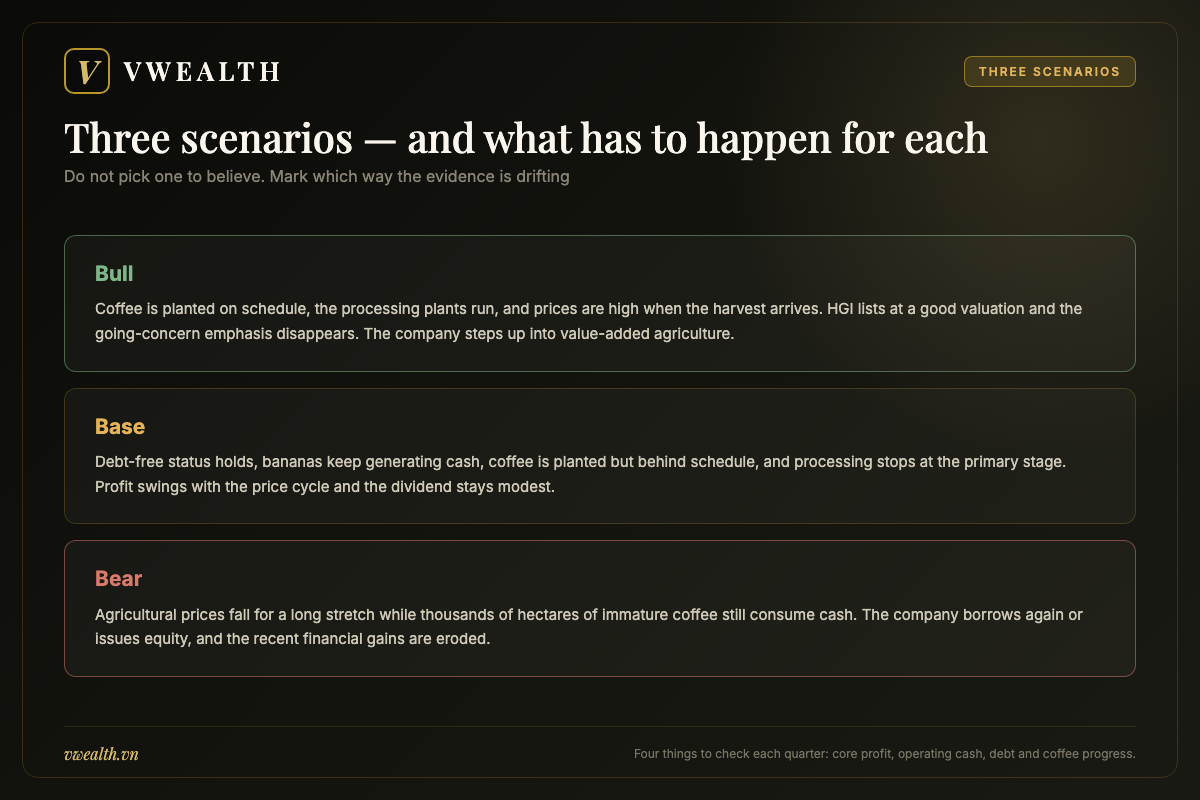
So, should you buy HAG stock?
It is time to pull everything together. There is no single answer that fits everyone, but there is an honest way to answer: list the gains and the losses in full, then hold them up against yourself.
What is working in HAG’s favour
First, the company has genuinely come through the hardest part. From total liabilities above VND 35 trillion in 2016, HAGL has settled the HAGLBOND16.26 issue, had more than VND 1,500 billion of interest forgiven, redeemed early, and declared at the April 2026 AGM that it no longer carries interest-bearing debt. The accumulated deficit was fully cleared from the second quarter of 2025 and the stock came off the warning list in August 2025. These are not promises; they are disclosed outcomes. For a company that once faced insolvency, that is a very long road travelled.
Second, the underlying assets are real and hard to copy. Thousands of hectares of contiguous farmland in the Central Highlands, Attapeu, Champasak and Stung Treng cannot be assembled in a few years with money alone. Neither can the experience of operating large growing areas, nor the ability to meet the standards of demanding markets such as Japan.
Third, the structure is far tidier. From more than fifty subsidiaries and associates in 2016 down to roughly ten entities, plus the complete exit from HNG in early 2026, today’s company is markedly easier to understand than the one that existed a decade ago.
Fourth, there are concrete catalysts within a short horizon: the HGI offering and listing plan, the VND 500 per share dividend planned from 2027, and the possibility that the going-concern emphasis paragraph disappears from the audit report.
Fifth, the underlying industries have positive long-run trends. Vietnamese banana exports are approaching the billion-dollar mark, durian demand is large, and Vietnamese coffee holds a solid global position.
What is working against it
First, earnings quality. Roughly 50 per cent of the 2026 profit plan comes from financial reversals as debt is written off, and the remainder includes subsidiary divestments. This is real profit in the accounts but it does not repeat. Any investor who values HAG by extrapolating 2026 profit is building on sand.
Second, the company has no pricing power. Bananas, durian, pigs and green coffee are all basic commodities. Margins move with world prices, and the company has no instrument for defending them. This is a structural characteristic, not a temporary problem.
Third, the execution record in value-added activities is not yet convincing. Bapi lasted 583 days and was sold for VND 27.5 billion. The Lamon beef brand never became a pillar. The million-pig and ten-million-chicken targets did not materialise. None of this means the coffee plan will fail, but it obliges you to apply a discount to every announced number.
Fourth, key-person concentration. The company is bound to one individual born in 1962, with no clearly identified operating successor. A personal brand is an asset, but it is also a single point of failure.
Fifth, high speculative content. HAG swings hard on news and remarks, carries an unusually high density of rumour, and has just regained margin eligibility — which widens the price range in both directions.
Sixth, the sector’s own risks: African swine fever, tighter Chinese phytosanitary enforcement on bananas and durian, extreme weather, and policy risk in the countries where the growing areas sit.
Set the two columns side by side and the picture gets much clearer.
| In favour | Against |
|---|---|
| Accumulated deficit cleared from Q2 2025; off the warning list from August 2025 | The auditor flagged a going-concern uncertainty in the reviewed half-year 2025 statements |
| Declared free of interest-bearing debt at the April 2026 AGM, down from a peak above VND 35 trillion in 2016 | About half the 2026 profit plan comes from financial reversals that do not repeat |
| Large contiguous land bank across three countries, very hard to replicate | Leased foreign land carries policy, currency and lease-renewal risk |
| Bananas turn land into cash in 9–10 months and already reach Japan and South Korea | Around 70 per cent of banana exports depend on China; price is set by supply and demand |
| The coffee bet could move the company into value-added processing | Coffee needs about three years to first harvest, and expansion begins just after a price peak |
| HGI’s offering and listing path bring capital without new debt and create a valuation reference | Issuance at the subsidiary dilutes profit attributable to HAG shareholders |
| Structure down to roughly ten entities; full HNG exit in early 2026 | A history of repeated strategic pivots makes any plan harder to take at face value |
| Cash dividend of VND 500 per share planned from 2027 after more than a decade | No dividend in 2026, and VND 500 is symbolic rather than material income |
What kind of investor HAG suits
This is the most important part of the article, because it moves the question from “is this a good stock” to “is this stock a good fit for whom”.
HAG may suit you if: you accept large drawdowns and can sit still through double-digit declines; you understand and accept that profit swings with the agricultural price cycle; you will actually follow the company, opening the accounts at least once a quarter rather than relying on headlines; you have a horizon long enough for the coffee bet to produce results, meaning at least four to five years; and you can distinguish core profit from one-off profit when you read a report.
HAG probably does not suit you if: you need a steady stream of cash dividends to spend; you want an investment you can hold for years without monitoring; you are investing with borrowed money or with money you might need to withdraw at any moment; you are easily pulled along by news and social media commentary; or you value stocks mainly by last year’s P/E. For those needs, businesses with steady profits and long dividend records — branded consumer names, or a stabilised retail model such as FRT of FPT Retail — are a far better match.
And if you do decide to buy, buy with discipline.
Suppose that after all of this you still want HAG in the portfolio. The four rules below are not recommendations; they are ways of limiting the damage when you turn out to be wrong.
The first rule is a position limit. A stock with high speculative content, key-person concentration and commodity-driven profit should not be a large share of anyone’s portfolio. Set yourself a ceiling and respect it even while the stock is rising.
The second rule is to build the position in stages rather than in one order. With a high-volatility name, spreading purchases over time reduces the risk of getting the entry point wrong — something nobody does consistently well.
The third rule is to set fixed review points. Each quarter, open the report and answer four questions: is core profit, after stripping out one-off items, growing; is operating cash flow positive; are borrowings rising again; and is coffee progress consistent with what was disclosed last period? If three of the four answers are no for two consecutive quarters, the evidence is contradicting your thesis.
The fourth rule is no leverage. A stock that has just regained margin eligibility and carries a large retail register is exactly the kind that produces cascading forced selling when the price turns. Someone using leverage on a name like this can be entirely right about the business and still lose money by being forced out at the bottom.
Final word: a company that has repaid its past and is now borrowing from its future
The Hoang Anh Gia Lai story is a rare one on the Vietnamese market. Very few companies have carried more than VND 30 trillion of liabilities and come back. Very few founders have stayed in the chair long enough to witness both the peak and the trough and then lead the way out. On that count, what HAGL achieved between 2021 and 2026 deserves to be acknowledged squarely.
But acknowledging the past and valuing the future are two different jobs. The company has repaid the financial debts of its past, and is now borrowing from its future in a different way: putting money into the ground today and waiting three to five years to get it back. That is precisely the model that failed badly with rubber fifteen years ago. This time it enters with less debt, a more conservative scale, and a banana business generating cash to fund the waiting period. Those are real, meaningful differences — but not enough to turn a gamble into a safe investment.
So, should you buy HAG stock? If you read this article and found yourself nodding through the “may suit you if” list, HAG is an opportunity worth considering — at a moderate position size, over a long horizon, with a commitment to review it every quarter. If you nodded more often through the “does not suit you” list, passing on this ticker is not a missed opportunity; it is a correct decision. In markets, knowing what does not suit you is worth as much as knowing what does.
The one thing you should not do is decide on the basis of affection or antipathy toward a name. HAGL is not bau Duc, and HAG stock is not a vote for or against anybody. It is a fractional ownership in a business with specific assets, specific cash flows and specific risks. Treat it that way — open the reports, read the numbers, ask questions, and update when the evidence changes. If you do not yet have the tools to do that quickly, start by creating a vwealth account and letting the machine handle the data retrieval.
Research Vietnamese stocks in English with vwealth. Our AI-powered platform turns Vietnamese market data into full English analysis reports — with international payment support and a free 2-month trial for new accounts. Create your free account and read the latest reports.