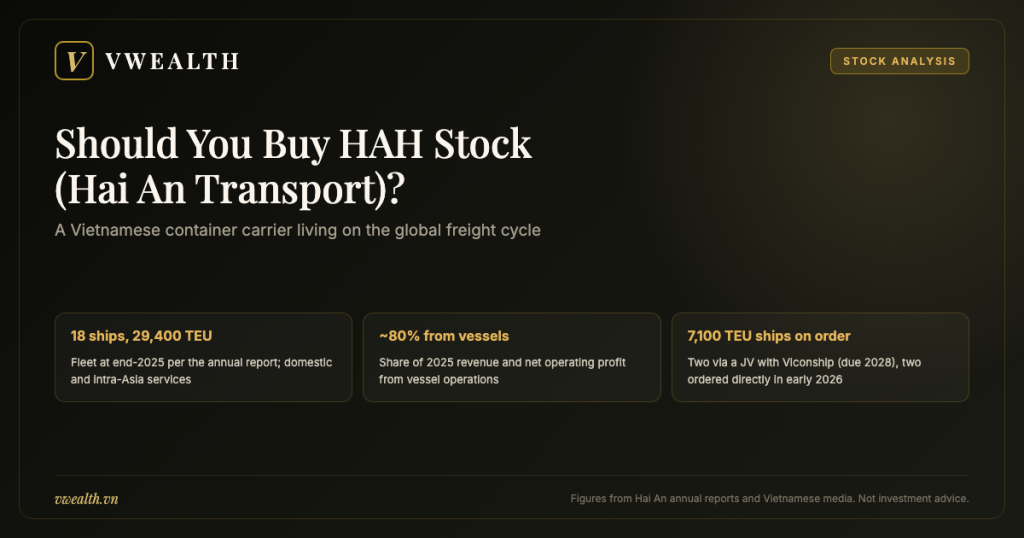
Should you buy HAH stock? HAH is the ticker of Hai An Transport and Stevedoring Joint Stock Company, a Vietnamese container shipping line listed on the Ho Chi Minh City Stock Exchange (HOSE) since March 11, 2015 — and its profits move with events thousands of nautical miles from its home port of Hai Phong. In 2020, Hai An earned roughly VND 138 billion in net profit attributable to shareholders. Two years later, when global container freight rates hit record highs during the pandemic, that figure jumped to about VND 822 billion. In 2023, as rates cooled, profit fell back to around VND 385 billion. Then in 2025, after the Red Sea crisis, the company posted a record of roughly VND 1,207 billion. Same company, same core route between Hai Phong and Ho Chi Minh City, yet results swung several-fold. That is the essential character of HAH: a domestic container carrier that lives and dies by the global freight cycle. Since late 2025, the story has gained two new layers — port operator Viconship has become the largest shareholder group, and Hai An has ordered 7,100 TEU ships for the first time, twice the size of anything it has ever operated. So the question of whether to buy HAH stock is no longer just about whether freight rates are high this year.
A note on how this analysis works, as with every company profile in the vwealth series. Dates, names, vessel names and financial figures come from published sources: Hai An’s annual reports for 2019, 2022, 2024 and 2025, its consolidated financial statements (compiled through VNDirect’s financial database), the company website haiants.vn, disclosures filed with the Ho Chi Minh City Stock Exchange, the minutes, resolutions and documents of the 2026 annual shareholder meeting, the governance report for the first half of 2026, and Vietnamese financial media including CafeF, Vietstock, VnEconomy and VietnamFinance. Where sources disagree, both figures are shown. Any number that vwealth derived by dividing or multiplying published figures is labeled “vwealth estimate.” This article does not quote today’s share price, current P/E or P/B, current market capitalization or the latest quarterly profit, because those change daily; for up-to-date numbers, open the latest vwealth analysis report. Figures are in Vietnamese dong (VND); as a rough guide for international readers, VND 1,000 billion is on the order of USD 38–40 million at 2025–2026 exchange rates.
If you are new to investing in Vietnam, start with our guide on how to invest in the Vietnam stock market, which covers account opening for foreigners, foreign ownership limits, settlement and daily price bands. If you have already read our VSC stock analysis of Viconship, you have seen this story from the buyer’s side: a port operator accumulating HAH shares and stepping into the shipping business. This article tells it from the other side of the table — from the deck of the ship. And if you know our GMD analysis of Gemadept, keep one fundamental difference in mind: a port collects a fee on every box that crosses its quay, whereas a shipping line earns the spread between freight rates and the cost of running ships — a spread that can balloon or vanish within a few quarters.
From a Container Berth in Dinh Vu to an 18-Ship Fleet: The History of Hai An
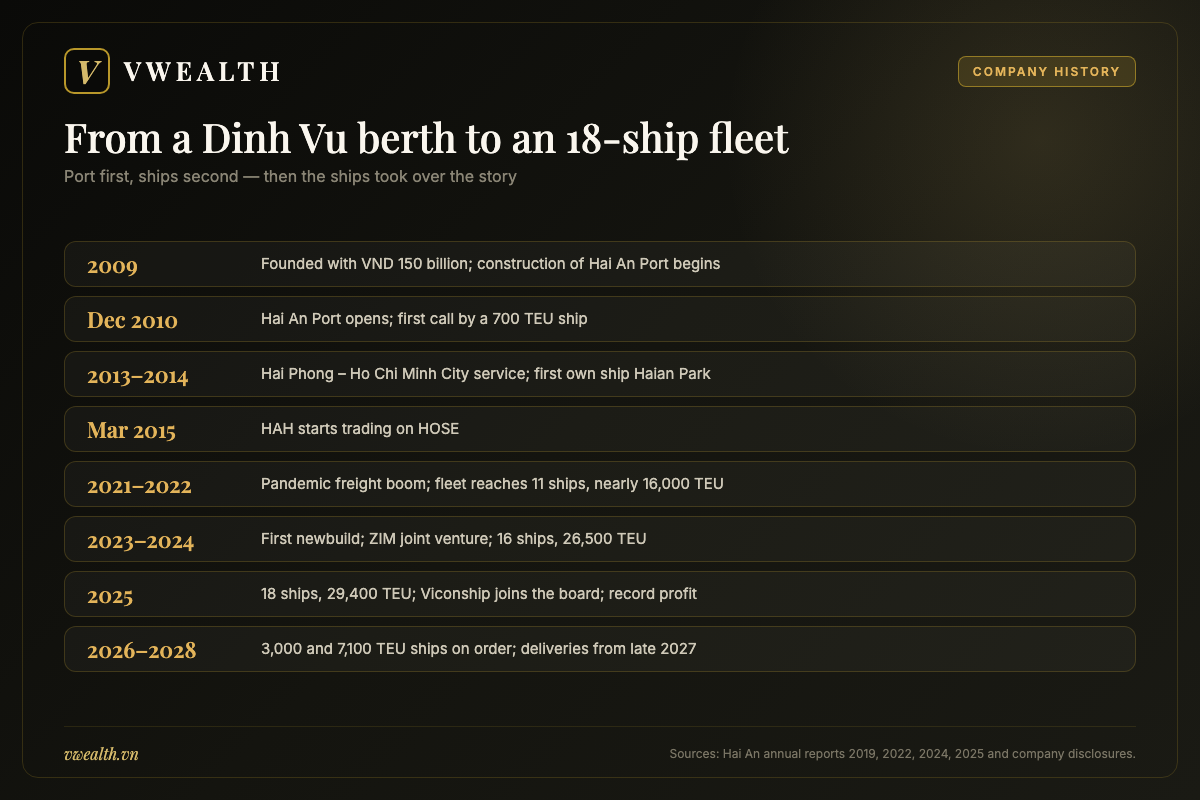
Many Vietnamese shipping companies grew out of state-owned conglomerates. Hai An did not. It was born from a group of private maritime companies, started by building a small port in Hai Phong, and only later stepped into the shipping business. Understanding that order — port first, ships second — explains why Hai An still runs both businesses today, and why the one that came second became the one that decides the fate of the stock.
2009–2011: Seven Maritime Companies Build a Berth
According to the company’s own annual reports, Hai An began life as Hai An Transport and Stevedoring Co., Ltd., incorporated in Hanoi on May 8, 2009 with charter capital of VND 150 billion. Its four founding investors were maritime businesses: Maritime Supply and Technical Services JSC, Hanoi Maritime JSC (formerly MHC JSC), Hai An Shipbuilding and Repair JSC, and Hai Minh JSC. The initial goal was very specific: build and operate a container terminal in the Hai Phong area. Construction of the first container berth began in May 2009.
In October 2010, charter capital rose to VND 187.5 billion as three more companies joined: Hai Ha Investment and Transport JSC, Maritime Services JSC (later MACS Shipping) and Ho Chi Minh City Foreign Trade Forwarding and Warehousing JSC (later Transimex). The same month, the company set up a wholly owned subsidiary, Hai An Port Co., Ltd. After about 20 months of construction, phase one of the terminal was complete. The inauguration took place on December 15, 2010, with the first vessel alongside being the 700 TEU “MV Mell Senang” of Mariana Express Lines. (The 2025 annual report dates the start of port operations to December 12, 2010; the 2019 report dates the ceremony to December 15, 2010 — one is the operating date, the other the ceremony.)
TEU — twenty-foot equivalent unit — is the unit you will meet throughout this article: one TEU equals one standard 20-foot container. A 700 TEU ship carries about 700 small boxes, or roughly 350 forty-footers. For perspective, the ships Hai An ordered in 2025–2026 carry about 7,100 TEU, ten times the first vessel that called at its terminal.
On September 19, 2011, the company converted into a joint stock company and was renamed Hai An Transport and Stevedoring JSC, with the seven founding shareholders listed above. The words “transport and stevedoring” already signaled the ambition: not only loading and unloading boxes at the quay, but also carrying them. At that point, however, Hai An owned no ships.
2012–2014: From the Quay to the Deck — the Haian Park
In its early years, Hai An lived off its port. The vessel-call log in its annual reports reads like a list of international customers: a Yang Ming ship from Taiwan in 2011, a K-Line vessel the same year, an RCL ship from Thailand in 2013, and on July 4, 2013 the 1,805 TEU “YM Inventive,” 172.5 meters long — the largest ship to have worked cargo at Hai An up to that time. In 2012, the company merged with Hai An Shipbuilding JSC, raising charter capital to about VND 231.96 billion, and set up Hai An Agency and Logistics Co., Ltd. for agency and logistics work.
The turning point came on September 1, 2013, when Hai An launched a domestic container service on the Hai Phong – Ho Chi Minh City – Hai Phong route, initially with chartered-in tonnage. On March 19, 2014, it signed an agreement to buy its first container ship; on May 8, 2014 it took delivery of the “Haian Park” in Shanghai with a handover ceremony in Hamburg, and on May 16, 2014 the vessel entered the domestic service. In June 2014, Hai An announced a three-sailings-per-week schedule. In October 2014, a second ship, the 1,121 TEU “Haian Song,” was delivered in Singapore.
Why would a port company buy ships? The logic is simple. Containerized trade between northern and southern Vietnam needs a conveyor belt at sea: consumer goods, industrial products and raw materials flow both ways all year. By owning ships, Hai An could sell freight and fill its own berth in Hai Phong at the same time. The port feeds the ships, the ships feed the port — at least on paper. In practice, as later chapters show, the shipping business grew so fast that it swallowed the port story entirely.
2015–2019: HOSE Listing and the Years of Cheap Freight and Thin Margins
On January 21, 2015, the Ho Chi Minh City Stock Exchange approved Hai An’s listing under Decision No. 15/QD-SGDHCM. On March 11, 2015, 23,196,232 HAH shares began trading at a par value of VND 10,000. Historical trading data show a reference price of VND 40,000 per share on debut day; HOSE’s daily price band for a first session was 20% at the time, and the stock closed its first session at VND 47,500. Those are unadjusted historical prices. After many rounds of stock dividends, the equivalent level on today’s adjusted basis is far lower.
In its listing year, Hai An bought its third ship, the “Haian Time,” built in Japan in 2001 with a capacity of 1,032 TEU and delivered in Thailand on September 29, 2015. In November 2015, it established Hai An Container Transport Co., Ltd. (HACT), initially holding 50.5%; by end-2025 HACT had charter capital of VND 200 billion and Hai An owned 55.94% — the unit that would become the backbone of the shipping business. In 2016, Hai An’s liner service began calling at Cai Mep, the deep-water port cluster serving southern Vietnam. 2017 was a busy year: Hai An became general agent in Vietnam for South Korea’s SM Line, signed a joint venture with Pantos Holding of Korea to create Pan Hai An Co., Ltd. and build a logistics center in Hai Phong, set up Hai An Freight Forwarding JSC, and bought the “Haian Bell.” 2018 brought the “Haian Link” and a Hai Phong – Hong Kong – South China service; 2019 added the “Haian Mind.”
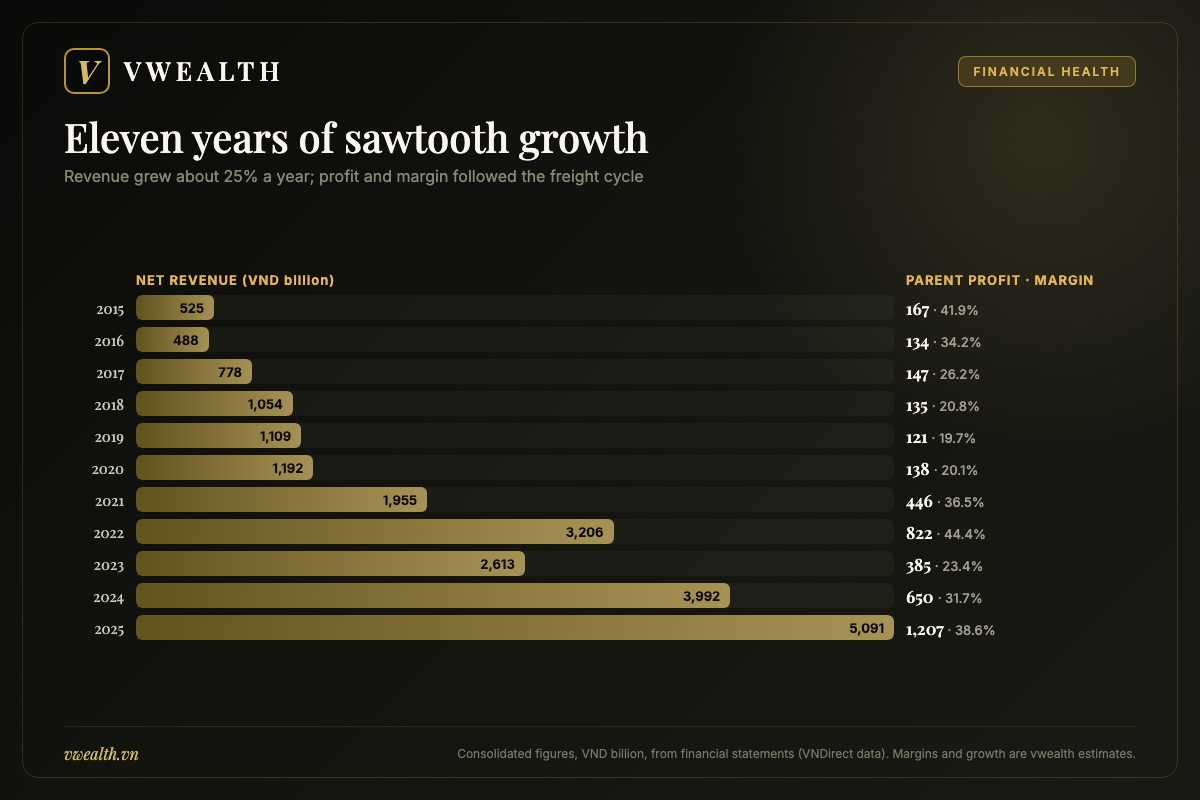
Operationally, this was a period of strong growth. In 2019, Hai An’s fleet carried about 267,761 TEU, 22.8% above plan, while Hai An Port handled 256 vessel calls and about 312,152 TEU. Financially, the picture was very different. According to the consolidated statements, net revenue roughly doubled from about VND 525 billion in 2015 to about VND 1,109 billion in 2019, yet net profit attributable to the parent fell from about VND 167 billion to about VND 121 billion. Gross margin shrank from about 42% to about 20% (vwealth estimate from the financial statements). In other words, Hai An sold more but kept less of each dong: domestic freight was cheap, the market had plenty of ships, and the lower-margin shipping business made up a growing share of the mix.
The share price told the same story. On VNDirect’s adjusted price series, HAH drifted sideways and then lower through 2016–2019; the adjusted price at the end of 2019 was only about 55% of the debut-day close (vwealth estimate). Buying HAH in those years meant buying a small port operator with a domestic shipping arm and modest profits. Few imagined it was about to become one of the best-performing stocks on the exchange.
2020–2022: The Pandemic Freight Boom Turns a Small Carrier into a Cash Machine
In early 2020, the pandemic froze world trade, and HAH’s adjusted price bottomed at around VND 2,178 on March 23, 2020, according to VNDirect data. Within months, everything reversed. Consumers in rich countries, stuck at home, bought goods instead of services. Ports congested, containers piled up in the wrong places, and ships took many more days to complete each loop. When each ship completes fewer voyages, effective supply falls while demand rises — and global container rates climbed to levels never seen before. The Shanghai Containerized Freight Index (SCFI), the industry’s best-known gauge, peaked in early 2022.
Hai An does not run trans-Pacific services, but it benefited through two channels. First, domestic and intra-Asia rates rose along with the global market. Second, and more important, were time-charter rates: when the big carriers ran short of tonnage, they were willing to pay very high rates to charter even 1,000–2,000 TEU vessels like Hai An’s. The company expanded quickly. On April 9, 2021 it bought the “Haian East” (built in Germany in 2008, 1,702 TEU), taking the fleet to eight ships; on April 29, 2021 it took delivery of its ninth vessel, the “Haian West” (1,740 TEU). In 2022 came the “Anbien Bay” (1,794 TEU), the “Haian City” (1,577 TEU), the “A Roku,” and on November 11, 2022 the “Haian Rose” (1,708 TEU). After that delivery, the 2022 annual report put the fleet at 11 ships with a total capacity of nearly 16,000 TEU. In March 2022, Hai An opened a Hai Phong – Hong Kong – Nansha service, the first time a HaiAn Lines vessel worked cargo at a mainland Chinese port.
The financial results changed at dizzying speed. Consolidated net revenue rose from about VND 1,192 billion in 2020 to about VND 1,955 billion in 2021 and about VND 3,206 billion in 2022. Net profit attributable to the parent went from about VND 138 billion to about VND 446 billion and then about VND 822 billion — almost six times in two years. Gross margin jumped from about 20% in 2020 to about 44% in 2022 (vwealth estimate). The adjusted share price rose roughly fivefold from its January 2021 low to its November 2021 high, then set a new peak on June 3, 2022 (vwealth estimate from VNDirect adjusted prices).
The lesson of this period is one every HAH investor should memorize: most of the extra profit did not come from Hai An suddenly becoming six times better at its job. It came from the price of the entire industry’s service shooting up. And what the market gives, the market can take back.
2023–2024: The Fall From the Peak, the First Newbuild and the Red Sea Boost
Every fever breaks. From mid-2022, port congestion cleared, ships turned around faster again, and a wave of newbuilds ordered during the boom started delivering. Freight and charter rates tumbled. HAH’s adjusted share price fell from its June 3, 2022 peak to a November 15, 2022 low, a loss of about 73% in just over five months (vwealth estimate from VNDirect adjusted prices). The 2023 results confirmed what the market had anticipated: net revenue slipped to about VND 2,613 billion and profit attributable to the parent dropped to about VND 385 billion, less than half the 2022 figure.
Yet 2023 was also the year Hai An laid the foundations for its next chapter. It took delivery of the first newbuilding in its history, the 1,800 TEU “Haian Alfa.” It formed a joint venture with Israeli carrier ZIM to launch Lotus Link, a direct Vietnam – Malaysia – India service with the rotation Hai Phong – Ho Chi Minh City – Port Klang – Kattupalli – Chu Lai – Ho Chi Minh City – Hai Phong. It started container handling services at Long An International Port and raised charter capital to about VND 1,055 billion.
In late 2023, Yemen’s Houthi forces began attacking merchant ships in the Red Sea. Many major carriers diverted around the Cape of Good Hope, adding thousands of nautical miles to Asia – Europe voyages. Hai An’s own 2025 annual report estimates that a return of ships to the Red Sea – Suez route could lift effective transport capacity by up to 10% because voyages would be more than 3,000 nautical miles shorter — which is another way of saying that roughly that much capacity was drained from the market while ships sailed the long way round. Once again, effective supply shrank and freight and charter rates climbed. Hai An does not serve Europe, but the big lines redeployed small and mid-size ships to fill gaps, which tightened the market for Hai An-sized tonnage as well.
In 2024, Hai An took delivery of three more 1,800 TEU newbuilds of the same “SDARI Bangkok Max IV” design, named Haian Beta, Anbien Sky and Haian Opus. On November 13, 2024, it received the 3,500 TEU “Toro,” renamed Haian Gama — the 16th ship in the fleet, lifting total capacity to about 26,500 TEU according to the 2024 annual report. To pay for this, Hai An issued VND 500 billion of privately placed convertible bonds to four investment funds: JSEAFF, DSVGF, VGIF and SSIAM. Fleet volume in 2024 reached about 605,900 TEU, 139% of the 2023 level: domestic cargo about 403,839 TEU (up 21%) and international cargo about 202,061 TEU (up 92%), largely thanks to a Singapore service operated in cooperation with Ocean Network Express (ONE) from January 2024. Profit attributable to the parent recovered to about VND 650 billion.
2025–2026: Viconship Arrives, 7,100 TEU Ships and a Record Year
2025 was Hai An’s most profitable year to date. According to the 2025 annual report, total revenue reached about VND 5,151 billion (consolidated net revenue about VND 5,091 billion), and consolidated profit after tax attributable to the parent was about VND 1,206 billion, 5.83% above the VND 1,140 billion target stated in the report. For comparison, the plan first approved by the June 2025 shareholder meeting was only VND 865 billion of consolidated profit after tax, according to CafeF — so the target was raised during the year as freight and charter rates beat expectations. During the year, the company took over two second-hand ships, HA Zeta (February 2025) and HA Iris (October 2025), bringing the fleet to 18 vessels with 29,400 TEU of capacity. (The milestone page of the same report says “29,300 TEU” — a 100 TEU discrepancy between two pages; this article uses the investment section’s 29,400 TEU.)
But what made 2025 a turning point was not the profit number. First, Viconship (VSC), a major port operator in Hai Phong, kept buying HAH shares; its Chairman Nguyen Xuan Dung and CEO Ta Cong Thong joined Hai An’s board on June 26, 2025, and by the end of 2025 the Viconship group held about 23.99% of the company. Second, Hai An moved from buying used ships to ordering large newbuilds: in May 2025 it contracted two 3,000 TEU ships at Jiangsu New Yangzi Shipbuilding, later expanded to four 3,000 TEU ships at Yangzijiang (three for the parent, one for HACT), with the first delivery expected in December 2027 and the rest following at roughly three-month intervals. Third, in August 2025 Hai An and Viconship created a joint venture, Hai An Green Shipping Lines Co., Ltd., with initial charter capital of VND 1,000 billion, 60% owned by Viconship and 40% by Hai An. On November 12, 2025, the JV signed contracts with China Shipbuilding Trading and Dalian Shipbuilding Industry for two 7,165 TEU ships at USD 86.6 million each, due for delivery in June and September 2028.
In 2026, the pace of expansion only accelerated. A written shareholder consultation, with votes counted on March 16, 2026, approved an investment plan for new container ships under a board proposal dated March 2, 2026; the press (VnEconomy, Mekong ASEAN, CafeF) reported total investment capped at USD 184 million for two ships of about 7,100 TEU, built by CSTC and Dalian like the JV’s pair. The June 2026 shareholder meeting documents confirm that these two 7,100 TEU contracts were signed in early 2026, alongside the four 3,000 TEU contracts signed in 2025. Also in March 2026, Bao Dau tu and Mekong ASEAN reported that Viconship and Hai An would cooperate on investing in five container ships. In August 2026, Hai An’s board approved the JV’s purchase of the second-hand “Buxmelody” (formerly Maruba Maxima), a 2,702 TEU vessel built in Germany in 2008, at a disclosed value of more than VND 755 billion, or about USD 28.6 million.
The JV did not wait for its newbuilds either. According to Vietstock, in the first half of 2026 Hai An Green Shipping Lines took over the 1,060 TEU Green Park from Transimex, and on May 5, 2026 it took delivery of the Hammonia Baltica, built in Germany in 2011 and renamed Green Time, with capacity of nearly 2,800 TEU; the ship remains on time charter to Maersk on a Mediterranean – West Africa service. With Green Time, the number of ships Hai An owns, manages and operates (including the two JV ships) reached 20, with total capacity of about 33,000 TEU — consistent with the about-us page of haiants.vn (viewed in September 2026). At the June 2026 meeting, management called this a “walking on two legs” strategy: buy second-hand ships for immediate capacity and cash flow, while ordering newbuilds for the long term.
The table below summarizes Hai An’s key milestones at a glance.
| Date | Event | Why it matters |
|---|---|---|
| May 8, 2009 | Hai An Transport and Stevedoring Co., Ltd. founded with VND 150 billion | Four maritime companies team up to build a port |
| Dec 2010 | Hai An Port starts operating; 700 TEU Mell Senang is first to call | First port revenue |
| Sep 19, 2011 | Converted into a joint stock company with seven founders | Hai Ha, MACS and Transimex join |
| Sep 2013 | Domestic container service Hai Phong – Ho Chi Minh City launched | Entry into liner shipping |
| May 2014 | First owned ship, Haian Park, delivered | From chartering in to owning |
| Mar 11, 2015 | HAH starts trading on HOSE | 23.2 million shares listed |
| 2017 | General agent for SM Line; Pan Hai An JV with Pantos | Agency and warehousing expansion |
| 2021–2022 | Rapid second-hand purchases; fleet reaches 11 ships, nearly 16,000 TEU | Full exposure to the pandemic boom |
| 2023 | First newbuild Haian Alfa; Lotus Link JV with ZIM | Longer intra-Asia routes |
| 2024 | Three more 1,800 TEU newbuilds and 3,500 TEU Haian Gama; VND 500 billion convertible bonds | 16 ships, about 26,500 TEU |
| 2025 | 18 ships, 29,400 TEU; Viconship group joins the board; Hai An Green Shipping Lines JV | Record profit; 3,000 and 7,100 TEU ships ordered |
| 2026 | Two 7,100 TEU contracts signed (up to USD 184 million); JV takes over two used ships, fleet of 20 at about 33,000 TEU; bonds-with-warrants plan | Largest investment cycle in the company’s history |
Who Runs Hai An and Who Owns It: From Maritime Founders to the Viconship Group
For a shipping line, management makes three life-or-death decisions: when to buy ships, how to pay for them, and whether to charter them out or run them in-house. Get the timing wrong at the top of the cycle — buying expensive ships with borrowed money — and the damage can eat into profits for years. So before asking whether to buy HAH stock, you should know who is on the bridge, and where the shareholder base is heading.
The Board and Management: A Former Seafarer as CEO
According to the 2025 annual report, Hai An’s board of directors has seven members elected by the general meeting of shareholders (GMS), chaired by Mr. Vu Thanh Hai. Other members are Ms. Tran Thi Hai Yen (independent), Mr. Nguyen Ngoc Tuan, Mr. Nguyen Duc Kien, Mr. Le Anh Minh, and two members elected on June 26, 2025, Mr. Nguyen Xuan Dung and Mr. Ta Cong Thong, who replaced Mr. Pham Quang Khanh and Mr. Nguyen Van Truc on the same day. Hai An’s own annual report identifies Mr. Dung as Chairman and Mr. Thong as CEO of Vietnam Container Shipping JSC (Viconship). A three-member supervisory board — a feature of Vietnamese corporate governance that sits alongside the board — is headed by Ms. Nguyen Thi Thanh Tu.
Day-to-day operations are run by General Director (CEO) Nguyen Ngoc Tuan, born in 1974 in Ha Nam province, a marine navigation engineer with a bachelor’s degree in international economics. His résumé in the annual report describes a career that started on deck: from 1999 to 2004 he was a seafarer with a shipping and international labor cooperation company; from 2004 to 2008 he headed operations at the Hai Phong branch of Hanoi Maritime JSC; from 2009 to 2010 he was director of the Hai Phong branch of Marina Logistics & Agencies Co., Ltd.; and from early 2011 he was deputy director of Hai An Port Co., Ltd. The two deputy general directors are Mr. Vu Doan Hanh and Mr. Pham Quang Khanh; the chief accountant is Ms. Tran Thi Thanh Hao.
A notable detail is how little stock the executives own directly. The 2025 annual report lists individual holdings from tens of thousands of shares up to about 227,651 shares — at most about 0.135% of charter capital. Chairman Vu Thanh Hai separately acts as the representative of the stake held by Hai Ha Investment and Transport JSC — 28,987,421 shares according to the 2025 annual report. Power at Hai An, therefore, does not sit with management’s personal stakes but with the institutional shareholders behind them — and that list has changed dramatically in the past two years.
Hai Ha and the Founding Maritime Shareholders
For many years, Hai An’s largest shareholder was Hai Ha Investment and Transport JSC, one of the seven founders of 2011. The 2024 annual report shows that Mr. Vu Thanh Hai sits on Hai Ha’s board, and that during 2024 Hai Ha raised its stake in Hai An from about 15.33 million shares (14.53%) to about 20.43 million shares (16.83%). Vietnamese media also reported in 2024 that a relative of the chairman registered to buy additional HAH shares. In the related-party section of the reports, names such as Marina Logistics and Hai Ha appear repeatedly: Hai An both sells and buys transport and agency services to and from these entities.
This is not unusual in Vietnam’s maritime industry, where private companies often hold stakes in and do business with one another. But it is a reason to read the related-party note in each of Hai An’s financial statements. In 2025, services provided to related parties amounted to about VND 223.5 billion according to the annual report, up from about VND 122.9 billion the year before. Against net revenue of about VND 5,091 billion, that is a small share (about 4.4%, vwealth estimate), but the upward trend is worth watching.
Enter Viconship: From Financial Investor to the Largest Shareholder Group
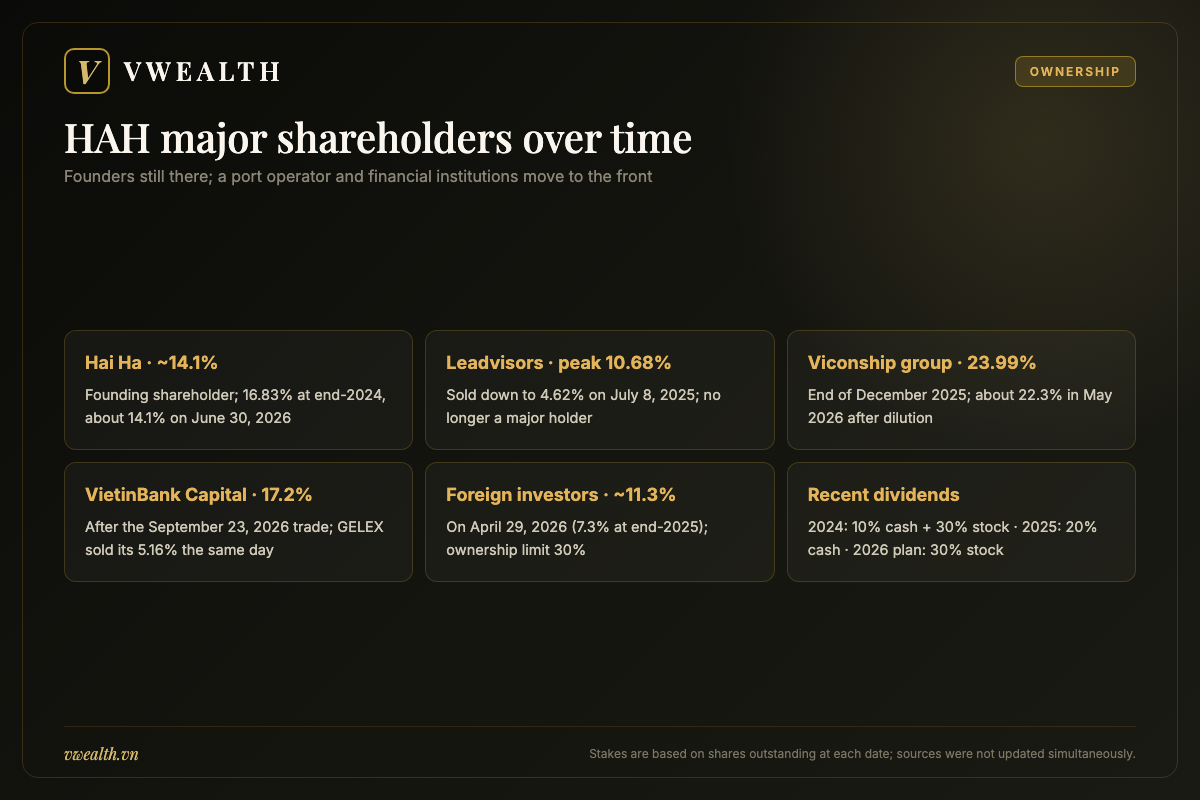
The new chapter in Hai An’s ownership opened in 2025, when Viconship and its subsidiaries bought HAH shares in multiple rounds. According to CafeF, in two sessions on April 29 and May 5, 2025, Viconship raised its direct stake from about 5.4% to 7.45%, with the group (including subsidiaries Green Port Services and Green Logistics Center) at about 8.53%; by May 22, 2025, the group held about 17.11 million shares, or 13.18%. According to CafeF, Viconship bought 1 million shares on December 22, 2025, lifting its stake to about 12.947%; between December 25 and 29, 2025, Viconship bought another 8 million shares (to about 17.68%), its subsidiary Green Logistics Center bought 2 million (to about 2.43%) and its subsidiary Green Port Services bought 4 million (to about 3.87%). In total, the Viconship group held more than 40.5 million shares, or about 23.99% of Hai An’s charter capital, at the end of 2025.
That stake was then diluted when Hai An issued new shares on bond conversion in 2026, and partly restored: in May 2026, Nam Hai Dinh Vu Port Co., Ltd. — a port company in the Viconship group — bought 1,488,540 HAH shares according to a disclosure dated May 20, 2026, and according to CafeF the Viconship group then held about 42 million shares, or about 22.3% of the company. The governance report for the first half of 2026 (as cited by Vietstock) shows Viconship directly holding nearly 29.9 million shares, about 15.86%, while Hai Ha held more than 26.5 million shares, about 14.1%. In other words, founding shareholder Hai Ha remains a large block right behind the Viconship group rather than having left the table. Also in 2026, Marina Logistics & Agencies Co., Ltd. reported that it ceased to be a major shareholder on April 17, 2026, after its stake fell below 5%.
Why would a port operator want to own a shipping line? From Viconship’s perspective, the usual rationale is integration: ports need ships to call, ships need good berths. From the perspective of HAH’s minority shareholders, the practical question is different: when a major shareholder is simultaneously a JV partner, a port service provider and a potential customer, how are minority interests protected? The answer lies in specific transactions — charter rates between the two sides, port tariffs, and how capital and risk are split inside Hai An Green Shipping Lines. Those are the items to read carefully in each year’s shareholder meeting documents.
Funds and Financial Institutions: Leadvisors, VietinBank Capital and Gelex’s Brief Stay
Beyond the Viconship group, financial institutions have become increasingly visible on Hai An’s register — but they also come and go quickly. Leadvisors Fund Management built a position in HAH from late 2024 and at one point held about 13.9 million shares, or 10.68%; on July 8, 2025 it sold nearly 7.9 million shares, dropping to 4.62% and ceasing to be a major shareholder, according to Vietstock. In 2026, VietinBank Capital — the fund management arm of state-controlled VietinBank — became a major shareholder after buying 10.36 million shares on July 30, 2026, lifting its holding from about 4.05% to 9.56%. It then bought another 15 million shares on September 23, 2026, taking its position to about 33 million shares, or roughly 17.2%, as reported by CafeF and Vietstock. VietinBank Capital’s filing lists “entrusted clients managed by VTBC” as related persons, so the 33 million shares should be read as including shares the fund manager holds in its name on behalf of entrusted clients. On that same day, GELEX Group reported selling its entire holding of more than 9.7 million HAH shares (about 5.16%), only about a month after becoming a major shareholder.
The 2025 annual report shows that on December 30, 2025, Hai An had 12,382 shareholders: domestic institutions held about 49.17%, domestic individuals about 43.56%, foreign institutions about 6.94% and foreign individuals about 0.34%. In other words, foreign investors owned only about 7.3% at that date — low compared with many Vietnamese stocks of similar size. The figure then rose quickly: ESOP documents put foreign ownership at 7.269% on February 25, 2026 and 11.313% on April 29, 2026, against a foreign ownership limit of 30% notified by the State Securities Commission in 2023.
What this means for minority investors: HAH is a stock where large blocks can change hands in a single session. On September 23, 2026, negotiated (put-through) trades accounted for more than 15.3 million shares worth nearly VND 722 billion, according to CafeF. Such block trades often coincide with price swings, and the list of major shareholders can look different just one quarter later. If you read this article at a later date, check the latest ownership structure in the vwealth report or the company’s disclosures.
Convertible Bonds, ESOPs and Warrants: How Fast the Share Count Has Grown
A shipping line that wants to grow fast needs capital, and Hai An’s capital comes from three sources: retained earnings, bank loans and new shares. The third leaves the clearest footprint in the share count. At listing in 2015, Hai An had 23,196,232 shares. At the end of 2025, it had 168,861,212 shares according to the annual report. After the March 2026 bond conversion and two employee stock ownership plan (ESOP) issues in 2026, charter capital rose to about VND 1,918.4 billion, equivalent to about 191.8 million shares. That is roughly 8.3 times the listing-day share count after a little more than eleven years (vwealth estimate).
Most of that increase came from stock dividends, which do not change the total value held by existing shareholders — they simply cut the same pie into more slices. Part of it, however, came from issuing shares to new holders below market price, and that part is genuine dilution. The VND 500 billion convertible bond of 2024 is the clearest example. In March 2025, VND 203 billion of bonds converted into 8,551,327 shares, an implied conversion price of about VND 23,740 per share (vwealth estimate). In March 2026, the remaining VND 297 billion converted into 16,979,189 shares (listed in May 2026), implying a conversion price of about VND 17,492 per share after adjustments for stock dividends (vwealth estimate). Around the same time, HAH traded near VND 56,000 per share in mid-March 2026 (closing price on March 16, 2026, per VNDirect data) — so the bondholding funds booked large paper gains, while existing shareholders absorbed the corresponding dilution.
On ESOPs, the March 2026 written consultation cancelled the 2025 ESOP and replaced it with a 2026 program. In 2026, Hai An issued 2.5 million shares (subscription April 7–15, 2026, three-year lock-up) and 3.5 million shares (distribution completed on July 28, 2026 to 624 employees, two-year lock-up), both at VND 10,000 per share. According to CafeF, the first round was priced about 82% below the market price of VND 54,500 on April 7, 2026. Each round amounted to roughly 1.5–1.9% of shares outstanding.
More significant still is the plan approved by the annual GMS on June 6, 2026 (with about 91.4% of votes in favor): a public offering of up to 18,834,040 non-convertible, unsecured bonds to existing shareholders at a 10-for-1 ratio, with a face value of VND 100,000, a five-year tenor and a fixed coupon of no more than 8% a year, raising about VND 1,883.4 billion as equity for shipbuilding contracts already signed and to be signed. According to the proposal in the meeting documents, each bond carries a warrant to buy up to 10 new shares at an expected exercise price of VND 20,000 per share (subject to adjustment), meaning up to about 188.34 million shares could be issued on exercise. If every warrant were exercised, the share count could nearly double from its level when the proposal was drafted (vwealth estimate). Anyone considering HAH stock should read the official documents on this point closely: issuance timing, the warrant exercise window, and whether you would subscribe to the bonds under your rights.
Dividends: Little Cash, Lots of Shares — With 2025 as the Exception
If you are looking for a reliable cash dividend payer, HAH has not historically been a natural choice. VNDirect’s corporate actions data show the recent record: for 2021, 10% in cash (VND 1,000 per share) plus 40% in shares; for 2022, 50% in shares; for 2023, 15% in shares; for 2024, 10% in cash plus 30% in shares. 2025 was the exception: a 20% cash dividend of VND 2,000 per share, record date July 15, 2026, paid August 5, 2026, totaling about VND 376–377 billion according to CafeF. For 2026, the plan approved by shareholders is a 30% stock dividend. At the meeting, management explained that it was holding off on an additional stock dividend out of 2025 profit in order to keep capital as equity for shipbuilding; the 2025 profit distribution allocated about VND 577 billion (60% of profit after tax) to the development investment fund, alongside about VND 376.7 billion in cash dividends. (In Vietnam, dividend percentages are quoted against the VND 10,000 par value, so “20%” means VND 2,000 per share.)
The logic is easy to follow: the company is in a heavy fleet-investment phase, so it keeps cash to pay shipyards rather than distributing it. The cash flow statement confirms this: almost no cash dividends were paid in 2023 and 2024, and about VND 157 billion in 2025 (including payments to non-controlling shareholders of subsidiaries).
| Date | Shareholder / group | Stake (as reported) | Source |
|---|---|---|---|
| End-2024 | Hai Ha Investment and Transport JSC | 16.83% | 2024 annual report |
| Before Jul 8, 2025 | Leadvisors Fund Management | 10.68%, then sold down to 4.62% | Vietstock |
| Late Dec 2025 | Viconship group (VSC, Green Logistics Center, Green Port Services) | 23.99% | CafeF |
| Dec 30, 2025 | Foreign investors (institutions and individuals) | About 7.27% | 2025 annual report |
| May 2026 | Viconship group (after dilution, incl. Nam Hai Dinh Vu Port) | About 22.3% | CafeF |
| Jun 30, 2026 | Viconship (direct) / Hai Ha | 15.86% / 14.1% | H1 2026 governance report (cited by Vietstock) |
| Apr 29, 2026 | Foreign investors | 11.313% (limit 30%) | ESOP documents in the 2026 GMS file |
| Sep 23, 2026 | VietinBank Capital (incl. entrusted clients) | About 17.2% | CafeF / Vietstock |
| Sep 23, 2026 | GELEX Group | Sold all 5.16%; no longer a holder | CafeF |
A caveat on the table: each percentage is calculated on the share count at that date, which keeps changing, and the sources were not updated simultaneously. The table shows the direction of capital — the founding maritime shareholders are still there, but a port operator and financial institutions have pushed into the front row — rather than a precise snapshot on a single day.
How Hai An Makes Money: Ships, Berths and the Links Around Them
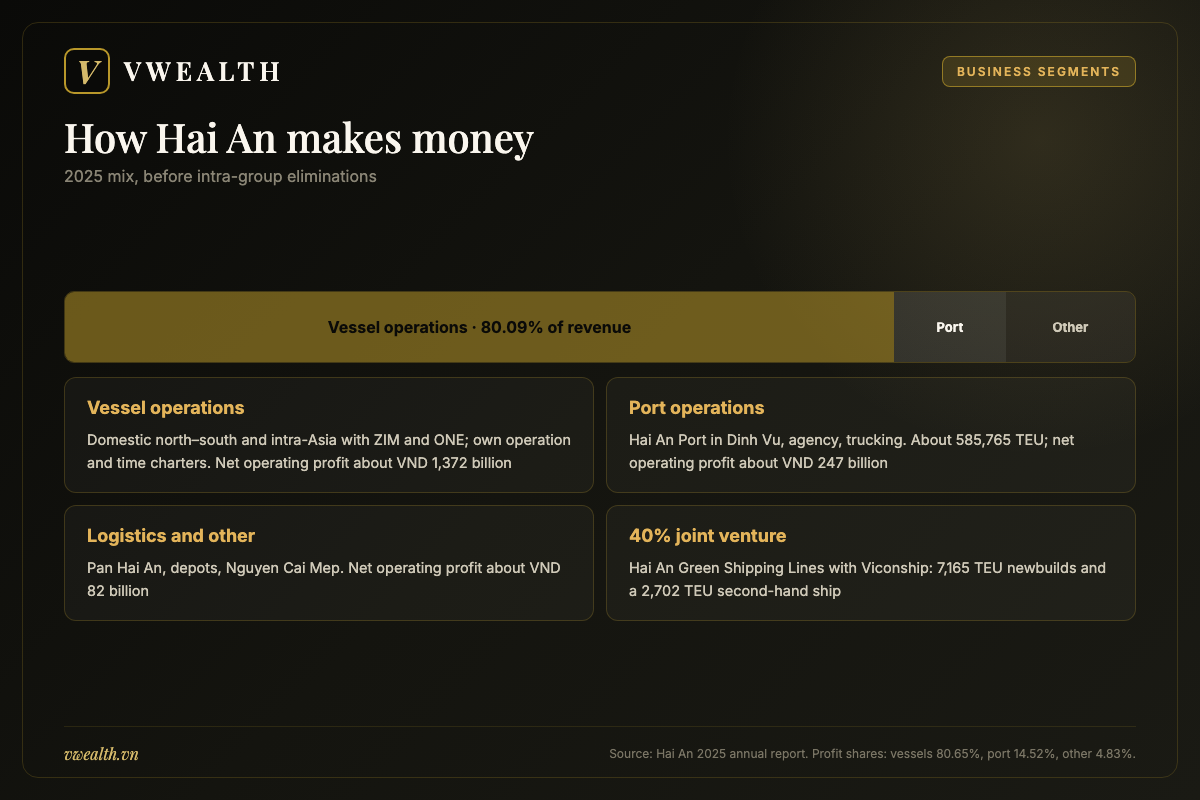
From the company name, you might think Hai An is a port operator with a few ships attached. The 2025 numbers say the opposite. According to the 2025 annual report, in the revenue mix before intra-group eliminations, vessel operations brought in about VND 5,554 billion, or about 80.09%; port operations (port, agency, trucking) about VND 631 billion, or about 9.10%; and other activities about VND 750 billion, or about 10.81%. Net operating profit by segment looks similar: ships about VND 1,372 billion (about 80.65%), port about VND 247 billion (about 14.52%), other about VND 82 billion (about 4.83%). The company itself writes that the vessel business accounts for roughly 80% of group activity. So when you ask whether to buy HAH stock, you are mostly asking about a shipping line.
Domestic North–South Container Shipping: The Economy’s Conveyor Belt at Sea
Hai An’s core route since 2013 has been Hai Phong – Ho Chi Minh City. Cargo moves both ways: southbound, industrial products, materials and consumer goods made in northern industrial parks; northbound, farm produce, food, raw materials and consumer goods. Domestic container shipping has three attractions for a carrier. Demand is tied to domestic consumption and production, so it is less volatile than export cargo. Customers are often long-standing forwarders and shippers. And Vietnam’s cabotage rules — which reserve domestic transport for Vietnamese-flagged ships, with some exceptions — make it hard for foreign lines to compete directly.
In 2024, according to the annual report, Hai An’s domestic fleet volume was about 403,839 TEU, up 21% on 2023. But domestic trade has its downside: domestic rates do not rise nearly as much as international ones during booms, and competition among Vietnamese carriers on the same north–south lane is fierce. In other words, the domestic business is the “floor” that keeps the fleet busy, while the “ceiling” of profit in high-rate years comes mainly from international services and chartering ships out.
Intra-Asia: Sailing With ZIM, ONE and Foreign Partners
From 2018, Hai An began venturing beyond Vietnamese waters with a Hai Phong – Hong Kong – South China service. In 2022 came Hai Phong – Hong Kong – Nansha and Hai Phong – Qinzhou. In 2023, a joint venture with ZIM — the Israeli container line listed in New York — launched the Lotus Link service connecting Vietnam with Malaysia and India. According to the 2025 annual report, Zim Hai An Joint Venture Co., Ltd. has charter capital of about VND 46.11 billion and is 51% owned by Hai An, making it a subsidiary. From January 2024, a Singapore service in cooperation with Japan’s ONE contributed about 85,911 TEU in its first year. Thanks to these services, the fleet’s international volume grew by about 92% in 2024 to about 202,061 TEU. In 2026, the company website reported HACT acting as agent in Vietnam for Indonesia’s Meratus on a service to Indonesia and the southwest Pacific. In October 2025, the newly acquired HAIAN IRIS was deployed on a Hai Phong – Lianyungang (China) service, according to the company.
Sailing with partners lets a small carrier enter international routes without building a global sales network from scratch. In exchange, profits are shared, and in a downturn partners can withdraw ships or cut slot allocations. Hai An’s 2022 annual report set a goal of lifting international volume to 30–40% of total fleet volume by 2025; in 2024 the ratio was about 33% (vwealth estimate: 202,061 out of 605,900 TEU).
Time Charter Versus Own Operation: Hai An’s Most Important Lever
Many investors overlook this concept, yet it explains much of HAH’s profit volatility. A Hai An container ship can be used in two ways. The first is own operation: Hai An runs the ship on its own service, sells space to shippers, and bears fuel, port charges and the risk of sailing half-empty. The second is a time charter: Hai An leases the entire ship, with crew, to another carrier for a fixed period and receives a daily hire; the charterer pays for fuel and port costs and finds its own cargo.
The two have very different risk profiles. Own operation is highly profitable when rates are high but loses money quickly when rates fall or fuel prices spike. Time charters provide more stable cash flow over the contract term, but the rate is locked in at signing — sign at the top and you benefit for years, sign at the bottom and you miss the recovery. Hai An’s annual reports have for years described a strategy of “flexibly using the fleet through both own operation and time charter.” The 2026 plan explicitly mentions “maintaining the structure and ratio between chartered-out and self-operated vessels,” while seeking charterers at good rates and tenors for the 3,000 TEU and 7,000 TEU newbuilds and for existing vessels whose charters expire in 2026.
At the June 2026 shareholder meeting, management said time-charter income accounts for nearly 50% of total fleet revenue, and that the company prefers two-year charters over short six-to-twelve-month deals. The reasoning was stated plainly: short contracts can capture higher rates when the market is hot, but carry large risk when rates turn. According to the meeting minutes, from the start of 2026 to the meeting date, self-operated ships on domestic and intra-Asia routes ran at an average of about 90–95% of capacity.
That last point matters for anyone weighing HAH stock. It tells you that part of the fleet has charters rolling off in 2026, and new rates will depend on the market at re-fixing. The company does not disclose individual contracts, so you cannot calculate the impact precisely; but you can watch international charter rate indices for 1,700–3,500 TEU container ships as an early indicator of Hai An’s charter revenue in coming quarters.
Hai An Port and the Depot: Small but Steady
Hai An Port sits in the Dinh Vu area of Hai Phong and is operated by Hai An Port Co., Ltd. (100% owned, charter capital VND 100 billion). VNDirect’s company profile describes its advantage as a location on the lower Cam River, with a wider approach and deeper draft than upstream terminals, able to receive vessels of up to about 20,000 DWT. In 2024, the port handled 350 vessel calls and about 549,229 TEU, roughly 17.6% above plan; in 2025, port throughput was about 585,765 TEU and depot volume about 180,161 TEU.
In the context of Hai Phong as a whole, Hai An Port is small. The 2024 annual report cites total container throughput in the Hai Phong area of about 7.3 million TEU in 2024, which puts Hai An Port at about 7.5% (vwealth estimate). The deep-water terminals at Lach Huyen can take far larger ships. So the port’s role in the group is a “home berth” for the fleet and a steady fee income, not a growth engine. The company’s 2026 plan also mentions cooperating with other Hai Phong ports to bring Hai An ships in, and seeking to invest in more port capacity to reduce transshipment costs for its fleet — a sign that the existing berth is no longer enough for a growing fleet. This is where the relationship with Viconship, which owns a network of terminals in Hai Phong, becomes practically relevant.
In the south, Hai An owns about 51.54% of Luu Nguyen Cai Mep Port Services JSC (charter capital VND 90 billion), which runs a container yard and port services. The 2026 plan in the annual report includes reviewing the feasibility of the Luu Nguyen Cai Mep project and the BP05 mooring buoy for operations in the south. In 2025, investment property also appeared on the balance sheet for the first time, at about VND 14.5 billion.
Logistics, Agency and Warehousing: The Links Around the Ship
Around the ships and the berth sits a chain of smaller units. Hai An Agency and Logistics Co., Ltd. (75% indirectly owned) handles ship agency and logistics; since 2017 Hai An has been SM Line’s general agent in Vietnam. Pan Hai An Co., Ltd. (51% owned, charter capital about VND 273.77 billion), the joint venture with Pantos Holding, runs warehousing, container yards and inland waterway transport. Hai An Freight Forwarding JSC (about 36.16%) and An Bien Shipping JSC (about 19.02%) are associates and also significant customers: in 2025, services provided to Hai An Freight Forwarding totaled about VND 129 billion and to An Bien about VND 30.6 billion, according to the annual report.
These links do two things. They keep customers inside the Hai An ecosystem from the warehouse to the ship, and they add a little steadier profit than the shipping business. But in scale, the whole “other activities” bucket contributed only about 4.83% of net operating profit in 2025 — a supporting cast, not enough to change the cyclical character of the stock.
Which Business Feeds Which, and Where Hai An’s Moat Lies
The straight answer: the ships feed the whole group in good years, while the port and logistics keep the group from wobbling too much in bad ones. In 2019, a low-rate year, profit attributable to the parent was only about VND 121 billion; in 2022, the peak-rate year, it was about VND 822 billion. Most of that nearly sevenfold gap came from the ships.
As for a moat — a durable competitive advantage — container shipping is an industry where moats are hard to build, because the product is almost a commodity: a box moving from Hai Phong to Ho Chi Minh City is the same box whichever ship carries it. Hai An’s advantages, such as they are, lie in four places. First, scale and schedule reliability on the domestic lane, which builds shipper trust. Second, owning rather than chartering in its ships, which locks in capital cost at purchase — a big plus if bought cheaply, a burden if bought dear. Third, a home port in Hai Phong and the associated logistics units. Fourth, partnerships with international carriers such as ZIM, ONE, SM Line and Meratus, which keep the fleet employed beyond domestic trade. None of these is strong enough to protect profits through a freight collapse, but together they helped Hai An stay profitable through the bad years — the data from 2015 to 2025 show the company never posted an annual loss.
| Segment | Main entities | 2025 revenue (before eliminations) | 2025 net operating profit | Character |
|---|---|---|---|---|
| Vessel operations | Parent, HACT (55.94%), Zim Hai An JV (51%) | About VND 5,554 billion (80.09%) | About VND 1,372 billion (80.65%) | Highly cyclical; depends on freight and charter rates |
| Port operations (port, agency, trucking) | Hai An Port (100%), Hai An Agency and Logistics (75%) | About VND 631 billion (9.10%) | About VND 247 billion (14.52%) | More stable, higher margin |
| Other activities | Pan Hai An (51%), Nguyen Cai Mep (51.54%), depots, warehousing | About VND 750 billion (10.81%) | About VND 82 billion (4.83%) | Supporting, lower margin |
| JVs and associates | Hai An Green Shipping Lines (40%), An Bien (19.02%), Hai An Freight Forwarding (36.16%) | Recognized under the equity method | Hai An Green holds the first 7,100 TEU ships | |
Source: Hai An 2025 annual report; ownership as of December 31, 2025.
Financial Health: Reading a Shipping Line’s Numbers Before You Buy HAH Stock
Reading a shipping company’s accounts is very different from reading a retailer’s or a bank’s. Revenue can double purely on price, profit can halve even as volumes grow, and the largest cost — ship depreciation — involves no cash outlay during the year. This chapter walks through six things to look at, using Hai An’s own numbers.
Eleven Years of Revenue and Profit: A Sawtooth Climb
The table below summarizes Hai An’s consolidated figures from its annual financial statements, via VNDirect’s database. Gross margin is calculated by vwealth as gross profit divided by net revenue.
| Year | Net revenue (VND bn) | Gross margin (est.) | Profit to parent (VND bn) | Depreciation (VND bn) | Interest expense (VND bn) |
|---|---|---|---|---|---|
| 2015 | 525 | 41.9% | 167 | 63 | 4 |
| 2016 | 488 | 34.2% | 134 | 77 | 4 |
| 2017 | 778 | 26.2% | 147 | 79 | 6 |
| 2018 | 1,054 | 20.8% | 135 | 94 | 7 |
| 2019 | 1,109 | 19.7% | 121 | 117 | 17 |
| 2020 | 1,192 | 20.1% | 138 | 137 | 23 |
| 2021 | 1,955 | 36.5% | 446 | 164 | 32 |
| 2022 | 3,206 | 44.4% | 822 | 278 | 57 |
| 2023 | 2,613 | 23.4% | 385 | 364 | 73 |
| 2024 | 3,992 | 31.7% | 650 | 457 | 101 |
| 2025 | 5,091 | 38.6% | 1,207 | 588 | 131 |
Two parallel lines jump out. The first is scale: 2025 net revenue was about 9.7 times the 2015 level, equivalent to compound growth of about 25% a year (vwealth estimate). The second is margin, which rises and falls with the freight cycle: from about 20% in 2019–2020 to about 44% in 2022, down to about 23% in 2023, and back to about 39% in 2025. Profit is the product of the two, so it swings even more than revenue. 2023 is the clearest example: revenue fell about 18%, but profit attributable to the parent fell about 53% (vwealth estimate).
A small data note: the 2025 annual report states consolidated profit after tax attributable to the parent as VND 1,206 billion, while the compiled financial statement data show about VND 1,207 billion — a rounding difference. Total consolidated profit after tax, including non-controlling interests, was about VND 1,401 billion in 2025.
Gross Margin: The Thermometer of the Freight Cycle
For Hai An, gross margin is the fastest indicator of where the company sits in the cycle. The reason is that a shipping line’s costs are largely fixed in the short run: depreciation, crew wages, insurance and maintenance do not change whether rates go up or down. Fuel and port charges vary with the number of voyages, not with the freight rate. So when freight or charter rates rise 20%, most of that increase drops straight into gross profit; when they fall 20%, gross profit shrinks accordingly.
When you read Hai An’s quarterly reports, compare the quarter’s gross margin with the same quarter a year earlier and with the long-term average. Over the past eleven years, the simple average of annual gross margins was about 30% (vwealth estimate). A quarter with a margin far above that level is usually one where rates are elevated; the next question is how long that will last.
Depreciation: A Silent Cost That Has Grown More Than Ninefold
Depreciation is how accountants spread the purchase price of a ship over its useful life. It does not take cash out of the company during the year, but it reflects a reality: ships wear out and must eventually be replaced. Hai An’s depreciation of fixed assets rose from about VND 63 billion in 2015 to about VND 588 billion in 2025, roughly 9.3 times (vwealth estimate). Fixed assets on the balance sheet grew from about VND 855 billion at the end of 2019 to about VND 5,085 billion at the end of 2025.
This has two consequences for anyone weighing HAH stock. First, Hai An’s break-even point is much higher than it was in 2019: the company must earn enough freight to cover roughly VND 588 billion of annual depreciation before it makes a profit. If rates returned to 2019 levels while the fleet and depreciation stayed at 2025 scale, profits could fall much further than they did in 2023. Second, when the newbuilt 3,000 TEU and 7,100 TEU ships arrive from late 2027 and 2028, depreciation will step up again, because a new ship costs far more than the decade-plus-old second-hand tonnage Hai An traditionally bought.
Ship Financing Debt: Moderate Leverage Today, Big Commitments Ahead
Hai An pays for ships with the three sources of money described above, and long-term borrowing is a major one. According to the consolidated statements, total borrowings and finance lease liabilities (short plus long term) grew from about VND 321 billion at the end of 2019 to about VND 1,322 billion at the end of 2022 and about VND 2,330 billion at the end of 2024, then eased to about VND 2,200 billion at the end of 2025. Over the same period, equity rose from about VND 1,255 billion to about VND 5,395 billion. At end-2025, borrowings were therefore about 0.41 times equity; subtracting about VND 534 billion of cash and about VND 54 billion of short-term financial investments gives net debt of about VND 1,612 billion, or about 0.30 times equity (vwealth estimate). The 2025 annual report likewise shows consolidated liabilities to total assets falling from 0.46 in 2024 to 0.38 in 2025.
Another way to measure the debt burden is to compare debt with cash-generating capacity before interest, tax, depreciation and amortization. In 2025, net operating profit was about VND 1,748 billion; adding back about VND 131 billion of interest and about VND 588 billion of depreciation gives a rough EBITDA of about VND 2,467 billion, so total borrowings of about VND 2,200 billion were only about 0.9 times that figure (vwealth estimate). In 2023, a weak-rate year, the same calculation gives about 1.6 times. At end-2025, then, Hai An’s leverage was moderate.
The issue is what lies ahead. Announced commitments include: four 3,000 TEU ships at Yangzijiang (three for the parent, one for HACT), with the first due in December 2027; two 7,100 TEU ships of Hai An’s own with total investment of up to USD 184 million (more than VND 4,800 billion as converted by CafeF); and Hai An’s 40% share of Hai An Green Shipping Lines, which has two 7,165 TEU ships at USD 86.6 million each plus a 2,702 TEU second-hand ship valued at more than VND 755 billion. According to the annual report and board resolutions reported in the press, Hai An’s contribution to the JV has risen step by step: VND 400 billion at founding in 2025, another VND 140 billion in January 2026, about VND 793 billion after a further top-up of more than VND 193 billion in July 2026 to pay the second installment on the two 7,100 TEU ships, and an expected VND 914 billion after a top-up of about VND 121 billion for the Buxmelody; the JV’s charter capital would then be about VND 2,280 billion, with Hai An still at 40%. The two self-ordered 7,100 TEU ships alone are worth nearly as much as Hai An’s entire end-2025 equity (vwealth estimate). The company says funding will come from bank loans, bonds and new shares. At the June 2026 meeting, management said banks used to finance on a 50/50 basis (the company putting up 50% as equity), but some recent credit agreements require only 40% from the company, with some packages at 35% or heading toward 30%. In April 2026, the board also approved a foreign loan secured by company assets at Cathay United Bank (Taiwan). In other words, during 2026–2028 both debt and the share count are likely to rise significantly.
Cash Flow: Earns a Lot, Spends a Lot
A shipping line’s accounting profit usually understates its operating cash flow, because depreciation is added back. For Hai An, cumulative net operating cash flow over 2021–2025 was about VND 6,235 billion, higher than cumulative net profit for the period. But cumulative capital expenditure on fixed assets (mostly ships) over the same five years was about VND 6,840 billion — more than all the operating cash flow (vwealth estimate from the cash flow statements). In 2025, the company also spent about VND 422 billion on equity investments in other entities, mainly the joint venture with Viconship.
Read this way, you understand why Hai An’s cash dividends are low: almost every dong it earns goes back into ships. That is not bad if the ships are bought at the right price and run profitably; but it means shareholders are betting that ships bought today will still be earning money ten or fifteen years from now, across several freight cycles. One more item to watch: long-term receivables on the consolidated balance sheet rose from about VND 113 billion at end-2024 to about VND 782 billion at end-2025, and about VND 1,689 billion on June 30, 2026. In VNDirect’s classification, most of the increase sits in long-term prepayments to suppliers (about VND 696 billion at end-2025, about VND 1,603 billion by mid-2026). That fits the shipbuilding payment schedule management described at the meeting: a 15–20% deposit at signing, about 10% at each technical milestone such as steel cutting, keel laying and launching, and roughly the remaining 50% on delivery. Linking these prepayments to specific shipbuilding contracts is vwealth’s inference, however; read the notes to the financial statements to confirm.
Non-Controlling Interests: Not All Consolidated Profit Belongs to HAH Shareholders
Because Hai An owns only 55.94% of HACT, 51% of the Zim Hai An JV, 51% of Pan Hai An and 51.54% of Nguyen Cai Mep, part of consolidated profit belongs to other shareholders in those subsidiaries. In 2025, profit attributable to non-controlling interests was about VND 194 billion, roughly 14% of total consolidated profit after tax (vwealth estimate). When you calculate earnings per share or P/E, use profit attributable to the parent — about VND 1,207 billion in 2025 — not VND 1,401 billion. Conversely, Hai An Green Shipping Lines contributes only 40% of its profit or loss through the “share of profit from associates” line, and its ships do not appear on Hai An’s balance sheet.
First Half of 2026: Profits Still Rising, Balance Sheet Growing With New Ships
The consolidated financial statements for the first half of 2026 (published by Hai An in late July 2026 and summarized by CafeF) show no sign of a turn yet. Net revenue for the six months reached about VND 2,798.5 billion, up 14.5% year on year; consolidated profit after tax was about VND 817.6 billion, up 18.8%, or about 65.4% of the full-year plan of VND 1,250 billion. The portion attributable to the parent, summed from the two quarters in VNDirect’s data, was about VND 672 billion, up about 13% from the first half of 2025 (vwealth estimate). In the first quarter of 2026 alone, consolidated profit after tax was about VND 351 billion, and Vietstock noted that the quarter’s gross margin widened year on year.
According to Vietstock, ships remained the main driver: vessel-segment revenue (before intra-group eliminations) rose about 8% in the second quarter of 2026, with the segment’s gross margin rising to about 34.6%, helped by HAIAN IRIS from late 2025 and the JV’s GREEN TIME from May 2026. Securities firm MBS, in a September 2026 sector report cited by CafeF, also said Hai An’s charters were being renewed at favorable rates, even as fuel prices weighed on costs. The other side of the coin shows up on the balance sheet. Total assets on June 30, 2026 were about VND 10,274 billion, up 17.9% from the start of the year; borrowings and finance lease liabilities were about VND 2,661 billion, above the roughly VND 2,200 billion at end-2025; cash and cash equivalents were about VND 1,057 billion. Quarterly cash flow data show the company generated about VND 987 billion from operations in the first half but spent about VND 901 billion on fixed assets, including about VND 844 billion in the second quarter alone (vwealth estimates from VNDirect data).
The two figures tell the same story as the rest of this chapter: Hai An is earning well, and nearly everything it earns goes back into ships. For later quarters — especially the third quarter of 2026, typically released around late October — see the updated vwealth report, since this article does not track the latest quarterly numbers.
Seven Questions to Ask Every Time Hai An Reports
To turn all this into a habit, here is a short checklist you can use each quarter. One: how does this quarter’s gross margin compare with the same quarter last year and with the roughly 30% long-term average? Two: are vessel and port volumes up or down — if revenue rises while volume falls, the gain came from price. Three: how much did depreciation increase, and has any new ship just entered the books? Four: how have total borrowings and interest expense changed from the previous quarter? Five: is operating cash flow keeping pace with profit, or is it getting stuck in receivables? Six: is the share of profit from associates — especially Hai An Green Shipping Lines — positive or negative? Seven: has the share count changed — any new conversion, ESOP or warrant exercise? If you want a refresher on reading ratios such as ROE and P/B in a Vietnamese context, our guide to investing in Vietnam is a good starting point.
How the Market Has Treated HAH Stock: A Textbook Cyclical
If you had to describe HAH stock in one image, it would be a ship in heavy seas: stretches of fast surfing and deep troughs. Buy HAH at the right time and you can multiply your capital several times; buy at the wrong time and you can lose most of it within months — even while the underlying company stays profitable. Understanding that personality matters as much as understanding the business.
Memorable Price Phases
The table below uses VNDirect’s closing prices adjusted for dividends and share issuance, so it should be read only as percentage changes between points, not as actual traded prices at the time. All percentages are vwealth estimates.
| Period | Points | Change in adjusted price | Context |
|---|---|---|---|
| Mar 2015 – Dec 2019 | Debut to end-2019 | Down about 45% | Cheap domestic freight, shrinking margins |
| Mar 23, 2020 – Jun 3, 2022 | Covid low to cycle peak | Up about 17 times | Freight and charter rate boom |
| Jun 3, 2022 – Nov 15, 2022 | Peak to trough | Down about 73% | Rates cool, newbuilds deliver, broad market sell-off |
| Nov 15, 2022 – Nov 18, 2025 | Trough to new high | Up about 6.4 times | Red Sea, intra-Asia expansion, Viconship buying |
| Mar 3, 2026 – Jul 28, 2026 | 2026 high to 2026 low | Down about 36% | 2026 profit target below 2025, fleet oversupply concerns |
The “context” in the last row is vwealth’s reading of public information at the time (a 2026 profit target about 11% below 2025, and the company’s own annual report warning about fleet oversupply), not an official explanation from the company or the market.
Stock Personality: The Lowest P/E Is Often the Most Dangerous
With a cyclical stock like HAH, the rule “low P/E means cheap” often misleads. P/E is price divided by earnings, and a shipping line’s earnings are largest exactly at the peak of the freight cycle. In mid-2022, Hai An’s trailing four-quarter earnings were at a record, so the P/E looked very low — just as profits were about to fall by more than half. Conversely, at the bottom of the cycle, depressed earnings make the P/E look expensive, even though that may be an attractive entry point if the cycle is about to turn.
A more practical approach is to estimate “normalized earnings through the cycle” — for example, applying the long-run average gross margin to the current fleet size — and compare the price with that level rather than with peak-year earnings. It is not precise, but it forces the right question: if rates are merely average next year, what can this business earn?
Valuing a Shipping Line: P/B, Fleet Value and Replacement Cost
Beyond P/E, shipping analysts typically look at three other measures. First, P/B (price to book value), because a shipping line’s main assets are vessels with observable market values. Second, EV/EBITDA — enterprise value (market cap plus net debt) divided by earnings before interest, tax, depreciation and amortization — which suits businesses with heavy depreciation. Third, comparing enterprise value with the market value of the fleet: when the market values the whole company below the resale value of its ships, sentiment is usually overly pessimistic; when it values the company far above, investors are paying for expectations of prolonged high rates.
Hai An does not publish the market value of its fleet, so you cannot run the third comparison precisely. But one fact helps: second-hand ship prices move with the freight cycle too. In 2021–2022, Hai An bought 13-to-14-year-old ships in a hot market; in 2025, the JV contracted 7,100 TEU newbuilds at USD 86.6 million apiece. Every ship purchase is, in effect, management’s own valuation call on the cycle. HAH’s current P/E, P/B and EV/EBITDA change daily; check them in the latest vwealth report.
Liquidity, Foreign Ownership and Catalysts
HAH is relatively liquid among Vietnamese transport stocks and frequently sees large negotiated block trades when major shareholders change. Foreign ownership is low — about 7.3% at end-2025 according to the annual report, and about 11.3% on April 29, 2026 according to the GMS documents — against a limit of 30%, so the foreign ownership limit (the cap on how much of a Vietnamese company foreign investors may hold) is not a near-term constraint. That also means HAH’s price is set mainly by domestic investors and large domestic institutions. For foreign readers, remember that HOSE stocks move within a daily band of plus or minus 7% from the reference price, so sharp moves in HAH often play out over several sessions rather than in one day.
Catalysts that could move HAH sharply include: container freight indices such as the SCFI and charter rates; news on the Red Sea and the Suez Canal — ships returning to the short route is usually bad news for rates; the outcome of re-fixing charters that expire in 2026; progress on the bonds-with-warrants issue; changes among major shareholders such as Viconship and VietinBank Capital; and the delivery timing of newbuilds from late 2027. More broadly, Vietnam’s market upgrade story could draw more foreign attention to mid-cap stocks like HAH; our overview of Vietnam export economy stocks explains how trade flows connect to different listed sectors.
Industry Backdrop: A Domestic Carrier Living on the Global Freight Cycle
This is the part many HAH buyers skip: they see ships on the Hai Phong – Ho Chi Minh City route and assume this is a “domestic economy” stock. In reality, Hai An’s profits are decided to a large extent by what happens in Shanghai, Rotterdam, the Red Sea and Chinese shipyards. This chapter explains why.
Container Freight Rates: The Thermometer of the Whole System
A container freight rate is the price of moving one box on one route. It is set by supply and demand: demand is the volume of cargo to be moved, supply is the ship space actually available. The crucial point is that short-term supply is almost fixed — building a ship takes two to three years — while demand can change very quickly. So a shock that cuts effective capacity (port congestion, ships forced to divert) or suddenly lifts demand (households buying goods during the pandemic) can multiply rates. Conversely, when the shock fades while newbuilds keep arriving, rates fall very hard.
A domestic carrier like Hai An is pulled along through three channels. The first is charter rates: when the big lines are short of ships, they charter even small vessels at high rates, which benefits Hai An’s chartered-out tonnage. The second is redeployment: when international rates are high, many owners move ships onto international routes, reducing supply on intra-Asia and domestic lanes and lifting regional rates. The third is ship prices: when rates are high, second-hand and newbuild prices rise too, making fleet expansion more expensive. Look at Hai An’s 2020–2025 profit series and you can see the footprints of two big cycles: the pandemic boom of 2021–2022 and the Red Sea boost from late 2023.
Vietnam, Hai Phong and Domestic Cargo Flows
On the domestic demand side, Vietnam has a natural advantage: a long S-shaped country with its two economic centers roughly 1,700 km apart by road, which makes sea transport a sensible choice for heavy or high-volume cargo between the two ends. Hai An’s 2024 annual report cites container throughput in the Hai Phong area of about 7.3 million TEU in 2024, up 16% on 2023, of which domestic cargo was nearly 1.1 million TEU, up 3%. That 3% is a realistic reminder: domestic container flows grow slowly and steadily, while the fast growth comes from import-export cargo.
The shift of manufacturing toward Southeast Asia and India — which Hai An’s 2025 annual report names as one of the forces restructuring global trade — is an opportunity for the intra-Asia services Hai An is opening. For a wider view of how Vietnam’s logistics chain is represented on the stock market, including airports and airlines, see our overview of Vietnam aviation and logistics stocks.
Fleet Oversupply 2026–2029: A Warning From Hai An’s Own Annual Report
What is striking is that the industry’s biggest risk is spelled out in Hai An’s own 2025 annual report. The company expects 2026–2027 to be a period in which the global shipping market “enters a cyclical adjustment phase following the robust post-COVID-19 expansion,” characterized by fleet oversupply, slowing demand growth and decarbonization pressure. Specifically, the report says the container ship orderbook equals about 30% of the fleet in service; in 2026 alone about 1.4 million TEU of new capacity is expected, nearly 5% of global capacity; and in 2027–2029 deliveries are projected to keep growing 6–9% a year, “prolonging downward pressure on freight rates over the medium to long term.”
The report also points to a notable mechanism: if ships return to the Red Sea – Suez route, effective capacity could rise by up to 10%, and “as major trade lanes revert to normal operating conditions, freight rates are likely to experience significant downward adjustments.” In other words, peace in the Red Sea — good for world trade — could be bad news for shipping line profits, Hai An’s included.
What makes the story more complex is that Hai An is ordering ships precisely in the period for which it forecasts oversupply. There are two ways to read this. The optimistic reading: new, fuel-efficient, regulation-ready ships will out-compete older tonnage as the market sorts itself out, and shipbuilding prices locked in now may look reasonable against market prices at delivery. The cautious reading: ships delivered in 2027–2028 may arrive just as rates are low, with depreciation and interest rising while new charter rates are weak. Both readings are defensible; you need to decide which one you believe.
Hai An’s management clearly leans toward the first reading. Answering shareholders at the June 2026 meeting, the presiding board argued that IMO emission rules (CII, EEXI) and the shift to cleaner fuels will remove or restrict older ships of 20–30 years, so most new tonnage will simply replace retired ships and help the market rebalance. Management also registered an aspirational target of about 15% average annual profit growth over the next five years, based on plans to invest in four 3,000 TEU and four roughly 7,100 TEU ships. That is the company’s view, not a vwealth forecast. In the same meeting documents, the CEO’s report forecast that in 2026 global container volumes would grow only about 2.6% while newbuild deliveries would add about 4.5%, and that carriers returning to the Red Sea – Suez route could keep freight rates from rising or even push them lower. Put side by side, the two statements show that the company itself sees near-term oversupply risk, even while it is optimistic about the long term.
IMO Green Rules: A New Cost for Older Ships
The International Maritime Organization (IMO) is tightening emissions rules. Hai An’s 2025 annual report lists the requirements: ships must meet the Carbon Intensity Indicator (CII) and the Energy Efficiency Existing Ship Index (EEXI); they may need to slow steam, reducing voyages and revenue; they may need engine, propeller and hull retrofits; and in the long run they will need to switch to alternative fuels such as LNG, methanol or ammonia. The framework is expected to apply to ships above 5,000 gross tonnage — a segment responsible for about 85% of CO₂ emissions from international shipping. Hai An itself acknowledges this could be a major challenge for Vietnam’s fleet, which has not yet fully met green-transition requirements.
For a fleet that includes many second-hand ships built around 2008, green regulation is a real cost. It is also a legitimate reason for Hai An to order newbuilds: according to the company website, the JV’s 7,165 TEU ships are designed with shore-power connection, exhaust gas scrubbers and readiness for conversion to methanol fuel.
Competitors and Alternatives in Vietnam’s Maritime Space
On domestic container routes, Hai An competes with other Vietnamese carriers and with slot-sharing arrangements among several lines. On intra-Asia routes, its rivals are regional carriers many times its size. Hai An’s website describes its fleet as ranking among the world’s top 100 container fleets according to Alphaliner; a company news item dated October 17, 2025 puts Hai An at 68th on that list. According to the company profile cited by CafeF in April 2026, with 17 ships and about 28,200 TEU, Hai An’s fleet accounted for nearly 68% of Vietnam’s container fleet capacity and about 30% of the domestic container shipping market — figures the company provides about itself, which vwealth could not independently verify. That scale is significant within Vietnam, but small next to global carriers operating hundreds of ships.
For investors, the more practical question is: if you want exposure to cargo moving through Vietnamese waters, how does HAH differ from other listed options? The table below compares business models rather than valuations (valuation multiples change daily; check the vwealth report).
| Ticker | Core model | Profit driver | Sensitivity to the container freight cycle | Analysis |
|---|---|---|---|---|
| HAH | Domestic and intra-Asia container carrier with a small Hai Phong terminal | Freight, time-charter hire | Very high | This article |
| VSC | Container terminal operator in Hai Phong; moving into shipping via HAH and the JV | Handling fees, logistics services | Medium, rising | VSC analysis |
| GMD | North–south container port chain, Cai Mep deep-water terminal, logistics | Port fees, throughput | Low to medium | GMD analysis |
| PVT | Crude oil, product and LPG tankers | Tanker freight and charter | Follows the tanker cycle, not the container cycle | PVT analysis |
The takeaway: within this group, HAH is the purest bet on the container freight cycle, and also the most volatile. If you want exposure to container flows with less volatility, port stocks tend to be steadier because handling fees fluctuate less than freight rates. If you want to diversify across cycles, PVT’s tanker business runs on a different cycle. And if you are interested in the transport chain more broadly, including aviation, our HVN analysis of Vietnam Airlines covers another industry that is highly sensitive to fuel prices and the economic cycle.
Outlook: Three Scenarios for HAH Stock in a New Investment Cycle
Nobody can forecast container freight rates two years out — not even the world’s largest carriers. So this chapter offers no price target. Instead, we identify the variables that matter and build three scenarios with the conditions under which each would unfold, so you can track them yourself.
Five Variables That Will Shape Hai An’s Future
The first variable is freight and charter rates for small and mid-size container ships — the biggest driver, and entirely outside the company’s control. The second is the situation in the Red Sea and the Suez Canal: when ships return to the short route, effective capacity rises and pressure on rates increases. The third is the progress and cost of the newbuilding program: four 3,000 TEU ships from late 2027, two self-ordered 7,100 TEU ships, and two 7,165 TEU JV ships due in 2028. Ships arriving on time, on budget and with good charters in place is the precondition for the investment to pay off. The fourth is the capital structure: how much comes from debt, how much from bonds with warrants and new shares — which determines how far future earnings per share are diluted. The fifth is the relationship with Viconship: whether the partnership creates real value for HAH shareholders (cargo through ports, lower transshipment costs, new routes) or mainly serves the strategy of the major shareholder.
One reference point: the 2026 plan approved at the June 6, 2026 GMS targets total revenue of about VND 5,140 billion (down about 0.2% from 2025 total revenue of VND 5,151 billion) and consolidated profit after tax of VND 1,250 billion (down about 11% from roughly VND 1,401 billion in 2025, vwealth estimate). The volume plan is also lower: about 1,202,300 TEU in total, including 500,000 TEU of port throughput, 496,600 TEU of vessel operations and 205,700 TEU of depot volume. Management, in other words, did not set a target to beat the 2025 peak — although the first half already delivered about 65% of the full-year profit plan, as noted in the financial health chapter. For later quarterly results, see the updated vwealth report.
Bull Case: The Cycle Stays Tight and New Ships Arrive at the Right Time
This scenario requires several conditions to line up. Geopolitical disruption on major shipping lanes persists, keeping many ships on longer routes and absorbing capacity that offsets newbuild deliveries. Intra-Asia trade grows on the back of manufacturing shifting to Southeast Asia and India, filling the new services Hai An runs with ZIM, ONE and other partners. Charters expiring in 2026 are re-fixed at good rates. The 3,000 TEU and 7,100 TEU ships are delivered on schedule and immediately secure long-term charters at rates that comfortably cover depreciation and interest. Cooperation with Viconship gives Hai An ships better berths in Hai Phong and lower transshipment costs.
In this scenario, a larger fleet multiplied by healthy margins could lift profits to a new, higher plateau. Even if the share count grows through warrants, earnings per share could still improve if the new capital goes into profitable ships. This is probably the scenario that the large buyers of 2025–2026 are betting on.
Base Case: Rates Normalize, Profits Settle Below the Peak
The base case assumes the market behaves as Hai An’s own 2025 annual report predicts: oversupply builds gradually and rates face medium-term pressure but do not collapse, because some route disruption persists and intra-Asia demand grows steadily. Hai An stays profitable thanks to a larger fleet and a sensible share of time-chartered ships, but gross margin drifts back toward its long-run average rather than 2025’s elevated level. Depreciation and interest rise as new ships arrive, while revenue grows mainly on volume. Dividends lean toward shares; the share count increases.
In this scenario, profits may sit below the 2025 peak for several years, but the business remains healthy and the fleet keeps growing. The stock would likely trade on quarterly freight news without a clear trend.
Bear Case: Oversupply Meets the Arrival of New Ships
The bear case unfolds if the Red Sea – Suez route normalizes quickly, a wave of new global tonnage delivers in 2027–2029, and world trade slows because of tariff tensions or recession. Freight and charter rates fall sharply, as they did from late 2022 into 2023. Just then, Hai An’s expensive newbuilds arrive, pushing up depreciation and interest while new charters are signed at low rates. Add dilution from the bonds with warrants, and earnings per share could fall even more steeply than total profit.
History shows how deep this can go: in 2023, revenue fell about 18% but profit attributable to the parent fell about 53%, and the adjusted share price had already lost about 73% from its peak before the 2023 results were even published. The difference this time is that the fleet and depreciation are much larger, so operating leverage — the degree to which profit amplifies revenue swings — is larger too.
Illustrative Example: What a 10% Change in Rates Means for Hai An
To see the sensitivity, consider a simplified calculation — an illustrative example, not a forecast. Take the 2025 figures: net revenue of about VND 5,091 billion and gross profit of about VND 1,965 billion. Suppose all revenue falls 10% purely on price (volumes unchanged) and cost of sales stays the same because it is mostly fixed. Revenue would drop by about VND 509 billion, all of which would come straight off gross profit, taking it from about VND 1,965 billion to about VND 1,456 billion — a fall of about 26%, or roughly 2.6 times the revenue decline (vwealth estimate).
Reality is messier: part of revenue comes from long-term charters with locked-in rates, some costs (fuel, port charges) vary with voyages, and oil prices may fall at the same time as freight. But the calculation gives you the right intuition: for a shipping line, a 10% change in selling price can become a 20–30% change in profit. That is why you should follow freight and charter rates more closely than company news.
| Scenario | Key conditions | Impact on Hai An | Signals to watch |
|---|---|---|---|
| Bull | Shipping lanes stay disrupted, intra-Asia grows, new ships get good charters | Profits reach a higher plateau despite more shares | Charter rates for 1,700–3,500 TEU ships, share of fleet on charter, charters for newbuilds |
| Base | Gradual oversupply, slowly easing rates, stable demand | Profits below the 2025 peak; business stays healthy | Quarterly gross margin versus the roughly 30% average |
| Bear | Red Sea normalizes, global newbuild wave, trade slowdown | Profits fall sharply; depreciation and interest rise as rates drop | SCFI, Suez Canal news, interest expense, warrant progress |
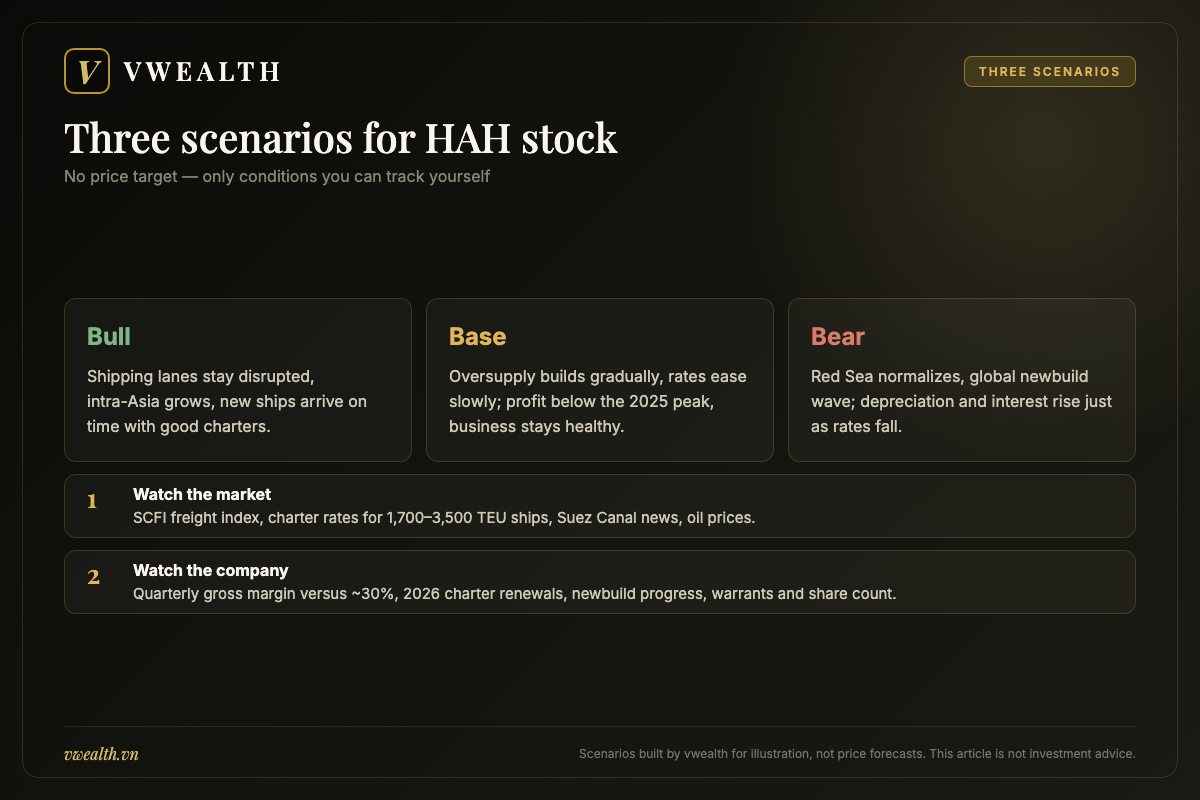
So, Should You Buy HAH Stock? Weighing the Pros and Cons Honestly
By now you have all the pieces: a private shipping line that grew out of a small port, never posted an annual loss yet saw profits swing several-fold with global freight rates, and is now entering the biggest investment cycle in its history with a port operator as its new largest shareholder. There is no single answer to whether you should buy HAH stock. It depends on how you read the freight cycle and how much volatility you can live with.
The Case For
The first argument in favor is a record of profitability through the cycle. From 2015 to 2025, Hai An never recorded an annual loss, including low-rate years such as 2019 and the correction year of 2023; the 2025 annual report shows consolidated return on equity of about 29.68%. The second is scale: the fleet grew from one ship in 2014 to 18 ships and about 29,400 TEU in 2025 (and 20 ships, about 33,000 TEU by mid-2026 including the two JV ships), with vessel volume of about 675,056 TEU, giving Hai An a meaningful position on the domestic lane and a springboard into intra-Asia. The third is moderate leverage at end-2025 — net debt of about 0.3 times equity by vwealth’s estimate — which leaves room to finance new ships. The fourth is a network of international partners (ZIM, ONE, SM Line, Meratus) and a strategic shareholder with terminals in Hai Phong, opening the door to berth cooperation and new routes. The fifth is a modern newbuilding program aligned with tightening green rules, which could help Hai An compete as older tonnage is weeded out.
The Case Against
The first and biggest argument against is cyclicality: profits depend on freight and charter rates the company does not control, and the share price has suffered drawdowns of about 73% from peak. The second is timing risk: Hai An is committing to large newbuilds precisely in the period for which it forecasts global oversupply. The third is dilution: the share count has grown about 8.3 times since listing, and the bonds-with-warrants plan could nearly double it if fully exercised (vwealth estimate). The fourth is a low and irregular cash dividend, since cash goes into ships. The fifth is a fast-changing shareholder base, with frequent block trades and overlapping interests among the major shareholder, the JV partner and service providers — something minority shareholders need to monitor through related-party transactions.
| Pros | Cons |
|---|---|
| No annual loss in 2015–2025; consolidated ROE of about 29.68% in 2025 | Profits swing several-fold with rates; the stock has fallen about 73% from a peak |
| 18 ships, about 29,400 TEU at end-2025; domestic and intra-Asia services | Large newbuild commitments during a forecast oversupply period (2026–2029) |
| Net debt about 0.3 times equity at end-2025 (estimate) | Debt and depreciation will rise as new ships arrive from late 2027 |
| International partners and a strategic shareholder with ports | Overlapping interests with the major shareholder; many related-party dealings |
| New ships ready for green regulations | Dilution from convertibles, ESOPs and warrants; low cash dividends |
Who HAH Stock Suits
HAH suits investors who understand and accept cyclical stocks: people willing to track freight indices, charter rates and Red Sea headlines the way steel investors track steel prices, and disciplined enough to buy when the market is gloomy and sell when it is euphoric. It also suits investors who believe in the long-term story of Vietnamese shipping — a growing national fleet, rising intra-Asia trade — and are prepared to sit through years of volatility while the fleet investment pays off. For them, HAH can be one holding in a diversified portfolio, sized in proportion to its volatility. Foreign investors should also factor in currency: Hai An reports in VND while ships are priced in US dollars — the company’s own annual report flags exchange-rate risk on its fleet investment obligations — and your returns are also converted back from VND.
Who Should Probably Avoid It
HAH does not suit investors who need a steady stream of cash dividends every year, since the company has historically preferred stock dividends and kept cash for ships. It does not suit those who read a low P/E as a buy signal without considering the position in the cycle. Nor does it suit anyone who cannot stomach watching a position halve within months, or anyone using heavy margin — with a stock as volatile as HAH, margin can turn an ordinary correction into an unrecoverable loss.
Final Thoughts
Hai An is an impressive corporate story: from a container berth in Dinh Vu in 2010, a group of private maritime companies built one of Vietnam’s larger container fleets, stayed profitable through hard years, and is now ordering 7,100 TEU ships. But HAH stock is not the story of a company that controls its own destiny. It is the story of a domestic container carrier living on the global freight cycle — where profits are decided in the Red Sea, at the Suez Canal and in Chinese shipyards more than on the Hai Phong – Ho Chi Minh City lane. The question of whether to buy HAH stock boils down to two questions: where do you think the freight cycle is, and do you believe the ships Hai An is ordering today will arrive in time to make money for shareholders, rather than to pay depreciation in an oversupplied market?
This article is not a recommendation to buy or sell. Before deciding, check the latest numbers — price, P/E, P/B, the most recent quarterly profit, gross margin, debt, and the status of the bonds and warrants — in vwealth’s analysis report, read Hai An’s latest shareholder meeting documents, and weigh your own risk tolerance. To put HAH alongside other names in Vietnam’s transport chain, read our analysis of VSC — Hai An’s largest shareholder group — and our guide to investing in Vietnam stocks. You can create a vwealth account to follow HAH reports quarter by quarter.
Research Vietnamese stocks in English with vwealth. Our AI-powered platform turns Vietnamese market data into full English analysis reports — with international payment support and a free 2-month trial for new accounts. Create your free account and read the latest reports.


