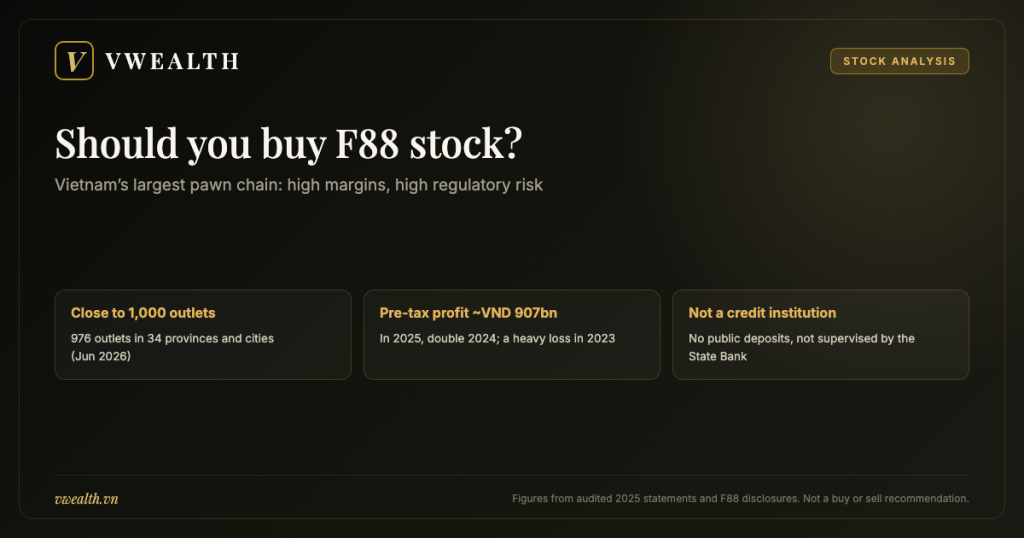
Should you buy F88 stock? Few Vietnamese listings raise that question as sharply. F88 is the ticker of the country’s largest pawn-lending chain, a business that lends like a finance company but is not a licensed credit institution, takes no deposits from the public, and sits outside the supervision of the State Bank of Vietnam. Its customers are the people banks tend to overlook: ride-hailing drivers, construction workers, market traders and freelancers who own a motorbike but not a payslip. That niche produces lending margins few banks anywhere could dream of, and it carries a risk that bank stocks rarely do — the possibility that the rules of the game change. When F88 joined the UPCoM market on 8 August 2025, its reference price of VND 634,900 per share was the highest on the Vietnamese exchange. This analysis walks through thirteen years of F88’s history, shows you how to read its unusual financial statements, and ends with an honest answer about which kind of investor this stock suits and which it does not.
First, a naming point that trips up many readers. The ticker F88 belongs to F88 Investment Joint Stock Company (Công ty Cổ phần Đầu tư F88), the listed parent company founded in 2013. The shops you see on Vietnamese streets are operated by its subsidiary, F88 Business Joint Stock Company (Công ty Cổ phần Kinh doanh F88). The subsidiary is the entity that signs pawn contracts with customers, holds the collateral documents and issues the bonds that carry the F88 name. In this article, “F88” on its own refers to the group and its consolidated numbers; where the distinction matters we write “F88 Investment” for the listed parent and “F88 Business” for the operating subsidiary. The difference is not academic: money raised from shareholders sits at the parent and is pushed down into the subsidiary, while profits are generated in the subsidiary and flow back up as intra-group dividends.
Second, how we handle numbers. As in every company analysis in the vwealth series, dates, names, ownership stakes and figures come from published sources — the listing prospectus, audited financial statements, shareholder-meeting documents, disclosures on the Hanoi Stock Exchange (HNX), and Vietnamese financial media such as CafeF, VnExpress, VnEconomy, Tuoi Tre and Vietstock. Figures for completed years are used as historical markers. We do not quote today’s share price, current P/E or P/B, or the latest quarterly profit, because those change constantly; for current numbers, open the latest vwealth research reports. Anything vwealth has calculated itself is labelled “vwealth estimate”. Where sources disagree, we say so. If you are new to investing in Vietnam, our guide to investing in the Vietnam stock market explains the basics — exchanges, trading limits, settlement and account opening — that this article takes for granted.
From a Pawn Shop to a Billion-Dollar Stock: F88’s Thirteen-Year Journey
Pawnbroking in Vietnam is older than any of its joint-stock banks. For decades it was a trade of small shops tucked into alleys, where the owner valued the item, set the interest and collected the debt personally. F88’s story is about one founder’s attempt to turn that trade into a retail financial chain: bright street-front stores, uniformed staff, standard printed contracts, centralized data, and funding from foreign investors instead of the shop owner’s savings. The path was not smooth. It included years of breakneck expansion, a heavy loss, a nationwide inspection by the authorities, and then a dramatic stock-market debut. Understanding that path is the first step in deciding whether to buy F88 stock.
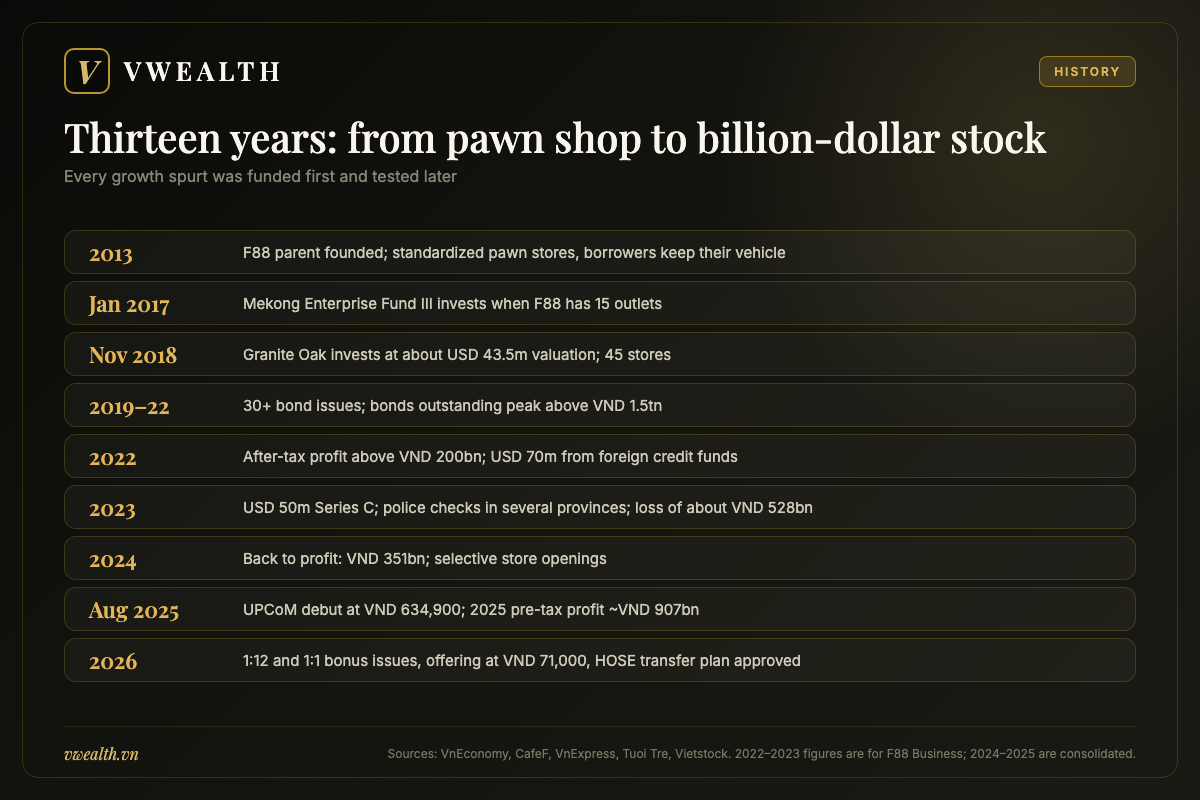
2013: a former pawn customer starts a pawn chain
F88’s founder is Phung Anh Tuan, born in 1984 in Phu Tho province. According to CafeF, before moving into finance he was known in Vietnam’s technology circles as a security specialist and once ran a cybersecurity firm. The founding story he has told repeatedly is down-to-earth: in his early entrepreneurial days there were months when he could not make payroll, so he pawned his own belongings. At an investor roadshow in July 2026, he said he had been “a regular pawn customer” before founding F88. From the borrower’s side of the counter, he saw both the demand and the pain points — arbitrary valuations, opaque fees, gloomy shops and the embarrassment of walking in.
F88 was established in 2013. According to the company profile on Vietstock, the parent is registered under enterprise code 2600948135 with a registered head office in Phu Tho, although day-to-day operations run from Hanoi. The charter capital in the early years was tiny: it reached only VND 25.5 billion in November 2015. That is the scale of a start-up, not a financial institution.
The difference lay in the model: stores on main roads rather than in back alleys, standardized service, and — most important for low-income borrowers — borrowers usually keep using the vehicle they have pledged, instead of leaving it at the shop as traditional pawnbrokers require. F88 holds the vehicle papers under the contract, and the borrower keeps riding the motorbike to earn a living. For a delivery driver or a builder, that distinction decides whether borrowing costs them their livelihood. The practice has also drawn official scrutiny: when police in Dong Nai province inspected nine F88 outlets in April 2023, they said most of the 1,430 pledged vehicles were not kept on site but were “lent back” to the borrowers under a separate fee-bearing contract (Tuoi Tre, 18 April 2023). The trade carries stigma, too: Tuan himself has said he once felt ashamed when asked, “So you work in pawnbroking?” (CafeBiz, July 2026).
2017–2018: Mekong Capital, Granite Oak and the store-rollout formula
The first turning point came when private equity arrived. According to Chris Freund, founder of Mekong Capital, quoted by VnEconomy in 2023, Mekong Enterprise Fund III invested in F88 in January 2017, when the chain had just 15 outlets. The size of the first round was never officially disclosed; the newspaper Nguoi Quan Sat (January 2026) estimated it at about USD 10–20 million — a press estimate, not a figure from the fund.
Why would a private equity fund bet on a pawn chain? Mekong Capital’s track record explains it. The fund was an early investor in Mobile World (MWG), Vietnam’s dominant electronics retailer, when that chain was still small. Its playbook is to back retailers that can replicate stores. Freund later drew the comparison explicitly, saying F88 carried “many expectations of success like Mobile World”. In other words, the fund saw F88 as a retail chain whose product happens to be a loan.
In late 2018 a second investor, Dublin-based Granite Oak, came in. According to VietnamBiz on 27 November 2018 (citing DealStreetAsia), that round valued F88 at about USD 43.5 million. At the time F88 had 45 stores in northern Vietnam and had just opened its first 3 in Ho Chi Minh City. The company said it had lent VND 600 billion in 2017 and targeted 300 stores nationwide by 2021. VnEconomy describes this as the Series B round, following the Series A from Mekong Enterprise Fund III.
One detail of this period matters later. Vietstock’s list of milestones shows the parent’s charter capital rising in small steps — VND 31.5 billion at the end of 2015, 37.5 billion in 2016, then 42.1 and 49.1 billion in 2017. Par value stayed low while investors paid far above par for each share, with the difference booked as share premium. That is why, years later, F88 came to market with very few shares and a per-share price in the hundreds of thousands — and then millions — of dong.
2019–2022: racing to open stores, funded by bonds and foreign lenders
With fund money in hand, F88 expanded at the pace of a retail chain. At the end of 2018 the company targeted 300 stores by 2021; by March 2023 VnEconomy counted 830 branches. Going from 45 stores in late 2018 to 830 branches in early 2023 is roughly an 18-fold increase in just over four years (vwealth estimate from the two press data points).
Opening a pawn shop costs little in fit-out but a lot in lending capital: every store needs a cash “inventory” to disburse. And because F88 is not a bank, it cannot use public deposits. The money had to come from three places: equity from investors, corporate bonds, and loans from international credit funds. In this period, privately placed bonds were the main channel. According to VnExpress in 2023, F88 had completed more than 30 bond issues; outstanding bonds peaked at more than VND 1.5 trillion in 2021, about 90% of total debt and twelve times the 2019 level. Total liabilities rose from about VND 355 billion in 2019 to roughly VND 3.6 trillion in 2022. VnExpress added that most of those bonds had matured or been bought back early; in the first half of 2023 alone, F88 repaid VND 1.25 trillion of bond principal falling due.
In 2022 F88 opened another tap. VnEconomy reports that the company raised USD 70 million from two private credit providers, CLSA Capital Partners (HK) Limited through its Lending Ark fund, and London-based Lendable. The same year, FiinRatings — the local credit-rating arm of FiinGroup — rated F88 for the first time; VnEconomy (March 2023) reported the rating as BBB with a stable outlook, while FiinRatings described the prior rating as BBB- when it upgraded F88 in October 2025, so we note both. F88 received Client Protection Certification from the Center for Financial Inclusion (formerly The Smart Campaign) for 2022–2025.
Profitability confirmed the model worked, though at a modest scale. VnExpress summarized it this way: from its first disclosures in 2019, F88 was consistently profitable, earning tens of billions of dong a year in 2019–2021; in 2022, after-tax profit peaked at more than VND 200 billion, with return on equity (ROE) of 31.6%. The annual figures reported in 2023 were VND 16, 44, 51 and 211 billion, about VND 322 billion in total (vwealth estimate). Note that these are the numbers of F88 Business, the operating company; the listed parent’s consolidated after-tax profit for 2022 was about VND 166 billion (VNDirect financial data). The 2022 peak was also the launching point for the fall that followed.
2023: a year of stress — a successful funding round, then a heavy loss
2023 began with good news. On 2 March 2023 F88 announced a USD 50 million Series C round. According to VnEconomy and a Mekong Capital press release, Mekong Enterprise Fund IV contributed USD 20 million, and the other investor was the Vietnam Oman Investment fund (VOI). Management then targeted an IPO in 2024, once the chain reached 1,400 branches and a USD 1 billion valuation. F88 Business’s equity rose to VND 1,588 billion by mid-2023, almost double the end-2022 level.
That same year, F88’s operations were inspected by the authorities in many provinces, at a time when regulators were cracking down on debt-collection practices across consumer lending and pawnbroking. We set out the sequence exactly as reported in the press based on information from the authorities, without adding interpretation. On the afternoon of 6 March 2023, Ho Chi Minh City police, working with units of the Ministry of Public Security, searched several F88 branches in the city; Phung Anh Tuan said at the time that the search concerned one staff member (The Gioi Tiep Thi, 7 March 2023). On 16 March 2023, the standing committee of Ho Chi Minh City’s anti-corruption steering committee placed “the case related to F88 Business JSC” on its monitoring list (Thoi bao Tai chinh Viet Nam). On 30 March 2023, city police leaders said investigators had charged 10 people — team leaders and debt-collection staff at the Ho Chi Minh City branch — in an investigation into property extortion, and that an administrative sweep had found 79 F88 business locations with violations of the rules for security-and-order-conditional businesses (Tuoi Tre, 30 March 2023). F88 said at the time that it had been notified of charges against five debt-collection employees, that it had procedures and sanctions for staff, and that it would not shield wrongdoing (Bao Dau tu, 31 March 2023).
In April 2023, police in several other provinces also inspected F88 outlets. In Dong Nai, besides the finding on “lent-back” vehicles described above, provincial police said district-level police had fined 10 F88 outlets a total of VND 37 million in Q1 2023 and revoked the security-and-order certificates of two outlets (Tuoi Tre, 18 April 2023); Binh Duong police checked numerous outlets on 27 April 2023 (Tuoi Tre). More than a year later, on 31 July 2024, the Ho Chi Minh City People’s Court sentenced six former F88 Business debt-collection employees to between 1 year 6 months and 4 years 6 months in prison for property extortion, for repeatedly sending threatening and insulting messages to borrowers and their relatives to force repayment (VnExpress, 31 July 2024). According to reports on the trial, those tried were individuals; the loans in the case file carried an interest rate of 1.1% a month.
Three years later, at the share-offering roadshow on 9 July 2026, Chairman Phung Anh Tuan spoke publicly about the period for the first time (CafeF, Dan Tri). He said that in 2023 inspections of debt collection at financial companies were intense; at F88, the checks found two or three employees who had violated rules by sending messages that pressured customers. The police, he said, inspected the company’s operations nationwide and concluded these were individual violations, not company policy. Afterwards F88 reviewed its entire collection process and required collection staff to use company-issued devices instead of personal phones so their communications could be monitored. He called it a lesson in risk management — “fortunately it happened in 2023”, before the listing. He also noted that some customers took advantage of the period to deliberately stop repaying. The “two or three employees” figure is his account at the roadshow; the 2023–2024 press record shows 10 people charged and six former employees convicted — we give both so you can compare.
The financial impact was stark. In the first half of 2023, F88 Business posted an after-tax loss of VND 368 billion, against a profit of more than VND 46 billion a year earlier — roughly VND 2 billion lost per day, as VnExpress put it. That six-month loss exceeded the previous four years of profit combined. According to the company’s explanation cited by VnExpress, the industry-wide scrutiny of debt collection hurt customers’ willingness to repay, forcing lenders to tighten their risk appetite and slow store openings; at the same time, low-income borrowers were squeezed by falling incomes. F88 was not alone. Many Vietnamese consumer-finance companies saw profits collapse or swing to large losses in the first half of 2023 — you can see the same cycle at FE Credit in our VPB stock analysis.
For the full year 2023, F88 Business lost about VND 528 billion after tax (CafeF, VnExpress and Baodautu cite VND 528.8 billion), while the parent’s consolidated loss is reported by Tuoi Tre and CafeF at about VND 545 billion. The figures differ because they belong to two legal entities. The cause is the important part: the company said pre-provision operating profit in 2023 actually rose about 2.1 times from 2022; the loss came from provisioning. In the 2023 consolidated accounts, cost of services — the line where F88 also books provision expense — reached about VND 2,323 billion, more than service revenue of about VND 2,082 billion (VNDirect financial data). In plain terms, the sales engine kept running, but a large share of the money lent did not come back.
Even in that difficult year, F88 kept its funding lines open. According to CafeF, Lending Ark added another USD 50 million in September 2023, bringing its total commitment to USD 100 million, and F88 issued more than VND 250 billion of private bonds in the fourth quarter. The company says it met 100% of its debt obligations on time in 2023 — about VND 2.73 trillion in total, including about VND 1.47 trillion of bonds and USD 49 million of foreign loans (Tin nhanh Chung khoan, Bao Dau tu). For a business that borrows in order to lend, keeping a clean repayment record through a loss-making year is what allowed it to keep raising money afterwards.
2024: restructuring and a return to profit
After the loss, F88 pulled in its horns. The network barely grew: from 830 branches in March 2023 to “more than 850” outlets when F88 signed its partnership with MB in December 2024 (VnExpress, 17 December 2024), and 868 at the start of 2025 (vwealth estimate: 950 at end-2025 minus 82 openings during the year, per CafeF) — a sharp contrast with the hundreds of openings per year before. The company restructured its sales force, added front-line staff and removed layers of middle management. According to VnExpress in May 2024, the cost-to-income ratio (CIR) in Q1 2024 fell by 8% and labour productivity rose 3% compared with Q4 2023, while collection costs fell 46% year on year. F88 Business earned VND 31 billion after tax in Q1 2024 — back in the black after a year of heavy losses.
The store strategy changed too: instead of blanket coverage, the company prioritized the efficiency of each outlet and of its collection process. In Q1 2024, F88 Business also raised VND 191 billion in bonds, with a debt-to-equity ratio of about 1.99 times (VnExpress, 27 May 2024).
For full-year 2024, the consolidated accounts show service revenue of about VND 2,280 billion, up about 9.6%, and after-tax profit of about VND 351 billion, compared with the roughly VND 545 billion loss in 2023 (VNDirect financial data). Provision expense in 2024 was about VND 919 billion (vwealth estimate, derived from the VND 1,009 billion booked in 2025, which F88’s explanatory letter on the 2025 accounts says was up 9.8%). Year-end headcount was about 4,030 (derived from 4,681 at end-2025 and roughly 650 added during that year, per Tuoi Tre). This was the year F88 showed that the model could still make money with tighter risk control — and the year it built the track record needed to go public.
2025: becoming a public company, and a debut at the market’s highest share price
On 6 May 2025, F88 Investment became a public company after the State Securities Commission (SSC) confirmed it met the requirements. On 8 August 2025, just over 8.26 million F88 shares (par value VND 10,000, total registered value about VND 82.65 billion) began trading on UPCoM, the unlisted-companies board operated by HNX. The first-day reference price set by HNX was VND 634,900 per share — about three times book value (Tuoi Tre) — implying a market capitalization of roughly VND 5.24 trillion (roughly USD 200 million at 2025 exchange rates, vwealth estimate). UPCoM allows a ±40% band on a stock’s first trading day, and F88 hit the ceiling at the open, closing at VND 888,800. You will see both numbers on data sites: VND 634,900 is the debut reference price, VND 888,800 the limit-up close of that same session.
Shortly before the listing, the board gained a notable member: Piyasak Ukritnukun, CEO of Ngern Tid Lor (NTL), a leading Thai vehicle-title lender with nearly 1,700 branches, was elected an independent director by the AGM on 26 June 2025 (per the audited 2025 accounts); the appointment was widely reported at the end of July 2025 (Dan Tri, 31 July 2025). He has run NTL since 2013, and under him NTL listed on the Stock Exchange of Thailand in 2021 with an IPO of about USD 1.2 billion. His presence signalled that F88 intends to follow the path already travelled by Thailand’s listed title lenders.
The rest of 2025 was about building funding capacity. In October, FiinRatings upgraded F88 from BBB- to BBB with a stable outlook. In November, the SSC approved F88 Business’s first public bond programme — VND 1 trillion of bonds at a fixed 10% coupon with a 24-month term. On 11 December, F88 completed the issue of 206,615 employee stock ownership plan (ESOP) shares to 324 employees at VND 10,000 each (CafeF). Operationally, 2025 was the best year in the company’s history: consolidated pre-tax profit of about VND 907–908 billion, up 102% from 2024 and 35% above plan; consolidated after-tax profit was VND 719.4 billion, up 104.8% (F88 explanatory letter, 9 March 2026); the network had 950 outlets at year-end according to CafeF (the company’s letter says 949).
2026: a bonus-share split, the billion-dollar club and a planned move to HOSE
A share priced near VND 1 million is awkward for retail investors: Vietnamese stocks trade in board lots of 100 shares, so a single lot costs close to VND 100 million. In early 2026 F88 completed a bonus issue of more than 101.65 million shares from equity at a ratio of 1:12 (twelve new shares for each share held, often described locally as a “1,200% bonus”), lifting charter capital to about VND 1.1 trillion. The price adjusted down to a little over VND 100,000 — and the stock promptly rose limit-up for several sessions in a row. On 26 January 2026, after five consecutive limit-up days, F88 closed at VND 242,400, giving a market capitalization of about VND 26.7 trillion and making it Vietnam’s newest billion-dollar listed company (CafeF). F88 sent an explanation to the SSC and HNX saying the move reflected market supply and demand and that it had no undisclosed material information.
On 30 March 2026, the first annual general meeting (AGM) after listing approved the 2026 plan: net loans of about VND 7.5 trillion, revenue of VND 5,462 billion, consolidated pre-tax profit of about VND 1,133 billion (Bao Dau tu; some outlets report VND 1,134 billion), no cash dividend, a further 1:1 bonus issue, a public share offering and the principle of moving the listing to the Ho Chi Minh City Stock Exchange (HOSE). The 1:1 bonus was completed on 9 June 2026, with more than 110.1 million shares distributed to 3,110 shareholders, lifting charter capital to about VND 2,202.5 billion (CafeF). In July, F88 offered more than 22 million new shares to the public at VND 71,000; by August it had placed just over 11 million, about half. Also in July, F88 launched its NNX insurance brand. On 24 September 2026, the board approved the plan to move F88 from UPCoM to HOSE, targeted for the end of 2026 (Dien dan Doanh nghiep, 25 September 2026). At the time of writing, this is an approved plan, not a completed transfer; the move still depends on HOSE approving the listing application.
| Date | Event | What it means for investors |
|---|---|---|
| 2013 | F88 parent founded; first standardized pawn store | Chain model in which borrowers keep their vehicle |
| Jan 2017 | Mekong Enterprise Fund III invests when F88 has 15 outlets | A private equity backer with a retail-rollout playbook |
| Nov 2018 | Granite Oak invests at about USD 43.5 million valuation; 45 stores | Series B; expansion into Ho Chi Minh City |
| 2019–2022 | More than 30 private bond issues; outstanding bonds peak above VND 1.5 trillion (2021) | Network growth funded by debt |
| 2022 | F88 Business after-tax profit about VND 211 billion, ROE 31.6%; USD 70 million from Lending Ark and Lendable | First profit peak; foreign credit lines open |
| Mar 2023 | USD 50 million Series C; about 830 branches | Strong equity base before the shock |
| 2023 | Police inspections in several provinces; 10 debt-collection staff charged in HCMC; F88 Business loses VND 528.8 billion, about VND 545 billion consolidated | Lesson in regulatory, compliance and credit risk |
| 2024 | After-tax profit of VND 351 billion; management layers cut; selective openings | Model profitable again under tighter risk discipline |
| 8 Aug 2025 | UPCoM debut at VND 634,900 reference price; limit-up to VND 888,800 | Highest share price on the market at the time |
| 2025 | Pre-tax profit about VND 907 billion, after-tax VND 719 billion; 950 outlets | Best year in company history |
| Jan 2026 | 1:12 bonus issue; market cap passes USD 1 billion | More liquidity, extreme price swings |
| Jun–Aug 2026 | 1:1 bonus; public offering at VND 71,000, about 50% placed | Charter capital about VND 2.31 trillion; demand below the offer size |
| 24 Sep 2026 | Board approves plan to transfer listing to HOSE, targeted end-2026 | A catalyst the market is watching |
The table shows a recurring rhythm: each time F88 accelerates, funding comes first and risk follows. In 2019–2022, bonds financed store openings, and in 2023 credit risk and regulatory risk surfaced together. In 2025–2026, equity and public bonds are financing a new growth spurt. The question for investors is how this cycle differs from the last. The following chapters address that, starting with the people in charge.
Leadership and Ownership: the Founder, the Foreign Funds and a New Layer of Shareholders
In a lending business, the people at the controls matter more than in most industries. A plastics factory can run well through a change of management; a chain making hundreds of thousands of small loans lives or dies by its risk culture — who gets approved, how collections are handled, and when management is willing to say “no” to growth. This chapter answers three questions: what F88’s legal structure looks like, who runs it, and who owns it.
Two legal entities: a listed parent and an operating subsidiary
As noted at the start, F88 shares are shares of F88 Investment JSC. According to its Vietstock profile, the parent’s subsidiaries and affiliates include F88 Business JSC (abbreviated F88C or F88KD), F88 Trading Co., Ltd., FFintech JSC and Green House Technology JSC (Ngoi nha Xanh); in 2026 the group added NNX Technology JSC, the entity behind the NNX insurance brand, which is described as an F88 member company. F88 Business is the engine: it signs pawn contracts, holds collateral documents and issues the F88-branded bonds.
This structure explains two things you will notice in F88 news. First, money raised at the parent is pushed down to the subsidiary. After the 2026 public offering, for example, F88’s board approved injecting almost all of the net proceeds — about VND 764.4 billion — into F88 Business as new charter capital for its pawn operations, keeping virtually nothing at the parent (Bao Phap luat, August 2026). Second, profits move up as intra-group dividends. In May 2026 F88 Business paid nearly VND 476.9 billion in cash dividends for 2025 at a 28.5% rate, of which the parent received about VND 476.8 billion. Consolidated accounts eliminate these internal flows, so for F88 shareholders the consolidated numbers are what count.
A practical consequence: when reading news, check which entity it concerns. Stories about bonds, bond redemptions or the 2023 results usually refer to F88 Business; stories about the shares, offerings, major shareholders and the exchange transfer refer to F88 Investment.
Chairman Phung Anh Tuan: the founder still at the wheel
Phung Anh Tuan is the founder, the chairman and the largest individual shareholder. Before 2026 he also served as chief executive — VnEconomy in 2023 and CafeF in 2018 both describe him as “chairman and CEO”. According to the audited 2025 accounts, the chief executive is now Nguyen Duc Dai, who also signs the company’s disclosures.
Tuan’s message has been consistent: F88 is a retail financial-services company for ordinary people, not an oversized pawnshop. He has described the pawn industry in “crisis is also opportunity” terms (CafeF), and at the July 2026 roadshow he said plainly that tighter oversight of the sector by the State Bank of Vietnam is “a scenario certain to happen once outstanding loans are large enough”. He also regularly articulates long-term ambitions: by 2030, F88 aims for a loan book of VND 31,730 billion, revenue of nearly VND 17,000 billion and after-tax profit of VND 3,549 billion, and 5 million cumulative customers, up from 1.6 million today (roadshow materials cited by Vietstock, July 2026). These are company targets, not vwealth forecasts; the scenario chapter below discusses what would need to happen for numbers like these to materialize.
On ownership, audited 2025 statements cited by Tuoi Tre show Tuan held 12.04% at the end of 2025. In August 2026 he bought 1.18 million shares in the public offering, bringing his holding to about 27.7 million shares, or 11.98% of the enlarged capital (CafeF, 8 August 2026). His percentage dipped slightly despite buying because the total share count also rose.
Management and the board: finance professionals and Thai experience
The executives investors usually meet at disclosure events are CEO Nguyen Duc Dai, who signs the company’s results explanations to the SSC and told the 2026 AGM that the company has “never set growth targets at any cost” but balances growth with risk control (Bao Dau tu); and Chief Financial Officer Tran Mai Thao, who fields most questions on margins, funding costs and write-offs at investor meetings.
According to the audited 2025 accounts, the board at the time of reporting consisted of Chairman Phung Anh Tuan and members Ngo Quang Hung, Christopher E. Freund, Nguyen Xuan Giao, Nguyen Ngoc Nhu Uyen and Nguyen Thi Hoang Anh (the latter two elected on 26 June 2025), plus two independent directors, Do Long and Piyasak Ukritnukun (both elected on 26 June 2025). Do Long has chaired the Audit Committee since 17 July 2025. Also on 26 June 2025, several earlier members left the board, including independent directors Nguyen Quoc Trung and Hamed Shayannasr. The auditor is KPMG.
Besides the chairman, the board includes Ngo Quang Hung, a director and the second-largest individual shareholder with about 10.5% after the 2026 offering, and independent director Piyasak Ukritnukun, CEO of Ngern Tid Lor. According to F88, Piyasak first visited its Hanoi headquarters in 2020 and served as a senior adviser from 2021 before joining the board. His experience is directly relevant: NTL grew from a vehicle-title lender into a listed company with nearly 1,700 branches.
Two personnel changes in 2026 are worth recording exactly as disclosed. Christopher E. Freund, founder of Mekong Capital, submitted his resignation from the board on 11 August 2026 for personal reasons and was relieved of the role effective 8 September 2026, reducing the board from six members to five; according to the disclosure, he held no F88 shares directly (CafeF, 11 September 2026). Also in August 2026, Chief Accountant Nguyen Hoang Luong resigned effective 20 August 2026, citing personal reasons and a change in career direction (CafeF, 22 August 2026); the company appointed Hoang Minh Thai as chief accountant from the same date (Nguoi Quan Sat). On their own, these changes say nothing about F88’s financial health. What you should watch is who replaces them and whether future statements are reviewed and audited on time. F88’s 2025 financial statements were audited by KPMG; according to Dien dan Doanh nghiep, the 2026 interim statements were reviewed.
Shareholder structure: foreign funds hold the largest stakes, retail ownership is rising
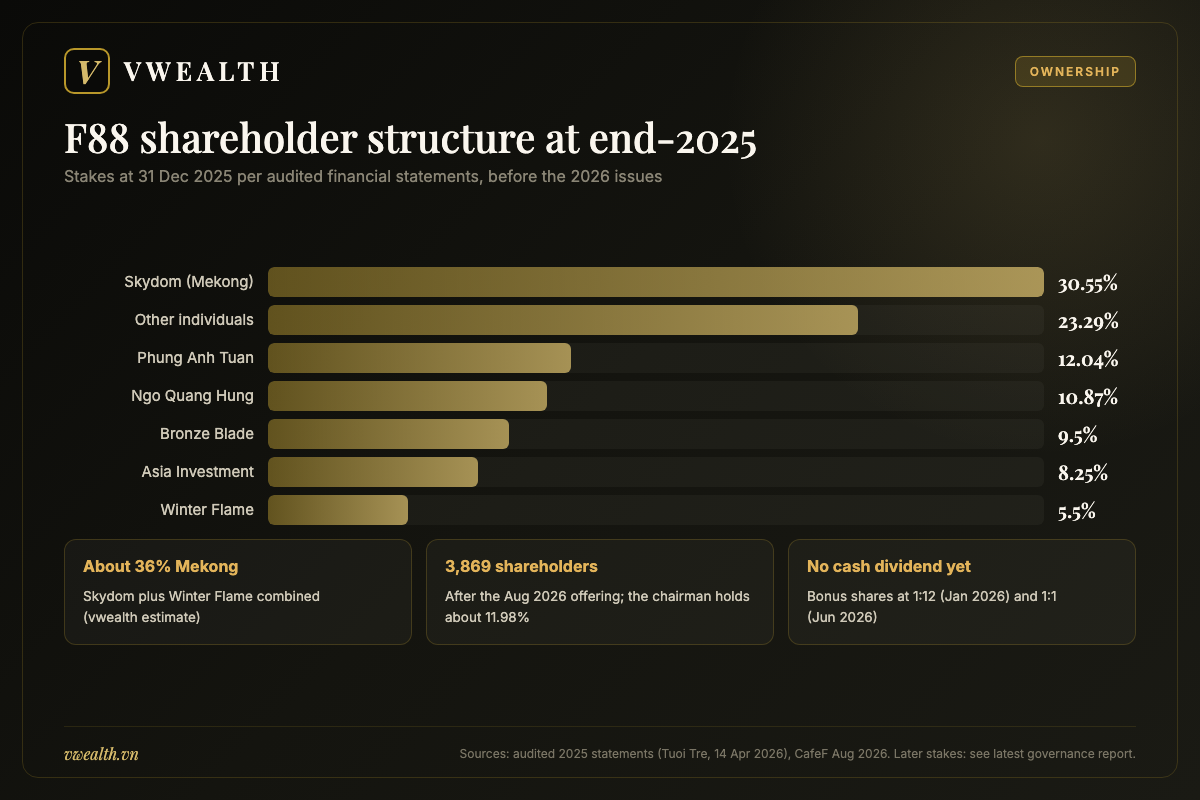
Unlike most Vietnamese companies that go public, F88 arrived on the market majority-owned by foreigners. According to the prospectus as summarized by CafeF, at 31 December 2024 six foreign shareholders (four institutions and two individuals) held a combined 57.52%. The table below shows the structure from the audited 2025 financial statements (as of 31 December 2025, before the 2026 bonus issues and offering).
| Shareholder | Who they are | 31 Dec 2024 | 31 Dec 2025 |
|---|---|---|---|
| Skydom Pte. Ltd. | Investment vehicle of Mekong Capital | 31.32% | 30.55% |
| Phung Anh Tuan | Founder, chairman | About 12.1% (mid-2025) | 12.04% |
| Ngo Quang Hung | Board member | 10.93% (mid-2025) | 10.87% |
| Bronze Blade Limited | Investment vehicle of Granite Oak | 9.83% | About 9.5% |
| Asia Investment Company S.à r.l. | Vehicle of the Oman Investment Authority | About 8.1% | 8.25% |
| Winter Flame Pte. Ltd. | Investment vehicle of Mekong Capital | 5.64% | 5.5% |
| Other individuals | Retail investors, employees, market buyers | — | 23.29% |
Sources: 2024 column from the prospectus (CafeF, 4 August 2025) and the H1 2025 governance report; 2025 column from the audited 2025 financial statements (Tuoi Tre, 14 April 2026). The two Mekong Capital vehicles together held about 36% at the end of 2025 (vwealth estimate, adding 30.55% and 5.5%).
After the August 2026 offering, F88 had 3,869 shareholders, of whom 3,751 were domestic and 118 foreign, ; director Ngo Quang Hung also bought 288,000 shares, lifting his holding to about 24.2 million shares, or 10.5% (CafeF, August 2026). Because the offering increased the share count, holders who did not subscribe were slightly diluted. For the latest stake of each fund, check F88’s most recent governance report or the vwealth research reports.
How to read this: F88 is one of very few Vietnamese listings where a foreign private equity firm is the largest shareholder and the state holds nothing. That cuts two ways. On the positive side, investors such as Mekong Capital, Granite Oak and Oman’s sovereign fund typically demand international standards of governance, reporting and audit. On the watch-list side, private equity funds have finite lives: at some point they need to sell to return money to their own investors.
How long the funds have been in, and why the market watches them
Mekong Enterprise Fund III has been in F88 since January 2017 — close to ten years by 2026. Fund IV joined in March 2023. According to the newspaper Nguoi Quan Sat in January 2026, Mekong Capital’s total investment in F88 was estimated at around USD 30–40 million, and at prices then its stake was worth roughly ten times the capital invested. That is a press estimate, not a Mekong Capital disclosure.
At investor meetings in 2026, the possibility of a Mekong Capital exit was raised, and the question was reported in the press (Mekong ASEAN). It is a reasonable question for any company in which a private fund holds a large stake: when such a fund sells, the volume can be large relative to daily trading. Some exit routes barely touch the market price — a negotiated block sale to a strategic investor or another long-term fund, for example — while others involve gradual selling on the exchange. vwealth has no information on any fund’s specific plans; Freund’s departure from the board was for personal reasons as disclosed, and we draw no further inference. What you can do is follow major-shareholder transaction notices on HNX: any trade that moves a major holder across regulatory thresholds must be disclosed.
Beyond Mekong, Granite Oak (through Bronze Blade) has been an investor since 2018. On the Omani side, Asia Investment Company belongs to the Oman Investment Authority, and according to CafeF the Vietnam Oman Investment fund was one of the two investors in the 2023 Series C. In the 2026 public offering, five foreign investors bought a combined 5.14 million shares (CafeF, 11 August 2026) — evidence of fresh foreign interest, although small relative to the total share count.
Dividends: no cash yet, only bonus shares
If you want a steady cash dividend, F88 is not currently that stock. F88 Investment has not paid a cash dividend to parent-company shareholders since listing. The AGM on 30 March 2026 approved paying no dividend for 2025 and retaining the remaining profit to fund the business (Thoi bao Tai chinh Viet Nam).
Instead, shareholders have received bonus shares: the 1:12 issue completed in January 2026 and the 1:1 issue completed in June 2026. The 1:1 issue was funded from equity on the audited 2025 consolidated balance sheet — nearly VND 477.2 billion of retained earnings and more than VND 624.1 billion of share premium (CafeF). It is worth being clear: bonus shares do not add value to your holding. They cut the same cake into more slices, and the share price adjusts down accordingly. What they do achieve is a larger share count, a lower price per share that is easier to trade, and the conversion of retained earnings into charter capital — which matters for a company that needs a thick equity base in order to borrow and lend more.
The reason F88 retains earnings is straightforward: a lending model needs equity as a cushion. As the financial chapter below explains, FiinRatings puts F88’s debt-to-equity ratio at around 1.53–1.68 times between Q3 2024 and Q3 2025. To grow the loan book by 30–40% a year without letting leverage balloon, the company must either retain profit or issue new shares. It has done both. For investors, that means any return from F88 stock comes mainly from price appreciation driven by earnings growth, not from dividends.
How F88 Makes Money: Finance for the People Banks Overlook
Picture an electrician in Bac Ninh, an industrial province near Hanoi, who needs VND 12 million this week to pay his child’s school fees. He has no salary paid through a bank, no clean credit history and no land title to pledge. A bank would take days to assess him and would probably decline. A consumer-finance company might approve him, but would still want proof of income. What he does have is a motorbike registered in his name. F88 is built for exactly this customer: bring the registration papers, get cash in around 15 minutes (as F88 advertises on its website), and keep riding the bike to work. The price of that speed is a borrowing cost far above a bank’s. F88’s entire business model revolves around this trade-off.
How standardized pawn lending differs from banks and finance companies
The first point to grasp is that F88 is not a credit institution. Banks and licensed finance companies such as EVF, FE Credit or HD Saison are licensed by the State Bank of Vietnam under the Law on Credit Institutions and must comply with capital adequacy ratios, caps on consumer-lending rates and loan-classification rules. F88, by contrast, is not a credit institution and is not currently supervised by the State Bank the way a finance company is — F88’s own chairman said at the July 2026 roadshow that tighter State Bank oversight is a scenario that will come once loan volumes are large enough (CafeF, 10 July 2026). In Vietnam, pawn services are a business line subject to security and public-order conditions: the police issue the certificate of eligibility and carry out inspections, while the relationship between borrower and pawnbroker is governed by the Civil Code’s provisions on pledges and interest. Our EVF stock analysis explains in detail what a licensed finance company can and cannot do; F88 sits in an entirely different legal framework.
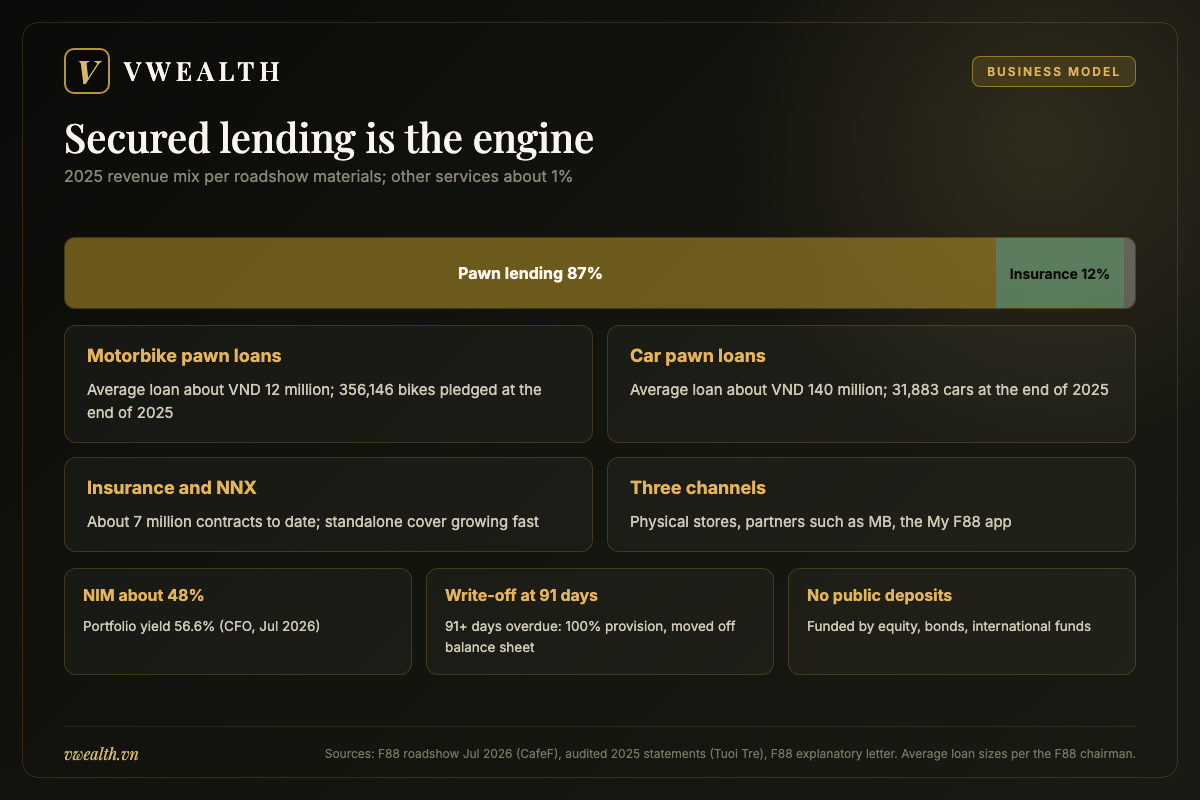
Second, F88 cannot take deposits from the public. That is the decisive difference from a bank. A bank borrows from savers at a few percent a year; F88 must borrow through bonds and loans from international funds at double-digit costs. FiinRatings describes F88’s funding as coming mainly from equity and debt (international lenders, domestic financial institutions and bonds), with debt making up about 60–65% of total funding. Because its money is expensive, F88 can only survive by lending at very high margins — and it can do so because it serves a segment banks do not.
Third, every F88 loan is secured, mostly by motorbikes and cars. That is a big difference from unsecured consumer lending, the product that drove FE Credit’s heavy losses. Collateral does not eliminate risk — an old motorbike can be hard to sell, and a borrower may not cooperate — but it gives each loan a fallback. Loans are typically only a portion of the value the company assigns to the collateral, which gives F88 a cushion if it has to realize the asset.
Motorbike and car pawn loans: the core product
According to the chairman at the July 2026 roadshow, the average motorbike loan is about VND 12 million (roughly USD 450) and the average car loan about VND 140 million (roughly USD 5,300) — currency conversions are vwealth estimates. These are tiny loans by banking standards, and that is precisely F88’s market: people who need small amounts, fast and flexibly.
The collateral base has grown quickly. According to the audited 2025 statements cited by Tuoi Tre, F88 held 356,146 motorbikes and 31,883 cars as collateral at the end of 2025 — roughly double the start-of-year count for motorbikes and more than 2.4 times for cars. Roadshow materials in July 2026 put the cumulative number of loan contracts at more than 3.5 million (CafeF). Cars growing faster than motorbikes is worth noting: a car loan is roughly ten times larger, so the book is gradually shifting toward customers with more valuable assets.
According to F88’s explanatory letter on its 2025 accounts, net loans at the end of 2025 reached VND 7,216 billion, up 57.4%, a figure that includes loans disbursed through partner banks; disbursements for the year totalled VND 16,476 billion. By the end of Q2 2026, loans had risen to VND 8,827 billion (CafeF). Because the company’s “loan book” figure includes the bank-partnership portion, it is larger than the “loans receivable” line on the balance sheet — an easy trap when reading F88 news.
Note the “partnership lending” model with banks: F88 finds the customer, underwrites, holds the collateral and services the loan, but part of the money disbursed comes from the partner bank. The partner banks F88 named in 2026 include MB and CIMB (VietnamBiz, April 2026). This lets F88 grow without raising all the funding itself — in effect renting out its retail capability to banks.
Interest, fees and the “cost of borrowing”: the model’s most sensitive point
If you could ask F88 only one question, it would probably be: how much do customers pay? The answer has two layers.
The first layer is the law. Vietnam’s 2015 Civil Code caps the agreed interest rate on a loan of assets at 20% a year, unless another law provides otherwise. Pawnbrokers, including large chains, state interest within that cap — case records from 2023–2024 show F88 contracts stating 1.1% a month. But on top of interest, pawnbrokers charge service fees, such as loan-management and asset-management fees. The law caps interest, but there is no single cap on the total cost (interest plus fees) for the pawn industry, so the total can be well above the interest cap. This is an industry-wide issue and the root of much of the debate around pawn chains in general.
The second layer is F88’s own numbers. At the July 2026 roadshow, CFO Tran Mai Thao said the average yield on F88’s loan portfolio was about 56.6% a year and its net interest margin (NIM) about 48% (CafeF, 10 July 2026). Put simply, for every 100 dong of average loans outstanding over a year, F88 collects about 56.6 dong in interest and fees; after funding costs, about 48 dong remains. By comparison, Vietnamese banks typically report NIMs of a few percent — our Vietnam banking sector guide explains how to read NIM. According to Thao, funding costs are falling, so F88 is not under pressure to accept a narrower NIM, and the headroom can be used to keep cutting borrowing costs for mass-market customers.
A 56.6% yield sounds extreme, but it needs context: the loans are small and short, the operating cost per contract is high (stores, staff, collateral valuation, reminders), and loss rates are much higher than at banks. A large part of that margin is eaten by operating costs and write-offs, as the financial chapter shows. What matters for investors is that the margin depends on the current legal framework. If regulators one day set a clear cap on the total cost of borrowing (interest plus fees) for pawnbrokers, F88’s margin would have to adjust. Management says it has prepared by gradually lowering borrowing costs; the CFO said a pilot product priced about 30% cheaper increased the number of customers and disbursements by about 40–50%. That is the company’s claim; the real results of the price-cut strategy will show up in the coming years’ accounts.
Insurance: from add-on sales to the NNX brand
F88’s second business line is insurance distribution. Thousands of customers walk into F88 stores every day — a distribution channel insurers find hard to build themselves. F88 sells non-life products: personal accident cover, hospital cash benefits, compulsory motor third-party liability for cars and motorbikes, car physical-damage cover and motorbike roadside assistance.
The segment is not small. In 2025, insurance agency revenue reached VND 483.2 billion, up 51.8%, from more than 1.5 million contracts (F88 explanatory letter) — implying about VND 318 billion in 2024 (vwealth estimate). In Q4 2025, insurance contributed VND 149 billion, about 12.2% of quarterly revenue (CafeF); in Q2 2026 it was VND 202 billion, up 80%. Roadshow materials in 2026 put cumulative insurance contracts at about 7 million. According to Vietcap, F88’s commission rate on insurance premiums in Q1 2026 was about 74% — very high, because F88 does not just sell but also handles after-sales services such as claims support.
The obvious question with any “add-on” model is whether borrowers are pressured into buying insurance — a common compliance risk in consumer finance across the region. The published data show F88 shifting toward standalone insurance, bought independently of a loan. According to F88’s explanatory letter, the number of standalone insurance contracts rose about 170% in 2025; in Q2 2026 the segment’s contract count was nearly eight times the year-earlier level (CafeF), albeit from a low base. On 7 July 2026, member company NNX Technology JSC launched the NNX insurance brand, signed a strategic partnership with insurer Bao Minh and opened its first insurance centre at 298 Tay Son, Hanoi. The chairman said he accepts early losses from physical insurance centres and wants NNX to become an independent brand not overly dependent on F88. Media reported NNX’s ambition of a valuation of about USD 200 million by 2030 and of supporting claims within 60 minutes once paperwork is complete — company aspirations, not forecasts.
According to roadshow materials, F88 wants insurance to rise from 12% of revenue in 2025 to 17% in 2030, with lending falling from 87% to 80%. If it gets there, profits will depend less on lending margins — a form of self-insurance against any future cap on borrowing costs. To see how the market values a pure insurer, compare our BVH (Bao Viet) stock analysis; F88 acts only as an agent and does not carry claims risk, so this is a capital-light, fee-based business.
Three distribution channels: stores, partners and the app
The first channel is still the physical store. The network reached 888 stores in mid-2025, 950 at the end of 2025, 956 at the end of Q1 2026 and 976 at the end of Q2 2026, covering all 34 provinces and cities (Vietnam consolidated its provinces into 34 administrative units in 2025); the 2026 AGM set a target of 1,000 locations. The most striking figure F88 publishes is store-level economics: roadshow materials in July 2026 put the share of profitable outlets at 99% (CafeF). If that holds, each new store is a replicable profit unit — exactly the retail formula Mekong Capital looks for.
The second channel is partners. On 16 December 2024, F88 signed a comprehensive partnership with MB (Military Bank), starting with helping MB customers update their ID documents at more than 850 F88 outlets (VnExpress, 17 December 2024). By 2026, the partners F88 named included MB, CIMB, Zalo, MoMo and VNPost (VietnamBiz, April 2026). In the other direction, partners’ customers become potential borrowers. According to the company, the partner channel brought in about 50,000 new customers in 2025 as a whole and about 23,500 in Q2 2026 alone.
The third channel is digital. In 2025 the My F88 app recorded about 617,000 new downloads, and in Q4 2025 alone the app accounted for 14% of total disbursements (F88 explanatory letter). By the end of June 2026, downloads were approaching 1 million (Dien dan Doanh nghiep), while the app’s share of disbursements in Q2 2026 was 12% (CafeF). F88 calls this model “phygital”: customers apply online, then visit the nearest store to complete the collateral check. The digital share has not risen steadily quarter by quarter; watch this metric in coming reports.
Which business feeds which — and where F88’s moat lies
According to roadshow materials, about 87% of 2025 revenue came from lending, 12% from insurance and 1% from other services. Lending is the engine; insurance is the turbocharger that runs on the same customer traffic; banking-agent and payment services keep customers coming back to the store. The share of contracts from returning customers (borrowing two or more times) rose from 58% in Q1 2025 to 67% in Q4 2025 (CafeF) and 69% at the end of Q2 2026 (Dien dan Doanh nghiep). For a lender, repeat customers are the cheapest to serve and come with a repayment history already on file.
So where is the moat? It has four layers. First, data: more than 3.5 million loan contracts and about 1.6 million cumulative customers across thirteen years have produced a dataset on how low-income Vietnamese borrowers repay — something banks lack and small pawnshops cannot accumulate. Second, access to capital: a small pawnshop lends the owner’s savings; F88 holds a BBB rating from FiinRatings, borrows from international funds and issues bonds to the public. Third, the network: close to a thousand street-front outlets are hard to replicate quickly. Fourth, brand and standardized processes: in an industry burdened by stigma, customers have reasons to choose a lender with printed contracts, published pricing and a customer hotline.
The moat has limits, though. It does not protect F88 from regulatory change — if the rules change, they change for everyone. Nor does it protect against competition from banks moving down-market, or from other chains such as VietMoney, Happy Money and Srisawad Vietnam. F88’s real strength is that it is far ahead in scale within the “new-generation pawn” segment.
| Feature | Commercial bank | Consumer-finance company | F88 pawn chain | Traditional pawnshop |
|---|---|---|---|---|
| Licensing authority | State Bank of Vietnam | State Bank of Vietnam | Police (security and order conditions); Law on Enterprises | Police (security and order conditions) |
| Takes public deposits | Yes | No | No | No |
| Main funding | Deposits | Interbank, debt papers, international funding | Equity, bonds, international credit funds, bank partnerships | Owner’s capital |
| Collateral | Varied, often real estate | Mostly unsecured or instalment | Motorbikes and cars (borrower usually keeps the vehicle) | Items left at the shop |
| Typical loan | Hundreds of millions to billions of dong | Tens of millions | About VND 12 million (motorbike), 140 million (car) | A few million |
| Cost to borrower | Lowest | Capped under consumer-lending rules | High: interest within the 20% annual cap plus service fees | Not standardized |
| Main risk | Corporate and real-estate credit | Unsecured consumer defaults | Losses on small loans, regulatory change | Legal, scale |
This comparison is vwealth’s general description, meant to position the model rather than compare figures. Its message: F88 sits between two worlds — far more standardized than a pawnshop, far less constrained than a credit institution. That in-between position is both the source of its high margins and the source of the stock’s biggest regulatory risk.
Financial Health: Read the Statements Before Deciding Whether to Buy F88 Stock
F88’s financial statements look like neither a bank’s nor a retailer’s. They use the standard Vietnamese corporate format (“revenue”, “cost of sales”, “gross profit”) to describe what is essentially lending. Readers used to bank statements will not find NIM or a non-performing-loan ratio by loan group; readers used to retail will be puzzled that “cost of sales” includes provisions. This chapter shows you how to read F88’s own numbers correctly.
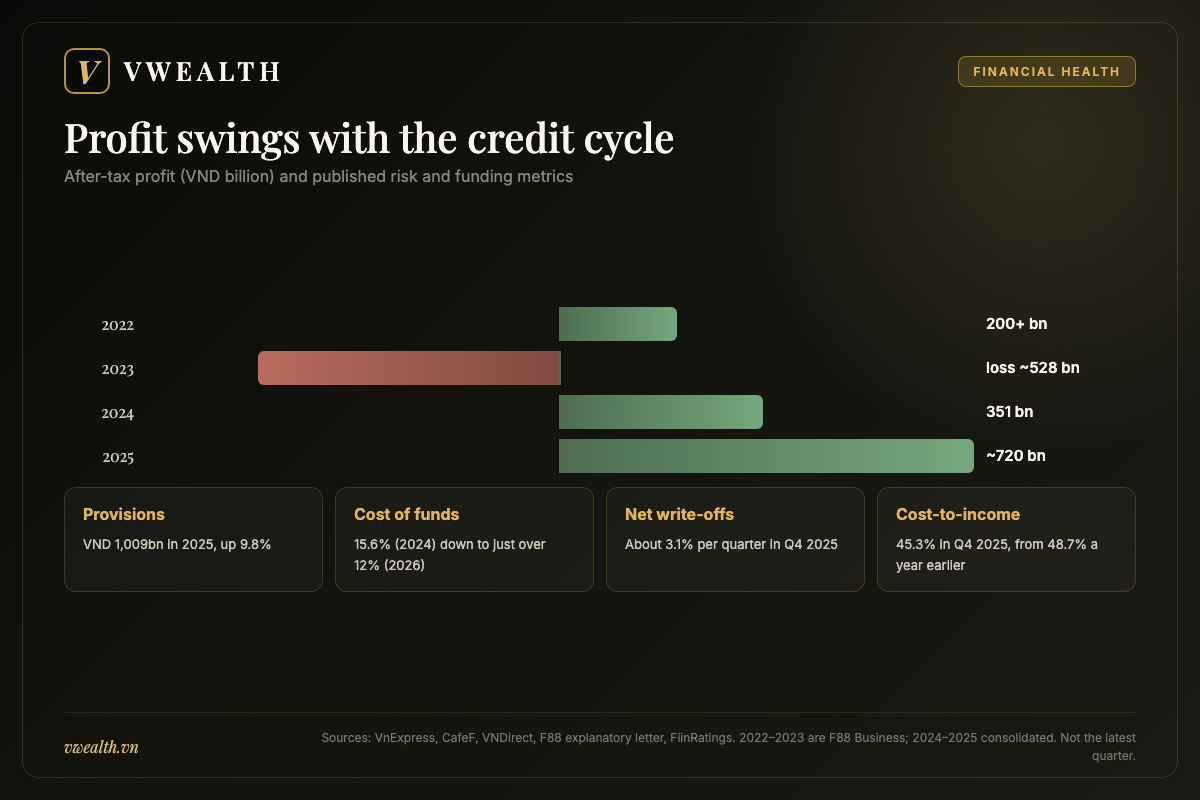
Profit through the years: from tens of billions to nearly a trillion, with one loss year
| Year | Result | Context | Source |
|---|---|---|---|
| 2019–2021 | After-tax profit of tens of billions of dong per year | Network expansion funded by bonds | VnExpress, Sep 2023 |
| 2022 | F88 Business after-tax profit about VND 211 billion, ROE 31.6%; parent consolidated about VND 166 billion | First profit peak | VnExpress, Sep 2023; VNDirect |
| 2023 | After-tax loss of VND 528.8 billion (F88 Business); about VND 545 billion (parent, consolidated) | Heavy provisioning; industry-wide collection scrutiny | CafeF, Apr 2024; VNDirect |
| 2024 | After-tax profit about VND 351 billion; service revenue about VND 2,280 billion | Provisions about VND 919 billion (estimate); management layers cut | VNDirect; 2025 explanatory letter |
| 2025 | Pre-tax profit about VND 907 billion, after-tax VND 719.4 billion; service revenue about VND 3,105 billion | Disbursements of VND 16,476 billion; provisions VND 1,009 billion; 950 outlets | Audited 2025 statements; explanatory letter 9 Mar 2026; CafeF, Jan 2026 |
| H1 2026 | Consolidated revenue VND 2,758 billion (+58.1%), pre-tax profit VND 686 billion (+113.5%), after-tax nearly VND 545 billion | Q2 after-tax profit VND 303 billion (+102%); loans VND 8,827 billion | Reviewed interim statements (Dien dan Doanh nghiep); CafeF, Jul 2026 |
| 2026 (plan) | AGM target of about VND 1,133 billion pre-tax; in September 2026 the CFO said the company was aiming for about VND 1,500 billion | Target of 1,000 outlets | Bao Dau tu, 30 Mar 2026; Dien dan Doanh nghiep, 25 Sep 2026 |
Three things stand out. First, F88’s profit swings violently: from more than VND 200 billion of profit to a loss of over VND 500 billion and then to nearly VND 1 trillion within three years. That is the nature of a high-margin, high-risk lender — a small change in the loss rate flips the bottom line. Second, 2025 was the best year but also the year of fastest loan growth (net loans up 57.4%, according to F88’s explanatory letter); new loans take time to reveal their quality. Third, the company says 2026 profit is running ahead of plan, but you should wait for audited full-year numbers and compare them against the plan — open the vwealth reports for the latest quarter rather than relying on guidance.
For 2025 you will also meet two different “revenue” figures. The press, citing AGM documents, reports revenue of VND 3,840 billion, while Tuoi Tre, citing the audited statements, reports service revenue of about VND 3,105 billion. Both are correct; the gap lies in how income is booked, as the next section explains.
Why F88 reports two different “revenue” numbers
On the consolidated income statement, F88’s pawn income is split across three lines. “Revenue from services” mainly contains pawn service fees and insurance commissions. “Financial income” contains the interest portion of pawn loans — about VND 771 billion in 2025, according to Tuoi Tre. And “other income” contains contract penalties and recoveries on loans previously written off — consolidated other income was about VND 516 billion in 2025 (VNDirect financial data). F88’s explanatory letter combines fees, interest and contract penalties into “revenue from pawn lending”, which reached VND 3,491.1 billion in 2025, up 39.2%. When the company quotes “total revenue” in investor materials, it adds these sources together; when the press quotes “net revenue” from the financial statements, it takes only the first line.
The practical takeaway: do not calculate F88’s gross margin as you would for a retailer. Tuoi Tre calculated a 2025 gross margin of about 38% based on service revenue; that figure can swing sharply between periods not because the business changes overnight, but because the mix of fees, interest and provisions within “cost of sales” shifts. A better approach is to look at total lending income relative to average loans (similar to portfolio yield), then subtract funding costs, operating costs and write-offs — exactly the way you would analyse a bank.
One more point: “other income” from penalties and recoveries is not a one-off for F88; it recurs every quarter. In the consolidated accounts, “other profit” in 2024 was about VND 604 billion, almost double the VND 317 billion of 2023 (VNDirect financial data). For a pawn lender, recovering part of previously written-off loans is routine. But watch its share of profit: if earnings rely more and more on penalties and recoveries, that is a signal to ask harder questions about portfolio quality.
Asset quality: the 91-day rule and net write-offs
Banks classify loans into five groups and publish a non-performing-loan ratio. F88 does not; it uses a simpler and stricter rule. According to the company, loans overdue by 91 days or more, or judged unrecoverable, are provisioned at 100% and moved off balance sheet for collection tracking. A bad loan therefore does not sit on the books for long — it is written off quickly and goes straight into expenses. You will not find a static “5% NPL ratio” on F88’s balance sheet; risk shows up through provision expense and the net write-off rate instead.
The net write-off rate is loans written off minus recoveries, divided by average loans. F88 reports it quarterly: about 3.1% per quarter in Q4 2025, up slightly from earlier quarters, which the company attributed to prolonged storms and flooding through November 2025 that hurt repayment in affected areas (CafeF, January 2026); the rate was 3.5% per quarter in Q1 2026 (VietnamBiz), and in Q2 2026 net write-off expense was VND 319 billion, up 17% from the previous quarter (CafeF). Do the multiplication to see what it means: if net write-offs stayed around 3% a quarter for a full year, roughly 12 of every 100 dong of average loans would be lost annually (illustrative example, vwealth estimate). For a bank, losing 12% of the loan book a year would be catastrophic; for F88, a NIM of around 48% can absorb it — and that is the whole logic of the model.
Other indicators F88 publishes include an on-time repayment rate of around 84% in Q4 2025, and the roll rate from current (B0) to 1–10 days overdue (B1), an early-warning metric. The Q1 2026 statements cited by Tuoi Tre show total pawn loans receivable of about VND 5,832 billion (up nearly 4% from the start of the year), of which about VND 522 billion was overdue (VND 192 billion at 11–30 days and nearly VND 330 billion at 31–90 days), up 20% from end-2025; provision expense in Q1 2026 was VND 381 billion, up 75% year on year. In September 2026, F88’s CFO said the company had tightened its credit policy since the start of the year, controlled disbursements through its digital platform and increased face-to-face meetings with customers, and expected the net write-off rate to improve in Q4; the year-end target is a net write-off rate on disbursements (measured by disbursement cohort) below 5.5%, within the board-approved risk appetite (Dien dan Doanh nghiep, 25 September 2026).
The lesson of 2023 explains why these numbers deserve close attention: that year, provisions wiped out operating profit and pushed the company into loss. With loans growing more than 50% in 2025, new loans will “season” during 2026; a small miss in the quality of recent cohorts could move profit materially away from expectations.
Operating costs: supporting nearly five thousand employees
The second-largest cost after credit losses is people. At the end of 2025, F88 had 4,681 employees, about 650 more than a year earlier. Operating expenses in 2025 (excluding provisions) were about VND 1,994 billion, according to the explanatory letter; in the consolidated accounts, selling expenses were over VND 211 billion and administrative expenses about VND 877 billion, with staff costs the largest component. A physical-store model with staff to value collateral, advise and serve customers is expensive, which is why F88 puts so much weight on its digital channel.
F88 measures efficiency with the CIR. The Q4 2025 CIR was 45.3%, down from 48.7% a year earlier; the full-year 2025 CIR was 50.9%, down from 53.1% in 2024; and Q2 2026 fell to 42.6% (F88 explanatory letter; CafeF). The company’s 2030 target is 42%. As stores mature and more disbursements move to the app, CIR falls — operating leverage, with revenue growing faster than costs. Conversely, a burst of new openings, like the 2026 push past 1,000 outlets, lets costs run ahead of revenue for a few quarters.
Funding and the cost of funds: the structural weakness of a lender without deposits
If cheap deposits are a bank’s weapon, the cost of funds is F88’s Achilles heel. According to FiinRatings, F88’s average cost of funds was 15.6% in 2024 and 14.7% in the first half of 2025, improving thanks to cheaper borrowing and a drop in currency-hedging costs from 2–3% to about 0.8%. At the July 2026 roadshow, the CFO said the average cost of funds was a little above 12% a year and falling. In other words, funding costs fell by roughly 3 percentage points in two years (vwealth estimate from those data points).
Borrowing comes from three groups. The first is international funds: at the end of September 2025, borrowings stood at about VND 2,487 billion, mainly from Puma Asia, Lendable, the Indo-Pacific Liquidity Facility and Lion Asia (FiinRatings, via CafeF); in the first nine months of 2025 alone, F88 agreed a USD 30 million (about VND 780 billion) loan with a two-to-three-year term from Lendable. Foreign-currency borrowing brings exchange-rate risk, so hedging is a real part of funding costs. The second is bonds: after years of private placements, F88 Business began selling bonds to the public in January 2026 at a fixed 10% coupon and a 24-month term; it raised about VND 833.5 billion through this channel in 2026 across three tranches, the third (more than VND 233 billion) completed in September 2026 (Vietstock). The third is equity, topped up by the 2026 share offering.
On leverage, FiinRatings puts F88’s debt-to-equity ratio at about 1.53–1.68 times between Q3 2024 and Q3 2025 — far below a bank (typically above ten times), because F88 has no deposits and its creditors require a thick equity cushion. In Q1 2026, the debt-to-equity (D/E) ratio fell from 1.79 to 1.69 times (Vietstock, April 2026). The real risk is not high leverage but continuity of funding: F88 must keep rolling over bonds and renewing fund facilities. If the bond market froze as it did in 2022–2023, or foreign lenders cut their lines, lending growth would be squeezed. On the positive side, the company says it has never missed a bond payment, including in 2023.
Seven questions to ask every time F88 reports
Pulling it together, here is a checklist you can use every quarter without being a specialist:
1. How much did loans grow, and under which definition? Compare like with like (with or without bank-partnership loans). Loan growth far outpacing new store openings is a sign of loosening credit.
2. How did the net write-off rate move versus last quarter and last year? One or two quarters of storm-related increases can be explained; three consecutive increases are a trend.
3. What are the on-time repayment rate and the B0-to-B1 roll rate? These are leading indicators, typically running about a quarter ahead of provision expense.
4. Is the cost of funds still falling? Watch coupons on new bond tranches and news on international facilities.
5. Where is CIR heading? A burst of openings can lift CIR temporarily; if CIR rises without matching expansion, ask why.
6. What share of insurance revenue is standalone? The higher, the better for quality and compliance.
7. How much of profit comes from other income? Penalties and recoveries are normal, but they should not be the main pillar.
To compare this with a bank that owns a consumer-finance arm, see our analyses of SSB (SeABank) and VPB (VPBank); the banking sector guide explains ROE, P/B and other lender metrics.
How the Market Has Received F88 Stock: a Record Price, a Split and a Half-Filled Offering
Few Vietnamese stocks have had a first year as eventful as F88’s. In just over a year, it went through almost every state a stock can: the market’s highest share price, a string of limit-up sessions, a billion-dollar valuation, a sharp decline, and a public offering that did not sell out. This chapter recounts what happened, with dates, so you understand the stock’s personality — not to predict its price.
8 August 2025: a newcomer with the market’s highest share price
F88 listed on UPCoM with fewer than 8.3 million shares. With so few shares, each one represented a large slice of the company: the VND 634,900 reference price was the highest on the Vietnamese market at the time (CafeF, Vietstock). Before the listing, according to CafeF, shares had changed hands in the over-the-counter market at around VND 1 million, above the reference price. According to VNDirect price data, the first session closed at the VND 888,800 ceiling; the next two sessions also closed limit-up, reaching VND 1,175,400 on 12 August 2025, and on 13 August the stock touched VND 1,250,000 intraday; by the end of August 2025 closing prices had settled back around VND 1.0–1.06 million.
The first lesson: a high share price does not make a stock expensive. What determines value is total market capitalization relative to earnings and book value. The VND 634,900 reference price equalled roughly three times end-2024 book value — a P/B the market was willing to pay for a high-ROE business. For foreign readers, note that UPCoM is Vietnam’s third and least regulated trading venue, with a ±15% daily price band versus ±7% on HOSE; our Vietnam investing guide explains the three venues.
January 2026: the 1:12 bonus issue and a run of limit-up days
As soon as the 1:12 bonus issue was completed and the price adjusted to a little over VND 100,000, F88 embarked on a string of limit-up sessions at UPCoM’s 15% daily cap. According to CafeF, on an adjusted basis the stock rose about 97% from 19 January to the morning of 26 January 2026; it closed that day at VND 242,400, a market capitalization of about VND 26.7 trillion, making F88 Vietnam’s newest billion-dollar listed company. On 27 January it touched the ceiling for a sixth time at VND 278,700, closing at VND 276,000 (VNDirect data). F88 filed an explanation saying the move reflected supply and demand and that there was no undisclosed information.
Then the trend reversed. Although the company had reported a doubling of 2025 profit on 28 January 2026, the stock closed on 29 January at VND 209,900, about 24% below the 27 January close — roughly VND 7.3 trillion of market value lost in two sessions, taking F88 out of the billion-dollar club (vwealth estimate from VNDirect price data). Before the public offering the market price hovered around VND 78,000; it closed at VND 77,900 on 9 July 2026 (CafeF) — a figure that already reflects the 1:1 bonus in June 2026. Adjusted back to before the 1:1 bonus, VND 77,900 is equivalent to about VND 155,800, some 36% below the VND 242,400 close of 26 January (vwealth estimate).
The second lesson: F88 is a highly volatile stock. The free float was initially small, individual investors dominate trading, UPCoM’s price band is wide, and the “billion-dollar” story attracts media attention — all of which can push the price much further than changes in earnings would justify, in both directions. If you cannot stomach a 30–50% decline within a few months, this stock may not suit you even if the business is good.
The VND 71,000 public offering: about half placed
Rather than a private placement to a few pre-selected investors, F88 chose a public offering — unusual for a company still on UPCoM. Under the offering registration certificate issued by the SSC on 1 July 2026, it offered 22,025,190 shares at VND 71,000 each, with subscriptions from 6 to 27 July 2026 and a 10% deposit. The adviser was Vietcap Securities. At the roadshow, Chairman Phung Anh Tuan registered to buy 1.188 million shares; after two days, about 3.24 million shares, or 14.7% of the offer, had been validly subscribed (CafeF, 10 July 2026).
Results published in August 2026: F88 placed 11.0132 million shares with 540 investors (535 domestic, 5 foreign), roughly 50% of the offer, raising nearly VND 781.94 billion; after about VND 17.54 billion of costs, net proceeds of about VND 764.4 billion went into F88 Business. The board decided to keep offering the unsold shares to other investors at the same price, with those shares subject to a one-year lock-up. After the offering, 231,265,102 shares were outstanding, equivalent to charter capital of about VND 2,312.65 billion (Vietstock company profile).
Why only half, even though the offer price was below the market price at announcement? There is no official explanation. Objective factors can be listed: the gap between paying for shares and receiving them exposes investors to price risk; the market price was volatile during the offer period; and raising more than VND 1.5 trillion is large relative to the stock’s normal liquidity. Whatever the reasons, the result is a market data point worth noting: at that price, real demand covered only about half of the supply.
Valuation: which lens to use for F88
This is the most debated question. There are three lenses.
The first treats F88 as a lender and uses P/B and ROE. High-ROE lenders generally command high P/B multiples. F88 reports very high ROE — 43% in Q3 2025 (CafeF, in its report on the FiinRatings upgrade), 34.4% for full-year 2025 and 41% in Q2 2026 according to the company. At that level of ROE, a P/B of several times is not unusual. But F88’s high ROE comes with more risk than a bank’s, so a rational investor will demand a larger discount. Our banking sector guide explains the link between ROE, cost of equity and a fair P/B.
The second treats F88 as a growth retailer and compares P/E with earnings growth. This is the lens Vietcap — the offering’s adviser — presented at an investor event in July 2026: Dang Van Phap, managing director of investment banking, called F88 a “one-of-a-kind” model resembling a retail company; Vietcap’s research team forecast after-tax profit of nearly VND 1,200 billion in 2026 and nearly VND 1,700 billion in 2027, equivalent to a 2026 P/E of about 15 times and a 2027 forward P/E of about 10 times at the offer price. When reading these figures, remember that Vietcap advised on the offering, so this is not an independent view.
The third compares F88 with its Thai counterparts. According to CafeF in August 2025, Ngern Tid Lor’s market capitalization was about VND 37.3 trillion and Srisawad’s about VND 28 trillion, while each had total assets roughly 14 times F88’s. In other words, the market has paid a high price for F88 relative to its asset base — paying in advance for growth. If that growth arrives on schedule, the valuation may be justified; if not, that is the gap the price would have to close.
vwealth does not publish price targets. For current P/E and P/B and how they compare with history, open the vwealth reports, which update with each price move and filing.
Catalysts the market tends to react to
The first is the move to HOSE. The board approved the plan on 24 September 2026, targeting the end of 2026. A HOSE listing typically opens the door to index funds and institutions that may only buy listed shares, and it narrows the daily price band (±7% instead of ±15% on UPCoM). But distinguish between an approved plan and HOSE’s actual approval; the timing may change.
The second is market context. According to Dien dan Doanh nghiep, FTSE Russell’s upgrade of Vietnam to Secondary Emerging market status took effect on 21 September 2026, which could draw more active and passive foreign capital into Vietnamese equities. The maximum foreign ownership in F88 depends on rules for conditional business lines and on the company’s charter — check F88’s current foreign-ownership limit in its disclosures before assuming how much more foreign money can come in. Our explainer on foreign ownership limits in Vietnamese stocks covers how “foreign room” works.
The third is quarterly data, especially the risk indicators. January 2026 showed that even strong results can coincide with a falling price when expectations are already high. The fourth is any news on how the pawn industry will be regulated — the subject of the next chapter.
Industry Context: Alternative Finance — High Margins, High Regulatory Risk
To judge a company you need to understand its playing field. F88’s field has a name that industry reports have started to use: “alternative finance” — financial services outside the banking system for people who do not have, or do not qualify for, bank services. It is a large, fast-growing market whose legal framework is still being shaped. Those two halves — big demand and unfinished rules — are the whole story of the sector.
Who the “overlooked” customers are
According to Vietcap, about 70% of F88’s customers are self-employed — drivers, tradespeople, small traders, online sellers. What they have in common is irregular income, no employment contract or steady salary record, but a vehicle they own. For a bank, their applications are costly to assess for loans that are small, so they are not worth pursuing. For consumer-finance companies, the lack of information makes them risky. The result is a gap between the formal system and informal lending.
Industry material usually calls this group “underbanked” — customers not fully served by banks. Vietcap, in its 2026 commentary on F88, pointed to a pool of about 33 million such customers (Nguoi Quan Sat). At the 2026 AGM, F88’s chairman also made a telling observation: when the economy is weak, the number of people using pawn services actually rises — the question is whether a lender can raise enough capital and keep risk under control (Bao Dau tu). That is why investment funds are interested in the sector, and also why its credit risk is tied so closely to the economic cycle.
The key insight is this: “finance for the people banks overlook” earns high margins precisely because banks overlook them. If banks find a cheaper way to serve this group — through digital data, electronic ID and alternative credit scoring — margins across the sector will compress. One investor raised exactly this at the July 2026 roadshow, asking about new rules raising banks’ consumer-lending limits; the chairman replied that the change would not greatly affect F88’s core customers, whose loans are much smaller and need to be disbursed quickly.
The pawn market: tens of thousands of small shops and a handful of chains
Vietnam’s pawn industry is extremely fragmented. At the July 2026 roadshow, F88’s chairman put the number of traditional pawnshops at about 22,000 (CafeF). Set against F88’s roughly 1,000 outlets, that shows most of the market is still in the hands of small independent shops.
On market share, several numbers circulate and each needs its context. At the 2026 AGM, F88 cited a survey suggesting that chain pawnbrokers account for only about 3% of the total market. Meanwhile, a company profile appended to a CafeF report in July 2026 states that F88 “holds 85% of the national pawn market”, without any definition or method. The two figures measure different things and cannot both be true if read as whole-industry shares; we use the AGM’s 3% to gauge the runway and do not use the 85% figure in any calculation. What is more certain: F88 is the largest chain by number of outlets, and chains are still a small part of the market. That is the company’s “runway” argument — and the reason competitors such as VietMoney, Happy Money and Srisawad Vietnam (present since 2016 with more than 100 branches, per CafeF) are racing too.
The legal framework: pawnbroking is not credit — at least for now
As explained earlier, pawn services are a business line subject to security and public-order conditions, overseen by the Ministry of Public Security; those conditions are updated by government decree, most recently Decree 58/2026/ND-CP, issued on 13 February 2026 and effective from 15 March 2026, which amends the security-and-order conditions for several business lines; according to provincial police, one change is that commune-level police now directly oversee pawn businesses. The loan relationship between borrower and pawnbroker follows the Civil Code, with its 20% annual interest cap. No authority supervises pawnbrokers’ capital adequacy, loan classification or total borrowing cost the way the State Bank supervises finance companies.
F88’s own leadership expects this to change. According to CafeF (10 July 2026), Chairman Phung Anh Tuan said State Bank oversight of the sector is “a scenario certain to happen” once F88’s or the industry’s lending is large enough, because the activity is credit in substance; F88 has worked with the State Bank for years and is proactively lowering borrowing costs toward finance-company levels. He argued that if licensing were required, many small shops would fail to meet capital, governance and compliance standards, creating room for well-organized players. The CFO added that if borrowing costs fall under a new framework, loan demand could rise strongly (CafeF, 10 July 2026).
That argument is reasonable, but investors should see both sides. On the positive side, a clear framework would give large chains full legitimacy, reduce stigma and perhaps open access to cheaper funding. On the risk side, no one knows in advance where a cap on total borrowing cost would be set, how quickly it would be phased in, whether it would apply to existing loans, or what minimum capital would be required. A new regulation could be designed in a way that suits F88 — or the opposite. This is the stock’s largest and least quantifiable risk.
The “loan-shark” stigma and how the industry is trying to change it
It is hard to discuss pawnbroking in Vietnam without the image of tín dụng đen — “black credit”, the local term for illegal loan-sharking with extortionate interest and intimidating collection. To be clear and fair: loan-sharking is illegal lending, while a pawnbroker holding a certificate of eligibility runs a lawful business. But the public does not always draw the line so neatly, because within pawnbroking and consumer lending some operators have been sanctioned over collection practices or fees. In 2023 the Ministry of Public Security held a conference on property-extortion crimes carried out “under cover” of finance companies, law firms and debt-trading firms; Ho Chi Minh City police said they had broken up six such groups (Tuoi Tre, 30 March 2023).
For F88, vwealth records only what has been disclosed, as in the history chapter: in 2023, 10 people in the Ho Chi Minh City branch’s debt-collection unit were charged, and in 2024 six former employees were convicted of property extortion; police in some provinces imposed administrative fines on some outlets. According to the chairman, the authorities inspected the company nationwide at the time and concluded the company had no policy of pressuring customers; F88 subsequently changed its collection process. On the independent-certification side, F88 received Client Protection Certification from the Center for Financial Inclusion for 2022–2025 (VnEconomy, March 2023).
For investors, stigma is a real business risk even though it does not appear on the balance sheet. It affects funding costs (some institutional investors exclude pawnbroking from their portfolios), hiring, relations with regulators and public reaction whenever an incident occurs. Conversely, if F88 succeeds in standardizing the industry and is placed within a formal legal framework, that same stigma becomes a barrier that makes it hard for small rivals to compete.
Compared with Thailand’s leaders: a path others have walked
Thailand is where vehicle-title lending has matured, with two large listed players, Ngern Tid Lor (NTL) and Srisawad. NTL’s CEO sitting on F88’s board shows that F88 sees Thailand as its model. The figures below were compiled by CafeF in August 2025 and are meant to illustrate the gap, not to describe the present.
| Metric | F88 (Vietnam) | Ngern Tid Lor (Thailand) | Srisawad (Thailand) |
|---|---|---|---|
| Origins | 2013, standardized pawn chain | Vehicle-title lending roots; grew through M&A with Bank of Ayudhya and CVC Capital involved | Family pawnshop from 1979, organic growth |
| Listing | UPCoM, Aug 2025; planned HOSE transfer | SET, 2021, IPO of about USD 1.2 billion | SET |
| Network | Close to 1,000 outlets (2026) | About 1,700 branches (Jul 2025) | Present in Vietnam since 2016 with 100+ branches |
| Total assets vs F88 | 1x | About 14x | About 14x |
| Market cap (Aug 2025) | About VND 8.5 trillion (vwealth estimate from ratios cited by CafeF) | About VND 37.3 trillion | About VND 28 trillion |
| Reported bad-loan ratio | Not reported by loan group; written off from 91 days overdue | 1.78% | About 3.73% |
Two conclusions follow. First, F88’s asset base is still far smaller than the Thai pair; if Vietnam follows Thailand’s trajectory, the runway is long. Second, the market has already paid F88 a relatively high valuation versus its assets, pricing in part of that runway. Note the bad-loan comparison: Thai lenders use loan-classification standards, while F88 writes off loans 91 or more days overdue, so the ratios are not directly comparable. What is worth watching in Thailand is how these two companies sustained growth and controlled bad loans at scale: according to the same CafeF article, NTL grew net profit 14.3% in the first half of 2025 while Srisawad’s fell 6.2%. Even within the same model, credit discipline produces very different outcomes — a direct lesson for F88 as it accelerates.
Outlook: Three Scenarios for F88 Stock and What Would Trigger Each
No one knows where F88’s share price is going, and vwealth does not set price targets. What we can do is identify the variables that matter and build scenarios with explicit conditions — so that when news arrives, you know which scenario it pushes F88 toward.
Six variables that will shape F88’s future
1. Quality of the 2025–2026 loan cohorts. Loans grew more than 50% in 2025 and kept growing in 2026. Net write-offs and the B0-to-B1 roll rate will show how healthy that growth is.
2. The regulatory framework for pawnbroking. Whether the sector comes under State Bank supervision, where any cap on total borrowing cost is set, and how quickly it is phased in.
3. Cost of funds. It has fallen from about 15.6% in 2024 to a little above 12% in 2026 according to the company; whether it keeps falling depends on the bond market, global rates and credit ratings.
4. Network and digital efficiency. The share of profitable stores, payback time for new stores and the share of disbursements through the app.
5. Insurance and non-lending services. The growth of standalone insurance and NNX — income that does not depend on lending margins.
6. Share supply. The HOSE transfer, remaining unsold offering shares, and the plans of long-standing fund shareholders.
Bull case: growth holds up and regulation arrives clearly and favourably
Conditions: new loan cohorts show stable or falling net write-offs, in line with the company’s targets; any new supervisory framework is phased in, with a borrowing-cost cap at a level F88 has prepared for, while weeding out substandard small operators; funding costs keep falling thanks to public bonds and a stronger credit rating; F88 lists successfully on HOSE and attracts more institutional investors; insurance grows its share of revenue on schedule.
In this case, profit could track the path the company has set for 2026–2030, and the “retail financial chain” story would continue to be valued at growth-stock multiples. Signals to look for: falling net write-offs while loans still grow; lower coupons on new bond tranches than on earlier ones; HOSE’s approval of the listing.
Base case: growth slows and margins compress gradually
Conditions: loan growth drops below the 2025 pace as the company tightens credit; net write-offs hover around 2025–2026 levels; borrowing costs for customers edge down (through competition or preparation for regulation), lowering portfolio yield; insurance grows but not enough to offset. The HOSE transfer happens but brings no significant new money.
In this case, F88 remains profitable with ROE well above the market average, but earnings growth slows and the valuation tends to “de-rate” from hot growth stock toward high-ROE financial. The share price then follows earnings more than narrative. Signals: slower store openings, profit growing more slowly than loans, a gradually declining reported NIM.
Bear case: credit risk and regulatory risk hit at the same time
Conditions: an economic slowdown cuts self-employed incomes, repayment deteriorates and net write-offs rise sharply for several consecutive quarters — as in 2023; at the same time, a new framework imposes a low and abrupt cap on total borrowing cost, forcing F88 to cut prices across its entire book; or a reputational or legal incident damages the trust of customers and bond investors, making funding more expensive or harder to obtain.
2023 proves this scenario is not theoretical: within six months, F88 went from record profit to a loss larger than the previous four years of earnings combined. With a loan book many times larger today, the absolute impact would be bigger. Signals: the on-time repayment rate falling clearly below the roughly 84% of end-2025, provision expense growing faster than loans, new bond tranches requiring higher coupons or failing to sell out.
Illustrative example: how a borrowing-cost cap could affect profit
This section uses hypothetical numbers for illustration only; it is not a forecast. Suppose a pawn lender has average loans of VND 10 trillion, a portfolio yield of 56% (close to F88’s reported figure), funding costs equal to 8% of loans, operating costs equal to 22% of loans and net write-offs of 12% of loans. Pre-tax profit from lending would be about 56% − 8% − 22% − 12% = 14% of loans, or about VND 1.4 trillion.
Now suppose a new rule forces total borrowing costs down by 30%: portfolio yield falls from 56% to about 39%. With nothing else changing, pre-tax profit from lending becomes 39% − 8% − 22% − 12% = −3% of loans — a loss. To stay profitable, the lender must compensate in three ways: grow loans strongly (cheaper pricing attracts more customers — F88’s CFO said a 30% price cut in a pilot lifted disbursements by 40–50%), cut operating costs per dong lent through scale and digital channels, and lower write-offs by selecting better borrowers (customers attracted by cheaper loans tend to be better credits). In our example, if loans grow 45% while absolute operating costs rise only 15% and write-offs fall from 12% to 9%, the margin turns positive again (vwealth illustrative estimate: 39% − 8% − about 17.4% − 9% ≈ 4.6% on a larger loan book).
The lesson: a borrowing-cost cap would not automatically kill the model, but it would turn F88 from a “high-margin, mid-sized” lender into a “lower-margin lender that needs large scale and very efficient operations”. The size and speed of any regulatory change will decide whether the company can adapt in time. That is why variable number two above matters as much as variable number one.
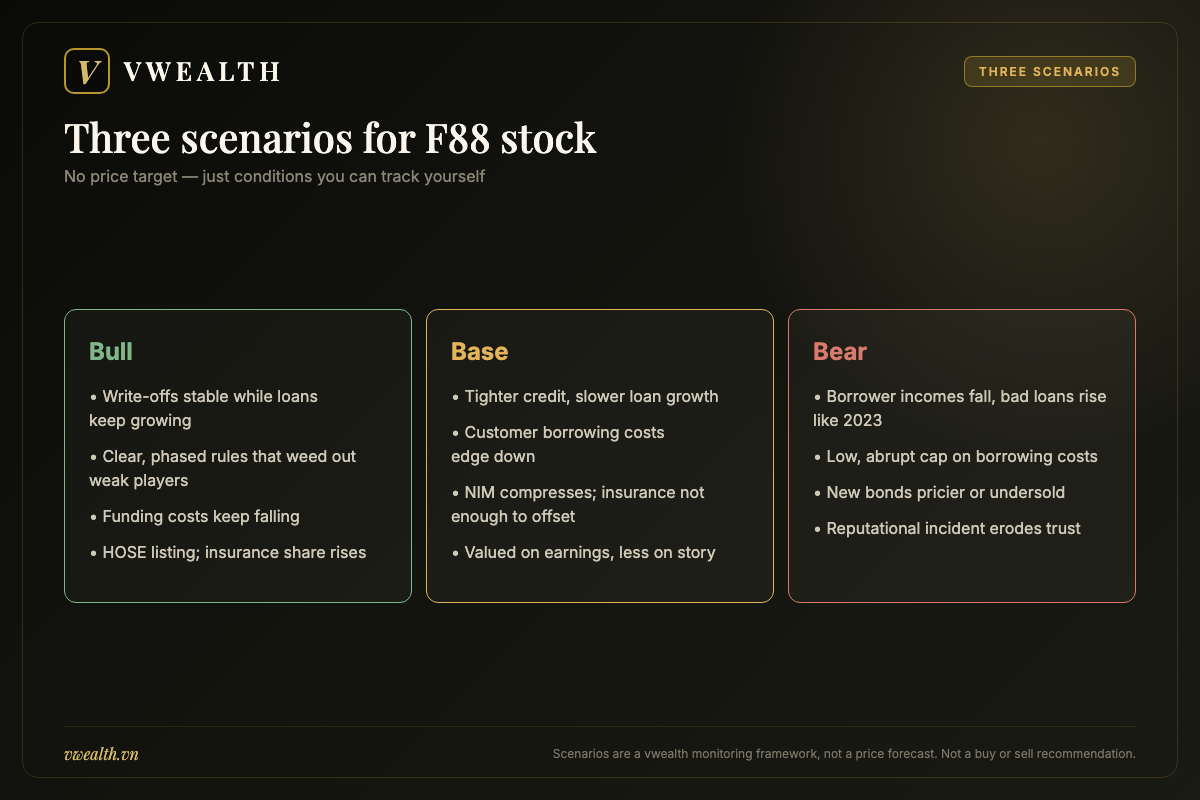
So, Should You Buy F88 Stock? Weighing the Pros and Cons for Different Investors
After seven chapters, back to the original question. The answer is not “yes” or “no” but “for whom, and under what conditions”. F88 is a business with profitability rarely seen on the Vietnamese market and a growth story that is easy to grasp; it is also an extremely volatile stock tied to an industry whose rules may change. Both are true at once.
The compelling positives
Leadership in a fragmented market. Close to a thousand outlets, the largest of Vietnam’s modern pawn chains, while most of the market is still small independent shops.
High profitability proven in audited accounts. Pre-tax profit of about VND 907 billion in 2025, reported ROE above 40% in some quarters, and, according to the company, 99% of outlets profitable.
Every loan is secured, and bad loans are written off fast. Loans are only a portion of the collateral value; the rule of writing off loans 91 or more days overdue makes risk visible early instead of letting it accumulate.
More diversified funding than before. Public bonds at 10%, international funds, bank partnerships; falling cost of funds; a FiinRatings upgrade to BBB; and, according to the company, no missed bond payment.
A growing, capital-light insurance business. High commission rates and fast-growing standalone insurance reduce dependence on lending margins.
Internationally flavoured governance. Foreign funds have been major shareholders for years; the 2025 financial statements were audited by KPMG, a Big Four firm; an independent director has taken a company with the same model public in Thailand.
The negatives you cannot ignore
Large, hard-to-quantify regulatory risk. The pawn sector is not supervised by the State Bank; F88’s own chairman calls tighter oversight “certain” once the sector is large enough. A cap on total borrowing cost could compress margins sharply.
Earnings that swing with the credit cycle. 2023 is the proof; the rapid loan growth of 2025–2026 needs time to reveal its quality.
Structurally higher funding costs than banks. No retail deposits; reliance on bond markets and foreign lenders, with currency risk on foreign-currency loans.
Stigma and reputational risk. A collection incident or a controversy over fees could hit customers, investors and regulators at the same time.
Very high volatility and no cash dividends. The stock has nearly doubled within a week and fallen by almost half within months; the company retains all profit for growth.
Potential share supply. Unsold offering shares and the possibility that long-standing funds reduce their stakes as their fund lives end are supply factors to monitor.
| Factor | Upside | Downside | What to track |
|---|---|---|---|
| Growth | Large market, chains hold a small share | Fast growth can erode loan quality | Loan book, store count, net write-offs |
| Margin | NIM of about 48% per the company | Depends on the current legal framework | Portfolio yield, regulatory news |
| Credit risk | Secured by motorbikes and cars | Borrowers with unstable incomes, sensitive to the economy | On-time repayment, B0–B1 roll rate, provisions |
| Funding | Diversified, costs falling | No deposits; reliant on bonds and foreign funds | New bond coupons, credit rating |
| The stock | Planned HOSE transfer, an easy-to-grasp growth story | High volatility, no cash dividend yet | Listing decision, major-shareholder trades |
Who F88 stock may suit — and who it does not
It may suit investors with a high risk tolerance who want exposure to financial services for Vietnam’s mass market — a segment the listed banks do not represent — and who are willing to track risk data every quarter. It may also suit investors diversifying within financials: in a portfolio that already holds banks such as VPB or SSB, F88 carries a different kind of risk (small, secured loans with no real-estate exposure) and therefore may not move in step. For a stock this volatile, a sensible position size is usually smaller than a core holding.
It does not suit investors who need regular cash dividends; those who cannot tolerate deep short-term drawdowns; those without time to read quarterly reports; and investors who, for ethical or personal reasons, prefer not to own a business that lends at high rates to low-income people — a legitimate choice each investor makes for themselves. Foreign investors should also check the stock’s foreign-ownership headroom and remember that UPCoM liquidity and disclosure practices differ from HOSE until the transfer is completed. If you are new to the market, start with our guide to investing in Vietnam and the banking sector guide for the broader picture before tackling a special case like F88.
Frequently asked questions about F88 stock
Which company does the F88 ticker belong to? F88 Investment JSC, the parent company; the store network is operated by its subsidiary, F88 Business JSC.
Where does F88 trade? On UPCoM since 8 August 2025. On 24 September 2026 the board approved a plan to transfer the listing to HOSE, targeted for the end of 2026; check HOSE announcements for the latest status.
Is F88 a bank or a finance company? No. F88 runs a pawn business — a line subject to security and public-order conditions — is not licensed by the State Bank as a credit institution and does not take public deposits.
Does F88 pay dividends? It has not paid cash dividends to parent-company shareholders; in 2026 shareholders received bonus shares at 1:12 (January) and 1:1 (June). The 2026 AGM decided not to pay a dividend for 2025.
Why was the share price so high at listing? Because there were very few shares (about 8.26 million). After two bonus issues the share count rose above 220 million, then to about 231 million after the offering, and the price adjusted accordingly. A high or low share price says nothing about whether a stock is cheap or expensive.
Who is the largest shareholder? At the end of 2025, Skydom Pte. Ltd., part of Mekong Capital, with 30.55%, followed by Chairman Phung Anh Tuan and director Ngo Quang Hung. Check the latest governance report for stakes after the 2026 issues.
Final thoughts
F88 is a bold experiment on the Vietnamese stock market: taking an old, stigmatized trade — pawnbroking — and turning it into a retail financial chain with data, foreign private equity backing, international auditing and publicly traded shares. Thirteen years show that the model can be highly profitable, but also that it can reverse very quickly when credit risk and regulatory risk appear together, as in 2023.
So the answer to “should I buy F88 stock” does not lie in the 2025 profit figure or the billion-dollar headline. It lies in three things to monitor over the next 12–18 months: whether the fast-growing 2025–2026 loan cohorts keep write-offs within target; how the regulatory framework for pawnbroking is designed and how F88 adapts; and how the HOSE transfer and share supply from offerings and major holders affect the stock. If all three go well, F88 could be one of the standout growth stories among Vietnam stocks in the financial sector. If not, it will remain a profitable business whose shares swing far more than its earnings.
This article is for information and analysis only and is not a recommendation to buy or sell. Before deciding, check up-to-date figures — price, P/E, P/B, latest quarterly profit, net write-off rate — in the vwealth research reports, and consider your own risk tolerance. For a useful comparison within Vietnamese financials, read our EVF analysis, which covers a licensed finance company and shows how different the two legal frameworks are. And if you would like to follow F88 alongside hundreds of other Vietnamese stocks without digging through every filing yourself, you can sign up for vwealth.
Research Vietnamese stocks in English with vwealth. Our AI-powered platform turns Vietnamese market data into full English analysis reports — with international payment support and a free 2-month trial for new accounts. Create your free account and read the latest reports.