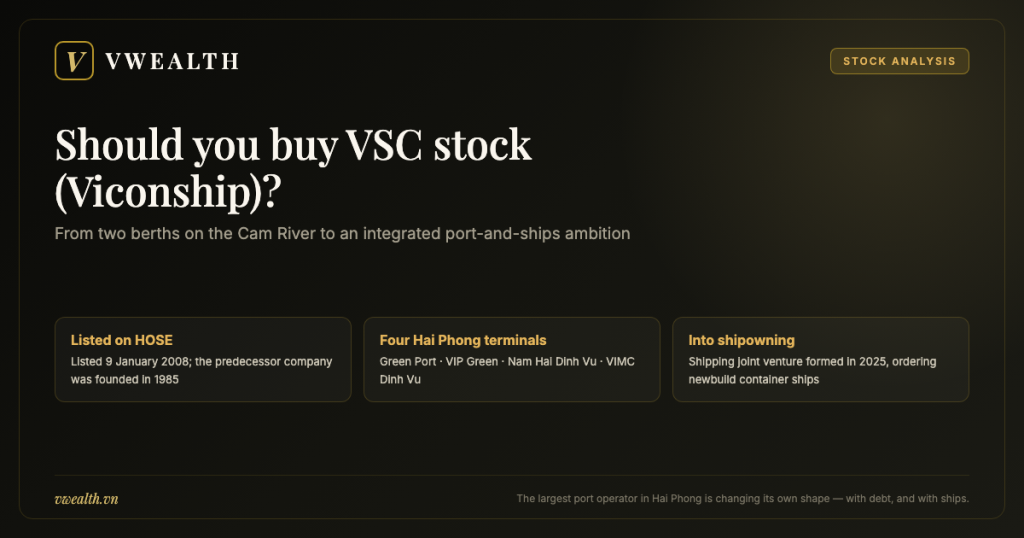
Should you buy VSC stock — the ticker of Vietnam Container Shipping Joint Stock Corporation, universally known as Viconship, listed on the Ho Chi Minh City Stock Exchange? For most of its listed life this was a question almost nobody asked. Viconship was a quiet, competent, mid-sized port operator on the Cam River in Hai Phong, the kind of company that pays a steady dividend and never appears in the headlines. Then, in the space of roughly three years, it spent thousands of billions of dong buying a rival’s container terminal outright, bought into a second one, assembled the largest port operation in northern Vietnam by capacity, accumulated a large minority stake in the country’s biggest domestic container shipping line, and finally set up a joint venture that is now ordering newbuild container ships. This article walks through that entire transformation, teaches you how to read the financial statements of a port operator — a business type where the standard toolkit for industrial stocks will actively mislead you — and finishes with a straight answer about which kind of investor VSC suits and which kind should stay away.
Before we begin, one convention needs to be agreed between you and this article, the same convention used throughout this series. You will meet a great many dates, names, transactions, terminal names and capacity figures — all drawn from public disclosures filed with the stock exchange, shareholder meeting resolutions, and mainstream Vietnamese financial media. But this article will not quote the most recent quarter’s financials: what profit was booked last quarter, what the gross margin is today, what earnings multiple the stock trades at this morning. Not because numbers are unwelcome, but because for a port operator in the middle of a debt-funded expansion those numbers swing violently between quarters, and an article meant to remain useful for two years becomes actively misleading ninety days after publication if it hard-codes a single quarter. Instead you will learn where to look and how to interpret what you find, and you can pull the current figures from the analysis reports on vwealth.
A second note. Container terminals belong to the infrastructure family: asset-heavy, depreciation-heavy, with reasonably predictable cash flows but a growth ceiling set by something stubbornly physical — the length of your quay and the depth of your channel. You cannot double a terminal’s throughput by hiring more people or spending more on marketing. A port operator that wants to grow has exactly three options: run its existing berths harder, build new berths, or buy someone else’s terminal. Over the past three years Viconship has pursued all three simultaneously, and that single fact generates both the appeal and the entire risk profile of VSC stock. Understand that logic and you will understand why the market is simultaneously excited and nervous about the largest port company in Hai Phong.
One final orientation note for readers approaching Vietnam from abroad. Vietnam is a manufacturing export economy whose northern industrial belt — Bac Ninh, Bac Giang, Hai Duong, Hung Yen, Vinh Phuc, home to a very large share of the country’s electronics assembly — ships almost everything through one gateway: the Hai Phong port cluster. That makes container throughput at Hai Phong close to a real-time indicator of northern Vietnamese export health, and it makes the companies that own quay space there a fairly direct way to own a slice of that trade. It also means their fortunes are tied to global trade policy decisions made in Washington, Brussels and Beijing, over which they have no influence whatsoever. If you are new to this market, the guide to investing in the Vietnam stock market covers the mechanics of access, custody and settlement that sit underneath everything discussed here.
From a 1985 state container company to the largest port operator in Hai Phong
If you had to pick one Vietnamese listed company whose biography splits cleanly into a “before” and an “after”, Viconship would be a strong candidate. For roughly thirty-five years it was a steady, unremarkable business — the kind value investors quietly like because it is boringly profitable. Then, starting in 2023, the same company began doing things that startled even its own long-term shareholders. To understand how the market prices VSC today, you have to walk each of those turns.
1985: a container company founded before containers mattered here
On 27 July 1985, Vietnam Container Company was established. It was among the first state-owned enterprises in Vietnam to offer container transport services, at a time when containerisation was still an unfamiliar concept to most of the domestic economy. The northern arm initially operated as the North Container Company under the Vietnam Container Company umbrella, and in 1993 it was renamed Viconship Hai Phong.
Pause on that founding date, because it says something important about the nature of the business. Containerisation was the single largest change in twentieth-century shipping: it turned break-bulk cargo handling that consumed weeks into a crane movement that consumes minutes, and it is the reason global supply chains exist in their present form. A Vietnamese company betting on containers in 1985, before the country had opened its economy, was a company standing in the right place before the wave arrived. Four decades later, that is why Viconship holds land, licences, shipping-line relationships and operating know-how at the northern gateway — assets that latecomers can only obtain by paying a great deal of money.
2002 and 2008: equitisation, then listing into the worst possible year
Viconship was equitised in 2002, converting from a state enterprise into a joint stock company. On 9 January 2008, VSC shares were listed on the Ho Chi Minh City Stock Exchange.
The timing deserves a moment’s attention. The year 2008 was the worst of the young Vietnamese market’s life, a year in which the index lost the majority of its value. Companies that list into that kind of market are usually not listing to sell shares at a good price — they list to formalise governance and open a long-term funding channel. That is consistent with everything Viconship did afterwards.
For roughly fifteen years the company was a textbook healthy infrastructure stock: slow but steady revenue growth, stable profit, regular cash dividends, low borrowings. If you have ever heard the phrase “a stock you can buy and forget”, Viconship between 2010 and 2020 was close to the definition. This matters, because it explains why many long-standing shareholders find the post-2023 company uncomfortable: the business they bought precisely because it required no attention now requires attention every quarter.
Green Port and VIP Green: the two terminals that built the foundation
The physical foundation of Viconship is two container terminals in Hai Phong. Green Port sits upstream on the Cam River, close to the city centre. VIP Green, operated by Green VIP Port Joint Stock Company, sits downstream in the Dinh Vu area, closer to the sea.
The distinction between upstream and downstream sounds like mere geography. In the port business it is destiny. An upstream terminal sits inland along a river: shallower channel, bridge air-draft restrictions, therefore only smaller vessels — typically intra-Asia feeder ships. A downstream terminal near the river mouth has deeper water, no bridge constraint, handles larger vessels, and earns a higher rate per box. Since the global container fleet has been getting steadily larger for three decades and shows no sign of stopping, upstream terminals face a structural headwind that no amount of good management can reverse. Keep this in mind; it returns in chapter seven when we discuss the downside scenario.
Around the terminals, Viconship built a logistics chain: container depots, warehouses, an inland container depot, road haulage, shipping agency and freight-forwarding services. None of these individually earns spectacular margins. Their function is customer retention. A shipping line already calling at your terminal, storing empties in your depot and renting your warehouse faces a switching cost that is measured in operational disruption, not just in price per box.
2023: buying a rival’s terminal outright
In April 2023, Viconship formally announced an agreement to acquire Gemadept‘s stake in Nam Hai Dinh Vu Port Company Limited. This is a transaction the Vietnamese port industry remembers, because it is a rare instance of one listed port operator buying an operating terminal outright from another listed port operator, inside the same port cluster, for a four-digit billion-dong sum.
Nam Hai Dinh Vu was built with total investment above 1,000 billion dong, entered service in 2014, and has design capacity of roughly 500,000 TEU per year. TEU stands for twenty-foot equivalent unit, the industry’s standard box-counting measure — a forty-foot container counts as two TEU. You will meet this unit in every port report you ever read.
Viconship’s initially announced outlay was around 2,250 billion dong, and the total spent to lift ownership to roughly 99.99% across 2023 and 2024 came to approximately 3,178.4 billion dong, completing in July 2024. Estimates published at the time suggested the seller booked a substantial pre-tax gain on the divestment. For a VSC shareholder, though, the important consequence is not who profited on the sale. It is that Viconship ended up with three adjacent downstream terminals whose combined quay length approaches 1.6 kilometres.
VIMC Dinh Vu and the economics of contiguous quay
Alongside Nam Hai Dinh Vu, Viconship also holds an interest in VIMC Dinh Vu terminal. By the end of 2024 the company operated four terminals — one upstream (Green Port) and three downstream (VIP Green, VIMC Dinh Vu and Nam Hai Dinh Vu) — with combined capacity around 2.6 million TEU per year, equivalent to roughly 30% of the Hai Phong cluster’s capacity.
Why does it matter so much that the berths sit next to each other? Picture three small terminals operating separately. Each has its own vessel schedule. Sometimes a terminal is congested and a ship waits at anchor; sometimes a berth is idle with no cargo to work. Now put those three terminals side by side under one owner. The planner can allocate vessels like a puzzle: big ships to the long berth, small ships slotted into gaps, boxes moved between yards on internal roads rather than trucked through public streets. Throughput per metre of quay rises without a single dong of new construction.
That is the genuine economic rationale behind Viconship’s acquisition strategy, and it is a sound one — provided the purchase price was not excessive and the money used to buy it was not too expensive in interest terms. Both of those provisos matter, and both are examined in chapter four.
2024 and 2025: Vinaship, Hai An, and the turn into shipowning
Had the story ended with terminal consolidation, it would already be interesting. Viconship went one step further, and it is this step that divides opinion.
At the end of 2024, Viconship raised its holding in Vinaship, a Vietnamese shipping company, to approximately 40.01% at a cost of roughly 365.1 billion dong, reclassifying the investment as an associate. Through 2025 the company steadily bought shares in Hai An Transport and Stevedoring Joint Stock Company (ticker HAH), Vietnam’s largest domestic container shipping line. The Viconship group’s stake climbed in visible steps: through 5% to become a substantial shareholder, then above 8.5%, then roughly 10.65%, then 13.2%, then approximately 15.3% by mid-2025 — the point at which Viconship nominated directors to HAH’s board — and onward to roughly 22.3%.
In August 2025 the two companies formed a joint venture, Hai An Green Shipping Lines, with initial capital of 1,000 billion dong, Viconship holding 60% and Hai An holding 40%. The joint venture contracted for newbuild container vessels: three ships of roughly 3,000 TEU each, at a reported price near 46 million US dollars per vessel — described by management as below the prevailing market level of around 51 million dollars at the time — plus orders for two vessels of roughly 7,100 TEU.
This is a very large strategic decision. A terminal operator collects fees on fixed assets: steady cash, modest volatility, local competition. A shipping line sells a commodity service into a global market where freight rates can quintuple in a year and then collapse in the next. Management’s argument is that the two businesses reinforce each other: owning ships secures cargo for your terminals, and owning terminals lowers costs for your ships. That argument has genuine merit. But it also means that from now on, VSC’s reported earnings will be considerably more sensitive to the global container freight cycle — something nobody in Hai Phong controls.
Summary timeline
| Date | Event | What it means for an investor |
|---|---|---|
| 27 July 1985 | Vietnam Container Company established, among the first container service providers in Vietnam | First-mover position at the northern gateway |
| 1993 | Renamed Viconship Hai Phong | Anchored firmly to the Hai Phong cluster |
| 2002 | Equitisation | Conversion to joint stock company form |
| 9 January 2008 | VSC shares listed on HOSE | Listed into the market’s worst year, implying no dependence on equity markets to survive |
| 2014 | Nam Hai Dinh Vu terminal, then owned by Gemadept, enters service | The asset Viconship would buy a decade later |
| April 2023 | Agreement announced to acquire Gemadept’s stake in Nam Hai Dinh Vu | The inflection point: from mid-sized operator to consolidator |
| May 2023 | Operational handover of Nam Hai Dinh Vu completed | Consolidation of both throughput and debt begins |
| 2024 | One-for-one rights issue raising approximately 1,333.96 billion dong | Share count expansion to fund asset purchases |
| July 2024 | Ownership of Nam Hai Dinh Vu raised to roughly 99.99%; total outlay approximately 3,178.4 billion dong | Three contiguous downstream terminals, close to 1.6 km of quay |
| Late 2024 | Vinaship stake raised to approximately 40.01% for roughly 365.1 billion dong | First step into shipping |
| 2025 | Continuous accumulation of HAH shares to approximately 22.3%; board nominations submitted | From financial investor to strategic partner of a shipping line |
| August 2025 | Hai An Green Shipping Lines joint venture formed, capital 1,000 billion dong, VSC holding 60% | Formal entry into shipowning, with newbuild orders placed |
| April 2025 | Mr Nguyen Xuan Dung takes the chair of the board | A new leadership generation with a financial background |
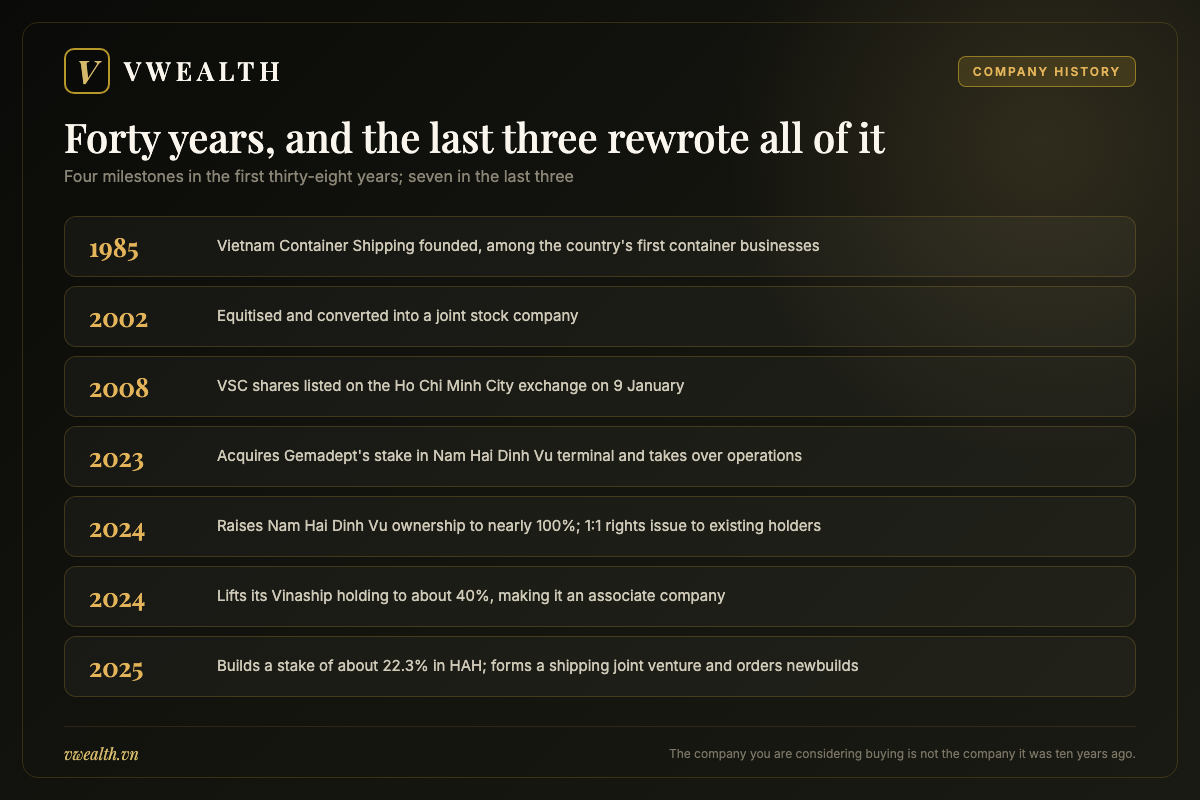
Look at that table again and notice the shape of it. Thirty-eight years produce four entries. The last three years produce eight. That is not a formatting quirk — it is a portrait of the company you are considering buying.
Who runs Viconship, and who owns it?
For most Vietnamese listed companies, the ownership chapter is the easiest one to write: identify the controlling family or the state agency, state the percentage, move on. Viconship is the opposite. This is probably the strangest chapter in this article, and the one you should read most carefully, because VSC’s ownership structure is genuinely unusual by the standards of this market.
A generational handover after forty years
For most of the company’s modern history the chairmanship was held by Mr Nguyen Viet Hoa, who spent roughly forty years with Viconship — effectively its entire post-founding existence. At the 2023 annual general meeting he stepped down from the chair. That was a genuine generational handover, and it happened almost simultaneously with the Nam Hai Dinh Vu transaction.
The sequencing is worth thinking about. A company changing strategy as radically as Viconship did — from holding cash and paying steady dividends to borrowing heavily, buying assets and ordering ships — rarely manages it with the same leadership team in place. You can reasonably read this as evidence of a deliberate change of direction rather than an impulsive one.
Mr Nguyen Xuan Dung: a chairman from banking
Since April 2025, Mr Nguyen Xuan Dung (born 1979) has served as Chairman of the Board of Directors. The notable feature of his background is a career in finance and banking before moving into logistics and ports.
The professional background of the person at the top is not decorative detail. For a company using financial leverage to acquire assets, negotiating credit facilities, structuring a convertible bond with attached warrants and restructuring an investment portfolio, a chairman who came up through banking is a real advantage. It is also a signal about appetite: people trained in capital markets tend to view leverage as a tool rather than as something to be avoided. As a shareholder, you should know whose appetite you are travelling with.
Mr Ta Cong Thong: the chief executive who also runs the flagship terminal
Mr Ta Cong Thong (born 1985) serves as General Director and a member of the Board of Directors of Viconship, and simultaneously as Chairman of Green VIP Port Joint Stock Company, the operator of VIP Green terminal. Having the group’s chief executive personally chair the operating company that generates a large share of profit indicates a concentrated management model: the top operator holds the link in the chain that matters most.
In mid-2025, both the chairman and the chief executive of Viconship were nominated to the board of Hai An — clear evidence that the HAH stake is not a passive financial investment but a move to consolidate influence.
Ownership: a listed company with no substantial shareholder
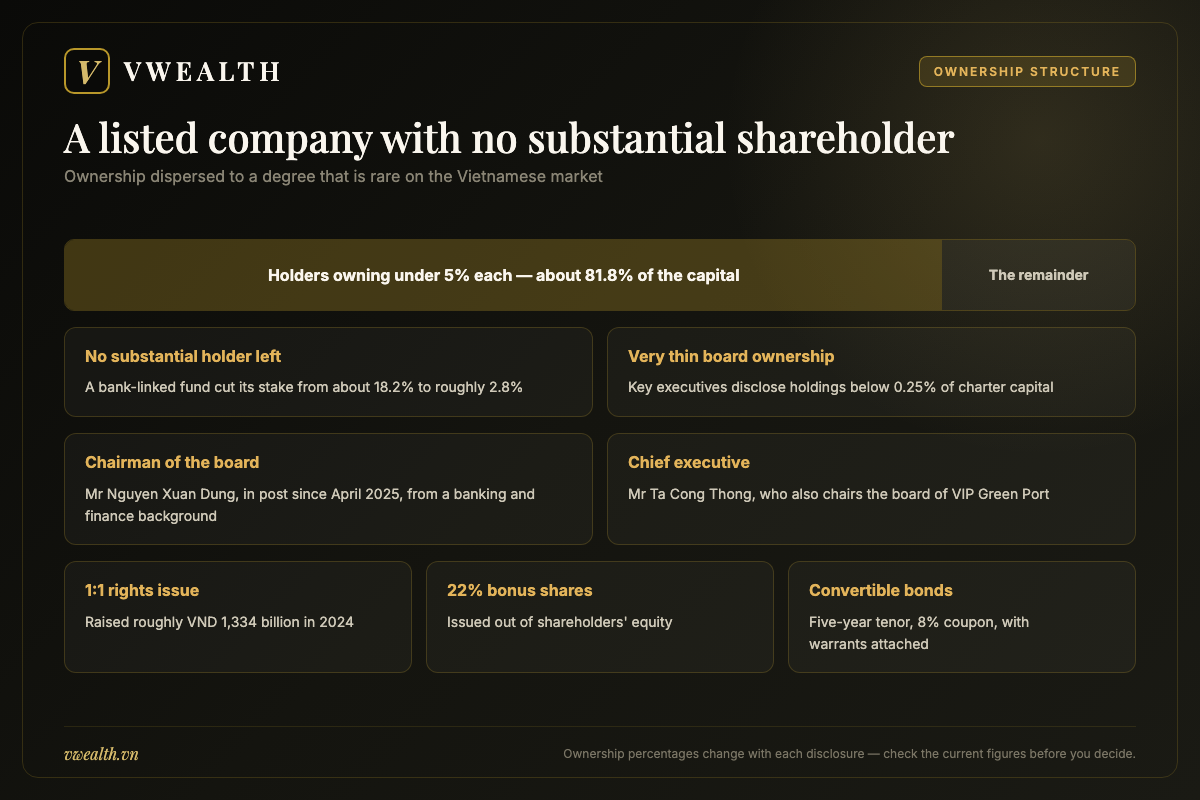
Here is where VSC differs most sharply from almost every other stock in this series. After the fund management arm associated with a major Vietnamese commercial bank reduced its holding from roughly 18.2% to approximately 2.8% of charter capital, Viconship was left with no substantial shareholder as legally defined. Ownership is dispersed to the point where roughly 81.8% of capital is held by shareholders each owning less than 5%.
Management’s own shareholdings are similarly thin. Disclosed figures show Mr Nguyen Duc Dung, a board member, at around 0.22%; Mr Ta Cong Thong at around 0.19%; Ms Tran Thi Phuong Anh at around 0.08%; and Ms Truong Anh Thu, a deputy general director, at around 0.07%. Asked about this by shareholders, the company explained that it follows a principle of separating share ownership from management and executive roles, in the interest of transparency and professionalism, while still encouraging executives to hold shares as a form of long-term alignment.
How should you read this structure? It has two faces, and neither is straightforwardly right or wrong.
The positive face: no controlling bloc can impose its private interests on the company. There is very little scope for opaque related-party transactions because there is essentially no related party large enough to matter. Decisions genuinely pass through the general meeting rather than being settled in a small room beforehand. In a market where minority shareholders of family-controlled companies frequently discover their interests were not the priority, this is not a trivial advantage.
The risk face: when the executives who make the decisions own well under one percent of the equity between them, their financial interests and yours are not tightly bound. Corporate finance calls this the principal-agent problem — the people making the decisions do not bear most of the financial consequences. A company borrowing heavily to buy terminals and order ships, run by executives holding a few tenths of a percent, is a structure about which a cautious investor is entitled to ask questions. Dispersed ownership also makes a company theoretically easier to accumulate quietly — which is precisely what Viconship has been doing to HAH.
Dividends and the sequence of dilutions
During an expansion phase, capital allocation shifts toward retention. In 2024 Viconship conducted a one-for-one rights issue to existing shareholders, raising approximately 1,333.96 billion dong — meaning the share count roughly doubled. The company also issued bonus shares from equity reserves at a ratio of 22%, and settled a 2024 dividend at a total ratio of 8%, comprising 5% in cash and 3% in shares, replacing an earlier plan of 7.5% entirely in shares. In 2025, the cash payout was reduced from 10% to 5% in order to prioritise fleet investment.
What does this sequence tell you? That VSC is no longer a dividend stock. If you are buying it because you remember an infrastructure company that reliably distributed cash, you are buying a company that no longer exists. Cash is being retained to buy assets; the reward to shareholders, if it comes, will arrive through asset value and future cash flow rather than through money landing in your account each year.
Convertible bonds with warrants: instrument or hazard?
Among the funding instruments introduced in this period is a convertible bond with a five-year tenor, an 8% annual coupon, and attached warrants permitting share purchase at 10,000 dong. Chairman Nguyen Xuan Dung, presenting the plan, emphasised the goal of generating long-term returns for shareholders who stay through the expansion phase.
Understand the instrument in plain language. A convertible bond is a loan that carries the right to convert into equity. For the issuer it is cheaper than a straight bank loan because the conversion right has value, so investors accept a lower coupon. For the bondholder it pays interest while retaining a ticket to the upside. For an existing shareholder like you, it is conditional dilution: if the share price rises well above the exercise level, new shares are issued and your proportional ownership shrinks.
There is nothing improper about this — it is a standard instrument used worldwide. What you must do is remember it. When you calculate per-share value for VSC, do not use the current share count; use the fully diluted count. Skipping that step is the single most common error investors make with companies growing through convertible instruments, and at VSC it matters more than usual because issuance has been frequent.
How Viconship makes money: anatomy of a port and logistics chain
You now know what Viconship owns and who steers it. This chapter answers a more concrete question: through which doors does money enter, which doors are wide, and which are protected by a moat.
The terminal business: the heart of the model
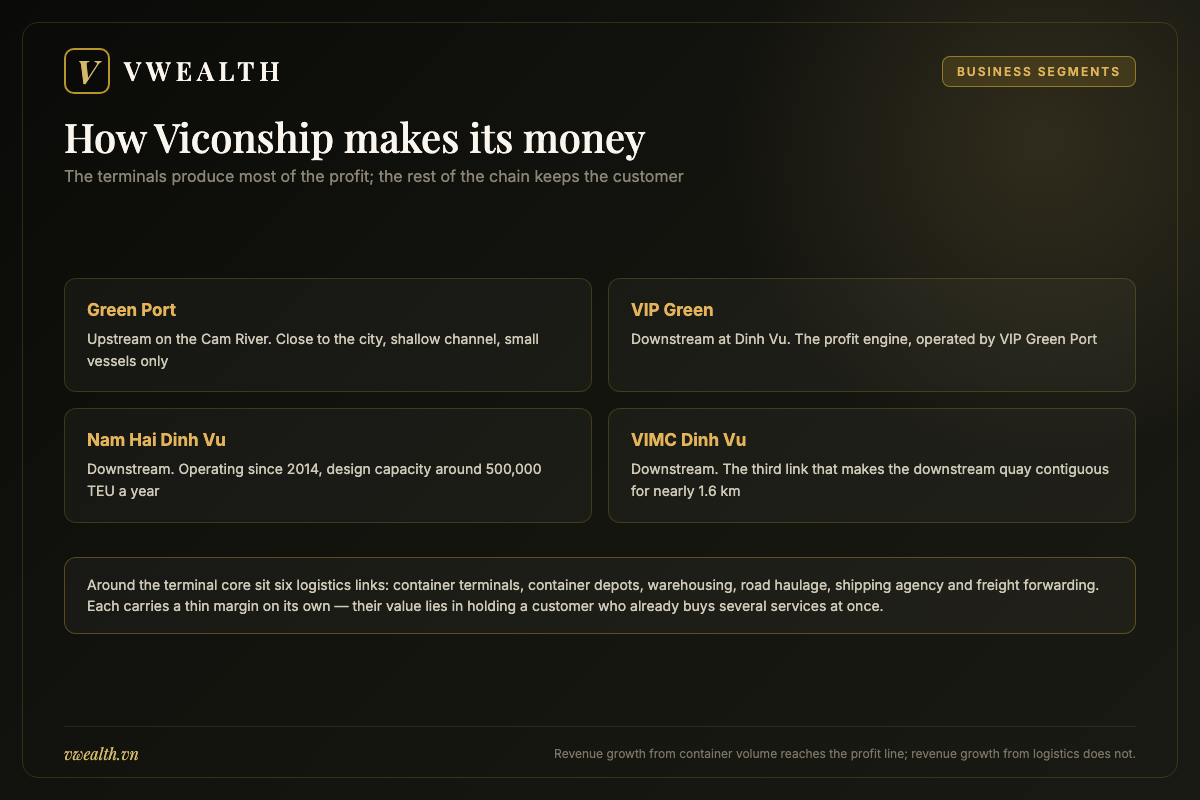
Container terminal operation is the core. According to published industry analysis, the port segment contributes roughly 65% of revenue but around 80% of the profit mix. Within revenue, container handling alone accounts for roughly 66%; transport services and yard operations, cold storage, inspection and quarantine account for around 24%; the remaining 10% comes from other services.
The gap between 65% of revenue and 80% of profit tells you the economic nature of the terminal business: materially higher margins than the logistics services wrapped around it. The reason is straightforward. A terminal is a natural local monopoly within its radius — nobody can build a competing quay next to yours simply because you are profitable; they need planning approval, land clearance, channel dredging, crane investment, and several years. Road haulage and warehousing, by contrast, are businesses anyone can enter with tractor units and leased land.
The practical lesson when you read VSC’s accounts: do not treat consolidated revenue growth as uniformly good news. Revenue growth driven by transport and logistics barely improves profit. Revenue growth driven by container throughput flows straight to the bottom line.
Four terminals, four different roles
| Terminal | Location | Characteristics | Role in the system |
|---|---|---|---|
| Green Port | Upstream, on the Cam River | Close to the city, shallower channel, vessel size constrained | The original terminal; serves smaller vessels and domestic cargo; holds long-term land value |
| VIP Green | Downstream, Dinh Vu area | Operated by Green VIP Port, handles larger vessels | The profit engine, chaired personally by the group chief executive |
| Nam Hai Dinh Vu | Downstream, Dinh Vu area | In service since 2014, design capacity around 500,000 TEU per year | Acquired 2023 to 2024; the link that made the downstream quay contiguous |
| VIMC Dinh Vu | Downstream, Dinh Vu area | Associated terminal within the downstream cluster | The third link, bringing total downstream quay close to 1.6 km |
This table explains why Viconship paid up for Nam Hai Dinh Vu. It was not simply buying 500,000 TEU of capacity; it was buying the position that allows three terminals to function as one facility. In the port business, 1.6 kilometres of contiguous quay is worth more than three separate terminals of the same total length. This is exactly the kind of value that never appears on a balance sheet — and exactly the kind of value that is easy to overstate.
The logistics chain: six links around the core
Around the terminal axis, Viconship has assembled a chain covering six areas: container terminals, container yards, warehousing, transport, shipping agency and logistics services. Group entities associated with this chain include the Green Port operator, Green VIP Port Joint Stock Company, a logistics arm, and the Green ICD facility.
ICD stands for inland container depot — a facility located away from the waterfront where containers are consolidated, cleared through customs, stuffed and stripped before or after the sea leg. For a factory in an industrial park several dozen kilometres from the coast, an ICD reduces truck waiting time at the terminal gate. For the port operator, an ICD is a way of extending its reach inland toward the customer’s gate — which in practice means keeping cargo inside its own system rather than letting it drift to a competitor.
Think of this chain as a retention system rather than a profit machine. Each link individually earns thin margins. Their combined value lies in the fact that once a shipping line or a cargo owner uses three or four Viconship services, switching provider stops being a simple comparison of unit prices.
The new shipping segment: large opportunity, larger amplitude
The youngest and most contentious segment is shipping. Through an approximately 40.01% stake in Vinaship, roughly 22.3% of HAH, and a 60% interest in the Hai An Green Shipping Lines joint venture, Viconship is assembling its own fleet capability. The joint venture contracted three vessels of around 3,000 TEU at approximately 46 million dollars each — presented by management as below the roughly 51 million dollar market level at the time — plus orders for two vessels of about 7,100 TEU. Management has stated a target of a fleet of roughly 30,000 TEU capacity by 2030, and has projected roughly doubled revenue and materially higher profit at that horizon.
You need to be clear-eyed about shipping. It is a pure commodity business: the product sold — a slot carrying a box from A to B — is essentially undifferentiated between carriers. Price is therefore set entirely by the balance of vessel supply and cargo demand, and that balance swings violently. Ships take years to build, so when every carrier orders during a strong market, the new tonnage tends to be delivered into a weak one. This is the classic shipping cycle, and it has repeated many times.
The fair assessment is therefore this: the integration logic is real, but it moves VSC out of the defensive infrastructure bucket and into the cyclical bucket. The risk is not that the strategy is wrong. The risk is that you buy VSC with the expectations appropriate to an infrastructure stock while actually holding a cyclical one.
Where is the moat, and how deep is it?
A moat is a durable competitive advantage that protects profit from competitors. Viconship has three, and all three have limits.
First, licence and location. Quay space at Dinh Vu cannot be replicated. Anyone wanting to compete must build elsewhere, and elsewhere is usually further away or more expensive. The limit is explicit: the state is developing the Lach Huyen deepwater area, and quay is rising there quickly.
Second, contiguous scale. Close to 1.6 kilometres of downstream quay permits scheduling optimisation that smaller operators cannot match. The limit: this advantage only has value when there is enough cargo to require scheduling. In an oversupplied cluster, every terminal has spare berth time and the advantage evaporates.
Third, shipping-line relationships, now reinforced by Viconship itself becoming a substantial shareholder in a carrier. The limit: holding 22.3% of a shipping line does not oblige that line to call at your terminals if another terminal is cheaper or faster. The carrier’s board owes duties to all of its shareholders.
The honest conclusion: Viconship has a moat, but a moderate one, and it is under pressure from new supply. If you have read the analysis of Vietnam’s airport infrastructure operator in the aviation and logistics stocks overview, the contrast is instructive: there, the moat is near-national monopoly by regulation; here, the moat is strong only within a radius of a few kilometres.
Position and financial health: seven things to check before you buy VSC stock
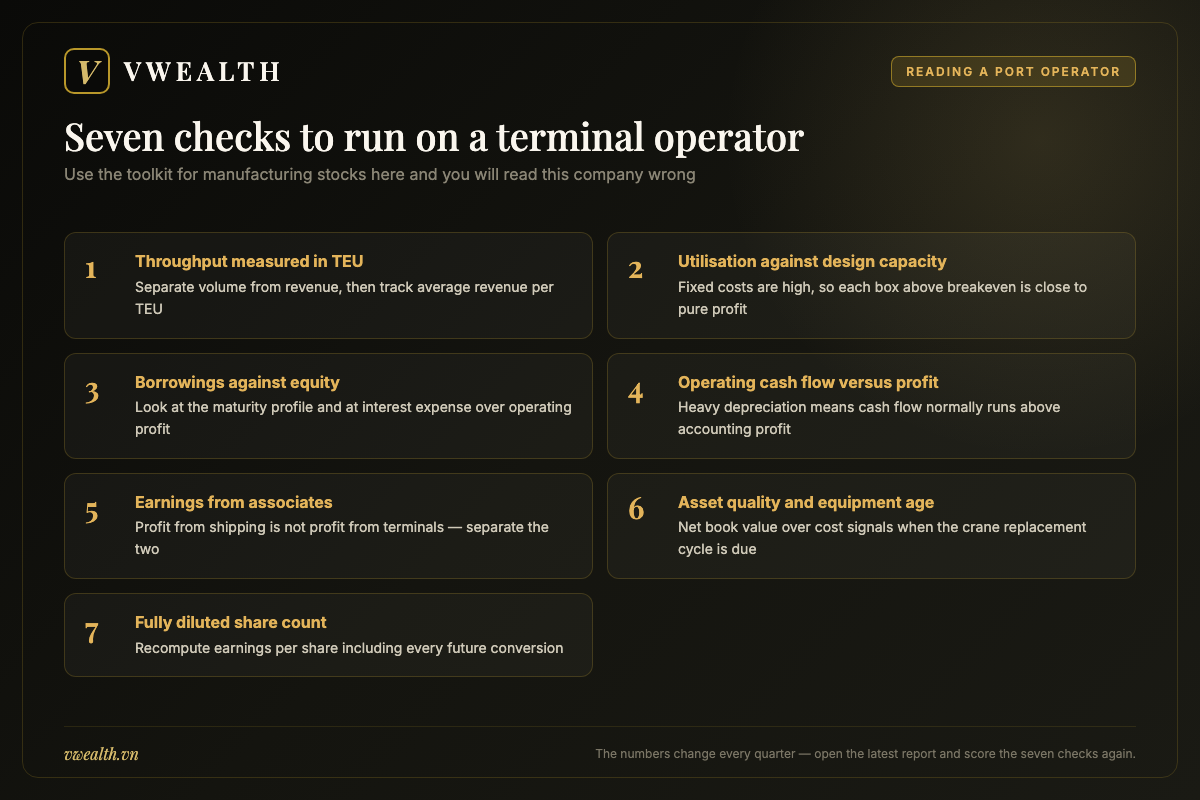
This is the longest and probably the most useful chapter in the article. Port operators have their own financial language. If you apply the metric set you use for manufacturers or retailers to VSC, you will almost certainly reach the wrong conclusion. The seven checks below work on any listed port operator in Vietnam, not just this one.
Check 1: throughput in TEU, not revenue
The primary operating metric for a port company is container throughput measured in TEU. Revenue is simply throughput multiplied by average unit price, and unit price depends on cargo mix and on negotiations with shipping lines.
Why separate them? Because they tell different stories. Rising throughput means shipping lines are choosing your terminal more often — your competitive position is improving. Rising revenue with flat throughput means you achieved price increases, which may reflect a favourable market or a change in mix. Rising throughput with revenue that does not keep pace is the warning sign: you are winning cargo by discounting, which is exactly what happens when a cluster has surplus capacity.
When you read VSC’s disclosures, look for TEU volumes by terminal where the company publishes them, and compute average revenue per TEU across at least six to eight quarters. The trend in that number matters far more than any single quarter’s absolute figure.
Check 2: utilisation against design capacity
Every terminal has a design capacity. Nam Hai Dinh Vu, for instance, is rated at roughly 500,000 TEU per year; the whole Viconship system at around 2.6 million TEU per year. The ratio of actual throughput to design capacity is decisive for margins.
The reason lies in the cost structure. A terminal is a high fixed cost model: depreciation on quay, cranes and yard; the operating crew’s wages; maintenance. These costs barely change whether the terminal runs at 50% or 90%. Consequently, every incremental box beyond breakeven contributes almost entirely to profit. This is why a terminal running at 85% utilisation can earn several times what the same terminal earns at 60%.
Public information indicates that after Viconship took over Nam Hai Dinh Vu, the terminal was brought above 80% of design capacity utilisation during 2025. Read that as evidence of operating capability — and simultaneously as a warning. Once utilisation is above 80%, the growth available from filling existing capacity is nearly exhausted. Further growth must come from new assets, which means new capital.
Check 3: borrowings and the debt-to-equity ratio
This is the single most important check for VSC at present, and the one requiring the most frequent updating.
The company bought terminals with borrowed money. As at 31 March 2025, total borrowings were reported at approximately 2,115.25 billion dong, equal to roughly 41.3% of equity — against an industry average of around 21%. That is a historical point-in-time figure, cited to show the level of leverage management is willing to accept, not a current one. For today’s position you must open the latest report.
Read leverage in three layers. Layer one: borrowings to equity, compared against the company’s own history and against the sector. Layer two: maturity structure — short-term debt funding long-term assets is a dangerous configuration, because an asset that generates cash over ten years is financed by an obligation due within twelve months. Layer three: interest expense against operating profit, which tells you how much headroom exists before financing costs consume earnings.
For a company simultaneously buying terminals and ordering ships, all three layers should be checked every quarter without exception.
Check 4: operating cash flow versus accounting profit
For a port operator, operating cash flow is normally larger than net profit, because depreciation is a book charge rather than a cash outflow. This is the attractive feature of infrastructure economics: once the asset is built, cash arrives while depreciation remains an accounting entry.
What you should examine is the relationship between the three cash flow lines: operating, investing and financing. A healthy port operator in steady state shows strongly positive operating cash flow, moderately negative investing cash flow (maintenance, crane replacement) and negative financing cash flow (debt repayment, dividends). A company in expansion shows heavily negative investing cash flow and strongly positive financing cash flow — precisely Viconship’s current state.
Neither state is inherently bad. But the expansion state is only acceptable if the acquired assets generate enough cash to service the debt within a reasonable period. The question to answer each time you read the accounts: is operating cash flow rising in proportion to the money spent on assets?
Check 5: associate earnings and one-off items
This is the most easily misread line in VSC’s accounts today. With roughly 40.01% of Vinaship and roughly 22.3% of HAH, the corresponding share of those companies’ results appears in the consolidated accounts under the equity method — meaning the associate’s profit or loss is recognised in proportion to ownership, even though no cash changes hands.
The practical consequence: in a quarter with strong freight rates, VSC’s consolidated profit can improve substantially because of the shipping contribution rather than because the terminals performed better. And the reverse applies.
There are also genuine one-off items. In 2024 Viconship recovered approximately 823.6 billion dong on exiting a hotel investment partnership, and planned to reduce its holding in Green VIP Port from roughly 74.35% to 64.35% by selling 6.325 million shares. Transactions like these create one-time gains or losses that distort mechanical year-on-year comparisons.
The rule: always separate core terminal profit from associate contributions and from divestment gains. These three sources have entirely different quality and deserve entirely different valuation multiples.
Check 6: asset quality and equipment age
A terminal comprises quay, yard, ship-to-shore cranes, yard cranes, reach stackers and an operating system. Quay structures last for decades; cranes do not. When you buy shares in a port operator you need to know where the company stands in its equipment replacement cycle, because a crane renewal programme can absorb several quarters of cash flow.
A simple check: look at net book value against gross cost of fixed assets in the notes to the financial statements. A low ratio means assets are largely depreciated — good news for near-term accounting profit because the depreciation charge declines, but a signal that replacement capital expenditure is approaching.
Check 7: fully diluted share count
The last check, and the one retail investors most often skip. Viconship’s registered share count stands at 374,370,362 units according to listing data. But that figure already reflects a one-for-one rights issue, a 22% bonus issue and stock dividends, and ahead of it lies a convertible bond with warrants exercisable at 10,000 dong.
When you calculate earnings per share or book value per share, you must use the fully diluted count. Otherwise the company will look cheaper than it is. This is a classic trap with any company funding growth through issuance, and at VSC the frequency of issuance makes it particularly relevant.
Where Viconship sits on the Hai Phong map
By capacity, Viconship is the largest port operator in Hai Phong — around 2.6 million TEU per year, equivalent to roughly 25% to 30% of cluster capacity depending on the measure and the date. That is a real position, purchased with real money.
It is not, however, guaranteed to last. Vietnamese financial media have repeatedly discussed the possibility that Hai Phong Port (ticker PHP) will overtake Viconship in scale as new berths come online. In infrastructure, leadership by capacity tends to change according to project schedules rather than commercial skill — and project schedules are decided by state planning.
How the market treats VSC stock: portrait of a share in transition
This chapter is about the stock rather than the company. The two are related but not identical: a good business can be a poor investment if you buy it at the wrong price.
Why port operators are usually valued on EV/EBITDA
For infrastructure businesses like terminals, analysts generally prefer EV/EBITDA to the price-to-earnings ratio. Let us unpack both terms.
EV means enterprise value: market capitalisation plus net debt. EBITDA means earnings before interest, tax, depreciation and amortisation. The ratio tells you how many times gross operating cash flow the market is paying to own the whole business, including the part financed with debt.
Why does this suit ports better than a price-to-earnings ratio? Three reasons. First, depreciation at a terminal company is large and accounting-driven, which makes net profit understate cash generation. Second, port operators carry very different debt loads, which makes their earnings multiples incomparable; enterprise value already includes debt and is therefore fairer. Third, when a company has just bought a large asset, new interest expense and new depreciation suppress net profit for several years, making the earnings multiple look artificially high.
When you look up VSC’s valuation on an analysis platform, examine the earnings multiple, the book value multiple and EV/EBITDA together, but weight the latter two more heavily. And always compare against VSC’s own five-year history rather than against a single peer at a single moment.
The personality of VSC shares
Every stock has a personality, formed by its shareholder register and by the type of investor who holds it. VSC has several clear traits.
First, good liquidity by the standards of the port sector. This follows directly from dispersed ownership: when roughly 81.8% of capital sits with holders below 5%, free float is large and you can enter and exit far more easily than in a company where the state holds a majority. For a foreign investor, this matters more than it first appears — many Vietnamese small and mid-cap names are effectively untradeable in size. If you are unfamiliar with the mechanics of trading here, the note on trading hours and daily price bands explains the daily limit system that governs how fast a Vietnamese share can move.
Second, the stock reacts strongly to transaction news. Throughout 2023 to 2025, every disclosure about HAH accumulation, about the shipping joint venture, about newbuild orders produced movement. This is characteristic of a share in restructuring: the market is pricing expectations rather than results.
Third, and most importantly: VSC is migrating from the defensive bucket to the cyclical bucket. Someone who bought VSC in 2018 bought a dividend-paying terminal operator. Someone buying VSC today buys a terminal-plus-shipping group expanding on debt. These are two different asset classes requiring two different risk management approaches.
Dividends: do not buy VSC for income
This needs saying plainly to avoid misunderstanding. With the 2024 dividend set at a total of 8% — 5% cash and 3% shares — and the 2025 cash payout cut from 10% to 5% to fund the fleet, VSC is not a suitable choice for an investor seeking income.
That is not a criticism. A company with investment opportunities returning more than its cost of capital is right, in theory, to retain earnings. But it changes how you must evaluate the holding: you are no longer being paid to wait. The entire reward depends on whether management converts retained cash into value.
Foreign ownership, room and the catalysts to watch
Port operation is a conditional business line for foreign investors in Vietnam, and each company’s maximum foreign ownership ratio is published by the securities depository and shown on broker price boards. You should check this figure yourself at the time of purchase, since it depends on the specific business lines a company has registered. For broader context on how international capital positions itself in this market, the survey of what foreign funds hold in Vietnam is a useful reference.
On catalysts, four groups deserve monitoring. One, the delivery schedule and economics of the new fleet — each vessel delivery steps up both cash flow and risk. Two, container freight rates on intra-Asia routes, the principal trade for Vietnamese-owned tonnage. Three, the commissioning schedule of new berths at Lach Huyen, since new supply feeds directly into pricing at Dinh Vu. Four, connecting infrastructure — the roads behind the berths, the bridges, the links to industrial parks — which determines which terminal cargo naturally flows toward.
Comparing VSC against other transport infrastructure options
| Criterion | VSC (Viconship) | A national-scale seaport operator | An aviation infrastructure operator |
|---|---|---|---|
| Principal revenue source | Container handling in the Hai Phong cluster, plus logistics and now shipping | Handling across terminals in several regions, plus logistics | Passenger and cargo services across an airport network |
| Geographic concentration | Very high, dependent on one cluster | More distributed across regions | Distributed nationally |
| Nature of the moat | Quay position within a narrow radius | Network scale and international carrier relationships | Near-monopoly position established by planning |
| Sensitivity to the freight cycle | Rising sharply following the fleet investment | Moderate | Low; sensitive to tourism cycles instead |
| Financial leverage at present | Above the sector average | Varies by company | Typically low, supported by strong cash generation |
The table is not a ranking. Its purpose is to help you place VSC within your own portfolio. If you already hold a defensive infrastructure name, VSC adds growth and cyclicality. If your portfolio is already heavy in cyclical exposure, adding VSC doubles down on one type of risk rather than diversifying it.
Vietnam’s port sector in 2026: the fight for boxes is only beginning
No port company is ever bigger than the trade that flows through it. That sentence sounds obvious, and yet it is the single most commonly ignored fact in port investing. An operator can have the best cranes, the sharpest management and the cleanest balance sheet in the country, and if the boxes stop coming down the road from the industrial parks, none of it matters. So before you decide whether to buy VSC stock, you need to understand the picture at the level above the company — and in particular what is happening in Hai Phong, where Viconship has placed very nearly all of its assets.
Why Hai Phong matters more than any other cluster in the north
Hai Phong is the seaborne gateway for the whole of northern Vietnam. The output of the industrial parks in Bac Ninh, Bac Giang, Hai Duong, Hung Yen and Vinh Phuc — the belt where most of the country’s electronics assembly and export-oriented engineering sits — moves by road to Hai Phong before it goes onto a ship. There is no realistic alternative. The northern ports further along the coast are smaller, less well connected to the expressway network and shallower. Container throughput through the Hai Phong cluster is therefore close to a direct, real-time indicator of the health of northern Vietnamese industrial exports.
For a VSC shareholder this characteristic cuts both ways, and it is worth being precise about how. The favourable side: when foreign direct investment continues to flow into the northern industrial parks, container volumes through Hai Phong rise without the port companies having to do anything at all. This is close to a free option on Vietnamese industrialisation. You do not need Viconship to invent a new product, win a new market or out-innovate a competitor. You need factories in Bac Ninh to keep shipping. That is a rare and pleasant kind of exposure to own.
The unfavourable side is the exact mirror image. When global trade slows, when a major buying market raises tariffs, or when a supply chain relocates for reasons that have nothing to do with Vietnam, this cluster feels it first and feels it directly. A port operator has no way of manufacturing cargo for itself. It cannot discount its way to volume that does not exist, because the volume is determined upstream by decisions taken in factories and, ultimately, in the trade policy offices of Washington, Brussels and Beijing. Management can control cost, service quality and asset utilisation. It cannot control the size of the pie.
This is why, when you read commentary that treats a Vietnamese port stock as a defensive infrastructure holding, you should be sceptical. Toll roads collect from traffic that exists whatever the state of world trade. Airports collect from passengers who fly for reasons unconnected to the container market. A container terminal collects from international trade flows, and international trade flows are cyclical. The asset is infrastructure; the revenue is cyclical. Those two facts sit uneasily together and they are the source of most of the mispricing, in both directions, that you will see in this sector.
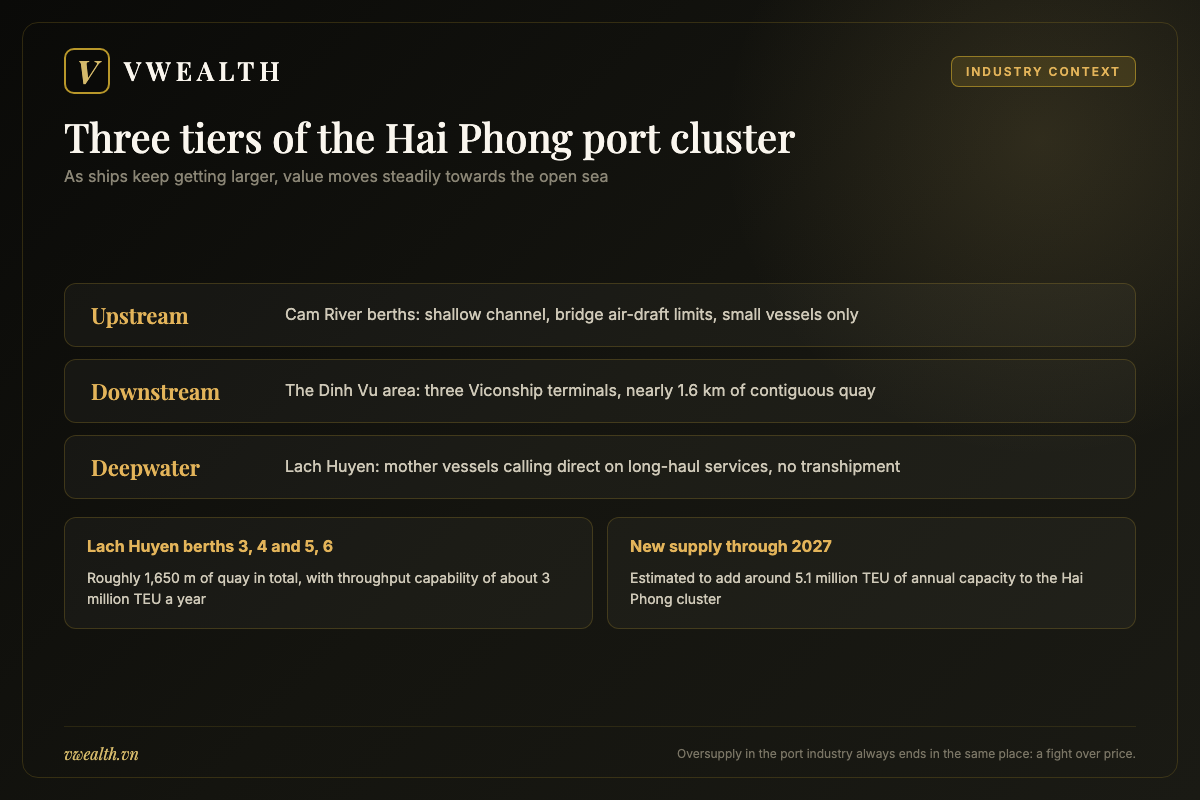
Lach Huyen: new supply and a structural threat
This is the most important section of this chapter, and it is also the largest single risk to the investment case for VSC. If you remember nothing else from this article, remember this part.
The Lach Huyen deepwater port area is the state-prioritised port development for Hai Phong. It sits outside the river mouth, where the channel is naturally deep enough to receive mother vessels calling directly on long-haul services without transhipping through Singapore or Hong Kong. That is a fundamentally different proposition from the river terminals, and it is the direction the whole industry has been moving in for thirty years.
The scale is what matters. Berths 3 and 4 together with berths 5 and 6 provide roughly 1,650 metres of quay in total and a throughput capability of around 3 million TEU per year. Berths 3 and 4 alone comprise about 750 metres of quay able to take vessels of 100,000 deadweight tonnes, with a design capacity of roughly 1.1 million TEU per year. Berths 5 and 6 add about 900 metres and are built to receive container ships in the 12,000 to 18,000 TEU class — vessels that simply cannot get anywhere near the Cam River. Under the published plan, the Lach Huyen container area is working towards having eight berths in operation by 2027.
Volume is already arriving. Throughput through the Lach Huyen area in the first seven months of 2025 reached roughly 1.2 million TEU, against a full-year target of around 2.2 million TEU. And estimates carried in the Vietnamese financial press suggest that the new berth projects scheduled for completion in Hai Phong through 2027 will add on the order of 5.1 million TEU per year of capacity to the cluster.
Now put those numbers side by side, because the comparison is the whole argument. Viconship’s entire system — four terminals, the product of forty years of building and three years of expensive acquisition — has a capacity of roughly 2.6 million TEU per year. The new supply arriving in the same cluster is on the order of 5.1 million TEU per year. In other words, within a few years the Hai Phong cluster may add capacity equal to almost twice the entire system of the largest port operator in the region.
The economics of oversupply in the port industry are easy to predict and unpleasant to live through. Handling tariffs come under pressure. Terminals compete on discounts to retain shipping line customers, because an empty berth earns nothing and the fixed costs do not go away. Terminals with a weaker channel and berth position are squeezed hardest, because they are the ones the lines drop first when they have a choice. Within the Viconship system, Green Port upstream on the Cam River is the asset most exposed to this dynamic.
Fairness requires three qualifications, and none of them is trivial. First, cargo through Hai Phong is still growing with northern industrial production, so a meaningful share of the new capacity will be absorbed by organic growth rather than by taking volume from existing terminals. Second, Lach Huyen serves a different segment — mother vessels on long-haul services — while the Dinh Vu terminals principally serve intra-Asia feeder ships; the two segments are not perfect substitutes, and a feeder operator will not simply move to a deepwater berth because one exists. Third, the new berths belong to a range of different owners, several of them listed companies in their own right, so the competitive pressure is distributed rather than concentrated on any single name.
But the direction of travel is unambiguous, and no amount of qualification changes it. The easy years for northern Vietnamese port operators are over. From here, returns have to be earned through operating skill, berth position and customer relationships rather than through the simple fact of owning scarce quay. That shift is precisely what makes the current management’s strategy comprehensible — and it is also what makes it risky.
The competitive map of the Hai Phong cluster
Viconship does not operate in a vacuum. Broadly, the competition in the Hai Phong cluster falls into three groups, and they compete on different bases.
The first group is the state-rooted port companies, which hold long-established quay and land banks, often in locations that would be impossible to assemble today. Their advantage is position and history; their constraint is that state-linked ownership structures do not always allow fast capital allocation decisions.
The second group is the private and joint-venture terminal operators working berths in the Dinh Vu area — the direct peer set for VIP Green, Nam Hai Dinh Vu and VIMC Dinh Vu. This is where the day-to-day competition for feeder services happens, and it is competition on service quality, turnaround time, yard capacity and, when the market softens, price.
The third group is the new owners of the Lach Huyen deepwater berths, and this group includes joint ventures with international shipping lines. It is the third group that changes the structure of the industry rather than merely the intensity of competition within it.
Consider what happens when a global shipping line owns a share of a terminal. That line now has a natural, entirely rational incentive to route its own vessels to its own berth. The cargo does not go where the service is marginally better; it goes where the ownership is. This is competition that a pure-play terminal operator finds almost impossible to answer on price, because the other side is not optimising for terminal profit at all — it is optimising for the economics of the whole voyage.
Once you see that clearly, Viconship’s decision to enter shipowning stops looking like an adventure and starts looking like a defensive necessity. If the lines are integrating downstream into terminals, a terminal operator that cannot secure its own cargo base is structurally exposed. Viconship’s answer has been to integrate upstream into shipping: build a fleet, secure the volume, and make sure that at least some of the boxes crossing your quay arrive on ships you have an interest in. That is a coherent strategic response to a real structural threat. Whether it is a well-executed one is a separate question, and the answer will take years to become visible.
Three long-run trends that will shape the next decade
Above the immediate competitive dynamics sit three slower trends. They move too gradually to affect any single quarter and too powerfully to ignore over a holding period of several years.
The first is containerisation. Vietnam’s containerisation ratio still has room to rise. A share of the country’s freight still moves as breakbulk or bagged cargo, and the migration of that freight into boxes tends to accompany industrialisation. This is a slow tailwind for every terminal operator in the country, Viconship included, and it operates independently of the trade cycle.
The second is the reconfiguration of supply chains away from single-country concentration in China. This continues to favour Vietnam, and it favours the north disproportionately because of the adjacency to Chinese component suppliers and the road infrastructure that has been built over the past decade. But the benefit is neither automatic nor evenly distributed. It depends on tariff policy in the large consuming markets, and that is outside the control of any company, any port and, for practical purposes, any government in Hanoi. Investors who are new to this dynamic will find the discussion of how the China-plus-one shift shows up in Vietnamese listed companies a useful companion to this chapter.
The third trend is the steady growth in the size of the world container fleet, vessel by vessel. Ships get larger because larger ships carry boxes more cheaply per slot. This trend favours deepwater terminals and penalises river terminals, and it is a technical trend rather than a commercial one, which means it does not reverse. It is the reason why Viconship’s shift of its centre of gravity downstream towards Dinh Vu is strategically correct even though it has been expensive. A company that had stayed at Green Port and paid out its cash as dividends would look better on this year’s income statement and would be running out of relevance by the middle of the next decade.
Policy and planning: the shareholder you never see on the register
In infrastructure industries, state planning carries a weight comparable to management competence. Which berth positions are licensed, how quickly the navigation channel is dredged, when the road behind the terminal is completed, what floor tariffs are set for seaport services — all of these are decided by regulators, and all of them feed directly through to the profit line of a listed port company.
For an individual investor, monitoring the whole body of relevant regulation is not realistic and not necessary. A more practical approach is to follow two proxy indicators that between them capture most of the policy effect: the actual construction and commissioning progress of the new Lach Huyen berths, and any change to the tariff framework for seaport services. If those two are moving in Viconship’s favour, most of the rest of the regulatory noise can be safely ignored. If they are moving against it, no amount of good operating performance will fully offset the effect.
One further note for readers investing from outside Vietnam. State planning in this sector is genuinely long-horizon and reasonably transparent — master plans are published, targets are stated, and progress is reported. What is less predictable is timing. Vietnamese infrastructure projects have a long record of arriving later than the plan says, which in this particular case is a mild positive for incumbent operators: every quarter of delay at Lach Huyen is a quarter in which the existing terminals keep their pricing power. Do not build an investment case on that delay, but do not be surprised by it either. If you want a wider view of the sector as a whole, the aviation and logistics stocks overview maps how the listed transport names fit together, and the discussion of the structural risks of investing in Vietnam covers the policy and currency layer that sits underneath all of them.
Looking forward: three scenarios for VSC stock and the conditions that produce each
This chapter does not offer a price target. Any specific price written down today would be wrong within a few months, and a price target has the additional vice of encouraging you to stop thinking once it is reached. Instead, what follows describes three scenarios and the concrete conditions under which each one occurs, so that you can check reality against the framework yourself as the quarters go by. This is a more useful tool than a number, because it survives contact with events.
The four variables that decide everything
Before the scenarios, identify the variables. For Viconship there are exactly four that matter, and almost everything else you will read about the company in the financial press is noise around them.
Variable one is container throughput at the Hai Phong cluster and Viconship’s share of it. This is the foundation of everything else. If cluster volume grows and Viconship holds or gains share, the model works even if margins compress somewhat. If cluster volume grows but Viconship loses share to the new deepwater berths, the growth accrues to somebody else. Track the cluster number and the company number together; either one on its own will mislead you.
Variable two is the level of handling tariffs after the new Lach Huyen supply comes into operation. This is the variable with the greatest leverage on profit and the one investors most often underestimate. In a business model with high fixed costs, a 10 per cent fall in revenue per TEU does not reduce profit by 10 per cent — it can erase most of it, because the costs that a terminal cannot avoid do not fall when the price does. This asymmetry is why revenue per TEU deserves more of your attention than absolute revenue.
Variable three is the return on the fleet investment: intra-Asia container freight rates, the delivery schedule of the newbuilds, and the ability to fill the slots once the vessels arrive. This is the variable with the highest uncertainty, because none of its components is under management’s control. Freight rates are set in a global market; delivery schedules depend on shipyards; slot utilisation depends on the trade.
Variable four is the cost of capital. With borrowings above the sector average, every percentage point of interest rate feeds straight through to the shareholders’ share of profit. In a leveraged company, the interest rate environment is not a background condition — it is an operating variable.
Notice what is not on this list: quarterly earnings headlines, transaction rumours, and the day-to-day movement of the share price. Those things move the price. They do not move the business.
The optimistic scenario: integration proves its worth
In this scenario, the following conditions all hold at once. Throughput through Hai Phong keeps growing as northern industrial exports maintain their pace. The new supply at Lach Huyen is largely absorbed by that organic growth, so handling tariffs at the Dinh Vu terminals come under only mild pressure rather than a price war. The newbuild vessels are delivered on schedule and enter service during a period when intra-Asia freight rates are healthy. And domestic interest rates stay in the lower part of their range, so financial expense does not swell.
Under those conditions the integrated model does exactly what it was designed to do. Vessels in which the group has an interest call at terminals the group owns. Throughput at those terminals is underwritten rather than won afresh each year. Margins improve at both ends of the chain, because each end is helping the other rather than competing for the same margin. And — this is the part that matters most for the share price — the market begins to value VSC as an integrated maritime group rather than as a regional terminal operator. That is a re-rating of the multiple, not just a rise in earnings, and re-ratings are where the large returns in this kind of stock come from. This is the outcome management is aiming at when it states a fleet target on the order of 30,000 TEU by 2030.
What would tell you early that this scenario is unfolding? Three markers, all of them visible in the published financial statements. Operating cash flow growing faster than borrowings for four consecutive quarters — that is the single cleanest signal that the expansion is self-funding rather than debt-funding. Average revenue per TEU holding flat or rising despite the arrival of new capacity in the cluster, which would show that the terminals have pricing power the sceptics did not expect. And the associate earnings line shifting from erratic swings to steady growth, which would indicate that the shipping investments have moved from speculation to contribution.
None of those three markers requires you to forecast anything. They are all backward-looking facts that you can check quarter by quarter, which is exactly what makes them useful.
The base scenario: bigger, but not more profitable
On a cautious reading, this is the highest-probability outcome, and it is the one most investors are least prepared for emotionally.
The conditions: throughput grows, but tariffs are modestly compressed by competition. The fleet is delivered on time, but into a freight market at average rather than elevated levels, so the investment pays back roughly on plan rather than ahead of it. Interest expense is stable but continues to absorb a meaningful share of operating profit. And the dilution from the convertible bonds proceeds gradually as holders convert.
The result is a company that is materially larger in assets and revenue, while earnings per share improve only slowly — because the denominator, the share count, grows at much the same time as the numerator. The stock trades in a broad sideways range, moving on deal news and on the swings of the maritime freight cycle, without establishing a clear long-term trend.
It is important to be clear about what this scenario means. In it, Viconship remains a sound company with real assets and real cash generation. Nothing has gone wrong. But an investor who bought expecting a fast re-rating will spend several years watching the business get bigger while their own position gets no better, and that experience tends to produce impatient selling at exactly the wrong moment. The base case is not a failure case. It is the case in which the reward arrives late — and being mentally prepared for a late reward is most of what separates investors who capture returns in this kind of company from those who do not.
The adverse scenario: new supply meets a falling freight cycle
The bad scenario does not require a disaster. It requires three ordinary things to happen at the same time, which is how most bad outcomes in cyclical industries actually arise.
One: the new Lach Huyen berths come into operation just as export growth stalls, so the cluster genuinely has excess capacity and a price war breaks out. Two: the newbuild vessels are delivered precisely when intra-Asia container rates have fallen to the low end of their range — the classic pattern of shipping, where orders placed in a good market are delivered into a bad one, and the industry does this to itself with almost perfect regularity every cycle. Three: interest rates rise, making the financing cost of an already-leveraged balance sheet materially heavier.
In that situation the company faces three pressures simultaneously: compressed terminal margins, thin profit or losses from the shipping segment, and rising interest expense. The plausible consequences are a complete suspension of the cash dividend, disposals of non-core assets, or an equity issue on unfavourable terms — which is the most expensive form of dilution there is for existing shareholders, because it converts a temporary problem into a permanent reduction in your claim on the business.
This needs to be stated plainly: the adverse scenario is a risk case, not a forecast. It is set out here not to frighten you but so that you know in advance what you would do if you began to see it developing. The early warning signals are specific and checkable. Average revenue per TEU falling for two consecutive quarters. The ratio of interest expense to operating profit breaching whatever threshold you set for yourself in advance. And news of delays to the vessel delivery schedule — because a delay in a falling rate market is actually helpful, while a delay in a rising one is costly, and knowing which situation you are in tells you how to read the announcement.
One structural comfort is worth noting even here. The terminals are real, they are in a scarce location, and they do not stop existing because the cycle turns. A leveraged company with irreplaceable physical assets in a downturn has options — it can sell an asset, bring in a partner at the asset level, or refinance — that a leveraged company with only goodwill on its balance sheet does not have. That is not a reason to be relaxed about leverage. It is a reason to distinguish between the risk of a painful period and the risk of permanent capital loss. For VSC the first is entirely plausible; the second would require a much more extreme combination of events.
Summary of the three scenarios
| Scenario | Conditions required | How it appears in the accounts | What it means for shareholders |
|---|---|---|---|
| Optimistic | Hai Phong volumes grow well; handling tariffs hold; vessels delivered on schedule into a favourable rate cycle; interest rates low | Operating cash flow grows faster than borrowings; revenue per TEU does not fall; associate earnings grow steadily | The market re-rates VSC as an integrated maritime group rather than a regional terminal operator |
| Base | Volumes grow but tariffs mildly compressed; average freight rates; stable interest expense; gradual dilution from conversions | Revenue and assets grow while earnings per share improve only slowly | The stock trades in a broad range; the reward arrives, but late, and patience is required |
| Adverse | Cluster oversupply coincides with stalling exports; freight rates low at delivery; interest rates rise | Revenue per TEU falls for consecutive quarters; interest expense absorbs most of operating profit | Risk of suspended dividend, asset disposals, or dilution at a depressed price |
A final note on how to use this table. Do not try to decide today which column will happen — nobody can. Use it instead as a scorecard. Each quarter, read the results and ask which column the evidence has moved towards. Over four or five quarters a pattern emerges, and that pattern is far more reliable than any forecast made in advance. This is also, incidentally, the discipline that keeps you from anchoring on the price you paid, which is the most expensive habit in retail investing.
So, should you buy VSC stock? A straight answer
You now have the facts. This final chapter does not dodge the question, but it also does not issue a buy or sell recommendation, because such a recommendation is only meaningful in the context of your own financial circumstances, time horizon and tolerance for risk — three things this article cannot know. What it can do is set out the case on each side with equal honesty, and then say clearly which kind of investor this share suits and which kind it does not.
The case for: five reasons VSC deserves consideration
First, these are real assets in a real location. Four terminals with combined capacity of roughly 2.6 million TEU per year, and close to 1.6 kilometres of contiguous downstream quay in the largest port cluster in northern Vietnam. That is not a narrative; it is concrete and steel in a place where nobody can build more of it without a licence that is not being handed out. In a market where a good many listed companies are selling you an expectation, Viconship is selling you infrastructure — and infrastructure has a floor under its value that a story does not.
Second, the operating capability has been demonstrated by a specific test rather than asserted in a presentation. After Nam Hai Dinh Vu passed into Viconship’s hands, utilisation was lifted above 80 per cent of design capacity. Buying an asset is easy; anyone with access to credit can do it. Making the asset run better than it did under its previous owner is a genuine skill, and it is the skill that determines whether an acquisition-led strategy creates value or destroys it.
Third, the integration of terminals and shipping has sound defensive logic behind it. As international shipping lines take ownership stakes in terminals, a pure-play terminal operator risks being pushed into a passive position on cargo sourcing — waiting to be chosen rather than choosing. Viconship’s decision to take an interest in shipping itself is a rational response to that structural shift, even though it is expensive and even though it increases earnings volatility. Doing nothing was also a risk, and arguably the larger one.
Fourth, the ownership structure is dispersed and the stock is liquid. With roughly 81.8 per cent of the capital held by shareholders each owning less than 5 per cent, you face less risk of a controlling group steering the company towards its own interests at the expense of minorities — a risk that is far from theoretical in this market. Dispersed ownership also means the shares actually trade, so you can build and exit a position without moving the price against yourself. For foreign investors in particular, liquidity is not a luxury; it is the difference between a position you can manage and one you are stuck with.
Fifth, management has shown discipline in withdrawing from non-core investment. Recovering roughly VND 823.6 billion from a hotel investment cooperation in order to concentrate capital on the core business is the right direction of travel, and more importantly it is a signal about how this management team thinks about capital allocation. Companies that drift into unrelated ventures during good years are the companies that struggle in bad ones.
The case against: six risks you must look at directly
First, new supply. Roughly 5.1 million TEU per year of capacity is expected to be added to the Hai Phong cluster through 2027. This is the largest structural risk in the investment case, and its most uncomfortable feature is that it does not depend at all on whether Viconship executes well. A management team can do everything right and still face a market where the price of its service is falling.
Second, financial leverage. Borrowings have been recorded at around 41.3 per cent of equity against a sector average nearer 21 per cent. That is not a covenant crisis, but it is a clear statement of risk appetite, and leverage amplifies outcomes in both directions. In a good cycle it produces excellent returns on equity. In a bad one it produces the forced decisions described in the adverse scenario.
Third, continuous dilution. A 1:1 rights issue, a 22 per cent bonus share issue, stock dividends, and convertible bonds with warrants attached — each instrument is legitimate and each was used for a defensible purpose, but the cumulative effect is that a shareholder who does not participate sees their proportional claim on the business shrink materially. If you are modelling this company, model it fully diluted or do not model it at all.
Fourth, the move into a strongly cyclical industry. Container shipping is a business in which the selling price is set by a global market and can move by a multiple within a single year. Entering it structurally increases the amplitude of Viconship’s future earnings. That is acceptable if you are being compensated for it; it is not acceptable if you thought you were buying a stable infrastructure company.
Fifth, geographic concentration. Essentially all of the terminal assets sit in one cluster. Any problem specific to Hai Phong — channel silting, a bottleneck in the hinterland road connection, or a downturn in northern exports — hits directly, with no other segment to cushion it. Diversification, in this company, does not exist at the geographic level.
Sixth, the agency question. Senior management holds a very small proportion of the shares while running a debt-funded expansion strategy. The company’s position is that this reflects a deliberate separation of ownership from management, which is a legitimate governance philosophy and is standard practice in many markets. But as a shareholder you should be aware of it and weigh it for yourself, because the people making the decisions do not experience the downside in the same way you do.
The two sides in one table
| The case for | The case against |
|---|---|
| Four terminals, roughly 2.6 million TEU of capacity, close to 1.6 km of contiguous downstream quay | Roughly 5.1 million TEU of new capacity expected in the Hai Phong cluster through 2027 |
| Demonstrated ability to raise an acquired asset above 80 per cent of design utilisation | High utilisation already achieved means little further growth is available from the existing assets |
| Terminal and shipping integration defends the cargo base against lines that own berths | Container shipping is strongly cyclical and freight rates are entirely outside management control |
| Dispersed ownership and good liquidity; low risk of a controlling group extracting value | Management holds a very small stake, which raises a question about alignment of interest |
| Capital withdrawn from non-core investment and redeployed into the core business | Leverage above the sector average during a period when interest rates are hard to predict |
| Position as the largest port operator in Hai Phong measured by operating capacity | A sequence of dilutive issues slows the improvement in earnings per share |
Which investor VSC suits, and which it definitely does not
This is the section to read most carefully, because the same share can be a correct decision for one person and a clear mistake for another. The question is not whether VSC is a good company. It is whether VSC is a good fit for the portfolio and the temperament you actually have.
| Investor type | Is VSC a fit? | Why |
|---|---|---|
| Growth investor, three to five year horizon, comfortable with volatility | A fit, at a moderate position size | The integration story needs several years to prove itself; this is precisely the kind of risk a growth investor is paid to carry |
| Value investor looking for real assets trading below intrinsic worth | Possibly a fit, but only after you revalue on a fully diluted basis | The assets are genuinely there, but borrowings and the future share count make the margin of safety narrower than it first appears |
| Income investor seeking dividend yield | Not a fit at this stage | The cash dividend has been reduced to fund the fleet programme; cash is being retained inside the business by design |
| New investor with a small portfolio and limited experience reading financial statements | Better to wait | This company requires quarterly monitoring against the seven checks in chapter four; buy-and-forget is the wrong approach to VSC as it stands today |
| Investor already holding several cyclical names in steel, transport or chemicals | Consider position size carefully | Adding VSC concentrates exposure to the same category of cyclical risk rather than diversifying it |
| Foreign investor seeking exposure to Vietnamese manufacturing exports | A reasonable vehicle, with caveats | Port throughput tracks northern export activity closely, but you are also taking on shipping cycle risk and single-cluster concentration in the same position |
If you are constructing an infrastructure and industrial sleeve, comparing VSC against the alternatives in the same family is a step worth taking rather than skipping. Reading the analysis of Vietnam’s largest steelmaker shows a different shape of cyclicality driven by commodity prices rather than freight rates, while the analysis of a listed transport infrastructure developer shows how another Vietnamese company uses leverage to hold long-duration assets, and what that does to shareholder returns over a full cycle.
Four questions to answer before you place an order
Before you press the button, answer these four questions honestly. If there is any one of them you cannot answer, stop — not because the stock is bad, but because you are not yet ready to own this particular one.
Question one: are you willing to follow this company every quarter? VSC at this stage is not a buy-and-forget holding. The seven checks in chapter four need to be scored again after every reporting period, and if you are not going to do that, you are effectively holding a leveraged cyclical position blind.
Question two: have you calculated value per share on a fully diluted basis? If you have simply divided profit by the current share count, your number is prettier than reality. Redo it with the convertible bonds converted and the warrants exercised, and see whether the conclusion survives.
Question three: what percentage decline can you tolerate without selling in a panic? A company with above-average leverage and a newly added cyclical segment will have bad quarters. Write the number down before you buy, not after the screen turns red — the figure you choose while calm is the only one that means anything.
Question four: what proportion of your portfolio will this position represent? For a stock with concentrated geographic risk like VSC, position sizing is a more important risk-management tool than entry timing, and it is entirely within your control, which entry timing is not.
Closing: a company making a calculated bet
There is one thing Viconship has done that very few listed Vietnamese companies manage: it changed its shape while it was still healthy. Most companies only reinvent themselves when they have been backed into a corner, by which point the options are poor and expensive. Viconship chose to leave the comfortable position of a steady dividend-paying terminal operator and step into a much larger game — with borrowings, with acquired assets, and with ships still being built in a yard.
The bet has a rational basis. Vessels keep getting larger, international lines keep buying into terminals, and a wave of new capacity is arriving at Lach Huyen. Each of those is a genuine pressure on a mid-sized river port operator. Standing still was also a choice with risk attached, and quite possibly the riskier one. Management looked at a business that was working and concluded that it would stop working, and then acted on that conclusion while it still had the balance sheet capacity to act. That is unusual and it deserves credit.
But a bet remains a bet. The success of this strategy depends on things outside management’s reach: global container freight rates, the pace of northern Vietnamese exports, the level of interest rates, and the construction timetable of berths that other people are building. The company can do everything right and still endure several difficult years. Investors who cannot hold that thought and the previous paragraph in mind at the same time will find this stock frustrating.
So, should you buy VSC stock? If you understand that you are buying an infrastructure business in the act of transforming itself into an integrated maritime group, if you accept that the transformation comes with debt, dilution and some quarters of unattractive results, and if you have both a long enough horizon and a small enough position size to sleep at night — then VSC is a rational choice within a Vietnamese transport infrastructure allocation. If you are buying because the shipbuilding headlines sound exciting, because the share price has just run, or because you remember the safe dividend-paying port company of ten years ago, then you are buying a business that no longer exists.
One last thing to take away. Viconship’s history, its assets and its strategy change slowly. Its TEU throughput, revenue per box, gearing, operating cash flow and valuation change every quarter. Before you place an order, open the latest analysis report and score the seven checks from chapter four again. It takes fifteen minutes, and they are the most valuable fifteen minutes in the whole decision process. If you do not yet have the tools to do that, create a vwealth account and let the platform read the reports for you.
This article provides information and analysis for reference purposes and is not a recommendation to buy or sell any security. Every investment decision is yours alone, and you carry the consequences of it. Consider consulting a licensed financial adviser before acting.
Research Vietnamese stocks in English with vwealth. Our AI-powered platform turns Vietnamese market data into full English analysis reports — with international payment support and a free 2-month trial for new accounts. Create your free account and read the latest reports.