If Vietnam stock market has a “flagship,” the name that comes first to most investors minds is SSI — SSI Securities Corporation (HOSE: SSI). This isn’t merely a brokerage: SSI is Vietnam number-one securities firm by capital scale and total assets, and for many years has been among the leaders in brokerage market share on HOSE. When people talk about the “flagship stock of the securities industry,” they mean SSI.
SSI appeal lies in its very nature. A securities stock is a high-beta asset — among the most volatile and sensitive to the ups and downs of the VN-Index. When the market is euphoric, liquidity explodes, margin loan balances swell, SSI profit accelerates and the share price often “runs” faster than the index. Conversely, when the market plunges, SSI is also one of the deepest and fastest fallers. SSI Research even ranks SSI among the highest-beta in the basket of stocks benefiting from the market-upgrade story — meaning you’re holding a direct “lever” on the health of the whole market.
And the biggest story ahead is the market upgrade. Vietnam is expected to be officially upgraded by FTSE Russell from a frontier to an Emerging Market, effective from September 2026. SSI Research estimates passive capital inflows could reach about $1.4 billion, disbursed in tranches over 2026–2027, and SSI is one of the names cited as benefiting most — both as a stock in the basket and as the “shovel seller” in the gold rush: the more vibrant the market, the more the brokerage prospers.
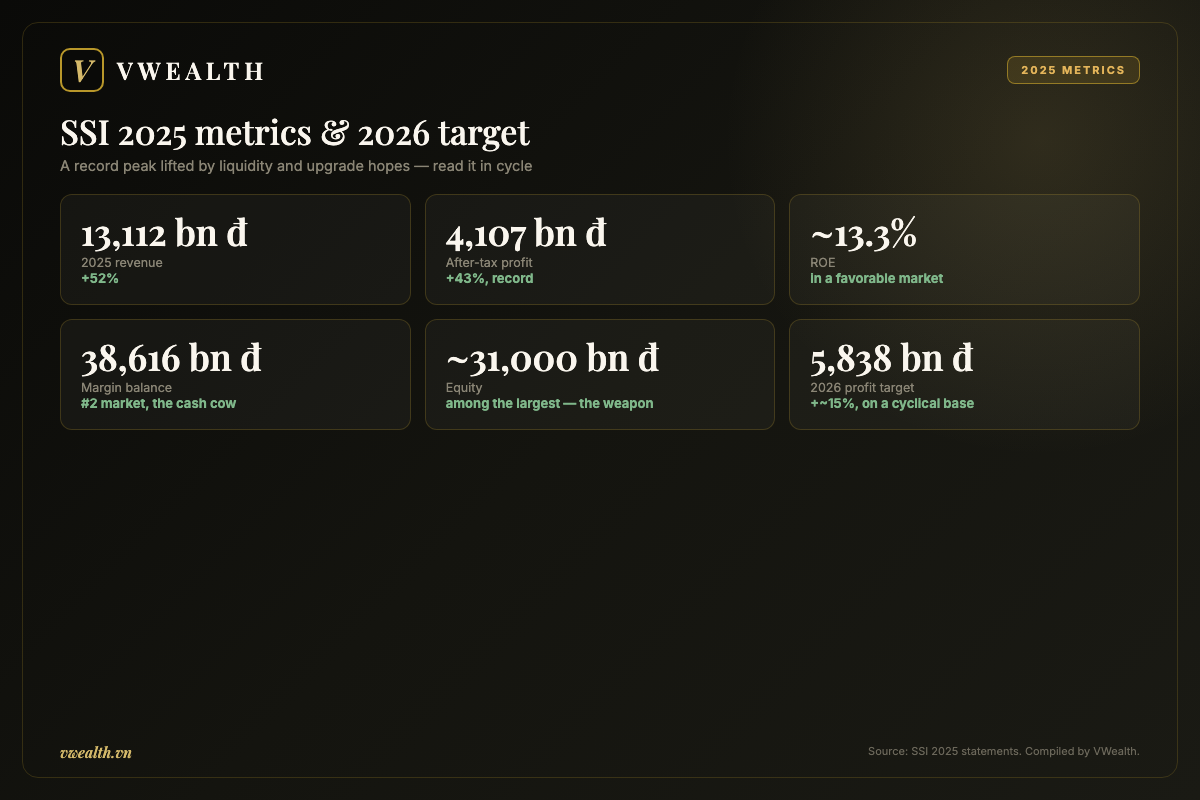
The business foundation is also at a historic high. In 2025, SSI reached net revenue of 13,112 billion dong (+52%) and after-tax profit of 4,107 billion dong (+43%) — a record over its 25 years of existence. At 27,150 dong a share (close of 19 June 2026), the question is clear: should you buy SSI at this price, and what kind of investor does it suit? To answer properly, you need to understand SSI isn’t an ordinary stock — it’s a mirror reflecting almost the entire 25-year history of Vietnam stock market. Let’s start from the root.
SSI market data (updated 19 June 2026)
| Current price | 27,150đ | 2025 revenue | 13,112 bn (+52%) |
| Change (June) | −1.09% | 2025 after-tax profit | 4,107 bn (+43%, record) |
| P/E | P/B | ~13–14x | ~1.7–2x | Brokerage share | #1 HOSE (~11%) |
Source: VWealth price data + SSI 2025 reports. Figures move by session — for reference only.
History and evolution
To understand why SSI holds its “flagship” position today, you need to go back to the days when Vietnam stock market didn’t yet exist. SSI story almost exactly overlaps with the story of a whole market being born and growing up — and that’s what gives this stock a symbolic meaning far beyond the financial figures.
1999–2000: Betting on a market not yet born
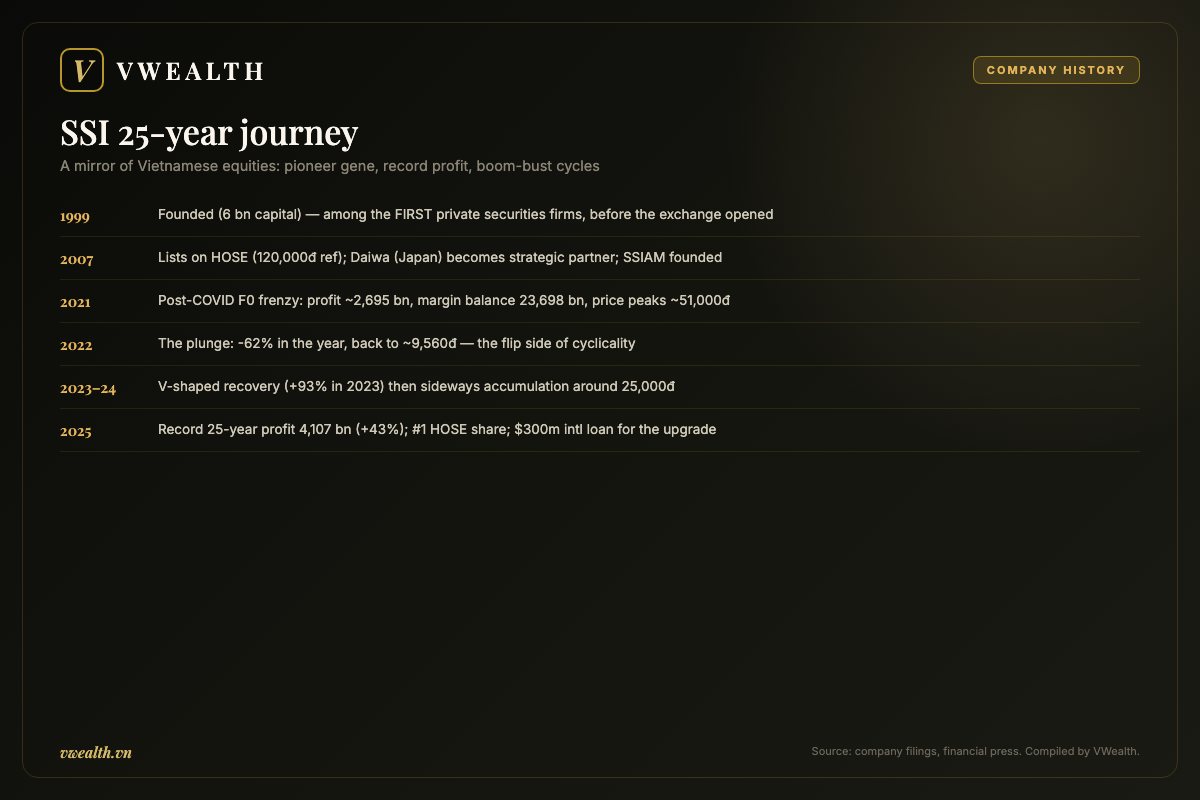
SSI was established on 30 December 1999 in Ho Chi Minh City, with modest initial charter capital of just 6 billion dong. The founder was Nguyen Duy Hung — who had just returned from studying investment abroad. Notably, SSI was one of the first licensed private securities firms in Vietnam, born even before the Ho Chi Minh City Securities Trading Center officially opened its first session in July 2000.
Picture that context: in 1999, the vast majority of Vietnamese didn’t yet know what a “stock” was, there was no exchange, no investors, almost no goods to trade. Putting money into founding a securities firm then was a bet of faith in the future — faith that Vietnam would have a real capital market. Hung placed that bet, and it shaped both his career and a whole industry. For you — an investor today — this detail matters because it shows SSI carries a “pioneer gene”: this business grew up with the market, understood it from the earliest days, and has almost always been the first to try new operations.
2001–2006: Growing up with a young market
In the early 2000s, Vietnam stock market was tiny, with only a few listed tickers and low liquidity. But this was also when SSI quietly built its foundation. The company gradually completed the core operations of a modern securities firm: brokerage, proprietary trading, corporate finance advisory (investment banking) and custody. Growth in this period was staggering: SSI revenue rose 233-fold in 2003–2007, from 5.8 billion dong to over 1,352 billion, while after-tax profit jumped from a few hundred million to 864 billion.
An important milestone came in December 2006: SSI shares were first registered for trading at the Hanoi Securities Trading Center. This was a stepping stone before SSI made a landmark “move” one year later. The meaning for you: this period shows SSI wasn’t just a broker for others, but early became an investment good itself — its own shares became something the market valued.
2007: HOSE listing and the peak of the first frenzy
In October 2007, SSI officially moved to list on the Ho Chi Minh Stock Exchange (HOSE) under the ticker SSI. The starting reference price was 120,000 dong a share — a price reflecting the extreme euphoria of the 2006–2007 market, the first boom of Vietnamese equities.
Listing on HOSE — the largest, most transparent exchange — put SSI at the center of domestic and foreign investor attention. But this was also the first classic lesson in the cyclicality of a securities stock: shortly after listing near a peak, the market entered the 2008 global financial crisis, and SSI along with the whole market plunged violently. This is vivid proof of the “high beta” argument you must carve in: SSI rises fast when the market is euphoric, but falls no less fast when the wind reverses.
2007–2008: Shaking hands with the Japanese — the alliance with Daiwa
Amid the 2008 crisis storm, SSI did something far-sighted: it found itself a world-class international strategic partner. On 24 June 2008, SSI signed a strategic cooperation agreement with Daiwa Securities Group — one of the “Big 4” largest securities groups in Japan (alongside Nomura, SMBC Nikko and Mizuho), with over 120 years of history. Daiwa bought at least 10% of SSI (about 5.8 million shares, worth about $10.8 million then) and sent a representative to the board.
Per the agreement, Daiwa committed to support SSI on technology, IT, staff training, product diversification and Japanese-market development. This is one of the rare durable cooperations between a Vietnamese business and an international “giant” — lasting nearly two decades and continually reinforced.
This relationship isn’t just a financial investment. It brought SSI governance standards, technology and an international network few Vietnamese securities firms have. Daiwa repeatedly raised its stake (at one point wanting to go above 20%), and in recent years remains a committed strategic shareholder. For you, this is a plus on governance quality and reliability: SSI has been “endorsed” by a top Japanese financial institution for nearly 20 years.
2007–2008: SSIAM born — stepping into asset management
In parallel, SSI expanded into another strategic segment. In August 2007, SSI Asset Management Co. Ltd (SSIAM) was established, a 100%-owned subsidiary of SSI. This step took SSI from a pure brokerage to a multi-service financial group: brokerage, proprietary trading, investment banking and asset management for domestic and foreign investors.
SSIAM later became one of Vietnam most reputable fund managers, pioneering products like exchange-traded funds (ETFs) — with SSIAM VNFINLEAD among the Vietnamese ETFs listed abroad. SSIAM also held a 4-year streak (2021–2024) of being voted “Asset Management Company of the Year” by The Asset magazine. The meaning for you: SSI doesn’t only earn from transaction fees — very cycle-sensitive — but also has income from asset-management fees, helping diversify cash flow and somewhat reduce the “boom-bust” nature of a pure brokerage model.
The man behind it: Nguyen Duy Hung and the “empire” expanding into agriculture
You can’t tell SSI story without the founder. Nguyen Duy Hung is called by investors the “securities kingpin” — the man who almost shaped the face of Vietnam private securities industry. But his vision didn’t stop at finance.
From 2012, Hung turned to lead a seemingly unrelated direction: agriculture and food, through the PAN Group. His reason was very “Vietnam”: this is an agricultural country with most of its population farming, with large room for clean agriculture and clean food. In 2013–2015, PAN executed a series of M&A deals with industry-leading businesses: seed companies (NSC, SSC), Bibica confectionery (BBC), cashew (LAF), seafood (ABT)… gradually building a trillion-dong agri-food ecosystem.
Why does this matter to an SSI holder? First, it shows the investment-banking and long-term investment capability of the ecosystem around Hung — SSI itself once invested in clean agriculture. Second, it shows the leadership strategic thinking: not putting eggs in one basket, not depending solely on the securities cycle. But note too: PAN and SSI are two separate legal entities; when assessing SSI stock, you must still separate and focus on SSI own results.
2021: Boom — the peak of the “F0” wave
2021 was one of the most brilliant years in SSI history, and a perfect illustration of “high beta” power on the way up. The pandemic drove deposit rates deep down, and idle cash from new individual investors — often called “F0” — flooded into stocks. Market liquidity exploded, and SSI benefited directly on all three fronts: brokerage fees, margin-loan interest and proprietary trading.
- 2021 net revenue: over 7,786 billion dong, up over 70% year on year.
- 2021 after-tax profit: about 2,695 billion dong.
- Margin loan balance: reached 23,698 billion dong — 2.6 times end-2020.
- Share price: climbed to a historic (adjusted) peak around 51,000 dong late in the year.
This is a golden lesson: when the market is in a wave, SSI is a cash printer and the stock can double or triple in a short time. But precisely because it climbs so high so fast, correction risk hangs overhead.
2022: The plunge — the flip side of cyclicality
Into 2022, the wind reversed violently. Global inflation pressure, tight monetary policy, plus shocks from the corporate-bond and real-estate markets pushed the VN-Index into a deep correction. SSI stock — already near a peak — plunged almost all year. Revenue and profit from the two most sensitive segments, brokerage and margin lending, reversed sharply, especially in Q4 2022.
The 2021–2022 period is a complete “case study” anyone planning to buy SSI should remember: from bottom to peak then back near bottom in about two years. It proves SSI isn’t a “buy and forget” stock if you buy at the wrong time — valuation and market timing are vital for this ticker.
2023–2025: Recovery and reaching record-profit heights
After the tough period, the market gradually recovered and SSI returned to its growth orbit. The peak was 2025 — the year SSI set a profit record over its 25 years of operation:
| Metric (2025) | Value | Growth |
|---|---|---|
| Net revenue | 13,112 billion dong | +52% |
| After-tax profit | 4,107 billion dong | +43% |
| ROE | ~13.3% | — |
| HOSE brokerage share | Top (5-year high) | 5 consecutive quarters of growth |
This is the highest growth in SSI 25-year history, with HOSE brokerage share at a 5-year high and a 5-quarter growth streak. In parallel, SSI kept strengthening its financial capacity with large capital raises: privately placing over 104 million shares (raising about 3,256 billion dong), lifting charter capital past 20,000 billion dong — among the largest in the industry.
2025–2026: Clearing the way for the upgrade wave
In late 2025, SSI did one more thing showing its ambition to get ahead of the upgrade: successfully signing an international unsecured syndicated loan of up to $300 million — the largest international capital raise ever by a Vietnamese securities firm. The loan was arranged by a group of Asian banks (led by Cathay United Bank and Union Bank of Taiwan). This figure is the peak of an impressive escalation:
- 2019: $55 million — the first international unsecured loan of the Vietnamese securities industry.
- 2020: $85 million.
- 2021: $100 million.
- 2022: $148 million.
- 2025: $300 million.
The purpose is clear: to prepare ample resources to handle large orders from foreign capital when the market is upgraded. Into 2026, SSI set an ambitious plan — revenue 15,660 billion dong, profit 5,838 billion dong, while raising charter capital toward the 30,000-billion mark and paying a 30% dividend — all to “catch the upgrade wave” of September 2026.
25 years in retrospect: why SSI history matters to your buy decision
Closing the journey from 1999 to now, three big messages to carry. One, SSI is a stock with a “pioneer gene” and a real industry-leading position — from capital and total assets to brokerage share — not a paper title. Two, SSI price history is a series of clear boom-bust cycles (2007–2008, 2021–2022) proving it’s a high-beta stock, requiring you to value timing and valuation. Three, the business is at its best-ever foundation (record 2025 profit, largest capital in the industry, the Daiwa partner, leading international-capital-raising capability) — and stands right before the FTSE upgrade story of September 2026, of which it’s one of the biggest beneficiaries.
All this leads to a natural next question: who steers the SSI ship, and what is their vision and governance capability? Let’s go deep into SSI Leadership in the next section.
Leadership and ownership structure
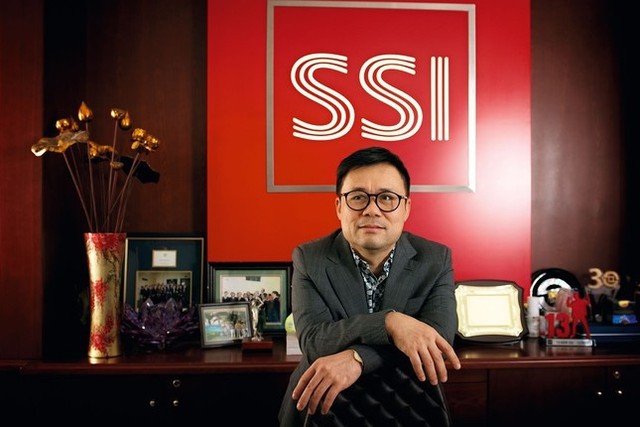
When you analyze a securities firm, don’t stop at profit figures and the balance sheet. For a financial institution, “people quality” and “who really holds power” usually decide the stock fate more than any technical metric. For SSI, this story is even more special, because for nearly two decades the company name has been almost absolutely tied to one individual: Nguyen Duy Hung. This is the part you should read most carefully, because it reveals both the strength and the structural risk of the business.
Nguyen Duy Hung — the man who built SSI and a market icon
If you had to pick a few iconic figures of Vietnam early stock market, Nguyen Duy Hung would almost certainly be on the list. Per public biographies, he was born in 1962, from Thanh Hoa, and studied in the former East Germany before returning to Vietnam. He is the founder and Chair of SSI Securities Corporation — one of the earliest securities firms in Vietnam and still an industry leader today.
What you need to picture is: SSI wasn’t “inherited” or spun off from a state-owned bank. It was built from the days when Vietnam stock market wasn’t clearly formed, when the concept of a “stock” was still foreign to most people. That very context makes Hung journey often described as a story of strategic thinking, steadfastness and long-term vision amid a volatile market. The through-line philosophy he has often mentioned is the belief that a healthy, transparent stock market is the foundation to attract and retain investors, thereby serving the economy sustainable development. For these contributions, he was once awarded the Labor Medal by the state (per public biographies).
An important detail investors often overlook: Hung doesn’t just stand behind SSI. He is simultaneously the founder and Chair of PAN Group JSC (ticker PAN) — a leader in agriculture and packaged food. In other words, you’re following a founder with influence spanning two large ecosystems: finance (SSI) and agri-food (PAN). This is both a plus on reputation and network, and a point to note on the concentration of power in one individual.
Defining statements: the “eldest brother” and the independence advantage
To understand how SSI positions itself, you should read directly what the leadership said at the 2026 annual general meeting (23 April 2026). When shareholders voiced concern that SSI risked “growing old” against a wave of young, bank-backed securities firms, Nguyen Duy Hung gave a very thought-provoking definition of the market-leadership role.
“The eldest-brother position isn’t about scale or grabbing the most share. The eldest brother is the one who leads and builds the market. Being the eldest brother doesn’t mean straining to grab everything. That isn’t called the eldest brother, that’s called the market boss.” — Nguyen Duy Hung, SSI AGM 2026 (per VietnamBiz, Dan Tri).
This phrasing captures the governance philosophy Hung pursues: prioritizing leadership and “building the market together, sharing benefits through healthy competition,” rather than maximizing short-term profit at all costs. At the same meeting, the leadership stressed three strategic pillars: maintaining financial strength to “steady the helm” when the market is volatile, shifting from quantity to quality (streamlining staff and costs), and investing heavily in technology and new products.
There’s a statement often cited as SSI “thinking brand,” which you should quote carefully. It’s the view that SSI not being a subsidiary of a bank is an advantage, not a disadvantage. An important source note: per reporting from the 2026 AGM (DNSE), the specific statement to this effect is recorded from Nguyen Vu Thuy Huong — Senior Director of the Investment Division and the Capital & Financial Business Division — and shouldn’t be attributed verbatim to Hung personally. Even so, the “independence is an advantage” spirit is clearly a view shared across SSI leadership.
Why is this argument worth weighing? A “subsidiary” securities firm of a bank usually has the advantage of cheap capital access and a ready customer base, but in exchange may be bound by the parent bank direction, advisory conflicts of interest, and the risk appetite of a credit institution. SSI argues that its independent position lets it be more neutral in advice, more flexible in capital and investment strategy. This is a reasonable argument, but you should view it as a competitive angle, not absolute truth.
Generational handover: who really runs SSI?
This is where many old analyses are outdated, so you need to be especially current. For many years, the SSI CEO position was tied to Nguyen Hong Nam — Hung younger brother and a board member, who held the CEO seat from about 2020. Many investors still assume this “brother duo” runs the company.
However, in 2025 SSI made a notable generational handover. Per company disclosure (DNSE, Nguoi Lao Dong), SSI appointed a new CEO, Nguyen Duc Thong — a young figure (born 1988, a Cambridge graduate, who worked at Goldman Sachs and Morgan Stanley, joining SSI about 6 years ago). Chairman Nguyen Duy Hung described this as a strategic decision to hand over leadership generations, build a succession team and drive SSI to break out in the digital era, while pledging to “directly accompany and support” the new CEO to complete the mission.
And “Nguyen Duy Hung son”? Many expected the son — Nguyen Duy Linh — to succeed at SSI. But trading data shows another direction: in late March 2025, Nguyen Duy Linh sold all 154,496 SSI shares (transferred to a family-group entity), after which he no longer directly held SSI shares (Tuoi Tre, CafeF, VnEconomy). You should read this detail cautiously: an individual selling personal shares and shifting to a family entity doesn’t mean “retreating from the empire,” but it shows the succession path at SSI is now led by a professional executive team (like CEO Nguyen Duc Thong) rather than a traditional father-son handover.
In sum, the current management picture to remember: Nguyen Duy Hung remains Chair and the “soul” of SSI, while the day-to-day executive seat (CEO) has been handed to a younger generation. This is a positive governance signal — showing SSI is aware of key-person risk and proactively builds a succession layer.
Ownership structure: the Hung family, the Japanese partner Daiwa and the rest
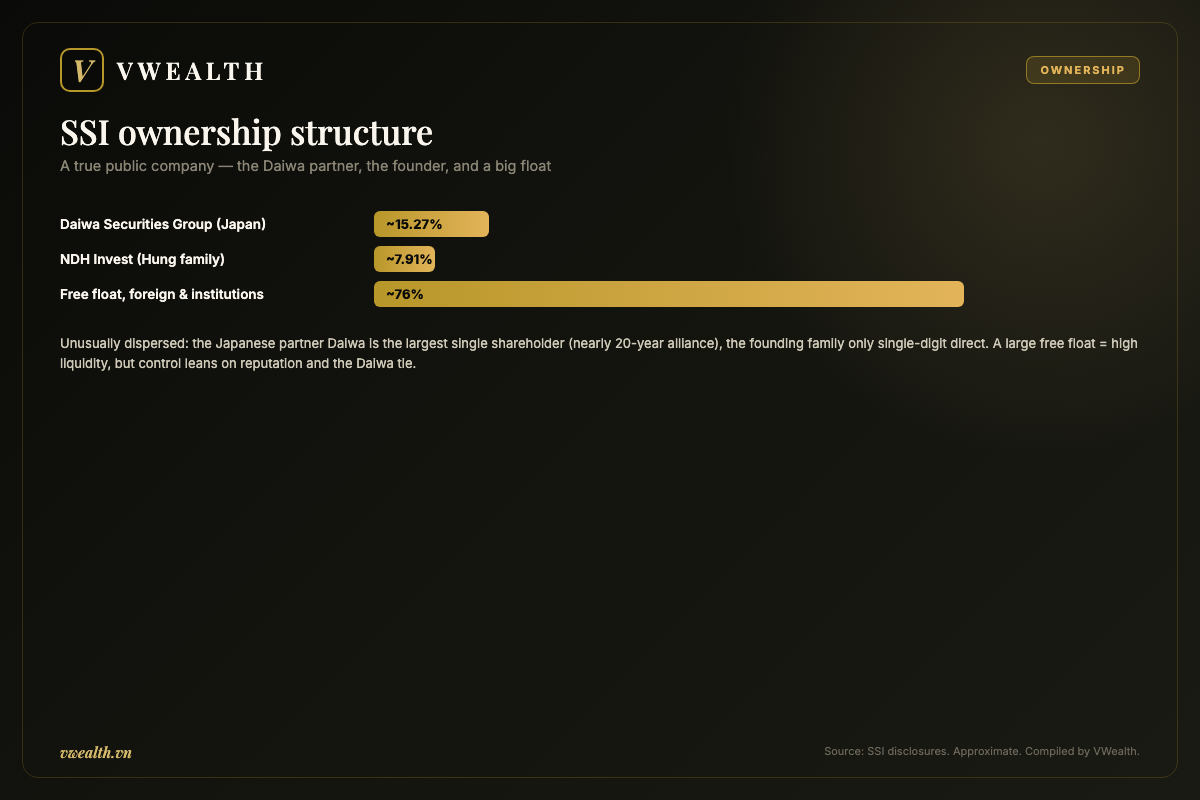
To the core part: who owns SSI? Unlike many Vietnamese private businesses where the founder holds an overwhelming controlling stake, SSI ownership is fairly dispersed with a clear foreign mark. Per recent disclosures, the two prominent large shareholders are:
| Large shareholder | Shares (approx.) | Ownership | Trait |
|---|---|---|---|
| Daiwa Securities Group (Japan) | ~380.5 million | ~15.27% | Strategic partner, largest shareholder |
| NDH Investment Co. Ltd (NDH Invest) | ~197.1 million | ~7.91% | Entity tied to the Hung family group |
| Other shareholders (free-float, other foreign, institutions/individuals) | the rest | ~76% (est.) | Large free float, high liquidity |
Note: the ratios above are disclosed at a point in time and will change after each SSI capital raise/share issue. You should cross-check SSI official ownership page and latest reports before an investment decision.
The first notable point: Daiwa Securities Group — not the Hung family group — is the largest single-entity shareholder, at about 15.27%. Per VnEconomy, Daiwa recently spent over 951 billion dong to exercise rights to buy over 63.4 million shares, thereby keeping its stake around 15.2% and remaining the largest shareholder. Meanwhile, NDH Investment Co. Ltd — the entity chaired by Nguyen Duy Hung — holds about 7.91%, serving as the “ownership axis” of the founding family group.
You need to read this figure subtly. The founding family holding only a single-digit direct stake (through NDH Invest and related individuals) cuts two ways. On one hand, it shows SSI is a true public company with a large free float and high liquidity — which institutions and foreign funds favor. On the other, the founding group not-too-high direct stake means control depends heavily on reputation, influence and relationships with other large shareholders — especially Daiwa.
The Daiwa relationship: nearly two decades of a Vietnam–Japan “bond”
The SSI–Daiwa relationship isn’t a pure financial investment but a strategic alliance lasting nearly 20 years. Per Nguoi Quan Sat and VnEconomy, as early as July 2007, Daiwa bought a small SSI stake (a deal of about $10.8 million) with a cooperation memorandum; by 2007–2008, Daiwa officially became a strategic shareholder, committing to raise its stake and join the board, while supporting SSI on IT, staff training, product diversification and developing a Japanese customer base.
For you — the analyst — the meaning of Daiwa lies in three layers of value. First is capital and shareholder stability: a large Japanese securities group committed long term keeps SSI shareholder base solid, reducing ownership-disruption risk. Second is experience and governance standards: Daiwa brings the know-how of a developed financial market, helping shape SSI image as a transparent, methodical company. Third is a bridge to Japanese capital and customers: the two have jointly set up funds (like the Daiwa-SSIAM fund line) and expanded the channel bringing Japanese capital into Vietnam — a hard-to-copy advantage as Vietnam heads toward a market upgrade. This is a factor you should add points for when assessing SSI “shareholder quality.”
Governance and capital strategy: continuous capital raising — a double-edged sword
SSI has long been cited as one of the securities firms with leading governance and transparency standards. Hung himself has repeatedly affirmed a clean-governance view, even stressing the principle that the company “doesn’t trade its own shares” (per 2026 AGM reporting, DNSE) — a commitment to avoid conflicts of interest, a sensitive point for securities firms.
But the most important governance-financial trait you must grasp is the strategy of using large capital and continuously raising it. SSI business model consumes capital heavily: margin lending and proprietary trading/investment both need a thick balance sheet. So SSI almost every year moves to raise charter capital. Per 2025–2026 sources, the company completed many issues: by 23 January 2026, SSI completed offering over 415 million shares, lifting charter capital to about 24,932 billion dong — nearing the 25,000-billion mark and leading the industry in charter capital; the next ambition is toward a 30,000-billion charter capital to “catch” the market upgrade. The margin-loan plan is set very high (around 26,000 billion dong per the 2025 AGM).
View this continuous capital raising two ways:
| The positive side (raising capacity) | The cautious side (dilution) |
|---|---|
| Expands margin-lending room — a stable revenue source with a good margin | Shares outstanding rise fast, diluting EPS if profit doesn’t keep pace |
| Cements the “eldest brother” position on capital scale, an advantage when the market is upgraded | Pressure to continuously “digest” new capital efficiently |
| Raises risk-bearing capacity when the market is volatile | Existing shareholders diluted if they don’t buy more |
In other words, each SSI capital raise is a trade-off: you get a company stronger in lending and investment capacity, but must accept the profit “pie” split among more shares. The key to assessing is whether the leadership turns new capital into corresponding profit (keeping ROE good). In fact in 2025, SSI reported record profit (per sources, profit around and over 4,000 billion dong) — a signal that capital is being used efficiently, at least in a favorable market period.
Dividends: nearly 20 years of cash payouts — a commitment to shareholders
A bright spot in SSI policy that long-term investors value highly is the dividend. SSI is famous for combining both cash and stock dividends. Per Tien Phong and DNSE, the company has kept a cash-dividend streak of nearly 20 consecutive years, starting from 2007 — a rare achievement in a very “fickle,” cyclical industry.
In its 2025 profit-distribution plan, SSI plans a total dividend of about 30%, including 10% in cash (over 2,500 billion dong) and 20% in shares. This is a very “SSI-signature” approach: paying cash to keep its commitment and shareholder trust, while paying shares to retain resources to keep building capital for margin and investment. For you, the meaning is: SSI wants to be both a “steady-dividend” stock and a “capital-growth” stock — and you need to be clear about which reason you buy SSI for, to have the right expectation.
To close this section, remember the overall picture: SSI is an institution tied to the reputation of founder Nguyen Duy Hung, proactively handing over management to a younger generation; with a solid shareholder base with the Japanese strategic partner Daiwa as the largest shareholder; pursuing a large-capital strategy, continuously raising capital to lead in margin capacity; and maintaining a rare cash-dividend discipline. It’s this “governance gene” that anchors us moving to the next section — analyzing the ecosystem and segments that made SSI the “eldest brother” of the industry.
Business segments and ecosystem
To understand a stock, you can’t just look at the price. You must understand the machine underneath: how this business makes money, from which sources, and how sensitive those sources are to the outside world. For SSI, this question is especially interesting, because a securities firm isn’t like any other business you’re familiar with. It doesn’t sell a physical product like Vinamilk, doesn’t build houses like Vinhomes, doesn’t do consumer lending like a pure bank. A securities firm stands at the center of money flows in the capital market — broker, lender, investor and advisor all at once. Each of those roles is a separate money-making machine, with its own mechanism and its own risk level.
SSI is Vietnam oldest and among the largest securities firms, and after 25 years of development, it has built a fairly complete ecosystem. In 2025, the company reached consolidated net revenue of 13,112 billion dong, up 52% year on year, with after-tax profit of about 4,107 billion dong — the highest growth in its 25-year history. But that total is woven from many different threads. In this section, we’ll take the SSI machine apart segment by segment, and more importantly, I’ll explain to you — even if you’re just entering the market — exactly how each segment makes money, why one matters more than another, and why this whole machine “breathes” to the rhythm of the stock market.
Brokerage: the oldest trade, and also the most precarious
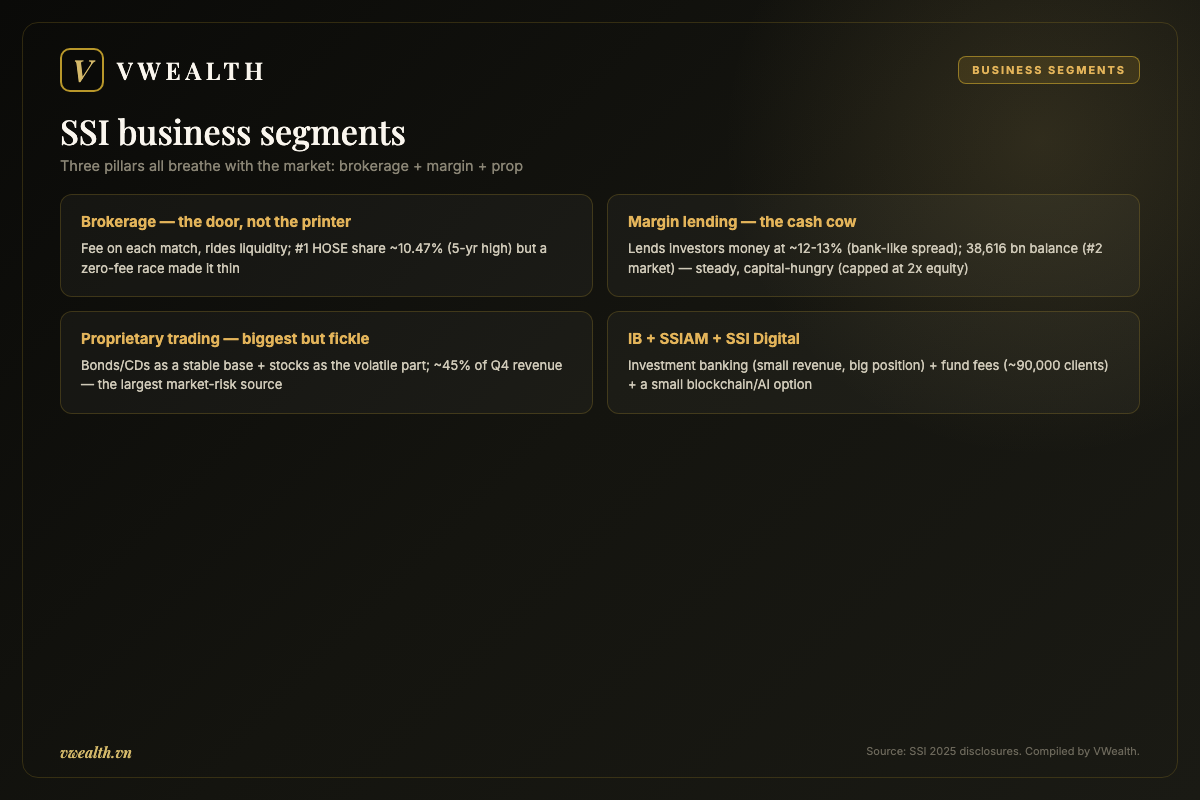
Let’s start with the segment everyone thinks of first when hearing “securities firm”: brokerage. This is the original trade, the reason these firms exist. Its money-making mechanism is so simple you can understand it immediately: each time you buy or sell a stock, you pay a transaction fee — usually a percentage of the order value, e.g. a few basis points up to about 0.15–0.25% of the transaction. That fee flows to the securities firm where you have your account. SSI acts as intermediary, matching your buy/sell orders with the market, and collects a fee on each match.
It sounds simple, but here’s what you must carve in: brokerage revenue depends entirely on market liquidity — the total transaction value all investors do each day. When the market is vibrant, tens of thousands of billions change hands each session, and brokerage fees pour in. When the market is dull and investors sit still, then however high SSI market share, the total pie shrinks. In other words, brokerage is a highly cyclical revenue segment: it swells in an up-wave and shrinks in a lull. This is why any securities firm profit, including SSI, swings violently by year — one year record profit, the next a plunge, not because the business got worse, but because the market cooled.
In the brokerage game, two variables decide SSI revenue: market share (how much of total trading SSI captures) and market size (whether total trading is large or small). On market share, 2025 was a clear victory: SSI rose to lead HOSE with a share of about 10.47% — a 5-year high, after a long period of losing share to cheap-fee brokers and bank-origin firms. In the last quarter alone, its share pushed above 12%, the highest in many consecutive quarters. SSI reclaiming the HOSE lead is a very notable signal, because it shows the company brand, technology infrastructure and advisory team still draw big investor money back.
But be sober here. The brokerage share war in recent years has become a race to the bottom on fees. Many firms offer zero-fee trading to lure customers, accepting a nearly unprofitable brokerage segment in exchange for customers to sell more lucrative services. SSI too was forced into that race. So while a high brokerage share is something to be proud of and strategically valuable, the brokerage segment itself is no longer the cash printer it was a decade ago. It’s more like a door — a door drawing customers into the ecosystem, so the truly money-making segment sits in the next room.
Margin lending: the “cash cow” of ever-growing importance
That next room is margin lending, which investors shorten to margin. If brokerage is the old trade, margin is the new lifeblood and the main profit driver of large securities firms today, SSI included. To understand why, you need to understand what margin really is.
Margin, plainly, is the operation where a securities firm lends you money to buy more stock. Suppose you have 100 million dong. Normally you can only buy 100 million of stock. But with margin, SSI lends you more, say another 100 million, so you can buy 200 million of stock — the stock you buy serves as collateral for the loan. In exchange, you pay SSI interest on that borrowed amount, usually around 12–13% a year. This is the crux: SSI is behaving exactly like a bank — raising capital at low cost, then lending to investors at a higher rate, and pocketing the interest spread. And that spread, multiplied by a huge loan balance, generates extremely large, steady cash flow.
At end-2025, SSI margin loan balance reached 38,616 billion dong, second in the market. Pause and feel this number: nearly 39,000 billion dong is borrowed by investors and paying SSI interest steadily. Just multiply the net interest margin by that scale, and you see this is a huge interest-income stream. And this is why margin is likened to a “cash cow”: it gives milk steadily each day, little dependent on whether the market rises or falls short term. As long as investors hold positions and owe, SSI collects interest. Versus brokerage fees — which only arise when there’s trading and swing dizzyingly — margin interest income is far more stable and predictable. That’s the fundamental difference explaining why margin, not brokerage, is SSI core profit driver today.
Remember this principle: brokerage is cash flow by trading rhythm — flaring up then dying; margin is cash flow by loan balance — flowing steady as a stream, as long as investors owe. A strong securities firm is one that turns the precarious brokerage segment into a stable margin machine.
But margin has a harsh demand you must understand to value SSI stock correctly: it consumes capital terribly. To lend a lot, the company must have a lot to lend. The law also caps margin balance at no more than two times equity — meaning the larger the equity, the wider the lending “room.” This is the key explaining why SSI has continuously raised capital for years, from rights issues to private placements, and set a plan to raise charter capital to 30,000 billion dong. Each capital raise dilutes shares short term, but in exchange expands lending room, and thus the core profit machine. SSI leadership set a target of raising margin balance to 45,000 billion dong — an ambition feasible only if the capital base keeps being built. When you assess SSI share issues, don’t rush to think “dilution is bad”; for a securities firm, raising capital to expand margin is usually raising capital to expand future interest income. The only question is how efficiently they use the new capital.
Of course, the “cash cow” has its downside too. Margin amplifies both profit and loss for investors, and when the market plunges sharply, mass “margin calls” — forced liquidation — can create a domino effect, pushing prices down faster. For SSI specifically, the risk is that when the market falls deep, the balance shrinks, and some loans may become bad debt if the collateral loses value too fast. That’s why margin risk management — choosing which stocks get margin, setting prudent loan ratios — is a survival capability, and what separates a good securities firm from a reckless one.
Proprietary trading and investment: the biggest but most fickle machine
The third segment is proprietary trading, or prop trading in English — the company uses its own money to invest, earning profit for itself rather than clients. This is where SSI behaves like a large institutional investor. SSI proprietary portfolio has three main groups, and you should distinguish them clearly because their risks are very different.
- Safe financial assets: the largest part of SSI proprietary portfolio isn’t stocks, but fixed-income instruments like bonds and certificates of deposit. These are relatively safe assets earning steady interest — almost like SSI placing money for controlled returns, leveraging its ample capital. This part contributes a stable, low-risk financial-income stream.
- Listed and unlisted stocks: this is the most “fickle” part. SSI holds stocks of many businesses, and this portfolio value moves with the market. When the market rises, SSI books large mark-to-market and realized gains; when the market falls, this very part causes proprietary losses that suddenly drag profit down.
- Strategic investments: some long-term strategic holdings or investments in the group ecosystem.
What to remember about proprietary trading: this is usually the largest revenue-contributing segment in favorable-market years, but also the largest market-risk source. Proprietary trading is like a double-edged sword: it can push SSI profit to a peak in an up-market year, but can also erode profit quickly when the market reverses. The bond and deposit part is a stable “base,” while the stock part is where volatility comes from. When you read an SSI surprise-profit report in some quarter, always check whether most came from mark-to-market proprietary gains or from durable margin interest — because the quality of these two sources is entirely different.
Investment banking (IB): small in revenue, large in position
The fourth segment is investment banking, IB. Don’t confuse it with the commercial bank where you save money. IB here advises businesses on large capital-market deals: advising on IPOs, on issuing more shares or bonds to raise capital, on mergers and acquisitions (M&A), and acting as underwriter and distributor in those deals. In exchange, SSI collects advisory and underwriting fees — usually a percentage of the deal value.
On pure revenue scale, IB is a small segment — only a few dozen billion dong a quarter, no match for margin or proprietary trading. But IB value lies elsewhere. First, it has its own cycle and can boom in periods of a vibrant IPO market or when the upgrade wave draws businesses to list. Second, and more importantly, IB reflects SSI position and relationships with the large-business community. A securities firm chosen to advise billion-dollar IPOs is a firm with reputation, a network, and the ability to connect SSI with domestic and foreign institutional money. IB is thus the arm that lifts the brand, and a segment expected to grow strongly if Vietnam is upgraded to emerging-market status, when the number and size of capital-raising deals surge.
SSIAM fund management: steady fees on other people money
The fifth segment sits in the subsidiary SSIAM (SSI Asset Management) — fund and asset management. The money-making mechanism here is very attractive for its stability: SSIAM raises money from individual and institutional investors, pools it into funds, then invests on their behalf. In exchange, SSIAM collects a management fee as a percentage of assets under management (AUM) each year, regardless of whether the fund profits or loses, plus a performance fee when the fund does well. This is a dream revenue model: as long as AUM is large and growing, the fee flow comes steadily year after year.
SSIAM manages a fairly diverse product line: index ETFs like SSIAM VNFIN LEAD, SSIAM VN30, SSIAM VNX50; active open-ended funds; and funds for institutional investors, including foreign capital. SSIAM customer base reaches about 90,000 individuals and institutions. Though not yet the largest profit source, this segment has long-term strategic meaning: as Vietnam middle class gets richer and shifts from savings to fund investing, the asset-management industry is forecast to grow durably for decades. SSIAM is SSI ticket to join that long-term trend, with a fee flow far less volatile than the rest of the group.
SSI Digital and digital assets: a future gamble, small today
The last segment is the “future” part of the ecosystem: SSI Digital (SSID) — the group technology and digital-asset investment arm. This is where SSI bets on things that don’t generate profit today but could shape tomorrow game: fintech, blockchain, artificial intelligence, and digital-asset infrastructure.
SSI Digital was established in 2022, and in early 2025 officially launched the SSI Digital Ventures investment platform with a commitment to invest up to $200 million, plus a co-investment plan of up to $500 million in digital-technology and blockchain businesses. In 2025 alone, this fund planned to disburse at least $10 million into about 10 blockchain and AI projects in Vietnam. SSID also broke ground on a digital-technology and blockchain complex at the Hoa Lac High-Tech Park, and the company was raised to a trillion-dong scale. The ambition is even larger: SSI leadership sees blockchain and digital assets as the key for Vietnam to build an international financial center, especially as the government issued a resolution piloting a digital-asset market for 5 years — paving the way for a licensed digital-asset exchange, with a very high minimum-capital requirement only a few “big players” like SSI can meet.
But this is where you need to be especially sober, and I’ll say it straight: SSI Digital, at present, is still a small, experimental segment not yet contributing significantly to profit. Don’t let the hundreds-of-millions-of-dollars figures and trendy keywords like blockchain, AI, digital assets make you overvalue this part. This is a long-term venture investment: it could create breakthrough value if Vietnam truly legalizes and develops the digital-asset market and SSI wins a pioneer position; but it could also take years to profit, or fall short of hopes. View SSI Digital as an “option” — a potential upside attached, not the core valuation basis of SSI stock today. SSI real value still lies in margin, brokerage and proprietary trading; SSI Digital is a bonus if the gamble succeeds.
Putting the picture together: the revenue mix and market sensitivity
Now step back and see the whole. Combining the six segments above, you’ll see SSI revenue machine essentially revolves around three big pillars: brokerage + margin + proprietary trading. These three make up the overwhelming majority of revenue, while IB, SSIAM and SSI Digital are supplementary — strategically important but small in weight. How the three main pillars coordinate decides the whole “character” of SSI stock.
And here’s the key conclusion to carry: all three main pillars are highly sensitive to stock-market movements, but in different ways. Brokerage is sensitive to liquidity — more trading, more income. Proprietary trading is sensitive to asset prices — the market rises, big profit; falls, heavy loss. Only margin is relatively more stable, because it relies on loan balance and interest rather than directly on whether the market is green or red on the day — though long term, the margin balance also flexes with market sentiment. This explains why SSI profit swings strongly with the cycle: in a soaring-market year like 2025, all three pillars boom together and push profit to a record; in a dull year, all three shrink and profit falls deep.
In other words, buying SSI stock is essentially buying a “leveraged bet” on the overall health of Vietnam stock market. When you’re optimistic about the market — about liquidity, money flows, the upgrade outlook — SSI is one of the most direct and powerful beneficiaries, because it collects transaction fees, lends margin and profits from its proprietary portfolio, all at once. Conversely, when you’re pessimistic, SSI is also the hardest-hit stock. That’s both the appeal and the core risk of this business.
Precisely because SSI profit rises and falls with the market rhythm, the next important question isn’t “how does SSI make money” — you already grasp that — but “is SSI solid enough to get through even harsh market years.” A powerful revenue machine with a thin capital base, high leverage and weak risk management is very dangerous; conversely, a thick capital base, good liquidity and tight risk discipline help a business not just survive but break out when the market recovers. That’s why, in the next section, we’ll dissect SSI competitive position and financial health — to see how solid a foundation the money-making machine you just understood is built on.
Position and financial health
When you hold a securities stock, what you’re really holding isn’t a business producing tangible goods, but a “machine” run by the market own money and confidence. And in that world, SSI isn’t merely a player — it’s the leader. To understand why SSI is sought after whenever the market brightens, and why it also plunges fast when the market darkens, you need to look deeply at two things: its position in the industry, and the financial health beneath the surface of numbers. This section peels back each layer, from the huge capital scale to the harsh cyclical nature of the securities industry.
The number-1 position: When capital scale becomes a weapon
Let’s start with a number that surprises many: for 2025, SSI recorded consolidated revenue of 13,112 billion dong, up 52% year on year, and after-tax profit of 4,107 billion dong, up 43% — the highest since founding. Pre-tax profit exceeded 5,000 billion dong. This isn’t an accidental “bumper” year; it’s the result of a position built over two decades.
What sets SSI apart from the rest of the industry is capital scale. SSI charter capital and equity are among the largest in Vietnam securities industry, with end-2025 equity around 31,000 billion dong and total assets approaching 93,000 billion dong. You might think large capital is just about being “big-bodied,” but in the securities industry, capital scale is a truly sharp weapon.
Why? Picture the core money-making mechanism of a modern securities firm. Besides collecting brokerage fees whenever investors trade, the firm lends investors money to buy more stock — that’s margin lending. This lent money earns interest steadily. And to lend a lot, you must have a lot: the law caps margin balance at no more than two times equity. Meaning the thicker the capital, the wider the lending “room,” and thus the larger the interest income. SSI has top-tier equity, so it has lending room most rivals can only dream of.
The proof is very clear: SSI margin loan balance at end-2025 reached 38,616 billion dong — second in the market. Remember that the whole Vietnam stock market then had a total margin balance exceeding 400,000 billion dong; SSI alone took nearly a tenth. Each dong lent is a dong earning interest, and at that scale, lending becomes one of the company most stable cash printers.
SSI position is further cemented by three hard-to-copy soft pillars:
- Scale advantage: large capital lets SSI raise capital cheaper. In Q4 2025, the company arranged a $300 million international syndicated loan — seen as the largest syndicated loan ever from a Vietnamese securities firm. Borrowing cheap then lending at a good margin is the art of making money in this industry.
- A long-standing brand: SSI is one of the industry earliest names, trusted by investors through many market cycles. That trust can’t be bought and is a natural entry barrier for new rivals.
- An institutional and foreign customer base: unlike many firms serving only individuals, SSI has deep relationships with domestic and foreign investment funds and institutions. This is a “high-quality” customer group, trading large values and committed long term.
Brokerage share: 5 straight quarters of growth to a 5-year peak
If large capital is the foundation, brokerage share is the mirror of SSI position on the daily competitive front. In 2025, SSI brokerage share on HOSE reached 10.47% — a 5-year high, and more importantly, the result of 5 consecutive quarters of growth.
You should understand the “5 straight quarters of growth” figure carries special weight. Brokerage share is a fierce war where firms race to cut fees, even offer zero-fee trading, to win customers. A large firm like SSI reclaiming share durably, quarter after quarter, shows it’s not just defending its position but proactively expanding. In an industry where many rivals “burn money” to buy short-term share then lose it, SSI steady rise is a sign of a deep strategy, based on service quality and product ecosystem rather than just a price race.
HOSE brokerage share of 10.47% — a 5-year high, up 5 consecutive quarters. For a company already at large scale, gaining more share is far harder than for a newcomer, because each added percentage point requires pulling customers from the strongest rivals. This is a sign SSI isn’t “resting on its laurels.”
Combined, you have a very clear position picture: SSI leads or is among the leaders in brokerage share, while owning a capital base among the industry largest. These two factors reinforce each other in a virtuous spiral — large share brings more customers, more customers need margin, large capital meets that need, interest income comes back to thicken the capital. That’s why many analysts view SSI as the “representative” stock of Vietnam whole securities industry.
High cyclicality: Why SSI is a “high-beta” stock
Here you need an important warning to balance the bright picture above. All the record 2025 numbers — revenue, profit, market share, margin balance — were born in an extremely favorable market. And this is the most uncomfortable nature of the securities industry: extremely high cyclicality.
A securities firm profit swings strongly with two variables it barely controls: market liquidity (the money traded each day) and the general index (whether the VN-Index rises or falls). Think about it simply:
- When the market is vibrant, investors trade more — SSI brokerage fees rise. They borrow more margin to “play big” — SSI lending interest rises. Stocks in SSI proprietary portfolio rise too — the company investments profit big. All three revenue sources swell at once.
- When the market is dull, everything reverses at once: trading shrinks, investors sell down margin to cut risk, and the proprietary portfolio may lose. Three revenue sources shrink together, and the proprietary segment may flip from profit to loss, cutting deeper into profit.
This “resonance” effect — when all three engines accelerate or brake together — is why a securities firm profit swings far more than an ordinary manufacturer. A factory still sells when the economy is tough, just slower. But a securities firm can see over half its profit evaporate in a single bad-market year.
The direct market consequence: SSI is a “high-beta” stock. Beta measures how much a stock dances relative to the general market; high beta means when the VN-Index rises, SSI usually rises more, and when the VN-Index falls, SSI falls deeper. Picture SSI as a race car: on a clear straight it shoots to the front, but on a slippery corner it also flies off more easily than slow family cars.
The record 2025 profit thus needs to be read with sober eyes. It’s real, it’s something to be proud of, but it was created thanks to a specially vibrant market, boosted by the expectation of upgrading Vietnam stock market from “frontier” to “emerging.” The upgrade expectation draws big money, pushing liquidity and stock prices high, and SSI — with its number-1 position — benefits most. But if one day that expectation cools or the market enters a correction, that same resonance mechanism will pull profit down just as fast. This is what you must remember when valuing this ticker: you shouldn’t extrapolate a cycle-peak year profit as the “new normal.”
A shifting profit mix: Less dependent on pure brokerage
There’s good news that somewhat eases the cyclicality worry: SSI profit mix is shifting toward a healthier structure. If for many years brokerage was the main lifeblood, now the two largest pillars have become margin lending and investment (proprietary trading). In 2025, the investment activity contributed a very large share of total revenue, on par with the securities-services segment; in Q4 alone, investment made up about 45% of revenue.
Why is this a positive shift? Because pure brokerage is the most “thankless” business: a thin margin from fierce fee competition, and extremely volatile by trading session. Meanwhile:
- Margin lending brings a steady interest flow, far more predictable. A disbursed loan earns interest each day regardless of whether the market rises or goes sideways, and only truly shrinks when investors collectively sell down margin in a bad-market phase. Versus session-dependent brokerage fees, this is a “steadier” income source.
- The investment segment, if well-managed with a portfolio tilted toward fixed-income assets and quality bonds, can generate stable cash flow. Of course the stock part still carries price risk, but the overall structure is more solid than just “eating” transaction fees.
This trend shows SSI proactively transforming from a pure “broker” into a multi-service financial institution, knowing how to make money from its own huge balance sheet — using large capital to lend and invest, rather than just collecting intermediary fees. This is the path all the world leading securities firms have walked, and it helps reduce — though not eliminate — dependence on the market ups and downs.
Financial health: Leverage is a double-edged sword
Now let’s dissect the “health” — what decides whether SSI can stand through a market storm. The nature of a margin-lending securities firm is that it must borrow to have money to lend. In other words, it uses financial leverage deliberately. Total assets of nearly 93,000 billion dong are financed by equity of about 31,000 billion dong and the rest by debt. That difference is the leverage.
Leverage is a double-edged sword. The first edge cuts favorably: when SSI borrows cheap capital (like the $300 million syndicated loan) then lends investors margin at a higher rate, the interest spread multiplied over a huge scale generates large profit. This is the 2025 profit-growth engine. The second edge cuts dangerously the other way: if the market plunges and many margin loans go at risk (investors unable to repay as stocks fall), the company can face bad debt, while still paying interest on what it borrowed.
So is SSI safe? A few signals to reassure you:
- Thick equity as a cushion: with equity among the industry largest, SSI leverage is in a controlled zone. This capital cushion absorbs shocks far better than small firms that over-borrowed. A 38,616-billion margin balance on ~31,000-billion equity is still within the regulatory safe limit (not exceeding two times equity).
- The margin risk-management mechanism: margin lending at SSI always has collateral in the pledged stock itself, plus a margin-call mechanism and forced liquidation when the price hits a threshold. This lets the company recover capital before a loan becomes bad debt, though in consecutive floor sessions it also creates widespread selling pressure.
- International capital-raising ability: successfully arranging the industry largest syndicated loan shows international financial institutions rate SSI creditworthiness highly. This is an independent confirmation of financial health not every company has.
The point to watch is the quality of the proprietary portfolio. As the investment segment contributes an ever-larger share of profit, the portfolio composition becomes important. A portfolio tilted toward bonds, certificates of deposit and fixed-income assets creates stable, low-risk cash flow; conversely, a stock-heavy portfolio makes the company profit “dance” with the market, worsening the already-high cyclicality. You should read the FVTPL-asset notes in the financial statements to know where SSI is betting.
2026 targets: Ambition set on a cyclical base
Looking ahead, SSI leadership continues to set ambitious targets for 2026: revenue of 15,660 billion dong and pre-tax profit of 5,838 billion dong. Versus the 2025 results (revenue 13,112 billion, pre-tax profit over 5,000 billion), this is continued double-digit revenue growth — an optimistic plan, betting on the market keeping its vibrant momentum and the upgrade story continuing to draw money.
You should read these targets with both excitement and caution. Excitement, because it reflects the confidence of those who understand the company most about growth room — especially as the strengthened capital base opens more margin and investment “room.” Caution, because as analyzed, every securities-firm target depends on a variable beyond its hands: the general market. A beautiful growth plan built on the assumption of a favorable market is very vulnerable if that assumption doesn’t materialize.
| Metric | 2025 actual | 2026 target | Note |
|---|---|---|---|
| Revenue | 13,112 bn (+52%) | 15,660 bn | Continued double-digit growth |
| Pre-tax profit | over 5,000 bn | 5,838 bn | Targeting above the old peak |
| After-tax profit | 4,107 bn (+43%, record) | — | Highest since founding |
| HOSE brokerage share | 10.47% (5-year peak) | — | 5 consecutive quarters of growth |
| Margin loan balance | 38,616 bn (#2 market) | — | A stable profit pillar |
| Equity | ~31,000 bn | — | Among the industry largest |
Market reception
Closing the financial picture, you can sum up SSI position in three ideas: a company leading in market share and capital scale, using that very capital base as a weapon to profit from margin lending and investment; a high-beta, deeply cyclical stock, brilliant when the market is good and deep-falling when the market is bad; and a generally healthy balance sheet, with thick equity as a cushion for its deliberate leverage. 2025 was a peak year, lifted by ample liquidity and upgrade expectations — a beautiful story that needs to be read in its proper cyclical context.
Precisely because it combines both a “leader” trait and a “market bet” trait, SSI stock is always in investors sights. So how exactly has the market valued and received this stock through the ups and downs? That’s the story we’ll dissect in the next section.
Market reception
When you look at SSI stock, you don’t just look at a business. You’re looking at a mirror reflecting the very sentiment of Vietnam whole stock market. At the close of 19 June 2026, SSI traded at 27,150 dong a share (real price data from the VWealth plugin). That number by itself says little. But set it next to a ten-year price journey, next to a capital scale swelling each quarter, next to foreign money flows, and next to the VN-Index itself, and 27,150 dong begins to tell a compelling story about how the market values the “eldest brother” of the securities industry. In this section, you and I will peel back each layer: valuation, volatility, continuous dilution, and foreign flows — to understand why SSI is both an opportunity and a trap for the impatient.
Valuing SSI: when P/E and P/B tell two different stories
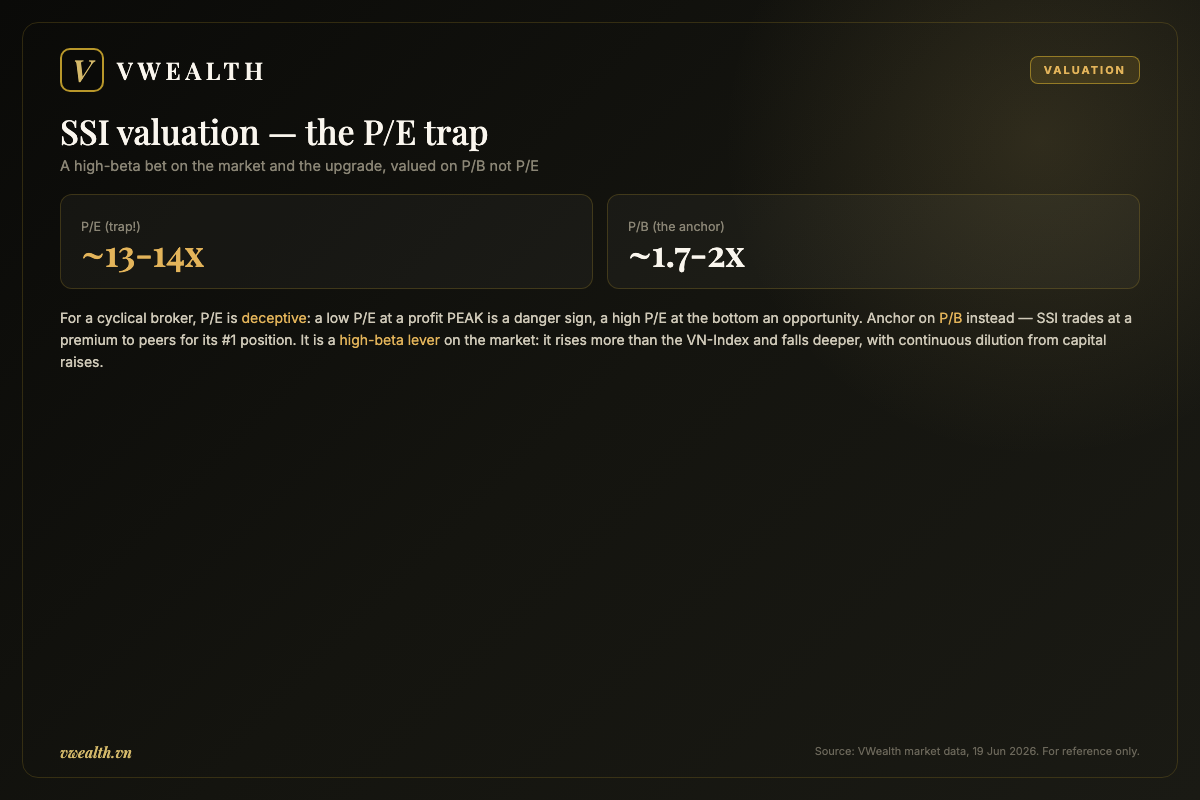
Let’s start with the base numbers. SSI 2025 after-tax profit reached a record 4,107 billion dong, up about 43% from 2024. Charter capital at the reference point is around the equivalent of about 2 billion shares outstanding — a number you need to remember is always moving upward, because SSI issues more almost every year. Dividing profit by share count, you get EPS of about 2,000 dong. Paired with the 27,150-dong price, SSI P/E lands in the 13–14x zone. And P/B, based on equity and market price, hovers around 1.7–2x.
Here, many new investors rush to conclude: “A P/E of 13–14x for an industry leader is too cheap, let’s buy.” Please hold on. For a securities-firm stock, P/E is one of the most deceptive metrics on the whole market. And understanding why is the key so you don’t buy SSI at the wrong time.
The P/E trap of a cyclical stock
A securities firm like SSI profits from three main sources: brokerage fees (riding market liquidity), margin interest (riding investors margin balance), and proprietary trading (riding stock-price movements). All three surge when the market is euphoric and shrink when the market is dull. This is the classic definition of a business with highly cyclical profit.
What’s the consequence? When the VN-Index peaks, liquidity exploding tens of thousands of billions a session, everyone borrowing margin to ride gains, securities-firm profit hits a cycle peak. Then the denominator of the P/E formula (the E — profit) swells abnormally, making the P/E look low and “cheap.” But that’s the most dangerous moment: you’re paying for an unsustainable profit level, about to reverse down.
For a securities stock, a low P/E at a cycle peak is usually a danger signal, while a high P/E at a cycle bottom can be an opportunity. This is the complete opposite of most investors instinct.
Conversely, when the market bottoms — liquidity dries up, investors flee, proprietary trading loses — securities-firm profit shrinks near zero. The tiny E denominator sends the P/E to 30, 40, even negative. It looks “terribly expensive.” But if you believe the market will recover, that’s the best buy time, because profit only has one way to go — up. See the paradox? For a cyclical stock like SSI, P/E almost inverts its usual meaning.
Precisely because of this trap, professional analysts usually prefer P/B when valuing securities firms. Book value is far more stable than quarterly profit, because it reflects accumulated equity rather than the jerky profit flow. P/B gives you a more durable anchor to ask: “How many times the company real capital am I paying?” And here’s the interesting point: SSI almost always trades at a higher P/B (premium) than the securities-industry average. The market is willing to pay more per dong of SSI capital for its number-1 position — top brokerage share, the industry largest capital scale, a two-decade brand, and superior capital-raising ability. When you buy SSI at nearly 2x P/B while many small firms trade around 1x, you’re paying a premium for the leader “sure-footedness.”
High beta: SSI is a “lever” betting on the market itself
If I had to sum up SSI volatility nature in one sentence, I’d say: buying SSI is a leveraged bet on the health of Vietnam whole stock market. This stock has high beta — meaning it amplifies the VN-Index movement. When the general index rises 1%, SSI usually rises more; when the index falls 1%, SSI falls deeper. The reason lies in the business model above: SSI profit is tightly tied to liquidity and market sentiment, so the share price reacts like a “magnified” version of the market.
Price history is the most vivid evidence. Walk with me through the waves:
- 2021 — Peak euphoria: In the post-COVID stock frenzy, when millions of F0 investors opened accounts and liquidity hit records, SSI flew to a peak around 51,000 dong (pre-adjustment). Peak profit, taut margin, everyone thought the party would last.
- 2022 — Collapse bottom: When rates reversed, corporate bonds crashed and money fled, SSI plunged about -62% in the year, at times back to around 9,560 dong (adjusted). A classic free-fall of a high-beta stock in a bear market.
- 2023 — V-shaped recovery: SSI bounced about +93%, back to around 36,000 dong in September, perfectly illustrating how a cyclical stock recovers violently when the market warms.
- 2024 — Sideways accumulation: A year of “absorbing supply,” the price almost still around 25,000 dong, up under 2%. The market hesitated, SSI hesitated too.
- 2025 — A new wave forms: With the KRX-system rollout and market-upgrade expectations, SSI entered a new up-wave, at times surpassing the old historic peak.
What do you notice through this chain of events? Each SSI turn almost exactly overlaps each VN-Index turn, just with a larger amplitude. The 27,150-dong price today puts SSI in the middle zone — far from the 2022 bottom, but still below the 2021 euphoric peak (in pre-dilution terms). That’s the portrait of a stock “mid-cycle,” where risk and opportunity coexist.
Continuous capital raising: the double-edged sword of dilution
This is a trait you must understand if you plan to hold SSI long term. SSI is one of the most frequent share issuers on the exchange. Recently, the company announced a plan to raise charter capital on a roadmap toward the 30,000-billion-dong mark — the highest in the securities industry — through a series of moves: rights issues, stock dividends (20% in the 2025 plan), ESOP issues, and additional offerings. Why does a business making record profit need to keep raising capital?
The answer lies in two words: margin and market share. Margin lending is a securities firm cash printer, but it’s capped by equity — by regulation, margin balance can’t exceed two times equity. To lend more, earn more interest, grab more share ahead of the upgrade wave forecast to draw billions of dollars of foreign capital, SSI must inject capital. The leadership targets a margin balance that could reach 26,000 billion, with an ambitious scenario mentioning 45,000 billion dong.
But this is a double-edged sword you need to weigh coolly:
- The positive edge: raising capital expands business capacity, cements the number-1 position, and helps SSI fully catch the big money when the market is upgraded. Large scale creates a competitive advantage and better shock resilience.
- The negative edge: each issue dilutes EPS. If shares rise faster than profit, your earnings per share — as a current owner — is eroded. You own a smaller slice of a larger pie.
The core question with SSI thus isn’t “will profit rise” (almost certainly yes), but “will profit rise faster than the dilution rate.” When the market is favorable and margin profits well, new capital generates profit beyond the dilution — shareholders win. When the market is dull, new capital lies dead, dilution happens while profit doesn’t keep pace — shareholders lose. This is yet another expression of cyclicality: even SSI capital policy bets on the market continuing up.
Dividends: two decades of steadiness amid a volatile stock
Amid all that violent swinging, there’s an anchor that reassures many long-term investors: SSI is one of the few securities firms paying a cash dividend steadily for about two consecutive decades. In its 2025 profit-distribution plan, the company plans a total dividend of 30%, including 10% in cash (over 2,500 billion dong) and 20% in shares.
This structure reflects SSI “reward and retain” philosophy. The cash part is a real thank-you to shareholders, giving a dividend yield around 3–3.5% — not high but stable, rare for a high-beta stock. The share part keeps money in the business to keep feeding the margin machine, and is itself a “soft” dilution channel. When you receive a stock dividend, you have more shares but the reference price adjusts down correspondingly — assets don’t create themselves, just split smaller. You need to see through the glossy “30%” figure to understand this dual nature.
Foreigners and the room story: SSI is the industry proxy
You can’t discuss SSI market reception without foreign money flows. As the industry-leading securities stock with top liquidity, SSI is always in the watchlist of foreign funds wanting to “bet on Vietnam financial sector.” When foreign investors want to buy the whole story of Vietnam stock market growing, SSI is one of the first names they think of — it’s a proxy for the whole industry.
However, this relationship cuts both ways. In 2024, foreigners net-sold a record about 92,000 billion dong across the market, and this pressure extended into early 2025. In such broad withdrawal periods, high-liquidity large caps like SSI are usually sold hard simply because they’re easy to exit — the price of being the market liquidity “doorway.” Conversely, when foreign flows reverse back — a scenario strongly expected if Vietnam is upgraded to emerging-market status — SSI is again among the first and strongest beneficiaries. The foreign-room issue (the maximum foreign-ownership ratio) thus becomes a variable to watch: ample room means more headroom to draw foreign capital; exhausted room means foreign demand is blocked.
Summary: a ticket betting on the market growth and upgrade
So, all combined, how is the market valuing SSI and how should you understand it? The 27,150-dong level with a 13–14x P/E and 1.7–2x P/B isn’t “cheap” or “expensive” absolutely — it’s a price reflecting an industry-leading stock, at a premium to peers, mid-cycle, and carrying upgrade expectations. You don’t buy SSI to find peace. You buy SSI to make a leveraged bet on the belief that Vietnam stock market will grow larger, more liquid, and be recognized globally at a higher tier.
SSI is a ticket betting on the growth and upgrade story of Vietnam stock market — in exchange, you must accept higher-than-average volatility, continuous dilution, and harsh price waves in step with the VN-Index ups and downs.
If you believe in that story and have the patience to ride the waves, SSI rewards you with a leading position and a durable dividend flow. If you need stability and buy right when the P/E “looks cheap” at a cycle peak, it can teach you an expensive lesson. To fully understand this bet, you need to step out of the valuation number and look at the bigger picture — the securities-industry context we’ll dissect right after.
Economic and securities-industry context: where does SSI stand in the big picture?
Before you decide to put money into a stock like SSI, there’s a principle to carve in: a securities firm stock doesn’t live on its own story, but on the pulse of the whole market. Unlike a manufacturer that sells goods even when the VN-Index goes sideways, the “goods” SSI sells — brokerage fees, margin interest, proprietary profit — all expand or shrink with the mood of the millions of investors sitting before the board. So to understand SSI, you must understand the base it stands on.
Two variables deciding the securities industry “bread and butter”: liquidity and the index
Picture a securities firm as a toll collector. Their revenue doesn’t depend on whether the car is nice or ugly, but on how many cars pass each day. In the securities industry, “cars passing” is liquidity — the average transaction value per session. The more vibrant the session, the more people buy and sell, the larger the brokerage fees, and the higher the demand for margin to “play” big.
In 2026, Vietnam market liquidity picture truly turned a new page. In February 2026, the average transaction value on HOSE reached over 28,891 billion dong a session, about $1.15 billion a session — a figure that just a few years ago was a luxury. Many analyst forecasts see the full-year 2026 average matched-order value possibly rising up to 25% versus 2025, to around 36,000–36,400 billion dong a session. If this materializes, it’s a big rising tide lifting all boats in the industry, and SSI — the largest boat — will benefit most in absolute value.
The second variable is the market index (VN-Index). When the index rises, a securities firm proprietary assets gain value, the stock portfolio profits, and more importantly, euphoric investor sentiment drives a margin-demand boom. Conversely, when the market plunges, these three core revenue sources can shrink at once. This is why SSI profit is highly cyclical — a trait you must remember reading through to the conclusion.
The biggest driver of this period: the market-upgrade story
If you had to pick a single, biggest, most weighty driver for Vietnam securities industry — and especially SSI — in 2026–2027, it’s the market upgrade.
In early October 2025, the rating body FTSE Russell officially confirmed upgrading Vietnam stock market from the frontier group to the secondary emerging market group. Allocating Vietnamese stocks into FTSE index baskets will officially begin from 21 September 2026 and complete on a roadmap through September 2027. This isn’t a ceremonial title — it’s a passport for a huge capital flow.
Why is the upgrade so important? Because many international funds are bound by rules: they can only invest in markets ranked “emerging” or above. As long as Vietnam is in the frontier group, the door to these billion-dollar flows stays closed. When the door opens, these funds will have to buy Vietnamese stocks simply to track the new index basket.
The scale of this flow is preliminarily estimated at about $2–4 billion in the early phase, and could be far larger counting active funds following behind. For SSI, the securities firm with the deepest relationships with foreign institutional clients and one of the pioneers deploying the non-prefunding trading model for foreign investors, this is a chance to benefit directly. When foreign money pours in, it must go through a securities firm to match orders — and SSI sits right at the front of that flow.
The KRX system: the technical foundation paving the way for new products
Another important piece of the picture is the KRX trading system, developed by the Korea Exchange, which officially came into operation from May 2025. Picture KRX as upgrading from an old, congestion-prone two-lane road (the order-jam state of the old system) to a modern multi-lane highway.
KRX doesn’t just solve the order-jam problem, but is also the mandatory technical foundation for the market to open a series of new products previously undeployable:
- Intraday trading (T+0) and selling stocks awaiting settlement — helping capital cycle faster, raising liquidity.
- Controlled short selling — creating another direction to profit and also a risk-hedging tool.
- Diversifying derivative products and algorithmic trading.
However, keep a cool head: per the operating body leadership, products like T+0 or short selling will likely be deployed no earlier than the second half of 2026, but in practice may fall into 2027 or even 2028. This is a medium-term story, not a gift you receive tomorrow. Even so, each new product opens another revenue stream for the industry-leading securities firms with enough technology and capital — and SSI is clearly in that group.
Other tailwinds: low rates and a wave of new investors
Besides the two big drivers above, the securities industry is also backed by a few macro tailwinds. First is a low interest-rate level. When bank savings are no longer attractive, idle cash tends to shift to stocks seeking higher returns. Low rates also lower SSI own funding cost when raising money to lend margin, thereby improving the lending segment margin.
Second is a steady rise in new brokerage-account openings. Each new account is a potential player, a potential brokerage-fee flow, a potential margin borrower. Vietnam middle class is swelling and increasingly used to financial investing, creating a long-term customer base for the whole industry.
But don’t forget: this industry has inherent risks
An honest writer can’t tell only pretty stories. The securities industry carries structural risks you need to weigh very seriously:
- Market-reversal risk. The whole bright story above rests on the assumption the market goes up. If the VN-Index reverses deeply, all three SSI revenue sources shrink at once — brokerage fees fall from less trading, margin interest falls from a shrinking balance, proprietary trading loses from a depreciating portfolio.
- The chain margin-call effect. Margin is a double-edged sword. When the market rises, it amplifies profit. But when the market falls sharply, margin calls are triggered en masse, pushing prices deeper, triggering more calls — a spiral that can cause losses and debt-recovery risk for the securities firm itself.
- The brokerage-fee (zero-fee) war. This is a trend quietly eroding profit. Many new securities firms, especially foreign-backed or fintech ones, offer zero-fee trading to grab share. The race to the bottom on fees makes the brokerage segment — once the “backbone” — ever less fertile, forcing firms to shift the profit focus to margin lending and proprietary trading.
So the 2026 securities-industry context is a clearly two-sided picture: on one side, strong and rare growth drivers (the upgrade, KRX, low rates); on the other, inherent cyclical and competitive risks. SSI stands right at the center of both — and that’s what makes analyzing it both compelling and requiring caution.
Trend forecast: where will SSI go in the upgrade wave?
Having grasped the industry context, now let’s look ahead. Let me say at once that this section is a projection, based on the business plan and reasonable market scenarios — not prophecy. The future always has variables, and you should read this as a map of possibilities, not a fixed road.
The 2026 ambition SSI itself set
At the 2026 AGM, SSI leadership set very clear plan numbers, reflecting confidence in the market up-cycle:
| 2026 plan metric | Value | Expected growth |
|---|---|---|
| Consolidated revenue | 15,660 billion dong | about +19% |
| Pre-tax profit | 5,838 billion dong | about +15% |
| Margin loan balance (target) | up to 45,000 billion dong | strong expansion |
| Charter capital (after raises) | toward ~30,000 billion dong | keeping the #1 position |
These numbers show SSI strategy is very consistent: prepare a balance sheet large enough to catch the wave. Raising the margin-balance plan to 45,000 billion dong (versus about 36,928 billion at end-Q1 2026 and a peak over 39,200 billion in Q3 2025) shows SSI bets that investment-borrowing demand will boom as liquidity rises and foreign capital pours in. At the same time, continuous capital raises — bonus shares, ESOP, and approved plans — take charter capital toward the 30,000-billion mark, cementing the position of the largest-capital securities firm in the market. Large capital allows more margin lending, and margin is the industry profit printer in this period.
SSI also doesn’t hide its ambition on new fronts: the leadership affirms it continues to pursue the digital-asset (crypto-asset) segment and push digitalization and operational automation. These are long-term “growth options” — not contributing much to profit today, but which could become a new driver if the legal framework for digital assets in Vietnam takes shape.
Three scenarios for SSI stock
Instead of a single price target — which any honest writer should avoid — I want to build three scenarios with you, so you can weigh the probabilities by your own risk appetite.
-
Positive scenario — The upgrade wave resonating with a liquidity boom. In this scenario, FTSE Russell allocating Vietnamese stocks into index baskets from September 2026 goes smoothly, drawing billions of dollars of foreign capital actually disbursed. Market liquidity exceeds 36,000 billion dong a session and holds sustainably. Then all three SSI revenue sources — brokerage, margin, proprietary trading — expand together. The margin balance hits the 45,000-billion target, and profit can beat plan. As a high-beta, industry-leading stock, SSI usually rises more than average in euphoric phases, and the current P/E around 13–14x could be accepted by the market to expand.
-
Base scenario — Steady but non-explosive market growth. This is the middle-ground scenario and perhaps the most reasonable anchor. The upgrade proceeds on schedule but foreign capital disburses gradually, with periods of continued foreign net selling interspersed. Liquidity holds around 28,000–32,000 billion dong a session. SSI completes most of its business plan, profit grows double digits as pledged, but the share price rises in a controlled way, tracking profit growth rather than a valuation jump.
-
Negative scenario — Market correction and liquidity drying up. This is the dark side you must picture. If a global macro shock appears, rates reverse up, or simply the upgrade expectation is “already fully priced in” and investors take profit on the news, the market can correct sharply. When liquidity dries up, brokerage fees fall, margin demand shrinks (a sign already glimmering as the balance fell two straight quarters in early 2026), and the proprietary portfolio may lose. For a high-beta stock like SSI, the drop is usually deeper than average. This is when the “low-P/E-at-cycle-peak trap” is exposed — which I’ll explain in detail in the conclusion.
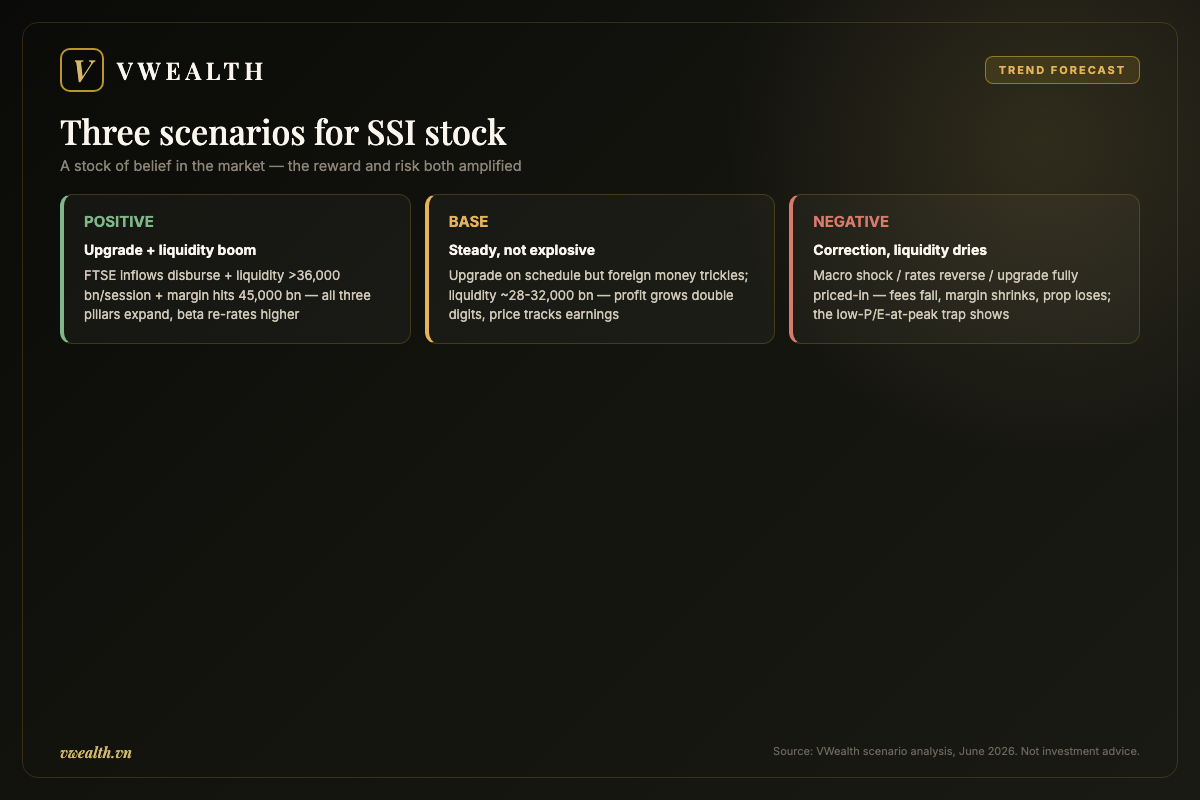
The key takeaway from these three scenarios: SSI is a stock of belief in the market. You don’t buy SSI because it makes a monopoly product, but because you bet that Vietnam stock market will grow, get more vibrant and draw global capital. If that belief is right, SSI is one of the most direct ways to benefit. If that belief is wrong, SSI is also one of the strongest-reacting stocks the other way.
Should you buy SSI stock?
And here’s the question you’ve probably awaited from the start of this article. I’ll answer you frankly, but not with a single “Yes” or “No” — because no serious analyst can, or should, decide for your wallet. Instead, I’ll help you weigh the pros and cons, then place SSI in its proper position for you to hold yourself against.
On the scale: why is SSI attractive?
Let’s start with SSI undeniable strengths:
- The number-1 industry position. SSI leads HOSE brokerage share (reaching about 11.14% in Q1 2026, a strong improvement from 9.93% the same period), and is the firm with the largest charter capital in the industry, toward the 30,000-billion mark. In an industry where capital scale directly decides lending and profit capacity, this “eldest brother” position is a real competitive advantage.
- Direct and largest beneficiary of three big stories. The FTSE upgrade, the KRX system and foreign flows — SSI is the name with the deepest relationship with foreign institutions (SSI Chair says the company has the largest institutional-client share, about 30%), so when foreign money flows in, SSI is at the front to receive it.
- A solid profit base. 2025 after-tax profit reached 4,107 billion dong, up as much as 43% — an impressive growth. The margin balance around 38,616 billion dong is a stable cash-generating machine in a low-rate environment.
- Leverage on the market up-trend. If you believe the VN-Index still has room to rise in the upgrade cycle, SSI is one of the most direct and liquid tools to bet on that belief.
And the dark sides you must not ignore
Now the part I hope you read even more carefully than the above, because understanding the risk is what protects your wallet:
- High beta — extreme volatility. SSI is one of the market most “sensitive” stocks. When the VN-Index rises 1%, SSI usually rises more; but when the index falls 1%, SSI usually falls deeper. This is a stock for those with nerves of steel, not for those who lose sleep over volatility.
- Cyclical profit. As analyzed, SSI revenue rises and falls with the market rhythm. A brilliant year like 2025 can be followed by a dull year if the cycle reverses. Don’t extrapolate past growth straight into the future.
- The low-P/E-at-cycle-peak trap. This is the subtlest trap with a cyclical stock. A P/E around 13–14x sounds “cheap,” but for a cyclical company, a low P/E usually appears right when profit is at its peak (a large E denominator). When the cycle reverses, E plunges and today “cheap” P/E suddenly becomes expensive. A low P/E in a cyclical stock is sometimes a warning signal, not a bargain.
- Dilution from continuous capital raising. SSI raises capital almost yearly through additional issues, ESOP, bonus shares. More capital allows more lending, but also dilutes per-share benefit — profit split among more shares. You need to track whether profit growth keeps pace with the capital-raising rate.
- Fee competition and proprietary risk. The zero-fee race erodes the brokerage margin, while the proprietary segment — though a large profit contributor — carries loss risk when the market moves unfavorably.
A four-investor frame: which group are you in?
The most useful way to answer “should I buy” is not to ask about the stock, but to ask about yourself. Hold yourself against the four portraits below:
| Investor type | Does SSI suit? | Reason |
|---|---|---|
| Believer in Vietnamese-market growth & upgrade, accepting high volatility | Suits the appetite | SSI is the most direct way to bet on the market growth; high beta means strong benefit if the market rises |
| Seeker of safety and stability, averse to volatility | Hard to suit | Strong volatility and cyclicality can cause psychological stress, easily leading to wrong decisions when the market shakes |
| One who lives on a steady cash dividend | Hard to suit | SSI prioritizes retaining capital to expand margin lending, leaning toward bonus shares/capital raises over a stable cash-dividend flow |
| A value investor seeking steady-profit, defensive businesses | Be very cautious | Cyclical profit and the low-P/E-at-peak trap make traditional valuation easily skewed |
In short: SSI suits those who believe in the growth and upgrade story of Vietnam stock market, and crucially can accept the high volatility of a high-beta, cyclical stock. Conversely, if you seek safety, hope for a stable dividend flow for retirement, or panic easily when the account is deep red by tens of percent in a correction, then SSI is likely not the right piece for your portfolio — however attractive the industry story.
Finally, even if you’re in the fitting group, remember the timeless principles: allocate only a reasonable weight you can bear if it falls deep; consider disbursing in tranches rather than all at once; and always have a clear exit plan before buying. A high-beta stock like SSI can be a wonderful companion in an up-wave, but also the harshest test of your mettle when the wave reverses.
Disclaimer: This article is produced for informational and reference-analysis purposes, and is not advice or a recommendation to buy or sell any security. All figures are compiled from public sources at the time of writing and may change. Investing in stocks always carries risk of capital loss; past performance doesn’t guarantee future results. You should research thoroughly, consider your personal financial situation, and/or consult a licensed advisor before making any investment decision. You bear full responsibility for your decisions.
Research Vietnamese stocks in English with vwealth. Our AI-powered platform turns Vietnamese market data into full English analysis reports — with international payment support and a free 2-month trial for new accounts. Create your free account and read the latest reports.