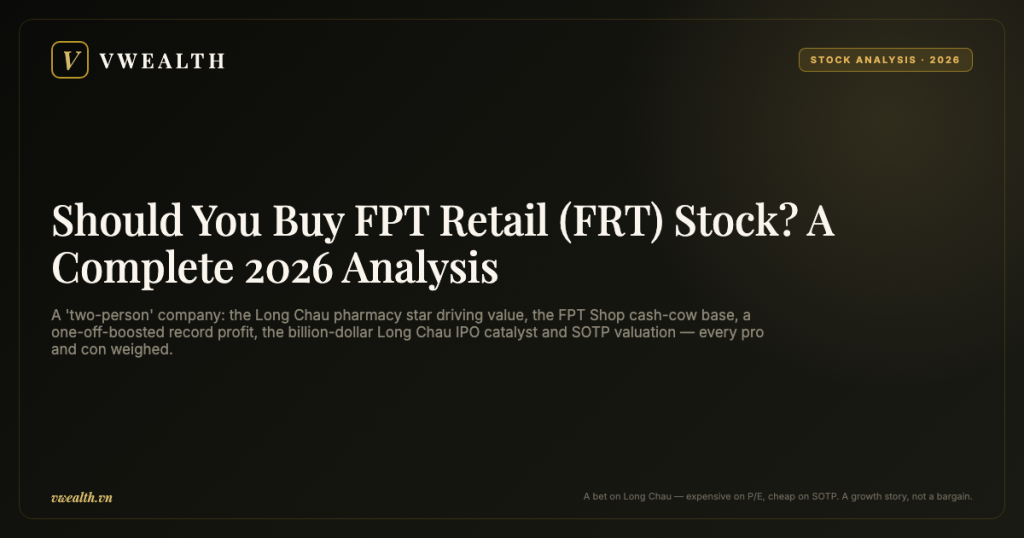
If you’re looking for a retail stock on Vietnam’s exchange that is both familiar and controversial on valuation, then FRT — the ticker of FPT Digital Retail JSC (FPT Retail, listed on HOSE) — is almost certainly on your list. This is a business people casually call “the owner of the FPT Shop chain,” but if you stop there, you’ve missed the most interesting part of the story. In truth, FRT today is a “two-person” company living in one body: on one side is FPT Shop — the phone, laptop and tech (ICT) retail arm that has entered saturation, once lost heavily and had to restructure; on the other is Long Chau — Vietnam’s number-one pharmacy-and-vaccination-center chain, the growth star pulling the whole group up.
That contrast is the very soul of the FRT investment thesis. For many years, FPT Shop was the “pillar” while Long Chau was just a money-burning gamble. Today, the roles have fully reversed: Long Chau exploded, contributing nearly 70% of revenue and becoming the growth machine, while FPT Shop retreated to a “cash cow” position — generating steady cash but no longer accelerating. In 2025, this resonance pushed FPT Retail to an unprecedented peak: consolidated revenue of 51,083 billion dong (up 27%) and pre-tax profit of 1,219 billion dong — up 131% and a historic record for the business.
But this is also where many investors hesitate. At 130,000 dong/share (close of 19 June 2026), FRT is a stock valued high, valued on future growth expectations rather than past profit. You don’t buy FRT for a generous dividend; you buy FRT believing Long Chau will keep booming for many more years — enough to “support” today’s expensive price. That’s a bet on the story, and like every story bet, the large reward comes with large risk if reality doesn’t match expectations.
This whole analysis will help you answer one question squarely: should you buy FRT, and if so, what kind of investor does this stock suit? To answer, you can’t skip the past. Because how FPT Retail went from a phone shop spun off from FPT Corporation, then boldly bet on pharma and struck the Long Chau “gold mine,” is precisely the key to understanding why the market is willing to pay so much for this stock. Let’s start from the beginning.
FRT market data (updated 19 June 2026)
| Current price | 130,000đ | 2025 revenue | 51,083 bn (+27%) |
| Change (June) | +2.28% | 2025 pre-tax profit* | 1,219 bn (+131%) |
| P/E | Long Chau | ~36–40x | 2,417 stores | Forward P/E | P/S | ~16x | ~0.35x |
*2025 pre-tax profit includes a ~900 bn ONE-OFF gain from selling Long Chau shares; CORE profit is ~300 bn. Expensive on P/E but reasonable on Long Chau’s value (SOTP). Source: VWealth price data + FRT 2025 reports. For reference only.
History and evolution
FPT Retail’s history is a rare story on Vietnam’s stock market: the story of a retailer that dared to “transform” mid-journey, abandoning the safe zone of the industry it knew best to bet on a completely unfamiliar field — and winning big. To understand why investors today value FRT by the formula of a growth company rather than a saturated phone retailer, you need to walk back through each step of that journey.
The origin: FPT Corporation’s retail child
FPT Retail’s roots lie within FPT Corporation — one of Vietnam’s largest tech groups. The FPT Shop brand was born in August 2007 as a chain specializing in digital products: mobile phones, tablets, laptops and electronic accessories. By March 2012, FPT Digital Retail JSC was formally established as one of seven member companies under FPT. In 2013, FPT Shop was spun off from the FPT Trading arm to focus solely on retailing computers, phones and laptops.
In this phase, FPT Shop grew fast and aggressively. In December 2013, the chain hit 100 stores. In 2014, the number jumped to 200 stores covering all 63 provinces, while also becoming a direct importer of genuine iPhones — a valuable position when “gray-market” goods were still rampant. Leading this phase was Ms. Nguyen Bach Diep, who built FPT Retail from just 17 stores to Vietnam’s second-largest phone retail chain with over 500 points of sale, in a career of more than 30 years with FPT. Remember this detail, because Ms. Diep later was the person behind the “gamble” that changed the whole company’s fortune.
Listing on HOSE in 2018: glory and pressure
On 26 April 2018, 40 million FPT Retail shares began trading on the Ho Chi Minh City Stock Exchange (HOSE) under the ticker FRT. The first-session reference price was 125,000 dong/share, corresponding to a starting market cap of about 5,000 billion dong — a respectable figure for a retailer. The shareholder structure at listing showed the “FPT blood” was still very strong: FPT Corporation held about 47%, the two foreign funds Dragon Capital and VinaCapital held 34.17%, the rest to other shareholders.
The point to note: FPT remains a major shareholder of FRT to this day. This isn’t an “abandoned” company, but a member still within the ecosystem, enjoying the parent group’s brand reputation, technology capacity and governance. The technology advantage — FPT’s DNA — would become a secret weapon when FPT Retail entered pharma, where standardizing and digitizing pharmacies creates an enormous competitive difference.
However, right after the listing glory came pressure. The ICT segment — selling phones, laptops — is inherently a thin-margin industry, fiercely competitive with the “giant” Mobile World (MWG). In 2018, FPT Retail reached revenue of about 15,298 billion dong (up 17%) and after-tax profit of 348 billion dong. But by 2019, though revenue nudged up to 16,634 billion dong, pre-tax profit fell 36% to 278 billion dong. The signal was clear: the phone market was beginning to saturate, and a “latecomer” retailer like FPT Shop could hardly overtake the leader by attacking head-on in the same arena. Leadership, especially Ms. Nguyen Bach Diep, understood they needed an “escape route” — a completely new growth driver.
The fateful turning point: betting on pharma with Long Chau
This is the most important bend, the part explaining FRT’s entire value today. In 2017, while FPT Shop was still at its peak, FPT Retail quietly acquired a small pharmacy chain named Long Chau — then just 4 pharmacies in HCMC, originally set up in 2007 as a family-pharmacy model on Hai Ba Trung street. A tiny deal, almost unnoticed.
But behind it was a big vision. Leadership realized Vietnam’s pharmacy-retail industry was a still-sleeping “gold mine”: a multi-billion-dollar drug market, but extremely fragmented, mostly small family pharmacies, lacking standardization, lacking price and origin transparency. That’s exactly the kind of market a business with chain-operating and technology capacity like FPT Retail could “industrialize” and capture. In 2018, FPT Retail established FPT Long Chau Pharma JSC with an initial charter capital of 100 billion dong (FPT Retail holding 75%), formally making Long Chau a strategic spearhead.
For Ms. Nguyen Bach Diep, this was a “gamble” in the literal sense — she once spoke of the “pioneer spirit, win to be king, lose to be an outlaw.” In the early phase, Long Chau lost continuously. Each pharmacy needed very high revenue (some stores about 2 billion dong/month) to hit break-even, and the money-burning expansion made not a few foreign shareholders anxious, doubting whether FPT Retail was scattering resources into a hopeless adventure. By March 2020, Ms. Diep even left the CEO seat to devote herself to leading Long Chau, handing the executive role to Mr. Hoang Trung Kien — a role split showing how seriously the company bet on the pharmacy chain.
Why Long Chau won: the pharmacy “industrialization” formula
That gamble won big, and you should understand why, because this is the “economic moat” protecting the FRT investment thesis. Long Chau’s success formula can be summed up in a few core points:
- Standardization and reliability. Long Chau turned the once-chaotic, non-transparent drug-buying experience into a modern retail chain: pharmacist consultation, clearly listed prices, assured drug origin. In an industry where trust is supreme (health), this standardization creates an enormous advantage.
- Wide catalog and good prices. Long Chau is famous for stocking even rare, prescription and specialty drugs small pharmacies lack — drawing customers from everywhere — while leveraging wholesale scale to keep prices competitive.
- “Lightning” coverage. From 4 pharmacies in 2017, Long Chau expanded at a dizzying pace: passing 200 pharmacies (2020), 400 pharmacies (2021), then hitting 1,000 pharmacies covering all 63 provinces in early December 2022 — becoming the first modern pharmacy chain in Vietnam to reach this number.
- Data and technology power from FPT. The chain-management system and customer data (Long Chau now has about 13 million customers) allow operating optimization and cross-selling — an advantage inherited directly from its tech roots.
The result is that Long Chau rose to absolute leadership in the number of points of sale among modern pharmacy chains in Vietnam, far ahead of Pharmacity and An Khang. From a “money-burning child,” Long Chau became a “lifeline,” then the leading star.
Opening vaccination: the second-tier growth driver
Good leadership doesn’t stop while winning. In October 2023, Long Chau opened its first 5 vaccination centers in Hanoi and HCMC, formally entering the vaccine market — long dominated by VNVC. This was a smart move because it maximizes what Long Chau already has: a network of thousands of pharmacies in prime locations (deploying a “shop-in-shop” model, placing vaccination centers right next to pharmacies), an existing base of 13 million customers to advise and refer, plus the attractive margins of the vaccine segment.
The expansion pace continued to stun: from a few centers at end-2023, Long Chau reached 75 vaccination centers in under a year — a distance rivals usually take many years to cover. More important, the market room is still enormous: Vietnam’s vaccine coverage rate is only about 4% of the population, while many countries reach 15–30%. The vaccination segment thus becomes Long Chau’s “second-tier growth driver,” extending the momentum of the pharmacy segment — and an important part of the expectation story investors are paying a high price for in FRT.
The 2023 storm: when ICT lost heavily and had to restructure
While Long Chau soared, the “big brother” FPT Shop went through its darkest period. Around April 2023, a phone price war broke out when MWG launched a “too cheap” campaign, dragging the whole industry into a discount spiral to grab share. The consequence was that already-thin margins were nearly wiped out. In Q2 2023 alone, FPT Retail reported a record after-tax loss of about 215 billion dong for the retail arm. In 2023, FPT Shop had to close about 30 ineffective stores and enter a deep restructuring.
This is an important lesson about the nature of ICT that you — as an investor — need to engrave: this is a saturated, thin-margin industry, vulnerable to price wars. It’s no longer a growth driver, and cyclical risk always lurks. Fortunately, in the very 2023 storm, Long Chau shone brilliantly — opening 560 more pharmacies and growing revenue about 66% — carrying the full “puller” role and shielding FPT Shop’s losses. That’s living proof of the value of diversifying in the right direction.
The 2023 storm was both a crisis and a confirmation: it showed the ICT segment was done accelerating, while proving the Long Chau gamble was FPT Retail’s true future.
Into 2024–2025, FPT Shop gradually recovered thanks to restructuring and expansion into electronics (TVs, fridges, washing machines). In 2025, FPT Shop recorded revenue of 16,809 billion dong (up 11%) and most importantly officially returned to profit. The “cash cow” segment stabilized, no longer a burden dragging down overall profit.
2025: selling some Long Chau shares and “revealing” the true value
2025 marked a delicate and very notable financial move. In April–July 2025, FPT Retail sold a small portion of its Long Chau stake (specifically through Long Chau Investment JSC) to the investment fund Creador from Malaysia — a private-equity fund managing over 3 billion USD, specializing in long-term investment in growth businesses in South and Southeast Asia. The deal brought FPT Retail about 887 billion dong (nearly 900 billion), with only about 2.7% of Long Chau transferred.
You need to read the numbers behind this transaction carefully, because it’s the crux. The price Creador paid valued Long Chau at about 32,852 billion dong (equal to ~1.3 billion USD). FPT Retail’s ownership in Long Chau fell slightly from 80.74% to 78.59%. The meaning of this move has three layers:
- First — a public “valuation.” By selling a small portion to a professional investor, FPT Retail set a market reference for Long Chau (~1.3 billion USD). It helps FRT investors “see” the standalone value of the Long Chau jewel rather than leaving it hidden inside consolidated reports.
- Second — raising capital and a partner. Nearly 900 billion dong in cash plus an experienced international partner supporting Long Chau to expand and prepare for a potential future IPO.
- Third — still keeping control. FPT Retail sold only a very small portion, still holding nearly 79% — that is, Long Chau remains the “beloved child,” fully consolidated, with all growth still flowing back to FRT.
The gain from this deal also contributed to the record 2025 results. All told, the 2025 financial picture fully reflects the internal role reversal: Long Chau (both pharmacy and vaccination) contributed about 34,501 billion dong of revenue — nearly 70% of total revenue — while FPT Shop retreated to the role of steady cash generator.
Journey summary: from selling phones to striking the pharma “gold mine”
Looking at the whole picture, you’ll see FPT Retail’s history is a chain of deliberate strategic decisions, not luck:
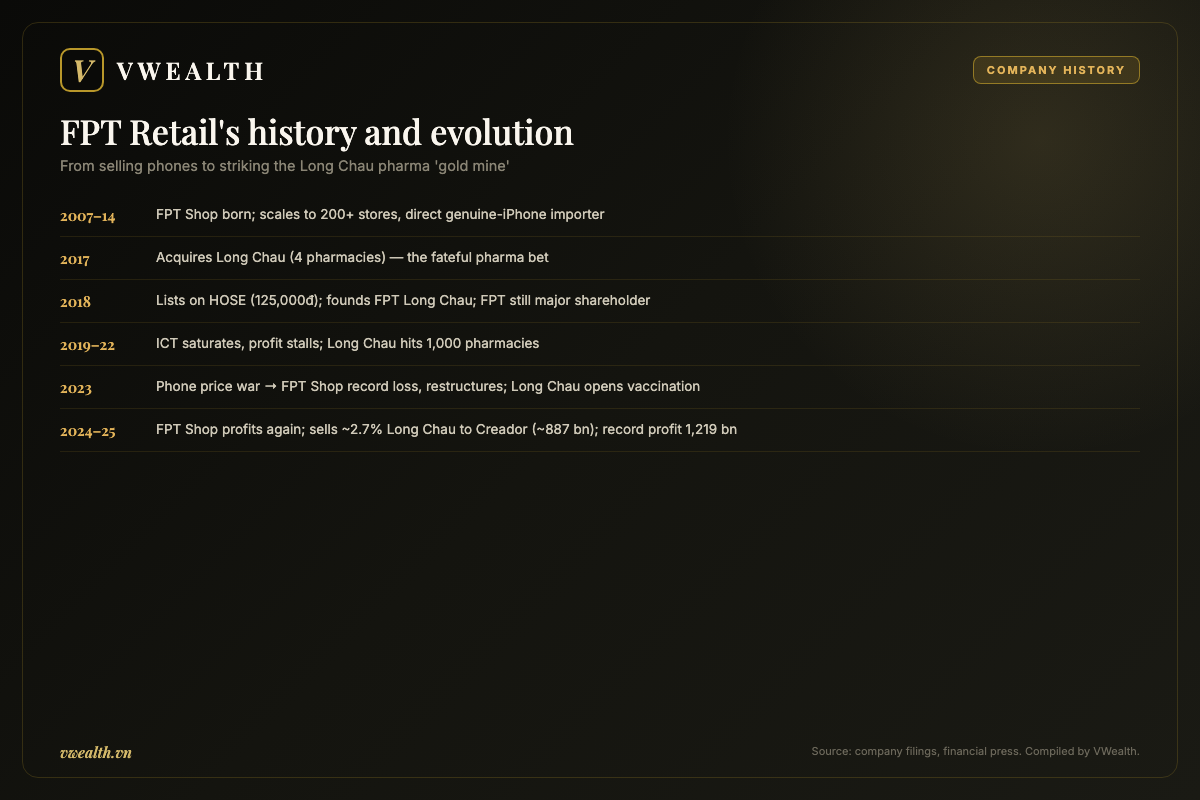
| Phase | Key event | Meaning for investors |
|---|---|---|
| 2007–2014 | Founding FPT Shop, accelerating to 200+ stores, importing genuine iPhones | Building the ICT retail foundation, chain-operating capacity |
| 2017 | Acquiring Long Chau (4 pharmacies) — betting on pharma | The fateful turning point, seeding the future growth driver |
| 2018 | Listing on HOSE (price 125,000đ); founding FPT Long Chau | Going public, FPT still a major shareholder; formalizing the pharma gamble |
| 2019–2022 | ICT saturates, profit stalls; Long Chau hits 1,000 pharmacies | The role begins shifting from ICT to pharma |
| 2023 | Phone price war → FPT Shop record loss, restructuring; Long Chau opens vaccination | ICT crisis + second-tier growth driver appear together |
| 2024–2025 | FPT Shop profits again; sells ~2.7% of Long Chau to Creador (~887 bn); record pre-tax profit 1,219 bn | Profit peak; Long Chau valued at ~1.3 billion USD |
From a “latecomer” phone retailer that seemed forever stuck in the shadow of its rival, FPT Retail rewrote its own fate with a bold pharma bet — and struck the Long Chau “gold mine” exactly. That journey explains why the market today no longer values FRT as a pure ICT retail stock, but as a pharmacy-retail growth story. It also shows something no less important: the quality of the people behind the decisions — from Ms. Nguyen Bach Diep’s Long Chau gamble to restructuring FPT Shop and bringing Creador on board. And that’s exactly what we’ll dissect next: who is FPT Retail’s leadership, what is their vision and execution capacity, and can you place faith in them for the road ahead.
Leadership and ownership structure
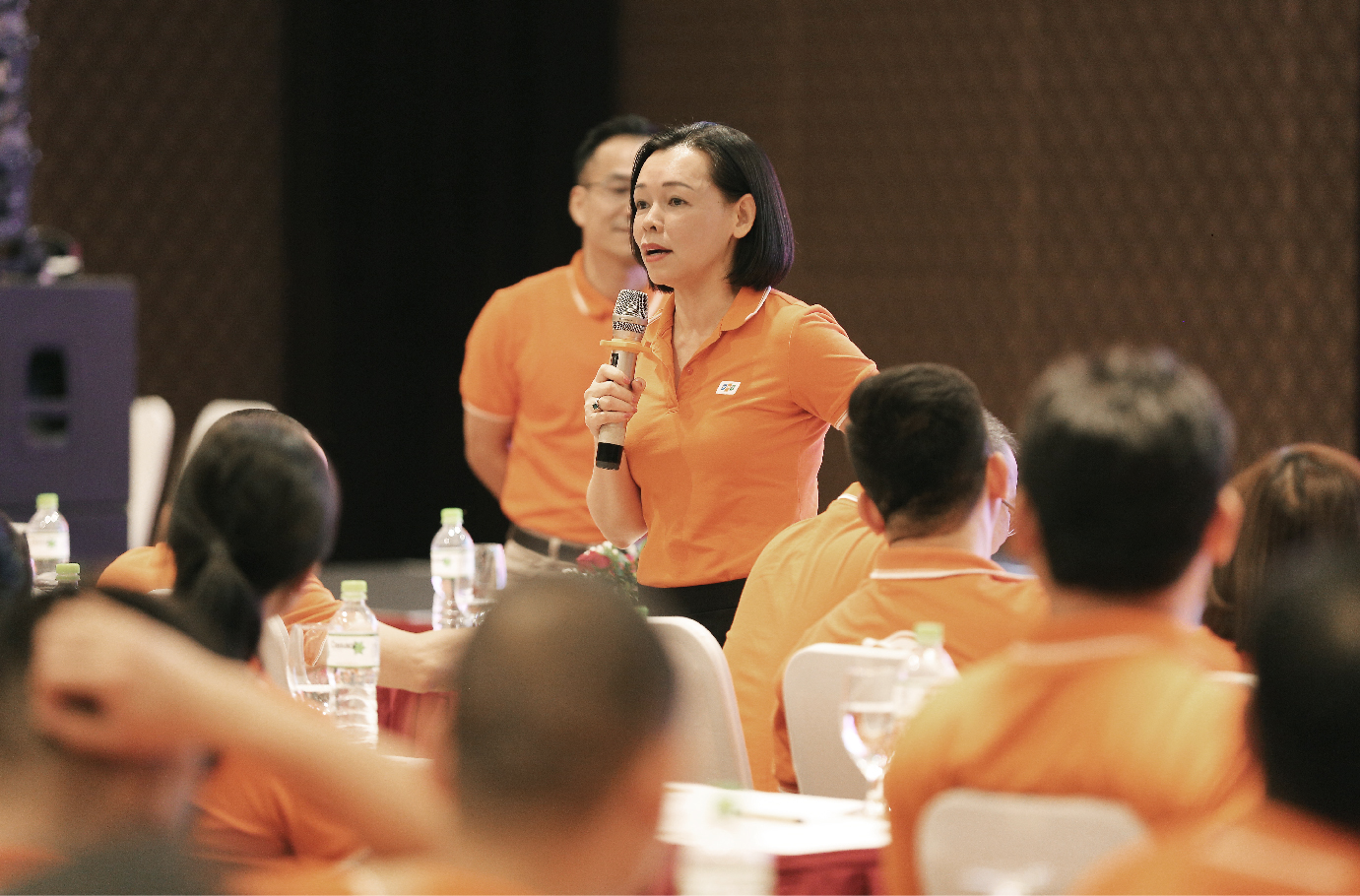
When you put money into a stock, what you really buy isn’t just a few numbers on a financial statement, but faith in the people behind the wheel of that business. For FPT Retail (ticker FRT), the story of leadership and ownership is perhaps one of the most interesting parts, because this is where a “commander” who has spent her whole career with FPT, a billion-dollar gamble named Long Chau, and the backing of one of Vietnam’s largest tech groups intersect. This section helps you see through who’s steering, who holds the shares, and above all: what those things mean for your pocket if you are (or plan to become) an FRT shareholder.
Nguyen Bach Diep — the “iron lady” and the Long Chau gamble
If you had to choose one name tied to FPT Retail’s journey, it’s certainly Ms. Nguyen Bach Diep, Chairwoman of the Board. Per interviews on VnExpress and VietnamNet, Ms. Diep has been with FPT for about 30 years, rising from an unpaid intern to leading one of the largest listed retailers on the exchange. That’s a rare long path, and it says something you should note when assessing FRT: this business’s head isn’t a temporary “hired” executive, but someone who has lived FPT’s culture for decades, knowing every nook of Vietnam’s retail industry.
Media often calls her a “commander” or “iron lady,” but interestingly she herself has repeatedly declined this title. In a piece on VietnamNet, she expressed the wish to be seen as “a colleague always by everyone’s side, walking alongside the whole company” rather than a general standing above. She also said there isn’t much difference in responsibility between male and female leaders, though women have their own strengths like subtlety, sharpness, perseverance and a constant learning spirit. This modest phrasing, from a veteran analyst’s view, usually comes with a pragmatic and decisive management style — you’ll see it clearly through the very business decisions she bets on.
“As a pioneer, win to be king, lose to be an outlaw.” Ms. Nguyen Bach Diep’s betting spirit when venturing into pharma with Long Chau is often recalled by the media as a representative slice of her leadership style.
To understand why Ms. Diep is mentioned so much, you need to go back to 2019. Then, FPT Shop — the phone-laptop retail chain that was once a “golden goose” — began hitting the growth ceiling, its cap fell, and the “latecomer” problem in ICT became suffocating. Instead of holding fast in a saturated segment, Ms. Diep decided to turn to a completely new field: pharma. Per CafeBiz, this was “the latecomer’s pressure finally solved” when she led the Long Chau pharmacy chain from a small acquisition into Vietnam’s number-one pharmacy chain in both store count and revenue. As of mid-2025, Long Chau reached about 2,191 pharmacies and 178 vaccination centers, contributing up to 70% of FRT’s consolidated revenue (per CafeF). In other words, Ms. Diep’s pharma gamble not only “saved” FRT from ICT stagnation, but redefined the entire investment story of this stock.
One point in her vision that you — as an investor — should remember: Ms. Diep sees pharma as an “essential good,” little affected directly by macro swings like trade wars or tariff walls. At early-2025 events, she assessed that drugs aren’t in the tariff-affected product group and are goods people must spend on even in hard times (per Dan Tri). This is an important defensive argument: while phones and laptops are non-essentials easily cut when wallets tighten, medicine is nearly “immune” to the economic cycle. She’s also steering Long Chau beyond the role of a mere drug-selling chain to become a healthcare ecosystem — including testing, examination, home care and insurance. This vision, if realized, would expand the market “pie” FRT targets many times over.
On personal recognition, Ms. Nguyen Bach Diep was named by Forbes Vietnam to the list of most influential women in Vietnam (per VietnamNet) — an honor reflecting her stature among female business leaders. Of course, as an analyst, you shouldn’t invest just because a CEO is “famous.” But the stability and long-term vision of the head is an important qualitative factor, especially for a business in a strong transition like FRT.
The executive team — the role split between Chair and CEO
An important milestone you should know: Ms. Nguyen Bach Diep handed over the CEO role to focus on the Chair role and devote herself to Long Chau. Her successor in the executive seat is Mr. Hoang Trung Kien. Per multiple sources (FPT’s ChungTa, VietnamNet, Meeyland), Mr. Kien was born in 1978, graduated from the National Economics University and holds an MBA and Information Systems (MBIS) degree from Vrije Universiteit Brussel (Belgium). He was appointed CEO of FPT Retail with a three-year term, succeeding Ms. Diep in this position.
Before joining FRT, Mr. Hoang Trung Kien served as Deputy CEO of FPT Telecom — the group’s core telecom arm — and had been an FPT Retail Board member since 2018, so he isn’t a stranger to the business. Media describes him as a CEO “bringing fresh air,” with strengths in technology and digital transformation. This role split is quite sensible given FRT’s strategy: Ms. Diep — the creator and expert on Long Chau — holds the strategic-direction role and steers the pharma arm at the Chair level, while Mr. Kien handles the daily operating machine of the whole retail group. Note that senior-personnel information can change over time; so before making an investment decision, cross-check against FRT’s latest annual report and disclosures.
Per FPT media updates (as of end-2024), FRT’s executive team also includes Deputy CEOs like Ms. Nguyen Do Quyen and Mr. Nguyen Viet Anh. The Long Chau arm specifically is run as a relatively independent legal entity (FPT Long Chau Pharma JSC / Long Chau Investment JSC), with its own leadership team — this is very important for the capital-raising and IPO story we’ll discuss right below.
Ownership structure — FPT behind, FRT walking on its own feet
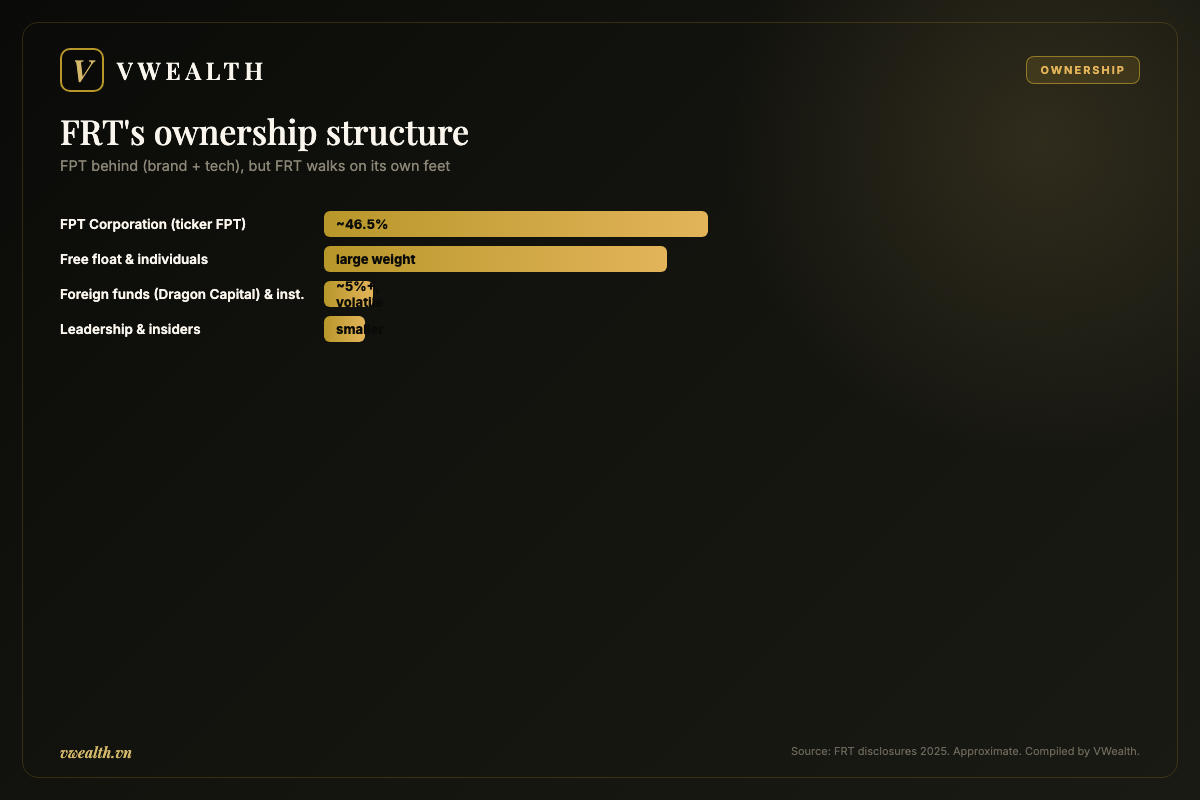
This is the part many investors misunderstand, so read carefully. FPT Retail’s largest and only shareholder (above the 5% threshold) is FPT Corporation (ticker FPT). Per data cited by Vietstock and Nguoi Quan Sat in 2025, FPT owns about 46.5% of FRT. This number has a dual meaning you need to weigh carefully.
| Shareholder group | Ownership (estimated, 2025) | Meaning for investors |
|---|---|---|
| FPT Corporation (ticker FPT) | ~46.5% | Largest shareholder, backing brand – technology – governance |
| Foreign funds (once Dragon Capital) & institutions | Strong swings in 2025 | Reflects foreign-capital appetite, may create short-term price pressure |
| Leadership & insider shareholders | Smaller weight | Interest aligned with shareholders, but not controlling |
| Free float & individual investors | The rest | Determines daily liquidity and price volatility |
On the positive side, having a tech group of FPT’s caliber holding nearly half brings FRT “intangible assets” few retailers have: the reputable FPT brand, technology and digital-transformation capacity (customer-data platform, chain-management system, applying AI to pharmacy operations), plus listed-company governance experience. This very technology foundation is seen as part of the “secret weapon” helping Long Chau operate more efficiently than rival chains. When you invest in FRT, you indirectly benefit from FPT’s “tech gene.”
But — and this is the crux — you need to understand the relationship correctly: at about 46.5%, FPT is a major shareholder but not absolutely controlling (above 51%), and more importantly, FRT operates as an independent business with its own strategy, executives and deals. FRT isn’t a “department” of FPT, but a company that makes its own business decisions, bears its own risks and reaps its own rewards. The clearest evidence is the Long Chau gamble and the capital-raising deal we’re about to analyze — moves planned proactively by FRT’s own leadership.
One point to watch closely about foreign capital: the Dragon Capital fund group was once a major FRT shareholder, at one point in early March 2025 holding about 12%. However, per Vietstock and CafeF, in 2025 this fund group continuously sold and by July 2025 had reduced ownership below 5%, formally leaving the major-shareholder seat. You shouldn’t panic reading “foreign fund divests” — this is profit-taking after a hot run and is normal market behavior. But it also reminds you that institutional capital can create significant selling pressure on FRT’s price short-term, and FRT’s shareholder structure isn’t “frozen” but always shifting.
The Long Chau capital-raising story — the “jewel” valued in the billions
This is perhaps the most fascinating part, and the key to understanding why FRT stock is so sought-after. In 2025, FRT made a strategic move: selling a portion of its Long Chau stake to a strategic investor, while revealing this “jewel’s” enormous valuation.
Specifically, per CafeF and DNSE, at the 2025 AGM, FRT introduced Long Chau’s new strategic investor Creador — a Malaysian fund experienced in investing in healthcare and pharma across many countries. The deal was designed in phases over a year, targeting Creador’s final ownership of about 13% of Long Chau; half via newly issued shares, the other half Creador buying from existing shareholders. In Q2 2025, FRT recorded taking in nearly 887 billion dong from this issuance — and this is the source of the “nearly 900 billion gain” the media mentions.
But the more important number is the valuation. Creador accepting to buy about 2.7% of shares for the corresponding sum valued Long Chau at about 32,400 billion dong — that is, roughly 1.2 to 1.3 billion USD (per CafeF, DNSE, 24hMoney). Stop and ponder this number: the Long Chau pharmacy chain alone was valued by a professional investor at over 1 billion USD, while FRT still holds the majority (about 78.59% after dilution, down from 80.74% at year-start). As an FRT shareholder, you need to understand the meaning of this in three layers.
First, the valuation is “marketized” by a third party. Previously, Long Chau’s value was just analysts’ paper estimates. Now, a reputable foreign fund has actually put real money in at a billion-dollar valuation — this is an objective confirmation, giving you a firmer basis to value the “hidden value” portion in FRT stock.
Second, FRT gets more resources without borrowing. The nearly 900 billion dong taken in helps FRT strengthen its balance sheet, giving more “ammunition” to invest in expansion (though leadership says it will slow new openings to focus on improving per-store efficiency). Selling a small stake at a high valuation is a very “smart” way to raise capital — you don’t dilute too much yet still realize value.
Third, and most important for the long-term vision: this is a stepping stone for a possible standalone Long Chau IPO. Welcoming a strategic investor, making the valuation transparent, and separating Long Chau into an independent entity are all classic preparation steps for a future listing. If Long Chau IPOs separately at an even higher valuation, FRT’s nearly-79% stake here could be re-rated positively by the market. In other words, when you buy FRT stock today, you’re not just buying a retail chain, but holding an indirect “option” on one of Vietnam’s most potential pharma IPOs. Of course, you need to be clear-headed: the IPO plan depends on market conditions and leadership’s roadmap, with nothing certain about timing or final price.
Dividends — how does FRT pay shareholders?
Finally, let’s talk about the most practical thing for your pocket: dividends. Here you need to set the right expectation. FRT is a business in a strong-growth phase needing to retain profit to reinvest (expanding the chain, developing the healthcare ecosystem), so it’s not a stock for “high-dividend” investors.
Per Vietstock and financial sources, in 2024–2025 FRT mainly paid dividends in stock rather than cash. At one point it set a 25% stock dividend (shareholders with 100 shares get 25 more). For the 2025 fiscal dividend, FRT announced a 5% stock dividend (100 shares get 5 new shares), corresponding to issuing over 8.5 million more shares, with the record date set around mid-2026. A business posting record profit yet prioritizing a modest stock dividend — as Nha Dau Tu analyzes — reflects the “keep cash for growth” philosophy: leadership believes retained capital will create more value for shareholders than distributing now.
For you, the implication is very clear: if you seek steady dividend cash flow, FRT isn’t an ideal choice. But if you invest for expected enterprise-value growth — especially the Long Chau story — then the company retaining profit to reinvest is precisely what you should welcome, because it nourishes the very “growth engine” you’re betting on.
To summarize, FRT’s leadership and ownership picture shows a business led by a seasoned, decisive leader, backed by FPT but still autonomous in each strategic move, and holding a Long Chau “jewel” just valued in the billions with an IPO prospect ahead. To fully understand the value of these people and this ownership structure, you need to look at the very business machine they run — the subject of the next section, when we dissect FPT Retail’s ecosystem and core business segments.
Two pillars: Long Chau and FPT Shop
When you look at FRT on the board, the most important thing to understand is that you’re not buying one business, but two very different businesses packaged in the same ticker. On one side is the Long Chau pharmacy chain growing at the speed of a tech startup. On the other is the FPT Shop phone-laptop retail chain, a mature machine that once struggled and just recovered. These two pillars have completely opposite value drivers, margins, growth room and risk. Misunderstanding each pillar’s role is the fastest way to misvalue the whole stock.
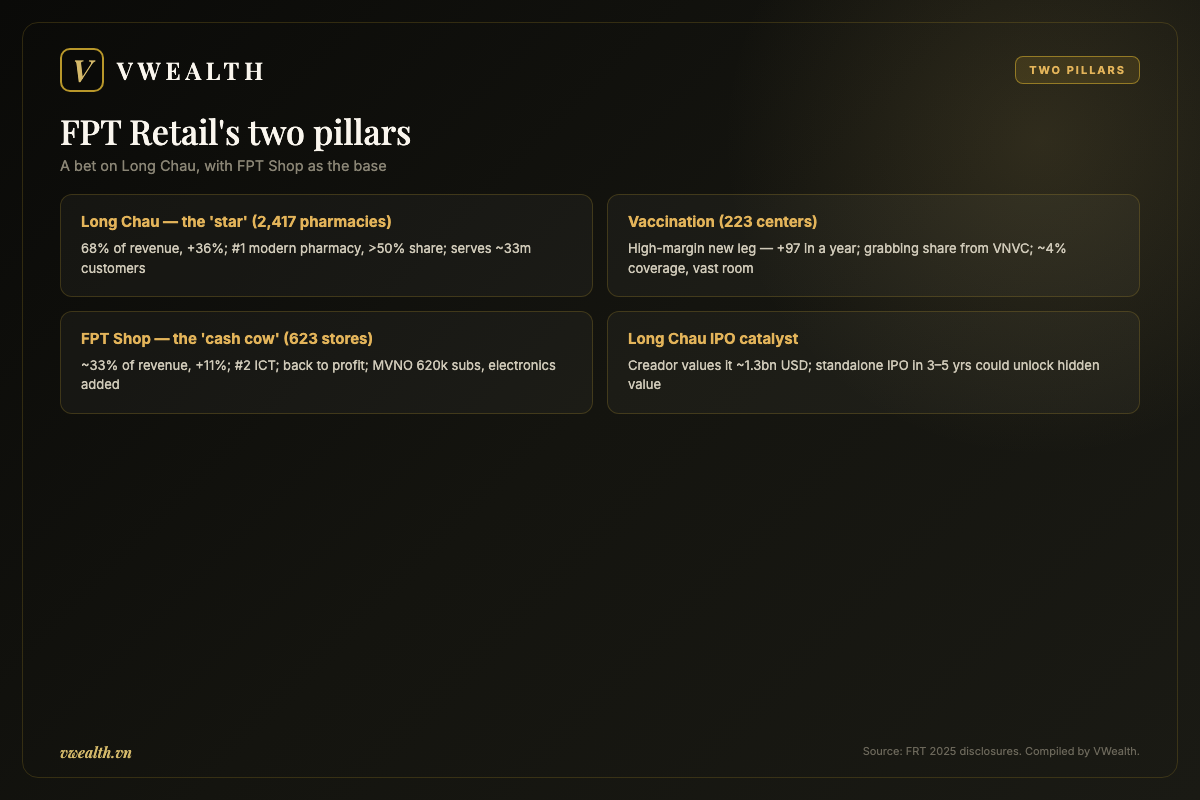
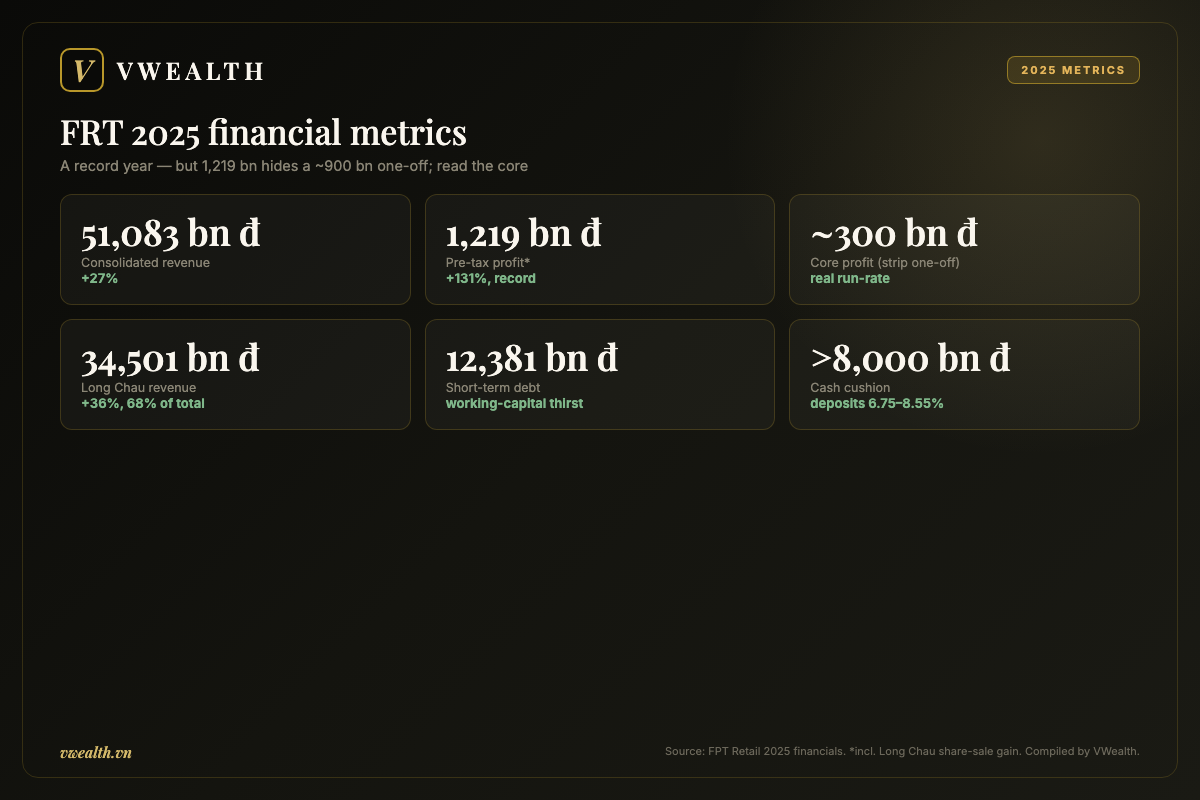
The 2025 numbers say it all. FPT Retail’s consolidated revenue reached 51,083 billion dong, up 27% year on year and at 106% of plan; pre-tax profit reached 1,219 billion dong, up as much as 131% and at 135% of the annual plan. But behind that total is a clear power shift: Long Chau contributed 34,501 billion dong of revenue, up 36% and accounting for up to 68% of consolidated revenue. FPT Shop, once the entire FRT story at listing, now contributes 16,809 billion dong, up 11%. In other words, for every three dong of FRT revenue, more than two come from pharmacies. This is no longer an ICT retailer with an added pharma arm — this is now a pharmacy retailer with an added ICT arm as a base.
Long Chau — the “star” and FRT’s real value driver
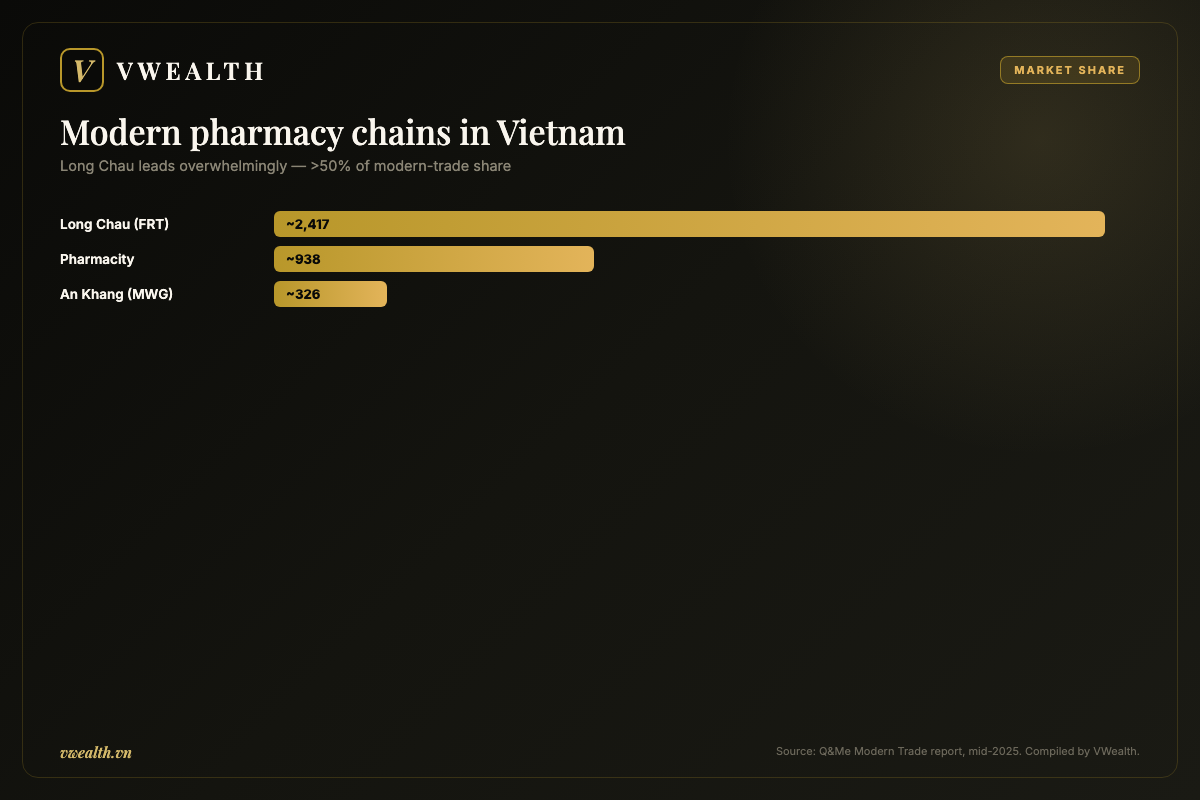
If you only have time to understand one thing about FRT, understand Long Chau. This is nearly the only reason this stock is valued as a growth stock rather than a struggling thin-margin traditional retailer. As of end-2025, Long Chau operated 2,417 pharmacies — putting the chain at absolute number-one in modern pharmacy-retail coverage in Vietnam, far ahead of rivals like Pharmacity or MWG’s An Khang. In 2025, the chain opened 474 new pharmacies, an expansion pace few retail chains in any industry in Vietnam can match.
Why did Long Chau win, while nearly every other modern pharmacy chain in Vietnam once burned money then shrank? The answer lies in a few stacked advantages, and you need to see all four layers to understand why rivals can’t copy it.
- Operating standardization at scale. Long Chau doesn’t run as a collection of individual pharmacies, but as a centralized system: the same catalog, the same warehouse–sale–consultation process, the same technology platform managing inventory and prescriptions. This allows opening hundreds of stores a year without quality thinning.
- Enough drugs — especially prescription drugs. This is the real weapon. Vietnamese going to a pharmacy usually seek exactly the doctor-prescribed drug, and the biggest fear is “out of stock, must go elsewhere.” Long Chau builds a very deep catalog, covering both prescription and specialty drugs that small pharmacies usually don’t stock. This strong prescription-drug demand is the main driver accelerating Long Chau’s revenue in 2025.
- Good prices from concentrated buying power. With over 2,400 points of sale, Long Chau negotiates with suppliers from a position no single pharmacy can have, keeping prices competitive while improving margins.
- Pharmacist consultation and provincial coverage. Long Chau positions itself not just as a place to buy drugs but a place to get advice, and more importantly, the chain pushes openings in areas outside the center, in provinces where people previously had no reliable modern pharmacy option. The average revenue of about 1.2 billion dong/pharmacy per month held steady even amid strong expansion into peripheral areas, showing the model doesn’t dilute when covering widely.
One point to remember about pharmacy-chain economics: margins improve with scale. The more stores, the more the fixed costs for technology, logistics, brand and purchasing negotiation are spread thin over larger revenue. Long Chau passed the break-even point of the money-burning expansion phase and entered the zone where each added store directly builds profit rather than eroding it. This is precisely why FRT’s consolidated pre-tax profit jumped 131% in 2025 even though revenue “only” rose 27% — operating leverage at work.
A number worth pausing on: Long Chau’s pharmacy and vaccination-center network now serves about 33 million customers — equal to nearly one-third of Vietnam’s population. That’s no longer a retail chain, that’s a healthcare infrastructure.
Vaccination — the new high-margin segment with vast room
If pharmacies are Long Chau’s already-firm trunk, then vaccination is the fastest-rising branch and perhaps the most interesting part for long-term investors. At end-2025, Long Chau had 223 vaccination centers, adding 97 in just one year. Put this in context: Long Chau only opened its first vaccination center in July 2023 with just two facilities. From near zero, the chain expanded at about eight centers a month to pass 220 in just over two years.
Why is this segment important to the valuation story? First, vaccination is a higher-margin service than ordinary drug sales, because it sells both service and peace of mind, not just goods. Second, the market room is still very large: demand for service vaccines in Vietnam keeps rising steadily and is far from saturation. Third, Long Chau leverages its very pharmacy network and existing 33-million-customer base to cross-sell — a vaccination center opened next to a branded pharmacy fills up far faster than a brand-new standalone facility.
Of course, this isn’t an empty arena. The biggest rival is VNVC, the giant that has dominated service vaccination for years. VNVC is counterattacking fiercely: raising charter capital fivefold, investing in a vaccine plant of about 2,000 billion dong with 100 million doses/year capacity expected to run in late 2027. You should see this as a long race between two giants rather than a settled victory. But the crux is that Long Chau enters this race with a geographic-coverage advantage and a customer base VNVC lacks — and they’re grabbing share fast enough to force the rival to pour capital into defense.
Expansion ambition and the possibility of a standalone IPO
Long Chau has no intention of stopping. Leadership targets bringing the total number of pharmacies and vaccination centers toward 3,000 points, with a plan to open another 400–500 new points in 2026. More important from an investment angle: FPT Retail has revealed a plan for a standalone Long Chau IPO within the next 3–5 years.
Why is this worth watching closely? A standalone IPO would value Long Chau independently, at the multiple of a high-growth pharma-healthcare business, rather than being “mixed in” and valued at a retail group’s multiple. If the market values Long Chau much higher than it’s currently reflected in FRT’s price, this could be a significant value-unlock catalyst for FRT shareholders. This is one of the core reasons many investors are willing to hold FRT long-term: they’re betting on a “hidden jewel” that could be separated and re-rated.
FPT Shop — the mature “cash cow,” revived
If Long Chau is the growth star, FPT Shop is the mature cash cow — and its 2025 story is a revival story. FPT Shop is the ICT retail chain: phones, laptops, accessories, and increasingly electronics and appliances. This is the segment FRT ran from the earliest days, so you need to assess it by a completely different yardstick than Long Chau: not growth speed, but stability and cash generation.
In reality, Vietnam’s ICT industry hasn’t been comfortable the past few years. The phone-laptop market has saturated: nearly everyone who needs a smartphone has one, the replacement cycle is lengthening, and demand for high-value tech goods is pressured when the economy is hard. Add fierce competition from Mobile World — a rival far larger in scale that has sparked price wars eroding the whole industry’s margins. In that context, FPT Shop once fell into losses.
What FRT did was a decisive restructuring: closing ineffective stores rather than holding coverage at all costs, streamlining the network to about 623 stores, optimizing the product catalog and pushing operating costs down. The results of this discipline show clearly in 2025:
- Officially returned to profit. This is the most important milestone — FPT Shop escaped loss, ending the phase of eroding the whole group’s profit.
- Revenue recovered. Full-year reached 16,809 billion dong, up 11% and at 105% of plan. In Q4 2025 alone, revenue rose 25% year on year — showing the recovery accelerated toward year-end, not from one lucky quarter.
- Store performance improved strongly. Average revenue per store reached about 2.8 billion dong/month in Q4, up 26% year on year. This is the clearest evidence that closing weak stores didn’t lose revenue but rather made each remaining store healthier.
- Revenue diversification. FPT Shop expanded into electronics, appliances and mobile virtual network (MVNO) services — the MVNO segment after two years reached about 620,000 subscribers, creating a steady recurring revenue stream alongside the traditional, cyclical sales business.
You should understand FPT Shop’s role correctly in the investment thesis: it’s not the growth engine and will never grow like Long Chau. Its role is a stable, cash-generating base, no longer a burden. A profitable FPT Shop frees leadership’s resources and attention to pour capital into Long Chau, while providing a cash flow and a distribution-logistics network the pharma arm can leverage. When assessing FRT, see FPT Shop as the “safe part” of the portfolio: it doesn’t create a price jump, but its escape from losses removed a large risk that once weighed on the whole group.
Online channel and the omni-channel model
A third value layer you shouldn’t overlook is the online channel, which cuts across both pillars. In 2025, FPT Retail’s online revenue reached 9,344 billion dong, up strongly 30% year on year — a pace even faster than total growth. This matters because it shows FRT isn’t just a physical store network, but runs a genuine omni-channel model: customers can look up, order drugs, book vaccinations or buy tech devices online then pick up at the nearest of 3,263 points of sale nationwide.
For the pharma arm, the online channel is especially valuable: it lets Long Chau serve repeat prescriptions, remote consultation and drug delivery — behaviors that create loyal customers returning regularly. The network of over 3,200 physical stores is precisely the “last-mile” logistics advantage pure e-commerce platforms lack. This is a resonance loop: stores feed online, online makes stores more efficient.
Why FRT = “a bet on Long Chau, with FPT Shop as the base”
Putting it all together, the FRT investment thesis can be summed in one sentence: you’re mainly betting on Long Chau, with FPT Shop as a risk-reducing base. Look at how the two pillars complement each other along the risk–reward axis:
| Criterion | Long Chau | FPT Shop |
|---|---|---|
| Role | Growth engine (“star”) | Cash-generating base (“cash cow”) |
| 2025 revenue | 34,501 bn (+36%) | 16,809 bn (+11%) |
| Revenue weight | 68% consolidated | ~33% consolidated |
| Market | Pharma – expanding, large room left | ICT – saturated, high competition |
| Margins | Improve with scale; vaccination high-margin | Thin, just recovered to positive |
| Catalysts | Opening 3,000 points, vaccination, standalone IPO | Stay stable, MVNO, electronics – appliances |
The “bet on Long Chau” clause comes from the reality that nearly all revenue-growth momentum and most of the 2025 profit jump originated from the pharma arm. The stock’s upside potential over the coming years — expanding to 3,000 points, the vaccination segment grabbing share from VNVC, and especially the possible standalone IPO re-rating Long Chau — all lie in this pillar. If Long Chau keeps its current momentum, FRT is a multi-year growth story, not a one-quarter one.
The “FPT Shop as base” clause is no less important, because it defines your downside risk. A profitable FPT Shop means the ICT part is no longer a leaky bucket draining Long Chau’s profit. It provides cash flow, a network and purchasing scale, while creating a cushion: even if pharma growth stalls temporarily, FRT still has a large, stable, cash-generating segment underneath. That’s the difference between an “all-in one door” growth stock and a growth stock with a defensive foundation.
Of course, there’s no free lunch. The biggest risk of this thesis is also its strength: concentration. When 68% of revenue and most expectations pile onto one pharmacy chain, any hiccup at Long Chau — a pharma-policy change, an escalated vaccination price war with VNVC, or a slowdown in new openings — will strongly impact the whole stock. This is the price of owning a fast-growing business: large reward comes with high sensitivity.
To summarize, FRT’s two-pillar picture is fairly clear and fairly healthy: a high-growth Long Chau leading value, plus a re-stabilized FPT Shop as a base. The next question any serious investor must answer is: how durable is these two pillars’ competitive position, and is the group’s financial health solid enough to fund Long Chau’s enormous expansion ambition? That’s what we’ll dissect in the next section on FRT’s position and financial health.
Position and financial health
After walking through FPT Retail’s growth story and overview, this is the part you should read most carefully if you’re considering putting money into FRT stock. Because 2025 was a very “beautiful” year on paper for this business, but behind the record numbers are a few details that, if not dissected, easily lead you to misvalue. A veteran analyst won’t stop at the headline “profit up 131%.” They’ll ask: where did that number come from, how much is real from selling goods, and how much is a one-time sum that never recurs. We’ll do that together.
Market position: two chains, two different leadership spots
Before talking money, let’s talk about standing. Market position is the foundation deciding whether a business can earn sustainably, and here FPT Retail holds two assets of very different value.
Asset number one, and the main growth engine, is the Long Chau pharmacy chain. By end-2025, Long Chau operated 2,417 pharmacies and 223 vaccination centers nationwide, opening 474 new pharmacies in just one year. This scale keeps Long Chau firmly leading the modern pharmacy-retail market in Vietnam, especially in prescription drugs, new-generation drugs, rare and hard-to-find drugs. In an industry where trust and coverage are everything, having over 2,400 points of sale each averaging around 1.2 billion dong/month is a competitive advantage rivals can’t copy overnight.
The second asset is FPT Shop — the ICT retail chain holding the market’s number-two position behind Mobile World. This is FPT Retail’s “first-generation” business, once a burden in 2022–2023 when phone-laptop demand plunged. The bright spot of 2025 is that FPT Shop returned to profit: full-year revenue reached 16,809 billion dong, up 11%, and Q4 alone rose 25% year on year — a clear sign the restructuring (closing ineffective stores, optimizing costs, pushing high-margin products) worked.
Picture FPT Retail as a boat with two engines: Long Chau is the growth engine roaring, while FPT Shop is the just-repaired engine, no longer belching smoke but running slow and steady. FRT’s investment story, ultimately, is the story of the Long Chau engine.
Profit quality: why the “+131%” number can deceive you
This is the most important part of the whole analysis, so read very slowly. In 2025, FPT Retail reported pre-tax profit of 1,219 billion dong, up 131% versus 2024 — a record high in the business’s history. Seeing this number, many investors’ natural reflex is to cheer “profit more than doubled!”. But a responsible financial writer must tell you straight: that number doesn’t accurately reflect core business health.
The reason lies in a special sum. In 2025, FPT Retail sold a small amount of Long Chau shares to a strategic investor, reducing ownership from about 80.74% to 78.59%. This transaction brought the company nearly 900 billion dong. This is a one-off financial gain — it comes from selling an asset, not from selling any additional box of drugs or phone. And most important: it won’t recur next year.
When you strip this 900 billion from the 1,219 billion figure, the picture becomes far more honest:
- Accounting (reported) profit: 1,219 billion dong, up 131%. This is the number you see in the press.
- Core profit (from real selling activity): only around 300 billion dong after removing the one-off. This is the number reflecting how much Long Chau and FPT Shop earn from day-to-day business.
Look back at the year’s trajectory to see this clearly. After the first 9 months of 2025, FPT Retail’s pre-tax profit only reached over 800 billion dong — and most of that already included the Long Chau deal gain recorded in Q2. In H1 alone, after-tax profit of 370 billion dong (up 239%) was also strongly “pumped” by this very item. In other words, without the share sale, FRT still profited and still grew, but at a pace far more modest than the glamorous 131%.
So does this mean FRT is “dressing up” numbers to deceive investors? Not really, and this is where balance is needed. Selling some Long Chau shares to a strategic partner is a sensible move: it helps value Long Chau transparently on the market, brings in cash to fund growth, and reveals the true value of the “precious jewel” FRT largely holds. The important thing is that you must separate them out: don’t value the stock based on the 1,219 billion profit as if it will recur every year. If you multiply that number by a P/E to value it, you’ll overpay.
The good news is that core profit is truly on an improving trend, and this is worth betting on long-term. Two clear drivers: first, Long Chau reached a scale large enough for operating efficiency to rise — the more pharmacies, the more supplier-bargaining power, the thinner fixed costs are spread. Second, FPT Shop escaped loss and began contributing positively again rather than dragging down overall profit. These two currents together make 2026 core profit likely higher than 2025, even without the 900-billion one-off.
Pharma-retail traits: thin margins and the working-capital thirst
To understand FRT’s financial health, you must understand the nature of pharmacy retail. This isn’t an easy “money-makes-money” industry. This is a thin-margin and capital-intensive industry — a combination demanding very high financial discipline.
First, margins. Drug retail is fundamentally a thin-net-margin industry, usually only around 3–5% of revenue. Long Chau sold over 34,500 billion dong of revenue in the year, but the profit left after deducting cost of goods, premises rent, pharmacist pay, cold-storage operations and logistics is very small per dong of revenue. This means the model lives on scale and turnover, not high margins. Each pharmacy must sell enough, turn goods over fast enough, for total profit to matter.
The second trait, the hidden trap for every fast-growing pharmacy chain, is the working-capital thirst. Picture it: each time Long Chau opens a new pharmacy, the company must spend upfront to (1) invest in the store’s facilities, and (2) fill the shelves with inventory — and drugs have thousands of SKUs, from common to rare, each needing to be in stock to keep the “come to Long Chau and it’s there” reputation. Multiply that by nearly 500 new pharmacies opened in a year, and you’ll see the capital “buried” in inventory and new stores is enormous. In fact, there was a period FRT’s inventory rose over 2,500 billion dong just to serve expansion.
FRT’s paradox is: the faster it grows, the “hungrier” for capital it gets. Growth here doesn’t self-generate abundant cash, but the opposite — it swallows cash. That’s why FPT Retail had to both borrow short-term and raise capital by selling some Long Chau shares.
Understanding this, you’ll see the 900-billion Long Chau share sale in a different light. It’s not just a beautiful accounting gain; it’s also fresh capital the business needs to keep fueling the expansion race without borrowing too much more. This is a reasonable financial decision by leadership, even though it “noises up” the profit figure.
Financial health: leverage, cash and cash flow
Now let’s examine the balance sheet. The core question: is FRT borrowing beyond its means to chase growth?
On the debt side, the number rose clearly with expansion. FPT Retail’s short-term borrowings rose from about 10,051 billion dong to 12,381 billion dong — mostly additional bank loans for working capital to buy inventory, with interest rates ranging 4.6% to 7.5%. This is a point to note: the business’s financial costs rose as much as 69%, to about 150 billion dong, precisely because the debt scale ballooned. In other words, Long Chau’s growth is being funded partly significantly by leverage, and each added percentage point of interest will erode the already-thin core profit.
However, don’t panic. FRT’s financial health has solid anchors to balance the leverage risk:
- A thick cash cushion: the business holds over 8,000 billion dong in held-to-maturity investments — mostly 3–12 month bank deposits at rates of 6.75% to 8.55%. This is an important liquidity cushion, and notably the deposit rate is higher than the borrowing rate, meaning the interest spread isn’t too unfavorable.
- Strengthened equity: thanks to retained earnings and the cash from selling Long Chau shares, FRT’s equity rose strongly (up about 59% versus year-start in H1 2025), making the debt-to-equity ratio healthier despite the absolute debt rising.
- High ROE: with record profit on a still relatively thin equity base, FRT’s ROE in 2025 was very high. But — and here’s another balancing warning — this ROE is also inflated by the 900-billion one-off gain. Core-operation ROE would be more modest, and you should use the core number when comparing with prior years or rivals.
On cash flow, this is the most “honest” indicator of a retailer. Profit can be distorted by accounting items, but cash flow is hard to hide. For FRT, operating cash flow is under great pressure because most of the profit and borrowed capital is flowing straight into inventory and new stores. This isn’t a sign of weakness — it’s the trait of a business in a high-growth phase. Problems only arise if new-opening pace slows while cash flow doesn’t recover in time, or if interest rates spike suddenly, pushing borrowing costs out of control.
Summarizing the financial-health picture, this is a business that’s healthy but straining: thick cash, strengthened equity, both chains profitable — but simultaneously carrying large short-term debt and a working-capital machine that never stops. This is the kind of health of an athlete at peak form but training at very high intensity: impressive, but requiring close metric monitoring.
What you should remember, in summary
If you carry only one idea from this section, let it be: FRT’s 2025 profit of 1,219 billion dong isn’t the number you should use to value the stock. Strip out the 900-billion one-off, look at core profit gradually improving thanks to Long Chau reaching scale and FPT Shop escaping loss, then place it beside the swelling debt from the pharma industry’s capital-intensive nature. When you view FRT through that lens — honest, balanced, not mesmerized by headlines — you’ll make far better decisions. And that’s also the foundation to move to the next section: how the market received FRT stock, when the very numbers we just dissected are what shape investors’ expectations.
Market reception
If you look at FRT of FPT Digital Retail JSC through the eyes of a traditional value investor — one fixated only on P/E and cash dividends — you’ll almost certainly find it “absurdly expensive” and pass. But if you’d done that over the past few years, you’d have missed one of the most spectacularly rising stocks on HOSE. Per data from the VWealth plugin, on 19 June 2026 FRT traded around 130,000 dong/share — a high price level, with moderate rather than abundant liquidity. To understand why the market is willing to pay this price, you can’t read FRT as a phone retailer. You must read it as a bet on Long Chau.
This is the most important part of the whole analysis, because it explains the central paradox: a stock where every ordinary valuation metric screams “too expensive,” but big money keeps buying and pushing the price to new highs. Read this part slowly — it will change how you view what “expensive” or “cheap” means for a growth stock.
The valuation picture: the numbers say FRT is very expensive
Let’s start with the barest truth. FRT currently has about 136.2 million shares outstanding (and is about to issue over 34 million more for the stock dividend). At 130,000 dong, the business’s market cap is roughly 17,700 – 18,000 billion dong. Meanwhile, 2025 consolidated pre-tax profit reached 1,219 billion dong — an impressive number, up 31% year on year and beating plan by 35% — but inside it is a one-off gain from selling some Long Chau shares. If you strip that out, core profit from regular operations is lower than the 1,219 billion.
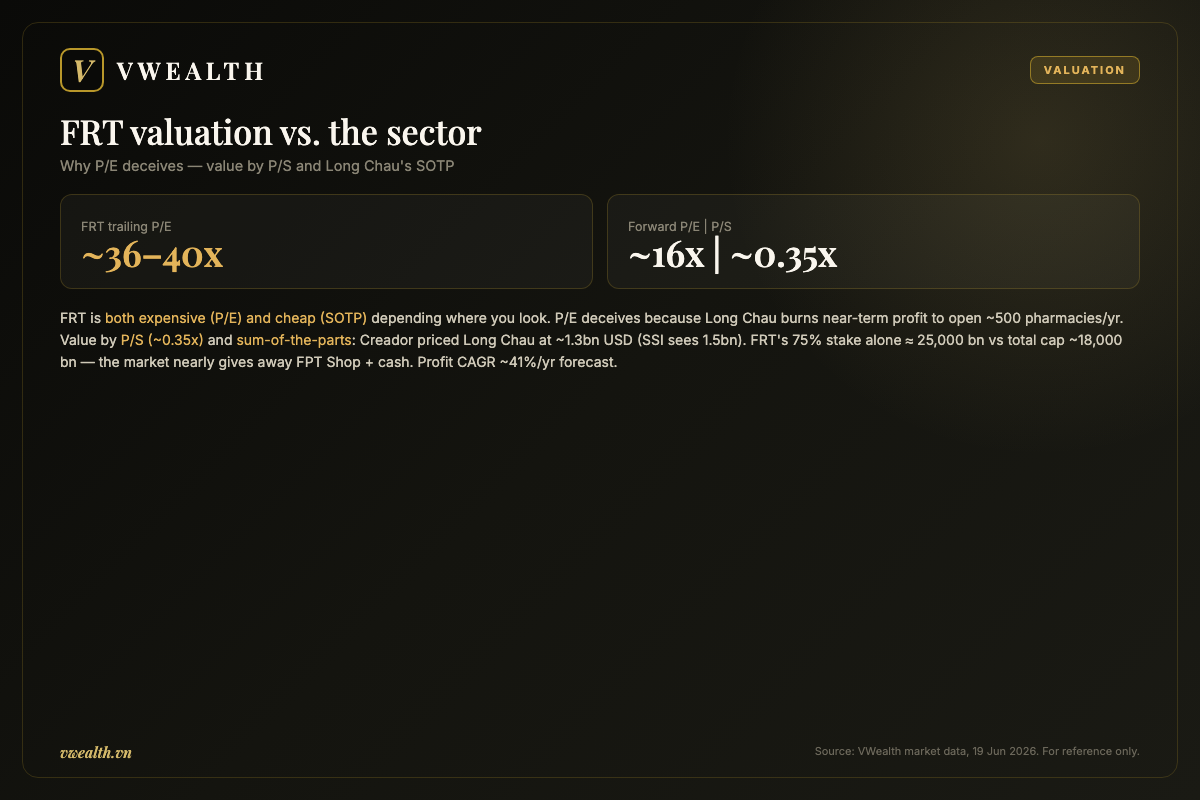
Converting to after-tax profit attributable to parent-company shareholders (FRT owns only about 75% of Long Chau so the minority-interest portion subtracted is quite large), FRT’s trailing-12-month EPS is around 3,600 dong/share. Dividing 130,000 by this, you get a P/E of about 35–40x — far above Vietnam’s whole-market average P/E (~14x) and above FRT’s own 5-year average P/E (~21x). At one point in early June 2026 the stock touched 165,000 dong, pushing the P/E above 40x.
For an investor looking only at current profit, FRT is expensive. Very expensive. But “expensive” doesn’t mean “wrong” — it just means the market is paying for something else, not today’s profit.
Why does a growth stock get a high P/E?
This is the core concept you need to grasp. P/E isn’t an “absolute cheapness/expensiveness measure” — it’s an expectation measure. When you pay a P/E of 40x for a stock, you’re essentially saying: “I accept this price because I believe future profit will be much larger than current profit, to the point that later years’ P/E will automatically drop to a reasonable level.”
This logic applies almost perfectly to FRT. The business’s profit is forecast to grow at a compound rate (CAGR) of about 41% a year over the next three years, while revenue holds a CAGR of about 18%. When a business grows profit 40% a year, then:
- this year’s P/E is 36x;
- the “forward” P/E — current price divided by projected profit for the next 12 months — is only about 16x;
- and if the growth continues, the P/E of 2–3 years later could drop to around 10x while the share price stays the same.
In other words, the 36–40x P/E you see today is a look in the “rear-view mirror.” The market is looking forward. HSC (HCMC Securities) raised its FRT recommendation from “Outperform” to “Buy” with a target price of 176,500 dong/share — much higher than the current 130,000 — precisely because they discount the future profit stream, not past profit. This is where new investors often err: you can’t use a “static” measure (trailing P/E) to assess a “dynamic” business (profit multiplying fast).
When P/E no longer makes sense: use P/S and sum-of-the-parts (SOTP)
For businesses burning profit to expand scale — opening new stores continuously, bearing opening costs, not yet fully depreciated — accounting profit is artificially “compressed.” Each new Long Chau pharmacy takes about 6–12 months to break even then profit. The faster the openings, the more the near-term profit is “eaten,” making the P/E balloon. In this situation, two other valuation methods reflect value better than P/E:
First, valuation by P/S (price to sales). Revenue reflects the market share and brand strength the business has captured, undistorted by expansion costs. In 2025, FRT’s consolidated net revenue reached 51,083 billion dong, up 27%. With a market cap of ~18,000 billion, the P/S ratio is only about 0.35x — a very modest number versus regional growth-retail chains. The Long Chau chain alone contributed 34,501 billion dong of revenue (68% of total, up 36%), with average revenue per pharmacy holding around 1.2 billion dong/month. Through the P/S lens, the “expensive” story immediately eases a lot.
Second, sum-of-the-parts — SOTP. This is the most accurate way to value FRT, because the business is essentially the sum of two very different bodies:
- FPT Shop — the mature tech-retail chain (623 stores end-2025, revenue 16,809 billion, up 11%). This is the “cash” segment, slow-growing, thin-margin, deserving a low P/E like an ordinary retailer.
- Long Chau — the booming pharmacy-and-vaccination chain (over 2,600 service points end-2025, including about 2,400 pharmacies and 220 vaccination centers), growing 36%/year. This is the “jewel” and must be valued as a separate growth company.
The crux: the market has self-valued Long Chau through real transactions. When FRT sold 2.7% of Long Chau to a new investor, the chain’s valuation was set at about 1.3 billion USD (~33,000 billion dong). SSI Research even estimates Long Chau’s value could reach 1.5 billion USD if margins keep improving. Do the simple math: if just FRT’s 75% Long Chau stake is worth about 25,000 billion dong, while FRT’s entire market cap is only ~18,000 billion, then the market is nearly “giving away” the FPT Shop segment and the over-6,000-billion cash on the balance sheet. This is precisely analysts’ argument saying “FRT owns 75% of Long Chau, is the market valuing it cheaply?”. FRT’s paradox is that: both expensive (by P/E) and cheap (by SOTP) — depending on where you look.
The biggest catalyst: the Long Chau IPO scenario
If you had to choose a single catalyst that could send FRT’s price soaring in the future, it’s certainly a standalone IPO/listing of Long Chau. FPT Retail’s leadership has openly left open the possibility of listing Long Chau within the next 3–5 years, and is pouring effort into preparing a “billion-dollar IPO.” The Creador fund has become a strategic partner, aiming for about 13% of Long Chau — a move reinforcing financial capacity and credibility ahead of the IPO. Long Chau has also entered foreign funds’ “IPO-hunting” lists.
Why is this such a strong catalyst? Because when a growth asset is separated and listed independently, the market usually values it much higher than when it’s “hidden” inside the parent — a phenomenon investors call removing the “conglomerate discount.” When Long Chau is publicly traded at a clear market price, the Long Chau value inside FRT (the parent) will be re-rated transparently and usually higher. In other words, a Long Chau IPO could be the moment the market is forced to admit FRT is undervalued by SOTP — and the parent’s stock is pulled up. This is the scenario investors holding FRT today are betting on.
Investing in FRT now is, to some degree, buying an “early ticket” to a Long Chau IPO that hasn’t happened. The reward could be large, but it lies in the future and depends on whether the story materializes.
Price behavior: a “national growth stock” and high volatility
FRT has become one of the “national growth stocks” on Vietnam’s market — the name individual investors mention whenever discussing a price rise driven by a clear narrative. This stock has risen strongly many times over the years, almost entirely tracking the Long Chau story: each quarter the pharmacy chain opens hundreds more stores, each quarter revenue sets a new record, and each piece of good news pushes the price up a step.
But you must understand the downside clearly: what rises fast on expectation also swings hard when expectation wavers. FRT is a high-beta stock. Its price is extremely sensitive to three variables, and you should watch all three closely:
- Long Chau’s store-opening pace. This is the “heartbeat” of the growth story. In 2026 the business plans to open 400–500 more pharmacies and vaccination centers. If the opening pace slows — for lack of good premises, for market saturation — the growth narrative will be doubted immediately.
- Margins. Long Chau must prove that as scale grows, margins improve too rather than being eroded by competition and costs. Each percentage point of margin strongly impacts valuation.
- Consumer purchasing power. The FPT Shop segment and even spending on drugs and supplements are sensitive to the economic cycle. When purchasing power is weak, revenue stalls and the stock reacts negatively.
With this structure, FRT isn’t for the faint-hearted. A 20–30% correction from the peak is entirely normal for a highly valued growth stock — and has happened. FRT’s “moderate” liquidity (the high price means the number of shares traded isn’t too large) also means when big money withdraws, the price can drop fast and deep.
Dividends: don’t seek steady cash flow here
If you buy stocks to enjoy steady cash dividends — the “savings account in stock form” type — then FRT isn’t for you. This is a true growth stock, and the business prioritizes retaining profit to reinvest in expanding the Long Chau network rather than paying cash to shareholders.
The evidence is very clear: the 2025 dividend was paid mainly in stock (20:1 ratio, i.e. 20 shares get 1 new share), with a total par issuance value of only about 85 billion dong — a small number versus the profit scale. Paying dividends in stock means the business keeps cash in the vault to open more stores, while shareholders get more shares (increasing shares outstanding, slightly diluting EPS). This is the sign of a company in the “investing for growth” phase, not the “harvest” phase. FRT’s cash-dividend yield is therefore nearly negligible — and that’s entirely reasonable for a business racing to expand.
Foreign investors: smart money in and out, room still available
The foreign-ownership story at FRT gives you an interesting view of “big money” psychology. The Dragon Capital fund group — one of Vietnam’s most powerful institutional investors — has had a very active in-and-out journey with FRT:
- In early March 2025, the Dragon Capital group still held about 12–14%;
- From mid-2025, they continuously sold, cutting ownership below 5% (no longer a major shareholder) — contributing to a net foreign outflow of nearly 1,070 billion dong from FRT in this period;
- By end-March 2026, they bought back and once again became a major shareholder, holding about 8.5 million shares, corresponding to ~5.01% as of end-April 2026.
A large fund selling then returning shows FRT is a stock institutions watch very closely and are willing to “trade” by valuation. For you — the individual investor — this is both a positive signal (foreign capital interested again) and a reminder that FRT’s price can face strong pressure when institutions dump. Besides, the appearance of foreign partners like Creador in Long Chau’s structure further increases the story’s appeal. FRT’s foreign room generally still has space, not filled like the bank stocks — meaning there’s still a door for new foreign capital when the Long Chau IPO catalyst becomes clearer.
Bottom line: FRT is a bet on Long Chau
So how is the market receiving FRT? The shortest answer: the market values FRT as a growth option on Long Chau, not as a phone retailer. The 35–40x P/E makes the stock look expensive when viewed against today’s profit, but becomes reasonable — even somewhat cheap — when you value by P/S or separate out Long Chau’s value (SOTP), especially since the chain has been traded at 1.3 billion USD and could head toward 1.5 billion USD.
When you buy FRT in the 130,000-dong zone, you’re not buying a safe value stock with steady dividends and cheap valuation. You’re buying an expensive but story-driven growth stock: the story of a pharmacy chain with room to open thousands more stores, of a billion-dollar IPO being prepared, of a business growing profit 40% a year. The reward could be very large if the story materializes; but the risk is real too — if the store-opening pace slows, margins don’t improve, or purchasing power weakens, that high P/E immediately becomes a burden and the price can correct strongly.
To understand why the Long Chau story carries such weight — and whether the growth room of Vietnam’s pharma, healthcare and retail industries is wide enough to justify this valuation — you need to look at the industry picture FRT operates in. That’s the subject of the next section: Industry context.
Economic and pharma-retail industry context
To understand why FRT stock is valued at such a high P/E — around 25 to 40x depending on the time and method — you can’t just look at FPT Retail’s own balance sheet. You must step back and place this business in its proper base: a Vietnamese pharma-retail industry transforming strongly, backed by some of the economy’s most durable macro drivers. FRT’s story, ultimately, is nearly the story of the pharma industry — and especially the story of the Long Chau pharmacy chain riding that wave.
A billion-dollar market swelling steadily
Let’s start with foundational numbers. Vietnam’s pharma market grew from about 2.7 billion USD in 2015 to 7 billion USD in 2025, and is heading toward the 10-billion-USD mark by 2026. This is a decade-long upward trajectory, not a short-term wave. Per IQVIA — one of the world’s leading healthcare-data firms — the 2023 to 2028 period is expected to hold an average compound growth rate (CAGR) of about 6 to 8% a year. Some more optimistic estimates even put nominal growth at 8 to 10%/year counting drug-price inflation and the shift toward high-value drug lines.
What you should remember here is the defensive nature of this number. Unlike phones, laptops or motorbikes — goods consumers can postpone buying when the economy is hard — medicine is nearly non-postponable spending. When you’re sick, you buy drugs, regardless of whether the VN-Index is green or red that day. This very trait makes pharma one of few retail fields with stable cash flow across economic cycles, and that’s the foundational reason investors are willing to pay a high price for a leader in this segment.
Three irreversible macro drivers
The pharma industry’s growth doesn’t come from luck, but from three long-term structural trends converging at once:
- Population aging. Vietnam is entering an aging phase at one of Asia’s fastest rates. The rising number of people over 60 drives demand for treating chronic diseases — cardiovascular, diabetes, blood pressure, joints — disease groups requiring regular, repeat, lifelong medication. This is precisely the golden customer base for a pharmacy chain: frequent buyers, loyal, and spending more as they age.
- Rising disposable income. As per-capita income rises, the share of healthcare in household spending baskets rises too. Vietnamese are increasingly willing to pay for better drugs, supplements, vitamins, and proactive healthcare products rather than only when already sick.
- Health awareness and prevention. After the pandemic, the “prevention over cure” mindset has sunk deep into consumer behavior. People proactively get vaccinated, supplement nutrition, screen early. This trend expands a modern pharmacy’s “basket” beyond pure prescription drugs.
A notable data point: in 2025, the pharmacy channel accounted for up to 61% of the pharma market’s size and grew about 11%, far outpacing the hospital channel which rose only 6%. The prescription-drug (Rx) group alone rose as much as 12%. In other words, not only is the pie growing, but the pharmacy-channel slice — Long Chau’s arena — is swelling faster than the rest.
The shift from traditional pharmacies to modern chains
This is the most important part to grasp, because it’s the core of the FRT investment thesis. Vietnam’s pharma-retail market is still extremely fragmented. The country has about 60,000 pharmacies and drug counters — the vast majority small individual establishments, household businesses, one counter one pharmacist. The “modern trade” rate — standardized chain retail — in pharma is still very low, estimated at only a small portion of the whole market.
For comparison: in grocery, modern trade (supermarkets, convenience stores) already holds significant share and is gradually “eating” into traditional markets. Pharma lags grocery in modernization pace, meaning the shift room is still very large. Each small pharmacy that must close or be replaced is a share flowing to the large chains. And in that race, Long Chau is in an overwhelming position.
Per Q&Me’s Modern Trade report, as of mid-2025, the total number of pharmacies belonging to modern chains nationwide reached about 3,459 stores, up nearly 7% versus 2024. In that modern-trade pie, Long Chau holds over half the share. The competitive picture among the large chains is fairly clear:
| Pharmacy chain | Store count (2025) | Position |
|---|---|---|
| Long Chau (FRT) | ~2,417 pharmacies + 223 vaccination centers | Overwhelming leader, >50% modern-trade share |
| Pharmacity | ~938 | Second, developing urban–suburban in parallel |
| An Khang (MWG) | ~326 | Consolidating, withdrew from Hanoi, restructuring |
The gap between Long Chau and its nearest rivals is very large — not by a little but by several times. Long Chau reached chain revenue of about 34,501 billion dong in 2025, average revenue per pharmacy about 1.2 billion dong/month, and the system serves about 33 million customers — equal to nearly one-third of Vietnam’s population. This is an extremely hard-to-copy economy of scale: the more stores, the more supplier-bargaining power, the lower the logistics cost per unit, the richer the customer data.
Vaccination — the new gold mine with high margins
Besides drugs, Long Chau has ventured into another lucrative market: vaccination. Vietnam’s vaccine market reached about 20,010 billion dong in 2023 and is forecast to grow an average 6.9%/year from 2024–2030, heading toward nearly 32,000 billion dong by 2030. This is a segment with more attractive margins than ordinary drug sales, and Long Chau entered with 223 vaccination centers as of end-2025 — adding 97 in just one year.
However, you need to face the competitive reality: VNVC remains the “giant” dominating vaccination with about 46% market share and a network of nearly 200 centers across 55/63 provinces. Long Chau is the latecomer, using a pricing strategy — vaccines at Long Chau are usually about 2 to 7% cheaper than VNVC — to grab customers. This is a costly, unsettled war. Long Chau is a “formidable rival” but not yet the leader in this segment, and you shouldn’t value the stock assuming Long Chau will easily dethrone VNVC.
Policy — a tailwind for standardized chains
A factor many investors overlook but which has very large structural impact: the pharma-management policy framework is increasingly tightening toward standardization — and this is fundamentally beneficial to large chains, disadvantageous to small pharmacies. Let’s review a few key changes:
- Mandatory e-prescriptions. Per Circular 26/2025, from 1 October 2025 hospitals must issue e-prescriptions, and from 1 January 2026 this requirement applies to all medical facilities. Pharmacies must check e-prescription codes, cross-check dosages, sell per the prescription and store data. A small pharmacy with one pharmacist and a paper notebook will struggle to comply; a chain like Long Chau with its interconnected technology system is almost “tailor-made” for this rule.
- GPP post-inspection. The Good Pharmacy Practice (GPP) standard shifts to a post-inspection mechanism, forcing facilities to self-ensure continuous compliance. This constant compliance pressure again raises costs for small stores and creates an advantage for the well-run chain model.
- Legalizing online drug sales. The law has allowed pharma retailers to sell over-the-counter drugs via e-commerce platforms — a channel Long Chau, with FPT Retail’s digital infrastructure and well-growing online revenue, can exploit effectively.
See the policy trend as a “tailwind” blowing steadily at the backs of modern chains. Each round of standardization tightening pushes small pharmacies to the margin, and share flows further to businesses with enough capital, technology and scale to comply. Long Chau sits right at the head of that wind.
The industry’s downside: thin margins and fierce competition
For balance, you mustn’t hear only half the beautiful story. Pharma retail is a thin-net-margin industry. Most revenue comes from drugs — price-controlled goods, fiercely competitive, with price-sensitive consumers. To profit, a business must reach sufficient scale, operate extremely efficiently, and continuously offset thin margins by selling more high-margin products like supplements, dermo-cosmetics, vaccination services.
Competition isn’t easy either. Pharmacity remains a resourceful rival pursuing a parallel urban–suburban coverage strategy. An Khang, though consolidating under Mobile World (MWG), could be revived anytime if the parent decides to pour capital back in. And don’t forget, every store-expansion race is a capital burn: renting premises, hiring pharmacists, investing in inventory. This industry is capital-intensive, and the return on each dong of capital takes a long time to pay back. That’s the dual context — much opportunity yet many thorns — you need to remember moving to the prediction section.
Trend prediction
After placing FRT in its proper industry context, now it’s time to look forward together. Let me say clearly upfront: no one — not even the most veteran analysts — can predict the exact share price. What I present below are conditional scenarios, each tied to a specific set of assumptions. The goal isn’t for you to believe a number, but to understand which mechanism leads to which outcome, so you can assess the probabilities by your own risk appetite.
The growth drivers ahead
Before drawing scenarios, let’s review the “bricks” building FRT’s growth story in 2026 and beyond:
- Long Chau keeps expanding the network. From 2,417 pharmacies end-2025, this chain can fully head toward 3,000 stores or more in a few years. Each new store, after the initial loss phase, will shift to contributing profit — creating natural growth momentum for the whole system.
- Expanding vaccination. With 223 centers and ambition to keep growing, the high-margin vaccine segment could become a second profit pillar alongside drug sales, if Long Chau grabs real share from VNVC.
- The Long Chau IPO catalyst. This is the “trump card” investors discuss most. If FPT Retail separates Long Chau for a standalone listing, the market could value this jewel very high — and that value would reflect back to the parent FRT stock. This is a large potential catalyst, but also an expectation already partly priced into the current price.
- FPT Shop back in profit. After a painful restructuring, the ICT segment returned to profit with revenue of about 16,809 billion dong in 2025 (up 11%). FPT Shop is no longer a burden dragging down consolidated profit, but has become a stable “base.”
- Ambitious 2026 targets. FPT Retail itself set a 2026 plan of 59,500 billion dong revenue and a record pre-tax profit of 1,550 billion dong, up 16% and 27% respectively versus 2025. Q1 2026 started well with 472 billion dong pre-tax profit, at 30% of the annual plan.
Three scenarios for FRT stock
At a reference price around 130,000 dong/share, here are three scenarios I sketch for you to weigh:
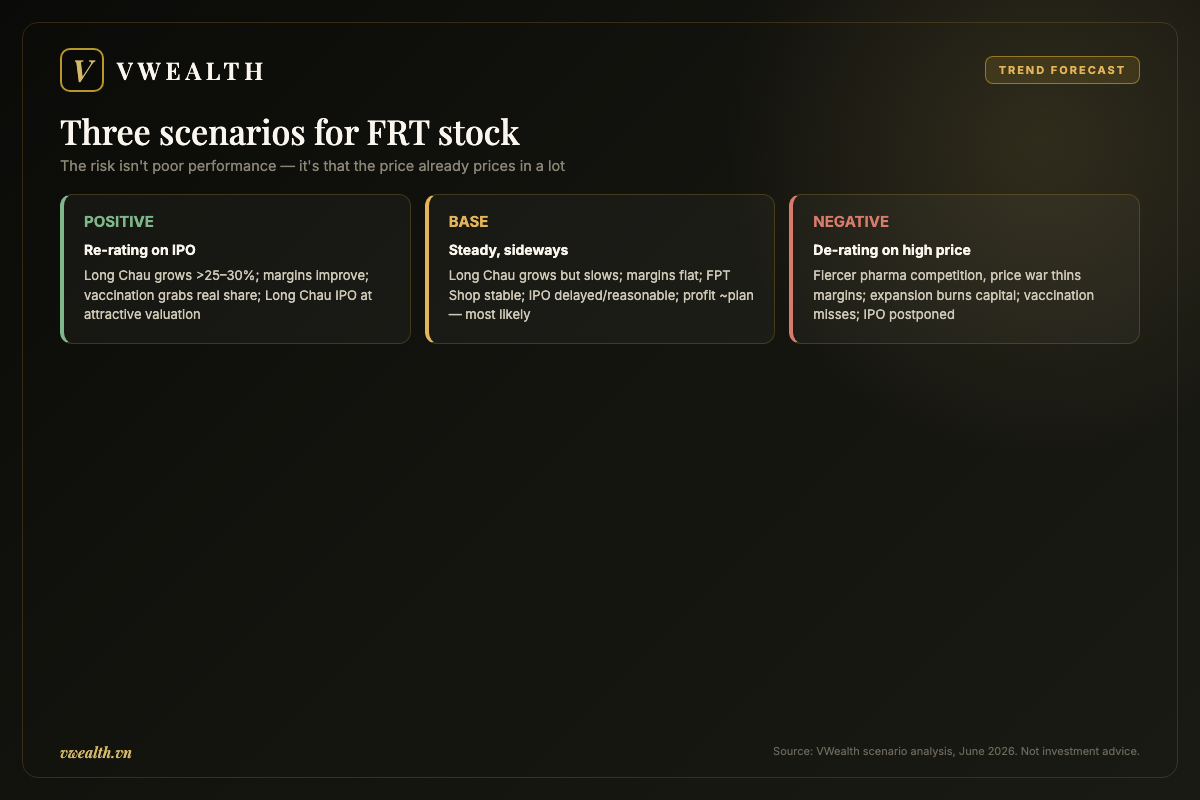
Positive scenario
Conditions: Long Chau maintains high revenue growth (above 25–30%/year), margins improve clearly thanks to a rising share of high-margin products and scale efficiency; the vaccination segment grabs real share; and most importantly, the Long Chau IPO plan materializes at an attractive valuation.
Price consequence: In this scenario, the market keeps paying a high P/E — even higher than now — for the growth story reinforced by the IPO catalyst. The share price has room to rise above the current zone. Note that even so, the gain will depend heavily on core profit truly rising, not just expectation.
Base scenario
Conditions: Long Chau grows well but gradually slows per the “a tree can’t grow to the sky” rule; margins move sideways; FPT Shop stays stable; the Long Chau IPO is delayed or happens but at a reasonable rather than explosive valuation. Profit grows steadily around the company’s stated plan (pre-tax profit about 1,550 billion dong in 2026).
Price consequence: This is the most likely scenario. The share price swings around the current zone, moving with short-term news and general market sentiment. The high P/E is “sustained” by real profit growth, but no valuation leap. Investors benefit from profit growth more than from P/E expansion.
Negative scenario
Conditions: Competition in pharma gets fiercer — Pharmacity or a revived An Khang pushes a price war, thinning the already-thin margins further; store and vaccination-center expansion costs devour capital but the payback is slow; the vaccination segment doesn’t grab share as expected; the Long Chau IPO is indefinitely postponed, dissolving the catalyst.
Price consequence: When a stock trades at a P/E of 25–40x and growth stalls or profit misses, the correction can be very strong. High valuation is a double-edged sword: it amplifies gains when everything’s favorable, but also amplifies the drop when expectations break. In this scenario, the share price could face significant downward pressure toward a more reasonable valuation zone.
The crux to draw: with FRT, most of the risk isn’t in the business “performing poorly” — it’s that the price you pay already embeds a lot of good expectation. When expectations are high, even a “good but not excellent” result can trigger a correction.
Should you buy FRT stock?
And now the question you’ve waited for all article. I’ll answer the most honest way an analyst can: I will not tell you “buy” or “sell.” Anyone who dares assert that firmly to a person they’ve never met, not knowing their finances, goals or risk appetite — is someone you should be wary of. Instead, I’ll put on the scale everything we’ve analyzed, then let you decide whether FRT fits you.
Weighing the pros — what makes FRT attractive
- Owning Vietnam’s number-one pharmacy chain. Long Chau doesn’t just lead, it leads overwhelmingly with over half the modern-trade share and a gap several times over the nearest rival. In an industry where scale is the core competitive advantage, this leading position is very hard to dethrone.
- Riding a defensive, high-growth, large-room industry. The pharma industry grows 8–10%/year, stable across the economic cycle, and the low modernization rate means the room to grab share from small pharmacies is still very wide. Long Chau is the biggest beneficiary of this shift.
- The rising high-margin vaccination segment. 223 centers and expansion momentum create a potential second profit pillar, on a swelling vaccine market.
- FPT Shop out of loss, providing a stable base. The ICT burden is removed; this segment profits again, no longer dragging down the consolidated picture.
- The Long Chau IPO catalyst. The possibility of separating Long Chau for listing at a large valuation is a potential driver that could re-rate the entire parent stock.
- Backing from the FPT ecosystem. As a member of the FPT family, FRT inherits technology capacity, data governance and brand reputation — things helping run a large-scale chain efficiently and comply well with the tightening digitalization policy framework.
Weighing the cons — what makes you cautious
- Expensive valuation. This is the biggest risk and must be said straight. At a P/E around 25–40x (2026 forward P/E estimated by some at about 32x), the market has prepaid a lot of growth expectation into the price. You don’t buy FRT at a “bargain” price; you buy a beautiful story fully — even somewhat optimistically — priced.
- Thin core profit with a one-off element. 2025 pre-tax profit reached 1,219 billion dong, up as much as 131% — a very impressive number. But you need to be clear-headed: this abnormal jump is partly “embellished” by a one-off gain, not recurring annually. Core pharma-retail profit is inherently thin, so don’t extrapolate the 131% growth into a sustainable trend.
- Thin pharma-retail margins and capital intensity. Each dong of revenue leaves only a small net margin, while expanding the network requires continuous capital burn for premises, staff and inventory. Growth is beautiful but “expensive” to sustain.
- Relentless competition. Pharmacity is still resourceful, An Khang could be revived by MWG, and the vaccination segment remains under VNVC’s shadow. A price war could erode margins anytime.
- ICT saturation. The FPT Shop segment escaped loss but the phone-laptop market has basically saturated, with little hope of breakthrough growth. It’s the base, not the engine.
- Low dividends. FRT mainly reinvests to expand, so cash dividends are very modest (recent dividends mainly in stock). If you need steady cash flow, this isn’t the stock for you.
Which kind of investor does FRT suit?
The most useful way to answer “should you buy” yourself is to view this stock through the lens of four common investor types:
| Investor type | Fit with FRT |
|---|---|
| Growth investor (accepts paying a high price for the future story, can bear volatility) | Best fit. If you believe in the Long Chau story dominating pharma long-term and are willing to ride the swings, FRT is right in your “appetite.” |
| Value investor (seeks stocks cheap versus intrinsic value) | Less suitable. A P/E of 25–40x is hard to call “cheap.” You’ll feel uncomfortable paying a high price for expectation. |
| Income investor (lives on dividends) | Not suitable. Low cash dividends, the business prioritizes reinvestment. |
| Defensive / risk-averse investor | Weigh carefully. The pharma industry is defensive, but FRT’s high valuation makes the stock prone to strong swings when expectations waver — not as “calm” as the industry name suggests. |
In short: FRT is a stock of the growth story, not a stock of safety or a bargain price. It’s for those who believe in Long Chau’s long-term vision in a pharma industry with much room, and have the nerve to accept they’re paying a high price for that belief. For those seeking a quantitative bargain, a steady dividend stream, or a peaceful sleep free of volatility worry — FRT is probably not the ideal choice.
Closing words
After all, the FRT picture is a clearly two-sided one: an operationally excellent business leading a wonderful industry, but traded at a price that already reflects most of that excellence. Opportunity and risk here don’t exclude each other — they walk together. Your job isn’t to find the “right answer” the whole market agrees on, but to find the answer right for your own situation, goals and risk tolerance.
Disclaimer: This article is produced for informational and reference-analysis purposes, and is not a recommendation to buy, sell or hold any security. All figures are cited from public sources at the time of writing and may change. Investing in stocks always carries risk of capital loss. You should research thoroughly (DYOR) and/or consult a licensed financial advisor before making any investment decision. Past performance does not guarantee future results.
Research Vietnamese stocks in English with vwealth. Our AI-powered platform turns Vietnamese market data into full English analysis reports — with international payment support and a free 2-month trial for new accounts. Create your free account and read the latest reports.