If you’ve ever stepped into a Thế Giới Di Động or Điện Máy Xanh store bathed in golden light, with blue-shirted staff rushing out to open the door, then you’ve touched Vietnam’s number-one retailer — Mobile World Investment Corporation (HOSE: MWG). This is the market leader in phone and consumer-electronics retail, now rising to lead grocery retail too with its Bách Hóa Xanh chain — an empire built from a few small phone shops on Nguyễn Đình Chiểu street in 2004.
But the story that makes MWG stock worth dissecting to the last detail isn’t a linear climb — it’s a spectacular “die and revive” life cycle, rare on Vietnam’s stock market. In 2023, MWG fell into a genuine profit crisis: net profit plunged nearly 96%, to just 168 billion dong — the lowest since 2013 — after the company itself lit a “price war” that self-destructed its margins, forcing it to close hundreds of stores and cut tens of thousands of staff to protect cash flow. Many had already written the “obituary” for this retail empire.
Yet just two years later, the picture reversed completely. In 2025, MWG’s revenue reached 156,166 billion dong (up 16%) and after-tax profit exceeded 7,000 billion dong — a record 89% jump year on year, the highest profit in the company’s history. The biggest driver of that revival was Bách Hóa Xanh — the gamble that “burned” money for nearly a decade — which finally turned a profit. The net-profit revival was driven directly by the core business results. As of 19 June 2026, MWG traded around 78,000 dong.
The question is very practical: at this price zone, should you buy MWG, and what kind of investor does it suit? That’s what this whole full analysis will answer for you. But to value a business that just walked through the “valley of death” then bounced back strongly, you can’t skip its founding journey — because that very history tells you what MWG learned from its stumbles, and whether today’s revival is sustainable.
MWG market data (updated 19 June 2026)
| Current price | 78,000đ | 2025 revenue | 156,166 bn (+16%) |
| Change (June) | −1.39% | 2025 after-tax profit | over 7,000 bn (+89%) |
| Current P/E | ~15–16x | Bách Hóa Xanh | Profitable 2nd year running |
Source: VWealth price data + MWG 2025 reports. Figures move by session — for reference only.
History and evolution
MWG’s history, from an investor’s angle, isn’t the chronicle of a company sailing smoothly. It’s a chain of bold bets, a few wins big enough to build an empire, and no small number of painful losses enough to teach leadership discipline. Grasp this flow and you’ll understand why MWG is both an attractive growth stock and a risky cyclical stock you need to treat with caution.
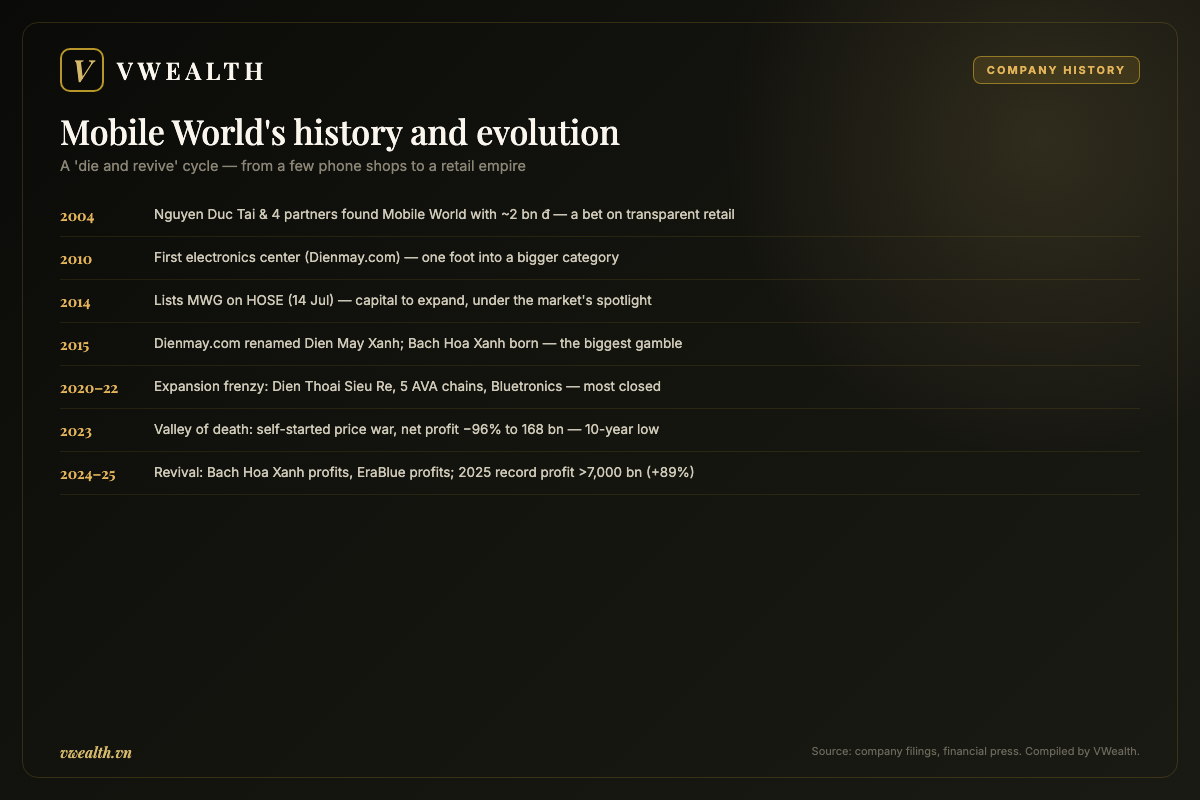
Starting from a few phone shops (2004–2009)
In 2004, Mr. Nguyễn Đức Tài and 4 partners contributed about 2 billion dong to found Mobile World JSC. By 2005, the first thegioididong.com supermarket specializing in phones and laptops was born on Nguyễn Đình Chiểu street, District 3, HCMC. At that time, Vietnam’s phone market was still fragmented into small shops where buyers were often “overcharged” and had no guarantee of genuine versus fake goods.
The difference Mr. Tài bet on from the start was a transparent shopping experience and dedicated service: publicly listed prices, enthusiastic sales advice, bright store spaces. That was the philosophy of “putting the customer’s interest above all, serving each customer with friendliness and courtesy” — which later became a core value in MWG’s corporate culture. Customer-centricity is one of the three culture pillars the company repeats over and over.
This model was immediately effective. In 2004–2008, more than 40 Thế Giới Di Động stores were born. The lesson for you here is very important: from the earliest days, MWG’s competitive edge wasn’t in the product (everyone sells the same phones), but in its chain-operating capacity and dense point-of-sale coverage. This is the core “weapon” the company would replicate into every other category.
Expanding into electronics and going public (2010–2014)
As the phone segment began reaching wide coverage, MWG spotted a neighboring category with far more potential: home appliances and electronics. In late 2010, the first electronics center opened at 561 Xô Viết Nghệ Tĩnh, Bình Thạnh District, under the Dienmay.com brand. This was the “one foot in” step into a new arena, learning to handle bulky, high-value goods requiring delivery-installation and warranty services more complex than phones.
The historic milestone for shareholders came on 14 July 2014: Mobile World officially listed MWG shares on the Ho Chi Minh City Stock Exchange (HOSE). Going public not only helped the company raise capital to expand, but also placed MWG under the market’s scrutinizing spotlight — from here, every leadership decision to expand or experiment would be reflected directly in the share price.
In 2015, MWG renamed Dienmay.com to Điện Máy Xanh nationwide and invested heavily in the brand. This “bet” succeeded resoundingly: in 2015 Điện Máy Xanh was only second with nearly 8% market share, but by 2017 it had risen to hold about 30%. Today, this chain holds about half the electronics market with a network of thousands of stores. For you, this is the first proof that MWG’s “formula” — bringing chain-operating capacity to conquer a fragmented category — truly can be scaled and create two solid profit pillars.
The big gamble named Bách Hóa Xanh (2015–2021)
Two pillars, phones and electronics, were already enough to make MWG the number-one tech retailer. But both industries have a hard limit: the market will saturate. People don’t buy a phone or fridge every week. Leadership understood that to sustain long-term growth, they had to enter a far larger market — one where consumers spend money every day: food and daily essentials.
In 2015, Bách Hóa Xanh was born. This was the biggest and most reckless gamble in MWG’s history. Fresh-food retail is an entirely different “beast”: thin margins, perishable goods, an obsessively complex supply chain, and fierce competition with traditional markets deeply embedded in Vietnamese habits. Bách Hóa Xanh went through many consecutive years of losses — an enormous price MWG paid to learn the food-retail lesson.
For investors, this was an extremely “divisive” phase. Many asked: was MWG burning shareholder money on a hopeless adventure? Bách Hóa Xanh’s prolonged losses became a “boulder” weighing on MWG’s valuation for years. But leadership itself argued this was an investment for the future: if it could capture the modern-grocery segment, MWG would own a growth engine many times larger than phones and electronics combined.
The expansion frenzy and the chains that had to close (2020–2022)
Entering the early 2020s, MWG entered a “frenzy” of testing new retail models, ambitious to diversify growth sources. Unfortunately, most of these experiments failed and closed one after another:
- Điện Thoại Siêu Rẻ — a low-price chain aimed at the mass segment, closed in 2020.
- The five AVA chains — in early 2022, MWG launched AVAFashion (fashion), AVASport (sportswear), AVAKids (mother and baby), AVAJi (watches, jewelry) and AVACycle (bicycles) all at once. Just half a year later, AVAFashion and AVAJi had to close for being ineffective, and AVASport was scaled back in 2023.
- Bluetronics — the effort to take the electronics model abroad to Cambodia, also in the group that had to be “corrected.”
This is an important chapter you shouldn’t skip when assessing leadership. On one hand, it shows MWG’s high risk appetite and sometimes undisciplined capital allocation. On the other — and this is the positive — the company shows the ability to cut losses decisively rather than stubbornly maintaining loss-making segments. This “test fast, fail fast, close fast” culture was precisely the prelude to the life-or-death restructuring right after.
The 2022–2023 crisis: the valley of death
If you had to choose one period that reshaped the market’s entire view of MWG, it’s certainly 2023. Post-pandemic, Vietnamese consumers’ purchasing power fell sharply amid spending cuts. In that context, MWG made one of its most controversial decisions: launching a “price war” to grab market share in phones and electronics.
The price paid was terrible. In 2023, MWG reached 118,280 billion dong in net revenue but net profit fell to just 168 billion dong — down 11.3% and 96% respectively versus 2022, the lowest profit since 2013. The price war MWG itself started eroded margins to the point of nearly wiping out the whole group’s profit.
Revenue still exceeded 118,000 billion dong, but profit was only 168 billion — a figure that stunned many investors into looking anew at a retail empire once thought invincible.
To survive, MWG entered a phase of fierce “belt-tightening”:
- Mass store closures — an estimated 200 stores closed in the last 3 months of 2023 alone to cut ineffective points of sale.
- Cutting tens of thousands of staff to reduce operating costs and protect cash flow.
- A series of senior leaders took no salary in Q3 2023 — a signal of the crisis’s severity.
At the same time, MWG carried out a pivotal Bách Hóa Xanh restructuring. From late 2022, leadership repositioned the chain from a “modern market” into a “minimart,” halting new openings to focus on changing store layouts, reviewing and closing hundreds of ineffective stores, and eliminating unprofitable categories. This is when MWG stopped chasing coverage and began chasing quality — a mindset shift of vital importance.
The lesson from this period is key when valuing MWG: this is a highly cyclical retail business, with profit extremely sensitive to the economy’s purchasing power and to strategic pricing decisions. A consumption shock or a strategic mistake can each “blow away” nearly all profit in a single year. This risk never fully disappears.
The revival: from the 2023 trough to the 2025 profit peak
The bottom of the crisis was also the start of one of the most impressive recoveries on Vietnam’s stock market. After swallowing the “bitter medicine” of restructuring, MWG entered 2024 with a leaner body, tighter cost discipline and a Bách Hóa Xanh that had undergone “major surgery.”
The sweet fruit came fast. In Q2 2024, Bách Hóa Xanh reached 10,138 billion dong in revenue (up 42%) and reported its first profit of about 7 billion dong after 7 straight years of losses. This seemingly small milestone carried enormous meaning: it proved the nearly decade-long gamble was finally right. For full-year 2024, Bách Hóa Xanh reached over 41,000 billion dong in revenue (up 30%) with 1,770 stores by year-end.
At the group level, the recovery showed clearly in “explosive” figures versus the low 2023 base: Q2 2024 after-tax profit of 1,172 billion dong (69 times the year-earlier period), and H1 2024 net profit of 2,075 billion dong (53 times). A new growth driver also began to profit: the EraBlue chain in Indonesia turned its first profit, and MWG set a goal to IPO EraBlue in Indonesia.
The peak of the revival journey was 2025. Consolidated revenue reached 156,166 billion dong (up 16%), while after-tax profit exceeded 7,000 billion dong — up as much as 89% and set a historic record. In Q2 2025 alone, profit hit a record of over 1,657 billion dong. More important than the number, the nature of the profit changed: it no longer relied only on phones and electronics, but gained a third pillar in a steadily profitable Bách Hóa Xanh, plus the potential billion-dollar “trump card” from EraBlue abroad.
What does this history tell you about MWG stock?
Closing the journey from a few phone shops in 2004 to a multi-sector retail empire in 2025, there are three messages to engrave when considering MWG at the 78,000-dong price zone:
- Chain-operating capacity is a real “moat.” MWG has proven it can replicate its retail formula successfully from phones to electronics, then to food — a hard-to-copy competitive advantage.
- This is a cyclical stock, not a linear grower. The 2023 history shows profit can nearly evaporate when demand is weak or strategy is wrong. Buying MWG means accepting living with volatility.
- Leadership dares to cut losses and knows how to revive. Closing a series of experimental chains and restructuring Bách Hóa Xanh until it profited shows a pragmatic, disciplined team — even if the risk appetite stays high.
Precisely because the human factor is decisive in this revival story, the next thing you need to examine closely is leadership — the people who took MWG to the bottom then pulled it back to the peak. That’s the subject of the next section.
Leadership and corporate culture

If you’re considering putting money into MWG stock, there’s a truth you need to absorb: you’re not just buying a chain of phone, electronics or minimart stores. You’re betting on a way of running people very different from the rest of Vietnam’s retail market. In this section, we’ll dissect MWG’s most intangible yet decisive asset: founder Nguyễn Đức Tài’s management philosophy, the successor layer now at the helm, the controversial stock-bonus culture, and the “dare to cut” mettle leadership proved in the 2023 crisis. This is a part investors tend to skim, but in my experience, it’s where the most risk and advantage are buried.
Nguyễn Đức Tài and the “put employees almost highest” philosophy
Nguyễn Đức Tài is co-founder and currently Chairman of the Board of Mobile World Investment Corporation. He’s the face tied to the entire brand story, and more importantly for you, the architect of a management philosophy Vietnamese business circles often mention with a mix of admiration and skepticism.
The most widely spread formulation tied to him is a controversial order of priority: customers in first place, employees in second, and shareholders — those who put money into the stock — in third. Note that this formulation has been conveyed by media and by him in various versions over time; the unchanging core is that employees are placed above shareholders in the internal value system. This is where a new investor should stop and think: you, as a small shareholder, are openly ranked after employees by leadership. It sounds disadvantageous, but the logic behind it is subtler than it looks.
Mr. Tài’s argument, as reported by the press, is roughly that most corporate outlays are costs, but two outlays should be seen not as costs but as investments: spending on employees and spending on customers. He once used the image that MWG is like a group of people going out to sea to fish together then sharing the catch — benefits shared among three groups: customers, investors and workers. This philosophy has also been called “management by love” by some writers, emphasizing trust and empowerment rather than control by fear.
What to draw from this: when a retailer wins or loses, it wins or loses at the checkout counter and in the store — where 50,000+ people directly touch customers. Placing employees high in the value system isn’t mere kindness; it’s an economic decision to turn service quality into a hard-to-copy competitive advantage.
Notably, Mr. Tài himself admits his management style has evolved. In the early founding phase, his system leaned toward “many rules,” rewarding right actions and punishing wrong ones — a tight-control model. Over time, he gradually shifted toward empowerment and accepting mistakes as part of growth. For you, this detail matters because it shows MWG’s head isn’t rigid; he’s willing to change even his own management beliefs when reality demands — a rare and valuable quality in an already-successful founder.
Battlefield retail thinking and memorable quotes
Unlike many Vietnamese business leaders who prefer talking macro strategy, Nguyễn Đức Tài is famous for very “battlefield” retail thinking and blunt, sometimes shocking statements. His most-quoted line revolves around accepting failure: roughly that failure is part of the game, that wanting something new means accepting a few failures, and that if you’re too afraid of failure, “going up a mountain to beat a wooden fish” (becoming a monk) is perhaps the safest option.
This statement isn’t just inspirational. It’s an operating compass explaining why MWG dares to test many models — from Bách Hóa Xanh, An Khang (pharmacy), AVAKids, to other chain experiments — and also dares to close them mercilessly when they don’t work. For an investor, this is a double-edged sword: you enjoy a culture that dares to experiment to find new growth engines, but you also must accept that experimental losses will appear in the financials. Understanding the “dare to play, dare to bear” character of the person in charge helps you not panic when a new segment isn’t yet profitable.
| Leadership trait | Real-world expression | Consequence for investors |
|---|---|---|
| Placing employees high in the value system | Pay, ESOP, service culture | Competitive edge in customer experience, but shareholders rank after |
| Accepting failure | Testing many new chains, closing weak ones | New growth opportunity paired with experimental-loss risk |
| Daring to cut when needed | Restructuring 2022–2024 | Protects margins, but large personnel swings |
| Self-changing style | From “control” to “empowerment” | Leadership able to adapt |
Stepping back from daily operations and the successor layer
A vital question for any business tied to a legendary individual is: “What happens when the founder steps back?” For MWG, this handover has been and is taking place deliberately, and it’s a point you should watch closely.
Nguyễn Đức Tài has gradually stepped back from the daily executive role to focus on the Chairman’s seat — that is, strategic direction and oversight, rather than directly running operations. In the new-term Board structure (2025–2028 per AGM documents), Mr. Tài is among the non-executive members, alongside figures like Robert A. Willett and Thomas Lanyi, plus independent members. The Chairman separating from operations is a positive governance signal, as it reduces the risk of power concentration and dependence on one person.
On the successor executive layer — and this is where you need to distinguish clearly to avoid confusing two names:
| Personnel (verified by disclosure) | Role | Note |
|---|---|---|
| Vũ Đăng Linh | CEO and Legal Representative of MWG (parent company) | Appointed around April 2025; with the group for many years; nominated for the new-term Board |
| Đoàn Văn Hiểu Em | Board member, tied to running the Thế Giới Di Động / Điện Máy Xanh chains | A veteran executive face, often appearing among senior leaders |
| Phạm Văn Trọng | Among the executive candidates on the Board | Tied to operations/chains within the group |
I want to stress caution here: Mr. Vũ Đăng Linh holds the CEO seat of the MWG group, while Mr. Đoàn Văn Hiểu Em is the person tied to running the Thế Giới Di Động chain — two roles at two different levels, easily confused by media. For you, the key message is: MWG is no longer a “one-man company.” An executive team forged over many years is gradually taking over, while the founder retreats to strategic oversight. What to watch is whether this successor layer keeps the “essence” of service culture and financial discipline Mr. Tài built — because culture, unlike a factory, can’t be transferred by an appointment decision.
ESOP: a double-edged sword between retaining talent and diluting shareholders
If there’s one thing that most “aggrieves” MWG’s small shareholders over the years, it’s the employee stock-bonus policy, or ESOP (Employee Stock Ownership Plan). This is a part you must understand well before putting money down, because it directly affects the shares you hold.
MWG is famous — or infamous, depending on your view — for its “generosity” in issuing ESOP. Leadership’s logic is consistent with the philosophy of placing employees high: let talented workers own part of the company at a preferential price so they stay, contribute and think like true owners. In a retail industry where regional and chain managers are constantly poached by rivals, ESOP is an extremely effective retention weapon. This is the bright side: it’s part of the motivation that helped MWG build one of the market’s most elite operating teams.
But the dark side, small shareholders feel most keenly: dilution. Each ESOP issuance at a low price increases shares outstanding, meaning your slice of the pie is cut smaller. This dispute isn’t new. From the early years after listing, at AGMs, representatives of big funds like Dragon Capital voiced that the ESOP ratio leadership proposed (at times up to about 5%) was too high and diluted their ownership. The classic contentious points include: large issuance ratios, preferential purchase prices far below market, and total ESOP value reaching thousands of billions of dong in some years.
How I see it: MWG’s ESOP isn’t absolutely good or bad, but a trade-off. You accept a little dilution each year in exchange for a team with ownership motivation. The right question isn’t “does ESOP dilute” (it certainly does), but “is the value the team creates larger than the portion diluted away.”
A commendable recent governance bright spot: MWG has begun attaching performance conditions to ESOP. Per recent AGM documents, the ESOP issuance ratio is only triggered when MWG’s share price grows above the general market index (VN-Index) plus a minimum premium (mentioned at about 5%). In other words, employees are only rewarded with stock when they actually make the stock outperform the broad market — their interest and yours are pulled in the same direction. This is a governance evolution you should see as a positive signal: leadership has listened to shareholders and adjusted, rather than ignoring. The ESOP ratio in recent rounds has also dropped significantly from the peak period, to around 1.3–1.4% instead of 5%.
The “dare to cut” mettle: managing through the 2022–2024 crisis
Management theory only has value when tested in the storm. The 2022–2024 period was the harshest test for MWG’s leadership, and how they overcame it says a lot about the quality of the team you’re about to invest in.
The context: phone and electronics demand weakened sharply post-pandemic, while the Bách Hóa Xanh chain had expanded too fast but wasn’t operating optimally, leading to prolonged losses with accumulated losses reaching thousands of billions of dong. Under that pressure, leadership chose the hard road: cut deep rather than tough it out.
| Restructuring action | Scale (per disclosure) |
|---|---|
| Closing ineffective Bách Hóa Xanh stores | About 400 stores, bringing the chain to around 1,700 points of sale |
| Streamlining group-wide headcount | Nearly 7,500 staff left in about a year (Q1 2024 alone about 4,900); headcount around 60,561 at end-Q1 2024 |
| Shrinking total system points of sale | Around 5,596 stores at end-Q1 2024 |
| Goal | The “Reduce quantity – Increase quality” strategy, bringing Bách Hóa Xanh to store-level profit |
The figure “nearly 7,500 staff left” sounds fiercely contradictory to the “place employees high” philosophy. This is a paradox you need to face head-on. Chairman Nguyễn Đức Tài explained that most of the headcount reduction came from natural attrition (staff leaving on their own), and the involuntary exit rate (layoffs) was very low. Whether or not you fully believe that explanation, one undeniable fact remains: leadership proved they dare to make painful decisions to protect the company’s financial health — which is protecting your assets.
For an investor, this is one of the most important signals in this whole section. Many Vietnamese businesses get bogged down because leaders don’t dare cut loss-making segments, toughing it out for pride or fear of public reaction. MWG did the opposite: they accepted short-term pain for long-term health. The result is that Bách Hóa Xanh after restructuring improved efficiency markedly and moved to break-even then profit at the operating level. This “dare to cut” mettle is, in my view, one of the strongest reasons to trust the quality of the executive team — no less important than the growth figures.
Ownership structure: who really holds MWG?
Finally, you need to know who you’ll “share the boat” with. MWG’s ownership structure has a few traits that surprise new investors.
First, Chairman Nguyễn Đức Tài’s personal ownership isn’t as large as many think. Per disclosures, he directly holds about 35 million shares, equal to about 2% of charter capital. This is modest versus the “boss” image the public imagines. However, the actual influence of the founding group and leadership is usually larger than the direct ratio, because ownership is dispersed across many team individuals and the internal ESOP-holding history. You should understand that controlling power at MWG comes more from the reputation and cohesion of the founding team than from any one person’s dominant stake.
Second, foreign investors were once a pillar shareholder but have decreased significantly. There was a time MWG’s foreign room was always full, held by big fund names like Dragon Capital and Arisaig Partners (Singapore). This picture has changed sharply: the Arisaig group exited its major-shareholder position from late 2023, and Dragon Capital — the remaining large foreign fund — also reduced its stake below the 5% threshold, no longer a major shareholder per recent disclosures (at one point around 4.96%). This is a point to weigh carefully in both directions: on one hand, foreign outflow creates share-supply pressure and partly reflects foreign caution; on the other, the foreign room no longer being too full opens room for new foreign capital to return if MWG’s growth story convinces again.
A monitoring tip: watch Dragon Capital’s buy/sell moves and the appearance of new foreign funds as a “barometer” of institutional confidence in MWG. Foreigners returning to accumulate is often an early signal that the fundamental story is improving.
To summarize this section, what you should carry away is: MWG is a business where human quality and culture are the core asset, led by a founder with a clear philosophy who knows how to evolve and dares to make hard decisions. ESOP is both a retention engine and a dilution cost you must accept — but it’s being managed more disciplinedly. The successor layer has formed, foreign capital is repositioning. A leadership apparatus that dares to cut losses and knows how to listen to shareholders is a solid foundation for you to move to the next section: dissecting the retail chains and ecosystem — where all this management philosophy converts into revenue, profit and real market share.
Retail chains and ecosystem
When you look at Mobile World Investment Corporation (ticker MWG), what you need to understand first isn’t a store, but a multi-tier retail machine. MWG is no longer the “phone king” of its original name. In 2025, this group set a historic revenue record of 156,166 billion dong, and the structure creating that number has changed fundamentally versus a decade ago. If you want to value MWG, you must dissect each chain: which is the “cash cow” giving steady money, which is the “star” devouring capital but promising the future, and which is just an experiment being trimmed. This section walks you through that whole ecosystem, so you see where MWG’s money truly comes from and where it will come from in the coming years.
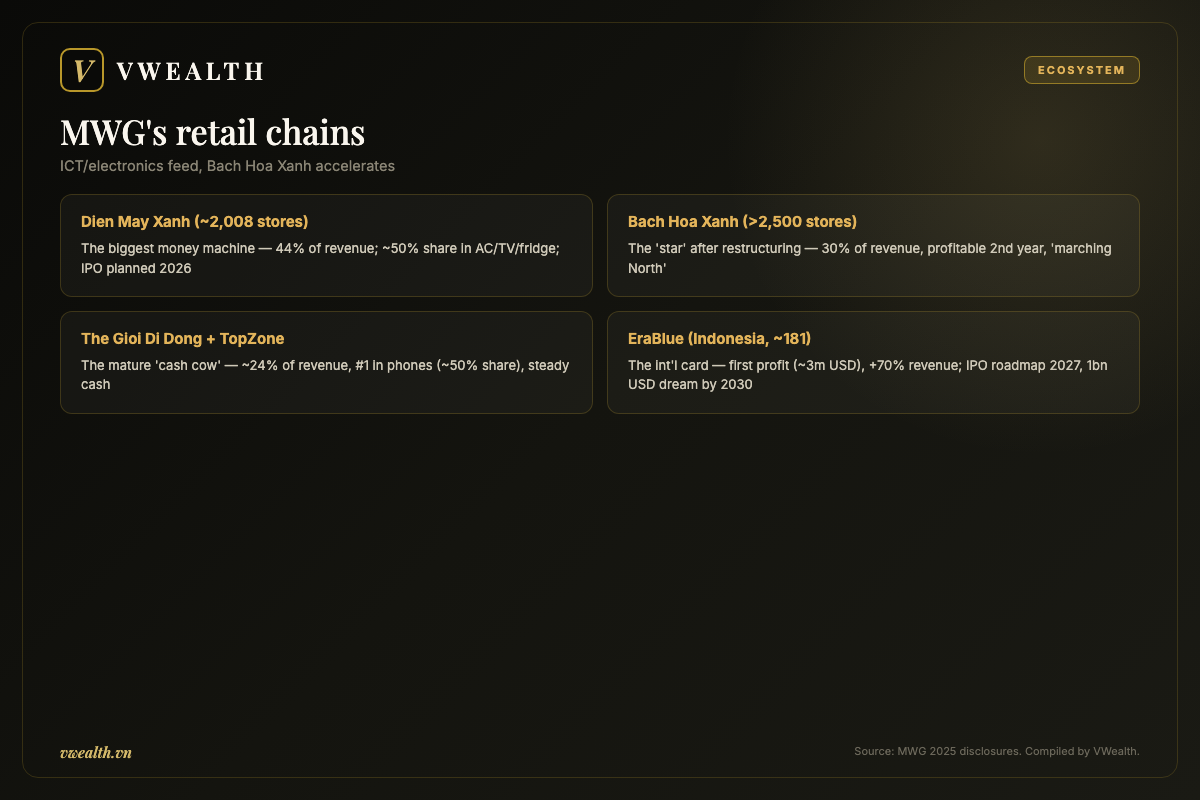
A framing number for this whole section: in 2025, the Điện Máy Xanh chain contributed 44% of total revenue, Bách Hóa Xanh 30%, and Thế Giới Di Động (including TopZone) about 23.7%. These three names carry nearly the whole machine, while An Khang, AVAKids and EraBlue play satellite roles — but satellite doesn’t mean unimportant. Let’s start where it all began.
Thế Giới Di Động (TGDĐ) — the mature “cash cow”
Thế Giới Di Động is the chain that laid the foundation for the whole group, and to this day it remains the symbol. But if you’re an investor, you need to view it clear-eyed: this is a mature category with no more room to boom. Vietnam’s mobile-phone market is basically saturated — almost everyone who needs a smartphone has one, and the replacement cycle is lengthening. TGDĐ holds the absolute number-one position in ICT (information and communications technology) market share, estimated at about half the official phone-retail market in Vietnam. MWG’s Chairman once said that a business holding up to 50% share in both phones and electronics is “a special case in the world,” not just Vietnam.
So why call this a “cash cow”? Because it generates stable cash flow with good margins, without requiring MWG to pour in more capital to expand heavily. At end-2025, the chain had 1,012 Thế Giới Di Động stores — a figure nearly flat, even slightly down from the peak a few years ago, because MWG proactively closed ineffective points. The strategy here is no longer “open more stores” but “milk the cow”: optimizing revenue per point of sale, pushing genuine Apple products through the premium TopZone chain, and cross-selling services, accessories and extended warranties. This is a part MWG operates too well, with little operating risk.
Note this reading MWG’s reports: the group often combines TGDĐ and Điện Máy Xanh revenue when reporting combined growth. In 2025, the “TGDĐ + ĐMX” cluster grew 18%, but the real driver of that gain lay in electronics, not phones. Standalone Thế Giới Di Động (including TopZone) revenue was about 37,300 billion dong. In other words, TGDĐ is the stabilizing brake, the cash flow feeding ambition — not the acceleration engine. Don’t expect it to double; expect it to be steady and generate cash.
Điện Máy Xanh (ĐMX) — the largest chain, the electronics throne
If TGDĐ is the symbol, then Điện Máy Xanh is MWG’s biggest money machine by revenue scale. This is what many individual investors get wrong — they still think “Thế Giới Di Động sells phones,” when in reality electronics is the pillar. In 2025, counting the way MWG consolidates the Điện Máy Xanh entity (including the ICT segment moved in), this entity recorded revenue of about 109,479 billion dong and 5,802 billion dong of after-tax profit, contributing up to 70% of revenue and 82% of profit of the whole group. The Điện Máy Xanh brand alone reached revenue of about 68,400 billion dong. This is a colossal figure for an electronics-retail chain in a country of nearly 100 million people.
ĐMX’s position is even more impressive than the number. This chain holds the absolute number-one position in electronics, with estimated market share around 50% in many key groups like air conditioners, TVs, fridges, washing machines. To picture its dominance: MWG once targeted 50% of the air-conditioner market and “wiped out” a series of rival electronics brands. At end-2025, the chain operated about 2,008 stores nationwide — double the number of TGDĐ stores.
ĐMX’s key growth weapon is the “supermini” model. These are small-footprint stores of just 120–150 m², designed to reach down to the district and commune level — where the traditional large electronics-supermarket model can’t fit due to premises cost and insufficient customer volume. An interesting fact to remember: average revenue per supermini store reaches nearly 2 billion dong/month, nearly double a normal Điện Máy Xanh mini store. This model has passed 1,000 stores, letting MWG cover rural areas at low cost while keeping high efficiency. This is precisely how ĐMX keeps growing even though the urban market is crowded.
Key point for valuation: ĐMX isn’t just the largest chain today — MWG is also preparing to IPO (initial public offering) the Điện Máy Xanh entity, expected in 2026. If successful, this could become an independent billion-dollar business on the exchange — an event that could unlock hidden value inside MWG. You should watch this information closely.
Bách Hóa Xanh (BHX) — the “star” after the restructuring storm
This is the most important part, and you should read it most carefully. Bách Hóa Xanh is the biggest, most expensive and most controversial gamble in MWG’s history. For many years, this food-and-grocery chain was the “money-eating child”: it lost continuously, at one point rocking the whole group and sinking MWG’s stock. The question the market posed in 2021–2022 was brutal: does MWG even know how to sell vegetables, or will this ambition drag the whole group down?
The turning point came from a fierce restructuring. MWG closed a series of ineffective points of sale, changed store layouts, redid the whole supply chain and logistics, and most importantly changed operating thinking toward cost discipline. The result is a spectacular revival story rarely seen in retail: BHX began profiting from 2024, and 2025 was the second straight year of profit — with profit growth MWG describes as “up several times” versus the prior year.
Look at the 2025 numbers to understand why this is a “star.” Bách Hóa Xanh reached revenue of about 46,900 billion dong, up 14% versus 2024 — a record revenue in the chain’s 8-year history. Average revenue exceeded 128 billion dong per day. In 2025 alone, BHX opened as many as 789 new stores, lifting total points of sale to over 2,500 supermarkets. This chain contributes about 30% of the whole group’s total revenue — a weight showing it has become a true pillar, no longer a burden.
Why call BHX the future growth driver? For two structural reasons. First, unlike phones or electronics, food and daily essentials are a daily repeat need — you buy a phone once every few years, but buy vegetables, meat, rice every day. This is durable cash flow with an enormous market size, many times larger than the ICT market. Second, BHX so far still operates mainly in the South (HCMC and southern provinces, the Central Highlands). The entire Central and Northern markets are almost untouched.
And this is precisely the “march North” plan you need to pay special attention to. MWG has announced a roadmap to expand BHX into the Central and Northern regions. Per securities-firm estimates (like Kafi), Bách Hóa Xanh could open another 800–1,000 stores each year in 2026 and 2027, mostly concentrated in the North and Central regions. MWG leadership even set the ambition of bringing Bách Hóa Xanh to 10 billion USD in revenue before 2030. If even part of that ambition materializes, BHX will surpass even electronics to become the group’s largest chain.
But you must also be clear-eyed about the risk. “Marching North” isn’t a straight line. The Northern market has different consumption habits, a dense traditional-market system and fiercer competition. Many food-retail chains have failed going North. MWG itself once paid dearly for expanding BHX too fast in the early phase. So when valuing MWG, you should treat BHX as a “growth option” of great value but with execution risk — it can be the engine that lifts the stock to a new valuation tier, but can also stumble if the expansion pace exceeds the ability to control margins. This is the most important variable in MWG’s investment story in the coming years.
An Khang and AVAKids — small chains being streamlined
Alongside the three pillars, MWG also nurtures a few small chains ambitious to find new growth “rails.” But in 2024–2025, the dominant spirit in this group is trimming, not expanding — and that’s a positive signal about leadership’s capital discipline.
The pharmacy chain An Khang is the clearest example. It was once expected to be the next “gold mine” in pharma retail, but reality was harsher. Versus early 2024, An Khang closed about 201 pharmacies, equal to a 38% cut in points of sale, with a peak month (July 2024) cutting up to 94 stores. By year-end, the chain stabilized at over 300 operating stores, with accumulated losses reaching nearly 1,000 billion dong. The good news is that after restructuring, the loss narrowed sharply and An Khang was forecast to near break-even (EBIT near break-even), possibly profitable from 2025. But its scale is too small versus the whole group — you shouldn’t put An Khang into the main investment thesis, only see it as a small bet being risk-controlled.
The mother-and-baby chain AVAKids follows a similar direction: shrinking points of sale to focus on efficiency over quantity. Notably, despite the sharp downsizing, AVAKids recorded double-digit revenue growth and reached company-level profit, with average revenue of about 1.8 billion dong/store/month. This proves MWG’s new philosophy: better fewer stores that profit than many stores that lose. For you, the message is: MWG has learned the lesson from its rampant-expansion phase, and now prioritizes cash-flow quality over ballooning the balance sheet.
EraBlue (Indonesia) — the international card that already profits
This is the part that makes the MWG story interesting from a long-term angle. EraBlue is MWG’s electronics-retail joint venture in Indonesia — a market of nearly 280 million people, nearly three times Vietnam’s and still very nascent in modern electronics retail. Simply put: MWG is trying to recreate the “Điện Máy Xanh” miracle in another country, where growth room is still untouched.
And the first signals are very positive. At the close of fiscal 2025, EraBlue grew revenue over 70% year on year, with about 181 stores — far exceeding the 150-store plan set at the start of the year. Chain revenue reached about 3,700 billion dong and after-tax profit about 54 billion dong (equal to 3 million USD). This makes EraBlue one of few international joint ventures of a Vietnamese business that truly profits, rather than just “burning money for market share.” Per-store performance is also impressive: the large-store model reaches revenue of about 4 billion dong/month, nearly double an equivalent store in Vietnam.
MWG’s ambition is far larger: group leadership targets bringing EraBlue to 1,000 stores and 1 billion USD in revenue by 2030, while setting an IPO roadmap for this chain in Indonesia, expected around 2027. If you believe in MWG’s proven operating capacity in electronics, EraBlue is an attractive “international growth option” — large potential reward, and if it stumbles the damage is limited because it’s a risk-sharing joint venture with a local partner. However, remember EraBlue’s scale is still small versus the whole group, so it’s more a factor “adding to expectation” than an immediate financial driver.
Online, logistics and the Quà Tặng VIP membership card — the glue binding the ecosystem
A segment you easily overlook but is important to understand MWG as an ecosystem, not a collection of disconnected stores, is the online channel and loyalty program. MWG operates its own e-commerce platform for each chain, and in 2025 renewed its online ambition: the online channel reached nearly 2,700 billion dong in the first 6 months, about 6% of total revenue. Unlike pure online platforms that must burn money on logistics, MWG has the “omni-channel” advantage — thousands of physical stores serving as points of sale, warehouses and pick-up/delivery points, keeping delivery costs low and speed fast.
The weapon binding the whole ecosystem is the Quà Tặng VIP app — the group’s membership and points program, with about 16 million users. In May 2025, MWG integrated the MWG Shop e-commerce marketplace into this very app, expanding the catalog to food, beverages, mother-and-baby goods, household items. Customers can use points to discount up to 10% on each order at any store, website or service of the group. Picture the power of this: a customer buys a phone at TGDĐ, an air conditioner at ĐMX, vegetables at BHX — all in the same account, the same behavioral-data store. This is an enormous data asset that standalone rivals can’t have, and the foundation for MWG to cross-sell across chains.
Bottom line: “ICT/electronics feed — Bách Hóa Xanh accelerates”
If you need one line to remember about MWG’s whole ecosystem, it’s: ICT and electronics feed, while Bách Hóa Xanh accelerates. Thế Giới Di Động and Điện Máy Xanh are two mature cash cows, generating abundant, stable cash flow — they no longer grow explosively, but they’re the “safe” part, the part valued by certain cash flow. That money is used to feed future ambition: Bách Hóa Xanh “marching North” domestically, EraBlue expanding in Indonesia, while An Khang and AVAKids are kept in streamlined, low-risk mode.
This structure makes MWG a “two-in-one” stock for you: partly a value business generating cash from ICT and electronics, partly a growth story from food retail and international expansion. MWG’s fair valuation, therefore, can’t just look at current profit, but must balance the certain cash flow of the mature chains against the option value of the accelerating chains. To make that balance, you need to move to the next part — where we dissect MWG’s competitive position and financial health, to see how firmly this multi-tier machine stands on the balance sheet and whether it has the internal strength to fund the ambitions just described.
Position and financial health
If you looked at just one number for Mobile World (ticker MWG) in 2025, which would you pick? Net revenue of 156,166 billion dong — a record, up 16% and topping 156 trillion for the first time in history? Or after-tax profit exceeding 7,000 billion dong, jumping 89% year on year, a recovery almost like “resurrection” after the 2023 trough? The answer actually lies not in either number, but in the gap between them. Revenue rose only 16% but profit rose 89% — that very divergence is the key to understanding the financial nature of the largest retailer on Vietnam’s stock market. This section dissects MWG’s market position, margin characteristics, the Bách Hóa Xanh turning point and the balance-sheet health — so you don’t just read the number, but understand why the number moves as it does.
Number-one position in retail: a moat made of scale
Before discussing each dong of profit, you need to place where MWG stands on Vietnam’s retail map. The short answer: at the lead, and the gap with the rest is not at all close. In its core segment of phones and electronics, MWG holds dominant market share. In mobile phones alone, the two chains Thế Giới Di Động and Điện Máy Xanh control over 50% of the total market across all brands; in iPhones specifically — the highest-value segment — MWG at one point held about 50% of distribution share in Vietnam. In electronics and consumer electronics generally, Điện Máy Xanh is the number-one chain nationwide. In other words, for every two phones sold through official retail channels, one goes through MWG’s system. That’s not “one of the leaders,” that’s the leader.
That position is built on scale, and MWG’s scale is hard for any listed rival to match. Net revenue of 156,166 billion dong in 2025 means that, on average, this group takes in nearly 428 billion dong per day — an almost non-stop flow of goods money. The physical network behind that flow includes over 2,000 Điện Máy Xanh stores, a Thế Giới Di Động system covering all provinces, and nearly 1,800 Bách Hóa Xanh stores. When you operate several thousand points of sale on one logistics system, a small math problem becomes a large advantage.
What investors call MWG’s “economic moat” is made of three layers stacked on top of one another:
- The purchasing-scale moat. As the largest customer of nearly every phone and electronics brand in Vietnam, MWG has bargaining power with suppliers a small chain can’t have. Better discounts, more flexible payment terms, priority on stock when “hot” products are scarce — all flow toward the biggest buyer.
- The network moat. Several thousand stores reaching down to the district level create coverage that a new rival would have to burn a lot of capital and years to copy. This coverage isn’t just for selling, but also for delivery, warranty, returns — things that build trust for high-value buyers.
- The logistics moat. A warehousing, inventory-management technology and supply-chain system built to serve enormous scale. It’s precisely this logistics capacity that MWG is “reusing” to feed Bách Hóa Xanh — a strategic card we’ll return to right below.
MWG’s leading position doesn’t come from an exclusive product or a patent, but from scale. And scale, once large enough, feeds itself: sell more to buy cheaper, buy cheaper to sell more competitively, sell more competitively to sell even more. That spiral is very hard to break from outside.
The thin-margin story: why profit rose 89% when revenue rose only 16%
This is the most important part if you want to understand MWG as an investor rather than a news reader. Retail has a very distinctive profit character: enormous revenue but very thin net margins. For MWG, the after-tax margin is only about 4–5% of revenue — meaning of every 100 dong of goods sold, after deducting cost of goods, store operating costs, staff pay, premises rent, interest and tax, the business keeps just about 4 to 5 dong. Most of the revenue is suppliers’ money passing through MWG’s hands and moving on.
A margin this thin sounds like a weakness, but it actually creates an extremely interesting financial trait: very high operating leverage. Picture it simply. Suppose revenue is 100 dong, cost of goods and fixed costs eat 95 dong, profit is 5 dong. Now revenue rises slightly to 110 dong. If the fixed-cost portion (premises, core staff, depreciation, systems) doesn’t rise at the same pace, the added revenue flows almost straight to profit. Profit can jump from 5 to 8–9 dong — that is, up 60–80% with just a 10% revenue rise. Operating leverage is precisely that amplifying mechanism.
See it? This is exactly what happened to MWG in 2025. Revenue rose only 16%, but because the business had gone through the fierce 2023–2024 restructuring — closing ineffective stores, streamlining the apparatus, cutting costs, lifting gross margins — when demand recovered, the added revenue met a cost structure already compressed tight. The result was after-tax profit jumping 89%. Gross margin improved each quarter, and net profit thickened with each reporting period.
But leverage is a double-edged sword, and this is what you must engrave when valuing MWG stock:
- When demand rises and costs are controlled: profit rises many times faster than revenue — exactly like 2025. This is the “favorable heaven” scenario.
- When demand is weak or costs escalate: the reverse also holds. A small revenue dip or a cost spike can erode the thin profit very fast — exactly like 2023, when MWG’s profit fell to nearly zero.
So MWG’s profit is very sensitive to two variables: consumer purchasing power (a macro factor, out of control) and cost discipline (an internal factor, within control). A wise investor always asks: is this year’s spiking profit from the business truly getting better, or just from a favorable consumption cycle? For MWG in 2025, the answer is both — and that’s why the market was excited.
Bách Hóa Xanh profits: the turning point that turned a “black hole” into an engine
If operating leverage is the theoretical frame, then Bách Hóa Xanh is the real story that made the 2025 profit jump special. For many years, Bách Hóa Xanh was MWG’s “black hole” — a fresh-food grocery chain heavily invested in, rapidly expanded, and chronically loss-making. Every dong of profit the phone and electronics segments earned was partly sucked away by Bách Hóa Xanh. Investors valuing MWG always had to “dock points” for this loss as a fixed burden.
2025 reversed that story. Bách Hóa Xanh not only escaped operating loss but contributed significant profit — a contribution recorded at over 700 billion dong, marking the second straight year of profit and a “thick” profit several times higher than the prior year. Average revenue per store reached about 2 billion dong/month, up as much as 29% year on year — a figure showing the chain reached scale break-even (each store selling enough to carry fixed costs) and began truly profiting.
Why is this a valuation turning point, not simply a small segment flipping from loss to profit? Think through this logic:
- Double impact on consolidated profit. When a segment flips from loss to profit, overall profit improves in two directions at once: cutting the loss being subtracted, and adding the new profit. This reversal contributed significantly to the whole group’s 89% profit jump.
- Opening a second growth axis. The phone and electronics segments already hold dominant share, meaning little natural growth room remains. Bách Hóa Xanh — hitting the enormous food-and-essentials market where MWG still has small share — becomes the new growth engine the market craves.
- Changing how the market “labels” the stock. A saturated electronics chain is usually valued at a modest multiple. A business with an added growing, profitable grocery axis deserves a higher multiple. This is precisely the “re-rating” mechanism — when the story changes, the market is willing to pay more for the same dong of profit.
Bách Hóa Xanh profiting doesn’t just add a few hundred billion to the report. It erases a years-long psychological burden, replacing it with a new growth story. In stock valuation, a change in the story is sometimes even more important than a change in the number.
The ambition ahead makes this story more attractive: leadership targets raising Bách Hóa Xanh’s profit contribution to at least 1,200 billion dong in 2026, while deploying a plan to open about 1,000 more stores and aiming for the long-term goal of erasing accumulated losses. If achieved, this second growth axis will contribute far more in the coming years.
Financial health: reading a retailer’s balance sheet
Beautiful profit is one thing, sustainable financial health is another. To assess whether MWG is “healthy,” you need to understand that retail is a working-capital-intensive industry — it needs a large amount of money “stuck” in inventory and receivables to operate daily. How MWG manages this capital flow is precisely the measure of the apparatus’s true capability.
Inventory turnover. This is a vital metric for an electronics retailer, because tech products lose value very fast — a phone model sitting long in the warehouse loses value each day. At end-Q3 2025, MWG’s inventory was over 24,000 billion dong. The absolute number sounds large, but what’s notable is that inventory turnover improved in sync with return on invested capital — proof that the apparatus after restructuring became leaner, sold faster, and “held” fewer slow-moving goods. For a retailer, fast turnover means not just good sales, but also reduced markdown risk and freed cash.
Short-term debt funding working capital. This is the most easily misunderstood point reading MWG’s balance sheet. At end-Q3 2025, total liabilities were nearly 48,500 billion dong, of which borrowings were over 28,700 billion dong, and notably almost all is short-term debt. At a glance, a business with nearly 50 trillion in debt looks very risky. But the nature here differs entirely from a business borrowing long-term to build a factory. MWG borrows short-term mainly to fund working capital — using cheap, short-term, continuously rolling debt to buy goods, then selling goods to collect cash to repay. This is the classic retail financial model: goods money turns very fast so short-term debt is repaid and re-borrowed continuously and safely. Problems only arise if goods suddenly sell slowly — then short-term debt becomes real pressure. So this debt’s health is tightly tied to the inventory turnover we discussed above.
The “cash store” and cash flow. The counterweight to the large short-term debt is an enormous cash balance. At end-Q3 2025, MWG held over 40,000 billion dong in deposits and bond investments — an “idle cash store” that’s not only a safety cushion but also self-generates significant financial interest, adding to profit. More important is that operating cash flow (CFO) stayed strongly positive over the years — proof that MWG’s profit is “real profit” with hard cash attached, not just a book number. A business that profits but is cash-flow negative is a suspicious sign; MWG is the opposite, both profiting and generating cash.
ROE recovers strongly. If you had to pick one metric to summarize MWG’s revival, it’s return on equity (ROE). This metric bounced from near zero — just 0.71% in the 2023 trough — to about 21% in 2025. This is a spectacular turnaround: from shareholders’ capital nearly not generating profit, to every 100 dong of capital creating over 20 dong of profit a year. ROE recovering to the 20% zone puts MWG back among businesses with good capital efficiency on the market, and is quantitative proof the restructuring succeeded.
Putting it together, MWG’s financial-health picture can be summarized: large short-term debt but “backed” by fast inventory turnover and a thick cash store; spiking profit but with real cash attached; capital efficiency (ROE) recovering strongly to the 20% zone. This is the balance sheet of a retailer that has walked through crisis and returned to health — provided purchasing power stays favorable.
2025 financial metrics and 2026 targets
For a condensed view before moving to market reception, the table below summarizes MWG’s core 2025 financial metrics alongside the targets leadership set for 2026:
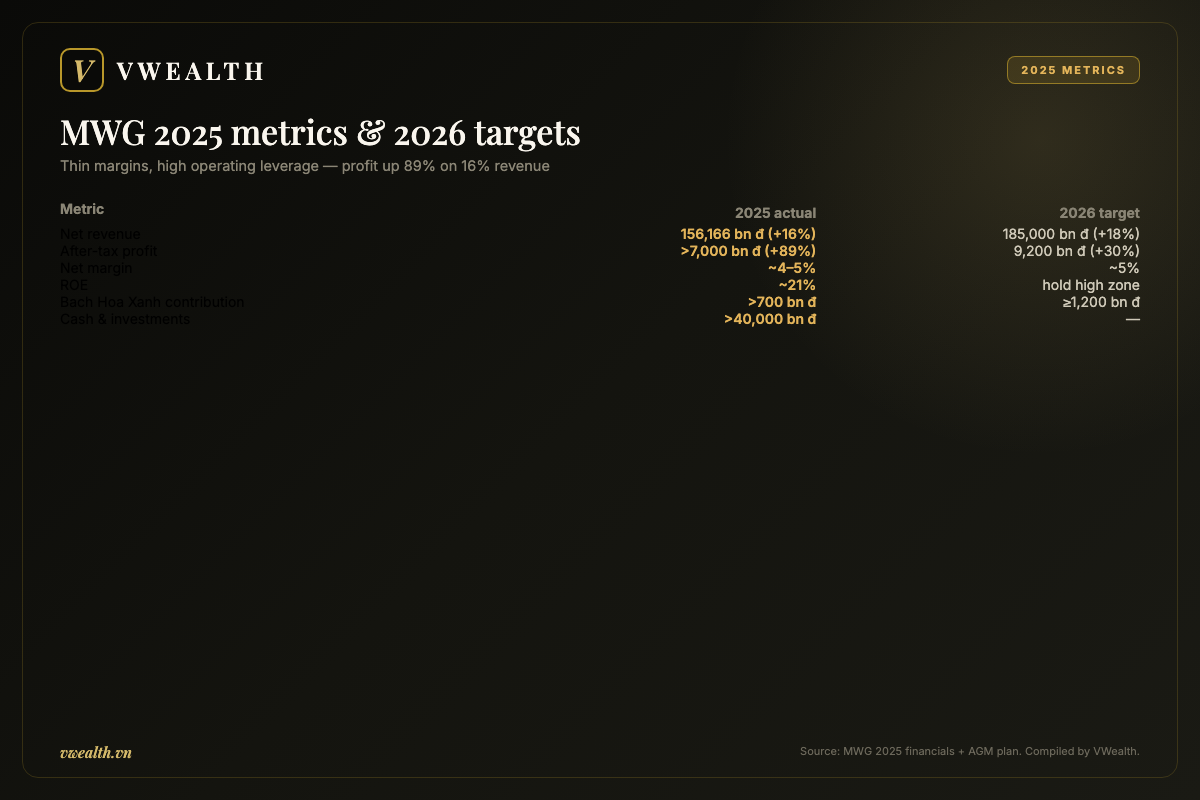
| Metric | 2025 actual | 2026 target | Note |
|---|---|---|---|
| Net revenue | 156,166 bn (+16%) | 185,000 bn (+18%) | Both are historic records |
| After-tax profit | >7,000 bn (+89%) | 9,200 bn (+30%) | Operating leverage + Bách Hóa Xanh |
| Net margin | ~4–5% | ~5% | Retail’s thin-margin nature |
| ROE | ~21% | Expected to hold the high zone | Recovered from 0.71% (2023) |
| Bách Hóa Xanh contribution | >700 bn | ≥1,200 bn | The second growth axis |
| Cash and investments | >40,000 bn | — | Idle cash store earning interest |
Looking at this table, you’ll see a consistent logic. MWG targets 2026 to keep setting new records in both revenue and profit, with profit up 30% — faster than revenue (18%), once again showing retail’s operating-leverage nature. The main driver is clearly stated: optimizing revenue at existing stores and lifting Bách Hóa Xanh’s contribution to nearly double. This isn’t a plan reliant on a miracle, but a reasonable extension of what already ran in 2025.
Of course, a target is still just a target. This whole beautiful scenario stands on a foundational assumption: consumer purchasing power keeps recovering and costs are controlled. If the macro reverses, the very operating leverage amplifying profit up today will amplify the drop down tomorrow. That’s the inherent risk anyone holding MWG stock must put on the scale — not to fear, but to value correctly.
So you now hold a full picture of MWG’s position and financial health: a retail-industry leader with a solid scale moat, operating on thin margins but high leverage, having just activated the added Bách Hóa Xanh growth engine, and standing on a balance sheet that has recovered its health after crisis. The next question, and the one every investor cares about most, is: how has the stock market received all this, and how far has the current share price reflected that revival story? That’s what we’ll dissect next.
Market reception
If the previous section helped you understand what MWG does to make money, this section answers a more important question for an investor: how is the market valuing Mobile World, and is the 78,000-dong price you see on the board on 19 June 2026 expensive, cheap or reasonable? This is where emotion and numbers clash hardest. MWG isn’t an ordinary stock — it’s the “national” stock of hundreds of thousands of Vietnamese individual investors, a name tied to both fat gains and heartbreak in the 2022–2023 period. So the way the market receives MWG carries heavy cyclical psychology — and that very thing creates both opportunity and trap for you.
Let’s start from the barest numbers, then move to the “why.”
The current valuation picture: P/E around 15–16x
At a reference price of 78,000 dong/share (real data on 19 June 2026 from the VWealth system), MWG is trading in a valuation zone analysts call “reasonable leaning toward attractive” for an industry leader in a profit-recovery phase. Look at the chart below for a common reference baseline before going deeper.
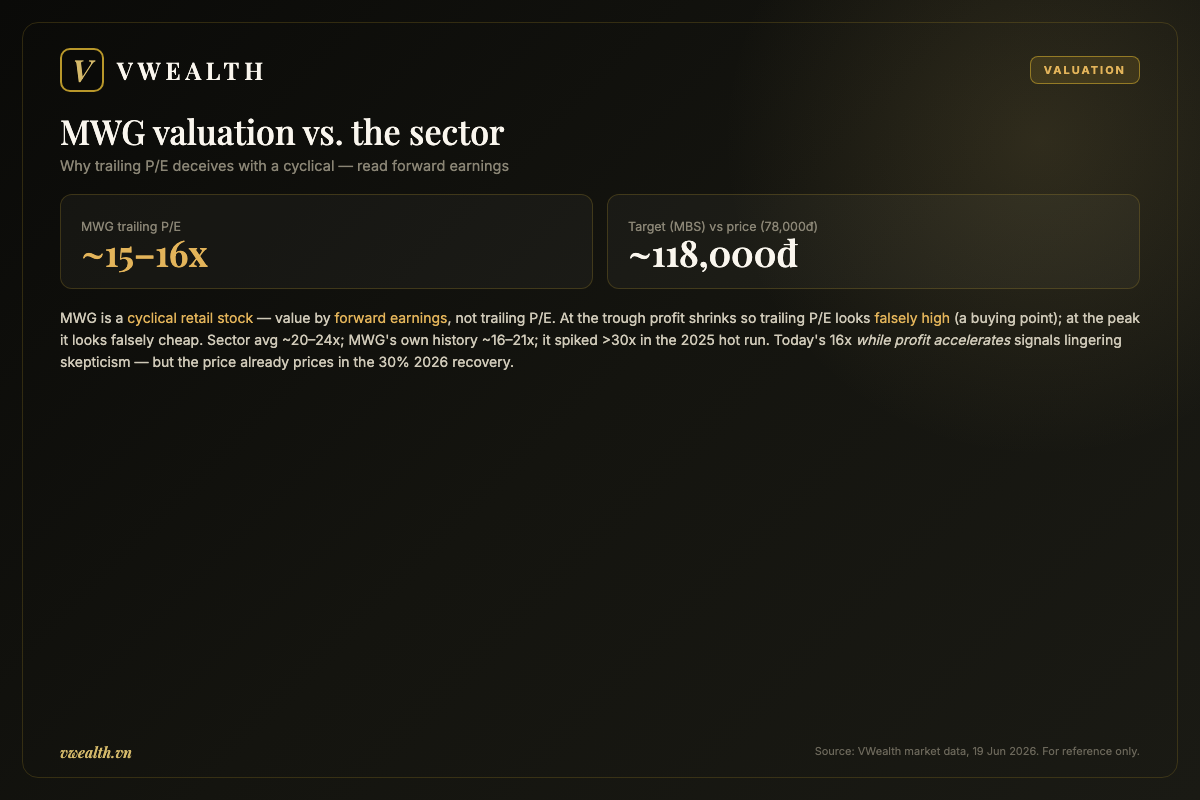
The core calculation is very simple, and you should verify it yourself rather than trust anyone’s words. MWG reported 2025 after-tax profit over 7,000 billion dong — specifically about 7,075 billion, the highest in its history and up nearly 90% year on year, beating the plan by 46%. With about 14.6 billion shares outstanding, earnings per share (EPS) fall around 4,800–5,000 dong. Dividing 78,000 by that EPS, you get a price-to-earnings (P/E) ratio of about 15.6 to 16.3x. In other words, at the current price, you’re paying about 16 dong to buy 1 dong of profit MWG generates each year.
This 16x figure is meaningless without a reference point. So place it beside three benchmarks: the Vietnam retail-sector average around 20–24x; MWG’s own historical P/E in “normal” years (about 16–21x); and especially the P/E that once spiked above 30x during the stock’s hot 72% run from April to September 2025. Versus itself a year earlier, MWG at 16x today is not expensive at all — indeed, some securities firms like MBS set a target price up to the 118,000-dong zone, implying the stock has significant room to rise if profit keeps climbing on plan.
A quick-reading tip: when MWG’s P/E drops to around 15–16x while profit is accelerating, that’s usually a signal the market is still skeptical, not yet fully “believing” the recovery. When the P/E spikes above 25–30x, that’s when expectations have been overblown. Where you are in that band matters far more than the absolute number.
Why trailing P/E can deceive you with a cyclical retail stock
This is the core part that, if skipped, could make you buy or sell MWG wrong for a whole cycle. A consumer-retail stock like MWG is a cyclical stock — its profit rises and falls with the economy’s purchasing power, with interest rates, with people’s spending sentiment. And for such businesses, trailing P/E (based on past profit) becomes a counterproductive tool if used mechanically.
Picture a paradox: at the cycle trough — when the economy is hard, people tighten belts — MWG’s profit is squeezed to a very low level (recall that in 2023 the whole group’s net profit at one point nearly “evaporated,” to just a few hundred billion). When the EPS denominator is tiny, the calculated P/E ratio spikes extremely high, possibly to hundreds of times. If you look at that huge P/E and conclude “the stock is terribly expensive, stay away,” you’ve missed exactly the best buying point of the whole cycle. Conversely, at the cycle peak when profit explodes, large EPS makes the P/E look very “cheap” — and that’s usually a dangerous time to buy, because profit can hardly hold its peak.
- Cycle trough: low profit → small EPS → trailing P/E abnormally high → looks “expensive” but is actually an opportunity.
- Cycle peak: peak profit → large EPS → trailing P/E low → looks “cheap” but is actually reversal risk.
That’s why professional investors value cyclical retail stocks mainly by forward earnings expectations, not past profit. When analysts say MWG is at a forward P/E of about 15x, they mean: current price divided by next year’s projected profit. And for 2026, MWG leadership set a plan for up to 9,200 billion dong of after-tax profit (up 30%) on revenue of 185,000 billion. If that target is hit even 90%, forward EPS jumps significantly, pulling the forward P/E even lower — and that’s the number reflecting that you’re paying for the business’s recovery future, not for a closed past.
The lesson for you: with MWG, don’t value by staring at trailing P/E. Ask “what will its profit be next year, and do I believe the consumption-recovery story?” The answer to that question decides the fair price.
Price behavior: a vivid illustration of “buying a cyclical at its worst”
No example of cyclical psychology is more vivid than MWG’s own price history over the past four years. It’s almost a textbook in charts.
In April 2022, MWG peaked around the 78,000-dong zone (adjusted price) — exactly the price zone the stock is returning to today, a meaningful coincidence. Then the whole market was intoxicated by the growth story, foreign room was full, everyone believed MWG was an unstoppable machine. Then the shock hit: interest rates spiked, phone-electronics demand plunged because these are non-essentials people postpone first when wallets tighten, plus the “too cheap” price war MWG itself launched eroded margins. The consequence: the stock fell without brakes, all the way to about 38,000 dong in late November 2023 — losing over half its value, pushing hundreds of thousands of individual investors into heavy losses, many cutting losses right at the bottom.
But that was also the “worst” moment those who understand cycles wait for. From the 2023 base, when profit began returning from an extremely low base, MWG’s price bounced strongly through 2024–2025, with runs multiplying several-fold from the bottom. Those who bought MWG right when the news was worst, profit was most dismal, sentiment most pessimistic — reaped the biggest rewards. This is a classic proof of the principle: with cyclical stocks, the moment business figures are worst usually coincides with the moment prices are best, and vice versa.
The journey of 78,000 (2022 peak) → 38,000 (2023 trough) → 78,000 (2026) isn’t just a price circle. It’s a reminder that crowd psychology always repeats: euphoria at the peak, despair at the trough. The disciplined do the opposite of the crowd.
Of course, you need to be honest with yourself: MWG returning to exactly the historic peak zone of 78,000 dong also poses a hard question — has the market this time priced in all the recovery expectation? The key difference is the profit foundation. The 2022 peak was built on hot-growth expectations while the underlying strength was about to weaken; the 2026 price zone is supported by real profit of 7,000 billion already in the account and Bách Hóa Xanh having escaped loss. The same price, but its “quality” differs.
ESOP and the dilution problem: MWG’s classic minus
If there’s one topic that keeps MWG’s shareholder community in endless dispute over the years, it’s ESOP — the employee stock-bonus program. You need to understand this well because it directly affects your pocket.
ESOP is how MWG rewards leadership and talented staff with the right to buy new shares at a very low price (usually just 10,000 dong/share, at par). For retaining talent and creating motivation, this is an effective tool — and MWG always argues the “MWG people own MWG” culture is part of what makes them succeed. But financially for outside shareholders like you, ESOP is a double-edged sword: each ESOP issuance increases total shares outstanding, thereby diluting earnings per share (EPS). The same absolute profit, but divided among more shares, means your “share” per unit is thinned.
- Benefit for the business: retaining key personnel, tying employee interest to the share price, creating long-term growth motivation.
- Harm to small shareholders: diluting EPS, creating a supply of cheap shares that may be sold to take profit, temporarily “opening” the foreign room.
The positive is that MWG has listened and tightened the conditions. Recent-year ESOP programs are tied closely to business results and a condition that the share price must beat the VN-Index by at least 5% to be issued — meaning if the stock doesn’t create superior value for shareholders, employees don’t get rewarded either. This is a significant governance improvement, though it doesn’t fully erase dilution concerns. When valuing MWG, you should discount partly for this factor — don’t calculate EPS as if share count will stay still forever.
Foreigners and the room story: from “coveted” to net-selling then returning
The journey of foreign capital with MWG is a story full of ups and downs, and it tells you a lot about this stock’s appeal as well as its risk.
For many years, MWG was one of the most coveted full-foreign-room stocks on HOSE. The foreign ownership ratio regularly hit the 49% ceiling, and whenever a small gap appeared — usually from an ESOP issuance raising share count — foreign investors immediately “scrambled to buy,” filling it in a short time. Foreigners were willing to pay a premium to buy MWG through negotiated trades, because they believed the Vietnam retail-growth story and the business’s leading position. A full room was a “medal” showing MWG was once seen as a rare asset.
But the picture reversed fiercely during the hard 2022–2023 period. When profit collapsed and prospects dimmed, foreigners themselves led the net-selling wave — from the start of Q4 2023 alone they net-sold over 2,200 billion dong of MWG shares. The consequence was something unseen for years: MWG’s foreign room “opened” by more than 4%, the foreign ownership ratio falling to around 44.6%, leaving over 64 million shares that foreign investors could buy but couldn’t be bothered to. A stock once “chronically full-room” suddenly had “unwanted room” — an extremely strong psychological indicator showing how shaken big-money confidence was at the trough.
And then, like a perfect cyclical loop, when profit recovered clearly in 2024–2025, foreigners turned to net-buy strongly — with sessions where they spent nearly 600 billion dong accumulating MWG, putting this stock back atop the foreign “sought-after” list. Foreign capital sold at the bottom and bought back at higher prices — once again illustrating that even large institutional investors act by psychological cycles. For you, the foreign-room trend is a useful psychological thermometer: a tight full room usually signals confidence has returned, sometimes returning a bit late.
Cash dividends: a steady reward for patience
A big plus helping MWG retain investors through the storms is its steady cash-dividend policy. Unlike many growth businesses that pay dividends only in stock (which dilutes further), MWG maintains paying real cash into shareholders’ accounts.
For 2025, MWG plans a cash dividend around 10–20% of par, corresponding to a record total of nearly 3,000 billion dong — and notably, leadership, especially the CEO, has openly expressed the expectation of paying more cash in the future as the business enters a phase no longer having to pour capital into aggressive expansion (MWG declared it’s temporarily not opening new chains). At 78,000 dong, this cash dividend corresponds to a modest yield around 1.3–2.6% — not high, but it’s real cash, and more importantly, it’s a signal of financial discipline and leadership’s confidence in cash-flow health. A business that dares to pay a record cash dividend is one confident in its cash-generating ability.
Bottom line: MWG is a bet on consumption recovery and Bách Hóa Xanh
Wrapping up all you just read: buying MWG at the 78,000-dong zone with a P/E around 16x isn’t buying a “cheap” stock in the safe-value sense, but betting on a recovery story. You’re paying a reasonable price for the expectation that: Vietnamese consumers’ purchasing power keeps rising, the phone-electronics segment holds its dominant position, and especially Bách Hóa Xanh — the chain that “devoured” thousands of billions in losses over years — has now reached break-even and begun contributing profit rather than eroding it.
Bách Hóa Xanh is precisely the variable deciding whether today’s 78,000-dong zone is the start of a new up-cycle or just a repeat of the 2022 peak. If the grocery chain truly becomes a sustainable second profit engine, MWG’s forward P/E will “cheapen” over time as profit balloons — and the current price will be looked back on as a reasonable entry. If Bách Hóa Xanh runs out of breath, the current valuation becomes tense. That’s the gamble, and you need to know clearly what you’re betting on.
To understand why the consumption and Bách Hóa Xanh story is so decisive, we need to step off the price board and look at the bigger picture — the health and structure of Vietnam’s whole retail industry. That’s the subject of the next section: Retail industry context.
Economic and retail industry context
A retail stock never just reflects the business’s internal strength. It’s a mirror of the wallet health of tens of millions of consumers. So before asking “should you buy MWG,” you need to step back and look at the big picture: how are Vietnamese spending, where is the phone-electronics industry in its cycle, and is modern grocery really the fertile land the MWG leadership keeps telling. This section helps you connect those dots, because the 78,000-dong price and 15–16x P/E you see today are valued on an implicit assumption: demand is recovering and will keep recovering.
Vietnamese purchasing power: past the trough, but recovery uneven
Start with the most important number for any retailer: total retail sales of goods and consumer-service revenue. Per the Statistics Office (Ministry of Finance), in 2025 this indicator topped 7 million billion dong, precisely about 7,008.9 trillion dong, up 9.2% year on year. December 2025 alone reached 627.8 trillion dong, up 9.8% year on year. This is at current prices (not stripping inflation), but even subtracting the price factor, the real increase stays in positive territory.
Why does this matter to MWG? Because 2022–2023 was a real shock to Vietnam’s whole retail industry. Post-pandemic, consumers entered “belt-tightening” mode: high interest rates, precarious incomes, sliding consumer confidence. Non-essential items like new phones, TVs, air conditioners, fridges were postponed first. MWG then fell into a fierce price war called “too cheap,” its margins eroded, and 2023 after-tax profit nearly hit bottom. The 9.2% growth figure of 2025 is therefore not just a dry statistic; it’s evidence that Vietnamese have taken their hands out of their pockets again.
However, you shouldn’t read this number too optimistically. The domestic purchasing-power recovery has three traits to remember. First, a large part of the growth driver comes from tourism and accommodation-catering (accommodation-catering revenue up 14.6%, travel-tourism up 20.2% in 2025) rather than entirely from durable-goods spending. Second, the recovery is polarized: high-income and well-off middle groups recover fast, while the low-income group — the core customer of Bách Hóa Xanh and provincial Điện Máy Xanh — is still price-sensitive. Third, this momentum depends on interest rates staying at a comfortable level to encourage consumer loans and installments — a channel MWG exploits heavily through attached consumer-finance products.
In short: purchasing power has passed the trough and is rising, but it’s a gentle slope with a headwind, not a vertical line. This is both the foundation for MWG’s profit-revival story and the biggest risk if the consumption cycle suddenly stalls.
ICT and electronics: the money-printing machine has entered middle age
This is where many new investors misunderstand MWG. They see Thế Giới Di Động and Điện Máy Xanh covering every street and think this is the growth engine. Reality is the opposite: these two chains are now the “cash cow” — milking steady cash flow to feed ambition elsewhere, while they themselves have hit the growth ceiling.
The reason lies in the category’s nature. Vietnam’s phone and electronics market has saturated in penetration. Nearly every urban family has a smartphone, TV, fridge, washing machine. When coverage is high, sales no longer come from first-time buyers but depend on the replacement cycle — people only change phones when the old one breaks or when a model is attractive enough to upgrade. And the replacement cycle is lengthening: smartphones are more durable, more expensive, and the difference between generations is ever smaller. As a result, MWG’s ICT revenue is flat or grows in low single digits many quarters, tightly tied to Apple’s and Samsung’s new-product launch cycles.
This creates a trait you must engrave about MWG: this is a business with very high operating leverage. The premises, staff, logistics costs of a network of thousands of stores are fixed. When revenue per store rises slightly, profit can jump; but when revenue falls slightly, profit can evaporate. This very leverage explains why 2025 after-tax profit exceeded 7,000 billion dong, up as much as 89% — not because MWG sold twice as much, but because the revenue recovery touched the leverage part, plus the cost-cutting and store closures from the restructuring phase.
You need to understand this mechanism in both directions. It’s a reason for optimism when consumption rises, but also a warning: that same lever will whip profit down very fast if demand reverses. The 89% growth of one year isn’t the “new normal” pace — it’s a bounce from a low base. Expectations for next year need to be more realistic.
Modern grocery: where the real growth story happens
If ICT is the past, grocery is the future MWG bets on. And this is where the industry picture becomes most interesting for you.
Vietnam is one of the fastest “modernizing” food-retail markets in Southeast Asia, but with much room left. Per market reports, the modern-trade channel’s share (supermarkets, minimarts, convenience stores) reached only about 27% in 2025 and is forecast to hit about 35% by 2030 — the fastest shift pace in ASEAN. In other words, nearly three-quarters of Vietnamese food buying still happens at traditional markets, grocery shops, and street vendors. Kantar Worldpanel forecasts the traditional channel’s points of sale will gradually decline, with the lost share flowing straight into modern channels and e-commerce.
This is precisely the “ocean” Bách Hóa Xanh is swimming in. Unlike phones — where the pie is nearly fully divided — grocery is a race to grab share from markets and grocery shops, an enormous and expanding pie. Urbanizing consumers increasingly prioritize convenience, food safety, clear listed prices — all things a systematized minimart does better than a market stall. That’s why Bách Hóa Xanh set a record revenue of nearly 46.9 trillion dong in 2025, averaging over 128 billion dong per day, and contributing about 30% of MWG’s total revenue — surpassing even the Thế Giới Di Động phone segment.
More important than revenue is the quality of that revenue. 2025 was a pivotal milestone: Bách Hóa Xanh not only grew sales but also had after-tax profit estimated to exceed 600 billion dong — about three times the prior year — per MWG leadership. For a food-retail chain, reaching break-even then positive profit is a huge psychological and financial turning point, because it proves the model “runs” rather than being a money-burning machine. This is the core reason the market re-rated MWG stock.
Competition: a multi-front war
Of course, no delicious pie is without competitors. You need to see clearly who MWG is jostling with.
- Masan’s WinCommerce (WinMart/WinMart+) — the most direct and formidable rival in modern grocery. Together with Bách Hóa Xanh, these are the two chains leading the minimart market with an expansion pace and coverage far ahead of the rest. WinCommerce’s advantage is the Masan ecosystem (private labels, MEATDeli meat, beverages) and a strong network in the North — exactly where Bách Hóa Xanh wants to advance.
- Co.opmart and traditional supermarket systems — strong in the large-supermarket segment and the loyalty of the urban middle class, though a more cumbersome model than the minimart.
- E-commerce — Shopee, TikTok Shop, Lazada — both rival and channel. TikTok Shop rose extremely fast in fast-moving consumer goods and electronics too, pressuring MWG’s ICT/electronics segment directly because buyers can compare prices and buy online with deep discounts. This is a long-term structural risk to the “cash cow” segment.
- Điện Máy Chợ Lớn and regional electronics chains — direct price competition in electronics, especially in the southern provinces.
This competitive structure gives you a dual message. In ICT/electronics, MWG is number one but is defending against online pressure and saturation. In grocery, MWG is one of two leaders but must face a very strong rival, Masan — and this war will decide most of the future growth.
Macro risk: interest rates, income and non-essential spending
Finally, you can’t separate MWG from the economic cycle. Because most historical profit comes from phones and electronics — typical of postponable non-essential spending — MWG is extremely sensitive to two variables: the interest-rate level and household disposable income.
When interest rates are low and jobs are stable, people readily upgrade phones, buy new air conditioners, pay off TVs in installments — and MWG’s operating leverage turns that revenue into amplified profit. Conversely, if inflation returns, rates are forced up, or the export economy slows dragging worker incomes down, then the mass provincial customer group postpones buying first. Bách Hóa Xanh sells essential food so it’s less sensitive, but grocery margins are very thin, so even a slight drop in foot traffic is enough to push back break-even.
To summarize the industry picture: MWG stands on two legs aging at different rates — a mature ICT leg being milked, a young grocery leg accelerating — all resting on a consumption base that’s recovering but still fragile. Understanding this, you’ll see every valuation number is a way of betting on the speed and durability of that recovery.
Trend prediction
Now that you have the industry foundation, we’ll look forward. This section isn’t to forecast the share price precisely to the thousand dong — no one can do that honestly. The goal is to help you understand the strategy MWG pursues, the numbers leadership commits to, and most importantly the different scenarios that can happen and the conditions triggering them. When you grasp “if A then B,” you’ll make far better decisions than listening to a curt piece of advice.
MWG’s four strategic spearheads
First — Bách Hóa Xanh “marching North” and raising margins. This is the most important growth driver. After profiting in the South and Central markets, MWG began probing the North — starting cautiously with “pilot” scale, choosing Ninh Bình because it’s near the already-developed Thanh Hóa. This scouting approach is very shrewd: instead of pouring money into Hà Nội and confronting WinCommerce head-on on their home turf, MWG expands the buffer zone first. Besides raising store count, MWG also pushes revenue per store and improves gross margin through private labels and optimizing the fresh-food supply chain. Each added percentage point of margin on a revenue base of nearly 47 trillion is significant profit.
Second — EraBlue in Indonesia, the “child” reaping sweet fruit. This is a surprise bright spot. The EraBlue electronics chain (joint venture in Indonesia) turned its first profit in 2025, reaching about 3 million USD of profit, passing 150 stores ahead of plan and ending the year with about 181 stores, revenue about 3,700 billion dong — up over 70%. Leadership targets doubling in 2026 and dreams of turning EraBlue into “the Điện Máy Xanh of Indonesia” with an ambition of 1,000 stores and 1 billion USD in revenue before 2030, plus an IPO roadmap expected in 2027. Indonesia is a market of nearly 280 million people with still-low modern-electronics penetration — exactly the phase Vietnam went through a decade ago. If MWG can replicate its winning formula here, this will be a new long-term growth driver, and a successful IPO could create a valuation boost.
Third — Pushing online and omni-channel. Under pressure from Shopee and TikTok Shop, MWG can’t stand still. Integrating online shopping with the physical store network (order online — receive at store, fast delivery) is how MWG turns a weakness into an advantage: no platform has thousands of local service points like they do.
Fourth — Streamlining the secondary chains. MWG keeps filtering ineffective segments, concentrating resources into the three main pillars (ICT/electronics, Bách Hóa Xanh, EraBlue). This capital-allocation discipline is precisely what helped profit bounce strongly in 2025.
2026 targets and the numbers anchoring expectations
On top of 2025 after-tax profit exceeding 7,000 billion dong (up 89%), MWG targets about 9,200 billion dong of after-tax profit in 2026, corresponding to about 30% growth. This is an ambitious but not unreasonable target if three conditions coincide: consumption keeps recovering, Bách Hóa Xanh widens margins as it enters the North, and EraBlue doubles in scale. At the current 78,000-dong price and about 15–16x P/E on 2025 profit, if MWG hits the 2026 target, the forward P/E will drop to a more attractive zone — this is precisely the optimists’ argument.
But note the flip side: the current valuation has already reflected most of that 30% growth expectation. MWG stock is no longer “cheap” in absolute terms; it’s being priced for a beautiful recovery future. This means the reward for “everything going to plan” has been partly priced in by the market, while the risk if the plan misses remains intact.
Three scenarios for the next 12–18 months
| Scenario | Trigger conditions | Effect on profit & share price |
|---|---|---|
| Positive | Consumption recovers strongly and evenly; interest rates stay low; Bách Hóa Xanh “marches North” smoothly and margins improve clearly; EraBlue doubles on plan and the 2027 IPO materializes. | 2026 after-tax profit meets or beats the 9,200-billion target. The market re-rates on forward P/E, the stock has significant room to rise above the current zone. |
| Base | Consumption recovers moderately, polarized by segment; ICT/electronics flat; Bách Hóa Xanh grows but margins improve slower than expected; EraBlue keeps profiting but at moderate pace. | 2026 after-tax profit rises but may not fully hit the 30% target. The stock swings around the current zone, moving with each quarterly results report. |
| Negative | Purchasing power stalls or reverses; inflation/rates rise again; non-essential spending postponed; grocery competition with Masan and online squeezes margins; EraBlue hits obstacles in the foreign market. | Operating leverage whips back, profit falls versus expectations. Because valuation is anchored to recovery, the stock may correct deeply as expectations are withdrawn. |
What you should draw from these three scenarios isn’t “which will happen” — but the asymmetry between them. In the positive scenario, you’re rewarded for betting right on the recovery cycle. In the negative scenario, you’re heavily penalized because of the same operating leverage and a valuation no longer cheap. This is a stock of faith in recovery, and the risk level you accept depends on how much you believe that story.
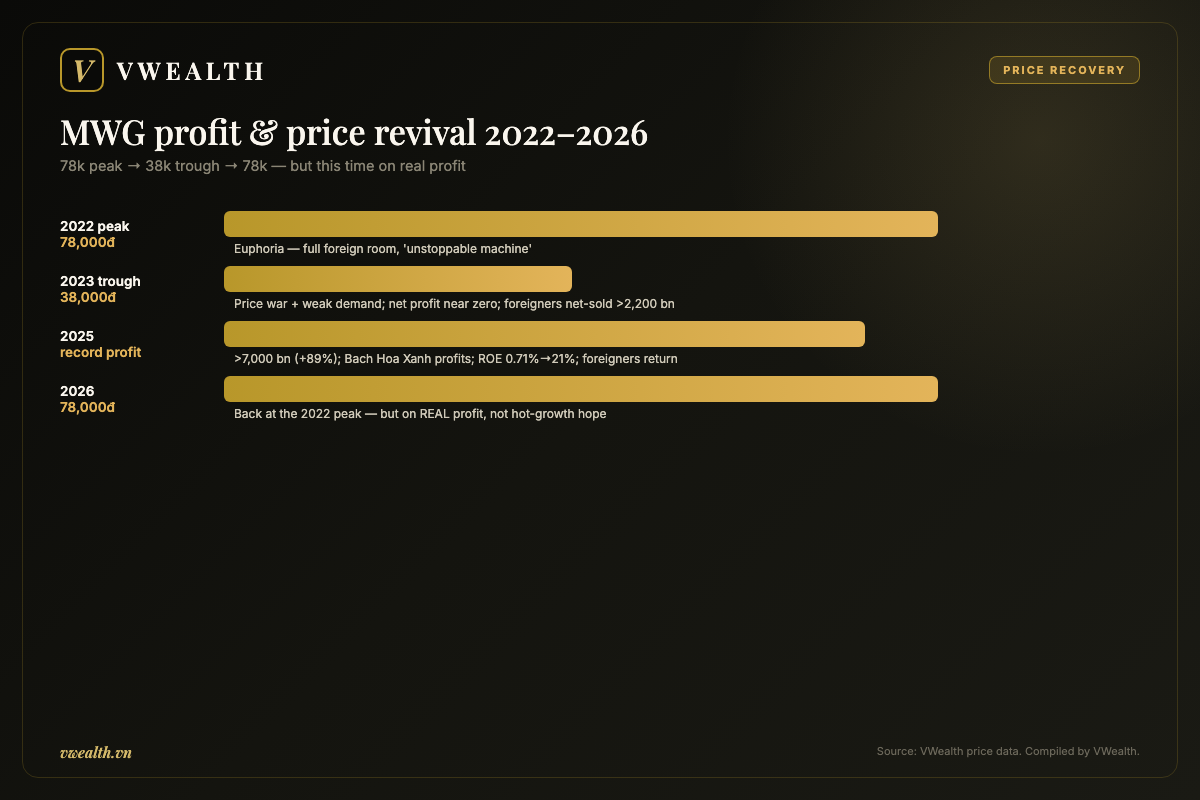
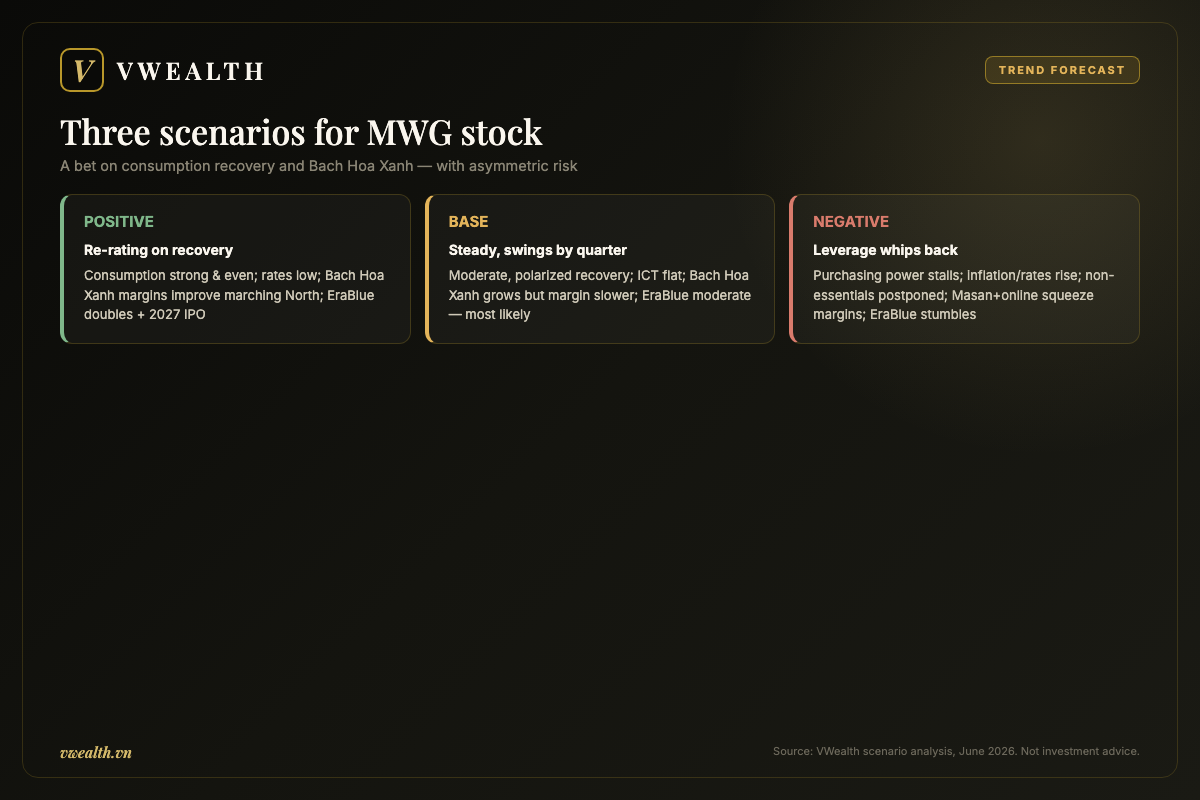
Should you buy MWG stock?
We’ve come a long way: from financial health, valuation, competitive position, industry context to future scenarios. Now it’s time to gather it all to answer the question you care about most. But let’s be frank from the start: this section won’t tell you “buy” or “sell.” No one honest can do that for you, because the right answer depends on what kind of investor you are, your risk appetite, and how you view the consumption recovery. This section’s job is to put the scale on the table for you to weigh.
On the scale: reasons for optimism
- Number-one position in retail. MWG is Vietnam’s largest retailer with a network and operating capacity no domestic rival matches. This scale creates supplier-bargaining advantage, brand strength, and a “moat” hard to cross short-term.
- Strongly revived profit. 2025 after-tax profit exceeded 7,000 billion, up 89% from a low base, proving the restructuring and cost-cutting worked. This isn’t a fake number — it comes from real operating improvement.
- Bách Hóa Xanh now profits and has large room. The grocery chain reaching estimated after-tax profit over 600 billion in 2025 is a turning point. With the modern channel at only about 27% and heading to 35% by 2030, this segment has a long growth runway ahead.
- Operating leverage as consumption recovers. The high-fixed-cost structure means when demand rises, profit rises many times faster than revenue. In a recovery cycle, this is an extremely attractive trait.
- Good management and capital discipline. MWG leadership has proven the ability to read cycles, dare to close ineffective stores, concentrate on the pillars, and expand abroad (EraBlue) in a calculated way. This is an important intangible asset.
And reasons for caution
- Thin net margins — high risk when demand is weak. Retail is inherently a thin-margin industry; food grocery is even thinner. A slight drop in foot traffic or a price war can erode profit very fast. The operating lever cuts both ways.
- ICT/electronics is saturated. The “cash cow” generating most historical profit is growing slowly, dependent on the replacement cycle and under increasing pressure from TikTok Shop, Shopee. This is a structural, not temporary, risk.
- ESOP dilution. MWG has a tradition of fairly generous employee stock bonuses (ESOP). This is good for staff motivation but dilutes existing shareholders’ interests — a real cost you need to factor in.
- Fierce grocery competition. Masan’s WinCommerce is a very strong rival, especially on its home turf in the North where Bách Hóa Xanh wants to advance. This share-grabbing race can be costly and prolonged, eroding both sides’ margins.
- Valuation already reflects much expectation. At a P/E of 15–16x and 78,000 dong, the stock is no longer cheap. Most of the recovery story and 30% growth in 2026 has been priced in. If reality doesn’t keep up with expectations, the room for disappointment is real.
A four-investor-type frame: which group are you?
The same stock, but the answer “should you buy” differs by person. Hold yourself up against the four portraits below.
- Deep-value investor. You seek stocks clearly cheap versus assets or profit, with a large margin of safety. At a current valuation already reflecting much recovery expectation, MWG probably isn’t in the “deep value zone” you favor. You’d want a clearer discount.
- Cyclical growth investor. You believe Vietnam’s consumption cycle is rising and want to ride that wave. This is the group the MWG story resonates with most strongly: operating leverage, Bách Hóa Xanh accelerating, EraBlue expanding. If you accept high volatility in exchange for growth potential, MWG is right in your appetite.
- Dividend / steady-income investor. You need steady cash flow and peace of mind. A thin-margin retail stock, swinging with the consumption cycle, plus ESOP dilution, isn’t the ideal harbor for this goal. You’ll find more suitable options in defensive sectors.
- Short-term trader. You trade on momentum and quarterly news. MWG has good liquidity and reacts strongly to each report — this may suit you, but requires tight risk-management discipline because volatility is also high.
Putting it all together, the clearest portrait emerges: MWG suits those who believe Vietnam’s consumption cycle is recovering, believe in the modern-retail growth story, and importantly can accept the accompanying volatility. This is a stock of faith and patience, not of certainty and safety. If you’re in group two and have read both sides of the scale above carefully, you have enough information to decide for yourself.
Finally, remember the immutable principle of investing: whichever side you lean toward, never pour everything into one ticker, never use borrowed money or money needed in the short term, and size your investment to exactly the risk level your sleep allows.
Disclaimer: This article is produced for informational and reference-analysis purposes, and is not a recommendation to buy, sell or hold any security. The figures are compiled from public sources at the time of writing and may change. Every investment decision is your own, and you should weigh your personal financial situation and consult a licensed advisor before acting. vwealth.vn is not responsible for any gain or loss arising from the use of information in this article.
Research Vietnamese stocks in English with vwealth. Our AI-powered platform turns Vietnamese market data into full English analysis reports — with international payment support and a free 2-month trial for new accounts. Create your free account and read the latest reports.