The HOSE exchange lists about two dozen bank stocks, but very few carry as many fascinating contradictions as VPB — Vietnam Prosperity Joint Stock Commercial Bank (VPBank). This is the private bank with the largest charter capital in the entire system — a figure that even the state-owned “Big 4” must look up to — yet it is also a name that regularly tops the bad-debt-ratio table among listed banks. VPB is both a symbol of ambition and a nerve test for investors.
VPBank’s story is tightly bound to two names. The first is billionaire Ngo Chi Dung — the man who returned from Eastern Europe, steered the VPBank ship for more than a decade, and turned it from a mid-sized bank into one of Vietnam’s largest private financial institutions. The second is SMBC (Sumitomo Mitsui) — the giant Japanese financial group, the strategic partner that has poured nearly 3 billion USD into the VPBank ecosystem through two landmark deals and now holds 15% of the parent bank.
But the true soul of the VPB story lies in two words: retail and consumer finance. While most Vietnamese banks live on corporate lending, VPBank chose to go into the wallets of tens of millions of ordinary people — through credit cards, consumer loans, and especially the “golden goose” FE Credit, once Vietnam’s number-one consumer finance company. This very choice created VPB’s dual character: a net interest margin (NIM) among the industry’s highest, but correspondingly high bad debt. It is a high-return, high-risk model, and the market reflects it with a valuation markedly cheaper than that of “cleaner” retail banks.
On 19 June 2026, VPB closed around 25,900 dong. A price many call “cheap,” but whether cheap for a reason or cheap unreasonably is still to be debated. This full analysis will dissect VPB from its historical roots, through each financial layer and its valuation, to the final question you care about most: should you buy VPB, and if so, which kind of investor does it suit? To answer, you first need to understand the road by which VPBank became what it is today.
VPB market data (updated 19 June 2026)
| Current price | 25,900đ | 2025 pre-tax profit | >30,600 bn (+53%) |
| Change (June) | −3.90% | NIM | Group NPL | ~4.4% | <3% |
| P/E | P/B | ~8.5x | ~1.0–1.2x | SMBC | Charter capital | 15% | highest in industry |
Source: VWealth price data + VPBank 2025 reports. Figures move session to session — for reference only.
History and evolution
To understand why VPB today is a “high-return, high-risk, cheaply valued” stock, you cannot skip this bank’s more-than-three-decade journey. This is not a story of smooth linear growth, but a chain of bold bets: betting on retail when the whole industry was obsessed with wholesale, betting on consumer finance when it was still nascent, and betting on joining hands with the Japanese to raise its stature. Each bet left its mark on the financial structure and the “risk appetite” you are analyzing today.
Origins in 1993 and the transformation under Ngo Chi Dung’s group
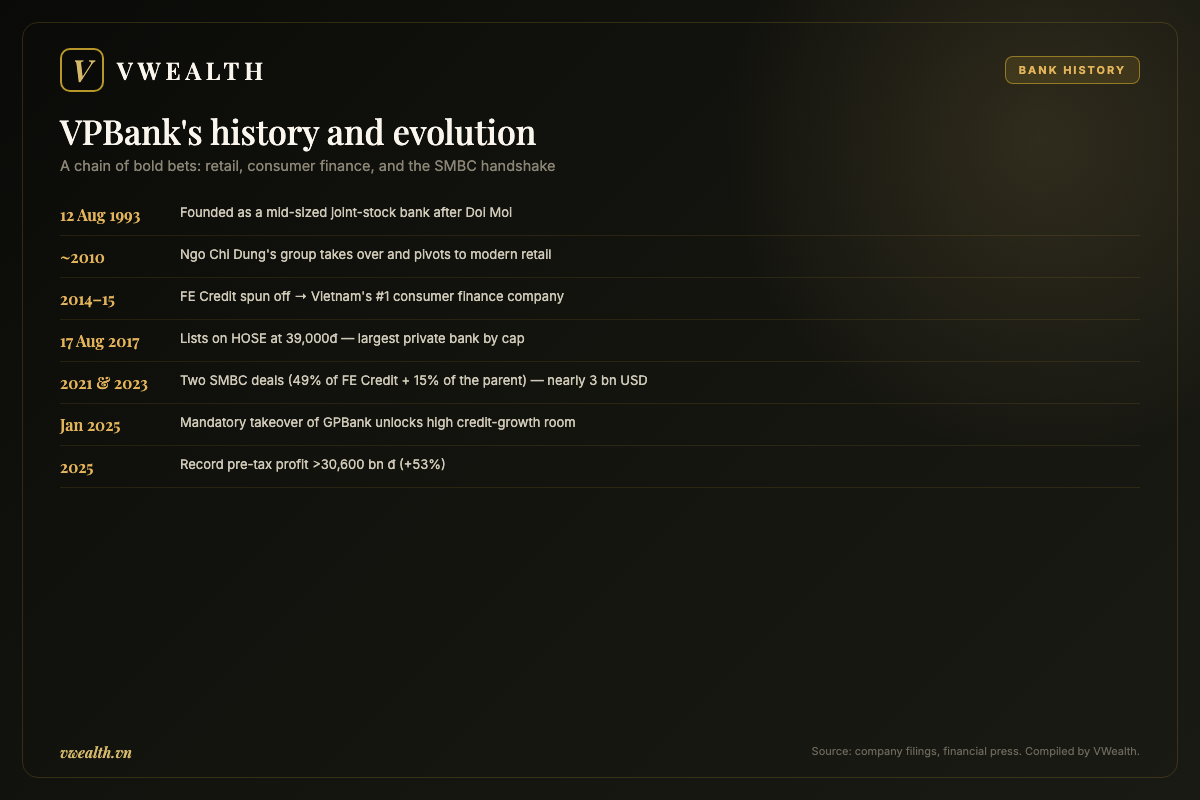
VPBank was founded on 12 August 1993, part of the first generation of joint-stock commercial banks born after Vietnam opened up its two-tier banking system. For nearly the first two decades, VPBank was just a mid-sized joint-stock bank, nothing too outstanding in a jungle of banks jostling for corporate credit market share.
The real turning point came around 2010, when a group of shareholders led by Mr. Ngo Chi Dung entered the Board and he took the Chairman’s seat. Mr. Dung was born in 1968 in Hanoi, part of the generation of businessmen who accumulated capital and experience in the volatile post-Soviet Eastern European market before returning home. That very experience in a harsh marketplace shaped a decisive business mindset, one willing to accept risk in exchange for growth — which would become VPBank’s “DNA” for the era that followed.
Under the new leadership, VPBank made a strategic decision later seen as wise: shifting from a wholesale bank to a modern retail bank. In 2010–2014, when most banks still saw corporate lending and funding (wholesale) as the main goal, VPBank pioneered into the individual and small-business segments. The logic was clear: retail, though more labor-intensive to build a network and more complex to manage risk, delivers far higher margins and an enormous, dispersed customer base. This was the foundation for everything that followed.
Choosing retail as the strategic pivot from the early 2010s is the foundational decision that explains why VPBank’s NIM is still among the industry’s highest today — and why its bad debt is too. You cannot have one without bearing the other.
The FE Credit gamble: from “golden goose” to crisis
If the retail pivot was the foundational step, then FE Credit was the biggest gamble, defining VPBank in the market’s eyes for a decade. In 2014–2015, VPBank spun off its consumer-credit segment into a separate finance company and poured resources into building it. The result exceeded expectations: FE Credit quickly rose to become Vietnam’s number-one consumer finance company, holding about 50% market share, with over 20,000 service-introduction points nationwide and more than 13,000 staff.
FE Credit made cash loans, installment loans, and issued credit cards to the “below-bank-standard” customer segment — low-to-middle-income earners and manual workers who struggle to access traditional bank credit. In exchange for very high credit risk, lending rates were also very high. In its heyday, FE Credit contributed a large share of VPBank’s consolidated profit, a true “golden goose” that pushed the bank’s consolidated NIM to a level no other bank could match.
But the “high-risk” model has its price, and that price arrived with the COVID-19 pandemic. FE Credit’s borrowers were precisely the most vulnerable group in a downturn — workers who lost jobs, freelancers who lost income. Add the spreading “debt-dodging” trend and the State Bank’s tightening of consumer-credit controls, and FE Credit plunged:
- 2021: still a thin profit of about 312 billion dong, but the bad-debt ratio had jumped to 13.6% — a clear warning sign.
- 2022: swung to a loss of about 2,376 billion dong; bad debt leapt to 20.4%.
- 2023: a record after-tax loss of about 2,965 billion dong (some reports recorded a pre-tax loss of over 3,500 billion), with bad debt around 20%.
This was the darkest period, when the “golden goose” became a burden dragging down the whole group’s consolidated profit. Management was forced into a comprehensive restructuring from 2023: reviewing the business model, changing the risk-management model, retreating to lower-risk customer segments to pull bad debt down. The effort gradually bore fruit: by the end of 2024, FE Credit’s bad-debt ratio fell from about 20% to 15.3%, and in Q4 2024 alone the company returned to profit with pre-tax earnings of 949 billion dong — 25 times the year-earlier figure. FE Credit began finding its way back toward its heyday, though the road remains long.
The lesson from FE Credit is extremely important for you when valuing VPB: this bank knows how to make big profits from a high-risk segment, but it also shows that such profits can evaporate quickly when the economic cycle turns. That is why the market always demands a “risk premium” when valuing this stock.
HOSE listing in 2017 and the sale of 49% of FE Credit to SMBC
On 17 August 2017, more than 1.33 billion VPB shares officially listed on the Ho Chi Minh City Stock Exchange (HOSE) at a reference price of 39,000 dong, lifting market cap to nearly 52,000 billion dong. Right at listing, VPBank overtook MB to become the private bank with the largest market cap on Vietnam’s stock market at the time — a milestone affirming the bank’s new standing. Listing also opened the door to international capital-raising, laying the ground for later billion-dollar deals.
The first billion-dollar move came in 2021. On 28 April 2021, VPBank signed an agreement to sell 49% of FE Credit’s charter capital to SMBC (specifically the subsidiary SMBC Consumer Finance), valuing FE Credit at up to 2.8 billion USD and yielding nearly 1.4 billion USD. The deal completed in late October 2021. VPBank retained 50% of FE Credit, with the remaining 1% held by another investor.
What is fascinating is that VPBank “took profit” on FE Credit almost right before that segment plunged into crisis. The over 20,000 billion dong of “fresh cash” from SMBC was recorded into profit and bolstered capital, giving VPBank a thick cushion to survive the FE Credit losses that came right after. In hindsight, this was one of the best-timed divestments in Vietnamese banking — selling half the “goose” while it was still laying golden eggs, then using that money to survive the winter.
The 1.5-billion-USD SMBC deal of 2023: a leap in capital
If the 2021 deal was selling a business segment, the 2023 deal was selling part of itself — and it was far larger. On 27 March 2023, VPBank reached an agreement to privately place 15% of the parent bank to SMBC, over 1.19 billion shares at about 30,159 dong per share, a total of about 35,900 billion dong (approximately 1.5 billion USD). Notably, this price was about 1.5 times the market price at the time, implicitly valuing all of VPBank at around 10 billion USD.
This is recorded as the largest M&A deal in the history of Vietnamese banking. This 1.5 billion USD was Tier 1 capital, lifting VPBank’s total equity from about 103,500 billion to roughly 140,000 billion dong — vaulting VPBank into the system’s leading group by equity, behind only Vietcombank and first among private banks. The deal completed in October 2023.
The significance of this deal for VPB stock has many layers:
- An enormous capital buffer: a thick capital base lets VPBank grow credit strongly for many years without worrying about “hitting the ceiling” on capital safety — a rare advantage in the industry.
- Backing from a leading Japanese institution: SMBC is not a trading financial investor, but a long-term strategic shareholder, bringing prestige, risk-management experience and the ability to connect with Japanese FDI customers in Vietnam.
- A valuation signal: a savvy player like SMBC being willing to pay above the market price shows VPBank’s intrinsic value is rated higher than its share price — a psychological anchor for shareholders.
The mandatory takeover of GPBank: opening more growth room
The latest turning point occurred in 2024–2025. On 17 January 2025, the State Bank officially announced the decision to mandatorily transfer GPBank (Global Petro Bank, once a weak “zero-dong” bank) to VPBank, per a plan approved by the Government. After the transfer, GPBank continues to operate as a single-member limited liability bank 100%-owned by VPBank.
At first glance, “taking on” a weak bank seems like a burden. But for VPBank, this was a calculated move. In exchange for participating in restructuring a weak credit institution, receiving banks typically enjoy important preferential mechanisms — especially a higher credit-growth room (quota) than the general level. In a system where credit growth is tightly allocated by the State Bank each year, being granted more room is like “opening the valve” for the money machine to run faster. VPBank was also allowed to expand its network and customer base, and has the right to keep GPBank as a subsidiary or transfer it to a new investor once restructuring is complete.
Taking on GPBank turns a policy obligation into a competitive advantage: wider credit room is the most precious resource for a bank with a strong growth appetite like VPBank.
2025: record profit, closing a cycle
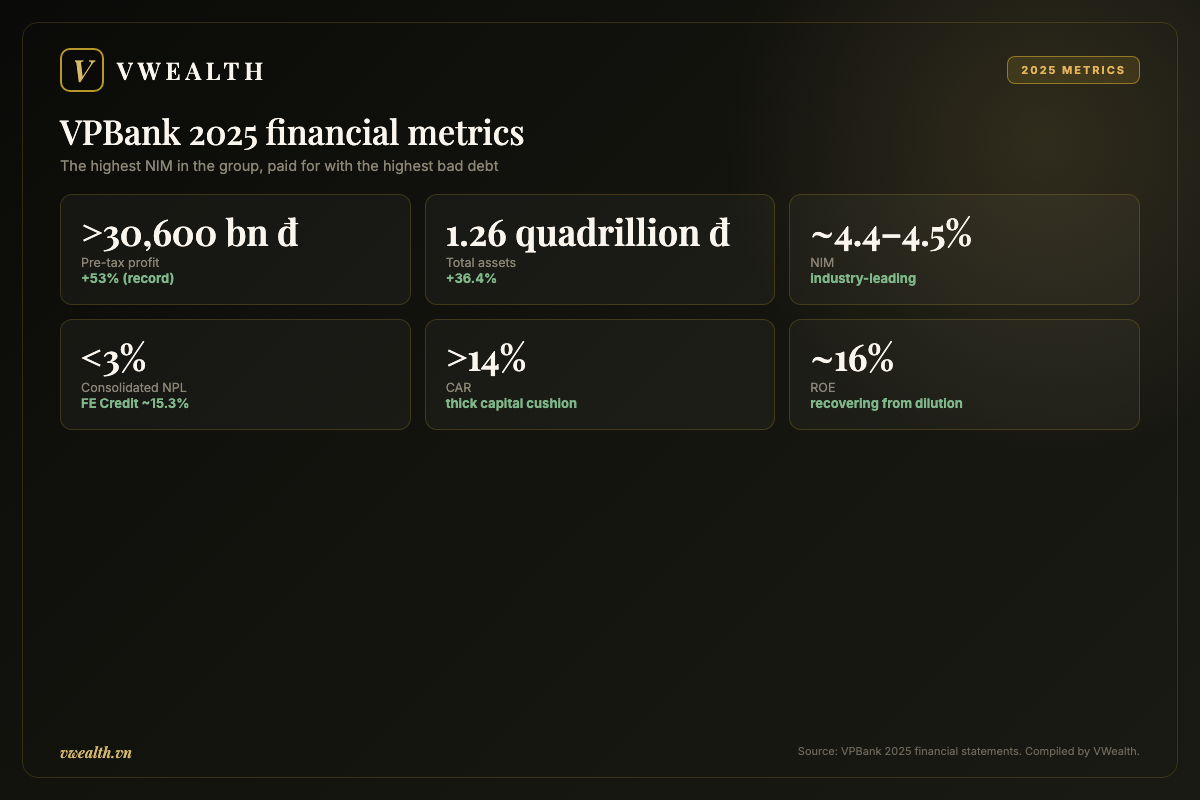
All the pieces above — the SMBC capital buffer, FE Credit’s recovery, wide credit room from GPBank, plus the economic recovery — resonated to create a brilliant 2025. VPBank announced consolidated pre-tax profit exceeding 30,600 billion dong, up 53% year on year and the highest in its history, completing 121% of plan. A few notable figures:
- Consolidated total assets: reached 1.26 quadrillion dong, up 36.4% from the start of the year.
- Total operating income (TOI): nearly 75,000 billion dong, continuing to lead the private-bank bloc.
- Profitability: consolidated ROE and ROA recovered to around 16% and 2.2%.
- Consolidated credit: crossed 961,000 billion dong, with credit growth among the highest in years — true to the wide-room advantage noted above.
- Subsidiaries: the parent bank earned over 26,300 billion (+44.4%), the securities firm VPBankS earned 4,476 billion (4 times more), showing the ecosystem operating in sync.
Thus, from a mid-sized joint-stock bank in 1993, over more than three decades of bold decisions — the retail pivot, building then partly selling FE Credit, joining hands with SMBC through two deals worth nearly 3 billion USD, and taking on GPBank — VPBank became the private bank with the largest charter capital in the system, with record profit and one of the thickest capital buffers in the industry.
But history also left scars: a chronically high bad-debt ratio that comes with the consumer-finance model, and a market valuation always “cheaper” than expected because the market does not yet fully believe VPBank has tamed the risk. Behind every big bet is a leadership with distinct character and vision. To understand whether VPBank can keep turning risk into profit in the next cycle, you need to look closely at the very people at the helm — and that is the subject of the next section on Leadership.
Leadership and ownership structure
When you put money into a bank stock, you are not just buying a balance sheet or a profit figure. You are betting on the people behind it: who steers the strategy, who runs the machine daily, and most importantly, whether their interests are tightly aligned with yours. At VPBank, this carries special weight. This is one of the few Vietnamese private banks where the founding family holds a stake among the highest in the system, alongside a global-scale strategic partner, and a CEO dubbed the highest-paid hired hand in the industry. Understand these three forces, how they interlock and pull at one another, and you understand most of VPB’s soul.
Ngo Chi Dung — the billionaire chairman who “rose from instant noodles in Russia”
The first person you need to know is Mr. Ngo Chi Dung, Chairman of VPBank since April 2010. In early 2026, Forbes officially added his name to its world billionaires list, with net worth estimated at about 1.1 billion USD, making him one of Vietnam’s richest businessmen and ranking around 2,966th globally per Forbes. This is not a fleeting glamorous title, but official recognition of the enormous stake his family accumulated over many years.
Mr. Dung’s biography has distinctive features. Born in 1968 in Bac Ha (Lao Cai), he graduated from the Moscow Geological Prospecting University as a geological engineer, then earned a PhD in Economics at the Russian Academy of Sciences. But his path to wealth began in the post-Soviet Eastern European marketplace. According to major domestic press, Mr. Dung co-founded the Rollton instant-noodle brand in Russia (in 1998) with Mr. Dang Khac Vy — who later became Chairman of VIB. This journey of “rising from a packet of instant noodles in a foreign land” explains his business style: decisive, willing to make big bets, and a risk appetite higher than the norm of state-owned banks. That very appetite made VPBank the pioneer in consumer finance and retail — a land of much profit but also many storms, which you will see clearly reflected in VPB’s margins and asset quality.
One point to remember: Mr. Dung is famously a “discreet tycoon.” He rarely appears in the media outside shareholder meetings, where he typically makes candid statements about his ambition to make VPBank a leading Vietnamese financial group and reach regional stature. For an investor, this discretion is both neutral and worth noting: you will have to rely more on actions and disclosed numbers than on loud vision statements.
The family shareholder group — one of the highest ownership stakes in the industry
This is the feature that makes VPBank’s ownership structure very different from most listed banks. By regulation, each individual may own at most 5% of a bank, so no member of Mr. Dung’s family exceeds that threshold. But when the family group is combined, the picture becomes very different.
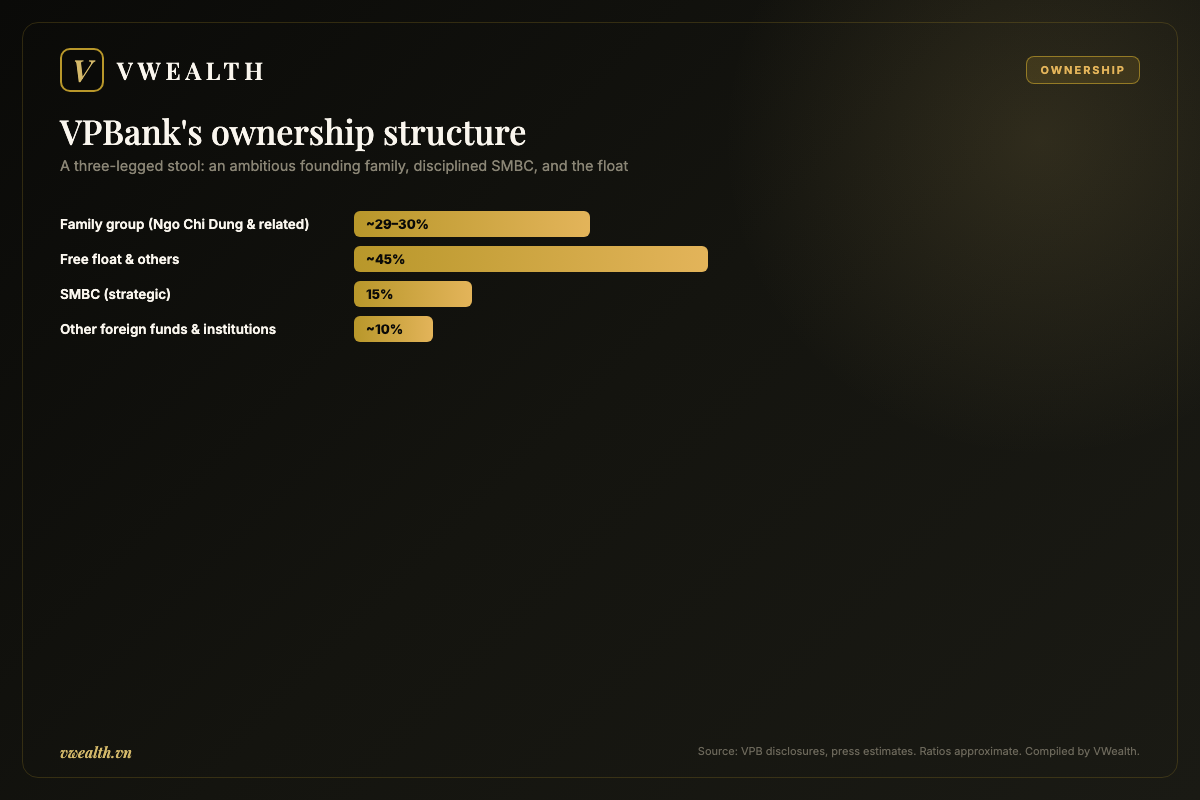
Based on disclosures compiled by many financial outlets in 2025, the ownership of the chairman’s inner circle can be pictured as follows. Mr. Ngo Chi Dung himself is the largest individual shareholder with over 328 million shares, equal to around 4.14% of charter capital. His wife, Ms. Hoang Anh Minh, holds about 326.7 million shares (around 4.1%). His mother, Ms. Vu Thi Quyen, owns about 325.9 million shares (around 4.1%). So these three alone account for approximately 12% of the bank. Adding the children’s stakes — including son Ngo Chi Trung Johnny, who completed buying 70 million VPB shares in late 2023, enough to enter the top 100 richest on the exchange — and other related shareholders, some sources estimate the total group tied to the chairman at around 29–30% of charter capital. You should understand this aggregate figure as a press-compiled estimate that may fluctuate with trading and issuance rounds, not a static number; still, it shows the family group’s control is very large.
When a founding family holds nearly a third of a bank, their interests and yours — a small shareholder — are essentially in the same boat. They grow richer or poorer with VPB’s share price, exactly as you do.
This is the most important plus of a family-run ownership structure. “Skin in the game” — the decision-makers bearing the financial consequences of their own decisions — is very real and very large at VPBank. When an entire clan’s personal wealth is tied to over a billion shares, the drive to preserve and grow the bank’s value is intrinsic, needing no prodding. On the other hand, you must stay clear-eyed about the accompanying risk: with such large control, major decisions on strategy, M&A or dividends will strongly reflect the owners’ will. Small investors can essentially only ride along, rarely able to form a counterweight. You are placing faith in the vision and ability of one family, so closely watching their actions each period is a must.
SMBC — the 1.5-billion-USD handshake and the shadow of a Japanese giant
If the family group is VPBank’s “Vietnamese soul,” SMBC is the “Japanese mind” invited in to standardize and elevate it. In October 2023, VPBank completed a private placement of over 1.19 billion shares, equal to 15% of charter capital, to Sumitomo Mitsui Banking Corporation (SMBC) — a member of Sumitomo Mitsui Financial Group (SMFG), one of Japan’s largest financial institutions. The total placement value reached over 35.9 trillion dong, nearly 1.5 billion USD. Finance circles called it the largest M&A deal in the history of Vietnamese banking up to that point, and it revealed a notable valuation figure: SMBC valued all of VPBank at around 10 billion USD.
The significance of this deal for you — a future shareholder — is multi-layered. First is capital. After the deal, VPBank’s equity rose from about 103.5 trillion dong to roughly 140 trillion dong. The capital adequacy ratio (CAR), per Moody’s calculation at the time, was pushed to nearly 19% — among the highest of Vietnamese banks it rated. Such a thick capital buffer lets VPBank both withstand risk better and have room for strong credit growth and taking on weak banks without capital strain.
Second, and no less important, is governance quality and customer network. This was not the two parties’ first cooperation. Earlier, in 2021, VPBank had sold 49% of FE Credit — Vietnam’s largest consumer finance company — to SMBCCF, a wholly-owned SMFG member, for about 1.4 billion USD. So SMBC is both a 15% strategic shareholder of the parent bank and a partner owning 49% of the consumer-finance “golden goose.” This two-tier bond gives VPBank things money cannot buy immediately: corporate governance, risk management and digital transformation experience that SMBC accumulated globally; and especially a door into the FDI customer base, the Japanese businesses investing heavily in Vietnam — a high-quality customer segment almost every domestic bank covets. For a country strongly attracting Japanese FDI, this advantage can become a very real long-term growth driver.
You should also view this deal as an external “stamp of verification.” A disciplined and prudent institution like SMBC does not spend 1.5 billion USD unless it believes in VPBank’s long-term prospects. All the shares issued to SMBC are also restricted from transfer for 5 years, meaning the Japanese partner is committed to accompanying at least until around 2028, not a trading investor. That said, keep balance: SMBC’s backing lifts the governance base but does not immunize VPBank from consumer-credit cycle risk or bad debt — things you still must scrutinize in later sections.
Foreign room and the rest of the ownership structure
A technical but valuable detail for investors is the foreign-ownership room. To pave the way for SMBC, VPBank proactively raised foreign room to 30%. By mid-2025, foreign ownership of VPB was around 25–26%, meaning there is still room. More notably, per a new Decree effective from mid-2025, VPBank is among the private banks participating in restructuring that are permitted to raise the foreign-ownership cap to a maximum of 49%. This is a rare policy advantage: it opens the possibility of attracting more foreign capital in the future, while making VPB more attractive to international funds that are always constrained by room.
Taken together, you can picture VPBank’s ownership as a “three-legged stool”: the Ngo Chi Dung family group holds the controlling and directing role; SMBC holds 15% as strategic partner and a “governance brake”; the rest is institutional shareholders, foreign funds and the free float on the market. The combination of an ambitious domestic owner and a disciplined Japanese institution creates an interesting balance: ambition kept within a framework, and a framework that does not choke ambition.
Nguyen Duc Vinh — the industry’s most expensive hired “captain”
Ownership is one thing, management another. The man steering VPBank’s machine daily is Mr. Nguyen Duc Vinh, the CEO. He is one of Vietnam’s most veteran and highest-paid bank CEOs. Before VPBank, Mr. Vinh made his mark as Techcombank CEO with compensation rumored at around 1 million USD a year. At VPBank, his disclosed income is recorded at over 11 billion dong a year, nearly 1 billion dong a month — a figure that makes VPB one of the highest payers for executives in the system.
For you, this “huge” salary should be read positively rather than negatively. It shows two things: the owners are willing to pay high to keep a good executive, and they draw a fairly clear line between the “ownership” role (Mr. Dung’s family) and the “professional management” role (Mr. Vinh). This is a sign of mature governance: owners not grabbing everything, but handing the machine to a well-paid professional hired hand. More importantly, recent shareholder meetings show Mr. Vinh continuing to be trusted to keep the CEO seat for years to come — this senior-personnel stability is a plus, because bank strategy needs continuity, and changing generals midstream always carries the risk of disruption. Alongside Mr. Vinh is a management team with many deputy CEOs continually appointed and strengthened, showing the apparatus is being invested in for depth.
Business results under this management also say much: in 2025, VPBank recorded its highest consolidated pre-tax profit ever, over 30,600 billion dong, up about 53% year on year; and the 2026 target is set at over 41,300 billion dong, up about another 35%. This is very high growth ambition, mirroring the owners’ decisive appetite.
Dividend policy — a turn to steady cash payouts
The last part, but perhaps the one you care about most if you invest for income: dividend policy. For years, VPBank chose to retain profit to raise capital, strengthen its base and expand — an understandable choice for a bank growing hot and needing a thick capital cushion. But after a period of strong capital raising, especially after gaining nearly 1.5 billion USD from SMBC, management clearly changed course.
At a shareholder meeting, Chairman Ngo Chi Dung made a notable commitment: VPBank would pay cash dividends for 5 consecutive years. And the bank kept its word. In 2024, 2025 and 2026, VPBank maintained cash dividends, each year around 4,000 billion dong (the 2026 plan alone is about 3,966 billion dong, equal to 5% in cash, alongside a bonus-share plan). A high-growth bank still regularly handing out real cash to shareholders is a signal of confidence in cash flow and earnings health. For you, this is a double plus: potential capital gains if the share price rises with profit, plus a steady cash-dividend stream in hand.
A bank that dares commit to cash payouts for 5 straight years, while still targeting profit growth of tens of percent a year, is a bank that believes its machine is healthy enough to both run fast and share the spoils. That is the implicit message management sends you.
To close this section, you are looking at a bank with a very clear power and ownership structure: a billionaire founding family holding a controlling stake and betting everything on the VPB ship, a global-scale Japanese partner injecting capital and raising governance standards, a veteran, expensive CEO running the machine, and a steady cash-dividend policy to share the fruits. This framework of people and ownership not only explains why VPBank grows decisively, but is also the foundation for what the bank has painstakingly built behind it: a financial ecosystem spanning the parent bank to consumer finance, securities and insurance — exactly what you’ll explore next in the VPBank ecosystem.
Ecosystem and business segments
If you want to understand VPB thoroughly, you cannot look only at the bank’s own profit figure. VPBank today is no longer a single bank, but a diversified financial group — a structure with the parent bank at the center and a series of subsidiaries around it, each serving a different customer segment and financial need. This is what makes VPB special, and also what makes it riskier than many peers. You own (or are considering owning) a machine with many engines running in parallel, including one that accelerates very hard but also runs very “hot.”
Picture it this way: a traditional bank is like a shop selling one type of product. VPBank is more like a shopping mall — the ground floor for the mass market, upper floors for businesses, a separate booth for those needing fast consumer loans, a securities counter, an insurance counter, and recently even a “branch” received from a weak bank. All share one data platform, one technology infrastructure, and cross-sell products to each other. The scale of this shopping mall, by end-2025, is a staggering figure: consolidated total assets reached 1.26 quadrillion dong, up 36% in one year, and consolidated credit crossed 961,000 billion dong. VPBank formally entered the “quadrillion” club — a group very few Vietnamese banks reach.
In this section, we’ll go through each “stall” one by one, explaining what it does, how it makes money, and most importantly for you — the investor — what it contributes and what it threatens in the overall picture.
The parent bank — the heart of the machine: retail, SME and large corporates
Before talking about the flashy subsidiaries, you need to understand that most of VPBank’s profit still comes from the parent bank. This is where it takes deposits from millions of people and lends out to the economy. But the way VPBank runs the parent bank is very different from a “safe” bank like Vietcombank.
VPBank positions itself as a bank pushing retail and unsecured lending. Instead of focusing only on large-corporate lending with thin margins and low risk, VPBank actively dives into higher-margin segments: personal loans, home loans, consumer loans, credit cards, and lending to small and medium enterprises (SMEs). These are customers state-owned banks often shy away from because they are hard to appraise, but they are also customers willing to pay higher rates to borrow.
This strategy produces a signature metric you’ll hear repeated throughout this analysis: a high NIM. NIM (Net Interest Margin) is the gap between the rate the bank earns on lending and the rate it pays depositors. Simply: if you raise money at 5% then lend at 12%, your NIM is very wide. VPBank is regularly among the highest-NIM banks in the system, mainly because it lends heavily into unsecured and retail loans — riskier loans, hence higher rates. High NIM is VPB’s number-one money-making weapon, but remember an unchanging principle in finance: there is no high return without high risk.
High NIM is a double-edged sword. When the economy is good, it lets VPBank print outsized profits. When the economy sours and borrowers can’t repay, those very high-rate loans turn into bad debt fastest. Every VPB story revolves around this trade-off.
Besides lending shrewdly, the parent bank must also handle the “raw input” — cheap funding. Here is a concept you need to grasp: CASA (Current Account Savings Account — non-term deposits). This is money customers leave in payment accounts rather than term savings, so the bank pays almost no interest (or very little). The higher the CASA ratio, the cheaper the bank’s input funding, and the wider the NIM. VPBank invests heavily in digital banking to attract CASA — platforms like VPBank NEO, and especially the two “pure digital banks” CAKE and Be backed by VPBank — as the net to pull millions of young customers to open accounts, so money flows into the system at near-zero cost. You can picture digital banking as a giant funnel: it does not directly generate much profit, but it draws customers and cheap deposits for the whole group.
FE Credit — the strongest NIM engine, and also the riskiest
If the parent bank is the heart, FE Credit was once the “growth lung” — and the part that makes VPB most controversial. You need to spend time understanding this segment well, because it is the key to explaining both the years VPB earned big and the years VPB struggled.
FE Credit is a consumer finance company. Unlike the parent bank lending large secured amounts, FE Credit specializes in small, fast, unsecured loans: cash loans of a few million to a few tens of million, installment purchases of phones, motorbikes, electronics, and credit cards for low-income earners. FE Credit’s customers are workers, manual laborers, people who never accessed traditional banks. This is an enormous segment in Vietnam that mainstream banks cannot reach.
For years, FE Credit was the absolute number one in consumer-lending market share, controlling over 30% of the market — a dominant position. Its business model fits in one sentence: lend at high risk to earn high rates. Because customers have no collateral and thin credit histories, rates on consumer loans can reach 20–40% a year, even higher. When all goes smoothly, this is a money printer with extremely fat margins, and FE Credit is precisely why VPBank’s consolidated NIM always leads the industry. That is why people call FE Credit the group’s “NIM engine.”
But the risk of this model was revealed devastatingly during and after COVID-19. When the pandemic hit, FE Credit’s most vulnerable customers — workers who lost jobs, laborers whose incomes fell — were the very borrowers. They defaulted en masse. Bad debt exploded, and FE Credit went from golden goose to a burden dragging down the whole group’s profit in 2022–2023. This is a bitter lesson for anyone valuing VPB: the highest-rate segment is also the one most likely to collapse when the economy struggles.
| Period | FE Credit status | Impact on VPB |
|---|---|---|
| Before 2021 | Market-share leader, big profits | NIM engine, strong profit contribution |
| 2021 | VPBank sells 49% to SMBC (Japan) | Raises large capital, gains a strategic partner |
| 2022–2023 | Post-COVID crisis, bad debt ~20% | Losses, drags down consolidated profit |
| 2024 | Restructuring, bad debt falls to 15.3% | Starts returning to profit |
| 2025 | Profit over 600 billion — second straight year | Steady recovery, easing provisioning pressure |
The turning point came in 2021, when VPBank sold 49% of FE Credit to Japan’s SMBC group, renaming the company VPBank SMBC Finance Company Limited. Together with SMBC, FE Credit entered a comprehensive restructuring: cutting the riskiest products, tightening appraisal, optimizing debt collection, and restructuring about 70% of its loan portfolio. The results are clear — the bad-debt ratio was pulled from about 20% (2023) to 15.3% by end-2024 (about 10,300 billion dong), and by 2025, FE Credit had earned over 600 billion dong — a second straight profitable year, with a run of consecutive positive quarters.
I want you to view this 15.3% figure clear-eyed. Set against VPBank’s consolidated bad-debt ratio (controlled below 3% per Circular 31) and the parent bank’s standalone bad debt of only about 2%, FE Credit’s 15.3% is a very high number — five times the rest of the group. That is the price of the below-standard lending model. FE Credit is recovering, returning to profit — that is good news. But don’t forget: as long as FE Credit is in the consolidated portfolio, a significant part of VPB’s “asset quality” is still tied to a portfolio with double-digit bad debt. This is a point you must watch closely in every quarterly report.
VPBankS — the securities card riding the upgrade wave
Leaving credit behind, VPBank also reaches into the capital market through its securities firm VPBankS (VPBank Securities). This is one of the group’s most ambitious and best-capital-backed moves in recent years.
What does VPBankS do? Simply, it is where investors open accounts to trade stocks (brokerage), where margin lending gives investors more money to trade, and where advisory on issuance and underwriting of bonds and stocks for businesses (investment banking) happens. VPBank injected very large capital to make VPBankS one of the top-charter-capital securities firms on the market — because in the securities business, more capital means more margin lending, i.e., more interest earned.
Why is VPBank pushing this segment right now? The answer lies in one word: “upgrade.” Vietnam’s stock market is in the process of being upgraded from “Frontier” to “Emerging” per international assessments. If successful, an enormous flow of foreign capital is expected to pour in, liquidity surges, and the securities firms with strong capital and good platforms benefit first. VPBankS is betting on that scenario. In 2025, the company achieved record pre-tax profit of about 4,476 billion dong, its customer accounts crossed 1.1 million, and it first entered the top 10 brokerage market share on HOSE in Q4. This is the segment forecast to contribute the most to group profit in 2026.
OPES — fast-growing digital insurance, the cross-sell piece
The next piece is OPES — the ecosystem’s non-life insurance company. Distinguish: “non-life” means insurance for property, health, vehicles, travel and goods — not life insurance (long-term coverage of a life). This is insurance tied to each transaction, each loan, each card.
OPES’s distinctive feature is that it positions itself as a digital insurance company, applying strong technology and AI to sell products online at low cost. And this is precisely why OPES matters to the VPBank ecosystem despite its still-small scale: it is a perfect cross-sell tool. Every time the parent bank grants a loan, FE Credit disburses a contract, or a customer opens a card, OPES can “attach” an insurance package. With millions of customers in the ecosystem, OPES has a ready enormous market to tap without much customer-acquisition cost. In 2025, OPES maintained impressive growth, contributed positive profit, and further completed the group’s closed value chain.
GPBank — a gamble in exchange for high credit room
This is the newest and most surprising piece, and you need to understand it is unlike any segment above. GPBank is a weak bank that VPBank mandatorily took over under State Bank policy. “Mandatory transfer” means the state hands a troubled bank (negative equity, years of accumulated losses) to a healthy bank to take over and revive.
At first hearing, taking on a weak bank seems like a burden. But look at the “in exchange” part. When it takes on a mandatory transfer, VPBank enjoys special incentives, the most important of which is a much higher credit-growth room (quota) than other banks. In Vietnam, each year the State Bank grants each bank a “quota” of allowed additional lending — a factor that directly decides how fast a bank can grow. Being granted higher credit room is the “reward” that lets VPBank grow its loan book far above the norm, and partly explains why consolidated credit in 2025 surged past 961,000 billion dong. After restructuring, GPBank was repositioned to focus on technology and SME/individual customers, and in the first 9 months of 2025 achieved pre-tax profit of nearly 400 billion dong — a remarkable turnaround from a bank once in negative equity.
How to view GPBank correctly: don’t see it as a profit-generating business, but as a “ticket” exchanged for the right to high credit growth. The credit-room reward can be worth far more than the cost of reviving a small bank.
SMBC and the Japanese/FDI customer ecosystem
There is a red thread running through the whole VPBank story you should not overlook: Japan’s SMBC group. SMBC is not only a shareholder of FE Credit, but also a strategic shareholder owning 15% of the parent bank VPBank after the historic 2023 private placement — one of the largest M&A deals in Vietnamese banking.
The benefit from SMBC far exceeds the money it injected. SMBC brings VPBank something very valuable: a door into the FDI business ecosystem, especially the Japanese businesses investing heavily in Vietnam. Japanese corporations, used to working with SMBC at home, can now be introduced to VPBank to open accounts, borrow and transact in Vietnam. This is a high-quality, stable, low-risk customer segment — exactly what VPBank lacks to rebalance a portfolio tilted toward high-risk unsecured lending. In other words, SMBC helps VPBank “upgrade” in customer quality and international standing, while adding capital and the risk-management experience of a leading Asian financial institution.
The “universal bank” ambition — serving every segment
When you fit all the pieces together, the strategic picture becomes clear. VPBank does not want to be a bank good at one thing. Its ambition is to become a “universal bank” serving every customer segment — from a worker borrowing a few million via FE Credit, to a middle-class family taking a home loan at the parent bank, to a stock investor using VPBankS, an insurance buyer through OPES, an SME business, and even a Japanese FDI corporation coming through SMBC. Each customer walks in one door, and the ecosystem seeks to sell them many more products.
The advantage of this model is synergy: the units share a data platform, technology and customer base, cross-sell to one another, forming a closed value chain. The subsidiaries’ contribution to consolidated profit is estimated at about 22–24% and rising toward 2027. That is why in 2025 VPBank achieved record pre-tax profit of about 30,600 billion dong, up 53% — a figure hard to reach on the parent bank alone.
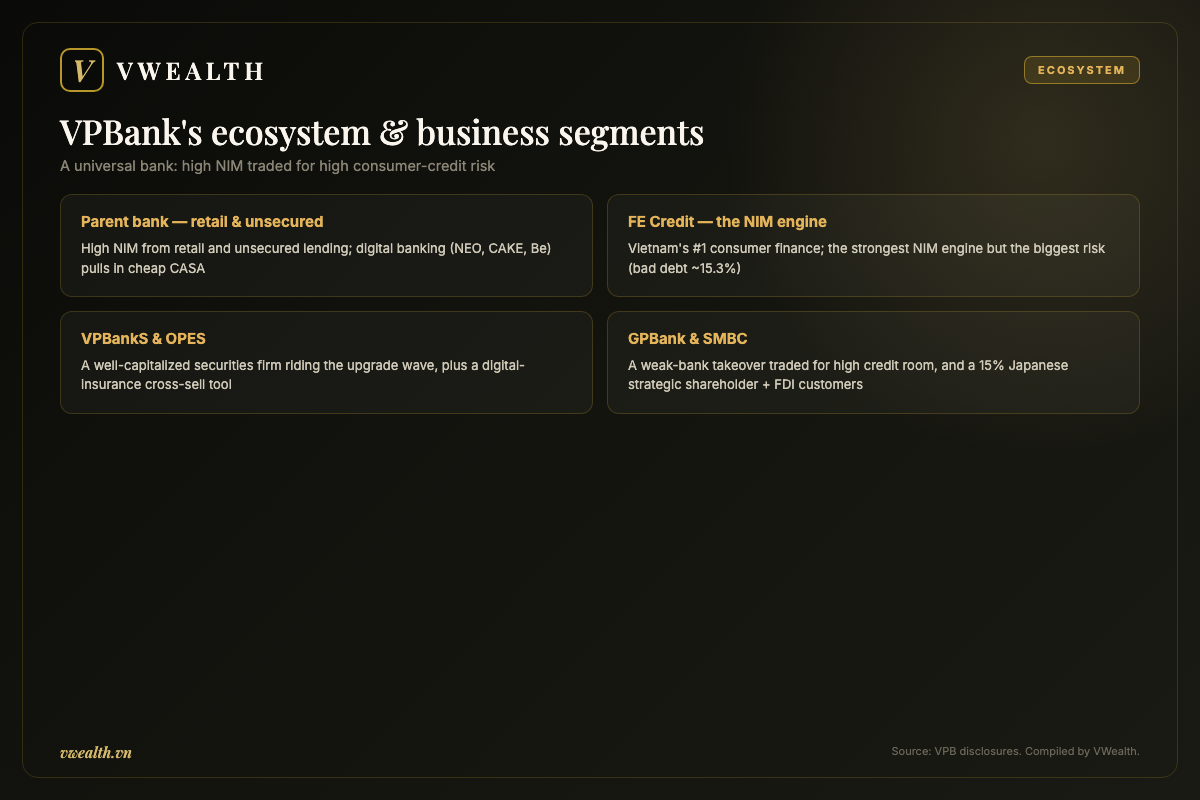
- Parent bank: high NIM from retail and unsecured lending, pulling CASA via digital banking — the core profit machine.
- FE Credit: the strongest NIM engine but 15.3% bad debt — the group’s largest concentration of risk.
- VPBankS: the card riding the market-upgrade wave, a future growth driver.
- OPES: digital insurance, the cross-sell tool completing the ecosystem.
- GPBank: a ticket exchanged for high credit room, a base for outsized loan growth.
- SMBC: strategic shareholder, gateway to Japanese/FDI customers and foreign capital.
And here is the most important takeaway to carry into later sections. VPBank’s universal model is a very clear trade-off: an outstandingly high NIM in exchange for high consumer-credit risk. When the economy is favorable and credit room is widened, this machine accelerates faster than most rivals — as 2025 itself proved. But when the cycle turns, those very high-rate engines are where bad debt erupts first, as the COVID lesson still teaches. So to value VPB correctly, you cannot be intoxicated by growth alone — you must scrutinize the asset quality and financial health behind those growth numbers. And that is exactly what we dissect next: VPBank’s position and financial health.
Financial position and health
If the previous section helped you picture who VPBank is and where it stands in the private-banking game, now we open the bank’s “medicine cabinet” to see its true internals. A bank stock, ultimately, is a promise about the ability to generate sustainable profit on a safe capital base. For VPBank, 2025 was a special milestone: consolidated pre-tax profit set a record, over 30,600 billion dong, up 53% year on year and completing 121% of the plan the AGM assigned. This figure did not fall from the sky — it is the result of a machine that accumulated capital over a decade, resonating with the 1.5-billion-USD boost from Japanese partner SMBC, and a simultaneous recovery of the ecosystem’s “children.”
But don’t let the record number dazzle you. A veteran analyst always asks: on how much capital was that profit generated, at what risk, and can it repeat? VPBank is a classic case of the risk–return trade-off in banking. This bank has a NIM among the system’s highest, but the accompanying price is a bad-debt ratio also higher than the norm. It has an enormous capital base that helps it withstand risk very well, but that very base “dilutes” its return on equity (ROE). Understand these paradoxes, and you truly understand why the market both loves and wary of VPB.
A giant capital base: the largest safety cushion in the system
Start from VPBank’s undeniable strength: capital scale. After selling 15% to SMBC — Japan’s second-largest bank — for nearly 1.5 billion USD (over 35,900 billion dong), completed at end-2023, VPBank’s equity rose from about 103,500 billion to roughly 140,000 billion dong. Combined with nearly a decade of retaining profit to accumulate capital, VPBank rose to the system’s leading group by charter capital, surpassing even the “Big 4” state banks with charter capital above 79,000 billion dong. This is a position very few Vietnamese private banks hold.
Large capital is not a figure to boast about. It is a shock absorber and a growth “launchpad.” Credit-rating agency Moody’s once calculated that VPBank’s CAR could approach 19% right after the SMBC deal — leading among the Vietnamese banks it rated. By end-2025, consolidated Basel-standard CAR stayed above 14%, still notably above the 8% minimum the State Bank requires, and more comfortable than many peers of similar scale. What does this figure mean in practice for you — an investor?
- Wide credit-growth room: a high CAR lets VPBank “pump” credit strongly without being blocked by capital limits. This is why consolidated credit in 2025 crossed 961,000 billion dong, and in Q1 2026 officially crossed the one-quadrillion mark.
- Large risk endurance: for a loan portfolio with a high-risk appetite like VPBank’s, a thick capital cushion is the lifeboat. If an economic shock hits and bad debt jumps, VPBank has more “ammunition” to provision and absorb losses without shaking its foundation.
- Capacity to take over and expand: a giant capital base let VPBank play “receiving bank” for the mandatory GPBank transfer from early 2025 — something requiring financial strength and governance capacity not everyone has.
However, this is also where an honest analyst must be frank with you about the flip side. The larger the equity, the more the denominator in the ROE formula (return on equity) swells. For the same absolute profit, a thin-capital bank yields a far prettier ROE than a thick-capital bank like VPBank. This is the “dilution” of profitability. In the few years after the SMBC deal, VPBank’s ROE was pulled to a low level versus its own glorious history, simply because an enormous amount of capital came in but had not yet been deployed to earn proportionally. Large capital is a long-term strength, but in the short term it is a “sweet burden” management must prove it can “digest.”
For VPBank, the giant capital base is a double-edged sword: on one side it is the strongest shock shield and growth launchpad in the system; on the other it is a drag pulling ROE down until the bank proves it can digest all that capital into profit. 2025 is precisely the year that proof began to show clearly.
The highest NIM in its group — and the price paid in bad debt
If I had to choose one number to describe VPBank’s financial “identity,” I’d choose NIM — the net interest margin. This is the gap between the rate the bank earns on lending and the rate it pays depositors, measured over earning assets. Put plainly, NIM is a bank’s “gross margin.” In 2025, VPBank’s consolidated NIM stayed around 4.4–4.5%, among the industry’s highest, far above many banks with NIM around 3% or lower.
Why does VPBank have such a high NIM? The answer lies in a loan portfolio heavily tilted toward retail and consumer credit. The parent bank’s individual-customer loans in 2025 reached about 850,000 billion dong, up 35%; the SME segment rose 38%. In particular, the system’s “high-risk, high-return gem” is FE Credit — the consumer finance company making unsecured loans at very high rates. These small unsecured loans deliver enormous yields, lifting the whole group’s NIM to a level banks that focus only on large-corporate lending cannot reach.
But — and this is the most important “but” of the whole section — there is no free lunch in banking. The higher the lending rate, the riskier the borrower, and the more easily bad debt arises. That is VPBank’s most characteristic risk–return trade-off, which you must understand before putting money in:
- Consolidated bad debt: in 2025 pulled below 3% (per Circular 31), a notable improvement but still above the norm of prudent retail banks.
- Parent-bank (standalone) bad debt: at about 2% — a fairly healthy figure, showing the bank’s “core” is well controlled.
- FE Credit bad debt: still very high, about 15.3%. This is the very “culprit” pulling up consolidated bad debt, and also the source of the high NIM.
View this pair of numbers as two sides of a coin. A NIM near 4.5% and consolidated bad debt near 3% are not two contradictory facts — they are the inevitable consequence of the same strategic choice: accepting high risk to hunt high returns. A “safe” bank with a 3% NIM would have lower bad debt, but would also never produce the 53% profit growth VPBank just did. The core question is not “is high bad debt scary?”, but “does the bank have enough NIM and enough capital cushion to absorb that extra bad debt?” For VPBank in 2025, the answer is leaning positive — and this leads us to the next part.
FE Credit revives: from burden to bright spot
In 2022–2023, FE Credit was the “debt lump” that kept many investors up at night, deeply loss-making and eroding VPBank’s consolidated profit. Consumer borrowers — mostly workers and low-income laborers — took a double blow from the pandemic and economic slowdown, swelling bad debt. But the 2025 story is entirely different.
FE Credit recorded pre-tax profit of over 600 billion dong — a second straight profitable year after the crisis. The absolute figure is not yet large, but its meaning is: it confirms that VPBank’s high-yield “money printer” has escaped the bottom and entered a recovery cycle. When FE Credit is healthy again, it both contributes profit directly and “releases” the provisioning pressure that once weighed on consolidated results. This is one of the key drivers of the 53% consolidated profit surge for the year. For 2026, management even targets FE Credit profit growth of up to 93% — an ambition showing they believe in this recovery momentum.
You should read this signal in balance. The bright side: FE Credit’s revival proves VPBank’s high-risk model can operate profitably again in a favorable cycle. The cautious side: with internal bad debt still around 15%, FE Credit is forever the segment most sensitive to the economy’s health and workers’ incomes. If the macro environment worsens, this is where the “blow lands” first. FE Credit is both the acceleration engine and the point to watch most closely while you hold VPB.
Strong credit growth and the provisioning buffer
A strategic advantage few notice: taking on the mandatory GPBank transfer from January 2025 is not only a system obligation, but also brings a concrete “reward” to VPBank. Under the mechanism supporting receiving banks, VPBank enjoys a higher-than-average credit-growth room (quota) — an invaluable resource amid the “narrow blanket” of credit quota the State Bank allocates to the whole industry. In addition, participating in the transfer helps VPBank cut its required-reserve ratio by 50%, adding about 9,000 billion dong of funding to lend.
Thanks to wide room and a giant capital base, VPBank grew credit among the strongest in the industry: consolidated credit crossed 961,000 billion dong in 2025 and pierced the one-quadrillion mark right in Q1 2026. Consolidated total assets reached 1.26 quadrillion dong, up 36.4% — a rate of scale expansion rare for a bank already as large as VPBank.
Fast credit growth always raises questions about asset quality. What’s commendable is that VPBank does not “go wild” lending while forgetting defense. The bank maintains active debt recovery (over 5,700 billion dong of consolidated recovery for the year) and keeps a significant provisioning ratio to handle bad debt. The table below summarizes VPBank’s characteristic trade-off picture for easy visualization:
| Metric | VPBank 2025 | Implication for investors |
|---|---|---|
| Consolidated NIM | ~4.4–4.5% (industry-leading) | Very strong core profitability |
| Consolidated bad debt (Circ. 31) | < 3% | Above industry average — the price of high NIM |
| Standalone bad debt | ~2% | The bank’s core is well controlled |
| FE Credit bad debt | ~15.3% | Source of high NIM, also the largest risk |
| Consolidated CAR | > 14% | Thick capital cushion, wide growth room |
| Consolidated ROE / ROA | ~16% / 2.2% | Recovering after a diluted phase |
| Total assets | 1.26 quadrillion (+36.4%) | Rapidly expanding scale |
ROE recovery: proof it can “digest” the capital
Return to the capital-dilution problem I raised at the start of this section. The biggest question for VPBank over recent years is: can the bank turn its enormous capital into proportional profit, or will it just “sleep” and keep dragging ROE down? 2025 gave an encouraging answer.
Consolidated ROE recovered to about 16%, alongside ROA of 2.2% — figures showing profitability heading in the right direction. When consolidated profit jumped 53% while equity grew far more slowly, the inevitable result is a markedly improved return on capital. In other words, VPBank is gradually proving it can “digest” the SMBC capital: capital no longer sits idle but has been deployed into profitable credit, into recovering subsidiaries (FE Credit, VPBankS earning 4 times more, OPES beating plan), into a profit machine accelerating again.
I want you to grasp the nuance here. A 16% ROE is not the “peak” in VPBank’s own history — they achieved higher when capital was thinner. But against the current giant capital base, achieving a 16% ROE is a respectable feat, because it is produced on a much larger denominator. More important than the absolute number is the trend: ROE is rising, not falling. For a stock, an improving trend often carries more weight than a static number.
Management does not hide its ambition either. The 2026 plan targets pre-tax profit over 41,300 billion dong — continued high double-digit growth, alongside a plan to grow credit about 34–35% and funding 40%, among the highest in the industry. This is a clear commitment that the 2025 momentum is not a one-off, but the start of a new cycle as the giant capital base is fully exploited.
Financial-health summary: a robust body, but read the “medical file” carefully
To close this section, let me redraw VPBank’s financial portrait in a few condensed strokes. This is a bank robust in capital — equity and CAR among the system’s highest, creating a safety cushion and growth room very few rivals have. It is also the bank with the strongest core profit-generating ability in its group thanks to high NIM, and 2025 proved it with record profit of 30,600 billion dong.
But with strength come “sensitive spots” you must not overlook: bad debt above the industry average due to its consumer-risk appetite, with FE Credit the focal point; and an ROE that, though recovering, still faces dilution pressure from the giant capital base. VPBank is not a stock of “absolute safety” like the prudent state-owned bank group. It is a stock of a calculated trade-off: accepting higher risk to hunt higher profit and growth, backed by a capital shield thick enough to take the blows.
With such financial health — setting a profit record, recovering profitability, and expanding scale strongly on a safe capital base — the natural next question is: how has the market and investors reacted to VPB stock? Has the current price fully reflected this transformation, or is there still room? That is exactly what we dissect next.
Market reception
You’ve walked through VPBank’s business picture — a private bank with charter capital among the system’s largest, and record 2025 pre-tax profit over 30,600 billion dong. But investing in stocks is not buying the best business, it’s buying a good business at a reasonable price. So the most important question in this section is not “is VPBank large,” but: how is the market valuing VPB, and what does that price say about investor expectations?
On 19 June 2026, VPB closed at 25,900 dong per share. This is a number well worth pausing on. A stock priced under 26,000 dong, of a private bank with among the largest absolute profits in the bloc, with a market cap around 150,000 billion dong — and it is still valued in the “cheap” zone relative to its own intrinsic strength. To understand why, you need to look at the two valuation metrics characteristic of banking: P/E and P/B.
The valuation picture: unusually cheap
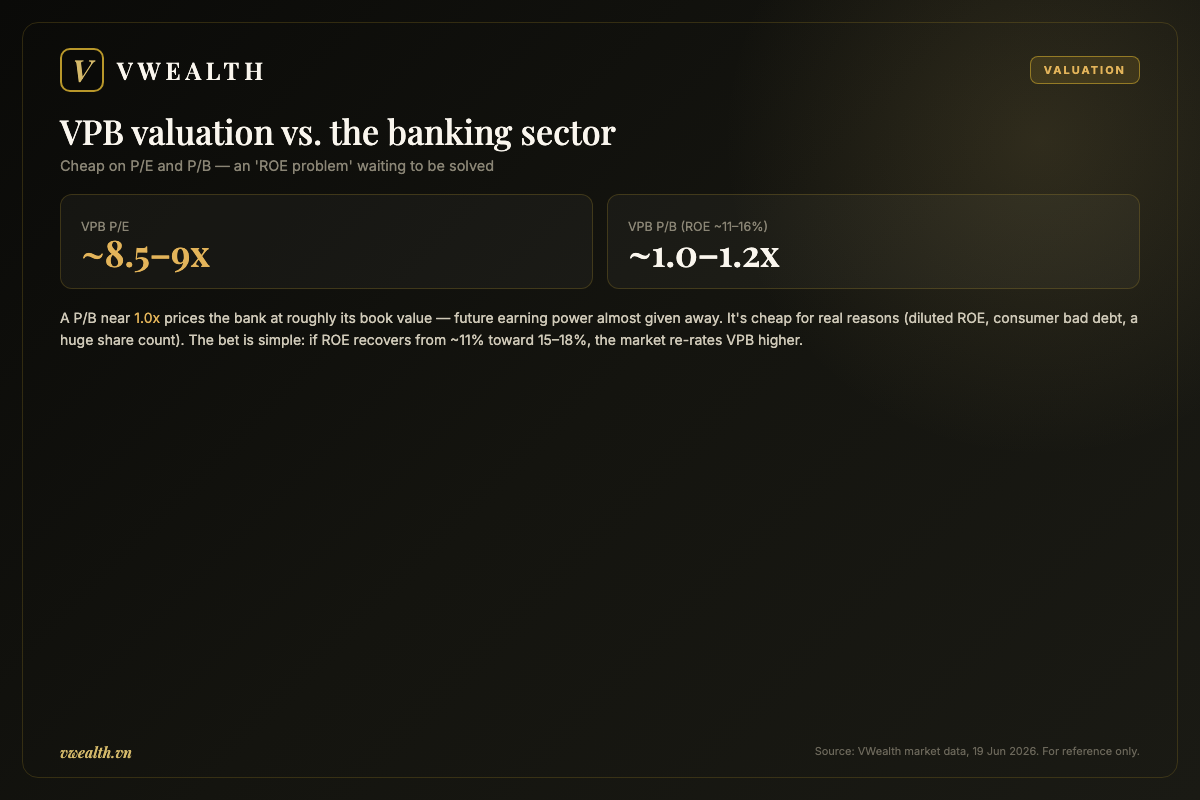
With about 7.93 billion shares outstanding (charter capital of 79,339 billion dong — among the highest in the industry, behind only Vietcombank by capital scale), VPBank produces earnings per share (EPS) of about 2,800–3,100 dong for 2025. At 25,900 dong, that pushes VPB’s P/E to around 8.5–9 times — meaning you pay under 9 dong to buy 1 dong of annual profit the bank generates.
But for a bank, P/E is only half the story. The more important metric — and the one bank analysts always look at first — is P/B (price-to-book). At current prices, VPB trades at a P/B of only about 1.0–1.2 times, at times even falling below 1.0. To picture how “cheap” this is: a P/B of 1 means the market values the entire bank at exactly the equity it holds — as if all its future profit-generating ability is given away for free.
Compare within the industry to see clearly: banks with good asset quality and high ROE like Vietcombank, ACB, Techcombank are typically paid a P/B of 1.3 to over 2 times. VPBank — despite absolute profit on par with the leading group — sits at the bottom of the valuation ladder. This is no accident; the market has its reasons.
Why is VPB cheap? Three reasons the market “discounts” it
A stock cheap for a long time is never cheap for no reason. When you see a large bank continuously trading below or near book value, the market is sending a message: “I don’t believe this capital will earn as well as expected.” For VPBank, three core reasons create that discount, and you need to understand all three.
Reason one: ROE diluted by too-large equity
This is VPBank’s biggest paradox. This bank has enormous equity — the result of continuous capital raises and the 2023 sale of 15% to SMBC that brought in nearly 36,000 billion dong. Thick capital is a strength for safety (CAR among the industry’s highest), but it is a “burden” for profitability metrics.
The reason lies in the formula itself: ROE = net profit / equity. When the denominator (equity) swells faster than the numerator (profit), ROE is pulled down. VPBank ended 2024 with ROE only around 11–12% — notably below the 18–22% of the most efficient private banks. The market looks at this low ROE and concludes: the bank has not “spent all” its capital, so it deserves a low P/B.
Remember this principle, for it is the key to the whole VPB investment thesis: in bank valuation, P/B and ROE go hand in hand. A high-ROE bank deserves a high P/B; low ROE means low P/B. VPB is cheap because ROE is in the low zone — but that is also where the opportunity lies, if ROE recovers.
Reason two: bad-debt fears from FE Credit and retail
VPBank positions itself as a retail and consumer-finance bank — the highest-margin but also highest-risk segment. Subsidiary FE Credit, once the “golden goose,” went through a severe crisis after the pandemic when below-standard consumer borrowers defaulted en masse. VPBank’s consolidated bad debt has therefore always been among the industry’s highest.
The good news is the picture is improving markedly. By end-2025, consolidated bad debt per Circular 31 fell below 3%, with parent-bank bad debt only around 2%. FE Credit has also returned to profit two straight years, with 2025 pre-tax profit up about 19%. But the “ghost” of bad debt from the earlier period still makes many investors cautious, and they demand a risk discount when valuing VPB. That is the second reason P/B is compressed.
Reason three: a large share count diluting the price
With nearly 8 billion shares outstanding, VPB is one of the highest-share-count tickers on HOSE. The direct consequence: profit, however large, when divided by an enormous share count, yields fairly modest EPS and share price. On top of that, the plan to issue 26% bonus shares in 2026 (raising charter capital to the 100,000-billion-dong mark) continues to create dilution pressure. Each capital raise poses the old question: will profit grow fast enough to “absorb” the new shares?
| Factor pushing VPB’s valuation down | Mechanism | Reversal signal to watch |
|---|---|---|
| Too-large equity | Dilutes ROE to ~11–12% | Credit growth uses up capital, ROE rebounds to 15%+ |
| Retail & FE Credit bad debt | Investors demand a risk discount | Consolidated NPL durably below 3%, FE Credit steadily profitable |
| Large share count (~7.93 bn shares) | EPS & price “diluted” | Profit accelerates faster than capital growth |
Cheap for a reason, or a re-rating opportunity?
This is the core question you — as an investor — must answer yourself. A cheap stock can be a “value trap”: cheap because the business is truly weak and will stay weak. But it can also be a “re-rating opportunity”: cheap because the market temporarily fails to see the change coming.
For VPBank, the answer lies entirely in one variable: ROE. Recall the bank-valuation logic. If a bank has a sustainable 20% ROE but trades at just 1.0 times P/B, that is extremely cheap. But if ROE is only 11%, then a 1.0 P/B is… reasonable. VPB is currently in the second case. The investment question is not “is VPB cheap or expensive now” — but “where will VPB’s ROE go over the next 2–3 years.”
And here is where the bull thesis appears. VPBank sits on an enormous, under-exploited capital base. If the bank pushes credit growth to “spend all” the excess capital, if FE Credit keeps recovering and contributing profit like its heyday, then the numerator (profit) will grow fast on a stabilized denominator (capital) — and ROE will spring up. When ROE recovers from 11% to 15–18%, by the P/B–ROE law, the market will be forced to re-rate VPB to a P/B of 1.5–1.8 times. That is the “re-rating” investors who buy VPB in the cheap zone are counting on.
In short: VPB is an “ROE problem.” You don’t buy VPB because it is excellent now, but because you bet it will become more efficient — and when that happens, today’s cheap price becomes tomorrow’s profit.
Cash dividends: a plus for patience
While waiting for the ROE story to play out, VPB investors are not “empty-handed.” VPBank has shifted to a policy of steady cash dividends — a big cultural change for a bank that for years paid only in stock. Management committed to keeping cash dividends for 5 straight years, and in 2026 the bank continues to pay 5% in cash (500 dong per share), a total of nearly 4,000 billion dong.
At a price of 25,900 dong, a 500-dong dividend equals a dividend yield of about 1.9% a year. This is not high versus savings rates, but its meaning far exceeds the yield itself: steady cash flow is evidence that the profit VPBank generates is real money, not a paper figure. For a bank once doubted on asset quality, a continuous cash-payout commitment is a significant confidence-boosting signal.
- 2026 cash dividend: 5% of par (500 dong/share).
- Dividend yield: ~1.9% at a price of 25,900 dong.
- Commitment: cash for 5 straight years — a dividend-culture shift.
- Plus bonus shares: 26%, raising charter capital to 100,000 billion dong.
Price action and liquidity: a “people’s” stock
One of VPB’s less-discussed advantages is its accessibility. At around 26,000 dong, this is a bank stock affordable for individual investors — you need only about 2.6 million dong to own a lot of 100 shares. This low price, combined with the enormous share count, makes VPB one of the highest-liquidity tickers on the whole market, with matched volume regularly tens of millions of shares per session.
Ample liquidity brings two practical benefits: first, you can buy or sell large volume without significant “slippage”; second, VPB is always in the “basket” of ETFs and index funds, so it benefits whenever large flows enter the market. In the past 52 weeks, VPB swung within a wide band from around 17,000–18,000 dong up to nearly 39,000 dong — showing this is a high-volatility stock, moving with the banking industry’s general story and specific factors like the SMBC deal or market-upgrade expectations.
Foreigners and the room story: SMBC and the 49% door
The final factor — and perhaps the most attractive catalyst — lies in foreign capital. VPBank already has a top-tier strategic shareholder in SMBC (Sumitomo Mitsui Banking Corporation) of Japan, holding about 15%. The presence of a leading Asian financial institution brings not only capital, but also a “seal of assurance” on governance and operating standards.
More importantly, after VPBank completed the mandatory takeover of the weak bank (GPBank), it is permitted to raise its foreign-ownership cap to 49% — far above the industry’s usual 30%. With foreign ownership currently only around 24–25%, this means a very large “room” remains for foreigners to keep buying. In fact, there was a period when foreigners net-bought over 1,800 billion dong of VPB in under a month, pushing the stock to a new high. Amid Vietnam approaching the market-upgrade milestone from frontier to emerging, VPB — with a large cap, high liquidity and wide foreign room — stands in a particularly favorable position to receive incoming foreign capital.
| Foreign-capital factor | Current status | Implication for investors |
|---|---|---|
| Strategic shareholder SMBC | Holds ~15% | Governance assurance, long-term capital |
| Foreign-room cap | Raised to 49% after the takeover | Very large room to buy in |
| Current foreign ownership | ~24–25% | Attractive “empty room” at the upgrade |
Summary: VPB is a cheap bet on ROE recovery
Let’s wrap up everything you just analyzed. At 25,900 dong, VPB is a cheap stock — cheap on both P/E (~8.5–9 times) and P/B (~1.0–1.2 times) — and it is cheap for real reasons: ROE diluted by giant equity, the bad-debt ghost from consumer finance, and too large a share count. This is not an unreasonable cheapness; the market is correctly valuing a bank “strong in scale but not yet optimized in efficiency.”
But within that “not yet optimized” lies the opportunity. VPBank sits on under-exploited capital, has a recovering FE Credit, steady cash dividends to wait on, top liquidity and a wide 49% foreign room amid the market approaching an upgrade. Buying VPB at this price is essentially betting that the bank’s ROE will recover — and when it does, the P/B valuation will be re-rated to a higher level, rewarding those who patiently bought in the cheap zone.
That is the thesis. But a thesis is only solid in the industry context. Is Vietnam’s whole banking industry in a cycle favorable to the ROE-recovery story? How do bad-debt pressure, NIM and the upgrade wave affect VPBank specifically? That is what we dissect next, on the banking-industry context.
Economic and banking-industry context: where does VPB stand in the big picture?
A bank stock never exists in isolation. VPB’s price today around 25,900 dong, at a P/E of about 8–9 times and a P/B of just 1–1.2 times, reflects not only VPBank’s own story but is also a mirror of the entire credit cycle, interest rates and consumer health of the Vietnamese economy. You cannot judge VPB fairly if you ignore the large current of the banking industry carrying it along. This section places VPBank in that context, so you understand why the record 2025 profit is both an achievement and a gamble tied to the whole system’s fate.
Industry-wide credit growth: from a 19% peak toward a 15% target
2025 closed with an impressive figure: industry-wide credit growth of about 19.01%, lifting the economy’s total loans to roughly 18.58 quadrillion dong. This is one of the strongest credit-boom years in recent memory, a direct driver of most banks’ profits, VPBank included. When credit flows strongly, banks have more room to lend, net interest income swells, and banks that dare grow fast like VPB benefit directly.
But 2026 will be a different story. The State Bank (SBV) targets industry-wide credit growth of only about 15%, notably below the prior year’s 19%. Credit in 2026 is projected to add about 2.79 quadrillion dong, about 183,000 billion less than 2025’s injection. More important is the management style: SBV plans to assign the quota once for the whole year and control it quarterly, requiring banks not to let first-quarter growth exceed 25% of the full-year quota.
This poses an interesting paradox for VPB. While the industry norm slows, VPBank targets credit growth of up to 35% for 2026 and already crossed one quadrillion dong of loans in Q1 2026. A bank aiming to double the industry’s pace amid tightened “room” is a big ambition, requiring a thick capital base and regulatory approval. This is the point to remember: VPB is a stock of a bank choosing to go fast when the crowd goes slow, and that is both an opportunity and a risk.
Low rates stimulating consumer credit — a gift for VPB and FE Credit
One of the most important factors for VPB is the interest-rate environment. Keeping lending rates low throughout 2025 and early 2026 is a deliberate policy to support economic growth. For most banks, low rates mean thinner margins. But for VPBank, the story has a special layer of meaning.
VPB is the bank with the largest share of consumer lending in its group thanks to subsidiary FE Credit — the “big player” in consumer finance. When rates fall and the economy recovers, people borrow more for consumption: buying motorbikes, phones, installment household goods, small cash loans. This is FE Credit’s fertile ground. After the post-COVID crisis that battered consumer finance with bad debt, FE Credit has recovered and recorded a second straight profitable year. Low rates stimulating consumption are thus a favorable wind blowing directly into VPBank’s most characteristic profit engine — something pure-wholesale or large-corporate-focused banks do not have.
Industry-wide NIM narrowing — a shared headwind
However, the flip side of low rates is that the whole industry’s NIM is eroded. Data show industry-wide NIM falling continuously, from about 3.25% in Q1 2025 to 3.0% in Q3 2025 — the lowest in years, with the trailing four-quarter average only around 3.15%, the lowest since 2018. The cause is rising funding costs while lending rates are kept low to support the economy. Most mid-sized banks even fell short of their profit plans because of this NIM vise.
NIM pressure is forecast to persist into Q1 2026 before stabilizing in the second half, if system liquidity eases seasonally and lending-rate competition becomes less fierce. Here VPB has a structural advantage: thanks to its high share of consumer and retail lending — loans with higher rates than large-corporate lending — VPBank maintains a NIM among the system’s highest. When the whole industry reels from thin margins, VPB still has a thicker “cushion” to absorb. But don’t forget: high NIM also comes with high credit risk, and that is the price this model always pays.
Consumer recovery and consumer lending — FE Credit’s driver
If I had to name the single biggest variable for VPB’s profit outlook in the coming years, it is the pace of domestic-consumption recovery. FE Credit was once the “golden goose” bringing VPBank thousands of billions in profit each year before the pandemic. Then the consumer-finance bad-debt wave turned it into a burden, dragging down the whole group’s consolidated profit for many quarters.
2025–2026 marks the turning point: FE Credit has returned to profit two straight years, though Q1 2026 profit dipped slightly year on year. This recovery not only improves the profit figure but also restores a distinctive growth engine no other bank replicates at comparable scale. When workers’ incomes stabilize, consumer confidence returns and demand for small loans rises, FE Credit can regain part of its former glory. This is the scenario VPB buyers are betting on.
Consumer and real-estate bad-debt risk — the dark side of the picture
Every dong of high profit from consumer lending comes with a shadow: bad debt. Banking-industry asset quality shows signs of strain. Though rating agencies like VIS Rating expect industry-wide bad debt in 2026 to ease slightly to 2–2.1% thanks to a stable business environment and tighter control of high-risk real-estate lending, three “variables” still add pressure: floating rates, developers’ refinancing needs, and major planning adjustments.
VPB sits at the center of both risk types. On one hand, consumer lending via FE Credit always carries above-average bad debt because borrowers are the below-standard, easily-hurt segment when the economy swings. On the other, VPBank also has a relatively high risk appetite in real estate and corporate bonds. VPB’s bad-debt ratio is among the highest of listed banks — the direct price of the high-NIM strategy. When you look at record profit, always place beside it the question: what is the asset quality behind those numbers?
The highest NIM in its group and the highest bad debt in its group are two sides of the same coin. You cannot buy VPB for the profit while ignoring the credit risk — they are an inseparable package.
SBV policy: from easing to selective caution
The SBV’s 2026 management direction has a “selective caution” flavor. On one hand, it keeps rates low and assigns credit “room” to support GDP growth. On the other, it requires tight control of credit growth into risk-prone areas, especially real estate. Assigning the quota once for the year and monitoring quarterly shows the regulator wants both to stimulate and to guard against bubbles.
For a hot-growth, high-risk-appetite bank like VPB, this policy is a double-edged sword. If VPBank is granted high credit “room” thanks to its solid capital base and the GPBank takeover, that is a launchpad. But if the SBV clamps down hard on real estate and risky lending, VPB’s growth model, heavily reliant on consumption and real estate, could be restrained. Macro policy is thus a variable you cannot control but must watch closely.
The upgrade story and foreign capital
A long-term driver for all bank stocks, VPB included, is the prospect of Vietnam’s stock-market upgrade. FTSE Russell confirmed it is keeping the roadmap to upgrade Vietnam from Frontier to Secondary Emerging per its announcement from October 2025. When the upgrade officially happens, foreign capital from global funds is expected to flow strongly into large-cap, highly liquid stocks — and leading bank stocks like VPB are prime candidates to benefit.
VPB has a very large share count and a market cap among the industry’s highest, making it almost certain to be in the target portfolios of index-tracking ETFs at the upgrade. This creates a potential “re-rating story”: if foreign capital pours in, the current P/B of just 1–1.2 times could be reassessed more favorably.
SMBC’s role — a bridge to Japanese FDI customers
The final factor, and VPB’s biggest strategic differentiator from the rest, is the presence of strategic shareholder SMBC — one of Japan’s leading financial groups, holding 15% of VPBank’s charter capital. This is not a purely financial-investment relationship. SMBC supports VPBank across many core areas: risk management, capital management, international funding, and especially developing the FDI corporate customer base.
Vietnam is a top destination for FDI, in which Japanese businesses are among the largest investor groups. SMBC becomes a natural bridge bringing Japanese FDI customers to VPBank — a high-quality, stable customer source with deep, broad financial-service needs. In 2026, VPBank also plans to raise charter capital to over 106,000 billion dong, aiming for the highest in the system, partly through a private placement to foreign investors. SMBC’s backing is thus not only capital, but a whole customer ecosystem and governance capacity few domestic banks have. This is one of the foundational reasons many investors believe in VPB’s long-term story.
Trend prediction: where will VPB go?
Having understood the industry context, it’s time to look ahead. This section is not a prophecy — no one forecasts a share price precisely. Instead, you’ll see the strategy VPBank’s management is pursuing, and three possible scenarios with their triggers and effects on the share price. The goal is to help you picture the situation yourself, not to make you believe a preset number.
VPBank’s strategy: use up the “giant capital chest” to grow
The core of VPBank’s strategy for the coming years can be summed in one sentence: maximize the enormous equity base for strong growth. After selling 15% to SMBC, VPBank became one of the highest-equity banks in the system. The question over recent years has always been: when will VPB “spend” all this capital to earn? 2025–2026 is precisely when the answer emerges.
VPBank’s multi-pronged strategy includes:
- Outsized credit growth: targeting credit growth of up to 35% in 2026, nearly double the industry norm, with loans already past 1 quadrillion dong in Q1 2026.
- FE Credit regaining form: bringing consumer finance back to a high-profit orbit, capitalizing on the domestic-consumption recovery.
- Pushing retail and investment banking: expanding the individual and SME customer base while developing the IB segment via VPBankS — which successfully raised a 100-million-USD international loan in Q1, riding the market-upgrade wave.
- Handling GPBank: completing the restructuring of the mandatorily-transferred bank. GPBank earned over 400 billion dong in Q1 2026 alone, nearly the full-year 2025 result — a signal the “burden” is gradually becoming an asset.
- Ambitious profit target: a 2026 pre-tax profit plan of over 41,300 billion dong (up about 35%), on top of the record 30,600 billion of 2025 (already up 53%), aiming for the industry’s profit-leading group.
In other words, VPBank is shifting from a “capital-accumulation” phase to a “capital-deployment” phase. If this strategy succeeds, profit and ROE will spring up. If it fails — if bad debt erupts or consumption doesn’t recover as hoped — then the very large capital chest becomes a blade eroding profitability.
Three scenarios for VPB stock
Based on the drivers and risks analyzed, you can picture three scenarios. Note: this is a framework of conditions and consequences, not a specific price forecast.
Positive scenario: ROE breaks out and re-rating
Conditions: domestic consumption recovers strongly, FE Credit regains form and contributes large profit; bad debt is well controlled, provisioning costs fall; VPBank meets or exceeds the over-41,300-billion profit target; Vietnam’s stock market is upgraded and foreign capital flows into leading bank stocks; GPBank keeps improving into an additional profit source.
Consequence: ROE recovers and breaks out as the large capital chest starts earning efficiently. Then the current P/B of just 1–1.2 times is seen as too cheap and the market re-rates VPB to a higher level. The stock has considerable upside from combining profit growth and multiple expansion — the “two-engine” scenario value investors dream of.
Base scenario: steady growth but flat valuation
Conditions: consumption recovers gradually; FE Credit is profitable but not booming; VPBank meets most of its profit plan; bad debt is kept stable at a high but controlled level; the upgrade happens but the capital-flow impact takes time to permeate.
Consequence: profit grows steadily, but the market keeps a cautious stance on bad-debt risk and capital dilution. The share price moves with profit growth, P/B stays around 1–1.2 times. This is the “nothing breakout but no collapse” scenario — suited to a value stock paying dividends and biding its time.
Negative scenario: bad debt erupts
Conditions: consumption doesn’t recover as hoped or weakens again; FE Credit’s consumer-finance bad debt jumps; real-estate and corporate-bond risks materialize; the SBV clamps hard on risky credit; provisioning costs surge, eroding profit; GPBank needs more resources to resolve.
Consequence: profit misses plan, ROE is pulled down. The market re-rates negatively, P/B could fall below 1 time. This is the real risk of the high-NIM, high-risk model, and the reason VPB’s P/B is always lower than banks with better asset quality.
To weigh the two sides of the scale visually, look at the summary chart below before reaching a conclusion.
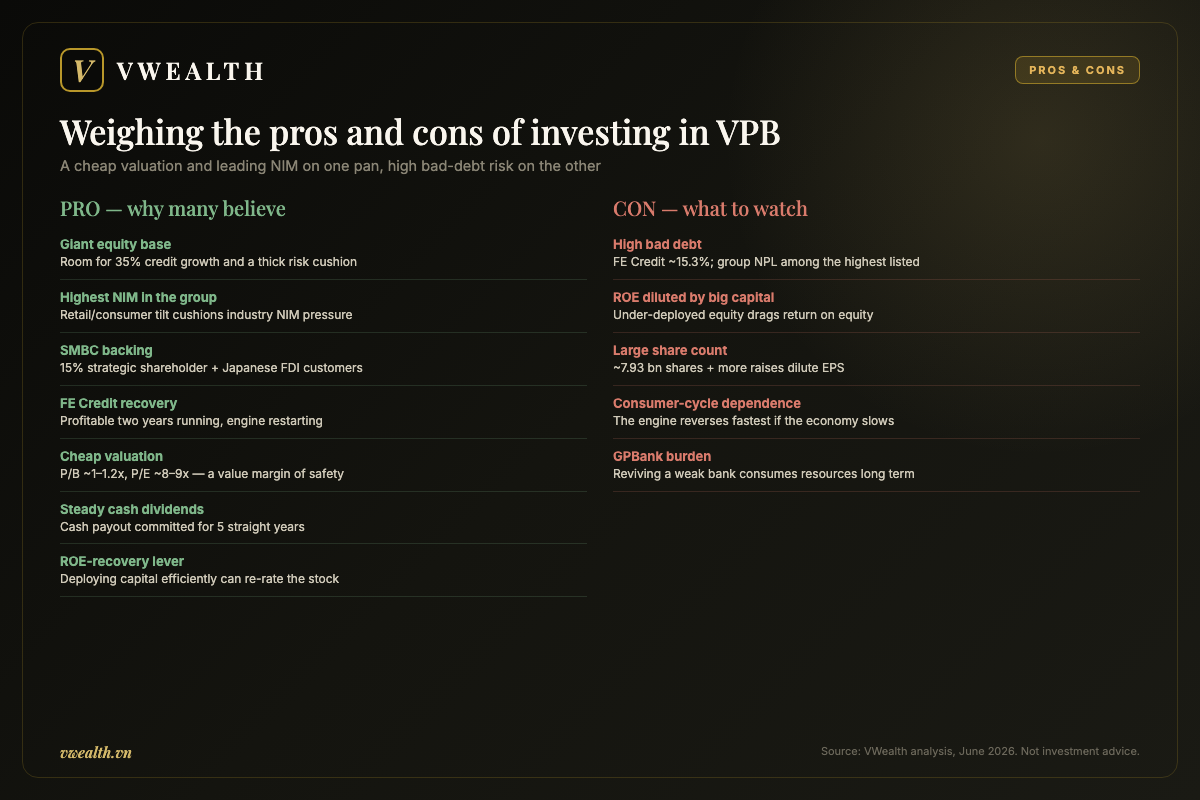
Should you buy VPB stock?
This is the question you really want answered. But an honest analyst will not tell you to “buy” or “sell” — because that decision depends on your own risk appetite, goals and financial situation. My job is to put all the pros and cons on the scale fairly, then help you recognize which kind of investor VPB suits. The final decision is yours.
The pros: why many believe in VPB
- Giant equity — room for growth and risk-bearing: An equity base among the system’s largest gives VPBank room for strong credit growth (targeting 35% in 2026) and a thick cushion to absorb risk that thin-capital banks lack.
- The highest NIM in its group: Thanks to a high share of consumer and retail lending, VPB’s net interest margin is among the industry’s highest, helping the bank withstand industry-wide NIM narrowing better.
- SMBC’s backing: The Japanese strategic shareholder holds 15%, supporting risk management, international funding, and bringing Japanese FDI customers to VPBank — a unique competitive advantage.
- FE Credit’s recovery: The consumer-finance engine has been profitable two straight years, opening the possibility of regaining its former “golden goose” form.
- Cheap valuation: A P/B of just 1–1.2 times and a P/E of 8–9 times — a low valuation relative to brand quality and profit scale, creating a margin of safety for value investors.
- Steady cash dividends: VPBank maintains a cash-dividend policy, delivering real cash flow to shareholders while awaiting growth.
- The ROE-recovery lever: When the large capital chest is deployed efficiently and FE Credit recovers, ROE has the potential to break out — the biggest re-rating driver.
The cons: risks you must not ignore
- High bad debt: This is the biggest risk. Consumer lending via FE Credit and a risk appetite for real estate and bonds put VPB’s bad-debt ratio among the highest of listed banks.
- ROE diluted by large capital: The giant capital chest is a double-edged sword — while not yet fully deployed efficiently, it drags ROE below banks with leaner capital.
- A large share count diluting: A very large share count and continued capital raises (to over 106,000 billion in 2026) dilute earnings per share.
- Dependence on consumer recovery: The FE Credit and retail story is tightly bound to domestic-consumption health — if the economy slows, this distinctive profit engine reverses fastest.
- The GPBank burden: Although GPBank has turned profitable, resolving a weak bank still consumes resources and carries long-term surprises.
Which kind of investor does VPB suit?
To position yourself, picture four common investor types:
- Value investor — cheap price: Those seeking quality stocks the market underprices. VPB, at a P/B of 1–1.2 times, a strong brand and a bet on ROE recovery, suits this group well — as long as you accept the trade-off of bad-debt risk.
- Income investor: Those prioritizing steady cash flow. VPB’s cash-dividend policy is a plus, but this is not a purely defensive stock given its high credit risk.
- Growth investor: Those hunting fast profit growth. The 35% profit target and strong capital-deployment strategy are appealing, but come with volatility and high risk.
- Conservative investor — safety-first: Those prioritizing capital preservation who hate volatility. This group should think carefully, because high bad debt and dependence on the consumption cycle make VPB not a “sleep well” choice.
In sum, VPB suits best a value investor seeking a cheap price, willing to bet on ROE recovery and enjoy cash dividends, while accepting the high bad-debt risk tied to the consumer-lending model and the bank’s risk appetite. If you belong to this group, VPB is a name worth deeper research. If you are cautious and hate volatility, the height of the bad-debt ratio is something you need to think about very carefully.
VPB is not an absolutely “good” or “bad” stock. It is a calculated gamble: you trade high bad-debt risk for a cheap valuation, a leading NIM and the hope of an ROE breakout. The question is not “is VPB good?” but “does your risk appetite match VPB?”
Disclaimer: This article is produced for informational and reference-analysis purposes, and is not investment advice or a recommendation to buy or sell VPB or any security. The figures and views are based on public data at the time of writing and may change with market developments. Investing in stocks always carries the risk of capital loss. You should do your own thorough research, weigh your personal financial situation and consult a licensed investment advisor before making any decision. vwealth.vn and the author bear no responsibility for any losses arising from the use of information in this article.
Research Vietnamese stocks in English with vwealth. Our AI-powered platform turns Vietnamese market data into full English analysis reports — with international payment support and a free 2-month trial for new accounts. Create your free account and read the latest reports.
Read more sector analysis: Vietnam’s Banking Sector: A Foreign Investor’s Guide to the Market’s Backbone