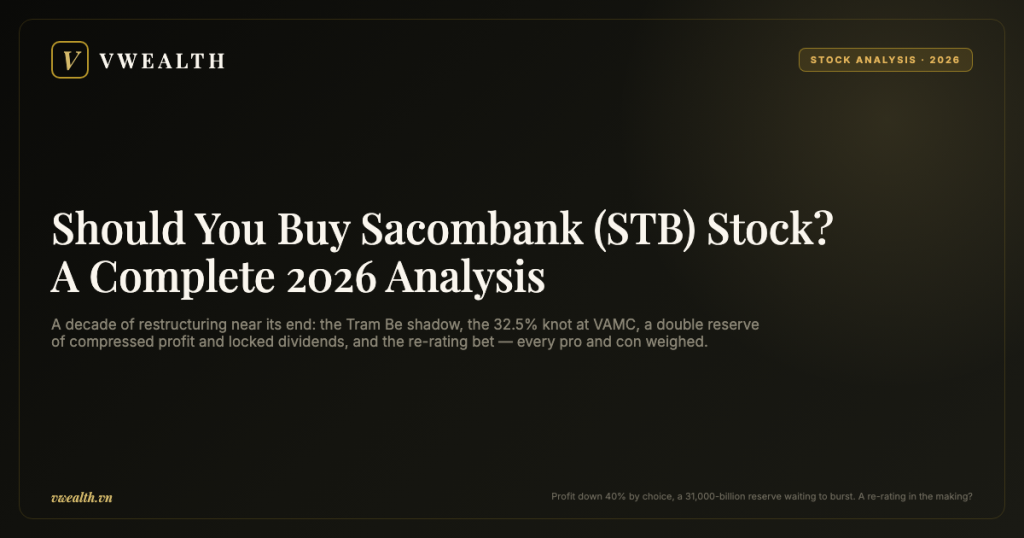
In all of Vietnamese banking, few tickers tell a story as dramatic as STB. If you have ever heard of deals about “rising from the shadow of bad debt,” then Saigon Thuong Tin Commercial Joint Stock Bank – Sacombank (HOSE: STB) is the most classic version, the most talked about, and now the closest to a beautiful ending. This is not simply a mid-sized joint-stock bank. It is an entity that walked the peak of glory, fell into the abyss after being taken over and forced to carry an enormous pile of legacy assets from the 2015 merger with Southern Bank (Phuong Nam Bank) engineered by the Tram Be group, and then quietly cleaned its balance sheet for nearly a decade to come back.
Why do you need to understand this story well before deciding to put money in? Because the nature of an investment in STB right now is unlike any other bank stock on the exchange. You are not buying a smoothly running bank and betting on its credit-growth pace. You are betting on a specific event: a restructuring that is all but complete after about 10 years, and with it the re-rating that comes when the market realizes the last “shadow” has been removed. That trigger lies in two symbolic knots: the definitive resolution of the debt and the 32.5% stake tied to the Tram Be group now sitting at VAMC, and the return to paying dividends for the first time since October 2015 — that is, after exactly a decade of “three nos” (no dividend, no bonus shares, no capital increase from profit).
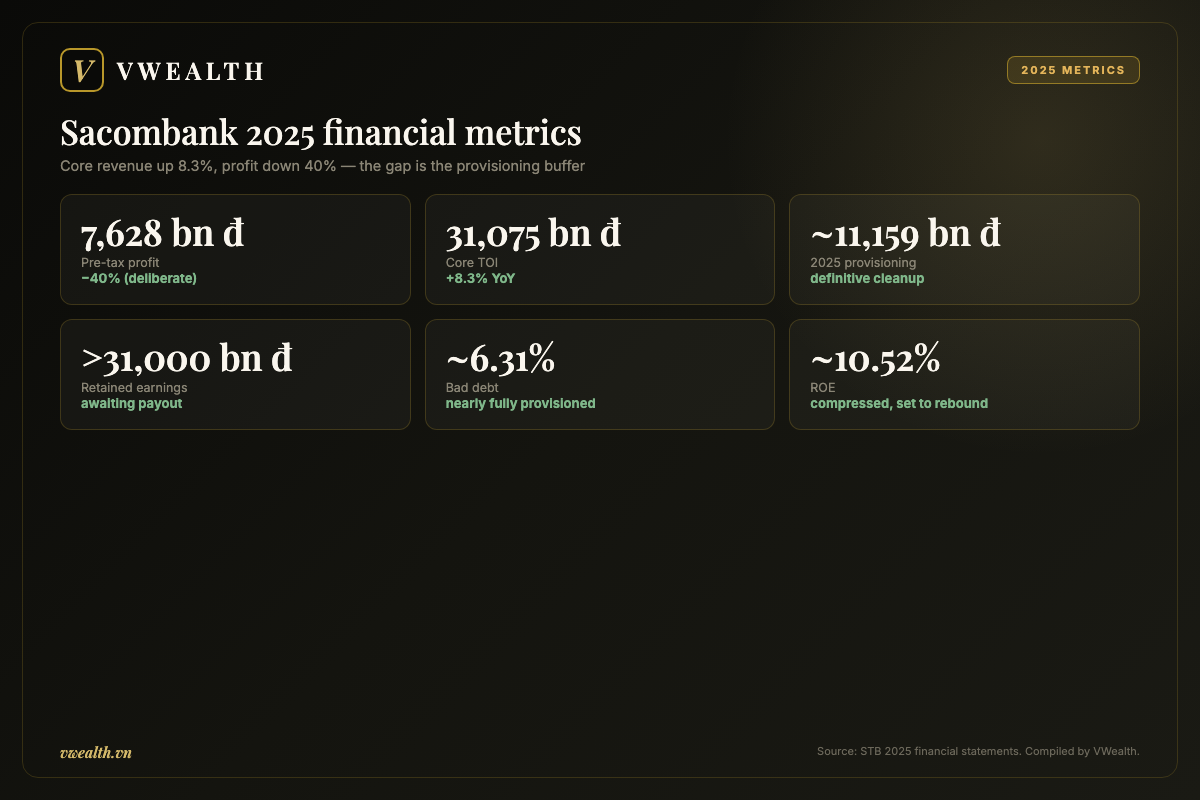
And here is the paradox you absolutely must grasp if you don’t want to misread the numbers: in 2025, Sacombank’s pre-tax profit reached only about 7,628 billion dong, down as much as 40% year on year, with Q4 2025 alone posting a loss of over 3,300 billion dong. On the surface, that was a “bad” year. But dig deeper and you find the opposite: the core business is still healthy — total operating income still grew over 8%, net interest income still rose — profit fell only because the bank proactively provisioned to the end, “eating” all the remaining bad in one go to clear the runway. In other words, the ugly 2025 profit figure is precisely the price voluntarily paid to turn to a new chapter. The share price, having read that story, still rose sharply and reached 72,300đ on 19 June 2026.
This full analysis is written to answer directly the question you may be pondering: should you buy STB, and if so, which kind of investor does this stock suit? To answer properly, we cannot start from the price board. We must start from the roots — from a small credit cooperative in 1991, through the golden Dang Van Thanh era, to the Tram Be episode, and then the 10-year journey of rebirth. Only by understanding what STB went through can you correctly value what the market is paying for today.
STB market data (updated 19 June 2026)
| Current price | 72,300đ | 2025 pre-tax profit* | 7,628 bn (−40%) |
| Change (June) | +7.91% | Retained earnings | >31,000 bn (awaiting payout) |
| P/E | P/B | ~17–28x | ~1.3–2.1x | Forward P/E 2026 | ~8–11x |
*2025 pre-tax profit fell 40% because of DEFINITIVE PROVISIONING to close the restructuring (core TOI still +8.3%) — NOT a weak business. The story = a re-rating once restructuring completes. Source: VWealth + STB 2025 reports. For reference only.
History and evolution
To understand why STB today is a restructuring “case study” rather than an ordinary bank stock, you need to walk with it through three transfers of power — three chapters with utterly different fates. Each change of owner changed Sacombank’s very nature: from a rising star, to the hostage of an interest group, to a critically ill patient treated patiently for a decade.
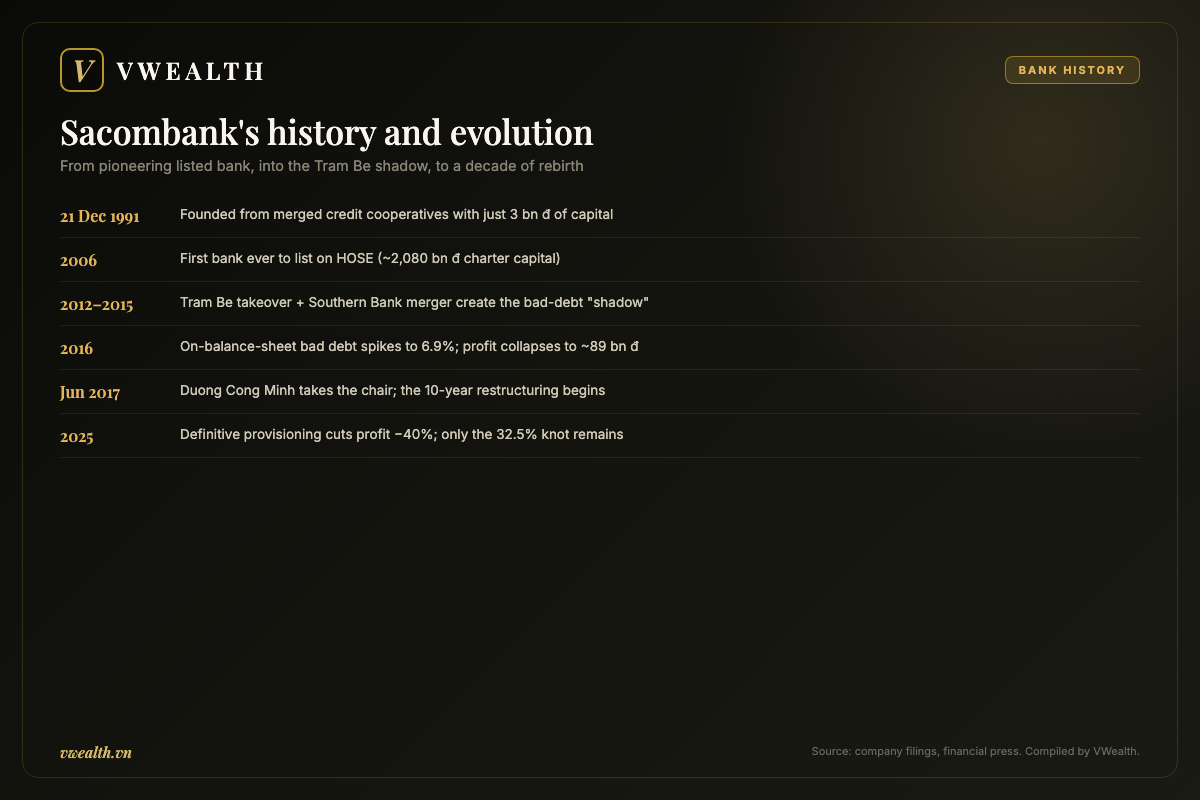
1991–2012: origins and the golden Dang Van Thanh era
Sacombank officially began operating on 21 December 1991, with initial charter capital of just 3 billion dong, formed by merging several struggling credit cooperatives in Ho Chi Minh City at the time. It was one of Vietnam’s first private joint-stock commercial banks — born almost in step with the first tentative moves of the two-tier banking system after Doi Moi. Picture the context: in the early 1990s, the concept of a “private joint-stock bank” was very new, and it was far from certain that an institution born of weak credit cooperatives could rise into a real force.
The man who laid the foundation and lifted Sacombank to its peak was businessman Dang Van Thanh, who held the Chairman’s seat from 1994 to 2012. Behind him stood the Thanh Thanh Cong ecosystem with its sugar-cane empire — a financial and relationship base that helped Sacombank grow steadily. Under Mr. Thanh, Sacombank produced a string of “firsts” for Vietnam’s financial industry. Most importantly, in 2006, Sacombank became the first bank to list its shares on the Ho Chi Minh City Stock Exchange (HOSE), with charter capital of about 2,080 billion dong at the time. This was a historic milestone: before STB, no bank stock had ever been on the exchange. A private bank daring to list, become transparent, and submit to the scrutiny of tens of thousands of public shareholders was a pioneering step that reshaped how Vietnamese people saw “king” stocks.
Not content with the domestic market, Sacombank also expanded into Laos and Cambodia, building a financial-services ecosystem. At its peak, STB was one of the most sought-after stocks, the symbol of a well-governed, dynamic private bank. But that very success — a listed bank, a highly liquid stock, dispersed ownership — also inadvertently turned Sacombank into an attractive “prey” for those who wanted to take it over. And that was the beginning of the tragedy.
2012–2017: the Tram Be takeover and the Southern Bank “shadow”
Around 2012, a group of shareholders led by businessman Tram Be quietly accumulated shares and seized control of Sacombank. Dang Van Thanh’s family left their leadership positions one by one. This was one of the most shocking takeovers in the history of Vietnamese banking — a good bank falling into the hands of a new ownership group carrying its own calculations.
Had the change of ownership stopped there, the story might have been different. The problem lay in the next step. On 1 October 2015, under the Tram Be group’s management, Sacombank carried out the merger with Southern Bank (Phuong Nam Bank) — a weak bank to which the Tram Be group was also deeply connected. This was the source of the “shadow.” Before the merger, Southern Bank had extremely poor asset quality, a bad-debt ratio cited as very high, exhausted financial capacity, and was nearly unable to recover on its own. When that entire pile of legacy assets was folded into Sacombank, the immediate consequences were severe.
- By end-2016, Sacombank’s on-balance-sheet bad debt jumped to as much as 6.9% of total loans, far above the safe threshold.
- Bad debt sold to VAMC rose to over 23,000 billion dong.
- Total bad debt and legacy assets to be resolved were cited at a scale reaching hundreds of thousands of billions of dong.
- Profit in 2016 fell to only about 89 billion dong — down nearly 90% from earlier, a figure almost “zero” for a bank of Sacombank’s scale.
Why was it called a “shadow”? Because post-merger bad debt was not just a number on a report, but an enormous pile of collateral — mostly real estate and projects — “frozen,” not generating income while eroding capital year after year through provisioning. Sacombank fell into a “three nos” state that shareholders had to bear for many years: no dividend, no bonus, no growth. The peak of the governance crisis was the prosecution and detention of Mr. Tram Be in 2017 for violations. Sacombank was formally placed under restructuring per a plan approved by the State Bank. A bank once a private-sector pride became a “patient” of the whole system.
The core lesson for you in this chapter: a bank’s biggest risk does not always come from its business, but can come from governance and controlling shareholders. One wrong merger decision by the owners pushed the entire institution and tens of thousands of small shareholders into a lost decade.
2017–2025: ten years of restructuring under Duong Cong Minh
The turning point came in June 2017, when businessman Duong Cong Minh — Chairman of the Him Lam Group — was elected Chairman of Sacombank’s Board at the AGM on 30 June 2017, alongside CEO Nguyen Duc Thach Diem. Mr. Minh made a commitment that would be repeated for years afterward like an oath: if within 5 years he could not resolve Sacombank’s bad debt, he would resign. That promise shaped the entire spirit of this era — patiently working out legacy assets rather than chasing hot growth.
The way Sacombank cleaned its balance sheet was a persistent journey, auctioning each block of collateral:
- Auction of Duc Hoa III Industrial Park land (Long An): three land lots tied to the Tram Be group were auctioned at a value of nearly 10,000 billion dong.
- The debt at Phong Phu Industrial Park: after 18 grueling auction rounds (2023), this debt went to a new owner at a price of 7,934 billion dong — higher than the customer’s debt obligation. This was one of the most emblematic debt-resolution deals, with the recovery cash flow stretching across years.
The result of a decade of persistence is telling numbers. On the original principal of the old customer group (mainly Tram Be-related) of about 35,400 billion dong at end-2016, by end-2024 Sacombank had recovered and resolved 25,612 billion dong, leaving only about 12,037 billion dong — most of which had been moved to VAMC, of which VAMC bonds stood at 9,743 billion dong with provisions of up to 8,128 billion dong already set aside. In other words, the remaining bad portion is almost fully “covered” by provisions, and the real residual risk is very thin.
In parallel with cleaning up debt, business health recovered spectacularly. Net interest income rose about fivefold, from 5,000 billion dong (2017) to over 24,500 billion dong (2024). Pre-tax profit crossed the 10,000-billion mark, peaking in 2024 at around 12,700 billion dong. Total assets nearly doubled, reaching about 748,000 billion dong. Important for you — the investor — is that accumulated undistributed after-tax profit exceeded 25,352 billion dong (and continued rising to over 34,000 billion dong per later updates). This is the “treasury” accumulated over a decade that could not be distributed, waiting for the day it is released.
The final knot: the 32.5% Tram Be stake and the door to dividends
By now you will ask: if the debt is nearly resolved, assets are strong, and accumulated profit is large, why has Sacombank still not “broken out”? The answer lies in the one remaining knot — and this is the most important detail you need to grasp to value the stock today.
It is the 32.5% of Sacombank shares belonging to the Tram Be group, currently mandated/held at VAMC. This block is collateral for the remaining debt, but due to legal entanglements it cannot yet be divested. Sacombank has submitted a specific plan to the State Bank: to be allowed to self-organize an auction of this STB share lot to recover the debt. Securities firms forecast very large proceeds from this deal — SSI estimates about 12,000 billion dong, while Mirae Asset’s optimistic scenario reaches 15,000–31,000 billion dong if the auction succeeds. According to the bank itself, at present Sacombank has only this final knot left, awaiting the State Bank’s approval of the plan to resolve the STB share lot under the restructuring scheme.
Why does “finished cleaning” mean “profit break-out and dividend payout”? Because the condition for Sacombank to pay dividends again is not just having money, but meeting all the scheme’s criteria: completing the charter-capital remediation, bringing bad debt below the 3% threshold, and especially resolving the 32.5% Tram Be stake with the state authority’s consent. When this knot is untied, three things happen almost simultaneously:
- Sacombank formally exits special control, ending the restructuring scheme that ran from 2016.
- The undistributed profit of over 25,000–34,000 billion dong is “released,” opening the way to the first dividend since October 2015 — that is, after exactly a decade. This is something long-time shareholders have awaited so keenly that many worry they “won’t live to see the payout.”
- The stock is re-rated: from a bank discounted by the market for “Tram Be debt risk,” STB returns to the group of healthy banks, eligible for a peer comparison on valuation.
This is also why the definitive provisioning of 2025 — which cut profit 40% and made Q4 a loss — is viewed positively by many investors. It is a “pain once” move to bring asset quality up to standard, cleaning up the last part before turning the page. The context grew even more symbolic when, at end-2025, the management had senior personnel changes and Sacombank even changed its brand identity — signals that the bank is proactively stepping into an entirely new chapter.
In sum, Sacombank’s history is a nearly closed circle: born of hardship (1991), risen to the peak under Dang Van Thanh (1994–2012), fallen into the “shadow” from the Tram Be group’s takeover and Southern Bank merger (2012–2017), and then patiently revived over nearly a decade under Duong Cong Minh (2017–2025). Today, at 72,300đ and rising strongly, STB stands right before the final door. Understanding this journey, you will see why the next step — the people steering the bank through the decisive turn — matters so much. And that is exactly what we examine closely next: Leadership.
Leadership and ownership structure
If you looked only at profit figures or bad-debt ratios, you would miss half of STB’s investment story. Sacombank is a rare case on Vietnam’s stock market where the human factor and ownership structure decide almost the entire outlook for the stock. For nearly a decade, this bank’s fate has been tightly bound to one name — Mr. Duong Cong Minh — and to an unprecedented “ownership blood clot”: the 32.5% lot in the regulator’s hands, awaiting the day it goes to auction. When you weigh putting money into STB, you are really betting on who will sit in the driver’s seat and when that ownership knot is untied. This section dissects both aspects thoroughly.
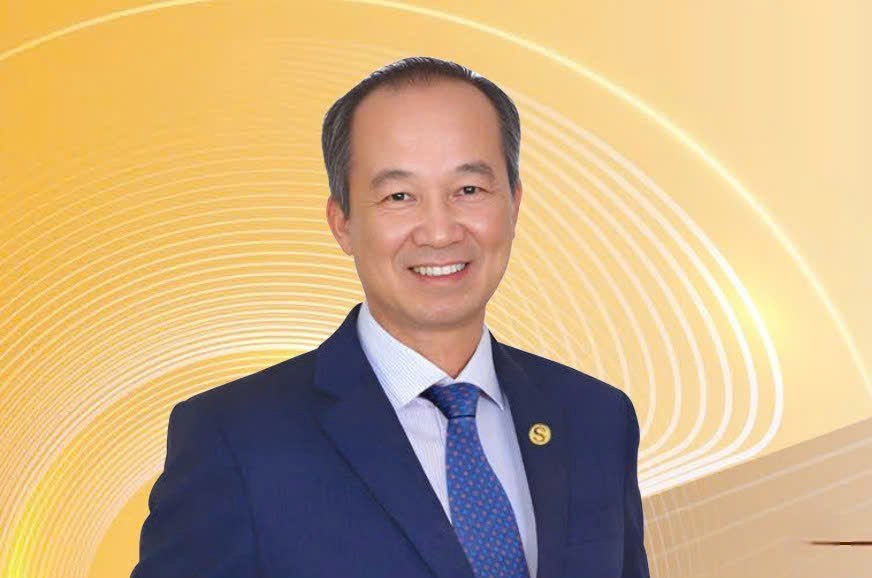
Duong Cong Minh — the “restructuring hero” and one man’s imprint on a bank
It is hard to find a bank in Vietnam whose fate is bound to an individual as tightly as Sacombank’s is to Mr. Duong Cong Minh. In June 2017, when Sacombank was sinking in the post-merger crisis with Phuong Nam Bank (PNB) — carrying an enormous pile of bad debt and legacy assets — Mr. Minh stepped in as the man expected to “revive” the bank. On 30 June 2017, he was elected Chairman by the AGM with the highest vote share, opening a restructuring journey that even now is not fully closed.
What caught investors’ attention was not just his taking the Chairman’s seat, but the price he was willing to pay to do it. To comply with the amended Law on Credit Institutions (effective January 2018) barring one person from simultaneously leading multiple organizations, Mr. Minh resigned from a series of key posts one by one. According to press accounts at the time, he left the chair at four businesses tied to his name, most notably the Him Lam Group — the real-estate “empire” he himself built — along with entities such as Bao Long Sports Equipment Company, Xin Man Development Company and LienViet Securities. Earlier, he had also resigned from LienVietPostBank (now LPBank), and Him Lam divested its entire stake of nearly 97 million LPB shares (about 14.98% of charter capital) at that bank.
A businessman voluntarily letting go of almost his entire “original estate” to devote himself to an ailing bank is a rare signal. For STB shareholders, it was both a heartfelt commitment and proof of Mr. Minh’s characteristic “all-in” style.
Mr. Duong Cong Minh’s background partly explains his ability to handle Sacombank’s “debt pile.” His name is tied to Him Lam — one of the large private real-estate businesses — where he accumulated deep experience in valuing, resolving and liquidating assets, especially real estate. This was the key “weapon,” because most of the legacy assets and bad debt Sacombank inherited from the PNB deal were secured by real estate. Many analyses in the financial press describe him as having a decisive style, a “hunger” for resolving debt, and a readiness to make firm decisions — qualities a bank in emergency care badly needs.
You should also remember a symbolic promise: Mr. Minh once declared, in essence, that if within 5 years he could not restructure Sacombank, he would leave. That deadline has passed, and although the journey took longer than expected, as of early 2026 he remains in office. At recent AGMs, his message has shifted in tone markedly — from “defense, crisis management” to “offense, rising up.” According to statements quoted in April 2026, he affirmed that Sacombank had resolved most of its bad debt and legacy assets, largely completed its financial obligations and dealt with cross-ownership, and was “ready to rise to new heights.”
That said, the picture is not entirely rosy, and an honest analyst must make this clear to you. Also per reports, Sacombank’s 2025 profit reached only about 52% of plan because the bank stepped up provisioning — 2025 credit-risk provisioning expense was cited as jumping to about 11,384 billion dong, many times the prior year. The charitable interpretation is that the bank is proactively “cleaning up” to clear the balance sheet before a new cycle; but either way, it is an indicator that the restructuring still has final pieces of work that cannot yet be considered fully closed.
A few cautious notes around the Chairman’s name
As an investor, you should approach sensitive information around Mr. Minh calmly and based on official sources. His name once appeared in some speculation related to major banking cases, but he publicly denied it. In statements quoted by many outlets, he affirmed he had “no involvement whatsoever” with the case of Ms. Truong My Lan and the Van Thinh Phat Group. Here, the key is to distinguish between rumor and an official conclusion by a competent authority — and to date, there is no legal basis linking him to those cases.
Another point to express carefully is the link between Sacombank and Bamboo Airways. According to information disclosed at the AGM, Bamboo Airways’ outstanding debt at the bank was once about 3,583 billion dong and was classified as group 1 (standard debt). Sacombank said that after the airline gained a new shareholder group, the bank secured additional real-estate collateral, so the loan is now better secured. Mr. Minh was once mentioned in a role related to the airline’s restructuring phase but later withdrew. The message for you is this: credit risk from Bamboo Airways is currently presented by the bank as controlled and collateralized, but it remains an item worth watching in upcoming reports.
Executive management: an important handover in 2025–2026
If you are used to the name Nguyen Duc Thach Diem tied to Sacombank’s CEO seat for years, this is the time to update. Ms. Diem — who accompanied Mr. Minh through almost the entire restructuring journey as CEO — stepped down as CEO in June 2025. This is a notable senior personnel change, marking the close of a long chapter of management.
Her successor is Mr. Nguyen Duc Thuy. Per reports, Mr. Thuy served as Acting CEO from 23 December 2025 and was officially approved by the State Bank as Sacombank’s CEO from 3 March 2026. At the same time, he was also nominated to join the Board. Bringing a new person into both of the top executive positions at once shows a significant reshuffle at the highest level. For investors, this is a double variable: on one hand, fresh air in the CEO seat can bring growth momentum for the “post-restructuring” phase; on the other, every power transfer needs time for the market to test the new person’s ability and direction. You should watch the new management’s first strategic statements closely to assess continuity with the prior legacy.
| Position | Person | Note |
|---|---|---|
| Board Chairman | Mr. Duong Cong Minh | In office since June 2017; the “architect” of the restructuring |
| CEO (incumbent) | Mr. Nguyen Duc Thuy | Acting CEO from 23 Dec 2025; officially approved by the State Bank from 3 Mar 2026; nominated to the Board |
| CEO (former) | Ms. Nguyen Duc Thach Diem | Stepped down as CEO in June 2025 after many years leading |
Note: senior personnel information may continue to change; you should cross-check with Sacombank’s latest official disclosures before making a decision.
A distinctive ownership structure: the 32.5% knot and the “who will control” question
This is the most important part, and also what sets STB apart from every other bank stock you might compare it to. Sacombank currently has no single large shareholder holding a clear, formal controlling stake. The bank’s shareholder structure is unusually dispersed, with a “power vacuum” created by the special share lot tied to Mr. Tram Be’s group.
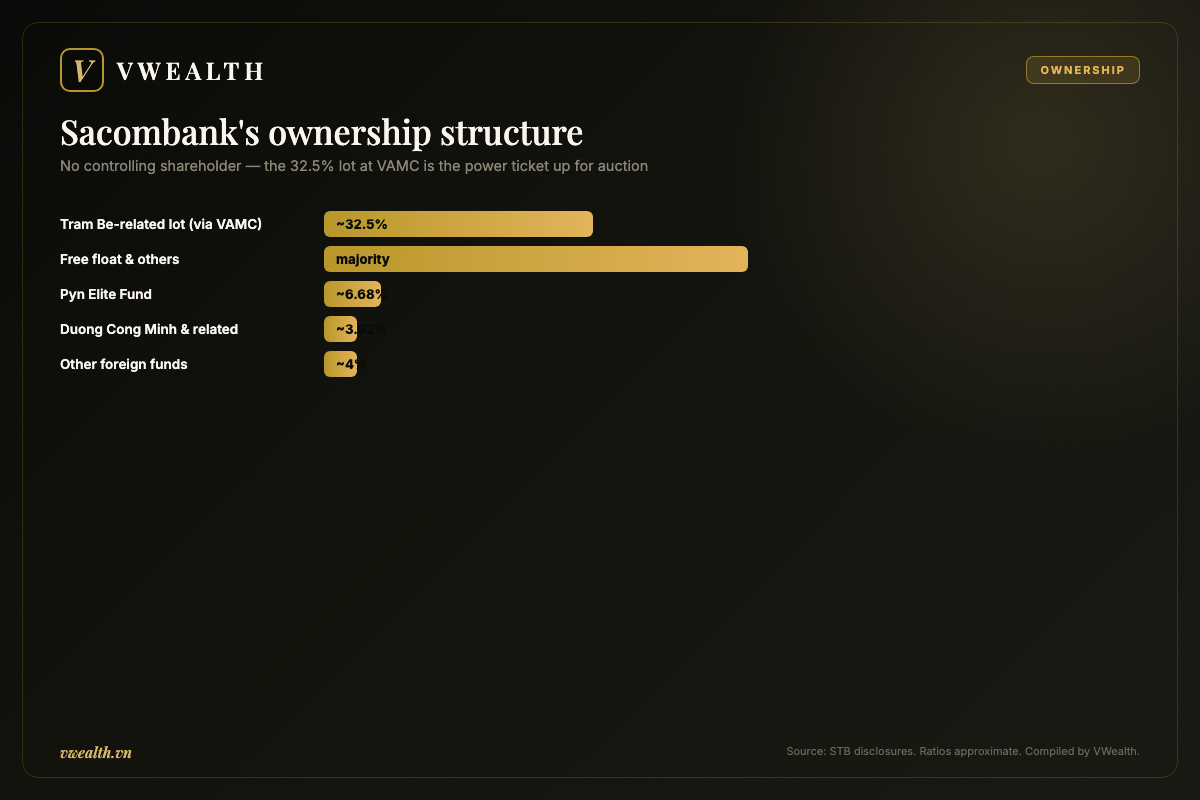
Specifically, about 32.5% of Sacombank shares — tied to Mr. Tram Be and related persons — were used as collateral for the debt and now sit under the management and resolution mandate of the Asset Management Company (VAMC) of the State Bank. This lot originates from the 2015 PNB merger: the shares were pledged to secure a preferential-rate refinancing loan that helped Sacombank overcome the liquidity crisis at the time. From then until now, this 32.5% lot has “hung in suspense” — belonging to no active strategic shareholder, but awaiting the day it is auctioned to recover principal, interest and penalties.
The consequences of this structure are well worth pondering. Because the most control-defining block of shares is “frozen” in the regulator’s hands, the rest of the ownership becomes fragmented. Per the disclosed list of shareholders owning 1% or more of charter capital, alongside VAMC, the picture is as follows:
| Shareholder / group | Ownership (approx.) | Nature |
|---|---|---|
| Tram Be-related lot (via VAMC) | ~32.5% | Under management/resolution mandate, awaiting auction |
| Pyn Elite Fund (Non-Ucits) | ~6.68% | Foreign fund (~125.9 million shares) |
| Mr. Duong Cong Minh (Board Chairman) | ~3.32% (with related persons ~3.92%) | Insider shareholder (~62.57 million shares) |
| Tianhong Vietnam Thematic Fund (QDII) | ~1.71% | Foreign fund |
| SCB Vietnam Alpha Fund | ~1.36% | Foreign fund |
| Norges Bank | ~1.13% | Foreign fund (Norway’s pension fund) |
| The rest (free float) | Majority | Individual and small institutional shareholders |
A few points to note when reading the table above. First, even a powerful Chairman like Mr. Duong Cong Minh, counting related persons, holds only a fairly small stake — around 3.9% — nowhere near “controlling” in ownership terms. His power comes from his role leading the restructuring and his personal standing, not from a dominant stake. Second, foreigners are notably present via funds such as Pyn Elite, Norges Bank and Tianhong — showing STB is still in the “sights” of professional international capital. (Sacombank also has a historical link to Dragon Capital, having been one of the founding institutions of that fund-management firm back in 2003 — a detail showing the depth of the bank’s relationships with the financial-investment community.) Third, and most important, the large free float plus the absence of a controlling shareholder makes STB an attractive “prey” for anyone wishing to take it over — and this leads straight to the stock’s biggest catalyst.
The 32.5% lot is not merely a debt to be resolved. It is a ticket to power: whoever buys this lot in the future auction will almost immediately become Sacombank’s controlling shareholder. This is both an opportunity to re-rate the stock and the biggest governance unknown you must account for.
Why is this a catalyst? Imagine the scenario: when the State Bank approves the plan and the 32.5% lot is successfully auctioned, many things resolve at once. Sacombank recovers its final legacy debt, cleaning the balance sheet; a legal knot lasting nearly a decade is untied; and most importantly, the bank has, for the first time, a clear ownership structure with a defined large shareholder (or group). Per market analyses, the expected auction price for this lot has been cited in a high range — from about 40,000 dong to even 60,000 dong per share depending on timing and how accrued interest is calculated — reflecting the deal’s very large value (some estimate proceeds reaching hundreds of millions of USD). This is why every piece of news on progress with this lot can strongly move STB’s price.
But — and an honest writer must stress this “but” — this is simultaneously the biggest unknown. As of the first half of 2026, the State Bank has still not given a final response to the plan Sacombank submitted for the 32.5% lot; the bank hopes to receive a final opinion in the second half of 2026, but this timeline has been pushed back several times in the past. You have no way to know for certain who will win the auction, and a new controlling shareholder always brings the risk of changes in strategy, personnel and governance culture. The bigger the catalyst, the higher the uncertainty — that is the nature of an investment in STB at this moment.
Dividends: nearly a decade of “abstinence” and the coming turning point
No topic troubles Sacombank shareholders as persistently as dividends. This is one of the most important highlights when you assess STB, because it reflects both the past of “belt-tightening” to restructure and reveals a valuable turning point ahead.
The last time Sacombank paid a dividend was October 2015. Since then, for nearly a decade, the bank has not paid a single dong in dividends. The reason was not losses — on the contrary, Sacombank’s accumulated retained earnings piled up to a very large figure, cited at about 25,352 billion dong — but because the bank was under a restructuring scheme and had to prioritize resources for resolving bad debt and legacy assets and complying with the regulator’s profit-retention requirement. At every AGM, the question “when will you pay dividends” became almost a ritual, and Mr. Duong Cong Minh had to explain the reason for the wait more than once.
The good news is that a turning point is near. Sacombank has submitted a proposal to pay a stock dividend to increase charter capital, and this plan now only awaits the State Bank’s approval. As directed, once approved, the Board will build a detailed plan — including the stock-dividend issuance ratio and the bonus-share ratio for employees — then seek shareholder opinion before implementing. In other words, this will be the first time in about 9–10 years of restructuring that Sacombank shareholders have a chance to receive the “sweet fruit.”
For you, the significance of this event lies not in the immediate dividend value — since paying in stock does not increase assets right away — but in its symbolic value and signal. Being permitted to pay dividends again is confirmation from the regulator that Sacombank’s “special treatment” phase is essentially complete, that the bank returns to normal operating status and begins distributing benefits to shareholders. At the same time, paying a stock dividend will help Sacombank increase charter capital — the base for expanding credit-growth room and strengthening capital-safety ratios in the new development cycle.
To close this section, keep in mind three pillars governing STB’s leadership and ownership story: (1) a powerful Chairman with a deep personal imprint but a small stake, alongside a just-transitioned management; (2) the 32.5% ownership knot — both the biggest re-rating catalyst and the biggest governance unknown; and (3) the return of dividends as a signal closing the decade of restructuring. All three lead us to the next door: once its internals are cleaned, how will Sacombank run its ecosystem and business segments to realize the “rise to new heights” expectation? That is what we analyze next.
Ecosystem and business segments
To understand why STB is seen by many investors as one of the most attractive “rebirth” stories in banking, you need to look past one year’s profit figure to see the real business machine underneath. Sacombank — full name Saigon Thuong Tin Commercial Joint Stock Bank — was not born from state capital or a large conglomerate’s injection. It is a private joint-stock commercial bank, grown up from the trading streets, market stalls and family businesses of the South. That retail “character” is baked into the bank’s DNA and remains its hardest-to-copy strength to this day.
In this section, you and I will peel back each layer of the “Sacombank ecosystem”: from the parent bank with its two pillars of retail and SMEs, through cards and digitalization, insurance and service fees, to the subsidiaries and especially the “hidden assets” — assets sitting quietly on paper that can burst into profit when the restructuring closes. Understanding this picture, you can answer for yourself: what engines is STB’s money machine running on, and which engine still has room to accelerate.
The parent bank — the heart of retail and SMEs
If I had to choose one sentence to describe Sacombank, I would say: this is the bank of the many. Unlike banks that pour resources into large corporations, trillion-dong projects or corporate bonds, Sacombank built its foundation on millions of individual customers, household businesses, small traders and SMEs (small and medium enterprises). This is a legacy from its early days: the bank rose alongside market traders and small shops in Saigon and the Mekong Delta, then gradually expanded nationwide.
To see why this matters, think about how a bank makes money. The core revenue comes from net interest income (NII). Simply: the bank raises money from depositors at one rate, then lends it to others at a higher rate; that gap, after deducting funding costs, is net interest income. The percentage of that gap over total earning assets is called NIM (Net Interest Margin). The higher the NIM, the “fatter” the bank earns on each unit of lending capital.
So how does a retail base help NIM? Two ways. First, lending to individuals and SMEs typically carries higher rates than lending to large corporations — because risk and servicing costs are higher, but in return the margin is better and less dependent on a few “big shots.” Second, when the loan portfolio is broken into millions of consumer loans, home loans and small-business loans, concentration risk drops markedly — no single customer is large enough to “topple” the bank if they default. That is slow-but-steady growth, true to the spirit of a retail bank.
By end-2025, the parent bank’s scale was very large: consolidated total assets reached nearly 918,000 billion dong, up about 23% from the start of the year, bringing Sacombank close to the “quadrillion” threshold. Loans outstanding crossed 600,000 billion dong. Full-year net interest income reached nearly 27,000 billion dong. These numbers show the core credit machine still running steadily and growing, regardless of the 2025 profit being compressed by provisioning costs (we’ll cover this in detail later).
The branch network — a weapon the digital age struggles to copy
You might think that in the age of digital banking, a physical branch network is a cost burden. That’s half true. But for the small-trader, household-business and provincial SME segments, physical presence is still a real competitive advantage. A market seller, a grocery-store owner or a family business in a small province still needs a nearby transaction point, a familiar staff member to deposit and pay in cash each day, and to borrow working capital. This is a customer group “pure digital” banks find very hard to reach.
Sacombank owns one of the largest branch and transaction-office networks in the private-bank bloc, spread across Vietnam’s provinces. More importantly, this network reaches beyond the border: Sacombank was the first Vietnamese joint-stock bank to open a branch in Laos (December 2008) and to establish a 100%-owned subsidiary bank in Cambodia (October 2011). This presence in the two neighboring markets is not merely symbolic — it serves the very active trade, remittance and border-commerce flows among the three Indochina countries.
The deeper benefit of a dense network lies in CASA — Current Account Savings Account, i.e., the ratio of non-term deposits. This is the money customers leave in payment accounts, at nearly zero interest, ready to withdraw anytime. For the bank, this is the cheapest source of funding. A trader depositing daily revenue, a business using its account to pay salaries and suppliers — all create a flow of non-term money through the bank. The higher the CASA, the lower the cost of capital and the more NIM improves.
Sacombank’s CASA currently stands at about 15.15%, equivalent to about 94,264 billion dong. This is modest against the industry leaders, forcing the bank to rely more on higher-rate term funding — this is both a current weakness and a very large room to improve if the digitalization and retail strategy proves effective.
Remember this CASA figure: it is one of the “levers” management can pull to raise NIM in the coming years. A bank with a strong small-trader and SME base like Sacombank, if it can retain customers’ transaction flows rather than let them drift elsewhere, can certainly lift CASA higher — and every extra percentage point of CASA feeds directly into profit.
Digitalization and Sacombank Pay — retaining the money flow
Today’s banking race has shifted from “lending” to “holding the money flow.” Whoever holds a customer’s main transaction account — where the salary lands, where daily spending happens — captures CASA, captures behavioral data, and captures the chance to cross-sell products. This is why Sacombank pours resources into the Sacombank Pay app.
Sacombank Pay is not just a transfer app. It is the gateway for customers to manage accounts, manage credit cards, pay bills, shop with 0% installments, and hunt for discounts of up to 50% at dining, shopping and travel points. Each feature is designed to keep customers inside the Sacombank ecosystem rather than moving to an e-wallet or another bank. For the small-trader segment, the bank also pushes collection solutions and QR scanning at the counter — turning every stall and shop into a digital touchpoint.
Why does this matter to you — an investor? Because digitalization is the cheapest way to improve two metrics at once: raising CASA (holding non-term money) and lowering operating costs (fewer new branches, fewer staff per transaction). A bank that digitalizes successfully will see its cost-to-income ratio fall over time, and that is a sustainable profit driver — not dependent on one-off income.
Cards — a traditional strength few notice
There is a business Sacombank has been good at for a long time but is rarely mentioned when discussing STB stock: cards. Sacombank is a market leader in card issuance and payment, partnering deeply with both major international card organizations, Visa and Mastercard. Its card portfolio spans debit cards to credit cards of various tiers, up to premium lines like World Mastercard.
To understand why cards are “delicious,” look at how they make money:
- Fees from cardholders: annual fees, cash-withdrawal fees, foreign-currency conversion fees when spending abroad.
- Merchant discount fees: each time a customer swipes at a store, the bank collects a small percentage of the transaction value.
- Interest on credit-card balances: with credit cards, customers get up to 55 days interest-free; if they pay late, the bank charges a fairly high rate on the balance.
- Spending data: card-swipe behavior is a gold mine of data for cross-selling insurance, consumer loans and personalized offers.
The subtle point here is that cards generate non-interest income — revenue that does not depend on how much the bank lends, not eroded when the State Bank calls for lower rates. In a context of industry-wide NIM pressure (Sacombank’s NIM is currently around 3.2%, down slightly on rapid asset growth), stable fee sources like cards are the counterweight that keeps profit from swaying.
Bancassurance with Dai-ichi Life and service fees
Another pillar of non-interest income is bancassurance — the bank distributing insurance products. From September 2017, Sacombank signed an exclusive insurance-agency contract with Dai-ichi Life Vietnam for a term of up to 20 years — one of the longest bancassurance deals in Vietnam’s insurance market.
The mechanism is simple: Sacombank uses its branch network and advisory team to introduce and sell Dai-ichi Life’s life-insurance contracts to customers. In return, the bank receives commissions and agency fees. This is a revenue source that requires almost “no capital” — the bank bears no insurance risk, acting only as the distribution channel. To boost sales, Sacombank also combines cards with insurance: customers paying Dai-ichi Life premiums with an international credit card get up to 5% cashback on the premium — a classic example of how ecosystem segments “join hands” to both sell insurance and stimulate card spending.
You should note a context: industry-wide bancassurance stalled after 2023–2024 due to issues with advisory quality and customer trust. So don’t expect this segment to boom immediately. But the 20-year exclusive contract with Dai-ichi Life remains a long-term strategic asset: when the market recovers and rules are standardized, this will be a steady fee stream flowing in throughout the coming decade.
The subsidiaries in the ecosystem
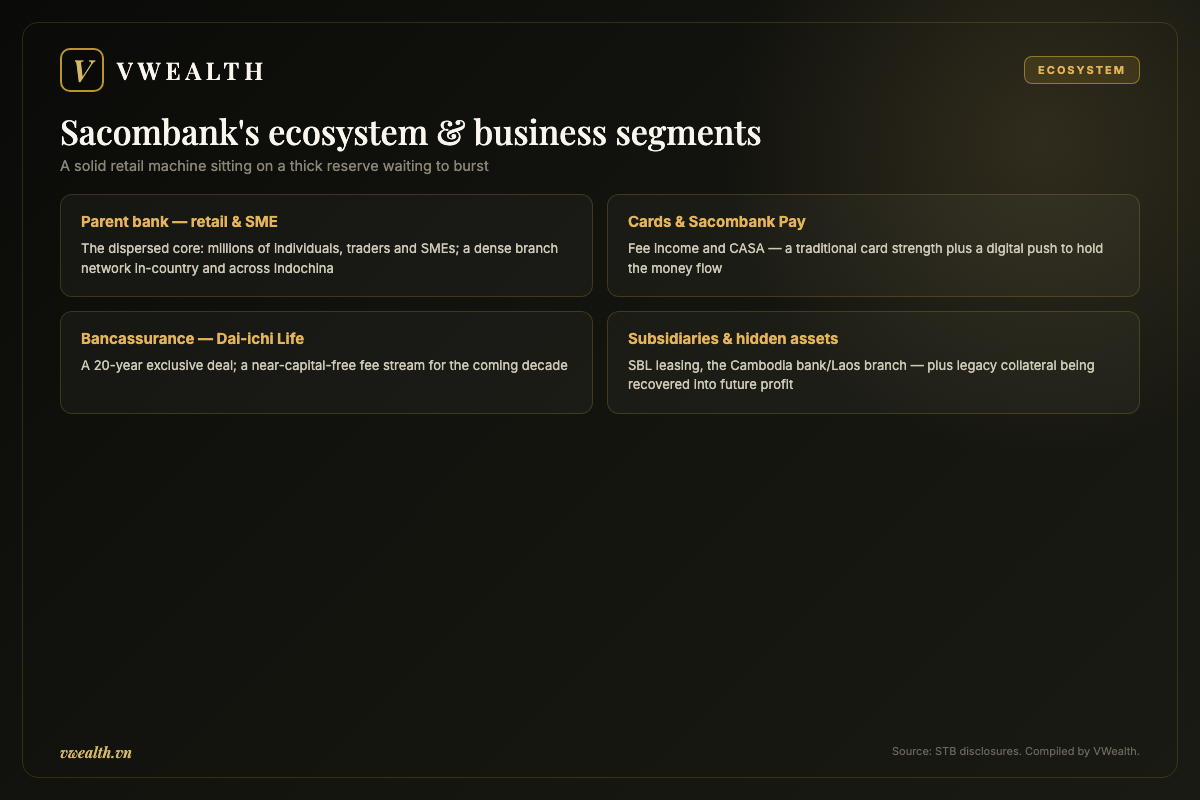
Sacombank is not just a single bank but a miniature financial group with several subsidiaries serving different segments. Understanding these “satellites” helps you see the breadth of the ecosystem:
- Sacombank-SBL (financial leasing): a 100%-owned subsidiary specializing in financial leasing — i.e., financing businesses to lease machinery, equipment and vehicles instead of buying outright. Founded in 2006, SBL is being heavily invested in by Sacombank: charter capital was raised from 300 billion to 600 billion dong. This directly serves the parent bank’s core SME base — right in its wheelhouse.
- Sacombank-SBS (securities): a securities firm once part of the ecosystem, but it went through divestment and restructuring. Slimming down the securities segment shows Sacombank proactively focusing resources on its core banking rather than spreading thin.
- The subsidiary bank in Cambodia and the branch in Laos: as noted above, serving Indochina-region trade and remittances.
- The remaining companies: Sacombank also holds units for debt management and asset exploitation, remittances, and gold and precious-metals trading. Each unit complements a service segment of the parent bank.
The overall picture shows a fairly complete ecosystem: the core bank at the center, surrounded by subsidiaries for financial leasing, debt management, remittances and cross-border operations. The chart below summarizes the main segments and units for a quick grasp.
The “hidden assets” — the biggest reserve of the STB story
This is the most important part, and also what sets STB apart entirely from every other bank stock. To understand it, you need a bit of context: over a decade ago, Sacombank merged with Southern Bank (Phuong Nam Bank) and had to carry an enormous pile of bad debt and legacy assets. From then, the bank entered a multi-year restructuring scheme under regulatory supervision, its main task being to definitively resolve this bad debt.
The bank’s way of handling bad debt has a feature that creates “hidden assets.” When a loan turns bad, the bank must set aside provisions — proactively recording an expense, “putting aside” money in case of capital loss. This provision reduces profit at the moment it is set. But here’s the clever part: if the bank later recovers the debt — say, by successfully selling the collateral — the provision set aside earlier is no longer needed and is reversed, recorded back as profit. In other words, every dong of provision set for a debt that is then recovered is a dong of profit “sleeping,” waiting to be awakened.
The most classic example is the debt tied to Phong Phu Industrial Park in Binh Chanh, Ho Chi Minh City. This debt arose from loans at Phuong Nam Bank in 2011–2012, with collateral being all interests arising from the land-use rights of the Phong Phu IP project. After 18 grueling auction rounds, Sacombank successfully sold this debt at 7,934 billion dong — higher than the customer’s debt obligation. By August 2025, the bank had received the remaining payment worth about 6,300 billion dong and recorded most of it into Q3 2025 results; an estimated 3,600 billion dong of provisions were reversed from this deal.
Picture “hidden assets” as a granary of savings. In hard years, Sacombank quietly set aside provisions — storing rice in the granary rather than distributing it all to shareholders. When the bad debt is resolved, that granary is opened: part is real cash flowing in, part is provisions reversed into profit. That is why people say STB has a “reserve.”
The scale of this “reserve” is considerable. By the end of the process, Sacombank had resolved about 86.2% of the bad debt and legacy assets under the restructuring scheme (equivalent to about 81,928 billion dong), and importantly had provisioned 100% for these. More importantly, the bank accumulated over 31,000 billion dong of retained earnings — an enormous financial “buffer.” Precisely because it proactively raised provisions (setting aside over 11,300 billion dong across 2025), consolidated pre-tax profit in 2025 reached only 7,628 billion dong, down about 40% and equal to 52% of plan. But this is a deliberate decline — the bank chose to “take the pain once” to clean the balance sheet, clearing the way for the profit break-out ahead.
There is still one final knot to watch: the roughly 32.5% share lot tied to Mr. Tram Be’s group, held as collateral and awaiting auction. When this lot is resolved, the restructuring scheme will formally close, opening the possibility of dividends again after years of “abstinence” and turning the Sacombank story to an entirely new page.
The bottom line — a solid retail base, a thick reserve, room for profit to burst
If you compress this whole section into one picture, you see two layers of value stacked. The first layer is the everyday business machine: a genuine retail bank, strong in small traders and SMEs, with a dense branch network both domestically and across Indochina, digitalizing via Sacombank Pay, leading in cards and holding a 20-year exclusive bancassurance contract with Dai-ichi Life. This machine generates stable net interest income plus an increasingly important stream of service fees — with large room to improve when CASA is still only around 15%.
The second layer is the “reserve”: the hidden assets from debt resolution — large collateral like Phong Phu IP being sold and recovered, bringing real cash and provisions reversed into future profit. When the Tram Be share knot is untied, these two layers of value will resonate: a bank that has cleaned its balance sheet, free of past burdens, standing on a solid retail base with a profit buffer of over 31,000 billion dong ready to burst.
That is the very nature of the STB investment story: you are not buying a bank at its peak, but a bank at the end of its restructuring stretch — where today’s profit is compressed by proactive cleanup, but tomorrow’s room is wide open. Next, we go deep into Financial position and health to see how solid Sacombank’s capital base, asset quality and safety metrics really are after this major surgery.
Financial position and health
If you looked only at Sacombank’s 2025 consolidated pre-tax profit — about 7,628 billion dong, down 40% year on year and only 52% of plan — you would easily conclude this is a bank in decline. But that is the most common trap when reading a business at the end of a nearly decade-long “major surgery.” The truth is far more complex and interesting: profit fell not because the core business weakened, but because management proactively “burned” profit to clear the last legacy items and close the restructuring scheme. To understand STB correctly, you must separate two overlapping stories: one about actual operating health, and one about a “reserve” locked up, waiting to burst.
Position: one of the largest private banks
Before diving into the controversial numbers, place Sacombank properly on the industry map. This is not a small bank struggling to survive. Sacombank is among Vietnam’s largest private joint-stock commercial banks by total assets, with total assets approaching the one-quadrillion-dong threshold. More important than scale is the quality of the base: Sacombank owns one of the widest branch and transaction-office networks in the private bloc, spread across the country and in Laos and Cambodia.
This massive network is not a burden but a strategic asset. It is the foundation for one of Sacombank’s core strengths: retail banking. Unlike banks that grow fast on real-estate credit or corporate bonds concentrated on a few large customers, Sacombank builds its total operating income on a broadly dispersed base of individual and SME customers. In 2025, consolidated total operating income reached about 31,075 billion dong, up 8.3% from 2024. Remember this growth figure: it shows the bank’s core money machine still running well and growing steadily, entirely opposite to the 40% profit drop. The mismatch between “revenue up” and “profit down” is the key that unlocks the entire STB story.
When core revenue rises 8.3% but profit falls 40%, you are not looking at a weakening business — you are looking at a business proactively sacrificing short-term profit for a bigger goal. The right question is not “why did profit fall” but “where did the profit go.”
Why 2025 profit fell 40%: a decision, not an accident
The profit went into provisions. In 2025, Sacombank’s total risk-provisioning expense reached about 11,159 billion dong. This figure is shocking when you learn that in the first nine months, the bank had provisioned only about 2,151 billion dong. That means in Q4 2025 alone, Sacombank set aside over 9,000 billion dong more — a burst of provisioning that even pushed the bank to report a loss in the final quarter.
This is the crux you must see clearly. Such a surging provision can come from two entirely opposite causes. The first, worrying: asset quality suddenly worsened, bad debt arose beyond control, forcing the bank to strain to cover losses. The second, positive: the bank proactively provisions in advance to definitively resolve old legacy items, clearing the balance sheet to close the restructuring scheme. For Sacombank, the evidence leans strongly toward the second cause.
Management has repeatedly stated the direction of “prioritizing reinforcing the provisioning buffer” before total assets hit the quadrillion mark. In particular, for the debt tied to Mr. Tram Be’s group — the final knot of restructuring — Sacombank provisioned 100% of the principal and wrote off all accrued interest from Q2 2022. In other words, the bank assumed the worst-case scenario for this debt and recorded all the potential loss as expense. This is the action of a bank wanting to “close the book” on the past, not of a bank being chased by its past.
For balance, you must also acknowledge the real side of the issue: the 2025 bad-debt ratio returned to a high level. Bad debt over customer loans rose to about 6.31%, and over total credit extended, about 4.95%. These are not pretty numbers, and you should not gild them. However, most of this increase is tied to bringing old legacy items into the light and reclassifying them by their true nature, alongside having fully provisioned. A bank with 6% bad debt but nearly full provisioning is in a far safer position than a bank with 3% bad debt but a thin “buffer.”
The central story: the “double reserve” — two compressed springs
This is the most important part, and if you remember only one thing from this entire analysis, remember the concept of the “double reserve.” Sacombank sits on two enormous pools of latent value, both “locked” for restructuring reasons, and both like tightly compressed springs — waiting for the day they are released.
Spring one: over 25,352 billion dong of undistributed retained earnings
Throughout about ten years of restructuring, Sacombank could not pay dividends to shareholders. The reason was not a lack of money, but that while under the restructuring scheme under the State Bank’s supervision, all resources had to be retained to strengthen the foundation. As a result, accumulated profit piled up year after year. To date, Sacombank’s accumulated retained earnings have exceeded 25,352 billion dong — more than 1.3 times the bank’s own charter capital.
Picture the scale of this number. It is a “book-value cash” pool already belonging to shareholders but not yet distributed. Management has affirmed it is “ready to pay dividends as soon as the State Bank approves.” This creates two value-unlocking scenarios for you as a potential investor:
- Dividend payout: when the restructuring scheme closes and the State Bank gives the green light, part of this profit pool can be distributed to shareholders, possibly in cash or stock — something Sacombank shareholders have awaited for nearly a decade.
- Capital increase: the retained earnings can also be used to raise charter capital, strengthening capital-safety ratios and expanding credit-growth room in the coming years.
Either way, this is value already present on the balance sheet, not a fanciful expectation. This spring is pre-compressed; it awaits only an approval signature to burst.
Spring two: fully set provisions and legacy assets awaiting reversal
The second spring is subtler but potentially even stronger. As analyzed, Sacombank has provisioned very heavily, especially 100% of the principal tied to the Tram Be group. In bank accounting, a provision is an expense recorded to guard against loss. But there is a mechanism few notice: if a debt already provisioned is later recovered — in whole or part — the provision set earlier is reversed, and this reversal flows straight into profit.
This is the “compressed spring” mechanism of profit. Sacombank accepted recording all the provisioning expense in the present (cutting 2025 profit), while the legacy assets behind those debts are still being recovered gradually. Every dong recovered above what was provisioned becomes extraordinary profit in the future.
Evidence for this recovery cash flow is far from abstract. On the Tram Be debt group, Sacombank has recovered over 25,600 billion dong, with the remaining about 12,037 billion dong still being worked out. Another classic example is the Phong Phu Industrial Park debt: the bank successfully auctioned it in 2023 at 7,934 billion dong — higher than the customer’s debt obligation — and is in the process of fully recovering this amount. When such recoveries complete, the corresponding provisions set aside will be reversed.
Picture it: the bank “prepaid” all the cost for the worst-case scenario, but in reality many debts were recovered. That difference does not vanish — it flows back into profit. That is why a closing restructuring is often followed by a phase of powerful profit “break-out.”
Adding the two springs, you get a picture quite different from the initial impression. The 40% profit drop in 2025 does not reflect a weakening business, but a business compressing itself one last time before springing up. This is what makes STB a special case: the hardest part sits in the present and has been recorded, while the benefits sit ahead.
Asset quality and profitability: waiting for ROE to rebound
A direct consequence of heavy provisioning is that 2025 profitability was compressed. Return on equity (ROE) in 2025 stopped at about 10.52% — modest against leading private banks that typically reach 18–22%. But you need to read this figure in the right context: the low ROE here is the result of profit being temporarily “eroded” by provisioning costs, not because the bank is inefficient in its core operations.
The logic here is fairly straightforward: provisioning cost is the biggest variable dragging profit down. When the restructuring scheme closes, the burden of definitive provisioning will not recur, and reversals begin to appear. Then, on the same base of steadily growing revenue, post-provision profit will recover quickly and ROE has ample room to rebound to a much higher level. On asset quality, the long-term direction is also positive: cumulative bad-debt resolution under the restructuring scheme has exceeded 86%, showing the hardest part has passed. A thicker provisioning buffer means the remaining latent risk has been “packaged” and controlled.
Risks you must not ignore
For balance, an honest analyst must make clear: the entire “compressed spring” thesis above depends on a variable Sacombank does not fully control — the pace of approval and resolution from the State Bank.
- Progress on the 32.5% share auction: the biggest knot is the 32.5% block (about 605 million shares) tied to the Tram Be group, held by VAMC. Sacombank has submitted a resolution plan but still awaits State Bank approval. If the auction drags on longer than expected, the “value release” timing will be pushed back, and the market’s patience has limits.
- Dependence on regulatory approval: both paying dividends from over 25,352 billion dong of retained earnings and completing the restructuring require State Bank consent. This is beyond management’s control and hard to forecast precisely on timing.
- Uncertain valuation of the share block: the actual auction price of the 32.5% block will determine the recovery rate and the scale of provision reversal. Current estimates (e.g., assuming an auction price of about 48,000 dong per share, equivalent to a recovery rate of about 46% versus the related principal and interest) are only scenarios, and may be higher or lower than reality.
- Existing bad debt still high: a bad-debt ratio above 6% is a real number to watch closely. If the macro environment worsens, provisioning pressure may not stop as expected.
In other words, the STB story is a story about timing more than about substance. The substance of the “double reserve” value is essentially present; what is uncertain is when the approval doors will open. You need to determine clearly whether you have enough patience for a story whose reward sits ahead but whose schedule depends on the regulator.
It is precisely the tug-of-war between pre-compressed latent value on one side and uncertainty over the release timing on the other that has created STB’s notable price swings on the exchange. And that is what we look at closely next — how the market is receiving and valuing this story.
Market reception
If you looked at the price board on 19 June 2026 and saw STB at 72,300 dong, your first reflex was probably to check the P/E. And this is the first trap many investors fall into with Sacombank stock. A peer bank stock like VCB, CTG or BID typically trades around a P/E of 8–12 times. STB is in the 17–20 times zone, and at one point in May 2026 its P/E jumped to nearly 28 times when the price hit an all-time high of 76,800 dong. Reading that bare number, you easily conclude STB is “terribly expensive,” the most expensive in the bank group, expensive to the point of absurdity.
But the market does not value by the bare number. The market is valuing a story. And STB’s story is that of a stock being re-rated by the future, not the past. In this section, you and I will dissect why an unusually high P/E does not frighten the money flow, but on the contrary, made STB one of the strongest-rising bank stocks in the recent rally.
A “people’s” stock and an impressive rally
Before talking about valuation, let’s talk about how the market treats STB on the board. If any bank stock deserves the “people’s” title for liquidity, it is STB. Sacombank’s matched volume per session is regularly among the market’s highest, with peak sessions matching tens of millions of shares. This is a stock individual investors especially love: a moderate price, an easy-to-understand story, dense press coverage, and most importantly a nearly decade-long restructuring “promise” nearing its end.
This ultra-high liquidity and huge individual-investor base create two sides of a coin. The good side: you almost never worry about being “stuck” unable to sell. The point to note: STB swings very hard with each beat of restructuring news. A line about progress on the Tram Be share auction can push the stock to its ceiling, and a delay can trigger a deep correction. This is not a stock to buy and forget; it is a stock where news and price move together.
On price action, the numbers speak for themselves. In June 2026 alone, STB rose 7.91% — a strong gain while many other bank stocks went sideways. From the start of 2026, the stock rose about 27%, and looking back over a full year, the price doubled. STB has repeatedly been called by the media “the most expensive bank stock on the exchange,” its market cap first crossing 138,000 billion dong in early May 2026. A bank once seen as the system’s “bad-debt burden” is now one of the locomotives leading the bank-group money flow. The question is: what is the market paying for?
When a stock doubles in a year while profit is falling, don’t rush to conclude the market is “crazy.” Usually the market is seeing a different profit number — tomorrow’s, not today’s.
Why STB’s P/E is “distorted” — and where you should look
This is the core part for understanding STB. Start from the bare 2025 numbers. Full-year 2025 pre-tax profit reached only about 7,628 billion dong — just 52% of the annual plan. Net profit attributable to parent-company shareholders even fell over 41% year on year, back to around 5.9 trillion dong. With about 1.88 billion shares outstanding, 2025 EPS was pulled to an unusually low level, and that anemic EPS denominator is what inflates the P/E sky-high.
But why was 2025 profit so low? The answer is not that the core business weakened. In fact, total operating income (TOI) still grew, to around 32,000 billion dong. The problem lies in provisioning. To clean up the last of the bad debt and legacy assets from the restructuring phase, Sacombank proactively “ate” into profit to provision at a very large scale. In other words, the bank is sacrificing short-term accounting profit to buy a clean balance sheet in the future. The 7,628 billion in profit is profit after heavy provisioning, not the bank’s true earning power.
This is why, with STB, you should not value by the current year’s P/E. There are two sounder angles:
- Look at P/B instead of P/E. STB’s P/B is now around 1.3–2.1 times depending on timing and how book value is calculated. P/B reflects how much the market pays for each dong of equity — and for a bank about to release tens of thousands of billions in retained earnings, equity is in fact much “richer” than one year’s EPS shows. P/B is a more honest gauge than P/E when a single year’s profit is distorted by provisioning.
- Look at normalized earnings. When provisioning ends — and most of it has been packed into 2025–2026 — the provisioning burden dissolves. Profit is then no longer “eroded” and can spring up very strongly. Management set a 2026 pre-tax profit plan in the 14,000–14,650 billion dong zone, nearly double the 2025 figure. Applying this normalized profit level, STB’s forward P/E is no longer 17–28 times, but falls to the single-digit-to-low-double-digit zone — that is, cheap, not expensive at all.
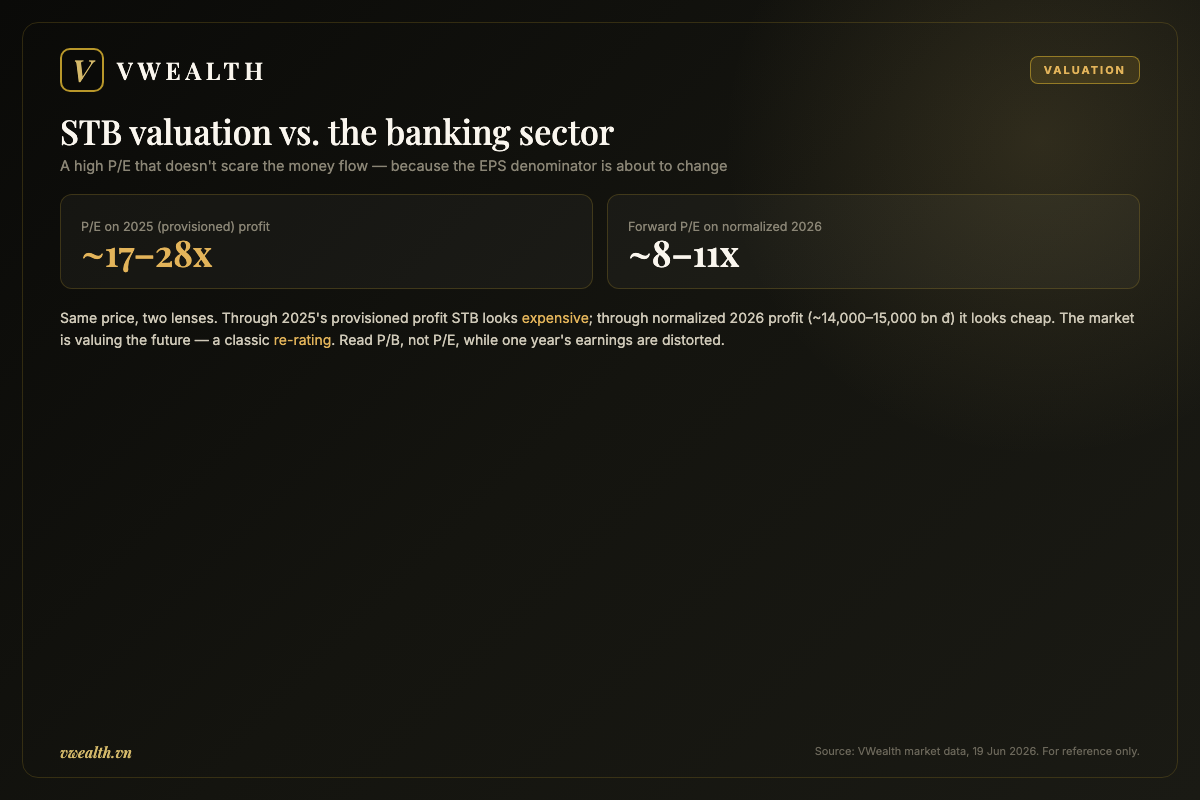
Read the valuation chart above carefully. The same stock, the same price of 72,300 dong, but two angles yield two opposite conclusions. Through the lens of 2025 (provisioned) profit, STB is expensive. Through the lens of normalized 2026 profit, STB is reasonable to cheap. The market, with the sharpness of large money flows, is valuing through the second lens. That is the essence of a re-rating: investors accept paying a high P/E on today’s profit, because they are confident the EPS denominator will swell tomorrow, pulling the real P/E down.
A restructuring stock: valued by the future, not the past
To help you picture it, liken Sacombank to a prime property that in recent years had to close for major renovation. During renovation, revenue is near zero and costs are high — the books look ugly. But if you know for certain the renovation is almost done and the property sits right on a golden street corner, would you value it by the revenue of the closed months? Of course not. You value it by the cash flow it will generate once it reopens.
STB is a classic restructuring stock, and restructuring stocks are always valued by the market according to the destination, not the starting point. STB’s entire rally is not fed by past profit — because the past is being dragged down by provisioning — but by expectations for three final “knots” being untied one by one. As each knot opens, part of the value “locked” in the bank is released, and the market immediately re-rates it to a higher level.
Three catalysts driving the STB wave
If you want to understand why the money flow into STB is so strong, remember these three catalysts. They are the backbone of the entire investment thesis:
- Catalyst 1 — the State Bank approves the final restructuring plan. This is the first door that must open. Sacombank’s scheme for resolving bad debt and legacy assets is more than 86% complete. State Bank approval of the plan to resolve the rest — especially the Tram Be share lot — will formally close nearly a decade of restructuring. Every signal on approval progress produces an immediate reaction in the share price.
- Catalyst 2 — the auction of the 32.5% stake tied to Mr. Tram Be’s group. Securities firms call this outright the “final knot.” This lot equals 32.5% of charter capital, tied to total principal and accrued interest of about 63,000 billion dong — that is, nearly 2.4 billion USD. When this lot is successfully auctioned, two big things happen at once: Sacombank recovers this enormous debt, and no less importantly, the bank will have a clear new controlling shareholder. Analysts assess the auction price as unlikely to be below 40,000 dong per share, showing this is a coveted asset.
- Catalyst 3 — the first dividend in nearly a decade and a capital increase from retained earnings. When the Tram Be knot is untied, Sacombank is permitted to release its enormous retained-earnings pool. Accumulated retained earnings after the 2024 distribution stood at 25,352 billion dong — more than 1.3 times charter capital — and by end-2025 this figure had jumped to about 31.3 trillion dong. This is a “treasure” locked for years, now about to be opened for dividends and capital increase.
These three catalysts are not independent but follow one another like dominoes: State Bank approval → successful auction → release of retained earnings → dividends and capital increase. Topple one, the whole chain falls. That is why the market buys STB not for what it is, but for what it is about to become.
Dividends returning and appeal to foreigners
For a Sacombank shareholder, the word “dividend” carries a special emotional weight. The last time the bank paid a dividend was October 2015 — in stock at 12% for the year 2014. Since then, it has been nearly a decade of dividend “hunger.” At AGMs, quite a few older shareholders have frankly voiced the fear of “not living to see the payout.” That line sounds a bit bitter, but it also shows the enormous pent-up expectation accumulating.
The key is that the retained-earnings pool is ready. Management has repeatedly affirmed Sacombank is “ready to pay dividends as soon as approved.” That is, the only barrier is not money — over 25,000 billion sits there — but the legal procedure tied to completing the restructuring. Once catalysts 1 and 2 finish, the dividend flow and capital increase can burst almost immediately. For investors, this is a “reward” with high certainty, waiting only for the timing.
This story is also not lost on foreigners. A bank with a balance sheet about to be cleaned, profit about to spring strongly, dividends about to return, and a clear new controlling shareholder — this is exactly the kind of asset foreign funds seek in Vietnamese banking. Foreign interest, plus the enormous demand from domestic individual investors, creates a very thick demand base for the stock — and explains why STB’s liquidity is always among the highest on the exchange.
What the market is really betting on
If I had to compress this whole section into one sentence: buying STB at current prices is not buying a bank with pretty profit today, but betting on the completion of restructuring. Sacombank’s profit and dividends are compressed like a spring under the final knot. When that knot opens — through State Bank approval and a successful auction of the 32.5% Tram Be stake — the spring bursts: profit can jump from 7,628 billion to the 14,000–15,000 billion zone, the retained-earnings pool of over 31,000 billion is released, dividends return after nearly a decade, and charter capital is raised.
That is why a high P/E does not frighten the money flow, because the money flow knows the EPS denominator is about to change. That is also why STB swings hard with news, because every piece of restructuring news changes the probability of the “spring burst” scenario. And that is why you need to watch the legal progress especially closely: for a restructuring stock, the day the knot opens is the day the valuation is rewritten. To understand why this entire scenario becomes feasible at precisely 2026 — not earlier or later — you need to look at the wider banking industry. That is the subject of the next section: Industry context.
Macroeconomic and banking-industry context in 2026
Before you place your faith in Sacombank’s rebirth story, there is a truth any serious investor must accept: no bank stock, however healthy, can swim against the current of the whole industry and economy. The STB price of 72,300 dong you see today reflects not only company internals, but is also colored by the interest-rate level, credit-growth pace, foreign capital’s risk appetite and the general market sentiment toward “king” stocks. So this section takes you out of Sacombank’s own balance sheet to look at the bigger picture, where STB is just one piece on a chessboard of many variables.
High credit growth but quality is a question mark
In 2026, Vietnam’s banking industry enters a phase of both many opportunities and many challenges. The State Bank targets system-wide credit growth of about 15%, while more optimistic research units forecast the figure could stay high, around 19–20%, if the economy keeps its recovery momentum. This is a credit-growth rate among the region’s highest, reflecting the authorities’ effort to pump capital into the economy to reach the ambitious GDP-growth target.
However, you need to understand that high credit growth is a double-edged sword. On one hand, it creates room for banks to expand lending and boost interest income. On the other, when credit is pushed out fast while businesses’ capital-absorption capacity is still weak, asset-quality risk always lurks. The lesson from prior cycles: hot credit growth today often leaves a “legacy” of bad debt a few years later. For a bank like Sacombank that just went through a decade of “major surgery” to clean its balance sheet, keeping credit discipline in a hot-growth environment is something you should watch closely.
Low rates and pressure on the net interest margin (NIM)
One prominent feature of the 2026 macro environment is that the rate level is kept low to support growth. This is good news for borrowing businesses and for the economy generally, but a direct pressure on banks’ profits. When lending rates are compressed while deposit rates tend to edge up due to competition for funding, the gap the bank earns — the net interest margin (NIM) — narrows.
Industry data show system-wide NIM fell from about 3.5% at end-2024 to around 2.9% at end-2025, and many forecasts hold that NIM will stay below 3.0% in 2026. The two main causes analysts cite are: falling earning-asset yields as net new overdue debt rises (meaning banks must stop recognizing interest on problem loans), and rising cost of capital as deposit rates adjust upward. In other words, banks are squeezed at both ends: taking in less while paying out more.
Remember this: in an industry where NIM is narrowing broadly, the competitive advantage no longer lies in lending more, but in asset quality, in the ability to grow non-interest income, and in which bank still has a “reserve” after a heavy provisioning phase.
The notable point for Sacombank lies precisely here. While many other banks that enjoyed pretty profits in recent years now face NIM narrowing from a peak, Sacombank is in the opposite position: the bank just finished a phase of enormous provisioning, meaning that when the provisioning burden is lifted, profit can spring up even if industry-wide NIM stays flat. This is a difference in cycle “phase” you must grasp to understand why STB is treated differently from the rest of the bank group.
Bad-debt risk from real estate and corporate bonds
The biggest risk hanging over the banking industry in 2026 remains asset quality, especially exposure to real estate and corporate bonds. After a frozen property market and a wave of clustered corporate-bond maturities, many banks are still carrying restructured debt, group-2 debt and latent debt not yet reclassified. The industry-wide bad-debt ratio tends to edge up, and provisioning pressure continues to erode the profits of quite a few banks.
Here is an interesting paradox to weigh carefully. Precisely because Sacombank had to pour all its energy into resolving the “rubble” from the Phuong Nam Bank merger and working out debt at VAMC over the past decade, this bank was forced to be extremely cautious in lending. Throughout the restructuring, Sacombank had little “room” to chase speculative real-estate loans or hold high-risk corporate bonds as some other banks did to maximize short-term profit. As a result, while many banks are only now bearing the consequences of their own “hot” loans in 2021–2022, Sacombank’s credit portfolio is relatively little exposed to the speculative real-estate segment and risky bonds.
Of course, you should not misunderstand that Sacombank is “immune” to bad-debt risk. Any bank is affected when the health of borrowing businesses weakens. But the forced caution during restructuring inadvertently became a shield, helping the bank partly avoid the asset-quality “storm” the rest of the industry faces. This is an important nuance when you compare STB with other bank stocks.
The September 2026 FTSE upgrade story and raising foreign room
If there is one catalyst that is a turning point for Vietnam’s whole stock market, and especially for large-cap bank stocks like STB, it is the market-upgrade story. FTSE Russell has officially confirmed the roadmap to upgrade Vietnam’s stock market from Frontier to Secondary Emerging, with Vietnamese stocks beginning to be allocated into FTSE indices from 21 September 2026.
Importantly, the upgrade does not happen all at once but in phases: the first phase from September 2026 adds Vietnamese stocks at a 10% ratio, then rising to 20% in March 2027, 35% in June 2027, and completing the remaining 35% in September 2027. The legal basis for the upgrade is reinforced by Circular 08/2026/TT-BTC, which improves the market-access mechanism for foreign investors and addresses the pre-funding (non-prefunding) issue.
The significance for you is clear. When the market is upgraded, a large flow of capital from passive funds (ETFs) tracking the FTSE index will be obliged to buy Vietnamese stocks in the basket. And the stocks that benefit most are the large-cap, highly liquid ones with room for foreign ownership — exactly the “portrait” of a large-cap bank stock like STB. In particular, the story of raising foreign room, though still a legal issue much debated and not fully resolved, further increases the appeal of stocks whose foreign room is not yet full.
For Sacombank, this appeal is multiplied by a distinctive factor: the 32.5% share lot at VAMC is expected to be auctioned and could be sold to a foreign investor after the restructuring completes. If this scenario materializes right at the time the market is upgraded and foreign capital flows in, Sacombank could become one of the most sought-after destinations. However, you also need to stay clear-eyed: the upgrade is a whole-market story, ETF flows allocate by index weight rather than “favoring” STB specifically, and much of the upgrade expectation may already have been priced in gradually.
Re-rating “restructuring” banks once the cleanup is done
There is a pattern the market has proven many times with restructuring bank stocks: throughout the “cleanup” phase, these banks are typically valued well below the industry average, because investors must discount a host of unquantifiable risks — from the true scale of bad debt, the pace of resolution, to the provisioning still to bear. The stock trades at a low P/B, profit is distorted by enormous provisions, and the fundamental story is nearly “frozen” in most eyes.
But once the cleanup completes, when the fog over asset quality lifts and profit begins to “normalize,” the market tends to re-rate these stocks strongly. The risk discount is removed, P/B is pulled closer to the industry average, and the long-compressed profit is “returned” to shareholders through EPS growth and the ability to pay dividends. This is exactly the scenario many investors expect for Sacombank, and also why STB has risen considerably, up nearly 8% in just the past month. The question for you is not “is this story real,” but “how much of that story is already reflected in the current 72,300-dong price.”
Trend prediction for STB stock
Having the industry picture and Sacombank’s internal picture, we now look ahead. Let me say plainly from the start: no one, not even the most veteran analysts, can precisely predict where a share price will go. What this section does is sketch possible scenarios based on known variables, with their triggers and effects on price. The goal is to help you prepare mentally for each situation, not to give a “target” number for you to bet on blindly.
The pivot of every scenario: completing restructuring in 2026
The entire STB investment story revolves around a single event: completing the restructuring scheme, whose final knot is resolving the 32.5% share lot at VAMC (tied to the old shareholder group’s debt). This is the last barrier preventing Sacombank from reaching three big rewards at once.
First, when the State Bank approves the plan and the share lot is successfully auctioned, Sacombank formally “graduates” from special control and restructuring, returning to a normal commercial bank. Second, the bank will be permitted to distribute the accumulated undistributed profit that has exceeded 25,352 billion dong, a “treasure” locked for years by the rule barring dividends during restructuring. Third, and most important long term, when the provisioning burden is fully lifted, Sacombank’s profit is expected to “normalize” and spring up strongly.
To picture the size of this “compressed spring”: Sacombank’s 2025 pre-tax profit was only about 7,628 billion dong, down 40% year on year, but the main cause of this decline was not weak business but the bank proactively concentrating provisioning to clean up the rest. When this provisioning burden disappears, many forecasts hold that Sacombank’s true profit, based on core earning power, could reach the 14,000–15,000 billion dong zone. In other words, the low 2025 profit is a “pretending to be sick” caused by provisioning, while the bank’s true health is much higher. This is the essence of the “compressed spring” story the market is valuing.
Three scenarios for the next 12–18 months
Below are three scenarios you should weigh, from most optimistic to most cautious.
Positive scenario: restructuring reaches the finish line fully
In this scenario, every piece falls into place in 2026. The State Bank approves the plan to resolve the 32.5% share lot, the auction succeeds at a good price (many estimates hold the starting price could be no lower than 40,000–60,000 dong per share to recover enough principal and accrued interest). Right after, Sacombank announces a plan to pay dividends from the accumulated profit pool of over 25,352 billion dong, while 2026 and 2027 profit “bursts” to the 14,000–15,000 billion dong zone once provisioning ends.
Trigger: State Bank approval + successful auction + dividend announcement + business results confirming normalized profit. If aided by foreign capital flowing in on the FTSE upgrade, demand will be even stronger.
Effect on price: this is the scenario that triggers a comprehensive re-rating. As normalized profit pulls P/E to a reasonable zone and P/B is lifted closer to the level of other healthy retail banks, the upside is considerable. The stock shifts from “valued by restructuring expectation” to “valued by real profit,” a qualitative leap.
Base scenario: right direction but slower than hoped
This is perhaps the most likely scenario, and also the one you should use as an “anchor” for your expectations. In this scenario, restructuring stays on track but slower than the optimistic promises. The legal procedures, the share-lot valuation, and the search for a suitable investor take longer than expected. Sacombank itself has, at AGMs, proposed extending the deadline to complete the restructuring scheme, showing a “schedule slip” is entirely possible.
Trigger: approval and auction progress inching forward step by step but no decisive push within the year; profit improving gradually but not fully “bursting” as some final provisioning remains.
Effect on price: the stock likely fluctuates in a wide band, with rallies on positive news then corrections when expectations are pushed back. The price rises in steps rather than a straight slope, demanding patience. In this scenario, those who buy on the right beat and stay calm have an edge over those who trade on short-term news.
Negative scenario: prolonged deadlock and new bad-debt risk
No analysis is honest if it skips the bad scenario. In this situation, approval of the plan and the auction of the 32.5% lot continue to be delayed by legal entanglements or a market unfavorable to auctioning at the expected price. Worse, amid the industry facing rising bad-debt risk from real estate and bonds, Sacombank could see new bad debt forcing continued provisioning, prolonging the phase of eroded profit.
Trigger: auction or approval dragging into 2027–2028 + a worsening macro environment + declining asset quality.
Effect on price: the “restructuring expectation” already priced in would be unwound. The stock could correct sharply as investors lose patience, with a particular risk of “sell the news” from those who bought only to front-run the story. This is the scenario that tests your psychological endurance the most.
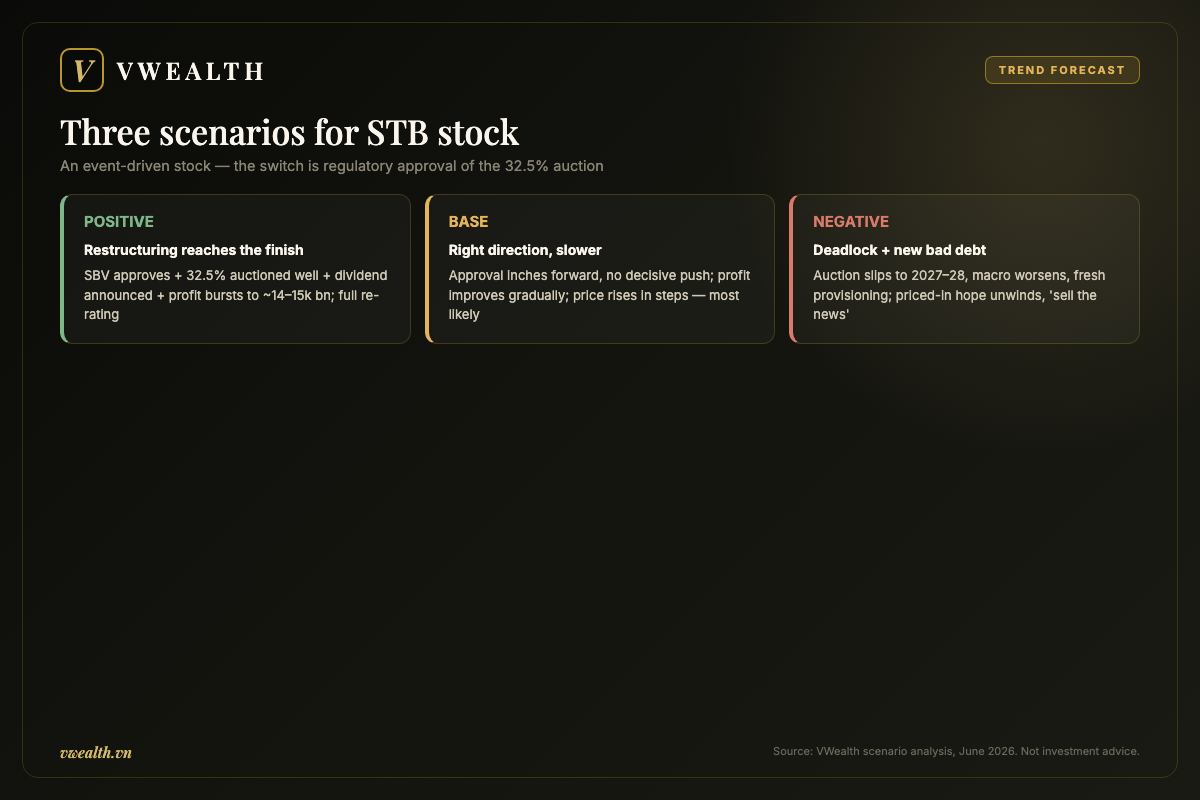
Looking across the three scenarios, you will notice a core feature of STB: this is not a stock whose price trend is decided mainly by quarter-to-quarter results, but by a chain of event-driven happenings, heavily dependent on the regulator’s decisions and the progress of a complex auction. That means STB’s swings will be “jerky” with the news flow, not smooth like already-stabilized bank stocks. You need to be clear about this before stepping in.
Should you buy STB stock?
This is the question you have perhaps awaited from the start of the article, and also the one a responsible analyst must answer most carefully. I will not tell you to “buy” or “sell,” because no one can or should make that decision for you. Instead, let us put on the scale everything favorable and unfavorable, honestly and fully, so you can draw your own conclusion suited to your circumstances.
The reasons STB is attractive
- A rebirth story near its ending. Sacombank has walked almost the entire arduous road of a decade of restructuring. The final knot, the 32.5% lot at VAMC, is within reach of resolution. This is no longer a “can it escape” story but a “when will it finish” one — a very large qualitative difference.
- The “compressed spring” of profit. The 40% profit drop in 2025 is the result of proactive provisioning to clean up, not a weak business. True earning power is expected in the 14,000–15,000 billion dong zone once provisioning ends. The gap between today’s “pretending to be sick” profit and the potential “truly healthy” profit is exactly the upside.
- Undistributed profit of over 25,352 billion dong awaiting payout. This is a real, accumulated asset, only locked by the restructuring rule. When released, it opens the possibility of large dividends for shareholders, a concrete reward rather than an empty promise.
- Three big catalysts converging. State Bank approval, the share-lot auction, and the dividend decision are three separate events, each of which can become a catalyst triggering a rally. Few stocks own so many positive “fuses” at once.
- A solid retail base and a rebounding ROE position. Sacombank has a wide branch network and a good retail customer base built over years. When no longer weighed down by provisioning, the bank’s ROE can rebound considerably, bringing its valuation closer to other healthy retail banks.
- Benefiting from the upgrade story. As a large-cap, highly liquid stock, STB is among those foreign capital eyes on the FTSE upgrade from September 2026, further amplified if the 32.5% lot is sold to a foreign investor.
The risks you must not ignore
- 2025 profit fell 40% and the current P/E is high. At 72,300 dong against profit compressed by provisioning, the current P/E looks expensive. You are paying for expected future profit, not present profit. If that future comes slowly or not as expected, the current price becomes hard to justify.
- Heavy dependence on the State Bank’s pace and the auction. This is the biggest risk. The entire story depends on the regulator’s decision and a complex auction of a 32.5% stake. History shows this process has “missed deadlines” many times, and the bank itself has had to request extensions. The risk of delay is entirely real.
- The unknown of the new controlling shareholder. After the 32.5% lot is auctioned, who will own this enormous block? A new controlling shareholder could change the bank’s strategy, risk appetite and governance culture in ways you cannot currently foresee. This is a large unknown about future governance quality.
- The price has risen sharply, reflecting much expectation. With a near-8% gain in one month and prior accumulated momentum, much of the positive story may already be “priced in.” When expectations are high, the room for positive surprises narrows, while negative surprises more easily shock.
- “Sell the news” risk. This is a classic psychological trap for event-driven stocks. When positive news is officially announced (approval, auction done, dividends), early buyers front-running may all take profit at once, sending the price down even when the news is good. You need to clearly distinguish between “good news” and “the price will rise,” two things that do not always go together.
Which kind of investor does STB suit?
There is no absolutely “good” or “bad” stock, only a stock “suited” or “not suited” to each person. Hold STB up against four typical investor groups to see where you stand.
| Investor type | Fit with STB | Reason |
|---|---|---|
| Speculator / story-growth investor | High fit | Believes in the restructuring reaching the finish line, ready to front-run big catalysts, accepting jerky volatility and timing risk in exchange for strong re-rating potential. |
| Long-term growth investor | Conditional fit | Can be attractive if you believe in normalized earning power and are ready to hold through a volatile phase, accepting a possibly extended schedule. |
| Investor needing steady income / immediate dividends | Low fit | The dividend, though potentially large, is uncertain in timing; you may have to wait a long time with no steady cash flow while holding. |
| Conservative investor prioritizing capital safety | Low fit | The dependence on administrative decisions, the new-shareholder unknown and high price volatility do not suit an appetite prioritizing capital preservation and stable results. |
Frankly, STB is a stock of story and of events. It suits those who believe in the rebirth scenario, clearly understand what they are betting on, and are steady enough to endure the shakes when news comes and goes. It suits less those who seek peace, a steady annual dividend flow and predictable results. Which group you belong to, only you can answer.
A closing word for your own journey
Sacombank stands at a special crossroads: it has walked almost the entire arduous road of a decade of restructuring, with a tightly compressed “profit spring” and a dividend pool waiting to be released. This is one of the most attractive and dramatic investment stories in Vietnamese banking right now. But as with every attractive story, it comes with no small uncertainty, the core of which is dependence on decisions beyond the bank’s own control.
What I hope you carry away after reading this article is not a “buy” or “don’t buy” answer, but a full enough framework to decide for yourself. Weigh the promising re-rating potential against the very real timing risk; the beautiful rebirth story against a price that already reflects much expectation. Ask yourself: can you bear waiting another one or two years? Can you sleep well if the price swings hard with each line of news? Is the money you plan to invest an amount you can accept putting at risk?
Disclaimer: This article is produced for informational and reference-analysis purposes, and is absolutely not advice or a recommendation to buy or sell any security. The figures cited are drawn from public sources at the time of writing and may change. Investing in stocks always carries the risk of capital loss. You should do your own thorough research, weigh your personal financial situation and consult a licensed advisor before making any investment decision. Every decision and related risk is yours alone.
Research Vietnamese stocks in English with vwealth. Our AI-powered platform turns Vietnamese market data into full English analysis reports — with international payment support and a free 2-month trial for new accounts. Create your free account and read the latest reports.
Read more sector analysis: Vietnam’s Banking Sector: A Foreign Investor’s Guide to the Market’s Backbone