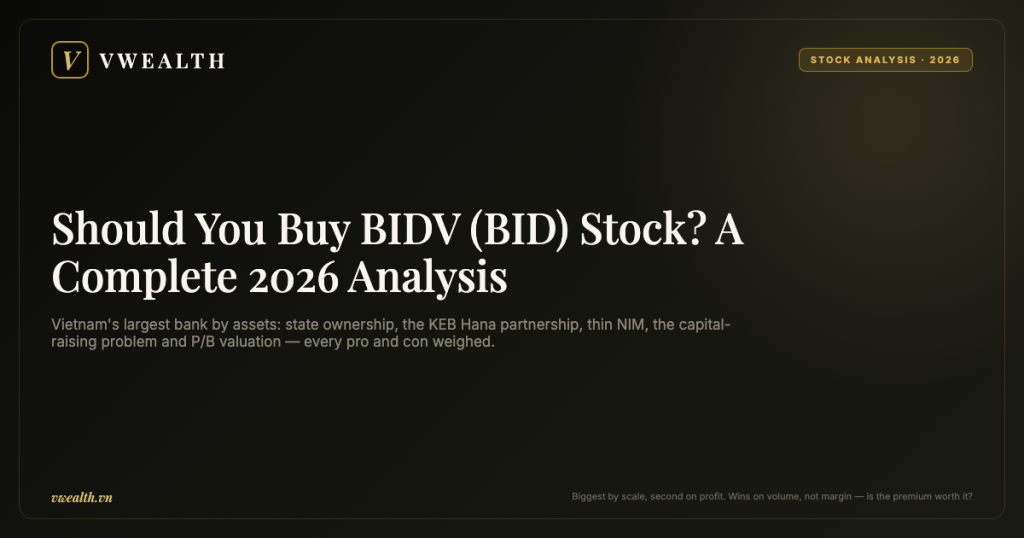
If you weighed Vietnam’s entire banking system and asked one very simple question — “which is the biggest?” — the answer, as of the end of 2025, is only one: the Joint Stock Commercial Bank for Investment and Development of Vietnam (BIDV, ticker BID on HOSE). With total assets exceeding 3.25 quadrillion dong (up more than 20% year on year), BIDV is the largest bank in the country by asset size, far ahead of the rest and one of the four familiar state-owned pillars investors call the “Big 4” (together with Vietcombank, VietinBank and Agribank).
The profit figure is not modest either: consolidated pre-tax profit in 2025 reached 37,788 billion dong, up 17.8% — an absolute profit among the highest in the industry. But if you look only at those two “big” numbers and rush to a conclusion, you’ll miss the most important thing. Because BID’s investment story lies not in the fact that it is big — everyone knows it is big — but in how that bigness operates: an enormous credit machine leading in lending share, a continuously swelling balance sheet, and counterbalancing all of that, a persistent problem you must understand if you want to hold this stock — the problem of raising capital and the safety buffer.
At 41,800 dong per share (session of 19 June 2026), BID is one of the largest-cap stocks on the market, virtually unavoidable in any institutional investor’s banking portfolio. The question for you — and what we’ll dissect throughout this full analysis — is very direct: should you buy BID at the current price, and if so, which kind of investor does this stock suit? A number-one-by-scale bank, big profits, the State controlling over 80% of capital — it sounds like a safe “national stock.” But “safe” and “profitable” are not always the same, and it is exactly the trade-offs buried beneath that enormous scale that decide whether BID is worth your money.
To answer properly, we cannot start from the price board. We must start from the roots: where BIDV came from, why it grew so big, and how the “DNA” formed over nearly seven decades of history is influencing every dong of profit — and every risk — you are about to bet on.
BID market data (updated 19 June 2026)
| Current price | 41,800đ | Total assets | 3.25 quadrillion (No.1 VN) |
| Change (June) | −0.24% | 2025 pre-tax profit | 37,788 bn (+17.8%) |
| P/E | P/B | ~12–13x | ~1.8–2.2x | NPL | State ownership | ~1.2% | ~81% |
Source: VWealth price data + BIDV 2025 reports. Figures move session to session — for reference only.
History and evolution
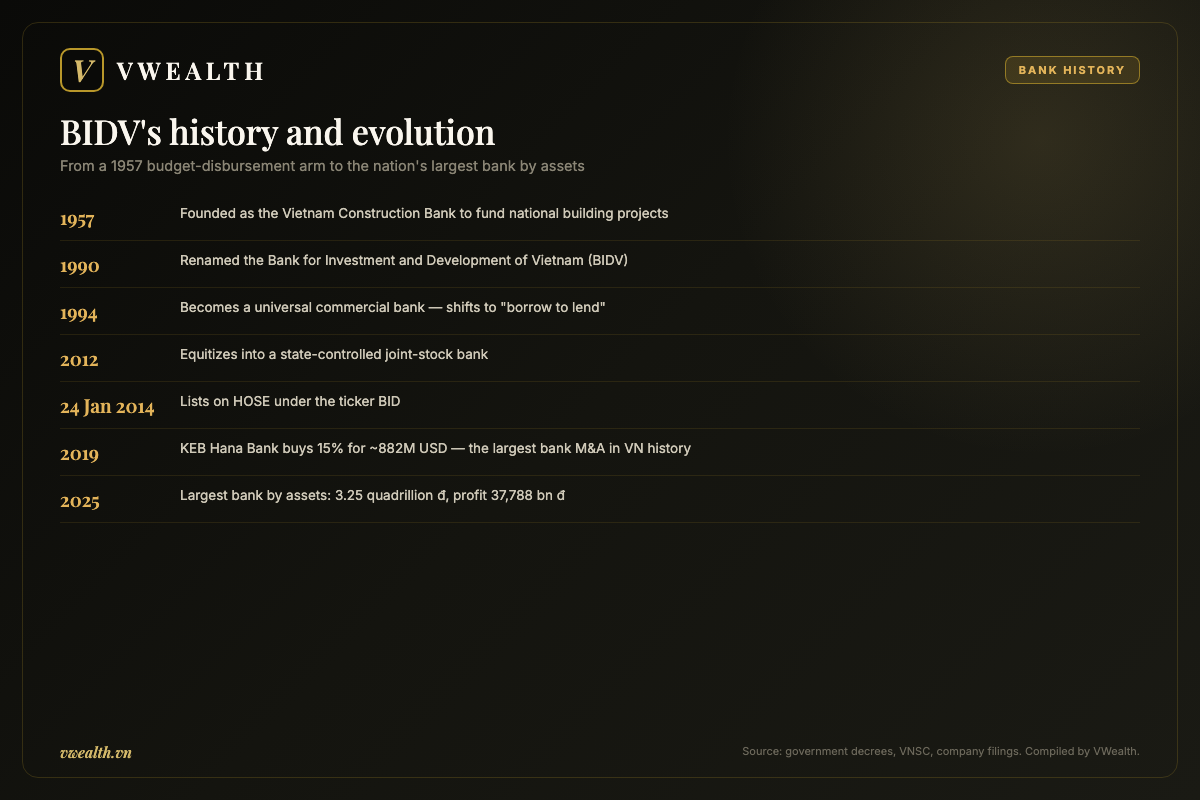
There is an interesting fact many young investors overlook: BIDV is the oldest financial institution in Vietnam’s entire credit-institution system. When you buy a bank stock, you usually think you are buying a modern business with an app, cards and QR codes. But with BID, you are buying shares of an organization born in 1957 — a time when the North was still pouring its energy into post-war reconstruction, and its very first name says it all: the Vietnam Construction Bank.
Understanding this history is not for nostalgia. It is extremely important to your investment decision, because the DNA of “a bank serving investment and development,” formed in 1957, still governs how BIDV lends, chooses customers and positions itself in the economy to this day. Let’s walk through each stage.
1957–1981: The Vietnam Construction Bank — born to fund the building effort
On 26 April 1957, under Decree No. 177/TTg, the Vietnam Construction Bank was officially established under the Ministry of Finance. Note the detail “under the Ministry of Finance” — this was not a commercial bank in the modern sense. In those early days, its task was to disburse state-budget capital for basic construction investment: that is, budget money was channeled through this bank to build the country’s projects, not “borrow to lend” like a bank today.
The starting scale was tiny: 8 departments, 12 branches and about 200 staff. But the role was large. Those first dongs went into foundational projects of the socialist North — the Bac Hung Hai major irrigation system, cement plants, strategic railways. By the early 1980s, the network had expanded to 38 branches nationwide with about 3,000 staff.
Why does this matter to you? Because from the “womb,” this organization was programmed to be tied to the nation’s mega-projects, infrastructure and development effort. That is why, long after, when it was a listed joint-stock commercial bank, BIDV was still the first name people thought of for large project loans, and for financing infrastructure, power, cement and industrial real estate. The DNA of “the bank of mega-projects” is not a marketing slogan — it is a nearly 70-year legacy.
1981–1990: The Bank for Investment and Construction of Vietnam — stepping out of “disbursement”
On 24 June 1981, under Decision No. 259-CP of the Government Council, the bank was renamed the Bank for Investment and Construction of Vietnam and moved under the State Bank of Vietnam. This was a quiet but meaningful shift: the organization began to leave the purely “disbursement” role under the fiscal-budget mechanism, to operate as a specialized bank for disbursement, credit, settlement and services in the field of basic-construction investment.
This period is tied to symbolic projects of the budding reform era: the Song Da hydropower plant, the Thang Long and Chuong Duong bridges, the Ha Long shipyard. It was still “the bank alongside big projects,” but the approach began to take on market characteristics. For an investor reading history, this is the first stage showing this organization can reform itself in step with each phase of the economy — a quality that will recur many times.
1990–2012: The Bank for Investment and Development of Vietnam — becoming a universal commercial bank
This is the longest stage and the “coming-of-age” of BIDV. On 14 November 1990, under Decision No. 401/CT, the bank took the name the Bank for Investment and Development of Vietnam — the name etched into the minds of many generations of Vietnamese and the root of today’s “BIDV” brand.
The real turning point came on 18 November 1994, when BIDV was permitted to operate universally, comprehensively, as a commercial bank. Roughly speaking, this is when the organization formally shifted from the “disbursement” model to the “borrow to lend” model — the core business model of every modern commercial bank. From here, BIDV was no longer just the State’s capital-channeling arm, but truly a business raising deposits from the public and enterprises, then lending to earn the interest spread.
The level of development in this period is very impressive if you look at the start-versus-end numbers:
- Mobilized capital: from about 300 billion dong (1990) to 285.6 trillion dong (2012) — nearly 1,000 times larger.
- Credit outstanding: from 3,700 billion dong (1995) to 293.9 trillion dong (2012).
- Network: from 52 branches (1994) to 118 branches and 525 transaction points (2012).
- Staff: nearly 18,000 employees by 2012.
At the same time, BIDV began building a financial “ecosystem” around the parent bank: the BLC financial-leasing company (1998), the BSC securities company and the Laos–Vietnam joint-venture bank (1999), the BIC insurance company (2006), along with receiving an international credit rating from Moody’s. In 1992, BIDV was also the bank entrusted with the first ODA loan from the Italian government — a milestone showing this organization’s role as a bridge for international capital.
For you, the message of the 1990–2012 stage is clear: BIDV entered the 21st century not as a young bank, but as a large-scale, universal financial group with a technology infrastructure and a wide network — the foundation that, when it later equitized, immediately made it a genuine “big player” without needing time to build scale from scratch.
2011–2014: Equitization and listing — the moment BIDV belonged to investors
This is the stage where you — a stock investor — begin to have a “door” to participate. On 28 December 2011, BIDV held its initial public offering (IPO): offering 84.7 million shares at an average price of 18,583 dong per share, raising about 1,575 billion dong. By 27 April 2012, BIDV officially converted into the state-controlled Joint Stock Commercial Bank for Investment and Development of Vietnam — the exact full name the ticker BID carries today.
And then the milestone every investor must remember: on 24 January 2014, the stock BID officially traded on the Ho Chi Minh City Stock Exchange (HOSE) with 2.81 billion shares listed. From that moment, an institution nearly 60 years old, once a budget-disbursement tool, became a public stock anyone with a securities account could own.
But there is a point you must engrave in your memory when investing in BID: equitization does not mean the State withdraws. This is the “equitize but the State still controls absolutely” model. To this day, the State Bank (representing the State’s capital) still holds about 80.99% of BIDV’s charter capital. Together with strategic shareholder KEB Hana Bank holding 15%, these two shareholders alone account for nearly 96% of capital. This is the most concentrated ownership structure in the Big 4.
That creates a dual character for your stock. On the positive side: BIDV has State backing, very high reliability, and virtually no “collapse” risk in the ordinary sense — this is the kind of stock the whole national financial system has an interest in keeping solid. On the downside: the truly “floating” free-float on the market is very thin, and every major decision — especially whether to pay dividends in cash or stock, and capital raises — depends on State direction, not fully on the logic of maximizing small shareholders’ benefit.
2019: The KEB Hana Bank deal — the most expensive handshake in Vietnamese banking
If you had to pick a single event most meaningful to BIDV’s governance quality over the past decade-plus, it is the KEB Hana Bank deal. On 11 November 2019, BIDV officially announced KEB Hana Bank (part of Hana Financial Group, South Korea) becoming a foreign strategic shareholder owning 15% of charter capital.
The scale of this deal was staggering at the time. BIDV issued more than 603 million shares to KEB Hana Bank, with a total transaction value of over 20,295 billion dong, equivalent to about 882 million USD. This was assessed by professionals as the largest M&A deal in Vietnamese banking history up to then, and one of the largest Korea–Vietnam financial partnerships.
For a state-owned bank often doubted on governance, the fact that a leading Korean financial institution accepted spending nearly 900 million USD to enter BIDV — and committed to holding at least 5 years — is a strong “endorsement” of this bank’s intrinsic value and prospects.
But money is only half the story. The more important part for you — the long-term investor — is what BIDV received beyond money. Under the agreement, BIDV received long-term technical support from KEB Hana Bank and Hana Group across 6 areas: development-strategy governance; technology-system and digital-banking management; retail-banking development; asset-portfolio diversification; risk management; and human-resource training and development.
These six pillars are not clichés. They target directly the inherent weaknesses of a traditional state-owned bank used to lending to large enterprises and projects: a lack of sophisticated retail capability, immature international-standard risk management, and digital technology needing upgrades. Having a Korean strategic shareholder — from a highly developed retail and digital banking market — sitting in the ownership structure, bringing both capital and know-how, was the catalyst helping BIDV shift strongly toward retail and modernize its governance in the following years.
And purely as an investment, this deal was also a fine win for the Korean side: after more than 4 years, when BID stock hit its all-time high, KEB Hana Bank’s investment had doubled. A small detail that says a great deal: even the most sophisticated strategic investor made large money from holding this stock long term — a hint worth pondering for you about time-horizon thinking.
2014 to now: the journey to the “number-one bank by total assets”
After listing and especially after the KEB Hana boost, BIDV entered a phase of continuous scale growth to become Vietnam’s largest bank by total assets. Look at the balance sheet’s cadence:
| Metric | 2023 | 2025 |
|---|---|---|
| Total assets | Over 2.3 quadrillion dong | Over 3.25 quadrillion dong |
| Pre-tax profit (consolidated) | 27,589 billion dong | 37,788 billion dong |
| Equity | — | 163,017 billion dong (+19.5%) |
| Charter capital | — | 70,214 billion dong |
| Credit growth | — | About 15% |
In just about two years, total assets jumped from over 2.3 to over 3.25 quadrillion dong — an absolute increase of nearly one quadrillion, larger than the combined total assets of many mid-sized banks. Pre-tax profit also climbed from 27,589 billion (2023) to 37,788 billion dong (2025). This is the arithmetic proof of the phrase “leading credit machine” we mentioned at the open: BIDV grows by pumping credit into the economy at an unmatched scale, and earning interest on that enormous asset base.
In parallel, BIDV maintains an international brand position: in the Top 2,000 largest public companies in the world (Forbes), the Top 300 most valuable banking brands globally (Brand Finance), and repeatedly named the best retail bank in Vietnam — evidence that the “pivot to retail” strategy after the KEB Hana deal has produced real results. The bank’s network now numbers nearly 1,100 branches and transaction offices, serving over 19 million customers, with nearly 30,000 staff and a presence in 5 countries.
The other side of the medal: the capital and buffer problem
By now you might think everything is rosy. But a serious analyst must show you the price of that enormous growth — and it lies right in BIDV’s most recent history: the problem of raising capital to keep the safety buffer.
The core issue is easy to understand, even if you are not a finance person. The more a bank lends, the thicker a “buffer capital” layer it needs in case those loans hit trouble. The ratio measuring this buffer is the capital adequacy ratio (CAR). At the end of 2025, BIDV’s standalone CAR was about 9.05% — still above the 8% minimum the State Bank requires, but among the lowest in the system, significantly thinner than many other banks.
Why does a bank earning nearly 38,000 billion dong a year have a thin buffer? This is exactly BID’s paradox you need to grasp. First, because assets (loans) grow too fast, the CAR ratio’s “denominator” keeps swelling, diluting the buffer. Second, and more importantly, because it is a state-controlled bank, BIDV for many years could not freely retain profit to raise capital as it wished — paying stock dividends or issuing new shares depends on regulator approval, and usually happens slower than the pace at which the bank lends.
The result is that BIDV continually scrambles to raise capital to “chase” its own growth. In 2025–2026 alone, the bank has deployed several plans: issuing shares to pay dividends, offering to existing shareholders (raising charter capital from 72,801 billion to 77,783 billion dong), and preparing private placements. If the whole plan completes, BIDV’s charter capital could exceed 100,000 billion dong in 2026–2027 — heading for the position of the bank with the largest charter capital. The goal behind these raises is clear: strengthen CAR, meet the Basel III international-safety roadmap, and create room to keep expanding credit.
For you, this is a double-edged sword to weigh carefully. On one hand, raising capital makes BIDV more solid, opens the path to long-term growth, and the fact that foreign room still has space (after Hana’s 15%) opens the possibility of more quality foreign capital. On the other hand, issuing more shares to raise capital means dilution: more shares outstanding, pressure on earnings per share (EPS) and cash dividends; and private placements at prices below the market price can affect the stock’s short-term price.
In short, nearly seven decades of history have forged a BIDV with a very distinctive portrait: largest by assets, leading in credit, tightly tied to mega-projects and the nation’s development, state-controlled and backed by a Korean strategic shareholder — but also a bank that must constantly solve the capital problem to keep its buffer in step with its growth ambition. That is the frame you need to keep in mind before going deeper.
History has shown you BIDV’s “genes.” But how does a 3.25-quadrillion-dong bank operate, who leads the capital-raising and retail-pivot decisions, and toward what direction — all of it depends on the people at the wheel. Let’s look at BIDV’s leadership in the next section.
Leadership and state ownership
If you want to understand how BID differs from a private bank stock, start from its ownership birth certificate. BIDV is not a public business in the ordinary sense, where institutional and individual shareholders share most of the shares. At BID, almost all the economic power and voting rights sit with exactly two names: the State of Vietnam, represented by the State Bank, and a foreign strategic partner from South Korea. The rest, the part belonging to you and tens of thousands of other investors on the exchange, is only a very thin slice. This very feature shapes almost everything: how BID grows, how it pays dividends, and why its stock price moves in its own way, less like the rest of the market.
Ownership structure: two shareholders hold almost everything
Look at the disclosed numbers so you don’t have to guess. According to BIDV’s disclosure of shareholders owning over 1% of charter capital (August 2024), the State Bank of Vietnam held about 4.62 billion BID shares, equivalent to 80.99% of charter capital. Korean strategic partner KEB Hana Bank held about 855.1 million shares, equivalent to 15% of charter capital at that time. KEB Hana Bank’s ownership is often cited with the original figure of 14.21% when they signed the 2019 deal, and this ratio fluctuates slightly around 14–15% whenever BIDV changes its charter capital. Combined, these two names hold about 95–96% of the entire bank. This is considered the most concentrated ownership structure among the Big 4 state-owned banks.
The rest, the shares truly freely traded on HOSE that investors call free float, is only a bit over 4%. By the end of 2025, when BIDV’s charter capital reached about 70,214 billion dong, the capital of outside investors was recorded at about 4,006 billion dong, equivalent to just around 5.7% of total capital. This number is very important to you, and we’ll return to analyze its meaning later.
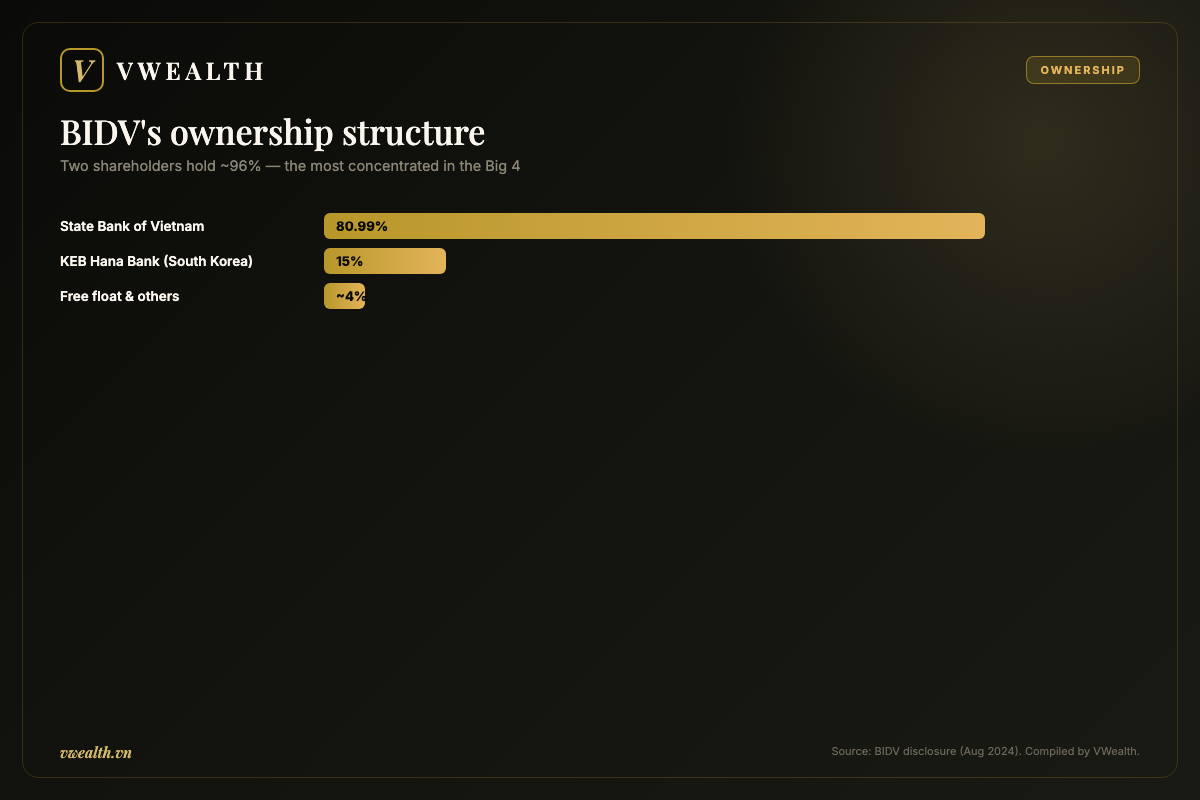
To picture the scale of this concentration, set it against reality: BID is one of the banks with the largest total assets in Vietnam’s system, with total assets exceeding 3.2 quadrillion dong at the end of 2025. Such a colossal institution, yet the shares truly in free circulation make up only a very small part. That is a paradox you need to remember when valuing this stock.
The meaning of state ownership: a shield and a chain
State ownership controlling about 81% is a double-edged sword, and you need to see both edges at once rather than only the good or the bad.
On the positive side, this is a nearly impenetrable shield. BIDV is one of the four pillars of Vietnam’s banking system. When a bank has the State as controlling shareholder and plays a lifeblood role in the economy like this, it belongs to what financiers call “too big to fail.” What does that imply for you? That BID’s bankruptcy or insolvency risk is nearly zero in any realistic scenario, because the State would not let this institution fall. Depositors’ trust in BID is absolute, helping the bank raise among the cheapest and most stable funds in the system.
Along with state backing comes a business advantage few private banks have: relationships with the state-owned customer segment and mega-projects. BIDV is traditionally tied to development-infrastructure investment, so it is often the arranger of capital for state groups, general corporations, and large power, transport and energy projects. This is a customer base a private bank finds hard to access, creating a solid revenue foundation and a hard-to-replace position.
Think of state ownership at BID as a shield: it protects you from collapse risk, but also limits how fast you can run. Safety and explosive growth rarely go together.
Now the other edge of the blade. A free float of only a bit over 4% means BID stock is scarce on the market. This has two opposing consequences. On one hand, thin floating supply means the price can be well supported and rarely dumped en masse. On the other, it makes BID less liquid relative to its market cap, and more importantly, your stock’s price depends heavily on the will and policy of the state shareholder, not fully on the supply-demand of public investors.
The deeper price of state ownership is policy dependence. As a state-owned bank, BIDV often has to shoulder tasks with a political and social flavour. When the Government wants to support the economy, BID is among the first banks called on to cut lending rates, roll out preferential credit packages, or pump capital into priority sectors. These are good for the economy, but they can erode the net interest margin (NIM) and profit. A private bank can refuse to lend to an inefficient project; a state-owned bank sometimes has no such choice. This is the chain that comes with the shield: you are protected, but you are also bound.
Leadership: a generational handover and KEB Hana’s role
2026 marks an important leadership handover at BIDV you need to know. Per disclosures at the annual general meeting and State Bank announcements, Mr. Phan Duc Tu, who held the Board Chairman seat for many years, retired from 1 July 2026.
The person elected to succeed as Board Chairman is Mr. Le Ngoc Lam, previously BIDV’s CEO. Mr. Lam, born in 1975, holds a master’s in banking finance and is a “true-blood” BIDV person: he has been with the bank since 1997, rising through a series of positions from credit-risk management, corporate customers, to Deputy CEO and then CEO. A person raised entirely within the BIDV system taking the Chairman’s seat shows seamless succession, prioritizing stability over upheaval.
The CEO seat went to Mr. Hoang Viet Hung, born in 1972, who joined BIDV in 1996 and also has nearly three decades in the system. Thus, BID’s two most powerful positions are now both held by people with deep understanding of the internal machine, approved by the State Bank. You should understand that at a state-owned bank, senior leadership appointments are not simply the Board’s decision, but tied to the planning and approval of the state management body, underscoring again BID’s “state-controlled” nature.
One point you should not overlook is KEB Hana Bank’s role on the Board. As a strategic shareholder holding about 14–15%, KEB Hana has the right to nominate a representative to management. In the 2026 personnel reshuffle, BIDV nominated an additional board member representing KEB Hana Bank. The presence of a large Korean banking institution on the Board gives BID not only capital, but also governance experience, technology and international banking standards. This is a valuable difference versus some purely state-owned banks: BID has a foreign “eye” supervising and contributing at the highest level.
The capital and safety-buffer problem: the biggest bottleneck
This is perhaps the most important part to grasp when assessing BID’s prospects, because it is the bottleneck constraining this very largest bank in the system.
BIDV’s paradox is that asset scale is colossal, but the capital buffer is relatively thin. BIDV’s standalone CAR at the end of 2025 was about 9.05%. This still meets the State Bank’s minimum requirement (8% or above), but it is significantly thinner than many top private banks, which usually maintain CAR above 11–12%, even higher. The capital adequacy ratio, put simply, is the cushion for a bank to absorb risk and the room to expand lending. A thin CAR means limited credit-growth room: to lend more, BIDV must raise capital correspondingly.
The problem is that capital raising at a state-owned bank like BIDV is structurally slow. Why? Because every capital-raising plan must go through a complex approval process involving state capital. When the State holds 81%, any new issuance or stock dividend touches the management of state capital, requiring approval from multiple levels. While a private bank can quickly call capital from shareholders or privately place with a foreign partner within a few months, BIDV can take years to complete a similar plan. BIDV’s own leadership admitted at the shareholders’ meeting that the bank’s capital-raising pace is still slow.
| Metric (end 2025) | Value | Meaning for you |
|---|---|---|
| Charter capital | ~70,214 billion dong | Large but needs fast growth to keep up with assets |
| Total assets | >3.2 quadrillion dong | The largest scale in the system |
| Standalone CAR | ~9.05% | Meets the standard but thinner than private banks |
| Charter-capital target | Toward ~100,000–105,000 billion dong | Needs approval to be realized |
Why is this a real bottleneck? Because a bank’s profit growth depends heavily on its ability to expand lending scale, which is locked by capital. When CAR is thin and capital raising is slow because it depends on the State and issuance procedures, BID’s growth room is squeezed relative to its potential. This is why, despite being the largest bank by assets, BID sometimes grows profit less explosively than the nimble private group. You own a giant, but a giant that must move at the permitted pace, not its own maximum pace.
Dividend policy: a turning point from retaining to distributing
A positive development you should note is the change in BIDV’s dividend policy, directly tied to the capital problem above.
For many years, state-owned banks were kept from distributing profit or paid trickle dividends to concentrate on accumulating capital. Recently, BIDV has become more proactive. In October 2025, the bank approved a cash dividend for 2024 at a 4.5% ratio, i.e. 450 dong per share. This is a real cash reward for shareholders, even if the ratio is not high.
More important is the large-scale stock-dividend plan. BIDV plans to use most of its retained profit to pay dividends in stock, thereby raising charter capital. Retained profit after appropriations for 2025 was about 13,205 billion dong, and the bank submitted a plan to issue up to about 1.39 billion shares for dividends (a ratio of about 19%). Together with other components such as issuing to existing shareholders and a public offering in 2026–2027, BIDV targets raising charter capital to the 100,000–105,000 billion dong threshold.
You need to read the true nature of this dividend policy. A cash dividend is real money flowing into your pocket. But a stock dividend is essentially not free: it is how BIDV “hits two targets with one arrow,” rewarding shareholders in stock while retaining profit in the bank to solve the capital problem and strengthen CAR. In other words, most of BID’s profit is being reinvested back into the bank’s own safety buffer. For a long-term investor, this is reasonable: it gives the bank more room to lend and grow in the future. But if you expect a high, steady cash dividend, BID is not the kind of stock for you at this stage.
To sum up, BID’s state-ownership foundation and leadership paint a portrait of a bank both rock-solid and bound by that very stature. To fully understand how this machine operates and where it makes money, next you need to step inside BIDV’s ecosystem and core business segments, where that enormous scale is converted into real revenue and profit.
Ecosystem and business segments
When you look at BIDV, picture Vietnam’s largest banking machine by asset scale. At the end of 2025, the bank’s consolidated total assets exceeded 3.25 quadrillion dong — the largest figure in the whole system, far ahead of the rest. To picture it easily, 3.25 quadrillion dong is equivalent to about a third of Vietnam’s nominal GDP concentrated on a single bank’s balance sheet. Credit outstanding exceeded 2.3 quadrillion dong, up 15.2% year on year; deposits exceeded 2.4 quadrillion dong, up 13.7%; and consolidated pre-tax profit set a new peak above 36,000 billion dong.
But that enormous scale is only the shell. To understand where BID stock truly makes money, you need to break this ecosystem into layers: a parent bank as the backbone, a network of subsidiaries spanning securities, insurance and financial leasing, and a belt of international presence in Indochina plus the strategic relationship with the Koreans. In this section, you and I will go through each layer, not just to know “what BIDV has,” but to understand why that scale forms a competitive “moat” — and why that moat has a crack named NIM.
The parent bank: the No.1 machine by scale
The heart of BIDV is traditional commercial banking, and this is where most profit is generated. Before going deeper, let’s agree on a foundational concept you’ll meet repeatedly throughout this analysis: net interest income, abbreviated NII.
NII is the difference between the interest a bank earns from lending (and bond investment) and the interest it pays depositors. Roughly: the bank “buys” depositors’ money at one rate, then “sells” it to borrowers at a higher rate, and the surplus is NII. For most Vietnamese banks, NII makes up 70–80% of total operating income.
BIDV’s uniqueness lies in this: its NII is calculated on an enormous interest-earning asset base. With more than 2.3 quadrillion dong of credit, even if the margin on each dong is only average, the total interest collected is still the largest in the system simply because the “denominator” is so large. This is the economics of scale: you don’t need the highest margin if you have the largest volume. A small bank with a high 5% NIM on 200,000 billion dong of assets still loses on absolute total interest to BIDV with a 2.5% NIM on 2.3 quadrillion dong.
Wholesale-credit strength — the “state-owned” streak in its genes
If you had to pick one word to describe BIDV’s credit identity, it is wholesale. Unlike Techcombank or VPBank, famous for retail and consumer credit, BIDV was born from an investment and development bank (its full name is the Joint Stock Commercial Bank for Investment and Development of Vietnam). That history left a legacy: the bank has deeply rooted relationships with large enterprises, state general corporations, and especially national infrastructure projects.
When Vietnam deploys mega-projects — the North–South expressway, Long Thanh airport, power plants, large industrial parks — BIDV is almost always among the arranging banks. This is a type of credit with distinct features you need to grasp:
- Large loans, long tenors: an infrastructure project may need several thousand to tens of thousands of billions of dong, disbursed over many years. BIDV, with the largest capital scale in the system, is one of the few banks with the “muscle” to participate.
- State-owned relationships: the State Bank still owns over 80% of BIDV. Its state-owned position helps BIDV access key projects, preferential capital flows and the default trust of the state-enterprise sector — an advantage a private bank finds hard to copy.
- FDI customers: foreign-invested enterprises pouring into Vietnam are also a segment BIDV pushes, especially Korean capital — which I’ll cover in detail in the KEB Hana section.
Alongside wholesale, in recent years BIDV has proactively pushed retail to balance the mix. This is an important strategic shift: retail credit (personal home, car, consumer loans, household businesses) usually has a higher margin than large-corporate lending, and helps diversify risk instead of concentrating on a few large customers. BIDV leverages its most precious asset to do this: the largest branch network in Vietnam.
The network — a physical “moat” hard to copy
Ask yourself: in the digital-banking era, is a physical branch network still important? The answer for BIDV is: yes, and very important. A system of hundreds of branches and thousands of transaction offices reaching down to district level and rural areas — where pure digital banks have not reached — is exactly the channel for drawing cheap deposits and cross-selling products. Each branch is a touchpoint with customers, a “funnel” for attracting retail deposits and distributing retail credit, insurance and payment services.
This network is a classic “moat”: building it took decades of accumulation, thousands of billions of dong in physical and human investment. A new rival cannot, in a few years and with a big pile of money, copy BIDV’s coverage and local-level presence. This is the advantage creating the largest customer base in Vietnam — the foundation for every other business segment.
CASA and cost of funds: the crack in the moat
Here I must tell you frankly about the biggest weakness in BIDV’s profit structure, and this is what distinguishes an investor who gets it from someone who only looks at the “record profit” number. Large scale does not automatically mean the most efficient profitability. The problem lies in two tightly linked concepts: CASA and NIM.
CASA (Current Account Savings Account) is the ratio of non-term deposits in total funding. This is the bank’s “cheapest” money — money customers keep in payment accounts, on which the bank pays almost no interest (or very little, around 0.1–0.5% a year). Conversely, term deposits (savings books) pay 4–6% a year. The higher the CASA, the lower the average cost of funds.
NIM (Net Interest Margin) is NII divided by average interest-earning assets. It tells you: on each dong of assets, how many cents of net interest the bank earns. The thicker the NIM, the more the bank profits on each dong lent.
The link between these two is very direct: high CASA → low cost of funds → thick NIM. And this is exactly where BIDV loses out. BIDV’s CASA ratio is only around the industry average — significantly lower than Vietcombank (VCB) or especially Techcombank, the two banks that usually lead on non-term deposits. The inevitable consequence: BIDV’s cost of funds is higher, and BIDV’s NIM is thinner than banks with high CASA.
Why is BIDV’s CASA not as high? There are a few structural reasons you should understand:
- A customer mix leaning wholesale: large enterprises and projects usually keep term deposits to earn interest, not large balances in payment accounts like the nimble retail segment or actively transacting businesses (Techcombank’s playground).
- A traditional customer base: many of BIDV’s long-standing customers in rural and public-sector areas prefer term savings over active payment accounts.
- The technology race: high CASA usually pairs with a smooth, free digital-payment ecosystem that retains transaction cash — an area private banks invest heavily in.
This is why, despite BIDV’s absolute profit being among the leaders, efficiency metrics like ROE (19.02% in 2025) or NIM are not always at the top. BIDV wins on volume, not on margin. When you value BID stock, remember this: you are buying a giant by scale, but a giant with a thinner margin than some higher-quality rivals. In compensation, the push into retail and digital transformation is exactly the deliberate effort to improve CASA and thicken NIM in the coming years.
The subsidiary ecosystem: a “universal” bank
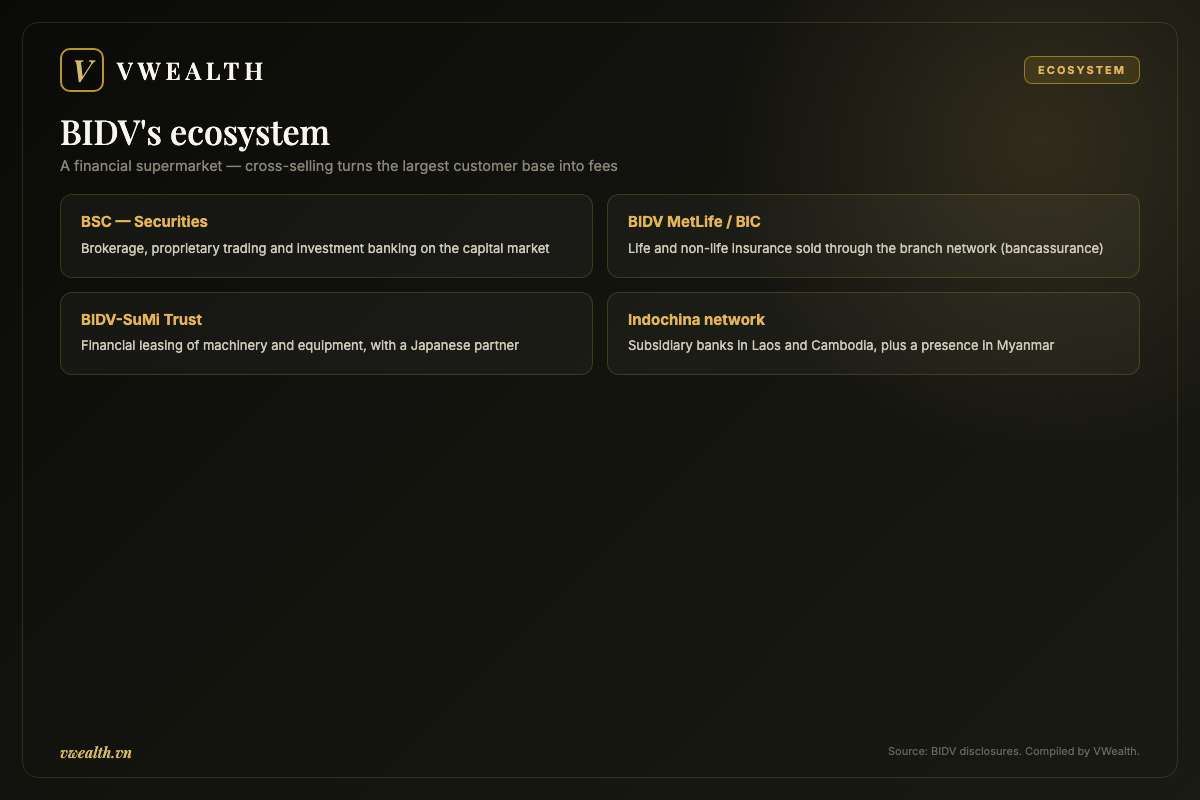
BIDV is not just a lending bank. Around the parent bank is a cluster of subsidiaries and joint ventures spanning almost every financial-service segment. In total BIDV has about 10 subsidiaries plus joint ventures and associates. The ecosystem’s purpose is very clear: cross-selling. A customer who has borrowed at BIDV can be offered BIC insurance, investment via a BSC securities account, BIDV MetLife life insurance, or financial leasing from BIDV-SuMi Trust. Each additional product sold is a fee source — the non-interest income every bank craves because it does not “eat” capital or bear credit risk like lending.
Let’s run through each piece so you see the whole picture:
- BSC (BIDV Securities): a securities company providing brokerage, proprietary trading and issuance advisory. This is BIDV’s arm on the capital market — helping the bank participate in investment banking, corporate-bond issuance, and tapping the wealthy customer base wanting to invest in stocks.
- BIDV MetLife: a life-insurance joint venture between BIDV, BIC and MetLife Group (US, NYSE: MET). Life insurance sold through the bank channel (bancassurance) is a fee goldmine: the bank uses its branch network and customer base to distribute insurance contracts and earn commission.
- BIC (BIDV Insurance): a non-life insurance corporation — property, vehicle, health and cargo insurance. BIC serves both borrowing corporate customers (collateral insurance) and retail individuals.
- BIDV-SuMi Trust: a financial-leasing joint venture with a Japanese partner (Sumitomo Mitsui Trust). Financial leasing finances machinery and equipment for enterprises — a segment complementing traditional wholesale credit.
- The Indochina subsidiary network: BIDV has subsidiary banks in Laos (the Laos–Vietnam Joint Venture Bank, LaoVietBank) and Cambodia (BIDC), plus a presence in Myanmar (a branch) and representative offices in Taiwan and Russia. This is the “going regional” mark — BIDV following Vietnamese capital and businesses investing into Indochina, while serving border trade.
You need to understand the real value of this subsidiary cluster lies not in each unit’s profit (usually quite small versus the parent bank), but in that they turn BIDV into a financial supermarket. When a customer can meet every need — borrow, deposit, invest, insure, lease — within one ecosystem, the cost of switching to another bank rises, and each customer brings more income streams. That is how the largest customer base is “squeezed” into many layers of value.
The KEB Hana relationship: a bridge to Korean capital
A strategic piece many investors overlook is BIDV’s foreign strategic shareholder: KEB Hana Bank (part of Hana Financial Group, South Korea). In late 2019, KEB Hana spent nearly 20,300 billion dong to buy over 603 million privately placed shares, becoming a shareholder owning 15% of BIDV’s capital. This deal raised BIDV’s charter capital from 34,187 billion to 40,220 billion dong — the highest in Vietnam’s banking system at the time.
Why does this matter to you? There are two layers of value:
- A bridge to Korean customers: South Korea is one of the largest FDI investors in Vietnam (Samsung, LG, Hyundai and thousands of satellite businesses). The KEB Hana relationship helps BIDV become the “gateway” bank serving Korean capital and businesses — a high-quality, stable FDI customer base.
- Capability transfer: under the cooperation agreement, Hana Group provides long-term technical support to BIDV across 6 areas: strategy governance, technology systems and digital banking, retail development, earning-asset diversification, risk management, and staff training. These are exactly the points BIDV most needs to strengthen — especially retail and digital banking, the two key areas for improving CASA and NIM discussed above.
Digital transformation: SmartBanking and the No.1 customer scale
The final layer of the ecosystem — and also the future driver — is digital transformation. BIDV owns the largest customer base in Vietnam, and the bank is pouring resources into digitizing that base via the BIDV SmartBanking app (along with products like SmartBanking X, BIDV Home). This is not just about “having an app to look good.”
Digital banking is a direct weapon against the CASA and cost weaknesses. When customers use the app to pay, transfer and transact daily, they tend to leave cash in their payment accounts — that is, raising CASA and cutting the cost of funds. At the same time, each digital transaction generates a service fee at a far lower operating cost than serving at the counter. In fact, BIDV’s non-interest income has grown well thanks to digital-banking services, ranking among the industry leaders in fee scale. With the largest customer base as “ammunition,” if BIDV digitizes successfully, the leverage effect will be very large — this is the most important long-term growth scenario for you to watch in this stock.
To close: the scale moat and the NIM crack
So how does BIDV’s ecosystem form a competitive “moat”? Let me sum it in three pillars:
- No.1 scale: total assets of 3.25 quadrillion dong and loans above 2.3 quadrillion create the largest absolute NII volume in the system — a weight no rival can match in large credit deals and infrastructure projects.
- Network and customer base: the widest branch network in the country plus the largest customer base is an asset accumulated over decades, hard to copy — both a funding funnel and a cross-selling channel for the whole subsidiary ecosystem.
- State-owned relationships and a strategic partner: state ownership above 80% opens the door to key projects and preferential capital; the KEB Hana relationship brings Korean FDI customers and modern governance capability.
But this moat has a real crack you must not close your eyes to: a thinner NIM than banks with high CASA. BIDV wins by scale and volume, not by margin. This means BIDV’s profit-growth room depends heavily on whether the bank can improve CASA (through retail and digitalization), and whether it can control asset quality — especially with a wholesale portfolio concentrated on large enterprises and long-term projects, which carries risk if one large customer runs into trouble.
That is why, after understanding where BIDV makes money and its strengths and weaknesses, our next step is to examine the bank’s position and financial health: what the NPL ratio, CAR, provisioning buffer and profitability metrics really say. The largest scale does not mean the safest — and the next section answers the question: behind this giant, is the financial foundation solid enough for you to invest with confidence.
Position and financial health
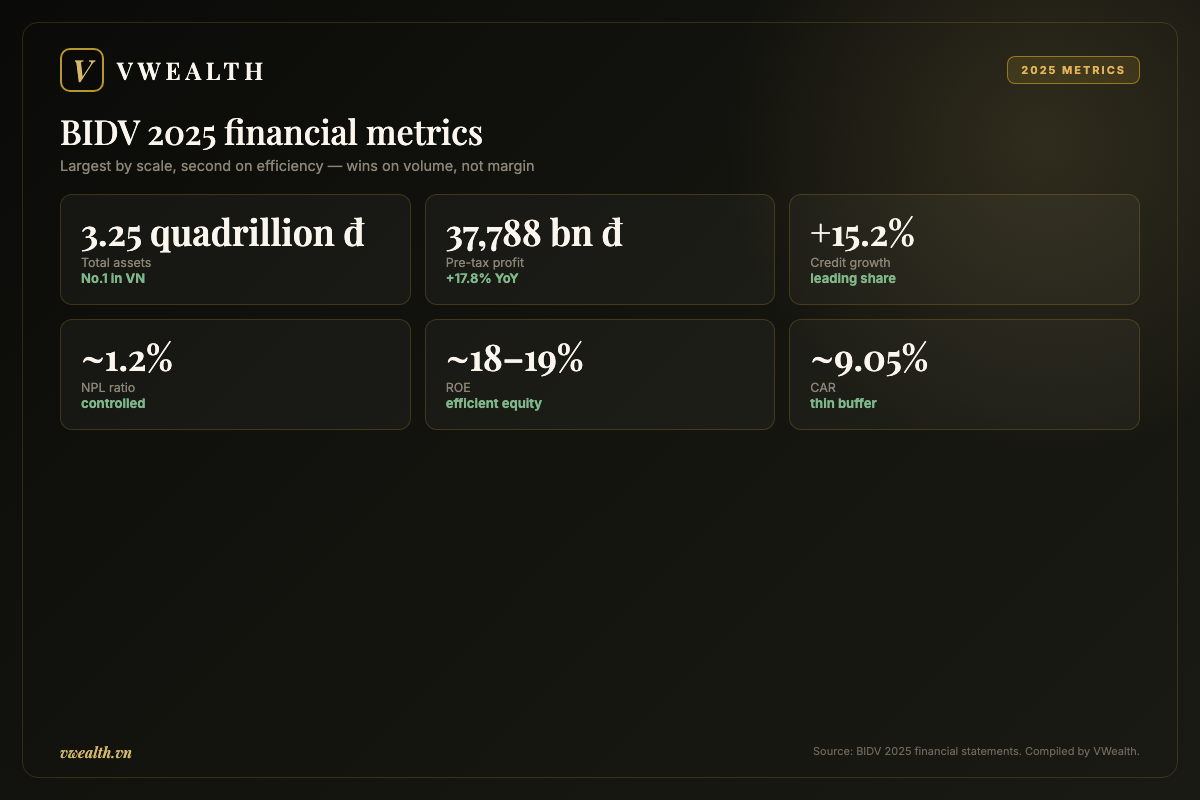
If you want to understand BIDV in one sentence, here it is: the largest bank in Vietnam, but not the most profitable. The entire BID investment story fits within that paradox. BIDV’s scale is overwhelming: total assets exceeded 3.25 quadrillion dong at the end of 2025, up more than 20% year on year and the largest figure in Vietnam’s banking system, matched by no institution. Credit outstanding exceeded 2.3 quadrillion dong, up 15.2% — also the number-one lending scale in the industry. This is the economy’s largest capital-pumping machine.
Yet on profit, BIDV ranks second, behind Vietcombank. Consolidated pre-tax profit in 2025 reached 37,788 billion dong, up 17.8% and a new record for the bank — a very respectable figure, but still below Vietcombank’s over-42,000 billion dong, even though Vietcombank’s assets are only about half of BIDV’s. This is not a side detail. It is the key to valuing this stock correctly and not expecting wrongly. This section dissects BIDV’s three health pillars — profitability, asset quality, and capital buffer — frankly, neither sugar-coating nor smearing.
The No.1 position: enormous scale is a moat, but also a burden
Start with what BIDV does best: scale. In banking, scale is not simply a number to boast about. Assets of 3.25 quadrillion dong mean a customer network across the country, a thick deposit base, and a default-partner position for most large infrastructure projects, state groups and industry-leading businesses. When an expressway, a power plant or an industrial park needs trillions of dong, BIDV is almost always on the financing list. That is a competitive moat private rivals would take decades to build.
Deposits exceeded 2.4 quadrillion dong, up nearly 14%, showing depositors’ trust in a state-controlled bank remains rock-solid. In tense financial-market periods, money tends to flow to “too big to fail” banks, and BIDV is one of them. This is a very real defensive advantage, especially for a safety-minded investor.
But the enormous scale also has a downside you should not overlook. A 3.25-quadrillion-dong balance sheet is like a super-heavy cargo ship: steady against storms, but extremely slow to turn. To grow that balance sheet another 15% a year, BIDV must find an enormous amount of new earning assets — and the more it lends, the more own capital it must have to “carry” the risk behind it. It is exactly here that enormous scale turns from advantage to pressure, as you’ll see in the capital problem below.
The “largest but not most profitable” paradox: BIDV’s money is more expensive than Vietcombank’s
This is the most important part, and also the most easily misunderstood. Why does a bank with nearly double the rival’s assets generate lower profit? The answer is not that BIDV is weak — it lies in three interwoven structural factors.
First, and most importantly, is CASA — the non-term deposit ratio. CASA is a bank’s “nearly free” funding: money in payment accounts, salary accounts, linked wallets… on which depositors don’t demand high interest. The higher a bank’s CASA, the cheaper its input cost of capital, and thus the thicker its net interest margin (NIM — the spread between lending and deposit rates). Vietcombank has CASA around 35–36%, among the highest in the state-owned group, thanks to a base of foreign-trade transaction and large-corporate customers leaving money idle in accounts. BIDV has a markedly lower CASA, meaning it must raise more via term deposits — which are more expensive. Lending the same dong, BIDV’s “cost of capital” is higher than Vietcombank’s, so each dong of BIDV’s assets generates less interest. That is the core reason BIDV’s NIM is thinner.
Second is the provisioning buffer. With the largest loan portfolio in the system, leaning heavily toward enterprises, BIDV must set aside very large risk provisions each year. Each dong provisioned is a dong “eaten” straight into profit before it reaches shareholders. Vietcombank, thanks to better asset quality and a “cleaner” customer base, need not provision as heavily, so it retains more profit. In other words, part of BIDV’s potential profit is “locked” in provisions for defence.
Third is the “main bank of the economy” role. As the largest state-controlled bank, BIDV usually leads in priority-credit programmes, interest-support packages, and politically mandated projects — where the goal is not to maximize profit but to serve macro direction. These help BIDV keep its position and relationships, but are not always the most profitable dongs.
The consequence of these three factors shows clearly in the efficiency metrics. BIDV’s ROE in 2025 was about 18–19% — a very good number by absolute standards, showing efficient use of shareholders’ capital. But ROA (return on total assets) is only around 1%, lower than Vietcombank. This gap between high ROE and low ROA is the sign of a bank “making up efficiency with scale”: BIDV offsets a thin margin per dong of assets by… having an enormous number of assets. High leverage lifts ROE, but also reminds you that each dong of assets here works less productively than the leading rival.
Remember this thinking formula when holding BID: BIDV wins by scale, not by efficiency. That is both a safety pillar and a glass ceiling limiting how fast the bank can get rich.
Another metric that shows the efficiency gap is CIR — the cost-to-income ratio. Running a machine with tens of thousands of staff and a network across all 63 provinces makes BIDV’s CIR significantly higher than Vietcombank’s (kept around 30–32%). The bigger the machine, the heavier the fixed costs, and the more they “eat” into profit. The good news is BIDV has invested heavily in digitalization over the years, and CIR is trending down — one of the future profit levers worth watching.
Asset quality: pretty ratio, but colossal absolute number
On bad debt, BIDV presents an overall controlled picture: an NPL ratio of 1.2% under Circular 31’s classification, within the safe limit and lower than many private banks. With a portfolio leaning toward enterprises and large projects, keeping this ratio is no trivial risk-management achievement.
But you — as a clear-headed investor — must look at both numbers: the ratio and the absolute value. 1.2% sounds small, but 1.2% of a 2.3-quadrillion-dong loan book is about 27,600 billion dong of bad debt. That is a colossal absolute number — larger than a year’s profit for most banks in the system. The largest scale means the largest absolute risk too: the NPL ratio only needs to tick up a few tenths of a percent because a group of corporate customers struggles, and the absolute number can swell by thousands of billions, with provisioning pressure immediately weighing on profit.
Frankly, for a balanced view: the detailed financial-statement figures show the picture is not entirely rosy. In the bad-debt structure, the “loss” category (group 5) stays very large, around 25,000–26,000 billion dong — the “hardest” bad debt, the most difficult to recover. In addition, BIDV’s NPL coverage ratio (LLR — provisions set aside versus total bad debt) has narrowed significantly versus prior years, to around 100%, meaning provisions just about cover existing bad debt without much “rainy-day fund” left. At its peak, BIDV once had LLR above 130–180%, creating a very thick cushion. A thinner cushion means that if the bad-debt cycle worsens more than expected, BIDV will have to raise provisions again — and that will directly erode profit in the coming quarters.
A bright spot to balance: group-2 debt (loans needing attention — those at risk of falling into bad debt) shows signs of declining, indicating the “waiting-to-turn-bad” flow is being controlled rather than swelling. This is an early positive signal. To sum up this section: BIDV’s asset quality is acceptable but needs close watching — not an alarm zone, but no longer the comfortable zone of a few years ago. This is a variable you should track quarter by quarter.
The capital problem: BIDV’s biggest bottleneck, and also the valuation bottleneck
If you had to name a single structural weakness of BIDV, it is capital. BIDV’s CAR was only around 9–10% at the end of 2025 — just clearing the 8% minimum the State Bank requires, but markedly thinner than the private-bank group (usually 11–12% or above) and still fairly far from the future Basel III standard (around 10.5%). Vietcombank, for comparison, has a significantly higher CAR.
Why is a thin CAR such a big problem? Think of CAR as a bank’s “shock absorber”: it is the layer of own capital that absorbs losses before risk reaches depositors’ money. The thicker the CAR, the safer the bank and the more room to lend. Rules require each new dong of lending to have a corresponding ratio of own capital “backing” it. When CAR is thin, BIDV is nearly at the ceiling of its credit-expansion ability — to lend more for growth, the bank must inject more own capital first.
This is exactly where the vicious cycle appears, and you need to grasp it clearly:
- To grow credit (the bank’s main profit driver) requires more capital.
- Raising capital comes mainly two ways: retaining profit to pay stock dividends, or issuing new shares to investors.
- But slow capital raising — because decisions involving state capital usually pass through many approval layers and take time — limits BIDV’s credit “room,” and thus constrains growth.
For many years, this was the inherent bottleneck keeping BID stock from being valued as high as its scale: the market feared that however big BIDV is, the bank cannot “unleash” growth if its capital pocket doesn’t keep up. A thin CAR is therefore not just an accounting number — it is a real ceiling placed on future growth and profit.
The good news is BIDV has been proactively solving this. The bank completed a private placement to investors, raising thousands of billions of additional Tier-1 capital, while continuously using retained profit to pay stock dividends, pushing charter capital toward the 100,000-billion-dong mark — the industry’s dream capital threshold. Each successful capital raise loosens the “glass ceiling” on growth and improves the safety buffer. This is a key variable: if the capital-raising roadmap goes smoothly, BIDV’s biggest bottleneck will gradually be resolved, and that could be a re-rating catalyst for the stock. Conversely, if capital raising stays slow, that ceiling will remain.
Health summary: a solid giant but carrying a burden
Combining the three pillars, you have BIDV’s financial portrait at the end of 2025: a bank of absolute No.1 scale, record profit but second on efficiency, controlled asset quality but a thinning buffer, and a capital base still a bottleneck being resolved. This is not a “perfectly beautiful” bank like Vietcombank, nor a hot-growth stock like the private group. BIDV is a large, stable value machine with a strong defensive position, but bound by its very scale and structure.
For an investor, that means: you should not expect BIDV to break out spectacularly on profitability in the short term, but you can count on durability and the “slow catalysts” — improving CASA, lowering CIR through digitalization, and especially successful capital raises. Exactly how the market views and reacts to that trio of forces decides BID’s price action — and that is what we’ll dissect right after, looking at how the market truly received this stock.
How the market received the stock
If you type BID on the board and see 41,800 dong (close of 19 June 2026), the first thing to understand is: you are not looking at an ordinary stock. You are looking at one of the “heaviest bricks” of the VN-Index — the stock of the bank with the largest total assets in the system, an institution the State controls absolutely, and a name almost every foreign fund investing in Vietnam must consider in its portfolio. How the market “receives” BID, therefore, is not like how it values a growth stock. It is a story of scale, of trust in state assets, and of a contentious valuation question you’ll have to answer yourself before putting money down.
What BID’s price today says about market expectations
Start with the hard numbers. At 41,800 dong and 2025 pre-tax profit of 37,788 billion dong, BID is valued at a level you need to place in the Big 4 context to understand. BIDV’s shares outstanding are about 7 billion — the result of many years of continuous capital raising via bonus shares and stock dividends, pushing charter capital to the top tier of the system. With that share count, estimated after-tax profit (after roughly 20% corporate income tax on the nearly 37,788-billion pre-tax figure) lands around over 30,000 billion dong. Divided by shares outstanding, BID’s earnings per share (EPS) is in the range of over 4,000 dong. Set against 41,800 dong, you have a P/E around 12–13 times — not cheap, not obviously expensive, but above the Vietnamese banking-industry average, which usually trades around 9–11 times P/E.
But for bank stocks, P/E is only half the story. Professionals look at P/B — price to book value — because that better reflects a bank’s “substance.” And this is where BID becomes especially interesting.
P/B valuation: why is BID nearly as expensive as VCB?
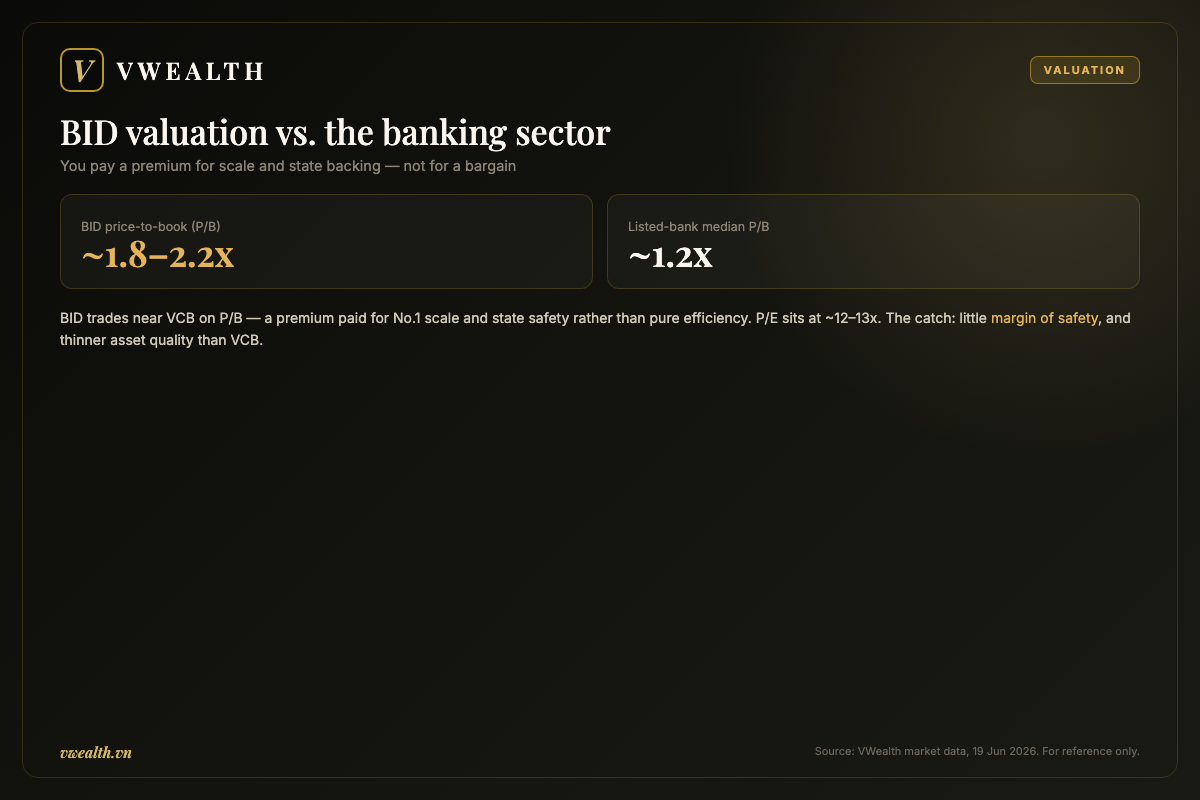
BID currently trades at a P/B of about 1.8–2.2 times depending on when book value is measured. This is an unusually high number versus the general level. Per market statistics, the median forward P/B of listed banks is only around 1.2 times, while the whole-industry P/B once retreated to around 1.6 times after correcting from a 2.0 peak. In that picture, BID is almost always in the valuation-leading group — close to Vietcombank (VCB), still considered the valuation “king” of Vietnamese banking.
Why is the market willing to pay such a high P/B for BID? There are three reasons to grasp.
- The No.1 state-owned position by scale. BIDV is the joint-stock commercial bank with the largest total assets in Vietnam, over 2.7 quadrillion dong. When you buy BID, you buy a piece of the system’s largest financial institution — this scale creates cheap-funding advantages, a wide branch network, and deep credit relationships with the state-enterprise sector and large infrastructure projects.
- The “State behind it” safety factor. The State controls BIDV absolutely. For investors, especially institutions and foreign funds, this is a layer of implicit insurance: a state-owned bank this size has almost no bankruptcy risk, and in systemic-stress scenarios, this group is prioritized for support. That safety premium is “priced in.”
- Foreign preference and pillar liquidity. BID is a VN30 pillar stock, huge market cap, high liquidity, and a nearly mandatory name in the baskets of ETFs and active funds wanting “a Vietnamese bank” in their portfolio. This structural demand creates a fairly firm valuation floor.
The debatable point is this: BIDV’s ROE in 2024 was about 19.5% — actually higher than VCB’s (around 16–17%). But asset quality is weaker: BID’s NPL ratio is around 1.4%, while VCB stays below 1%, among the industry’s lowest. You are paying a P/B nearly equal to VCB’s for a bank with higher return on capital but somewhat less “clean.” Whether this premium is deserved is a question each investor must weigh.
In other words, the market is placing BID in the banking industry’s “premium valuation club” based more on position and safety than pure operating efficiency. When you buy BID at a ~2x P/B, you are not buying a quantitative bargain — you are buying a belief in the durability of a leading state institution.
Price action: a pillar stock moving with the banking-industry “climate”
If you track BID’s chart, you’ll notice this stock rarely “walks alone.” As one of the largest-cap stocks on HOSE, BID moves almost in phase with the general sentiment of the banking industry and the VN30 index. When money believes in the banking group — for instance amid high credit-growth expectations, improving NIM, or when the market-upgrade story heats up — BID is one of the direct beneficiaries thanks to its large cap and appeal to foreigners. Conversely, when the market worries about property bad debt, about system asset quality, or when provisioning pressure rises, BID also faces correction pressure.
Three groups of factors drive BID’s price action to watch:
- Banking-industry sentiment and the credit cycle. The whole-industry P/B once exceeded 19% above its 5-year average after a hot run, then corrected to a familiar zone. BID, as a pillar stock, amplifies both directions of this cycle.
- Bad-debt risk, especially property-related. As the largest-scale lender, BIDV has enormous outstanding loans related to property and infrastructure enterprises and projects. Every piece of news about the property market’s health can affect BID’s bad-debt and provisioning expectations.
- The capital-raising story. This is BID’s specific catalyst in recent years — and a factor important enough to warrant its own section to analyze.
The capital-raising problem: dilutive but necessary
BIDV is in the middle of a large-scale charter-capital raising programme, and this directly affects the valuation of the stock you hold. The bank has approved a plan to raise charter capital from around 72,800 billion dong gradually toward a target of about 100,000–105,000 billion dong, placing BIDV among those with the largest charter capital in the system. This roadmap is carried out via three main components:
- Raising capital from the charter-capital supplementary reserve — the State Bank has approved BIDV raising nearly 5,000 billion dong from this source, expected in 2026.
- Issuing shares to pay dividends from accumulated profit — the largest component, up to nearly 1.4 billion shares (about 19.9% of existing shares) from undistributed 2023 profit.
- Private placement to domestic and foreign investors — BIDV placed over 264 million shares privately at 38,900 dong per share (33 investors participating), and plans to place about 138 million more new shares (~2% of existing) around 44,800 dong per share in mid-2026.
So is capital raising good or bad for your stock? The honest answer is: both, and you need to understand the mechanism.
On the negative side, issuing more shares — whether bonus, stock dividend or private placement — is dilutive. When total shares rise nearly 19.9% from the dividend component alone, EPS and every “per share” metric is divided down accordingly. If profit doesn’t grow fast enough to match the issuance, the value of each share you hold is theoretically eroded. The private placement to partners at around 38,900–44,800 dong — near or below the market price — also creates a valuation “anchor” the market will reference.
But on the positive side — and this is why capital raising is mandatory rather than optional — charter capital is the foundation determining a bank’s growth capacity. The CAR of Vietnam’s state-owned banks has long been much thinner than the private group, due to years of paying cash dividends back to the budget. To grow credit steadily in double digits each year, BIDV must add own capital. Raising capital thus unlocks future lending room, strengthens the risk buffer, and is a condition to keep the leading position. A bank raising capital to grow is entirely different from a business issuing shares to cover losses. For BID, this is a controlled-growth story.
Dividends: from a cash “drought” to dense stock payouts
BIDV’s dividend policy reflects the capital problem above. For many years, to retain profit for capital raising, BIDV prioritized stock dividends over cash. Recently the bank returned to paying part of the dividend in cash — a 4.5% ratio (450 dong per share) for 2024, paid in late 2025 — but this is a modest number.
At 41,800 dong, a 450-dong cash dividend equals a yield of only around 1.1% — far below bank savings rates. What does this say? That if you buy BID to “live off cash dividends,” you’ve chosen the wrong stock. BID’s real reward comes from stock dividends (increasing your share count) and the expectation of capital appreciation as book value grows. This is a stock of asset growth and long-term accumulation, not a stock of a steady dividend stream.
Foreigners, room and the upgrade story
One pillar supporting BID’s valuation is its appeal to foreign investors. The largest strategic shareholder is KEB Hana Bank (South Korea), holding about 14.2% of BIDV’s capital — a long-term investment from a large Asian financial institution, bringing both capital and governance and technology capability. After the capital raises, foreign investors’ ownership at BIDV is expected to tick up toward 17.55%.
This number matters because it relates to two stories:
- Foreign room still has space. Unlike many private banks that hit their foreign-room ceilings long ago, room at state-owned banks like BID still has space because of the large State stake. This lets BID take more foreign capital via private placements, and is also a release valve for ETF flows when needed.
- The market-upgrade story. This is the biggest catalyst for large-cap names like BID. When Vietnam’s stock market is upgraded from frontier to emerging under international indices, passive capital from global ETFs will flow strongly into the largest-cap, most-liquid pillar stocks — and BID is almost certainly among the first beneficiaries. Betting on BID is, to some degree, betting on this upgrade scenario.
Note the nuance: in some recent periods, foreign holdings in the state-owned “Big 3” tended to decline as funds took profit after a price run, and when this group’s valuation was no longer cheap. That shows foreign flows into BID are not always one-directional — they are sensitive to the valuation level and to the actual progress of the upgrade story.
So how does the market really “receive” BID?
Overall, how the market values BID can be summed in one proposition: you are paying a premium price for No.1 scale and the safety of a state institution, with future rewards depending on two big stories — capital raising and the upgrade.
This is not a stock for someone seeking a quantitative bargain. A P/B around 2 times and a P/E of 12–13 times already reflect the leading position fairly fully. It is also not a stock for cash-dividend hunters — the yield is only around 1%. BID suits an investor who believes the long-term story: the system’s largest bank, backed by the State, proactively strengthening its capital base for sustainable growth, and one of the first names to benefit when foreign capital flows into Vietnam on the upgrade wave. You accept paying a premium today in exchange for peace of mind about state-asset quality and a unique position on scale.
Is that premium “expensive”? It depends on what you believe. If you believe property bad debt is controlled, capital raising goes smoothly and the upgrade materializes, then 41,800 dong is reasonable for a long-term foundational stock. If you worry about dilution and about BID’s ROE being high but its asset quality not as “clean” as VCB’s, you’ll find this premium a bit stretched. To answer that thoroughly, you need to step out of BID alone and look at the bigger picture: the health of the whole banking industry, the credit cycle, and the macro environment every Vietnamese bank operates in — exactly the industry context we’ll dissect right after.
Economic and banking-sector context: where does BID stand in the big picture?
Before you decide to put money into any bank stock, there is a nearly unchanging principle veteran investors remind each other: a bank is a mirror reflecting the economy. When the economy grows, credit expands, businesses borrow more, bad debt shrinks and bank profit swells. When the economy stumbles, the bank is where risk first accumulates through unrepaid loans. For a colossal institution like BIDV (ticker BID) — the bank with the leading total assets in the whole system, about 3.25 quadrillion dong — this is even more true. BID is so large its balance sheet is almost a miniature copy of Vietnam’s whole economy. So to understand BID stock, you must understand the macro and industry context it operates in.
Industry-wide credit: the strongest money-pumping cycle in years
The most striking feature of the current context is that credit is flowing very strongly. The State Bank initially targeted system-wide credit growth of about 16% for 2025, but the reality far exceeded expectations: full-year 2025 credit grew over 19%, taking total economy-wide outstanding to about 18.58 quadrillion dong. This is among the strongest money-pumping paces in years, reflecting the easing stance to support GDP growth toward ambitious targets.
You need to understand the mechanism behind this number. For a bank, high credit growth means the earning-asset “pie” expands, lifting interest income. BID, with a leading credit share, is one of the most direct beneficiaries of this abundant credit cycle. BID’s 2025 pre-tax profit reached 37,788 billion dong, up about 17.8% year on year — a respectable growth rate for a bank already at colossal scale, and tightly tied to the broad credit wave.
However, into 2026, the picture adjusts. The State Bank guides system-wide credit growth for 2026 at about 15%, lower than 2025, with a clear message of “prioritize quality over speed.” The regulator also asks credit institutions to control disbursement pace in the first quarter (not exceeding 25% of the full-year target) and especially to tighten property credit — not letting this sector grow faster than the general pace. This has two sides for BID: on one hand, credit-scale growth room in 2026 will be narrower; on the other, tightening quality may help reduce newly arising bad-debt risk in the medium term.
Low rates and the increasingly hard NIM problem
The interest-rate context is the second key variable to grasp. Vietnam is maintaining relatively low rates to stimulate growth. For borrowers, this is good news. For banks, especially on the net interest margin (NIM — the spread between lending and deposit rates), it is a double-edged sword.
When lending rates are pushed down to support the economy while funding costs don’t fall correspondingly fast, the whole industry’s NIM tends to narrow. This is a common pressure nearly every bank faces in this period. But for BID, the thin-NIM story is more serious for a structural reason: BID’s non-term deposit ratio (CASA) is not as high as rivals like Vietcombank (CASA around 35–40%) or Techcombank (~45%). CASA is a bank’s cheapest funding — money people and businesses keep in payment accounts at almost no interest. A bank with high CASA has a low cost of funds, a thick NIM and durable profit. BID has thinner CASA, meaning it must raise more high-rate funds, putting its already-thin NIM under further pressure in a low-rate environment. This is why analysts often note BID’s profit is “constrained by NIM narrowing” — you need to remember this structural weakness.
A simple way to picture it: if Vietcombank and Techcombank buy their “capital raw material” at a cheap wholesale price, BID must buy a significant part at a more expensive price. When the output price (lending rate) is held down by the State for macro goals, the margin of the one buying expensive raw material thins faster.
Bad-debt risk: property and bonds are still the dark shadow
No honest bank analysis ignores bad-debt risk. This is the biggest, most persistent risk of Vietnam’s banking industry in this period, and it comes mainly from two sources: real estate and corporate bonds.
Vietnam’s property market went through a prolonged slump, with many stalled projects and clogged developer cash flows. When property firms struggle, their ability to repay banks declines, and related loans risk turning bad. In parallel, the corporate-bond market — which once boomed then hit a confidence crisis — also left after-effects. Many maturing bonds couldn’t be repaid, spreading risk to banks holding or guaranteeing them.
For BID specifically, the 2025 numbers show the picture isn’t entirely rosy. The NPL ratio is cited around 1.2% on a base measure — an absolute figure that sounds safe and lower than many private banks. However, some end-2025 statistics show BID’s bad debt ticking up (around 1.4–1.5%), and especially the “loss” category rising by nearly 6,000 billion dong in the year. This is a point to note carefully: because BID has the largest total loans in the system, even though the percentage is low, the absolute bad-debt value is still very large. A small change in the ratio can equal thousands of billions of dong to provision, eating directly into profit.
State-owned banks and “political tasks”: advantage or burden?
This is the feature that makes BID fundamentally different from a private bank, and you need to understand it well because it cuts both ways. BID is a state-controlled commercial bank (the State holds an overwhelming stake). This isn’t just about who owns it — it shapes how BID does business.
As a pillar of the national financial system, BID shoulders certain “political tasks”: participating in lending to priority sectors, supporting struggling businesses, financing mega infrastructure projects, accompanying the Government’s economic-management policy. The positive side is very clear: BID has relationships with most large groups, national projects, ODA flows and state-enterprise transactions. This is a competitive “moat” private banks find hard to copy. Depositors’ trust in a pillar state-owned bank is also nearly absolute — a crucial factor in an industry where trust is everything.
But the downside is no less real. When it must prioritize macro goals, BID is not always free to choose the most profitable customers or reject a risky loan for purely commercial reasons. Lending rates to some priority groups are capped. This, plus thin CASA, explains why BID’s return on each dong of assets usually lags nimble private banks. In other words, BID trades part of its efficiency for safety and position. You need to ask yourself: which do you value more?
The upgrade story and foreign flows: a favourable wind
A big catalyst is approaching that anyone interested in BID cannot ignore: the upgrade of Vietnam’s stock market. FTSE Russell has confirmed the roadmap to upgrade Vietnam’s market from “frontier” to “secondary emerging,” officially from September 2026, with passive-capital disbursement occurring in stages through 2027.
Why does this matter to BID? When the market is upgraded, international funds (especially ETF index funds tracking the emerging basket) must buy the Vietnamese stocks in the index. And the stocks bought first, with the most money, are always the largest-cap, most-liquid group. BID — as one of the largest-cap stocks on HOSE, alongside VCB, VIC, VHM, HPG — is almost certainly among the direct beneficiaries of this foreign flow. Estimates of the capital scale into Vietnam after the upgrade vary quite widely, from about 1.67 billion USD (initial stage, per SSI Research) to 3.4 billion USD (HSBC) and even about 6 billion USD (FTSE Russell). Whatever the actual figure, the general principle is: foreign money flows to the large-caps, and BID is exactly in that position.
Accompanying the upgrade story is the effort to loosen foreign room — raising the foreign-ownership ceiling. Currently the foreign room at state-owned banks like BID is fairly tight, one of the bottlenecks making it hard for foreigners to buy more. If room-loosening policy progresses, BID will become even more attractive to international money. This is one of the expectations supporting BID’s valuation now.
Trend forecast: BID’s strategy and the three scenarios ahead
In this section, we look ahead. Let me say frankly upfront: forecasting a trend is not prophecy. No one knows for sure where BID’s price will go in 6 months or 2 years. But a serious analyst can do something far more useful than guessing: sketch scenarios based on specific conditions, so you know what to watch and what each situation means for your wallet.
BID’s core strategy: four spearheads
Before discussing scenarios, understand what BID is proactively doing to shape its future. Management is pursuing four clear strategic directions:
- Raising capital to open growth room. This is the vital priority. BID has a relatively thin CAR, around 10% at the end of 2025 — lower than Vietcombank (~11.7%). A thin CAR is like a shirt already too tight: to lend more (grow assets) you need more buffer capital. BID is pushing capital raising through several channels: stock dividends (a ratio around 21%), and especially private placements to investors (selling about 2.9% of capital, expected to raise thousands of billions). Successful capital raising will unlock credit-growth room for the coming years.
- Pushing retail to improve CASA and NIM. As analyzed, BID’s core weakness is a thin NIM due to low CASA. The solution is shifting the mix toward retail — serving individuals and small businesses — which brings a higher margin and a more abundant non-term deposit base. This is a long war but the right direction.
- Digitalization. Like every large bank, BID invests heavily in digital banking to cut operating costs, attract young customers and raise CASA via digital payment accounts.
- Bad-debt handling. Controlling asset quality, pushing debt recovery and provisioning fully to keep the balance sheet healthy — a key factor amid the many unknowns in property and bonds.
An important support for these strategies is strategic partner KEB Hana Bank (South Korea), currently owning 15% of BID. KEB Hana brings not only capital but also help in improving governance, technology and international connectivity — a governance-quality plus you should include in your assessment.
Three scenarios for BID stock
Based on the variables analyzed, I sketch three scenarios. Read the “conditions” of each carefully, because those are what you need to watch in reality.
| Scenario | Trigger conditions | Consequence for the price |
|---|---|---|
| Positive | Capital raising (private placement + stock dividend) completes on schedule; property/bond bad debt controlled, ratio held around or below 1.2–1.4%; the September 2026 upgrade goes smoothly, foreign capital flows into large-caps; foreign room loosened. | BID re-rates, P/B to the high end of 1.8–2.2x or slightly above, on growth and foreign-flow expectations. The price has significant room to rise from the 41,800đ zone. |
| Base | Capital raising progresses but slowly; 2026 credit grows around the industry ~15% target; NIM stable, bad debt flat; the upgrade brings foreign capital in staged phases but dilutes gradually. | The price moves in a band, tracking single- to mid-double-digit profit growth. P/B holds around 1.8–2.0x. No strong breakout but no collapse either. |
| Negative | Property and bond bad debt rises sharply, forcing large provisions that eat into profit; capital raising is delayed so a thin CAR “bottlenecks” credit growth; NIM keeps narrowing in a low-rate environment. | Profit growth slows or reverses, ROE falls. The already-high P/B is corrected down. The price faces downward pressure. |
What’s interesting looking at these three scenarios side by side: most key factors revolve around three axes — capital raising, bad debt, and the upgrade. If you track BID, put these three “warning lights” on your dashboard. Completed capital raising is a growth-unlocking signal. Rising bad debt is a yellow warning light. The September 2026 upgrade milestone and foreign-fund disbursement stages are valuation catalysts.
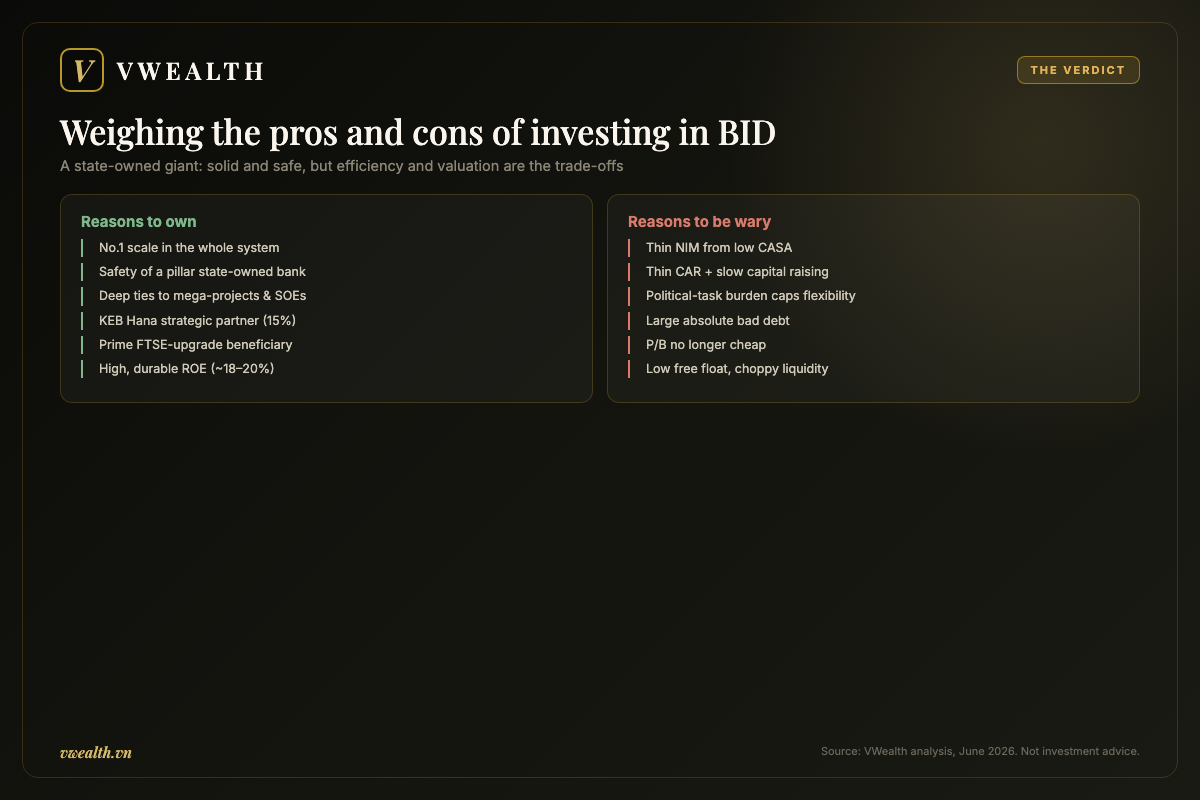
To weigh it systematically, the framework below summarizes the upward pulls (price support) and downward pulls (pressure) on BID stock — also the thinking frame leading into the conclusion.
Should you buy BID stock?
This is the question you really want answered, and I’ll answer it honestly: no one — including the author of this article — should tell you flatly to “buy” or “sell” BID. Because the right answer depends on who you are, what you need and how much risk you can bear. A serious analyst’s job is to weigh everything favourable and unfavourable, then help you see yourself in it. Let’s do this fairly.
The benefit side: why BID is attractive
- No.1 scale in the system. BID leads on total assets (~3.25 quadrillion dong) and is among the leaders on credit. Scale creates cost, network and bargaining advantages few rivals can match.
- The safety of a pillar state-owned bank. BID is one of the “backbones” of the national financial system. Depositors’ trust is nearly absolute, bankruptcy risk in reality is extremely low. For a capital-preservation-minded investor, this is a big plus.
- Relationships with large enterprises and mega-projects. BID has credit relationships with most large groups, national infrastructure projects and ODA flows — a hard-to-copy competitive moat.
- Strategic partner KEB Hana Bank. The Korean strategic shareholder holding 15% helps upgrade governance, technology and international connectivity.
- Upgrade and foreign-flow beneficiary. As one of the top-two largest-cap stocks on the exchange, BID is exactly positioned to catch passive foreign flows from the FTSE upgrade roadmap from September 2026 on, plus foreign-room-loosening expectations.
- Fairly high, durable ROE. BID’s ROE stays around 18–20%, among the highest of state-owned banks, showing return on equity remains good despite thin NIM.
The risk side: why you must be wary
- Thin NIM due to low CASA. This is the biggest structural weakness. BID’s CASA is lower than VCB and top private banks, making the cost of funds higher, the margin thinner, and the return per dong of assets weaker. In a low-rate environment, this pressure is more exposed.
- Thin CAR and slow capital raising. A CAR around 10% is relatively thin. If capital raising is delayed, BID will be “bottlenecked” — no room to grow credit. Slow capital raising is a risk management itself admits.
- The burden of political tasks. Having to prioritize macro goals and lend to priority sectors at capped rates reduces commercial flexibility and part of the efficiency.
- Large absolute bad debt. An NPL ratio of ~1.2–1.5% sounds safe, but because the loan book is the largest in the system, the absolute bad-debt value is very large. The “loss” category once rose by nearly 6,000 billion dong in 2025. Property and bond risk still hang overhead.
- P/B valuation no longer cheap. At a P/B around 1.8–2.2x and P/E ~12–13x, BID is not a “bargain” stock. Most of the good expectations (upgrade, capital raising) may already be partly priced in. Buying at a high valuation means a narrower margin of safety.
- Low free float. The State holds a large controlling stake, freely floating shares are few. This can make the price move sharply when large money enters or exits, and limits foreign investors’ ability to buy the weighting they want.
Which kind of investor are you? A four-group self-assessment
Instead of generic advice, let me place four mirrors before you. See which group you most resemble.
| Investor type | Does BID fit? | Reason |
|---|---|---|
| Seeking safety, prioritizing capital preservation, long-term | Fairly fitting | A pillar state-owned bank, No.1 scale, extremely low real bankruptcy risk, durable ROE. Suits those who see stocks as a long-term store rather than fast money. |
| Betting on the upgrade story | Fitting | BID is one of the most direct “tickets” to catch passive foreign flows into large-caps from September 2026 under the FTSE roadmap. |
| Seeking high profitability, thick NIM, explosive profit growth | Less fitting | Thin NIM, low CASA, and political-task burdens make efficiency lag VCB and nimble private banks. Those hunting a “profit machine” have better options. |
| Preferring fast growth, high risk, short-term trading | Less fitting | Valuation already high, low free float, scale-growth pace limited by thin CAR and political tasks. This is a “slow but sure” stock, not a breakout growth stock. |
To sum up, BID is the classic portrait of a “state-owned giant”: solid, safe, colossal scale, positioned to benefit from the upgrade — but trading it off with thinner profitability, growth room constrained, and a valuation no longer cheap. BID leans firmly toward those seeking safety, scale and a long-term view, plus those wanting to place part of their portfolio in the market-upgrade story. Conversely, if what you crave is excellent operating efficiency and high growth speed, BID is probably not the optimal choice.
Disclaimer: This article is produced for analysis and reference purposes, and is not a recommendation to buy, sell or hold any stock. The figures cited are from sources believed reliable at the time of writing, but may change and are not absolutely guaranteed for accuracy. The stock market always carries risk; stock prices may rise or fall. You should do your own thorough research, consider your personal financial situation, and consult a licensed investment advisor before making any decision. All investment decisions and resulting risks are your own responsibility.
Research Vietnamese stocks in English with vwealth. Our AI-powered platform turns Vietnamese market data into full English analysis reports — with international payment support and a free 2-month trial for new accounts. Create your free account and read the latest reports.
Read more sector analysis: Vietnam’s Banking Sector: A Foreign Investor’s Guide to the Market’s Backbone