History and evolution
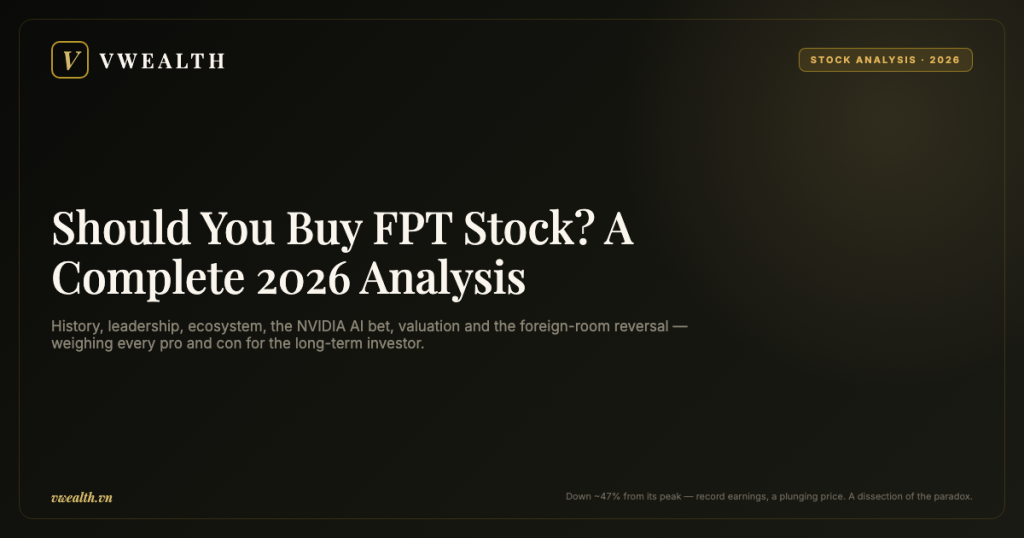
When you pull up the board today and look at the ticker FPT, the first thing that jumps out is probably a number that gives many investors pause: the stock of Vietnam’s “technology king” has fallen roughly 47% from the all-time high of 134,500 dong set in early 2025, sliding back to around 71,500 dong (price on 19 June 2026, per VWealth market data). A drop of nearly half — enough to wear down the faith of even the most loyal shareholders. Foreign investors dumped the stock on a net basis to the cumulative tune of more than 13,000 billion dong, pushing FPT to the top of the “sell-off” list session after session (per Vietnam Economic & Financial Magazine and Mekong ASEAN). And the question you — like so many other investors — are wrestling with right now boils down to six words: “Should I buy FPT at this point?”
This is not an easy question, because FPT’s paradox is exactly this: the business is healthy while the stock is sick. In 2025 the group posted record earnings, with net profit attributable to the parent company’s shareholders up 19% and EPS up as much as 21%. The fall in the price, then, is not the story of a decaying business, but the story of a valuation that had once run too hot being pulled back down to earth — the P/E, above 30 times at the 2024–2025 peak, has come down to around 14–18 times, close to fair value against the multi-year average of roughly 20–22 times (per VNSC and 24hMoney). On top of that, the foreign selling pressure — which once suffocated the stock because it was “out of room” — has now flipped into a record-high open room. The picture has reversed: what used to be a weakness (an expensive valuation, jammed foreign room) is gradually becoming a support.
But to answer “should I buy,” you cannot just stare at a dry P/E number. You need to understand what it is you are buying. And FPT is one of the very few Vietnamese businesses where answering that question requires travelling back almost four decades — all the way to a threadbare room in Hanoi in 1988, where thirteen people without a cent of capital laid the foundation for what would later become a billion-dollar technology empire. This article is a dissection down to the roots. Let’s start where it all began, because the genetic code formed in those earliest days is precisely what determines whether FPT deserves your money today.
FPT market data (updated 19 June 2026)
| Current price | 71,500đ | 2025 EPS | 5,211đ |
| Change (June) | −1.92% | P/E (on 2025 EPS) | ~13.7x |
| vs. peak (134,500đ) | −47% | 2025 cash dividend | 20% (~2.8%) |
Source: VWealth real-time market price data + FPT’s 2025 financial statements. Figures move session to session — for reference only.
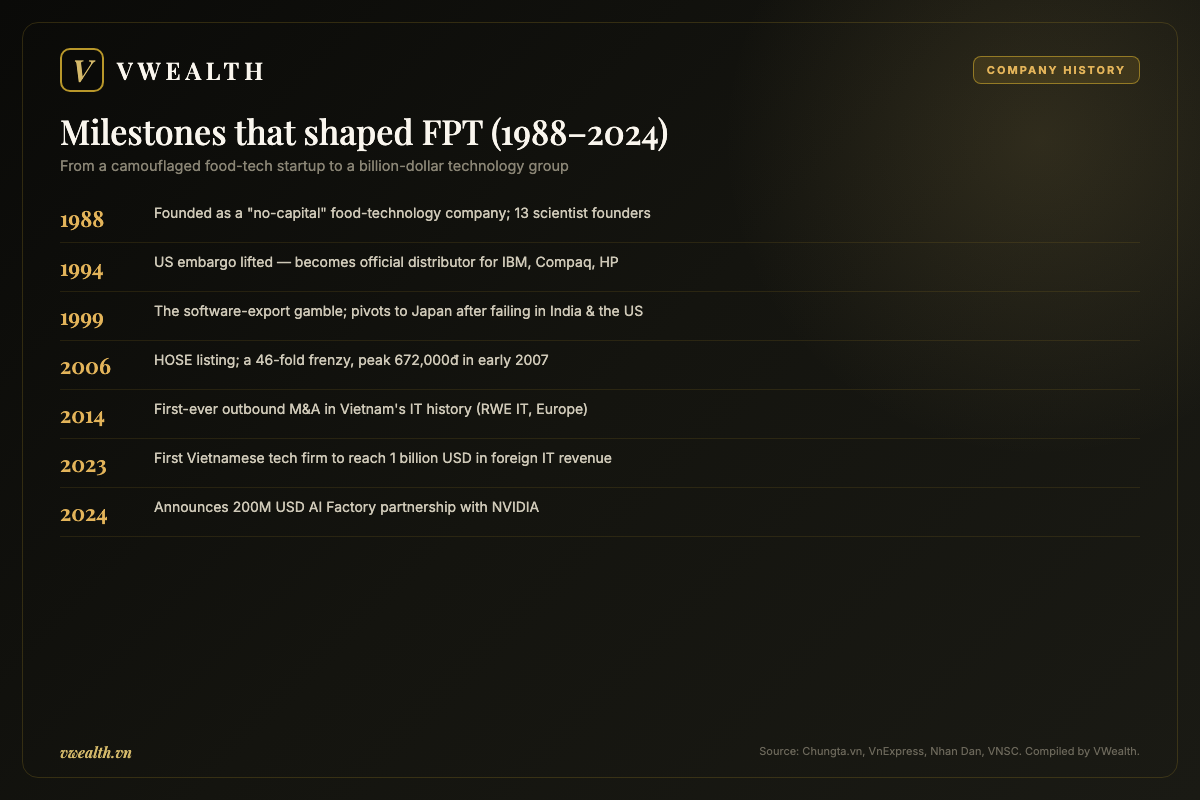
1988: Thirteen scientists and a company with “no capital”
To picture the setting correctly, put yourself in the Vietnam of 1988. The country had just come through the Sixth Party Congress (1986) — the milestone that launched the Doi Moi reforms — but the old subsidy mechanism still weighed on every meal and every ration coupon. Runaway inflation touched triple digits at times. The idea of a “private enterprise” was still foreign and politically risky. In that stifling landscape, on 13 September 1988, Professor Vu Dinh Cu — director of the National Institute for Technology Research — signed the decision to establish The Food Processing Technology Company, an arm of the institute. Truong Gia Binh became its director (per Chungta.vn and VietnamNet).
That name is an anecdote worth remembering, because it reveals a great deal about FPT’s nature from the embryo stage. Because the company sat under the National Institute for Technology Research, its name was required to contain the word “technology.” When Professor Cu asked what he intended to do, Truong Gia Binh answered that he wanted to work in drying technology, information technology and automation technology. The professor smiled: only the field of food processing could wrap all three of those technologies into one. And so the name “Food Processing Technology” was born — a perfect camouflage for a genuine technological ambition (per VietnamNet). FPT, short for Food Processing Technology, was later “reborn” as The Corporation for Financing and Promoting Technology — but the three letters have stayed intact to this day.
Who were they, those thirteen people? The founders were: Truong Gia Binh, Le Vu Ky, Le Quang Tien, Nguyen Trung Ha, Nguyen Chi Cong, Tran Duc Nhuan, Le The Hung, Pham Hung, Bui Quang Ngoc, Nguyen Thanh Nam, Vo Mai, Dao Vinh and Do Cao Bao (per Chungta.vn). Most were young scientists returning from training in the Soviet Union and Eastern Europe — minds rigorously schooled in mathematics, physics and cybernetics, yet adrift in an economy that did not yet know what to do with them. Truong Gia Binh was a doctor of mathematics and physics from Lomonosov University; Bui Quang Ngoc, Do Cao Bao, Nguyen Thanh Nam and the rest each brought a fragment of knowledge. They founded the company with no capital, no assets, no cash — only thirteen heads full of ambition and faith in their own hands and minds (per Chungta.vn).
FPT aspires to become an organization of a new kind, prosperous through creative labour in science and technology, contributing to national prosperity and giving each member the fullest material conditions and the richest spiritual life. — The founding manifesto of FPT’s founders (Chungta.vn)
Why does the “no capital” detail matter to you — an investor in 2026? Because it shaped what people call the “FPT culture” — an intangible asset that no balance sheet can record. A company born from nothing, surviving the subsidy era by doing every kind of work, carries within it a survival instinct and an ability to pivot that “born-rich” companies rarely possess. That gene of “creative labour” and “a new kind of organization” is precisely why FPT, after 38 years, keeps reinventing itself — from selling computers, to software, to telecoms, and then to AI and semiconductors. When you buy FPT, you are not buying a factory or a resource mine; you are buying an organization that knows how to learn and how to shape-shift.
The 1990s: Selling computers to build “muscle”
Technological ambition is one thing, but putting food on the table is another. Throughout the 1990s, FPT actually lived off distribution and system integration — a phase many people downplay today, but which I regard as its single most important foundation. From the early 1990s, FPT was already supplying computers and quickly rose to become one of the largest suppliers in the Vietnamese market (per VnExpress, “Playing with the giants”).
The biggest obstacle back then was the US embargo. Before 1994 every computer transaction was small and had to route through a third party. The turning point came in 1994 when the US lifted the embargo: FPT immediately approached and persuaded the hardware heavyweights — IBM, Compaq, HP — to name it their official distributor in Vietnam (per VnExpress). This was a move that generated cash flow and, more importantly, generated muscle: a distribution network, a team of engineers who could install and run large systems, and a relationship with the very top global technology corporations.
What does this mean for you? Many people think FPT “suddenly” became good at software. It did not. Ten years of grinding in the computer trade and system integration taught FPT three lessons vital to survival: (1) how to work with foreign customers and partners; (2) how to manage large-scale, many-variable projects; and (3) how to accumulate the capital needed to “gamble” on a bigger dream. Without this “muscle-building” phase, there would never have been the 1999 gamble I’m about to tell you about.
The 1999 turning point: The software-export gamble — reckless and brilliant
If I had to pick a single moment that defines the entire FPT story you are about to put money into, I would not choose the listing day, nor any billion-dollar deal. I would choose 1999.
The context: in 1998, at the ten-year anniversary review, Chairman Truong Gia Binh looked with dismay at a software arm of just 30 people. He made a statement that later became legend: “I want a thousand software engineers standing before me, together exporting Vietnamese intelligence to the world” (per VnEconomy). Set against a country that had only just escaped the embargo, with GDP per capita of a few hundred dollars and a rudimentary telecoms infrastructure, that declaration sounded delusional. India — the software-outsourcing superpower — was already a decade ahead. And yet a computer trader in Hanoi was proposing to export brainpower into global competition.
On 13 January 1999, FPT Software was born (its forerunner was the Software Export Centre, later FSU1, inaugurated in June 1999 with exactly 13 staff — a fateful number repeating itself). The first move: choosing Bangalore, India as a springboard, with the naive belief that “if you just stand in the marketplace, buyers will come.” Reality was brutal: after a year without signing a single contract, the Bangalore branch closed in 2000. An office opened in Silicon Valley met the same fate — “no one wanted to give us work.” Binh bitterly admitted FPT spent five years just to convince other businesses to believe in the software-export path (per Nhan Dan newspaper, the “From standing in the labour market…” series).
This is where I want you to pause and feel it. Two consecutive failures in the two biggest markets. An ordinary company would have retreated, gone back to the safe profits of selling computers. FPT did not. They pivoted to Japan — and this was the truly brilliant move. Why Japan?
- Closer cultural and geographic distance: the Japanese value trust and long-term relationships — a fit for the “dig deep, work hard” capacity of Vietnamese engineers, quite unlike the “lowest-bid” culture India had come to dominate.
- The language barrier turned into a competitive advantage: when the Japanese partner asked FPT to wait while they learned English, Truong Gia Binh answered with a decision that changed the game: “We will learn Japanese and come back to discuss the partnership in Japanese” (per Nhan Dan). The very Japanese-language barrier that made Indian rivals hesitate became FPT’s protective moat.
- The push from relationships: thanks to a Sumitomo executive who arranged meetings with leading Japanese corporations (after Nguyen Thanh Nam and Truong Gia Binh’s trip in late 2000), FPT won its first contract with NTT-IT in 2001.
Look at this decision through an investor’s eyes. FPT did the opposite of conventional logic: instead of avoiding the hard point (the Japanese language), they charged straight at it and turned it into an exclusive advantage. That is the “turn the barrier into a moat” mindset — a way of thinking you will see repeat in every strategic decision FPT makes. And history proved the result: by 2023, FPT’s IT-services revenue from foreign markets reached 1 billion USD (per Nhan Dan and Dan Tri) — turning the “thousand engineers” dream into an army of tens of thousands spread across the globe. The 1999 gamble did not merely succeed; it redefined an entire nation’s standing on the world map of software outsourcing.
The 2006 listing: A 46-fold frenzy and a valuation lesson still valid today
On 13 December 2006, FPT officially listed on HOSE — and instantly created a mania Vietnam’s young stock market had never witnessed. At the close of the first session, the price settled at 400,000 dong per share, putting market capitalization at roughly 1.5 billion USD (per VNSC). In just half a month the price rose 46 times above par value, and on 27 February 2007 it hit a record peak of 672,000 dong per share (per VietnamFinance and VNSC). Truong Gia Binh, with his shareholding, became the richest person on Vietnam’s stock market at the time.
But here is the part that you — an investor weighing FPT around 71,500 dong in 2026 — must engrave in your memory. The 2006–2007 frenzy also had its “dark day of the 13th.” When the balloon of expectations burst, the stock plunged, and inside FPT the measure of wealth suddenly became “sold in time or didn’t sell in time” (per StockBiz). Many who held the stock at the 672,000-dong peak, believing “technology only goes up,” paid for it with years.
| Milestone | Price / Event | Valuation lesson |
|---|---|---|
| 13 Dec 2006 | HOSE debut, close 400,000đ, cap ~1.5 billion USD | Scarcity + expectation = irrational valuation |
| 27 Feb 2007 | Peak 672,000đ (46x par value) | Price runs too far from intrinsic value |
| 2008–2011 | Plunge, “sold in time / didn’t” | Buying the peak = paying for years |
| Jan 2025 | All-time high 134,500đ (P/E >30) | History repeats: AI hype pushes price beyond fundamentals |
| Jun 2026 | Down ~47% to 71,500đ, P/E ~14–18x | Valuation back to a reasonable zone |
Do you see the frightening symmetry? The 2007 frenzy at a sky-high P/E and the 2024 AI frenzy that pushed the P/E past 30 times are the same story, only in a different setting. The unchanging lesson: FPT is a wonderful business, but at what price it is wonderful is the question that decides your profit or loss. Those who bought FPT at the 2007 peak and those who bought at the 2024 peak were both right about the business but wrong about the valuation. That is exactly why the current 47% drop — dragging the P/E back to around 14 times — deserves serious analysis rather than a panicked sell-off. History gives you no guaranteed answer, but it gives you a mirror to look into.
Cross-border M&A: How FPT “buys” growth and knowledge
There are two ways for a big technology company to grow: build it (organic) and buy it (M&A). FPT chose both, but it is the cross-border M&A strategy that turned FPT from a software outsourcer into a world-class digital-transformation consultancy. Let’s run through the key deals and — more importantly — what they mean.
- 2014 — RWE IT Slovakia (Europe): FPT bought 100% of the IT unit of German energy group RWE. This was the first outbound M&A deal in the history of Vietnam’s IT industry, bringing contracts worth tens of millions of dollars with RWE (per Cafef). The meaning: FPT bought not just a company, but a customer base and energy-sector expertise — things that would take decades to build from scratch.
- 2018 — Intellinet (US): FPT bought 90% of consulting firm Intellinet, estimated at over 50 million USD (per Cafef). This was a qualitative shift: from “hired to write code” to “sitting at the strategy-consulting table” for American clients — climbing a higher rung on the service value ladder.
- 2023 — A wave of US deals: a strategic investment in Landing AI (the company of Andrew Ng, a world AI legend), and the acquisition of the IT-services arms of Intertec, Cardinal Peak (product engineering) and AOSIS. Nearly half of FPT’s foreign M&A deals are US companies (per Cafef). The meaning: FPT actively “loaded up” on AI and high-end product-engineering capabilities right as the AI wave broke.
- 2024 — NAC (Japan): bought 100% of Next Advanced Communications NAC — reinforcing its position in Japan, the “second home” FPT had sweated to build since 2001.
- 2025 — David Lamm Consulting (Germany): completed the acquisition of an IT consultancy in the energy sector, thickening its energy & utilities expertise (per FPT Software).
Read the list carefully and you’ll see a consistent logic I call “buying to shorten time.” FPT does not do M&A to pad revenue for a pretty report. Each deal targets one of two things: either industry knowledge (energy with RWE and David Lamm; AI with Landing AI; product engineering with Cardinal Peak), or high-end customer relationships (Intellinet opening the consulting door in the US; NAC reinforcing Japan). For an investor, this is an extremely positive signal: FPT’s leadership understands that in the technology industry the most valuable thing is not factories but capability and customer trust — and they are willing to use cash to buy what cannot be produced quickly in-house.
But M&A is also a double-edged sword you must watch: the risk of cultural integration, the “winner’s curse” (overpaying), and pressure on goodwill on the balance sheet. FPT’s integration track record has been fairly good so far — largely thanks to the flexible “new kind of organization” gene from 1988 that I described at the start. But the more it buys and the bigger it grows, the harder this problem becomes. This will be one of the points you’ll need to watch closely in the financial-analysis sections that follow.
From a “no capital” company named after food in 1988, to an IBM distributor in the 1990s, to the 1999 Japan gamble, the 2006 listing frenzy and today’s global M&A empire — FPT is proof that a business can reinvent itself any number of times if it has the right people at the wheel. And that is exactly what we must dissect next. Because when you buy a top-tier quality technology stock, you are not just buying its glorious history — you are betting on the people who will write its next chapters. Let’s move on to the Leadership section, to see who holds the wheel, what they have proven, and whether they have the stature to steer the FPT ship through the current 47% drawdown.
Leadership

When you value a technology stock, you’re used to asking about profit margins, revenue growth rates, market size. But for a business whose largest asset lies not in factories or land but in the heads of tens of thousands of engineers, there is a variable much harder to quantify that decides nearly all the rest: the person sitting in the top seat, and the culture that person builds. At FPT, that variable is not a question mark. It is one of the most durable competitive advantages, and the deepest reason long-term investors sleep well. Read this section carefully, because it is exactly where most FPT analyses are written far too superficially.
Truong Gia Binh — why this man is exceptional
There are founders you remember for the numbers they created. And there are founders you remember because they redefined what an entire generation believed was possible. Truong Gia Binh belongs to the second group, and to understand why a serious analysis should devote so many words to him, you need to step back and look at this man’s whole journey — because few chairmen in Vietnam carry that many layers of meaning at once.
He was born on 19 May 1956, with roots in Dien Ban, Quang Nam — a studious and hardy land of central Vietnam. That is the first detail worth remembering, because the “aspiration” quality he later turned into the operating philosophy of an entire group is partly rooted in that origin.
The second layer, the one that most piques public curiosity: according to many domestic press sources, Truong Gia Binh was once the son-in-law of General Vo Nguyen Giap, through his marriage to Ms. Vo Hanh Phuc — one of the legendary general’s children. I emphasize “according to many press sources” deliberately: this is a detail widely mentioned in the domestic press but belongs to private life, so receive it with appropriate caution. Why does this matter to an investor? Not because it creates “connections” in the pragmatic sense — FPT grew on real capability, on software-export contracts, not on favours. It matters because it gives you a piece of the picture about the stature and intellectual environment in which FPT’s founder came of age: a man placed at the intersection of intellect, science and great expectations about the nation’s destiny. The “national aspiration” he keeps invoking is not a marketing slogan cobbled together later; it is living material he carried from very early on.
The third layer, and the weightiest for a technology business: Truong Gia Binh is first and foremost a scientist, not a merchant. He won a scholarship to study in the Soviet Union, at the Faculty of Mathematics and Mechanics of Moscow State University named after Lomonosov — among the world’s most prestigious schools for mathematics and physics. He graduated in 1979, successfully defended his doctoral thesis in 1982, and was conferred the title of Associate Professor in 1991. Pause on this detail. The man who has led FPT for almost four decades is not a CEO trained to optimize financial reports, but a mind forged in the ruthless discipline of pure mathematics. That leaves its mark everywhere in the group’s DNA: a near-worship of intellect, a belief that any hard problem has a solution if you are smart and persistent enough, and a culture that treats learning as a way of life.
His journey from scientist to entrepreneur is bound to an anecdote that has become Vietnamese business legend: in 1988, in the midst of the Doi Moi transition, he and a group of young intellectuals — most also doctors of mathematics and physics from the same Eastern European “furnace” — started up almost empty-handed. From a food-technology company (the very name that gave birth to the FPT abbreviation), this group pivoted to computing and wrote one of the longest-running growth stories in Vietnam’s private sector. Hold that original number in your head — a near-empty-handed start — then set it against FPT’s billion-dollar scale today; that is the most honest measure of the man at the wheel’s creative capacity.
The architect of an entire industry, not just one company
One thing that distinguishes Truong Gia Binh from most other business owners: his influence extends beyond FPT’s four walls. He founded and chaired the Vietnam Software and IT Services Association (VINASA) for two full decades, from 2001 to 2021. Understand what that means: in the years when Vietnam’s software industry was still embryonic, the head of FPT was simultaneously the person lobbying policy, opening markets, and building the positioning of “Vietnam — a destination for outsourcing and technology services” on the world map. When a business is led by someone who rows his own boat while also shaping the flow of the whole river, the advantage compounds over time and is hard to copy. He also founded FPT University and later the online education organization FUNiX, turning the group’s own talent needs into a self-supplying talent machine — a virtuous cycle few domestic rivals possess.
Vision and philosophy: “globalization” and the AI bet
If I had to distil Truong Gia Binh’s operating philosophy down to a few keywords, they would be: globalization, aspiration, and most recently AI-First. These are not decorative words. Nearly thirty years ago, when most Vietnamese businesses were still fumbling with the domestic market, he declared globalization to be “not a choice but an inevitable path” for FPT. The reckless decision to send troops off to export software to Japan, the US and Europe — at a time when “Made in Vietnam” was virtually unknown in the industry — was the product of that vision. The global technology-services arm reaching billion-dollar revenue is the sweet fruit of a seed sown from a gutsy belief in the standing of Vietnamese intellect.
That philosophy is always wrapped in the language of national aspiration more than the language of profit. He speaks of “bringing Vietnamese intelligence to the world,” of Vietnamese people training technology talent “not only for Vietnam but for the whole world.” To a skeptical investor, these statements may at first sound like slogans. But the crux is: in FPT’s case, the words are continuously backed by action and by verifiable numbers across three decades. That is the difference between a hollow inspirational leader and a leader whose track record vouches for the vision.
His biggest bet in the current phase is artificial intelligence. Truong Gia Binh has bluntly declared that FPT will “bet its future on AI,” that “AI is an irreversible game,” and set the goal of transforming his entire engineering force into “AI engineers.” He also positions Vietnam as “an ideal destination for global AI and semiconductors,” and the strategy he chose is not to burn hundreds of billions of dollars like the giants, but to ally with the industry’s biggest names to close the gap. One of his most resonant statements: a country cannot defend itself without mastering technology, especially AI. For you — someone weighing holding this stock for years — the key takeaway is: the person at FPT’s wheel is not defending, he is attacking exactly the technology wave that will define the coming decade, and he does it with strategic clarity rather than momentary excitement.
“We will bet our entire future on AI.” — This spirit, repeated across Chairman Truong Gia Binh’s remarks, tells you FPT does not see AI as an experimental project, but as the strategic pivot of the whole group in the decade ahead.
“Betting personal wealth”: why his ownership stake is a signal
In corporate governance there is a concept called “skin in the game” — a shared fate in wealth. It answers the vital question of every small shareholder: is the operator in the same boat as me, or does he just collect salary and bonuses and leave when the waves get big? At FPT, the answer is reassuringly clear.
Truong Gia Binh is FPT’s largest individual shareholder. His ownership has ranged around 6.9% to just over 7% of charter capital across periods — a figure that seems small in percentage but is enormous in absolute value, equivalent to thousands of billions of dong of personal wealth locked to the fate of the business. (A note for you: this percentage shifts each period due to changes in shares outstanding and new issuances, so always check the latest governance report when making a decision.)
| Criterion | Meaning for a long-term investor |
|---|---|
| Largest individual shareholder | The founder’s interest is tightly bound to small shareholders’ — win together, lose together |
| Thousands of billions of personal wealth in the stock | Incentive to protect long-term value, restraining reckless, irresponsible bets |
| Committed for nearly 4 decades, no “cash out and exit” | Durable commitment instead of the surf-and-flip mindset of a hired operator |
Set this against the reality of FPT’s shareholder structure: the business has more than a hundred thousand shareholders, the vast majority of them individual investors holding small amounts. When the founder is the largest individual shareholder and still tirelessly at the wheel, you — one of those tens of thousands of small shareholders — know that the person in the highest seat will suffer the first and largest loss if the business veers off course. That is a form of incentive insurance no contract clause can buy.
Culture and governance: why the “new kind of organization” is FPT’s intangible asset
You cannot understand FPT by looking only at the balance sheet, because most of its value is intangible and lives in the culture. FPT is famous for the spirit of a “new kind of organization” — a corporate culture woven from the intellectual origins of its founders. This is a place where intellect is honoured almost like a religion, where internal entrepreneurship is encouraged to the point that many of the group’s billion-dollar businesses today were born as “sub-projects” proposed and steered by employees. FPT’s culture is also known for its humour, democracy and low power distance — a legacy from the days when young scientists debated as equals regardless of rank.
Why is this so important that I place it on par with the financial numbers? Because FPT operates in an industry where people are the production line. A factory can keep its machines through depreciation; a technology company can only keep its assets — its best engineers — through culture, growth opportunities and trust. In the brutal global battle for tech talent, where every rival can pay a higher salary, culture becomes the real defensive “moat.” A culture built over almost forty years, embedded in the organization’s identity, is something a rival cannot buy with money and cannot erect in a few quarters.
Generational handover: a rare governance plus for Vietnamese businesses
This is perhaps the part a discerning investor should value most, because it directly resolves the biggest fear of investing in a business tied to a legendary individual: founder-dependency risk. The question that haunts every shareholder is: “What if Truong Gia Binh is gone tomorrow?” FPT answered this question years ago, with a rigour rarely seen.
In 2019, FPT appointed Nguyen Van Khoa — born in 1977, of the 1970s generation — to the CEO seat. What’s notable is not just his youth, but that he is someone who grew up entirely from within. Nguyen Van Khoa joined FPT in 1997 as a student, rose through every kind of position, and left a particular mark leading FPT Telecom — where under his hand revenue grew several-fold. FPT did not “buy” a star CEO from outside; the group raised its successor through a deliberate succession-leadership training programme. That is the key difference: a CEO who grows up with the company’s culture will preserve that identity, rather than an outsider who might inadvertently erode it.
More important than anything is the governance model FPT designed: the founder steps back into the role of Chairman of the Board — where he continues to hold the vision, set strategic direction and serve as a spiritual symbol — while the younger operating generation runs the day-to-day machine. This is the “founder holds the vision, successors run the operation” structure that the world’s most durable large corporations pursue, but which is extremely rare in Vietnam’s private sector — where too many companies still run on a “one person does it all” basis.
The handover picture is even more complete when you look at the “founding fathers” — the group of intellectuals who co-founded FPT in 1988. Names like Bui Quang Ngoc (former CEO, now Vice Chairman), Do Cao Bao and Hoang Nam Tien have all stepped back one by one into board roles, advisory positions or strategic leadership, ceding the operating line to the next generation. This is not a retreat out of exhaustion, but a handover with a roadmap. The result is that FPT possesses two seemingly contradictory things at once: the depth of experience of the founding class and the spring of the young operating class.
For you — an investor weighing holding this stock for many years — this is the core reassurance: FPT is not a ship only one captain knows how to steer. It is an institution. And institutions outlive any individual.
Transparency and investor relations: reducing “information risk”
The last factor, less glamorous but extremely important for valuation, is the quality of transparent governance. FPT is one of the very few listed Vietnamese businesses that discloses business results monthly — not just quarterly as the minimum rule requires. When a business voluntarily shines a light on itself every month, it sends a message about confidence and a commitment to hide nothing. For investors, this directly reduces so-called “information risk” — the unease of not knowing what is really happening inside a business between two reporting periods.
Add to that a professional investor-relations (IR) team, high-quality annual reports, and a history of steady cash dividends over many years. A stable cash dividend is the harshest test of cash-flow health: you cannot pay cash dividends with paper profits. A business that grows fast and steadily pays cash dividends is proving that its growth is real growth, with real cash behind it.
When you gather it all — a founder of stature with personal wealth locked into the business, an intellect-honouring culture that is hard to copy, a rigorous generational handover that resolves individual-dependency risk, and a transparency standard above the minimum — you have the portrait of a leadership machine that is itself a layer of value protection for your investment. This is not the “software” of the FPT story. It is the hardware of trust. But even an excellent leadership only shines when it runs on a business platform broad enough and resonant enough. Let’s dissect that ecosystem in the next section.
Member companies and the ecosystem
When you hold a share of FPT, what you actually own is not “a technology company” in the ordinary sense, but a piece of a multi-tiered business conglomerate, where each member unit is both an independent business entity with its own scale and a link in a larger machine. To truly believe in FPT’s growth story, you need to understand what each of these units is, how big it is, how it makes money and why they form a hard-to-copy battle formation. This is the core of the investment thesis: FPT is strong not because of one product or one segment, but because of its ecosystem structure.
The three-block group model: a machine that both accelerates and keeps rhythm
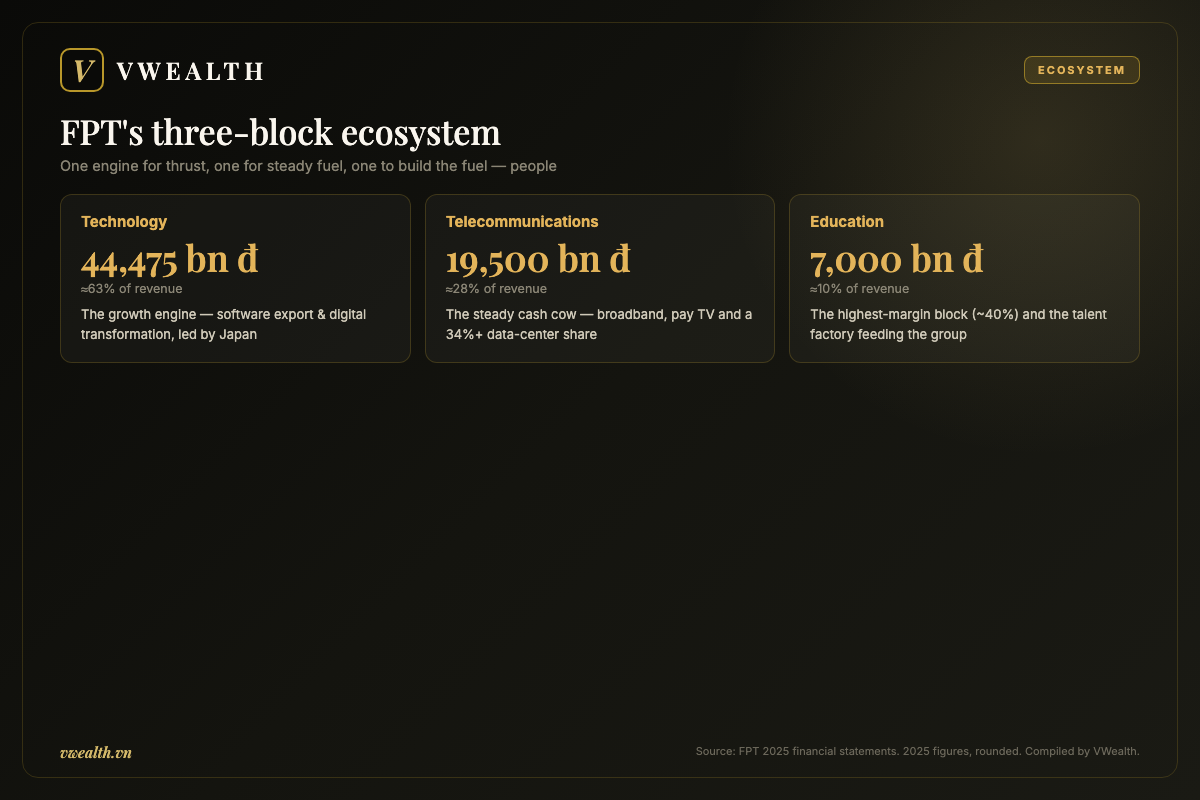
FPT operates on a clear three-block architecture: Technology, Telecommunications and Education. This is not a random collection of businesses, but a deliberate portfolio design, and that design explains why FPT can maintain double-digit growth for years on end while keeping the cash-flow stability many pure-technology companies lack.
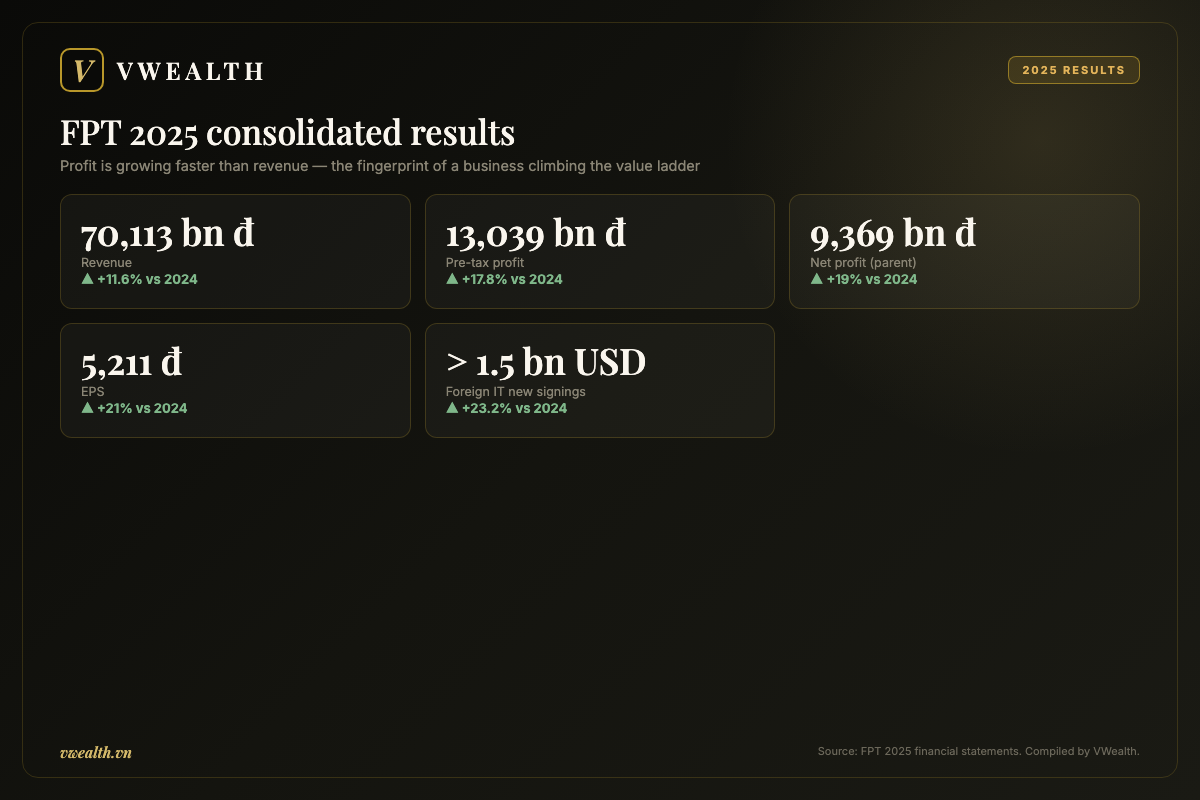
In 2025, the whole group recorded revenue of roughly 70,113 billion dong, up 11.6% year on year, pre-tax profit above 13,000 billion dong (up 17.8%), and net profit attributable to the parent’s shareholders of 9,369 billion dong, up 19% — the highest in its history. Note the important detail: profit grew faster than revenue. That is the sign of a business gradually raising the added value in each dong of revenue, not just selling more.
The Technology block contributed about 63% of group turnover, equivalent to 44,475 billion dong. This is the growth engine — where the speed and margin of software exports create the thrust. The Telecommunications block, with revenue of about 19,500 billion dong and a record pre-tax profit of over 4,360 billion dong (up about 21.6%), plays a very different role: it is a source of steady, low-volatility cash flow with a “subscription” nature — customers pay every month, year after year. The Education block, though smaller in scale at about 7,000 billion dong, plays the strategic role of a talent cradle that feeds the whole machine.
Picture it this way: the Technology block is the jet engine generating growth thrust, the Telecommunications block is the stable reserve fuel tank that keeps the machine from ever stalling mid-flight, and the Education block is the factory producing the main fuel — people — for both. These three blocks do not compete for each other’s resources but complement each other across the economic cycle.
This complementarity has real meaning for you when assessing risk. When the global economy slows and corporations cut IT budgets, software-outsourcing revenue may slow — but Vietnamese people still use the internet, still watch television, still send their children to school. Telecom and education cash flow become the cushion. Conversely, when the economy recovers, the technology block accelerates and pulls overall profit up quickly. That is why FPT has the growth metrics of a technology company but the durability of an infrastructure business.
FPT Software — the export locomotive and the group’s “economic moat”
If you could pick only one unit to understand why FPT is different, it must be FPT Software. This is the largest software exporter in Vietnam by both headcount and revenue, and the face that carries Vietnamese intellect to the global market.
FPT Software’s origin story is almost a legend in Vietnamese technology circles. In 1999, when FPT decided to make software export its strategic direction for “globalization,” Nguyen Thanh Nam led a team of just 13 people. At the time, the idea of a Vietnamese company doing software outsourcing for international corporations was seen as fanciful — Vietnam had no name on the world technology map, weak infrastructure, and almost no one believed a group of engineers in Hanoi could compete with India. The “we didn’t know anything but did it anyway” spirit of this start-up phase later became part of FPT’s identity.
Over two decades later, the scale is entirely different. FPT Software now has roughly 33,000 staff, a presence in about 30 countries and territories, serving more than 1,100 customers. What makes this figure truly credible is the quality of the customer base: it includes over 90 companies on the Fortune Global 500 list — the largest corporations on the planet. These are not small clients; they are organizations with among the most rigorous vendor-vetting processes, and their entrusting core systems to FPT is a self-evident endorsement.
What does FPT Software do for these clients? The work has moved far from the pure “outsourcing” of the early days. Today the portfolio includes: modernizing aging legacy technology systems (legacy modernization), consulting and implementing comprehensive digital transformation, developing automotive software, and — increasingly prominently — artificial-intelligence solutions. Each step up the value chain means better margins and stickier customer relationships.
Specific names bring the picture to life. In aviation, FPT Software was one of the first certified partners of Airbus on the Skywise data platform, handling the collection, standardization and integration of data from more than 30 airlines into that platform. In the auto industry — a field demanding extremely strict safety standards — FPT has built a team of more than 4,000 specialized engineers serving over 150 customers including global brands such as Honda, Hyundai, Volvo, Ford, Panasonic, LG, NXP and Vietnam’s own EV maker VinFast. When a carmaker entrusts control software to a partner, it stakes both its brand reputation and user safety — and they choose FPT.
On financial scale, FPT’s global IT-services revenue crossed the 1 billion USD mark in 2024 and continues to accelerate, with the value of new signed contracts repeatedly setting records — in 2025 alone FPT won 26 large contracts each worth over 10 million USD, taking total new foreign signings past 1.5 billion USD. The group has set the ambitious target of reaching 5 billion USD in global technology-services revenue by 2030.
Why is FPT Software the group’s “economic moat”? Because its advantage does not lie in a patent that can expire, but in three things that are very hard to copy: the scale of its rigorously trained engineering workforce at competitive cost, multi-year customer relationships with large corporations (whose cost of switching vendors is very high), and accumulated reputation across thousands of projects. A new rival wanting to compete cannot simply spend money — it must spend a decade building the team and the trust. That is the very essence of a durable economic moat.
FPT Telecom — the cash-flow “cash cow” and the launchpad for AI infrastructure
If FPT Software is the growth engine, then FPT Telecom is the heart pumping steady cash flow to the whole group. This is Vietnam’s leading provider of broadband internet, pay TV (PayTV) and, especially, data-center infrastructure.
In 2025, FPT Telecom recorded net revenue of about 19,500 billion dong, up around 10.8%, along with the highest pre-tax profit in its operating history — over 4,360 billion dong, up around 21.6%. Note the character of this revenue stream: it comes from millions of paying subscribers each month. This is the recurring revenue every investor craves — easy to forecast, little dependent on the economic cycle, and with margins that improve gradually as the infrastructure is fully depreciated while subscriber numbers keep rising. This is a “cash cow” in the true sense: it needs large upfront infrastructure investment, but then squeezes out steady cash flow year after year.
But FPT Telecom’s most exciting story right now lies in the data-center segment. The business holds over 34% of the data-center market share in Vietnam, operates standards-compliant Mega centres, and owns the first data centre in Vietnam to earn the prestigious Uptime Tier III certification — making Vietnam one of the few Southeast Asian countries with this certification. The group has also announced plans to invest “several billion USD” in data-center infrastructure in the coming years.
Why does this matter to you? Because the AI and cloud-computing wave is turning data centres from a “dull” infrastructure segment into an extremely valuable strategic asset. Every AI model, every cloud service needs to place its servers somewhere — and that “somewhere” increasingly needs to be domestic for reasons of data sovereignty and latency. FPT Telecom is both the landlord and the host of Vietnam’s AI boom. Today’s infrastructure investment is tomorrow’s right to collect tolls.
FPT IS — rooted in national digital transformation
FPT IS (FPT Information System) is the unit specializing in system integration and solution delivery, with more than 26 years of development — one of the oldest and largest system integrators in Vietnam. Unlike FPT Software, which faces the international market, FPT IS focuses on the domestic market, serving the backbone sectors of the economy: government, banking–finance–insurance, healthcare, transport, energy and large enterprises.
FPT IS’s position is special in that it is rooted directly in the national digital-transformation process — a trend strongly and continuously pushed by the Vietnamese government for many years. When the state digitizes administrative procedures, builds population databases, and modernizes tax and customs systems, FPT IS is often one of the few domestic contractors with enough technical capability and experience to deploy national-scale systems. In banking, the company develops solutions such as a digital-finance ecosystem that seamlessly connects banks, financial institutions and enterprises.
FPT IS’s strategic value to you is its durability and barriers to entry. Contracts with the public sector and banks typically span many years, require the partner to deeply understand internal processes, earn security trust, and pass rigorous vetting rounds. Once you have become a supplier to a ministry or a large bank, the cost for the customer to replace you is very high. This is the kind of “deep-rooted” advantage that only strengthens as time passes.
FPT Smart Cloud / FPT.AI — betting on AI infrastructure
FPT Smart Cloud is the unit consolidating two spearheads of the future: cloud computing and artificial intelligence, under the product brand FPT.AI. This is where FPT most clearly shows its ambition not just to “do technology for hire” for the world but to create its own branded “Made-by-FPT” AI products.
At the heart of this segment is FPT AI Factory — a full-stack AI infrastructure complex built in partnership with NVIDIA, running on NVIDIA H100 and H200 superchips. This is a very notable move: while most Vietnamese businesses only “resell” AI services from abroad, FPT invests directly in the most expensive compute-infrastructure layer — the layer the whole world is fighting over. FPT AI Factory is organized into three components: infrastructure, model-building tools and model operation, providing dozens of AI-cloud services to more than 18,000 engineers, scientists and enterprise users.
You should view this segment as an investment in the future: at present it is not yet a main profit source, but it places FPT right at the centre of the biggest technology wave of the decade. More importantly, it creates synergy — the AI Factory infrastructure sits on FPT Telecom’s data centres, is used by FPT Software to build solutions for international clients, and is deployed by FPT IS for domestic clients. One investment serving the whole ecosystem.
FPT Education — the engineer “furnace” and a rare closed loop
With revenue of about 7,000 billion dong in 2025, FPT Education is by scale the smallest of the three big blocks. But if you look only at the revenue figure, you’ll miss its true strategic role — and this is one of the most unique points of the entire FPT investment thesis.
FPT Education is both an independently profitable business (a system of universities, colleges, secondary schools and vocational training) and a talent-production factory for FPT’s own ecosystem. Connect the dots: FPT Software needs thousands of new engineers each year to sustain growth and expand into 30 countries. The supply of quality technology engineers is the bottleneck of the whole industry — every rival must fight for talent, pushing salary costs up. FPT solves this problem by training its own: the group’s schools provide a steady flow of talent, oriented to exactly the skill needs of the member units. Notably, this is also one of the group’s highest-margin segments thanks to the “build the school once, collect tuition for years” model.
This is a rare closed loop: FPT Education trains engineers → FPT Software and the technology units recruit them → growth generates profit → profit is reinvested to expand education and technology. Each turn of the wheel reinforces the next. Very few technology groups in the world control the source of their own talent this way.
For you, the investment meaning is this: while other technology companies worry about spiralling staff costs and the war for talent, FPT has a structural advantage that helps control the most important input of the software industry — people.
FPT Retail (FRT) and Long Chau — a separately listed jewel
FPT Retail is a slightly different story structurally, and you need to grasp this point to avoid financial misunderstanding. FRT is a separately listed company on the stock exchange, not a fully consolidated subsidiary of FPT. FPT Group only records its contribution through profit from an associate — meaning FRT’s huge revenue is not added directly to FPT’s consolidated revenue. When reading the reports, do not confuse the scale of these two entities.
Even so, this is still a valuable piece, chiefly thanks to the explosive phenomenon of the Long Chau pharmacy chain. By the end of 2024, Long Chau had expanded to 1,943 pharmacies, adding nearly 450 stores in a single year, and is heading for a target of 2,500–3,000 stores. In 2024, Long Chau alone reached revenue of about 25,320 billion dong, up 59% year on year and accounting for around 60% of FRT’s total revenue. Interestingly, why does Long Chau target only a few thousand stores when the market has 45,000–60,000 pharmacies? This is a strategy focused on the highest-performing locations and models rather than expanding recklessly — a disciplined view of capital. For you, FRT and Long Chau are a bonus in the FPT story: they show the group’s capability is not limited to pure technology but extends to building and operating large-scale business models in new industries.
FPT Online and the digital platforms — the supporting pieces
Alongside the big pillars, the ecosystem also has smaller units that thicken the formation. FPT Online runs digital content and advertising products — tied to the online newspaper VnExpress, one of the highest-traffic media channels in Vietnam. This is both an advertising-revenue source and a strategically valuable media asset.
More strategically notable is Base.vn — the business-management platform FPT acquired a controlling stake in in 2021. Base.vn provides more than 50 management applications built around three solution groups: work and project management, building transparent information systems, and comprehensive human-resource management. The logic of this deal is very clear: Vietnam has more than 800,000 small and medium enterprises (SMEs) needing digital transformation, and Base.vn gives FPT a “packaged,” easy-to-deploy product to reach this huge customer base. This is how FPT “reaches down” into the SME segment — a market the group previously found hard to serve effectively.
How this ecosystem forms an “economic moat” and durability
Now step back and see the whole picture. What truly sets FPT apart is not any single unit, but the way these units interlock to form a multi-layered moat protecting the fortress (economic moat) that rivals find very hard to cross.
- The talent layer: FPT Education secures the supply of engineers — controlling the software industry’s most important input, the thing rivals must fight for on the open market.
- The infrastructure layer: FPT Telecom owns the network and data centres — the physical foundation for every cloud and AI service, not something you can buy overnight.
- The capability and relationship layer: FPT Software has accumulated over two decades of reputation with more than 90 Fortune Global 500 corporations, while FPT IS is rooted in national digital infrastructure — both carry very high switching costs for customers.
- The future-technology layer: FPT Smart Cloud / FPT.AI together with the NVIDIA AI Factory place the group right on the AI wave, sharing the infrastructure and talent of the whole ecosystem.
Each layer is itself a competitive advantage. But the real strength lies in the synergy: Telecom’s data centres house Smart Cloud’s AI Factory, which Software uses to serve international clients and IS uses to serve domestic ones, all running on talent trained by Education, and profit from every segment is reinvested to reinforce the whole system. A rival wanting to compete comprehensively with FPT cannot be good at just one segment — it must recreate all four layers at once, which is nearly impossible in the Vietnamese market context. To fully understand FPT’s position, in the next section you’ll see this ecosystem is further amplified by market power and a partner network — from NVIDIA and Airbus to the world’s leading corporations — turning an internal advantage into a global one.
Market power and partners
When you ask the core question of any long-term investment decision — “What makes this business hard to replace over the next ten years?” — for FPT, the answer lies not in a pretty revenue number for one quarter, but in what investors call the economic moat. That is the set of durable competitive advantages a rival cannot copy with money or time alone. In this chapter, you and I will dissect FPT’s three moat layers: absolute scale leadership in Vietnam, a two-decade relationship fortress in Japan, and technology capability proven through the AI gamble with NVIDIA. Each layer is significant on its own; but what makes FPT a rare investment story on HOSE is the way these three layers lock into each other.
Leadership position: scale is not a number, but a barrier
Let’s start with a milestone you should remember, because it redefines FPT’s entire position on Vietnam’s technology map. At the end of 2023, FPT became the first Vietnamese technology business to reach 1 billion USD in IT-services revenue from foreign markets — a milestone no domestic name had touched before. To picture the gap: FPT’s overseas digital-transformation revenue in 2023 was more than five times that of 2018. This is not the linear growth of a software outsourcer; this is a qualitative shift, from a low-cost labour contractor to a technology partner trusted by global corporations.
And that scale keeps expanding. FPT’s 2025 results are a symphony of record numbers you should look at closely:
| Metric (2025) | Value | Growth vs 2024 |
|---|---|---|
| Revenue | 70,113 billion dong | +11.6% |
| Pre-tax profit | 13,039 billion dong | +17.8% |
| Net profit attributable to parent’s shareholders | 9,369 billion dong | +19% |
| Earnings per share (EPS) | 5,211 dong/share | +21% |
| Foreign IT-services revenue (new signings) | Over 1.5 billion USD | +23.2% |
Note a detail many investors skim past: profit grows faster than revenue. Revenue rose 11.6% but pre-tax profit rose as much as 17.8%, while EPS — the measure that truly matters to your wallet — rose 21%. This “profit running faster than revenue” phenomenon is the classic sign of a business climbing higher value rungs: less manual work, more intellectual work; fewer pure-outsourcing projects, more digital-transformation and AI-transformation consulting with fatter margins. When a company sells intellect instead of labour hours, that is when the economic moat begins to deepen.
So how does this scale create a barrier for the investor? There are three mechanisms you need to understand:
- The talent barrier. A digital-transformation contract worth tens of millions of dollars requires not a few dozen but thousands of engineers who can be mobilized within weeks. FPT has that force on hand. A new rival wanting to compete must build a team from zero — a process taking years and thousands of billions of dong in training investment.
- The reputation barrier. The world’s large corporations do not hand their core systems to an unproven vendor. The fact that FPT has served hundreds of global customers, including over 90 Fortune Global 500 corporations, is the “passport” money cannot buy — accumulated project by project, delivered on time, at quality.
- The blue-chip barrier. As a member of the VN30 basket — the 30 largest-cap, most-liquid stocks on the exchange — FPT is by default in the mandatory portfolio of most ETFs, pension funds and institutional investors. This passive flow creates a firm price floor that small stocks lack.
FPT also hides no ambition to place itself on the world map: the group has entered the Top 50 IT-services companies in Asia, and openly targets the Top 50 leading comprehensive digital-transformation service providers worldwide by 2030. For a long-term investor, what’s valuable here is not the ranking itself, but that the leadership sets a clear, measurable destination, and has proven its ability to stay on the roadmap for many years.
The Japan market: FPT’s hardest-to-storm fortress
If I had to point to one part of FPT’s assets that is hardest to replace, I would point straight at Japan. This is not just the group’s largest foreign market; it is a fortress built over twenty years that any rival wanting to attack would have to pay a nearly impossible price to breach. To understand why, you need to understand both sides: why Japan needs FPT, and why FPT is hard to replace in Japan.

Why Japan is a structural gold mine, not momentary luck
The Japanese economy faces a demographic problem with no short-term way out: a rapidly ageing population and an increasingly scarce young workforce, especially technology engineers. At the same time, most Japanese corporations still run on “legacy” IT systems built in the 1980s–1990s — cumbersome systems written in old languages, whose original Japanese builders have now retired. Japan is forced to modernize, but lacks the people to do it itself. This is exactly the gap FPT fills — and it is a structural gap that will exist for decades, not a momentary fad.
When a country is short of engineers by demographic structure, and the partner supplying engineers has proven reliable over two decades, that relationship is no longer a buy-sell relationship — it becomes mutual dependence. And mutual dependence is the highest form of economic moat.
The numbers that confirm the Japan position
In 2024, FPT’s revenue in Japan officially passed the 500 million USD mark, growing 32.2% in USD terms (and more impressively, up 36.3% in yen terms — this figure matters because it shows the real increase in work volume is much larger than the USD figure, which is eroded by the sharply weaker yen). Japan alone accounts for about 39.8% of FPT’s total foreign IT-services revenue — nearly four-tenths of the group’s “foreign-currency engine” sits here.
| FPT Japan — the position at a glance | Detail |
|---|---|
| Revenue (2024) | Over 500 million USD, +32.2% (USD) / +36.3% (JPY) |
| Share of foreign revenue | ~39.8% |
| Presence history | Established 2005 — 20 years on the ground |
| Staff in Japan | Over 4,000 people, many nationalities |
| 2027 target | 1 billion USD revenue, Top 15 IT companies in Japan, ~30%/year growth |
Across the whole group, in 2025 FPT won 26 projects each worth over 10 million USD in foreign markets — double the same period the year before — and total new signed contract value reached over 1.5 billion USD. Pause on the “over 10 million USD per project” detail, because it says a great deal. A project of that scale is not hiring a few programmers to write code; these are strategic consulting and implementation contracts where FPT sits at the very core of the customer’s operating system. And once seated at the core, FPT is nearly impossible to replace mid-course.
Four walls protecting the Japan market
Try putting yourself in the position of a rival wanting to break into FPT’s Japan market. You would hit four walls in succession:
- The cultural and language wall. Japanese businesses are famously demanding, prize trust, meticulous processes and Japanese-language communication. FPT has invested hundreds of billions of dong training Japanese-speaking staff — an investment in people a rival cannot “buy quickly.”
- The 20-year relationship wall. FPT has been present in Japan since 2005. Trust in Japanese business culture is built year by year through successful delivery, and cannot be fast-tracked.
- The deep-capability wall. FPT’s Japan projects focus on areas demanding accumulated experience: legacy-system modernization, ERP optimization, automotive and AI. These are fields you only master after doing and fixing them hundreds of times.
- The M&A-expansion wall. FPT grows not only organically; the group successfully acquired Japanese tech firm NAC, buying its customer base and local team outright — a strategy of “putting down roots” deep into the market.
Those four walls together create what an investor should treasure most: highly repeatable revenue and strong customer stickiness. A Japanese customer that has entrusted a core system to FPT faces an enormous cost and risk to switch to another vendor — this is “switching cost,” one of the most durable forms of economic moat that investment theory recognizes.
The technology-partner network: chosen by the giants
Another economic moat, subtler but no less important, is FPT’s position within the ecosystem of the global technology giants. You should view this as a form of indirect “quality certification”: when Amazon, Microsoft or SAP choose FPT as a senior partner, they are staking their own reputation on FPT’s capability.
- AWS (Amazon Web Services): FPT was named AWS Technology Partner of the Year, with certified competencies in migrating SAP, Oracle and SharePoint systems to the cloud.
- SAP: FPT IS is SAP’s top-tier partner — a Gold Partner — in Vietnam.
- Microsoft, Salesforce, Adobe: FPT has reinforced strategic partnerships with all three of these leading enterprise-software platforms.
- Recognition from independent analysts: FPT Software was placed in the Major Player group in the IDC MarketScape report on cloud-security services for Asia-Pacific.
Why does this matter to you? Because in the technology-services industry, large corporations do not deploy everything themselves; they rely on a network of certified partners to bring their products to end customers. The more high-tier certifications FPT holds across more platforms, the more it becomes the “gateway” enterprise customers must pass through — and the harder it is to skip in any large digital-transformation tender.
The AI gamble with NVIDIA: a new growth driver or a capital black hole?
Now we come to the most controversial and most compelling part of FPT’s economic-moat story — the relationship with NVIDIA, the most valuable company on the planet in the AI era. As an analyst, I will not sell you one-sided optimism. This is a genuine gamble, with both bright and dark sides, and you need to weigh both before putting money down.

The scale and nature of the handshake
In April 2024, in Hanoi, FPT announced a comprehensive partnership with NVIDIA together with a commitment to invest 200 million USD to build an “AI Factory” — a supercomputer system running on NVIDIA’s most powerful GPUs. The key points you need to grasp:
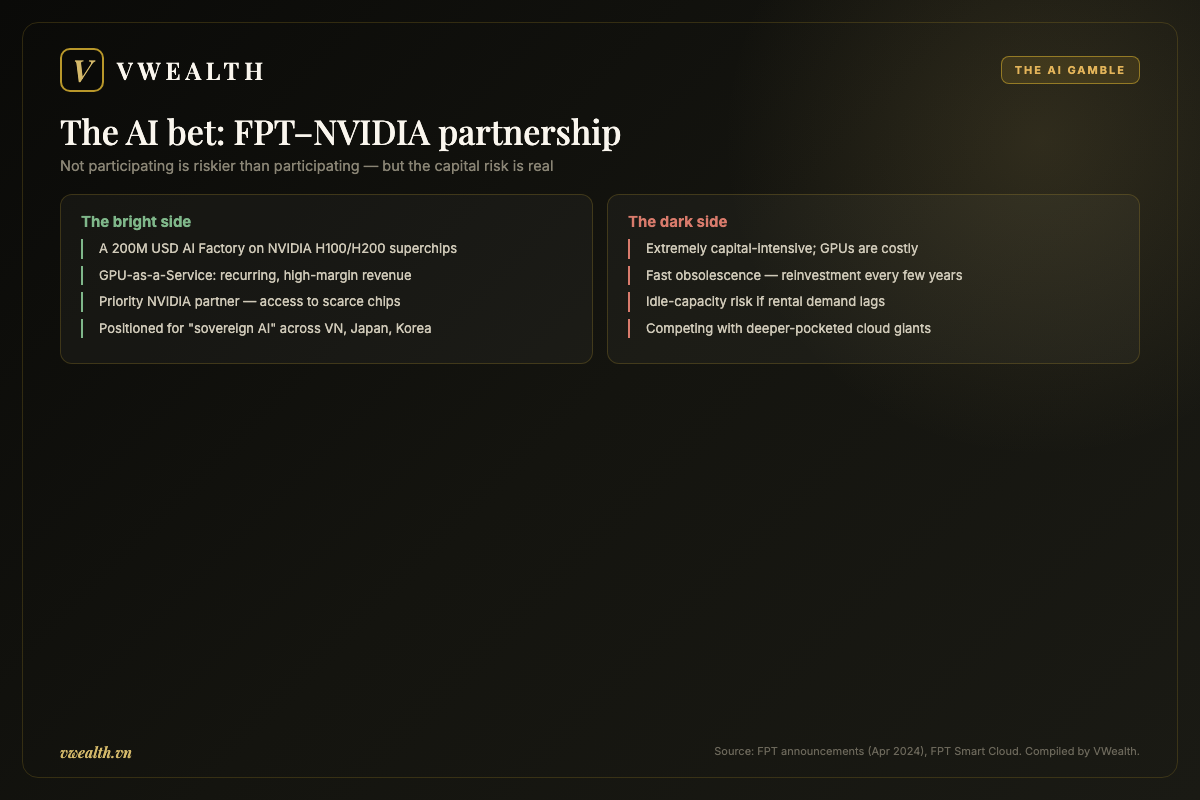
- Top-tier infrastructure: the AI Factory is equipped with supercomputers using NVIDIA H100 (Hopper architecture) and H200 GPUs — the world’s most powerful chips for AI training.
- Special partner status: FPT joined NVIDIA’s network as a service-delivery partner and is aiming to become a global system integrator — not a chip buyer, but a partner NVIDIA chose to bring the technology to market.
- The GPU-as-a-Service business model: instead of selling outright, FPT rents AI compute capacity to businesses on demand — a recurring, high-margin revenue stream, right in a long-term investor’s wheelhouse.
- Regional ambition: FPT does not stop at Vietnam. The group has committed to building a network of multiple AI factories across Vietnam, Japan and South Korea, and has launched FPT AI Factory in Japan for Japanese businesses to pre-order GPU services on the cloud.
- Endorsement from the top: the weight of this relationship was underscored by the Vietnam visit of Jensen Huang — NVIDIA’s founder and CEO — a signal that FPT sits within the company’s Asia strategy.
The bright side: an exponential growth driver
If the gamble succeeds, this could be FPT’s largest growth driver of the coming decade. The AI Factory places FPT right in the eye of the technology storm defining the era. Vietnam, Japan and South Korea are all thirsty for AI compute infrastructure but dependent on a globally scarce supply of GPUs — FPT, thanks to its priority-partner status with NVIDIA, can access chips that many rivals must queue for. Moreover, the concept of “sovereign AI” — each nation wanting to control its own AI infrastructure rather than depend on foreign clouds — is becoming a policy priority, and FPT is positioning itself as a sovereign-AI infrastructure provider for the region.
The dark side: the risk of a capital black hole
But I have a duty to warn you about the other side. AI infrastructure is a terribly capital-intensive game. High-end GPUs are very expensive, wear out fast, and NVIDIA keeps releasing new generations that make old hardware lose value within a few years. There are three risks you must watch closely:
- Idle-capacity risk: if GPU-rental demand does not fill the invested capacity, those expensive machines will “burn money” through depreciation and electricity without generating returns.
- Fast-obsolescence risk: the AI technology cycle is short. Today’s 200 million USD investment may need large reinvestment within just a few years to avoid falling behind — this is a race with no finish line.
- Competition from deeper pockets: the global cloud giants are also building AI factories; FPT must compete on price and service with rivals of superior resources.
The most balanced view, in my opinion, is this: FPT has placed itself in a gamble where not participating is riskier than participating. A leading technology company cannot stand outside the AI wave and keep its leadership position. What deserves respect is that FPT plays this gamble with a “cushion” few rivals have: abundant, stable cash flow from three traditional segments. In other words, if the AI Factory needs a long time to turn a profit, FPT still has the strength to hold on — you are not betting on a pure AI startup that could go bust, but on a mature group using old profits to buy a ticket to the future.
Summing up the economic moat: why long-term conviction is reinforced
Now step back and assemble the pieces. FPT’s economic moat does not come from a single factor — it comes from the synergy of three forces: scale (the first Vietnamese technology business to reach a billion-dollar export milestone, a VN30 member, profit growing faster than revenue); relationships (a two-decade Japan fortress with very high switching costs, plus the AWS, SAP, Microsoft partner network); and proven capability (chosen by NVIDIA as a strategic partner, ranked by IDC, honoured by AWS). Most importantly, these three forces lock into each other: the new AI capability (NVIDIA) is sold to the very Japanese customer base already in hand (relationships), and is backed by cash flow from the group’s enormous scale. A rival wanting to beat FPT cannot be good at just one segment; it must simultaneously have scale, two-decade relationships, and certified AI capability — a trio nearly impossible to recreate within a decade.
Of course, an economic moat, however deep, only has value if it converts into specific cash flows, from specific products and services. That is exactly what you and I will dissect in the next section — where the stirring numbers of this chapter are broken down into the real money-making machine behind FPT stock.
Products, services and revenue mix
After seeing FPT hold the cards of power in its hand — the NVIDIA partnership, the global customer network, the negotiating position with the Japanese establishment — the next question you should ask is very practical: how does this group actually make money, and which of that money is “quality” money? Because a business can have huge revenue but flimsy profit, or the reverse — and it is the internal structure of the 70,113 billion dong of 2025 revenue that tells you the truth about FPT’s health, not the total number.
Let’s start with the overall picture. In 2025, FPT reached revenue of 70,113 billion dong (up 11.6%) and pre-tax profit of 13,039 billion dong (up 17.8%). Net profit attributable to the parent’s shareholders reached 9,369 billion (up 19%), pulling EPS up to 5,211 dong, up as much as 21%. Note right away a detail that seems small but is among the most important: profit rose 17.8% while revenue rose only 11.6%, and EPS rose 21%. Three numbers rising at three different speeds, in ascending order. This is no coincidence — it is the fingerprint of a business model “climbing the value ladder,” which I will explain in detail at the end of this section.
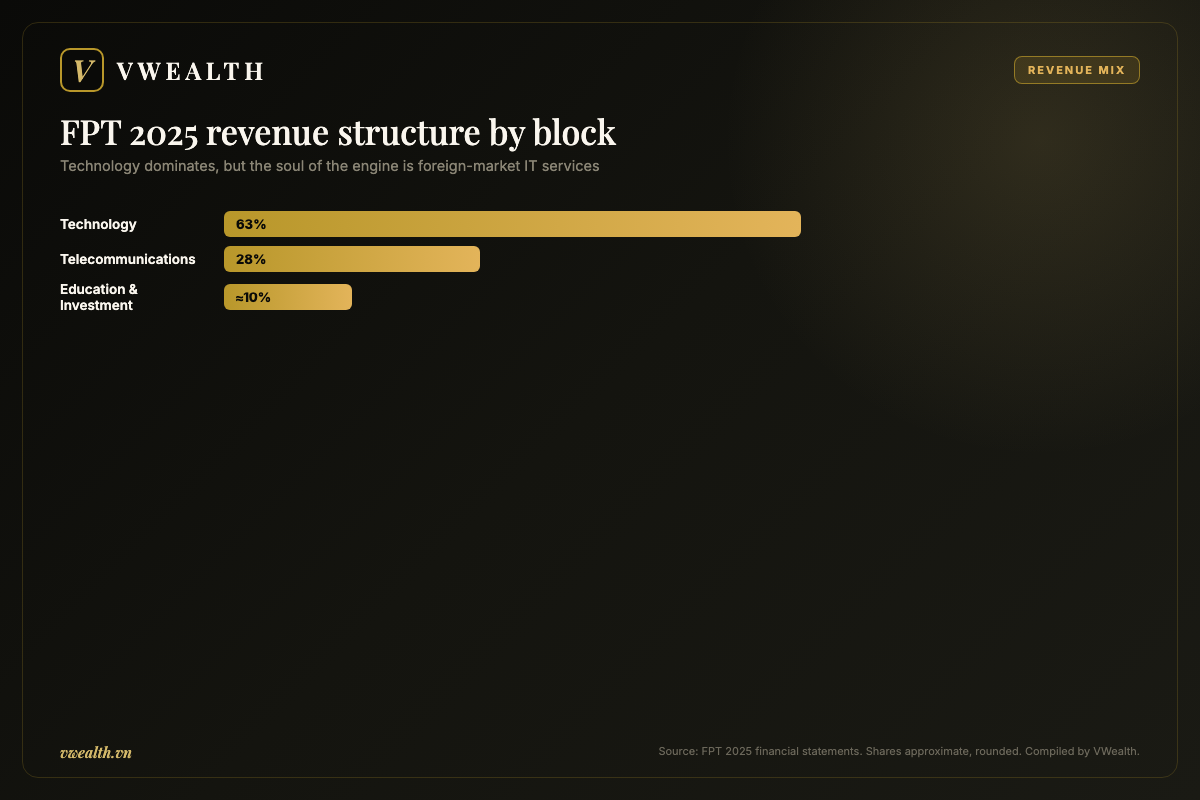
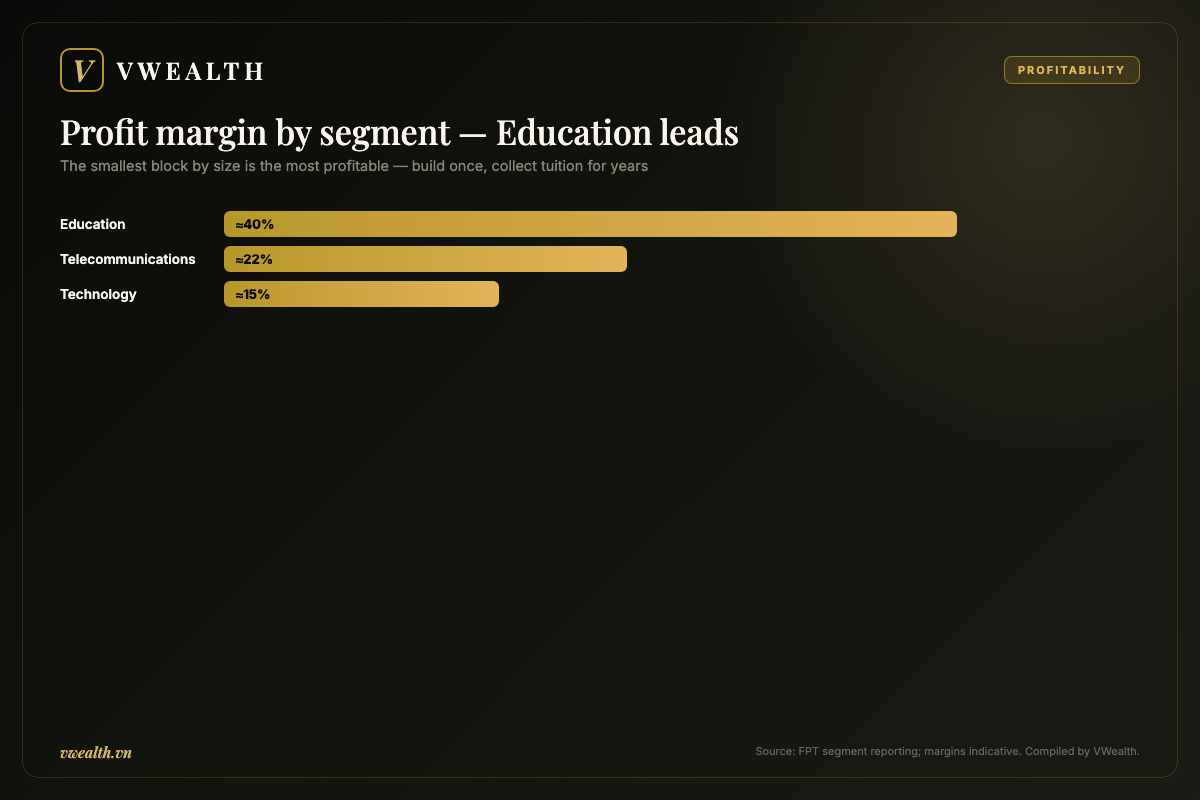
The Technology pillar: 63% of revenue, but its soul is in foreign markets
The Technology segment contributes 63% of revenue (44,475 billion dong, up 13.7%). This is the largest machine, but to understand it you must break it into two parts very different in nature.
The core part — and the real engine of the whole group — is IT services for foreign markets: 35,382 billion dong, up 14.3%. The model here is simple in principle but sophisticated in execution: FPT sells the capability of Vietnamese software engineers to corporations in Japan, the US and Europe — writing software, digital transformation, system maintenance. The root competitive advantage is the labour-cost gap: a skilled engineer in Vietnam is many times cheaper than a Japanese or American counterpart, while output quality is increasingly standardized to international levels.
Within this foreign picture, Japan is the jewel, with 25.4% growth — nearly double the segment’s average pace. You should understand why the Japan market matters so much, far beyond the growth number alone:
- Japan’s demographic structure forces it to outsource. Japan is ageing and severely short of IT engineers — this is not a cyclical, momentary need, but a structural trend spanning decades. FPT does not sell Japan a “nice-to-have” service, but a solution to their existential problem.
- The yen and cultural barrier create a protective “moat.” Working with Japanese clients demands the meticulousness, discipline and Japanese-language capability that very few regional rivals can match. An Indian rival with equivalent cost still struggles to break in because it cannot clear the language–culture barrier.
- Foreign-market margins are higher than domestic ones. International customers pay international rates, while staff costs are still counted in dong. It is exactly this gap that creates the segment’s attractive margins.
Order sizes also show FPT has left the “small-job outsourcing” arena: in 2025 the group won 26 projects each over 10 million USD, and foreign new signings exceeded 1.5 billion USD. These are strategic, long-term contracts, not seasonal work.
The second part of the Technology segment — domestic IT — reached 9,093 billion dong. This segment plays a different role: it keeps FPT in the position of Vietnam’s number-one technology contractor, tied to e-government, banking and large domestic-enterprise projects. Margins are typically lower than foreign work because of fierce price competition, but it is the “home ground” — where FPT pilots products, builds the brand and trains talent before taking it to the world.
Made-by-FPT: from “selling labour hours” to “selling products”
This is the detail I want you to linger on longest, because it is an indicator of growth quality, not just speed. Revenue from “Made-by-FPT” products and platforms — that is, technology products FPT owns the intellectual property of, such as akaBot, akaChain, FPT.AI and the AI platforms — reached 2,672 billion dong, up 19.1%, clearly faster than the overall pace of the Technology segment.
Picture the difference: selling outsourcing services is like renting out workers — you earn by the labour hour, and revenue is capped by how many people you can hire. Selling products/platforms is like building a building and then leasing it — you build once, sell many times, and margins expand with scale without hiring proportionally more people.
When the Made-by-FPT share grows faster than the rest, it signals FPT is moving up the value ladder: less dependent on “selling labour hours” and gradually increasing the “selling intellectual property” part. This is exactly the mechanism that makes profit grow faster than revenue. For the same dong of revenue, if it comes from a product rather than a labour-intensive service, it leaves behind more profit. That is why you should not just look at the 11.6% revenue growth and conclude FPT is slowing down — the important part is that the quality of that growth is improving.
Telecommunications: a money-printing machine and a surprise AI lever
The Telecommunications segment (mainly FPT Telecom) brought in about 19,500 billion dong of revenue (up around 10.8%) and set a pre-tax profit record of over 4,360 billion dong (up around 21.6%). The business logic here is entirely different from software: this is a subscription model — customers pay for internet and television monthly, steadily, stably, with little cyclical volatility.
Telecom’s role in FPT’s structure is not to be the “growth star,” but the cash-flow pumping machine. It generates steady, easily forecastable cash flow — something the software segment, with its project cycles, does not have. This cash flow gives FPT the “ammunition” to invest in long-term gambles without borrowing heavily. But the most interesting thing is that telecom is being injected with a new engine: data centres. As the AI wave breaks, demand for compute and storage infrastructure surges — and data centres are the “real estate” of the AI era. The telecom segment is therefore no longer a dull “fibre internet” story, but a gateway for FPT to benefit directly from the AI boom at the infrastructure layer.
Education and Investment: a small segment but “super-profitable”
The Education–Investment segment reached about 7,000 billion dong of revenue, which on the surface looks “flat” in share (only about 6–10% of total revenue) and is not a growth engine by scale. But do not let the small share fool you: this is actually the highest-margin segment of the whole group. This block’s pre-tax margin has for many years stayed around 40% — far ahead of Technology and Telecommunications.
Why? Education (the FPT Education system, from secondary school to university) collects stable tuition, while the marginal cost of taking on one more student is very low once the facilities are built. This is the “build the school once, collect tuition for years” model. Moreover, education serves a deeper strategic purpose: it is the talent-production machine for FPT itself. A segment that is both super-profitable and nourishes the group’s main engine — that is the subtlety in FPT’s design that many investors skim over and miss.
To sum up this section: when you assemble the four pieces — foreign software (a high-margin growth engine led by Japan), Made-by-FPT (upgrading growth quality), telecom (cash flow + AI lever), education (super-profit + talent source) — you see a business structure with rare balance: growing, cash-generating, high-margin, and self-supplying talent. The question that arises is: if the business’s internal strength is this good, why did the market treat FPT stock so harshly over the past year? That is the paradox the next section will dissect.
How the market received the stock
If the section above is the story of the business, this section is the story of the stock — and you need to draw a sharp line between the two, because this is exactly where your profit or loss is decided. An excellent business bought at the wrong price can still leave you in the red; an ordinary business bought cheap enough can still make you money. And FPT’s story over the past 18 months is one of the most vivid illustrations of this principle on Vietnam’s stock market.
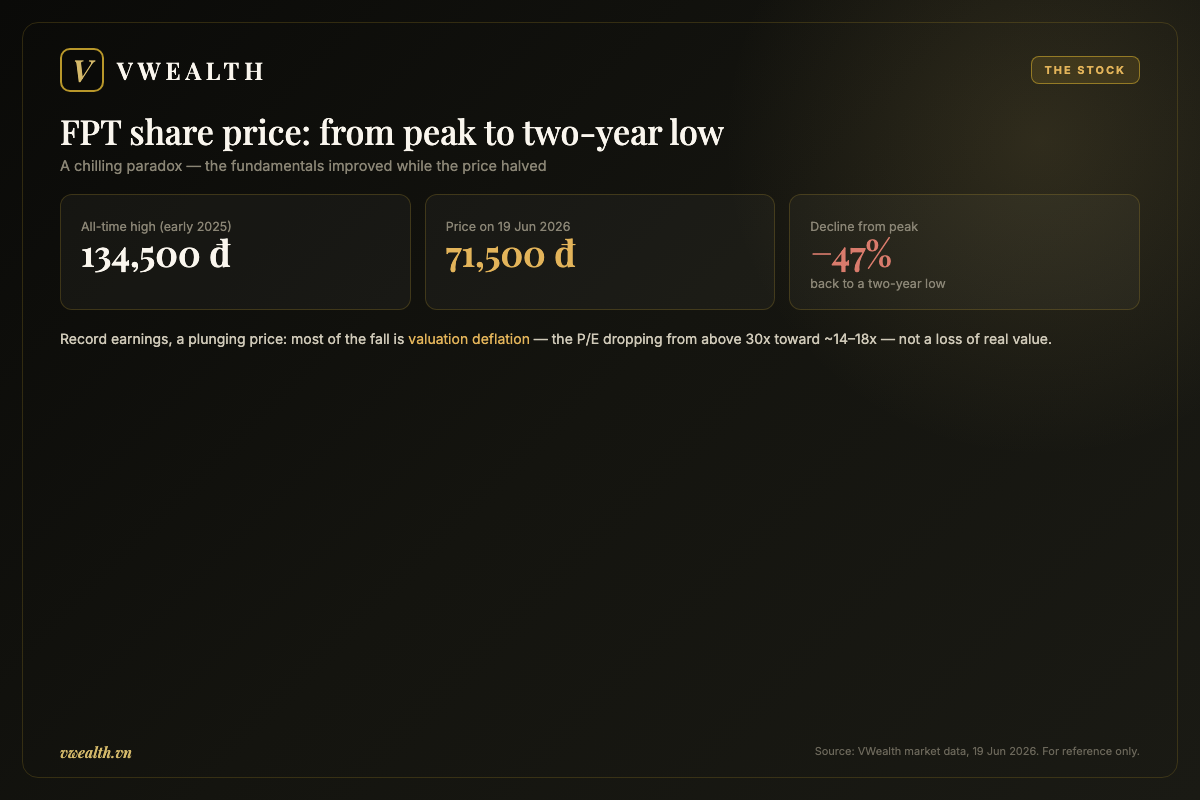
The 47% drop: the “record profit, plunging price” paradox
Look straight at the numbers. FPT stock once peaked around 134,500 dong in early 2025. By 19 June 2026, per market data, the price was only about 71,500 dong — evaporating about 47% of its value, back to a two-year low. Over that same period, the business posted record profit and EPS rose 21%. A chilling paradox: the fundamentals improved, the market price fell by half.
To understand this paradox, you must remember that a stock price does not reflect the present, but reflects expectations about the future. FPT’s problem is not that it does poorly — it is that the market once expected too much. At the peak, FPT was valued at a P/E of about 30 times, a level only reasonable if the group grew 25–30% a year. But in reality 2025 revenue grew only 11.6%, and into early 2026 growth slowed further. The plan for profit growth around 15% — still good for most businesses — is a step down from the 19–20% era.
In other words, FPT did not collapse because the business worsened. It fell because the market is lowering expectations from “super-growth star” to “good but ordinary growth business.” Most of the 47% drop is a “valuation deflation” — shedding the exaggerated-expectation portion, not losing real value.
The AI story also contributed to the disappointment. The market once valued FPT as an “AI stock,” but actual AI revenue is still modest against the 70,000-billion total. When AI expectations met a more modest reality, the “dream premium” in the price was pulled out.
Valuation: from expensive to reasonable — and perhaps cheap
This is when you need to put on the value investor’s glasses. After the drop, FPT’s P/E on 2025 EPS is about 14 times (some methods give 16–18 times depending on timing and approach). Put this number in context:
| Reference | P/E | Meaning |
|---|---|---|
| FPT now (on 2025 EPS) | ~14–18x | After the 47% drop |
| FPT historical average | ~22–23x | Multi-year norm |
| FPT at peak | ~30x | The “expectation bubble” valuation zone |
| TCS (India) | ~22x | A same-industry outsourcing rival |
| Infosys (India) | ~15x | Sitting low versus the industry average |
The picture is fairly clear: FPT is trading at a valuation well below its own historical average, and on par with or cheaper than regional rivals. More important than the static P/E is the PEG ratio — the ratio between P/E and the growth rate. With a PEG around 1 (a P/E reasonable against double-digit EPS growth), FPT is no longer expensively valued relative to its growth. A business growing EPS 21% while trading at a P/E of 14–18 times is an equation the value investor will notice.
Of course, “cheaper than the past” does not automatically mean “the bottom.” The bitter lesson this very drop teaches is: a cheap price does not mean a good price if growth keeps slowing. If FPT truly enters a phase of long-term slower growth, then a lower P/E is deserved, not a bargain. This is a point you must answer yourself, based on your conviction about the engines in Section 5.
Dividends: this is a growth stock that pays dividends, not a dividend stock
FPT pays a 20% cash dividend (2,000 dong/share) plus a 10% bonus share. At a market price around 71,500 dong, the cash dividend yield is about 2.8% — not high compared with a savings deposit. You need to position it correctly: FPT is not a stock to buy to “live off dividends.” It is a growth stock with a dividend attached — the bulk of profit is retained to reinvest in data centres, AI, and foreign-market expansion, and the dividend is only a symbolic sharing with shareholders. If you buy FPT, you are betting on capital growth, not on a dividend stream.
VN30 status and ETF flows: a double-edged sword
FPT is one of the pillars of the VN30 basket and one of the largest-cap stocks on HOSE. This has two sides. The good side: it is always in the portfolio of most index-tracking ETFs, ensuring a baseline demand and high liquidity. The downside: when foreign capital withdraws from the Vietnamese market as a whole, pillar stocks like FPT are sold first and hardest — simply because they are easy to sell, with high liquidity. FPT is sold not because it is bad, but partly because it is important — it is the largest door for foreigners to exit through.
The reversal of the foreign-room story: a pivotal turning point
This is the part I consider most important for you to understand FPT stock at this moment. For many years, FPT was a classic “full-room” stock — foreign investors wanting to buy had to pay a premium via negotiated deals because there was no “space” left in the ownership limit. Foreign ownership once reached 45.87%, close to the ceiling.
But in 2025–2026, everything reversed. Foreigners sold on a record net basis: cumulative to mid-2026 it exceeded 13,000 billion dong, corresponding to more than 200 million shares. Foreign ownership fell from 45.87% to only about 30%. As a result, FPT now has an open room of nearly 19% — equivalent to more than 200 million shares foreign investors can freely buy without paying a premium. This is a reversal of an order that had stood for years.
- The negative side — selling pressure dragging the price down: foreigners continuously dumping stock creates a selling force weighing on the price, and this is the biggest technical driver behind the 47% drop. When there is a large, persistent seller who does not care about price, domestic demand struggles to absorb it in time, and the price is pushed down regardless of the business fundamentals.
- The positive side — the barrier vanishes, opportunity opens: for many years domestic investors wanting to buy FPT had to compete with a red-hot full-room market. Now that barrier has dissolved. Domestic investors can buy FPT at a deeply discounted price without having to scramble. And crucially: when foreign selling pressure runs dry — because they have sold most of what they wanted — the weight on the price will naturally ease, opening the way for a recovery if the fundamentals stay firm.
The vital question you must ask yourself is: are foreigners selling because the business worsened, or for capital-flow structural reasons? The evidence leans heavily toward the second. If FPT had truly worsened, profit would not have hit a record, margins would not have improved, Japan would not have grown 25.4%. The net-selling wave occurred broadly across the whole Vietnamese market and emerging markets, tied to global capital shifting toward US assets and a strong dollar — not a specific judgement on FPT’s health. This is a capital-flow story, not a business story.
Once you can separate those two things, the picture becomes clear: the market is treating FPT stock with one logic (capital withdrawing, lowering the valuation expectation) entirely different from the logic the FPT business is running on (record profit, AI expansion, climbing the value ladder). This phase difference between the two logics is exactly what creates both risk and opportunity — and which way it tips will depend heavily on the macroeconomic context and the outlook for the whole technology industry, which we need to place FPT within in the next section.
The economic and technology-industry context
After dissecting FPT’s products and revenue mix — where foreign-market IT services play the growth-locomotive role — you need to step back to see the whole picture. However excellent a business is, it is only a boat on a great river. That river is the global technology industry, the macro trends and the undercurrents that can lift the boat or sink it.
The huge pie called global IT outsourcing
The heart of FPT’s profit lies in software export and IT services. To understand its room to grow, look at the market size: the global IT-services outsourcing industry is estimated by Grand View Research at roughly 807 billion USD in 2025 and heading toward 1,219 billion USD by 2030, corresponding to a compound annual growth rate (CAGR) of about 8.6%/year. Other firms give more modest figures (CAGR 5.5–6.5%), but under any scenario this is still a near-trillion-dollar market expanding steadily.
The key point you need to grasp: Vietnam’s share of this pie is still extremely small. Vietnam’s entire IT-services market reached only about 2.37 billion USD in 2025 — less than 0.3% of the global size. FPT, though number one in Vietnam with foreign IT revenue over 1 billion USD since late 2023, is still a tiny player on the world board. That sounds negative, but reverse the view: that very smallness is the room to grow. When you hold 0.3% of a market growing 6–9%/year, you do not need the market to grow fast to grow big — you only need to win a few more percentage points of share to double your scale. This is the mathematical foundation for FPT’s ambition of 5 billion USD in foreign revenue by 2030.
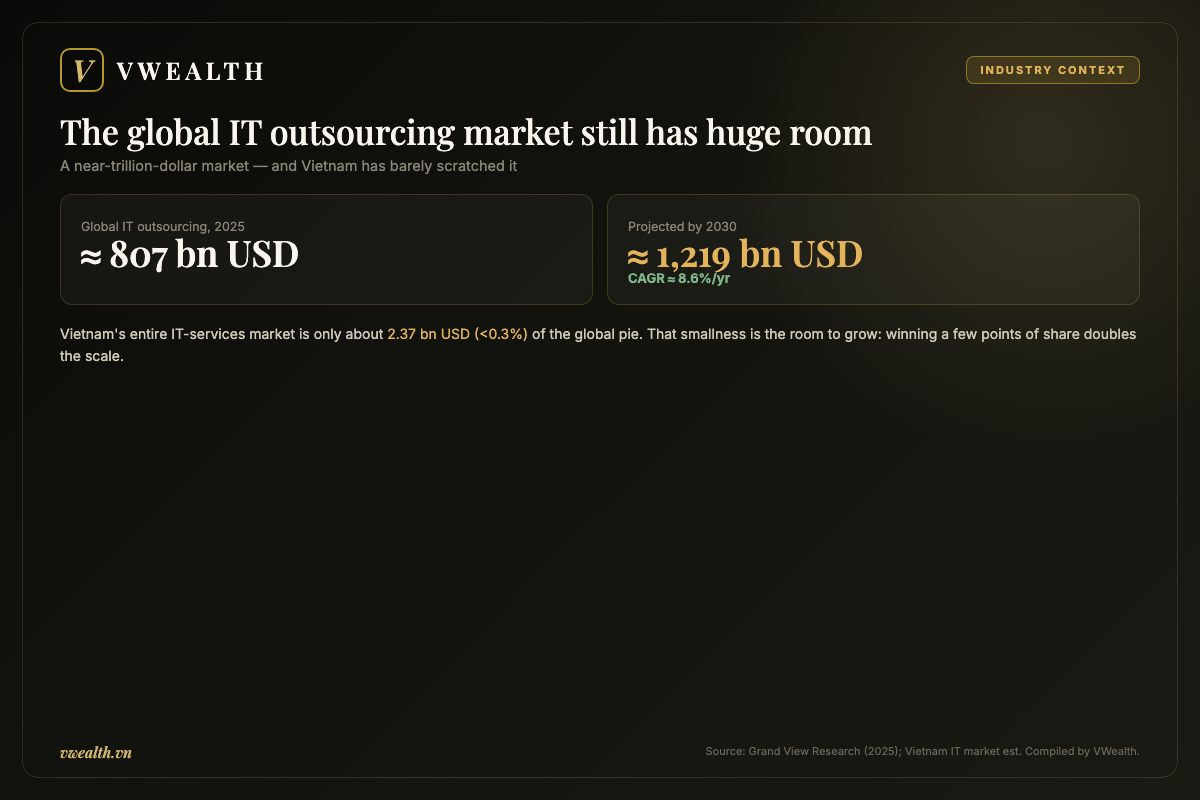
The “China+1” wind: why the world turns to Vietnam
A macro wave is blowing straight into FPT’s sails: the “China+1” strategy and supplier diversification. After US–China trade tensions, the pandemic and geopolitical instability, large corporations no longer want to put all their eggs in one China basket. They look for “one more place” — and Vietnam emerges as a strong candidate: political stability, an abundant young engineering workforce, competitive cost, and especially close geographic and cultural ties with Japan. This is a structural wind, not a momentary one — and FPT, with 25 years of globalization experience, is in exactly the right place at the right time to catch this flow.
The two faces of the AI wave: both launchpad and blade
This is the most important and most controversial part of the whole analysis. AI is both the largest opportunity and the most fearsome long-term risk to FPT’s business model. You need to understand both faces so you are not swept along by one side of the story.
The bright side — AI is a machine that creates new demand. Every major technology wave (cloud computing, mobile, and now AI) creates a huge wave of consulting and implementation demand. Global businesses are racing to integrate AI into their operating core but lack the people to do it. FPT positions itself as an AI-implementation partner: from consulting to building solutions to operations. The group’s ambition is very clear — targeting a third of revenue from “AI-First” projects, and building an “AI Factory” aiming for 100 million USD of GPU-cloud revenue by 2027.
The dark side — AI could erode the very labour-hour model. This is a long-term worry many investors ignore. The traditional model of outsourcers like FPT is “selling labour hours” (time-and-material): the more engineers, the more hours, the more revenue. But AI coding is breaking this very logic. When an AI-assisted engineer can do the work of three, customers will pay less for the same product. This is not idle theory: the Indian giants (TCS, Infosys, Wipro, HCLTech) have cut more than 42,000 staff over the past two years while revenue still rose — a sign that the “more people = more money” link is cracking.
FPT’s paradox in the AI era: if it does not seize AI, it falls behind; but if AI succeeds in eroding demand for manual coding, the very growth model based on selling engineering capacity is also challenged. FPT is forced to race to shift from “selling hours” to “selling value/outcomes” before the AI wave sweeps away the cheap-labour advantage.
The undercurrents: macro risks you must not ignore
A balanced analysis must scrutinize the risk side. There are four undercurrents:
- A downturn cutting customers’ IT budgets. When the US or European economy stalls, IT spending is one of the first items cut or delayed. This has already shown up: FPT’s foreign IT revenue was affected by customers delaying in pursuit of cost savings. This is why FPT lowered its growth target from the original plan.
- A weak yen eroding converted profit. Heavy dependence on Japan is a double-edged sword. When the yen loses value, yen-denominated revenue “shrinks” when converted to dong (or USD). FPT may grow well in work volume in Japan but the reported profit figure still erodes because of the exchange-rate effect — a risk beyond the business’s control.
- Indian competition at another level. Look straight at the scale: TCS has about 613,000 employees, Infosys 324,000, Wipro 233,000. FPT, though the largest in Vietnam, has an IT headcount many times smaller. The Indian giants have ready relationships with most Fortune 500 corporations, and huge marketing and R&D budgets. FPT must compete in a niche (especially Japan, where India is weak in language and culture) rather than head-on.
- Rising Vietnamese engineer salaries narrowing the cost advantage. FPT’s biggest weapon is cheap labour cost. But Vietnamese software-engineer salaries are rising steadily each year, and Japanese-speaking roles are paid a premium. Each passing year narrows the cost gap between Vietnam and other outsourcing hubs. If productivity (from AI, from added value) does not rise faster than salary growth, margins will come under pressure.
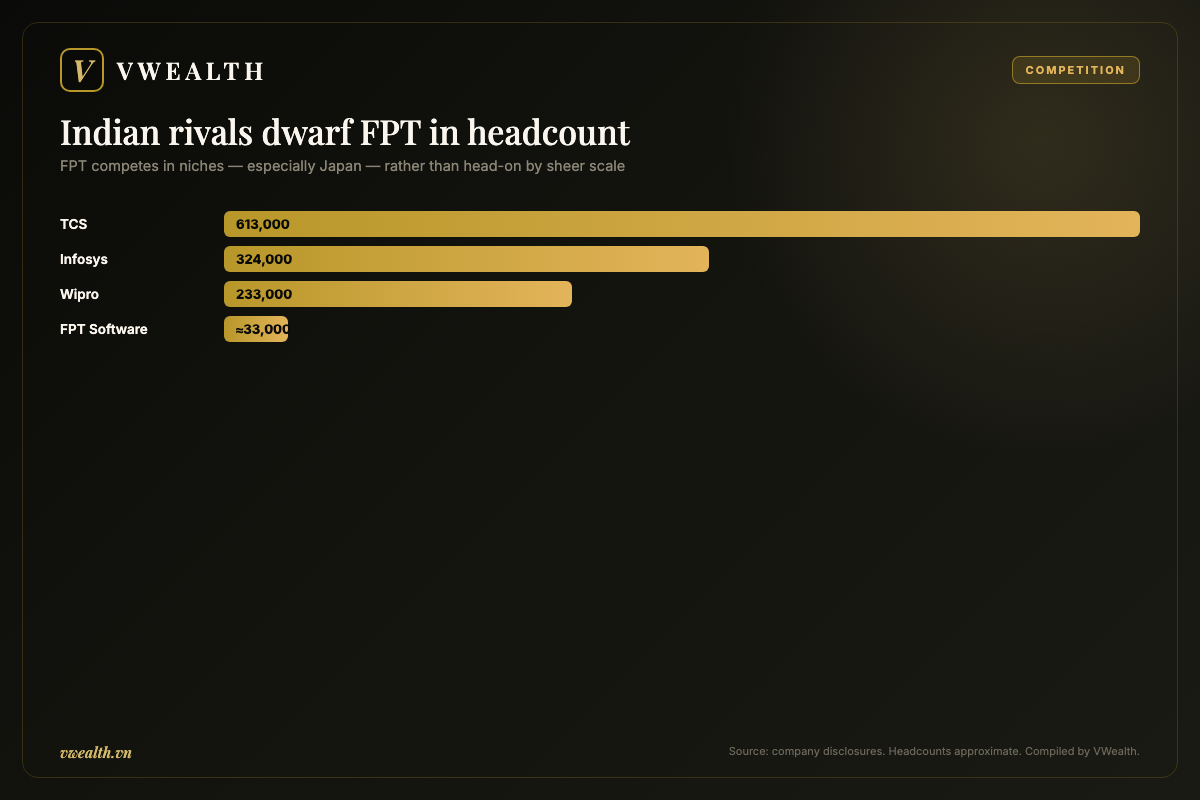
Trend forecast
Analysing the past and present only has value if it helps you look to the future. This section is not to “predict” the stock price — no one can do that — but to lay out conditional scenarios, helping you know which signals to watch and what each signal leads to.
The ambitions shaping FPT’s future
FPT is betting on five strategic spearheads: AI, Semiconductors, Automotive technology, Digital transformation and Green transformation. The overarching goal is 5 billion USD of foreign IT-services revenue by 2030 — about five times the 1 billion USD milestone reached in late 2023. In semiconductors specifically, FPT Semiconductor has moved its power-management chip (PMIC) from the research stage to mass production — a long-term move, even if its current revenue contribution is still small.
The important thing to understand: these ambitions are both a driver and a burden. The AI Factory and semiconductors devour large investment, carry a lag before turning a profit, and high technology risk. If they succeed, they lift FPT to a new class with higher margins. If they fail or are delayed, they become a drag pulling back short-term profit.
Three scenarios for FPT
-
POSITIVE scenario — “The growth machine restarts.”
Trigger conditions: the US/Japan economies recover, global IT spending enters a new upcycle; FPT proves its AI capability generates large contracts; Japan revenue reaches 1 billion USD on schedule in 2027; foreigners stop net selling and return to buying now that room is ~19% open.
Consequence: profit returns to 18–22%/year growth. The market restores a high P/E (20x+). The share price could head toward the average target of the securities firms (~100,000đ), or even higher toward ~126,000đ in the most optimistic case — a substantial rise from the current 71,500đ. -
BASE scenario — “Growth slows but stays firm.”
Trigger conditions: the economy moves sideways, IT spending recovers slowly; FPT grows profit around 13–18%/year; AI both creates opportunity and applies price pressure, the two forces roughly cancelling out; foreign net selling gradually eases but does not yet return to strong buying.
Consequence: the stock accumulates in a wide band around the current price, with the P/E holding ~14–18x. This is the “sideways accumulation” scenario — no explosion but no collapse either, suited to a patient investor accumulating gradually. This is the most likely scenario in the short term. -
NEGATIVE scenario — “A double storm hits.”
Trigger conditions: a global recession forces customers to cut IT budgets sharply; AI automates coding faster than expected, eroding demand for engineers and squeezing service prices; the yen keeps losing value; the AI Factory and semiconductors devour capital but are slow to profit; foreign net selling drags on longer.
Consequence: profit growth falls to single digits or moves sideways. The market re-rates cautiously, the P/E may contract to 12x or lower, pulling the price below the current zone. This is the most fearsome scenario for a short-term investor but also an opportunity for a long-term buyer if the business’s essence is not broken.
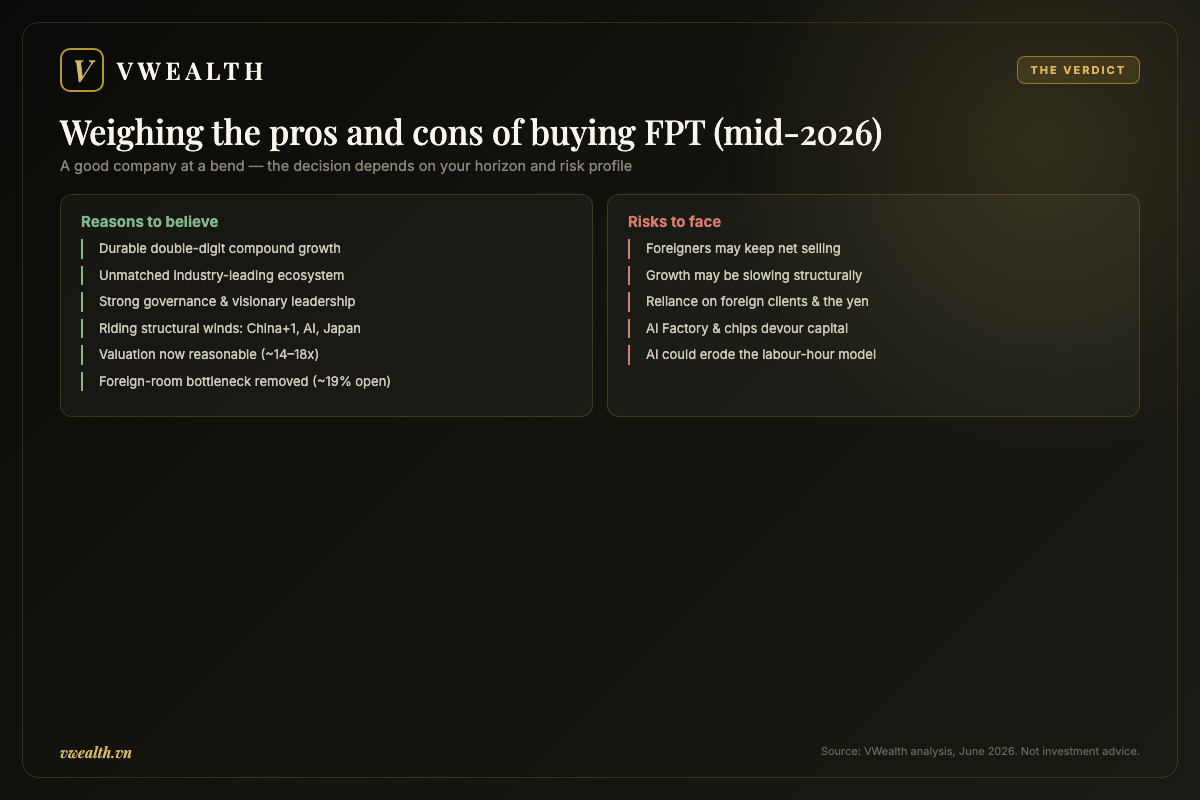
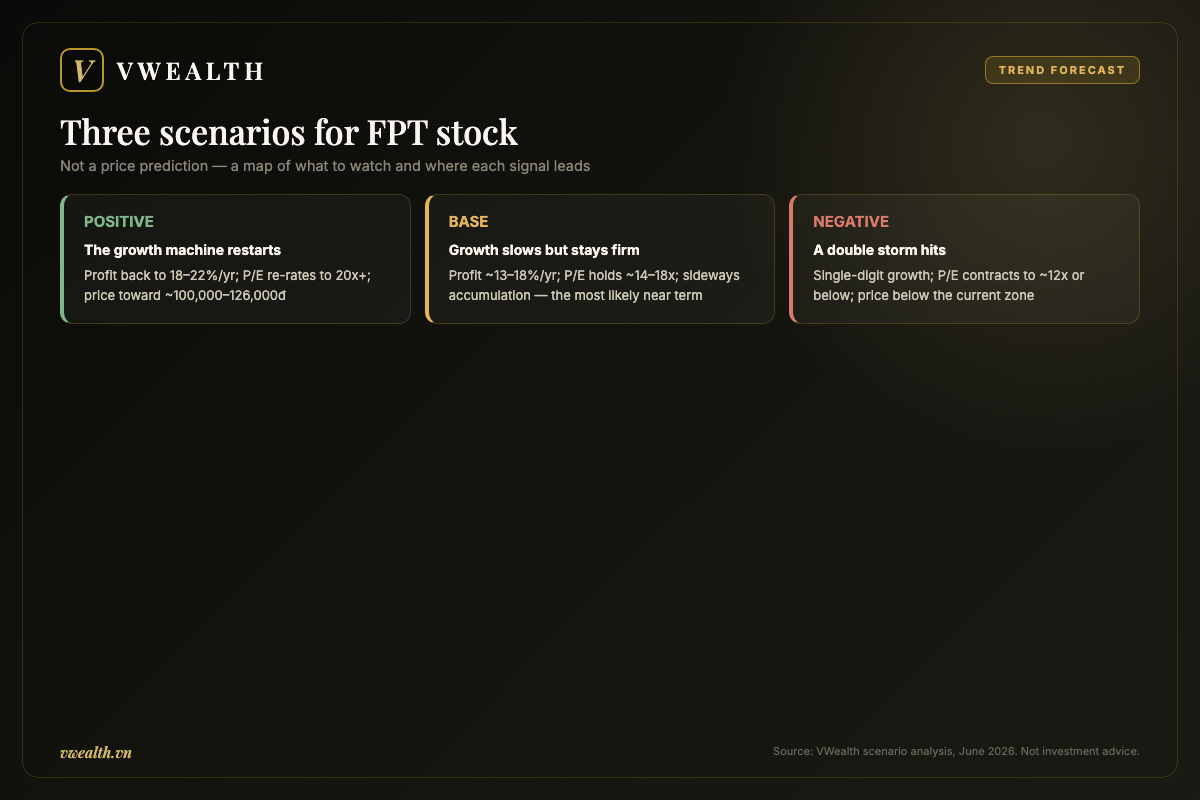
Which scenario is more likely? From a balanced view, the base scenario has the highest probability in the short term (1–2 years), because foreign net-selling pressure and the caution of international customers are real and not yet over. However, over the long term (3–5 years), if FPT keeps execution discipline, the structural winds (China+1, AI demand, the Japan/US markets) still tip the scales toward the positive. The question is not “is FPT still a good business” — but “how much will the market pay for that goodness, and when.”
Should you buy FPT stock?
This is the question you have waited for through the whole article. The most honest answer: there is no “yes” or “no” that is right for everyone. FPT is an excellent business facing a challenging phase — and whether it is a good investment for you depends on what kind of investor you are, how much risk you can bear, and over what time horizon you invest.
Weighing the pros: why many still believe in FPT
- A durable compound-growth machine. FPT has maintained double-digit profit growth for years. In 2025, net profit attributable to the parent was 9,369 billion (+19%), EPS 5,211đ (+21%). Very few listed Vietnamese businesses have such even, transparent growth quality.
- An unmatched industry-leading position. FPT is Vietnam’s number-one technology company, with a closed ecosystem from software and telecom to education — a wide and deep economic moat.
- Good governance, a visionary leadership. A 25-year globalization strategy, a strong corporate culture, a reliable execution history.
- Benefiting from structural winds. China+1, AI demand, the Japan/US markets — long-term trends on FPT’s side.
- Valuation has become reasonable. After falling about 47% from the peak to around 71,500đ, the P/E contracted to ~14–18x — much cheaper than the 30x of the peak era.
- The foreign-room barrier has been removed. Foreigners’ net selling of more than 13,000 billion dong — though bad news for capital flow — created an “open room” of about 19%, removing a bottleneck that constrained the stock for years.
Weighing the cons: the risks you must face squarely
- Foreigners may keep net selling. This is the biggest short-term risk. The selling force of over 13,000 billion has exceeded the whole prior year’s value, and no one is sure it has stopped.
- Growth may slow. FPT has lowered its own targets. If the 20%+ growth era is over, the market will have to re-rate — a process usually accompanied by price volatility.
- Dependence on foreign customers and the exchange rate. Core revenue comes from abroad, especially Japan, making profit sensitive to customer downturns and yen swings.
- The AI Factory and semiconductors devour capital. The future gambles demand large investment, with a profit lag and technology risk.
- The spectre of AI eroding the model. Long term, if AI automates coding faster than FPT shifts to a value-added model, their very labour advantage could be eroded.
A decision framework by investor type
| Investor type | View on FPT at this point |
|---|---|
| Value investor | A P/E of ~14–18x for an industry-leading business growing double digits is attractive versus the past. The core question: is this cheap valuation an opportunity or a “value trap” if growth really slows? Deploy in tranches, do not “go all in.” |
| Growth investor | You buy FPT for the AI, Japan, US and 5-billion-USD-by-2030 story. The thing to weigh: the growth rate is slowing from 20%+ toward a lower zone. You need to believe the new engines will re-accelerate the machine — and accept volatility while waiting for them to prove it. |
| Long-term / accumulation investor | This is probably the group best suited to FPT right now. If you believe in the business quality and the 3–5 year trend, the price fall creates a chance to accumulate gradually (average in) at a reasonable valuation. You don’t need to guess the bottom — you need patience and discipline. |
| Conservative / short-term investor | This is the group that needs the most caution. Foreign net-selling pressure is not over, so the price may still shake hard. If your goal is capital preservation, you should wait for a signal that foreign flows have stabilized before considering it. |
Closing thoughts
FPT is not a stock to bet “all in” on emotionally, nor a business worth turning your back on over a few months of falling price. It is a good company passing through a bend — where the long-term foundation is still firm but short-term waves (foreign net selling, slowing growth, the AI spectre) are stirring the surface. That is the paradox of investing: a stock often becomes more attractive on valuation exactly when market sentiment is most pessimistic. Whether it deserves a place in your portfolio depends on the time horizon through which you view it and how much volatility you can bear. Decide with a cool head, based on your own risk profile — not with the crowd or out of fear of missing out.
Disclaimer: This article is produced for informational and educational purposes, based on publicly available data at the time of writing (June 2026). It is not a recommendation to buy, sell or hold any stock. All price, valuation and projection figures may change over time and with market movements. The stock market always carries the risk of capital loss. You should do your own thorough research, consider your personal financial situation, and consult a licensed advisor before making any investment decision. Investors bear full responsibility for their own decisions.
Research Vietnamese stocks in English with vwealth. Our AI-powered platform turns Vietnamese market data into full English analysis reports — with international payment support and a free 2-month trial for new accounts. Create your free account and read the latest reports.
Read more sector analysis: Vietnam Technology Stocks: The Software Export Story