Anyone researching Vietnam stocks to buy eventually lands on the same shortcut: find out what the foreign funds hold, and buy that. They have analysts, access to management, and money at risk.
The shortcut fails, and it fails for a specific reason. A foreign fund’s portfolio is not a list of the best businesses its analysts found. It is what remained after three constraints removed most of the options — ownership caps, liquidity, and benchmark risk.
This piece covers where the disclosures are, why foreign portfolios resemble each other more than people assume, and the one calculation that turns a holdings list into information.
Should you buy the Vietnam stocks that foreign funds hold?
Short answer: Not directly. A fund’s holdings reflect what it was permitted to buy, able to buy at size, and obliged to hold to stay near its benchmark. Use the disclosures to find names you had not considered and to test your own reasoning — not as a buy list, because the list omits the entry price, the horizon and the thesis.
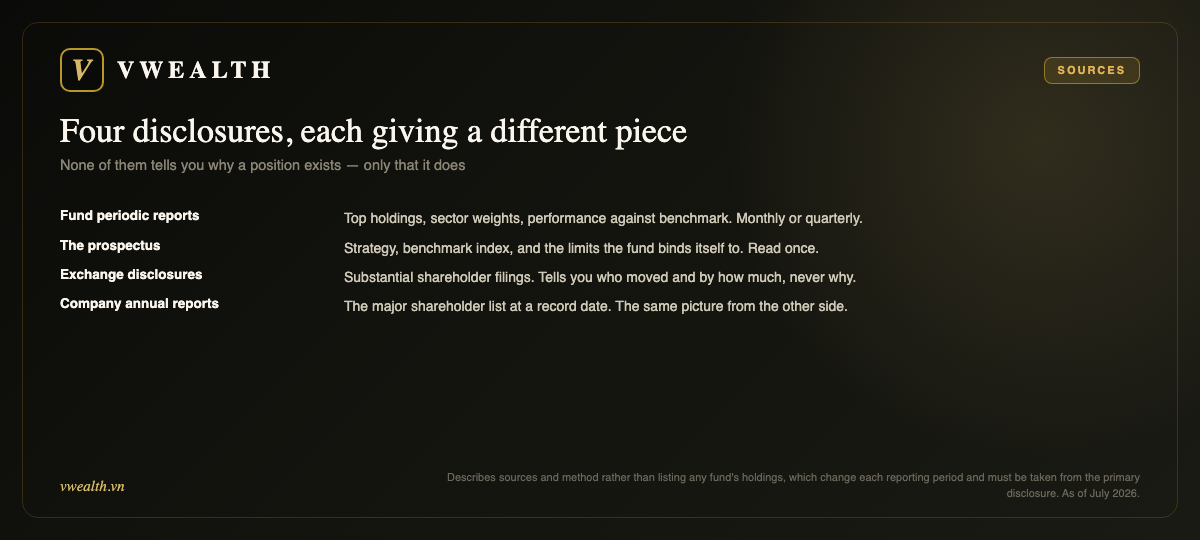
Four disclosures, four different pieces
Fund periodic reports
The primary source. Published monthly or quarterly, listing the largest holdings, sector allocation and performance against the benchmark.
The most useful part is not the holdings list but the sector weights, which are more stable and reveal positioning more clearly than individual names.
The prospectus
Read once, and it explains most of what the periodic reports show.
It contains the strategy, the benchmark index, and the internal limits the fund binds itself to — maximum weight per holding, permitted asset types, how far it may deviate from the index.
Knowing those limits explains why a manager does not hold more of something they clearly like.
Exchange disclosures
When an institution crosses certain ownership thresholds, it must file. Faster than fund reports, and narrower — it tells you who moved and by how much, not why, and not whether it was a view on the company or a portfolio rebalance.
Company annual reports
The reverse view: instead of asking what a fund holds, ask which institutions hold a given company.
Useful when you are researching a specific name and want to know whether any institution has been there for years. Where to find these documents is covered in reading a Vietnamese company’s accounts.
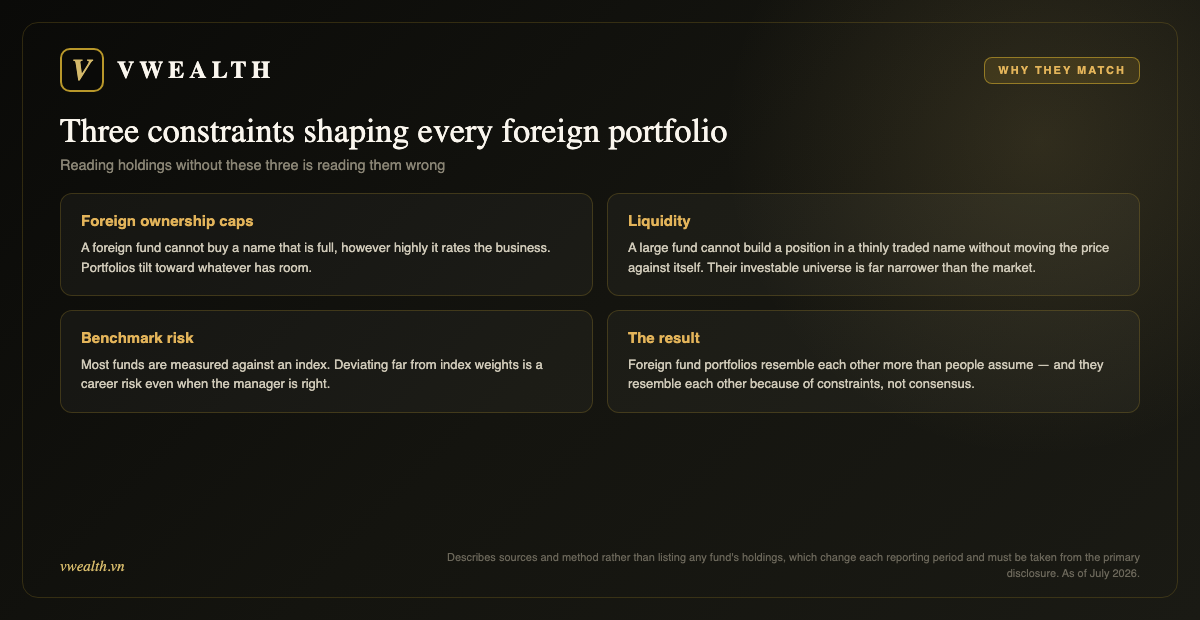
Three constraints that shape every foreign portfolio
Foreign ownership caps
The constraint unique to this market and the one most often ignored by readers elsewhere.
Where a company’s foreign ownership is at its ceiling, no foreign fund can add — regardless of how highly it rates the business. Ordinary commercial banks are capped at 30%, with an exception permitting up to 49% for banks receiving mandatory transfers as part of restructuring where the state does not hold control.
The consequence: foreign portfolios tilt toward names with room remaining. A quality company absent from every foreign fund may simply be full. Mechanics in foreign room and the cap that blocks foreign money.
Liquidity
A fund running significant assets cannot build a meaningful position in a thinly traded name without pushing the price up while buying, and pushing it down while selling.
Their investable universe is therefore much narrower than the listed market. Many good businesses are simply too small for them.
This is one of the few genuine advantages an individual has: you can transact in names institutions cannot reach.
Benchmark risk
Most funds are measured against an index. Deviating substantially from index weights is a professional risk for the manager, even when they are right — and being wrong while different is punished far more heavily than being wrong while aligned.
The result is that a holding’s weight often reflects its index weight more than the manager’s conviction.
What the three produce together
Foreign fund portfolios in Vietnam look alike. Not because managers agree, but because the same three constraints apply to all of them.
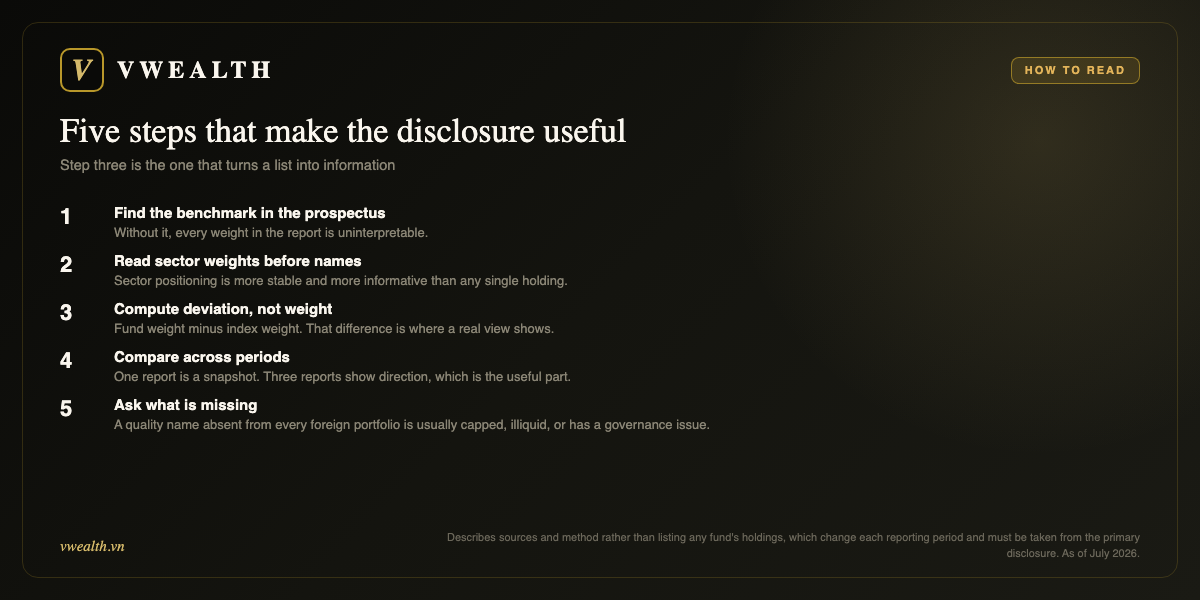
The calculation that makes disclosures useful
Step 1 — find the benchmark
In the prospectus. Without it, every weight in the report is uninterpretable, because you have nothing to compare it against.
Step 2 — read sector weights first
More stable than individual names and closer to what the manager actually decided.
Step 3 — compute deviation, not weight
Fund weight minus benchmark weight for the same holding.
A large positive deviation means the manager chose to hold more than they had to — that is a view. A large negative deviation is equally a view, expressed by absence.
Absolute weight tells you almost nothing. Deviation tells you a great deal.
Step 4 — compare across periods
One report is a snapshot. Three consecutive reports show whether a deviation is growing or shrinking, which is the part that carries information.
Step 5 — ask what is missing
The most underrated step. If a company you rate highly appears in no foreign portfolio, there is a reason: it is capped, it is illiquid, or there is a governance issue you have not found yet.
Working out which is more valuable than any name on the list. Context in corporate governance in Vietnam.
Three fund types, three different readings
Treating all funds alike is the most common error. The three categories behave very differently.
Index trackers
The portfolio is the index, minus whatever the ownership caps block. There is no view in it at all.
Reading a tracker’s holdings for stock ideas means reading a description of market structure. What is worth reading is the gap between the fund and its index, because that gap is the cap constraint made visible.
Active funds
Here the portfolio does reflect judgement. A manager selects and is accountable for the selection.
They remain bound by benchmark risk to varying degrees, and the prospectus states how far they are permitted to deviate. A fund allowed to deviate widely and choosing not to is telling you something.
Closed-end and specialist vehicles
Longer horizons and no redemption pressure, which lets them hold illiquid names that open-ended funds cannot touch.
Usually the most interesting disclosures for an individual investor, because their constraints are closest to yours: they can wait.
A worked reading
Method illustrated with representative figures rather than any specific fund.
Step 1. The prospectus names the benchmark. Everything downstream depends on this.
Step 2. Sector weights: the fund holds 38% in banks against a benchmark weight of 42%. A four-point underweight — the manager is cautious on the sector, or constrained in it, and the next step distinguishes those.
Step 3. Position level: one holding is 7% of the fund against 3% in the index. A four-point overweight is the clearest expression of conviction in the entire document, and that name is the one worth researching.
Step 4. Compare against the two prior reports. Is that overweight growing, stable or being reduced? Direction beats level.
Step 5. Note what is absent. Any large listed company missing entirely from the portfolio deserves a question — and in this market the answer is frequently the ownership cap rather than a judgement about the business.
Twenty minutes per fund, and it produces something a holdings list never does: a direction of travel.
What the caps do to the data itself
Worth spelling out, because it changes how much weight to give the disclosures.
In an open market, an underweight position is a signal — the manager could have bought more and chose not to. In a capped market, an underweight may simply mean the shares were unavailable.
Two identical-looking underweights can therefore mean opposite things. Distinguishing them requires checking the foreign room on that name at that time, which is more work than most readers do.
The practical rule: treat underweights in capped sectors as uninformative unless you have checked the room. Treat overweights as informative in all cases, because nothing forces a manager to hold more than the benchmark requires.
This asymmetry is specific to markets with ownership limits, and it is why analysis written for open markets translates poorly here.
Why copying fails
You cannot see the entry price
A fund that bought three years ago at a much lower price is in a completely different position from you buying today. Their willingness to hold through a decline is a function of that entry, not only of the thesis.
You cannot see the horizon
Institutional positions are frequently built over months and held for years. If your horizon is shorter, holding the same stock does not produce the same outcome.
You cannot see the thesis
The disclosure shows the position, never the reasoning. And the reasoning is what tells you when the position should end.
The data is already old
Reports are published after the period closes. What you read is a past portfolio, and the fund may have exited before you saw it.
What an individual can do that a fund cannot
Reading these disclosures long enough produces a more useful conclusion than any single name: you are not solving the same problem they are.
You are not measured quarterly. No benchmark, no career risk in being different. You can be wrong for two years if the ten-year thesis holds.
You can access smaller companies. The part of the market funds cannot reach on liquidity grounds is less competitive, and less competition often means less efficient pricing.
You cannot be forced to sell. Open-ended funds must sell when investors redeem, and redemptions peak when markets fall. You only face that if you create it yourself, through leverage or by investing money you need soon.
You are allowed to do nothing. A fund must deploy according to its mandate. You may hold cash indefinitely when nothing looks worth buying — probably the largest and least used advantage on this list.
What changes with the index upgrade
Vietnam moves to Secondary Emerging status under FTSE Russell’s classification effective 21 September 2026, with inclusion phased into 2027.
Two consequences for reading fund disclosures.
Global emerging market index funds will begin holding Vietnamese equities at a small weight — FTSE estimated roughly 0.22% of FTSE Emerging and 0.34% of FTSE Emerging All Cap at the April 2026 review. Their subsequent disclosures will show precisely which names they were able to buy, and by omission, which were blocked by caps.
That is genuinely informative, because it converts a theoretical constraint into observed evidence.
Actively managed funds may position ahead of it. Watching deviations shift across the quarters around the effective date shows who is anticipating the flow and where.
Full context in what actually changes in September and which stocks foreign funds must buy.
Building your own tracking file
The disclosures compound in value when recorded rather than read once.
One row per fund per reporting period. Five columns: fund, as-of date, largest sector deviation, largest single-name deviation, and any position that entered or exited the top holdings.
What emerges after four periods. Which sectors are being accumulated across multiple managers, which names are being reduced quietly, and whether the deviations you noted were followed through or reversed.
What to ignore. Month-to-month changes in absolute weight, which mostly reflect price movement rather than any decision. A holding whose weight rose because the price rose is not a purchase.
That last point catches a lot of people. Weights move without anyone trading, and mistaking price drift for conviction is the most common misreading of a holdings table.
Where the disclosures are genuinely predictive
Rarely about individual companies, occasionally about structure.
Sector rotation across several managers. When multiple independent funds shift the same way over consecutive periods, that is more informative than any single manager’s largest position — because it is harder to explain away as idiosyncratic.
Cash levels. Some funds disclose the cash weight. A rising cash position across several funds says something about how much they are finding worth buying, which is a market-level signal rather than a stock-level one.
New names appearing across portfolios. A company that appears in two or three foreign portfolios for the first time in the same period is worth investigating — not because they are right, but because something changed that brought it into their universe. Often that something is foreign room opening up.
None of these are trading signals. They are prompts to look, which is the correct use of second-hand information.
The mirror question: what do domestic funds hold?
Comparing foreign and domestic portfolios is more informative than reading either alone, because the two groups face different constraints.
Domestic funds have no cap
They can own any listed company at any level permitted by their own mandate. Their universe is the whole market.
So where a name appears prominently in domestic portfolios and not at all in foreign ones, the ownership cap is the likely explanation. That is a useful test, and it takes one comparison.
They face the same liquidity limits
Size constrains everyone. A large domestic fund cannot trade a thin name any more easily than a foreign one.
Their benchmark may differ
A domestic fund is often measured against a local index, a foreign fund against a global emerging index that includes Vietnam at a fraction of one percent. Those are very different pressures, and they produce different deviation patterns.
The practical use
Take a name you are researching. Check whether it appears in domestic portfolios, foreign portfolios, both or neither. Four outcomes, four different sets of questions — and the answer is usually more informative than the weight itself.
A note on second-hand information generally
Everything in this article is a method for using information that someone else produced for their own purposes.
That is legitimate and it has a ceiling. Fund disclosures are filed to satisfy regulation, not to help you. They arrive late, omit reasoning, and reflect constraints you do not share.
Used as prompts — names to examine, sectors to question, absences to explain — they are genuinely useful. Used as conclusions, they substitute someone else’s constrained decision for your own unconstrained one, which is a poor trade even when the other party is more skilled.
Three questions to bring to any holdings table
Compressed to what actually matters, for readers who will not build a tracking file.
What is this measured against? Find the benchmark. Without it the table is decoration.
Where is the largest deviation? One number, computed by subtraction. It identifies the single position the manager most wanted to hold, and that is the name worth your research time.
What is not here that should be? Absences carry information in a capped market, and checking foreign room on a missing name usually explains it in two minutes.
Three questions, ten minutes, and they extract most of the available value. Everything else in this article is refinement on top of them.
When following the money is actually right
For balance, three situations where the disclosures deserve more weight than this article has given them.
A specialist fund in an area you do not know. If a manager has spent a decade on Vietnamese industrials and you have spent a weekend, their positioning is evidence — not conclusive, but evidence.
A closed-end vehicle building over quarters. A position accumulated slowly by a fund with no redemption pressure reflects conviction that survived several reporting cycles. That is a stronger signal than a single-quarter appearance.
Coordinated absence. When a large, liquid, uncapped company is held by no foreign fund at all, that is worth taking seriously. The constraints do not explain it, which leaves a judgement about the business — and it is worth finding out what they see.
In each case the disclosure narrows where to look. It still does not tell you what to do, because the reason remains missing — and the reason is the whole thing.
Frequently asked questions
How often are holdings disclosed?
Varies by fund type and domicile, commonly monthly or quarterly. The report states the as-of date, and that date matters more than the publication date.
Is heavy foreign selling a warning?
Not necessarily. It can reflect redemptions, a portfolio rebalance, or a view on the whole market rather than on that company. Reading net flow without context is reading half the picture.
Why would a fund hold a company that looks weak?
Usually benchmark risk. If the name carries index weight, not holding it is an active bet the manager may not want to take.
Which funds are worth following?
Those whose strategy resembles yours. Following a short-horizon fund while investing for a decade produces information you cannot act on.
Do holdings predict returns?
No. They describe a past position. A fund buying a company does not improve the company.
Are domestic funds different?
They face no foreign ownership constraint, so their universe is wider. Where a name appears in domestic portfolios but not foreign ones, the cap is the likely explanation rather than a difference of opinion.
Summary
Looking for Vietnam stocks to buy by copying foreign fund holdings mistakes a constrained output for a considered recommendation.
Caps determine what they may own, liquidity determines what they can own at size, and benchmark risk determines how far they dare stray. The list you are reading is the residue of those three filters.
Read it for the names you did not know, for sector direction, and above all for deviations from the benchmark — because that is the only place a genuine view is visible. Then do the company work yourself, because the disclosure will never contain the one thing that matters: the reason.
Further reading: the complete guide to the Vietnamese market, what blue chip means here, and an honest assessment of the risks.
This article is for information and education. It is not a recommendation of any security or fund. Holdings data changes each reporting period and must be taken from primary disclosures. As of July 2026.