Screening for Vietnam dividend stocks looks easy from the outside. Yields here are frequently higher than in developed markets, the companies are often household names, and the payouts appear regular.
Three things complicate that picture, and none of them appear in a yield column. Vietnamese companies distribute in several different forms, only one of which pays you cash. Tax is applied in ways that surprise investors used to capital gains treatment. And a yield calculated on a peak year of cyclical earnings is quoting a number that will not repeat.
This piece covers what actually reaches your account, five checks before trusting a yield, and the tax mechanics that determine your total return.
Are Vietnam dividend stocks worth holding for income?
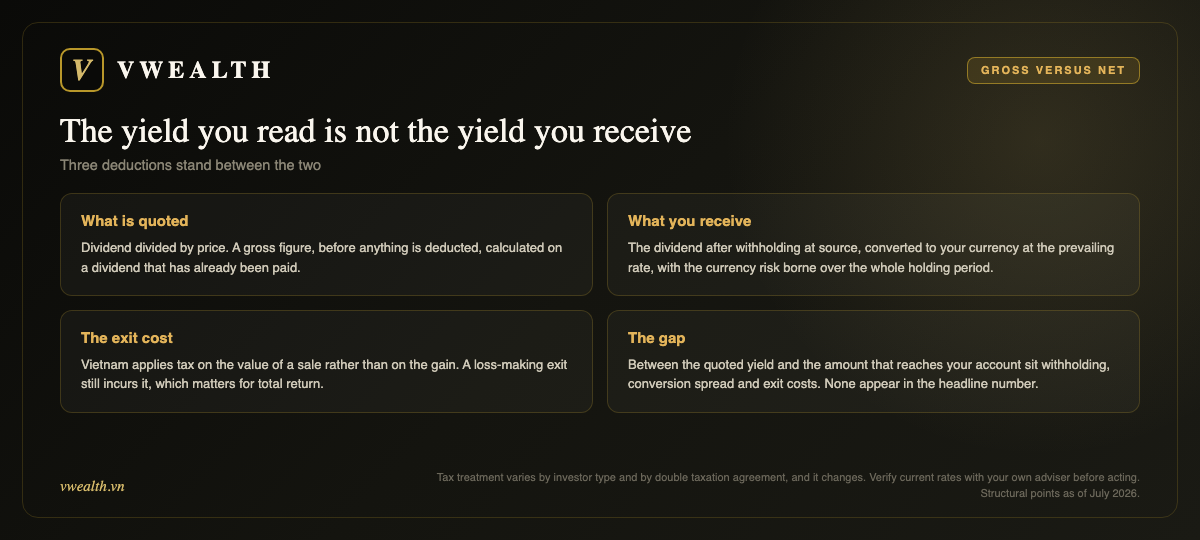
Short answer: They can be, but the quoted yield overstates what you receive. Between the headline figure and your account sit withholding at source, currency conversion, and an exit cost applied to the value of a sale rather than to the gain. Check payout ratio and cash coverage before treating any yield as sustainable.
Four corporate actions, only one of which pays you

This distinction causes more confusion among foreign investors than any other feature of the market, because the announcements use similar language.
Cash dividend
Money leaves the company and arrives in your account. This is the only one of the four that constitutes income.
Stock dividend
The company issues new shares to existing holders. You end up with more shares, and the share price adjusts downward correspondingly on the ex-date.
Your ownership percentage is unchanged. The company’s assets are unchanged. Nothing has been distributed — it is an accounting entry that redistributes the same value across more units.
This is worth being blunt about because stock dividends are frequently reported as “a dividend of X percent”, and screeners sometimes include them in yield calculations. If a yield looks unusually high, check whether it includes stock distributions.
Bonus issue from reserves
Mechanically similar. Reserves are capitalised into share capital and new shares issued. Again, no cash and no value created.
Rights issue
Not a distribution at all — the company is asking shareholders for additional capital. It appears in the same announcement stream as the others, which is why it occasionally gets misread as a benefit.
For an income investor the practical rule is simple: count only cash dividends, and verify the form before relying on any yield figure.
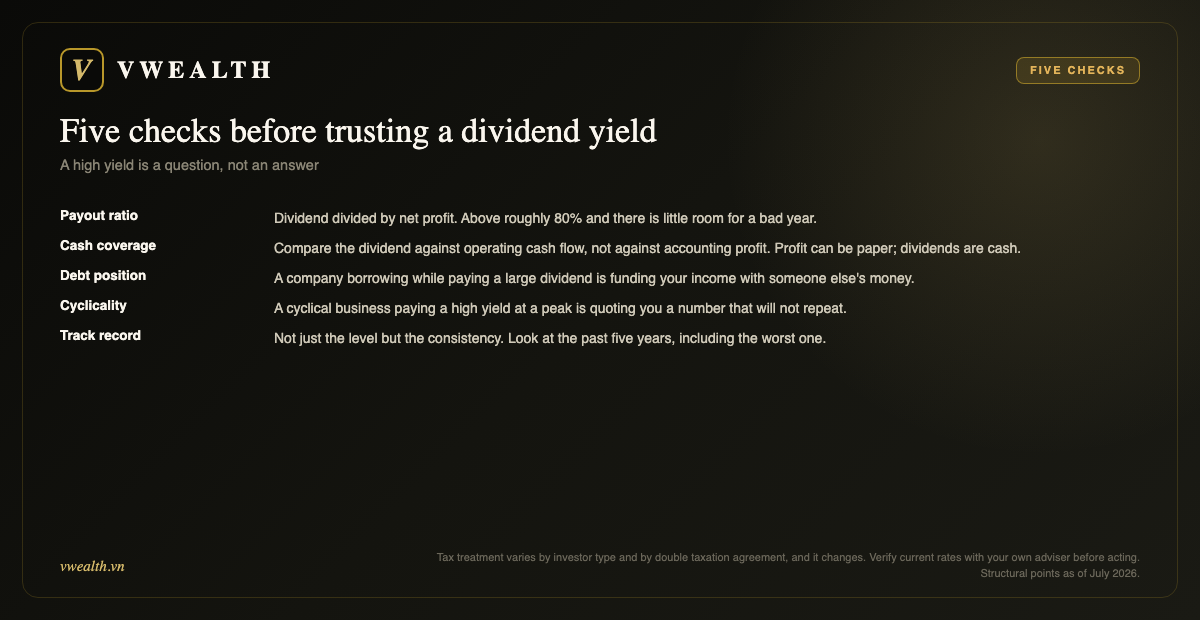
Five checks before trusting a yield
1. Payout ratio
Dividend divided by net profit. It tells you how much cushion exists if earnings fall.
A very high payout ratio means a bad year forces a cut, and dividend cuts are usually accompanied by a sharp price decline — so the income investor takes both hits at once.
2. Cash coverage
Compare the dividend against operating cash flow rather than accounting profit.
Profit can be recognised without cash arriving — a company with growing receivables reports earnings while the money sits with customers. A dividend is unambiguously cash. When the two diverge for several quarters, the dividend is being funded from somewhere other than operations.
3. Debt position
A company increasing borrowings while maintaining a large distribution is, in effect, paying your income with borrowed money. That can be reasonable for a short period and is a warning sign when sustained.
4. Cyclicality
The trap specific to this market, because cyclical sectors carry a large index weight here.
A steel, chemical or shipping company at a cyclical peak generates unusual profit, pays an unusual dividend, and displays an unusually attractive yield — at exactly the moment the earnings base is least sustainable. Our piece on steel and industrials covers how to spot where in the cycle a business sits.
5. Track record including the worst year
Look at five years, and pay particular attention to what happened in the weakest one. A company that maintained its distribution through a difficult year is telling you something a good year cannot.
Gross yield versus what reaches your account
Withholding at source
Cash dividends paid to individual shareholders are subject to withholding in Vietnam. Treatment for corporate holders differs and can be affected by a double taxation agreement between Vietnam and your country of residence.
Rates and treatment change, and they depend on your specific circumstances. Establish your position with your own adviser before building an income thesis — this article describes the structure, not your liability. The broader picture is in taxes for foreign investors.
The exit cost that surprises people
Vietnam applies tax on the value of a sale rather than on the gain realised.
The consequence is one that developed-market investors rarely anticipate: selling at a loss still triggers the charge. There is no offsetting of losses against gains in the way a capital gains regime allows.
For a dividend strategy this matters at both ends. It raises the effective cost of entering and exiting positions, and it argues for longer holding periods — churning a dividend portfolio is more expensive here than the commission schedule suggests.
Currency
Your income arrives in dong and your return is measured in your own currency. The dong does not float freely, and a depreciation over the holding period reduces the real yield regardless of what the company paid.
For an income investor holding for years, this is not a minor consideration — it can exceed the entire dividend. Mechanics in what the dong means for USD returns.
A worked example of total return
Illustrative figures, chosen to show the method rather than to describe any listed company.
The headline. A stock trades at 40,000 dong and paid 2,800 dong in cash dividends over the past year. Quoted yield: 7%.
Adjust for withholding. Assume a 5% withholding applies to your holding structure. The cash reaching the account is 2,660 dong, so the net yield is 6.65%.
Adjust for currency. Suppose the dong depreciates 2% against your reporting currency over the year. The dividend is worth about 6.5% in local terms after conversion, and your capital position has also lost 2%.
Add the exit cost. If you sell the position at some point, tax applies to the sale value regardless of gain. Spread across a five-year holding period that cost is modest per year; across a one-year holding period it is material.
The comparison that matters. Set the result against what a local bank deposit pays, because that is the alternative the marginal domestic buyer is weighing. If deposits pay close to the net dividend yield, the equity is carrying additional risk for very little additional reward.
None of this makes the stock unattractive. It changes what you are comparing it against, and the comparison is what determines whether the position makes sense.
Why the holding period changes the answer
Because two of the three deductions are one-off and one is recurring.
Withholding recurs with each dividend. The exit cost happens once. So the longer the holding period, the more the exit cost amortises and the closer your realised yield sits to the net dividend yield.
This is the structural reason dividend investing in Vietnam rewards patience more than it does in markets with capital gains treatment — not as a philosophical preference, but as arithmetic.
Reading a Vietnamese dividend announcement
The announcements follow a pattern, and knowing the four fields saves a great deal of misinterpretation.
The rate, expressed on par value. This is the field that causes the most confusion. Vietnamese companies typically state dividends as a percentage of par value rather than of market price. A “20% dividend” on a par value of 10,000 dong means 2,000 dong per share — not 20% of the market price.
If the market price is 60,000 dong, that 20% announcement is a yield of about 3.3%, not 20%. This single misreading accounts for a large share of the confusion foreign investors have about Vietnamese yields.
The form. Cash, stock, or a combination. Frequently both in the same announcement.
The ex-date. Buy before it to be entitled; the price adjusts on it.
The payment date. Often weeks after the ex-date. Cash arrives then, not on the ex-date.
The par value point deserves emphasis
Because it works in both directions. A company announcing a 50% dividend on par value is paying 5,000 dong per share — which on a 20,000 dong stock is a 25% yield, and on a 200,000 dong stock is 2.5%.
Always convert the announcement to dong per share, then divide by the market price. Never read the announced percentage as a yield.
Where the sustainable payers tend to sit
Described as sector characteristics, not as recommendations.
Consumer staples and established consumer brands
Stable demand, modest capital requirements, predictable cash generation. Structurally the natural home for a dividend strategy, and typically the sector with the longest unbroken payment records. See the consumer sector piece.
Utilities and infrastructure
Regulated or semi-regulated revenue, long asset lives, steady cash. The counterweight is that heavy capital expenditure cycles can interrupt distributions.
Banks
Complicated. Distribution policy interacts with capital adequacy requirements, and regulators have a view on how much capital a bank retains. Bank dividends in Vietnam are frequently paid in stock rather than cash for exactly this reason — which brings us back to the first section. Detail in the banking sector guide.
Cyclicals
Capable of very large distributions at the right point in the cycle and none at the wrong point. Treatable as a source of variable income, not as an anchor.
Three mistakes
Screening on yield alone
The highest-yielding names on any screen are usually there because the price fell, and the price usually fell for a reason the market has already identified. A high yield is the market’s way of expressing doubt about sustainability.
Counting stock dividends as income
Covered above, and worth repeating because screeners can obscure it. If the yield looks anomalous relative to the sector, check the form of distribution first.
Ignoring the ex-date mechanics
The price adjusts on the ex-date by approximately the distribution amount. Buying just before the ex-date to capture a dividend gains you the dividend and costs you the price adjustment. It is not free money, and after withholding it is often slightly negative.
Building an income position, step by step
A practical sequence for anyone constructing this rather than reading about it.
Step 1 — screen on cash distributions only
Filter out stock dividends and bonus issues before anything else. Depending on the data source this may require checking each name individually, which is tedious and eliminates most of the false positives immediately.
Step 2 — apply the five checks
Payout ratio, cash coverage, debt trend, cyclical position, five-year record including the worst year. Most names that survive step one do not survive step two.
Step 3 — convert every announced rate properly
Announced percentage on par value, converted to dong per share, divided by current market price. Do this manually for the shortlist rather than trusting a screener’s yield column.
Step 4 — model the net
Withholding, currency assumption, amortised exit cost across your intended holding period. Compare against the local deposit rate.
Step 5 — size for illiquidity
Income positions are held for years, which means the exit may happen in poor conditions. Size against average daily traded value so that exiting does not require accepting a bad price.
Step 6 — write down the cut trigger
What would make you sell. For an income position the natural trigger is not price but the distribution itself: a cut, or a switch from cash to stock, or cash coverage falling below the distribution for two consecutive years.
Written in advance, that trigger prevents the most common income-investing failure — holding a broken payer because the yield on your original cost still looks good.
The yield-on-cost trap
Worth its own section because it is so widespread.
After holding a stock for several years, investors often calculate the current dividend against their original purchase price rather than the current market price. The resulting number is large and comforting and analytically meaningless.
The relevant comparison is always the current yield against the current price, because that is the decision you face today: hold this, or sell it and buy something else. What you paid years ago does not enter that calculation.
Yield on cost measures your past luck. Current yield measures your present choice.
How dividend investing interacts with the upgrade
The index reclassification effective 21 September 2026 touches an income strategy in ways that are not obvious.
It does not change dividends. Index membership has no effect on what a company distributes. Any argument connecting the two is confusing price with cash flow.
It may compress yields. If passive and active flows push prices up, the yield on those prices falls. A rising market is a headwind for someone building an income position, not a tailwind.
It concentrates in large caps. Index flow reaches the largest names, which is also where many established dividend payers sit. So the effect is felt most in exactly the part of the market an income investor shops in.
Capped names are insulated. Where foreign room is full, index flow cannot reach the stock, so yields there are less affected. This is one of the few situations where a foreign ownership cap works in an investor’s favour.
The practical implication: if you are constructing an income position through this period, the question of whether to wait is genuinely open. Buying into flow-driven price appreciation reduces the yield you lock in for years afterwards. Context in what the upgrade actually changes.
What a good dividend record looks like
Rather than a yield threshold, four qualitative markers worth more than any single number.
Cash, consistently. A company that pays cash every year, including difficult ones, is making a statement about its capital discipline that a high yield in one year does not.
A stated policy, followed. Some companies publish a target payout range. Compare the stated policy against actual behaviour over five years — the gap, if any, tells you how much the policy is worth.
Distributions that grow with earnings. A payout that rises with profit and holds steady when profit falls indicates management treating the dividend as a commitment rather than a residual.
No pattern of cash dividend followed by rights issue. Paying out cash and then asking shareholders to return it is a round trip that costs tax and achieves nothing. It is rarer than it used to be and still worth checking.
Two structures worth knowing about
Direct ownership is not the only route to Vietnamese dividend income, and the alternatives change the tax and operational picture.
Funds and ETFs
A pooled vehicle handles the trading code, the capital account and withholding at fund level. Distributions to you are then treated according to the fund’s domicile rather than Vietnam’s rules.
For a smaller allocation this removes a great deal of friction, at the cost of fees and of holding whatever the fund holds — which, given foreign ownership caps, may not be the names you would pick. Comparison in Vietnam ETFs, onshore and offshore.
Holding through an existing regional structure
Investors already operating in the region sometimes access Vietnam through an existing entity, which can alter treaty treatment.
Whether that helps depends entirely on the specific structure and residence, and it is a question for a tax adviser rather than an article. The reason to raise it is that the answer can materially change net yield, and it is worth asking before rather than after building the position.
A closing thought on income here
Vietnamese dividend investing rewards a particular temperament: someone willing to do the form-checking, convert announced rates properly, model the round trip, and then hold for years rather than trade around the ex-date.
The market makes short holding periods expensive and long ones comparatively cheap. That is unusual, and it is the single most useful thing to internalise before starting.
Frequently asked questions
Are Vietnamese dividend yields higher than regional peers?
Frequently, and part of that gap compensates for real factors — liquidity, currency management, access constraints. It is not a free premium.
How often are dividends paid?
Practice varies by company. Some pay annually after the shareholder meeting, some in instalments. Consistency of schedule is itself a signal worth noting.
Do I need to do anything to receive a dividend?
Holding through the record date is sufficient. Withholding is applied at source, so the amount arriving is already net.
Can dividends be repatriated?
Yes, through the indirect investment capital account established at setup. The path is defined by that structure — which is one reason to understand it before you need it. See choosing a broker in Vietnam.
Should I reinvest dividends manually?
There is no automatic reinvestment mechanism, so reinvesting means placing a new order and incurring the costs again. Given the exit charge applies to sale value, accumulating dividends and deploying them less frequently in larger amounts is usually more efficient than reinvesting each payment.
Is a stock dividend ever a good sign?
It can indicate a company preserving cash for growth or for regulatory capital, which may be entirely sensible. What it is not is income.
Summary
A dividend strategy in Vietnam dividend stocks works, with three adjustments to how the numbers are read.
Count only cash distributions. Test sustainability against operating cash flow and the payout ratio rather than against a headline yield. And model the full round trip — withholding, currency, and an exit cost applied to sale value rather than to gain.
Do that and the yields that survive are considerably fewer than a screen suggests, and considerably more reliable.
Further reading: the complete guide to the Vietnamese market, what blue chip means here, and reading Vietnamese financial statements.
This article is for information and education. It is not investment, legal or tax advice, and it is not a recommendation of any security. Tax treatment depends on your circumstances and residence — verify with your own adviser. Structural points as of July 2026.