Every time you buy a phone assembled in Bac Ninh, a pair of shoes stitched in Binh Duong or a bag of coffee shipped to Europe, that shipment may well have passed through a berth operated by Gemadept. That is what makes GMD stock different: you aren’t betting on a product or a consumer brand, but on the very flow of Vietnam’s import-export goods — a lifeline that only grows larger as the country integrates deeper into the global supply chain.
Gemadept JSC (HOSE: GMD) is Vietnam’s number-one private seaport operator. Its two “jewels” say it all: in the south is Gemalink — the largest deep-water port in the Cai Mep – Thi Vai cluster, one of the few ports in Vietnam able to receive mother vessels of up to 232,000 tonnes (equivalent to 24,000 TEU) sailing straight to Europe and the Americas without transshipment; in the north is the Nam Dinh Vu port cluster (Hai Phong), the most important cargo gateway of the north. This “two-pole port” structure across north and south makes GMD the only listed business owning and operating an integrated port–logistics system spanning the whole country.
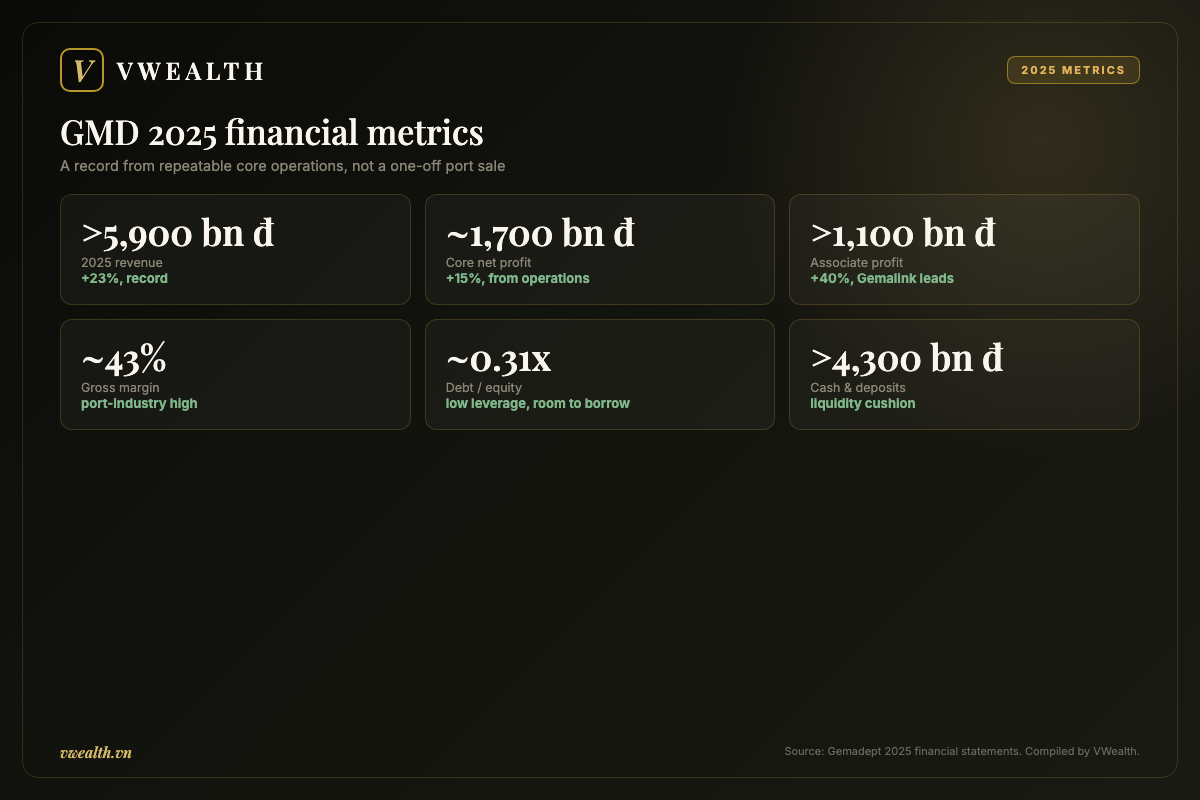
In 2025, Gemadept set a record: revenue exceeded 5,900 billion dong (up about 23%) and core profit peaked at about 1,700 billion dong — a notable figure because this profit comes from real operations, no longer relying on one-off gains from asset sales as in previous years. As of 19 June 2026, GMD stock traded around 77,000 dong.
So the question for you is very concrete: should you buy GMD at this price, and what kind of investor does this seaport stock suit? To answer thoroughly, you need to understand Gemadept isn’t an overnight phenomenon. This is a business that has accompanied the country for over three decades, from a small shipping agency to a leading port–logistics group. That history isn’t just about the past — it reveals the very strategic DNA deciding this stock’s future. Let’s start from the origin.
GMD market data (updated 19 June 2026)
| Current price | 77,000đ | 2025 revenue | >5,900 bn (+23%) |
| Change (June) | +5.05% | 2025 net profit | ~1,700 bn (core peak) |
| P/E | P/B | ~18–20x | ~2.5–3x | Gemalink | Gross margin | ~1.69m TEU | ~43% |
GMD is a growth PORT-INFRASTRUCTURE stock (high margin, premium valuation). Volume is sensitive to the trade cycle + tariffs. Part of past profit came from selling ports (one-off). Source: VWealth + GMD 2025 reports. For reference only.
History and evolution
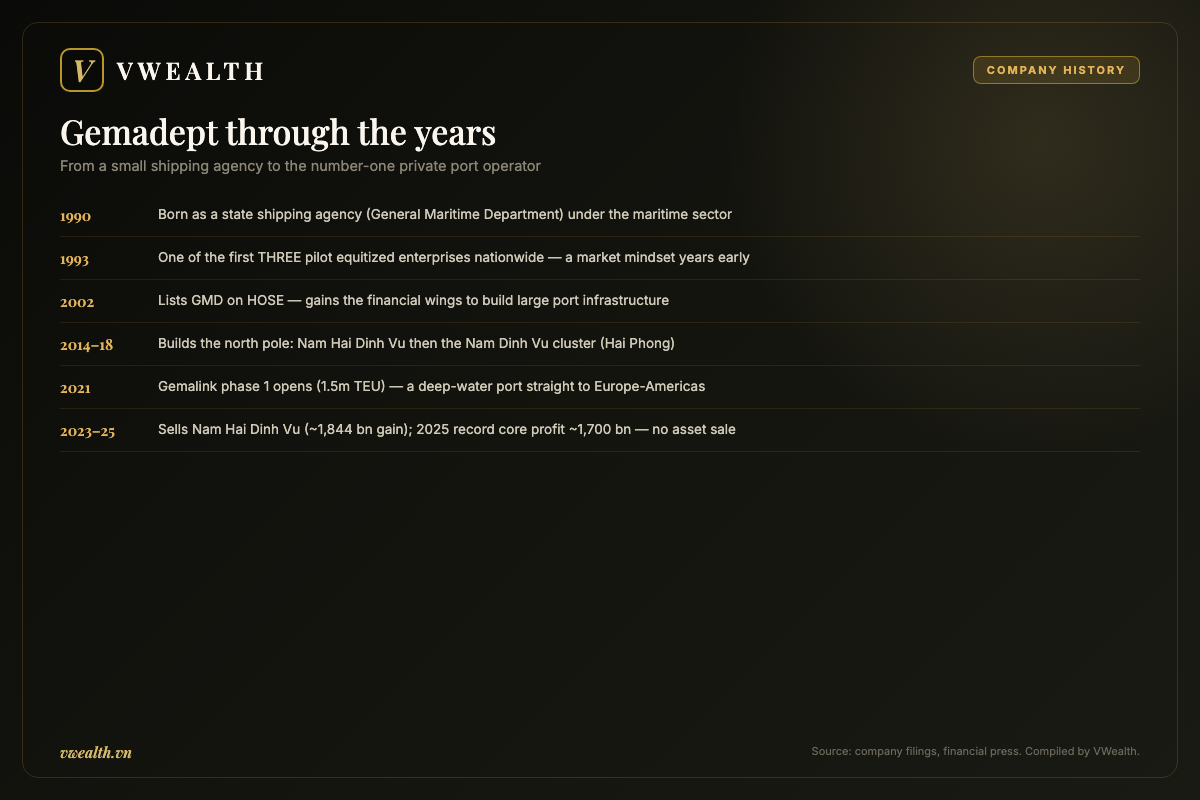
To understand why Gemadept today can stand in the number-one position, you must go back to 1990 — when Vietnam was still taking its first tentative steps in the Doi Moi (reform) era, when the concept of a “private port operator” barely existed. GMD’s journey, in the company’s own words, is “a journey accompanying the country,” and that isn’t empty talk.
Origin 1990: from a state shipping agency
Gemadept was born in 1990, its forerunner a state enterprise under the maritime sector — the General Transport Agency, within the Vietnam Maritime Union. The name “Gemadept” itself tells the origin: short for General Maritime Department. In this early stage, the company did the work of a shipping agency: representing foreign carriers, handling procedures, connecting cargo with vessels. It was a service link, owning no port infrastructure at all.
What’s worth remembering is this “agency” starting point. It shaped Gemadept’s thinking from the outset: understanding cargo flows very well, understanding carriers’ needs, understanding procedures and the flow of international trade. When the business later built ports, it didn’t build like a mere construction contractor, but with the eye of a transport-service provider — knowing what carriers need, knowing where cargo goes. This is a “soft” advantage a business starting from concrete and steel struggles to have.
1993: a historic transformation — one of the first three pilot equitized enterprises
The real turning point came in 1993. Back then, the Vietnamese state began experimenting with a very new idea: equitizing state enterprises. Gemadept was chosen as one of the first three enterprises the state selected for pilot equitization nationwide. With a modest starting charter capital of just a few billion dong, the company officially donned the joint-stock cloak.
Don’t dismiss this “one of the first three” detail. It’s not just a nice line in the profile. Being chosen for pilot equitization so early gave Gemadept two things many rivals in the port industry — mostly still state enterprises until much later — didn’t have:
- A market-governance mechanism years earlier. Having to answer to shareholders from the 1990s, the leadership was forced to think efficiency, profit and growth, rather than operate under a subsidy mechanism.
- Flexible capital-raising ability. As a joint-stock company, Gemadept could raise capital, issue shares, partner with foreign investors — the key financial tools to build the multi-trillion-dong deep-water ports later.
In other words, 1993 planted the seed for a “privatized-mindset business” in an industry with a very heavy state character. That was the start of a long-term competitive advantage.
2002: listing on HOSE, entering the public-capital arena
Nearly a decade after equitization, Gemadept took a decisive step: listing GMD stock on the Ho Chi Minh Stock Exchange (HOSE) in 2002, at a very early stage of Vietnam’s stock market (which only opened in 2000). Listing not only helped the company become transparent and access a wide pool of capital, but also officially turned GMD into a public investment choice — so that today you can consider putting money in.
From this milestone, Gemadept had financial “wings” to enter the large-scale infrastructure-building phase. And this was when the company’s story shifted from “service agency” to “infrastructure investor–operator.”
From a transport agency to an integrated port–logistics ecosystem
This is the core part helping you understand Gemadept’s nature today. Unlike a business owning a few scattered berths, Gemadept pursues an integrated ecosystem model: the seaport at the center, surrounded by inland container depots (ICDs), logistics centers, cold storage, river–road transport and freight forwarding. The goal is for a shipment to travel the whole chain without leaving Gemadept’s system — thereby retaining more margin and “locking in” customers more tightly.
This integration happened in many steps. A few milestones illustrate that ambition:
- 2014: Gemadept raised charter capital and put the Nam Hai Dinh Vu port in Hai Phong into operation — planting a firm foothold at the northern cargo gateway.
- 2015: Put into operation a logistics center and cold storage of the largest single-facility scale in Southeast Asia in the Mekong Delta — expanding from “port” to “deep logistics.”
- 2018: Inaugurated phase 1 of the Nam Dinh Vu port cluster, the foundation for GMD’s largest strategic stronghold in the north.
- 2020: Launched a customer-service center and a dedicated e-portal for the port–ICD–logistics system, pushing digital transformation in operations.
Each of these steps isn’t separate. They form a network where the seaport draws cargo, while logistics and domestic transport keep the cargo within the system. When you look at the 2025 financial statements and see the logistics–office-leasing segment contributing nearly 700 billion dong alongside over 5,200 billion dong from port operations, that’s the fruit of the integration strategy planted a decade ago.
The “two-pole port” strategy: balancing north and south
If you had to sum up Gemadept’s positioning in one idea, it’s two poles. In the north, the company builds and reinforces a port cluster in Hai Phong — starting with Nam Hai, then Nam Hai Dinh Vu, and culminating in the Nam Dinh Vu cluster. In the south, the company bets big on the Gemalink deep-water port in Cai Mep – Thi Vai. These two poles hit two different economic engines of the country:
| Criterion | Northern pole (Hai Phong) | Southern pole (Cai Mep) |
|---|---|---|
| Main stronghold | Nam Dinh Vu port cluster | Gemalink deep-water port |
| Vessel type served | Feeder ships, intra-Asia, northern domestic cargo | Large mother vessels sailing straight to Europe-Americas |
| Cargo driver | Manufacturing, FDI and northern import-export | Long-haul trade, global supply chain |
| Strategic role | Stable cash flow, steady volume | High growth, a rare hard-to-copy advantage |
The benefit of the two-pole positioning for you — an investor — is risk balance. When one region struggles (e.g. price competition in Hai Phong due to local oversupply), the other can offset. At the same time, GMD reaps both waves fully: the manufacturing-FDI wave shifting to the north, and the global-trade wave flowing to the southern deep-water cluster.
Gemalink: a hard-to-copy strategic jewel
In the whole journey, no milestone matters more to GMD’s future than Gemalink. This is a deep-water port built in Cai Mep – Thi Vai, a partnership between Gemadept (holding a controlling ~75%) and CMA Terminals — a subsidiary of CMA CGM, one of the world’s leading container carriers, from France. CMA CGM’s presence brings not just capital, but more importantly cargo: a large carrier committing to bring its ships to the port is a guarantee of volume.
The port received its first commercial vessel and officially operated phase 1 from 2021, with a capacity of about 1.5 million TEU/year. Why is Gemalink a “hard-to-copy” advantage?
- A rare deep-water location. Cai Mep is one of very few areas in Vietnam with a channel deep enough to receive the world’s largest mother vessels. Gemalink is among the few global ports able to receive container ships of up to over 232,000 tonnes.
- Direct Europe-Americas routes. Receiving mother vessels means Vietnamese cargo can ship straight to Europe and North America without transshipping through Singapore or Hong Kong — saving time, cost, and keeping value in the country.
- Proven performance. After 5 years of operation (2021–2025), Gemalink has received over 2,000 vessel calls with throughput of about 6.5 million TEU, growing double digits steadily — proving this isn’t a paper project.
A deep-water port like Gemalink takes years to permit, clear the site, build and, especially, to win the trust of large carriers to bring in mother vessels. That’s a natural entry barrier protecting Gemadept’s advantage — something money can’t buy quickly.
The ambition doesn’t stop. In April 2026, Gemadept and CMA CGM officially broke ground on Gemalink phase 2 right at Cai Mep – Thi Vai. When complete, the cluster’s total capacity will exceed 3 million TEU/year, cementing its position as Vietnam’s number-one deep-water port. This is the long-term growth driver you need to track closely when assessing this stock.
Divesting from non-core segments: discipline returning to the core
A mature business shows not only in daring to invest, but in knowing when to let go. In the past, Gemadept once “ventured” into non-core fields like rubber cultivation (in Cambodia) and real estate (projects like Saigon Gem). These investments, at the time, may have been expected to create supplementary profit.
However, management later made a strategic decision: divest from non-core segments to concentrate fully on the port–logistics core. Finding partners to transfer the rubber and real-estate projects reflects a clear philosophy — Gemadept wants to be a top expert in one field, rather than spread thin across many. For you, this is a positive governance signal: the business concentrates capital where it has a real competitive advantage.
The “buy – build – sell to lock in gains” art in the port portfolio
A very distinctive trait in Gemadept’s history is that it doesn’t view ports merely as assets to hold forever, but as a portfolio to be optimized. The most emblematic deal was selling Nam Hai Dinh Vu port in 2023. Gemadept transferred a large stake in this port to an investor group (including Viconship/Container Vietnam), reaping a one-off profit of over 1,800 billion dong. Thanks to this deal, GMD’s full-year 2023 profit jumped to a record of about 2,220 billion dong.
Next, the company also divested from Nam Hai port, again booking profit. The logic behind these deals is very consistent with the “two-pole port” strategy:
- Locking in gains when valuation is attractive. When a port has matured and someone is willing to pay a high price, selling to realize value is a wise financial decision.
- Reallocating capital to higher-return projects. Proceeds from selling old ports are poured into the “big plays” like expanding Nam Dinh Vu and Gemalink phase 2 — where growth potential is superior.
- Reducing internal competition and oversupply risk. The Hai Phong area has many competing ports; divesting some feeder ports to focus on the strongest stronghold is a way to streamline the portfolio.
What you need to note when reading GMD’s financial statements: clearly distinguish one-off profit (from selling ports, non-recurring) and core profit (from operating ports, recurring annually). The 2,220-billion profit peak in 2023 was largely thanks to selling Nam Hai Dinh Vu — it doesn’t reflect regular operating health. Conversely, the about 1,700 billion dong of 2025 is the real profit from the business, and this is the measure you should use to value the company.
2025: the peak of a three-decade journey
All the steps planted from 1990 to now clearly bore fruit in 2025. Gemadept booked net revenue over 5,900 billion dong, up about 23% year on year and a record for the second straight year. The main driver came from port operations with over 5,200 billion dong (up 25%), while logistics and office leasing contributed nearly 700 billion dong.
More important than the revenue figure, GMD’s profit was strongly reinforced by over 1,100 billion dong of profit from joint-venture and associate companies, up nearly 40% versus 2024, with Gemalink playing the leading role. As a result, core profit peaked at about 1,700 billion dong. At the same time, the Nam Dinh Vu port cluster phase 3 was completed and put into operation from late 2025, significantly raising throughput at the northern pole.
The 2025 story thus carries a special meaning: for the first time, Gemadept proved it can set a profit record without relying on one-off asset sales. The core operating machine — container volume through the ports, improving margins, Gemalink contributions — was strong enough to generate a profit peak on its own. That’s the maturity a long-term investor always seeks.
Lessons from history for your investment decision
Looking back over the whole journey, there are three red threads throughout you should remember before considering buying GMD:
- Long-term strategic thinking. From a shipping agency, Gemadept patiently built an integrated port–logistics ecosystem spanning the country. This isn’t a short-term opportunist.
- Capital-allocation discipline. It dares to invest big where it has an advantage (Gemalink, Nam Dinh Vu) and decisively divests where it doesn’t (rubber, real estate, even matured ports).
- A hard-to-copy competitive advantage. The Gemalink deep-water port and the north-south two-pole positioning create an entry barrier rivals find very hard to overcome in the short term.
However, history only answers “who Gemadept is and where it’s strong.” To know whether to buy GMD at 77,000 dong and what kind of investor this stock suits, you need to go deeper into the people steering the ship. Because however sharp a strategy is, it depends on those executing it. Let’s learn about Gemadept’s leadership in the next section.
Leadership and ownership structure
When you analyze an infrastructure business like Gemadept (ticker GMD), the financial numbers are only the tip of the iceberg. The submerged part — what decides whether a port company turns a location advantage into sustainable cash flow — lies in the quality of the people at the helm and in who really stands behind the shareholder register. A deep-water port can be built in five years, but capital discipline, sobriety in each buy-sell deal, and the ability to retain large carrier partners must be accumulated over decades. In this section, you and I will dissect three layers: who runs Gemadept, who owns it, and what that says about the safety of your investment.
The leadership machine: a maritime cohort committed for decades
The first thing to note about Gemadept is its internal succession. This isn’t a company that swaps leaders every market cycle, but a collective of maritime professionals who have walked together since the business was a small unit split from the state maritime sector in the early 1990s. That commitment creates an intangible capital the balance sheet doesn’t record: understanding the trade, the ports, the carriers.
Per disclosures, the person in the Chairman seat of Gemadept now is Do Van Nhan. Let me stress this so you don’t confuse it: in various documents and on the market there are some easily confused names, but corporate data confirms Do Van Nhan is the incumbent Chairman, while Do Van Minh — who was CEO for 17 years — left the executive role in May 2021, and Pham Quoc Long is a Deputy CEO, not a founder. These are details you should verify against the latest governance report before citing, as the senior-personnel structure can be reorganized at each shareholders’ meeting.
Do Van Nhan’s profile is quite typical of Gemadept’s leadership “character.” Born in 1957, with training in maritime affairs and languages, he entered the sea trade in the late 1980s. He held an executive role at Gemadept in 1993–1996, went through the Gemartrans shipping joint venture, and was once a Deputy CEO at the Vietnam National Shipping Lines (Vinalines) — meaning he understands both the carrier side and the port side, both the state and private sectors. For a business whose success depends on negotiating cargo with global carrier alliances, a leader who once sat on “the other side of the negotiating table” is a rare asset.
In the executive role, the incumbent CEO is Nguyen Thanh Binh, also a long-committed internal figure who rose from Deputy CEO before being given top executive authority. This “promote from within” model, if you’re used to scoring governance, is a positive signal: it shows the business has a clear succession path, reducing the risk of strategic disruption at each generational handover. You should cross-check the specific names and titles against the annual report and governance report published by Gemadept itself, as that is the source of highest legal authority.
For a port business, a “seasoned maritime” leadership team isn’t just about reputation. It’s the ability to read the transport cycle correctly, to know when to pour capital into building a port and when to lock in gains and retreat — a skill that can’t be recruited overnight.
Governance style: prudence and capital discipline
If I had to wrap Gemadept’s operating philosophy in a few words, I’d choose: prudence and capital discipline. You can verify this through their own big decisions over the past ten years, rather than trusting the self-description in a report.
The clearest evidence is the very sober “buy – build – sell” strategy in ports. When an asset reaches peak value and holding it no longer adds efficiency, management is willing to sell to realize profit and rotate capital to a higher-margin project. The emblematic deal is transferring Nam Hai Dinh Vu port (Hai Phong) in 2023: Gemadept divested most of its stake in this port to an investor group, reaping about 1,800 billion dong and booking a one-off gain of over 1,840 billion dong. This wasn’t “selling green rice” — it was disciplined profit-taking: selling a matured port in the fiercely competitive north to concentrate on the southern deep-water cluster, where the growth runway is far larger.
In the same spirit, Gemadept has persistently divested from non-core segments — like the Cambodian rubber project and real-estate projects (Saigon Gem, Gemadept Vientiane) — to concentrate all resources on the port-and-logistics axis. For a long-term investor like you, this is a sign of a leadership that knows what it’s good at and doesn’t stray into adventures beyond its core competence. In Vietnam’s market history, quite a few good businesses have weakened themselves by chasing “multi-industry” ambitions; Gemadept goes against that trend, and that’s a significant governance plus.
Another sign of prudence is that many leaders and related persons register to buy more GMD shares during market corrections. When insiders put their own money into accumulating shares, it’s usually a signal they believe in the business’s intrinsic value — though you should treat this as reference data, not a buy recommendation, and always consider that insider transactions can have many motives.
Ownership structure: dispersed, not state-controlled
This is the part I want you to read very carefully, because the ownership structure decides “who really steers” and whether the interests of small shareholders like you are protected.
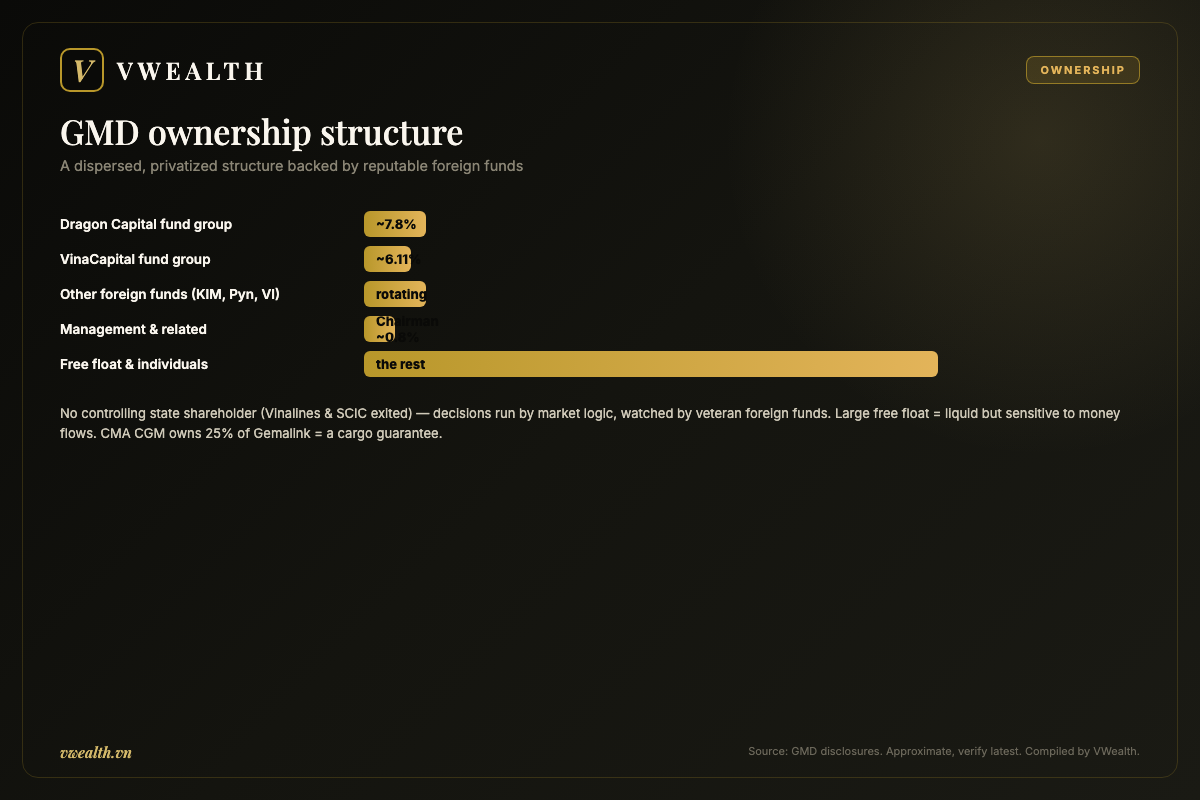
The key point: Gemadept no longer has a controlling state shareholder. In the past, this business bore traces of state capital through the maritime sector, but both the Vietnam National Shipping Lines (Vinalines) and the State Capital Investment Corporation (SCIC) have divested. As a result, Gemadept today is a fully privatized business in ownership, with a dispersed shareholder structure. For you, this cuts two ways. The positive: the business decides by market logic, flexibly, unbound by the administrative mechanism of a large state shareholder. The caution: because no large shareholder holds absolute control, the “voice” of direction rests with the alliance between management and large funds.
So who holds GMD? The current picture has four interwoven layers:
First, management and related persons. This isn’t a group holding a controlling stake — for instance, Chairman Do Van Nhan alone owns about 0.8% (over 3.4 million shares), plus his family members’ portions. This ratio is modest versus “family-rule” businesses, but enough to align the operators’ interests with shareholders’. You should understand that Gemadept management’s power comes more from operating capability and professional reputation than from an overwhelming ownership stake.
Second, large foreign funds. This is the institutional-shareholder layer creating credibility for GMD. The VinaCapital fund group raised ownership to about 6.11% (equivalent to nearly 26.1 million shares, per an early-2026 disclosure), while the Dragon Capital fund group — one of the most veteran institutional investors on Vietnam’s market — holds around 7.8% (about 86–89 million shares, fluctuating through portfolio-rebalancing trades). There is also the presence of funds like the KIM Vietnam Growth Equity Fund (Korea), Pyn Elite Fund and VI Group at various points. When such professional fund names hold a stock together, it’s an indirect “vetting” layer: they have their own analyst teams, and their maintaining a large position in GMD is a vote of confidence in the business’s governance quality.
Third, domestic institutions and rotating large shareholders. This structure isn’t static. For example, SSJ Consulting (Vietnam) once held over 4.62% but sold all and left the shareholder list. This rotation is normal for a liquid stock, but also reminds you that ownership figures are only accurate at the disclosure moment — you need to check the latest major-shareholder and ownership reports before each decision.
Fourth, a fairly large free-float. This is the part for individual investors and small institutions. A high free-float is a double-edged sword: it gives the stock ample liquidity, with the price closely reflecting market supply-demand; but it also makes the price more sensitive to money flows and short-term sentiment. As a long-term investor, you should view free-float-driven price swings as accumulation opportunities rather than reasons to panic.
| Shareholder group | Role | Ratio note (reference, verify) |
|---|---|---|
| Management & related persons | Operating, aligned interest | Chairman alone ~0.8%; total insider group modest |
| Dragon Capital fund group | Veteran foreign fund | Around ~7.8% (fluctuates with trading) |
| VinaCapital fund group | Large foreign fund | ~6.11% (early 2026 disclosure) |
| Other foreign funds (KIM, Pyn Elite, VI Group…) | Foreign institutions | Rotating presence |
| Free-float & individual investors | Market liquidity | The rest, large weight |
To visualize this dispersed ownership picture, see the chart below.
The strategic partner CMA CGM at Gemalink: a cargo guarantee for the deep-water port
In Gemadept’s whole ownership story, there’s one relationship I believe you must not overlook: the joint venture at Gemalink — the largest deep-water port in the Cai Mep – Thi Vai cluster. Here, Gemadept holds about 75%, while the remaining 25% belongs to CMA Terminals, a subsidiary of the French shipping group CMA CGM — the world’s third-largest container carrier.
Why does this 25% matter so much, even though it isn’t a controlling stake? Because for a deep-water port, the life-or-death issue isn’t finishing the berth, but whether mother vessels call or not. A modern berth without ships is just concrete burning depreciation. When a global carrier the size of CMA CGM becomes a co-owner, it has a direct incentive to route its services, bring its cargo and mother vessels to Gemalink. In other words, CMA CGM’s 25% ownership isn’t just capital — it’s a cargo commitment, a guarantee for the port’s throughput.
In the port industry, “who owns the port” and “who brings cargo to the port” are usually two separate stories. Gemalink cleverly merges them: turning a giant carrier into a shareholder, so the cargo interest and the operating interest flow in one direction.
For you, the investment meaning of this relationship is that it sharply reduces the biggest risk of new deep-water port projects — the risk of idle capacity in the early years. At the same time, it lifts Gemalink’s bargaining position with the whole logistics ecosystem around Cai Mep. You should track news about Gemalink being permitted to receive larger vessels (the port has been approved to receive very large container ships) and the phase-2 progress — those are indicators the Gemadept – CMA CGM alliance is bearing fruit.
Governance, dividends and profit-distribution discipline
A good leadership that’s “stingy” with shareholders isn’t the ideal choice for a long-term investor either. On this front, Gemadept scores with its tradition of steady cash dividends. Looking at recent history, the business kept stable cash payouts: around 20% for 2022, 22% for 2023, 20% for 2024, and a jump to 30% in cash (equivalent to 3,000 dong a share) for 2025. Raising the cash-dividend ratio amid a volatile transport market shows two things worth noting: Gemadept’s operating cash flow is healthy enough, and management is committed to sharing results with shareholders rather than retaining everything.
Note that the 2025 dividend increase was partly “boosted” by one-off gains from port divestment — so don’t rush to extrapolate the 30% level as the norm for every year. More important than a single year’s figure is the distribution discipline: Gemadept doesn’t pay dividends on a whim, but balances between paying shareholders cash and retaining capital for the big port projects underway. This is a sign of mature capital-allocation thinking.
On governance transparency, Gemadept maintains relatively full disclosure: annual reports, governance reports, shareholder-meeting documents and major-shareholder transaction bulletins are all public. The permanent presence of large foreign funds like Dragon Capital and VinaCapital also acts as an indirect “gatekeeper” on governance standards — because these funds have strict corporate-governance requirements and are willing to exit if they spot problems. When you see such disciplined funds persistently holding, it’s a layer of confirmation of the machine’s reliability.
To sum up this section: you’re looking at a business run by a maritime cohort committed for decades, by a prudence-and-capital-discipline philosophy; a dispersed ownership structure now clear of a controlling state shareholder, supported by reputable foreign funds; a world-class strategic partner behind the flagship deep-water port; and a tradition of steady cash dividends. This quartet of traits forms a solid governance foundation — the very base for the competitive advantage we’ll dig into next: Gemadept’s port and logistics system, where all the above governance decisions turn into capacity, market share and real cash flow.
Port and logistics system
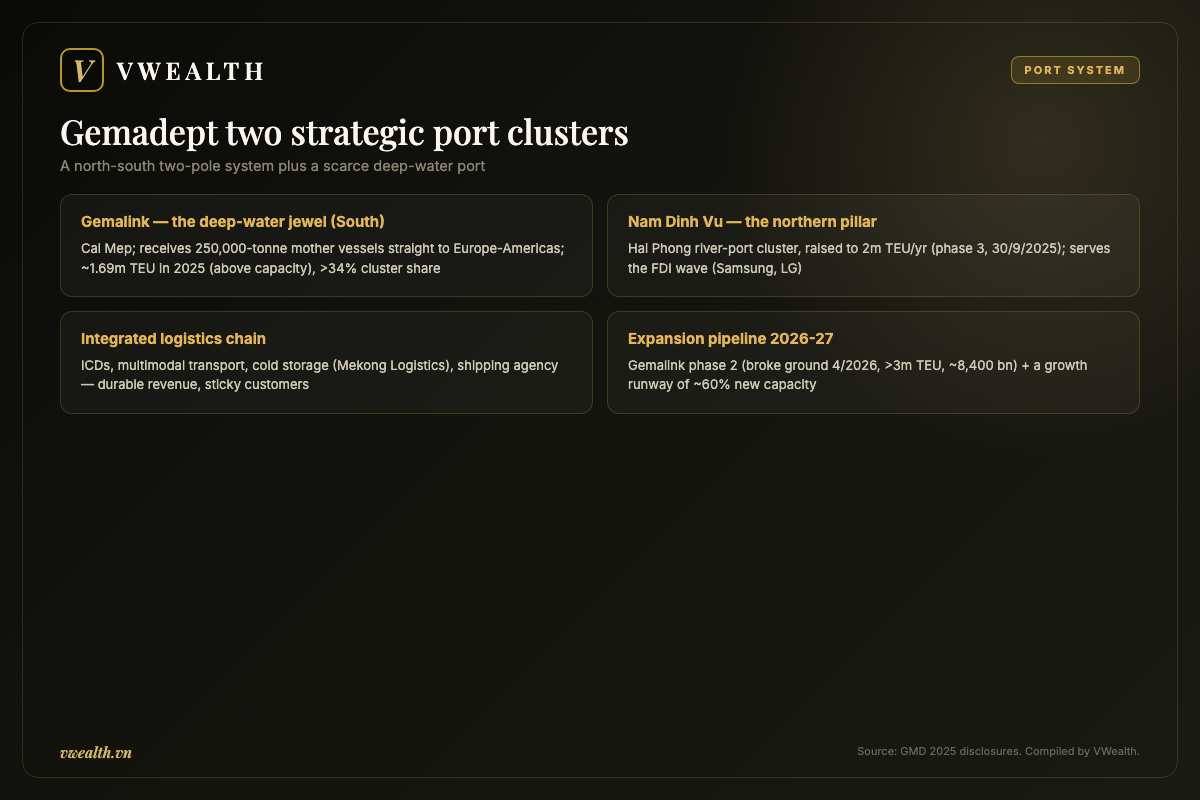
If you want to understand why analysts call Gemadept (ticker GMD) the “shark” of Vietnam’s port industry, don’t look at last quarter’s profit report first. Look at the map. On the S-shaped coastline, Gemadept plants two pillars at either end of the country: a strategic deep-water port cluster in the south named Gemalink (Cai Mep – Thi Vai), and the largest river-port cluster in the north named Nam Dinh Vu (Hai Phong). Surrounding these two poles is an integrated logistics network built over 36 years — warehouses, distribution centers, inland container depots (ICDs), river-sea-road-air transport, cold storage and shipping agencies.
In this section, you and I will dig into the “hardware” that makes up this business’s value. Because for a port company, the asset isn’t in the brand or the sales team, but in the concrete berths, the channel depth, and the geographic location — things almost impossible to copy. Understand GMD’s port system, and you’ll understand why this is an infrastructure asset with a very wide economic moat, and why its cash flow has a very distinctive “toll-collecting” character.
Why is a port worth so much?
Before naming each one, let’s clarify a foundational concept, because it’s the key to valuing the whole industry. A container port doesn’t sell a product — it sells a handling service. The measurement unit is the TEU (Twenty-foot Equivalent Unit), i.e. one standard 20-foot container. Each time a ship calls and a crane lifts a container to the yard (or onto the ship), the port collects a fee. The more TEU volume, the higher the revenue.
What makes this model financially attractive is its cost structure. To build a port, you must spend an enormous sum upfront: dredging the channel, driving piles, pouring the berth concrete, buying ship-to-shore (STS) cranes worth millions of dollars each. This is a very large fixed cost, very “hard to swallow” in the early phase. But once the port is built and running stably, each extra TEU adds almost no cost — the crane is the same crane, the berth is the same berth, just a little more electricity and labor. In other words, a port’s margin rises with volume: the fuller the port, the more each extra container “profits richly.”
Picture a toll bridge: the bridge-building cost is fixed and enormous, but once the bridge is done, the millionth vehicle crossing adds almost no cost — nearly all the toll collected flows straight into profit. A seaport operates by exactly that logic. This is why a “filled-to-capacity” port is a cash printer, while a newly inaugurated port loses money or earns thin profit in the first few years.
The consequence of this logic matters greatly for investing: when GMD puts a new port into operation (like Nam Dinh Vu phase 3 in late 2025), don’t expect a profit explosion immediately — the early phase is the “nurturing the port” phase, filling volume gradually. But as far as the volume curve rises, the margin stretches to. That’s the growth driver “built in” to the business’s expansion projects.
The southern port cluster — Gemalink: the deep-water jewel
If you had to choose one asset to call Gemadept’s “jewel,” it’s definitely Gemalink. This port sits in the Cai Mep – Thi Vai area (Ba Ria – Vung Tau, now part of expanded Ho Chi Minh City), and the special thing lies in two words: deep water.
To picture the importance of “deep water,” think about how Vietnamese cargo reaches the world. Most ports in Vietnam — even the large ports in Ho Chi Minh City or Hai Phong — are river ports with shallow channels, receiving only medium and small ships (feeders). Cargo bound for the US or Europe must be gathered by feeders to a regional transshipment hub — usually Singapore — then loaded onto super mother vessels for the long haul. This adds a leg, more time and more cost.
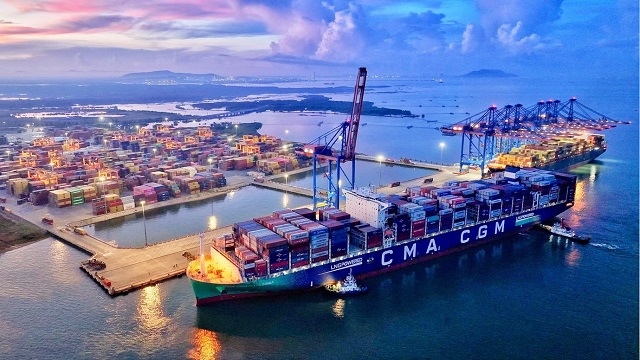
Gemalink breaks that dependence. With a deep-water channel designed to receive ships of up to 250,000 tonnes (equivalent to 24,000 TEU — among the world’s largest container ships today), Gemalink lets super mother vessels dock straight into Vietnam and sail direct on the Europe-Americas route without transshipping at Singapore. This is a national-level strategic advantage, not just corporate: it shortens Vietnamese exports’ journey, cuts logistics costs, and turns Cai Mep into a true international gateway. Gemalink is now among the 19 ports worldwide able to receive the largest container ships in operation — a very short, very prestigious list.
On scale and performance, remember these numbers:
- Phase 1 has a design capacity of 1.5 million TEU/year. In 2025, Gemalink handled about 1.69 million TEU — i.e. running above design capacity. This tells an important truth: the port is “packed,” no room left to receive more. When a port hits its ceiling like this, it’s both good news (in the highest-margin zone) and a call to expand immediately.
- After 5 years of operation (2021–2025), Gemalink has received over 2,000 vessel calls, of which nearly 70% were large ships of 160,000 to over 232,000 tonnes, with cumulative throughput of about 6.5 million TEU and double-digit annual growth.
- Gemalink now holds over 34% market share of the whole Cai Mep – Thi Vai area — a dominant position.
Precisely because phase 1 is packed, on 17 April 2026 Gemadept and its strategic partner CMA CGM (France’s leading shipping group) officially broke ground on Gemalink phase 2. When complete (expected to operate Q4 2027), the combined capacity of both phases will exceed 3 million TEU/year — i.e. double the current level. Phase 2 adds a 285-meter main berth to receive ships of up to 250,000 DWT, with total investment of about 8,400 billion dong.
The relationship with CMA CGM — why it matters to investors
There’s a detail in the ownership structure you shouldn’t overlook, because it’s Gemalink’s “volume insurance.” Gemadept holds over 65% of the port, the rest belonging to CMA Terminals — a subsidiary of carrier CMA CGM. This isn’t merely a financial capital relationship.
Recall the biggest fear of any port owner: building the port then no ships come. However beautiful the port, without a carrier calling, the berth sits idle, loss upon loss. CMA CGM — one of the world’s largest container carriers — being both shareholder and customer has almost fully solved that risk. CMA CGM now brings about 8–10 vessel calls a month to Gemalink and has honored its cargo commitment. When a carrier has “flesh-and-blood” interest in a port, it has a natural incentive to route cargo there. For an investor, this turns Gemalink from an infrastructure project “with fill-up risk” into an asset with relatively certain cash flow.
The northern port cluster — Nam Dinh Vu: the pillar in the north
While Gemalink is the arm reaching the open sea in the south, Nam Dinh Vu (Hai Phong) is GMD’s solid pillar in the north — and the largest river-port cluster in the northern region today.
Unlike Gemalink (a deep-water port receiving super mother vessels), Nam Dinh Vu is a river port serving mainly feeder ships of up to about 48,000 DWT. Don’t dismiss its role for that. Hai Phong is the import-export gateway of the entire north — a region densely packed with electronics and textile industrial zones, and especially the wave of factories shifting from China to Vietnam (Samsung, LG, and their supply chains). Cargo through Hai Phong rises steadily with FDI flowing into the north, and Nam Dinh Vu sits right on a favorable channel to receive that flow.
The most important 2025 update: on 30 September 2025, Gemadept officially put Nam Dinh Vu phase 3 into operation. This project spans 23 ha, with total investment of 2,800 billion dong, adding 650,000 TEU/year of capacity. After phase 3 operates, the whole Nam Dinh Vu cluster’s capacity rises to 2 million TEU/year, making it the largest and most modern port cluster in the north.
For you — considering GMD stock — this event has a dual meaning. On one hand, it adds a new volume-growth driver for the coming years (per the “nurture then fill gradually” logic above). On the other, it shows management executing the “north-south two-pole” strategy correctly: not putting eggs in one basket, but balancing the southern gateway (Gemalink) and the northern gateway (Nam Dinh Vu), reducing dependence on a single economic region.
The logistics ecosystem — the value chain around the two port poles
If the two port clusters are the “heart,” the logistics system is Gemadept’s “bloodstream.” This is what sets GMD apart from businesses that purely operate ports: it doesn’t stop at lifting containers on and off ships, but follows that container along the journey from port to factory and back. Over 36 years, Gemadept has built an integrated service chain across many segments:
- Inland container depots (ICDs) and warehousing: “dry ports” like Nam Hai ICD (the largest logistics facility in the north) or Phuoc Long ICD, Binh Duong Port in the south — where containers are gathered, cleared and distributed, easing the load on the seaport.
- Multimodal transport: connecting cargo by sea, inland waterway (river), road and air — a network letting GMD receive cargo “from factory door to ship door.”
- Cold-chain logistics: this is a high-value-added segment very suited to an agri-seafood-exporting country like Vietnam. Mekong Logistics cold storage is among the largest in Southeast Asia. Agricultural, seafood and frozen-food cargo needs strict preservation conditions, so customers are willing to pay more and “haggle” less than for ordinary dry cargo.
- Shipping agency and auto logistics: specialized services for carriers and the vehicle-manufacturing-and-assembly industry.
Why does this integrated chain matter to you from an investment angle? Because it creates two things the market prizes: durable revenue and customer-retention power. When an exporter has handed the whole chain — from port, ICD, transport to cold storage — to one provider, the cost and risk of “switching provider” is very high. They tend to stay. At the same time, each container passing through GMD’s system can generate revenue at multiple points (handling at the port + storage at the ICD + transport to the factory), rather than just once. This is how Gemadept “squeezes” more value from the same cargo flow.
The value model: a port is a high-margin infrastructure asset
Now let’s put it all into a coherent investment picture. Why is a port-and-logistics portfolio like GMD’s an asset worth holding long term?
First, as analyzed, a port is an infrastructure asset with a high margin after investment is done. The large upfront capital is the entry barrier — no one can build a competing deep-water port overnight, because it needs a suitable geographic location, a deep channel, permits, and thousands of billions of dong. Once the port is built and filled with cargo, cash flows in steadily with volume, at low marginal cost. This is a “hard to create but easy to profitably operate” asset — an ideal trait for a long-term investor.
Second, the growth driver comes from two macro flows you can observe independently. One is Vietnam’s import-export value — the more cargo in and out, the more TEU through the ports. Two is the wave of global supply chains shifting to Vietnam (China +1) — each new factory placed in Hai Phong or Binh Duong is another long-term cargo source for the ports. These two flows don’t depend on the temporary talent of one individual, but are tied to the whole economy’s position — so they’re highly sustainable.
Third, and most important for GMD specifically: the “north-south two-pole plus Gemalink deep-water” structure creates a hard-to-copy competitive advantage. Many businesses can run a river port well. But owning at once a deep-water port receiving super mother vessels in the south (Gemalink), a leading port cluster in the north (Nam Dinh Vu), wrapped in an integrated logistics chain and with a large world carrier (CMA CGM) as both shareholder and cargo supplier — that’s a near-unique combination in Vietnam.
| Criterion | Southern cluster — Gemalink | Northern cluster — Nam Dinh Vu |
|---|---|---|
| Port type | Deep-water port (receives super mother vessels) | Largest river port in the north |
| Location | Cai Mep – Thi Vai (south) | Hai Phong (north) |
| Vessel size received | Up to 250,000 tonnes (~24,000 TEU) | Up to ~48,000 DWT (feeder ships) |
| Phase-1 capacity | 1.5 million TEU/year | — |
| 2025 volume | ~1.69 million TEU (above capacity) | Cluster raised to 2 million TEU/year |
| Expansion | Phase 2 broke ground 4/2026, operates Q4/2027, total >3 million TEU/year, ~8,400 bn capital | Phase 3 operates 30/9/2025: +650,000 TEU, 23 ha, 2,800 bn capital |
| Strategic role | Gateway direct to Europe-Americas, no transshipment; GMD’s “jewel” | Northern FDI cargo gateway, geographic balance |
A few notes so you aren’t overly optimistic
An honest analyst won’t tell only the pretty story. You should also raise a few questions before valuing. Ports are capital-intensive: each expansion phase devours thousands of billions, so watch the debt level and the cash flow financing the investment closely. Port volume is also sensitive to the global trade cycle — if imports-exports weaken (from a recession in the US or Europe, or tariff barriers), TEU through the ports will stall, and because of the high fixed cost, profit can fall faster than revenue. Moreover, new ports like Nam Dinh Vu phase 3 need time to “fill up,” so don’t expect a sudden profit contribution in the first few quarters.
Even so, on balance, Gemadept’s port-and-logistics picture still leans clearly positive for a long-term investor. You’re looking at a business owning core infrastructure assets, an uncopiable geographic location, a margin that stretches with volume, and two expansion drivers “built in” for 2026–2027 (Gemalink phase 2 and Nam Dinh Vu phase 3 just running). That’s a solid physical foundation.
But a good physical foundation is only half the story. The next question — one any serious investor must answer — is: with this asset system, how healthy is the business financially? Is the debt under control? Is cash flow enough to both service debt and pour into expansion projects? And most importantly, how does the market value that position? That’s what you and I will dissect in the next section: Gemadept’s position and financial health.
Position and financial health
When you put a stock on the scale to decide whether to hold it long term, two questions matter more than this quarter’s profit figure: where does the business stand in its industry, and how healthy is its financial “frame” to get through the tough years? For Gemadept’s GMD, both questions lead to the same answer few listed businesses on Vietnam’s exchange have: this is a seaport infrastructure asset, not a factory. That difference governs nearly everything you’ll read below, from margins, cash flow, profit recognition to the risks that truly deserve worry.
Before the analysis, you should have the 2025 numbers ready in mind. This was Gemadept’s second straight record year, and the figures below will anchor every argument about both position and health.
Position: the number-1 private port operator, and why it’s hard to copy
Gemadept isn’t the largest business in Vietnam’s port industry counting the state bloc, but among listed private players, its lead is almost unrivaled. What you should note is its presence at both of the country’s most important port clusters: the north with the Hai Phong cluster, and the south with the Cai Mep – Thi Vai cluster. Per the first-9-months-of-2024 data, Gemadept holds about 17% of container volume share in Hai Phong and about 27% in Cai Mep – Thi Vai. These two numbers say one thing: the business doesn’t depend on a single gateway, but spreads its system along Vietnam’s two largest import-export arteries.
GMD is currently the only listed business owning and operating a port chain stretching from north to south: the Nam Dinh Vu cluster (Hai Phong), Gemadept Dung Quat port (central), Phuoc Long ICD, Binh Duong and especially the Gemalink deep-water port in Cai Mep. Gemalink is now the largest-scale deep-water port at Cai Mep – Thi Vai, able to receive large mother vessels sailing straight to Europe and North America without transshipping through Singapore or Hong Kong.
Why is this position hard to copy? Picture it: to build a deep-water port equivalent to Gemalink, a new rival needs three things almost impossible to buy quickly. First is deep-water coastal land zoned for a port, which is extremely limited and tightly state-controlled. Second is permits and relationships with mother-vessel carriers, because a port with no service calls is just an empty concrete yard. Third is investment of tens of thousands of billions of dong and years of building before the first dong of revenue. These three barriers create what analysts call the “economic moat” of port infrastructure. When Gemadept broke ground on Gemalink phase 2, it wasn’t just expanding capacity, but reinforcing control of a geographic location rivals can hardly squeeze into.
Remember a principle when looking at an infrastructure business: the biggest advantage isn’t in technology or marketing, but in location. A good port is like a prime piece of real estate — whoever grabs it first holds it for the long haul, and latecomers must pay far more to compete.
High margin and steady cash flow: the port-industry trait
This is what makes a seaport stock quite different from a manufacturing stock, and why many institutional investors favor this group. After completing construction, a port operates with very low variable cost: an extra container through the port adds almost no meaningful cost, but adds straight to revenue. As a result, the port segment’s gross margin usually sits in a very high zone. For Gemadept, the Q2 2025 gross margin reached about 43.1%, though down slightly from 45.9% the same period a year earlier. Set this figure next to manufacturing or trading businesses, where gross margin is usually just 10-20% and they wrestle with material prices, and you’ll see the qualitative difference.
Why does a high margin come with steady cash flow? Because port revenue is tied to container volume through the port — a physical flow of import-export goods, recurring steadily with the rhythm of trade, not dependent on one big order or a short season. When the economy and trade grow, volume rises and money flows in per container. That’s why in 2025 GMD’s port-operations revenue reached over 5,200 billion dong, up as much as 25%, pulling total consolidated revenue past 5,900 billion dong — a record, up about 23%. This stable-cash-flow trait is exactly what lets Gemadept carry the investment debt we’ll discuss later.
- High fixed cost, low variable: after construction, each extra container is almost pure added profit, so the gross margin anchors in the 40-45% zone.
- Revenue by volume: tied to the real cargo volume through the port, with fewer sudden swings than a commodity or price-based manufacturing stock.
- Large depreciation but no cash spent: accounting profit is “eaten” by depreciation, but real cash inflow is usually better than net profit — a plus for an infrastructure business.
“Two-layer” profit: the consolidated parent ports and the associate Gemalink
This is the part where, if you don’t understand it well, you easily misjudge Gemadept’s true health. GMD’s profit comes from two sources recorded differently, and you need to separate them.
The first layer is consolidated profit from the port system Gemadept controls plus the logistics segment. This is added directly to revenue and profit on the consolidated statement, reflecting daily core operations: ships calling, container handling, warehouse leasing, logistics services.
The second layer, and the hottest growth driver recently, is profit from the associate Gemalink. The subtle point lies in the recording: though Gemadept holds a controlling stake in Gemalink (about 65% in the joint venture with CMA Terminals of France’s CMA-CGM), in accounting terms this business is recorded by the equity method. Meaning Gemalink’s revenue and volume are not consolidated into GMD’s revenue; instead, only the profit corresponding to the ownership ratio is brought to a single line called “profit from joint ventures and associates.”
The number in this layer is booming. In the first 9 months of 2025 alone, Gemadept’s associate profit reached a record of about 767 billion dong, of which Gemalink alone contributed 526 billion — i.e. nearly 70% of the associate contribution. For the full 2025, joint-venture and associate profit exceeded 1,100 billion dong, up nearly 40%. Cumulatively since Gemalink came online, the profit brought to the parent has exceeded 1,170 billion dong.
What you need to draw: GMD’s 5,900-billion consolidated revenue actually understates the ecosystem’s true scale, because all of Gemalink’s huge volume isn’t in that figure. When assessing GMD, you can’t just look at the consolidated statement and conclude — you must count the fast-growing Gemalink “underground layer” below.
This is also a double-edged sword to note. Because Gemalink isn’t consolidated, a large part of GMD’s growth driver depends on a single asset. If Gemalink hits trouble — losing service routes, price competition at Cai Mep, or a trade shock — the fall will concentrate in one profit line, rather than being diluted across many segments. This concentration is something you should track quarter by quarter.
Extraordinary gains: separating core profit from divestment gains
A good habit reading Gemadept’s report is to always ask: “Does this profit come from operations, or from selling assets?” The reason is GMD has a clear history of selling ports to lock in large gains — a “capital-rotation” strategy sensible for an infrastructure business, but one that distorts the profit picture if you don’t separate it.
The classic example is 2023. Back then GMD transferred 84.66% of Nam Hai Dinh Vu Port to the Viconship-related investor group, booking an extraordinary gain of about 1,844 billion dong (after related costs) in Q2 2023. This very item pushed full-year 2023 after-tax profit to 2,502 billion dong, up 116% — a figure that looks extremely impressive, but is largely a one-off asset-sale gain, not operating health doubling. The business then explained this was a proactive move: avoiding losses from local overcapacity in Hai Phong and concentrating resources on the south.
Set them side by side to see the qualitative difference between the two years:
| Criterion | 2023 (with divestment gain) | 2025 (core profit) |
|---|---|---|
| After-tax profit | ~2,502 bn (up 116%) | ~1,700 bn (up 15%) |
| Main profit source | Largely the Nam Hai Dinh Vu sale gain (~1,844 bn one-off) | Core port operations + Gemalink associate profit (repeatable) |
| Profit quality | Extraordinary, non-recurring | Durable, a core-operations peak |
Seen this way, the 2025 net profit of about 1,700 billion dong, though smaller than 2023 in absolute terms, is far higher in quality: it’s a peak core profit, generated by ships calling and containers passing through, repeatable year after year. For a long-term investor, a dong of recurring profit is worth much more than a dong of one-off asset-sale gain. This is why you shouldn’t panic seeing profit growth of “only” 15% — because the 2023 comparison base was inflated by the extraordinary item.
Financial health: is the investment debt under control?
An infrastructure business in an expansion phase almost always must borrow, because new ports devour huge capital before profiting. The right question isn’t “is there debt” but “is operating cash flow enough to carry it.” For Gemadept, the answer so far is positive.
Two big projects drawing capital are Nam Dinh Vu phase 3 (total investment about 2,800 billion dong, capacity 650,000 TEU/year, expected complete late 2025, raising the cluster to 2 million TEU/year) and the upcoming Gemalink phase 2. To serve these two, by end-Q3 2025 total debt had risen about 16.9% year on year. This is a significant increase, and you have every right to be wary.
However, looking at the safety metrics, the picture is quite healthy:
- Low leverage: financial debt is kept at a safe level, with a debt-to-equity ratio of only about 0.31x — meaning equity still overwhelms debt, with plenty of room to borrow more if needed.
- Thick equity: by end-2025, equity reached about 15,000 billion dong, creating a solid capital cushion for investment projects.
- Ample cash: idle cash and deposits stayed above 4,300 billion dong — a liquidity cushion letting the business comfortably service interest and rotate capital even in tough markets.
- Good profitability: ROE (return on equity) around 12-13%, ROA around 8% — not too hot but steady and durable, exactly the trait of an infrastructure business.
The core logic to reassure you: the debt here is debt invested to create new cash-generating assets, not debt to cover operating losses. Each dong borrowed for Nam Dinh Vu 3 or Gemalink 2 becomes new port capacity, and that new capacity — thanks to the port industry’s characteristic high margin — will generate cash flow to repay the very loan. As long as container volume keeps rising, this cycle runs smoothly. That’s the fundamental difference between a business borrowing to grow and a business borrowing to survive.
Risks: what you need to honestly acknowledge
No stock is all rosy, and an honest writer must point out the dark side too. For GMD, the biggest risks are cyclical and macro — i.e. beyond management’s control, however skilled they are.
- The global trade cycle: port revenue is tightly tied to import-export volume. When the world economy slows, cargo through ports falls, and the port industry’s high margin also amplifies the profit drop in reverse.
- Tariffs and trade tensions: this is the hottest risk now. Tariff barriers or a new trade war could disrupt routes to the US and Europe — the very segment Gemalink serves directly. A policy change on the other side of the planet can immediately affect volume at Cai Mep.
- Rising port competition: both Cai Mep and Lach Huyen (Hai Phong) are adding new ports coming online. Competition can pressure service prices and erode margins — partly explaining why the gross margin dipped from 45.9% to 43.1%.
- Large investment-capital pressure: expansion projects devour many thousands of billions and take years to fully profit. If volume falls short of expectations after a new port operates, the depreciation and interest burden will weigh on profit in the early phase.
- Concentration on Gemalink: as analyzed, most of the growth driver is concentrated in a single associate asset. This dependence amplifies both the upside and the risk.
The balance point to state clearly: the above risks are real, but mostly cyclical risk rather than business-quality risk. A well-located port with a large carrier partner and a healthy balance sheet will get through down cycles — something highly leveraged, thin-margin businesses struggle to do. You should view these as variables to monitor periodically, not reasons to remove GMD from your radar.
Summary of position and health
Put together, Gemadept’s financial picture is quite consistent and trustworthy for a long-term investor. You’re looking at the number-1 private port operator, owning hard-to-copy infrastructure assets at both of the country’s most important port clusters. The business has a high margin and steady cash flow characteristic of the port industry, a two-layer profit structure with the fast-growing Gemalink driver below the consolidated statement, and a healthy enough balance sheet — low leverage, thick cash, durable ROE — to carry its expansion ambitions. 2025 is especially notable because this time the profit peak came from repeatable core operations, not from a one-off port sale like the prior period.
When the internal foundation is this solid, the next question naturally shifts to the market: does the investor recognize and correctly value all this, and how is GMD stock being received on the exchange? That’s what we’ll dissect right after.
Market reception
When you look at the board and see GMD at 77,000 dong a share (close of 19 June 2026, per real price data from the VWealth plugin), the first thing to understand is that you’re looking at a seaport-infrastructure stock the market values by an entirely different set of standards than an ordinary manufacturing business. In June alone, GMD jumped +5.05% — a strong move reflecting money returning to the port industry’s long-term growth story. To feel this ticker’s position correctly: with about 415-426 million shares outstanding (charter capital ~4,265 billion dong, par 10,000đ), GMD’s market cap at the current price is about 32,000 billion dong — placing Gemadept among the largest listed port-and-logistics businesses on HOSE.
This analysis will help you answer the core question any investor faces looking at GMD: why is a stock trading at a higher-than-average P/E still chased by foreigners and large funds? And more importantly — what are you paying for when you buy GMD at this price.
The valuation picture: P/E ~18-20x and the story behind the number
Let’s start with the base numbers. Gemadept’s 2025 net profit reached about 1,700 billion dong attributable to the parent’s shareholders (on total consolidated after-tax profit of ~2,224 billion dong — the highest in the business’s history). With shares outstanding around 415-426 million, EPS lands around 4,000 dong a share. Dividing 77,000đ by this EPS gives you a P/E of about 18-20x. On P/B, with book value per share around 26,000-30,000đ, GMD trades at a P/B of about 2.5-3x.
This is what confuses many newcomers to GMD. A P/E of 18-20x is clearly higher than the VN-Index average (usually 12-15x) and higher than many manufacturing businesses of the same size. If you look at P/E mechanically, you’ll conclude GMD is “expensive.” But that’s a thinking trap. A seaport stock — especially a deep-water port — can’t be valued through the lens of an ordinary cyclical stock.
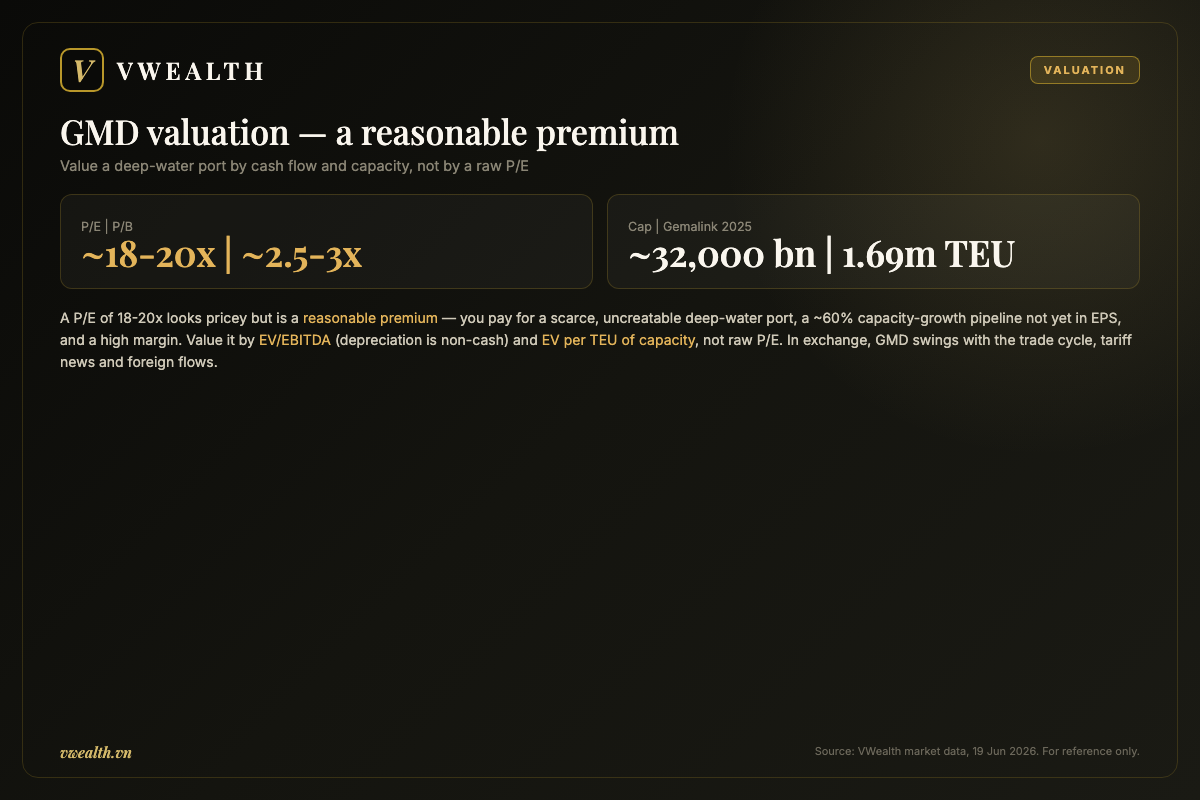
So why is the market willing to pay this premium? There are three foundational reasons you need to grasp firmly:
- A deep-water port infrastructure asset is among the scarcest asset types. You can’t “build more” of a Cai Mep – Thi Vai deep-water cluster or a Hai Phong port location just with money. It requires a specific geographic location (a channel deep enough for large mother vessels), national planning, permits, and decades of accumulated relationships with international carriers. GMD’s Gemalink can receive ships of up to 232,606 tonnes — a capability very few ports in Vietnam have. When an asset is nearly impossible to copy, the market values it as a “privilege” rather than a factory.
- Volume growth comes with strongly expanding new capacity. GMD now handles over 2 million TEU/year, nearly 10% of the country’s total container volume. Two key projects — Nam Dinh Vu phase 3 and Gemalink phase 2 — are expected to add about 2.1 million TEU/year, equivalent to a 60% rise on current design capacity. When a business has a clear capacity-growth path and has laid the physical foundation, the market values it on future cash flow, not current-year profit.
- A high, durable margin. Port operation is a “heavy-asset but thick-margin” model: once the infrastructure is invested, each extra container flows almost straight to profit. GMD’s gross and net margins are among the high group in logistics, and its operating cash flow is steady — the foundation for stable cash dividends.
When you buy a deep-water port stock at a P/E of 18-20x, you aren’t paying for last year’s profit. You’re paying for an uncreatable infrastructure position, a swelling container flow, and the right to participate in the import-export growth of a whole country.
Why P/E isn’t the right measure — and EV/EBITDA plus capacity-based valuation are the keys
If you want to value GMD seriously, set P/E aside and get familiar with two tools more specialized for infrastructure businesses: EV/EBITDA and port-capacity valuation.
Why EV/EBITDA? A port business is “heavy-asset” — investing in berths, cranes, warehouses and channel dredging requires huge capital, entailing enormous depreciation and usually debt to finance projects. Depreciation is a “non-cash” accounting cost: it makes net profit (the P/E denominator) look smaller, but doesn’t take money out of the till. EBITDA — earnings before interest, tax and depreciation — removes this noise, showing the true operating cash-generating capacity of the port cluster. And EV (enterprise value = market cap + net debt) counts the project-financing debt, allowing a fair comparison between ports with different capital structures. In other words, two ports with the same cash-generating capacity but one borrowing heavily and one lightly — P/E will distort; EV/EBITDA won’t.
Why capacity-based valuation? For ports, there’s a very “physical” measure infrastructure investors use: enterprise value per TEU of capacity. You divide EV by total design capacity (in million TEU/year) to know how much the market pays per unit of handling capacity. This is especially useful for GMD because most of its future value lies in underutilized capacity — Nam Dinh Vu 3 and Gemalink 2 will raise capacity by ~60%, but that capacity isn’t generating profit in today’s EPS. If you only use P/E, you unintentionally ignore this whole “growth reserve.” Capacity valuation forces you to answer: how much has the market paid per TEU GMD will operate in the next 2-3 years, and is that cheap versus the cost of building an equivalent new port?
Combining these two views, GMD’s 18-20x P/E becomes reasonable: you’re valuing a business whose profit driver is largely ahead, not behind. This is exactly the logic infrastructure funds use to justify the “port-industry premium” — they discount future-capacity cash flows to the present, rather than valuing the port as a static cash printer.
Price action: GMD is a “growth infrastructure stock” favored by funds and foreigners
If you follow GMD’s chart over the past year, you’ll see a fairly wide range: a 52-week low around 51,900đ and a peak around 89,500đ. The current 77,000đ sits in the upper part of this range — showing the market leans toward the optimistic scenario, and the +5.05% June move reinforces that sentiment. But to trade GMD effectively, you need to understand what this stock is “sensitive” to.
GMD doesn’t move on trivial internal news. It’s a macro-bet stock — a proxy for the health of Vietnam’s trade. Three groups of factors govern almost all its price action:
- Import-export data and container volume. This is GMD’s “heartbeat.” Whenever seaport clearance data, import-export value or container volume through Vietnamese ports is released, GMD reacts immediately. Rising volume means rising handling revenue — and because the margin is high, that rise amplifies strongly to profit. This is why GMD is often used as a “barometer” of national trade.
- US tariff news and trade tensions. This is the biggest risk variable and the most volatility-inducing. When news emerges of US tariffs on Vietnamese goods, or global trade tension escalates, GMD usually faces selling pressure as the market fears falling export container flows. Conversely, when tariff risk cools, or Vietnam benefits from supply-chain shifts, GMD bounces. You should view this news group as the stock’s “weather” — uncontrollable but always to be watched.
- Port-expansion progress. Each milestone of Nam Dinh Vu 3 and Gemalink 2 — groundbreaking, dredging completion, coming online — is a catalyst. Good news (on schedule, signing new service routes with carriers) pushes the price up; delay news (there was once a warning Gemalink phase 2 could be up to 2 years late) creates correction pressure.
An important trait to remember: GMD swings with the trade cycle. In a global-trade expansion phase, containers flow strongly, and GMD is one of the clearest beneficiary stocks. In a downturn or tariff-uncertainty phase, it also corrects first. This isn’t a flaw — it’s the nature of an infrastructure stock tightly bound to cargo flows. Understand this, and you’ll know that corrections driven by tariff news are often opportunities for a long-term investor who believes in the deep-water-port growth story.
The value story: Gemalink phase 2, associate profit and the ability to divest for gains
By now you understand the valuation and price action. But what truly keeps long-term funds in GMD is the value story ahead — and it has many layers.
Layer one — Gemalink phase 2 is the core growth engine. In April 2026, GMD and its strategic partner CMA CGM (France) officially broke ground on Gemalink phase 2 at Cai Mep – Thi Vai, raising the cluster’s total capacity to about 3 million TEU/year. When operational, the expansion alone is expected to add about 800-1,000 billion dong of revenue and 200-300 billion dong of net profit a year. For a business with ~1,700 billion of net profit, this is a significant addition — enough to shift EPS and “soften” the P/E over time. Having CMA CGM, one of the world’s largest carriers, standing on the project is also a guarantee of input cargo — you don’t worry about the port being built without ships calling.
Layer two — associate profit is rising. A significant part of Gemadept’s profit comes from associate investments in the port-and-logistics ecosystem. As industry-wide volume rises and associates operate more efficiently, this “associate profit” stretches, supplementing core profit without GMD having to invest large capital itself.
Layer three — the ability to divest ports for gains, creating extraordinary profit. This is a very distinctive “trump card” of GMD you should understand. Because Gemadept’s port assets are valued higher over time (land, location, scarce capacity), the business has a history and room to partly divest matured ports to realize value. Each such deal can create an extraordinary profit in the period — pushing that year’s profit up and often a strong catalyst for the share price. This creates an interesting trait: besides the steady operating cash flow, GMD also holds a “value option” from its very infrastructure-asset pool. You’re holding a business that both generates cash flow and can crystallize asset value into cash profit when needed.
Steady cash dividends and foreign appeal
For a growth stock, a stable dividend flow is a plus that keeps investors through volatile phases. GMD maintains a steady cash dividend: the most recent dividend around 2,200 dong a share, with a yield in the 2.8-3.6% zone depending on timing — a reasonable level for a growth-leaning stock. Notably, for 2025 Gemadept proposed a 22% cash dividend plus a 50% stock bonus, both paying shareholders cash and deliberately diluting to boost liquidity and capital scale — a move the market usually receives positively.
On foreign ownership, GMD has long been a heavily foreign-held stock and one of the top choices for funds wanting exposure to the theme of “Vietnamese infrastructure and import-export growth.” Why? Because very few listed businesses let foreign investors buy directly into such a quality deep-water port portfolio. This has two consequences to grasp:
- Foreign room becomes a price-support factor. When foreign ownership approaches the allowed ceiling (room), the stock becomes scarce for foreigners, supporting the price and sometimes trading at a “foreign-room premium.”
- Foreign capital is also a double-edged sword. Because foreigners hold a large weight, each net-selling wave — usually from tariff news, FX swings or global portfolio rebalancing — creates significant downward pressure on GMD. History has seen periods where the stock fell sharply under foreign net selling. So tracking foreign net buy/sell action is an indispensable part of trading this ticker.
To close: what are you betting on buying GMD at 77,000đ
Combining all the analysis layers above, here’s how you should position GMD in your mind: GMD is a growth port-infrastructure stock, a bet on Vietnam’s import-export and on the Gemalink story, valued at a premium with a sound basis.
The 18-20x P/E doesn’t reflect irrational expensiveness, but three things: a scarce, nearly uncreatable deep-water port asset, a ~60% capacity-growth path from Nam Dinh Vu 3 and Gemalink 2 not yet reflected in current profit, and a high margin generating durable cash flow. When you value GMD by EV/EBITDA and by port capacity instead of raw P/E, the “reasonable premium” picture emerges clearly. In exchange, you accept a stock sensitive to the trade cycle and tariff news — swinging strongly with cargo flows and foreign action.
If you believe Vietnam’s trade will keep growing, that container flows through deep-water ports will keep swelling, and that Gemalink phase 2 plus the ability to divest for gains will create profit jolts over the next 2-3 years, then 77,000đ is the price of a ticket into one of the best infrastructure positions on HOSE. But if you worry about tariff risk and foreign-flow volatility, those very traits also remind you that GMD demands you track macro variables closely. To fully understand this opportunity and risk, we need to place GMD in its proper arena — and that’s what the next industry context section will clarify.
Economic and seaport–logistics industry context
To value a seaport stock like GMD, you can’t just look at the business’s own financial statements. Seaports are a deeply “infrastructure” and “macro” industry: cargo volume through ports is tightly tied to the trade flow of the whole economy, to import-export, to foreign direct investment (FDI) and to the global geopolitical picture. When you buy a port stock, you’re essentially betting on the container flow through Vietnam over the next 5–10 years. So this section places GMD in the proper industry context it operates in — both the tailwinds and the headwinds.
A structurally growing industry, not just cyclical
The first thing to remember: Vietnam’s seaport industry has for many years grown much faster than GDP. Container volume through Vietnam’s port system has long maintained growth of about 8–10% a year — a very impressive figure versus nominal GDP growth or most other “traditional” industries. This isn’t temporary growth, but structural growth, driven by Vietnam’s rising position in global trade.
A few recent real data points show this driver is still very strong. In the first 10 months of 2025, the Cai Mep – Thi Vai deep-water cluster alone handled nearly 6.3 million TEU of mother-vessel cargo, up over 18% year on year — i.e. double the industry’s average growth. Vietnam now has three container ports in the world top-100 busiest, and per the Container Port Performance Index (CPPI) published by the World Bank and S&P Global, Cai Mep has entered the global top-7 among over 400 surveyed ports. For a country where a modern port industry has truly boomed only in the past decade-plus, these are milestones showing Vietnam’s port infrastructure is maturing very fast.
Four long-term drivers supporting the port industry
You should understand why this industry grows durably, because that’s also the foundation for the GMD investment case.
- The “China +1” supply-chain shift. The prolonged US–China trade tension has pushed multinationals to diversify their production bases, and Vietnam is one of the clearest beneficiary destinations. Each new factory placed in Vietnam means more materials imported and finished goods exported — i.e. more containers through the ports.
- FDI staying high. FDI into Vietnam remains strong, with the first 4 months of 2025 alone reaching about $13.8 billion, up nearly 40% year on year; FDI into manufacturing-processing in 2024 exceeded $25 billion. FDI is the “seed” of future import-export volume: capital disbursed today becomes cargo through ports in 2–3 years.
- Import-export expanding with FTAs. Vietnam has signed a series of new-generation free-trade agreements (CPTPP, EVFTA, RCEP…), helping goods reach most major markets at preferential tariffs. The US remains the largest export market, accounting for nearly a third of Vietnam total export value, with the first 7 months of 2025 reaching about $85 billion. The larger the trade scale, the more cargo through ports.
- The trend of ever-larger mother vessels needing deep-water ports. This is the key point and where GMD has a special advantage. To optimize cost, global carriers increasingly deploy ultra-large container vessels (ULCVs) carrying 18,000–24,000 TEU. These ships can’t dock at inland river ports; they need deep-water ports with a deep enough channel and a long enough berth to receive them. In Vietnam, ports meeting this standard are very rare — and GMD Gemalink at Cai Mep is one of the few, able to receive ships of up to 200,000–250,000 DWT. As international trade shifts to direct mother-vessel routes to the US and Europe, deep-water ports are the scarce bottleneck — and whoever owns them holds the most valuable “entry ticket.”
You can picture the deep-water-port advantage as owning a prime location on the busiest trade street: global cargo must pass through, and not everyone with money can create an equivalent position, because it also depends on natural conditions (channel depth) and state planning.
The headwinds not to be ignored
If we listed only the favorable factors, the analysis would be unbalanced and easily lead you to a skewed decision. The seaport–logistics industry faces some very real risks, and you need to face them squarely.
Tariff and trade-war risk. The very supply-chain shift benefiting Vietnam comes with its flip side. 2025 saw a tariff shock from the US: the Trump administration initially announced a “reciprocal tariff” of up to 46% on Vietnamese goods, then after negotiation reduced it to 20% for confirmed Vietnamese-origin goods — but simultaneously imposed up to 40% on goods deemed transshipped from a third country. Higher-than-before tariffs raise the cost of Vietnamese goods in the US market, potentially eroding competitiveness and slowing export-volume growth. Because nearly a third of Vietnam exports go to the US, this is a very significant concentration risk for the whole port industry — and GMD, with a large weight from the deep-water port serving long-haul routes, will be affected if mother-vessel routes to the US thin out.
Competition from new ports. Deep-water ports are scarce, but “scarce” doesn’t mean “permanent monopoly.” In the south, the Cai Mep – Thi Vai cluster keeps expanding with many new berths; rivals like TCIT (about 2.2 million TEU in 2025) and CMIT (over 2 million TEU in 11 months) are very strong ports competing directly with Gemalink for cargo and service routes. In the north, the Lach Huyen cluster (Hai Phong) is being heavily invested with new deep-water berths coming online. The more new capacity added, the greater the pressure on service prices and fill rates.
Handling-price and margin pressure. Handling-service prices at Vietnamese ports are partly regulated by a state price framework, and raising the floor price doesn’t always keep pace with businesses’ wishes. When berth supply is excessive, ports may be forced to compete on price to retain carriers, eroding the already-high margins.
Port planning and channel dredging. A deep-water port’s efficiency depends on maintaining a stable channel depth — this is tied to the state’s budget and dredging progress, beyond the business’s control. At the same time, national port-system planning (locations, capacity, allocation of new projects like Can Gio, Cai Mep Ha) will reshape the competitive map in the future. A major planning decision can be both an opportunity (if GMD participates) and a risk (if it creates a next-door rival).
In sum, you’re looking at an industry with a solid long-term growth foundation, but with short-term profit very sensitive to the trade cycle and tariff policy. That’s the core paradox any GMD investor must live with.
Trend forecast
Having understood the industry picture, now it’s time to look ahead. Let me say at once: no one forecasts a stock’s price precisely, and the purpose of this section isn’t to give a “magic” number. Instead, I want to sketch with you the real drivers shaping GMD’s future, then place them into three scenarios for you to weigh the probability and your own risk tolerance.
The growth drivers ahead
Gemalink phase 2 — the biggest capacity jolt. This is the central story. Gemalink phase 1 now runs near full capacity — at one point utilization reached about 129%, a sign that demand for deep-water ports is very hot and GMD is “short of space to sell.” Phase 2 will relieve that bottleneck: with total investment of about $250 million, the project adds about 1.25 million TEU/year of capacity, raising Gemalink’s total design capacity to about 2.75 million TEU. When phase 2 fills, it will be GMD’s most important volume-and-profit growth driver for years to come.
Nam Dinh Vu phase 3 running at full capacity. At the northern pole, GMD completed the phase-3 investment of Nam Dinh Vu port in 2025, bringing the whole cluster into full operation. Phase 3 has a capacity of about 650,000 TEU/year with investment of about 2,800 billion dong. When the cluster runs at full load, it reinforces GMD’s position in the northern market and creates a more balanced “two-pole” north-south revenue base.
Import-export volume keeps expanding. If the macro drivers noted earlier (FDI, supply-chain shift, FTAs) keep working, container flows through Vietnam will keep rising above GDP — and GMD, with its two strategic port clusters, is well-positioned to catch this growth.
The ability to divest ports for gains. GMD has a history of shrewd “asset rotation”: selling matured ports at good prices to fund reinvestment in new higher-return projects. In 2023, the company sold Nam Hai Dinh Vu port and booked an extraordinary gain of over 2,250 billion dong. In the future, it’s not out of the question that GMD keeps partly divesting established ports to realize value — this could be an extraordinary profit jolt in some particular year.
Long-term potential from the Can Gio super-port. Further out, the Can Gio international transshipment port project (Ho Chi Minh City) is a “potential unknown” that could reshape the southern port map over the next 5–10 years. If GMD has a role in this ecosystem, it would be a new-generation growth driver; but this is still a very long-term story with many unknowns about planning, partners and timeline.
Three scenarios for GMD
To help you picture it, I place the above drivers and risks into three scenarios. Remember: this is a thinking frame, not prophecy.
| Scenario | Trigger conditions | Consequence for GMD |
|---|---|---|
| Positive | A favorable trade environment, US tariffs stable or eased; import-export volume accelerates; Gemalink phase 2 fills fast; another port-divestment deal for gains. | Core volume and profit rise strongly, plus an extraordinary divestment gain. The market is willing to pay a higher valuation for the growth story, creating significant upside room. |
| Base | Trade grows steadily, tariffs stay around current levels; Gemalink phase 2 and Nam Dinh Vu fill gradually on schedule; no big shock. | Core profit grows steadily by single to low-double digits a year with new capacity. The share price rises gradually with profit, the premium valuation maintained but hard to expand much further. |
| Negative | US tariffs tighten or a trade war escalates, cutting exports; global trade weakens; competition from new ports (Cai Mep, Lach Huyen) pressures handling prices and fill rates. | Volume grows slowly or goes sideways while newly added capacity pushes up depreciation and interest. The margin is squeezed, profit can fall, and the premium valuation is easily narrowed by the market — creating double downward pressure. |
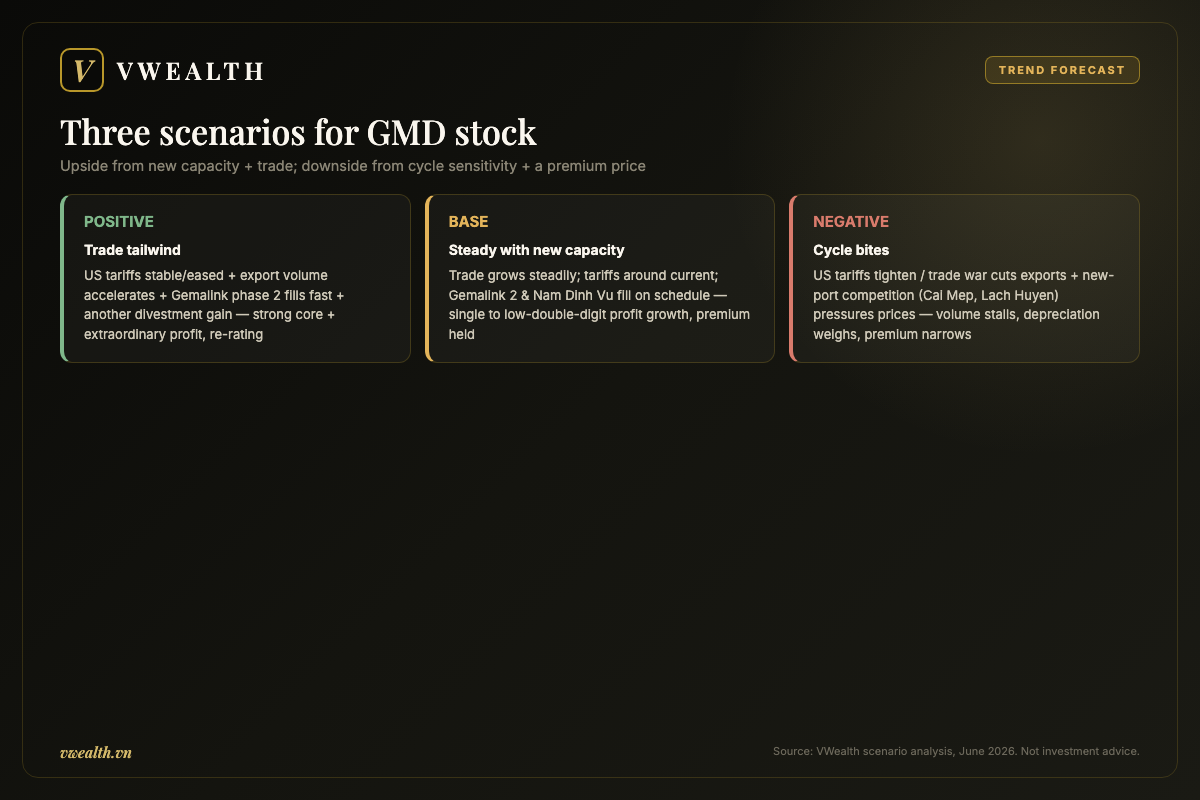
The important thing you draw from these three scenarios: GMD upside is tied to the new-capacity story and favorable trade, but the downside risk comes precisely from its sensitivity to the cycle and a valuation no longer cheap. When a stock is valued highly, it has “priced in” much good news — meaning the room for disappointment is also larger if reality isn’t as pretty as expected.
Should you buy GMD stock?
This is the question you really care about, and also the part I want to tell you most frankly: this article won’t tell you to buy or sell. No one — not even the writer — has enough information about your financial situation, risk appetite and goals to issue that command for you. An analyst’s job is to lay both sides clearly on the scale, so you decide with full understanding.
Weighing the pros: why GMD is a quality business
- Vietnam number-1 private port operator. GMD isn’t a small name in the industry — it’s the leading private port operator, with over three decades of experience and an integrated port–logistics ecosystem.
- Owning a scarce deep-water port. Gemalink at Cai Mep is one of very few ports able to receive super-large mother vessels. This is a hard-to-copy strategic asset, right in line with the trend of ever-larger ships in global trade.
- The “two-pole” north-south positioning. With Nam Dinh Vu in the north and Gemalink in the south, GMD covers both of the country’s largest import-export centers, diversifying cargo sources and reducing dependence on one market.
- High margin, steady cash flow. A port is a “infrastructure toll” model: once invested, it generates stable cash flow with an attractive margin. The 2025 net profit of about 1,700 billion dong shows real profitability.
- Direct beneficiary of import-export and the supply-chain shift. GMD is one of the purest ways to “bet” on the story of Vietnam becoming the region new factory.
- New capacity expanding. Gemalink phase 2 and Nam Dinh Vu phase 3 provide a clear volume-growth runway for years to come.
- A world-class strategic partner. The presence of CMA CGM — one of the world largest carriers — at Gemalink helps ensure stable mother-vessel cargo, something not every port has.
Weighing the cons: what should make you cautious
- Valuation already at a premium. With a P/E of about 18–20x (some sources up to over 21x), GMD is not cheap. The market has paid a high price reflecting much good expectation. When you buy at a high valuation, the margin of safety thins and the room for “disappointment” is larger.
- Profit sensitive to the trade cycle and tariffs. As analyzed, a tariff tightening from the US or a global trade slowdown can directly affect volume and profit. This is a risk beyond the business control.
- Large port investment and debt. Building a deep-water port devours thousands of billions and many years. During the investment phase, rising depreciation and interest while new capacity isn’t yet filled can temporarily erode profit.
- Competition from new ports. Rising new-berth supply at Cai Mep and Lach Huyen can pressure service prices and slow GMD own fill rate.
- Part of past profit doesn’t recur. This is easily overlooked: some years GMD had extraordinary profit from selling ports (like the Nam Hai Dinh Vu deal). These one-off gains aren’t steady core profit — if you take a divestment-year profit to extrapolate the future, you’ll overvalue.
What kind of investor does GMD suit?
A good stock doesn’t mean it suits everyone. The most useful way to answer “should I buy” is to view GMD through four common investor types:
- Growth investor. This is the group GMD suits best. If you believe in the port-infrastructure and Vietnam import-export story long term, are willing to pay a high valuation to own a scarce strategic asset, and are patient enough to weather trade-cycle swings — then GMD is right in your court.
- Value investor seeking cheap stocks. This group fits less. At a P/E of 18–20x, GMD is hard to see as a “bargain” by classic value standards. You’d have to wait for deep corrections to find an attractive margin of safety.
- Income investor needing a high dividend. Also fits less. GMD is in a big expansion-investment cycle, so most cash flow is prioritized for reinvestment over a generous cash dividend. If your goal is a stable, high dividend flow, this isn’t the optimal choice.
- Defensive investor averse to volatility. Consider carefully. GMD profit is tied to the trade cycle and tariff policy — factors that can create strong volatility. If you’re uncomfortable with large swings, this stock “safety” may not be what you expect.
In other words: GMD is a high-quality business with a compelling long-term story, but valued in line with that quality — meaning you don’t get to “buy a good asset cheaply,” but must “pay full price for a good asset.” The final decision depends on how much you believe in Vietnam port-infrastructure and import-export story, and how much you can bear a high valuation plus cyclical swings.
Disclaimer: This article is produced for informational and reference-analysis purposes, and is not a recommendation to buy, sell or hold any stock, including GMD. The figures are cited from public sources at the time of writing and may change. Past share prices don’t guarantee future results. Every investment decision is your own, and you should research thoroughly, consider your personal financial situation, and consult a licensed investment advisor before acting.
Research Vietnamese stocks in English with vwealth. Our AI-powered platform turns Vietnamese market data into full English analysis reports — with international payment support and a free 2-month trial for new accounts. Create your free account and read the latest reports.