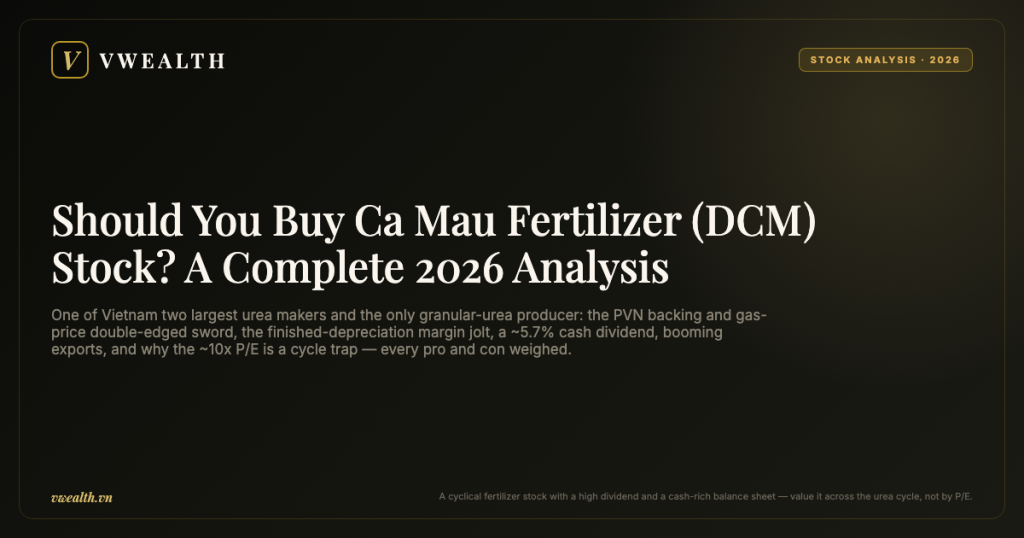
There are stocks where just naming them makes you picture a whole industry. DCM — Ca Mau Petroleum Fertilizer JSC (now the Ca Mau Petroleum Fertilizer Corporation — PVCFC) — is one such stock. Behind these four letters is the Ca Mau Fertilizer Plant beside a dredged canal in the southwestern Mekong Delta, the “Ca Mau Fertilizer — Golden Grain of the Harvest” brand familiar across the Mekong Delta rice fields, and the position of one of Vietnam’s two largest urea producers (alongside Phu My Fertilizer — DPM). DCM also carries the “lineage” of the Vietnam Oil and Gas Group (PVN) — the shareholder holding about 75% of capital — an origin that is both a support and a constraint you need to understand thoroughly before putting money in.
But if you think buying DCM is buying a “fertilizer company” in the simple sense, you’ve missed the most interesting part. Buying DCM is essentially betting on three things at once: the world urea price, strong cash flow and steady cash dividends, plus the cost discipline of a plant nearing the end of its depreciation life. This is a stock deeply marked by the commodity cycle — its value rises and falls with the beat of two prices DCM barely controls: the urea output price and the natural-gas input price. When both are favorable, DCM prints money like a machine; when both turn adverse, profit can “evaporate” 70% in a single year. This business’s history is vivid proof of that.
At 36,600 dong a share (19 June 2026 session), the question every investor asks is: is DCM still cheap or already expensive, and more importantly — what kind of investor does this stock suit? A dividend hunter who prefers stable cash flow, or a cycle player who accepts volatility for a multi-fold return? To answer, you can’t look at a single quarter or a lone P/E. You must go back in time, understand how DCM was born, the waves it has ridden, and why 2023–2025 is a quiet but perhaps most important turning point in the business’s history. This full analysis will guide you from that root.
DCM market data (updated 19 June 2026)
| Current price | 36,600đ | 2025 revenue | 16,961 bn (+26%) |
| Change (June) | −6.27% | 2025 after-tax profit | 1,917 bn (+34%) |
| Cash dividend | Cash | ~2,000đ (5.7%) | >7,000 bn | P/E (distorted) | P/B | ~10x | ~1.4–1.7x |
DCM is a CYCLICAL fertilizer stock + high dividend + healthy cash. The ~10x P/E looks cheap but is a P/E TRAP (near the cycle peak); the 2026 plan projects profit down ~40% + dividend back to ~10%. Source: VWealth + DCM 2025 reports. For reference only.
History and evolution
To understand a commodity business, you must start from the input material — and with DCM, everything begins with the offshore natural-gas fields of the southwestern sea. The Ca Mau Fertilizer Plant isn’t a standalone fertilizer project, but a link in the Ca Mau Gas–Power–Fertilizer Cluster, a huge industrial complex the government planned to leverage the PM3-CAA gas (the Vietnam–Malaysia overlapping-claim sea area). The logic is simple but very “oil-and-gas”: with gas, build a pipeline to shore; with gas onshore, both run a power plant and make it the material for fertilizer. Ca Mau Fertilizer was thus born as a way for PVN to turn seabed gas resources into value-added on the field.
From a project management board to an operating plant (2008–2012)
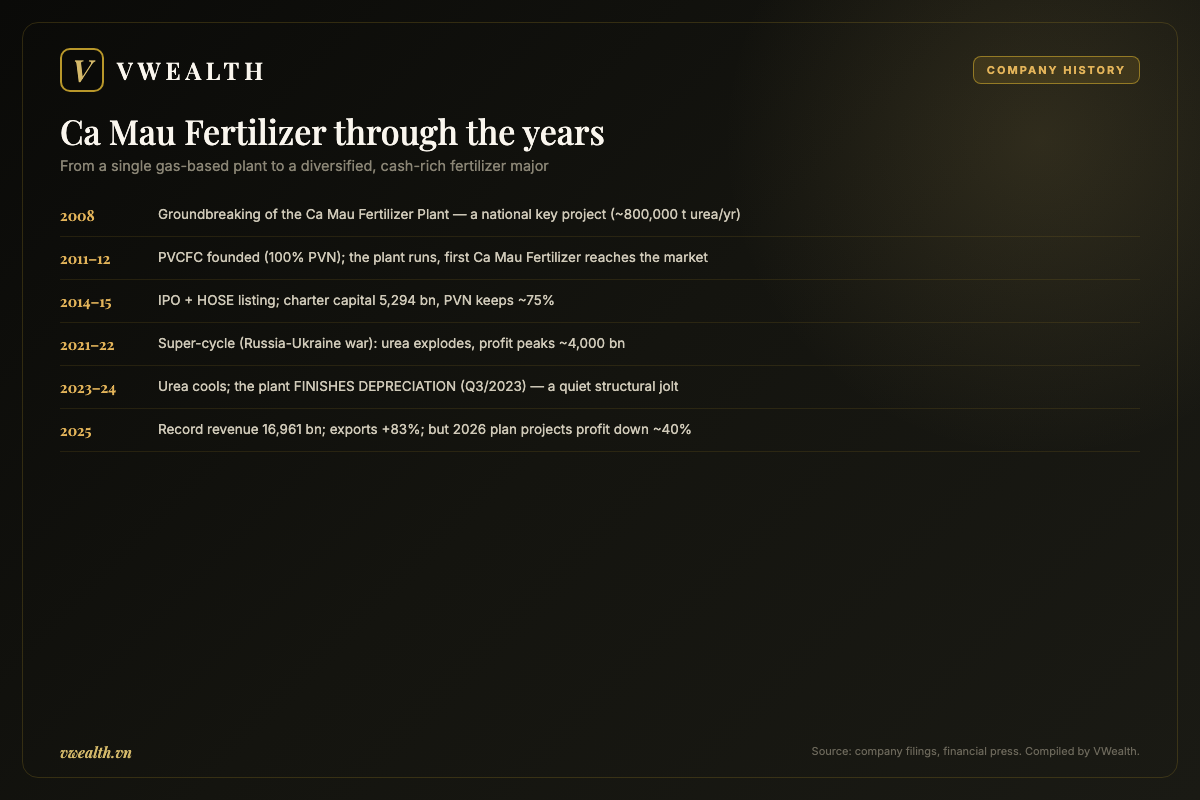
The starting milestone is 26 July 2008, when the Prime Minister ordered the groundbreaking of the Ca Mau Fertilizer Plant. This was a national key project, with technology producing urea from natural gas — modern technology from the world’s leading contractors, with a design capacity of about 800,000 tonnes of urea/year. Remember this capacity figure, because it’s the natural “output ceiling” that shaped DCM’s entire business story for the next decade-plus.
As a legal entity, the forerunner was the Ca Mau Gas–Power–Fertilizer Cluster Project Management Board, under PVN. On 9 March 2011, Ca Mau Petroleum Fertilizer Co. Ltd (PVCFC) was established under Decision No. 474/QD-HDTV, with PVN owning 100% of capital. This is the official “birth year” DCM uses as its milestone — 2011. On 2 July 2012, the project board handed over all plant assets to PVCFC to manage, operate and produce commercially; 2012 became the first year the “Ca Mau Fertilizer” product officially reached the market.
What’s notable in this period is the gas-pricing mechanism — a factor that would follow DCM throughout its life. When the plant came online in April 2012 and used PM3 gas, the input gas price was calculated by a formula tied to the FO oil price (fuel oil). In other words, right from the starting line, DCM’s largest cost was “anchored” to the world oil price. Grasp this and you’ll understand why DCM is forever a cyclical stock: the input (gas) follows the oil price, the output (urea) follows the world fertilizer price, and profit is precisely the gap between those two price lines, stretching and shrinking over time.
Equitization and HOSE listing (2014–2015)
The second turning point came from the policy of equitizing state enterprises. On 11 December 2014, PVCFC held a successful IPO — a first public offering — selling nearly 129 million shares, about 24.4% of charter capital. This was the shift from a 100%-state-owned unit to a model with public shareholders, bringing requirements for transparency and standardized governance — very important to you as an outside investor.
On 15 January 2015, the business officially became a joint stock company with charter capital of 5,294 billion dong — about 529.4 million shares, a charter-capital figure kept almost unchanged to this day (this is why DCM’s EPS reflects the profit trend quite “cleanly,” with little dilution). By March 2015, DCM officially listed and traded on the Ho Chi Minh Stock Exchange (HOSE). After the IPO, PVN’s ownership fell to around 75% — and this figure has held to today, making DCM a “hybrid”: both a public company on the exchange and deeply the nature of a state-group member.
The state holding ~75% is a double-edged sword. The upside: DCM is backed by stable gas supply from the PVN ecosystem, cautious governance, low leverage risk. The downside: the low free-float ratio limits liquidity and the influence of small shareholders; every big decision (dividends, investment, M&A) bears the mark of the state shareholder.
The 2021–2022 super-profit cycle: when urea prices exploded
If you had to choose one period to understand why DCM is a cyclical stock, it’s 2021–2022. For many years before, DCM was a “steady” business: revenue around 7,000–8,000 billion, profit of a few hundred billion dong a year, paying a cash dividend of about 8%. A defensive, stable stock but nothing explosive. Then the global commodity storm hit.
From the second half of 2021, world fertilizer prices soared on supply ruptures and Europe’s climbing gas prices. In early 2022, the Russia–Ukraine war pushed the situation to its peak: Russia — the world’s largest urea and NPK exporter — tightened fertilizer exports, causing a sudden global supply shortage. World and domestic urea prices surged. For DCM, this was a “dream” scenario: the selling price exploded while gas costs hadn’t risen correspondingly, stretching the margin unprecedentedly wide.
The result was a spectacular leap. In 2021, DCM booked revenue of about 9,870 billion dong (+30.5%) and after-tax profit of about 1,920 billion dong — up nearly 190% from 2020. But that was just the start. In 2022, Q1 alone reached revenue of about 4,028 billion and after-tax profit of 1,515 billion dong — 10 times the same period; the average Q1 urea selling price rose as much as 148% year on year. For the full 2022, total revenue exceeded 15,000 billion dong — the highest in history then, and profit peaked around 4,000 billion dong.
The most valuable detail for you is this: in early 2022, DCM’s own management set an after-tax profit plan of just 513 billion dong — 72% lower than 2021. A figure so “cautious” it proves that even insiders couldn’t forecast urea prices. This is the core lesson of commodity stocks: the peak profit of a super-cycle year isn’t the business’s intrinsic capability, but a gift from the market — and that gift can be revoked at any time.
| Year | Revenue (bn dong) | After-tax profit (bn dong) | Cycle context |
|---|---|---|---|
| 2020 | ~7,560 | ~665 | Low urea prices, stable operation |
| 2021 | ~9,870 | ~1,920 | Fertilizer prices start rising strongly |
| 2022 | ~15,000+ | ~4,000 | Super-cycle peak (Russia–Ukraine war) |
| 2023 | ~12,600 | ~1,100 | Urea prices cool sharply; plant starts to finish depreciation (Q3) |
| 2024 | ~13,400 | ~1,430 | Full benefit from finished depreciation |
| 2025 | ~16,961 | ~1,917 | Record revenue; exports accelerate +83% |
(The 2020–2024 figures are rounded estimates from various reports, used to illustrate the cycle’s shape; the 2025 figures are officially announced results.)
Cooling and the diversification strategy: NPK, organic, exports
Like every commodity-cycle peak, the 2022 peak didn’t last. From 2023, world urea prices cooled sharply as supply gradually recovered, bringing DCM’s revenue and profit back to earth. This was also when the structural weakness of a “single-product” business was exposed: when urea decides nearly all business results, the company becomes hostage to a single good. DCM’s management understood this clearly, and the solution they chose was diversification — to depend less on the up-and-down beat of the urea price alone.
The first spearhead is NPK — a three-component compound fertilizer (nitrogen–phosphorus–potassium) with a margin and stability different from single urea. DCM built its own Ca Mau NPK plant, while making a notable M&A: acquiring Han-Viet Fertilizer Co. Ltd (KVF). KVF is an NPK plant invested by Korea’s Taekwang group and its subsidiary Huchems, operating since December 2017 with a design capacity of 360,000 tonnes of NPK/year and total investment once up to about $60–83 million. DCM completed buying 100% of the capital in KVF in May 2024 for about $23.6 million (~600 billion dong) — i.e. buying a billion-dong plant for a small fraction of the original investment, a rather shrewd “cheap asset purchase.” After just about a month of restructuring and consolidating into the DCM ecosystem, the KVF plant began to profit and contribute cash flow.
KVF’s strategic meaning is geographic expansion: the existing Ca Mau NPK plant serves the southwestern market and Cambodia, while KVF (in the southern region) helps DCM penetrate the southeast, Central Highlands and central regions. DCM’s NPK sales volume grew continuously — from about 41,000 tonnes (2021) to 152,000 tonnes (2023) — showing this isn’t a half-hearted effort. Besides NPK, DCM also developed an organic fertilizer line and pushed exports: beyond the Cambodian market (where DCM holds a stable ~30% share), the “Golden Grain of the Harvest” product is now in nearly 20 countries. Building an export channel helps DCM sell off surplus volume when domestic demand is weak, while taking advantage of moments when regional urea prices are attractive.
- Urea (core): ~800,000 tonnes/year capacity, the “heart” of profit and the biggest cyclical variable.
- NPK: the Ca Mau NPK plant + KVF, expanding the footprint and reducing dependence on single urea.
- Organic & nutrition products: the “Golden Grain of the Harvest” product set, toward sustainable agriculture.
- Exports: Cambodia (~30% share) and nearly 20 countries, a pressure-release valve when domestic demand is weak.
The quiet turning point: the urea plant finishes depreciation (2023–2024)
If the 2022 peak was a loud event, the most important turning point for DCM’s intrinsic value happened very quietly: the Ca Mau Fertilizer Plant finished depreciation from Q3 2023. You need to pause here a long time, because this is what separates an investor who understands DCM from one who only watches the urea price.
Depreciation is a “paper” cost — reflecting the allocation of the huge initial plant-building capital across the asset’s life. For a gas-based fertilizer plant worth tens of thousands of billions of dong, annual depreciation is a very large number weighing on profit. Per brokerage estimates, finishing depreciation alone cut DCM’s 2024 costs by about 877 billion dong versus 2023. More importantly, this is a cost that doesn’t consume cash: the plant still runs normally, still produces ~800,000 tonnes of urea, but the accounting burden vanishes. As a result, the margin rises sustainably — not thanks to the urea price (a luck factor), but thanks to a “freed” cost structure. This is true profit quality.
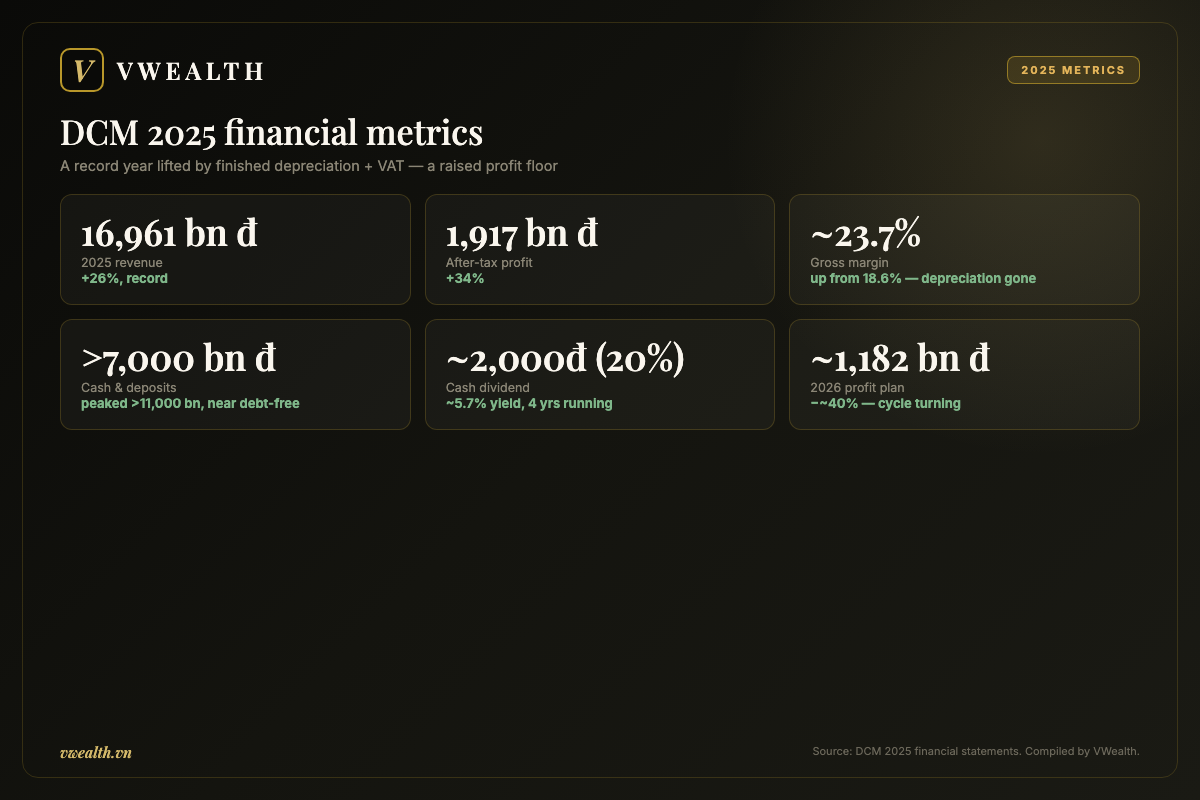
This impact shows clearly in the numbers: the 2025 margin reached 23.7%, well above 18.6% in 2024. Also in this period, the plant reached the milestone of producing 10 million tonnes of urea (December 2023) and then passed 11 million tonnes — proof of operational stability after over a decade. DCM also held its leading position with a domestic urea share among the highest in the country. In other words, entering 2024–2025, DCM stepped into a “rare favorable cycle”: depreciation cost fell, products became more diverse, exports brightened — and the business no longer had to depend entirely on whether the urea price peaked to profit well.
The 2025 record and the current picture
The peak of the restructuring journey shows in the 2025 results: DCM booked net revenue of nearly 16,961 billion dong and after-tax profit of about 1,917 billion dong, up 26% and 34.3% respectively year on year. This is the highest revenue in the business’s operating history — surpassing even the 2022 super-cycle peak in revenue. A special bright spot is export revenue up 83%, showing the regional-market strategy has truly “sunk in.” Versus the profit plan raised to 1,448 billion dong in December 2025, DCM beat it by over 32% — an impressive completion.
What’s notable for you: the 2025 record was achieved without any sudden urea-price shock. Quite unlike 2022 — when profit came from war and supply ruptures — the 2025 result came from the synergy of three more durable internal factors: the plant finishing depreciation (low cost), a more diverse product portfolio (NPK, organic), and expanding exports. That’s a sign DCM’s “profit floor” has been raised a notch versus the previous cycle.
Even so, no feast lasts forever, and the cyclical nature always lurks. Two big clouds hang over DCM that you must track closely. First is the input gas price: because gas cost is anchored to the oil price, each oil-price surge (at times spiking to $120/barrel when geopolitical conflict flared) can shock the cost base. Second is the risk of the southwestern gas fields running dry: the PM3-CAA reserves are gradually depleting. DCM’s management reassures that gas for the Ca Mau cluster is sufficient until just before 2028, and PVN is working to bring new fields (Nam Du – U Minh, Khanh My – Dam Doi) into production to supplement gas for the southwestern region in 2028–2030. This is a make-or-break long-term risk — and also why DCM’s product-diversification and export-expansion strategy isn’t just a growth ambition, but a defensive step for a future where cheap gas is no longer as abundant.
Summing up over 15 years: DCM has gone from a standalone gas-based fertilizer plant in Ca Mau — born to turn southwestern gas into fertilizer — into a diversified fertilizer business with urea at the core, NPK and organic as wings, exports as support, and a cost structure “freed” after the plant finished depreciation. DCM’s stock today is thus a blend of two characters: the volatile cyclical part from urea and gas prices, and the defensive part from strong cash flow, a healthy balance sheet and the tradition of steady cash dividends. This very blend decides what kind of investor DCM suits — a question we’ll dissect carefully in later sections. But first, to understand whether this business has the mettle to steer through the cycle and the gas-depletion problem ahead, you need to get to know the people at the helm: DCM’s Leadership.
Leadership and ownership structure
When you hold a listed state-enterprise stock like Ca Mau Fertilizer (ticker DCM, full name Ca Mau Petroleum Fertilizer Corporation JSC, brand PVCFC), the first thing you need to understand isn’t the price chart, but “who holds power” and “who stands behind this business.” Because for DCM, the ownership structure isn’t just a number on a governance report — it shapes the entire business logic, from input material to dividend policy to the level of risk you bear by putting money in. This section dissects three layers: who owns DCM, who runs DCM, and the “double-edged sword” relationship with the parent — the factor deciding this business’s profit more than any other variable.
Ownership structure: the great shadow of Petrovietnam
The first key point to grasp: Ca Mau Fertilizer is a business under absolute state control, through its parent, the Vietnam National Industry–Energy Group (Petrovietnam, PVN). Per disclosures, PVN holds about 75.56% of DCM’s charter capital, corresponding to a capital contribution of about 4,000 billion dong on the corporation’s charter capital. This is near-absolute control — far above the 65% threshold needed to pass all the most important decisions at the general meeting. In other words, when you buy DCM, you become a minority shareholder in a business where every big decision — plant investment, dividends, leadership appointments — rests with PVN.
The rest, about 24.44% of capital, is distributed among foreign investors (foreign funds), domestic institutions, and individual investors making up the free-float. Note that because PVN “locks” more than three-quarters of the shares, DCM’s truly freely tradable shares are quite thin versus the charter-capital scale. This cuts two ways: on one hand it creates stability in the shareholder structure and reduces sudden-dilution risk; on the other, low free-float sometimes limits liquidity and appeal to long-term foreign capital — which is exactly why state-divestment plans are often cited as a potential catalyst.
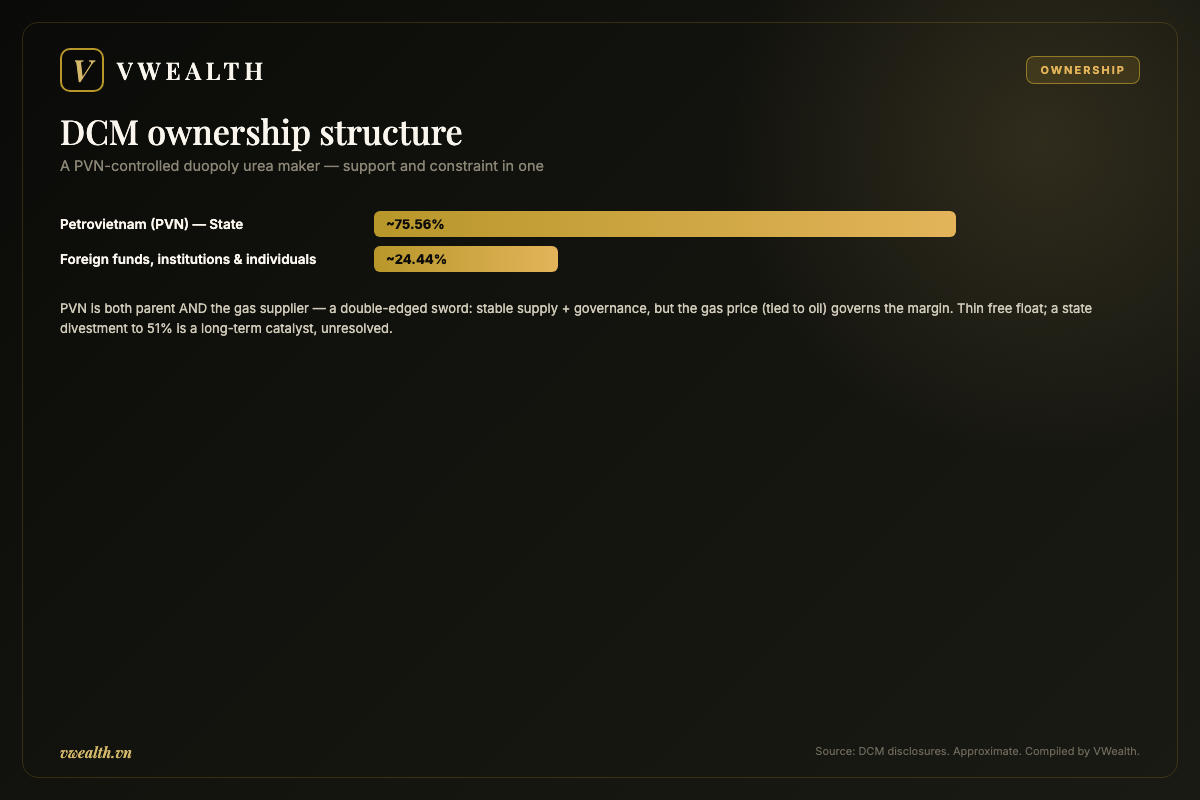
The divestment story is worth tracking. As early as 2018, DCM once mentioned an intention to seek a strategic investor to reduce state ownership from 75.56% to 51%. However, this plan hasn’t been executed to date, and per recent information, PVN won’t divest yet and will keep its ownership under the restructuring plan. For you — the investor — this means: the “loosen the room, divest” scenario remains open as a long-term story that could create a valuation jolt, but you shouldn’t bet short term on it because the timing depends entirely on state policy, not the business’s performance.
| Shareholder group | Estimated ratio | Meaning for investors |
|---|---|---|
| Petrovietnam Group (PVN) | ~75.56% | Absolute control, decides all big policy; backs gas supply and governance |
| Foreign funds + institutions + individuals (free-float) | ~24.44% | The freely traded part; liquidity and foreign room still have headroom |
Leadership: a technocrat team grown from within
A PVN-controlled business means senior leadership is appointed or approved by the parent through the state-capital representative. At the annual general meeting on 22 April 2026, PVCFC reorganized its leadership for the 2026–2031 term. Per disclosures, Van Tien Thanh was elected Chairman of the board, while Nguyen Thanh Tung took the role of board member and CEO. You should read these personnel details cautiously — titles can change per PVN and shareholder-meeting decisions, but the essence is stable.
What is that essence? It’s that DCM pursues an “internal succession model” — the key leaders all grew up within the business, are long-committed and deeply understand operations. Per a Petrovietnam representative, this approach is seen as building a solid foundation for sustainable development, because the operators understand every stage of running the urea plant — a complex technological complex requiring hands-on experience, not remote management. For you, this is a positive signal of continuity and stability in management: you don’t have to worry about “blood transfusions” causing strategic ruptures, a common risk at businesses where leaders are transferred sideways from another industry.
You should also see this team as a technocrat group of the oil-and-gas–fertilizer industry. They aren’t operators of the hot-growth or venture-investment school, but people running by the discipline of a state enterprise: prioritizing operating safety, capital preservation, plant efficiency and cash-flow maintenance. This governance style explains why DCM has a feature income investors love: a steady cash-dividend policy, which we’ll discuss right below.
The relationship with PVN: the “double-edged sword” that decides profit
This is the most important part to absorb when analyzing DCM, because it’s the key to why this business’s profit swings in ways many can’t foresee. PVN and DCM aren’t just a “parent–subsidiary” relationship in ownership terms. PVN is also the supplier of the life-or-death input material: natural gas. And gas is the largest production cost in making Ca Mau’s urea granules.
For DCM, natural gas isn’t just a material — it’s the variable deciding the margin. When oil prices rise, gas prices rise with them, and the business’s profit is eroded even while the plant runs at full capacity.
DCM’s gas-pricing mechanism is calculated by a formula tied to the MFO fuel oil price and Brent crude on the international market. This creates a very peculiar dual dependence you must understand: first, PVN is both the owner and the material seller, so the gas price DCM pays depends on the parent’s policy and mechanism as well as government approval; second, because gas prices are anchored to world oil prices, whenever oil prices climb, DCM’s input costs swell correspondingly, eating straight into the margin. This is why the relationship is called a “double-edged sword.”
The first edge — the upside — is support. As a PVN member, DCM is assured a stable gas supply for the plant, supported on governance and credit reputation, and in the early post-equitization period (2015–2018) PVN once applied a preferential gas-price mechanism to ensure the business kept a return on equity (ROE) around 12%. Without “mother” PVN, a business entirely dependent on gas like DCM would face far larger supply and material-negotiation risks.
The second edge — the risk — is dependence. When preferential gas-price mechanisms are no longer guaranteed and gas prices gradually shift to a market mechanism, DCM’s input costs become volatile and hard to control. In an environment of flat urea selling prices but rising gas prices, the business’s margin is compressed. More notably, DCM’s leaders also face the long-term story of gas-field depletion — the gas supplying the southwestern region isn’t infinite, and this is a strategic risk you need to keep in your sights for long-term investing. The business is calculating gas-supplement options, including imported gas, to ensure continuous plant operation in the decades ahead.
For you, the practical meaning is very clear: when analyzing DCM, you can’t just look at the urea selling price or volume. You must weigh two variables in parallel — the output price (urea) and the input price (gas, anchored to oil). There are periods when the urea price rises but oil also rises strongly, making profit fail to break out as expected. Conversely, when oil cools while urea stays anchored high, that’s the “golden zone” for DCM’s margin. Understand this rhythm and you’ll avoid the trap of buying DCM just because “fertilizer prices are rising.”
Dividend policy: a big plus for income investors
If the gas-price risk makes you wary, DCM’s dividend policy is the factor keeping many long-term investors — and it’s one of this stock’s most attractive features. DCM is famous for a high, steady cash-dividend policy, reflecting the business’s cash-flow health and ample cash.
Specifically, DCM has kept a 20% cash dividend (2,000 dong a share) for many consecutive years. Per disclosures, this is the fourth straight year the business has held this level since 2022. Management has repeatedly affirmed the orientation of keeping a minimum cash dividend of about 2,000 dong a share — corresponding to a dividend yield of about 5.7%, a very notable figure versus bank savings rates and the exchange average. Each such payout, DCM spends about 1,000-plus billion dong of cash, most of which flows to the largest shareholder, PVN.
| Dividend criterion | DCM level | Implication |
|---|---|---|
| Payment form | Cash | Real cash into shareholders’ hands, no dilution |
| Minimum commitment | ~2,000 dong/share (20%) | Held many consecutive years, high stability |
| Estimated dividend yield | ~5.7% | Attractive versus savings rates |
| Payout size per round | ~1,000+ billion dong | Reflects strong cash flow and net cash |
Why can DCM do this? The answer is on the balance sheet: the business owns ample net cash and strong operating cash flow. With the plant nearly done depreciating and running stably, most of the profit generated turns into real cash, letting DCM both reinvest and pay generous dividends without much borrowing. For you, especially if you’re an income investor prioritizing steady cash flow, DCM is a defensive stock worth considering: you receive a good cash dividend, cushioned by a large cash pile that helps the business better withstand down-cycles in fertilizer prices.
However, keep a balanced view. The high dividend policy partly reflects that DCM is a mature business, no longer with many breakthrough growth projects to “devour” capital — the state shareholder also needs dividends into the budget. So the dividend can be adjusted year to year depending on results and new investment plans (e.g. projects expanding the agricultural value chain or clean energy). You should view the cash dividend as a “safety cushion” and a portion of certain yield, not the whole investment story.
Governance: the transparency of a listed state enterprise
On governance, DCM carries all the traits of a state enterprise listed on HOSE. This means the business must comply with transparency standards: periodic audited financial statements, governance reports, disclosing related-party transactions (especially gas purchases from PVN), and holding public annual general meetings. For you, this is an important protective layer: every big decision must be disclosed and subject to oversight by shareholders and market regulators.
On the other hand, you also need to recognize this model’s traits. Because PVN holds control, the interests of minority shareholders like you in principle align with the state’s — both want the business to profit and pay cash dividends. This is a plus versus some models where large shareholders’ interests conflict with small shareholders’. But at the same time, DCM’s strategic decisions — from gas prices, investment plans, to the dividend ratio — are bound by the parent’s and state’s policy orientation, not purely by shareholder-value-maximization logic like a pure private business. Investing in DCM is investing in stability and discipline, in exchange for accepting a certain ceiling on growth speed and flexibility.
In sum, the leadership and ownership picture of DCM gives you a clear portrait: a business under PVN’s absolute control with about 75.56% of shares, run by a technocrat team grown from within the oil-and-gas–fertilizer industry, benefiting from parent support but also dependent on that very parent’s gas-price policy. In exchange for the gas-cost risk, DCM offers an attractive, durable cash-dividend policy and a strong cash base, making it a worthwhile defensive choice. To understand how this business generates that cash flow, let’s go deeper into Ca Mau Fertilizer’s core products and markets in the next section.
Products and markets

Before deciding to buy a stock, there’s a simple question many new investors skip: what does this business actually sell, to whom, and how does it make money? With Ca Mau Fertilizer (ticker DCM on HOSE), the answer seems simple — they sell fertilizer. But if you stop there, you miss nearly the whole most interesting story about this business: from a standalone fertilizer plant amid Ca Mau’s saline-acidic land, the company is gradually turning itself into a “crop-nutrition ecosystem,” with export tentacles reaching nearly a dozen countries. This section dissects each product segment, each market, and most importantly shows you where DCM’s money flows in from and what it depends on — the foundation for understanding the financial numbers later.
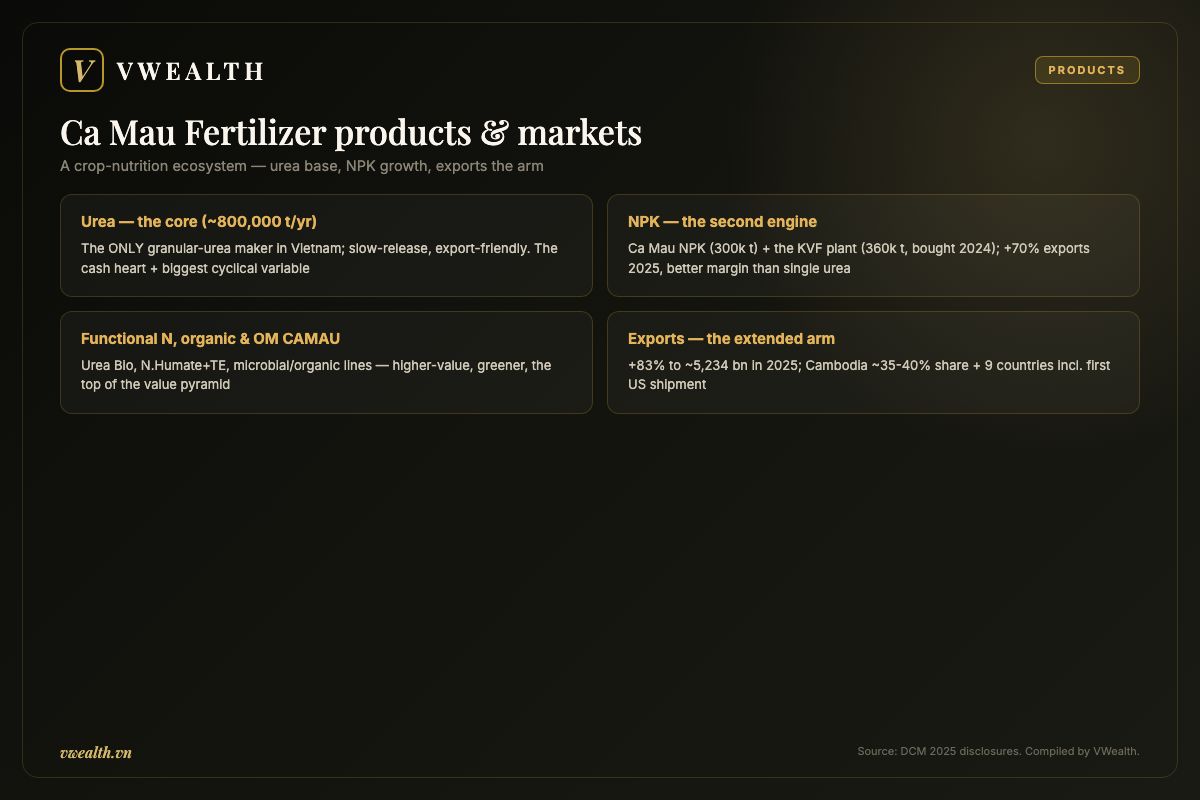
To help you picture the scale, 2025 was a pivotal year: Ca Mau Fertilizer booked revenue of about 16,961 billion dong, a record high in its operating history. The highlight isn’t the total, but the growth structure: exports boomed +83%, reaching about 5,234 billion dong; within that, urea exports alone rose +60% to about 4,051 billion dong, and NPK exports jumped +70% to about 248 billion dong. In other words, DCM’s growth driver last year didn’t come from the familiar domestic market, but from taking the “Golden Grain of the Harvest” across the border. This is a structural change well worth remembering.
The core product: urea — “Golden Grain of the Harvest” and the granular-urea advantage
The heart of Ca Mau Fertilizer, from its founding to today, is still urea — the most common nitrogen fertilizer in agriculture. If you’re not familiar, picture it simply: crops need nitrogen to grow leaves and stems, like humans need protein. Urea is the most common, cheapest and most effective way to supply nitrogen. Almost every rice field or orchard in Vietnam uses urea. DCM’s brand is tied to a positioning familiar to farmers: “Ca Mau Fertilizer — Golden Grain of the Harvest”.
But Ca Mau’s urea isn’t ordinary urea. This is a point to grasp firmly, because it’s the business’s core competitive advantage. DCM is currently the only Vietnamese fertilizer business producing granular urea, with a design capacity of about 800,000 tonnes/year and in fact, in 2025, production volume was raised to around 900,000–942,000 tonnes. So how does “granular” differ from “prilled,” and why does it matter to an investor?
- Larger and harder granules: granular urea has large, matte, hard granules that resist crumbling during transport and spreading. Prilled urea has small granules, dusts easily and cakes when it meets moisture.
- Dissolves slowly, less loss: large granules dissolve gradually in the soil so crops absorb nitrogen more efficiently, reducing evaporation and leaching — meaning farmers apply less for equivalent effect, a real selling point.
- Suited to mechanization and export: granular urea is durable, withstands storage and long-distance transport, ideal for sea export. This is the key that lets DCM penetrate foreign markets where prilled urea struggles to compete.
This very technical trait creates a small but real “economic moat.” When you’re the only granular-urea producer domestically, you don’t compete head-on on price with dozens of other prilled-urea plants; you serve a customer segment with distinct needs — especially markets where 90% of demand is granular urea, typified by Cambodia. That’s why urea remains the main cash-printing machine, and in 2025 export urea alone contributed about 4,051 billion dong.
For a manufacturer, “selling the only thing you can make” is always safer than “selling what anyone can make.” Granular urea places DCM in the first group — and that’s something you should appreciate when assessing business quality, not just looking at raw volume.
On market share, Ca Mau urea dominates the Mekong Delta — the country’s largest rice basket and the plant’s geographic “home turf.” From there, the product spreads to the southeast (industrial crops like rubber, coffee, cashew, pepper) and across the border to Cambodia. The plant’s location right in Ca Mau, near the gas source and near port, gives DCM a clear logistics advantage in the south and Mekong sub-regional exports — an advantage rivals in the north find hard to copy.
Diversification: from “one product” to a “crop-nutrition ecosystem”
If DCM only sold urea, it would be a predictable but also vulnerable business — because its fate would be tightly bound to the world urea price and input gas price. Management understands this clearly, and their biggest strategy in recent years can be summed up in one phrase: building a “crop-nutrition ecosystem” to reduce dependence on single urea. Let’s go through each piece of this ecosystem, because each matters to future revenue prospects.
NPK — the most important leap
NPK is a compound fertilizer containing three main nutrients at once: N (nitrogen, feeding leaves and stems), P (phosphorus, feeding roots and flowers), K (potassium, feeding tubers and fruit and boosting resilience). Plainly, if urea is “a single dish,” NPK is a “balanced nutrition meal” — and the margin is usually better because it has higher processing content. This is the direction the whole fertilizer industry pursues to escape “selling raw material.”
Ca Mau Fertilizer builds NPK capacity through two pillars:
- Ca Mau NPK plant: using modern melt technology (NPK Polyphosphate), capacity of about 300,000 tonnes/year. This technology yields high-quality NPK granules that dissolve well and cake little.
- Han-Viet NPK plant (KVF): from May 2024, DCM owns this plant with a design capacity of about 360,000 tonnes/year, significantly raising NPK capacity and expanding coverage in the southeast. This M&A lets DCM quickly gain capacity without building from scratch — a notable move.
As a result, the NPK segment is clearly accelerating. NPK volume keeps beating plan, and 2025 NPK exports rose as much as +70% (about 248 billion dong). Though the absolute number is still small versus urea, the growth rate shows NPK is becoming the business’s “second growth engine.”
Functional nitrogen, microbial organic and OM CAMAU
Besides urea and NPK, DCM expands into product lines with higher technology content and added value — the “fine” part of the ecosystem:
- Functional nitrogen: products like Urea Bio, N.Humate+TE, N46.Plus — still nitrogen but with added micronutrients and biological agents, helping crops absorb better and selling at a higher price than ordinary urea. The 2026 plan targets producing up to 120,000 tonnes of functional nitrogen, showing this isn’t a side line.
- Organic and microbial fertilizers: serving the green-agriculture, sustainable-farming trend, reducing overuse of chemical fertilizer. This segment anticipates consumer preference and the ever-stricter residue requirements of agricultural-export markets.
- The OM CAMAU brand: a product line tied to the “green agriculture” orientation, focusing on bio-mineral, organic and microbial groups. This is how DCM builds a new, softer brand branch to reach customers interested in safe farming.
Combined, you can picture DCM’s product portfolio as a pyramid: the base is high-volume urea (base revenue, thinner margin), the middle is NPK (fast growth, better margin), the top is functional nitrogen and microbial organic (small volume, high added value). This strategy not only diversifies revenue but also smooths volatility — when the world urea price falls, the value-added lines and NPK can offset part of it, helping profit ride the commodity cycle less like a roller coaster.
Exports: from Cambodia to the Americas and Africa
This is the segment that made 2025 special and the part you should read most carefully, because it reshapes how the business is valued. As noted, 2025 exports rose +83% to about 5,234 billion dong — meaning of every roughly three dong of revenue, nearly one comes from abroad. For a business once seen as “purely domestic, selling to Mekong Delta farmers,” this is a significant shift in business nature.
Cambodia — the number-one market
Cambodia is the largest export market and DCM’s most notable success story. Entering from early 2015, in just a decade Ca Mau Fertilizer has captured about 35–40% of Cambodia’s urea share and targets raising it to 50–60% soon. Why does DCM win big here? Three reasons to grasp:
- Demand traits: about 90% of Cambodia’s urea demand is granular urea — exactly the “specialty” DCM is the only producer of in Vietnam. This is a near-perfect match between product and market.
- Geography: the Ca Mau plant is near the southwestern border, so transport cost to Cambodia’s key agricultural regions (the Tonle Sap area and bordering provinces) is very competitive.
- Brand and distribution: DCM has painstakingly built its network and reputation there over a decade, creating a barrier for rivals wanting to squeeze in.
Expanding worldwide
In 2025, DCM’s products were in about 9 countries, not just in Southeast Asia but reaching far markets like India, Australia, New Zealand, and notably first entering the US market. When world urea prices are favorable, DCM flexibly exports even to the Americas and Africa to optimize the selling price. This approach shows a flexible commercial mindset: sell where the price is best, rather than being bound to a single market.
As an investor, you should view DCM’s exports two ways. The good: it expands markets, helps sell full capacity even when domestic is saturated, and captures moments of high world urea prices. The cautious side: export revenue is sensitive to global urea prices and FX, so the +83% growth in 2025 owes something to favorable selling prices, not entirely to volume. When world urea prices cool, this segment can “shrink” fast. Don’t extrapolate a good year’s growth rate straight into a long-term trend.
Distribution system and brand strength
A good product still needs a network to reach farmers. This is an intangible asset the balance sheet doesn’t record, but very valuable. Ca Mau Fertilizer owns a wide agricultural dealer network, especially dense in the Mekong Delta and southeast — the regions it has rooted in from the start. This multi-tier distribution system covers products down to the commune and hamlet, and more importantly, creates a “relationship cushion” with farmers that new rivals can’t build overnight.
Alongside the distribution system is brand strength. “Ca Mau Fertilizer — Golden Grain of the Harvest” is a brand farmers trust, winning the National Brand and Vietnam High-Quality Goods titles many years running. In fertilizer, where farmers tend to stay loyal to a brand that gave a good harvest, this trust translates directly into repeat purchase. DCM also invests in digital tools like the “2Nong Agricultural Assistant” app for technical advice and customer engagement — a way to modernize farmer relations and gather market data.
When assessing an agricultural-consumer business, don’t just count plants and capacity. The dealer network and brand trust are the second “moat” — intangible but durable — deciding whether that capacity can be fully sold.
The most important input: natural gas and the bond with oil prices
Here we touch the factor you must understand to assess DCM seriously — the input cost. The main material to produce urea isn’t an imported ore or chemical, but natural gas. Gas is used both as material (supplying hydrogen to synthesize ammonia then urea) and as fuel to run the plant. This is why the “Ca Mau gas–power–fertilizer” cluster is bound together.
DCM’s gas is bought mainly from the Vietnam Oil and Gas Group (PVN) system through PV GAS, under a gas sales agreement (GSA) for the PM3-CAA source. What you must carve into your mind is: gas cost makes up a very large share of the urea cost — usually the largest cost. And here’s the key point:
- The gas price is usually referenced to the oil price (MFO/Brent). Meaning when world oil rises, DCM’s input gas price rises, eroding the margin. When oil falls, gas cost falls, and profit stretches.
- To show the specific impact: in 2025, the input gas price was around $8.8/million BTU, and a large part of DCM’s record 2025 profit came from gas prices being comfortable while the urea selling price was favorable — exactly the “urea rising faster than gas” scenario.
So when you look at DCM, picture its profit as a clamp between two jaws: the urea output price (bringing revenue) and the gas input price (tied to oil, creating cost). The gap between these two jaws — not the urea price or oil price alone — decides how much the business profits in a year. This is the trait of a commodity-cyclical business, and it explains why DCM’s profit can swing sharply between years. A wise investor won’t value DCM by a peak year’s profit, but by the average profit across a cycle.
The product–market picture looking toward 2026
To close this section and bridge to the financial story, look at the 2026 plan — it shows where management itself is betting. In 2026, Ca Mau Fertilizer targets selling 771,000 tonnes of urea and 350,000 tonnes of NPK, plus about 120,000 tonnes of functional nitrogen and a significant amount of traded fertilizer. A few valuable observations for you:
- Urea remains the backbone, but the 771,000-tonne sales plan shows the business setting a more cautious target versus its nearly-1-million-tonne production capacity — the surplus reserved for opportunistic exports and flexible inventory.
- 350,000 tonnes of NPK is a number affirming NPK has become a real pillar, no longer an experiment. This is the direction of gradually raising the value-added product share.
- The 2026 profit plan is set below 2025 (after-tax profit target around 1,100–1,200 billion dong, down from the record year) — a signal management is provisioning for a scenario of cooling urea prices and less favorable gas prices. This is precisely the cyclical nature we just analyzed, and you should view the cautious plan as a sign of clear-headedness, not pessimism.
In sum, Ca Mau Fertilizer’s product–market foundation can be captured in one sentence: granular urea is the core creating base revenue and a relative-monopoly advantage; NPK plus the organic, microbial and functional-nitrogen lines are the growth and diversification engine; and exports — led by Cambodia — are the extended arm helping sell capacity and ride the global price cycle. Together, these three layers build a revenue base with both depth and expansion. But all revolve around one variable you can’t forget: the clamp between the urea price and the gas price. Understand this, and you’re equipped for the next section — where we scrutinize the business’s “Position and financial health,” to see whether these product advantages truly translate into cash flow, profit and a solid balance sheet.
Position and financial health
If you only look at Ca Mau Fertilizer’s 2025 profit — 1,917 billion dong after-tax, up 34.3% year on year and beating the adjusted plan by 32% — you easily draw a simple conclusion: the business is doing well. That conclusion isn’t wrong, but it misses the most important thing. A record-revenue year (16,961 billion dong, up 26%) and a nearly debt-free balance sheet don’t happen by chance. They’re the result of three forces converging at one moment — and the product of a cyclical business nature you must understand to value this stock soberly. This section dissects DCM at two layers: the market position the company holds, and the financial health behind the beautiful numbers.
Position: one of Vietnam’s two urea pillars
Let’s start with the standing. On Vietnam’s fertilizer map, the urea market — the most common nitrogen fertilizer — is basically dominated by two names: Ca Mau Fertilizer (DCM) and Phu My Fertilizer (DPM). This isn’t a market of dozens of rivals fighting over every dong of margin; it’s a near-duopoly structure in the domestically produced urea segment. DCM owns a strong brand — “Ca Mau Fertilizer” — with deep coverage in the Mekong Delta, the country’s largest rice basket, where nitrogen demand is tied to every crop season.
That position gives DCM three things a typical commodity business covets: stable offtake at home, a distribution channel embedded down to the commune-level dealer, and enough brand reputation to push exports. In 2025, DCM’s exports reached 5,234 billion dong, jumping 83% — a figure worth pausing on. When a domestic producer can bring its products to even demanding markets and expand its export weight so fast, it’s a sign its quality and cost capability are competitive beyond the border, not just living on domestic protection.
But you also need balance here. DCM’s leadership sits in an industry where the product itself — urea — is a commodity, with almost no differentiation between producers. Farmers buy urea by price and availability, not by a “brand story” like buying a phone. That means DCM’s position protects its market share, but doesn’t protect its margin from world price waves. And this is the door into the core part.
The three profit drivers of 2025
DCM’s 2025 profit broke out not by magic, but because three very specific factors converged. You should separate them, because each has a different “lifespan” — some are long-term structural, some are just a cyclical wave that will recede.
(a) The urea plant finishes depreciation — a structural jolt, not a fleeting one
This is the most important factor and the one amateur investors most often miss, because it sits deep in the financial statements rather than on the headline. Ca Mau Fertilizer’s urea plant finished depreciation from Q3 2023, and the depreciation cost of the whole plant complex fell off definitively from 2023–2024.
The number here isn’t small. In prior years, the urea plant’s depreciation ranged around 1,000–1,200 billion dong a year — an amount equal to 50% of 2021’s pre-tax profit, 26% of 2022’s and as much as 65% of 2023’s. Picture it: before, of every dong of profit DCM earned, a very large part was “swallowed” by depreciation — an accounting cost reflecting the asset gradually wearing out over time.
Depreciation is a “paper” cost: it’s deducted from profit but isn’t real money leaving the till. When a plant has finished depreciating, this cost vanishes from the report, but the plant still runs normally, still produces urea that sells for real money. Result: at the same revenue, profit jumps significantly.
This is what makes this factor entirely different from the other two. Finishing depreciation is a structural and durable change — it doesn’t depend on market prices rising or falling. Once the margin has been “raised” by lifting this burden, it stays for many years as long as the plant runs well. That’s why DCM’s gross margin is forecast to hold in the high zone — around 22–24% — rather than shrinking like the prior period.
(b) Urea prices and exports recovering — a cyclical wave
The second factor is entirely opposite in nature: it’s a wave, not a foundation. In 2025, DCM’s average urea selling price rose about 13% year on year, and at times the Asian urea price touched nearly $500/tonne — 10% to 17% above the 2024 low. When the output price rises while input costs haven’t risen correspondingly, the urea segment’s margin stretches spectacularly: at one point the urea gross margin reached 37%, well above 26% the same period the year before.
Alongside prices are exports. As noted, 2025 export revenue rose 83% to 5,234 billion dong. When world prices climb, exports both help DCM release volume and “ride” good prices in foreign markets. This is a positive flywheel — but remember it spins both ways. World urea prices that have risen can also fall, and then this same export machine will drag profit the other way.
(c) The 5% fertilizer VAT law — a long-term game-changer
The third factor is institutional, and subtler than it seems. From 1 July 2025, under the 2024 Value-Added Tax Law, fertilizer shifted from “VAT-exempt” to “subject to 5% VAT”.
At first hearing, you might think “being taxed more must be bad news?” This is exactly the counterintuitive point. Previously, because fertilizer bore no output tax, a business like DCM also couldn’t deduct input VAT — i.e. all the VAT on gas, electricity, materials and machinery it bought to produce was “absorbed” into the cost, unrecoverable. Per industry estimates, this non-deductible input tax alone cost fertilizer businesses like DPM and DCM about 500–650 billion dong a year.
When the new law took effect, fertilizer bears a 5% output tax but in exchange the business can fully deduct input VAT. The input tax once buried in the cost is now refunded or offset, cutting real production cost. This isn’t just accounting: it also lifts the competitiveness of domestic goods versus imported urea, which previously benefited from the tax differential. Most importantly, like the depreciation factor, this is a structural, long-term change — it improves the business’s base economics year after year, not a temporary wave.
In sum, of the three drivers, two — finished depreciation and VAT — are durable foundations, while one — urea prices and exports — is a cyclical wave. Understanding this distinction matters because it tells you which part of the 2025 profit will “stay” and which can “recede” when the cycle reverses.
Commodity cyclicality: a margin clamped between two prices
Now we touch DCM’s deepest nature. This is a true commodity-cyclical stock, and if you don’t grasp this, you’ll keep being surprised by the violent up-and-down swings in profit.
DCM’s profit is clamped between two prices at either end:
- Output — the world urea price. This is what DCM sells. Urea is a global commodity, priced by international supply and demand, moves in China, Russia, the Middle East, big countries’ export policies, and even global crop weather. DCM has almost no pricing power here — it’s a price taker.
- Input — the gas price. Natural gas is the main material to synthesize urea, and DCM’s gas price is anchored to the world oil price. When oil rises, DCM’s input cost rises. In 2025, DCM’s input gas price was around $8.8/million BTU.
The business’s profit is essentially the gap between these two prices — the gross margin clamped between the urea price (output) and the gas price (input). When urea rises faster than gas, the margin stretches and profit booms. When gas rises while urea stays flat or falls, the margin is choked. 2025 was a rare “favorable” year when urea rose faster than gas.
History illustrates this clearly. In 2021–2022, when world urea peaked on supply-chain ruptures and geopolitical conflict, DCM profited unprecedentedly. Then urea cooled, and profit shrank in 2023. By 2024–2025, prices recovered and, combined with the two structural factors mentioned, profit jumped again. You see — this is a wave chart, not a steadily rising line.
The lesson in valuing a cyclical stock: don’t take a peak year’s earnings, multiply by a high P/E and infer value. Peak earnings in a cycle usually come with a “deceptively” low P/E, and vice versa. You need to look at average profit across a cycle, while separating the durable “base” part (finished depreciation, VAT) from the “wave” part (urea prices).
A fact worth stating frankly for balance: market analysts have forecast that 2026 DCM revenue could edge down as urea prices are projected to decline along the cycle, and after-tax profit could fall by a double-digit percentage from the 2025 peak. This isn’t a warning about the business’s health — it’s a reminder that you’re investing in a boat that rises and falls with the tide of commodity prices.
The balance sheet: where DCM truly shines
If the profit side forces caution because of cyclicality, the balance sheet is where DCM puts you at ease. This is one of the healthiest balance sheets you can find on Vietnam’s stock market.
The focus is the net-cash position. At the end of 2025, DCM’s current assets concentrated mostly in cash and equivalents (about 1,900 billion dong) plus bank deposits (over 7,000 billion dong). During the year, DCM at one point held over 11,000 billion dong in bank deposits. This is a cash mountain in the literal sense.
More important than the cash mountain is what DCM doesn’t have: almost no long-term debt. The “liabilities” on the balance sheet are mainly normal operating debt — payables to suppliers, a bit of short-term borrowing, a science-technology development fund — not heavy financial leverage. When deposits far exceed borrowings, we say the business is in a large positive net-cash position. This gives you three layers of value:
- Safety. A cyclical business with almost no debt survives comfortably through years of bottomed urea prices. It isn’t strangled by interest pressure when profit thins — a survival cushion for a cyclical stock.
- Deposit interest contributes to profit. Thousands of billions in deposits generate a steady financial-revenue stream, adding straight to profit without “producing” anything more. This flow moves with the rate level — e.g. Q4 2025 financial revenue fell year on year as rates dropped — but fundamentally it’s a stable passive income source.
- Ample room for high dividends. With deep pockets and little big-investment need, DCM comfortably pays generous cash dividends. The business has proposed a 20% cash dividend (2,000 dong a share), totaling over 1,000 billion dong. For a cash-flow-oriented investor, this is a clear plus.
In other words, even when the urea-price wave recedes and operating profit shrinks, this healthy balance sheet ensures DCM remains a business you can sleep soundly with: debt-free, cash earning interest, and able to feed shareholders with dividends.
Risks: what could reverse the picture
An honest analysis can’t just list bright spots. DCM’s position and financial health are real, but they operate in an environment of many variables you need to weigh soberly:
- Falling world urea prices. This is the number-one risk. Because DCM is a price taker, a global urea down-cycle directly squeezes the margin, regardless of the plant finishing depreciation. As the 2026 forecasts themselves show, a cooling-price scenario is entirely realistic.
- Rising input gas prices. Gas is anchored to oil. A prolonged oil-price rise pushes input cost up while urea may not keep pace, squeezing the margin from the other side. Longer term, there’s also the worry about gas supply and the risk of regional gas-field depletion — a strategic variable DCM’s management has repeatedly mentioned.
- El Nino, weather and crop seasons. Fertilizer demand is tightly tied to cultivated area and the crop calendar. Drought, saline intrusion or extreme weather in the Mekong Delta can reduce domestic urea consumption, affecting sales volume.
- Competition from imported urea. When world prices are cheap, imported urea can flood in and pressure domestic selling prices. The new 5% VAT policy narrowed imports’ advantage, but price competition remains ever-present for an undifferentiated commodity product.
The key point to keep in mind: most of these risks hit cyclical profit, not the business’s survival. Thanks to the net-cash balance sheet and two durable structural drivers (finished depreciation, VAT), DCM has a relatively solid “floor” under it even in tough years. What swings is how fast or slow profit grows, not a question of survival.
Having understood the duopoly position, three profit drivers, cyclical nature and such a rare healthy balance sheet, the natural next question is: how is the market valuing all this? How is DCM stock being received, and does the current price fully reflect — or overshoot — expectations of a peak-cycle year? That’s what we’ll dissect right after.
Market reception
When you type DCM on the board and see 36,600 dong (close of 19 June 2026 per VWealth plugin data), you’re looking at one of the most interesting “two-faced” stocks on HOSE. On one side, DCM is deeply cyclical in the fertilizer industry — rising and falling with world urea prices like a boat on waves. On the other, investors love it as a steady income stock, thanks to its high cash dividend and cash-thick balance sheet. To understand why the market both “craves” and is “wary” of this stock, you need to peel back each layer: whether it’s really expensive or cheap, why money finds it, what makes the price dance, and which are the catalysts — and which the risks — ahead.
In June 2026 alone, DCM fell fairly hard, losing about 6.27%. This isn’t a groundless drop — it precisely mirrors market sentiment as the world urea price fell to a low zone around $360/tonne and the business announced a 2026 profit plan down nearly 40%. If you only see that drop and panic, you miss the big picture. But if you don’t understand why the market reacted that way, you easily “catch a falling knife” in the wrong place. This section helps you stand between those two extremes soberly.
Valuing a cyclical fertilizer stock: a low P/E isn’t necessarily cheap
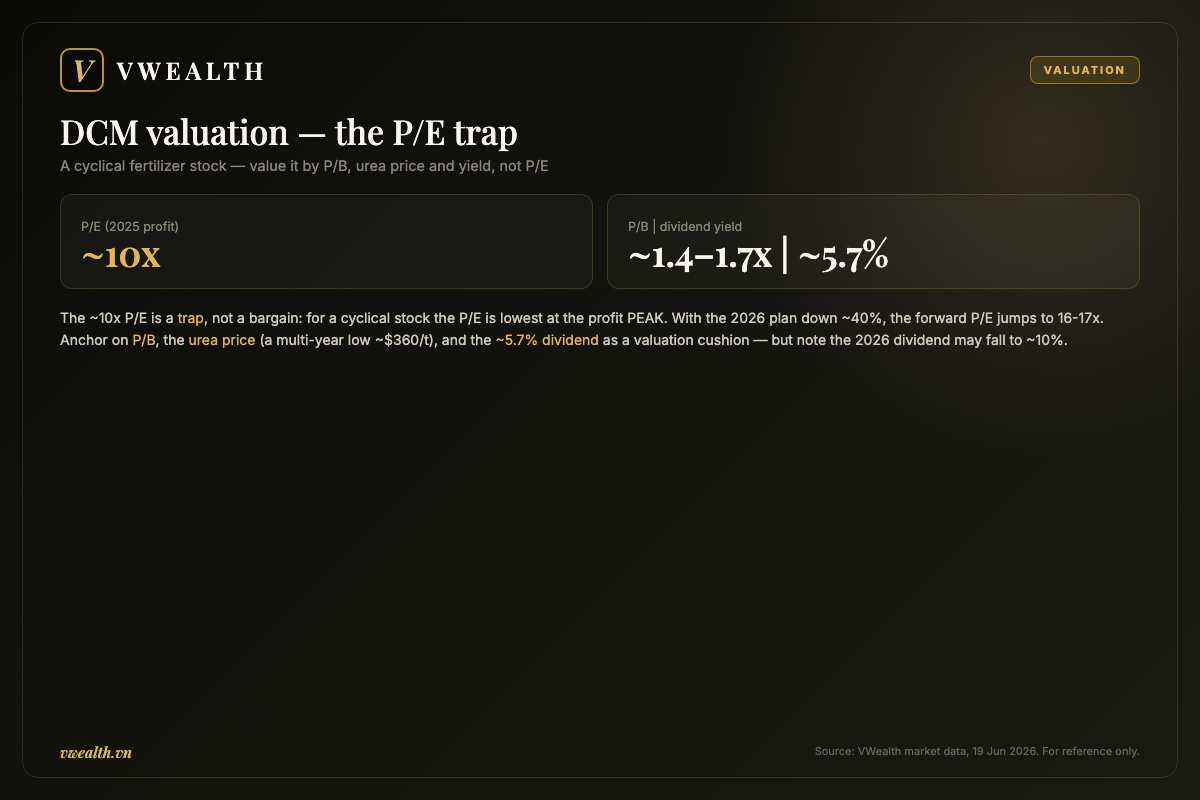
Let’s start with the simple calculation anyone does first. DCM’s 2025 after-tax profit reached about 1,917 billion dong (some sources record nearly 1,962 billion post-review). With about 529.4 million shares outstanding, basic earnings per share (EPS) lands around 3,600 dong. Dividing the 36,600-dong price by this EPS gives a P/E of about 10x. Versus the market average (usually 13–15x), 10x looks like a bargain.
But this is the biggest trap in valuing a cyclical commodity stock — what veteran analysts call the “P/E trap.” For a steadily growing business, a low P/E means the stock is cheap. But for a cyclical business like DCM, that logic is dangerously reversed:
- A low P/E usually appears right when profit peaks in the cycle. When urea prices are high, profit swells, the large EPS denominator pulls the P/E down. The stock looks “cheapest” exactly when it’s most expensive in risk terms, because after the peak usually comes the down phase.
- A high P/E often appears at the cycle bottom. When urea prices bottom, profit withers, the small EPS makes the P/E spike — but that’s the good buy point if you believe the cycle will reverse.
DCM’s 2025 is very likely a near-peak year: urea prices still high, the margin further supported by the new VAT policy. The clearest evidence is right in management’s own plan: they target 2026 after-tax profit of only about 1,182 billion dong — down nearly 40% from 2025. If that scenario plays out, EPS falls to around 2,200 dong, and the “real” forward P/E jumps to 16–17x. Then the 10x you see today means nothing.
For a fertilizer stock, never value by a single P/E at one point. DCM’s 10x P/E doesn’t say the stock is cheap — it only says profit is in a high zone. Value it across the whole urea-price cycle, not by one pretty quarter.
So if you can’t trust the P/E, what do you look at? For a cyclical stock, three far more reliable measures:
- P/B (price to book). DCM now trades around 1.4–1.7x book. P/B is far more stable than P/E because book value doesn’t dance with each profit/loss quarter. When DCM’s P/B falls to the low of its history (near 1x), that’s usually a far more attractive valuation signal than when the P/E looks “pretty.”
- The world urea price. This is the root variable. Every serious DCM valuation model must start from an assumption about the average urea price in the year. The current urea price around $360/tonne is at a multi-year low — this is both a risk (2026 profit will wither) and an opportunity (if you believe the price has bottomed and will recover).
- Dividend yield. For a business paying cash steadily and high like DCM, the dividend yield becomes a “valuation cushion” — a psychological floor below which income money automatically jumps in to support the price.
The chart below gathers DCM’s valuation picture for you to grasp the key numbers quickly — and more importantly, to see why they can’t be read in isolation.
The appeal: a high cash dividend and a cash-rich balance sheet
If cyclical valuation is the part that makes you wary, the dividend and cash are the part that makes you love DCM. This is the fundamental difference creating this stock’s “dual character.”
DCM’s general meeting approved a 20% cash dividend for 2025, i.e. 2,000 dong per share. With 529.4 million shares, the business pays out about 1,059 billion dong of real cash to shareholders. At 36,600 dong, this dividend equals a yield of about 5.7% — higher than long-term bank savings rates at present, and well above the VN-Index’s dividend-yield average.
That 5.7% isn’t an accounting miracle. It’s backed by a rarely “healthy” balance sheet among manufacturers:
- Ample cash and deposits. DCM has for years kept thousands of billions of dong in cash and equivalents, with almost no net debt. This deposit also earns interest, contributing significantly to financial profit — a “cushion” helping profit not fall hard even when the fertilizer segment struggles.
- Low debt, strong operating cash flow. A cyclical business without interest burden has a vital advantage. When the cycle bottom hits, DCM isn’t forced by debt pressure to fire-sell or urgently cut the dividend.
It’s this combination that turns DCM into what investors call a “defensive dividend stock” inside a very cyclical industry group. It sounds contradictory, but it’s true: while most commodity stocks make investors lose sleep over volatility, DCM has an income cushion helping investors stay calm. This is why income investors — those who want a steady dividend flow more than sky-high price gains — especially like DCM.
However, be sober on one point: the dividend isn’t forever at 2,000 dong. Management itself has proposed a 2026 dividend of only about 10%, i.e. 1,000 dong a share, alongside falling profit. If that plays out, the dividend yield at the current price falls to around 2.7%. The “cushion” is still there, but thinner. This is where cyclicality creeps into even the seemingly safe dividend story.
Price action: the four valves controlling the DCM wave
To trade or invest in DCM effectively, you need to know what pulls its price. Unlike a bank or retail stock, DCM has a set of “valves” very characteristic of the agricultural-commodity industry:
- (a) The world urea price. This is the most powerful variable. Urea is a globally traded good, and the domestic price tracks the international one closely. When world urea rises, DCM’s margin stretches very fast, and vice versa. Urea falling to $360/tonne in June 2026 is the direct cause of the stock’s 6.27% drop that month.
- (b) Oil and gas prices. Natural gas is the main input to produce urea, and the gas price usually anchors to oil. When gas rises, DCM’s production cost swells, eroding the margin. So the best scenario for DCM is high urea prices with low gas prices — a “phase mismatch” that doesn’t always happen.
- (c) Agricultural seasons. Fertilizer demand is clearly seasonal per the Winter-Spring and Summer-Autumn planting calendars. Domestic consumption and selling prices usually warm at the start of a season and cool at the end. Speculative money often front-runs these seasonal rhythms.
- (d) Export news. DCM exports a significant part of its volume. Each piece of news on a big export contract, or an export-policy change in big countries like China or Russia, can create a wave for the stock.
A trait to remember: DCM has high, stable liquidity and is a stock both schools care about. Dividend investors buy and hold long to earn the cash flow; while cycle speculators “surf” the urea-price and seasonal rhythms. The synergy of these two money flows means DCM rarely falls into “liquidity death,” while having waves big enough to trade. In other words, you can play DCM in many ways, as long as you clearly know which role you’re in.
Catalysts and risks: two sides of the same urea coin
Every decision with DCM ultimately revolves around weighing positive catalysts against risks. Let’s face both squarely.
The catalysts that could push the price up:
- Urea prices recovering from the bottom. The $360/tonne level is seen by many as a multi-year low. If geopolitical tension or global agricultural demand pulls urea up, DCM’s profit will bounce back very fast — and this is the cycle investor’s dream.
- The plant finishing depreciation. The Ca Mau plant has passed the biggest depreciation phase, cutting fixed costs sharply in coming years. This creates a higher, more durable margin base even when urea prices aren’t very high — a structural advantage, not temporary.
- Expanding exports. Diversifying export markets helps DCM reduce dependence on domestic demand and capture price differentials between regions.
- Benefiting from the 5% VAT law. Putting fertilizer under 5% VAT (instead of exempt) lets DCM deduct input tax, sustainably improving the margin. This is a real policy jolt, not empty hope.
The biggest risk:
- Falling urea prices in 2026. This is the number-one risk, and not hypothetical — management itself set a 2026 profit plan down nearly 40% based on the assumption of cooling fertilizer prices. If urea prices keep drifting or fall deeper, the margin will shrink and the dividend could be cut too.
- The risk of rising input gas prices, squeezing the margin from the cost side.
- Seasonal and weather risk affecting domestic fertilizer demand.
Foreign investors and foreign room
A factor you shouldn’t ignore when assessing long-term demand for DCM is foreign capital flows. DCM is a member of the Vietnam Oil and Gas Group (PVN), with a very high controlling state stake. This has a dual consequence:
- Because the state stake is large, the truly freely tradable shares (free-float) for outside investors are narrower than the charter capital. The room for foreigners is thus also limited by this ownership structure.
- When foreign room still has headroom, DCM becomes an accessible choice for funds wanting a position in Vietnam’s fertilizer industry — especially as the market-upgrade and room-loosening story is hot. Foreign net buy/sell action on DCM is thus a sentiment indicator worth tracking: they usually buy when they believe in a urea-price recovery cycle and sell when they fear a prolonged cycle bottom.
You should view foreign action as an added layer of information, not the only signal. For a stock whose root story is the urea price, foreign capital usually follows commodity moves rather than leading them.
To close: both defensive and cyclical
After peeling back enough layers, DCM’s picture becomes interestingly clear. This isn’t a growth stock to expect a double or triple, nor an absolutely safe bond. DCM sits in a rare hybrid position:
DCM is a cyclical fertilizer stock — but a cyclical stock with a high cash dividend and a healthy balance sheet. It’s both defensive (thanks to cash and dividends) and cyclical (following the urea price). So DCM suits those who like receiving a steady dividend and accept the trade-off that the share price will swing with the urea-price rhythm.
In other words, if you’re an income investor wanting a good dividend flow and willing to “sit still” through urea-price waves, DCM is a candidate worth considering — as long as you buy at a reasonable valuation (look at P/B and dividend yield, don’t be fooled by the low P/E) and understand the dividend can swing with the cycle. But if you can’t bear the share price rising and falling with a good beyond the business’s control, that very cyclicality will keep you up at night.
To place this “two-faced” character in its proper context, in the next section — Industry context — you’ll see how urea prices, tax policy and the global fertilizer supply-demand picture shape the fate of DCM and the whole Vietnamese fertilizer stock group.
Economic and fertilizer-industry context: understand the “rules of the game” before valuing DCM
Before you ask “is DCM expensive or cheap,” there’s a truth you must accept: Ca Mau Fertilizer isn’t a business whose fate rests entirely with management. Most of the company’s profit is decided by two numbers DCM barely controls — the world urea price at output and the natural-gas price at input. All management talent, sales strategy, distribution system… all revolve around the gap (margin) between these two numbers. So to understand DCM, you must understand the industry it lives in. This is an industry cyclical in nature, and if you ignore this, every pretty P/E or dividend figure can deceive you.
Urea is a global commodity, not a “brand” product
Let’s start from the product’s nature. A bag of urea DCM makes is essentially identical to a bag made by a plant in China, Russia, the Middle East or Indonesia — the same nitrogen fertilizer with about 46% nitrogen. Farmers aren’t loyal to a urea brand the way they’re loyal to a phone or a cup of coffee. They buy the cheaper one of equivalent quality. That means DCM has almost no pricing power in the classic sense. The urea price in Ca Mau is, ultimately, a function of the world urea price plus/minus transport cost, tax and local seasonal factors.
This is the first key point to carve in: when you buy DCM, you’re indirectly betting on the global urea price. DCM’s 2025 profit reached about 1,961 billion dong (consolidated after-tax), up as much as 45% year on year — but most of that leap didn’t come from DCM suddenly getting better, but from the urea-price and cost environment favoring them. That’s both good news and a warning.
The urea-price cycle: four invisible hands in a tug-of-war
The world urea price doesn’t move randomly. It’s the result of four large forces continually pulling against each other. Understand these four and you’ll read the fertilizer industry’s “weather” better than most individual investors.
- Energy input prices (gas and coal). This is the foundation of all cost. To produce urea, you first synthesize ammonia, and ammonia is made mainly from natural gas (in the West, Middle East, Vietnam) or coal (in China). Per market analyses, natural gas makes up about 90% of urea production cost at gas-based plants, and making one tonne of ammonia needs 28–33 million BTU of gas. When gas prices rise, urea production cost rises almost immediately, pulling the urea floor price up. Conversely, when gas is cheap, plants can run at full capacity at low cost.
- Agricultural demand. Urea is used to fertilize rice, corn, coffee, fruit trees… This demand is fairly seasonal-stable, but can surge when crop prices (rice, corn) rise, since farmers have an incentive to invest more heavily in their harvest. This base demand keeps urea prices from ever fully collapsing — people still must eat, and crops still must be fertilized.
- China’s policy. China is one of the world’s largest urea producers and exporters, so whenever Beijing tightens the export valve to prioritize domestic price stability and food security, global supply is instantly squeezed and world urea prices bounce up. This isn’t hypothetical: China’s urea exports once fell over 90% year on year during a period prioritizing the domestic market, and restrictions keep being applied at peak-season moments. Each time China “closes the door,” non-Chinese producers like DCM benefit indirectly from higher prices.
- Geopolitics and Russia. Russia is a fertilizer and gas export power. Every geopolitical tension, every sanction or disruption involving Russia can shake both the gas and fertilizer markets. War and trade conflict tend to push energy and fertilizer prices up — a paradox DCM investors need to be aware of: global instability is sometimes “beneficial” for a domestic urea business’s margin.
Picture the urea price as the water level in a lake with four streams flowing in and out. Gas prices and China/Russia policy usually push the level up; new supply and weak crop prices pull it down. When you buy DCM while the water level is high, ask yourself: how long will it stay there?
The 2025–2026 price picture: peak passed or still room?
This is the part where you need to be especially sober. Per international bodies, world urea prices had a strong 2025. Some forecasts show urea could rise about 30% in 2025 amid a tight market, before falling about 7% in 2026 and continuing to fall in 2027 as new capacity in East Asia and the Middle East comes online. More cautious forecasts see prices up about 15% in 2025 then down about 4% in 2026. In absolute terms, world urea in 2025 ranged around $0.32–0.37/kg, and the 2026 outlook is described as “stable but to be watched closely,” around $0.35/kg.
In other words: 2025 is very likely a favorable near-peak year, while 2026 onward is a question mark leaning toward a mild correction. The factor that could reverse this down scenario is: new capacity arriving slower than expected, China/Russia re-tightening exports, or gas prices bouncing. This is precisely why DCM’s low P/E (~10x) must be read with caution — we’ll return to this.
Input gas prices: a “fate” tied to oil prices and PVN supply
On input, DCM depends on gas supplied by the Vietnam Oil and Gas Group (PVN), and gas prices in Vietnam are usually referenced to world oil prices (Brent/MFO). When oil rises, gas prices tend to rise with it, eroding DCM’s margin. When oil falls, gas costs ease, the margin stretches.
The 2026 context here is quite notable. Many forecasts see 2026 Brent possibly only around $55–60/barrel — relatively low versus prior tense years. If cheap oil materializes, it’s a tailwind for DCM’s gas costs. However, natural gas prices at reference markets (like Henry Hub) are forecast by some bodies to edge up in 2026 due to a cold winter and rising LNG export demand. The lesson: DCM’s input doesn’t always move in the same direction as its output, and this very tug-of-war creates the large swing range in profit.
There’s a long-term risk you shouldn’t ignore: the PM3-CAA gas field (the Vietnam–Malaysia overlapping-claim sea area) is gradually depleting. Per DCM’s leadership, gas for the Ca Mau gas–power–fertilizer complex is sufficient until just before 2028, and PVN is working to bring new fields (Nam Du – U Minh, Khanh My – Dam Doi) into production, expected to supply gas in 2028–2030. This isn’t an immediate threat, but a “countdown clock” long-term investors should note.
The 5% fertilizer VAT law: a policy turning point favoring domestic businesses
If you had to pick the most important policy change for Vietnam’s fertilizer industry in years, it’s bringing fertilizer back under 5% VAT. Under VAT Law No. 48/2024/QH15 passed by the National Assembly in November 2024, from 1 July 2025, fertilizer (including organic) shifted from “exempt” to “subject to 5% VAT.”
At first hearing, “being taxed” seems like bad news. But for a domestic producer like DCM, this is actually an advantage. The reason lies in the deduction mechanism. Previously, when fertilizer was exempt from output tax, the producing business couldn’t deduct input VAT (on gas, electricity, machinery, services…), so that input tax was “absorbed” into cost, inflating the price. Shifting to 5% output tax lets the business deduct input tax, thereby easing the cost burden and improving cash-flow efficiency.
At the same time, this policy creates a fairer playing field between domestic and imported goods: previously imported fertilizer was also exempt, now imports also bear 5% VAT, reducing foreign goods’ price advantage. Domestic financial press has likened this to a “golden season” for the fertilizer industry thanks to VAT. For DCM — a large-scale producer with huge input costs — the deductible input tax is a real, durable saving, not a one-off effect.
Food security and Vietnam’s agricultural demand: a stable demand cushion
Another important anchor for the industry is the stability of domestic demand. Vietnam is an agricultural country with a large rice area, a top-tier rice exporter, plus vast coffee and fruit-tree regions. Food security is always a national strategic priority, meaning domestic fertilizer demand is unlikely to drop suddenly. Total domestic urea demand is about 1.8–2 million tonnes/year, while total domestic urea plant capacity is about 2.6 million tonnes/year — i.e. Vietnam is self-sufficient and in urea surplus, with the surplus pushed to exports. This is a demand cushion ensuring DCM never falls into “no market to sell,” however prices swing.
The industry risks you must not forget
For balance, let’s name the industry’s structural risks squarely:
- Cheap imported urea. When China reopens its export valve, or when new Middle East/East Asia plants release products at low cost, cheap imported urea can flood in, pressuring domestic selling prices and eroding DCM’s margin.
- A commodity-price reversal. The cyclical nature means after the peak comes the bottom. A double reversal — falling urea while gas rises — will “clamp” the margin from both sides, and profit can fall far faster than you think.
- Global oversupply. New urea capacity is being added in East Asia and the Middle East, which is why many bodies forecast cooling urea prices from 2026 on.
- Weather and crop seasons. Drought, floods, pests or changes in the crop calendar all directly affect quarterly fertilizer consumption.
To sum up this section: DCM lives in an industry with stable base demand thanks to food security, backed by the domestic-favorable 5% VAT policy, but with profit governed by a global urea–gas price cycle the company can’t control. You need to keep both pictures in mind heading into the forecast section.
Trend forecast: drivers, scenarios and what could happen to DCM’s share price
No one forecasts a cyclical stock’s price precisely. Anyone who firmly says “DCM will hit price X” is selling you false confidence. Instead, the mature approach is: identify the real drivers, then build scenarios with clear conditions, so you know what to watch. This is how veteran analysts work — not fortune-telling, but mapping probabilities.
DCM’s real growth drivers
Before discussing the urea price (which DCM doesn’t control), let’s note what DCM is actually doing to lift its own intrinsic value — this is the part worth appreciating at the business level.
- High, durable margin thanks to the finished-depreciation plant. This is the biggest driver and undervalued by many investors. The Ca Mau plant finished depreciation from Q4 2023. When a trillion-dong plant has finished depreciating, depreciation cost — a large cost that held profit down for years — nearly vanishes from the income statement. Result: at the same urea selling price, DCM’s margin is now well above the prior period, and the urea gross margin has improved to around 27%. This is a structural, durable advantage, market-independent.
- Expanding into NPK, organic and functional nitrogen. DCM is proactively reducing dependence on urea alone by pushing NPK, organic fertilizer and higher-value functional-nitrogen lines. NPK volume in the first 11 months of 2025 reached about 222,780 tonnes, up nearly 22% year on year and beating the year plan. The 2025 acquisition of the Han-Viet fertilizer plant helps DCM expand NPK capacity and diversify the portfolio. This is a very important effort because NPK is less “bare” than urea, can create product differentiation and a more stable margin.
- Strong exports. Thanks to domestic urea surplus, DCM pushes exports to Cambodia and regional markets. Exports both help sell surplus volume and capture moments of high world urea prices (especially when China tightens exports).
- New projects and post-urea diversification. DCM is researching long-term directions to prepare for the “post-urea” phase, including a green-hydrogen project. PVN has also said it won’t divest yet and wants DCM to complete the green-hydrogen project soon. These directions are still distant and can’t be quantified yet, but they show management is aware of the limits of the traditional urea segment.
The 2025 results reflect the synergy of these drivers with a favorable price environment: total consolidated revenue about 17,032 billion dong (beating plan by 7%, up 21% year on year), after-tax profit about 1,961 billion dong (up as much as 45%). A brilliant year. The wise investor’s question isn’t “was this year good,” but “how long can this beauty repeat.”
Three scenarios for the next 12–24 months
Let’s build three scenarios with clear conditions and consequences. Note: this is a conditional thinking frame, not an assertion.
Positive scenario — “the double tailwind”
Conditions: China keeps tightening urea exports or geopolitical tension keeps world urea prices high; while Brent oil is low (around $55–60/barrel) easing input gas prices; DCM pushes exports and NPK in rhythm. Consequence: the margin stretches from both sides — selling high, buying inputs cheap. Profit could hold or beat 2025. In this scenario, the market may pay a more generous valuation, and DCM’s price has room to rise. The cash dividend is likely maintained or improved.
Base scenario — “sideways and collect dividends”
Conditions: World urea prices cool mildly per forecasts (down a few percent in 2026) but don’t collapse, drifting around the current zone; gas prices stable; domestic demand solid thanks to food security; the 5% VAT advantage and finished-depreciation plant help hold the margin. Consequence: profit falls slightly from the 2025 peak but stays healthy. The share price trades in a band, and most of your return comes from the steady cash dividend (~5.7%) rather than price gains. This is the most probable scenario per current industry forecasts — DCM becomes a classic “dividend stock.”
Negative scenario — “the margin clamp”
Conditions: New urea capacity in East Asia/Middle East booms, China opens the export valve, pushing world urea prices deep down; while gas prices rise (from LNG demand, a cold winter, or oil bouncing). Consequence: the margin is “clamped” from both sides — selling cheap, buying dear. Profit could fall sharply, far faster than investors sense. Then today’s “cheap” P/E is exposed as a trap: because profit (the denominator) shrinks, the real P/E swells even as the share price has fallen. The dividend could be cut. This is the biggest risk and the reason you shouldn’t value DCM like a steadily growing business.
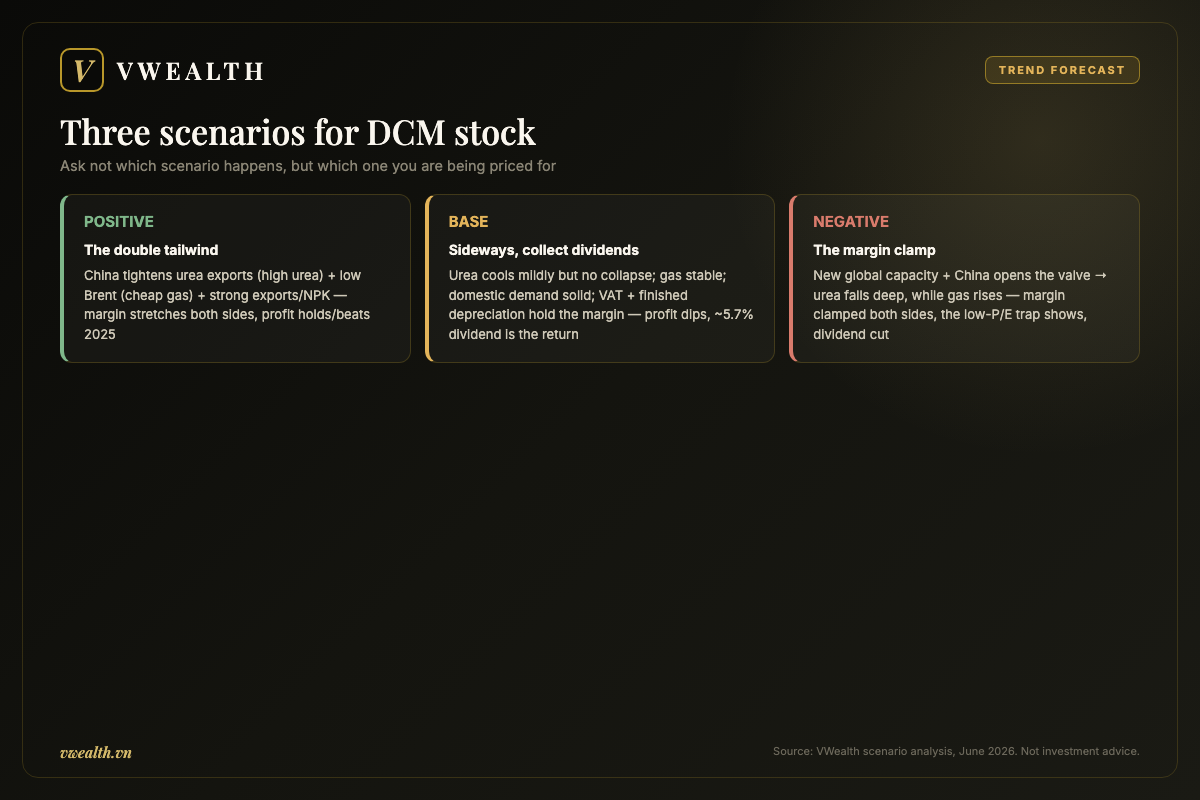
The important thing when reading these three scenarios: don’t ask “which scenario will happen,” ask “which scenario am I being priced for.” If DCM’s current price already reflects the positive scenario, your risk is asymmetric (little upside, much downside). If the price reflects the negative or base scenario, your margin of safety is thicker. This is the value-investing spirit applied to a cyclical stock.
Should you buy DCM stock?
This is the question you really want answered, and I’ll be honest from the start: this article won’t tell you to buy or sell. No one — not even the most skilled analyst — should issue that command for you, because the right answer depends on who you are: your goals, risk appetite, time horizon and portfolio structure. My job is to lay all factors honestly on the scale, so you decide with eyes wide open.
Weighing the PROS — why many investors love DCM
- An industry-leading position. DCM is one of Vietnam’s two largest urea producers. This is a business with scale, a reputable fertilizer brand and a wide distribution system — not a small, vulnerable name.
- The plant has finished depreciation — a high, durable margin. As analyzed, finishing depreciation from Q4 2023 is a real structural advantage. It sustainably raises the margin base, letting DCM profit better at the same urea price than rivals still carrying depreciation.
- An extremely healthy balance sheet. DCM is famous for large cash and low debt. A “cash-rich, low-debt” balance sheet is a precious safety cushion for a cyclical business: it helps the company live well through years of low urea prices, maintain dividends, and have room to invest/acquire when opportunity arises (like the Han-Viet deal). This is a sign of a financially disciplined business.
- A high, attractive cash dividend (~5.7%). At about 36,600 dong, the ~5.7% cash dividend yield is very competitive — higher than bank savings rates at many points. For investors seeking a steady flow, this is a core appeal. This high-dividend capacity is backed by the very healthy balance sheet and good margin above.
- Benefiting from the 5% VAT policy and exports. The 5% VAT law effective from 1 July 2025 is a durable jolt improving cost efficiency and creating a fair playing field with imports. Plus export room amid domestic surplus, these are real profit supports.
- PVN backing on gas supply. As a PVN-ecosystem member, DCM has relative assurance of input gas — at least until before 2028, with plans to add new fields in 2028–2030. PVN has also said it has no plan to divest, showing a long-term commitment to accompany.
Weighing the CONS — what should make you wary
- The commodity-cyclical nature. This is the fundamental, ineliminable risk. DCM’s profit is highly sensitive to the urea price (output) and gas price (input) — two variables the company doesn’t control. A brilliant year like 2025 doesn’t guarantee the next. If you can’t bear profit swinging sharply between years, this is a big sticking point.
- The peak-cycle P/E trap. This is perhaps the most dangerous trap for newcomers. DCM’s P/E around 10x looks “cheap,” but for a cyclical stock, a low P/E at peak profit is usually a warning signal, not an invitation. When profit turns down, the P/E swells even as the price has fallen. The counterintuitive rule of cyclical stocks: a high P/E (at trough profit) is sometimes the good buy point, while a low P/E (at peak profit) is the risk point. Don’t value DCM by the same measure you use for a steady grower.
- Dependence on PVN gas prices and long-term gas-supply risk. DCM doesn’t control its input. Gas prices are governed by the mechanism and oil prices, while long-term gas supply faces the PM3-CAA depletion story. Though not urgent, this is a “countdown clock” for the post-2028 phase you need to track.
- Limited long-term growth. The domestic urea market is saturated (Vietnam is self-sufficient and in surplus). DCM can’t grow forever by selling more urea. Future growth depends on NPK, organic, functional nitrogen, exports and new projects (green hydrogen) — drivers that still need time to prove. This isn’t a stock to expect multi-fold gains from compound growth.
- Imported-urea and weather/seasonal risk. Cheap imported urea (when China opens the valve or global new capacity rises) can pressure selling prices. Adverse weather, pests and seasonal shifts all directly affect quarterly consumption.
A four-investor frame — who does DCM suit?
The same stock can be an excellent choice for one person and a mistake for another. Let’s view DCM through four investor portraits so you position yourself:
| Investor type | What they seek | Does DCM suit? |
|---|---|---|
| Income investor | Steady cash flow, high dividend yield, financially healthy business | Fairly suitable. A ~5.7% dividend and a cash-rich, low-debt balance sheet are big pluses — as long as you accept the dividend can swing with the profit cycle. |
| Value investor | Buying good assets below value, with a margin of safety | Possibly suitable — if you buy at the right cycle point. The key is buying when the price reflects the bad/base scenario, not the peak. Stay sober about the P/E trap. |
| Growth investor | Fast, steady profit growth for many years | Less suitable. The urea market is saturated, long-term growth is limited. This isn’t a compound-growth story. |
| Investor seeking absolute stability | Low-volatility, predictable profit and price | Less suitable. The commodity-cyclical nature makes profit swing sharply between years — the opposite of the “calm” they want. |
To sum up this frame: DCM suits best those who love dividends and value investing, and are steady enough to bear the commodity industry’s cyclicality. Conversely, if you seek a high-growth stock or absolute stability, DCM may disappoint you — not because it’s a bad business (quite the opposite), but because it isn’t the “type” you need.
Closing words
Ca Mau Fertilizer is a good business by many measures: an industry-leading position, a finished-depreciation plant for a high, durable margin, a healthy balance sheet, a generous dividend, and benefiting from the new tax policy. But “good business” and “good investment at this price, for a person like you” are two different questions. The answer lies in where you buy in the cycle, whether you need cash flow or growth, and how much volatility you can bear. Use everything analyzed above to weigh it yourself — and if needed, consult a licensed advisor suited to your circumstances.
Disclaimer: This article is produced for informational and reference-analysis purposes, and is not a recommendation to buy, sell or hold any stock. The figures and forecasts are compiled from public sources at the time of writing and may change. The stock market always carries risk; past results don’t guarantee the future. You should research thoroughly and/or consult a licensed financial advisor before making any investment decision. vwealth.vn and the author are not responsible for any investment decision based on this article.
Research Vietnamese stocks in English with vwealth. Our AI-powered platform turns Vietnamese market data into full English analysis reports — with international payment support and a free 2-month trial for new accounts. Create your free account and read the latest reports.