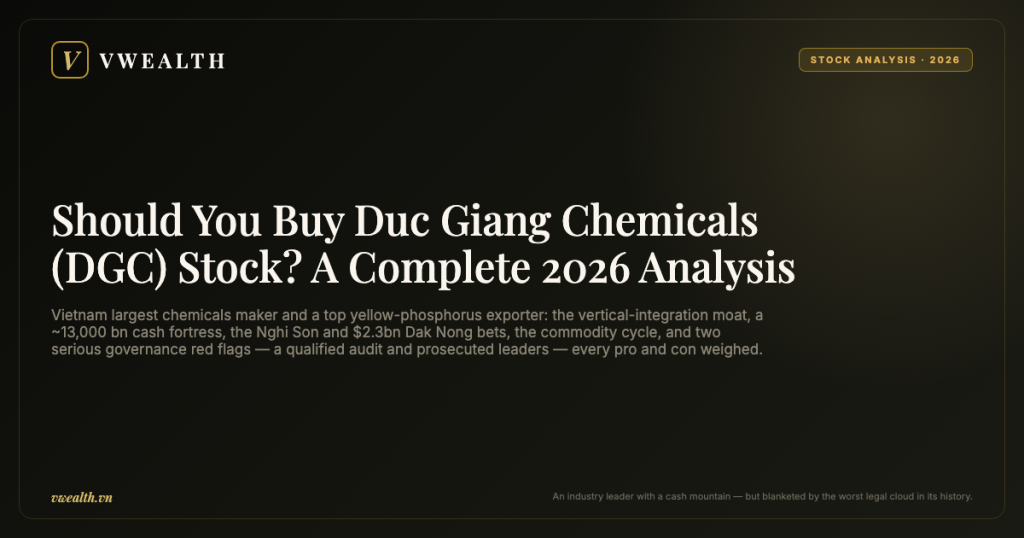
On Vietnam’s stock market there are businesses where simply naming the industry makes people think instantly of one ticker. Say steel, you think HPG. Say consumer-electronics retail, you think MWG. And say chemicals — specifically yellow phosphorus, phosphoric acid, fertilizer — and the name that comes up almost immediately is DGC, Duc Giang Chemicals Group. This isn’t an ordinary chemical company: DGC is the largest basic-chemicals producer on HOSE, holding 56% to 70% of the country’s yellow-phosphorus capacity, and one of the region’s largest yellow-phosphorus exporters.
Tied to Duc Giang is the name Dao Huu Huyen — whom investors call Vietnam’s “chemicals kingpin.” From an equitized state detergent plant, Huyen built a billion-dollar empire, driving DGC’s share price up about 20-fold in 2020–2022 and turning quite a few staff and shareholders into paper stock billionaires.
But if you only see DGC as a “growth stock,” you misunderstand its nature. DGC is first of all a CYCLICAL stock: the company’s profit dances to the price of yellow phosphorus and basic chemicals on the world market. In years when commodity prices peak, DGC prints money; in years when they cool, profit shrinks. In return, this is a business with extremely strong financial firepower: at the end of 2025 Duc Giang held over 13,100 billion dong in cash and deposits — about 67% of total assets — almost no debt, paying a steady cash dividend, and harboring huge expansion ambitions: the Nghi Son chemical complex (Thanh Hoa) and the giant bauxite–alumina project in Dak Nong worth up to $2.3 billion.
And yet, entering 2025–2026, that seemingly perfect picture developed two large cracks in governance — two hot spots anyone planning to buy DGC must face head-on. First, the audited 2025 financial statements received a qualified opinion over more than 951 billion dong of inventory. Second, and far more serious, was the upheaval at the top: Chairman Dao Huu Huyen and a series of individuals were prosecuted on charges related to the environment, mineral extraction and accounting. The stock fell about 50% from its historic peak, and as of 19 June 2026, DGC traded around 48,400 dong a share.
That’s the paradox this full analysis wants to dissect with you: a leading business, a cash mountain, a unique technological position — yet blanketed by the most serious legal cloud and governance risk in its own history. Should you buy DGC at the current price, and if so, what kind of investor does it suit? To answer, you first need to understand how Duc Giang got here — because its very history planted both the advantages and the seeds of risk erupting today.
DGC market data (updated 19 June 2026)
| Current price | 48,400đ | 2025 revenue | 11,262 bn (+14%) |
| Change (June) | +7.92% | 2025 after-tax profit | 3,154 bn (+2%) |
| Net cash | 13,106 bn (~67% assets) | P/E | Dividend | ~6–11.5x | 30% |
⚠ Risk note: the audited 2025 statements received a QUALIFIED opinion (inventory >950 bn) and some executives were prosecuted (3/2026, under investigation — presumption of innocence). The stock was placed under control. This is NOT a “safe-cheap” stock.
Source: VWealth price data + DGC audited 2025 statements + mainstream press. For reference only, not a recommendation.
History and evolution
Duc Giang’s story is one of the most classic “transformation” journeys of a Vietnamese business in the post-equitization era: from a small state enterprise making detergent and cleaning chemicals, into a billion-dollar basic-chemicals group dominating the phosphorus industry. To understand why DGC is both a profit machine and the focal point of risk in 2026, you need to retrace each rung of its nearly 60 years of existence.
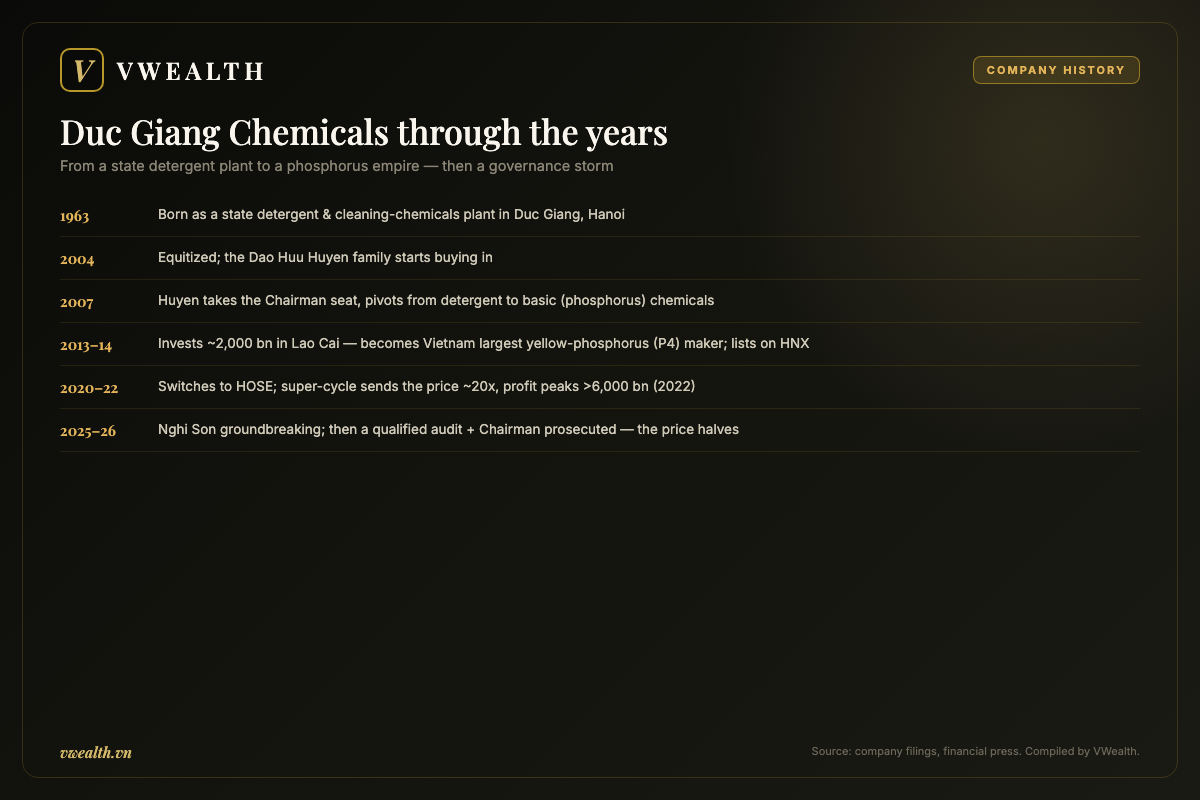
From a state detergent plant to the 2004 equitization
Duc Giang’s forerunner was a chemical facility born in 1963 in the Duc Giang area (Hanoi) — a purely state-owned business making detergent and cleaning chemicals for the domestic market of the subsidy era. For many decades, this was a modest-scale enterprise, nothing to suggest it would become the “kingpin” of a whole industry.
The first turning point came in 2004, when the business was equitized and shifted to a joint stock company model under the name Duc Giang Detergent and Chemicals JSC. This is when the couple Dao Huu Huyen and Nguyen Thi Hong Lan began buying shares, laying the foundation to become the controlling shareholder group later. Equitization wasn’t just a legal procedure — it was the doorway for a private entrepreneur to take control and impose an entirely different vision on a sluggish enterprise.
2007: Dao Huu Huyen takes over and bets on basic chemicals
The year 2007 was the decisive milestone. When the state divested, reducing its stake in Duc Giang (per various sources, from around 51% to about 20%), the family of Dao Huu Huyen bought a large volume of shares and officially became the largest shareholder group. In May 2007, Huyen took the Chairman’s seat — beginning a nearly two-decade journey shaping the entire fate of the business.
What you need to remember here is the strategic thinking of the man who took over. At that time, detergent and cleaning chemicals still made up about 70% of revenue — a fiercely competitive industry, thin margins, crushed by multinationals (Unilever, P&G). Instead of digging in on a losing “home turf,” Huyen chose a bold direction: shift the focus to basic chemicals, especially phosphorus-based products, where Vietnam had the resource advantage of readily available apatite ore but where no domestic business had exploited it properly.
The core lesson of this period: Duc Giang didn’t grow by doing the old thing better, but by daring to drop the old to bet on a new value chain with a resource moat. This very choice created a durable competitive advantage — but tying itself tightly to mineral extraction also sowed the seeds of the legal risk erupting 18 years later.
2013–2014: Lao Cai — the apatite and yellow-phosphorus gamble that made its name
If you had to choose one move that defines Duc Giang, it’s the investment up in Lao Cai. Around 2013, the business poured in about 2,000 billion dong — a huge sum for its size then — to build a chemical plant complex in Lao Cai, a land holding Vietnam’s largest apatite-ore reserves. The Duc Giang Lao Cai Chemical Plant complex was inaugurated around 2014, making Duc Giang the country’s largest producer of yellow phosphorus (P4).
Why is yellow phosphorus so important? It’s a strategic industrial material, the input for producing phosphoric acid, fertilizer, semiconductors, cleaning agents and food additives. Producing P4 requires enormous electricity and specialized metallurgical technology — a very high entry barrier. Duc Giang also owns an ore-processing technology in powder form that the company says is unique, using even the lean ore rivals must discard. This is the source of the cost advantage you’ll see reflected straight into DGC’s superior gross margins over the years.
Also in August 2014, DGC shares officially went public, listing on the Hanoi Stock Exchange (HNX). The former detergent business had officially entered the arena of the public capital market.
The vertical-integration strategy: the key to the cost advantage
What sets Duc Giang apart from most Vietnamese chemical businesses is its vertical-integration model — controlling nearly the whole value chain from raw resource to refined finished product. Picture this chain as a flow:
| Link | What Duc Giang controls | Advantage created |
|---|---|---|
| Apatite ore | Self-mines at Lao Cai | Not dependent on external material prices, controls its input |
| Yellow phosphorus (P4) | Smelts it from ore, the country’s largest capacity | Captures the full margin of high-value processing |
| Phosphoric acid | Makes technical and food-grade acid from P4 | Goes deeper into the chain, higher margin, exportable |
| Fertilizer & fine chemicals | Phosphate fertilizer, DAP, MAP, feed additives | Diversified output, absorbs price swings of each product |
The meaning of vertical integration is very practical: when world phosphorus prices rise, rivals must buy expensive P4 to process further, while Duc Giang makes it from self-mined ore, so almost every dong of price increase falls straight into profit. This is why, in high-commodity-price years, DGC’s margins broke out far more strongly than businesses doing only one link. The cost advantage doesn’t come from luck — it’s “cast” into the business structure from the mine and plant investment decisions of over a decade ago.
2020: switching to HOSE and the launchpad for the super-profit cycle
In July–August 2020, DGC transferred its listing from HNX to the Ho Chi Minh Stock Exchange (HOSE) — an exchange with far higher liquidity and institutional-investor coverage. Switching right at the threshold of a commodity super-cycle put DGC in the sights of big money, and the stock kept setting new historic highs right afterward.
2021–2022: the super-cycle — when phosphorus prices turned Duc Giang into a cash printer
This is the period that put DGC in the “temple” of legendary stocks on the Vietnamese exchange. When world yellow-phosphorus and basic-chemical prices surged — due to supply disruptions from China, Europe’s energy crisis and booming semiconductor demand — Duc Giang’s profit leaped with them. The vertical-integration model made every price rise amplify into the profit bottom line.
The capital-market consequence was spectacular: DGC’s share price (adjusted) rose about 20-fold, from around 7,000 dong to a peak above 130,000 dong. Chairman Dao Huu Huyen’s paper wealth at one point exceeded 9,000 billion dong, and many shareholders and staff holding bonus shares became billionaires. This is also the clearest proof of DGC’s cyclical nature you must carve into your mind: its profit and price are amplified in both directions — very fast up, and very deep down.
The cash mountain and the “hard cash” culture
Another distinctive feature of Duc Giang is its extremely conservative capital management. Instead of rushing into debt to expand, the business accumulates a huge cash pile. By the end of 2025, the group’s cash and bank deposits reached about 13,106 billion dong, making up 67% of total assets (total assets over 19,538 billion dong), up over 20% from the start of the year. The deposit interest alone contributes significantly to profit, creating a “cushion” that helps DGC stand firm through years when chemical prices bottom. The business also keeps the tradition of steady cash dividends — like the 2025 advance dividend at a 30% cash ratio — which long-term shareholders love.
This cash mountain isn’t just a “nest egg.” It’s the strategic ammunition for the two largest expansion ambitions in Duc Giang’s history, which we’ll discuss right below.
Ambition 1: the Nghi Son chemical complex — venturing into chlor-alkali (caustic soda–chlorine)
On 17 February 2025, Duc Giang officially broke ground on the Nghi Son chemical complex in Thanh Hoa — presented as Vietnam’s largest chemical complex, with total investment of about 12,000 billion dong, in three phases:
- Phase 1 (about 2,400 billion dong, 30 ha): capacity of 151,000 tonnes/year, including caustic soda (NaOH) 80,000 tonnes, PAC 30,000 tonnes, calcium hypochlorite 20,000 tonnes and phosphoric acid 10,000 tonnes — expected to run commercially from Q1 2026.
- Phase 2 (about 6,000 billion dong): producing PVC plastic — the first time Vietnam is self-sufficient in this technology.
- Phase 3 (about 3,600 billion dong): a soda-ash plant with a capacity of 400,000 tonnes/year.
The strategic meaning of Nghi Son is diversifying away from phosphorus dependence. The chlor-alkali (caustic soda–chlorine) segment is the “backbone” of modern chemical industry, the input for textile dyeing, paper, aluminum, water treatment and PVC production. Vietnam now self-supplies only about 50% of its industrial-chemical needs, importing most of the rest — meaning Duc Giang is targeting a vast import-substitution market. When fully operational, the complex is expected to bring in 3,000–4,000 billion dong of revenue a year, about 12% of group revenue from 2026. This is an effort to turn DGC from a “cyclical phosphorus stock” into a more stable, diversified base-chemicals group.
Ambition 2: the giant Dak Nong bauxite–alumina project — a $2.3 billion gamble
Bigger than Nghi Son is the bauxite–alumina/aluminum dream in Dak Nong — home to the country’s leading bauxite reserves. Per the plan, the complex is expected to mine about 14.4 million tonnes of bauxite ore/year, build 3 processing plants with a capacity of 5.8 million tonnes of concentrate/year, with total investment across both phases of about 57,000 billion dong (equivalent to $2.3 billion). When operational, the project is estimated to contribute over 4,800 billion dong/year to Dak Nong province’s budget.
From mid-2022, the Dak Nong provincial People’s Committee approved DGC to research and survey mine sites in the Tuy Duc and Dak Song districts; by early 2025, the province was still coordinating with the government to remove legal obstacles for bauxite–aluminum projects, including Duc Giang’s. This is where the 13,000-billion “cash mountain” finds its reason to exist: Duc Giang wants to use its accumulated cash to step into the aluminum industry — a leap in scale that could reshape the entire business over the next decade.
2025–2026: the “long slide” — two governance cracks
And then, just as these ambitions were moving, the Duc Giang empire ran into the most serious crisis in its history. This is the part where you need to be especially clear-headed, because it completely reverses the “safe industry leader” story.
The first crack — a qualified audit opinion. The audited 2025 statements recorded net revenue of 11,262 billion dong (up 14%) and after-tax profit of 3,154 billion dong (up 2%, adjusted down about 35 billion from the self-prepared report). But the worrying point is that auditor UHY issued a qualified opinion over more than 951 billion dong of inventory: because it was appointed after the fiscal year ended, the auditor couldn’t witness the inventory count on 31 December 2025, and so couldn’t confirm the value of this item. For a business, a qualified opinion is a warning signal about data reliability — anathema for a sensitive financial-sector stock.
The second crack — upheaval at the top. Far more serious, on 25 December 2025 and 14 March 2026, investigators prosecuted a total of 14 individuals at Duc Giang on three groups of charges: causing environmental pollution; violating regulations on mineral extraction; violating accounting regulations causing serious consequences. The lead defendant is Chairman Dao Huu Huyen. The allegations include illegally dumping millions of tonnes of waste at the Tang Loong Industrial Park (Lao Cai), extracting hundreds of thousands of tonnes of apatite ore without a permit, and concealing revenue causing tax losses. This is the “dark side” of the very vertical-integration advantage: when growth is built on mineral extraction, the legal boundary becomes a systemic risk.
The immediate consequence: on 17 March 2026, DGC hit the floor, with over 12.5 million shares stacked at the floor price; the market price lost about 50% from its historic peak and by 19 June 2026 was only around 48,400 dong. HOSE also moved DGC from warning to control status for filing its audited financial statements more than 30 days late. To keep operating, the business held an extraordinary shareholders’ meeting to reorganize the machine: Dao Huu Kha — Huyen’s younger brother — was elected Chairman, while a series of new personnel were appointed, including two 1980s-generation Deputy CEOs. The family-rule structure, which had been the strength letting Duc Giang decide fast for 18 years, now clearly showed its downside as risk concentrated in a single individual.
The key point to carry into the next section: DGC today is a vivid paradox. On one side, an industry leader, unique technology, a 13,000-billion cash mountain, steady dividends, and the promising Nghi Son and Dak Nong ambitions. On the other, an unresolved legal cloud, a qualified audit and a leadership machine just shaken to its roots. The valuation at 48,400 dong reflects that fear — the question is whether the fear is enough, excessive, or still insufficient.
To assess it correctly, you can’t just look at the numbers — you must understand the people steering this ship after the storm. That’s why in the very next section we go deep into Leadership: from the legacy and role of Dao Huu Huyen, the family ownership of over 40% of capital, to the successor team bearing the burden of keeping the Duc Giang empire standing through the biggest governance crisis of its life.
Leadership, ownership structure and governance
If the previous section helped you picture the scale of a leading chemical business, this section puts on the scale a harder question, and one far more important for your wallet: who really steers Duc Giang Chemicals, and how trustworthy is that governance machine? For a stock, however attractive the product story, that’s only half. The other half lies in the people making decisions, in how they share power, and in how transparent the numbers they present to shareholders are. In 2025–2026, it’s this second half of DGC that became the focus of one of the most shocking governance upheavals on Vietnam’s stock market. You need to read this section carefully, not to panic, but to correctly value the risk you’re carrying.
Dao Huu Huyen — the man who built the “phosphorus empire”
You can’t understand Duc Giang without understanding Dao Huu Huyen. A chemical engineer by training, Huyen is the man who turned an equitized state enterprise into the largest private chemical group on the exchange, nicknamed by investors the “phosphorus king.” His style is tied to two features you should remember because they shape both corporate culture and risk: first, this is a classic family-rule model — father as Chairman, son Dao Huu Duy Anh as CEO and Vice Chairman; second, Huyen is famous for financial conservatism to an extreme degree, almost never borrowing and preferring to “hug” a cash mountain rather than invest scattershot.
This “father chairman — son CEO” model has repeatedly drawn press and analyst questions about the independence of the board. When executive power and supervisory power sit within one family, internal control mechanisms — created to protect small shareholders like you — easily become a formality. In prosperous times, few notice this weakness. But corporate governance only reveals its true nature when the storm hits, and the storm has come to Duc Giang.
Ownership structure: the Dao family in absolute control
Before discussing the crisis, you need to grasp DGC’s “power map.” Per disclosures at the end of 2025, the shareholder group of Dao Huu Huyen’s family holds about 40.74% of charter capital, equivalent to over 155 million shares. This is an almost absolute controlling ratio: at this level, the Dao family can decide most voting content at the shareholders’ meeting without allying with anyone.
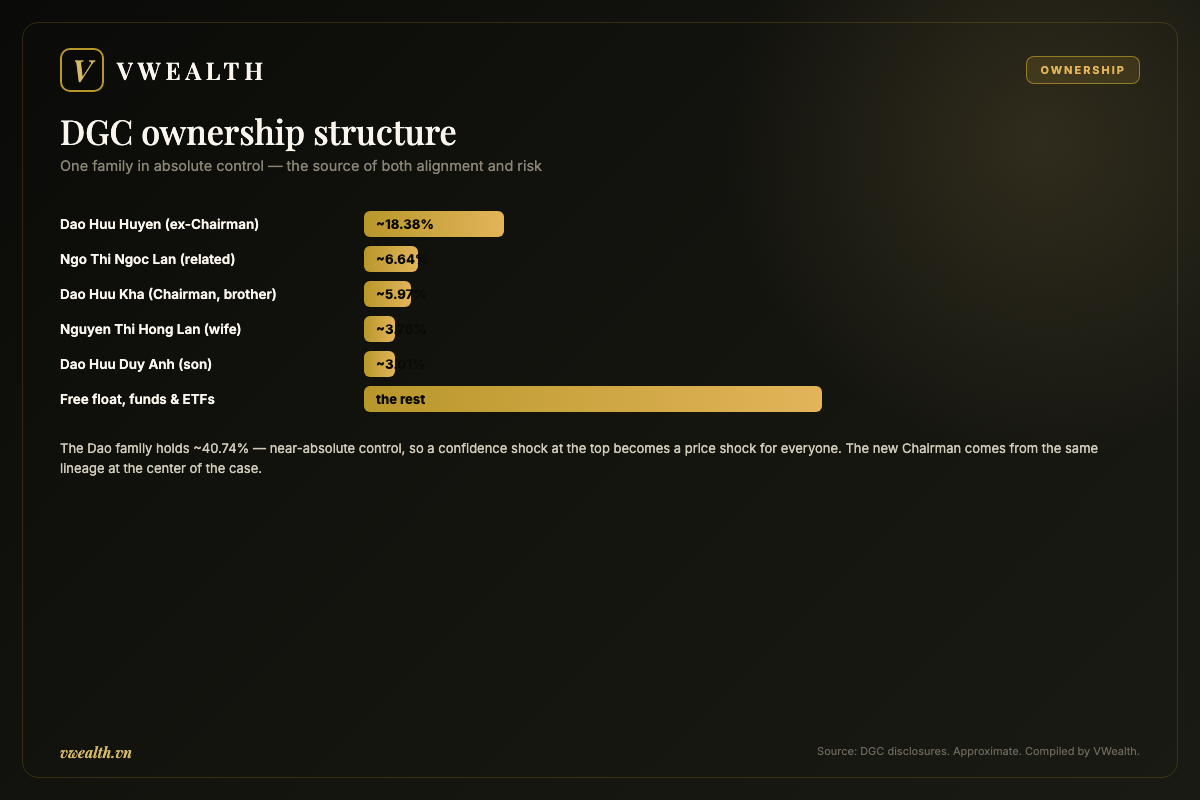
Specifically, per press information, ownership within the family is distributed as follows: Dao Huu Huyen holds about 18.38% (nearly 69.8 million shares) — the largest individual shareholder; Nguyen Thi Hong Lan (Huyen’s wife) about 3.76%; Dao Huu Duy Anh (son) about 3.01%; Dao Huu Kha (Huyen’s younger brother) 5.97%; and Ngo Thi Ngoc Lan (a related person) 6.64%. The rest is scattered among related members and entities. On the institutional side, foreign funds like the Dragon Capital and VinaCapital groups plus some ETFs (Fubon, VNM, DCVFM VN30) are present too, but each group’s weight is modest versus the family block.
What you need to draw from this picture is very clear: DGC’s truly freely tradable free-float ratio is significantly narrowed because nearly half the shares are “locked” in one family’s hands. The positive side is that management has an incentive for long-term commitment and “in the same boat” alignment with shareholders — they get richer or poorer with the share price. But the risk side, as the 2025–2026 story shows, is that when power concentrates too heavily in one group, wrongdoing (if any) at the top drags an extremely strong psychological shock onto all the remaining shareholders.
The 2025–2026 legal event: information per mainstream press
This is the most sensitive part, and you need to read it with absolute caution. All information below is cited from mainstream press and disclosures by the authorities; the case is under investigation and there is no verdict or final conclusion yet. By the principle of presumption of innocence, the individuals involved are not considered guilty until a court rules.
Per press information (Tuoi Tre, Nha Dau Tu, the Ministry of Public Security portal), the Police Investigation Department for corruption, economic and smuggling crimes (C03 — Ministry of Public Security) prosecuted the case occurring at Duc Giang Chemicals Group and related units, with 14 defendants. The prosecution decisions were announced from late 2025 to March 2026. Among them:
Per press information, Dao Huu Huyen was prosecuted on three charges: “Violating accounting regulations causing serious consequences,” “Violating regulations on resource extraction” and “Causing environmental pollution.” Dao Huu Duy Anh (son) was prosecuted for “Violating accounting regulations causing serious consequences.” Both were placed in temporary detention.
On the nature of the alleged conduct, reports cite information from investigators describing “organized” violations, including: illegally dumping millions of tonnes of waste over dozens of hectares; illegally extracting hundreds of thousands of tonnes of apatite ore worth hundreds of billions of dong; and keeping accounts off the books, concealing revenue, causing tens of billions of dong in tax losses to state assets. Again, note that these are allegations under investigation, not conclusions confirmed by a court.
The psychological impact on the stock was immediate and violent. As news of the Chairman and his son’s arrest spread, DGC hit the floor for several consecutive sessions; per Tuoi Tre, after just three floor sessions, the Chairman’s family’s on-exchange wealth “evaporated” by about 2,800 billion dong. For a stock where nearly 41% is held by one family, a confidence shock at the top instantly becomes a price shock across the entire market value. This is a vivid illustration of the ownership-concentration risk you just read about above.
Generational handover: Dao Huu Kha becomes Chairman
Facing the power vacuum, Duc Giang had to restructure the top. At the extraordinary general meeting on 8 May 2026, Dao Huu Kha (born 1970, Dao Huu Huyen’s younger brother) was elected Chairman for the rest of the 2024–2029 term, while the business announced dismissing Dao Huu Huyen and Dao Huu Duy Anh from leadership positions. Before taking the Chairman’s seat, Kha was a “low-profile tycoon” — rarely appearing in the media despite being a large shareholder with about 22.7 million DGC shares (equivalent to 5.97% of capital).
You should read this event two ways. On the positive side, immediately electing a family member who understands the business helps Duc Giang avoid a management vacuum and somewhat reassure market sentiment — production and exports keep running. Right after taking office, Kha signed a series of decisions reorganizing personnel at ecosystem subsidiaries to stabilize the machine. But on the cautious side, this is still a handover within one family: the family-rule structure — the root of the governance concern the market fears — is fundamentally unchanged. The new helmsman comes from the very lineage at the center of the case under investigation. This is a point to watch closely: whether Duc Giang truly improves board independence and supervisory mechanisms, or just changes the name at the top.
The audit issue: UHY’s qualified opinion and why you must care
Alongside the legal event is a big question mark over data transparency. DGC’s audited 2025 financial statements, performed by auditor UHY, received a qualified opinion on two issues. Before the details, you need to understand this term clearly.
A “qualified opinion” means the auditor overall accepts the financial statements, but separates out (excludes) one or a few items for which it couldn’t gather enough reliable evidence to confirm. In plain terms: the auditor says “most of the books I can trust, but these particular items I cannot vouch for due to lack of evidence.” This is a more serious level than an “unqualified” (clean) opinion, but lighter than a “disclaimer of opinion” or an “adverse opinion.” For an investor, a qualified opinion is a signal to be cautious: there are numbers on the report you’re reading that even the auditor won’t stake on their accuracy.
| Criterion | Content per disclosure |
|---|---|
| Qualification issue 1 | Inventory ~951 billion dong (about 56.5% of total inventory) at 31/12/2025 — UHY didn’t directly witness the count |
| Reason | UHY was appointed after the fiscal year ended (replacing PwC); substitute procedures didn’t provide enough reliable evidence on existence, completeness, accuracy and value |
| Qualification issue 2 | Legal matter — some key executives prosecuted on 17/3/2026; case under investigation, no conclusion yet |
| Post-audit profit | Adjusted down about 35 billion dong from the self-prepared report, to ~3,154 billion dong |
The first qualification issue revolves around inventory worth about 951 billion dong — about 56.5% of total inventory value at 31 December 2025. The technical cause: UHY was appointed as auditor after the closing date (replacing the original PwC), so it couldn’t directly witness the physical count. UHY stated that the substitute audit procedures “did not provide enough reliable evidence to confirm the existence, completeness, accuracy and value” of this inventory.
Why must you care? Inventory is one of the largest items on the balance sheet, and the most prone to discrepancy — from valuation to actual quantity. When the auditor can’t confirm more than half the inventory value, it means a significant part of the assets you use to value the business rests on an independently unverified foundation. Set against the case’s allegation of “keeping accounts off the books, concealing revenue,” the question mark over data reliability deserves serious consideration, even though in principle this is a procedural issue arising from an auditor change.
The direct consequence for the stock is also notable: for filing its audited 2025 statements more than 45 days past the deadline, DGC was placed under restricted trading from 26 May 2026 — tradable only in the afternoon session by matched-order and negotiated methods. This is a kind of “penalty card” from the exchange, reducing liquidity and a warning signal about disclosure discipline you shouldn’t take lightly.
Cash dividends: a durable bright spot amid the storm
Amid the series of governance risks, there’s still a point keeping DGC’s long-term shareholders holding on: its steady cash-dividend policy. Unlike many businesses that prefer stock dividends (dilutive), Duc Giang has for years paid cash — keeping a 30%-of-par ratio in 2024–2025, i.e. 3,000 dong a share. The peak was 2022 with 6,000 dong a share, reflecting the chemical industry’s super-profit cycle then.
This ability to “pay real cash” to shareholders stems directly from Huyen’s financial-conservatism philosophy you read at the start. By the end of Q3 2025, DGC’s total assets were about 19,424 billion dong, of which cash and deposits reached over 13,000 billion dong — about 67% of total assets. Such a nearly debt-free “cash mountain” gives you three things: a safety buffer when chemical prices swing, financial income from deposit interest, and the capacity to pay sustainable cash dividends even in tough times. This is one reason defensive investors still care about DGC despite the flood of bad news.
Even so, don’t let this bright spot obscure the overall picture. A healthy balance sheet and steady dividends are a necessary condition, but they don’t offset the risk if confidence in the truthfulness of the numbers and the stability of the leadership is shaken. The cash is real, but the business’s value also depends on whether the other numbers on the report are trustworthy — and that’s exactly what the auditor’s qualified opinion is questioning.
Summary of this section — and the bridge to the product ecosystem
In sum, investing in DGC at this point means buying a business with a very clear paradox: on one side a rock-solid financial foundation (a cash mountain, no debt, steady cash dividends), on the other an unusually high level of governance risk — family rule controlling nearly 41% of capital, a legal event under investigation at the top, a power handover still within one lineage, and a qualified audit opinion casting a shadow over data reliability. The reward and risk here aren’t symmetric in the usual way: you need to value this governance risk explicitly, rather than just looking at the profit and cash.
But to understand why Duc Giang still generates enormous cash flow despite the storm — why the “phosphorus king” has a cash mountain to pay dividends — you need to look at what stands behind it all: the products and the closed ecosystem from apatite ore to yellow phosphorus, acid and semiconductors. That’s the content of the next section.
Products, value chain and projects
If you’re just researching DGC, there’s a question to answer first: what does Duc Giang Chemicals actually sell to earn over 11,000 billion dong a year? The short answer is phosphorus and everything made from phosphorus. But the full answer is far more interesting, because it’s the story of a business that has gone from an ore mine beneath Lao Cai to the semiconductor chips and EV battery cells across Japan, Korea, Taiwan and the US. In this section, I’ll take you along the “flow” of material inside Duc Giang, from raw apatite rock to high-price pure products, before turning to the giant projects management is betting on for the coming decade.
In 2025, DGC’s net revenue reached 11,262 billion dong, up about 14% from the year before, with after-tax profit around 3,189 billion dong. This is a business with thick profits, lots of cash (over 13,000 billion in bank deposits), and most of that strength stems from its near-monopoly position in a product outsiders rarely hear of: yellow phosphorus.
Yellow phosphorus (P4) — Duc Giang’s “heart”
Let’s start with the star. Yellow phosphorus, chemical symbol P4 (because one molecule has 4 phosphorus atoms), is the pure elemental form of phosphorus, pale yellow like wax, smelted at extremely high temperatures in an electric furnace from apatite ore. It’s not a product you see on a supermarket shelf; it’s a “base industrial material” — meaning from it people make a whole range of other chemicals. Picture P4 like the “flour” of the phosphorus-chemical industry: flour itself is bland, but from it come bread, noodles, cakes…
So what is yellow phosphorus used for that DGC earns big money from it? There are three important application groups, and notably all three are in the world’s hottest-growth industries:
- Semiconductor chips: to produce microchips, plants like TSMC and Samsung need ultra-pure phosphoric acid (called “electronic grade”) to etch and clean silicon wafers. This acid must be pure to near-zero impurities, and it’s made from high-quality yellow phosphorus. As the world pours money into AI, 5G and semiconductors, demand for this acid — and thus for P4 input — rises.
- LiFePO4 (lithium iron phosphate) batteries: this is the battery type now dominating mass-market EVs and energy storage. The “phosphate” in the name is a phosphorus derivative. Each EV using an LFP battery is more phosphorus demand. As EVs boom, this is a long-term demand driver for P4.
- Industrial and consumer chemicals: yellow phosphorus is the material for industrial phosphoric acid, phosphate salts used in food, cleaning agents, water treatment, flame retardants…
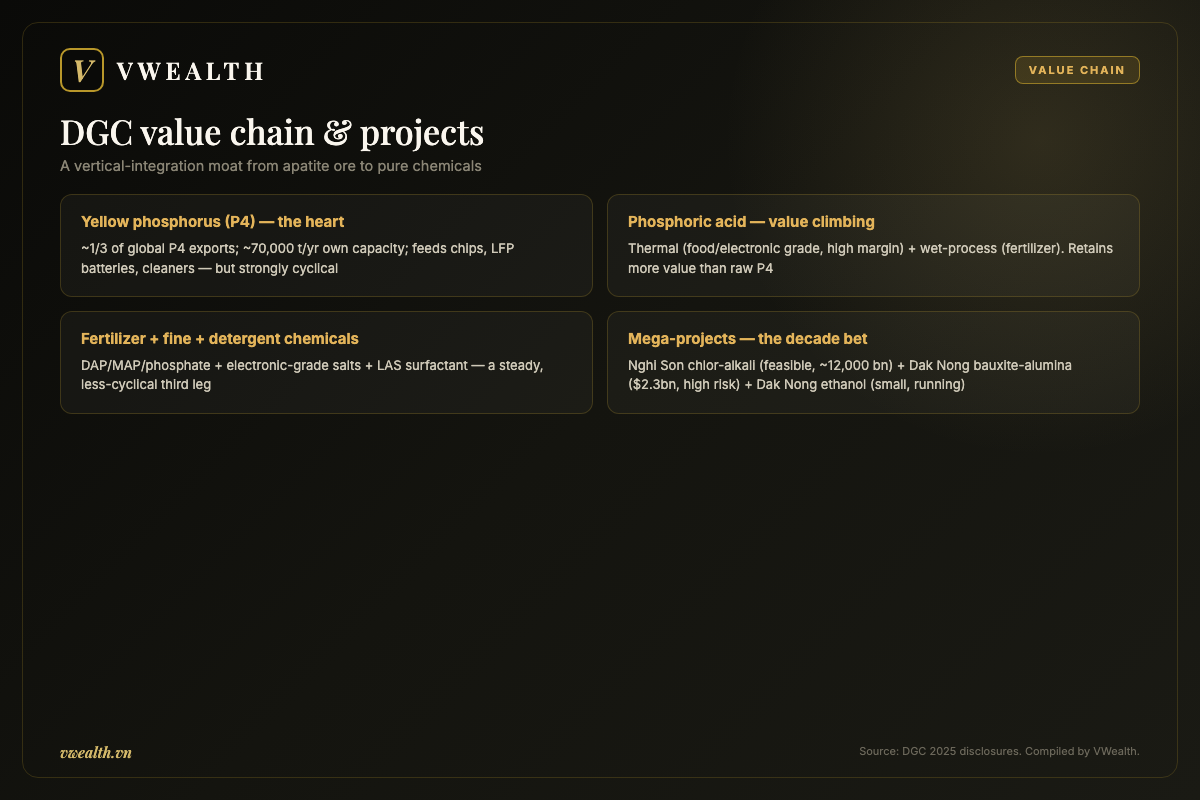
The key point to grasp: DGC is one of the world’s leading yellow-phosphorus exporters, commanding about one-third (1/3) of total global P4 exports, and holding about half of all Vietnam’s P4 capacity (its own capacity around 69,800 tonnes/year). Why can a Vietnamese business do this?
The reason is that yellow phosphorus is a “dirty” industry, terribly electricity-hungry and restricted in many countries. China — a large P4 producer — keeps tightening production over pollution and power shortages. When Chinese supply contracts, demanding buyers in Japan, Korea, Taiwan and the US must find substitutes, and Duc Giang — with its own ore mine, stable furnace technology and a location near port — becomes the number-one choice outside China.
But this is also where you must understand the risk clearly: DGC’s profit rises and falls with the yellow-phosphorus price, and the P4 price is very strongly cyclical. In 2021-2022, the P4 price at times shot above $6,000-7,000/tonne when China cut output and chip demand was tight, driving DGC’s profit to a historic peak. Then the price cooled to around $4,000-4,500/tonne, and profit “went downhill” too. This is the trait of a commodity business: when you sell a product whose price you don’t set, your margin swings with global supply and demand, with China’s policy, even with geopolitical events. So never judge DGC by a single pretty-profit quarter; you need to see where the P4 price is in the cycle at that moment.
Phosphoric acid — the next value rung
If yellow phosphorus is “flour,” then phosphoric acid is the first “loaf of bread.” This is the step where Duc Giang raises the value of its material. There are two ways to make this acid, and distinguishing them helps you understand DGC’s strategy:
- Thermal acid (from P4): burning yellow phosphorus then reacting with water. This gives extremely pure acid, used for food and electronics — the high-margin segment. DGC has proactively pushed food-grade phosphoric-acid production instead of exporting raw P4, to retain more value.
- Wet process acid (WPA): using sulfuric acid to “soak” apatite ore directly. This is cheaper, giving less pure acid, mainly for fertilizer. This is the backbone of the fertilizer segment.
The important thing to see here is the “value-climbing” strategy: instead of just selling raw phosphorus at a volatile price, Duc Giang processes ever deeper — into acid, into phosphate salts, into pure chemicals — so each tonne of input material brings in more money and depends less on the world P4 price. In the 2024 revenue mix, yellow phosphorus contributed about 40%, phosphoric acid about 30%, fertilizer about 16%, feed additives about 8% — showing the “post-phosphorus” segment already holds a significant weight.
Fertilizer and fine chemicals
From WPA and apatite ore, DGC makes phosphorus-bearing fertilizers: fused phosphate, superphosphate, and especially DAP, MAP (complex fertilizers containing both nitrogen and phosphorus, widely used by farmers). The fertilizer segment lets Duc Giang fully use the apatite ore mined up — ore not up to standard for P4 smelting can still go into fertilizer, nothing wasted.
At the very top of the value pyramid are fine chemicals: phosphate salts used in food (leavening, preservatives), and important long term, electronic/semiconductor-grade chemicals. This is the segment DGC wants to push deeper into because of the high margins and demand tied to the tech wave. Duc Giang is also developing materials for LFP batteries — a direction to turn itself from a raw-material seller into a value-added battery-material supplier. The higher up the pyramid, the more expensive the product, the more stable its price, and the harder it is for cheap rivals to compete.
Detergents and consumer chemicals
There’s a “quiet” segment tied to Duc Giang’s name from the very beginning: detergents. DGC’s forerunner was an old Hanoi chemical plant, and it still makes detergent, cleaners and basic cleaning chemicals. One flagship product is LAS (Linear Alkylbenzene Sulphonate) — a surfactant, plainly the “foaming and cleaning agent” in most detergents and dishwashing liquids. DGC is one of the large LAS suppliers to Vietnamese detergent makers. This consumer segment doesn’t grow explosively like P4, but it gives steady cash flow, is little dependent on the commodity cycle, and helps diversify risk — a stable “third leg” alongside the volatile P4 leg.
Vertical integration — Duc Giang’s “moat” of advantage
This is the most important part if you want to understand why DGC profits much more than rivals. In investing, people speak of the “economic moat” — a durable advantage that lets a business protect its profit from rivals. Duc Giang’s biggest moat is precisely the vertical-integration chain, meaning it controls nearly the entire value chain from ore in the ground to final product:
| Link | DGC controls | Meaning for investors |
|---|---|---|
| Apatite ore mine (Lao Cai) | Self-mines, e.g. Pit 25 | No buying material at market price → low, stable input cost |
| Yellow phosphorus (P4) | Own electric furnace, capacity ~70,000 tonnes/year | Very high gross margin when P4 prices rise |
| Phosphoric acid | Thermal + wet process (WPA) | Raises value, cuts dependence on raw P4 price |
| Fertilizer / fine chemicals | DAP, MAP, phosphate, phosphate salts, electronic chemicals | Fully uses ore, climbs the value ladder |
What’s the benefit of owning the apatite mine? Apatite is a “buried treasure” — ore containing phosphorus. When you mine your own ore, you don’t buy it at a market price that’s high one day, low the next; your material cost is almost “locked” at a cheap, stable level. When the world P4 price surges while your ore-input cost is unchanged, the whole difference flows straight into profit. That’s why, in high-P4-price cycles, DGC’s margins stretch very wide versus businesses that must buy ore.
But every moat has a weakness, and for DGC the weakness lies right at the mine. Self-sourced ore is an advantage only while the mining permit is valid. When a pit must halt over legal or environmental issues, Duc Giang must buy outside ore at a high price — and then the moat instantly narrows, and profit can fall sharply. This is a risk you must track closely: the legal health of the apatite mines is the health of DGC’s margins.
The giant future projects — betting on the coming decade
Duc Giang is sitting on over 13,000 billion dong of cash, and the big question of every investor is: what will they do with that pile? The answer is three “steel fists” — projects that will shape DGC’s growth over the next 5-10 years. You need to understand both the ambition and the risk of each.
The Nghi Son complex (Thanh Hoa) — entering the caustic soda–chlorine industry
This is the nearest and most concrete project. At the Nghi Son Economic Zone (Thanh Hoa), DGC is building a chlor-alkali (caustic soda–chlorine) chemical complex. Simply put, chlor-alkali technology electrolyzes salt to separate three products: caustic soda (NaOH), chlorine (Cl2) and hydrogen. Caustic soda is an extremely common industrial chemical — used in paper, textile dyeing, alumina, water treatment, and especially in the very bauxite-alumina processing DGC is targeting.
Why is this project attractive? Because Vietnam still imports most of its caustic-soda needs. DGC builds Nghi Son to substitute imports — a market with ready demand, no need to hunt for customers. Phase 1 has total investment of about 2,400 billion dong, caustic-soda capacity around 150,000 tonnes/year (per the expansion roadmap), and notably has a series of customers committed to offtake about 50% of output. This is a positive signal: the project has offtake before operating. The whole Nghi Son complex across phases could reach a scale of over 10,000-12,000 billion dong, expanding into PVC and higher-value vinyl products.
Nghi Son’s execution risk is moderate: this is mature technology, the market is ready, and DGC has experience running chemical plants. This is the project I rate as most feasible among the three big ones.
The giant Dak Nong bauxite–alumina project — a “life-changing” ambition
This is the real “mega-project” — and Duc Giang’s biggest gamble. Bauxite is aluminum ore; alumina (Al2O3) is the intermediate product, then electrolyzed into aluminum metal. Dak Nong is one of the regions with Vietnam’s largest bauxite reserves. DGC wants to leap into an entirely new industry — aluminum smelting — at a huge scale.
- Total investment: about 57,000 billion dong (equivalent to ~$2.3 billion) for both phases — a figure many times the phosphorus projects DGC has done.
- Scale: mining about 14.4 million tonnes of bauxite ore/year, capacity around 3 million tonnes of alumina/year.
- Revenue potential: at current alumina prices, the project could bring in revenue of about $1.5 billion/year when fully operational — roughly triple the group’s entire current revenue.
- Expected timeline: applying for permits in the coming years, operating around 2028-2030.
You see the numbers — if successful, this project could turn DGC from a “phosphorus king” into a diversified heavy-industry group. But this is also where you must be most clear-headed, because execution risk is very high:
First, $2.3 billion of capital is enormous versus DGC’s current size — even with lots of cash, the project still needs more raising and drags on for years, “devouring” cash flow before it profits. Second, the alumina/aluminum industry is entirely new to Duc Giang — they have no aluminum-smelting experience, quite different from phosphorus expertise. Third, alumina and aluminum prices are also cyclical global commodities. Fourth, this is a large-scale mineral project, heavily dependent on permits, planning and environmental factors — things beyond the business’s control and that can be delayed for years. For a long-term project this size, you should view it as “growth optionality” rather than something certain to arrive on schedule.
The Dak Nong ethanol plant — a small piece but already running
Alongside the two big projects, Duc Giang also acquired and put into operation an ethanol plant in Dak Nong. Far more modest in scale — total investment over 300 billion dong, capacity around 50,000-54,000 tonnes of ethanol/year. The positive is that this project came online in Q1 2025, estimated to bring in about 1,600 billion dong of revenue a year at a 10-15% net margin. This is a “safe and steady” investment, adding cash flow and diversification, without carrying much risk like the bauxite project.
In sum: the moat and the gamble
So what should you remember after this section? Duc Giang is a business built on a very solid vertical-integration moat: from its own apatite mine, it smelts yellow phosphorus — a product where it commands 1/3 of global exports — then climbs the value ladder into acid, fertilizer and pure chemicals for chips, batteries and consumers. This moat gives it high margins and cash reserves rare in Vietnam’s chemical industry.
But that moat also comes with two traits you can’t forget: profit rises and falls with the phosphorus price cycle, and the moat’s health depends on apatite mining rights. In parallel, three giant projects — Nghi Son (feasible, ready demand), Dak Nong bauxite (huge ambition but high execution risk), and Dak Nong ethanol (small, already running) — are future growth drivers and also where the money and management’s reputation are staked. To know whether Duc Giang can bear these gambles, and whether its pockets are truly as healthy as its reputation, follow the next section: Market position and financial health.
Position and financial health
If you only look at Duc Giang Chemicals Group’s (ticker DGC) 2025 balance sheet, you easily fall into one of two extremes: either awed by a “cash fortress” almost unrivaled on the exchange, or worried by the two big question marks the auditor itself raised. Both feelings are right. Duc Giang is one of the financially healthiest businesses on Vietnam’s stock market, but also a stock where you must learn to discount governance risk and cyclical risk before putting money in. This section dissects both sides fairly, so you understand what you’re holding.
The number-1 chemical business on the exchange and the vertical-integration advantage
Before talking about money, let’s talk position. Duc Giang is the largest listed chemical business in Vietnam, and one of the region’s leading yellow-phosphorus (P4) producers and exporters. This isn’t a self-appointed title. The group’s core products — yellow phosphorus, phosphoric acid, fertilizer and phosphorus-based chemicals — are sold to dozens of countries, serving supply chains from semiconductors, batteries and detergents to agriculture. When world phosphorus demand swings, Duc Giang is one of the few Vietnamese names able to price at global scale.
What makes this position more durable than a pure processor is the vertical-integration advantage. Duc Giang doesn’t just process chemicals; it also controls most of its input material by owning and mining apatite ore at Lao Cai. When you own both the ore mine and the processing plant, your margin isn’t strangled every time market ore prices surge — because you buy ore from yourself. This is the shield that lets Duc Giang durably keep high margins while many other chemical businesses scrape by at the mercy of input prices.
Even so, in 2025 you already saw that advantage isn’t infinite. Slower-than-expected expansion of Pit 25 (the Lao Cai apatite mine) made ore self-sufficiency lower than planned, forcing the group to buy extra market ore at a high price. As a result, the gross margin narrowed about 4 percentage points year on year, back to around 31%. The lesson here is clear: vertical integration is a structural advantage, but it only works when the material-source projects run on schedule. You should watch Pit 25’s progress closely in coming periods, because it directly affects the margin.
The “cash fortress”: nearly 13,000 billion and almost no debt
This is the part investors love most about Duc Giang. At the end of 2025, the group’s total assets reached 19,538 billion dong, of which cash and bank deposits alone made up 13,106 billion dong — about 67% of total assets, up over 20% from the start of the year. In other words, of every 3 dong of Duc Giang’s assets, 2 are cash and equivalents in the bank.
More importantly, this is net cash. Duc Giang has almost no debt. Period-end equity reached over 15,371 billion dong, of which undistributed after-tax profit exceeded 6,600 billion dong (accumulated over years past 8,300 billion before dividends). A business holding nearly 13,000 billion of cash with almost no debt is an extremely rare financial structure — it places Duc Giang among the safest on HOSE.
To help you picture the practical meaning of this “cash fortress,” let’s run through four concrete benefits:
- Absolute safety against macro risk: when rates rise or credit tightens, heavily indebted businesses reel from financial costs. Duc Giang is the opposite — no debt means no interest expense eroding profit, and near-immunity to liquidity risk.
- Huge deposit interest: 13,000 billion in bank deposits generates very large financial income each year. In periods when chemical prices fall, this deposit interest becomes the “cushion” supporting profit, keeping the bottom line from collapsing with commodity prices.
- A sustainable dividend base: thick undistributed profit plus strong cash flow lets Duc Giang keep a steady cash-dividend policy — something long-term shareholders value highly.
- Self-funding for the mega-projects: Duc Giang is investing in the Nghi Son chemical complex (Thanh Hoa) and the Dak Nong project. Thanks to its cash pile, the group can self-fund these without borrowing or diluting shares — a big advantage over rivals who must borrow to expand.
But — and this is where you need clear eyes — an overly large cash fortress also has its downside. When nearly 13,000 billion dong sits idle in a savings account instead of being put into high-margin operations, that’s “dead cash” in profitability terms. Deposit interest, though large in absolute value, is still far below the return a good chemical project brings. As a result, this cash pile drags down the ROE (return on equity): a very large amount of capital earning only deposit interest “dilutes” the overall efficiency. Duc Giang’s ROE is around 20-22% in 2025 — still a good number — but if you strip out the idle cash, the core business’s efficiency is actually far more impressive. This is why the market keeps asking: when will Duc Giang “spend” this money efficiently? The answer lies in the disbursement progress of the Nghi Son and Dak Nong projects.
The 2025 financial picture: growth but “flagging” at the bottom line
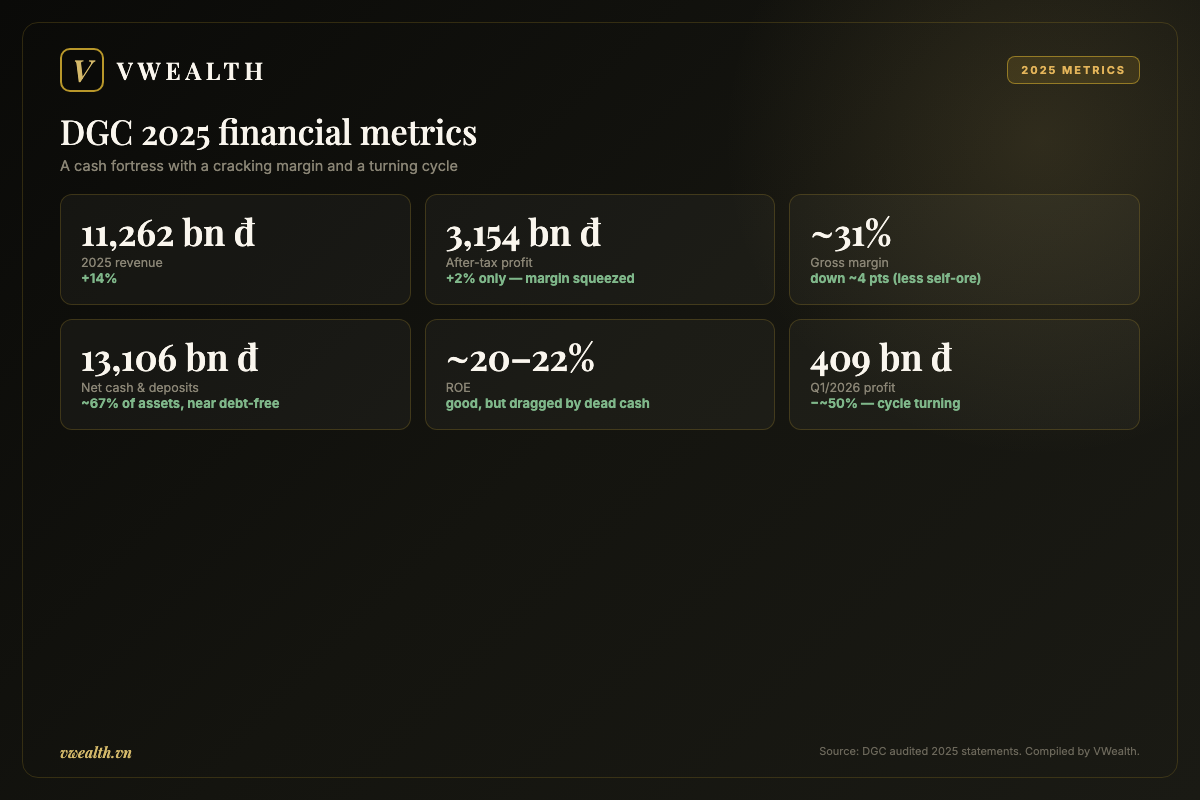
Looking at the table above, you’ll see an interesting story about the “gap” between revenue and profit. Net revenue in 2025 reached 11,262 billion dong, up as much as 14% — a healthy growth rate, showing that consumption volume and the output market remain solid. But down at the after-tax-profit line, the figure is just 3,154 billion dong, up a mere 2%.
Why did revenue rise 14% while profit stood almost still? The answer is margin erosion. As analyzed, lower-than-planned apatite self-sufficiency plus some rising input costs pulled the gross margin down about 4 percentage points. You sell more goods, take in more money, but each dong of revenue retains less profit. This is an early warning signal a sharp investor shouldn’t ignore: revenue growth without corresponding profit growth means the business is having to “run faster to stand still.”
Another detail to remember: this 3,154-billion after-tax-profit figure is the post-audit number, adjusted down about 35 billion dong from the self-prepared report. The audit “docking points” off profit isn’t itself unusual, but it leads us to the most important and sensitive part of Duc Giang’s story this year.
Red flag one: the auditor’s qualified opinion on 951 billion of inventory
On 20 June 2026, Duc Giang published its audited consolidated 2025 financial statements, performed by UHY Auditing and Consulting Co. And this wasn’t a “clean” report with an unqualified opinion. The auditor issued a qualified opinion — a much higher level of caution than a normal report — regarding inventory worth over 950.9 billion dong.
Per the auditor, because it was appointed after the period-end (31/12/2025), it couldn’t directly witness the inventory count. The substitute audit procedures performed still “did not gather enough reliable evidence to determine the existence, completeness, accuracy and value” of this inventory. Therefore, the auditor couldn’t determine whether the inventory balance at 31/12/2025 needed adjustment, and the effect (if any) on related items in the consolidated financial statements.
You need to understand the nature of this issue correctly so as not to panic but also not to dismiss it. Duc Giang explained that the 31/12/2025 inventory count was still performed per accounting law and witnessed by PwC Vietnam — the unit originally assigned for the 2025 period. However, UHY was then chosen to replace PwC to complete the audit. Because UHY wasn’t the party witnessing the count at year-end, it was forced to qualify. In other words, this is more or less a technical issue arising from changing the auditor midway, not yet evidence that inventory was overstated.
But whatever the cause, the consequence for you — the investor — is real: the reliability of the financial statements drops a notch. When the auditor can’t confirm nearly 1,000 billion dong of inventory, you have no way to be 100% sure that figure reflects reality. In valuation, you’re forced to apply a risk discount for this uncertainty. The very change of auditor midway is itself a governance question a cautious shareholder should note.
Red flag two: legal risk related to leadership
The auditor’s qualified opinion didn’t stop at inventory. The second issue — and the one hurting market confidence most — relates to legal risk. Per the report, some former Duc Giang executives were prosecuted (as of March 2026) on matters related to accounting, resource-extraction and environmental violations. Because the investigation is ongoing with no official conclusion, the auditor stated it couldn’t determine whether these matters would lead to material misstatement in the financial statements.
Caution must be stressed here: this is a matter under legal proceedings, with no final conclusion, and every individual is presumed innocent until a verdict. This article makes no conclusion about anyone’s legal responsibility. However, from an investment angle, you can’t ignore two practical impacts:
- Impact on confidence and governance: when a business’s senior leadership gets entangled in legal proceedings, the market instantly questions governance quality, transparency and management stability. DGC was once placed under restricted trading over the late filing of its audited statements — a direct consequence of these tangles. Confidence, once fractured, takes a long time to recover.
- Impact on valuation: unresolved legal risk is a variable that can’t be quantified precisely. The market usually reacts to uncertainty by applying a discount — i.e. willing to pay a lower P/E or P/B for the same profit stream. This is why the stock of a financially healthy business like Duc Giang can still trade at a valuation more modest than expected.
The message for you is very clear: Duc Giang’s balance sheet is beautiful, but beautiful doesn’t mean risk-free. These two qualifications are a reminder that you’re investing in a story with both “hard assets” and “soft risks,” and you must value both.
Cyclicality: why DGC is a commodity stock
If you only look at 2025, you easily conclude Duc Giang is a stable, steady business. But step back a few years to see the true nature: this is a classic commodity-cyclical stock, whose profit swings extremely strongly with yellow-phosphorus and world chemical prices.
The evidence is in its own profit history. 2022 was Duc Giang’s historic cycle peak: pre-tax profit set a record of about 6,375 billion dong, after-tax profit exceeded 6,000 billion, EPS reached 38,000 dong. The main driver was the runaway yellow-phosphorus price — at one point touching $8,460/tonne, about triple the 2020 average. Back then, yellow-phosphorus revenue rose 112% in a single year. Duc Giang almost “printed money” on the commodity-price wave.
Then what happened right after the peak? Phosphorus prices cooled, and profit plunged accordingly. In 2023, revenue fell about 33% to around 9,700 billion, profit dropped to around 3,250 billion — nearly halved from the 2022 peak. The 3,154 billion of 2025 shows profit has recovered slightly and gone sideways, but is still far from the golden days.
Why is Duc Giang so strongly cyclical? The reason lies in the product’s nature. Yellow phosphorus is a commodity; its price is set by global supply and demand, not by Duc Giang. When the world economy booms and demand for semiconductors, batteries and fertilizer surges, phosphorus prices rise and Duc Giang’s margin stretches spectacularly. When the economy slows or supply is excessive, prices fall and profit shrinks just as fast. Duc Giang’s production cost is fairly fixed, so each swing in the selling price hits the margin directly by a leverage effect.
This matters greatly for how you value DGC. You should not use the profit of a peak-cycle year (like 2022) to extrapolate the future, because it’s unsustainable. Conversely, don’t panic at the cycle bottom either. The reasonable approach is to look at average profit across a whole cycle, ask where the phosphorus price is in the cycle now, and remember that the cash fortress and deposit interest are what let Duc Giang “stay healthy” through bottom years better than any other commodity business.
Summary of financial health: strong but you must discount the risk
So how should Duc Giang’s financial health be scored? The balanced answer is: very strong in asset structure, but with governance and cyclical red flags you’re forced to value in.
On the hard side, few businesses on the exchange have such a beautiful balance sheet: nearly 13,000 billion of net cash, almost no debt, equity over 15,000 billion, thick undistributed profit, ROE around 20-22% and a gross margin still above 30% despite narrowing. This is the foundation for sustainable dividends, for self-funding the Nghi Son and Dak Nong mega-projects, and for superior resilience through commodity-cycle bottoms.
On the soft side, you must not forget three things: (1) profit swings strongly with the phosphorus price — this is a cyclical stock, not a steady-growth one; (2) the auditor issued a qualified opinion on nearly 1,000 billion of inventory, reducing financial-statement reliability; and (3) the legal risk related to leadership is unresolved, pressuring confidence and valuation. A large amount of “dead cash” is also dragging capital-return efficiency below its true potential.
Duc Giang is a classic example that a business can be both healthy and risky at the same time — and your task is to weigh those two sides. It’s precisely how the market reacts to the tug-of-war between the “cash fortress” and the “two governance red flags” that will decide DGC’s price action, and that’s what we’ll analyze right after in the Market reception section.
Market reception
If you only look at a single number — a P/E of about 6x based on 3,154 billion dong of 2025 after-tax profit and about 380 million shares outstanding — you’ll conclude at once that DGC is a bargain. A leader of Vietnam’s chemical industry, holding about half the domestic yellow-phosphorus (P4) share and about a third of global P4 export volume, valued as cheaply as a declining company. But this is exactly where the writer wants you to pause a very long time before putting money in. The market isn’t “dumb.” When a high-quality stock is valued unusually cheaply, there’s usually one (or more) reason the board doesn’t tell you. For DGC, there are two big reasons, and neither is small.
In the 19 June 2026 session, DGC closed at 48,400 dong a share (VWealth plugin data). In June alone, the ticker recovered about +7.92% — a notable bounce after a plunge. But to understand why the market receives DGC as it does, you need to put this 48,400 dong in proper context: it’s what’s left after a crash, not the peak of a rising wave. And behind each seemingly attractive valuation number is a story of a commodity cycle compounding with a governance crisis unprecedented at this business.
Valuation: a low P/E here is a trap, not a gift
Let’s start with the basic calculation you can verify yourself. 2025 after-tax profit reached 3,154 billion dong (audited, adjusted down about 33 billion from the self-prepared report). With about 380 million shares outstanding, EPS lands around 8,000 dong a share. Dividing 48,400 dong by this EPS gives a P/E of about 6x. On a book basis, DGC’s P/B is in the 1.5–2x range — not cheap in a “below liquidation value” way, but reasonable for a business still profiting well and still holding a cash mountain.
This is the first contradiction you must resolve. Some market data sources (like Simplize) show DGC’s P/E around 11.5x — still below the HOSE average of about 14.3x — because they compute on the sharply declined trailing four-quarter profit, not full-year 2025. The gap itself between “P/E 6x on 2025 profit” and “P/E ~11.5x on the trailing four quarters” tells you a truth: DGC’s profit is declining, and the denominator in the P/E formula is a moving target. This is where the low-P/E trap reveals itself.
For a commodity-cyclical stock, the lowest P/E usually appears at the PEAK of the profit cycle, while the highest P/E appears at the BOTTOM. Buying chemicals, steel or fertilizer when the P/E is “cheap” without asking “where is this profit in the cycle” is a classic mistake that makes investors buy right at the top.
Why so? Because DGC’s profit isn’t a stable cash flow like a consumer company’s. It swings violently with the world yellow-phosphorus price — a commodity whose selling price DGC barely controls. When the world P4 price surges (as in 2021–2022 from supply-chain ruptures and China tightening production), DGC’s margin stretches spectacularly, EPS multiplies, and the P/E becomes “super cheap” right at the peak. When the P4 price cools, the margin shrinks, EPS falls, and the P/E gets “expensive” even as the share price has dropped. So when you see a 6x P/E today, the right question isn’t “so cheap, why not buy?” but “is this 3,154-billion profit the profit of a peak, mid, or bottom zone of the phosphorus cycle?”
The most recent quarterly report leans toward the worrying scenario. In Q1 2026, DGC recorded revenue of over 2,100 billion dong, down about 24% year on year; after-tax profit was only 409 billion dong, down nearly half. If you mentally multiply four quarters at this pace, the 2026 profit level could be well below 2025’s 3,154 billion — meaning the “cheap” 6x P/E you just calculated will automatically widen as the denominator shrinks. That’s why the writer advises you never to value DGC by a single P/E slice. Look also at P/B (around 1.5–2x) for a more stable anchor, and most importantly, accept that the market’s cautious valuation of DGC has a reason, not because investors missed it.
The two “red flags” that make the market discount hard
If there were only phosphorus-price cyclical risk, DGC would probably still trade at a double-digit P/E like its history. The deep discount now comes from two governance red flags any serious investor must read carefully before buying.
Red flag one — the qualified audit opinion and the sealed accounting records. After months of delay, only on 20 June 2026 could DGC publish its audited consolidated 2025 statements. The auditor issued a qualified opinion — not an unqualified one. The core reason: the auditor was appointed after the fiscal year ended, so it couldn’t witness the 31 December 2025 inventory count worth 950.9 billion dong, about 56.5% of total inventory. In other words, more than half the inventory value on DGC’s balance sheet wasn’t independently verified firsthand. For a manufacturer, inventory is a key asset; a qualification at this scale is a signal the market must attach a “risk premium” to the valuation for.
Red flag two — the criminal case and executives prosecuted and detained. In March 2026, the authorities prosecuted the case related to environmental and accounting-regulation violations at Duc Giang Chemicals Group and related units. Then Chairman Dao Huu Huyen and some executives were prosecuted and detained for investigation. The business had to hold an extraordinary shareholders’ meeting on 8 May to reorganize leadership, with Dao Huu Kha taking the Chairman’s seat. Not stopping there, Pit 25 (Mine 25) had to halt for investigation, costing DGC its self-mined ore and forcing it to fully use imported ore and outside materials — pushing up yellow-phosphorus production cost, further eroding the margin amid the governance crisis.
These two red flags compounding created a clear price crash. From 12/3 to 31/3/2026, DGC fell 37.9%, from 80,900 dong to 50,200 dong a share — almost straight down in a few weeks. The 48,400-dong price today is thus the product of a market that has partly reflected these risks into the price. That’s also why the +7.92% June bounce should be read soberly: it may be relief that the audit report was finally published (removing prolonged uncertainty), not necessarily a signal the crisis has closed.
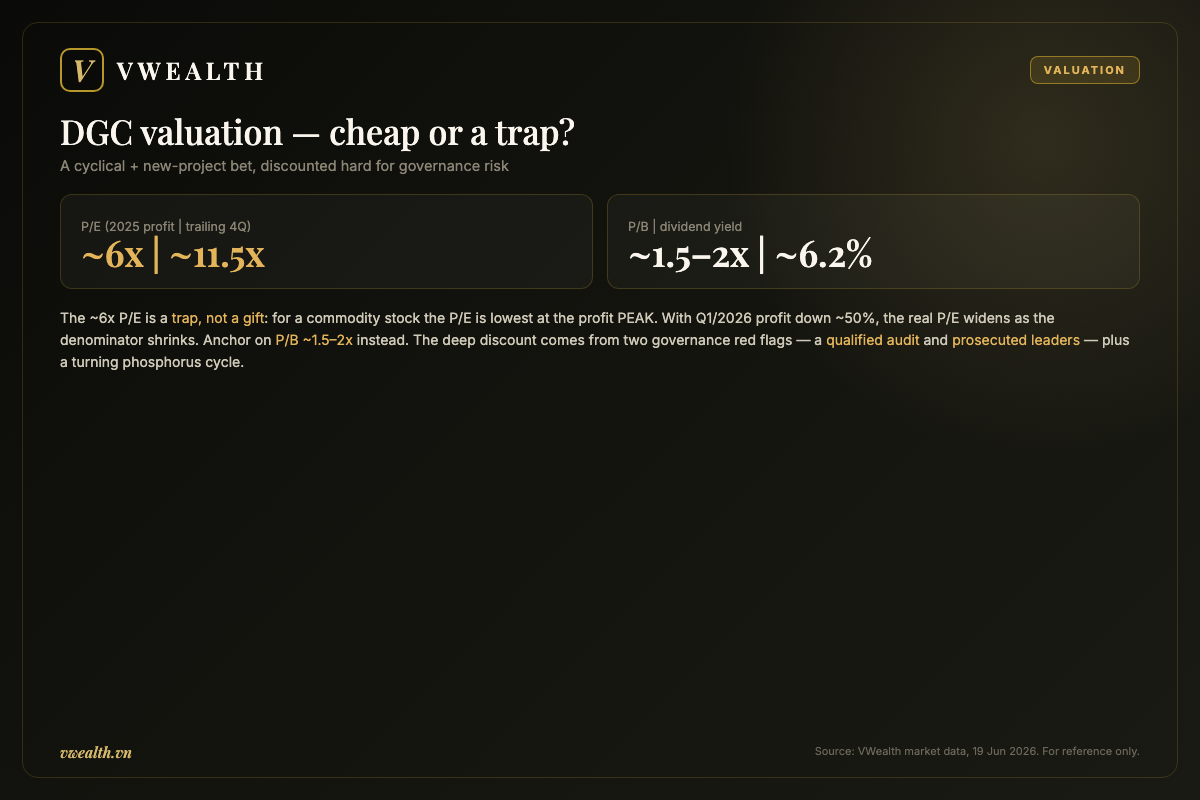
The valuation table above gathers the key numbers for you to weigh. Note how to read it: the 6x P/E is “cheap on paper” on peak 2025 profit; the ~11.5x P/E on the trailing four quarters more accurately reflects the declining profit trend; and the 1.5–2x P/B is the most durable anchor for a business still profiting and still holding cash. Don’t let one pretty number obscure the full picture.
Steady cash dividends — a plus from the cash mountain
Amid a risk-heavy picture, there’s a very real bright spot you shouldn’t ignore: DGC pays cash dividends steadily and generously. This business is famous for its “cash mountain” balance sheet — large cash and equivalents, low debt — and that financial health lets it keep a cash dividend of about 30% of par a year (i.e. 3,000 dong a share). Specifically, DGC set the record date for its 2025 advance cash dividend at a 30% ratio for 25 December 2025, paid on 15 January 2026. With nearly 380 million shares, total payout was about 1,140 billion dong — a figure showing the business really has hard cash to pay, not a “paper” dividend.
At 48,400 dong and a 3,000-dong cash dividend, DGC’s dividend yield is about 6.2% — a very notable level versus the Vietnamese stock average, and higher than long-term bank savings rates at many points. This is an important psychological cushion: even if the share price goes sideways during the governance crisis, you still receive a steady cash flow. However, the writer must honestly remind you: the cash dividend is fed by profit, and DGC’s profit just fell nearly half in Q1 2026 and is under cost pressure from losing its self-mined ore. A 30%-of-par dividend policy sustainable in the past doesn’t guarantee it will hold if the crisis drags on and profit keeps eroding. The 6.2% yield is a plus, but it’s not immune to the cycle.
Foreign investors and liquidity: big money is still cautious
Another signal to gauge the market’s “temperature” toward DGC is the behavior of foreign investors and liquidity. During the tense stretch of late 2025, selling pressure came not only from domestic investors. In the 19 December 2025 session, foreigners “dumped” DGC in an unusual burst worth over 634.7 billion dong in a single session — a very large number showing foreign capital actively retreating as governance risk surfaced. In that same stretch, DGC hit the floor with record-high liquidity, with some sessions nearly 4% of the company’s capital “changing hands,” some sessions nearly 10%. Liquidity exploding in a downswing like this is usually a sign of broad ownership transfer — the old exiting, the new (risk-takers) bottom-fishing.
This cuts two ways for you. The positive: DGC’s liquidity is very high, you can easily buy/sell large volumes without getting stuck — this is a true blue chip in trading terms. The caution: while foreigners still stand aside or net-sell, sustainable price support from large institutional money hasn’t returned. The +7.92% June bounce mainly bears the marks of domestic bottom-fishing money and a reaction to the audit-report news, rather than a long-term reallocation from foreign funds. Until you see foreigners net-buying steadily again, treat this bounce as a technical rebound in an unresolved story.
Summary of how the market is valuing DGC
So how is the market receiving DGC? The writer sums it up for you in three overlapping layers of identity:
- Layer 1 — a cyclical chemical stock. DGC’s profit and price swing with world yellow-phosphorus and chemical prices. The “cheap” 6x P/E today is the P/E of high 2025 profit; with Q1 2026 profit already down nearly half, the real valuation is less attractive than the surface number. This is a risk you must accept when buying any commodity stock.
- Layer 2 — a bet on new projects. DGC isn’t just the existing phosphorus story. The Duc Giang–Nghi Son chemical complex (Thanh Hoa) phase 1 is expected to run from Q2 2026, possibly contributing about 1,500 billion dong of revenue a year and rising toward 4,000 billion at full capacity; plus the ethanol plant benefiting from the E10 gasoline rule effective 1 June 2026. This is the “growth” part optimists are paying to buy.
- Layer 3 — discounted for governance risk. The qualified audit opinion over 56.5% of unwitnessed inventory, the criminal case that detained the former Chairman, Mine 25 halting and pushing up costs — all force the market to attach a large “risk premium” to the price. This is the main reason DGC trades at an unusually cheap valuation versus the quality of its fundamentals.
Wrapped in one sentence to remember: DGC is a cyclical chemical stock plus a bet on new projects (Nghi Son, ethanol), but heavily discounted by the market for governance risk (qualified audit, executives prosecuted). The 6x P/E isn’t a free discount coupon — it’s the price the market demands to compensate for the three overlapping risk layers above. You can see it as an opportunity (risk mostly reflected in the price, a 6.2% cash dividend as cushion, new projects as driver), or a trap (profit at a cycle peak, an unresolved governance crisis, foreigners still aside). Both views are reasonable — and that’s exactly why understanding the chemical-industry context DGC sits in becomes the deciding piece to tilt the scale one way or the other.
Economic and chemical–phosphorus industry context
To understand why DGC is sometimes hailed as a “cash printer” and sometimes dumped mercilessly, you must look beyond the business’s balance sheet. Duc Giang isn’t an isolated story. It’s a small but sensitive branch of a global commodity flow, where the price of a single good — yellow phosphorus — can decide whether the business earns thousands of billions or slides. This section dissects the macro and industry variables you need to track if you hold DGC, because in Duc Giang’s case, the “industry” is the “business” to a rare degree.
Yellow phosphorus (P4): the life-or-death variable of the whole DGC story
If you could only track one number while holding DGC, it must be the world yellow-phosphorus (P4) price. This is a strategic product, the source of most of the huge margins Duc Giang once generated in peak-cycle years. When the P4 price surges, DGC’s profit stretches exponentially, because its production cost (thanks to vertical integration from apatite ore) is nearly fixed while the selling price dances to the international market. Conversely, when the P4 price plunges, the margin shrinks unbelievably fast.
Look at recent price levels to feel the volatility. Per market data, the yellow-phosphorus price in China hovered around $3,233/tonne in March 2025, and by January 2026 was about $3,337/tonne, while prices in Southeast Asia and North America were considerably higher (above $5,000/tonne in some regions in late 2025). Versus the crazy peak above $6,000–7,000/tonne of 2021–2022, the current level has cooled a lot, but it’s still above DGC’s cost base — which is why the business still profits well. The issue is: this number isn’t in Duc Giang management’s hands. It’s set by the global supply and demand you’re about to see below.
The demand side: semiconductor chips and LiFePO4 batteries — long-term drivers
The most compelling — and most easily hyped — story is on the demand side. High-purity yellow phosphorus is the input for electronic-grade phosphoric acid, an ingredient used in cleaning chemicals (etchants) for semiconductors. As the world pours money into new chip plants, demand for pure phosphorus chemicals is expected to rise long term.
The second driver, and perhaps more important in scale, is LiFePO4 (lithium iron phosphate) batteries — the type dominating the cheap-EV and energy-storage markets. Each LFP cell needs a certain amount of phosphorus. As China and the rest of Asia-Pacific concentrate on building battery “gigafactories,” phosphorus demand for the new-energy industry is forecast to rise steadily. Market reports note: China’s phosphorus export supply is partly tightened because domestic demand for agriculture and new-energy batteries has risen. This is the “long-term growth” argument DGC supporters often cite.
You should remember one thing: the battery and semiconductor story is a long-term, gradual driver, not an immediate jolt. It explains why P4 prices are unlikely to return to the previous decade’s bottom, but it doesn’t guarantee prices will rise in the next 6–12 months. Don’t let the pretty story obscure the cyclical reality.
The supply side: China tightening production — a double-edged sword leaning toward DGC
This is where DGC truly has a structural advantage. China is the world’s largest yellow-phosphorus producer, but this industry is extremely electricity-hungry and polluting. For years, Beijing has imposed production restrictions for power-saving and environmental reasons, especially in provinces like Yunnan, Sichuan and Guizhou. Each time China cuts capacity, global supply tightens and the P4 price bounces — and Duc Giang, one of the few large low-cost producers outside China, benefits directly.
However, you need to balance this picture. The latest 2026 industry reports warn of the opposite direction: China’s yellow-phosphorus market could fall into slight oversupply (a net surplus of about 45,500 tonnes in 2026), as new added capacity (about 105,000 tonnes/year) outpaces the growth of downstream demand (about 59,500 tonnes/year). The phase mismatch between supply rising in the first half and demand recovering in the second half could raise inventories and create downward price pressure. In other words, the “China tightens supply” advantage is real long term, but in the short term of 2026, the balance may tilt toward price pressure. This is exactly the kind of contradiction a DGC investor must live with.
Fertilizer and DAP: the revenue-cushion segment
Besides phosphorus, Duc Giang also has a fertilizer segment (DAP, phosphate fertilizer) — where commodity prices also matter but with less extreme swings than P4. The good news is fertilizer prices are being supported. Per the Vietnam Fertilizer Association, global fertilizer prices are holding at reasonable levels, with potash and DAP showing a fairly clear rising trend. Domestic consumption is estimated to rise slightly by about 2% in 2026, reaching about 10.7 million tonnes, while exports remain favorable thanks to steady demand from India and Brazil. Despite some local DAP corrections in late 2025, the long-term uptrend holds on solid production costs.
For DGC, the fertilizer segment acts as a “cushion”: when P4 prices are weak, fertilizer cash flow helps smooth the volatility. But don’t expect this segment to create a profit leap — it’s stability, not a growth engine.
Caustic soda–chlorine: the Nghi Son piece substituting imports
A separate but increasingly important thread is caustic soda (NaOH) and chlorine. Vietnam now relies heavily on imported caustic soda, mainly from China — the world’s largest flake-caustic producer and exporter thanks to superior capacity and low cost. Caustic soda is produced by electrolyzing salt (NaCl), also generating chlorine as a byproduct. Domestic caustic-soda demand is very broad: textile dyeing, paper, water treatment, alumina, industrial chemicals.
This is where DGC’s Nghi Son project steps in. The Duc Giang Nghi Son chemical complex (Thanh Hoa) with its large caustic-soda plant is positioned to substitute part of the imports, serving mainly domestic demand. The logic here is very different from phosphorus: instead of betting on world export prices, DGC targets grabbing import-substitution share domestically — a more defensive, sustainable story. We’ll return to Nghi Son in the forecast section, because it’s one of the most concrete growth drivers.
The macro risks you can’t ignore
The industry picture wouldn’t be balanced telling only the bright side. There are at least four groups of macro risks hanging over DGC:
- A commodity-price reversal. This is the biggest risk. DGC’s profit model amplifies both up and down. A falling-P4-price cycle — like the 2026 oversupply scenario the industry warns of — can erode profit far faster than an investor looking at a cheap P/E senses.
- Export tax and resource policy. As a business mining apatite and exporting phosphorus, DGC is always in the sights of mineral-export-tax and resource-fee policy. Any tightening change eats straight into the margin.
- Electricity and the environment. Producing yellow phosphorus is extremely electricity-hungry and environmentally sensitive — exactly the reasons China tightens supply. Vietnam isn’t immune to rising power-price pressure and stricter environmental rules, which could push up DGC’s costs.
- Exchange rate. Because exports earn USD, VND/USD swings directly affect converted revenue. A strong USD benefits export revenue, but also pushes up the cost of importing equipment and materials for the new mega-projects.
In sum, at the industry level, DGC is a good business tightly bound to a commodity cycle you can’t control. The cost advantage and vertical integration are real, the battery-semiconductor story is real, but all must be read through the lens of “what is the P4 price today, and in which direction.”
Trend forecast
Having placed DGC in its proper industry context, now it’s time to look ahead. Let me tell you frankly: forecasting a commodity stock like DGC is much harder than a consumer or bank stock, because the outcome depends on variables beyond the business’s reach. So instead of a falsely precise target number, we’ll build three scenarios, each tied to specific conditions and price consequences. But first, let’s run through the growth drivers that could truly change the game.
The core growth drivers
Nghi Son: the nearest and clearest revenue jolt
The Duc Giang Nghi Son chemical complex is the most concrete, nearest driver in time. The project has total investment of about 12,000 billion dong; phase 1 (30 ha, 2,400 billion dong of capital) is expected to come online in Q1 2026, with a capacity of about 151,000 tonnes of chemicals/year, including a caustic-soda plant of 80,000 tonnes/year, PAC 30,000 tonnes/year and Ca(OCl)2 (calcium hypochlorite) 20,000 tonnes/year. Per published estimates, this complex is expected to contribute about 12% of DGC’s annual revenue from 2026, and when fully operational could bring in 3,000–4,000 billion dong of revenue a year.
What makes Nghi Son attractive is its defensive character: it targets substituting domestic caustic-soda imports, not depending entirely on world export prices like the phosphorus segment. If the project runs on schedule and reaches capacity, this is a new, relatively stable revenue stream, cushioning a profit that is highly sensitive to the P4 cycle.
Dak Nong bauxite–alumina: a leap in scale — if it works
Duc Giang’s biggest ambition lies in the bauxite-mining and alumina–aluminum production complex in Dak Nong (and related cooperation with the Lam Dong region per an October 2025 memorandum). The planned scale is staggering: design capacity of 2 million tonnes of alumina/year and 500,000 tonnes of aluminum/year, total investment estimated at about 58,000 billion dong (about $2.3 billion), rolling out from 2025 to 2030, expected to bring in revenue of up to 37,000 billion dong a year when complete.
If those numbers materialize, it would be a leap in scale — turning DGC from a phosphorus-chemical business into a diversified mining-industrial group. But you must read the “if” carefully. This is a $2.3 billion project, many times the capital of existing projects, requiring an investment permit, enormous capital, and the capacity to execute an entirely new field (alumina–aluminum smelting is electricity-hungry and complex). Per reports, the project may receive its investment permit this year, but between “may receive a permit” and “operating profitably” is a long road full of risk. Treat Dak Nong as an option of great value but uncertain probability and timing — don’t value it as already in the bag.
Phosphorus demand for batteries and semiconductors: a long-term floor
As analyzed in the industry section, phosphorus demand for LiFePO4 batteries and semiconductor chemicals is a long-term floor for the P4 price, keeping the price level from returning to the previous decade’s bottom. This isn’t an immediate booster, but it’s a reason to believe the “bottom” of the coming cycle could be higher than the “bottom” of the previous one.
Three scenarios for DGC
Putting it all together, here’s a three-scenario frame for you to weigh. Note: this is a condition–consequence frame, not buy/sell advice.
| Scenario | Conditions that must converge | Consequence for the share price |
|---|---|---|
| Positive | Yellow-phosphorus price holds high or bounces (China tightens supply strongly) + Nghi Son runs on schedule and Dak Nong is permitted + new management re-establishes transparency, clearing the qualified audit opinion. | Profit recovers and grows, investor confidence returns, the P/E is re-rated higher. This is the “cheap valuation + doubts erased” scenario — the largest upside. |
| Base | P4 price goes sideways around the current level (slight 2026 oversupply pressure but battery demand cushions the bottom) + Nghi Son contributes gradually + Dak Nong progresses slowly + legal/audit issues drag on but don’t escalate. | Profit goes sideways around ~3,000 billion, the cash mountain keeps supporting value, but the governance discount still weighs on the valuation. The price trades in a band, hard to break out until a catalyst. |
| Negative | Phosphorus prices fall deep (China oversupply materializes) + Nghi Son/Dak Nong delayed or over budget + legal risk for leadership and the audit escalate (widening the qualification scope, more individuals handled). | Profit shrinks, the “low-P/E trap” is exposed, the governance discount widens. This is the most painful scenario — the price could discount deeply despite the large cash mountain. |
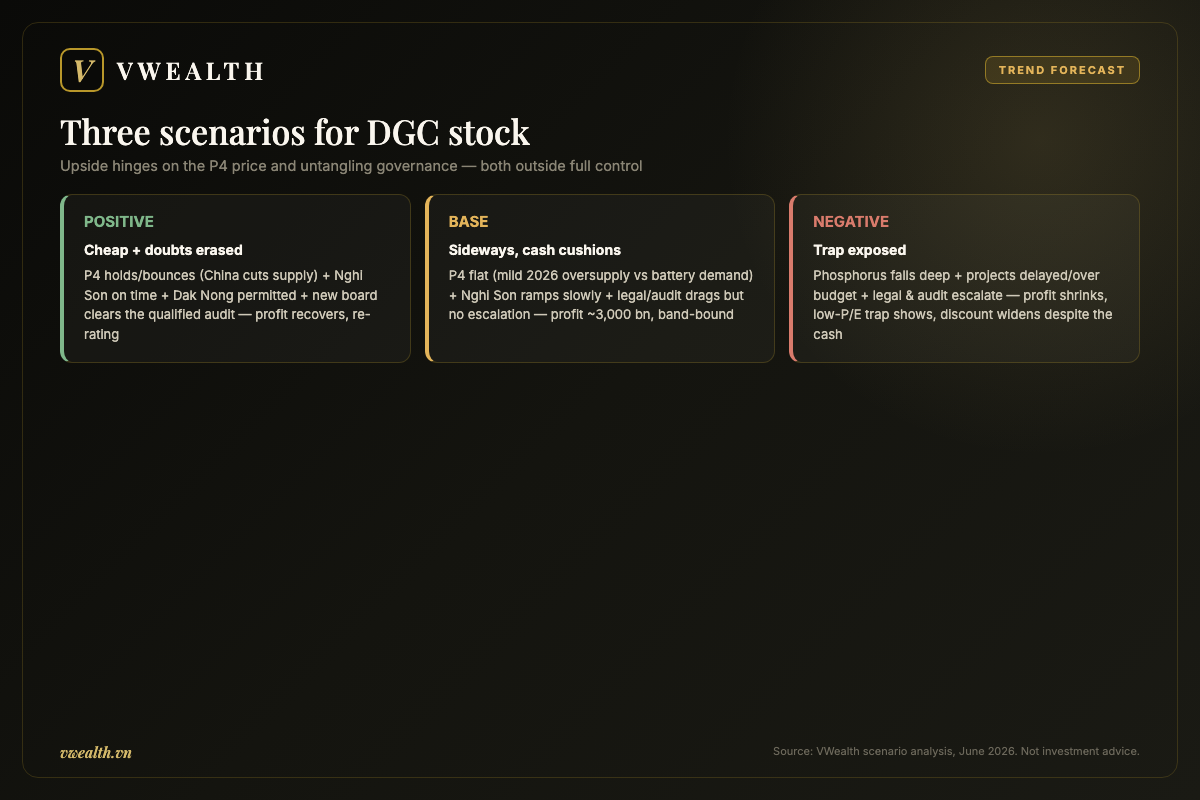
What you need to draw from the table above: most of DGC’s upside depends on two things the business doesn’t fully control — the P4 price and untangling the governance issues — plus one thing it can partly control, project progress. That’s a far more complex risk profile than the ~6x P/E first suggests.
Should you buy DGC stock?
This is the question you really want answered, and also the one a responsible analyst must not answer for you with a single “buy” or “sell.” Instead, our job is to lay the pros and cons clearly on two scales, then help you recognize which kind of investor you are. The final decision is yours, based on your risk appetite and goals.
Weighing the PROS: why DGC is still an admirable business
- Number 1 in phosphorus chemicals. Duc Giang is Vietnam’s leading yellow-phosphorus and phosphorus-chemical producer, a real leadership position, not just a title.
- Vertical integration — a real cost advantage. From apatite ore to final product, DGC controls the value chain, enabling low production cost and high margins when commodity prices are favorable. This is a hard-to-copy structural “moat.”
- A ~13,000-billion cash mountain, almost no debt. An extremely healthy balance sheet. The huge cash and equivalents let DGC survive cycle bottoms without default risk, while providing resources to self-fund part of the mega-projects.
- Steady dividends. The business has a history of regular dividends, a plus for cash-flow-oriented investors.
- Benefiting from long-term phosphorus demand + China tightening supply. The LiFePO4 and semiconductor story supports the P4 price floor, while China restricting production over power and the environment gives an advantage to low-cost producers outside China like DGC.
- The Nghi Son and Dak Nong projects with big potential. Nghi Son brings a defensive revenue stream from 2026; Dak Nong, if executed, is a leap in scale that could redefine the business.
- A cheap P/E valuation. At 48,400 dong and ~3,154 billion of 2025 profit, the ~6x P/E is very low for an industry leader — at first glance a bargain.
Weighing the CONS: why the “bargain” could be a trap
- The strongly swinging phosphorus-price cycle — and the peak-cycle low-P/E trap. This is the fundamental risk. Commodity stocks usually look cheapest right at the profit-cycle peak, because profit (the P/E denominator) is abnormally high. When the P4 price reverses — exactly the 2026 oversupply scenario the industry warns of — profit can shrink, pushing the “real” P/E much higher. Whether the ~6x P/E is cheap depends entirely on whether the 3,154-billion profit is sustainable.
- Two governance red flags — serious and recent. This is what makes DGC’s profile so different from an ordinary cyclical stock. The audited 2025 statements (published 20/6/2026, by UHY) received a qualified opinion on two issues: (1) the auditor couldn’t witness the count and substitute procedures lacked enough reliable evidence to confirm the value of over 950 billion dong of inventory; (2) some core executives were prosecuted on 17/3/2026, under investigation for accounting, resource-extraction and environmental-pollution violations. The Chairman change (Dao Huu Kha replacing Dao Huu Huyen at the extraordinary meeting) shows the scale of the shock at the top. These two red flags reduce the reliability of the very beautiful numbers the PROS side rests on.
- The big projects’ execution and capital risk. Dak Nong is a $2.3 billion gamble in a new field (alumina–aluminum), with the risk of cost overruns, delays, and permit dependence. Big ambition comes with a non-small probability of stumbling.
- “Dead cash” dragging ROE. The very ~13,000-billion cash mountain — a plus for safety — is a minus for efficiency: a large amount of idle cash earning low returns drags the return on equity below its potential. A business holding too much cash without deploying it efficiently is “wasting” shareholders’ capital.
What kind of investor are you?
The most useful way to answer “should I buy DGC” is to hold yourself against the four investor types below:
- The value, contrarian, risk-tolerant investor: if you believe the P4 price will hold thanks to battery/semiconductor demand, believe the new management will clear the governance red flags, and are willing to wait through the volatility, then DGC’s cheap valuation + cash mountain + industry-leading position is a compelling case for deeper research.
- The growth investor: you may be drawn by the Nghi Son and Dak Nong story, but must accept that most of that growth is still in the future and depends on execution.
- The income (dividend) investor: steady dividends and a healthy balance sheet are a plus, but a cyclical business’s dividend flow isn’t as stable as a consumer company’s — don’t expect absolute regularity.
- The investor prioritizing safety and absolute transparency: this is the group DGC doesn’t suit. When the financial statements receive a qualified opinion and core leaders are under criminal investigation, the transparency and data reliability have been seriously questioned. If you need to sleep soundly with a “spotless” business, DGC at this point isn’t for you.
In short: DGC suits those who can bear both cyclical risk and governance risk in exchange for a cheap valuation and re-rating potential if things brighten. It does not suit those putting safety and transparency first. The appeal of the ~6x P/E is real, but it comes with a “risk discount” each investor must value for themselves — and at DGC, that discount today comes not only from the commodity cycle, but also from confidence in the very numbers on the report.
Disclaimer: This article is analytical and informational, not a recommendation to buy or sell DGC. The figures and views are based on information published at the time of writing and may change. In particular, note the governance risks present: DGC’s 2025 financial statements received a qualified audit opinion and some core executives are under legal investigation — factors that reduce data reliability and may develop unpredictably. Investing in stocks, especially a cyclical commodity stock with governance issues, carries risk of capital loss. You should research thoroughly, consider your risk appetite, and consult a licensed financial advisor before deciding.
Research Vietnamese stocks in English with vwealth. Our AI-powered platform turns Vietnamese market data into full English analysis reports — with international payment support and a free 2-month trial for new accounts. Create your free account and read the latest reports.