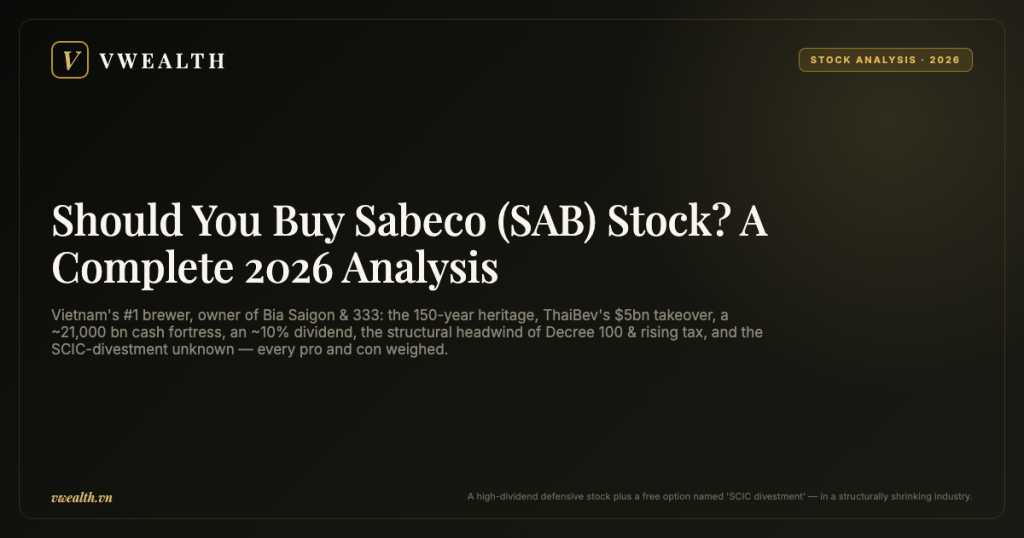
For a whole generation of Vietnamese, the phrase “let’s grab a few Saigons” has been almost synonymous with good times, with friends, with the end of a working day. Behind that collective memory stands the Saigon Beer – Alcohol – Beverage Joint Stock Corporation (Sabeco, HOSE: SAB) – Vietnam’s number-one brewer, owner of two national brands, Bia Saigon and 333, holding a market share usually estimated above 40% and leading an industry where just four giants (Sabeco, Heineken, Habeco, Carlsberg) split nearly 95% of total market volume.
If you’re looking for a “defensive” business by the textbook definition, Sabeco is almost the model. This is a cash machine: the company sits on a mountain of cash and bank deposits worth roughly 19,000–22,000 billion dong, with almost no borrowings, paying a 50% cash dividend three years running, and valued by many brokerages as a defensive stock with a dividend yield around 10% a year. For an investor who likes certainty, those are numbers that let you sleep soundly.
But – and this is the most important “but” of the whole article – Sabeco faces something far more dangerous than a bad quarter: a structural decline. Three headwinds are blowing at once. First, Decree 100 (and later Decree 168) tightening drink-driving enforcement, permanently changing the “if you drink, drink to get drunk” habit. Second, the special consumption tax rising along a new roadmap, pushing up cost and eroding purchasing power. Third, a trend both global and domestic: young Vietnamese are gradually drinking less beer and caring more about health. The blunt consequence: Sabeco’s 2025 revenue fell to just 25,888 billion dong, down about 19% year on year and into the lowest trough in more than a decade, even though after-tax profit still edged up to 4,573 billion dong (+1.7%) thanks to improved margins.
So you stand before a classic paradox: a leading, financially healthy, dividend-generous business – sitting in the middle of a long-term downtrend in volume. At 48,150 dong a share (close of 19 June 2026), the valuation is far cheaper than in its golden years, with the P/E back around 13–14x. The question isn’t simply “is SAB cheap or expensive,” but: are you buying a cheap cash machine, or catching a knife that’s falling structurally? And more importantly – what kind of investor does this stock suit? To answer, we need to start where it all began: a small French brewery in the heart of Cho Lon, exactly 150 years ago.
SAB market data (updated 19 June 2026)
| Current price | 48,150đ | 2025 revenue | 25,888 bn (−19%) |
| Change (June) | +2.01% | 2025 after-tax profit | 4,573 bn (+2%) |
| P/E | Dividend yield | ~13–14x | ~10% | Market share | Cash | >40% | ~21,000 bn |
Source: VWealth price data + Sabeco 2025 reports. Figures move by session — for reference only.
History and evolution
Few listed companies on Vietnam’s stock market carry as much history as Sabeco. When you hold a bottle of Bia Saigon, you’re touching a story stretching 150 years, through French colonial rule, war, the subsidy era, reform, equitization, and a billion-dollar takeover that shook all of Southeast Asia. Understanding this history isn’t just nostalgia – it helps you see why the Bia Saigon brand is rooted so deeply in the consumer’s mind, and why that “heritage halo” is both the company’s most precious asset and its heaviest burden today.
A 150-year legacy: from Victor Larue’s brewery to Bia Saigon
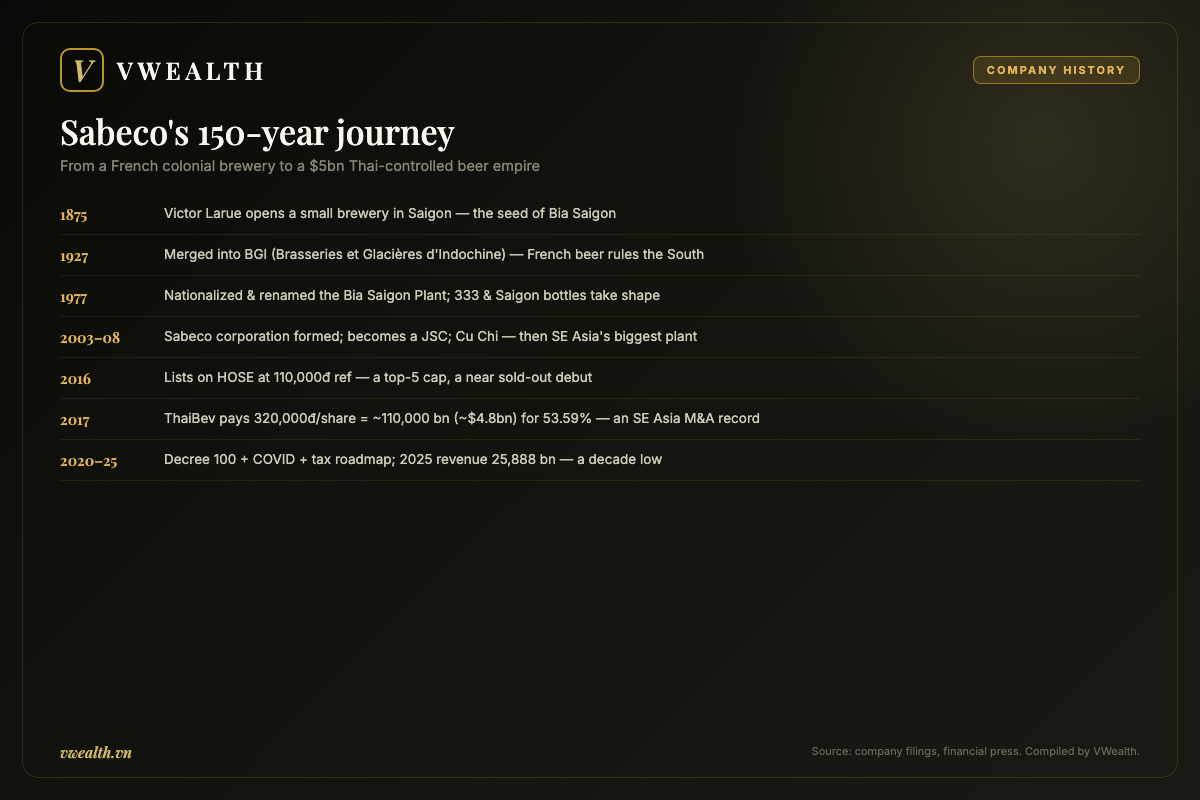
Sabeco’s roots begin in 1875, when a Frenchman named Victor Larue opened a small brewery in Saigon. This is the forerunner of today’s Bia Saigon plant on Nguyen Chi Thanh street – an iconic piece of architecture still standing in the heart of Ho Chi Minh City. Thirty-five years later, in 1910, that small workshop had grown into a full plant producing beer, soft drinks and ice – among the most luxurious and modern goods of colonial society at the time.
The next turning point came in September 1927, when the plant was formally merged into the BGI (Brasseries et Glacières d’Indochine) system – the French Indochina brewing-and-ice conglomerate. Under BGI, this French-marked beer brand dominated the southern market for many decades. This was when “beer” became part of Saigon’s urban life, and the Larue name (with the tiger on the label) entered the memory of many generations.
History turned an entirely new page after 1975. In 1977, the plant was nationalized, handed over to state management (under the Southern Alcohol–Beer Company), and renamed the Bia Saigon Plant. From a French-owned capitalist facility, the company entered a new era as a state enterprise, operating under the centrally planned mechanism of the socialist economy. It was in this period that the two “national children” gradually took shape: the Bia Saigon bottled line and especially 333 beer – a name tied to the Vietnamese drinking table, with roots in the French-era “33” brand.
The key point to remember: most of Sabeco’s brand value today wasn’t created by marketing money over a few years, but built up across many generations of consumers. This is an extraordinarily hard-to-copy intangible asset – but also the very thing that can make a company “fall asleep on its heritage” if it doesn’t keep renewing itself.
Entering the Doi Moi (reform) period, the company was gradually reorganized along modern lines. In 1993, the Bia Saigon Plant became the Bia Saigon Company. On 6 May 2003, the Saigon Beer – Alcohol – Beverage Corporation (Sabeco) was officially established by consolidating the Bia Saigon Company with a series of member units such as the Binh Tay Alcohol Company, the Chuong Duong Beverage Company, the Phu Tho Glass Plant and the Saigon Beer–Alcohol–Beverage Trading & Services Company. From here, the shape of a beverage “empire” began to emerge.
The year 2008 marked two big events: the company was restructured and converted its operating model into a joint stock company (taking the full name Saigon Beer–Alcohol–Beverage Joint Stock Corporation), and inaugurated the Bia Saigon – Cu Chi Plant, seen at the time as the largest brewery in Southeast Asia. Sabeco’s system expanded into a network of dozens of plants and subsidiaries spanning the whole country – a huge distribution advantage that few rivals could match.
Equitization and listing: the 2016 “sold-out” debut on HOSE
For years after equitization, Sabeco remained a “gem” controlled by the state (the Ministry of Industry and Trade), and putting the shares on the exchange was delayed for a long time, stirring plenty of controversy. Only on 6 December 2016 did more than 641 million SAB shares officially list on the Ho Chi Minh Stock Exchange (HOSE) at a reference price of 110,000 dong a share. At that price, Sabeco’s market cap immediately topped 70,000 billion dong, placing the company among the exchange’s top-5 largest listings, beside names like Vinamilk, PV Gas, Vietcombank and Vingroup.
SAB’s debut session was a memorable event: the stock nearly “sold out” in the opening minutes. Domestic and foreign investors rushed to chase a leading business with a strong brand, good margins and – most importantly – an imminent state divestment. The listing wasn’t just a procedure; it was the springboard for an M&A deal the whole market held its breath for: who would acquire Vietnam’s number-one brewer?
The historic 2017 deal: the Thais spend nearly $5 billion, an SE Asian M&A milestone
At the end of 2017, the answer arrived – and it was a shock. On 18 December 2017, through its subsidiary Vietnam Beverage, the ThaiBev group of Thai billionaire Charoen Sirivadhanabhakdi bought 53.59% of Sabeco from the state. The winning bid price was 320,000 dong a share – a “sky-high” number versus the market price then – corresponding to a total value of roughly 110,000 billion dong, or nearly $5 billion (~$4.8bn). This was one of the largest M&A deals in Southeast Asian history at the time, and Vietnam’s most successful state divestment by cash proceeds.
An important note so you don’t confuse the two “110” figures: 110,000 dong was the listing-day reference price (Dec 2016), while 110,000 billion dong was the total sum ThaiBev paid (Dec 2017), at a unit price of up to 320,000 dong a share. Within a single year, the Thais were willing to pay nearly triple the debut price for the business.
| Element | ThaiBev – Sabeco deal details (2017) |
|---|---|
| Buyer | ThaiBev (indirectly via Vietnam Beverage) |
| Stake bought | 53.59% of Sabeco |
| Unit price | ~320,000 dong a share |
| Total value | ~110,000 billion dong (~$4.8bn) |
| Trade date | 18 December 2017 |
| Remaining state shareholder | SCIC holds about 36% |
| Significance | One of the largest M&A deals in Southeast Asia |
The deal structure is also a classic lesson in “sidestepping” the foreign-ownership limit. Because the beer sector then capped foreign room, ThaiBev built a chain of intermediary companies: Vietnam Beverage – a legal entity registered in Vietnam with foreign ownership below 51% – was treated as a “domestic investor,” and through it dodged the foreign-room ceiling to accumulate shares. This is a point lawyers and investors still debate today.
Why was this deal controversial? There are two lines of opinion a serious investor should grasp:
- The supportive view: the state took in nearly $5 billion in cold cash – an enormous sum – at a peak price the market never paid again. Judged purely on timing of the sale, this was an excellent “sell the top” trade for the budget.
- The skeptical view: a price of 320,000 dong a share was too high versus intrinsic value; ThaiBev was reportedly forced to use very heavy debt leverage to fund the deal. Years later, when SAB’s price crashed, ThaiBev itself had to bear “paper” losses of billions of dollars – at one point cited around $3.7 billion. The lesson: overpaying for a good asset can still be a bad investment.
After the deal, Sabeco’s shareholder picture took clear shape: ThaiBev (via Vietnam Beverage) in control with 53.59%, and SCIC – representing the state’s capital – still holding about 36%. This “one controlling Thai owner, one large state shareholder” structure has very real meaning for the small investor: the free-float ratio is low, and every big decision – especially the high dividend policy – serves the interests of two large shareholders who need cash flow. That’s part of why Sabeco became the “dividend pump” it is today.
The post-acquisition era: Thai management and premiumization ambition
Taking the helm, ThaiBev brought the management philosophy and marketing muscle of a regional beverage conglomerate. The Thai leadership pushed two directions: optimizing operating efficiency (centralized procurement, controlling raw-material costs) and accelerating marketing to premiumize the Bia Saigon brand. The goal was clear: pull Sabeco out of the “trap” of the cheap, thin-margin popular beer segment, to compete more evenly with Heineken at higher tiers.
A slew of new products and moves emerged in this period, showing a far more “dynamic” Sabeco than in its state-owned days:
- Repositioning Saigon Special: the near-premium line was refreshed, using Yakima hops imported from the US along with Dry Hopping technology, plus a music-experience series like “Special’s Secret Lounge” aimed at urban youth.
- Launching Saigon Chill: the flagship product for young drinkers, using deep-cold filtration at -2°C, paired with the “Chill Fest” concert series – a modern marketing move hitting Gen Z’s “going out” culture squarely.
- Launching Lac Viet: a beer line evoking Vietnamese spirit with a purely Vietnamese recipe, meant to reinforce national sentiment and widen the mass-consumer base.
- Elevating the core range: the traditional trio 333, Saigon Lager and Saigon Export remained the revenue backbone, but were “rejuvenated” in packaging and communications.
In hindsight, the post-ThaiBev era was Sabeco’s most methodical and aggressive marketing period in history. Revenue in 2018–2019 climbed to a peak zone around 35,000–38,000 billion dong. Had everything sailed smoothly, ThaiBev would have had the deal of a lifetime. But Vietnam’s beer market was about to enter an unforeseen bend.
The double shock: Decree 100, COVID-19 and the tax specter
Just as the premiumization ambition was accelerating, 2020 dealt the beer industry a double shock. First came Decree 100/2019/ND-CP, effective 1 January 2020, tightening drink-driving penalties with very heavy sanctions. Unlike any ordinary demand fluctuation, this was a structural change in behavior: Vietnamese had to rethink “drinking then driving,” and the habit of gathering for beer after work was hit directly. Right after, the COVID-19 pandemic struck, shutting restaurants and eateries – the core on-trade beer channel – for a long stretch.
The two blows combined slashed Sabeco’s volume and revenue. And just as the economy recovered from the pandemic, the beer industry faced a third, more persistent headwind: the special consumption tax rising along a roadmap. Under the plans discussed, the beer tax rate could rise gradually to reach 90%–100% by 2030. Each liter of beer already carries a hefty tax burden, and this pressure will force the company either to sacrifice margin or push prices onto consumers – both options unfavorable for volume.
At the same time, a quieter but more dangerous trend appeared: young people drinking less beer. Rising health awareness, changing lifestyles, plus ever-stricter enforcement of Decree 100/168, have shown signs of stalling total industry demand over the long term. This is no longer a bad business season, but a question mark over the whole industry’s “growth ceiling.”
The cumulative consequence of all this crystallized in the 2025 numbers: Sabeco’s revenue fell to just 25,888 billion dong, down about 19% – far from the 30,000-billion mark and into the lowest trough in about a decade. The rare bright spot was that after-tax profit still reached 4,573 billion dong, up a slight 1.7%, thanks to a clearly improved gross margin (up to around 35.9% from 29.2% the year before) – proof of the Thai management’s cost-control ability. In other words: Sabeco is selling less beer, but still earning better on each dong of revenue. That’s both good news (on efficiency) and bad news (on growth).
| Shock | Timing | Core impact on Sabeco |
|---|---|---|
| Decree 100 (drink-driving crackdown) | 2020 → | Long-term consumer-behavior change, lower on-trade demand |
| COVID-19 pandemic | 2020–2021 | Restaurant/eatery shutdowns, sharp volume drop |
| Special consumption tax rising | Roadmap to 2030 | Erodes margin or pushes prices, squeezing volume |
| Declining beer-drinking trend | Long term | Lowers the whole industry’s growth ceiling |
To cope, Sabeco hasn’t stood still. The company pushed e-commerce channels, restructured its product portfolio, and in 2025 also merged with Sabibeco (Bia Saigon – Binh Tay) to add capacity and optimize the supply chain. In parallel, the leadership held firm to its 50% cash dividend policy three years running, maintaining the image of a cash-flush defensive stock with a deposit mountain around 19,000–22,000 billion dong – resources that let the company sail comfortably through the hard patch without worrying about debt.
In sum, Sabeco’s 150-year journey is the story of a brand forged by heritage, once valued by the Thais at nearly $5 billion, but now having to redefine itself amid a structurally shrinking industry. Its biggest asset – the national brand and the deep pockets – remains intact; its biggest challenge – finding growth again – still lies ahead. And to know whether this ship can ride out the waves, you need to look closely at those steering it. Let’s analyze Sabeco’s leadership in the next section.
Leadership and ownership structure
If you’re weighing whether to put money into SAB, this may be the single most important part of the whole analysis – more important than how many liters of beer Sabeco sells each quarter. Because for a business like Sabeco, the story of “who holds power, who runs it, and what those owners want” will decide almost the entire fate of your capital. Sabeco is no longer the purely Vietnamese state enterprise it was known as back in the days of the legendary Bia Saigon and 333 brands. Since late 2017, Sabeco has become a very peculiar entity on Vietnam’s market: a business controlled in management terms by foreigners, but still with a very large chunk of state capital inside. This “hybrid” structure creates both opportunity and risk you need to understand thoroughly.
Ownership: two giants and a fragile free float
Let’s start from the ownership picture, because it’s the root of everything. On paper, the Saigon Beer – Alcohol – Beverage Joint Stock Corporation (Sabeco, ticker SAB) has two overwhelmingly large shareholders, and the rest floating freely on the market is rather small.
The controlling shareholder is Vietnam Beverage – a legal entity set up in Vietnam, behind which stands Thai Beverage (ThaiBev), Thailand’s number-one beverage group. Per filings and press records, Vietnam Beverage holds about 53.59% of Sabeco. This is the very stake ThaiBev won in the historic takeover of late December 2017, when they spent nearly 110,000 billion dong (about $4.8–5 billion) to buy the shares – a figure that stunned all of Southeast Asia at the time, and is still seen today as one of the largest M&A deals in Asian beverage-industry history.
The second-largest shareholder is SCIC – the State Capital Investment Corporation, representing the Vietnamese state’s capital, holding about 36%. This stake was previously managed by the Ministry of Industry and Trade, then transferred to SCIC (from 2020) to manage and await the next divestment plan. Remember this 36% figure well, because it’s one of the biggest “unknowns” driving the SAB investment story, which I’ll analyze in depth below.
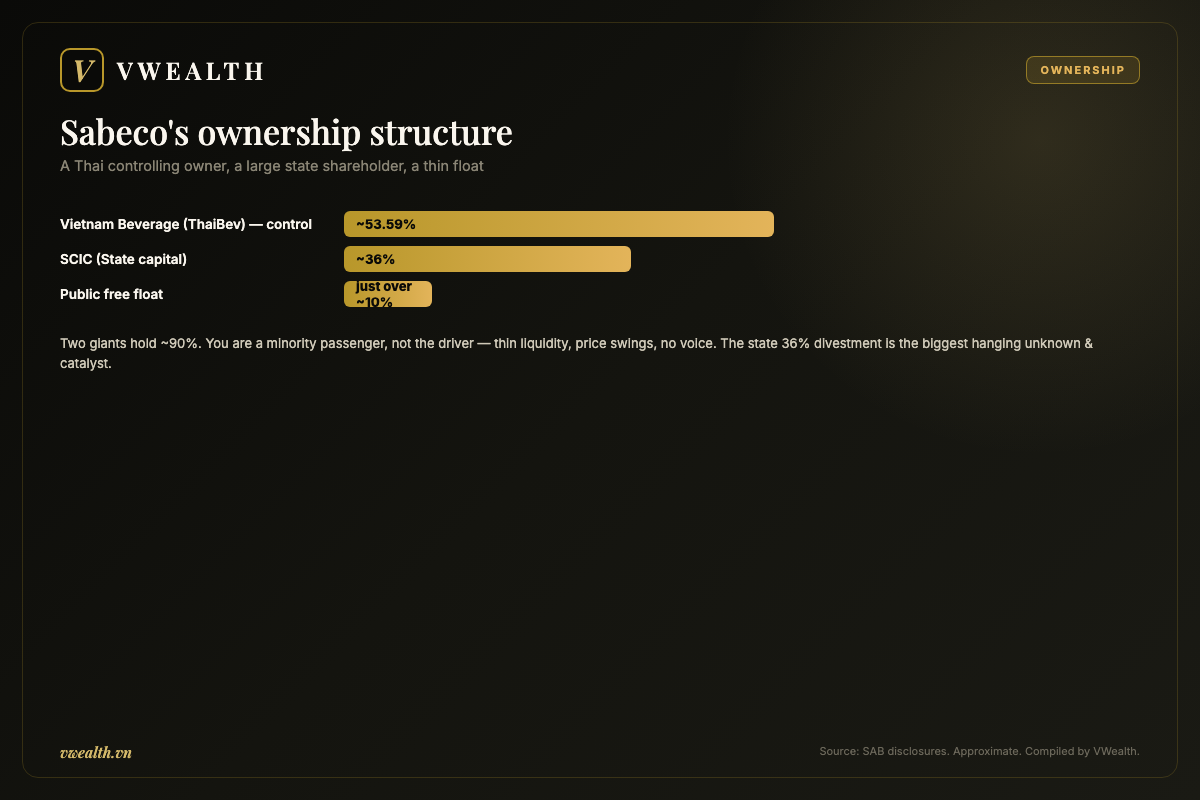
Added together, these two shareholders hold roughly 89–90% of Sabeco. What does that mean for you – an individual investor? It means the shares truly floating freely on the market (free float) amount to just over 10%. This is a very notable feature. A low free float creates several direct consequences:
First, SAB’s liquidity is usually not as high as other stocks of comparable market cap. When you want to buy or sell a large amount, you may have to accept a certain price spread. Second, the share price is prone to sharp swings around big news – because it takes only a relatively small amount of demand or supply to move the price level. Third, and most importantly, you – as a minority shareholder – have almost no voice in big decisions. Every shareholder-meeting resolution, every strategic direction, every dividend level… is decided by the two “giants.” You ride the same train, but you’re not the driver. So understanding the drivers’ intent – that is, ThaiBev and SCIC – is the key to your decision-making.
The man behind it all: billionaire Charoen Sirivadhanabhakdi
To understand what ThaiBev wants from Sabeco, you must understand the man behind ThaiBev. That’s Charoen Sirivadhanabhakdi – an ethnic-Chinese billionaire, one of Thailand’s richest. According to the Bloomberg Billionaires Index, his fortune is estimated in the range of $10–11 billion. Born in 1944, he is the founder of Thai Beverage and also chairman of large groups including TCC Group and Singapore’s Fraser and Neave (F&N).
Charoen’s empire isn’t just alcohol. TCC Group operates in five main areas: food and beverage, industry and trade, finance and insurance, agriculture and agro-processing, and real estate. The Sirivadhanabhakdi family is described as Thailand’s largest property developer and “landlord,” owning hundreds of thousands of hectares of land plus many commercial buildings in Singapore. In beverages alone, ThaiBev is Thailand’s largest beverage producer, with revenue of around 333 billion baht (about $10 billion) in the fiscal year ending September 2025.
So why would such a man spend nearly $5 billion to buy Sabeco? The answer lies in the strategic ambition ThaiBev has openly pursued for years, often called the “Vision 2020” vision and then a succession of long-term goals: to make ThaiBev the number-one stable and sustainable beverage company in the ASEAN region. And in that ASEAN picture, Vietnam is too attractive a piece – a nation of nearly a hundred million people, a young population, among the highest beer consumption in the region. And Sabeco leads market share in Vietnam’s mainstream beer segment. For ThaiBev, acquiring Sabeco wasn’t a single financial trade but planting a strategic flag right in one of Southeast Asia’s largest and most dynamic beer markets. ThaiBev’s own CEO once called Sabeco a “crown jewel” – a phrasing that shows they see it as a long-term asset, not something to trade in and out of.
A detail worth noting: in May 2025, the Charoen family formally announced a power handover, dividing the empire’s shares among five children. This signals that ThaiBev and related assets – including Sabeco – are being positioned as a long-term family legacy, further reinforcing the view that the Thais will stick with Sabeco for decades to come, not in a “buy then sell” mindset.
Leadership: a Thai-and-Singaporean brass takes over
After taking control, ThaiBev gradually changed Sabeco’s top leadership toward internationalization. This is understandable: they spent nearly $5 billion and naturally wanted their own people in place to reshape the business to multinational-group governance standards.
In the Chairman seat is Koh Poh Tiong, a highly respected figure in the regional beer industry. Per disclosures, he was born in 1946, a veteran Singaporean businessman. The media dubbed him “Mr Tiger” – because he spent 26 years with the Fraser & Neave (F&N) group and its Asia Pacific Breweries (APB) unit, serving as APB’s CEO for about 15 years, and was the architect who turned Tiger Beer into a symbol of Singapore while expanding APB from a few plants into a system with stakes in dozens of breweries across many countries. Having such a seasoned regional beer-brand builder sit as Sabeco’s Chairman says a lot: ThaiBev didn’t put in a pure financier, but a man who understands the beer trade deeply, who knows how to turn a local brand into a regional one. This is a governance-capability plus you should assess positively. Note that F&N is also a group in Charoen’s hands, so Koh’s presence reflects the tight connection between Sabeco and the Thai billionaire’s ecosystem.
In the executive seat – CEO – Sabeco made a notable change in 2023. Per disclosures, from 1 October 2023 Sabeco’s board dismissed Neo Gim Siong Bennett (who had held the CEO seat since mid-2018) and appointed Tan Teck Chuan Lester (commonly Lester Tan) as CEO and legal representative. Lester Tan is also a Singaporean citizen, with bachelor’s and master’s degrees in the US, and notably over 25 years of experience in brewing across markets such as Thailand, Myanmar, Mongolia and Singapore; before coming to Sabeco he oversaw ThaiBev’s beer business in the Thai market. So both Sabeco’s Chairman and CEO seats are now held by foreigners closely tied to ThaiBev.
This has a two-sided meaning for you. The positive: you’re investing in a business run by people with international expertise, methodical governance, and particularly strong marketing – a field the Thais are famous for doing very well. Post-acquisition, Sabeco pushed hard to restructure its distribution system, professionalize branding, invest in R&D and launch new product lines, while trimming costs to improve margins. The cautionary side: the business’s direction now serves ThaiBev’s strategy first. You need to believe that the interests of the controlling shareholder and those of minority shareholders like you are aligned – and fortunately, on dividends, those two interests currently overlap quite tightly.
Latent conflict between ThaiBev and SCIC – the 36% unknown
This is the part I want you to read very slowly. The parallel existence of ThaiBev (53.59%) and SCIC (36%) inside the same business creates a very peculiar balance of power, and a latent conflict of interest that few stocks on the exchange have.
ThaiBev runs it, controlling the board and the machine. But SCIC, with 36%, holds a large enough stake to have veto power over some of the most important resolutions under Vietnamese enterprise law (matters requiring a high approval threshold). In other words, ThaiBev can’t “do whatever it likes.” They must factor in the state’s vote. This is both a layer of protection for small shareholders (an extra watchdog) and a source of potential friction. The two sides could disagree on strategy, on reinvestment versus dividend payout, on transactions with ThaiBev’s related parties, or on the use of Sabeco’s “cash mountain.”
But the biggest unknown, and also the biggest catalyst for the SAB price, is the question: when will SCIC divest the remaining 36%? In terms of policy, the state’s stake in Sabeco is in the divestment queue – the state has no need to hold a controlling stake in a beer producer. ThaiBev openly wants SCIC to sell this 36%; if it could buy it, it would raise its ownership to an absolute level and gain full authority over Sabeco. In practice, however, this divestment has not happened for years. In SCIC’s recent divestment lists, Sabeco has not appeared; instead, SCIC keeps holding and enjoying the very large dividend flow from the business.
For you, this 36% unknown is a double-edged sword. In the positive scenario, if SCIC proceeds with divestment, it could be an event that “wakes up” the share price: liquidity rises, free float rises, and if there’s competitive bidding (ThaiBev and other investors), the auction price could be pushed high, creating a positive re-rating effect. In the negative scenario, prolonged delay turns this story into a promise forever unfulfilled, discouraging investors waiting on the catalyst. And remember: valuing Sabeco for a divestment is far from simple, because the historical reference price (ThaiBev’s 2017 buy price) is very high versus current levels. That’s why divestment is both politically sensitive and technically complex to value.
Financial governance and the “cash mountain” – why shareholders benefit
Now I’ll show you the brightest point in Sabeco’s governance story, the thing that makes many investors view SAB as a good defensive, dividend-generating stock. It’s how Sabeco manages an extremely solid balance sheet and is generous with shareholders.
Sabeco has almost no meaningful borrowings, and more importantly, the business sits on a colossal “cash mountain.” Per published financial reports, at the end of 2024 Sabeco’s total assets were around 33,400 billion dong, of which cash and bank deposits reached over 21,000 billion dong – making up most of total assets. Bank deposits alone were at times recorded around 19,000–22,000 billion dong. This idle cash is placed in banks to earn interest, and the deposit interest it brings is considerable: at one stage Sabeco was recorded taking in about 2.7 billion dong of interest a day, contributing significantly to overall profit. In other words, even when the beer business struggles (for instance during the Decree 100 crackdown that stalled beer consumption), Sabeco still has a huge financial “cushion” that keeps the business standing and continues to profit from its own cash flow.
And here’s what matters for your wallet: because it owns a cash mountain and has little need for big investment, Sabeco has a policy of high, regular cash dividends. Over the years, the cash dividend has typically ranged around 35–50% of par (i.e. 3,500–5,000 dong a share). For fiscal 2024 alone, Sabeco paid a total of up to 50% of par in cash (in several advance installments), i.e. 5,000 dong per share. For investors who like stable cash flow, this is a big plus – you get real cash, regularly, from an industry leader.
| Financial-governance metric | At Sabeco | Meaning for shareholders |
|---|---|---|
| Cash & bank deposits (end-2024) | Over 21,000 billion dong | A safety cushion, low bankruptcy risk |
| Borrowings | Almost negligible | Very healthy financial condition |
| Deposit interest | At times ~2.7 billion dong/day | A stable side income, cushions beer downturns |
| Cash dividend (2024) | 50% of par (5,000 dong/share) | Real cash, regularly, into shareholders’ hands |
However, there’s a two-way angle a responsible analyst must tell you. Sabeco keeping so much cash in bank deposits – rather than using it to expand production, do M&A, or invest for stronger growth – is also a question mark over capital efficiency. Some will argue that money “sitting still” earning bank interest isn’t the optimal way to create long-term value. On the other hand, this cash-hoarding and high-dividend policy fits the interests of both large shareholders very well: ThaiBev needs the dividend flow to offset its nearly $5 billion investment and partly repay the debt from the takeover, while SCIC also benefits directly from dividends to the budget. That’s why you see both “giants” agreeing with Sabeco’s generous payouts. In the roughly 8 years since the takeover, the dividends the Thai billionaire’s group alone received from Sabeco have reached close to 15,500 billion dong – very clear evidence of how large and steady the dividend flow at this business is.
In sum: how should you view SAB’s ownership?
Wrapped up, Sabeco’s ownership and leadership paint a very special portrait. You’re looking at a leader of Vietnam’s beer industry, run by seasoned international executives from ThaiBev – the group of billionaire Charoen Sirivadhanabhakdi – with among the best governance and brand-building capabilities in the region. You benefit from an extremely strong balance sheet, almost debt-free, sitting on a cash mountain of more than 21,000 billion dong, and one of the highest, steadiest cash-dividend policies on the exchange.
But in return, you must accept three things: first, you’re a minority shareholder in a business whose decision-making rests entirely with two “giants”; second, the low free float makes liquidity limited and the price prone to swings; third, the SCIC-36%-divestment story is a big unknown – it could be an alluring re-rating trigger, but also a promise dragging on year after year. Understanding this map of power, you’ll be far more confident stepping into the next section, where we dissect what makes up Sabeco’s core value: products and brand – the Bia Saigon and 333 legacy and the brutal market-share war with Heineken on the Vietnamese drinking table.
Products, brand and ecosystem
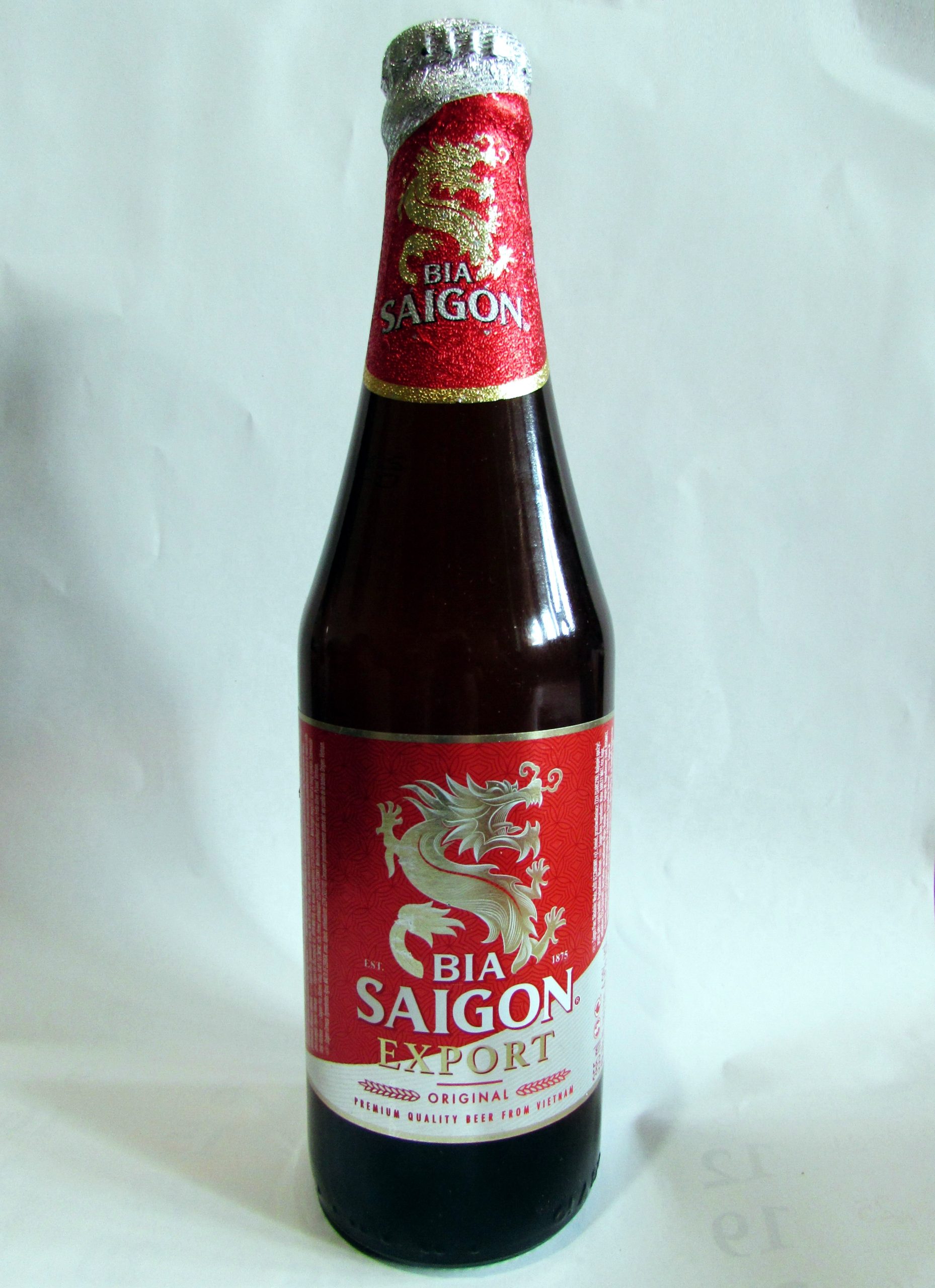
When you ask “what really holds a business’s position in a declining industry?”, then for the Saigon Beer – Alcohol – Beverage Corporation (Sabeco, ticker SAB), the answer isn’t on the balance sheet but in something far harder to quantify: the familiar green bottle set on drinking tables from Ca Mau to Hanoi, the fiery-red “three-number” can at country weddings, and the name “Bia Saigon” imprinted into the memory of four or five generations of Vietnamese. In 2025, Sabeco booked net revenue of 25,888 billion dong – the lowest in over a decade, down about 20% year on year as Vietnamese “drank less” under the pressure of Decree 168 on alcohol levels and a tough economy. But the paradox worth pausing on: after-tax profit actually inched up nearly 2% to 4,573 billion dong, the highest in three years. Volume fell but earnings didn’t – that’s the first proof of how Sabeco’s brand, distribution and premiumization “machine” is carrying the business through the downcycle. This section dissects that very machine.
Beer remains Sabeco’s heart, contributing about 93% of total revenue; the rest comes from soft drinks, alcohol and raw materials. With over 40% of national beer volume share, Sabeco is the absolute leader in Vietnam’s beer market – a number-one position both Heineken and Habeco must look up to. To understand why this position is hard to shake, let’s go through each layer of the ecosystem.
The brand portfolio: from national mass-market to premium ambition
What’s interesting when you look at Sabeco’s beer shelf is that it isn’t one product, but a whole “brand architecture” deliberately layered, covering everything from the most affordable segment up to the near-premium. Each name solves its own problem, targets its own wallet, its own drinking occasion. This isn’t wasteful duplication but a “cover the whole shelf” strategy so that whichever bottle a consumer picks up, the money flows back to Sabeco.
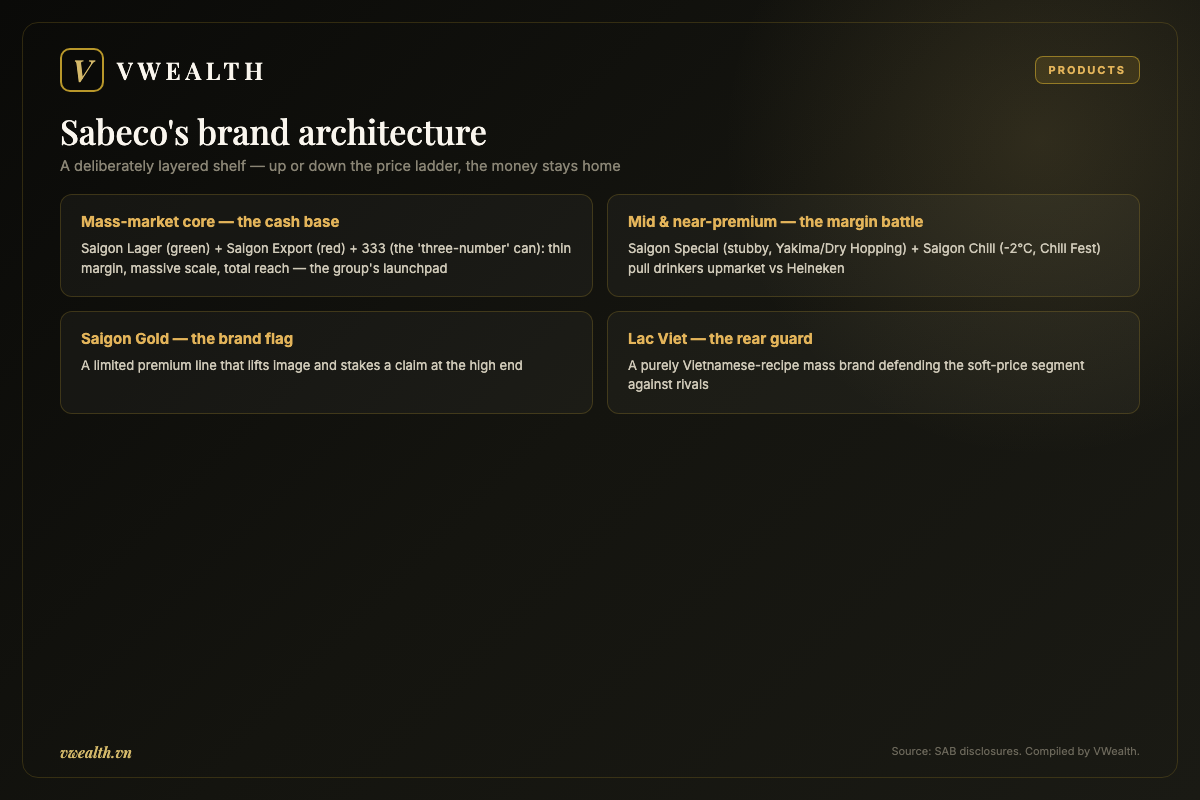
At the mass-market core – where most of the volume comes from – is the classic trio. Bia Saigon Lager (the traditional green bottle) and Bia Saigon Export (the “Saigon red” bottle) are the workhorses of sales, tied to affordable drinking, roadside eateries, feasts. 333 beer – the “three-number” can – is the icon of mass canned beer, present in every grocery fridge, a name almost every grown Vietnamese has held. This is the foundation layer: the margin per can isn’t as high as premium goods, but the massive scale and total reach make it a stable cash flow, a financial “launchpad” for the whole group.
In the mid and near-premium tiers – where the real margin battle happens – Sabeco deploys newer, sharper cards. Bia Saigon Special (the stubby bottle) is positioned as a “with taste” choice, relaunched with a new formula, packaging and positioning to compete head-on in the mid segment. Saigon Chill – launched to strike straight at young, urban “drink-it-cold” consumers – is the clearest premiumization spearhead, taking on international labels. Saigon Gold pushes even higher into the premium segment in limited quantities, playing a “brand flag” role that lifts the image. And Bia Lac Viet – a mass brand launched in recent years – carries strong Vietnamese identity, created from the recipe of Vietnamese master brewers, aimed straight at domestic consumers while filling the competitive gap in the soft-price segment against rivals.
Picture Sabeco’s portfolio as a multi-layered front: 333 and Saigon Export hold the mass customer, Special and Chill pull them upmarket, Gold guards brand prestige, and Lac Viet defends the rear at the cheap end. Whether the consumer moves up or down the price ladder, the money stays in the house.
The through-line behind this architecture is premiumization – and it’s the key to understanding the “revenue down, profit up” paradox of 2025. When total industry volume shrank due to Decree 168 and weak purchasing power, the survival path wasn’t selling more cans, but selling each can at higher value and thicker margin. Sabeco pushed the Special, Chill and Gold lines – products that let it raise the average selling price and improve the gross margin. Over the past 5 years, Bia Saigon has introduced 5 product upgrades targeting different segments, and several lines have won Gold–Silver medals from international bodies like the Beverage Testing Institute (US), a quality “stamp” that helps Sabeco tell its premiumization story convincingly rather than just slapping on a high price. This shift in product mix, plus tight cost control and a 5% cut in per-liter delivery cost in 2025, is why profit still rose even as volume fell.
“Bia Saigon” – the national brand and the emotional “moat”
If you’re an investor hunting for Sabeco’s most durable “economic moat,” don’t look at the line or the technology – look at the very name “Bia Saigon.” This is a legacy stretching 150 years. Its origin traces back to a small brewery set up by French capitalist Victor Larue in 1875 in Saigon, along with the distinctive southern habit of “drinking beer with ice.” Through the historical eras – from the Bia Saigon Plant in 1977, to the Bia Saigon Company in 1993, to today’s Sabeco Corporation – this brand has accompanied Vietnamese across many generations, through war, reform and integration.
Why does this matter to your wallet? Because a 150-year-old brand, voluntarily called by the public the “national beer,” long on the National Brand list, creates a kind of advantage money can’t buy in the short term: emotional loyalty and default familiarity. At the Vietnamese drinking table, ordering “a crate of Saigon” is a reflex, not a deliberated choice. That familiarity is an invisible entry barrier – a newcomer wanting share must not only build a plant, but change a habit rooted deep in culinary culture. That’s the emotional “moat”: it doesn’t appear in financial statements, but it’s why the 40%-plus share isn’t easily eroded despite fierce competition. Campaigns like the 150-year commemorative collection in 2025 are precisely the investment to “recharge” this emotional value, tying the brand to Vietnamese pride – a shrewd defensive move in a shrinking market.
Production and distribution: scale as a cost weapon
The third layer of advantage – and the most tangible – lies in Sabeco’s colossal physical scale. Picture a network spread across the country: around 26 breweries (including subsidiaries and affiliates) distributed from north to south, with a system of up to 44 subsidiaries and affiliates, dozens of regional trading companies, and total design capacity in the billions of liters of beer per year. The distribution network covers more than 145,000 points of sale nationwide, reaching every eatery, every grocery, every commune-level dealer.
This scale isn’t just “for show” – it’s a real cost advantage, and an almost insurmountable entry barrier. There are three mechanisms you need to grasp:
- Regional logistics optimization: plants dispersed across the country let Sabeco produce near consumption, cutting the cost and time of transporting beer – a heavy, bulky good with low value per kilogram. In 2025, the rate of direct delivery to distributors reached 89% and the per-liter delivery cost fell 5% – small numbers, but multiplied across billions of liters they become huge savings flowing straight into profit.
- Input bargaining power: buying materials at market-leader scale gives Sabeco better prices than any smaller rival.
- Distribution barrier: a new brand may brew good beer, but getting it to over 145,000 points of sale and keeping shelf space there takes decades and resources very few businesses have. The distribution network is the second “moat” alongside the brand.
It’s the combination of the national brand and the deep, wide distribution network that creates a compounding effect: consumers want to buy Bia Saigon, and everywhere they can. A rival wanting to compete must break both defensive layers simultaneously.
A weakness to note: dependence on imported materials
As an honest analyst, I must show you the downside of this machine. Sabeco has a clear “Achilles’ heel”: heavy dependence on imported materials. The core inputs to brew beer – malt (barley), hops (houblon) – must almost all be imported from Europe, Australia and the US, because Vietnam lacks suitable growing conditions. The main packaging, the aluminum can, is also directly affected by world aluminum prices.
This creates two layers of risk you must track closely. First, commodity-price risk: when malt, hops or aluminum prices on the international market spike (as happened during bouts of global commodity inflation), Sabeco’s gross margin is directly eroded. Second, FX risk: because imports are paid in foreign currency while revenue is collected in dong, each time the dong depreciates against the USD or EUR, input costs in dong swell. Sabeco has actively hedged by buying materials forward in 3-, 6-, 9- or 12-month terms to smooth the volatility – a good risk-management practice, but it only delays rather than eliminates the underlying risk. When assessing future margins, never forget this “imported input price” variable.
Other segments and the wider ecosystem picture
Beyond beer, Sabeco also holds several supporting segments that, though small in revenue, help close the value chain. Notable is the Chuong Duong soft drinks segment – the long-standing carbonated soft-drink brand (the familiar Chuong Duong sarsi) in which Sabeco holds a controlling stake, giving the group a foothold in non-alcoholic beverages. Alongside are the packaging (producing cans, bottles, crates mainly for internal needs) and small-scale transport and trading segments. These aren’t growth engines, but they help Sabeco better control the supply chain and reduce third-party dependence at key steps.
M&A and restructuring under ThaiBev: gathering into one
Since ThaiBev (via Vietnam Beverage) became the controlling shareholder in 2017, one big through-line has been restructuring and acquiring subsidiaries to clean up the tangled ownership structure inherited from state-enterprise days. The most notable M&A move was the deal with Sabibeco Group: Sabeco progressively made a public tender, raised ownership to about 59.6%, and formally turned Sabibeco into a subsidiary at the end of 2024. This deal wasn’t just a financial move – it added 6 plants with capacity of about 610 million liters/year, lifting Sabeco’s total capacity above 3 billion liters of beer per year (up about 25%), firmly cementing its position as the country’s largest brewer. Notably, Sabibeco is where many of Sabeco’s beer lines are made, so bringing it in as a subsidiary gathers the entire production–trading–brand chain into one head, removing complex internal transactions and retaining full profit rather than sharing it with an affiliate.
Along the same logic, Sabeco has also progressively raised its ownership and consolidated member units such as the Bia Saigon Song Lam group and other regional beer companies. ThaiBev’s philosophy is very clear: turn a once-fragmented group into a lean entity, controlled directly from plant to distributor, optimizing tax and consolidated profit. For you, the investor, this is a positive governance signal – a leaner, more transparent machine usually runs more efficiently and is easier to value.
To close: a defensive trio against the industry’s decline
Now let’s put it all together to see the big picture. Vietnam’s beer industry in 2025 faced a twin shock: Decree 168 tightening alcohol levels changed drinking behavior, plus weakened purchasing power – shrinking total demand and dropping Sabeco’s revenue to an 11-year low. In that context, three layers of soft and hard assets combined to carry the business: the 150-year national brand retaining loyal customers and defending the 40%-plus share; the huge production–distribution network creating a cost advantage, cutting logistics costs and protecting margins; and the premiumization strategy lifting the value per can to offset falling volume. The result is the beautiful paradox we saw at the start: revenue down 20% but profit still rising to a three-year high.
In other words, Sabeco didn’t grow by selling more beer in a shrinking market, but by selling smarter: using the brand to avoid a price war, using scale to lower costs, and shifting the portfolio upmarket to thicken margins. That’s how an industry leader defends through the bottom of a cycle. Of course, this machine still has its vulnerabilities – the dependence on imported materials and FX risk always lurk over margins. Whether these structural advantages are enough to translate into a solid balance sheet and safe financial health for investors, we’ll dissect in the next section: Position and financial health.
Position and financial health
When you open Sabeco’s 2025 financial report, you’ll meet a paradox that makes any veteran analyst pause. Net revenue fell to 25,888 billion dong, down nearly 19% year on year – the lowest in 11 years, i.e. back to the trough of an entire decade. Yet on the bottom line of the income statement, after-tax profit still edged up to 4,573 billion dong, up about 2%. A business that lost nearly a fifth of its revenue but still earned more profit than the year before – that’s not common, and it’s the door to understanding what kind of asset Sabeco really is.
This section isn’t meant to convince you to buy or sell. The goal is to peel back each layer: Sabeco’s position in the beer industry, why profit can move against revenue, what the “cash fortress” of over 20,000 billion dong says about both the health and the weakness of the business, and which core risk no accounting trick can hide forever. Once you understand these layers fully, you’ll have enough to judge why the market reacts to SAB the way it does.
The #1 position in beer: scale and brand are real assets
Before turning to the tricky numbers, you need a firm grasp of one fundamental: Sabeco isn’t a small business struggling to survive. It’s one of the two pillars dominating Vietnam’s beer market, with a brand portfolio almost every Vietnamese adult knows – Bia Saigon (Saigon Lager, Saigon Special, Saigon Chill, Saigon Export) and 333. In the mass and popular-price segment, Sabeco remains the dominant name, with a share the company positions above 40% – a figure very few consumer-goods companies in Vietnam ever reach.
Why does scale matter so much? In beer, advantage comes from three things compounding: a distribution network covering city to countryside, brand strength built over decades, and production efficiency from running a large-scale plant system. A new beer brand almost cannot squeeze onto the Vietnamese drinking table lacking any one of those. Sabeco has all three. This is what’s called the “economic moat” – the invisible wall that lets a business keep customers and profit against competitive pressure.
However, you also need a balanced view. Sabeco’s lead isn’t as absolute as a decade ago. Over recent years, Heineken Vietnam has risen strongly in the premium segment and, at times, surpassed Sabeco on some value-based share metrics. The most accurate picture now is a “two-horse race”: Sabeco and Heineken together control about 80% of the market, each strong in a different segment – Sabeco in the mass, popular-price line, Heineken in the premium. Sabeco’s position is real and very large, but it’s the position of a leader that must constantly defend, not a complacent monopolist.
The “revenue down but profit up” paradox: what happened?
This is the most core part for understanding the quality of Sabeco’s profit. When revenue falls 19% but profit still rises, three forces are working at once – and separating them matters more than you think, because each has a different durability.
Force one – gross margin improving strongly thanks to cooling material costs. This is the largest and most positive driver. Sabeco’s full-year 2025 gross margin jumped to about 35.9%, versus just 29.2% in 2024. In Q4 2025 alone, the gross margin reached nearly 37.9% versus 28% the same period a year earlier. The main cause is that the core input prices – especially malt and the rice used in brewing – cooled markedly after a hot phase, plus the company improved material-use efficiency. In other words, each dong of beer revenue in 2025 generated far more profit than the year before. This is an improvement in operating quality – genuinely good news.
Force two – the portfolio’s premiumization trend. Even as total volume fell, the sales mix gradually shifted toward higher-value product lines (like Saigon Chill, Saigon Special), lifting the average selling price and margin per liter of beer. When consumers drink less but tend to choose better products, the business can offset part of the volume loss with value.
Force three – and this is the part you must scrutinize – the huge bank-deposit interest. In 2025, Sabeco took in up to 995 billion dong of deposit interest, about 2.7 billion dong a day. To picture the gap: while collecting nearly 1,000 billion in interest, the company paid only a mere 34 billion-plus dong of interest expense – i.e. interest received was about 29 times interest paid. That 995 billion is pure financial profit, not from selling one extra bottle of beer.
The key point on profit quality: of 4,573 billion dong of after-tax profit, nearly 1,000 billion – about a fifth – comes from bank-deposit interest rather than the core business of selling beer. When you value SAB as a beer stock, you need to be aware that a significant part of the profit “engine” is actually running on idle cash parked in the bank.
So how to judge this fairly? The first two forces (gross margin and premiumization) are genuine improvements in business quality, but they have limits – material prices won’t fall forever, and at some point the low-base comparison effect will end. The third force (deposit interest) is more durable in cash-flow terms but is itself a sign of another problem we’ll discuss right after. In short: Sabeco’s 2025 profit rise is real, but it’s propped up by factors that can’t repeat infinitely, and doesn’t reflect the beer business getting healthier.
The “cash fortress”: defensive strength or a dead cash mountain?
Now to the most striking feature on Sabeco’s balance sheet. As of end-2025, the company’s total cash, cash equivalents and bank deposits reached about 20,976 billion dong – over 64% of total assets (about 32,597 billion dong). More importantly, Sabeco has almost no meaningful borrowings: total financial debt is only about 435 billion dong, roughly 1.3% of total capital. Equity is around 23,000 billion dong.
This means Sabeco holds nearly 21,000 billion dong of net cash – a financial “fortress” in the literal sense. Picture it: this business could sit still without selling a single extra bottle of beer for years and still not fear insolvency. This is an extremely thick defensive cushion, letting Sabeco weather every industry shock – from Decree 100 to the pandemic – without ever worrying about liquidity.
This cash fortress creates three very real benefits:
- A sustainable high-dividend base. With the cash mountain and stable operating cash flow, Sabeco maintains a high cash-dividend policy – proposing 50% of par for 2025, the second straight year at this level. This is precisely why many investors view SAB as a “defensive” stock, held to earn steady dividends.
- Crisis resilience. When the industry turns down, a debt-free business with a cash mountain survives easily, and may even take share from weaker rivals.
- Room for strategic action. The large cash lets Sabeco proactively invest, do M&A, or raise dividends at any time without borrowing.
But – and this is the “but” a straightforward analyst mustn’t skip – that huge cash mountain is also a weakness. When nearly two-thirds of a company’s assets sit idle in a bank account earning deposit interest (usually just a few percent a year), that’s capital not used efficiently. In finance, this is called “cash drag”: it pulls down the return on equity (ROE). A dong of capital that should be used to expand plants, build the brand, or acquire businesses to generate double-digit returns is instead only earning single-digit savings interest. Sabeco’s ROE is therefore diluted – not reflecting the true earning power of the beer business, which has a much higher margin and capital efficiency.
The question every shareholder – and every investor weighing SAB – must ask is: what does Sabeco intend to do with this cash mountain? After deducting dividends payable (over 2,611 billion dong) and working-capital needs, the business still has over 17,000 billion dong of idle cash left. That enormous sum has three plausible paths:
- Expansion/upgrade investment: pour into plants, technology, the distribution system, or ramp up marketing to win back share in the premium segment where Heineken has the edge.
- M&A: use the cash to acquire other businesses in or beyond the industry to diversify revenue and reduce dependence on beer alone.
- Special dividend / share buyback: return the surplus straight to shareholders if management can’t find attractive-enough investment opportunities.
So far, Sabeco has mostly chosen to “let the cash sit and earn interest,” and this is what makes many investors impatient. A cash fortress is strength when markets are volatile, but if it drags on too long without a clear capital-allocation strategy, it becomes a brake on share-price appreciation. You should watch management’s moves here closely – it may be the biggest catalyst for SAB in the years ahead, in either direction.
2025 financial-health metrics
To give you a consolidated picture, below are the core numbers reflecting Sabeco’s financial health in 2025 – set side by side so you clearly see both the strength and the paradox.
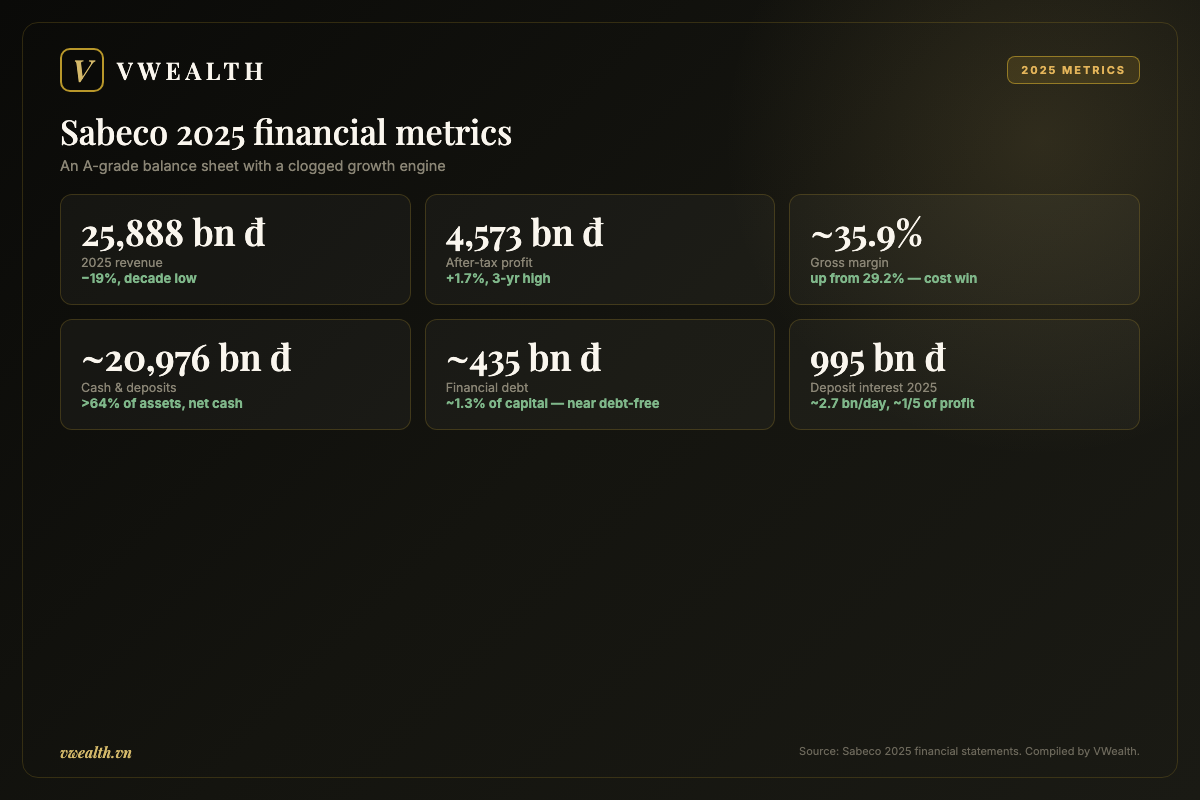
The two most notable figures in this table are the gross margin of around 30%-plus – very high for a consumer-goods business, showing the pricing power of the Bia Saigon brand – and the cash ratio of over 64% of total assets, evidence of both safety and the idle-capital condition we just analyzed. This is a rare “clean” balance sheet: high profit, no debt, ample cash. Sabeco’s problem doesn’t lie in financial health – it’s healthy almost absolutely. The problem lies in growth prospects, which we’ll dissect right below.
The core problem: structural decline in consumption volume
By now you’ve seen a Sabeco with a healthier margin, a huge cash mountain, no debt. If we stopped there, SAB would look like a perfect defensive stock. But an honest analyst must point out the “elephant in the room” – the biggest problem no accounting trick or cost-cutting can hide forever: beer consumption volume is declining structurally, not fluctuating short-term.
Look at the root. The 2025 revenue hitting an 11-year low isn’t due to one unlucky business season, but to three forces compounding to reshape Vietnam’s whole beer industry:
- Decree 100 on alcohol levels. This is the hardest blow. Since drink-driving penalties were tightened (from 2020), the habit of drinking beer at eateries – Sabeco’s key consumption channel – has fundamentally changed. Per industry estimates, Sabeco’s beer sales volume fell by over 30% in the 2019–2023 period. This isn’t a temporary effect but a durable social-behavior change: Vietnamese now think very carefully before drinking if they have to drive.
- The special consumption tax roadmap. The tax rate on beer is on a multi-year rising path – up to 65% from 2026 and continuing to rise in later years, heading toward 90% early next decade. Each tax hike pushes selling prices up, more or less eroding purchasing power and slowing volume growth in the first 2–3 years after each adjustment.
- Health trends and lifestyle change. Consumers, especially the urban young generation, care ever more about health and tend to cut alcohol consumption. This is a long-term trend playing out globally, not just in Vietnam.
Why is this a more serious risk than it looks? Because over the past two years, Sabeco has kept its profit mainly by cutting costs and benefiting from cheap material prices – i.e. optimizing the cost side. But cost optimization has a physical limit: you can’t keep cutting forever, and material prices will cycle back up. Meanwhile, if volume – the revenue foundation – keeps being eroded by the structural forces above, then at some point cost-cutting will no longer be enough to offset it. A business cannot shrink its way to prosperity; sustainable growth must ultimately come from selling more, not spending less.
To be balanced: the picture isn’t entirely bleak. Beer-industry history shows that after each tax or policy shock, volume usually slows for a few years then recovers as the market adapts. With its lead in the mass segment and deep pockets, Sabeco is fully capable of regaining share when smaller rivals can’t withstand the tax pressure. Some forecasts suggest beer consumption may recover slightly in coming years and Sabeco’s profit will rise again. The only issue is that the “new normal” consumption level of Vietnam’s beer industry is likely to be lower than the old pre-Decree-100 peak – and that’s a reality every SAB valuation needs to reflect.
To sum up the picture: you’re looking at a business with an A-grade balance sheet – leading the mass-segment share, a high gross margin around 30%, nearly 21,000 billion of net cash, no debt, a sustainable high dividend – but wrestling with a clogged growth engine: beer consumption volume declining for structural reasons hard to reverse in the short term. Sabeco’s financial health has almost nothing to fault; the real question is where the business will find growth again, and what it will do with that 17,000-billion cash mountain. It’s precisely this tug-of-war between “a solid financial fortress” and “hazy growth prospects” that decides how the market values SAB – and that’s exactly what we’ll analyze in the next section: Market reception.
Market reception
If you look at the board on 19 June 2026 and see SAB flat at around 48,150 dong, your first reaction is probably a frown. This is the stock of Sabeco – Vietnam’s number-one brewer, the Bia Saigon and 333 brands nearly every Vietnamese has held. Yet its market price today is only about one-seventh of the all-time high of 334,500 dong set on 29 November 2017. An industry leader, still earning over 4,500 billion dong of profit a year, valued by the market like a has-been stock. The question you need to answer isn’t “why did it fall” – that’s clear – but: at this price, is SAB a forgotten bargain, or a value trap of a declining industry?
How the market has received SAB over the years is a vivid lesson in how a growth story can flip into an income story. This section dissects three layers: how the market values SAB today, the biggest highlight that keeps the stock attractive – the huge cash-dividend flow, and the unknowns that could change the game, like the SCIC divestment story.
From growth star to income stock: a legend’s fall
To understand the 48,150-dong price today, you need to go back to late 2017 – when SAB was the hottest focus of Vietnam’s stock market. That’s when ThaiBev, the group of Thai billionaire Charoen Sirivadhanabhakdi, through the Vietnam Beverage entity, spent about 110,000 billion dong (nearly $5 billion) to buy 53.59% of Sabeco at 320,000 dong a share. That price reflected a P/E of up to 30-40x – a number reserved for businesses with sustainable double-digit growth. The market then believed Vietnam’s middle class was ballooning, per-capita beer consumption would keep rising strongly, and Sabeco with its dominant share would be the biggest beneficiary.
Then everything reversed. Early 2020, Decree 100/2019/ND-CP took effect, tightening sanctions on drink-driving with very heavy fines. Almost overnight, the Vietnamese “after-work drinks” culture was changed at its root. Right after came the COVID-19 pandemic, shutting the entire restaurant-and-eatery channel – the largest beer-consumption channel. Total beer-industry revenue at one point slid from over 55,000 billion to around 45,000 billion dong. And as if that weren’t enough, the special-consumption-tax roadmap for alcohol hung overhead, threatening to erode margins for years to come.
The result was one of the longest, most painful declines a Vietnamese blue chip has ever endured. SAB fell from the three-hundred-thousand-dong peak (pre-adjustment), through the 180,000, then 130,000 marks, then broke even the trough many analysts once thought impossible, down to around 48,000 dong as it is now. The market no longer values SAB as a growth story. It has been “re-categorized” – from a growth stock to a value/income stock. And that re-categorization is the key to understanding all the valuation numbers below.
When a stock falls from a P/E of 35x to 13x, it’s not because the business worsened proportionally – Sabeco’s profit today is still on par with its peak – but because the market completely changed its growth expectations. You are not buying the same stock the 2017 investor bought. You’re buying an entirely different story.
Valuation today: P/E 13-14x, cheap or a trap?
Let’s put the numbers on the table. Sabeco’s 2025 after-tax profit was about 4,573 billion dong. With around 1.28 billion shares outstanding (this figure matches the announced dividend: a 30%-cash ratio equates to spending about 3,840 billion dong, which back-solves to exactly ~1.28 billion shares), EPS is around 3,500 dong a share. Dividing the 48,150-dong price by this EPS gives a P/E of about 13-14x.
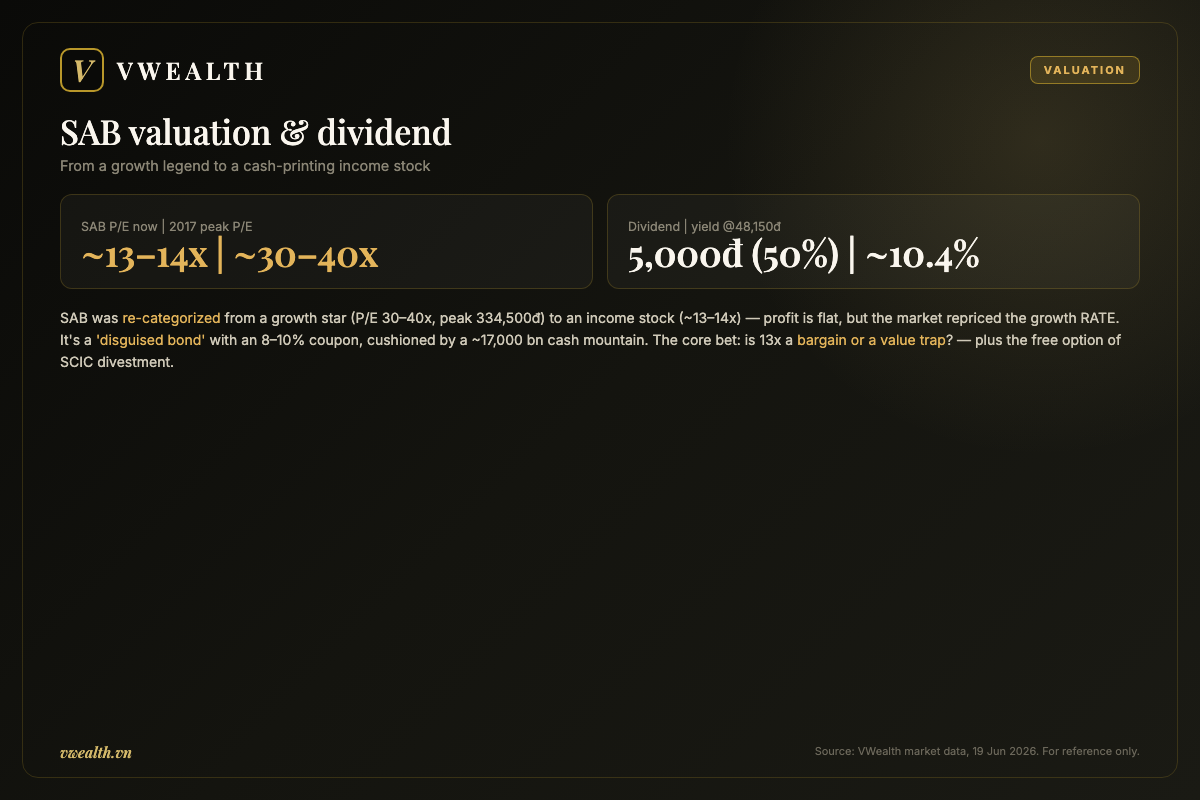
What does 13-14x say? In context: the VN-Index has often traded at a P/E around 13-15x, so SAB is no longer “expensive” versus the general market – something unthinkable a few years ago. Versus its own history, this is one of the cheapest valuation zones since listing. Some brokerages, updating their valuation models into late 2026, still set target prices around 59,000 dong, implying a fair P/E around 15x and some upside from current levels.
But this is where you need a clear head. A low P/E doesn’t automatically mean “cheap.” It’s only cheap if future profit is stable or rising. If profit keeps sliding – because the special consumption tax rises, because national beer volume falls, because young people drink less – then today’s 13x P/E could “swell” to 18-20x next year even if the price doesn’t change, and then it’s not cheap at all. That’s exactly the definition of a value trap: a stock that looks cheap on paper but whose intrinsic value erodes faster than the market realizes.
The optimists will argue: Sabeco still leads market share, has a high gross margin, the Bia Saigon brand is embedded in culture, and the company is actively restructuring its product portfolio, pushing premium to offset volume. The 2026 plan even targets profit around 4,835 billion dong – not declining but nudging up. The cautious will counter: EPS growth for 2024-2029 is forecast at only about 3%/year – nearly flat. A business with flat profit deserves a low P/E, and 13-14x may be the “right price” rather than a “bargain price.”
To sum up at this valuation layer: SAB isn’t expensive, but nor is it necessarily a quick-flip bargain. It’s a stock where, if you rely only on price gains, you’ll have to be very patient for a long time. Fortunately – and this is the most interesting part – SAB’s story isn’t only about price.
The biggest highlight: a “cash-printing” stock with a yield far above savings rates
If there’s only one reason for you to still keep an eye on SAB at this price, it’s the dividend. Sabeco is the classic example of an income stock in Vietnam – the kind of stock you buy not to wait for the price to double, but to receive each year a steady, large and reliable cash flow like a “premium” savings deposit.
Look at the payment history. In 2023, Sabeco paid a cash dividend of 35% of par (3,500 dong a share). In 2024 and 2025, the company raised it to 50% – i.e. 5,000 dong of cash per share, in two installments (usually a 20% advance first, 30% later). The recent 30% installment alone saw Sabeco spend over 3,840 billion dong. For the full year, the dividend cash the company pumped to shareholders reached over 6,400 billion dong. And the 2026 plan continues to maintain the 50% level.
Now the calculation every income investor cares about – the dividend yield. If Sabeco pays 5,000 dong a share, dividing by the 48,150-dong price gives a yield of about 10.4%. Even if the company pays only a “cautious” 3,500-4,000 dong, the yield still sits around 7-8.3%. This is a number worth pausing to ponder.
- 12-month bank savings rates are now commonly only around 5-6%/year.
- SAB’s dividend yield at the current price reaches 8-10%/year – and that’s real cash, already paid, not a promise.
- The 3-4 percentage-point gap each year, compounded over time, is a huge dual advantage.
In other words, at 48,150 dong, you can treat SAB like a “disguised corporate bond” with an 8-10%/year coupon – but with an added bonus if the share price recovers, and an added risk if profit falls and forces a dividend cut. What makes this dividend flow trustworthy is Sabeco’s cash mountain: the company’s balance sheet regularly holds over 17,000 billion dong of cash, equivalents and deposits. This is a huge cushion ensuring the company can maintain a high dividend even in tough business years – a luxury very few listed companies have.
For an investor prioritizing cash flow and safety over hot price gains, SAB at around 48,000 dong is one of the few stocks that combines an industry-leading brand, a cash-flush balance sheet, and a dividend yield one-and-a-half to two times the savings rate. That’s why it remains in the portfolios of many funds and long-term investors despite years of a deep price fall.
Game-changing unknowns: a special dividend and the SCIC divestment story
That 17,000-billion cash mountain isn’t just a defensive cushion – it’s also an offensive unknown. A business holding cash many times over operating needs always faces the question: saved for what? There are three possibilities. One is for M&A, expansion. Two is to keep holding. Three – the scenario shareholders most hope for – is to distribute part of it to shareholders as a special cash dividend. If part of this savings pile were distributed, the dividend yield that year could jump to a very high double-digit level, giving a strong psychological boost to the price. This is a “free option” you get on top when holding SAB.
The second unknown, and the biggest catalyst, is the state divestment story. Sabeco’s ownership is now very concentrated: Vietnam Beverage (ThaiBev) holds about 53.59%, and SCIC – representing state capital – holds about 36%. These two large shareholders together already hold nearly 90%. The direct consequence is a very low free float, making SAB’s daily liquidity thin, price moves sometimes not reflecting true supply and demand, and the stock hard for large money to be attracted to.
This is where the SCIC divestment story becomes interesting. The state divesting its 36% in Sabeco has long been in the divestment queue, and each time this news heats up, the stock draws attention again. If a divestment happens:
- Liquidity and free float improve – the freely tradable shares rise, opening the way for index funds and large money to participate.
- It could create a “price reference” – a large-scale divestment usually comes with a negotiated price that can become a new valuation anchor for the market.
- ThaiBev could raise its stake – if the Thai shareholder wants to accumulate more to firm up control, buying demand could push the price up.
Of course, this is a double-edged sword. Divestment could also create large supply pressure if the shares are sold into the open market, and the timing is always an unknown – this story has been raised for years without resolution. You shouldn’t buy SAB only to bet on divestment; treat it as a potential bonus added to the dividend thesis, not the main thesis.
To close: SAB is the sum of three pieces
So at 48,150 dong, how should you receive SAB? Wrap it into a clear formula to remember. Investing in SAB today is essentially betting simultaneously on three pieces:
- Piece one – a high, steady dividend flow: this is the most certain part, delivering an 8-10%/year yield thanks to the huge cash mountain, far above savings rates. This is the investment’s “safety floor.”
- Piece two – a bet that the beer industry doesn’t decline further: you don’t need the beer industry to boom again; you just need it not to get worse. If volume bottoms and goes sideways, today’s 13-14x P/E is cheap. If tax and consumption trends keep eroding profit, this is a value trap.
- Piece three – the SCIC-divestment and special-dividend unknown: this is the surprise bonus (the option) – if it happens, it could create a big re-rating; if not, you still keep the dividend.
In short: SAB is a high dividend + a bet the beer industry declines no further + the SCIC-divestment unknown. It isn’t a stock to expect to double your account in a year, but a stock to collect steady cash while waiting for one of those catalysts to take effect. Whether this price is the bottom of a cycle or just a rest stop on the way down – the answer lies in the health of Vietnam’s beer industry itself, which is exactly what we’ll dissect in the next section on the industry context.
Economic and industry context: when the whole boat is rowing against the current
Before you decide to put money into a stock, there’s a principle the most veteran investors know by heart: however good a business is, it’s hard to swim against the current if the whole river is flowing backward. Sabeco is the number-one giant of Vietnam’s beer industry, no one denies that. But the more important question isn’t “how strong is Sabeco?”, but “which way is the boat named Vietnam’s beer industry heading?” And this is the analysis you need to read most carefully, because it decides almost the entire investment thesis for SAB.
The harsh truth is that Vietnam’s beer industry is going through its hardest stretch in over a decade, and this isn’t a temporary stumble but a structural change. The telling number: total revenue of 14 listed beer companies in 2025 was about 44,117 billion dong, down 12% year on year. Sabeco alone had 2025 revenue of just about 25,888 billion dong, plunging 19% from 31,872 billion in 2024 – the lowest in over 11 years, even lower than the Covid-19 lockdown period of 2021. When an industry falls to a trough deeper than the era when the whole country was shut, you’re forced to ask: is this a cycle or a trend?
In my view, after years of following the consumer-goods group, this is the compounding of three structural headwinds, not merely temporary weak demand. Let’s peel back each layer.
Headwind one: Decree 100 – the blow that permanently changed drinking habits
If you had to pick one event that changed the game for Vietnam’s beer industry, it’s Decree 100/2019 on sanctioning drink-driving, effective from early 2020 and strictly enforced in recent years. You need to understand the cultural nature of beer consumption in Vietnam: most beer is consumed at eateries and restaurants – the channel professionals call “on-trade.” This is where people drink by the table, in groups, “bottoms up” glass after glass.
Decree 100 struck straight at the heart of that habit. When alcohol-level fines became severe and enforcement strict, Vietnamese consumers had to calculate: how do I get home after drinking? The result is that the eatery channel – the main growth driver of the beer industry for years – was severely eroded. This isn’t the kind of impact that vanishes after a year or two. It has been reshaping the behavior of a whole generation. Sabeco’s leadership also admits declining consumption volume is the core cause of falling revenue, and “Vietnamese drinking less” has almost become a familiar phrase describing this industry.
What makes this headwind fearsome is that it’s one-directional. Once the habit has changed, once consumers have gotten used to not driving after drinking, it’s very hard to “reverse” to the old state. This is why I stress to you that most of Sabeco’s revenue decline is hard to reverse, not the kind of “down this year, up next year.”
Headwind two: special consumption tax rising along a long-term roadmap
If Decree 100 is the blow to demand, then the rising special consumption tax (SCT) is the clamp squeezing both selling price and margin for years to come. This is a factor I believe many individual investors have not assessed seriously enough.
On 16 June 2025, the National Assembly officially passed the amended Special Consumption Tax Law with a very high approval rate, effective from 1 January 2026. Under the legislated roadmap, the SCT rate on beer will rise gradually as follows:
| Effective date | SCT rate on beer | Increase |
|---|---|---|
| Current (through end-2025) | 65% | — |
| From 01/01/2026 | 65% | Unchanged |
| From 01/01/2027 | 70% | +5% |
| Rising each year… | … | +5%/year |
| From 01/01/2031 | 90% | Roadmap peak |
What does this mean for your wallet – and Sabeco’s? The rise from 65% to 90% is forecast by analysts to push beer selling prices up about 2-3% a year over the next half-decade. And beer is a good with fairly meaningful price elasticity of demand: as prices rise, consumers – already “reluctant to raise a glass” because of Decree 100 – have even more reason to cut drinking frequency. The Vietnam Beer-Alcohol-Beverage Association (VBA) has repeatedly petitioned to delay the timeline and lower the increase, and the Ministry of Finance at one point even weighed a 100% scenario – showing this is a fiercely debated issue and a real, persistent pressure on the whole industry.
Picture it: Decree 100 reduces how often people drink, while the SCT raises the price each time they drink. These two forces act together on a non-essential good, for many consecutive years. That’s the definition of a “structural headwind.”
Headwind three: the health trend and the changing young generation
The third headwind is quieter but may be the most persistent: the shift in consumer awareness. Vietnamese, especially the urban young generation, care ever more about health, physique and a healthy lifestyle. The “sober curious” movement (deliberately cutting alcohol), the rise of non-alcoholic drinks, tea, specialty coffee, and the diversification of entertainment not centered on the drinking table – all are gradually eroding the central place of a glass of beer in Vietnamese social life.
This is a generational trend already proven in many developed markets before Vietnam: as incomes rise and health awareness improves, per-capita beer consumption tends to plateau or decline. Vietnam was once among the highest per-capita beer consumers in the region, and that itself implies the room for growth-by-breadth has narrowed considerably.
Competitive pressure: the “throne war” with Heineken and pressure from Habeco, Carlsberg
In a shrinking pie, the fight for a slice becomes fiercer. This is a point you need to grasp about the competitive structure. Sabeco dominates with over 40% share, but Sabeco’s revenue weight in the total industry has narrowed considerably – from about 63% in 2024 to below 59% in 2025. In other words, even while still number one, Sabeco is losing relative share to rivals.
The most formidable rival is Heineken – the Dutch group dominating the premium segment with brands like Heineken, Tiger. This is Sabeco’s strategic weakness: Bia Saigon’s traditional strength lies in the mass and popular segment (Bia Saigon, 333), while the “premiumization” trend – consumers drinking less but willing to spend more on each quality glass – is the arena where Heineken has the edge. This competition is so fierce the press calls it the beer industry’s “throne war.” Alongside, Habeco (dominant in the north) and Carlsberg also keep piling on pressure, forcing Sabeco to raise selling and promotional expenses to retain customers – a money-burning race.
The input-cost factor: imported materials and FX risk
A final piece of the industry picture is the cost structure. The core materials for brewing beer – especially malt (barley) and aluminum can shells – must mostly be imported, so Sabeco’s cost of goods is directly affected by world commodity prices and USD/VND FX moves. 2025 had a notable bright spot: thanks to cooling malt and rice prices plus optimized material use, Sabeco’s gross margin improved strongly to around 36%, from 29% the year before. This is precisely why, even as revenue plunged 19%, after-tax profit still edged up 2% to 4,573 billion dong – Sabeco “used margin to offset volume.”
However, you need to see this clearly: falling material prices is a cyclical factor beyond the company’s control. If next year malt or aluminum prices bounce back or FX moves unfavorably, this margin “cushion” can fully thin out. In other words, the pretty 2025 profit partly came from luck on input costs, not entirely from the core business’s strength.
Trend forecast: how will Sabeco cope in the headwind?
Having understood what the beer industry faces, your next question is surely: so what will Sabeco do? And where will SAB go? This section presents the leadership’s coping strategy, then draws three scenarios with specific conditions and price consequences to give you a reference frame. Let me stress upfront: this is scenario analysis, not prophecy. No one can forecast a share price precisely, and you should use these scenarios as thinking tools, not a treasure map.
What game is Sabeco playing?
Sabeco’s leadership isn’t sitting idle. They’re deploying a series of coping strategies whose potential you need to assess correctly:
- Product portfolio premiumization: this is the most important strategic arrow. When volume is hard to grow, the survival path is raising value per liter of beer sold – pushing more premium lines, investing in the brand to elevate Bia Saigon. If successful, this could both protect revenue and improve margin. But this is also Heineken’s home turf, so the battle won’t be easy.
- Cost reduction and operational optimization: as seen, controlling input costs and optimizing the production system helped the 2025 margin improve markedly. This is a defensive weapon keeping profit steady even as revenue falls.
- Using the huge “cash mountain”: Sabeco holds an extremely large amount of cash and bank deposits – over 22,000 billion dong – with almost no debt. This cash brings significant deposit interest each year, and is “ammunition” for M&A, expansion investment, or paying special dividends to shareholders.
- Boosting exports: as the domestic market saturates, expanding to foreign markets is a reasonable direction to seek new growth, though the current scale remains modest.
And overarching everything is the single biggest unknown that could change the game: the possibility that SCIC (the State Capital Investment Corporation) fully divests its 36% state stake in Sabeco, equivalent to nearly 231 million shares. The current controlling shareholder, Thailand’s ThaiBev group (holding about 53.59%), has long openly wished for SCIC to sell the rest of this stake – they once called Sabeco a “crown jewel.” A large-scale divestment like this, if it happens, would almost certainly create a “wave” of speculation and a re-rating of the stock.
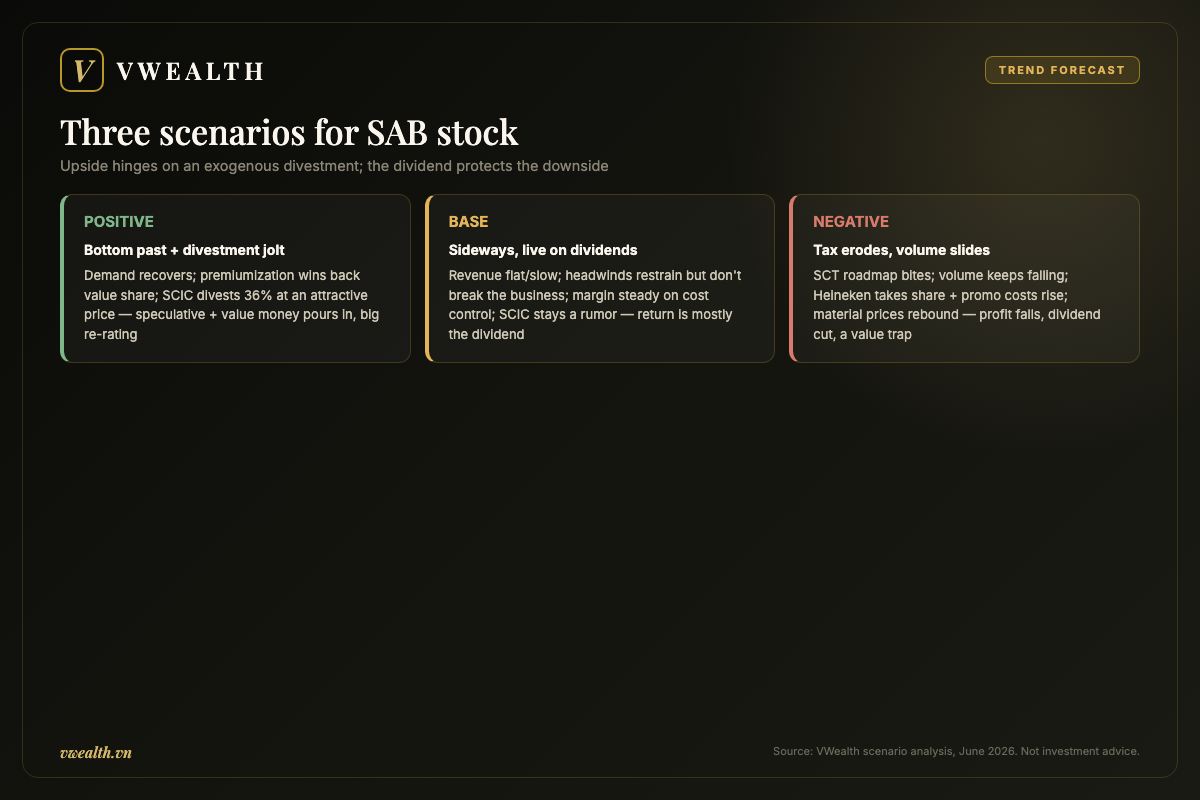
Three scenarios for SAB
Based on the pulls and pushes above, I picture three main scenarios. Assess the probability of each according to your own beliefs.
Positive scenario: “The bottom is past and the divestment jolt”
Conditions: domestic purchasing power recovers as the economy brightens, consumers gradually adapt to Decree 100; Sabeco’s premiumization strategy takes effect, regaining share in the high-value segment; and most importantly, SCIC launches the 36% divestment at an attractive reference price. Price consequence: in this scenario, speculative money and value investment both pour in, and SAB could be re-rated significantly, far above the current price. The divestment story is usually the strongest catalyst for the state-stake stock group.
Base scenario: “Sideways, living on dividends”
Conditions: this is the scenario I consider most probable in the medium term. Sabeco’s revenue goes sideways or recovers very slowly, the structural headwinds keep restraining growth but don’t make the business worsen abruptly. Margin is kept stable via cost control. The SCIC divestment story stays in “rumor” form without materializing. Price consequence: the stock trades in a narrow band with little sharp movement. Most of the investor’s return comes from steady cash dividends, not from price gains. This is the classic “defensive” scenario.
Negative scenario: “Tax erodes, volume keeps sliding”
Conditions: the SCT rise roadmap is fully implemented, pushing selling prices up and choking already-weak demand; consumption volume keeps falling year after year; competition from Heineken makes Sabeco both lose share and raise promotional costs; input material prices bounce back, thinning margins. Price consequence: profit genuinely declines (not just revenue), the dividend is forced to be cut, and the stock falls into the “value trap” group – looking cheap but losing value the longer you hold. In this scenario, the current attractive dividend level will no longer be sustainable.
The key takeaway you need to draw: most of SAB’s strong upside depends on an exogenous event hard to time – SCIC divestment – rather than lying entirely within the core business’s hands. Meanwhile the value “protection” comes from the dividend and the healthy balance sheet. That’s a very peculiar risk-reward structure we’ll summarize right after.
Should you buy SAB stock?
This is the part you’ve been waiting for most, and I want to say bluntly from the start: this article will not issue a “buy” or “sell” command. Anyone who firmly tells you to buy or sell a stock without asking anything about your circumstances, goals and risk appetite is either irresponsible or has a motive of their own. My job is to put on the scales everything we’ve analyzed, honestly and in balance, so that you make the decision that fits you.
Let’s weigh the two pans: Pros and Cons.
The PROS pan: why is SAB still attractive?
- An indisputable number-one position: over 40% share, Vietnam’s largest brewer. Scale and the distribution network are hard-to-copy competitive advantages.
- A strong brand tied to history: Bia Saigon and 333 are national brands with extremely high recognition – a precious intangible asset.
- A “cash mountain” of over 22,000 billion dong, almost debt-free: this is an extremely solid financial shield. The clean balance sheet lets Sabeco get through the hard patch without borrowing pressure, while generating deposit interest and “ammunition” for M&A or special dividends.
- A high, attractive and sustainably grounded cash dividend: Sabeco maintains a steady high cash-dividend policy (e.g. a 20% advance, i.e. 2,000 dong a share). At a price around 48,150 dong, the dividend yield sits in an attractive zone versus savings rates. Importantly, the cash generating this dividend comes from real profit and the cash mountain, not from borrowing to pay.
- A not-expensive valuation: at a P/E around 13-14x, SAB isn’t an over-hyped stock. This valuation reflects low growth expectations, but also creates a certain “margin of safety.”
- Defensive nature: beer is a consumer good with relatively stable demand across economic cycles. In volatile markets, the group of high-dividend defensive stocks is often the shelter for cautious money.
- The SCIC-divestment unknown – the trump card: the possibility of the state selling its 36% is a potential catalyst that could re-rate the stock in the future, offering a chance of a sudden price rise that other stocks don’t have.
The CONS pan: risks you must not ignore
- The beer industry is declining structurally: this is the biggest risk, and something you must face squarely. Decree 100 plus the SCT roadmap rising to 90% by 2031 are two long-term, one-directional clamps very hard to reverse. The 2025 revenue hitting an 11-year low is no temporary accident.
- Revenue decline is hard to reverse: when consumption habits have changed (drinking less over alcohol-level worries, over health) and prices keep being pushed up by tax, it’s very hard to expect revenue to return to old peaks in the near future.
- “Dead cash” drags on capital efficiency: this is the downside of the cash mountain. Over 22,000 billion dong sitting idle in the bank earning only modest deposit interest dilutes the return on equity (ROE). A large amount of capital not reinvested efficiently is a minus for those who prize capital-use efficiency.
- Fierce competition with Heineken: Sabeco is weaker in the premium segment – exactly where the consumption trend is shifting. Losing relative share (its industry revenue weight falling from 63% to below 59%) is a signal worth noting.
- Low free float, poor liquidity: most shares are held by ThaiBev and SCIC, leaving relatively few freely traded on the market. This makes liquidity limited, the price prone to sharp swings on large orders, and investors may struggle to buy/sell large volumes as they wish.
- Value-trap risk: a stock that looks cheap (low P/E, high dividend) in a shrinking industry can be a trap – you collect steady dividends but the price grinds sideways or falls, making the actual total return unattractive.
- The SCIC unknown is a double-edged sword: the divestment story could create a wave, but could also “hang” for years without happening, wearing investors down waiting for a catalyst that never comes.
A reference frame: what kind of investor does SAB suit?
Rather than declaring “should” or “shouldn’t,” I believe the most useful approach is to view SAB through the lens of four common investor types. Place yourself in the fitting group.
| Investor type | Fit with SAB | Reason |
|---|---|---|
| Dividend / defensive investor | Suitable | High, durable cash dividend, healthy balance sheet, strong defensive nature. This is the group SAB fits best. |
| Investor betting on a special story | Possibly suitable | Those who believe the beer industry is bottoming and bet on the SCIC-divestment scenario may see SAB as an asymmetric opportunity (limited risk thanks to the dividend, large upside from a divestment wave). |
| Growth investor | Less suitable | A structurally declining industry, revenue hard to break out. This isn’t the place to seek double-digit profit growth. |
| Short-term trader | Poorly suited | Low liquidity and thin free float make large-volume entry/exit difficult with high slippage risk. |
In sum, SAB’s portrait comes through fairly clearly: this is a high-dividend defensive stock, plus a free option named “SCIC divestment”, set against an industry facing a structural headwind. It suits those who prioritize a stable dividend cash flow and the safety of the balance sheet, and are willing to patiently bet that the beer industry will bottom and the divestment story will materialize. Conversely, if you’re a hunter of hot growth or need high liquidity for flexible trading, SAB will likely disappoint you.
The final decision, as always, rests with you. Weigh this stock’s portrait against your own financial goals, investment horizon and risk appetite. A stock that fits one person may not fit another – and that’s the very nature of investing.
Disclaimer: This article is produced for informational and reference-analysis purposes, and is not advice or a recommendation to buy or sell any security. The figures are compiled from public sources at the time of writing and may change. Every investment decision carries risk and belongs to the investor. You should research thoroughly and/or consult a licensed financial advisor before making any decision involving your money.
Research Vietnamese stocks in English with vwealth. Our AI-powered platform turns Vietnamese market data into full English analysis reports — with international payment support and a free 2-month trial for new accounts. Create your free account and read the latest reports.