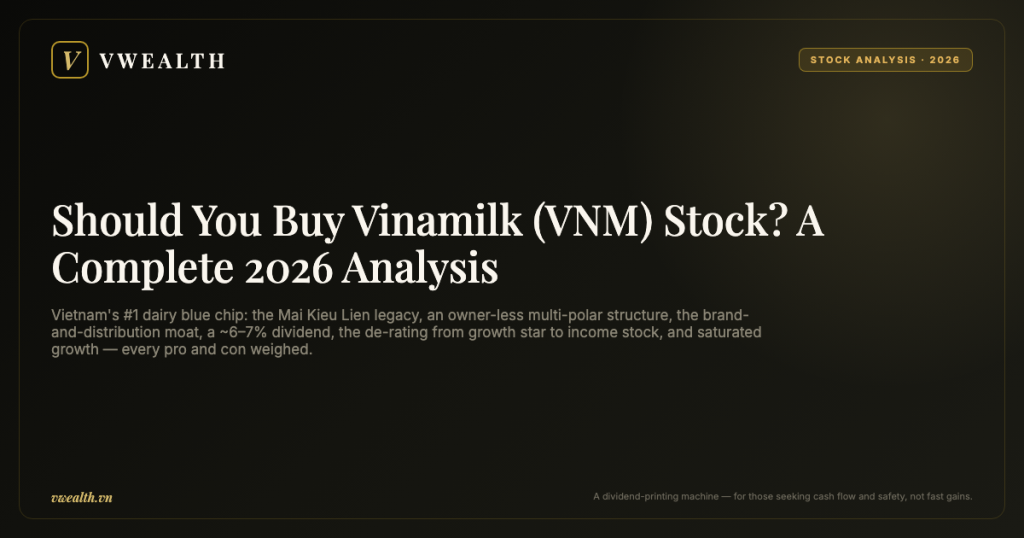
On Vietnam’s stock market, there are names nearly every investor has heard before they could read a financial statement. VNM – the stock of Vietnam Dairy Products JSC (Vinamilk), listed on HOSE – is one of those very few names. This is the number-one “giant” of Vietnam’s dairy industry, the business tied to the Ong Tho condensed-milk can and the Dielac powdered-milk box many generations of Vietnamese drank from the subsidy era. But to investors, VNM carries another, more classic title: it’s one of the market’s foremost defensive, high-dividend blue chips – an asset large funds and safety-oriented investors hold through cycle after cycle.
As of the session of 19 June 2026, VNM traded around 59,000 dong. Behind that number is a business that just closed 2025 with record revenue of 63,724 billion dong (up 3.1% year on year) – the highest in the company’s history – and after-tax profit of 9,414 billion dong. On one hand, that’s proof of enormous scale and rare resilience. On the other, the very phrase “3.1% growth” is what makes not a few investors hesitate: an empire that has hit its ceiling, growth slowing – is there still room to buy in?
That’s the central question this full analysis wants to answer with you: should you buy VNM stock now, and more importantly – what kind of investor does this stock suit? VNM isn’t a “strike fast, win fast” stock, nor a hot-growth story. To value it right and decide right, you need to understand its origins: why a company starting from 3 old state plants after reunification became a billion-dollar business, why the state had to gradually sell down and foreigners fought to buy at record prices, and why “self-sufficiency in dairy cows” is the foundation of its competitive advantage today. It all starts with history.
VNM market data (updated 19 June 2026)
| Current price | 59,000đ | 2025 revenue | 63,724 bn (+3.1%) |
| Change (June) | −0.17% | 2025 after-tax profit | 9,414 bn |
| P/E | Dividend yield | ~13x | ~6–7% | Dairy market share | #1 (~50%) |
Source: VWealth price data + Vinamilk 2025 reports. Figures move by session — for reference only.
History and evolution
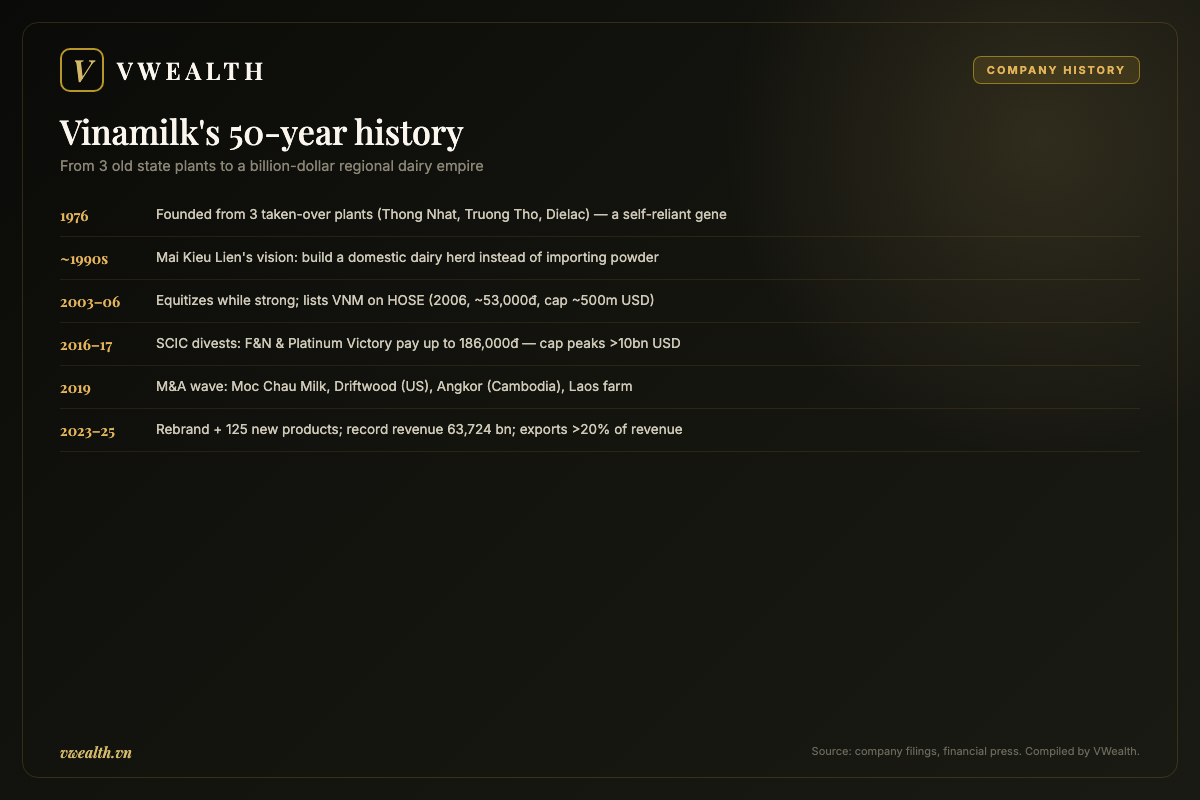
To understand why Vinamilk holds an “untouchable” position in the Vietnamese consumer’s mind – an intangible asset no financial statement fully records – you must go back to 1976, when the country had just reunified and the economy was still under the subsidy mechanism. Vinamilk’s 50-year story isn’t just a business growing up, but a journey from three taken-over state plants to a dairy empire with international-standard farms and a brand reaching over 60 countries.
Starting in 1976: three taken-over plants and a self-reliant spirit
Vinamilk was established on 20/8/1976 under the original name Southern Milk – Coffee Company, on the basis of taking over 3 dairy plants left by the old regime after liberation. This is an important detail many overlook: Vinamilk wasn’t built new from zero, but inherited existing industrial infrastructure – a starting point that was both a fortune and a burden.
- Thong Nhat Dairy Plant – formerly Foremost Dairies Vietnam of foreign capital, operating since 1965. This is where sweetened condensed milk was produced, the product line tied to the legendary Ong Tho brand later.
- Truong Tho Dairy Plant – formerly the Cosuvina plant set up by ethnic-Chinese businessmen in 1972.
- Dielac Powdered Milk Plant – a Nestlé plant still half-built. The name “Dielac” later became Vinamilk’s mainstay children’s-powdered-milk brand for many decades.
In the subsidy era – scarce materials, backward technology, a country under embargo – keeping these three plants running was itself a feat. The spirit of “self-reliance, resilience, for the community” formed in that hard period is the first cultural brick, and what explains why Vinamilk later was always obsessed with securing its own materials rather than depending on imports. For you – an investor – this detail isn’t mere nostalgia: a business with the “gene” of self-sufficiency usually has a more durable margin and less supply-chain risk than rivals.
The iron lady and the “national” brand: the imprint of Mai Kieu Lien
You can’t tell Vinamilk’s history without Ms. Mai Kieu Lien. She has been with the company almost from the earliest days – starting not as a businessperson, but as a young female dairy-processing engineer. She held the CEO seat for over 30 years, was honored by Forbes Vietnam for “Lifetime Achievement,” and was ranked by Fortune among Asia’s 100 most powerful women in 2024. But for the stock story, what’s worth learning from her is two turning-point decisions.
The first decision, around the early 1990s, was the vision of domestic raw fresh milk. Then Vietnam’s dairy industry depended almost entirely on imported milk powder. She and leadership set the goal of “building a dairy herd and domestic material zone” – an idea deemed fanciful in a tropical country with no dairy-farming tradition. She spent two years persuading her superiors to approve the Hanoi Dairy Plant project (completed late 1994 with total capital of 8 million USD). This was the seed of the “self-sufficient herd” strategy we’ll see bloom three decades later.
The second decision, and what investors are most grateful for, came in 2003: she persuaded the company’s leadership and the state to equitize Vinamilk – even when the company was thriving and had no “emergency” reason to equitize. That vision was proven astonishingly right by history: over 20 years after equitization, Vinamilk’s revenue rose about 15 times and pre-tax profit about 13 times versus December 2003. In other words, it’s thanks to this decision that there’s a VNM stock for us to discuss today.
The lesson for you: a business with “leadership that dares to equitize while strong” is usually one that places transparency and long-term interest above all. That’s a good governance sign foreign funds especially value when pricing VNM.
2003 equitization and 2006 HOSE listing: VNM is born
In November 2003, the company officially converted to a joint-stock model and renamed to Vietnam Dairy Products JSC (Vinamilk) as we know today. Three years later, on 19/1/2006, Vinamilk listed on the Ho Chi Minh City Stock Exchange (HOSE) under the ticker VNM. The starting listing price was about 53,000 dong/share, market cap then about 8,000 billion dong (equal to about 500 million USD).
Pause at this number: a market cap of about 500 million USD in 2006, and at the 2017 peak Vinamilk’s cap exceeded the 10–11 billion USD mark. That’s a rise of over 20 times in just over a decade – one of the most spectacular value-creation journeys in Vietnamese stock-market history. For investors who bought VNM on listing day and patiently held (plus dividends), this is the classic proof of the “buy a good business’s stock and stay with it long enough” philosophy.
SCIC divestment and the foreigners’ buying scramble
A particularly fascinating chapter – with many valuation lessons – lies in the story of SCIC (State Capital Investment Corporation) divesting from Vinamilk. As the largest state shareholder, SCIC once held a controlling ratio, and selling down sparked a fierce fight among foreign heavyweights.
- Late 2016: the F&N group (Fraser & Neave, of Thai billionaire Charoen Sirivadhanabhakdi’s empire – also owner of ThaiBev) bought about 78.38 million VNM shares from SCIC, equal to 5.4% of capital, at nearly 500 million USD. This price showed F&N valued Vinamilk at over 9 billion USD.
- 2017: SCIC continued selling 3.33% of capital to Platinum Victory (of the Jardine Cycle & Carriage group) at a record winning bid of 186,000 dong/share – 24% higher than the starting price. The deal pushed Vinamilk’s cap past 10–11 billion USD, setting the highest valuation in the company’s history to date.
Why were the foreign “sharks” willing to pay such high prices? Because VNM is a rare asset: an absolutely dominant brand in a populous, growing consumer market, with steady cash flow and high margins. After the deals, the F&N group raised its stake to nearly 25%, becoming the second-largest shareholder, only behind SCIC (holding about 36% of charter capital). This special shareholder structure – both the state and foreigners holding large stakes – is one reason VNM has good liquidity, transparent governance and is always closely “scrutinized.” For you, that’s both a plus (tight oversight, low manipulation risk) and a point to note (every large-shareholder divestment move can create short-term price volatility). Indeed, by end-2025 the market was still buzzing about a plan to trade thousands of billions of dong of VNM shares by foreigners – showing this is still a sought-after “pie.”
The “self-sufficient dairy herd” strategy: the foundation of competitive advantage
Back to the seed Ms. Mai Kieu Lien planted in the 1990s. Over 15 years, Vinamilk persistently built a system of 13 international-standard dairy farms across Vietnam, supplying over 1 million liters of raw fresh milk a day. This isn’t a marketing slogan, but an enormous investment creating a real competitive advantage:
- The first European-standard Organic dairy farm in Vietnam (in Lam Dong), with free-grazing cows, Non-GMO feed, no growth hormones.
- The Tay Ninh “dairy resort” (inaugurated 2019) at 8,000 cows, applying 4.0 technology – a symbol of the ambition to raise Vietnamese dairy farming to world class.
Why does this matter to an investor? Because self-sufficient materials = self-controlled margin. When world milk-powder prices swing strongly, a business self-sufficient in most materials sees its profit eroded less than a rival dependent on imports. That’s one of the core reasons VNM maintains a leading ROE and a durably high margin over many years – the foundation for its generous cash-dividend ability we’ll analyze closely later.
Expanding via M&A: from Moc Chau to the US and Cambodia
As the domestic market gradually saturated, Vinamilk chose the path of growth via mergers and acquisitions (M&A) and exports. This is the chapter explaining why the company can keep setting revenue records despite the traditional dairy segment growing slowly.
| Deal / Move | Meaning for investors |
|---|---|
| Driftwood Dairy (US) – raising investment from 10 to 20 million USD | A springboard to enter the US market, learning international operation |
| Angkor Dairy (Cambodia) – a dairy plant in Cambodia, revenue up over 25% (2019) | Expanding into the ASEAN market with much growth room left |
| GTNFoods → Moc Chau Milk – buying 75% of GTNFoods (2019), thereby holding Moc Chau Milk with a herd of ~25,000 cows | Acquiring the North’s number-one legacy dairy brand, reinforcing the material zone; Moc Chau’s gross margin improved clearly right after joining Vinamilk |
| Farm in Laos – phase 1 at 5,000 ha, 24,000 cows | Expanding cross-border material self-sufficiency capacity |
Each deal is a piece in the bigger picture: Vinamilk is no longer a “Vietnamese dairy company” in the narrow sense, but is becoming a regional dairy group. For you, this has two sides. The positive: M&A and exports open new growth drivers as the domestic market stalls (exports being one of the forces helping 2025 revenue peak). The point to be cautious about: growth via acquisition usually costs capital, dilutes the margin in the early phase, and integration isn’t always smooth – this is a risk you need to watch in coming reports.
2023 rebranding and the half-century journey
Entering a new phase, on 6/7/2023 Vinamilk announced a new brand identity after nearly 5 decades – changing the logo from an emblem to a wordmark with the line “Est 1976,” with the dot on the “i” stylized into a smile. This wasn’t merely aesthetics: it’s the first step in a 5-year “transformation” strategy, alongside digitalization, product innovation and management-process renewal, to reach young consumers faster and more effectively. By end-2023, Vinamilk’s brand value reached about 3 billion USD.
And so, from three old state plants in 1976, after 50 years Vinamilk became a business with revenue over 63,700 billion dong, products present in over 60 countries, with an international-standard farm system and a brand engraved in the Vietnamese mind. That history explains why VNM is dubbed a “national” blue chip – and also poses the question of the present: when the empire is mature, what about the people running it will decide the next chapter? To answer, let’s look deep into Vinamilk’s leadership in the next section.
Leadership and ownership structure
If you want to understand why Vinamilk (ticker VNM) has for decades remained the first name people mention when talking about defensive blue chips on HOSE, don’t just look at the milk or the billion-dollar revenue. Look at two things few dig into: who’s at the helm and who really owns this company. Here there’s a very special story, nearly unique among Vietnam’s large businesses. On one side is the legacy of a legendary female commander who tied nearly her whole career to one brand. On the other is a shareholder structure with no “owner” holding absolute control, where the state, a Thai billionaire’s group and tens of thousands of public investors hold hands together. This rare combination creates what you, as an investor, should consider one of VNM’s most durable advantages: governance quality.
Mai Kieu Lien — why she’s called a “legend”
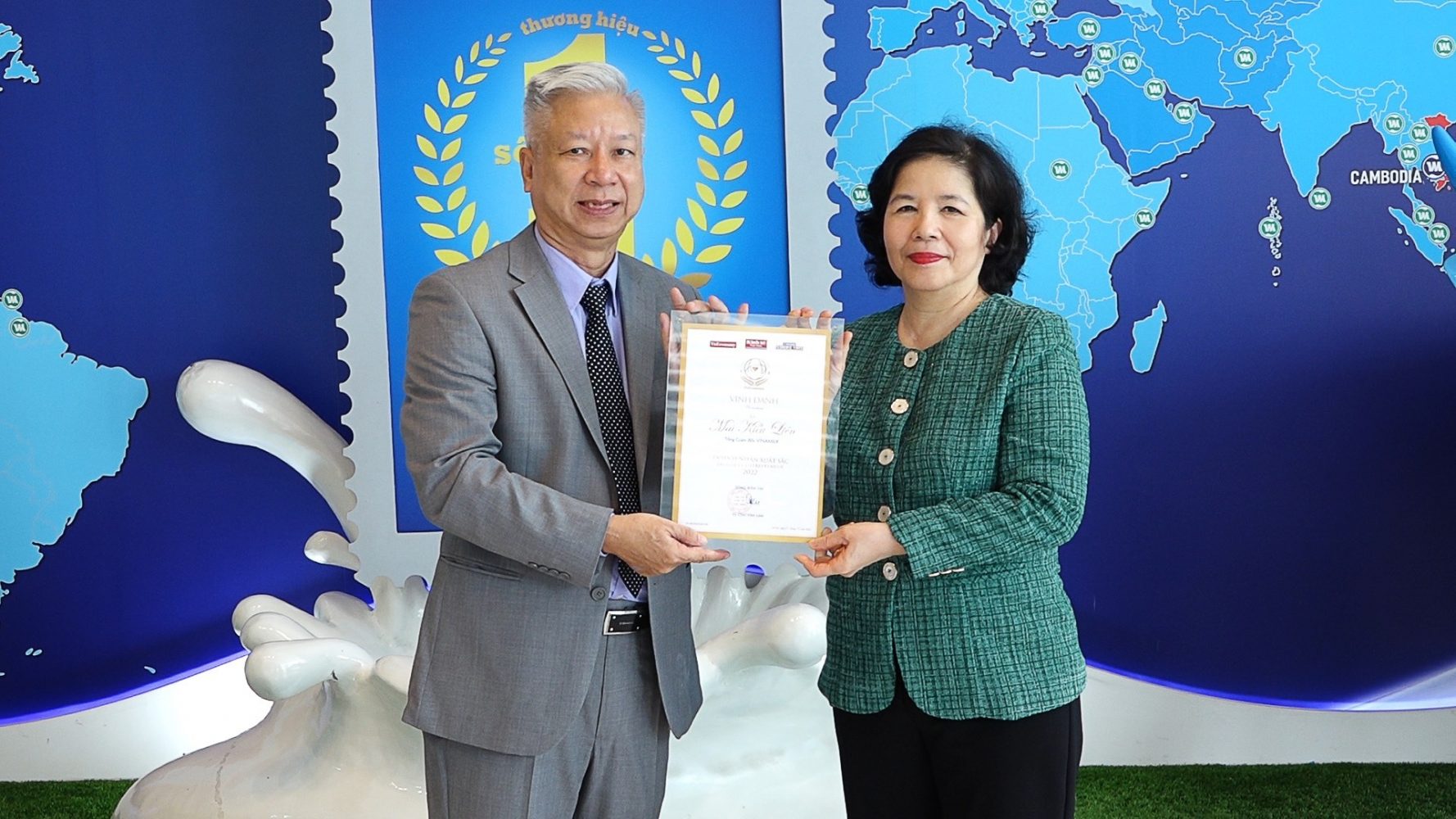
You’ll find it very hard to find a second case in Vietnam like Ms. Mai Kieu Lien: nearly her whole professional life tied to one company, turning that company from a post-war state enterprise into the nation’s largest dairy group, with a name on the world dairy map. The domestic press calls her by titles that became her own brand: “dairy commander,” “dairy woman.” That’s not empty flattery, but the public’s way of recognizing a very hard-to-repeat career.
Per public biographical materials, Ms. Mai Kieu Lien was born on 1/9/1953 in Paris (France), into an intellectual Vietnamese family. She was formally trained abroad: graduating from university in Moscow (former Soviet Union, now Russia) in 1976, majoring in meat and milk processing — precisely the trade she would pursue her whole life. This detail matters more than you think. Vinamilk’s head isn’t a financier or a “planted” politician, but a genuine dairy-processing technology engineer, understanding the product from the roots, from probiotics to the sterilization line. When the leader of a manufacturing business thoroughly understands what they make, decisions to invest in plants, choose technology, control quality usually have a firmer expertise foundation, less trend-chasing.
She began working in the industry in 1976, rising from an engineer at the plant, then Deputy CEO for economics (1984–1992), before officially taking the role of Vinamilk CEO from December 1992 and holding it to this day — one of the longest executive tenures you can find at any large listed business in Vietnam. Over three decades in the CEO chair, through equitization (Vinamilk equitized in 2003, listed on HOSE in early 2006), through plant expansions, dairy-farm acquisitions and stepping into export markets — nearly every major milestone of the company bears her handprint.
An often-mentioned imprint is 2013, when Vinamilk nearly simultaneously brought “super-plants” of dairy with investment of hundreds of millions of USD into operation, with capacity among the region’s largest — a bold move affirming industrial-scale ambition rather than mere domestic trading. This is precisely the kind of decision only someone both an engineer and a seasoned manager dares to bet on.
Her stature is also internationally recognized persistently. She featured for many years in Forbes’ list of Asia’s most powerful women (Forbes Asia’s Most Powerful Women, first from 2012 and many years after), was honored by Forbes Vietnam among the most influential women, and appeared in regional powerful-businesswomen rankings. Domestically, she was awarded the Labor Hero title and many noble medals by the state. For an investor, these honors don’t directly raise profit, but they’re indicators of the reputation and stability of the leadership apparatus — an intangible but real factor when valuing a blue chip.
Management style: methodical, cautious, effective
What analysts value in Ms. Mai Kieu Lien isn’t flowery declarations, but a management philosophy consistent over decades: cautious with leverage, disciplined with costs, methodical with strategy. Vinamilk under her is famous as a business using almost no debt, keeping a clean balance sheet, abundant cash, high and stable margins across many economic cycles. That’s not luck, but a management choice: prioritizing financial health and cash flow over growth at all costs.
For a value investor, an industry-leading business, nearly debt-free, with strong cash flow and run by someone who understands the product from the roots, is the very definition of “sleeping well.” VNM’s biggest risk rarely comes from internal governance — it usually comes from material prices, market-share competition and purchasing power, things beyond leadership’s control.
That cautious style also has a downside you need to acknowledge frankly: in years of a saturated domestic dairy market, pressure from foreign rivals and a falling birth rate, “certainty” sometimes means slower growth. VNM in many periods was valued by the market as a steady-dividend stock rather than a growth stock. This is worth remembering when you have hopes for this stock’s story.
Role handover: clarifying an often-confused point
There’s a detail easily misunderstood, and you should grasp it precisely to avoid misreading the news. Ms. Mai Kieu Lien once held both roles of Board Chair and CEO in 2003–2015. By 2015, per the modern governance practice of separating the Chair and CEO roles, she left the Chair seat — not the executive seat. The Chair position then passed to Ms. Le Thi Bang Tam.
In the 2022–2026 term, Vinamilk’s Chair seat continued to pass to Mr. Nguyen Hanh Phuc (former Secretary General of the National Assembly), while Ms. Mai Kieu Lien was reappointed CEO and is a Board member. In other words, as of 2025–2026, per disclosures, she remains Vinamilk’s highest executive (CEO), while the apparatus proactively separated the oversight role (Chair) from the executive role (CEO) — a governance structure seen as healthier and more transparent than the “one person holds all” model.
Because Ms. Mai Kieu Lien is over 70, the succession story is a variable any long-term investor must watch. A business tied too tightly to a legendary individual always faces “founder risk”: what happens when the company’s soul retreats? The good news is Vinamilk has spent many years building a professional lower-management team and a Board with large institutional shareholders (discussed below), so the handover risk is significantly reduced versus a typical family company. Even so, you should treat any official information about the CEO-succession roadmap as material information to update, rather than default it as unimportant.
Ownership structure: a blue chip with no “owner”
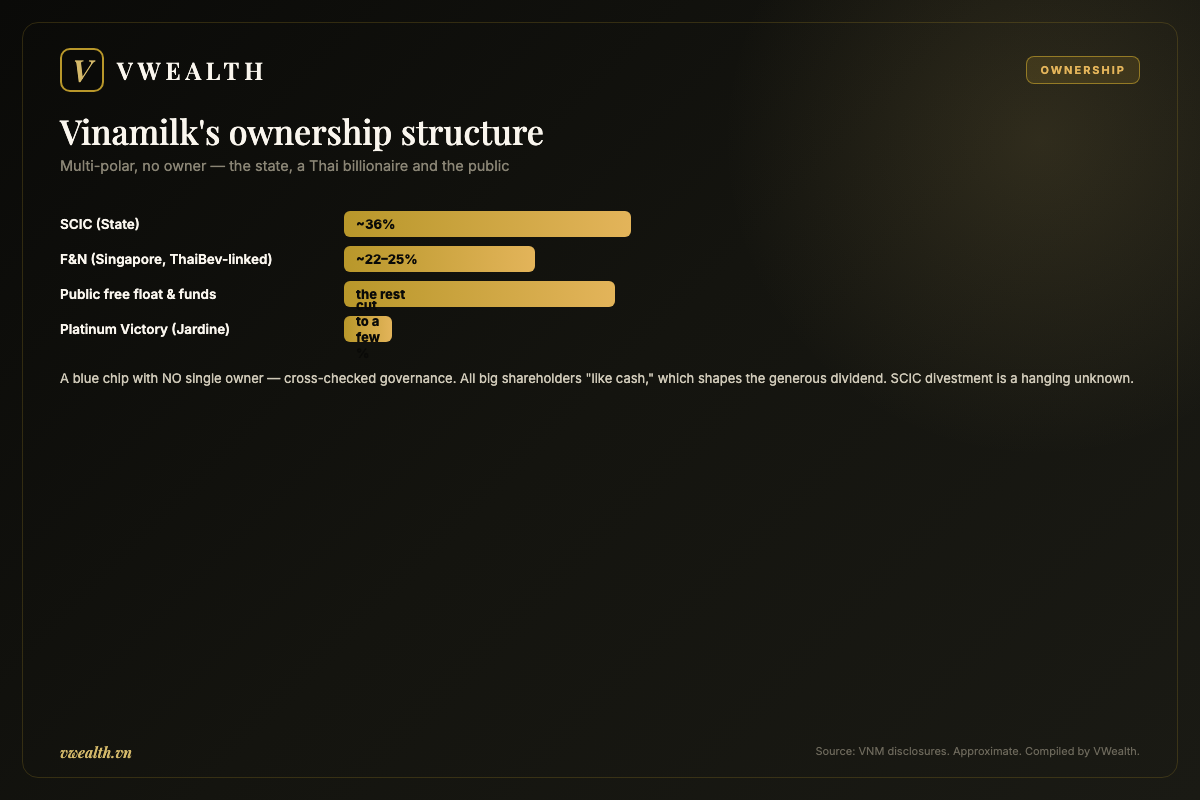
This is what truly sets VNM apart. Unlike most large Vietnamese businesses — where there’s always a founding individual or family holding a controlling stake — Vinamilk has a dispersed, multi-polar shareholder structure, no one holding absolute control. Per disclosures through 2025–2026, the ownership picture has three large blocks:
| Shareholder group | Nature | Ownership (approx., per disclosure) |
|---|---|---|
| SCIC (State Capital Investment Corporation) | State-capital representative | ~36% (about 752 million shares) |
| F&N Dairy Investments & related (F&NBev) | Singapore foreign bloc, tied to Thai billionaire Charoen Sirivadhanabhakdi’s F&N / ThaiBev group | ~22–25% (after buying more in late 2025) |
| Platinum Victory (Jardine Cycle & Carriage group) | Foreign bloc tied to the Jardine group | Once ~10%, cut sharply to a few % after 2025–2026 divestments |
| Public shareholders (free float) & other funds | Tens of thousands of domestic and foreign investors | The rest — high free-float ratio |
Note: the ratios above are expressed cautiously because VNM’s ownership structure changes continuously with large trades; you should cross-check against the company’s latest annual report and disclosures before deciding.
This structure brings several important consequences for you. First, no individual “owner” imposes their will on the whole company. Every big decision must pass consensus among the state bloc (SCIC), professional foreign shareholders and the executive apparatus. This forces Vinamilk to operate to transparent governance standards, because there are always many watching eyes from parties with large interests and high analytical capacity. For a small shareholder like you, this is a valuable protective layer — you worry less about “gutting” the business for a dominant shareholder group’s private interest.
Second, the presence of F&N — the group tied to Thai billionaire Charoen Sirivadhanabhakdi’s ThaiBev — is both a plus and a point to watch. The plus: this is a methodical institutional shareholder, experienced in running the regional beverage-food industry, long-committed and benefiting from Vinamilk’s high cash-dividend policy so motivated to keep the business healthy. The point to watch: in late 2025, F&N bought more to raise its stake to nearly 25% (buying most of the shares Platinum Victory divested), making the market question Vinamilk’s autonomy. The company affirmed its independence in management; but as an investor, you should treat every large foreign ownership change as data to update, because it relates to the power balance at the AGM.
SCIC and the state-divestment unknown
SCIC’s stake (~36%) is the biggest variable, and also the most interesting “unknown” of the VNM story. For a long time, there’s been a policy that the state will fully divest from Vinamilk — because this is no longer a field the state needs to hold. If that happens completely, hundreds of millions of shares would flood the market, opening the possibility of a new strategic investor entering, or the free-float ratio surging. This is the scenario investors have watched closely for years because it could entirely reshape VNM’s power structure and valuation.
However, reality through late 2025 – early 2026 shows this process is not at all smooth. SCIC once registered to sell some VNM shares but many rounds couldn’t be executed due to unfavorable market conditions, and at times the “divestment failed” news made VNM hit the ceiling (because the market worried the large supply was delayed, while hoping for a strategic-investor-handover scenario). At one point in early 2026, SCIC even signaled pausing divestment, continuing as the largest shareholder. So the state’s divestment roadmap at Vinamilk remains an open unknown: it could be a price catalyst if it happens favorably at a good valuation with a quality strategic partner, but could also create supply pressure and short-term uncertainty. Treat this as one of the “stories” to watch continuously while holding VNM.
Governance culture and a generous dividend policy
There’s a very logical thread linking Vinamilk’s shareholder structure and dividend policy, and once you see this thread, you’ll understand why VNM is always the “cash-egg-laying hen” investors favor. Note: the largest shareholder is SCIC — a state institution needing steady dividend cash flow to remit to the budget. Large foreign shareholders like F&N are also long-term financial investors, prioritizing steady cash flow. When controlling shareholders all “like cash,” the business’s dividend policy is nearly certain to be generous and steady. And Vinamilk is indeed like that.
For many years, Vinamilk maintained a high, steady cash-dividend policy, with the total ratio usually in the 30–50% of par zone each year. Recent years show impressive consistency: per disclosures, the total cash dividend for 2024 was about 43.5%; entering 2025, the company set a direction to pay cash dividends of at least 50% of consolidated after-tax profit — a very generous level versus the listed-business norm. For SCIC alone, the dividend flow received from Vinamilk reaches thousands of billions of dong a year (about 3,600 billion dong in 2025 per the press), showing the enormous scale of cash VNM “pumps” back to shareholders.
For you — especially if you’re a cash-flow-oriented investor — this is VNM’s core appeal: an industry leader, financially healthy, nearly debt-free, committed to paying most of its profit in cash. That’s why VNM is usually classed among “dividend and defensive” stocks, the kind helping your portfolio reduce shakes in volatile market periods.
Of course, the flip side of a high dividend policy is the company retains less profit to reinvest for growth. This again reflects Vinamilk’s current “character”: a mature, industry-leading business, prioritizing paying shareholders over chasing hot growth. You need to clearly set your expectation from the start — buying VNM is mostly buying stability and the dividend stream, not buying an explosive growth story.
Summary: governance quality is VNM’s “intangible asset”
Wrapping up this section, remember three core points before moving on. One, Vinamilk is led by a legendary female commander — Ms. Mai Kieu Lien — with a methodical, cautious style using almost no leverage, and the apparatus proactively separated the Chair role from the executive role; the biggest risk on the human side is the CEO-succession story to watch. Two, the multi-polar ownership structure (SCIC ~36%, the F&N bloc ~22–25%, high free float, no controlling private owner) creates a healthy cross-checking system, while leaving the state-divestment unknown as a long-term variable. Three, that “cash-liking” shareholder structure has shaped a generous, steady dividend policy, making VNM a classic defensive-dividend stock of Vietnam’s market.
A reputable leadership apparatus with a balanced ownership structure is a solid foundation. But that foundation only truly generates value standing on a strong product portfolio and a broad enough business ecosystem. That’s what we’ll dissect right after, entering the “Products and ecosystem” section — where you’ll see how the “dairy woman” and this powerful shareholder lineup built a business machine.
Products, brand and ecosystem
When you ask a seemingly simple question — “what does Vinamilk actually sell?” — you’ll realize the answer isn’t a product, but a whole ecosystem built over nearly five decades. For a long-term investor, this is the most important part of the whole analysis. Because the share price can swing with news, interest rates or crowd sentiment, but what decides whether a business is worth holding for ten years is something else: whether it has an “economic moat” wide and deep enough to protect its cash flow from rivals. For Vinamilk, that moat is woven from three tightly braided threads — a product portfolio covering the Vietnamese dining table, a national brand nearly synonymous with the word “milk,” and a self-sufficient supply chain from cow to point of sale. Let’s peel back each layer.
Product portfolio: covering every Vietnamese fridge shelf
The first thing to understand about Vinamilk is they’re not a “one-product” company. If you open a typical Vietnamese family’s fridge, there’s a very high chance of at least two to three things bearing the Vinamilk logo — a fresh-milk box for the kid’s school, a yogurt cup for evening dessert, and an Ong Tho condensed-milk can on the kitchen shelf for coffee. That’s the power of a broad portfolio: the business doesn’t depend on a single product’s fate, but spreads risk over many product groups with different lifecycles, margins and growth drivers. With nearly 400 SKUs in circulation, Vinamilk leaves almost no niche empty in dairy and dairy products.
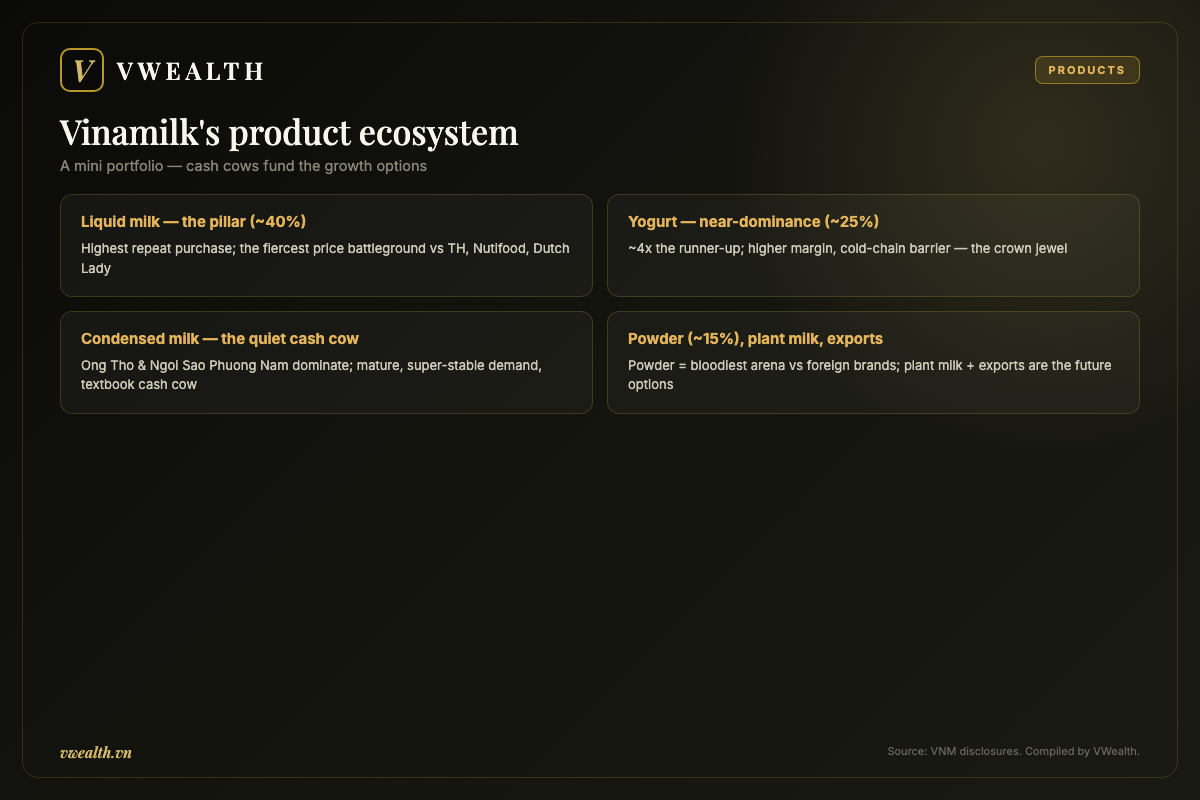
Liquid milk — the mainstay pillar. This is Vinamilk’s revenue “backbone,” contributing about 40% of total sales. Liquid milk (including UHT, pasteurized, reconstituted milk) is a daily consumer good, with the highest repeat-purchase frequency and the fiercest competitive battleground with rivals like TH true MILK, Nutifood or FrieslandCampina (Dutch Lady). Vinamilk’s leading position in this segment comes not only from the brand, but from continuously upgrading its premium line: Vinamilk Green Farm and Vinamilk 100% Organic are the world’s first two fresh-milk products certified by the US Clean Label Project. When you look at a dairy business, always check the liquid-milk segment’s “health” first — because that’s where cash flows strongest and also where price-competition pressure eats deepest into the margin.
Yogurt — near-absolute dominance. If liquid milk is the pillar, yogurt is the “jewel” in Vinamilk’s crown, accounting for about 25% of revenue. This is a segment Vinamilk dominates with a market share recorded at about 4 times the direct runner-up. The Probi live-culture drinking yogurt line alone has held the number-one spot in Vietnam for many consecutive years. This dominance is extremely valuable, because yogurt has a better margin than liquid milk and a higher entry barrier — a rival wanting to squeeze in must build both a cold distribution chain and trust in probiotics, which can’t be bought with money overnight. When a business is nearly “alone in the market” in a high-margin segment, that’s a clear sign of a real economic moat.
Condensed milk — the cow quietly generating cash. This is perhaps the product group investors underrate most, but the most valuable in terms of stability. With two brands, Ong Tho (nearly 50 years old) and Ngoi Sao Phuong Nam, Vinamilk controls the overwhelming portion of the domestic condensed-milk market. Both are among the dairy brands Vietnamese consumers buy most per Kantar surveys. Condensed milk is a “mature” market — slow growth, but extremely stable demand (tied to milk coffee, baking, cooking) and nearly no rival strong enough to topple it. This is the textbook “cash cow”: high share, low investment, steady cash flow returning to feed other growth segments.
Children’s powdered milk — the fiercest arena. Accounting for about 15% of revenue, powdered milk (especially infant and young-child formula like Dielac, Optimum Gold, ColosGold) is a segment with attractive margins but also the bloodiest battleground. Here Vinamilk confronts foreign “giants” like Abbott, Mead Johnson, Nestlé, FrieslandCampina — brands still favored by the “foreign-loving” psychology of some Vietnamese parents. This is a relative weakness in the portfolio: Vinamilk is strong in the mass and mid-tier segments, but not truly dominant in the premium imported segment. When you follow this stock, watch Vinamilk’s moves in powdered milk closely — it shows the business’s ability to withstand foreign competition.
Supporting groups — plant milk, beverages, ice cream. This is the portfolio’s “future defense” layer. Plant milk (soy, walnut, almond, red bean…) gets ahead of the plant-based and health-conscious trend, while beverages (Icy, Vfresh juice) and ice cream (Vinamilk, Subo) leverage the existing cold distribution system. Each group isn’t large in sales yet, but their strategic role is to widen the consumption “pie” and defend against the young generation’s trend of reducing animal-milk consumption. A business that sows seeds for new segments while the core segment is still strong — that’s a sign of visionary leadership.
The lesson for investors: a broad portfolio isn’t just “selling many things.” It’s a miniature investment portfolio — condensed milk and yogurt are the steady cash cows, liquid milk is the large-scale revenue machine, while plant milk and beverages are growth options for the future. When one segment struggles, the others carry the load.
The national brand: when “Vinamilk” is nearly synonymous with “milk”
Now let’s talk about this business’s most intangible yet most valuable asset — the brand. In value investing, the strongest economic moat is usually not the plant or the patent, but what Warren Buffett calls “share of mind” — occupancy in the customer’s mind. And this is where Vinamilk outperforms every rival. For many generations of Vietnamese, “going to buy milk” and “going to buy Vinamilk” are nearly one. That recognition can’t be bought with one year’s advertising budget — it’s the accumulated result of nearly 50 years of presence in every meal, every school-milk program, every childhood memory.
Why is the brand Vinamilk’s strongest “moat”? Because milk is a product where trust matters more than price. When you buy milk for your child to drink daily, you don’t seek the cheapest — you seek the one you trust most on safety and quality. That trust is a wall a new rival nearly can’t break. A new milk brand can launch a good, cheaper product, but they still fight the invisible question in a mother’s mind: “Do I dare switch to something I’ve never heard of for my child to drink?” Vinamilk has answered that question for half a century, and each passing year, that wall thickens by another layer.
This brand strength is also amplified by a second weapon tied to it: enormous distribution coverage. Vinamilk runs a distribution system of over 200,000 points of sale across 63 provinces — from modern supermarkets in central Saigon to small grocery stalls in remote rural areas. This is what you need to absorb deeply: in fast-moving consumer goods (FMCG), distribution is the real battleground. However good a product, if it’s not on the shelf when people need it, it’s meaningless. When Vinamilk products are in nearly every corner, a rival wanting to compete must not only win on product, but also build a network of hundreds of thousands of points of sale — a task costing decades and thousands of billions of dong. A strong brand pulls consumers in, while wide distribution ensures they always find it. These two factors resonate into a self-reinforcing loop economists call “scale and network advantage.”
This brand position is also internationally recognized: Vinamilk is the only Vietnamese dairy business on the Fortune 500 Southeast Asia list. A domestic brand reaching regional stature like this isn’t just pride — it’s a “passport” helping products be more easily accepted in export markets, where reputation precedes the product.
Material self-sufficiency: from cow to milk can
The moat’s third thread — and the one few amateur investors notice — is supply-chain self-sufficiency. In dairy, whoever controls the material source controls the margin. And Vinamilk spent 15 years building a dairy-farm system few Asian businesses can match.
Specifically, Vinamilk runs an international-standard dairy-farm system at home and abroad, producing over 1 million liters of raw fresh milk a day from a total herd of about 130,000–160,000 cows (including the household-cooperation part). These aren’t ordinary barns but high-tech “dairy resorts”: cows listen to music, lie on mattresses, get cool showers and have health managed by electronic chips. Most notable in this international-standard “collection” is Vinamilk Organic Milk Farm in Da Lat — Vietnam’s first European-standard (Organic EU) organic dairy farm, certified by Control Union (Netherlands). Alongside are the Vinamilk Green Farm ecological farm systems across Tay Ninh, Quang Ngai, Thanh Hoa, and large-scale high-tech dairy-farm complexes in Thanh Hoa and Laos.
The chain starts with farms, ends with plants — and here Vinamilk also owns heavy weapons. The Vinamilk “super-plant” of dairy in Binh Duong is one of the region’s most modern liquid-milk plants, with capacity up to 800 million liters/year, running on 4.0 automation and robots. In total Vinamilk has about 14–16 plants strategically distributed nationwide, optimizing the supply chain and ensuring product freshness to consumers. Controlling both farm and plant helps Vinamilk master quality “from farm to table” — a brand story very hard to copy, and the foundation for confidently exporting to demanding markets.
But here’s the point you must stay clear-headed on, don’t be mesmerized by the beautiful “self-sufficiency” story. Despite owning an enormous herd, Vinamilk’s domestic herd still only meets part of the fresh-milk need for the liquid-milk segment. Most of the material to produce powdered milk, condensed milk and many other lines still relies on imported raw milk powder (skim milk powder SMP, whole milk powder WMP) from New Zealand, the US, EU. This means Vinamilk’s margin is directly sensitive to two variables beyond its control: world milk-powder prices and the USD/VND rate. When world milk-powder prices surge (as happened in prior cycles), Vinamilk’s gross margin is eroded, and they usually can’t raise selling prices fast enough to offset because of competitive pressure. This is a core risk anyone planning to hold VNM long-term must remember — Vinamilk’s “material self-sufficiency” is relative, not absolute. When you follow this stock, always glance at the global milk-powder price index (like Fonterra’s GDT auction index) as an early indicator for the coming quarter’s margin.
Ecosystem and subsidiaries: a mature giant’s M&A chessboard
An industry leader, once at the peak of domestic share, naturally slows in growth — that’s a law. How Vinamilk overcomes this “growth ceiling” is through M&A and expanding the subsidiary ecosystem. Understanding this chessboard, you’ll understand where VNM’s future growth driver lies.
Moc Chau Milk (MCM) is the most delicate acquisition. Through controlling the chain GTNFoods → Vilico → Moc Chau Milk, Vinamilk acquired the legacy dairy brand tied to the Moc Chau highlands — a “regional specialty” with unique emotional value the parent Vinamilk brand itself lacks. After joining Vinamilk, MCM was reinforced in governance, technology and distribution, and recorded its highest-profit quarters in years. This proves leadership’s “buy then make better” M&A capability.
Driftwood (US) and Angkor Dairy / Angkor Milk (Cambodia) are two international spearheads. Driftwood is a legacy dairy company in California, helping Vinamilk have a presence right inside the US market and supply milk to that state’s school system. Angkor Milk is the first modern dairy plant in Cambodia, making Vinamilk the dairy-market leader in the neighboring country. Both recorded positive revenue growth in recent periods, contributing to the overseas-market segment that’s the group’s brightest growth driver.
Vinamilk Foods and especially the beef joint venture open an entirely new chapter. Through Vilico, Vinamilk partnered with Sojitz (Japan) to form the JVL joint venture (Vietnam-Japan Livestock Company), running the Vinabeef beef-processing plant (operating from late 2024) and the thousand-billion-dong Tam Dao beef complex project. This is a move leveraging existing livestock capacity to step into the beef industry — a large domestic market Vietnamese still import much of. If successful, the beef segment could add thousands of billions of dong of revenue, opening a new growth axis beyond traditional dairy.
Exports: a growth launchpad as the home market is crowded
If the domestic market is a steady “cash cow,” exports are the growth engine you should watch most closely in the coming period. Vinamilk has exported to over 60 markets (recorded up to 63–65 markets), with cumulative export turnover exceeding 3.4 billion USD since it began exporting in 1997. Key markets stretch from the Middle East (where Iraq is a large traditional customer), Southeast Asia, to China.
The most notable recent milestone: in 2025, for the first time export revenue contributed over 20% of consolidated revenue, and the overseas-market segment maintained positive growth for many consecutive quarters. A big breakthrough was Vinamilk getting a license to officially export to China — the enormous dairy-consuming market right across the border. When the home market is nearly saturated, finding growth room abroad is key to helping a mature business like Vinamilk escape the “zero-growth” trap. This is why you should read the overseas-market revenue section in each quarterly report carefully — it tells you whether VNM’s growth story is intact or fading.
Bottom line: how the “cash cow” machine runs
Now let’s put all the pieces together, because this is the picture that truly matters to your pocket. Vinamilk isn’t a hot-growth stock — it’s a classic cash cow, and that machine is run by three meshing gears:
- The national brand pulls consumers to actively choose Vinamilk, letting the business maintain selling prices and loyalty without burning an endless advertising budget to win back customers.
- The 200,000+ point-of-sale distribution network ensures products are everywhere, turning brand demand into real sales and building a nearly impregnable entry barrier for rivals.
- The self-sufficient farm-plant chain helps control quality and protect part of the margin, while creating the “farm to table” story as a launchpad for exports.
These three gears spin to create a large, steady, low-volatility free cash flow — exactly the kind of business value investors seek to receive high, sustainable cash dividends. Most of the abundant cash from cash cows like condensed milk and yogurt is used to pay dividends and reinvest in three future growth axes: M&A (Moc Chau, the ecosystem), exports (especially China), and new segments (beef, plant milk).
Of course, no moat is eternal. You’ve clearly seen three cracks to watch: dependence on imported milk powder makes the margin bear price and FX risk; increasingly fierce competition in liquid and powdered milk; and the long-term consumption trend shifting away from animal milk. A business with a strong economic moat doesn’t mean it’s invincible — it just means it has time and resources to adapt better than rivals. And that’s the bridge to the next section: if the product, brand and ecosystem foundation is so solid, how is that reflected in the actual financials? Let’s go deep into “Position and financial health” to see how well this machine profits, generates cash and withstands risk.
Position and financial health
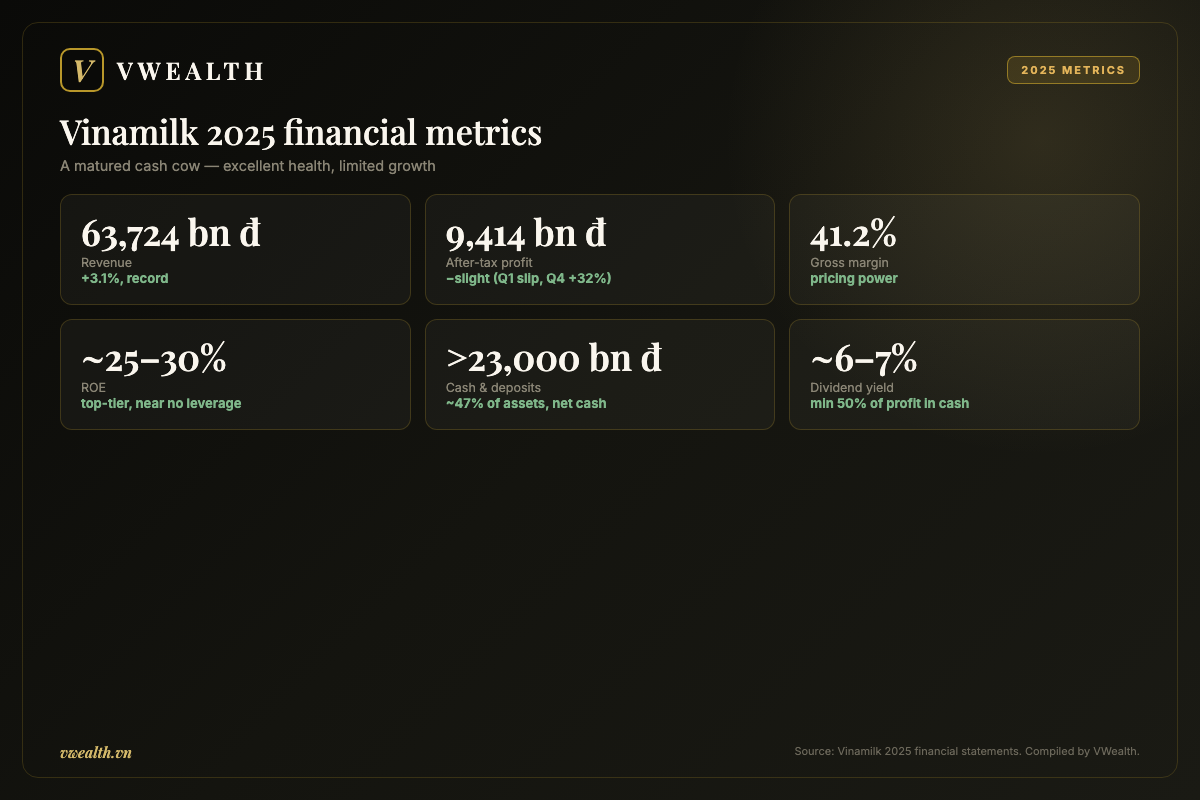
If you want to understand what Vinamilk truly is as a business, set aside the price chart and look straight at the balance sheet. There you’ll see a company most Vietnamese investors “know by name” but few truly understand why it’s valued as a classic defensive asset. In 2025, Vinamilk recorded consolidated revenue of 63,724 billion dong, up 3.1% and the highest in the company’s history; after-tax profit reached 9,414 billion dong, down slightly versus 2024 mainly due to the Q1 slip, but the second-half recovery was very clear. In Q4 2025 alone, after-tax profit reached 2,827 billion dong, up nearly 32% year on year and the highest quarter since Q4 2021. This isn’t the number of a dying business, nor a booming one. It’s the portrait of a matured “cash-printing machine,” and the whole VNM investment story fits in that paradox.
In this section, you and I will dissect four slices: what advantage the number-one dairy position gives Vinamilk, why the “clean” balance sheet makes the company a foundation for high, sustainable dividends, where the fatal weakness of saturated growth lies, and finally the most dangerous lever on the margin — imported raw milk-powder prices.
Number-one position: scale creates an advantage rivals can’t copy
Vinamilk holds about 50% market share of Vietnam’s whole dairy industry — a number that in most consumer categories, people can only dream of. To picture it: for every two milk boxes sold in the Vietnamese market, nearly one bears a brand of the Vinamilk ecosystem. And more important than the share number is how that share is held.
The first advantage is scale. When you’re the largest material buyer, you negotiate the best prices with global milk-powder suppliers. When you run 13 plants and a large-scale dairy-farm system, fixed costs are spread thin over an enormous output, pulling the cost per product unit down to a level smaller rivals can’t reach. This is the textbook “economies of scale,” but at Vinamilk it’s a daily reality.
The second advantage — and in my view the hardest to copy — is the distribution system. Vinamilk covers over 200,000 retail points nationwide, from big-city supermarkets to remote grocery stores. A new dairy brand wanting to compete fairly must not only have a good product and advertising budget, but also build a network reaching every alley — a task costing decades and thousands of billions of dong. That’s Vinamilk’s real “economic moat”: not a technology secret, but a physical network and a brand engraved into consumption habits across generations. Forbes Vietnam ranked Vinamilk atop the Top 25 leading brands of 2025, and that brand value isn’t on paper — it’s in the fact that when a Vietnamese mother thinks of “milk for my child,” the first name that pops up is usually Vinamilk.
Remember this: the number-one position doesn’t guarantee growth, but it guarantees stable profitability and resilience. That’s why even with revenue barely nudging, Vinamilk’s margin is among the highest of listed consumer businesses.
The “cash cow” and a rarely clean balance sheet
In the famous BCG matrix, a “cash cow” is a business with high share in a slow-growing market — it doesn’t need much investment to expand, so it produces abundant cash for owners to take home. Vinamilk is a nearly perfect illustration of this concept, and this is the part you need to understand best if you plan to buy VNM.
Let’s start with the margin. For full-year 2025, the consolidated gross margin reached 41.2%, only about 20 basis points below the year-earlier period. For comparison: many manufacturing businesses struggle to keep gross margin above 20%, while Vinamilk prints over 41 dong of gross profit on every 100 dong of revenue, year after year. A sustainably high gross margin is a sign of pricing power — the ability to sell high while customers still buy, coming from the brand and position mentioned above.
Next is return on capital. Vinamilk’s ROE has held in a very high zone for many years, usually around 25-30% — meaning every 100 dong of shareholder capital generates 25-30 dong of profit a year. This number is especially impressive because it’s achieved with almost no debt leverage. Most businesses push ROE high by borrowing; Vinamilk does the opposite — high ROE comes from actual business efficiency, not financial engineering.
And here’s the most beautiful part of the picture — the balance sheet. At end-2025, Vinamilk held over 23,000 billion dong in cash and bank deposits, most of it interest-earning; deposit interest alone in 2025 brought over 1,370 billion dong. As of end-Q1 2025, this cash and deposits accounted for nearly 47% of total assets (total assets about 55,014 billion dong, equity about 37,622 billion dong). More importantly, the company has almost no significant debt — that is, Vinamilk is in a “net cash” position: cash and equivalents far exceed borrowings.
A business holding nearly a billion USD in idle cash in the bank and almost no debt isn’t a business “thirsty for capital to grow.” It’s a business that has run out of places for large reinvestment, so it chooses to return money to shareholders. This is both a strength and a confession of growth limits.
This very financial structure is the foundation for the high, sustainable dividend policy — what makes VNM dubbed a “defensive stock” or “defensive star.” Vinamilk maintains paying cash dividends averaging 40-50% of after-tax profit annually; the 2024 cash dividend was 43.5%. For 2025, the company targets cash dividends of at least 50% of consolidated after-tax profit, with the remaining dividend of 1,850 dong/share (18.5% ratio) with the record date at end-June 2026. Each payment, Vinamilk withdraws nearly 6,000 billion dong of real cash from the vault to transfer to shareholders’ accounts. When you buy VNM, you’re not buying a growth stock — you’re buying a steady dividend-income stream guaranteed by a rarely clean balance sheet on the exchange.
The chart below summarizes the core 2025 financial metrics for you to quickly grasp this cash cow’s “condition.”
The fatal weakness: the machine has hit the growth ceiling
Now to the part a stock salesperson won’t tell you, but I’m obliged to. All the beauty of a cash cow comes with a price: being a cash cow, by definition, means you’re in a slow-growing market. And that’s the Achilles’ heel of the VNM investment story.
Look again at the revenue figure: up 3.1% in 2025. That’s low single-digit growth — perhaps not even keeping pace with Vietnam’s nominal GDP growth. The root problem is the market: Vietnam’s dairy industry is nearly saturated. About 81% of Vinamilk’s revenue comes from the domestic market, and Vietnam’s per-capita milk consumption has slowed after the boom phase. The population structure no longer supports it as before: a falling birth rate means the core customer group — milk-drinking children — no longer expands fast. When the market pie stops growing, a leader with 50% share like Vinamilk finds it very hard to grow fast: you can’t take more share from yourself.
Competitive pressure grows fiercer. You need to name three rival groups gnawing at Vinamilk’s turf:
- TH True Milk — attacking straight into the premium “clean fresh milk” segment with a large-scale dairy-farm brand story, right in the segment growing faster than the rest of the industry.
- Nutifood and other domestic brands — competing fiercely in children’s powdered milk and specialty nutrition, where margins are attractive but require continuous R&D and marketing investment.
- Imported milk — premium powdered-milk brands from Europe, Australia, New Zealand still favored by some high-income consumers, creating a ceiling for Vinamilk’s premiumization ambition.
Vinamilk isn’t sitting idle. Its strategy is portfolio premiumization, pushing product innovation and expanding exports — export revenue growing double-digit in 2025 is a notable bright spot. But you need to be clear-headed about scale: exports and overseas currently account for only about 19% of revenue, so however fast they grow, it’s not yet enough to pull the whole group into a high-growth orbit. Bluntly: saturated growth isn’t a temporary risk but a structural trait of this business. This is why many securities firms, despite recording Q4 profit up over 30%, only give a “neutral” recommendation on VNM — the market values it as an income asset, not a growth story.
The most dangerous lever: the margin and the imported milk-powder price cycle
If saturated growth is the structural weakness, then imported raw milk-powder prices are the variable making Vinamilk’s profit swing strongly quarter to quarter — and you must understand it to not panic each time a bad quarter appears.
Vinamilk’s operation is essentially a processor’s: they buy input materials — especially whole milk powder (WMP) and skimmed milk powder — mostly imported from the world market, then process and sell finished products domestically. Vinamilk’s domestic dairy farms only meet part of the need; most material still depends on imports. That creates a fatal timing gap: input prices swing with the global commodity cycle, while retail output prices in Vietnam are fairly “rigid,” hard to raise fast. When world WMP prices rise, Vinamilk’s costs jump immediately, but they can’t instantly raise milk prices to consumers — and the gross margin is squeezed.
You see this mechanism clearly in the 2025 data itself. Q1 2025 was the weakest quarter, dragging full-year profit down, partly because of high material costs (milk powder, plastic packaging). In Q2 2025, the gross margin recovered to about 42% (up 170 basis points versus Q1) as input prices cooled. By Q1 2026, the gross margin further improved to 42.7% from 40.1% in the year-earlier period. The same business, the same portfolio, but the margin dances to the rhythm of global commodity prices — that’s precisely the input-cost cycle risk.
What’s the practical consequence for you, the stock buyer? Three things to remember:
- Don’t judge Vinamilk by one quarter. A quarter of falling gross margin may just be WMP prices at the cycle peak, not the business weakening. Conversely, a spike-profit quarter may come from temporarily cheap inputs.
- Falling world milk-powder prices are the biggest tailwind for VNM’s profit. When the commodity cycle turns down, Vinamilk’s margin can widen strongly without the company doing anything more — and vice versa.
- The strategy of shifting to fresh milk and premiumization is a double-edged sword. It helps Vinamilk cling to the growth segment and rely less on imported powder, but some fresh-milk lines have lower gross margins, pressuring the medium-term margin.
To reduce risk, Vinamilk proactively maintains material inventory at a safe level and plans purchases ahead of the price cycle. But however deft, no processor can fully separate itself from global input prices. This is a risk you must accept owning VNM — and also a variable you should watch closely if you want to time buys and sells.
Condition summary: healthy but mature
Combining the four slices, Vinamilk’s financial portrait is fairly clear and consistent. This is an industry leader, high-margin, with ROE among the exchange’s best, a clean balance sheet with tens of thousands of billions in net cash and almost no debt — one of the most reliable cash-generating and high-sustainable-dividend machines on Vietnam’s stock market. At the same time, it’s a business that has hit the domestic growth ceiling, faces increasingly fierce competition and must strain against the imported milk-powder price cycle. Financial health: excellent. Growth prospect: limited. The whole challenge of valuing VNM is weighing those two opposing sides.
A business with such a financial profile is usually viewed very differently by the market — some see a “dividend safe” to hold long-term, others dismiss it as a “sleepy” stock lacking a breakout story. And precisely how the market receives, values, reacts to each quarter’s results is what decides whether you make money. That’s what we’ll analyze right after.
Market reception
If there’s a question any investor must ask before buying VNM, it’s not “is Vinamilk a good business” — nearly everyone agrees it’s good — but a much thornier one: “Why does such a good business have a share price moving sideways, even falling, for many years?” At 59,000đ on 19 June 2026 (VWealth plugin data), VNM trades in a price zone that even its long-term shareholders scratch their heads at. This is a stock once dubbed the “national stock,” once a growth superstar of Vietnam’s market, now classed among the “sleepy” — few waves, little expectation, little youth interest. In this section, you and I will dissect that paradox: how the market is actually valuing VNM, and what the market’s “boredom” with this stock says about the nature of the investment you’re about to put money into.
I’ll state the conclusion upfront so you have a reference frame reading on: VNM today is no longer a growth stock. It has transformed into an income stock — the kind you buy not expecting the price to double, but to receive a steady, high, reliable dividend stream year after year. Understanding this nature shift is the key to not being disappointed — and to not falling into a trap.
The core point: VNM is a “dividend-printing machine”
Let’s start with the most important thing, what makes VNM’s entire current investment thesis: cash dividends. If you remember only one thing about this stock, remember that Vinamilk is one of very few businesses on HOSE paying high, steady, uninterrupted cash dividends for over a decade.
Specifically with numbers: in 2024, VNM paid cash dividends totaling 43.5% — that is 4,350đ per share at 10,000đ par. In 2025, the company continued paying in multiple rounds, including a 25% advance and the remaining payment from the prior year, bringing the total dividend flow received around 2,850đ plus carry-over rounds. The crux isn’t a single year’s number, but the continuity: VNM has nearly never “forgotten” to pay cash dividends, even in years of falling profit. This is a sign of a leadership that treats paying shareholders as a commitment, not a choice.
Now the calculation that makes you pause and think. Take the cash dividend in the 3,500–4,350đ a year zone, divide by the 59,000đ price, and you get a dividend yield of about 6–7%. This number isn’t mere theory — international data sources record VNM’s dividend yield touching over 7% at times, and the 2026 projection is still around 5.8–6%.
A 6–7% dividend yield from an industry leader, steady cash flow, nearly no net debt — this is what defensive investors hunt like hunting gold.
To show its appeal, place it beside bank savings rates. As of mid-2026, large banks’ 12-month deposit rates hovered around 4.5–5.5%/year. That is, VNM’s dividend alone is higher than savings interest — and that’s before counting the possibility of the share price rising. Savings keep the principal still; holding VNM gives you both a cash flow higher than bank interest and part-ownership of a business with a brand, real assets, and the ability to appreciate with long-term inflation.
This is why VNM is a classic investment for two groups: defensive investors and those preparing for retirement. If you can’t bear strong volatility and want an asset generating a “second salary” annually without selling shares, VNM’s dividend structure is designed almost for you. A retiree holding 10,000 VNM shares would receive about 35–43 million dong of cash a year from dividends alone, steady like a salary — and that’s a cash flow independent of whether the market rises or falls that year.
- Steadiness: paying cash dividends continuously for over 10 years, even in falling-profit years.
- Height: a 6–7% yield superior to the 4.5–5.5% savings rate.
- Durability: strong operating cash flow, little debt, enough to feed dividends without borrowing to pay.
- Defensiveness: milk demand is little elastic to the economic cycle, helping keep profit and dividends stable.
I want you to remember a principle: in the stock world, a high and RELIABLE dividend stream is a form of risk “cushion.” When the share price falls, the dividend yield automatically rises, drawing buying from dividend-hunting investors, forming a psychological floor for the price. For VNM, whenever the price falls to the zone making the yield touch 7%, history shows income money tends to return to support the price.
Valuation: is VNM cheap, or a trap?
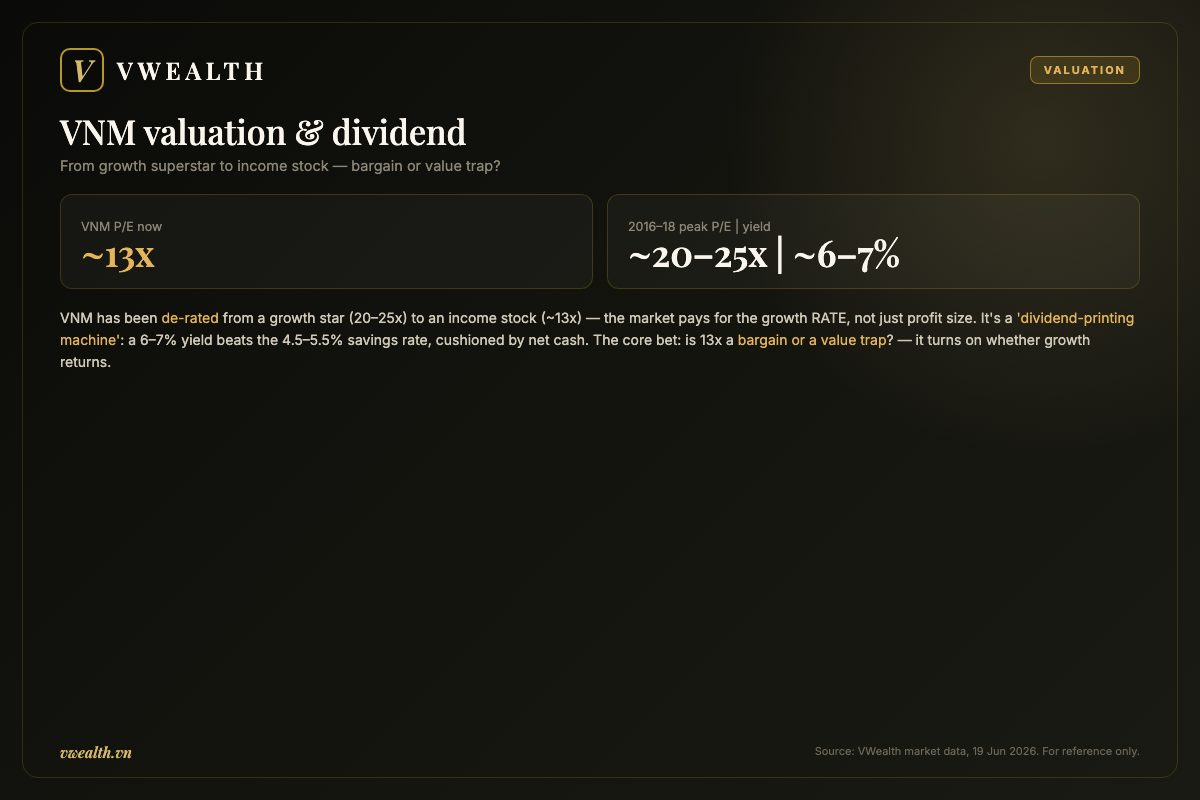
Now we enter the part many investors fiercely debate. At 59,000đ with 2025 after-tax profit of 9,414 billion dong and about 2.09 billion shares outstanding, earnings per share (EPS) fall in the 4,400–4,500đ zone. Dividing the price by EPS, you get a P/E of about 13x. Some international institutions calculate VNM’s P/E slightly higher, around 15.8–17.4x depending on the profit calculation and timing, but whichever number, the conclusion is consistent: VNM is valued much lower than its own past.
This is a point to view historically. In the 2016–2018 golden age, when Vinamilk still grew revenue double-digit and was a symbol of the “Vietnamese middle class drinking more milk” story, the market was willing to pay this stock a P/E of 20–25x. Investors then valued VNM as a growth machine: paying a high price today to buy much larger profit tomorrow. Now, at a P/E of about 13x, the market says a harsh thing: “I no longer believe VNM will grow fast.”
| Period | VNM’s position | P/E the market paid | Implication |
|---|---|---|---|
| 2016–2018 | Growth stock, VN-Index “star” | ~20–25x | Paying high for future expectations |
| 2019–2022 | Gradually slowing growth, margin pressured by material prices | ~17–20x | Expectations cooling |
| 2023–2026 | Income stock, single-digit growth | ~13–16x | Re-rated as a defensive stock |
This “de-rating” is the core phenomenon you must understand. When a business shifts from a growth phase to a mature phase, the market automatically lowers the valuation multiple it’s willing to pay — even if absolute profit is still stable or nudging up. VNM’s profit today isn’t bad at all; the issue is it no longer grows fast. And the stock market, being a future-discounting machine, pays for the growth rate, not just the profit size.
So the million-dollar question: at a P/E of 13x, is VNM a bargain (forgotten value) or a value trap? I’ll present both sides for you to weigh.
The “it’s a bargain” argument: An industry leader, one of Vietnam’s strongest brands, high gross margin, abundant cash flow, little debt, paying a 6–7% dividend, yet given only a P/E of 13x — that’s the valuation of a “dying” company, while VNM clearly isn’t dying. If the company just regains slight growth momentum — thanks to a Gen Z-oriented rebranding strategy, export expansion, or premium segments — the market could re-rate the multiple, and you profit from both price appreciation and dividends while waiting.
The “it’s a value trap” argument: A value trap is when a stock looks “cheap” by metrics, but is cheap for a reason — and will keep being cheap, or cheaper. Vietnam’s dairy industry faces young-population saturation, fierce competition, imported-material price pressure. If VNM’s growth has truly hit a structural ceiling, then a P/E of 13x isn’t “cheap” but “fair-priced” for a sideways business. Then, someone buying because they think it’s “cheap” may be stuck for years with a stock that doesn’t budge, though dividends are still paid.
The difference between “bargain” and “value trap” isn’t in the current valuation, but in the question of whether future growth returns. That’s the core bet when you buy VNM today.
Price behavior: from growth superstar to a “forgotten” stock
To feel the full paradox, look back at the price path. After adjusting for splits and stock dividends, VNM’s 2017–2018 historic peak equals a price zone very high versus now — the market then saw VNM as a must-have asset in every portfolio. Then from that peak, the stock entered a multi-year correction and sideways cycle, despite the business still profiting steadily, still paying dividends, still holding the number-one position.
Why does the market “get bored” with a stock still performing well? The answer lies in crowd psychology and capital-allocation mechanics. Money on the stock market tends to flow to where the most attractive growth story is — in recent years banks, industrial-park real estate, technology, retail. VNM, with a too-familiar story and single-digit growth, is no longer where speculative money goes. A stock needs a “new story” to attract new money; VNM keeps telling an old story — good, but old.
- The “no catalyst” effect: no breakout news to draw speculative investors, so the price lacks propulsion.
- Too-large size: the enormous cap makes VNM hard to move fast — moving a large ship needs more force than a small boat.
- Generational competition: young investors favor “hot” stocks, seeing defensive stocks as boring.
- Structural de-rating: as analyzed, the valuation multiple is permanently lowered as the business matures.
You need to understand that “price sideways for years” doesn’t mean “a bad investment.” If you held VNM through the sideways period but reinvested the 6–7% dividend each year, your total real return is still positive and accumulates significantly — it just comes from dividends rather than price appreciation. This is what new investors often miss: with income stocks, you don’t measure success by the price chart, but by total return (price plus dividends).
Foreigners: a prolonged retreat and pressure on the price
An indispensable piece explaining VNM’s stagnant price path is foreigners’ behavior. VNM was once a “full-room” stock — the foreign ownership ratio always at the allowed ceiling — and one of the most favored names by foreign investors on HOSE. Large institutional shareholders like F&N (Singapore) and Platinum Victory (of Jardine) hold controlling ratios, and their every move affects price sentiment.
The problem is that in recent years, foreigners have generally net-sold VNM. As de-rating happened and the growth story faded, foreign funds proactively cut their weight, shifting capital to markets or stocks with higher prospects. Prolonged foreign net-selling is a direct headwind on the price: whenever domestic demand pushes the price up, foreign selling creates a ceiling. This is part of why VNM struggles to break out despite stable business fundamentals.
When a once-full-room stock shifts to having room left because foreigners sell out, that’s a signal the market is re-valuing the long-term prospect — not an immediate crisis, but a systematic lowering of expectations.
However, you should read this signal both ways. Foreign net-selling is both a risk (price pressure, lower expectations) and a potential opportunity: when selling pressure exhausts and if a growth catalyst appears, returning foreign money could reverse the trend very fast, because VNM is still a high-liquidity, transparent stock qualifying for index-fund baskets. History shows whenever F&N or Platinum Victory move to buy more rather than sell, VNM’s price usually reacts positively.
So what is the market telling you?
Combining all the pieces — high steady dividends, P/E lowered to 13x, price sideways for years, foreign net-selling — the picture of the market’s reception of VNM emerges surprisingly clear and consistent. The market doesn’t “hate” VNM; the market simply no longer sees it as a growth stock, and has re-valued it as an income, defensive, mature stock.
This leads me to the most important conclusion of this section, which I hope you engrave: VNM suits those seeking dividends and safety, not those seeking fast price gains. If you put money into VNM expecting the price to double in one or two years, you’ll almost certainly be disappointed and sell in frustration. But if you buy VNM the way people buy a rental property — not expecting the price to soar, but to enjoy a steady cash flow and hold a quality asset over time — then this stock can be a solid foundation brick for your portfolio.
- Suitable if you: prioritize dividend cash flow, can bear a sideways price, invest long-term, have a defensive mindset, prepare for retirement.
- Not suitable if you: seek short-term waves, expect strong price gains, lack patience for a “sleepy” stock.
Of course, every argument about dividends and valuation stands on one foundation: the health of Vietnam’s dairy industry and Vinamilk’s position in it. A 6–7% dividend is only sustainable if profit is sustainable; and profit is only sustainable if the dairy industry still has room and VNM still holds its share. Whether a P/E of 13x is a “bargain” or “value trap” also depends entirely on whether this industry still grows or has hit the ceiling. So before your final decision, we need to enter the next section to examine the big picture — the context of Vietnam’s dairy industry — which decides whether this dividend-printing machine still runs well in the next ten years.
Economic and Vietnam’s dairy-industry context
To correctly value a stock like VNM, you can’t look at the 9,414-billion-dong profit or the ~13x P/E in isolation. An industry leader like Vinamilk ties its fate tightly to the “rail” it runs on: Vietnam’s dairy industry. And this is the crucial part many individual investors skip. You can buy a wonderful company, well-managed, strong brand, but if its very industry is entering a saturation phase, your share-price growth expectation must also be adjusted to reality. Let’s dissect the industry picture frankly.
Size and growth rate: a machine slowing down
Vietnam’s dairy industry is still a large, valuable market. Per IMARC Group, Vietnam’s dairy-market size reached about 5.71 billion USD in 2024 and is forecast to grow well long-term. But this headline number is misleading. What you should focus on more is that the growth rate is slowing. Per Euromonitor’s forecast, Vietnam’s dairy-market value is expected to grow only about 3.0%/year compound in 2024–2029, down from 4.2% in 2018–2024. In other words, the pie is still growing, but it grows ever slower.
Why? The answer is that the urban market — contributing most of the revenue and best margins — has nearly hit saturation. People in Hanoi, HCMC, Da Nang have drunk milk steadily for years. Vietnam’s per-capita milk consumption, though still lower than many developed countries, has nearly exhausted the easy growth room — the “those who haven’t drunk now drink” kind — in urban areas. Future growth must come from much harder sources: deeper penetration into rural areas (where purchasing power is low, margins thin), or making each person drink more and drink pricier products.
This is a reality you must internalize holding VNM: the easy double-digit growth era of the past decade is over. Vinamilk is present everywhere, so it growing faster than the whole industry is extremely hard — when you already hold about half the market, each percentage point of share gained costs dearly.
Two-sided demographics: a double-edged sword shaping the dairy future
If you could choose only one factor to understand Vietnam’s dairy future, choose demographics. And interestingly, this factor isn’t simply good or bad — it’s a very clear double-edged sword.
The unfavorable edge: falling birth rate, the children’s-milk segment shrinks
Vietnam faces a long slide in the birth rate. The total fertility rate in 2025 fell to about 2.01 children/woman — below the replacement level of 2.1 and continuing to fall. The crude birth rate in 2025 was about 14.61 per 1,000 people, down nearly 1.8% year on year. In large cities like HCMC, the birth rate is even far below the national average. The cost of raising a child to age 22 is estimated at about 15 million dong/month in a country with still-modest average income — a direct barrier pushing many young couples to delay or have fewer children.
The consequence for the dairy industry is very direct: fewer children means demand for infant formula and part of young-child liquid milk will shrink over time. This was a high-margin segment and Vinamilk’s historical battleground with foreign brands like Abbott, Nestlé, FrieslandCampina. A market where the number of “newborn customers” each year keeps falling is a structural headwind, not a temporary issue of one bad business quarter. You need to see this clearly: a core traditional part of VNM’s portfolio faces long-term pressure.
The favorable edge: an aging population and rising income open a new gold mine
But demographics also simultaneously gift the dairy industry a big opportunity at the other end of the age pyramid. Vietnam is aging at one of the region’s fastest rates. The 65-and-over population already accounted for about 9% in 2024 and this share will rise strongly in coming decades. In parallel, the middle class swells and disposable income steadily rises.
These two trends resonate into a promising segment: nutritional milk for adults and the elderly — calcium-boosting milk against osteoporosis, milk for diabetics, immunity-boosting milk, medical nutrition. These are high-value, good-margin products, with an ever-growing pool of potential customers. When a retiree has a pension or well-off children caring for them, spending a few hundred thousand a month on nutritional milk is a willing outlay. In other words, Vietnam’s dairy industry is witnessing a focus shift — from “raising children” to “caring for parents.”
The core point to remember: Vinamilk’s future growth isn’t in selling more milk to children — this group is shrinking — but in the company’s ability to successfully pivot to the adult, elderly and premium segments. This is the business’s biggest gamble.
Competition: the increasingly heavy crown
Vinamilk is undisputedly number one, holding about half of Vietnam’s dairy market, far ahead of rivals. But this leading position is being challenged from many sides at once, and you shouldn’t think “number one” is an impregnable shield.
- TH True Milk has positioned strongly in the “clean” fresh-milk, organic and premium segment, continuously grabbing share in cities — right in the good-margin area Vinamilk wants to keep.
- Nutifood is increasingly aggressive, expanding scale and making acquisitions to cement its position, especially in specialty nutrition and adult milk — the growth segment everyone eyes.
- FrieslandCampina (Dutch Lady) remains a heavyweight with about a quarter of the market in some segments.
- Imported milk from New Zealand, Australia, Europe, Japan, Korea is increasingly accessible via e-commerce and free-trade agreements (EVFTA, CPTPP cutting tariffs), especially in the premium children’s-powdered-milk segment — where the “foreign is better” psychology is still strong.
The consequence of this fierce competition is that Vinamilk’s sales and marketing costs must stay high to protect its share. When an industry slows but the number of players doesn’t drop, businesses must “burn money” to hold position — and that erodes the margin. This is why you see Vinamilk spending heavily on advertising and rebranding over the past few years.
World milk-powder prices: a factor beyond control affecting the margin
This is a piece individual investors often forget, but which directly impacts Vinamilk’s profit each quarter. A large part of Vietnam’s dairy input materials — especially whole milk powder (WMP) and skim milk powder — must be imported, because the domestic dairy herd doesn’t yet meet the need. That means Vinamilk’s gross margin is directly sensitive to world milk-powder prices, a variable leadership nearly can’t control.
Milk-powder prices are set via Global Dairy Trade (GDT) auctions. In 2026, this market is in a clear price-rise phase: WMP prices bounced to around 3,400–3,614 USD/ton, with the overall GDT index rising up to 6.7% in one session, driven by tightened seasonal supply and falling European WMP output. For you — a VNM holder — this is bad news on the cost side. When imported milk-powder prices rise, if Vinamilk can’t pass the full increase into retail prices (which is very hard in a competitive environment with weak purchasing power), the gross margin is squeezed.
Conversely, when the world milk-powder price cycle turns down, it’s a “boost” to Vinamilk’s profit without the company doing anything more. Understanding this mechanism helps you not panic when you see a quarter’s margin shrink — sometimes it’s just the material-price cycle, not the business weakening.
Consumption trends: organic, low-sugar, plant protein
The final layer of the industry picture is the shift in consumer taste, especially the urban middle class — the highest-value customer group. Several trends are reshaping the market:
- “Clean,” organic, farm products: consumers are willing to pay more for organic milk, A2 milk, standard-certified farm milk. This is both an opportunity (high margin) and a challenge (requiring large investment in material zones).
- Low-sugar, healthy: worries about diabetes and obesity raise demand for low-sugar, no-sugar, probiotic-added milk. Vinamilk responded by restructuring and launching over 125 new products in the recent period.
- Plant protein (plant-based): plant milk, soy milk, oat milk are emerging as a substitute segment, especially for young customers concerned about health and environment. This is both a portfolio-expansion opportunity and a threat “eroding” part of the traditional cow-milk share.
In sum, Vietnam’s dairy-industry context is a picture with depth: a large but slowing market, with demographics both taking away (children) and gifting (elderly), increasingly fierce competition, margins pressured by imported-material prices, and rapidly shifting consumer taste. Vinamilk stands amid that storm with the number-one position — but that position is both a shield and a burden to defend.
VNM stock trend prediction
After understanding the business and the industry context, you’ll naturally ask: so what does Vinamilk’s road ahead look like, and what does that mean for the share price around 59,000 dong now? This section analyzes the company’s response strategy and sketches three future scenarios. Let me stress first: this is analysis of conditional possibilities, not a prophecy. The goal is to help you picture the reasonable value range, not to fix a “correct” number.
Vinamilk’s response strategy: what is the business doing?
What’s commendable is that Vinamilk’s leadership doesn’t sit idle waiting for the industry to saturate. They’re deploying a series of strategic spearheads to find new growth momentum:
- Rebranding and refreshing the portfolio: Vinamilk carried out a large-scale brand-identity overhaul and reform, launching over 125 new products to fight the “aging” image and win back young urban customers — the group being pulled by TH, Nutifood and imported milk.
- Pushing exports: this is a bright driver. Vinamilk’s export revenue grows well in key markets including the Middle East, Japan, Korea, China and Southeast Asia. The Middle East especially emerges as consumers there increasingly favor Vinamilk products. Exports help the company escape the growth limit of the saturated domestic market.
- Focusing on adult milk and premium products: as analyzed, this is a growth segment thanks to the aging population and rising income. Vinamilk invests in specialty nutrition, elderly milk, organic products — high-margin products helping offset the shrinking children’s segment.
- The beef segment — a new billion-dollar gamble: through the Vinabeef joint venture with Sojitz (Japan), Vinamilk steps into high-tech beef processing in Tam Dao (Vinh Phuc). This complex is expected to start contributing meaningful revenue from 2026, opening an entirely new business beyond dairy. This is a revenue-diversification effort to reduce dependence on the slowing dairy industry.
The point to note: these strategies are all in the right direction, but all need time to prove and carry execution risk. Exports are sensitive to geopolitical and FX swings; the beef segment is a new field, thin-margin, with competition entirely different from dairy; rebranding costs a lot and doesn’t necessarily reverse the share-loss trend. So VNM’s future depends on whether these gambles “bear fruit” on schedule.
Three scenarios for VNM stock
Based on the industry conditions and strategy above, let’s sketch three scenarios with trigger conditions and price consequences. Read all three for a balanced expectation, rather than anchoring only on the scenario you desire.
Positive scenario: regaining growth momentum, improving margin
Trigger conditions: the rebranding strategy works, the adult and premium milk segments accelerate; exports maintain double-digit growth in the Middle East and Southeast Asia; world milk-powder prices cool in coming years helping the gross margin widen; Vinabeef starts contributing significant revenue from 2026 onward; domestic purchasing power recovers with the macroeconomy.
Consequence: revenue and profit return to good single-digit or near-double-digit growth. In this scenario, the market could re-value VNM at a higher P/E (multiple expansion), plus rising profit — creating a “double hit” pushing the share price clearly above the current level, toward a valuation zone notably higher than 59,000 dong. Some securities firms have set optimistic target prices in the 70,000–77,000 dong zone for the recovery scenario.
Base scenario: sideways, living on dividends
Trigger conditions: this is the most likely scenario. Vinamilk holds the number-one position, revenue grows slightly (a few percent a year, in step with the industry), profit flat or nudging slowly; the margin swings with the milk-powder price cycle but doesn’t improve sharply; share defended with high marketing cost.
Consequence: the share price swings around the current zone, the ~13x P/E maintained. In this scenario, the main return you receive comes from cash dividends at an attractive yield of about 6–7%/year, plus modest price appreciation. This is a “dividend bond” type — stable, steady, but not explosive. For many defensive investors, this is actually an entirely acceptable scenario.
Negative scenario: losing share, margin shrinks
Trigger conditions: TH, Nutifood and imported milk keep gnawing share in the premium segment; rebranding fails to retain young customers; world milk-powder prices anchor high for long, eroding the margin; the beef segment loses money or is slow to break even; a deep birth-rate fall drags the children’s-milk segment down more than expected.
Consequence: profit declines, the market loses faith in the growth prospect and re-values VNM at an even lower P/E (multiple contraction). Then the share price could fall below the current zone. However, even in this scenario, the “cushion” of high dividends and a clean net-cash balance sheet still significantly limits the drop — Vinamilk can hardly become a price disaster like debt-laden businesses. The biggest risk here isn’t “losing all the money,” but “money stuck in a sideways/slightly-falling stock for years” — the value trap.
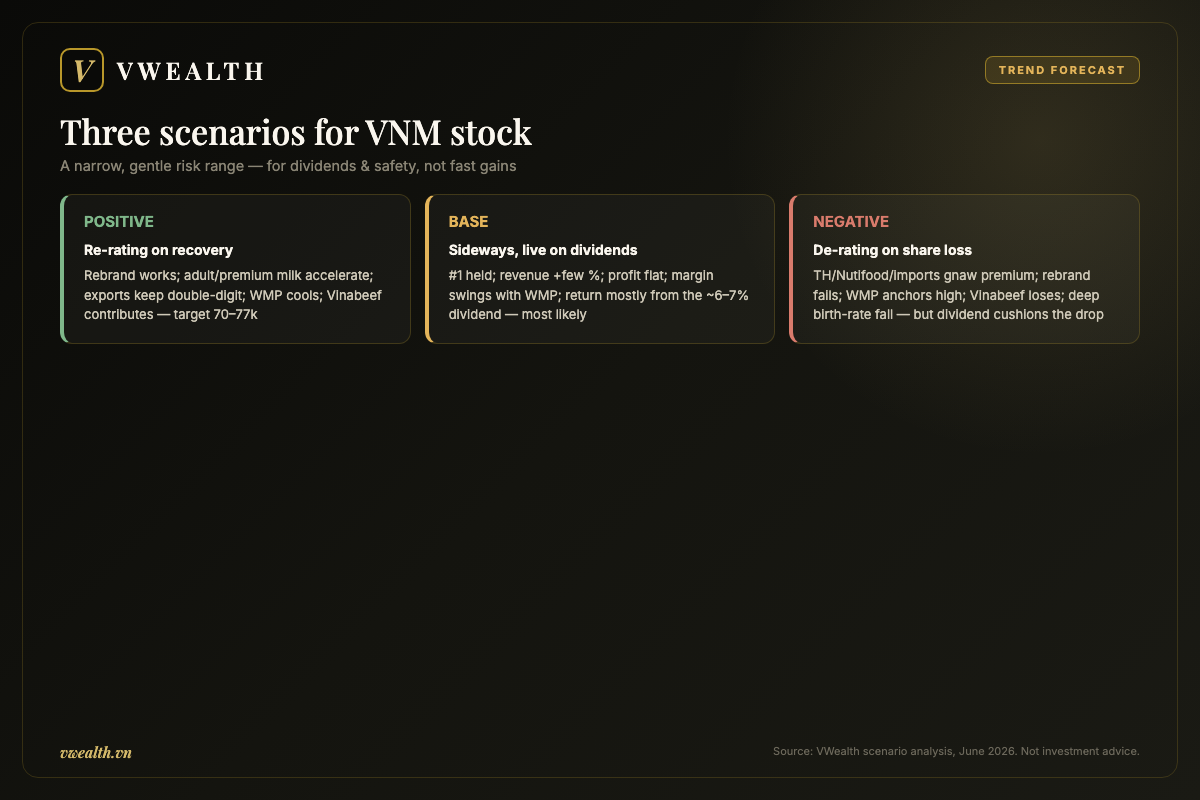
Looking at the three scenarios overall, you’ll see a very “Vinamilk” trait: a relatively narrow risk range. The upside potential isn’t too explosive, but the downside is well protected thanks to dividends and healthy finances. This is a stock with a fairly symmetric and “gentle” risk-return profile, accurately reflecting the defensive nature of an industry leader in essential consumer goods.
Should you buy VNM stock?
This is the question you truly care about, and after the whole analysis journey, it’s time to put everything on the scale honestly. I won’t tell you to buy or sell — no one has the right and enough information to decide for your own financial situation. Instead, I’ll help you clearly see both sides of the coin, then view VNM through the lens of four different investor types, for you to draw your own suitable conclusion.
Weighing pros and cons: VNM’s two clear sides
| Strengths (reasons to consider buying) | Weaknesses / risks (reasons for caution) |
|---|---|
| Absolute number-one share, holding about half of Vietnam’s dairy market — scale, brand, enormous hard-to-copy distribution advantage. | Saturated growth: the industry grows only ~3%/year, the urban market nearly full, very hard to create strong growth from an already-too-large base. |
| Strong brand, tied to Vietnamese consumers across generations — a valuable intangible asset. | Value-trap risk: the stock can move sideways for years despite “beautiful” financials, leaving your capital stuck. |
| Clean balance sheet, net cash (little debt), very safe against interest-rate swings and crises. | Fierce competition from TH True Milk, Nutifood and imported milk, eroding share in the premium segment and pushing up marketing cost. |
| High ROE, good capital efficiency, abundant and steady operating cash flow. | Sensitive to imported milk-powder prices: world WMP prices are rising (3,400–3,614 USD/ton zone in 2026) pressuring the gross margin. |
| Attractive, sustainable cash dividend, ~6–7%/year yield — one of the biggest pluses. | Unfavorable demographics for the children’s segment: the below-replacement birth rate shrinks infant-formula demand over time. |
| Reasonable valuation: ~13x P/E, not expensive for a stable industry leader. | New growth drivers (exports, adult milk, beef) need time and carry execution risk, not necessarily offsetting the shrinking part in time. |
| High defensiveness: milk is an essential consumer good, demand stable even in hard times. | Consumption trends (plant protein, plant milk) may erode part of the traditional cow-milk market long-term. |
Looking at this table, you’ll realize an important truth: VNM isn’t an absolutely “good” or “bad” stock. It’s a stock with a very clear character — high quality, safe, steady dividends, but slow growth. Every strength and weakness revolves around the same axis: stability traded for growth. The question isn’t “is VNM good or not,” but “is this trade-off suitable for you.”
VNM through the lens of four investor types
To answer whether it’s suitable or not, view this stock through four typical investor portraits. Identify which group you belong to.
- Income / dividend investor: if your goal is a steady passive cash flow — the “deposit money in a good business to receive dividends annually” type — then VNM fits your “appetite” very well. A sustainable ~6–7% dividend yield, backed by abundant cash flow and a clean balance sheet, is one of the most attractive offers on the exchange for this goal. This is the group most suited to VNM.
- Defensive / risk-averse investor: if you prioritize capital preservation, sleeping well in volatile market periods, and accept modest returns for peace of mind — VNM also fits very well. The essential-goods nature, solid finances and well-protected downside make it a “stability anchor” in the portfolio. This group is also suited.
- Long-term value investor: if you’re patient, buy good businesses at reasonable prices and hold for years, a ~13x P/E for a quality industry leader is a not-bad entry. However, you need to be especially wary of value-trap risk — cheap can stay cheap forever if growth doesn’t return. This group is relatively suited, provided you watch closely whether the new growth drivers truly bear fruit.
- Fast-growth investor: if you hunt stocks that double or triple the account in a few years, expecting explosive profit growth — then VNM is less suited. A business that already holds half the market in an industry growing 3%/year, however excellent, can hardly create the steep growth this group seeks. Your capital could profit better in smaller businesses, in booming industries. This is the group that needs to be honest with itself that VNM isn’t for them.
You see, the same stock, the same 59,000-dong price, but the “should you buy” answer differs entirely depending on who you are. A stock that’s an excellent investment for a dividend seeker could be a boring, inefficient investment for a growth hunter. The secret isn’t finding the “best stock,” but finding the “stock most suited to your own goals, risk appetite and time horizon.”
Final words: let yourself be the decider
Vinamilk is one of the highest-quality businesses on Vietnam’s stock market — that’s nearly undisputed. But “good business” and “investment suitable for you” are two different concepts. Through this whole analysis, I hope you have enough material to weigh yourself: on one side the number-one position, strong brand, clean finances, high ROE, attractive 6–7% dividend and reasonable defensive valuation; on the other a saturated industry, fierce competition, sensitivity to imported-material prices and two-sided demographics.
The final decision must come from you: what your financial goals are, what risk level you can bear, and what time horizon you invest with. Answer those questions honestly before placing an order, and never buy just because “everyone says VNM is good.”
Disclaimer: This article is produced for informational and reference-analysis purposes, and is not advice or a recommendation to buy or sell any security. The figures and forecasts may change over time and with market conditions. Investing in stocks always carries risk of capital loss. You should research thoroughly and/or consult a licensed financial advisor before making any investment decision. vwealth.vn is not responsible for any loss arising from the use of information in this article.
Research Vietnamese stocks in English with vwealth. Our AI-powered platform turns Vietnamese market data into full English analysis reports — with international payment support and a free 2-month trial for new accounts. Create your free account and read the latest reports.