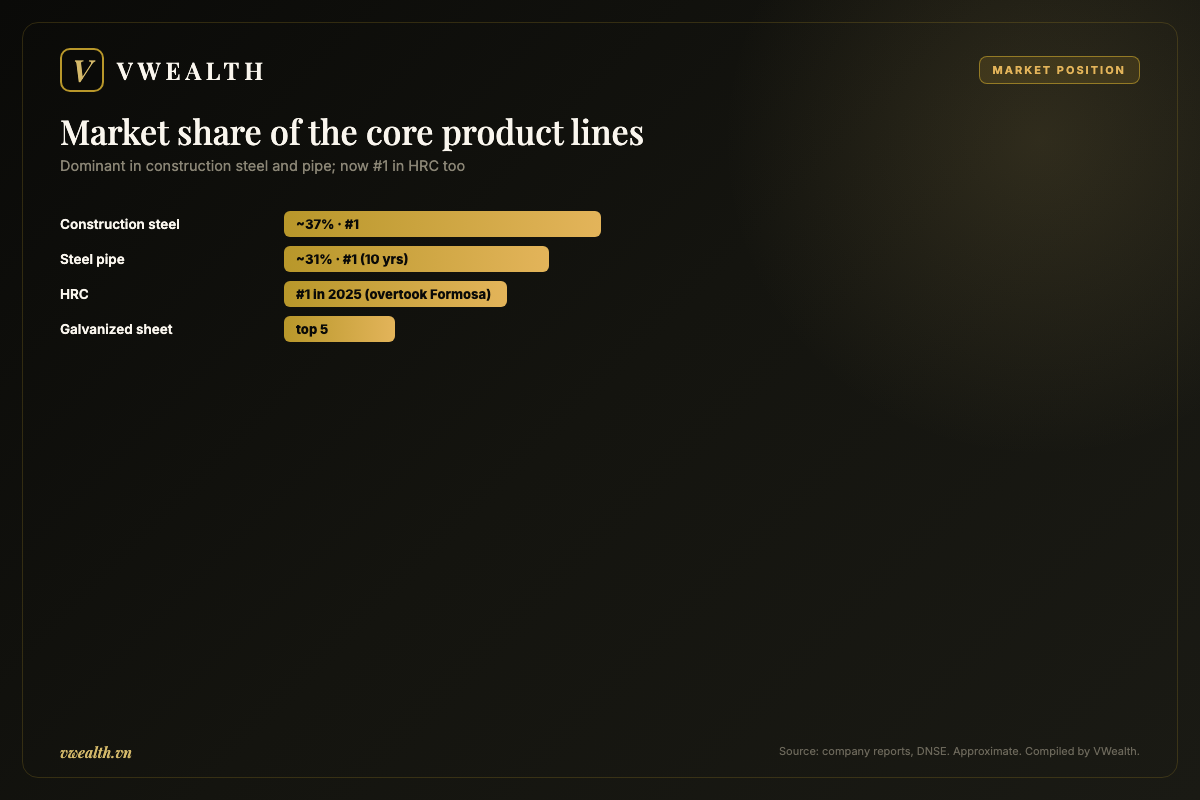
There’s a saying among Vietnamese stock investors you’ve probably heard to the point of boredom: “To know where the economy stands, look at steel prices.” And to know whether Vietnam’s steel industry is healthy or weak, people look at a single name — Hoa Phat. That’s not flattery. It’s a market-share fact: for every three construction steel bars poured into projects from north to south, more than one carries the Hoa Phat brand. The company founded by Mr. Tran Dinh Long holds about 36% of the construction-steel market and over 25% of the steel-pipe market nationwide — numbers every rival can only watch (Tap chi Cong Thuong). People call HPG the “steel king,” and it’s a title so deserved it’s almost beyond dispute.
But if you’re holding HPG shares — or weighing whether to buy in around the 23,600-dong price of 19 June 2026 — the “steel king” title is only half the story. The other half, the half that matters more to your wallet, lies in one word: cycle. HPG is not the stock of a steadily growing business like consumer goods or retail banking. It’s the stock of a wave. When the economy booms, property runs, public investment disburses in floods, and steel prices rise — Hoa Phat prints money and the stock flies. When the cycle reverses, steel margins can thin to the point where “selling a ton of steel earns less than a glass of iced tea” — and the stock falls without brakes. In 2021, the group earned an after-tax profit of up to 34,521 billion dong (Wikipedia); then in 2022–2023 profit plunged terribly as the property market froze. That is the heartbeat of a classic cyclical business.
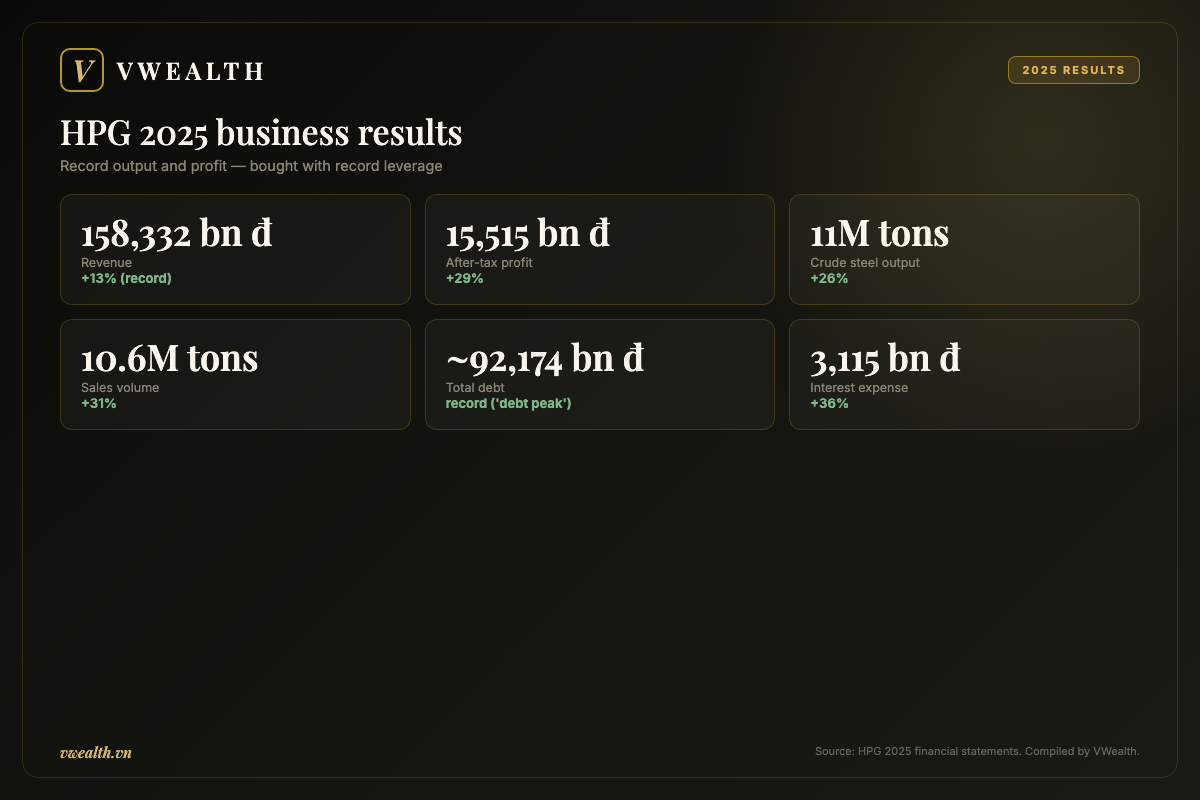
And then 2025 arrived as a spectacular comeback. Hoa Phat reported after-tax profit of 15,515 billion dong — the highest since the 2021 peak, up 29% year on year; revenue for the first time in history crossed 150,000 billion, reaching 158,332 billion dong, breaking its own old record (Tuoi Tre). The biggest driver was the gamble called Dung Quat 2 — the 85,000-billion-dong mega-project — which formally came online from September 2025, pushing full-year crude steel output past 11 million tons, up 26% (CafeF). The question you probably carry into this article is fair: record profit already, capacity about to double already — so should you buy HPG now, and if so, which kind of investor does it suit? To answer properly, we can’t start from today’s price board. We must go back to 1992, to a used-equipment shop, to understand why the “steel king” was built — and why every brick in that empire carries a message for the shareholder.
HPG market data (updated 19 June 2026)
| Current price | 23,600đ | 2025 after-tax profit | 15,515 bn (+29%) |
| Change (June) | −1.87% | P/E (2025 EPS) | ~11–12x |
| 2025 steel output | 11 million tons (+26%) | 2025 dividend | Cash returns |
Source: VWealth real-time market price data + HPG 2025 financial reports. Figures move session to session — for reference only.
History and evolution
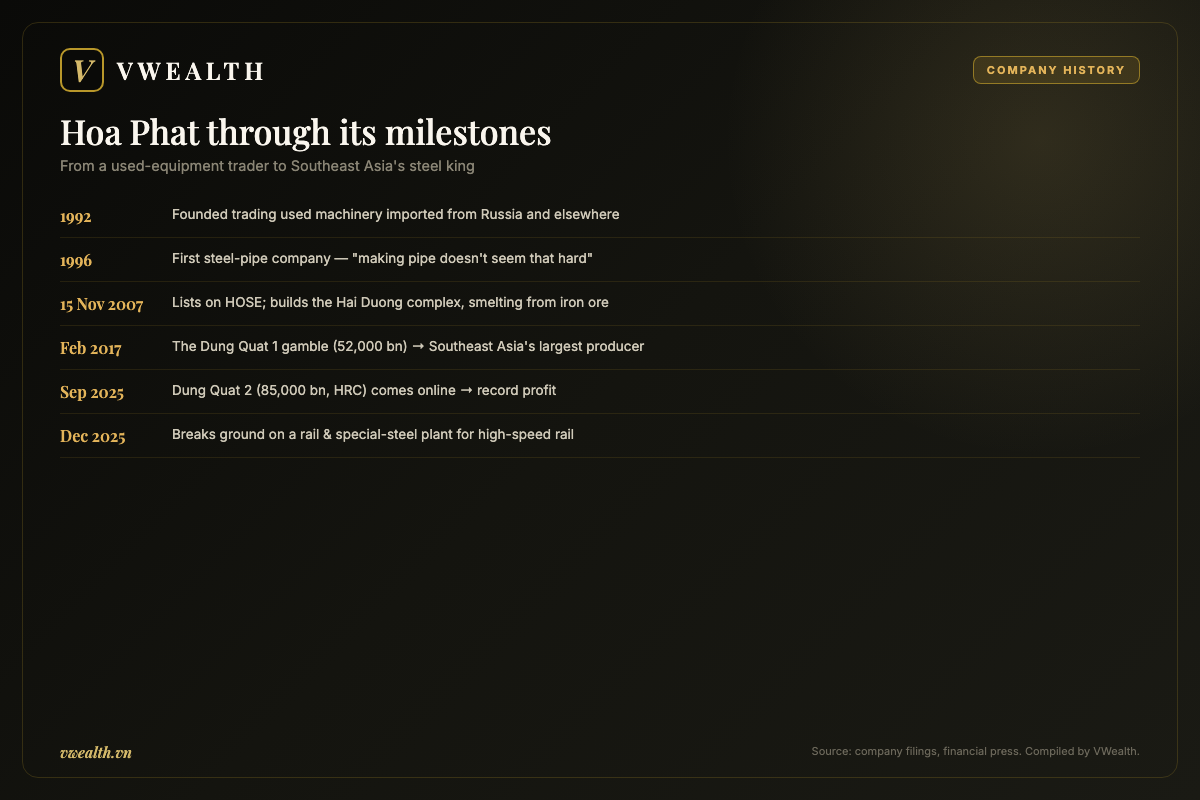
Every great empire has a beginning humble to the point of disbelief, and Hoa Phat is no exception. In 1992, when Vietnam’s economy was just tentatively stepping out of the subsidy era and the Private Enterprise Law was brand new, a young man named Tran Dinh Long, with his close friend Tran Tuan Duong, founded Hoa Phat Equipment and Spare Parts Company Limited. Their work then was nothing glamorous: trading in used machinery and construction equipment imported from Russia and other countries to resell domestically (Timviec365). The idea to start a business had actually kindled from 1990, but because the law was new, procedures cumbersome and personal capital tight, the plan was postponed until 1992 to take shape. Remember this detail, because it shaped Hoa Phat’s whole later philosophy: no rush, do it solidly, and only jump in once you understand the game.
From a used-goods trader to someone who understands what he sells
The most fascinating thing about the 1992–2000 period is not how much money Hoa Phat made trading equipment, but what they learned from that trading. When selling construction machinery, Mr. Long’s team often had to import scaffolding and steel pipes alongside to serve projects. Around 1996, looking at the coils of steel pipe he was buying and reselling, Tran Dinh Long realized something simple yet sharp: “Making steel pipe doesn’t seem that hard” (Timviec365). Instead of remaining a middleman earning a spread, why not make it yourself?
This was the pivotal mindset that followed Hoa Phat for the next 30 years: when you see whom you depend on, whom you must buy from at a high price, find a way to make it yourself. In 1995, the group set up a furniture company; in 1996 it founded Hoa Phat Steel Pipe Company using Taiwanese technology; by 2000, “construction steel” appeared in the product list for the first time; then in 2001 it expanded into refrigeration and real estate (Hoa Phat). In other words, from a trader, Hoa Phat gradually turned itself into a manufacturer — and it chose its fields not out of fashion, but because it had stood in the supply chain long enough to understand them.
For investors, the lesson from this period is clear: Hoa Phat is not a fad-following business. Each time it entered a new field — steel pipe, construction steel, and later HRC — it was when they saw margins flowing into someone else’s pocket that could have been theirs. It’s a kind of “disciplined ambition.”
The 2007 turning point: listing and the Hai Duong gamble
15 November 2007 was a life-changing milestone, not just for Hoa Phat but for the early investors who put faith in HPG. That day, HPG shares officially debuted on HOSE (Dan Tri). But listing was only the surface. The deeper — and far more important — part was the decision that same year of 2007: to build a large-scale integrated iron-and-steel complex starting from iron ore, located in Hai Duong.
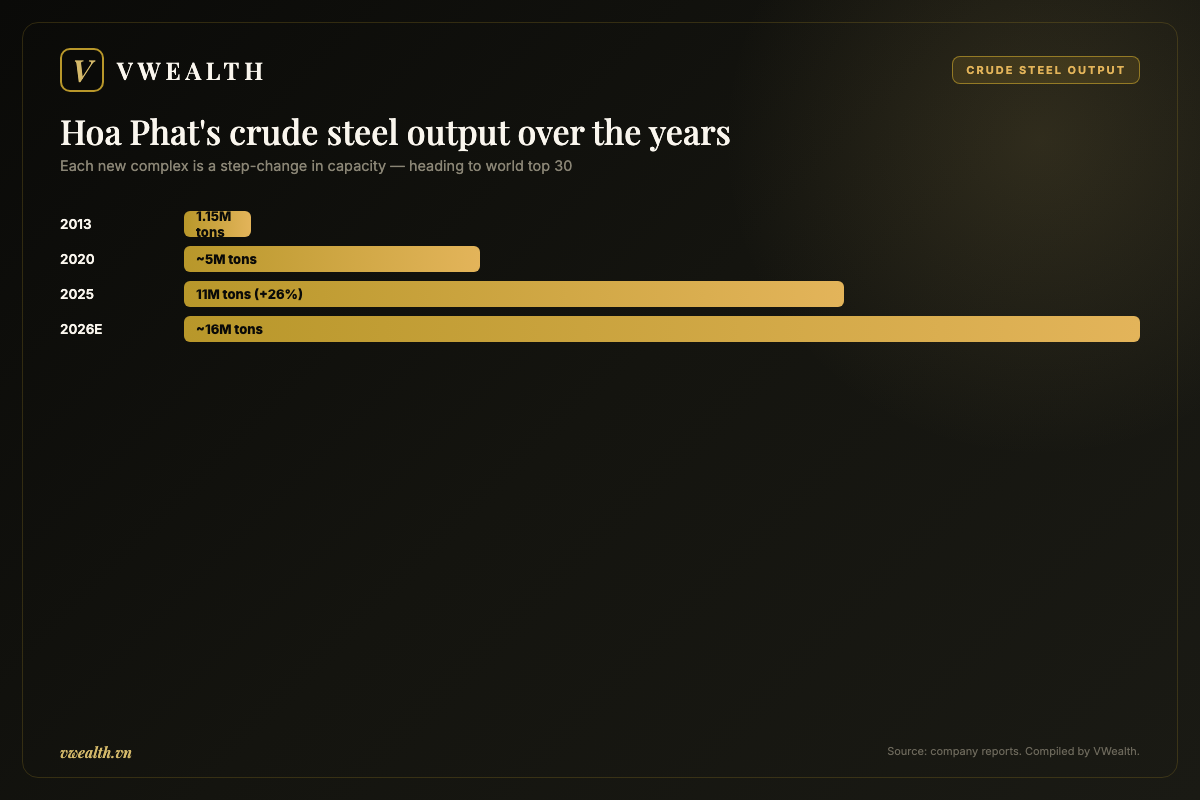
Why does the “starting from iron ore” detail matter? Because until then, most Vietnamese steel firms did only the final stage: importing semi-finished steel billet to re-roll into bars and coils. They were “re-rollers,” with thin margins and entirely passive on input prices. Hoa Phat chose a path many times harder: building blast furnaces, smelting pig iron from iron ore and coking coal, then refining it into steel — that is, mastering the entire chain from A to Z. Phase 1 of the Hai Duong complex was completed in late 2009, phase 2 in 2013, raising capacity to 1.15 million tons of steel a year (Wikipedia). This was when Hoa Phat truly became a steel smelter, no longer just a re-roller.
Why the blast furnace is Hoa Phat’s “secret weapon”
To understand why HPG stock is more durable than other steel firms, you need to grasp a technical concept that decides everything: blast furnace–basic oxygen furnace (BF-BOF) technology, instead of the electric arc furnace (EAF) many rivals use. Picture it this way for clarity:
- Electric furnace (EAF): melts scrap steel with electricity. The advantages are small investment and flexibility; the fatal weakness is that cost depends on two things that always swing wildly — scrap prices and electricity prices. When these rise, profit evaporates.
- Hoa Phat’s blast furnace (BF-BOF): smelts directly from iron ore and coking coal. Enormous investment, years to build, but once running, the production cost per ton of steel is notably lower and more stable, especially at large scale.
This is the origin of what’s called “cost leadership” — what economics calls an economic moat. In a pure-commodity industry like steel, where products are almost undifferentiated and everyone sells at the same market price, whoever produces cheapest survives longest and earns most. When steel prices hit the cycle’s bottom, high-cost electric-furnace plants must shut down because operating means losing money; but Hoa Phat, thanks to low costs, can still sell and even grab the market share of the fallen. That’s why after each steel-industry downturn, Hoa Phat emerges with a bigger slice of market share than before — from 21% in 2015 to 36–38% today (DNSE).
The biggest gamble: Dung Quat
If Hai Duong was the gamble that made Hoa Phat a steel smelter, Dung Quat was the gamble that crowned it regional king — and also the gamble that made no small number of investors hold their breath. In February 2017, Hoa Phat established Hoa Phat Dung Quat Steel Joint Stock Company, building an iron-and-steel complex right in the Dung Quat Economic Zone, Quang Ngai province, with capacity of 4 million tons a year and total investment of 52,000 billion dong (Wikipedia). That 52,000-billion figure, at the time, was larger than the market cap of many contemporary conglomerates. People called it Tran Dinh Long’s “all-in gamble,” because if the steel cycle reversed amid piled-up investment debt, the consequences could be brutal.
Dung Quat’s location was also a well-calculated move. Unlike Hai Duong deep inland, Dung Quat has a deep-water port right beside the plant — large ships carrying imported iron ore dock at the foot of the blast furnace, and finished steel ships out from there. Logistics costs drop a notch, and this is another cost advantage layered on top of the blast-furnace technology advantage. Completing Dung Quat 1 pushed the group’s total crude steel capacity to 8.5 million tons a year, making Hoa Phat the largest steel producer in Southeast Asia (Hoa Phat).
Dung Quat 2 and the leap to the HRC league
But Mr. Long’s ambition didn’t stop. Even as the number one in construction steel, Hoa Phat still saw a huge “slice” it hadn’t reached: hot-rolled coil (HRC) — the input material for galvanized sheet, steel pipe, autos, appliances and shipbuilding. This is a higher-end segment than construction steel, and for many years Vietnam had to import most of its HRC, mainly from China. Again that 1996 mindset: seeing money flowing into someone else’s pocket, Hoa Phat decided to make it itself.
So Dung Quat 2 was born — a mega-project with total investment of 85,000 billion dong, capacity of 5.6 million tons of high-quality HRC a year (DNSE). The first 300-ton blast furnace was fired up in December 2024, the project began contributing to results from March 2025 and formally entered commercial operation from September 2025 — exactly when it became the main driver of the record 15,515-billion profit for the year. When Dung Quat 2 runs at full capacity, Hoa Phat’s total steel-production capacity will jump to about 16 million tons a year from 2026, placing the group among the world’s top 30 steel companies (Dan Tri). And they’re not stopping: Dung Quat 3, with a planned capacity of 6 million tons a year, is already on the research table (CafeF).
Reading history through an investor’s eyes
Now, step back and look at that whole journey as an investor holding HPG. You’ll see a repeating pattern worth more than any single number:
- Hoa Phat always reinvests enormously into production capacity. They almost never “rest content” with their current position. From Hai Duong to Dung Quat 1, Dung Quat 2, then Dung Quat 3. What does this mean for shareholders? Long-term growth in output and revenue is almost pre-programmed — but in exchange, cash flow is regularly “devoured” by investment and debt rises high during construction phases. At the end of 2025, Hoa Phat’s debt hit a record high precisely because of Dung Quat 2 (Znews).
- Each new project is a “double bet” on the cycle. When a new plant runs right as the steel cycle rises, profit explodes spectacularly (like 2021, like 2025). When it runs into a downturn, the burden of depreciation and interest can erode profit terribly (like 2022–2023).
- The cost advantage helps Hoa Phat survive every cycle bottom and emerge stronger each time. This is the deepest reason many long-term investors patiently hold HPG despite the violent waves.
Back to the opening question — “should you buy HPG now?” The founding history reveals half the answer. HPG is not a buy-once-and-forget stock like a savings deposit; its cyclical nature demands you watch the rhythm of steel prices, property and public investment. But HPG is also not a high-risk speculative stock, because behind it stands a durable low-cost production machine and a leadership with a 30-year history of “disciplined betting” that has almost never lost a big gamble. In 2025, with Dung Quat 2 just running and output jumping to 11 million tons, the group is entering a new output-growth cycle — the only question left is whether the steel price cycle will accompany it.
And to answer the other half — whether the people behind those trillion-dong gambles have the mettle to turn 16-million-ton capacity into real profit in shareholders’ hands — we need to look squarely at the man at the helm and the management apparatus. That’s the subject of the next section: Leadership, where all of Hoa Phat’s “all-in” decisions originate.
Leadership
If you want to understand a heavy-industry business — where each investment decision can devour a few billion dollars and takes five to seven years to prove right or wrong — you cannot skip the person at the wheel. For Hoa Phat, that person is Mr. Tran Dinh Long. Among investors, there’s a half-joking saying: “Buying HPG is buying faith in Mr. Long.” That sounds sentimental, but when you peel back each layer, you’ll find it reflects a very serious truth about governance: at Hoa Phat, leadership quality is not a supporting factor — it’s a core part of the investment thesis.
In this section, you and I will go deep into the question: why is Hoa Phat’s leadership, especially Mr. Tran Dinh Long, viewed as a competitive advantage rather than just a line of names in an annual report? And, fairly, we won’t dodge the flip side: dependence on one exceptional individual always comes with a kind of risk that long-term investors must price.
Tran Dinh Long — the man who “bet” his whole career on steel
Mr. Tran Dinh Long was born in 1961 in Hai Duong, a land tied to the Hoa Phat name for decades afterward when the group’s first steel headquarters rose there. He graduated from the National Economics University in 1986, an economics degree, not a metallurgy engineer’s. This detail matters more than you’d think: the man who put Vietnam on the world steel map started with no expertise in steel at all. He was a trader before he was a manufacturer.
In 1992, he and his associates founded Hoa Phat Equipment and Spare Parts Company Limited — trading machinery, construction equipment, then furniture. It was an ordinary trading business of the early Doi Moi period. But in the mid-1990s, Mr. Long saw something many of his contemporaries hadn’t: a nation entering a phase of rapid industrialization and urbanization would “thirst” for steel for decades. In 1996 he set up a steel-pipe company, in 2000 a steel company. By the time Hoa Phat IPO’d in 2007, steel already made up over 60% of the group’s revenue and profit. An equipment trader had turned himself into a manufacturer.
He himself once said something I consider the key to understanding this man: “All I had back then was passion and no fear.” This is no empty phrase. Hoa Phat’s journey is a chain of times Mr. Long went “all in” on exactly what the market still hesitated over.
“All I had back then was passion and no fear.” — Tran Dinh Long, on his early days entering the steel industry.
The big gambles — and why they build trust
Picture the mindset of an investor facing the decisions Mr. Long bet on. In 2017, he poured about 2.6 billion USD into the Dung Quat 1 Iron and Steel Complex in Quang Ngai, building a closed value chain from iron ore to finished product with blast-furnace technology. At the time, this was an enormous gamble: investment far exceeding existing asset scale, with rivals being formidable names like Formosa and Posco. Many doubted whether a private Vietnamese firm could “carry” a metallurgical project of that scale.
History answered the result. In 2020, right as Dung Quat 1 ran fully, Hoa Phat’s crude steel output crossed 5 million tons, and its construction-steel market share jumped from about 26% (2019) to roughly 33%. HPG stock tripled from its March 2020 bottom, and the Dung Quat gamble was what pushed Mr. Long’s wealth to dollar-billionaire level on international rankings. The man who dared to bet won — and more importantly for you as an investor, he proved that his gambles were not blind recklessness but vision ahead of the market.
And he didn’t stop. Just as many other firms chose to “harvest” their gains, Mr. Long plunged into the next gamble: Dung Quat 2, total investment about 85,000 billion dong, design capacity 5.6 million tons of high-quality hot-rolled coil (HRC) a year. The construction of Dung Quat 2 alone accounted for over 60,000 billion dong — nearly 30% of the group’s total assets. To finance it, Hoa Phat raised debt to record levels; as of mid-2025, outstanding loans exceeded 90,000 billion dong. This is a figure that made no small number of cautious investors frown, and we’ll discuss this risk in detail in the financial section. But what I want you to note here is the character of the leader: at over 60, already the second-richest man on the Vietnamese stock exchange, Mr. Long still chose to “go big” on HRC — the hardest upstream segment, the highest value-add, where Vietnam still imports billions of dollars a year.
That spirit was revealed very frankly at the 2025 AGM. When a shareholder worried that new rivals expanding HRC capacity would heat up competition, Mr. Long replied curtly: “I’ve lost my fear nerve.” A very “Tran Dinh Long” line — blunt, confident to the point of near-arrogance, but behind it lay thirty years of battle and winning almost every big hand. Notably, in that 2025 Hoa Phat achieved record steel output, with HRC alone up 73% year on year. The seemingly boastful line turned out to have data backing it.
“I’ve lost my fear nerve.” — Tran Dinh Long, answering a shareholder worried about HRC competition at the 2025 AGM.
The dollar billionaire and the meaning of “skin in the game”
Mr. Tran Dinh Long first entered Forbes’ world billionaires list in 2018 with wealth of about 1.3 billion USD. Since then, his name has been an almost permanent fixture in the small group of Vietnamese dollar billionaires Forbes recognizes. On the 2024 ranking, he was valued at about 2.6 billion USD, his wealth swinging strongly with HPG’s share price and Dung Quat 2’s prospects. I want to stress one thing about how to read these numbers: Mr. Long’s billionaire wealth sits almost entirely in Hoa Phat shares. He’s not the kind of diversified tycoon who spreads assets across real estate, banking, aviation… and treats steel as just one segment. He and Hoa Phat are almost one.
This is the crux that investors call “skin in the game” — putting your own flesh into the game. Per ownership disclosures, Mr. Tran Dinh Long personally holds about 25.8% of HPG, his wife — Ms. Vu Thi Hien — holds a further ~6.9%, not counting the stakes of his son and related persons. Combined, Mr. Long’s family controls a very substantial portion of the business. (These percentages change with each stock-dividend issuance, so treat them as reference levels rather than fixed figures.)
| Holder | Role | Meaning for investors |
|---|---|---|
| Tran Dinh Long (Chairman) | Largest shareholder, ~1/4 of capital | Personal interest tightly tied to the long-term share price |
| Vu Thi Hien (wife) | Major shareholder | Reinforces the founding family’s control |
| Tran Vu Minh (son, born 1996) | Large individual shareholder | A succession signal, buying up when the price falls |
Why does this build trust for you? Because when the man at the helm owns a quarter of the ship, his interests and yours — a small shareholder — are fundamentally aligned. Every decision that lowers HPG’s price also evaporates thousands of billions of Mr. Long’s own wealth. He has no incentive to “hollow out” the company to enrich himself elsewhere, because nearly every dong of his wealth is inside HPG itself. In a market where quite a few listed firms are run by people holding tiny stakes but wielding large power — leading to the classic conflict of interest between “owner” and “hired hand” — Hoa Phat’s ownership structure is a precious layer of protection for long-term shareholders.
A billionaire who “eats at home 30 days a month”
A leader’s style is reflected in their own lifestyle, and here Mr. Long is a fascinating study. Despite owning wealth of tens of thousands of billions of dong, he’s described as living simply to the point of being “rough around the edges”: proud to “eat dinner at home all 30 days of the month” because family is his top priority, still keeping the habit of sitting at sidewalk iced-tea stalls with a group of close friends of over 20 years “under the bamboo,” and following “a very ordinary creed” — breakfast, coffee, then off to work. He dislikes being called the “steel tycoon.”
Why does this personal detail relate to your investment decision? Because it reveals a corporate culture. A leader who doesn’t show off, who prizes endurance and personal discipline, usually transmits that culture through the whole organization. Hoa Phat has long been famous for a culture of hands-on combat, cost-saving and operational discipline — exactly the vital qualities in steel, where margins are thin and the advantage belongs to whoever has the lowest production cost. When a group competes on cost, the principled “frugality” of the man at the top is not a flaw — it’s an asset.
Executive management and governance: not entirely a “one-man show”
It would be a mistake to think Hoa Phat has only one man. Alongside Mr. Long is a long-serving leadership lineup, many of them co-founders from the earliest days. The Board in recent terms brings together names like Tran Tuan Duong, Nguyen Manh Tuan, Doan Gia Cuong, Nguyen Ngoc Quang and Hoang Quang Viet — people who have gone through decades of ups and downs with Mr. Long. This is a Board with very high cohesion and industry knowledge, a rare stability.
The top executive position — CEO — is currently held by Mr. Nguyen Viet Thang, appointed in April 2021. Mr. Thang was born in 1970 in Hanoi, a construction engineer who graduated from the Hanoi University of Civil Engineering, and most importantly: he’s an “insider” in the truest sense, grown from within. Before taking the CEO seat, he had about 18 years of experience at Hoa Phat across a series of hands-on roles — from Director of the Animal Feed Company, to Director of Hoa Phat Hai Duong Steel JSC, then Deputy CEO of the group. When appointing Mr. Thang, Mr. Long himself assessed him as “having been forged through many challenges and grown at Hoa Phat.” Handing the executive seat to someone honed internally rather than an “imported” CEO shows a personnel philosophy that prizes understanding the business from its roots.
I also want to be fair with you on the governance side: Hoa Phat was once administratively fined for not maintaining enough independent Board members per regulation. This is a minus on corporate-governance standards that investors should note, though in scale it’s not a serious issue. On the positive side, Hoa Phat has a tradition of fairly good investor relations (IR) relative to the norm: annual AGMs are held on a large scale, Mr. Long answers shareholders directly and frankly, and the group has even organized tours for investors to visit the Dung Quat complex. This openness is a significant plus for transparency.
The dividend story: capital discipline or “stingy” to shareholders?
One of the most debated points among Hoa Phat shareholders is dividend policy. For many years, Hoa Phat prioritized retaining profit to reinvest or paying dividends in stock rather than cash — especially during the period pouring resources into Dung Quat 2. In 2024, a plan to pay 5% cash plus 15% stock was ultimately adjusted to 20% entirely in stock, after management weighed the risk from US import-tariff policy that could affect cash flow.
At the 2025 AGM, Mr. Long directly “asked shareholders to sympathize” about not yet paying cash, while committing: “If nothing especially unusual happens, from 2026 onward Hoa Phat will pay cash dividends again.” He called maintaining dividends a “tradition” that helps the company become a “national enterprise.” And that promise came true: Hoa Phat announced a 5% cash dividend for 2025 — the first cash payout in about 4 years.
“If nothing especially unusual happens, from 2026 onward Hoa Phat will pay cash dividends again.” — Tran Dinh Long, 2025 AGM.
You should read this dividend story both ways. For investors needing steady income, years of “suspending” cash is a disappointment. But for long-term growth investors, a business retaining profit to build Dung Quat 1 then Dung Quat 2 — projects that later generated tens of thousands of billions in profit — is admirable capital-allocation discipline. The retained capital wasn’t squandered; it was reinvested into the core competency at a high rate of return. This is the sign of a leadership that knows exactly what it’s doing with each dong of shareholders’ money.
The succession question: “Mr. Thang has it all covered”
When a business is tightly tied to one exceptional individual, the biggest question a long-term investor must ask is: what happens if one day that person is no longer at the wheel? This is the flip side of the “Tran Dinh Long advantage” — key-person risk.
The good news is that Hoa Phat appears to have prepared for this early. The appointment of Mr. Nguyen Viet Thang in 2021 was explicitly stated by the group to be part of a “strategy to restructure the operating model, transfer executive responsibility, and train the next generation of leaders.” Mr. Long has said, in essence, that “Mr. Thang has it all covered,” showing he’s gradually stepping back into a strategic-direction role, letting the professional executive apparatus handle the daily work.
On family ownership, son Tran Vu Minh (born 1996) emerges as a figure to watch. Mr. Minh has repeatedly registered to buy up tens of millions of HPG shares, often exactly when prices are low, and now holds a substantial personal stake. These “bottom-fishing” trades are both a signal of insider faith in the business’s value and a sign that the founding family’s wealth transfer is proceeding deliberately. That said, I won’t gild it: there’s no guarantee the next generation — whether in the family or in the executive apparatus — will have the vision and “gambling blood” that made Mr. Long. That’s an unknown you need to monitor continuously, not treat as already resolved.
In sum: leadership is part of the “economic moat”
So how to weigh Hoa Phat’s leadership? In my view, this is one of the most trustworthy leadership teams on the Vietnamese stock exchange, and that trust rests on verifiable foundations, not sentiment: a founder with market-ahead vision and a history of winning big gambles; an ownership structure that binds his interests to small shareholders; a disciplined, frugal, hands-on culture fit for the nature of steel; a capital-allocation discipline that dares to sacrifice short-term dividends to build long-term capacity; and a deliberate succession preparation.
To counterbalance, you must correctly price two risks: dependence on Mr. Long the individual, and a few imperfections on independent-governance standards. But overall, in a heavy-industry business where each capital decision is a billion-dollar gamble, having someone who both dares to bet and usually wins — and bets with his own wealth at that — is not a matter of luck. It’s part of a soft “economic moat” protecting the business’s value.
And to fully understand why Mr. Long’s gambles keep winning, you need to look at what he painstakingly built: a closed value chain and a product ecosystem stretching from iron ore to steel coil, from steel pipe to containers, from home appliances to industrial-park real estate. That’s the subject of the next section — Ecosystem & products — where the leadership’s vision is made concrete into competitive advantage in real iron and steel.
Ecosystem and products
When you buy a stock, what you truly own is not a ticker blinking on the board, but a part of a real business machine operating in the real world. For Hoa Phat (HPG), that machine is so large it’s almost hard to grasp in one glance: in 2025, the group for the first time in history reached 158,332 billion dong in revenue — crossing 150,000 billion for the first time — with 15,515 billion dong in after-tax profit, up 13% and 29% respectively versus 2024. Behind those numbers are 11 million tons of crude steel smelted, rolled, drawn and coiled — up 26% in one year — and over a dozen business segments woven around a single core: steel.
In this section, you won’t just read a list of “what Hoa Phat does.” You’ll go into each segment to understand how big it is, where it stands in the market, how much it contributes to the group’s coffers, and most importantly: why the very structure of this ecosystem — not the luck of a steel-price cycle — is what creates lasting value for shareholders. This is the trust-building part: trust based on business structure, not empty expectation.
The overall picture: a diversified group revolving around an integrated steel core
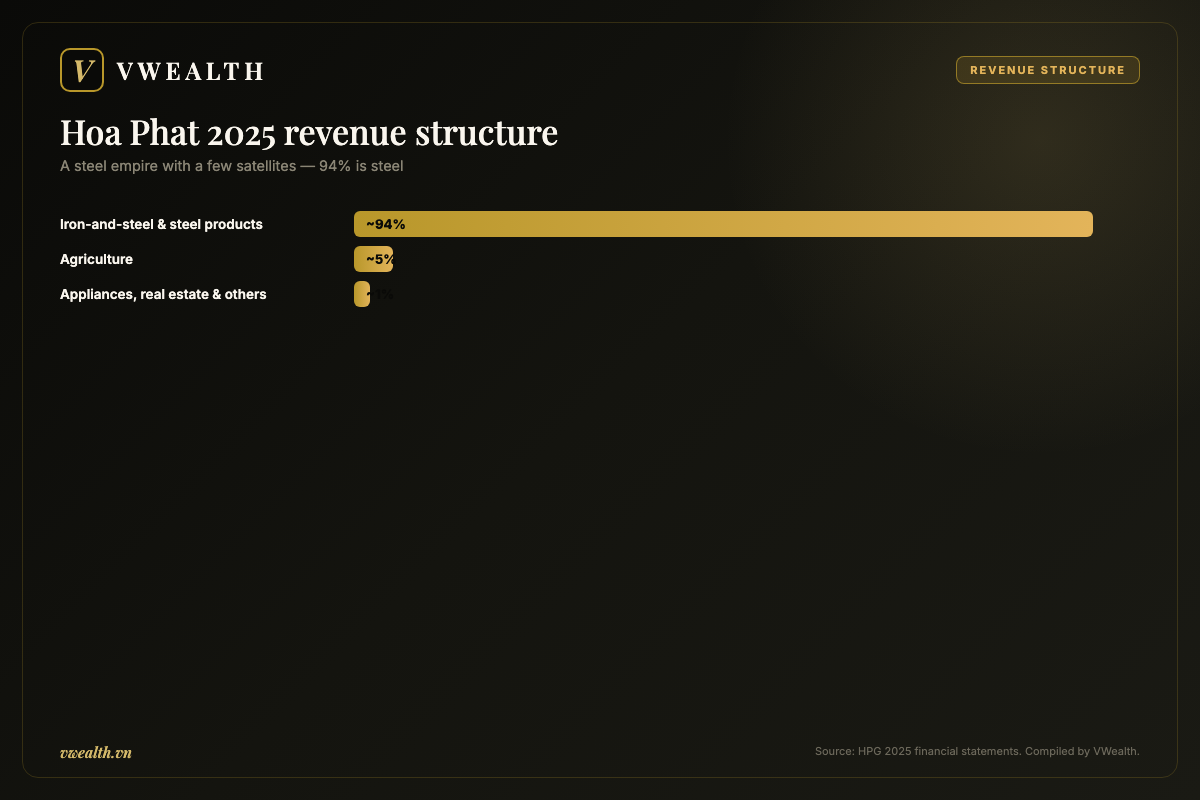
If you had to summarize Hoa Phat in one sentence, you could say: this is an integrated steel producer from ore to finished product, then from that steel core reaching out into a series of segments that consume its own products. In 2025, iron-and-steel and related products contributed up to 94% of total revenue; agriculture came second at about 5%; the rest (home appliances, real estate — industrial parks, and new segments) shared about 1%. Looking at the weightings, you’ll immediately understand a core fact: Hoa Phat is first and foremost a steel story, and every other segment — however attractive — is still a satellite orbiting that sun.
But what sets Hoa Phat apart from most Vietnamese steel firms is not scale, but how they make steel. Hoa Phat has successfully built a closed interconnected blast-furnace chain — starting from iron ore and coking coal, through the blast furnace to smelt liquid pig iron, then the basic oxygen furnace (BOF) to convert to steel, continuous casting into billet, and rolling into finished product. Industry people call this “upstream steel production.” To picture the difference: most other domestic steel firms only import billet to re-roll, or use electric furnaces (EAF) to melt scrap. Hoa Phat controls the entire value chain, from the first lump of ore to the last steel bar.
This difference isn’t to show off technique — it translates straight into money. Hoa Phat’s BF-BOF technology has notably cheaper inputs (iron ore + coking coal) than the EAF, which depends on scrap and electricity — two things with volatile, expensive prices. It’s estimated that electricity consumption per ton of steel via BOF is 10–15% lower than EAF. As a result, Hoa Phat’s production cost is far lower than most domestic producers, and analysts assess it on par with a mid-tier Chinese steel producer — a country with among the world’s most cutthroat steel industries. When you’re the market’s lowest-cost steel producer, you can both sell at good prices to hold market share and keep margins when steel prices hit the cycle bottom. This is the first brick of the “economic moat” we’ll return to at the end of the section.
Vertical integration at Hoa Phat is not a marketing slogan. It’s why, when the whole steel industry reels from raw-material prices, Hoa Phat still earns a profit — and when the market recovers, they’re the first and biggest to benefit.
One more point to remember: vertical integration also feeds the group’s own downstream segments. HRC (hot-rolled coil) that Hoa Phat produces itself becomes input for steel pipe, galvanized sheet, and even container bodies. Hoa Phat’s steel goes into Hoa Phat’s own real estate and industrial parks. This is a closed loop where each segment is at once a customer, a sales channel and a lever for the others. Now let’s go into each segment one by one.
Construction steel: an unshaken throne
Construction steel (rebar, and steel coil) is the product tied to the Hoa Phat name from the earliest days, and to this day remains the largest revenue pillar. In 2025, Hoa Phat firmly held the number-one position in Vietnam for construction steel with about 36% market share — that is, for every three construction steel bars sold in the market, more than one carries the Hoa Phat brand. This is a rare dominant position in a fragmented, fiercely price-competitive industry.
Why does this position matter so much to you — an investor? Because construction steel is a product tightly bound to the whole economy’s rhythm of public investment and residential construction. When Vietnam ramps up public-investment disbursement — highways, airports, ports — Hoa Phat with its dominant share is almost automatically the first to benefit. Sales volume of construction steel, high-quality steel coil, billet and HRC reached 10.6 million tons in a year for the first time in history, up 31% year on year. That figure doesn’t come from a single lucky segment, but from the whole machine running in unison.
Number-one market share in a “mundane” product like rebar is no small thing. It means Hoa Phat has scale large enough to maximize the cost advantage from blast furnaces, a distribution network covering the whole country, and bargaining power with both input suppliers and output customers. A new rival wanting to topple this position would have to burn tens of thousands of billions building a blast-furnace complex — with no guarantee of winning customers from a brand deeply ingrained in contractors’ habits over many years.
HRC — hot-rolled coil: the strategic card of the coming decade
If construction steel is Hoa Phat’s past and present, HRC (hot-rolled coil) is the future. This is a flat steel product higher-end than construction steel, used as input to make galvanized sheet, steel pipe, container bodies, appliances, autos and shipbuilding — nearly every manufacturing industry. And here’s the crux: Vietnam has always had to import an enormous amount of HRC each year because domestic production couldn’t meet demand.
Hoa Phat placed a big bet on reclaiming this market. The heart of the gamble is the “mega” Dung Quat 2 project — a 280-hectare iron-and-steel complex in Quang Ngai, total investment about 85,000 billion dong, design capacity 5.6 million tons of high-quality HRC a year. Dung Quat 2’s first blast furnace ran a trial and began contributing to results from late March 2025; the second blast furnace came online in September 2025. When the entire hot-rolling line is complete (expected from Q4 2026), the group’s crude-steel capacity will reach about 16 million tons a year — placing Hoa Phat among roughly the world’s top 30 steel producers. HRC capacity by then is expected to rise to a level letting Vietnam largely self-supply the raw-material needs of its domestic manufacturing sector.
Pause a moment to see the beauty of this strategy. When Hoa Phat makes its own HRC, three things happen at once:
- Import substitution: the billions of USD of HRC Vietnam must buy from abroad each year becomes a target market for Hoa Phat to capture right at home — an “ocean” of pre-existing demand.
- Feeding its own ecosystem: self-produced HRC becomes low-cost input for Hoa Phat’s own steel pipe, galvanized sheet and container bodies, closing one more loop of vertical integration.
- Upgrading margins: high-end flat steel has higher value-add and usually better margins than basic construction steel, helping the group move gradually up the value chain.
In 2025, the group was also approved to add about 3,400 billion dong of investment for Dung Quat 2 to add a high-quality coil-rolling line with capacity of 500,000 tons a year. In other words, Hoa Phat keeps thickening its HRC card. For you, HRC is the reason to believe Hoa Phat’s growth story is not over — it has just turned to a new chapter.
Steel pipe and galvanized sheet: dominating pipes, standing firm in sheet
Going one step further downstream, you meet two products that use HRC as input: steel pipe and galvanized sheet. In steel pipe, Hoa Phat has held the number-one market share in Vietnam for 10 straight years — a record of endurance — with about 30.8% market share in 2025 and output around 850,000 tons. Hoa Phat steel pipe is sold not only for residential projects but also into a series of key national projects like the T3 Terminal of Tan Son Nhat Airport and the National Exhibition and Fair Center — symbolic works showing the product’s quality is trusted at the high end.
In galvanized sheet, Hoa Phat recorded about 423,000 tons in 2025 and sits in the market’s top 5. This is a fiercely competitive segment with large names long established, so a top-5 position reflects a reality: Hoa Phat came late but is persistently gaining share, leveraging its HRC self-sufficiency to gradually improve its cost structure.
Notably, steel pipe and galvanized sheet perfectly illustrate the group’s vertical-integration logic. When Hoa Phat makes its own HRC upstream, it both sells HRC to the market and keeps a portion for its own pipe and sheet segments to use at competitive cost. Profit isn’t shared with middlemen; it stays within the group from the start to the end of the chain.
Agriculture: the second-largest diversification pillar
Stepping out of the steel world, you meet Hoa Phat’s second-largest business — and a pleasant surprise to many: agriculture. In 2025, Hoa Phat Agriculture (HPA) reached 8,326 billion dong in revenue (up 18%, about 5% of group revenue) and 1,600 billion dong in after-tax profit, up as much as 55% — beating plan by 22%. This is no “token” segment: with profit growth of more than half, agriculture is proving a real growth driver, mature enough for the group to conduct a successful IPO in mid-December 2025 — an offering with deposits exceeding the plan by 19% at a price of 41,900 dong per share.
Hoa Phat’s agriculture spans four branches, and in every one it rises to the top:
- Animal feed: 2025 output reached 357,000 tons — the highest in 10 years, growing at nearly double the industry’s overall pace. 13th in the whole market.
- Pig farming: among the leaders with capacity of about 750,000 head a year; over 380,000 commercial pigs sold, up 5.9%.
- Australian cattle: the market-share leader in supplying whole Australian cattle in Vietnam.
- Chicken eggs: number one in the clean-chicken-egg market in the North, with output near 1 million eggs a day, about 336 million eggs a year.
Why would a steel group raise pigs and sell chicken eggs? The answer is “diversification.” Steel is a very strongly cyclical industry — profit rises and falls with global steel and raw-material prices. Agriculture, with essential and stable food demand, acts as a shock absorber: when steel hits the cycle bottom, cash from pigs, cattle, eggs and feed still flows in steadily. With a 2030 target to raise feed capacity to 1 million tons a year and pig farming to 900,000 commercial head a year, Hoa Phat clearly sees agriculture as a serious leg of the stool, not a side gig.
Home appliances: a young segment with explosive growth
This is the segment that drew observers’ attention most in 2025, because of its growth rate. Hoa Phat Home Appliances recorded 2025 revenue about 5 times that of 2021 — the year Hoa Phat Home Appliances Corporation was founded — with 2025 alone seeing output up about 90% and revenue up about 80% versus 2024. When a business segment grows fivefold in four years, it’s a sign of a growth curve at its steepest phase.
The product range spans refrigerators (including premium Side-by-Side and multidoor lines), energy-saving air conditioners, large-capacity freezers, and water purifiers — with the Funiki-brand water purifier honored as “Most Loved Water Purifier” at Tech Awards 2025. Hoa Phat is targeting a Vietnamese home-appliance market worth tens of billions of USD, currently dominated by foreign brands like Panasonic and Electrolux.
You should view this segment with a balanced eye. On one hand, it’s a real growth opportunity, leveraging production capacity, a strong domestic brand and even steel plate from the group itself for appliance casings. On the other, its absolute scale is still small versus the leader, and this is a cutthroat game requiring long-term investment in brand and distribution. For a clear-eyed investor, home appliances is an interesting “growth option” — not yet moving the group’s profit needle today, but potentially the big story of tomorrow.
Real estate and industrial parks: land bank as a long-term weapon
Hoa Phat’s real estate splits into two branches: commercial housing and — more importantly — industrial-park (IP) real estate. As of end-2025, the group’s total IP land bank reached over 2,680 hectares, across Hung Yen, Bac Ninh, Ninh Binh, Hai Phong, Bac Giang, Dak Lak and many other localities. The business model is to build infrastructure then lease land, factories, warehouses and offices — prioritizing high-tech manufacturing projects. The group targets developing about 10 IPs over the next 10 years, with new projects like Dong Phuc IP (Bac Giang, over 3,730 billion dong) continually added.
In the first 9 months of 2025, real estate contributed about 858 billion dong of revenue (down year on year due to project-recognition timing) but after-tax profit still rose 24%, showing the IP segment’s fairly attractive margins. Why does this segment matter long term? Because IP real estate is a “cash-generating” asset stable for many years — IP land-lease contracts often run for decades. Amid Vietnam receiving a wave of supply-chain relocation and manufacturing FDI, owning a large industrial land bank in key provinces is a strategic weapon — and Hoa Phat is quietly accumulating that land bank right as demand rises.
Container bodies and the steel-rail ambition: two spearheads of the future
The last two segments best illustrate Hoa Phat’s long-term vision — moving from crude steel up to high-value industrial products very few Vietnamese firms dare to make.
First is container bodies. Hoa Phat’s plant in Ba Ria–Vung Tau has a design capacity of 500,000 TEU a year (phase 1 is 200,000 TEU a year), making Hoa Phat the largest container producer in Vietnam and Southeast Asia. The subtle point: containers require SPA-H weather-resistant HRC — the very steel Hoa Phat produces at Dung Quat. At full capacity, the container plant can consume about 1 million tons of HRC a year, conveniently becoming an outlet for the Dung Quat 2 project itself. 2025 marked a big milestone: Hoa Phat delivered 1,000 container bodies to CMA CGM — a top-3 global container shipping line — along with agreements with other international names like Hapag-Lloyd. A “Made in Vietnam” product being accepted by a world-leading shipping line is proof of quality few reports can express better.
Second, and perhaps the most symbolic ambition: steel rail for high-speed rail and special steel. On 19 December 2025, Hoa Phat broke ground on a rail and special-steel plant at Dung Quat, capacity 700,000 tons a year, investment about 14,000 billion dong. The products aim to serve major national infrastructure: the North–South high-speed rail line, the Hai Phong–Hanoi–Lao Cai line, and metro lines in Hanoi and HCMC. To do it, Hoa Phat partnered with SMS Group (Germany) — all main production equipment made in Germany to European standards. The first high-speed rail products are expected to roll out in early 2027.
When this plant is complete, Hoa Phat will become the only business in Southeast Asia capable of producing steel rail for high-speed rail — standing alongside names like Voestalpine (Austria), JFE (Japan) and Baosteel (China).
Picture the meaning of this. If Vietnam builds a high-speed rail project worth tens of billions of USD, and if a domestic-priority policy is applied, then Hoa Phat — as the only domestic rail producer — stands in a near-monopoly position to supply. This is no longer ordinary price competition; it’s building a near-absolute entry barrier through technology and strategic relations with the state. Looking further ahead, the group also targets massive-scale projects like Hoa Tam IP and Bai Goc port (Dak Lak) with investment up to 120,000 billion dong, aiming for long-term steel capacity of 22 million tons a year.
Economic moat: why this ecosystem is hard to copy
Now let’s put it all together. You’ve just gone through nine business segments, from number-one construction steel to high-speed rail. The most important question for an investor is not “what is Hoa Phat doing,” but “why are these advantages sustainable and hard for rivals to seize.” That’s the concept of an economic moat — and Hoa Phat’s ecosystem creates that moat in three overlapping layers:
- Scale advantage: with capacity heading toward 16 million tons of steel a year — world top 30 — and even bigger ambitions, Hoa Phat has a scale no domestic newcomer can reach without burning hundreds of thousands of billions and a decade of construction. Large scale means lower fixed cost per ton of steel and stronger bargaining power on both inputs and outputs.
- Cost advantage: integrated BF-BOF technology from ore delivers far lower production cost than producers reliant on imported billet or electric furnaces. This is the shield that keeps Hoa Phat healthy through the steel-price cycle bottom — exactly when weaker rivals lose money and retreat.
- Vertical integration: from ore to HRC, from HRC to pipe, sheet, containers; Hoa Phat’s steel goes into Hoa Phat’s IPs and real estate. Each segment feeds the others, and profit stays within the group across the value chain rather than leaking to middlemen.
These three layers resonate to create what other conglomerates would take decades and enormous capital to hope to build — if they could build it at all. A rival can copy one product, but to copy an entire world-top-30-scale vertically integrated ecosystem, with number-one market share in many product lines and a near-monopoly position in high-speed rail steel, is nearly impossible. That’s why 94% of revenue from steel doesn’t make Hoa Phat fragile — on the contrary, that extremely strong steel core is the foundation on which every satellite segment clings and grows.
And this is the bridge to the next section. An ecosystem creating such an economic moat doesn’t just help the business survive — it grants the business market power: the ability to shape prices, lead market share, and impose the rules of the game on the whole industry. In the next section, you’ll see how Hoa Phat’s market power specifically manifests — and what it means for margins, competitive resilience, and ultimately, the value HPG stock brings you.
Market power and revenue structure
When you hold HPG shares, what you truly own is not a “steel plant” in the ordinary sense. You hold part of the largest heavy-industry production machine in Southeast Asia — an entity that in Vietnam has almost no equal, and on the world map has entered the group of the planet’s largest crude-steel producers. To understand why HPG is hard to replace, you can’t look only at the market-share number. You must understand why that share is sustainable to the point that once-equal rivals now lie prostrate with accumulated losses of thousands of billions. That’s the story of the “economic moat” — and it decides whether your investment is safe through the brutal steel cycles.
The number-one position: a market-share figure hiding a scale truth
Start with the bare numbers. In 2025, Hoa Phat construction steel continued to firmly hold the number-one position in Vietnam with about 36–38% market share — meaning for every three steel bars in projects rising across the country, more than one carries the Hoa Phat brand. Steel pipe also leads the market with 30.8% share and output around 850,000 tons. But the most spectacular comeback lies in hot-rolled coil (HRC): from March 2025, after phase 1 of Dung Quat 2 ran at nearly 100% capacity, Hoa Phat formally overtook foreign “giant” Formosa to become the number-one HRC producer in Vietnam.
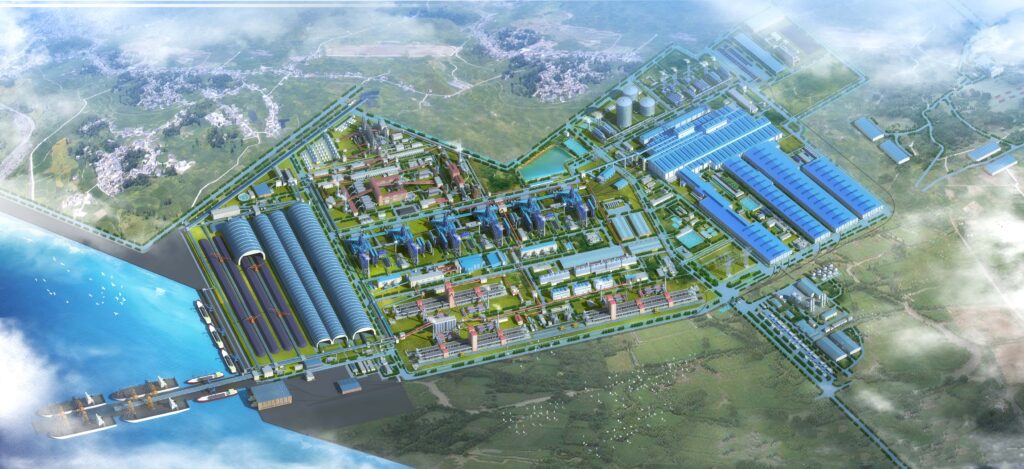
You need to pause at this “number one,” because it’s not advertising. Hoa Phat’s total steel output of all types in 2025 reached 11 million tons (+26%), sales reached 10.6 million tons (+31%) — crossing the double-digit mark for the first time in the group’s history. With capacity heading toward 16 million tons a year once Dung Quat 2 runs at full load, Hoa Phat is not only Southeast Asia’s largest steel producer but also among roughly the world’s top 30 crude-steel producers. For an investor, this scale has a very concrete meaning: it’s an industry entry barrier. No one can wake up one morning and decide to “compete with Hoa Phat” — because to do so, they’d need to spend billions of dollars, take 5–7 years to build, and most importantly, learn to run a blast-furnace complex without strangling themselves. As you’ll see shortly, this last lesson bankrupted no small number of rivals.
The real economic moat lies in cost — and here’s why it’s durable
This is the most important part, so read carefully. Steel is a “commodity” — a basic good. Hoa Phat’s rebar and a rival’s rebar essentially serve the same construction standard; buyers don’t pay extra for an “emotional brand.” In such an industry, there’s an iron law: whoever produces at the lowest cost wins. That’s the whole game. And Hoa Phat’s economic moat is precisely its cost advantage — an advantage built on three pillars very hard for rivals to copy.
The first pillar is blast-furnace technology from ore (BOF — basic oxygen furnace). Unlike electric-furnace (EAF) technology melting scrap that many rivals like Pomina use, Hoa Phat produces steel from iron ore via blast furnace. The electric furnace depends heavily on scrap and electricity prices — electricity alone accounts for 8–9% of cost and consumes about 600 kWh per ton — so every electricity-price hike evaporates their competitive advantage. Hoa Phat’s blast furnace has an entirely different cost structure, and more importantly, it enables something the electric furnace lacks: a circular economy.
The second pillar is that internal circular economy. Hoa Phat’s complex is designed to waste nothing. Waste heat from pig-iron smelting is recovered, and coal gas (exhaust from blast furnaces and coke ovens) is channeled to internal thermal power plants to self-generate electricity. Thanks to this, Hoa Phat self-supplies a large part of its own electricity needs — turning what rivals must buy expensively from the national grid into something “free” harvested from production waste. Every dong of self-generated electricity is a dong of lower cost than rivals.
The third pillar is enormous scale. When you operate 11 million tons, every fixed cost — depreciation, management, deep-water port logistics at Dung Quat — is spread over huge output, pulling per-ton cost low. Scale also gives bargaining power on ore and coal prices when importing tens of millions of tons of raw material a year.
These three pillars combine to create a production cost few domestic rivals can reach. And you need to understand why this is a truly durable “moat,” not a fleeting advantage: in a commodity industry, the cost advantage is the best kind of economic moat for withstanding the cycle. When steel prices rise, Hoa Phat earns more than anyone. And when steel prices collapse — like 2022 — the low-cost producer is the last survivor, while high-cost rivals die first. The cost advantage doesn’t just help you win in good times; it keeps you from dying in bad times, and each time a rival falls, market share flows to the survivor.
In the steel industry, the economic moat is not brand or patents. It’s cost. Whoever smelts a ton of steel cheaper than others both harvests money when prices rise and survives when prices fall. And each bankrupt rival pushes more market share toward the survivor.
Living proof: the price of competing with Hoa Phat
The moat theory sounds nice, but you deserve proof. Look at Pomina Steel (POM) — this name was once Vietnam’s largest construction-steel brand, a rival on par with Hoa Phat a decade ago. Pomina tried entering the blast-furnace game to compete on scale. The result? When the steel industry fell into a harsh cycle in 2022, Pomina posted a record loss of over 1,000 billion dong due to plunging steel prices, weak demand, excessive blast-furnace operating costs and debt burden. A lack of operating experience forced their blast furnace to repeatedly shut down. From Q2 2022 onward, Pomina lost money endlessly; by the end of September 2025, accumulated losses had exceeded 3,000 billion dong, to the point of having to seek a “savior” to revive.
This is living proof of Hoa Phat’s moat. Same blast-furnace technology, same market, same price cycle — but one side (Hoa Phat) earned 15,515 billion dong in 2025, while the other (Pomina) had thousand-billion accumulated losses and stood at the brink. The difference lies not in “who makes steel,” but in who makes steel at low enough cost and large enough scale to withstand the cycle’s blows. Running a blast-furnace complex is an art accumulated over decades, and that’s something money can’t buy overnight. When you hold HPG, you stand on the side of the one who has already paid that tuition.
Dung Quat 2 and 3: an output leap traded for record leverage
Hoa Phat’s biggest growth driver now is called Dung Quat 2. This complex formally started producing from September 2025, raising the group’s HRC capacity to 9 million tons a year and pushing total steel capacity toward 16 million tons a year. Its strategic significance is large: HRC is the input steel for galvanized sheet, steel pipe, shipbuilding, auto and appliance manufacturing — things Vietnam has long imported billions of dollars of each year. Dung Quat 2 lets Hoa Phat substitute imports, climbing into high-quality steel segments with better margins than ordinary construction steel. The group targets about 60% of future output being high-tech steel serving mechanical engineering, autos, shipbuilding, oil and gas, and energy. Behind it, Dung Quat 3 has been mapped out as the next chapter of scale ambition.
But — and this is the “but” a clear-eyed investor must not overlook — this output leap was bought at a very real financial price. To build Dung Quat 2, Hoa Phat disbursed about 70,000 billion dong of fixed capital, of which about half the funding came from debt. As a result, the group’s total financial debt at the end of Q3 2025 hit a record high in its operating history — 96,838 billion dong — before easing to about 92,174 billion dong at year-end. HPG’s leadership frankly admitted 2025 was the group’s “debt peak.”
You must clearly understand this leverage risk. When Dung Quat 2 formally operates, Hoa Phat must stop capitalizing interest expense — meaning interest previously “recorded into assets” now goes straight into the period’s expenses. Combined with rising rate levels, total interest expense in 2025 jumped to 3,115 billion dong, up 36%. Leverage is a double-edged sword: if the steel market is good and Dung Quat 2 runs at full load, the enormous cash flow will quickly repay debt and margins will explode. But if the steel cycle turns bad right when debt is at its peak, the interest burden will erode profit and amplify losses. This is HPG’s biggest risk tied to its biggest opportunity — you can’t separate the two.
Exports: a market door and the specter of anti-dumping duties
Hoa Phat increasingly relies on exports to consume its surging output. Some product lines have a very high export share — prestressed steel and drawn-wire steel exports contribute over 40% of sales volume. Exports open a large market beyond the border, but come with a specific risk you must watch closely: anti-dumping duties. When Vietnamese steel floods the world, importing countries often erect tariff barriers to protect their domestic steel industries.
2025 gave you a classic example of how this risk can become an advantage. In September 2025, the European Commission formally imposed anti-dumping duties on HRC imported from Vietnam at 12.1%. This was a heavy blow to the whole industry — but Hoa Phat and its affiliates were exempted, at 0%. Why? Because Hoa Phat’s HRC meets strict global quality standards like JIS, MS, SAE, BS EN and holds CE Marking certification — the “passport” to export to Europe. While Vietnamese rivals must bear 12.1% duty entering the EU, Hoa Phat passes through with zero tariff cost. This is another moat layer: internationally certified quality turns rivals’ trade barriers into its own competitive advantage. That said, don’t be complacent — anti-dumping investigations in the US, EU and many other markets will recur, and each adverse ruling can tighten an important sales channel.
2025 revenue structure: a steel empire with a few satellites
Now let’s dissect where Hoa Phat’s money comes from, so you understand what you’re really investing in. The group operates five fields: iron-and-steel, steel products (steel pipe, galvanized sheet, drawn wire, container bodies, prestressed steel), agriculture, real estate and home appliances. But don’t let that diversity fool you — steel is everything. Iron-and-steel and steel products contributed up to 94% of total revenue in 2025.
| Field | Role in the 2025 revenue/profit structure |
|---|---|
| Iron-and-steel & steel products | ~94% of revenue — the group’s absolute core |
| Agriculture | ~5% of revenue; rev 8,326 bn (+18%), profit 1,600 bn (+55%) — the second-largest side segment, good margins |
| Home appliances | Revenue 5x that of 2021 — young segment, fast growth from a low base |
| Real estate | Industrial parks + projects; small contribution, strategically supplementary |
This structure reveals an important truth for valuation: HPG is a pure steel stock. The agriculture, appliance and real-estate segments, despite bright spots — agriculture earning 1,600 billion with respectable margins, appliances growing fivefold since 2021 — are still satellites orbiting the steel planet. When you buy HPG, over 90% of your investment’s fate is bound to steel prices, steel output and steel margins. These satellites add a bit of stability and a “buffer zone” in tough steel times, but they’re not large enough to change the stock’s cyclical nature.
Revenue quality and margins: understanding the cycle’s heartbeat
This is a concept you — if you want to invest in steel stocks clear-eyed — must grasp: Hoa Phat’s margins are cyclical in nature. Look back at the 2025 numbers to see it. For the year, revenue reached 158,332 billion dong (+13%) but after-tax profit rose up to 15,515 billion dong (+29%) — profit growing more than twice as fast as revenue. In Q4 alone, revenue was 47,302 billion (+34%) and profit 3,888 billion (+38%). Why does profit “swell” faster than revenue like this?
The answer lies in the steel margin, and it works by a mechanism you must engrave. Profit per ton of steel = steel selling price − raw-material input price (iron ore, coking coal). Both sides move independently with the world market. When steel prices rise faster than raw-material prices, the gap (gross margin) widens and profit explodes per ton. When steel prices fall while raw materials remain high, the gross margin is choked, even negative — exactly the catastrophic situation of 2022 that felled Pomina and gave even Hoa Phat a loss-making quarter. In 2025, strong output growth (+26%) resonating with recovering margins created the doubling of profit growth over revenue you just saw.
The practical meaning for you is clear. Don’t value HPG like a steadily growing consumer business. Peak profit doesn’t last forever, and trough profit isn’t permanent either. A low P/E at the cycle top can be a “value trap” because profit is about to plunge; conversely, a sky-high P/E at the cycle bottom can sometimes be the best buying point because profit is about to recover. This is the core paradox of steel stocks. You must read HPG through the cycle lens — watching steel prices, ore prices, and the gap between them — rather than looking at a single profit number.
To summarize the market-power picture: Hoa Phat is number one in Vietnam in construction steel, steel pipe and now HRC, is Southeast Asia’s largest producer, protected by a truly durable cost moat — one that proved its strength by letting equal rivals like Pomina fall in the same cycle. Dung Quat 2 opens an output leap and an import-substitution door, but in exchange for record debt leverage. The revenue structure shows this is a pure steel stock with cyclical margins — both the biggest risk and the biggest opportunity. The next question, naturally, is: with all that intrinsic strength and risk, how is the stock market valuing and receiving HPG? That’s what we dissect next.
Market reception
If you’ve ever heard someone call HPG the “national stock,” that nickname didn’t come from nowhere. Over a million securities accounts in Vietnam hold at least a few hundred Hoa Phat shares, and every time this ticker moves a few percent, the whole market buzzes. But that very familiarity is the biggest trap: many people buy HPG without truly understanding they’re buying an asset with a character entirely different from a bank stock or a consumer stock. In this section, you’ll dissect with me how the market has valued HPG over the years, why its price “rides high, falls low” with brutal cycles, and most importantly: why the P/E you’re used to for bottom-fishing can lead you straight into the abyss if applied mechanically to a steel stock.
On 19 June 2026, HPG closed around 23,600 dong per share (real data from the VWealth plugin). This number says nothing until you place it in the multi-year picture. And that picture, as you’re about to see, is a rugged sine wave, where each peak and trough is tied to a story about steel prices, real estate, and crowd psychology.
The multi-year price path: a classic cyclical stock
Start by looking back at the road Hoa Phat’s stock has traveled. In early 2020, amid COVID panic, HPG (after adjusting for splits) fell to a zone of only about 6,000 dong. Very few dared to buy while the whole world was shutting down. Yet right then, a perfect storm appeared: governments simultaneously pumped stimulus money, ramped up public investment, world steel prices surged vertically, and Hoa Phat’s Dung Quat 1 plant had just run at full capacity to catch the entire boom. Profit exploded, and the share price exploded with it.
The historic peak fell around October 2021. At that time’s market price (unadjusted for later stock splits), HPG touched a zone of 58,000 dong; adjusted for a fair comparison with today, the peak equals about 44,000 dong. Either way, it’s a moment every HPG investor remembers: accounts tripling, quadrupling in just over a year. The press called it the era of “the national stock hitting a peak.”
Then came the fall. From late 2021 through all of 2022, everything reversed at once: world steel prices plunged as China clamped down on real estate, global inflation surged, rates rose, construction demand froze, while iron-ore and coking-coal costs stayed high, choking margins. Hoa Phat even reported losses in the last two quarters of 2022 — something almost unheard of for an industry leader. The stock reacted cruelly: from the peak, HPG slid straight to a bottom around 12,000–12,100 dong at the end of 2022. Those who bought at the top lost nearly three-quarters of their accounts. From 2023 to 2025, the ticker crawled back up with the industry’s recovery, and by mid-2026 is trading around 23,600 dong — that is, halfway up from the bottom, but still far from the old glorious peak.
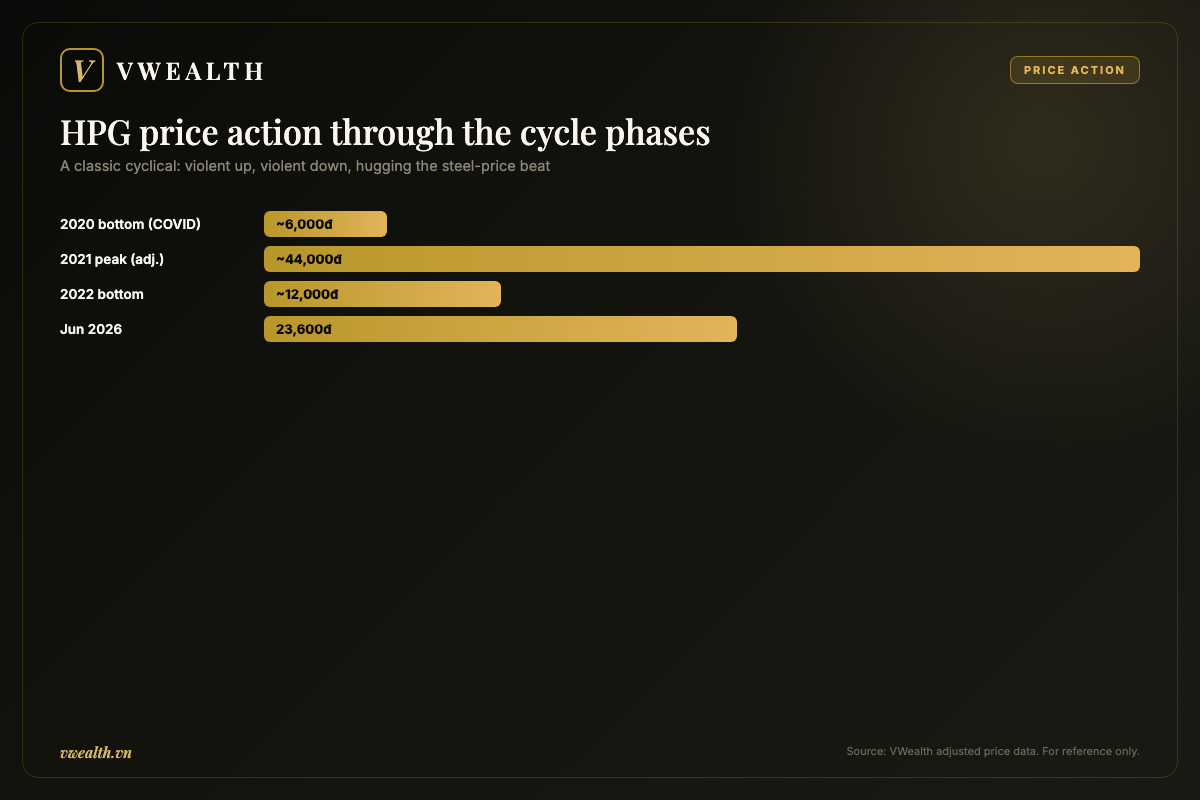
Do you notice anything from this path? This is not the price shape of a steadily growing business like Vinamilk in its golden days or a retail bank. This is the price shape of a classic cyclical stock: enormous swing range, rising violently then falling just as violently, hugging a heartbeat beyond the leadership’s own control — the heartbeat of steel prices and the property cycle.
Why do steel stocks swing so hard?
To understand why you shouldn’t treat HPG like an ordinary stock, you need to understand the steel industry’s economic structure. There are three reasons a steel producer’s profit — and hence share price — swings far more violently than most other businesses.
- Enormous operating leverage. A steel complex like Dung Quat devours tens of thousands of billions of fixed capital, with depreciation and operating costs almost fixed regardless of how much is sold. When steel prices rise a few percent, that gain flows almost straight to profit; conversely when prices fall, profit evaporates exponentially. For the same revenue change, steel profit swings many times more.
- Squeezed between two commodity prices. Inputs are iron ore and coking coal — world prices; outputs are construction steel and HRC — also world prices. Hoa Phat has almost no pricing power, it’s a price-taker. When the spread between selling price and raw-material price narrows, profit shrivels even if output stays high.
- Dependence on real estate and public investment. Most construction steel is used for projects, housing and infrastructure. When the property market freezes like 2022–2023, steel demand free-falls. When public investment and real estate warm up, steel is one of the first industries to benefit. That’s why HPG’s price is often seen as a “barometer” of the real economy’s health.
These three factors resonate to create what analysts call “double cyclicality”: the commodity-price cycle layered on the property cycle. When both are in a favorable phase (like 2020–2021), HPG flies; when both are in a bad phase (like 2022), HPG falls. Understand this, and you’ll stop asking “is HPG good” and start asking the right question: “where is the cycle?”
Valuing HPG: why P/E can deceive you
Now to the part that decides profit and loss. At a price of 23,600 dong and 2025 after-tax profit of 15,515 billion dong (up 29% from 2024), let’s do a basic calculation. On a base of about 7.66 billion shares (data before the 2025 stock dividend; after issuing nearly 768 million dividend shares, outstanding shares exceeded 8.4 billion units — note this detail when calculating yourself), earnings per share (EPS) falls to about 2,000 dong. Divide price by EPS, and you get a P/E of about 11–12 times. It sounds not expensive, even quite reasonable for an industry leader.
But this is exactly where many investors lose money for nothing. For cyclical stocks, the P/E almost inverts its meaning versus ordinary intuition. Let me explain this paradox slowly, because it’s the steel industry’s most expensive lesson.
When the steel industry is at the cycle top, Hoa Phat’s profit swells abnormally. The EPS denominator in the P/E formula swells with it. The result: P/E drops to a very low level — looking extremely “cheap.” In fact, at the 2020–2021 cycle top, HPG’s P/E at one point dropped to just around 2.7 times. An investor mechanically applying the “buy when P/E is low” rule would gleefully buy in — right at the historic peak, right before the collapse that cost three-quarters of its value. A low P/E at the cycle top is not a cheap signal; it’s a signal that profit is at an unsustainable level and about to reverse.
Conversely, when the industry is at the cycle bottom — the business losing money or earning thin — EPS shrinks or goes negative, sending P/E soaring very high or even meaningless (incalculable when loss-making). The stock then looks “terribly expensive” by P/E, but is often the best time to buy, because the price has discounted deeply and the cycle has only one way to go: up. This is the core paradox: for cyclical stocks, a low P/E is the dangerous time, a high P/E (or negative) at the bottom can be the opportunity.
So what do you use instead? For asset-heavy businesses like steel, professionals prefer P/B (price-to-book). The reason: Hoa Phat’s plants, blast furnaces and lines are enormous tangible assets, with book value relatively stable across years, not dancing with the profit cycle like EPS. P/B is therefore a more reliable “anchor” to know how much you’re paying for the real asset base.
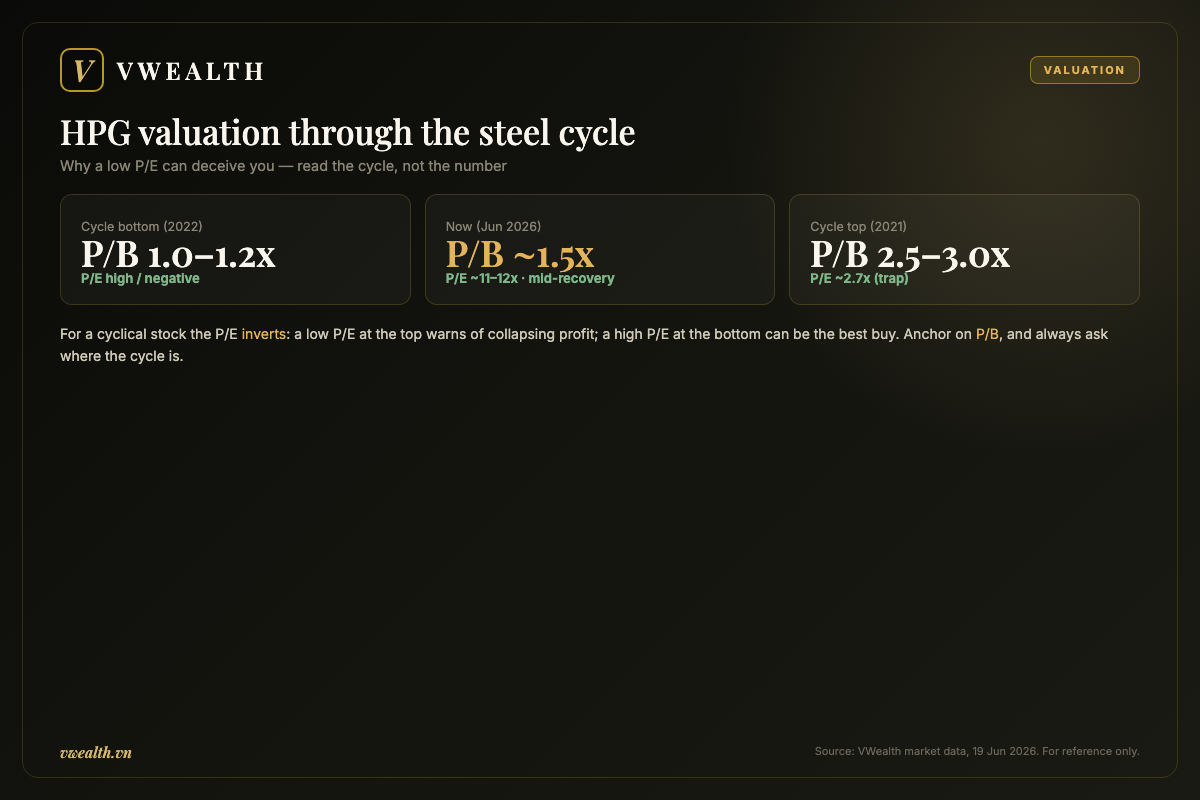
Currently HPG’s P/B swings around 1.5 times. Against history, the euphoric 2021 peak once pushed P/B to 2.5–3.0 times, while the desperate 2022 bottom pulled P/B to around 1.0–1.2 times. Today’s 1.5 times sits in the middle: no longer dirt-cheap like the bottom, but not yet touching the dangerous euphoria zone. In other words, the market is valuing HPG in a “recovering but not climactic” state — fitting the Dung Quat 2 story of running but not yet at full capacity. This is a reasonable positioning, neither too greedy nor too pessimistic.
| Valuation metric | Cycle bottom (2022) | Current (Jun 2026) | Cycle top (2021) | Meaning |
|---|---|---|---|---|
| P/E | High / negative (when loss) | ~11–12x | ~2.7x (trap) | A low P/E at the top is a warning, not an opportunity |
| P/B | ~1.0–1.2x | ~1.5x | ~2.5–3.0x | A more reliable valuation anchor for asset-heavy stocks |
| Cycle position | Bottom / quarterly loss | Mid-recovery | Top / euphoria | Decides which valuation framework to use |
The lesson is clear: never look at P/E alone to buy HPG. Ask what phase of the cycle the steel industry is in, then read the valuation numbers through that lens. A “pretty” P/E on an unsustainable profit peak is the most sophisticated trap the market sets for newcomers.
Dividends: from “retain to invest” to a signal the investment cycle has passed its peak
Hoa Phat’s dividend policy is a story worth reading, because it tells more than the surface. For many years, Hoa Phat almost never paid a cash dividend. Shareholders were used to receiving bonus shares or stock dividends — that is, the company retained all its cash profit to pour into mega-projects, especially the Dung Quat complex. At AGMs, Chairman Tran Dinh Long repeatedly had to ask shareholders to “sympathize”: the business needed every dong of capital to build plants, and retaining profit to reinvest would create far greater value than doling out small change.
From an analytical angle, a business prioritizing profit retention, paying dividends in stock rather than cash, is usually in a capital-heavy expansion-investment phase. They need money more than they need to please shareholders short-term. That’s not bad — it says the leadership believes there are growth opportunities big enough to justify sacrificing the dividend stream. For Hoa Phat over the past decade, that opportunity was Dung Quat.
And here’s the crux. In 2025, Hoa Phat announced a total dividend of 15%, of which 5% in cash (500 dong per share, total over 3,800 billion dong) and 10% in stock. Chairman Tran Dinh Long affirmed that barring anything unusual, from 2026 onward the group will continue paying cash dividends. Returning to cash after years of “abstinence” carries a very important implicit message:
When an asset-heavy cyclical business starts returning cash to shareholders, it’s usually a sign the biggest investment phase has passed its peak. The backbone of Dung Quat 2 has been built, the enormous disbursement pressure is easing, and free cash flow is starting to leave enough to share. This is a turning point in the business’s “age” — shifting gradually from the “burn capital to grow” phase to the “harvest” phase.
You should read this signal in balance. The positive: cash flow is now strong enough to both complete the project and pay cash. The point to note: 5% cash is still a modest ratio (dividend yield only around 2% on the market price), so HPG is still a stock bought for growth and cycle expectations, not yet a “dividend-eating” stock like the power or water group. But the fact that Mr. Long’s family — the largest shareholder group — receives about 1,300 billion dong from this payout shows leadership and small shareholders are now truly in the same boat on cash flow, something that didn’t exist years ago.
Blue-chip status: VN30, ETF flows and foreign moves
Another reason HPG swings hard and is watched closely is that it’s not just a stock — it’s a crucial component of the market. After issuances, Hoa Phat’s charter capital crossed 84,000 billion dong, rising to lead the whole exchange by charter-capital scale, surpassing even large state banks like Vietcombank and VietinBank. Market cap by mid-2026 reached about 205,000 billion dong, placing HPG among Vietnam’s largest businesses.
That scale places HPG in the VN30 basket — the index of the 30 largest-cap, most-liquid stocks. VN30 membership brings a double consequence. On one hand, HPG enjoys passive flows: every ETF tracking the VN30 (and other index baskets HPG is in) must hold this stock by weight, creating a stable base of demand. On the other, that ample liquidity and large weight turn HPG into a favorite tool for big money to “trade” the market state — when foreigners or funds want to raise/cut Vietnamese-stock weightings, HPG is often one of the most heavily bought and sold tickers. This amplifies the swing range.
On foreigners, HPG has a distinct love-hate history. It’s always one of the most favored stocks among foreign investors thanks to its industry-leading position and representativeness of the economy. But for that reason, HPG bears net-selling pressure whenever foreigners exit the Vietnamese market in general. Notably, per market data, foreigners returned to strong net buying from early 2026, especially after leadership sent positive signals on cash dividends and Dung Quat 2 progress. This move is usually interpreted as big money “front-running” a new output-growth cycle — as HRC capacity adds a few million tons from Dung Quat 2 stabilizing.
- Passive demand from ETF/VN30: a stable demand base, but also makes HPG sensitive to whole-market index flows.
- Foreigners net-buying again in 2026: a signal of expectation for the Dung Quat 2 output-growth phase.
- Top liquidity on the exchange: easy in, easy out, but also easily becomes big money’s “pump-and-dump machine,” amplifying volatility.
In sum, HPG is received by the market as a half-growth, half-cyclical blue-chip: both an indispensable pillar of the VN-Index and a boat bobbing on the steel-price wave. The abundant interest from individual, institutional and foreign investors is both a liquidity anchor and a source of violent waves.
So where are you in the steel cycle?
Let’s put it all together. Price of 23,600 dong — sitting midway from the 2022 bottom to the 2021 peak. P/B of 1.5 times — also mid-range historically, neither dirt-cheap nor euphoric. P/E of 11–12 times — looks reasonable, but you’re now clear-eyed enough not to conclude from this number alone. Cash dividends returning — signaling the heaviest investment phase may have passed its peak, cash starting to surplus. Foreigners net-buying again — betting on Dung Quat 2 output.
All these pieces point to the same question no single metric can answer: what phase is the steel cycle in now — early recovery, mid-cycle, or nearing late-cycle? HPG’s valuation suggests a mid-recovery phase, but the real answer lies in variables the valuation only reflects rather than creates: world steel prices, property health, HRC supply-demand, trade policy and anti-dumping duties. In other words, to know whether the market’s valuation of HPG is reasonable or mistaken, you must step outside the price board and look at the very industry lifting up — or weighing down — this business. That’s exactly what we dissect next, in the Industry context section.
Economic and steel-industry context
To understand a stock like HPG, you can’t look only at its own financial reports. Steel is among the most cyclical industries on the stock market, meaning Hoa Phat’s fate is tightly bound to the economy’s big waves, to world raw-material prices, and to political decisions all the way in Beijing or Hanoi. When you buy HPG, you’re not just buying a good business, you’re betting on the steel boat’s position on the cycle track. This section dissects each layer of that context, so you clearly see the favorable winds and the undercurrents.
Steel is a cyclical industry: HPG’s profit depends on three prices
First, you need to grasp a core principle: an integrated steel producer like Hoa Phat’s margin lies not in the selling price, but in the gap between the selling price and raw-material input price. Analysts call this the steel margin, or “steel spread.” Specifically, three prices decide whether Hoa Phat profits or loses in a quarter:
- Iron ore price — the main material for smelting steel by blast furnace. About 70% of globally seaborne-traded ore flows to Chinese steel furnaces, so ore prices are essentially set by China’s demand. When China buys strongly, ore prices climb and erode Hoa Phat’s margin; when China cuts production, ore prices fall and Hoa Phat breathes easier.
- Coking coal price (metallurgical coal) — the reductant and fuel in the blast furnace. Coking coal swings with energy supply-demand and geopolitical shocks, the second unpredictable variable in the cost structure.
- Finished steel price — including HRC (input for galvanized sheet, steel pipe, autos, appliances) and construction steel (rebar, coil). This is the output, what Hoa Phat sells to the market.
What makes steel dangerous is that all three prices swing strongly and don’t always move in the same direction. There are periods when ore prices rise faster than finished-steel prices — the margin is choked, and the business earns thin or even loses money despite still selling. Conversely, when raw-material prices cool while steel prices hold firm on strong demand, the margin widens and profit can surge exponentially. It’s precisely this margin-leverage mechanism that lets HPG’s profit go from a few thousand billion to tens of thousands of billion — then fall back — in just a few years. Engrave this: HPG is not a stock of steady cash flow, but a stock of waves.
When you see a fat-profit quarter from HPG, always ask yourself: is this profit from sustainable operating ability, or from a favorable, fleeting steel-margin gap about to close?
The domestic demand side: three drivers rising at once
The good news for Hoa Phat is that, as of early 2026, Vietnam’s domestic steel demand is in a recovery phase with three overlapping tailwinds — a rare resonance.
First is public investment. The 2025–2026 period is the final acceleration stretch of public-investment disbursement, with a series of highways, Long Thanh Airport and urban ring roads pushed to completion. Every kilometer of highway, every bridge span, every concrete pillar devours construction steel — and Hoa Phat is the country’s number-one construction-steel supplier. This is policy-driven demand, little dependent on market psychology, so relatively certain.
Second is the warming of residential real estate. After a legal-freeze period, important laws passed have removed obstacles, unclogged project supply and sped up construction. A property recovery pulls demand for construction steel, steel pipe and galvanized sheet. Total steel consumption across Vietnam in 2026 is forecast to rise nearly 13%, with construction steel up about 14% and especially HRC up as much as 30% — exactly the segment Dung Quat 2 targets.
Third, and most ambitious, is the North–South high-speed rail. This mega-project worth about 67 billion USD, if implemented as planned, will create enormous demand for rail steel and special steel lasting a decade — steel that Vietnam has always had to import entirely. Hoa Phat has moved a step ahead: signing a contract with SMS Group (Germany) for a rail-production line of 700,000 tons a year, breaking ground on a rail and special-steel plant with investment of about 14,000 billion dong, targeting the first rail batch in Q1 2027. If successful, Hoa Phat will be the first and only business in Southeast Asia to make high-speed rail steel — a near-monopoly domestic competitive moat for a hundred-billion-dollar project. This is the biggest long-term growth story, and the most hopeful, tied to HPG stock today.
The risk side: the specter of Chinese steel and the currency, debt problem
The picture isn’t all rosy. There are structural risks you must weigh.
Oversupply and dumping from China. This is the classic nightmare of Vietnam’s steel industry. When China’s property market weakens persistently, its domestic steel production becomes enormously surplus and must find export routes. China’s steel output in Q1 2026 fell about 5% year on year, to roughly 250 million tons — but the surplus portion is still enough to flood the region at dirt-cheap prices. In the first half of 2025 alone, Vietnam imported nearly 650,000 tons of wide-format HRC from China, up about 15-fold year on year, creating suffocating competitive pressure on domestic products.
Fortunately for Hoa Phat, a protective barrier was erected. The Ministry of Industry and Trade formally imposed anti-dumping duties on HRC from China from July 2025, and by April 2026 continued imposing preliminary anti-dumping duties of up to 27.83% on wide-format HRC imported from China — precisely the type sneaking in to dodge duties. Notably, the investigation complaint was initiated by Hoa Phat and Formosa themselves. After a year of duties, Hoa Phat reported domestic HRC output rising strongly, targeting nearly 15–16 million tons of steel in 2026. So tariff policy is a direct protective shield for HPG.
But that shield has two sides. Protection helps Hoa Phat at home, but also raises reciprocal risk: when Hoa Phat ramps up HRC exports abroad, markets like the EU, US, or other ASEAN countries may also impose anti-dumping duties on Vietnamese steel. In a world contracting on trade, every barrier can turn back around.
Pressure to absorb new capacity. Dung Quat 2, with total investment of about 100,000 billion dong, when running at full capacity will add about 5.6 million tons of HRC a year to Hoa Phat’s output, raising HRC capacity to around 8.6 million tons a year. This is a sharp double-edged sword: if domestic and export demand is strong enough to absorb it, surging output will drive profit to explode. But if the market stalls right when the new plant runs full, Hoa Phat will have to carry an enormous block of capacity with heavy depreciation and interest costs, without matching output. New capacity always needs a large enough market to swallow it — and timing is everything.
Currency and debt. To finance Dung Quat 2 and the rail plant, Hoa Phat had to borrow at record scale, part of it foreign-currency debt. This makes the business doubly sensitive: high interest eats into profit, while a VND depreciation against the USD swells foreign-currency debt and pushes up the cost of importing ore and coal. In a heavy-investment phase, a rate or currency shock can turn a year that should be fat-profit into a struggling one.
Trend prediction
Having shone a light into every corner of the context, now you and I look ahead. No one has a crystal ball, and for a cyclical stock like HPG, predicting the exact turning point is nearly impossible. Instead of guessing a number, the clearer-eyed approach is to sketch scenarios, tie each to specific triggers, then place yourself in them to prepare your mindset.
Long-term ambition: from construction-steel maker to a regional-scale steel group
First, understand where Hoa Phat wants to go. Leadership targets growth of at least 15% a year from now to 2030, pushing total production capacity toward the 16-million-ton mark after Dung Quat 2 is fully operational — enough to enter the group of the world’s large steel producers. More important than the number is the qualitative shift: from a business mainly selling low-value construction steel, Hoa Phat is climbing higher value rungs — HRC for industry, then rail steel and special steel for high-speed rail expected from 2027. If this path materializes, the HPG story will no longer be purely a construction-steel cyclical stock, but take on a long-term industrial-growth color. That’s what many long-term investors find captivating.
Three scenarios for HPG
Let me sketch three scenarios so you can picture the range of possible outcomes. Read them as possibilities, not prophecies.
| Scenario | Trigger conditions | Effect on HPG price |
|---|---|---|
| Positive (a growth super-cycle) |
Strong public-investment disbursement, clear property recovery, high-speed rail starting on schedule; Dung Quat 2 absorbs output well; anti-dumping duties hold the home turf; ore prices cool, widening the steel margin. | Profit could far exceed the 2025 mark, and the market re-rates HPG as a growth stock. The price has room to break out strongly from the current zone. |
| Base (solid growth but no boom) |
Domestic demand recovers steadily per forecast (steel consumption +13%); Dung Quat 2 gradually fills; the steel margin stays stable; high-speed rail progresses but its revenue contribution is still in the future. | Profit continues double-digit growth, P/E ~11–12x is maintained. The price rises gradually with profit, no sudden jump. |
| Negative (buying the wrong cycle phase) |
Property recovery runs out of steam, public investment slows; Chinese steel keeps flooding and pressuring prices; Dung Quat 2 runs full but the market can’t absorb in time; ore/coal prices rise, choking the margin; interest and currency turn unfavorable. | Profit declines, the “low-P/E trap” is exposed (see conclusion). The price can correct deeply and lengthily until the cycle reverses. |
What’s notable is that all three scenarios are plausible, and the line between them depends on variables beyond Hoa Phat’s control: the Government’s disbursement pace, property health, and especially Chinese steel supply-demand developments. Hoa Phat may be the best boatman, but the water is decided by the market.
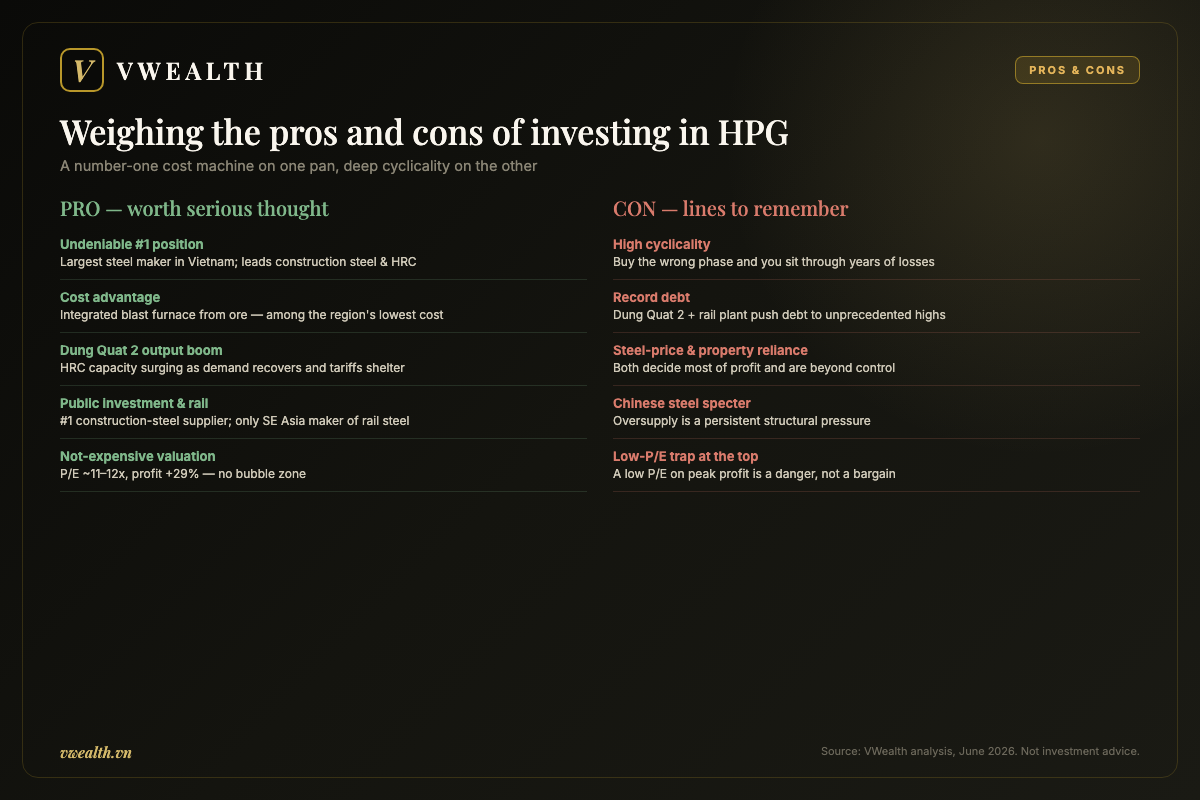
Should you buy HPG stock?
This is the question you really want answered, and I won’t dodge it — but I also won’t curtly declare “buy” or “avoid,” because that would be irresponsible with your money. The right answer is: it depends on who you are, how well you understand the cycle, and how much volatility you can bear. Let’s weigh the two pans.
The pro pan: why HPG deserves serious consideration
- An undeniable number-one position. Hoa Phat is Vietnam’s largest steel producer, leading in both construction steel and HRC. In an industry where scale decides survival, this leading position is an extremely valuable intangible asset.
- A cost advantage from the closed process. The integrated blast-furnace model from ore to finished product gives Hoa Phat among the region’s lowest production costs, a survival cushion when steel prices hit the bottom — when rivals lose money, Hoa Phat can still hold on.
- Dung Quat 2 about to boom output. HRC capacity surging exactly as the domestic market recovers and anti-dumping duties provide shelter — a very favorable timing alignment.
- Direct beneficiary of public investment and rail. As the number-one construction-steel supplier and the only Southeast Asian business advancing toward high-speed rail steel, Hoa Phat stands at the center of the coming decade’s national infrastructure capital flow.
- Not-expensive valuation. At 23,600đ (19 June 2026) and a P/E of about 11–12 times, with 2025 after-tax profit of 15,515 billion dong (up 29%), the stock is not valued in a bubble zone.
The con pan: the lines you must never forget
- High cyclicality — buying the wrong phase hurts badly. This is the biggest and most underrated risk. If you buy HPG right at the profit-cycle top, you may have to sit through years of losses waiting for the cycle to return. For steel stocks, entry timing matters as much as — if not more than — business quality.
- Record debt. The parallel investment in Dung Quat 2 and the rail plant pushed debt to unprecedented highs, making profit sensitive to rates and currency.
- Dependence on steel prices and real estate. These two variables decide most of profit, and both are beyond the business’s control.
- The specter of Chinese steel. The tariff barrier currently protects, but Chinese oversupply is a persistent structural pressure, and tariff policy can change or be reciprocated.
- The cycle-top low-P/E trap. This is the most sophisticated trap. At the cycle top, high profit pulls P/E low, making the stock “look cheap.” But when the cycle reverses, profit collapses, P/E immediately swells and the price plunges. For cyclical stocks, a low P/E is sometimes a danger signal, not a bargain.
A decision framework by four investor types
Instead of a one-size answer, hold yourself up against the fitting investor type:
- Value investor. The 11–12x P/E and industry-leading position may attract you, but beware the cycle-top low-P/E trap. Value HPG on average profit across the whole cycle, not just one peak year, and demand a wide margin of safety.
- Growth investor. The Dung Quat 2 story, high-speed rail steel and the 16-million-ton target are real growth catalysts. If you believe in this path and accept volatility, HPG can be a worthwhile industrial-growth bet. But follow execution progress closely, especially the ability to absorb capacity.
- Long-term accumulating investor. If you hold for many years, steadily, and treat cyclical volatility as a given, then accumulating HPG at reasonable prices across many beats can let you ride the full long wave of Vietnam’s steel industry. This is perhaps the investor type HPG suits best.
- Safety-first investor expecting short-term stability. If you need steady cash flow and fear strong volatility, HPG most likely doesn’t suit you. A stock that can swing tens of percent by cycle phase is no place to park idle money needing peace of mind.
In short: HPG suits those who understand the cycle and can bear the cycle. If you can see the multi-year picture and stay calm before short-term jolts, this is one of the most worth-holding businesses in the industry. If you need month-to-month peace, HPG’s beauty will become your headache.
Personally, I believe the industry-leading position, cost advantage and series of long-term drivers make Hoa Phat worth being on the watchlist of any serious investor interested in the Vietnamese market. But “worth watching” doesn’t equal “buy today” — your entry point, position size and personal endurance are what decide the final result.
Disclaimer
All content in this article is produced for informational and reference-analysis purposes, and is not a recommendation to buy, sell or hold any security. The figures, forecasts and scenarios above are based on public data at the time of writing and may change without notice. The stock market always carries the risk of capital loss. You should do your own thorough research, weigh your financial situation, goals and risk appetite, and consult a licensed investment advisor before making any decision. vwealth.vn and the author bear no responsibility for any losses arising from the use of information in this article.
Research Vietnamese stocks in English with vwealth. Our AI-powered platform turns Vietnamese market data into full English analysis reports — with international payment support and a free 2-month trial for new accounts. Create your free account and read the latest reports.