Vietnam has one of the most talked-about stock markets in Asia, yet finding Vietnam stock market data in English remains harder than it should be. The numbers exist — the exchanges publish them, companies file them, brokers analyze them — but most of it appears in Vietnamese first, and some of it never gets translated at all. This guide maps the entire information landscape layer by layer: exchange announcements, company filings and their English lag, index providers, broker research, aggregator platforms, and AI-assisted tools. By the end, you will know exactly where each type of number lives, how long the English version takes to arrive, and how to verify any figure across at least two independent sources before you trust it.
Why English-language data on Vietnamese stocks is scarce in the first place
Before mapping where to find things, it helps to understand why the gap exists. If you know the cause, you can predict where the gap will be widest — and where it barely exists.
The rules require Vietnamese, not English
Vietnam’s disclosure regulations require listed companies to publish material information in Vietnamese. That is the legal language of disclosure — the version that counts if there is ever a dispute. English disclosure is encouraged, and regulators have pushed larger companies toward bilingual reporting for years as part of the market’s upgrade ambitions, but for most of the roughly 1,600 companies trading across Vietnam’s three venues, English remains voluntary.
The practical consequence: when a company announces a dividend, a capital raise, or a change of CEO, the Vietnamese announcement is the primary document. An English version, if one appears, is a courtesy translation produced afterward. Sometimes “afterward” means the same day. Sometimes it means weeks. Sometimes it means never.
Why the gap persists even as foreign money arrives
Three structural reasons keep the gap alive. First, the market is dominated by domestic retail investors — individual Vietnamese traders account for the overwhelming majority of daily trading volume. Companies communicate with the audience that moves their stock price, and that audience reads Vietnamese. Second, translation costs money and carries legal risk: a mistranslated number in an English report can create liability, so smaller companies simply skip it. Third, the local data-vendor industry grew up serving Vietnamese brokers and Vietnamese retail apps, so the richest databases — tick data, adjusted price histories, ownership registers — were built with Vietnamese-language interfaces.
The result is a predictable pattern you can use. English coverage is deepest for the largest 30 to 50 companies (the ones foreign funds actually buy), decent for the next 100 or so, and nearly nonexistent below that. If you are researching a blue chip, you will find English annual reports, English broker notes, and English news coverage. If you are researching a small-cap on UPCoM — the market for unlisted public companies — you should expect to work from Vietnamese documents, machine translation, or a platform that does the translation for you. Our guide on how to invest in the Vietnam stock market as a foreigner covers the account-opening and access side of this same problem.
Layer one: the exchanges and the regulator — the primary sources
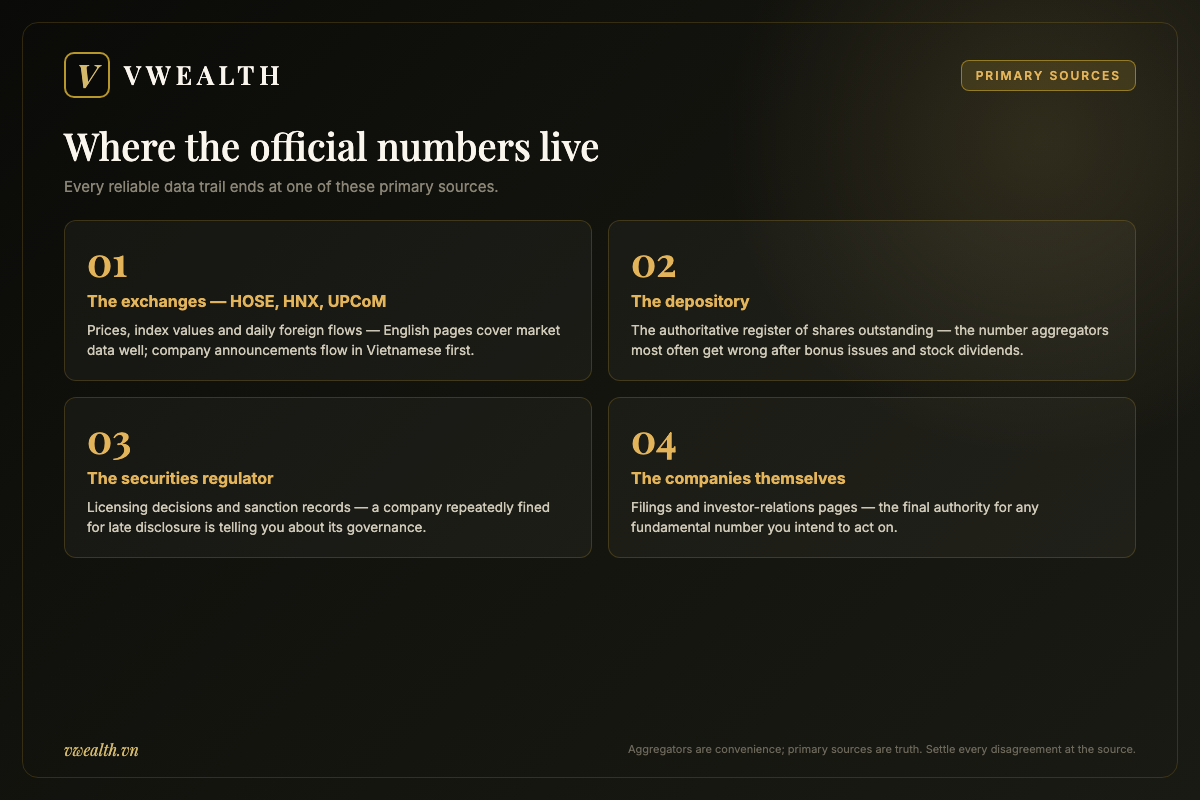
Every reliable data trail in any stock market ends at a primary source: the exchange where the trade happened, the depository that settled it, or the regulator that approved the filing. Vietnam is no different, and the good news is that the primary sources here are more English-friendly than most people expect.
Three trading venues, one holding company
Vietnam’s equities trade on three venues. The Ho Chi Minh City exchange (commonly abbreviated HOSE) hosts the largest listed companies and calculates the VN-Index, the headline benchmark. The Hanoi exchange (HNX) hosts smaller listed companies plus the bond market. UPCoM, operated under the Hanoi exchange, is the registration market for public companies that have not completed a full listing — think of it as a pre-listing waiting room with lighter disclosure standards. Both exchange operators sit under a single state-owned parent, the Vietnam Exchange (VNX). Roughly 1,600 companies trade across the three venues in total. The market’s back-end has modernized fast: the long-delayed KRX trading system went live on the Ho Chi Minh City exchange on 5 May 2025, and Circular 68/2024 (effective November 2024) removed the requirement that foreign institutional investors pre-fund purchases in full — both reforms that fed directly into Vietnam’s index-upgrade case. If you want the full comparison of what listing on each venue means for disclosure quality, we break it down in our comprehensive guide to the Vietnamese stock market for investors.
What matters for data purposes: both exchange websites maintain English versions. On the English pages you can reliably find end-of-day prices, index values, foreign buy and sell totals (Vietnam publishes daily foreign-investor flows, which many developed markets do not), listing announcements, and trading rules. What the English pages carry less reliably is the disclosure feed — the stream of company announcements. Those flow through in Vietnamese as companies file them, and the English mirror is partial. Treat the exchange’s English site as your source for market-level data and its Vietnamese site as the source of record for company-level announcements.
The depository: where share counts live
The Vietnam Securities Depository and Clearing Corporation registers every share of every public company. This is the authoritative source for one of the most error-prone numbers in Vietnamese equity research: shares outstanding. Aggregator platforms frequently disagree with each other on share counts because bonus issues and stock dividends — both extremely common in Vietnam — change the count several times a year. When two sources give you different market capitalizations for the same company, a stale share count is the usual culprit, and the depository’s registration records are how you settle the argument.
The regulator: filings, penalties, and warnings
The State Securities Commission is Vietnam’s market regulator. Its site publishes licensing decisions, sanction announcements (fines for late disclosure, trading violations, and accounting misstatements), and the legal framework itself. Sanction records are underused by foreign investors: a company that has been repeatedly fined for late or false disclosure is telling you something important about its governance, and the regulator’s penalty list is where that history lives. We explore how to read these signals in our article on corporate governance in Vietnam and what it means for minority shareholders.
Layer two: company filings — and the English lag you must plan around
Company filings are where the real fundamental data lives: revenue, profit, debt, cash flow, ownership. Understanding what Vietnamese companies file, on what schedule, and in what language is the single most valuable piece of knowledge in this entire guide.
What companies must file, and when
Listed Vietnamese companies file on a rhythm that will feel familiar if you know other markets, with local twists. Quarterly financial statements are due within weeks of quarter-end and are unaudited. Semi-annual statements receive a limited review by auditors. Annual statements receive a full audit and arrive within roughly three months of year-end, followed by an annual report — a glossier document that adds strategy discussion, governance disclosures, and ownership details to the audited numbers. On top of this calendar sit event-driven disclosures: dividend decisions, share issuance, major contracts, insider transactions, and shareholder meeting materials.
Two local twists deserve attention. First, quarterly statements in Vietnam are often filed as standalone spreadsheet-style documents with minimal notes, so the explanatory depth you may expect from a quarterly report elsewhere simply is not there — the notes arrive with the audited annual statements. Second, the audited annual figures sometimes differ meaningfully from the previously published unaudited fourth-quarter figures. A gap between unaudited and audited profit is a classic Vietnamese red flag, and it is only visible if you compare both documents.
The English lag, quantified by document type
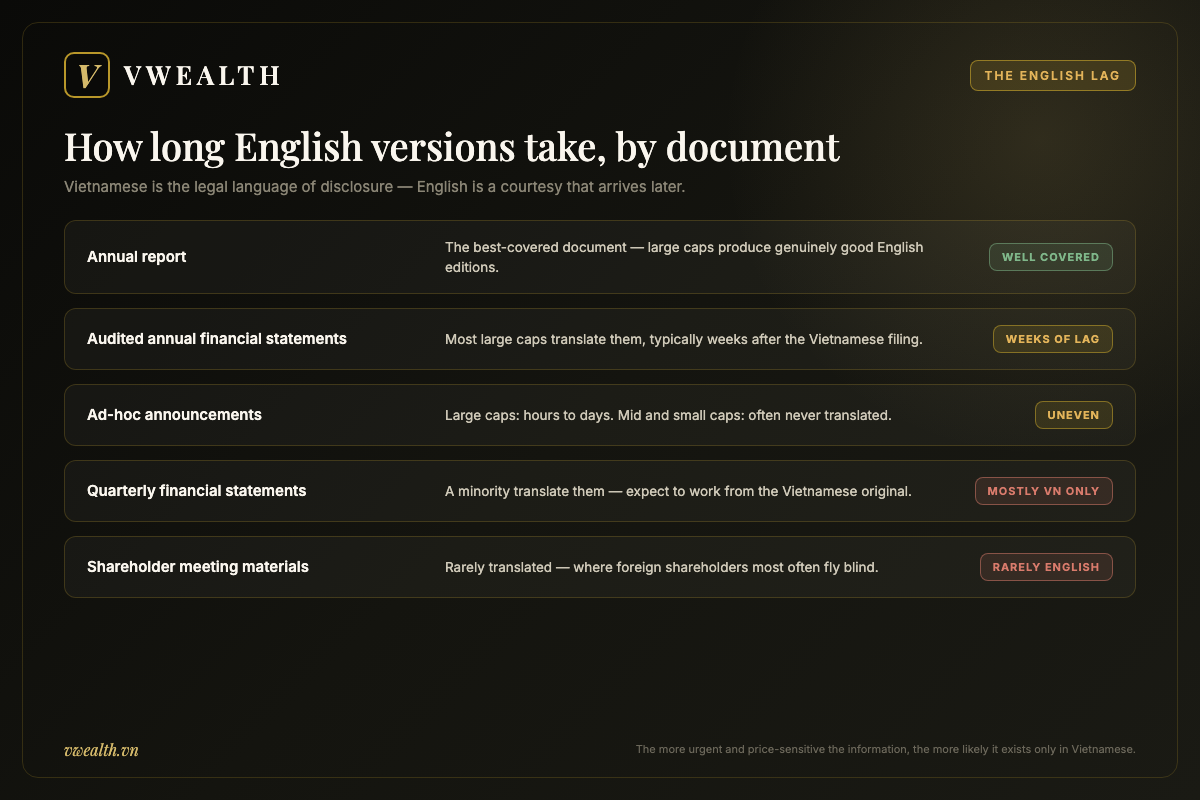
Here is the honest picture of when English versions appear, by document type:
| Document | Vietnamese version | English version — typical reality |
|---|---|---|
| Ad-hoc announcements (dividends, deals, management changes) | Immediately, as filed | Large caps: hours to days. Mid caps: often never. Small caps: almost never. |
| Quarterly financial statements | On the filing deadline | A minority of large companies translate them; most do not. Expect to work from the Vietnamese original. |
| Audited annual financial statements | Within the annual deadline | Most large caps and many mid caps eventually publish English versions, typically weeks after the Vietnamese filing. |
| Annual report | Before the annual shareholder meeting | The best-covered document. Companies competing in annual-report awards produce genuinely good English editions. |
| Shareholder meeting materials | Weeks before the meeting | Rarely translated except by the largest companies. This is where foreign shareholders most often fly blind. |
The pattern is clear: the more polished and backward-looking the document, the better the English coverage. The more urgent and price-sensitive the information, the more likely it exists only in Vietnamese. This is precisely backwards from what an active investor needs, and it is the core reason machine translation and AI-assisted platforms have become standard equipment for foreign investors in this market rather than a luxury.
The accounting-standards layer underneath the language layer
Even a perfectly translated Vietnamese financial statement is not the document a global investor expects, because Vietnamese companies report under Vietnamese Accounting Standards (VAS) rather than the international IFRS framework used across most major markets. VAS differs from IFRS in how it treats asset revaluation, financial instruments, impairment, and several other areas — differences that can move reported equity and profit materially. Vietnam has a long-running roadmap toward IFRS adoption, and some large companies voluntarily publish IFRS or IFRS-converted statements, but VAS remains the default. Before you compare a Vietnamese bank’s book value to a regional peer’s, read our detailed breakdown of Vietnamese financial statements under VAS versus IFRS — the translation problem in this market is only half linguistic; the other half is accounting.
Layer three: index providers — the numbers everyone quotes
Index data is the easiest Vietnamese market data to find in English, because indices are exactly the kind of aggregated, standardized number that travels well across languages.
The domestic index family
The VN-Index is the headline number — a market-capitalization-weighted index of every company listed on the Ho Chi Minh City exchange, with a base value of 100 set at the market’s opening in July 2000. Because it weights by full market cap and includes everything on the exchange, a handful of giants dominate its movements, and thinly traded heavyweights can push it around in ways that do not reflect the average stock’s day. The VN30 addresses this: it tracks the thirty largest and most liquid stocks, applies free-float adjustment (weighting by the shares actually available to trade rather than total shares), and caps any single stock’s weight. It is also the underlying index for Vietnam’s stock-index futures, which makes it the number derivatives traders watch. The Hanoi exchange calculates its own family, led by the HNX-Index, and UPCoM has one too, though few people quote it.
All of these are published in real time and are freely available in English on the exchange websites and every major financial portal. If you only need index levels, you have no data problem at all.
The international classification layer
Separately, global index providers — the firms whose emerging-market and frontier-market benchmarks steer trillions of passive dollars — maintain their own Vietnam country indices and, more importantly, their own classification of Vietnam’s market status. The two names that matter are FTSE Russell and MSCI. Reclassification between frontier and emerging status is one of the biggest structural stories in Vietnamese equities, because an upgrade forces passive funds tracking emerging-market benchmarks to buy Vietnamese stocks. As of mid-2026 the two providers sit in different places, which is exactly why you must check each one directly. FTSE Russell announced on 7 October 2025 that it would reclassify Vietnam from Frontier to Secondary Emerging Market status, and confirmed that decision at its March 2026 interim review, with the change taking effect on 21 September 2026. MSCI, by contrast, still classifies Vietnam as a Frontier market and, in its June 2026 annual review, did not add Vietnam to the watch list for a potential upgrade — leaving the next MSCI opportunity to the 2027 review. The classification criteria (settlement mechanics, foreign-ownership access, currency convertibility) and the annual review documents are published in English directly by the index providers, and they are worth reading in the original rather than through news summaries. Because the two providers move on different timetables, check both against their own review documents when you read this — the status is a moving target by design, and secondhand reporting on it is often stale.
One practical warning: the index providers’ Vietnam country indices contain far fewer stocks than the VN-Index and use different weighting rules, so their performance can diverge noticeably from the local benchmark. If a global fund factsheet says “Vietnam” it usually means the provider’s index, not the VN-Index. Know which one you are looking at before comparing returns.
Layer four: broker research — analysis in English, with predictable biases
Brokerage research is the layer where raw data becomes interpretation: earnings forecasts, valuation models, target prices, and industry deep-dives. Vietnam has a genuinely active research industry, and a meaningful slice of it is available in English.
Who produces English research
Three categories of producers matter. The large domestic full-service brokerages — the firms with institutional client desks serving foreign funds — publish English versions of much of their research: daily market commentary, company initiation reports, sector notes, and strategy pieces. The names you will encounter most often are SSI, VNDirect, and Vietcap (the brokerage whose ticker is VCI); these consistently rank among the largest brokers by trading market share and run the most-developed English institutional-research desks, and asset managers such as Dragon Capital and VinaCapital publish English commentary on top of their fund work. Foreign-owned brokerages operating in Vietnam — several of them subsidiaries of Korean, Japanese, and regional financial groups, Mirae Asset and KIS among them — produce English research as a core product because their client base demands it. Finally, independent research boutiques and fund managers publish English-language Vietnam commentary — monthly fund letters from frontier-market funds are an underrated free source, because fund managers explain their holdings with a candor that sell-side reports rarely match.
How to read it with the right discount
Vietnamese broker research carries the same structural biases as sell-side research everywhere, plus local flavors worth knowing. Coverage concentrates heavily on large caps and on companies with active investor-relations budgets, so the absence of coverage tells you nothing about a small company’s quality. Ratings skew positive — outright sell recommendations are rare, partly for relationship reasons and partly because brokers earn from trading volume in a retail-heavy market. And English reports are usually translations of Vietnamese originals, published with a lag of hours to days, so the Vietnamese-reading audience has often acted on the content before the English version lands. Use broker research for its inputs — the earnings models, the industry data, the management-meeting notes — rather than its conclusions. An analyst’s revenue breakdown of a steel company is valuable regardless of whether you share the analyst’s buy rating.
Getting access without an institutional account
Institutional clients receive research directly, but a surprising amount of Vietnamese broker research circulates publicly: firms post reports on their websites to attract clients, summaries appear in English-language business media, and aggregation channels republish key calls. The practical rule: recent, market-moving research is gated; research older than a few weeks is usually findable. For screening and valuation numbers specifically, a data platform will serve you better than hunting through report PDFs — which brings us to the next layer.
Layer five: aggregators and data platforms — convenience with a verification cost
Aggregators sit between you and the primary sources: they collect prices, financials, and announcements, standardize them into databases, and present them in dashboards and screeners. This is where most day-to-day research actually happens, and it is where language and data-quality issues compound each other.
The categories, from global terminals to local portals
Global professional terminals — the expensive institutional platforms — cover Vietnamese equities with English-standardized financials and are the default for fund managers, but their subscription costs put them out of reach for individual investors, and their Vietnam coverage depth (especially for small caps and for local disclosure documents) trails what domestic platforms offer. Global free portals — the mainstream international finance websites — carry Vietnamese large-cap prices and basic financials, but their coverage is shallow, share counts and corporate actions frequently lag, and delisted or renamed tickers linger. Domestic data platforms and broker apps offer the deepest Vietnam data anywhere — full financial histories, ownership data, foreign-flow numbers, event calendars — but their interfaces and data labels are mostly Vietnamese, which is exactly the barrier this article is about. English-language business news outlets covering Vietnam fill the narrative gap, reporting major corporate events and macro developments in English within a day or two.
| Source layer | English availability | Typical lag | Cost | Best used for |
|---|---|---|---|---|
| Exchanges and regulator | Good for market data, partial for announcements | None (primary source) | Free | Prices, indices, foreign flows, official record |
| Company filings | Good for annual reports, poor for everything else | Days to weeks for English versions | Free | Fundamentals, audited numbers, governance detail |
| Index providers | Excellent | None | Free (levels); paid (constituent data) | Benchmarks, market-status classification |
| Broker research | Good for large caps | Hours to days after Vietnamese version | Free to relationship-gated | Forecasts, industry data, context |
| Aggregator platforms | Varies from none to full | Minutes to months depending on field | Free to institutional pricing | Screening, charting, daily workflow |
The aggregator error taxonomy
Every aggregator introduces errors, and Vietnamese data has specific failure modes worth memorizing. Corporate-action adjustments are the biggest: Vietnamese companies issue stock dividends and bonus shares constantly, and each event requires adjusting the historical price series. Platforms disagree on adjustment methodology, so two charts of the same stock can show different five-year returns — both internally consistent, both defensible, but not comparable. Stale share counts produce wrong market caps and wrong per-share ratios. Financial-statement mapping errors occur when a platform’s template forces VAS line items into international-style categories and something lands in the wrong bucket. And ticker collisions happen because Vietnamese tickers are three letters, so the same combination may exist on international exchanges — searching a Vietnamese ticker on a global platform sometimes returns a different company entirely.
None of this makes aggregators unusable. It makes them what they are: a convenience layer whose numbers you spot-check against primary sources whenever a figure is about to influence a decision.
Where AI-assisted platforms fit — and where vwealth sits in this landscape
The newest layer of the landscape uses AI to attack the two problems this article keeps circling: the language barrier and the analysis barrier. Machine translation has made raw Vietnamese disclosures roughly readable for years; the current generation of AI tools goes further by reading the original filings and producing structured analysis — summaries, ratio calculations, red-flag detection — directly in English.
This is the category vwealth belongs to, so here is the honest version of what we do and do not solve. vwealth’s platform ingests Vietnamese market data and company filings and runs them through twelve specialized AI analysts covering financial-statement analysis, valuation, technical signals, and scoring, producing full research reports in English (and Vietnamese). For a foreign investor, that collapses the workflow this article describes — find the Vietnamese filing, translate it, restate the ratios, compare across sources — into reading a single report with updated numbers. The platform supports international payments and offers new accounts a free two-month trial, and you can browse the format in the report library before creating an account.
What an AI platform — ours included — does not replace: primary sources remain the final authority, and any AI system’s output is only as current as its data pipeline and only as good as its models. The intellectually honest way to use AI-generated analysis is the same way you use broker research: as a fast, structured first pass that tells you where to look, which you then verify against the filing itself for any number you intend to act on. An AI layer compresses the research cycle from hours to minutes; it does not eliminate the verification step. Nothing in this market does.
How to verify a number: the cross-checking discipline
Everything above describes where data lives. This section describes the skill that matters more than any source list: verifying a specific number before you rely on it. In a market with a translation layer, an accounting-standards layer, and an aggregator layer between you and the truth, verification is not paranoia — it is the baseline procedure.
The two-source rule, applied to Vietnam
The rule itself is simple: no number goes into your decision until two independent sources agree on it, where “independent” means the sources did not copy from each other. An aggregator and a news article citing that aggregator are one source, not two. An aggregator and the company’s audited financial statement are genuinely two. In practice, the second source for any fundamental number should almost always be the filing itself — which, thanks to the English lag, may mean opening a Vietnamese PDF and machine-translating the relevant page. That is a five-minute task that catches the majority of data errors you will ever encounter.
The Vietnam-specific unit traps
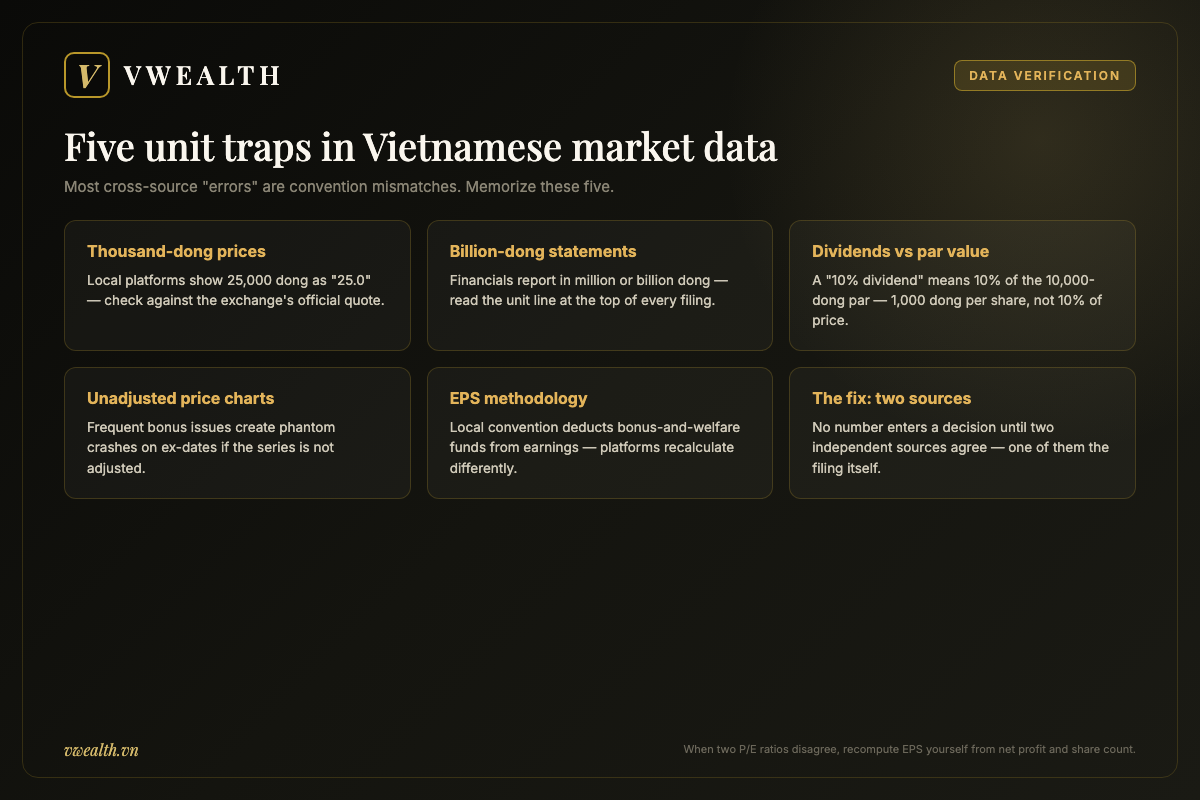
Most cross-source disagreements in Vietnamese data are not errors at all — they are unit and convention mismatches. Five traps account for nearly all of them:
| Trap | What happens | How to catch it |
|---|---|---|
| Thousand-dong price quotes | Local platforms often display a price of 25,000 dong as “25.0”. A foreign platform shows 25,000. Both are correct. | Sanity-check against the exchange’s official close, which is quoted in full dong. |
| Billion-dong financials | Vietnamese statements report in million or billion dong; a misread multiplier shifts revenue a thousandfold. | Read the unit declaration at the top of every statement. Every Vietnamese filing states it. |
| Dividends quoted against par value | A “10% cash dividend” means 10% of the 10,000-dong par value — 1,000 dong per share — not 10% of the market price. | Convert to dong per share, then compute yield against the market price yourself. |
| Stock dividends muddying returns | Frequent bonus issues mean unadjusted price charts show phantom crashes on ex-dates. | Confirm whether a price series is corporate-action adjusted before computing returns. |
| EPS methodology differences | Vietnamese convention deducts bonus-and-welfare-fund appropriations from earnings for EPS; some platforms recalculate without the deduction. | When two P/E ratios disagree, recompute EPS from net profit and share count yourself. |
The par-value trap deserves one more sentence because it costs real money: par value in Vietnam is standardized at 10,000 dong per share, which means charter capital divided by 10,000 gives you the share count, and percentage dividends are always percentages of that 10,000. An investor who reads “12% dividend” as a 12% yield on a stock trading at 40,000 dong is expecting four times the actual payout.
A worked verification, step by step
Illustrative example: suppose a screener tells you that a hypothetical listed logistics company trades at a P/E of 6, which would make it strikingly cheap. Before acting, you verify. Step one: check the price against the exchange’s official quote — confirm the 6 is not built on a stale or mis-scaled price. Step two: check the share count — search recent announcements for bonus issues or private placements; if the company issued 30% new shares last quarter and the screener has not updated, every per-share ratio is wrong. Step three: check the earnings — open the last four quarterly filings and confirm the trailing profit figure, watching for one-off gains (asset sales are a common Vietnamese earnings inflator) that make a trailing P/E meaningless. Step four: check the audited-versus-unaudited gap in the most recent annual statement. If the number survives all four checks, it is real, and you have also learned more about the company than the screener could ever tell you. The verification process is the research.
Building your personal research workflow
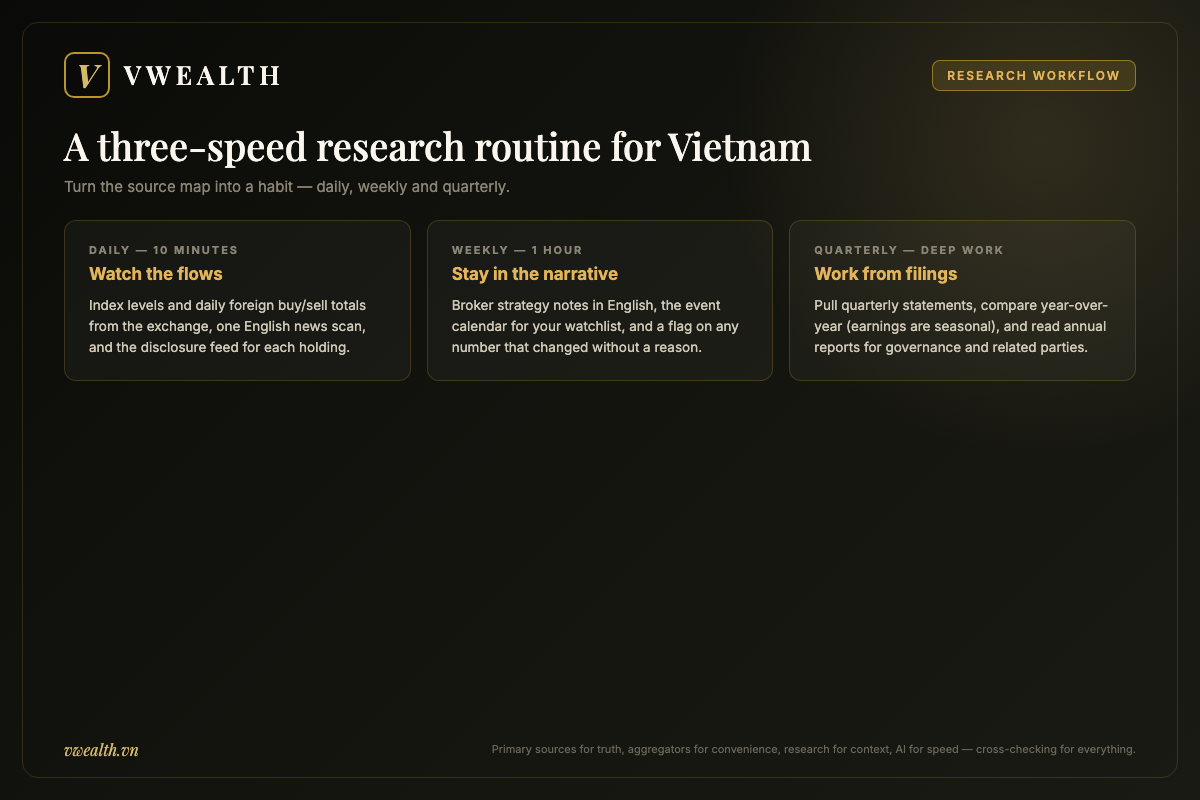
A source map is only useful once it becomes a routine. Here is a workflow structure that experienced foreign investors in Vietnam converge on, adaptable to your own time budget.
The daily pass: ten minutes
Check index levels and the daily foreign buy/sell flows on the exchange’s English site — foreign flows are Vietnam’s most-watched daily sentiment indicator. Scan one English-language Vietnam business news source for corporate events. If you hold positions, check each holding’s disclosure feed for new announcements; a translation tool on a Vietnamese headline takes seconds and beats waiting days for an English version that may never come.
The weekly pass: one hour
Read the English weekly strategy notes from one or two brokerages to stay attached to the local narrative. Review upcoming events for your watchlist: earnings deadlines, ex-dividend dates, shareholder meetings. Update your watchlist’s key numbers from your platform of choice, and flag any figure that changed for a reason you cannot explain — unexplained changes are either corporate actions you missed or data errors, and both are worth knowing about.
The quarterly pass: the deep work
Earnings season is where Vietnam’s information asymmetry is most extreme, because hundreds of companies file Vietnamese-only quarterly statements within a compressed window. This is the moment to work from filings rather than waiting for coverage: pull the quarterly statements for your holdings, run the numbers against your expectations, and compare the new quarter against the same quarter last year rather than the previous quarter — Vietnamese earnings are strongly seasonal, with fourth quarters distorted by expense timing and Lunar New Year effects. Once a year, read each holding’s full annual report in whatever language it offers, paying particular attention to related-party transactions and ownership changes — the governance sections that quarterly numbers never show. If your time budget cannot absorb this, that is the gap an analysis platform fills: a vwealth account generates this quarterly deep-read as structured English reports, which you then spot-check rather than build from scratch.
The bottom line: the gap is real, mapped, and manageable
Vietnam stock market data in English is neither absent nor abundant — it is unevenly distributed in a pattern you can now predict. Market-level data (prices, indices, foreign flows) is fully available in English from primary sources at zero cost. Analysis of large caps (broker research, annual reports, news coverage) is well covered with a modest lag. Event-driven disclosures and anything below the top hundred companies remain Vietnamese-first territory, where your options are machine translation, an AI-assisted platform, or accepting an information disadvantage that local investors will happily exploit.
The investors who do well in informationally uneven markets are rarely the ones with secret sources — they are the ones with disciplined verification habits, who know which layer each number came from and what that layer’s failure modes are. The market’s English coverage will keep improving as Vietnam pursues its market-status upgrade and as bilingual disclosure spreads down the market-cap spectrum. Until then, the workflow in this guide — primary sources for truth, aggregators for convenience, research for context, AI for speed, and cross-checking for everything — is how you turn Vietnam’s information gap from a barrier into an edge.
This article is a research and educational guide to information sources, not investment advice; always verify data independently and consider your own situation before making investment decisions.
Research Vietnamese stocks in English with vwealth. Our AI-powered platform turns Vietnamese market data into full English analysis reports — with international payment support and a free 2-month trial for new accounts. Create your free account and read the latest reports.