Most guides to Vietnam trading hours stop at the opening and closing bell. That is the least consequential fact about trading here.
What actually shapes execution is the combination of three things: a daily price band applied to every individual stock, a session structure with auctions at both ends and a midday break, and a settlement cycle that determines when you can reuse proceeds.
Get those three wrong and you place orders that cannot fill, plan sequences that do not settle in time, and misread a limit move as a market event when it is a mechanical one.
What are the Vietnam trading hours and session structure?
Short answer: HOSE runs Monday to Friday, roughly 9:15 to 11:30 and 13:00 to 14:30 Indochina Time, with an opening auction, continuous trading and a closing auction. Exact times are set by the exchange and change occasionally — confirm with your broker before relying on them for order timing.
Price bands: the rule that shapes everything
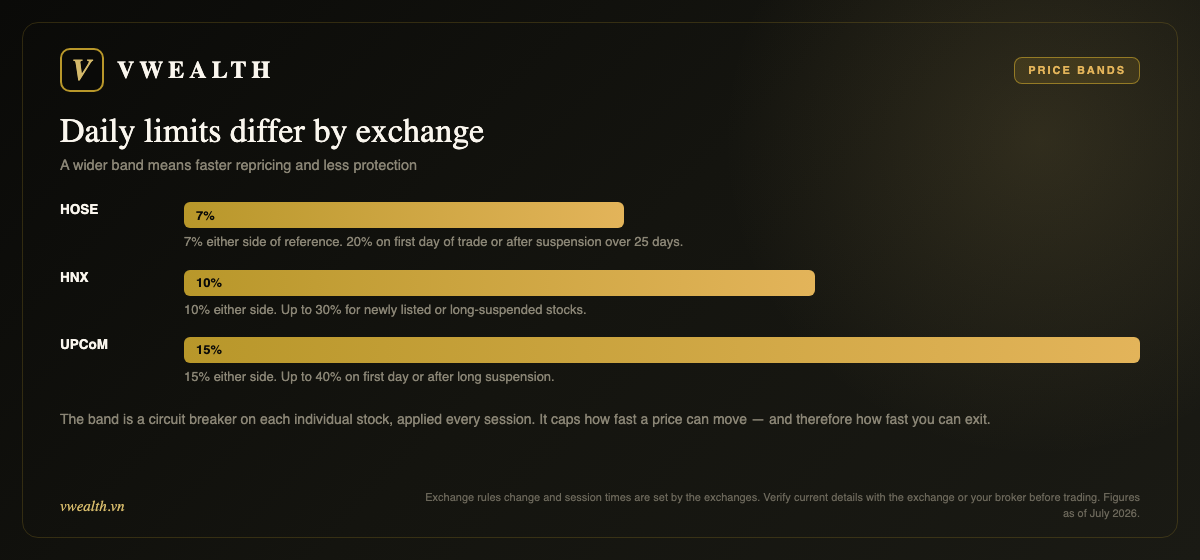
Every stock has a maximum permitted move from its reference price each session. The size differs by exchange.
HOSE: 7% either side of the reference price. Widened to 20% on the first day of trading, or after a suspension of more than 25 days.
HNX: 10% either side, up to 30% for newly listed or long-suspended stocks.
UPCoM: 15% either side, up to 40% on a first day or after long suspension.
What this means in practice
The band is a circuit breaker applied per stock, every session. It caps how fast a price can move — which sounds protective and cuts both ways.
When you want to sell into weakness, a stock at the lower limit may have no buyers at all. The price cannot fall further, so the market simply stops trading it. You are not protected; you are stuck.
When you want to buy into strength, the same applies in reverse. A stock at the upper limit has sellers who have withdrawn, and your order sits unfilled.
This is the single most important execution difference between Vietnam and a market without bands, and it explains why liquidity assessment matters more here.
Consecutive limit moves
Because the band is a percentage of yesterday’s close, several limit sessions in a row compound. Three consecutive limit-down sessions on HOSE move a price roughly 20% lower — and during those sessions a holder wanting out may have been unable to transact at all.
This is why position sizing against liquidity matters more than it does elsewhere, a point covered in the screening framework.
How a trading day is structured
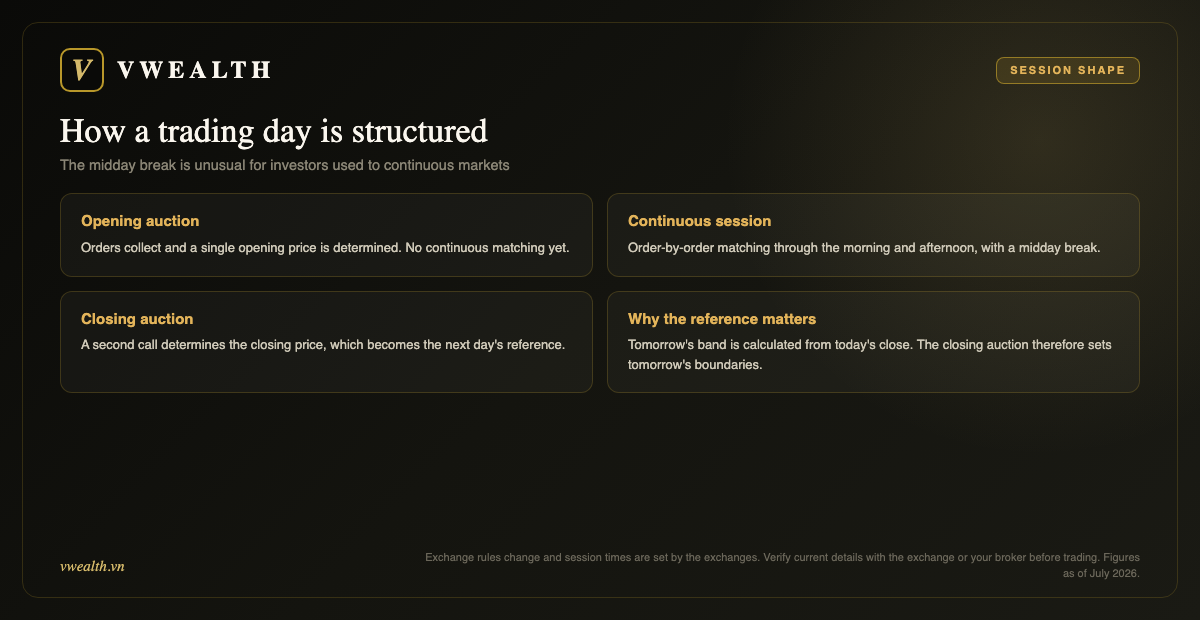
Opening auction
Orders accumulate and a single opening price is determined. No continuous matching happens during this window, so an order placed here participates in the auction rather than executing immediately.
Continuous session
Order-by-order matching, split across a morning and an afternoon block with a break between them.
The midday break catches out investors used to continuous markets. News released during it accumulates without any price response until the afternoon reopens, which frequently produces a gap.
Closing auction
A second call determines the closing price.
This is more consequential than it first appears, because the closing price becomes tomorrow’s reference price, and tomorrow’s band is calculated from it. The closing auction therefore sets the boundaries within which tomorrow can trade.
Practical consequences for order placement
Orders behave differently depending on which phase they land in. An order type that executes immediately in continuous trading may simply join the queue in an auction.
If timing matters for your order, confirm with your broker which order types are accepted in which session — the rules differ and they are not intuitive from a developed-market background.
Settlement: what happens after you trade
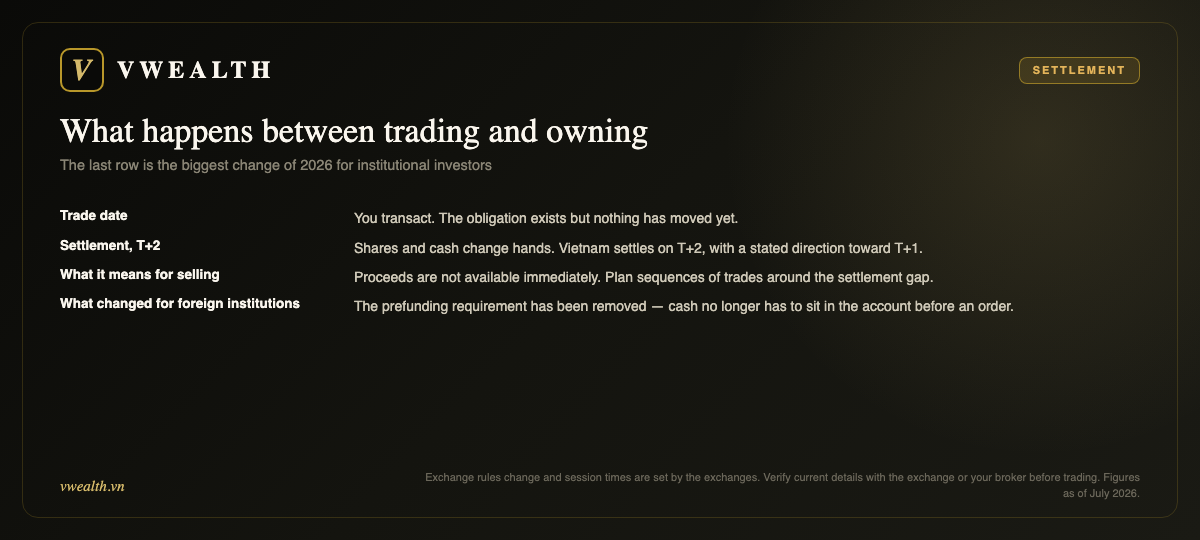
Vietnam settles on T+2, with a stated direction of travel toward T+1.
On trade date the obligation exists but nothing has moved.
On settlement shares and cash change hands.
What this means for sequencing trades
Sale proceeds are not immediately available for redeployment. If you plan to sell one position and buy another, the settlement gap sits between them.
For a long-term investor this is a minor scheduling matter. For anyone rotating positions frequently, it is a constraint that has to be built into the plan.
The 2026 change
The requirement for foreign institutions to place cash before trading has been removed — the non-prefunding model that FTSE Russell named explicitly as a condition ahead of Vietnam’s reclassification to Secondary Emerging status, effective 21 September 2026.
Under the old arrangement, money had to be wired in and sit idle, exposed to the currency, before an order could be placed. Many institutional mandates prohibited that outright, which kept funds out of the market entirely rather than merely inconveniencing them.
This is the most consequential mechanical change in this market for years, and it affects institutions rather than individuals. Full context in what actually changes in September.
Why bands exist, and what they trade away
Understanding the intent helps predict how the mechanism behaves under stress.
Price limits are designed to slow disorderly moves, give participants time to assess information, and reduce the chance of panic-driven cascades. In a market with a high share of individual investors, that rationale carries weight.
What they achieve
A single session cannot produce a catastrophic single-day repricing. The move is spread across days, which gives holders time to respond and clearing systems time to manage exposure.
What they cost
They delay price discovery rather than prevent it. If the market’s view is that a stock is worth 30% less, the band does not change that view. It spreads the adjustment across several sessions, and during those sessions the stock may barely trade.
They can attract rather than deter. A stock approaching its limit sometimes draws orders from participants who fear being unable to transact later, which accelerates the move to the boundary. The band becomes a magnet in the final stretch.
They complicate risk management. A stop instruction cannot execute if there is no counterparty at any permitted price. Anyone relying on stops to bound losses should understand that the mechanism has a limit here.
The practical stance
Treat bands as a feature to plan around rather than a protection to rely on. Concretely: size positions so that being unable to exit for several sessions is survivable, and do not build a strategy whose risk control depends on selling at a specific price during stress.
Interaction with margin
Price bands and leverage interact badly, and the combination deserves explicit attention.
A leveraged position facing consecutive limit-down sessions can breach its maintenance threshold while the holder is unable to sell — the price cannot fall further, so there are no buyers, and the position cannot be reduced.
The forced-sale mechanism then executes when trading resumes, at whatever price the market has reached by then.
This is the specific scenario that turns a leveraged loss into an outsized one, and it is a function of market structure rather than of any individual decision. The arithmetic of margin thresholds is set out in our Vietnamese-language piece on calculating the margin call price before buying.
Order types and where they apply
A brief orientation, because the naming differs from developed-market conventions and the session phase determines what is accepted.
Limit orders specify a price and are the default for most investors. They work throughout the continuous session and can participate in auctions.
Auction-specific order types exist for the opening and closing calls and behave differently from continuous-session orders. They are matched at the auction price rather than against a specific counterparty.
Market-style orders exist in some forms and are constrained by the band — an order to buy at any price still cannot execute above the upper limit.
The practical instruction: ask your broker which order types are available in which phase, and what happens to an unfilled order at the end of each session. Both answers vary and neither is guessable.
Market structure: what is changing
Beyond settlement, the exchange landscape itself is consolidating.
The stated plan is for listed equities to concentrate on HOSE, with HNX focusing on bonds and derivatives. UPCoM remains the venue for companies not meeting full listing requirements.
For an investor the practical implication is about price bands: a stock moving between venues moves between band regimes, and a 15% band behaves very differently from a 7% one.
Background on the three venues is in how HOSE, HNX and UPCoM differ.
Five practical consequences
1. Limit moves are mechanical, not informational
A stock at its limit has not necessarily received news. It has hit a boundary. Reading a limit move as a market verdict overstates what happened.
2. Exit planning matters more than entry planning
Because bands can prevent exit entirely for a session or several, the question “can I sell this if I need to” carries more weight here than in a market without bands.
3. The midday break creates gaps
Information arriving during the break is priced at the afternoon open, not gradually. Expect discontinuities rather than drift.
4. The closing auction sets tomorrow’s range
Which makes it more important than the last few minutes of trading in a continuous market, and worth understanding if you place orders near the close.
5. Foreign room interacts with all of this
An order in a capped name may fail for reasons unrelated to price or session. Checking room before placing is a separate step from checking liquidity. See foreign room and the cap that blocks foreign money.
Planning around the calendar
Three timing considerations that sit above the daily session structure.
Public holidays
The exchanges close for Vietnamese public holidays, and the Lunar New Year period involves a multi-day closure that is considerably longer than a typical market break.
For a foreign investor this matters in two ways: your position is unhedgeable during the closure while global markets continue trading, and settlement timelines extend across it.
Reporting season
Quarterly results cluster, which concentrates volatility. For anyone whose position sizing assumes normal liquidity, these windows are where the assumption is tested.
Index review dates
Particularly relevant this year. The reclassification takes effect on 21 September 2026, with the official constituent list expected in August and inclusion phased into 2027.
Index review periods typically produce unusual volume in affected names as funds adjust. For a long-term holder that is noise; for anyone transacting around those dates, it is worth knowing the calendar rather than discovering it.
A checklist before placing an order
Six items, most of which take seconds once habitual.
Which session am I in? Auction phases and continuous trading accept different order types.
What is the band today? Reference price from yesterday’s close, multiplied by the exchange’s limit.
Is there foreign room? Separate from price and liquidity, and binary.
What is average daily traded value? Against the size I intend, and against the size I would need to exit.
When does this settle? If I am funding this from a sale, does the timing work.
What happens to an unfilled order? Whether it carries or cancels at session end.
Nothing here is sophisticated. All six are the sort of thing that seems unnecessary until the first time an order does not behave as expected.
How this compares with markets you already know
Four differences that catch experienced investors, listed because knowing what is unusual is faster than learning each rule separately.
Per-stock circuit breakers rather than market-wide ones
Many markets halt trading market-wide when an index moves beyond a threshold. Here the mechanism operates on every individual stock, every day, whether or not the market is stressed.
That means the constraint is always present rather than exceptional, and it should be part of ordinary planning rather than a contingency.
A midday break
Common in Asia, unfamiliar to investors from continuously traded markets. Its practical effect is that information arriving in the break is priced as a gap rather than absorbed gradually.
The closing auction determines tomorrow’s boundaries
In markets without bands, the closing price is a data point. Here it is also a parameter — it sets the range within which the next session may trade.
Availability is not universal
The foreign ownership cap means some stocks cannot be purchased by you at any price, which has no equivalent in most developed markets and is the single most disorienting feature for newcomers.
What to verify before relying on any of this
Being explicit, because market microstructure changes and articles do not update themselves.
Session times. Set by the exchange, occasionally adjusted.
Band percentages. Stable historically, but they are policy settings rather than natural constants.
Settlement cycle. Currently T+2 with a stated direction toward T+1. When that changes, the sequencing advice in this article changes with it.
Venue rules. With listed equities consolidating onto HOSE, a stock’s applicable band may change with its venue.
The structural points — that bands exist, that they cap exit speed, that settlement creates a gap — will outlast the specific numbers. Treat the numbers as current-as-of-writing and check them.
A worked example of the band arithmetic
Illustrative numbers, to make the mechanism concrete.
A stock on HOSE closes at 50,000 dong. Tomorrow’s reference price is therefore 50,000, and the 7% band gives a permitted range of roughly 46,500 to 53,500.
No transaction can occur outside that range during the session, regardless of what any participant is willing to pay or accept.
If bad news arrives that the market believes is worth 20%, the stock opens at the lower limit and likely stays there with few or no trades. Sellers cannot find buyers at 46,500, because buyers know the fair price is lower and cannot bid it.
The following session the reference price becomes 46,500, and the new lower limit is roughly 43,200. The repricing continues.
By the third session the price has fallen roughly 20% cumulatively, and only now does trading normalise, because the price has reached a level where both sides will transact.
The lesson in that sequence
A holder who wanted to exit on the news could not, for two full sessions, and eventually exited around 20% lower than the pre-news price.
The band did not protect them. It determined the shape of their loss rather than its size, and it removed their ability to act during the adjustment.
This is why the practical response to bands is position sizing rather than exit planning: the exit may not be available when you want it.
Frequently asked questions
What is the reference price exactly?
The previous session’s closing price, determined by the closing auction. The current session’s permitted range is that figure plus and minus the exchange’s band percentage, which is why the closing auction sets tomorrow’s boundaries rather than merely recording today’s result.
Can I trade outside these hours?
Not on the exchange. Negotiated transactions exist under separate rules and are typically used for large blocks rather than ordinary orders.
What happens if a stock is at its limit all day?
It may trade very little or not at all, because the price cannot move to a level where buyers and sellers agree. This is the practical risk of bands.
Does the band apply to negotiated block trades?
Block and negotiated transactions operate under separate rules from order-book trading, which is one reason large foreign transfers in capped names often happen that way. If you are working an institutional-sized order, ask your broker specifically how those rules apply.
Is the band ever suspended?
Wider bands apply on a first day of trading and after long suspensions, as set out above. Rules on suspensions and special cases are set by the exchanges.
Does T+2 apply to both cash and shares?
Settlement moves both legs. The practical effect is that proceeds from a sale are not immediately redeployable.
Are these times likely to change?
Session times and settlement cycles are set by the exchanges and the clearing organisation, and both have changed historically. The stated direction on settlement is toward T+1. Confirm current details rather than relying on any article, including this one.
Do bands make the market less volatile overall?
They reduce single-session volatility by construction and do not obviously reduce volatility measured over weeks, since the adjustment still occurs — spread across sessions rather than compressed into one. What they change is the path, not the destination.
How does this affect long-term investors?
Less than it affects traders, with one exception: if you ever need to exit quickly, the band determines whether that is possible. Knowing the band on names you hold is worth the two minutes.
The one habit worth forming
Before any order, check the band and the room. Two lookups, under a minute combined.
Everything else in this article is context for those two numbers. They determine whether your order can execute today, and whether you could reverse it if you had to — which together account for most of what goes wrong in execution here.
Summary
Understanding Vietnam trading hours usefully means understanding three things rather than one: the session structure with auctions at both ends and a midday break, the daily price band that differs by exchange, and a T+2 settlement cycle moving toward T+1.
The band is the rule that matters most. It caps how fast a price can move, which sounds protective and in practice means a falling stock can become untradeable exactly when you want out.
And the change worth knowing this year is the removal of prefunding for foreign institutions — mechanical, unglamorous, and more consequential than the index inclusion it was a condition for.
Further reading: trading rules, settlement and price limits in detail, choosing a broker in Vietnam, and the complete guide to the market.
This article is for information and education. It is not investment advice. Exchange rules, session times and settlement cycles change — verify current details with the exchange or your broker. As of July 2026.