You find a Vietnamese company you like, you place the order, and it does not fill. Not because the price moved — because foreign room in that name is gone, and no amount of cash changes that.
Foreign room is the single most important number on a Vietnamese price board that developed-market investors have never had to look at. It decides whether your order can execute at all, whether an index fund can build the position it is supposed to hold, and whether the “foreign money is coming” thesis applies to a given stock or not.
This piece is the practical companion to our explainer on what the ownership rules actually say. Here we deal with reading the number, converting it into money, and understanding the strange second market that forms once a name fills up.
What is foreign room and why does it block your order?
Short answer: Foreign room is the share of a Vietnamese company that all foreign investors combined may still buy before hitting the regulatory ceiling. When current foreign ownership reaches the cap, no foreign buyer can add — the order simply cannot execute, regardless of price or size.
Three numbers, not one
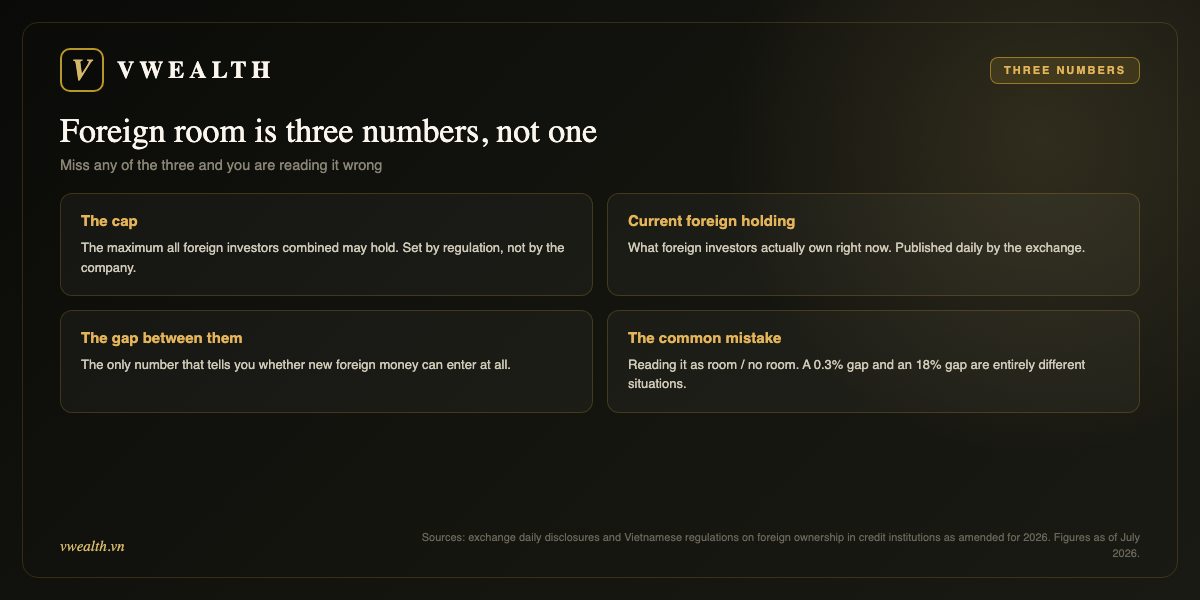
The most common error is treating foreign room as binary — room or no room. It is three numbers, and all three matter.
The cap
Set by regulation according to sector. Most ordinary sectors permit up to 100%. Credit institutions are far more restricted: ordinary commercial banks sit at 30%, banks receiving mandatory transfers as part of restructuring may go to 49% provided they are not majority state-owned, and non-bank credit institutions at 50%.
The three banks cited as eligible for the higher 49% ceiling are MBB, HDB and VPB.
Current foreign holding
What foreign investors actually own today. The exchange publishes this daily and most broker price boards carry it intraday.
The gap
This is the number that means something. A stock with 0.3% headroom and one with 18% headroom both display as “room available”, and they are completely different propositions.
What happens once a name fills up
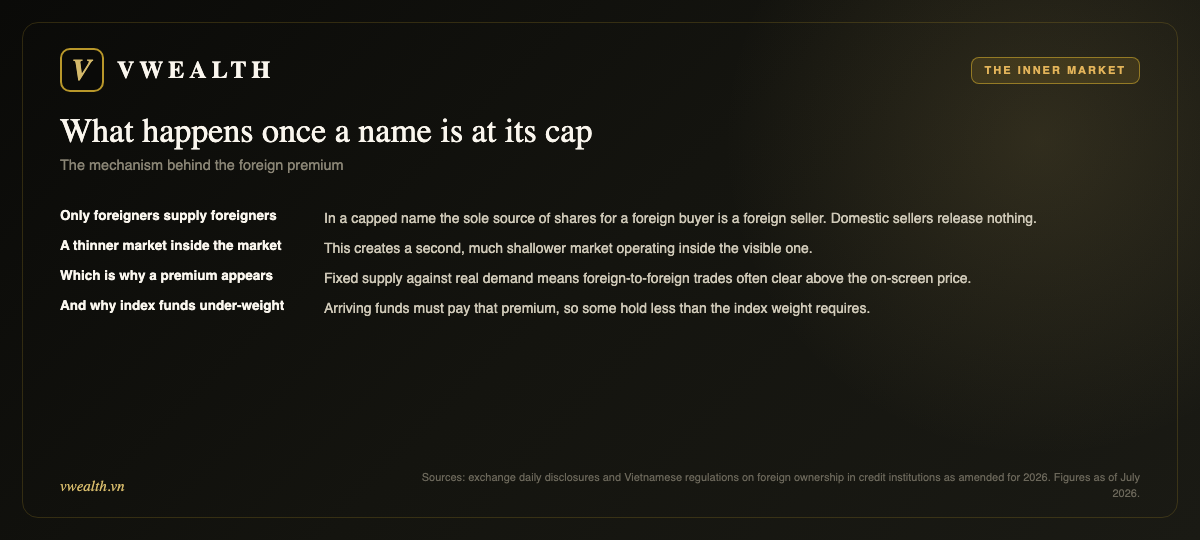
This is the part that surprises investors coming from markets without ownership caps, and it changes how you should think about capped names.
Only foreign sellers supply foreign buyers
In a name at its cap, the only way a foreign investor obtains shares is by buying from another foreign investor. A domestic seller does not free up foreign-eligible stock.
There is no queue and no entitlement. Whoever transacts first when a foreign holder sells gets the shares.
A second, thinner market forms
Inside the market you see on screen, a much shallower market operates in which only foreign participants can trade with each other.
A premium usually appears
Fixed supply meeting genuine demand tends to clear above the on-screen price. That difference is the cost of owning something rationed.
And index funds end up under-weight
An index fund arriving into a capped name must pay that premium to build its position. Some conclude the trade is not worth it and hold less than the index weight implies.
The practical consequence for the upgrade thesis: a capped stock is disadvantaged twice. There is little volume available, and what volume exists trades at a worse price. We cover this in detail in which stocks foreign funds must actually buy.
When the number goes negative
Occasionally you will see foreign room reported as negative. That does not mean negative ownership. It means current foreign holding exceeds the prevailing cap.
It happens when a cap is lowered after foreign investors have already bought, or when a company changes its registered business lines in a way that alters the applicable ceiling.
Two consequences follow. Foreign investors cannot add. And any holder above the threshold must reduce their position back into compliance — for credit institutions the rules allow six months to do so.
For anyone else in the stock, that period contains a source of forced supply that has nothing to do with the company deteriorating. Misreading it as a fundamental signal is a common and expensive mistake.
How to check it, step by step
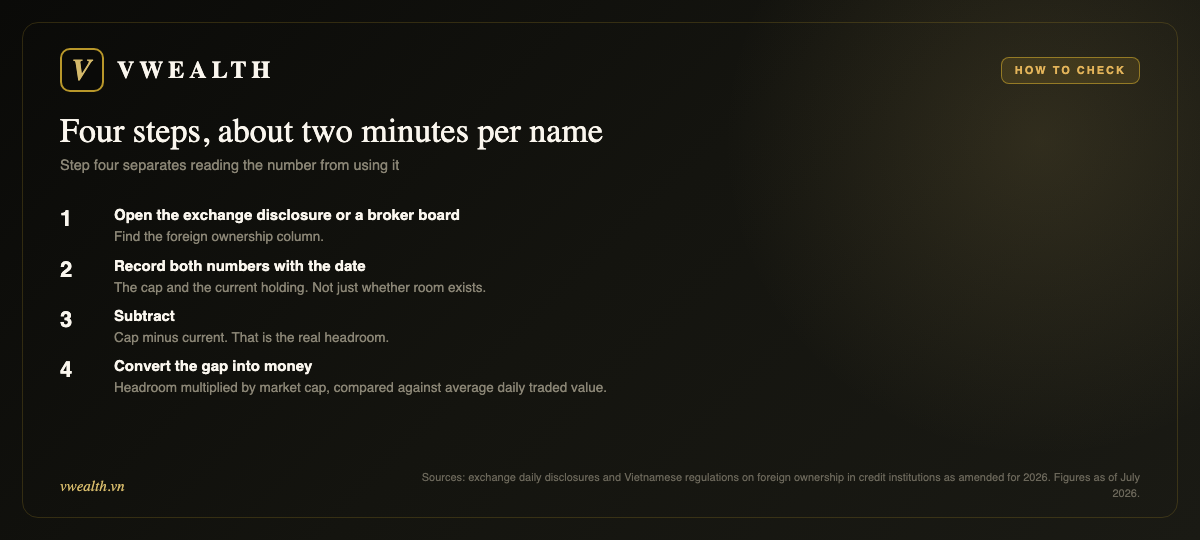
Step 1 — find the disclosure
The exchange publishes daily. Broker price boards carry a foreign ownership column, usually updated during the session.
Step 2 — record both numbers with a date
The cap and the current holding. Recording only “room available” gives you nothing to compare against next month.
Step 3 — subtract
Cap minus current holding. That is the actual headroom.
Step 4 — convert the gap into money
Multiply headroom by market capitalisation to get the amount foreign investors could still buy. Then compare that against average daily traded value.
If total available headroom equals a handful of normal sessions, then even if every foreign fund wanted the whole thing, the buying would not reset the price level. If it equals dozens of sessions, the situation is different.
A worked example
Take a hypothetical company with a market capitalisation of 50,000 billion dong, a 30% cap, and current foreign ownership of 28.5%.
Headroom is 1.5% of charter capital, worth roughly 750 billion dong at that market cap.
Suppose average daily traded value is 150 billion dong. The entire remaining headroom equals about five ordinary trading sessions.
The conclusion: even if every foreign fund bought the full remaining amount, that is a week of normal turnover. It does not create a new price level.
Now change one variable. If the cap were raised to 49%, headroom becomes 20.5% of charter capital — over 10,000 billion dong, or roughly 68 sessions. That is a materially different story.
The arithmetic takes three minutes and replaces a great deal of speculation about whether foreign money is coming.
Note: these are illustrative figures chosen to show the method, not the numbers of any specific listed company.
Reading room over time
One reading tells you a state. A series tells you a direction, and the direction is what is useful.
Room narrowing steadily
Foreign investors are accumulating. If it has run for months without a strong price response, that is worth noting — though it is not a buy signal on its own.
Room widening quickly
Foreign investors are exiting. Establish why before concluding anything: a single fund restructuring its portfolio looks identical to a fundamental problem in the data.
Room stable near full for a long period
An equilibrium: buyers and sellers matching, total unchanged. In such a name, incremental index flow has almost no effect.
How to keep the record
Four columns are enough: ticker, date, cap, current holding. One row per name per month.
After three months you have something most retail investors lack — a data series on foreign behaviour in the specific names you care about, rather than a general impression from headlines.
Who the cap actually binds
Foreign institutional investors
The most constrained group, because they face both the aggregate cap and single-holder ceilings. Within a bank’s 30% aggregate limit, a foreign individual may hold at most 5%, a foreign institution that is not a credit institution at most 15%, and a foreign credit institution at most 20% of charter capital.
So a large fund can be at its own ceiling while the aggregate line still shows room. The remaining space is usable only by a different holder.
This is why some funds access Vietnam through fund certificates or derivative structures instead of direct equity. Our piece on Vietnam ETFs onshore and offshore covers those routes.
Foreign individual investors
Subject to the same aggregate cap plus the 5% individual ceiling in banks. For most individuals the 5% limit is never binding, so the aggregate cap is the only real constraint.
Domestic investors
Not constrained directly, but affected in three ways: a blocked foreign bid removes a source of demand, a negative-room situation creates forced supply, and the foreign premium influences the general price level.
Four misconceptions
“Full room means it is a good company”
Not necessarily. Room can be full because foreign investors bought years ago on a thesis that no longer applies, or simply because the cap is low relative to company size. It tells you about ownership history, not current quality.
“Available room means foreigners are avoiding it”
Also not necessarily. A newly listed company or one with thin liquidity will show room for reasons unrelated to quality.
“Caps never change”
They do. The amendment allowing certain restructuring banks up to 49% is the most recent example. For a long-term holder, a cap increase in a name with real foreign demand is a genuine structural change, independent of any index decision.
“Room only matters to foreign investors”
The mechanism is foreign, the price effects are shared. Anyone trading the stock experiences them.
Why the cap shrinks Vietnam’s index weight
There is a direct line from foreign room to the number that determines how much passive money arrives, and it is worth following because it explains something that otherwise looks arbitrary.
Index providers do not weight countries by total market capitalisation. They weight by the capitalisation available to foreign investors — the free float, after removing state holdings, strategic stakes and anything above the foreign cap.
In Vietnam, banking is the largest sector in the index and also the most tightly capped. Combine those two facts and the investable slice of the market is considerably smaller than the headline market size.
That is the technical reason Vietnam’s weight in the global baskets is far below what the size of the economy might suggest — roughly 0.22% of FTSE Emerging and 0.34% of FTSE Emerging All Cap on FTSE Russell’s own estimates at the April 2026 review.
So the cap is not a side issue in the upgrade story. It is one of the inputs that determines how large the upgrade story is.
How Vietnam compares regionally
Vietnam is not unusual in limiting foreign ownership. What differs is the structure.
Several regional markets apply sector caps of their own, particularly in banking and in industries tied to national security. Others have removed most limits and moved to case-by-case approval for strategic investors.
The feature that makes Vietnam distinctive is the overlap: the sector with the largest index weight is also the one with the tightest ceiling. In markets where the capped sectors are peripheral, the effect on investable capitalisation is much smaller.
For an allocator comparing frontier and emerging markets, this is worth holding explicitly: two markets of similar nominal size can present very different amounts of actually buyable equity.
When foreign room does not matter
For balance, because not every decision needs this check.
Long-term positions in ordinary-sector companies. With a cap up to 100% there is effectively no constraint, and the room figure becomes background information about foreign behaviour rather than a limit.
Theses that do not depend on foreign flow. If you are buying for dividend yield, for valuation against earnings, or for competitive position, foreign room does not appear anywhere in the argument.
Small individual positions. The aggregate cap binds the market, not you personally, unless the name is genuinely full.
Foreign room matters most in exactly one situation: when your reason for buying includes the expectation that foreign institutions will buy it too. In that case it is not a detail — it is the link the whole chain hangs from.
Three things to do this week
One — check every Vietnamese name you hold. Record the cap and current holding with today’s date. Ten minutes for a ten-name portfolio.
Two — convert headroom into money for your three largest positions. Compare against average daily traded value. You will know immediately which holdings have space for a foreign flow story and which do not.
Three — flag anything close to full. Those are the names where upgrade headlines produce the least real effect, however often they are mentioned.
Practical execution notes
Knowing the number is one thing. Getting an order filled in a constrained name is another, and there are a few things worth knowing before you try.
Room is consumed continuously, not at settlement
Available room changes throughout the session as trades execute. A name showing headroom when you check in the morning can be full by the time you place a large order in the afternoon.
For meaningful size, check immediately before submitting rather than relying on a figure from earlier in the day.
Partial fills are normal
An order larger than the remaining room will fill partially or not at all. This is not a broker failing; it is the cap doing what it is designed to do.
Plan for it: if you need a specific position size, work out whether the room supports it before committing to a target.
Negotiated trades exist for a reason
In capped names, foreign-to-foreign transfers often happen through negotiated deals rather than on the order book. That is where the premium typically shows up explicitly.
If you are working a large order, this route may be the only practical one, and the reference price will not be the screen price.
Corporate actions can move the number
A share issue increases charter capital, which mechanically reduces the foreign ownership percentage without anyone selling. Room appears where there was none.
The reverse happens with buybacks. Worth watching around corporate action dates in names you follow, because a window can open briefly and then close again.
What we cannot tell you
Being explicit about limits.
We do not publish live room figures. They change daily and any number printed in an article is stale by the time it is read. The method above is durable; a snapshot is not.
We do not forecast whether caps will be raised. The 49% amendment for restructuring banks shows change is possible, not that more is coming.
We do not know how large the foreign premium is in any given name. It varies with demand and is not consistently disclosed.
What is stated above as fact is sourced and dated. Everything else is method — and method is the part that stays useful.
A short history of how the caps got here
Context helps, because the current structure looks arbitrary until you see what it was built against.
Vietnam opened its equity market to foreign participation gradually, and the early ceilings were far tighter than today’s. The direction of travel over two decades has been upward, in steps, usually attached to a specific policy objective rather than to a general liberalisation.
The banking cap is the clearest case. It exists because banking is treated as a conditional sector tied to financial system stability, and because the state retains controlling stakes in several of the largest institutions. Those are policy positions, not technical constraints, which is precisely why they can move.
The most recent move is instructive: rather than lifting the ceiling across the sector, the amendment permits a higher limit only for banks receiving mandatory transfers as part of restructuring, and only where the state does not hold control. The increase is tied to a specific policy goal — attracting capital into restructuring — not to opening the sector generally.
For an investor the lesson is practical. Cap changes tend to arrive as targeted instruments attached to a policy problem, which makes them somewhat predictable if you follow the policy rather than the market commentary.
Putting it together
Foreign room connects to almost every other question a foreign investor asks about this market, which is why it is worth the two minutes.
It determines whether an order fills. It determines how much of the index weight is genuinely investable, and therefore how large the passive flow is. It creates the second market and the premium that comes with it. It produces forced selling when a cap moves the wrong way. And it is the precondition behind the most repeated thesis in Vietnamese equities right now.
None of that requires a data subscription or a model. It requires reading two numbers off a price board, subtracting one from the other, and multiplying by market capitalisation.
Frequently asked questions
Where is the most reliable source?
Exchange disclosures are the primary source. Broker boards republish them, usually with intraday updates.
Can a capped stock still rise?
Yes, on earnings or domestic flow. What is absent is the incremental foreign bid.
Why are banks restricted more than other sectors?
Banking is a conditional sector tied to financial system stability. It is a policy choice rather than a technical constraint.
Can a company raise its own cap?
Only within what regulation permits, and generally through shareholder approval plus a regulatory process. In conditional sectors the ceiling is set by rule and is not the company’s to choose.
Does foreign room affect dividends?
No. It limits who may own shares, not the rights attached to shares already held.
Does this matter for a small personal position?
Only if your thesis contains the phrase “foreign money will buy this”. Then it is the precondition your entire argument rests on.
Summary
Foreign room is three numbers: the cap, the current holding, and the gap between them. The gap is the one that matters, and converting it into money against daily turnover tells you whether foreign flow can realistically move the price.
Once a name is full, a second and thinner market forms in which only foreign investors trade with each other, usually at a premium — which is why capped stocks are weaker beneficiaries of index inclusion than their size suggests.
It takes two minutes per name, and it is the check that decides whether the most popular thesis in this market applies to your holding at all.
Further reading: the complete guide to the Vietnamese market, the banking sector for foreign investors, and what the FTSE upgrade actually changes.
This article is for information and education. It is not a recommendation to buy, sell or hold any security. Figures are as of July 2026.
Frequently Asked Questions
What is foreign room in Vietnamese stocks?
It is the remaining share of a company that foreigners are still allowed to own. It is the single most important number on a Vietnamese price board that developed-market investors have never had to look at, because it decides whether an order can execute at all.
Why did my order not fill even though the price was right?
Because foreign room in that name is gone, and no amount of cash changes that. This is a hard constraint rather than a pricing problem — the shares exist and trade, but not to you.
How does foreign ownership affect index funds?
It decides whether an index fund can build the position it is supposed to hold. When a name runs full, the fund cannot buy more at market price and its holdings drift away from the index it tracks.
Does the 'foreign money is coming' thesis apply to every stock?
No. It only applies where there is room left to buy. A name that is already full cannot absorb new foreign inflows however strong the macro story is, which is why room has to be checked before the thesis is applied to a specific ticker.
Where do I check foreign room?
The exchange’s own disclosure is the source of truth; brokerage price boards republish it. Checking it before placing an order takes seconds and saves the confusion of watching a priced-correctly order sit unfilled.