If you have been following the Vietnam stock market upgrade FTSE Russell announced, you have probably read the same two sentences a dozen times: billions of dollars are coming, and Vietnamese stocks are about to re-rate. Both statements contain a grain of truth and a great deal of arithmetic nobody has shown you.
The decision itself is real, dated and confirmed. What is not real is the scale most coverage implies. Vietnam’s weight in the relevant FTSE baskets is between 0.22% and 0.34%, the inclusion runs in phases into 2027, and the constituent list is not final until August.
This piece works through what is verifiable: the timeline, the actual index weights, which technical change was the precondition, and where the story is still indicative rather than settled. Where a number cannot be sourced, it is left out.
What is the Vietnam stock market upgrade FTSE Russell has confirmed?
Short answer: FTSE Russell is reclassifying Vietnam from Frontier to Secondary Emerging market status, effective 21 September 2026. It is a technical audit of market infrastructure, not a reward for economic growth. The decision was announced on 7 October 2025 and confirmed at the interim review published 7 April 2026.
Five dates in a decision already made
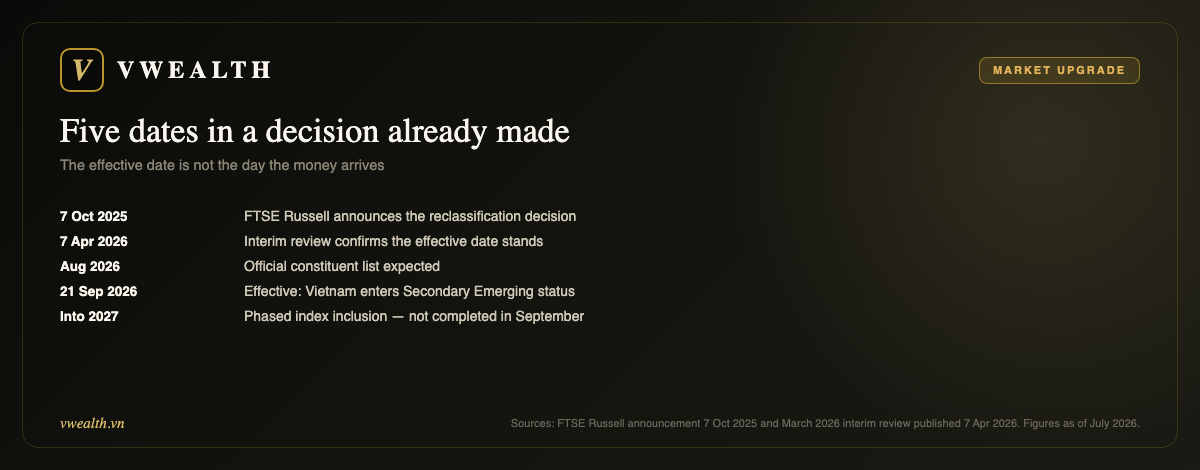
The sequence matters because it shows how much is settled and how much is not.
7 October 2025 — the announcement. FTSE Russell published the decision to move Vietnam up to Secondary Emerging. This is when the decision was taken, not when it takes effect.
7 April 2026 — the interim review. FTSE published the results of its March interim assessment and left the effective date unchanged, noting progress on market infrastructure. This review was the point at which the upgrade could have been delayed. It was not.
August 2026 — the constituent list. The official list of Vietnamese stocks is expected this month. Until then, every list circulating is indicative.
21 September 2026 — effective date. Vietnam formally sits in the Secondary Emerging category.
Into 2027 — phased inclusion. This is the part most coverage omits. Adding Vietnamese equities to the global index series happens in tranches extending into 2027, not in a single event.
The practical consequence: anyone expecting a wall of money on 21 September has misread the mechanism. Passive flows arrive in proportion to each tranche.
How much of the FTSE baskets is Vietnam actually?
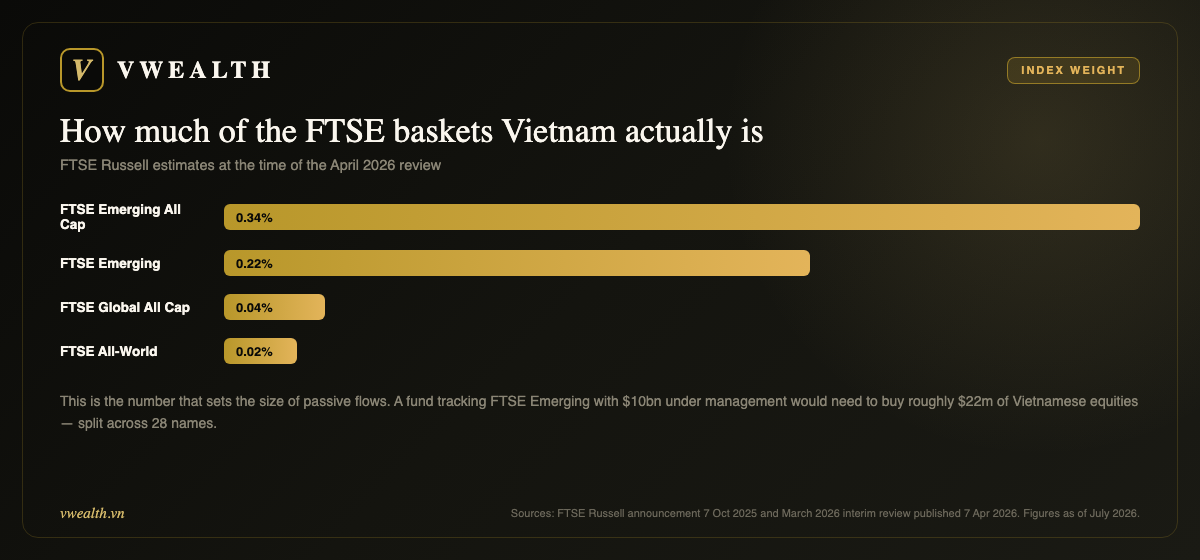
This is the section almost no article includes, and it is the one that matters if you are about to commit real money.
On FTSE Russell’s own estimates at the time of the April 2026 review, once included Vietnam will represent roughly 0.22% of the FTSE Emerging index and 0.34% of FTSE Emerging All Cap. In the broader global baskets the figures are much smaller: 0.04% of FTSE Global All Cap and 0.02% of FTSE All-World.
What that means in dollars
The simplest way to hold it: a fund tracking FTSE Emerging with $10bn under management would need to buy in the region of $22m of Vietnamese equities to track the basket. That amount is then split across the constituent names.
Scaled across all the money tracking FTSE baskets, the total is still a large absolute number. It is not a number that re-rates an entire market, and it certainly does not arrive on one day.
Why the weight is that low
Three reasons compound.
First, index weight is calculated on the market capitalisation available to foreign investors, not total market cap. State holdings, strategic stakes and anything above the foreign ownership cap are stripped out.
Second, foreign ownership limits still bind in several sectors. In banking the cap is a hard constraint, and several of the largest bank stocks are at or close to it.
Third, Vietnam is simply small next to China, India, Taiwan or Brazil. That is a question of size, not quality.
Four things that actually change
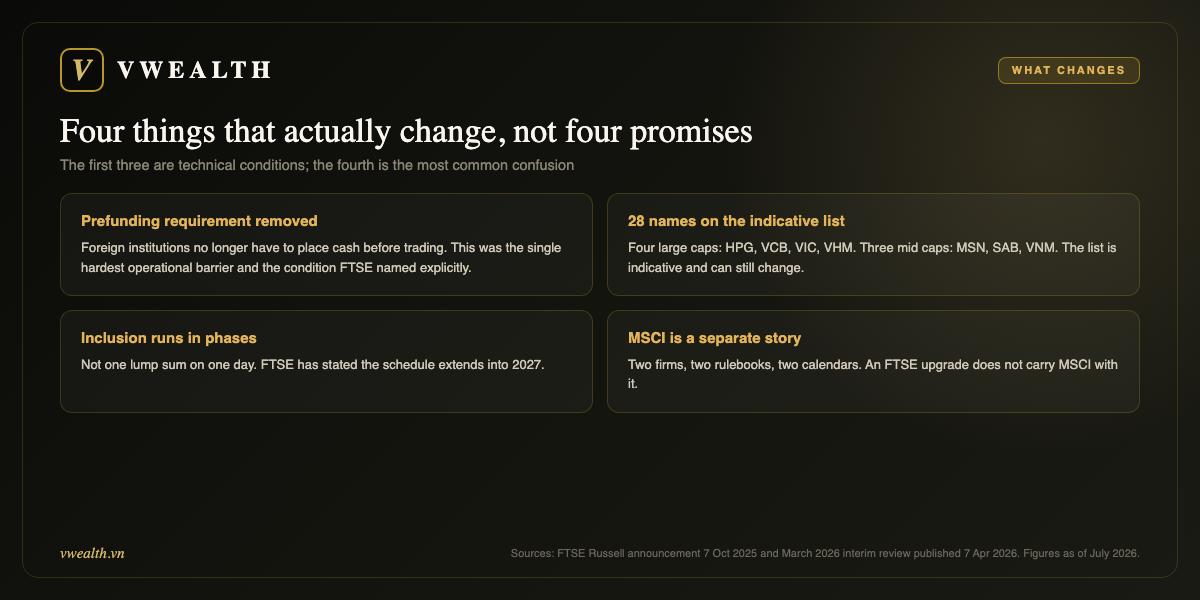
One: the prefunding requirement is gone
This is the most important change and the least discussed, because it reads like back-office housekeeping.
Until recently, a foreign institution buying Vietnamese equities had to have cash sitting in the account before placing an order. For a fund running billions across dozens of markets, wiring money ahead, waiting for it to settle, and only then trading is a genuine operational cost and a genuine currency risk.
Plenty of large funds were not avoiding Vietnam because they disliked the companies. They were blocked by internal mandates that do not permit prefunding into a frontier market.
Moving to a non-prefunding model was the condition FTSE named explicitly, and it has been implemented. Its long-run effect is larger than index inclusion, because it opens the door to active money as well as passive money.
Two: 28 names on the indicative list
FTSE Russell has identified around 28 Vietnamese stocks likely to enter the FTSE Global All Cap index. Four are large caps — HPG, VCB, VIC and VHM — and three are mid caps — MSN, SAB and VNM.
One point most coverage skips: this is indicative, not final. FTSE states the list is subject to change, with the official constituent list expected in August 2026 and confirmed at the September semi-annual review.
If you are weighing individual names, the company work still has to be done — index inclusion tells you nothing about how a business is trading. We publish a full analysis of each: what blue chip means in Vietnam, the banking sector, real estate, consumer and steel and industrials.
Three: inclusion runs in phases
Stated above, repeated here because it is where money gets lost. The schedule extends into 2027. Buying ahead of 21 September expecting to sell to index funds that week is a bet on timing, not an investment thesis.
Four: MSCI is a completely separate story
FTSE Russell and MSCI are different firms, applying different criteria on different calendars. An FTSE upgrade does not automatically bring an MSCI upgrade with it.
MSCI applies a stricter test on several points, notably currency convertibility and overall openness to foreign investors. Vietnam remains under MSCI review with no equivalent decision.
If you read a piece that says “upgraded to emerging market” without naming which index provider, treat that as a signal the author has not read the source documents. Our longer explainer covers how both scorecards actually work.
What history says about upgrades
Reclassification is not new. Several markets have been through it, and the pattern repeats often enough to be worth noting — with the caveat that every market differs and past cases guarantee nothing.
Most of the move happens before the effective date, not after. Markets price the expectation from the moment the decision is public, not when the cash actually arrives. For Vietnam that clock started in October 2025.
Post-inclusion periods are often flat or negative. The reason is mundane: early buyers take profits while passive flows dribble in on the phased schedule.
What persists is the plumbing, not the one-off flow. Removing prefunding, improving settlement, tightening disclosure — these make the market accessible to every institutional investor, including those who track no index at all.
What a foreign investor should actually do
This section deliberately avoids buy or sell recommendations. It is about how to think.
Worth doing
Know why you hold what you hold. If the only reason is “it appears on the 28-name list”, that is a thin thesis — the list is not final, and inclusion does not improve a company’s earnings.
Check the foreign room on your holdings. Where a stock is already at its foreign ownership cap, incremental foreign money cannot buy it regardless of what the index requires. The effect is materially smaller than on a name with headroom. Our piece on foreign ownership limits covers how to read this.
Understand the currency leg. Your return is in dollars, and the dong does not float freely. A currency move can erase an equity gain. This is covered in what the dong means for USD returns.
Worth avoiding
Trading off a circulating list. The official list is not out. Most lists in circulation are inferred from market cap and liquidity screens, not published by FTSE.
Leveraging into a specific date. The effective date is an administrative event. Prices need not move that day, and in several past cases they moved against consensus.
Skipping the company work. A stock in an index whose business is deteriorating is still a business that is deteriorating — it just has a few more forced holders.
Three misconceptions
“Upgrade means billions arrive immediately”
The weight figures answer this. Passive flow scales with weight, and weight is 0.22% to 0.34% depending on the basket. Active flow has far greater potential, but it moves on company fundamentals rather than an index calendar.
“An upgrade is a reward for economic growth”
It is not. Market classification is an infrastructure audit: settlement mechanics, openness to foreign investors, disclosure quality, currency convertibility. GDP growth appears nowhere in the criteria.
That is why a fast-growing economy can sit in the frontier tier for years — and why the reverse can also happen.
“Index inclusion means the stock goes up”
Inclusion creates forced demand from index funds. That demand may already be in the price from months of anticipation, and it arrives alongside supply from earlier buyers taking profit.
Foreign room: the detail that separates real beneficiaries from name-checks
This is technical, and it is where you separate stocks that actually feel the flow from stocks that merely appear on a list.
Foreign room is the maximum share of a company that all foreign investors combined may own. The cap varies by sector: some are fully open, some are restricted, and banking is the most tightly constrained.
Why room determines the effect
Index funds must buy to track the basket. If a name is already at its cap, they cannot buy more regardless of what the index says. The practical result is that the effective weight is adjusted down and the price impact is far smaller than the headline weight implies.
Conversely, a name with substantial headroom and good liquidity is one where forced demand actually reaches the price.
This is why two stocks on the same indicative list can experience completely different outcomes, and why copying a list and buying evenly across it is a poor approach.
How to check it yourself
Foreign ownership ratios are published daily by the exchange and appear on most broker price boards. What you want is the current foreign ownership percentage against the cap, and the gap between them.
A wide gap means headroom. A zero gap means the name is full, and all foreign activity in it is simply foreigners trading with each other.
Does macro data matter here?
Short answer: not to the classification decision, but very much to whether active money stays.
The classification criteria assess plumbing — settlement, openness, disclosure, currency convertibility. GDP growth, export figures and inflation appear nowhere in them.
But once the door is open, how much foreign capital comes through and how long it stays depends on something else entirely: corporate earnings growth, currency stability, and valuation relative to peer markets.
Put simply: an upgrade opens the door. It does not walk anyone through it. That part is decided by company fundamentals — which is why our sector work matters more after the upgrade than before it.
What could still knock this off course
The decision is settled, but a few things are worth watching between now and September.
The final list differs from the indicative one. FTSE has been explicit that this can happen. Any name that drops out late will see the anticipation premium come out of the price.
An infrastructure incident. The non-prefunding model is new. Any material operational failure during this window would be noted by every institution watching.
Currency moves. For a foreign investor the return is in dollars. A sharp depreciation can wipe out an equity gain — a risk entirely outside the index story.
The emerging market complex as a whole. When money leaves emerging markets broadly, being newly included helps nothing. Newly included markets often face heavier outflow pressure precisely because liquidity is thinner.
Three things to do this month
One — check foreign room on every Vietnamese name you hold. Ten minutes. It tells you whether you own a real beneficiary or a name-check.
Two — restate your thesis for each holding. If the reason contains the word “upgrade” and nothing else, the thesis rests on an event the market has known since October 2025.
Three — diarise August. The official constituent list is the only genuinely new information left between now and September. Everything else is already on the table.
How the two index providers actually differ
Because the FTSE and MSCI confusion causes so much bad decision-making, it is worth laying the difference out properly.
Different tiers, different names
FTSE Russell runs three broad buckets: Developed, Emerging split into Advanced and Secondary, and Frontier. Vietnam is moving into Secondary Emerging — the lower of the two emerging tiers.
MSCI uses Developed, Emerging and Frontier with no split inside Emerging. That structural difference alone means the two decisions are not comparable events.
Different emphasis
Both assess market access, but they weight the components differently. MSCI puts more weight on currency convertibility and on the experience of foreign institutional investors operating in the market over time. FTSE places relatively more weight on settlement mechanics and market infrastructure.
This is why a market can satisfy one provider before the other, and why the gap between an FTSE upgrade and an MSCI upgrade has historically been measured in years rather than months in several markets.
Different money follows each
The pools of capital tracking each provider’s indices are different sizes and belong to different institutions. An upgrade by one provider mobilises only the money tracking that provider.
Practically: if you are sizing an expected flow, you cannot add the FTSE and MSCI numbers together, and you cannot use one as a proxy for the other.
A note on what we cannot tell you
Being explicit about the limits of this analysis, because a piece like this invites more certainty than the evidence supports.
We do not know the final constituent list. Nobody outside FTSE does until August.
We do not know the total flow figure. Published estimates vary widely because they rest on assumptions about how much tracking money is passive versus benchmarked-but-active. We would rather give you the weight, which is sourced, than a dollar total that is inferred.
We do not know how the price will react. Historical patterns from other markets are informative, not predictive, and the sample of comparable upgrades is small.
What we do know is dated, sourced and stated above. Anything beyond that in this article is labelled as observation rather than fact.
Reading the September review when it lands
When FTSE publishes its September semi-annual review, three things in that document are worth more than the headline.
The final constituent count. If it differs materially from 28, the per-name flow assumption everyone has been working from changes with it.
The stated inclusion schedule. How many tranches, at what intervals, and what proportion in each. This determines whether the flow is spread over two quarters or five.
Any conditions attached. Reviews sometimes note areas requiring continued progress. Those notes are where the next round of risk lives, and they are usually written in language mild enough to be skipped.
Reading the source document takes twenty minutes and puts you ahead of most commentary on it, which will be written from a press summary rather than from the review itself.
Frequently asked questions
Is 21 September 2026 the day money arrives?
No. It is the date the classification takes effect. Index inclusion runs in tranches extending into 2027.
Is the 28-name list final?
No. FTSE describes it as indicative. The official list is expected in August 2026 and confirmed at the September semi-annual review.
What about MSCI?
MSCI applies its own criteria and has made no equivalent decision. The two processes are independent.
Which stocks benefit most?
There is no certain answer while the list is provisional. Mechanically, names with foreign room remaining and good liquidity feel more effect than names already at the cap. That is a necessary condition, not a reason to buy.
Should I buy before the effective date?
This article makes no recommendation. Worth noting that in comparable markets most of the move occurred before the effective date, measured from the announcement — and for Vietnam the announcement was October 2025.
Will the upgrade reduce volatility?
In theory a higher share of institutional ownership dampens volatility. That is a multi-year process, not something that appears the week after the effective date.
Summary
The Vietnam stock market upgrade FTSE Russell has confirmed is real and settled: effective 21 September 2026, following Vietnam’s removal of the prefunding requirement for foreign institutions.
The scale is smaller than the coverage suggests: 0.22% to 0.34% depending on the basket, phased into 2027, with a constituent list that is not final until August.
The part of this story with the longest shelf life is not the one-off flow. It is that a foreign institution no longer has to wire cash ahead to place an order — and that change outlasts any index event.
Further reading: the complete guide to the Vietnamese market, an honest assessment of the risks, and how HOSE, HNX and UPCOM differ.
This article is for information and education. It is not a recommendation to buy, sell or hold any security. Figures are as of July 2026, per FTSE Russell’s announcement of 7 October 2025 and interim review published 7 April 2026.
Frequently Asked Questions
What exactly is the Vietnam stock market index, and has Vietnam been upgraded on it?
There isn’t a single ‘Vietnam stock market index’ upgraded on its own — what happened is FTSE Russell reclassifying Vietnam from Frontier to Secondary Emerging market status, effective 21 September 2026. This is a status change in how index providers categorise Vietnam within their broader emerging/frontier market baskets, not a rebrand of a domestic index. The decision was announced 7 October 2025 and confirmed at the April 2026 interim review.
Does Vietnam actually have a stock market that foreign investors can access?
Yes — foreign institutions already trade Vietnamese equities, and the market has just gone through changes making it more accessible. The prefunding requirement, which forced foreign investors to have cash sitting in the account before placing an order, has been removed. That was the precondition FTSE Russell named explicitly for the upgrade, and it matters more long-term than the index inclusion itself since it also opens the door to active, non-index money.
How much weight will Vietnam get in the FTSE emerging market index once included?
Based on FTSE Russell’s own estimates at the April 2026 review, Vietnam is expected to represent roughly 0.22% of the FTSE Emerging index and 0.34% of FTSE Emerging All Cap. In the broader global baskets it’s smaller still: 0.04% of FTSE Global All Cap and 0.02% of FTSE All-World. These are the numbers that set the actual scale of passive money flowing in — far smaller than headlines about ‘billions coming’ tend to imply.
Which Vietnamese stocks are expected to be in the index fund basket?
FTSE Russell has identified around 28 Vietnamese stocks likely to enter the FTSE Global All Cap index. Four are large caps — HPG, VCB, VIC and VHM — and three are mid caps — MSN, SAB and VNM. This list is indicative, not final; FTSE states it’s subject to change, with the official constituent list expected in August 2026 and confirmed at the September semi-annual review.
Is the Vietnam market classified as emerging or frontier right now?
Under FTSE Russell, Vietnam is still classified as Frontier until the reclassification to Secondary Emerging becomes effective on 21 September 2026, with inclusion phased into 2027. Under MSCI, a separate provider with different criteria and calendar, Vietnam remains under review with no equivalent upgrade decision — MSCI applies a stricter test, notably on currency convertibility, so an FTSE move does not automatically bring an MSCI one.