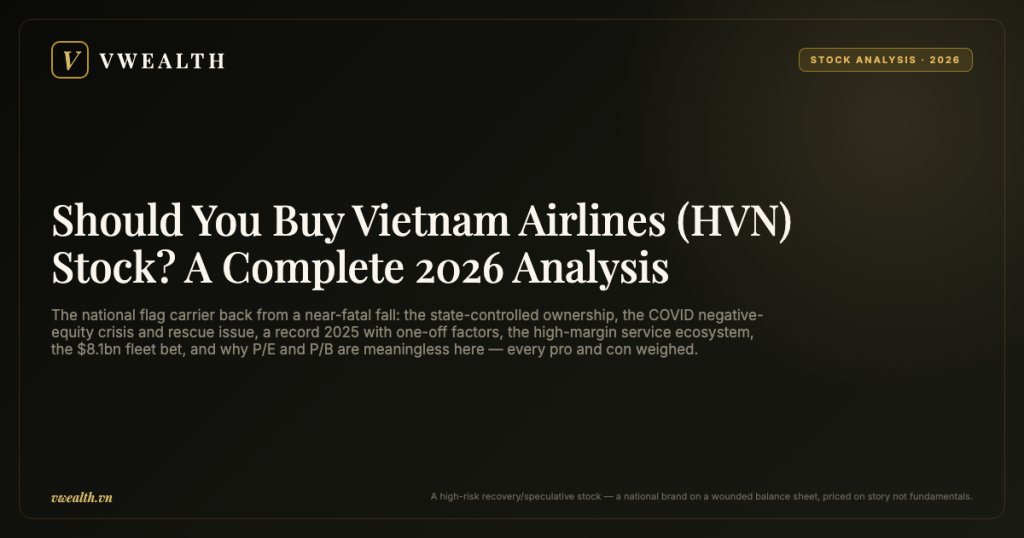
There’s a kind of stock where, each time you look at it, you aren’t just looking at a business — you’re looking at a national symbol staggering back to its feet after a near-fatal fall. HVN — Vietnam Airlines Corporation (HOSE: HVN) — is exactly such a stock. This is the national flag carrier, the lead bird carrying the nation flag across five continents, but also a business that just went through a journey that, told in medical terms, you would call a “razor-thin escape from death.”
Picture it this way. Before the pandemic, Vietnam Airlines was a point of pride, a Skytrax 4-star carrier, profiting a few thousand billion a year. Then COVID-19 hit, the skies froze, and within the three years 2020-2022 the carrier piled up losses to an enormous figure — accumulated losses at one point exceeding charter capital, pushing equity into negative territory. When equity turns negative and accumulated losses exceed contributed capital, under the Securities Law the stock faces the risk of mandatory delisting from HOSE. A national flag carrier, once among the market top-cap names, nearly “expelled” from the exchange. That was unprecedented.
And then the opposite, also unprecedented: HVN revived spectacularly. In 2024 it made its highest profit ever, in 2025 revenue hit a record 121,429 billion dong, consolidated after-tax profit 7,713 billion, and most importantly — it successfully issued nearly 897 million shares to officially escape negative equity. The sinking ship was pumped out and floated back to the surface.
But — and this is the “but” any serious investor must pin to their mind — floating again doesn’t mean healthy. When you buy HVN at 23,200đ (19 June 2026 session), you’re betting on the aviation recovery story, on the resilience of a national brand. But at the same time you’re standing next to a balance sheet still carrying large accumulated losses, enormous debt, and a significant part of that beautiful profit came from one-off items — debt forgiveness, aircraft-return negotiations — not entirely from selling tickets. Beautiful it may be, but how durable is the question.
This full analysis will help you answer the core question: should you buy HVN, and if so, what kind of investor does it suit? We’ll start from the root — the history of the national flag carrier — because for HVN, history isn’t a “filler” part. The very state-controlled ownership, the very COVID shock, the very way the carrier restructured to survive… all directly shape the stock value you’re weighing today.
HVN market data (updated 19 June 2026)
| Current price | 23,200đ | 2025 revenue | 121,429 bn (record) |
| Change (June) | +8.67% | 2025 parent profit* | 5,509 bn (2x) |
| Equity | Accumulated loss | ~6,817 bn | ~26,587 bn | P/E | Category | meaningless | high-risk speculative |
*2025 profit HAS ONE-OFF factors (debt forgiveness/deferral). HVN just ESCAPED negative equity via a share issue but ACCUMULATED LOSSES ~26,587 bn + debt ~67,368 bn remain large → a high-risk RECOVERY/SPECULATIVE stock, no dividend. Source: VWealth + HVN reports. For reference only.
History and evolution
To understand a stock, sometimes you must step back very far — far enough to before Vietnam stock market was born. For HVN, its origin is tied to the very formation of the country civil aviation industry. This isn’t a startup, not a private business born from a garage. This is a child of the state, grown up with the nation fate, and that explains why, even today, every big HVN decision — from capital raises to aircraft purchases — must pass through levels of state management.
From an early bird in 1956 to the Vietnam Airlines brand
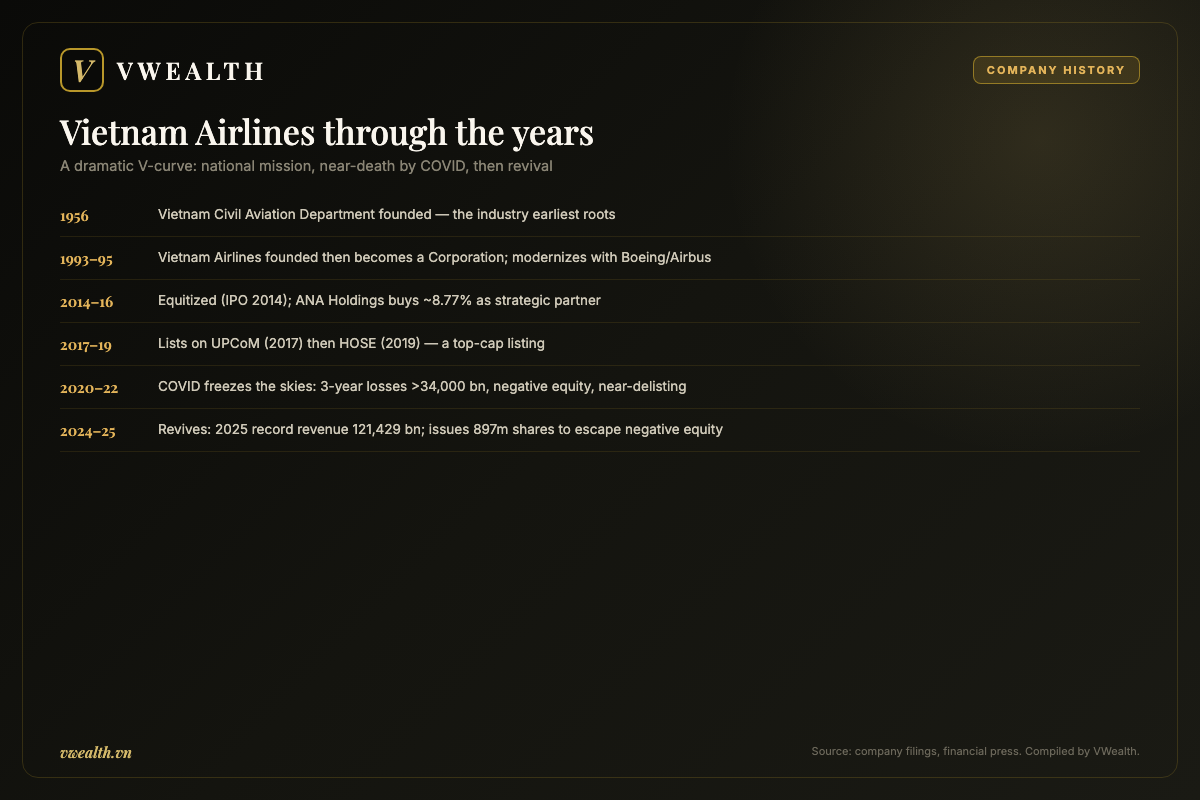
Vietnam Airlines forerunner traces to January 1956, when the Vietnam Civil Aviation Department was established, marking the birth of the country young civil aviation industry. In the early days, the fleet was just a few small propeller aircraft, a modest route network, serving mainly domestic transport needs amid war and the subsidy era. In other words, HVN “ancestor” was born not to make money, but to serve a national mission — keeping Vietnam skies flown by Vietnamese wings.
The real commercial turning point came in 1993, when Vietnam Airlines was officially established as a sizeable air-transport business. By 1995, the model was upgraded into the Vietnam Airlines Corporation, gathering many member units in the industry into one group. This was when the carrier began modernizing its fleet, gradually replacing old Soviet aircraft with Western types like Boeing and Airbus, expanding the international network and building a brand image with the Golden Lotus symbol — the lotus, the national flower, tied to Vietnamese identity.
What you should remember from this period: throughout those decades, Vietnam Airlines was a 100%-state-owned business. It operated by the logic of a state enterprise — prioritizing political missions, serving socio-economic development, playing the “unprofitable route” role to remote areas when needed. This trait, as you’ll see, is both a shield protecting the carrier in crisis (the state can’t let the national carrier go bankrupt) and a clamp tying its hands (everything is slow, everything must be permitted, everything must go through process).
Equitization 2014-2015 and the handshake with ANA Holdings
The most important “corporate finance” transformation came in 2014-2015, when Vietnam Airlines carried out equitization — shifting from a state enterprise to a joint stock company. Specifically, it held an IPO on 14 November 2014, selling over 49 million shares to raise about 1,093 billion dong. From 1 April 2015, the carrier officially operated as a joint stock company, with the Ministry of Transport (representing state capital) holding an absolute controlling ratio — about 86%.
Pause at this 86% figure, because it’s extremely important for you as an investor. Equitized but the state still holding absolute control means: the shares truly “floating” freely on the market (free-float) for HVN are very low. Low free-float means the share price swings easily and is more prone to manipulation by speculative money than reflecting intrinsic value. This is an “DNA” trait of HVN you’ll have to live with.
Another notable event in this period: on 4 July 2016, Japan ANA Holdings group — the parent of All Nippon Airways, a leading 5-star carrier in Asia — completed buying about 8.77% of Vietnam Airlines, becoming a strategic shareholder. This wasn’t just a capital injection. ANA brought Japanese operating standards, technical support, code-share cooperation, service-experience sharing. For a carrier wanting to reach international standards, having a “teacher” the caliber of ANA behind it is a very valuable intangible asset. Note too: as the carrier raised capital later, ANA ownership was gradually diluted (at one point around 5.6%), but the strategic-partner position was maintained.
Going public: UPCoM 2017 then HOSE listing 2019
After equitization, HVN path to the exchange went in two legs. The first, in January 2017 (3 January 2017), HVN shares began trading on UPCoM — the board for public companies not yet listed. As soon as it hit UPCoM, HVN market cap was among the largest, reflecting the carrier asset scale and position.
The second leg, in May 2019, HVN officially listed on HOSE — the Ho Chi Minh Stock Exchange, the most formal and prestigious listing board. At listing, the carrier put about 1.4 billion shares on the exchange with a total listing value of over 14,000 billion dong. Listing on HOSE put HVN in the market spotlight: more transparent, followed by more funds and institutions, better liquidity. For a business, a HOSE listing is a milestone of maturity.
But fate was cruelly ironic. HVN had barely found its footing on the most prestigious listing board when the storm of the century hit. And this very HOSE — with its strict listing conditions — was about to become the place that nearly “expelled” HVN. This is where the story turns to its most tragic chapter.
The 2020-2022 COVID disaster: why negative equity and near-delisting
For you to truly understand the severity of what happened to HVN in 2020-2022, first grasp the economic nature of the aviation industry. Aviation is an industry with extremely high fixed costs and large financial leverage. Even when the planes sit on the ground, the carrier still pays aircraft lease, interest, pilot salaries, parking fees, maintenance. Revenue can go to zero, but costs don’t. This is a “cash-burning machine” when there are no passengers.
And COVID-19 did exactly the worst thing: it froze the skies. International routes — the “golden goose” bringing most of HVN profit — were nearly paralyzed for almost three years. Domestic routes were also disrupted by lockdown waves. The result was a horrifying chain of losses:
- First half of 2020, accumulated losses reached about 5.1 trillion dong.
- First half of 2021, accumulated losses jumped to about 8.4 trillion dong; net revenue plunged 43.6% year on year.
- Cumulatively over the whole period, accumulated losses at one point exceeded 17.7 trillion dong and kept swelling in later quarters, with total three-year losses estimated to exceed 34,000 billion dong.
When accumulated losses ate up all the contributed capital, a scary thing happened: equity turned negative. For the first time in history, HVN equity went negative by about 2.75 trillion dong (exceeding charter capital). The negative-equity state continued and deepened — by end-Q1 2024, even when the carrier had started profiting again, consolidated equity was still negative by about 12,500 billion dong. Picture what “negative equity” means: if you sold every asset to repay debt, it still wouldn’t be enough — on the books, the shareholders portion had been blown away, even into the negative.
Negative equity is the life-or-death line for a listed business. Under the Securities Law, a stock will be mandatorily delisted if total accumulated losses exceed contributed charter capital in the latest audited statements, or three consecutive years of losses. HVN fell right into the “death zone” of both conditions.
This is why HVN stock was placed under warning and control, and faced a real risk of delisting from HOSE. On 26 September 2021, the carrier leadership had to formally petition the government and regulators to allow HVN a special mechanism to keep its listing, despite the violation. Feel the weight of the situation: a national flag carrier, a symbol of the country, facing the risk of being “expelled” from the most prestigious stock exchange. If delisted, the shares would drop to less liquid boards, investor confidence would collapse, and raising capital to save the carrier would be even harder. It was a death spiral.
For you — an investor weighing HVN in 2026 — this history isn’t to “recount poverty.” It’s a core warning: HVN is the stock of an industry extremely sensitive to external shocks (pandemics, fuel prices, FX, recession, geopolitical tension), and a business with a fragile financial structure when storms hit. Having nearly died once, no one can be sure there won’t be a second time.
The life-or-death restructuring: the 12,000-billion package, debt deferral, asset sales, divestment
So how did HVN survive? The answer is a total restructuring, combining a “ventilator” from the state with self-rescue efforts. You should understand these pieces well, because they explain HVN stock structure today.
First — the 12,000-billion liquidity support package. This was a rescue package approved by the National Assembly, with two components: a 4,000-billion refinancing loan (preferential rate) through banks, and issuing shares to existing shareholders to raise 8,000 billion more. Because the state holds control, most of this “money injection” was essentially the state putting in more capital to keep the national carrier from default. This was the “ventilator” keeping HVN breathing in the most critical phase.
Second — restructuring and debt deferral. The carrier negotiated with creditors and aircraft lessors to defer and delay payables, while negotiating to cut aircraft-lease costs. A very notable point: the carrier successfully negotiated to write off about 4,710 billion dong of debt related to returning Pacific Airlines aircraft — and this very item contributed largely to the “beautiful profit” of 2024 (more on this later). This is a “one-off” type of profit, non-recurring.
Third — asset sales and divestment. To get cash, the carrier sold assets: liquidating old aircraft (e.g. signing a contract to sell 5 A321s totaling about $37 million), sale-and-leaseback of aircraft, divesting non-core investments. Most notably, divesting from Cambodia Angkor Air (K6) — the aviation joint venture in Cambodia HVN had backed for over 10 years. This divestment (bringing in about $35 million) both provided cash and helped the carrier focus resources on core operations rather than spreading thin. HVN also leveraged valuable assets like its SkyTeam alliance membership, its route network and slots at international airports to strengthen its negotiating position.
Each of these steps carried meaning: the 12,000-billion package kept the carrier alive; deferral and forgiveness eased the immediate financial burden; asset sales and divestment created cash and streamlined the machine. Combined, they helped HVN hold out long enough to wait for the most important thing to return: passengers.
The 2024-2025 turnaround: revival and escaping negative equity
And passengers did return — in droves. As the world reopened post-COVID, the aviation market boomed again, especially the high-profit international routes. This was when the aviation industry “leverage” reversed favorably: as planes filled again, revenue surged while fixed costs had been compressed through restructuring, and profit jumped strongly.
2024 marked the revival: HVN ended a chain of 16 consecutive loss-making quarters, reaching a record consolidated after-tax profit of nearly 7,958 billion dong — the highest ever, over double the pre-pandemic peak (2018-2019). However, you must stay sober: a large part of the 2024 profit came from one-off factors, especially the ~4,710-billion Pacific Airlines debt write-off. Meaning the profit “quality” wasn’t yet entirely from core operations.
2025 was the peak of the revival story, with impressive numbers:
| Metric (2025) | Value | Meaning |
|---|---|---|
| Consolidated revenue | 121,429 billion dong (+~10%) | Highest ever — ~336 billion a day |
| Consolidated after-tax profit | 7,713 billion dong | Second straight big-profit year |
| Parent-company after-tax profit | 5,509 billion dong (2x) | Core operations clearly improved |
| Share issuance | 897,104,037 shares | Charter capital up to 8,971 billion |
| Equity at 31/12/2025 | No longer negative | Escaped the delisting “death sentence” |
| State budget contribution | 3,286 billion dong (+5%) | Contributing back to the country |
The most pivotal event for the stock is the successful issuance of nearly 897 million shares to raise capital, lifting charter capital to 8,971 billion dong and helping equity (both parent and consolidated) at 31 December 2025 officially turn non-negative. In other words, HVN defused the delisting bomb. For an investor, this is a world of difference: from a stock “that could be expelled from the exchange at any time” to a stock whose listing status has stabilized.
Even so, keep a cool head. Escaping negative equity doesn’t mean the accumulated losses are gone. The capital raise and two straight profit years only pulled equity from negative to positive, but the huge COVID accumulated-loss “scar” is still there, and the debt (especially aircraft-lease debt, FX-sensitive foreign-currency debt) is still very large. Big profit, but a significant part came from one-off factors. This is why, though the picture brightens, you must read the profit quality carefully rather than just the headline total.
A new ambition: an $8.1 billion fleet investment and the cash-flow problem
A business that has just escaped danger usually chooses one of two paths: cautiously consolidate, or accelerate expansion. HVN chose the second — and ambitiously. In early 2026, the carrier signed to invest in 50 narrow-body Boeing 737-8 (737 MAX) aircraft worth up to $8.1 billion, with the signing witnessed by senior leaders of both countries. These aircraft are expected to be received in 2030-2032, raising the fleet to about 151 by 2030. Not stopping there, the carrier left open a plan to invest in about 30 more wide-body aircraft with an estimated total value of over $12 billion.
This ambition has two very clear sides, and you need to weigh both. The bright side: a new, modern, fuel-efficient fleet will help HVN expand its network, get ahead of double-digit-growing travel demand, and cement its national-carrier position in a Vietnamese aviation market forecast to have large room. The dark side: this is a huge investment for a business that just escaped negative equity. To finance it, the carrier must work with large financial institutions (US EXIM Bank, Citibank…) and domestic banks — meaning more borrowing or finance leasing, raising the already-high leverage. The cash-flow problem and financial risk thus still hang overhead.
In sum, HVN history is a dramatic V-shaped curve: born from a national mission (1956), grown into a corporation (1995), equitized and partnered with a Japanese carrier (2014-2016), listed on HOSE (2019), plunged to the life-or-death abyss from COVID with negative equity and delisting risk (2020-2022), rescued and self-restructured (the 12,000-billion package, debt deferral, asset sales, K6 divestment), then revived spectacularly with record revenue and escaping negative equity (2024-2025), to now enter an ambitious but risky expansion-investment cycle (the $8.1 billion fleet).
Understanding this journey, you have the foundation to ask sharper questions: Who really steers this just-rescued ship? Do they have the mettle and vision to turn the turnaround into sustainable growth, or will they push the carrier into a new debt spiral? That’s what we’ll dissect in the next section — Leadership.
Leadership and ownership structure
If you’re weighing putting money into HVN, this may be the most important part of the whole analysis — more important than quarterly profit figures. The reason is simple: Vietnam Airlines isn’t an “ordinary” listed business. Before you read any financial number, you need to understand that the one truly steering this ship isn’t the board, nor the CEO, but the Vietnamese state as the absolute controlling shareholder. Every big decision — from issuing nearly 900 million shares to save the business from a delisting sentence, to whether to pay a dividend — bears the mark of a special owner. Understanding this power structure, you’ll understand why HVN is both a “cannot-die” stock and a stock small investors must always be wary of.
The ownership picture: the state in absolute control
Let’s start with verified numbers, because HVN ownership structure just changed significantly in 2025 after the historic share issue. After completing the issuance of 897,104,037 shares to existing shareholders (officially recorded from 30 September 2025), Vietnam Airlines total shares rose to 3,111,498,211 units, corresponding to a new charter capital of about 31,115 billion dong — a leap from 22,144 billion before. At this capital scale, HVN became one of the largest-charter-capital businesses on HOSE.
What you need to remember well is the allocation ratio. Per figures disclosed after the issue, Vietnam Airlines ownership structure is as follows:
| Shareholder | Shares (approx.) | Ownership | Nature |
|---|---|---|---|
| Ministry of Finance (state-capital rep.) | ~1,222 million | ~39.3% | State shareholder |
| SCIC (State Capital Investment Corporation) | ~1,466 million | ~47.1% | State shareholder |
| Total state ownership | ~2,688 million | ~86.4% | Absolute control |
| ANA Holdings (Japan) | ~175 million | ~5.62% | Strategic partner |
| Other shareholders (remaining foreigners + domestic) | the rest | ~8% | Very low free-float |
(Source: Vietnam Airlines disclosures and VnEconomy, data for reference, ratios may be rounded; you should cross-check the business latest governance report.)
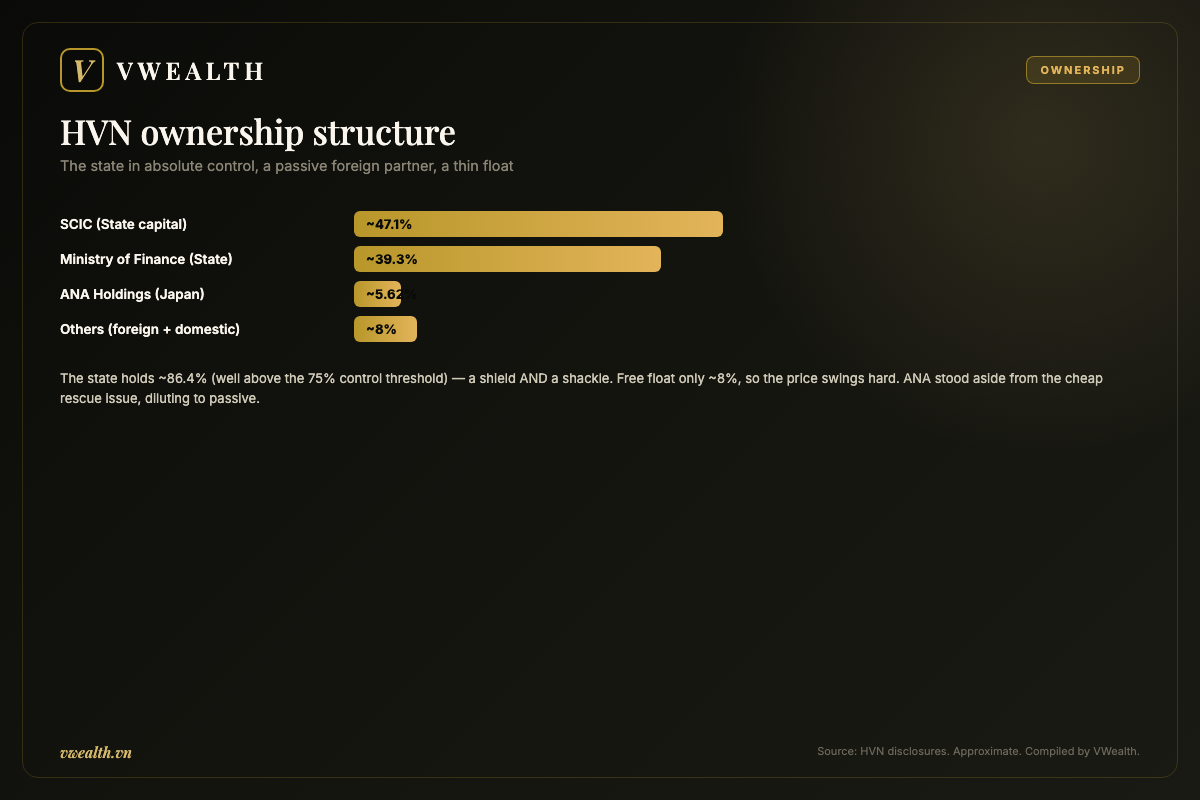
The most notable figure here is nearly 86.4% of shares in the hands of two state-capital representatives. Before the issue, the state held about 87.29% (Ministry of Finance over 55% and SCIC over 31%), while after the issue, due to a change in how subscription rights were allocated, SCIC rose to the largest shareholder at about 47.1%, and the Ministry of Finance kept about 39.3%. Though the ratio between these two entities shifted, the essence is unchanged: the state still holds over 86% — far above the 75% threshold needed to pass all the most important decisions at the general meeting. In other words, as a minority shareholder, you have almost no substantive voting voice on HVN strategic matters.
When the governing agency changes hands: from the Capital Management Committee to the Ministry of Finance
A detail many investors overlook, but very important for reading HVN news correctly, is that the agency representing state-capital ownership has changed. For many years, the state capital at Vietnam Airlines was held by the Committee for the Management of State Capital at Enterprises (often called the “super committee”). However, under the policy of streamlining the machinery, the state-ownership representation function at many large groups and corporations — including Vietnam Airlines — was transferred to the Ministry of Finance.
Why does this matter to you? Because when reading reports or news, you’ll see “Ministry of Finance” appearing as the largest state shareholder alongside SCIC (which is itself a unit under the Ministry of Finance). In practice, this means all of the nearly 86.4% state stake in HVN now converges on a single management point. That both makes rescue and restructuring decisions more unified and faster, but also means the business fate is tied more than ever to the state policy direction rather than pure market logic.
ANA Holdings: a strategic partner diluted “in silence”
The second-largest shareholder, and the only significant foreign institution, is ANA Holdings — the parent of Japan All Nippon Airways (ANA). ANA officially became Vietnam Airlines strategic shareholder from 2016, after investing to buy about 8.77%. This was once a beautiful story: a leading Japanese carrier, famous for 5-star service quality and operating discipline, shaking hands with the Vietnamese national carrier, bringing expectations of governance-standard transfer and expanded code-share and network cooperation.
But what you need to face squarely is: ANA ratio has been gradually eroded. Before the 2025 issue, ANA held about 5.62% (down from the original 8.77% after prior capital raises). And in the nearly-897-million-share issue of 2025, ANA — per disclosures — did not buy correspondingly to keep its ratio. As a result, ANA ownership was further diluted, staying around 5.62% on a much larger charter capital. This sends a signal you shouldn’t dismiss: the Japanese strategic partner, though not divesting, also didn’t “pump in more money” to accompany in the most important recapitalization. When an industry-savvy partner chooses to stand aside from a cheap issue (only 10,000 dong a share, far below market), that’s data worth pondering about their long-term expectations.
The lesson for you: at HVN, the “foreign strategic partner” is no longer a capital-raising pillar but merely a passive financial shareholder. The entire burden of saving the business rests on the state shoulders.
Low free-float: the double-edged sword of HVN price
The direct consequence of the state holding over 86% and ANA holding nearly 5.6% is that the shares truly freely tradable (free-float) are very thin — only about 8% of total shares, and the truly “floating” portion may be even lower after subtracting long-term institutional holders. This is something you must be especially mindful of because it shapes this stock entire price behavior.
With low free-float, HVN becomes a stock prone to strong swings. A not-too-large amount of demand can push the price up hot, and vice versa. In fact, there have been periods when HVN price surged to the 37,000-38,000 dong zone while the issue price to existing shareholders was only 10,000 dong — a huge gap reflecting both expectation and speculation on thin liquidity. For you, this cuts two ways: if you catch the right wave, the profit range can be large; but the risk of buying a speculative top then getting stuck is correspondingly high, because HVN price often detaches quite far from the business fundamentals. This isn’t a “buy and forget” stock.
Leadership: those running under state mandate
In a state-controlled business like HVN, the leadership is essentially people mandated by the state to run it, not representatives of small-shareholder interests. Even so, this machine competence and stability still matter greatly, and during the recent restructuring, HVN leadership showed notable consistency.
In June 2025, Vietnam Airlines completed reappointing its key leadership for a 5-year term, starting 25 June 2025:
| Title | Holder | Note |
|---|---|---|
| Chairman of the board | Dang Ngoc Hoa | Born 1972; reappointed, continues leading the restructuring |
| CEO and board member | Le Hong Ha | Born 1972; reappointed, runs business operations |
| Board member | Ta Manh Hung | Reappointed |
| Board member | Le Truong Giang | Reappointed |
(Source: VnEconomy, June 2025 appointment disclosure. Personnel info stated per official disclosure; you should verify against HVN latest governance report.)
Dang Ngoc Hoa held the Chairman role from 2020, right when COVID-19 hit the aviation industry hardest. It can be said he was the one at the helm through Vietnam Airlines entire “escape” journey — from piled-up losses, negative equity, facing delisting risk, to the milestone of escaping negative equity in late 2025. Both Hoa and CEO Le Hong Ha being reappointed for a new term shows the state, as owner, positively assessed this machine role in the crisis and wants to maintain stability to continue the restructuring plan.
A small detail reflecting improved results: leadership compensation in 2025 rose strongly year on year (Chairman and CEO both above 2.3 billion dong, up nearly 70%), tied to the business booking profit again. For you, this says little about stock valuation, but is a small signal that the incentive mechanism is gradually being tied to performance — something not always clear at state enterprises.
The listing-rescue share issue: HVN life-or-death chess move
This is the part any HVN investor must grasp firmly, because it both explains why this stock still exists on the exchange and shows the business dependence on the “state hand.”
Back to the context: for three straight years 2020-2022, due to the pandemic, Vietnam Airlines lost tens of thousands of billions of dong, pulling parent-company equity into the negative. From Q1 2022, HVN stock was placed under control due to accumulated losses and negative equity. Under HOSE rules, a business with prolonged negative equity or accumulated losses exceeding charter capital faces mandatory delisting. Bluntly: HVN stood very close to the edge of being “kicked” off the exchange.
The chosen way out was issuing shares to raise capital. In 2025, Vietnam Airlines was licensed by the State Securities Commission (3 July 2025) to offer nearly 900 million shares to existing shareholders, at only 10,000 dong a share, with a rights ratio of 1,000:406.4 (for every 1,000 old shares held, you could buy about 406 new shares). The record date to close the rights was 22 July 2025, with subscription and payment from 7 August to 8 September 2025. As a result, the business raised nearly 8,971 billion dong.
The key point to understand is where this money came from. Because the state holds control, most of the subscription rights also belonged to the state. And to ensure the issue succeeded, SCIC was assigned to invest in the additional shares on behalf of the state — SCIC alone disbursed about 7,770 billion dong in September 2025. This is why SCIC ownership jumped to the highest in the shareholder structure. In other words, this issue was essentially a state “rescue capital injection” carried out in market form.
All the proceeds were used not for expansion investment, but to repay debt: about 6,000 billion dong to pay suppliers and part refinancing, the remaining 3,000 billion to repay maturing short- and long-term loans. This matters so you don’t misunderstand: this is “patch-the-hole” money, not growth-investment money.
Escaping negative equity: the turning-point milestone and the dilution flip side
Combining the nearly-9,000-billion capital raise with strongly recovering results, Vietnam Airlines achieved a decisive milestone: officially escaping negative equity from 30 September 2025. Specifically, parent-company equity at this point reached about 9,602 billion dong — turning from negative to positive. Alongside, in 2025 the business booked over 7,700 billion dong of consolidated after-tax profit, and parent-company profit of about 5,509 billion dong. Earlier, from 26 December 2023, HOSE had also removed HVN from the warning list. The delisting sentence, at least in the short term, was defused.
But as a financial writer, I must tell you the flip side too. First, issuing nearly 897 million more shares means dilution. Total shares outstanding rose about 40%, so at the same profit, earnings per share (EPS) is “thinned” more than before. You shouldn’t look at the absolute profit figure and forget the swollen share denominator. Second, “escaping negative equity” doesn’t mean debt-free or loss-free. The business still carries accumulated losses piled up from the COVID era, and this is the direct barrier to the dividend story we’ll discuss right after.
The state-enterprise trait: why you shouldn’t expect a dividend
If you buy HVN expecting a steady dividend like ordinary blue chips, adjust that expectation now. By regulation, a business can only pay a dividend when it has positive undistributed after-tax profit, i.e. after fully covering accumulated losses. Though in 2025 HVN profited again and escaped negative equity, the huge accumulated losses from the pandemic years aren’t fully erased. As long as accumulated losses are large, HVN can’t pay a dividend. For you, this means that over the next few years, the profit you expect from HVN comes almost entirely from price gains, not a cash-dividend flow.
More deeply, you need to understand HVN carries the mission of a “national flag carrier.” This is both an anchor and a burden. An anchor, because as a national symbol and strategic asset, Vietnam Airlines always receives special state backing: from liquidity-support packages, preferential-loan mechanisms during COVID, to the very listing-rescue capital injection just now. In other words, this is a business almost “impossible to let go bankrupt” for political-economic reasons. That’s a safety cushion few stocks have.
But a burden, because the national carrier must bear missions not purely for profit: maintaining routes to remote areas, islands and borders despite economic inefficiency; participating in political, diplomatic and rescue missions; and generally balancing business goals with social responsibility. These “obligation routes” can erode profit that a purely commercial carrier would never accept. Besides, as a state enterprise, many of HVN big decisions — fleet investment, capital raises, personnel appointments — must pass many layers of approval, making decision-making slower and more mechanism-dependent than nimble private rivals.
To sum up this section, HVN portrait through the ownership-and-governance lens is: a business almost absolutely wrapped by the state (nearly 86.4% state shares, just “rescued” from a delisting sentence), but for that very reason tightly bound to the mechanism, with a low volatile free-float, a foreign strategic partner retreating to passivity, and unable to pay a dividend in the near future. This is an investment where the “state” factor governs everything — both a shield and a shackle.
Understanding who holds power and by what logic they decide, you’ll have the right lens to read the next section — where we go into the business “body”: the fleet, the network and the service ecosystem that have been and are generating the real cash flow to realize this revival story.
Fleet, route network and ecosystem
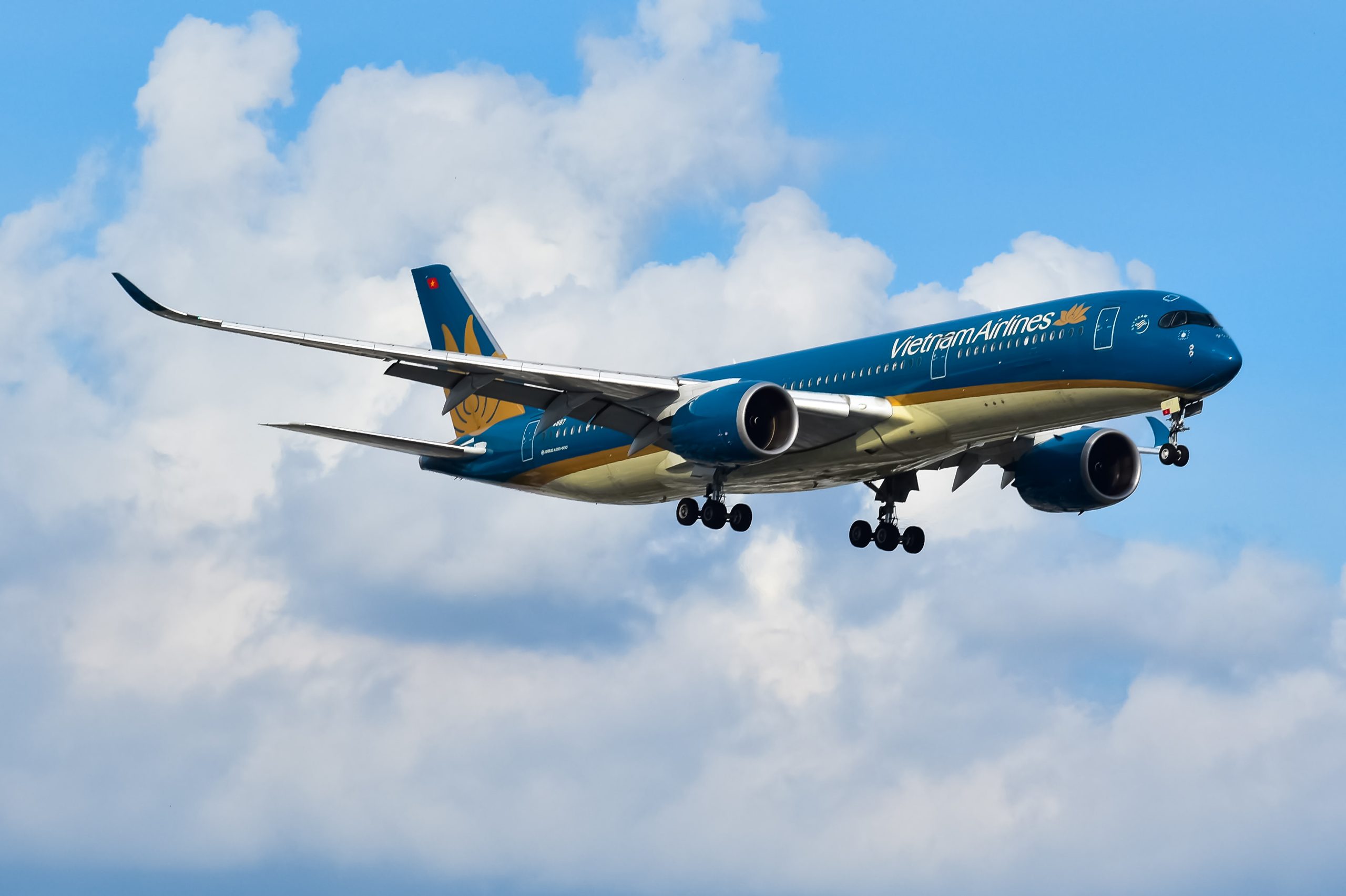
When you look at an aviation ticker like HVN, you can easily get swept up in the profit-loss figures on the financial statement and forget the core thing: behind that ticker is a business with very distinctive tangible assets. That is about a hundred planes flying in the sky, a route network covering all of Vietnam and reaching four continents, plus a whole “service kingdom” of dozens of subsidiaries serving around each flight. If you want to understand how much Vietnam Airlines is truly worth and where the risk lies, you must look at three layers: the fleet (the revenue-generating asset), the route network (where that asset is deployed), and the service ecosystem (where the profit is truly hidden). This section dissects each layer, in a way even someone who has never read an annual report can grasp.
Before going deep, remember a few 2025 base numbers to feel the scale. The whole Vietnam Airlines system operated about 156,000 flights, carried 25.6 million passengers (up about 11% year on year) and 340,000 tonnes of cargo. On average, the carrier takes off and lands over 420 flights a day and puts about 70,000 people in the sky. This isn’t a small business — it’s a huge logistics machine running 24/7, and each link in that machine is a cash flow.
The fleet: “flying” assets worth billions of dollars
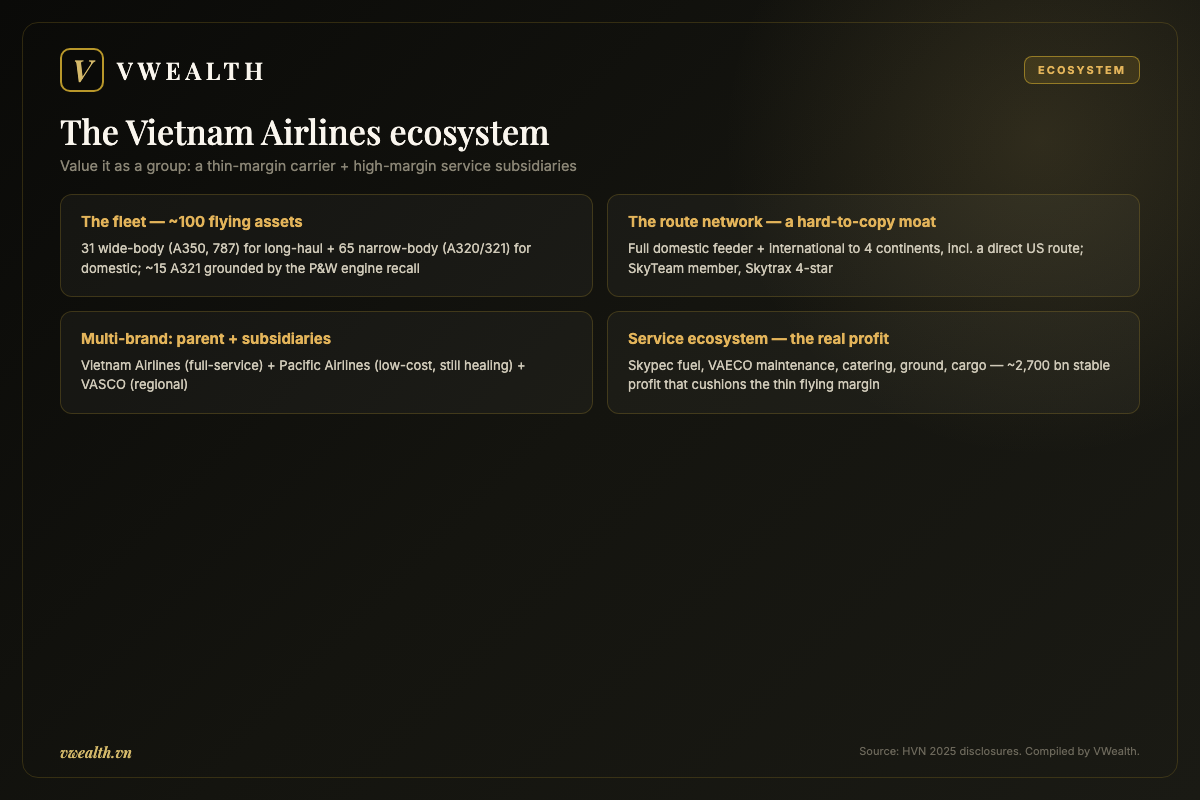
Let’s start with the easiest to picture: the planes. As of 2025, Vietnam Airlines operated a fleet of about 100 aircraft, and you need to clearly distinguish two types, because they serve two entirely different business strategies.
- Wide-body aircraft: these are the fleet “battleships” — about 31 planes, including 14 Airbus A350-900s and 17 Boeing 787 Dreamliners (both 787-9 and 787-10). This type has two aisles, 280-350 seats, a range of tens of thousands of kilometers. These are used for long international routes: to Europe, Australia, and especially the direct route to the US. Each is worth hundreds of millions of USD.
- Narrow-body aircraft: these are the “main force” by number — about 65 Airbus A320/A321 (including the fuel-efficient A321neo). This type has one aisle, about 180-220 seats, used for domestic and short regional routes around Asia. These are the ones you sit on flying Hanoi–Saigon or Saigon–Da Nang.
- Small aircraft (turboprop): also about 6 ATR-72 propeller planes, serving small airports with short runways like Con Dao — places jets can’t land.
Why do you — an investor — need to care about this mix? Because it decides both revenue and risk. Wide-body aircraft bring very large revenue per flight (a business-class ticket to the US can equal dozens of domestic tickets), but also “devour” enormous costs: fuel, maintenance, depreciation. Narrow-body aircraft have a thinner margin but turn over fast, filling steadily thanks to dense domestic demand. A healthy carrier is one that balances these two groups.
A very real risk few notice: as of mid-2025, about 15 A321s were grounded due to engine problems (the global Pratt & Whitney engine recall program), plus 4 A350s under repair. That is, nearly a fifth of the narrow-body fleet generated no revenue while still incurring lease/depreciation costs. When you read HVN reports, this is one reason supply capacity was clogged and wet-lease costs spiked.
The route network: a weapon money can’t buy quickly
If the fleet is the asset, the route network is where that asset makes money. And this is Vietnam Airlines hardest-to-copy competitive advantage — something a low-cost carrier, however rich, would take years to build.
The network has two tiers. At the domestic tier, Vietnam Airlines covers nearly all airports from north to south — from the golden trunks Hanoi–Da Nang–Ho Chi Minh City to tourist and local points like Phu Quoc, Con Dao, Dien Bien, Ca Mau. This dense network creates a “feeder” effect: a passenger in a small province flies domestically to Hanoi then connects internationally, the whole journey in one carrier hands. This is an advantage rivals flying only trunk routes don’t have.
At the international tier, the carrier reaches all four continents with demand: across Asia (Japan, Korea, China, Southeast Asia, India), to Europe (UK, France, Germany), down to Australia, and especially the direct route to the US — a milestone Vietnam Airlines was the first Vietnamese carrier to achieve. The direct US route carries great brand and strategic value (affirming the national-carrier position, serving the overseas Vietnamese community), though purely economically these ultra-long routes usually struggle for high profit early on due to fuel costs and fierce competition.
Two “passports” make this network stronger than itself:
- SkyTeam alliance membership: Vietnam Airlines is a member of SkyTeam — one of the world three largest aviation alliances. This means the carrier passengers can book connections to thousands of destinations of partner carriers (Delta, Air France, KLM, Korean Air…), earning and using shared points. For a mid-size carrier like Vietnam Airlines, this is a way to “borrow” a global network without opening routes itself.
- Skytrax 4-star carrier certification: Skytrax is the most prestigious aviation-service rating body. Maintaining a 4-star rating for many years helps Vietnam Airlines position in the full-service segment, selling higher fares than low-cost carriers — the foundation of the passenger-transport margin.
Remember this when valuing HVN: the international network, the slots (takeoff/landing turns) at busy airports like Tan Son Nhat, Noi Bai, Narita, Incheon, and the international traffic rights — these are intangible assets not clearly on the balance sheet, but extremely valuable and nearly impossible to buy with money in the short term.
The “parent + subsidiary carrier” model: a two-brand strategy
A point new investors often confuse: Vietnam Airlines isn’t just one carrier. It’s essentially a Group of three flying brands, each targeting a different customer segment. This is called the “multi-brand” strategy — common at large aviation groups worldwide (like how Lufthansa has both Lufthansa and the low-cost Eurowings).
- Vietnam Airlines (parent, full-service): the premium, full-service brand, targeting business travelers, international passengers, those willing to pay more for meals, baggage, roomy seats. This is the group heart.
- Pacific Airlines (subsidiary, low-cost): the low-cost brand, targeting price-sensitive customers, competing directly with budget carriers. Pacific Airlines goal is to “take the blows” in the budget segment so the parent doesn’t have to cut prices — protecting the premium brand.
- VASCO (subsidiary, regional): operating short routes and small airports with ATR-72 aircraft, covering niche markets where large planes aren’t efficient.
In theory, this model is very nice: one group “catching” customers across all three price segments. But you need to face the reality: Pacific Airlines is a weakness, not a strength. This carrier lost heavily for years, to the point of having to return all its planes and nearly stopping flying to restructure. After restructuring, Pacific Airlines took off again but in a maximally streamlined direction: operating a small fleet, sharing resources with the parent (pilots, ground, maintenance) to cut costs. In other words, the budget segment is still in a “healing” phase, not yet a growth engine. When assessing HVN, you should view Pacific Airlines as a risk to monitor rather than a profit-generating asset.
The service ecosystem: where the real profit hides
This is the most important part I want you to understand well, because it completely changes how you view HVN stock. Many think Vietnam Airlines makes money from selling tickets. Partly true — but the passenger-transport segment has an extremely thin margin, depends on fuel prices, FX and competition, and easily flips from profit to loss just from one external shock. The most stable and “juicy” profit comes from the service ecosystem surrounding each flight.
Picture it this way: each time a plane lands, a series of services must happen — refueling, cleaning, catering, stair-truck towing, cargo loading/unloading, technical checks. Vietnam Airlines doesn’t outsource these — it owns the subsidiaries doing exactly those jobs, serving not just its own planes but selling services to foreign carriers flying into Vietnam too. These are high-margin businesses with steady cash flow, little hurt by fuel-price swings — the opposite of the flying segment.
The 2025 numbers say it all: Vietnam Airlines subsidiary group contributed about 2,700 billion dong of pre-tax profit (up nearly 54% year on year), out of total consolidated profit of over 8,450 billion dong. Let’s run through these “golden geese”:
- Skypec — aviation fuel: supplying over 1.75 million tonnes of jet fuel, pre-tax profit over 605 billion dong (up 125%). This segment is much discussed because of a plan to transfer/restructure ownership — you should track it because Skypec entering/leaving the group directly affects consolidated profit.
- VAECO — technical maintenance: aircraft repair and maintenance, profit about 309 billion dong (up 13%). When the global fleet has engine problems, in-house maintenance capability is a strategic asset.
- Aviation catering (NCS, VACS): making in-flight meals. VACS alone brought in nearly 226 billion dong. This is a high-margin service, tied to the carrier 4-star quality.
- Ground services (VIAGS): serving passengers, baggage, aircraft pushback at airports — profit about 358 billion dong (up 45%).
- Cargo services (NCTS, TCS): operating cargo warehouses and air-cargo handling — NCTS profit nearly 480 billion, TCS profit over 430 billion. The cargo segment boomed thanks to cross-border e-commerce.
- SkyPearl — loyalty (Lotusmiles): the points program. Don’t dismiss this: loyal-customer data and revenue from selling points to banks/partners is a stable cash source large carriers worldwide value very highly.
The lesson for you when valuing HVN: don’t value Vietnam Airlines as a pure carrier. Value it as an aviation group, where the flying segment is the thin-margin, highly volatile part, while the service subsidiaries are the thick-margin, stable part, cushioning the whole group in years the flying segment struggles. It’s precisely the 2,700 billion of subsidiary profit that helps HVN hold through periods of adverse fuel prices and FX.
The $8.1 billion fleet investment: a growth opportunity or a debt bomb?
This is the biggest event shaping HVN future and you must look at both sides. In early 2026, Vietnam Airlines signed to buy 50 narrow-body Boeing 737-8 (737 MAX) aircraft, worth up to $8.1 billion — one of the largest aircraft-purchase contracts in Vietnamese aviation history, signed under the witness of senior leaders of both countries. These aircraft are expected in 2030-2032, raising the fleet to about 151. Not stopping there, the carrier is working with Boeing on a next plan: buying about 30 more wide-body aircraft, estimated over $12 billion.
The bright side (opportunity): Vietnam is one of the fastest-growing aviation markets in the region. Vietnam Airlines current fleet is short of planes, with engine recalls grounding some — the carrier is having to wet-lease expensive planes to patch the gap. The 50 new 737 MAX (over 15-20% more fuel-efficient than the old generation) will solve the capacity shortfall, lower cost per seat, and open more routes. If demand keeps growing 10-11% a year like 2025, this is a reasonable anticipatory investment.
The dark side (risk): $8.1 billion isn’t pocket money — most will be financed by debt and finance leasing. For a business that just went through a huge accumulated-loss period, once negative-equity, taking on billions of dollars more in financial obligations is a big strain on cash flow and leverage. You need to track closely: how the carrier arranges the capital, whether outright purchase or lease, and whether the flying segment is healthy enough to “feed” this investment when the planes arrive in 2030. A large aircraft order is both a signal of ambition and a risk if the industry cycle reverses right as the planes are delivered.
Putting the pieces together: HVN core value picture
To sum up so you take away a clear thinking frame. Vietnam Airlines core value — and thus HVN stock — stands on three legs:
- Leg one — the national-carrier position: a Skytrax 4-star brand, SkyTeam member, an international network spanning four continents with a direct US route. This is an entry barrier rivals struggle to overcome.
- Leg two — the route network and slots: full domestic coverage as a feeder base, international connections as a high-fare revenue source. A precious intangible asset not clear on the books.
- Leg three — the service ecosystem: dozens of high-margin subsidiaries (fuel, maintenance, catering, ground, cargo) contributing 2,700 billion of stable profit, cushioning the volatile flying segment.
Against these three strengths are two big question marks you can’t ignore: Pacific Airlines still restructuring and the $8.1 billion fleet investment being both a growth driver and a debt strain. Understanding the network, fleet and service ecosystem is understanding the “body” of the HVN elephant. Next, we’ll examine the “blood” — the carrier true position and financial health: accumulated losses, equity, cash flow and debt-servicing ability — to see whether the three strengths above are enough to carry the two question marks.
Position and financial health
If you only read a headline — “Vietnam Airlines record profit, highest revenue ever” — you can easily draw a wrong conclusion about HVN stock. This section exists to keep you out of that trap. Here, the writer will separate two things often lumped together in the news: Vietnam Airlines business position (something truly strong and hard to replace) and the business financial health (something that just escaped the danger zone, not yet healthy at all). These two stories don’t coincide, and it’s precisely the gap between them that you need to weigh before placing an order.
The writer will tell you frankly from the start: HVN 2025 profit figure doesn’t fully reflect the carrier core transport health. It’s a beautiful picture painted with many colors — some very durable (real passenger recovery), and some that will fade (non-recurring one-off items). Your task, as an investor, is to tell which color is which.
Position: national flag carrier — a hard-to-copy advantage
Let’s start with the strongest part, and this is a part the writer doesn’t hesitate to rate highly. Vietnam Airlines holds the position of a national flag carrier, and this position creates advantages a new rival almost can’t buy with money in the short term:
- The widest international network in Vietnam. This is a real strategic asset. The long-haul routes to Europe, Northeast Asia, Australia plus the slot system at major international airports are accumulated over decades, impossible to build in a few seasons.
- A large domestic share, splitting most of the pie with Vietjet in a near-duopoly market. The “full-service” position lets HVN hold the business-traveler, connecting-international and premium segments — segments with better margins than budget fares.
- The ancillary service ecosystem: catering, aviation fuel (Skypec), ground services, cargo, maintenance. In 2025, these ecosystem segments contributed significantly to consolidated profit — a quality plus, because these are recurring revenue.
- The state-ownership factor. The state holds control, which is both an anchor (the ability to be supported in crisis, as the COVID-era refinancing package proved) and a limit (slow decision-making, fare-pricing constraints, political-social mission pressure).
Note this fairly: in terms of market position, it’s very hard to imagine a Vietnam without Vietnam Airlines, or a rival fully replacing the carrier role within 5-10 years. That’s a real “moat.” But — and here’s the pivot — a strong market position doesn’t automatically mean a healthy balance sheet. A business can be both market-dominant and financially fragile at the same time. HVN is a classic example.
2025 profit quality: peeling back each layer
This is the most important part of the whole analysis, and the writer hopes you read very slowly. The total figures are very beautiful: consolidated revenue 121,429 billion dong (+10%, highest ever), consolidated after-tax profit over 7,713 billion dong (post-audit about 7,607 billion — reviewed down over 100 billion from the self-prepared figure), parent-company after-tax profit 5,509 billion dong, double the year before. But “7,600 billion profit” and “earning 7,600 billion from carrying passengers” are two entirely different propositions. Let’s peel it apart.
Layer one — real recovery (high quality, durable)
The healthiest part of the profit comes from the aviation industry real recovery. In 2025 the carrier operated over 156,000 flights, carried over 25.6 million passengers (+12.7%) and over 340,000 tonnes of cargo. Passengers rose, the load factor improved, average fares were better, ancillary services contributed steadily. Average daily revenue hit a record of about 336 billion dong. This is the profit part you can trust to recur — as long as travel demand holds.
Layer two — one-off and extraordinary factors (NOT to be extrapolated)
This is the central warning. A significant part of the 2024-2025 profit picture came from items not tied to core transport and non-recurring:
- Income from debt-deferral/forgiveness negotiations with lessors and partners. During restructuring, the carrier and its subsidiaries (notably Pacific Airlines) negotiated to write off/reduce part of the debt tied to returning aircraft. When a debt is forgiven, accounting records it as other income — it beautifies the profit line but isn’t money earned from selling tickets. Importantly: this factor has gradually diminished, and this is why the post-audit 2025 profit (7,607 billion) is actually lower than 2024 by over 350 billion — because 2024 had a large extraordinary boost from debt forgiveness that 2025 no longer has at a similar scale.
- FX differences. HVN has a large foreign-currency (mainly USD) debt pile. When FX moves favorably, the carrier reverses/records an FX gain; when unfavorable, the opposite. This depends on macro factors beyond management control, and can reverse at any time.
- Provision reversals and income from asset sales/liquidation, entries that improve accounting profit but don’t reflect the flying segment recurring cash-generating capacity.
The message the writer wants you to carve in: don’t take the 2025 profit figure and multiply it for coming years. The core transport profit — the real money earned from carrying passengers and cargo after subtracting fuel, aircraft lease, staff, interest — is far thinner than the total figure. Part of this year beautiful profit is “one-off income” that doesn’t return.
The clearest evidence for this argument is right in Q4 2025: quarterly revenue peaked (+28% YoY) but pre-tax profit fell about 24% year on year, to only about 868 billion dong. Revenue rising strongly while profit went backward — that’s the sign that as the extraordinary items fade, the real core margin shows its true form: very thin and very cost-sensitive.
The balance sheet: escaped danger, not yet recovered
HVN biggest financial event of 2025 wasn’t the record profit, but the carrier officially escaping negative equity — ending a chain of 14 consecutive negative-equity quarters, i.e. just stepping out of the risk of mandatory-delisting review and “technical bankruptcy” status. This escape came from two legs: profit accumulated in the year, and especially the successful issue of 897 million shares, lifting charter capital to nearly 8,971 billion dong.
But “escaping negative” doesn’t mean “healthy.” This is where you need to be most sober:
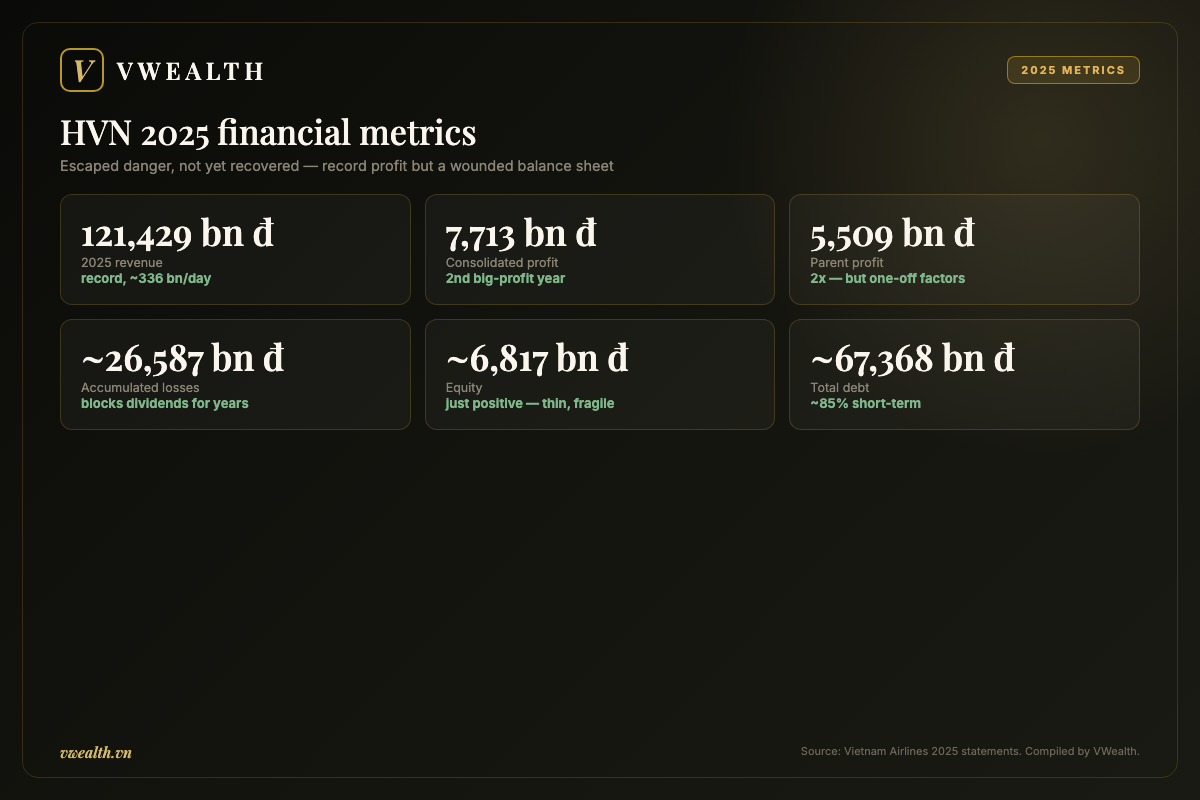
- Accumulated losses are still huge. As of end-2025, accumulated losses on the consolidated statement were still around 26,587 billion dong. Picture it: the COVID-era wound is so deep that even after a big-profit year, the carrier has only patched part of it.
- Equity is thin and fragile. End-2025 equity was only positive by about 6,817 billion dong — a very small number versus the hundreds-of-thousands-of-billions total assets and the debt of a carrier. Thin equity next to large debt means very high financial leverage: just one bad business year could erode this equity cushion back again.
- Debt is still large, though a positive is that the carrier cut nearly 7,000 billion dong of debt in the year and had creditors extend and reschedule. Most debt is tied to leasing and buying aircraft — aviation is inherently a capital- and debt-intensive industry.
- No dividend yet. This is a direct consequence of the accumulated losses: by regulation, a business with accumulated losses can’t pay a dividend. If you buy HVN, you’re betting entirely on the expectation of price gains, with no dividend flow underneath in the near future.
There’s a real bright spot the writer wants to balance: operating cash flow in 2025 reached about 12,272 billion dong (+30% YoY). The ability to generate cash from core operations clearly improved, and this is a far more trustworthy health indicator than accounting profit (which is noisy from the extraordinary items above). The business is genuinely pumping cash into the till — the foundation to gradually repay debt and heal the balance sheet. The only issue is: the wound is so deep the healing journey will take many years.
Core 2025 financial-metrics table
For you to see the whole picture in one place — both bright and dark — the writer compiles the following key numbers (consolidated 2025, per disclosures and reviewed reports):
Cash flow and debt: three variables that decide survival
For a highly leveraged business like HVN, next year profit isn’t in management hands as much as you think. It depends heavily on three external variables, and you need to understand each sensitivity:
- Jet fuel price. This is the killer variable. Fuel makes up about 30-40% of total operating cost. Per management itself, for every $1/barrel of fuel price above plan, the annual cost can swell by over 300 billion dong. Remember this number: it means a prolonged oil-price rise can fully “eat” the carrier thin core profit. Into 2026, fuel-price pressure is being clearly warned of by management.
- USD/VND exchange rate. Because the debt and a large part of costs (aircraft lease, fuel, maintenance) are in USD, whenever the VND depreciates against the USD, both costs and the converted debt value swell. FX affects both real cash flow and the FX gain/loss items on the report.
- Travel-demand intensity. The most comfortable variable now (travel and aviation are in a good recovery cycle), but also among the most sensitive to economic recession, pandemics or geopolitical shocks. Aviation has high “operating leverage”: large fixed costs, so when passengers dip a little, profit can evaporate very fast.
The key point: because equity is thin and debt is large, HVN loss-absorbing capacity is low. A financially healthy business can swallow a high-oil-price year unscathed; HVN doesn’t have much such room. That’s the core difference between “currently profiting” and “safe.”
Risk summary: what must be on your checklist
Before moving to the market reaction, the writer lists the risks squarely so you don’t miss any — because with this stock, understanding the risk matters more than understanding the potential:
- Non-recurring one-off profit: the income from debt forgiveness/deferral, favorable FX differences, provision reversals has and will fade. Coming years profit is very likely below 2025 even if the flying business stays good — don’t be surprised if that happens.
- Rising fuel prices: a +$1/barrel sensitivity = +300 billion cost; the thin core margin means this risk can directly push the carrier to low profit or loss.
- Unfavorable USD FX: a double hit on both cost and debt value.
- Competition with Vietjet in the domestic market, pressuring fares and margins.
- The $8.1 billion fleet-investment plan: a double-edged sword. A new fleet raises capacity and fuel efficiency, but this huge investment will almost certainly raise debt in coming years — right when the balance sheet isn’t yet healed. You need to track closely how the carrier finances this (borrowing, leasing, or issuing more shares — each has different consequences for shareholders).
- Share dilution: the carrier issued 897 million shares to save equity, and to finance the fleet and keep improving the balance sheet, further issuance in the future is something to factor in — each issue dilutes your ownership.
- Large accumulated losses: blocking dividends for years and keeping equity in a fragile state.
The writer doesn’t write these lines to scare you away from the stock. Vietnam Airlines position is real, the recovery is real, and the improving cash flow is real. But a mature investor needs to see both sides: a national flag carrier with a solid moat, reviving impressively — but still carrying a wounded balance sheet, high leverage and large sensitivity to external shocks. HVN is a stock of the “recovery and turnaround” story, not a stock of stability. It suits those who accept volatility and understand clearly what they’re betting on, more than those seeking a safe place to park money.
So how did the market — the place that gathers all these expectations, hopes and worries into a single number, the share price — react to that two-sided picture? That’s the story of the next section.
Market reception
If you just glanced at the board and saw HVN all green, up 8.67% in June alone to 23,200 dong (19 June 2026 session), congratulations — you’re looking at one of the most controversial and hard-to-value stocks on HOSE. I’ve followed HVN since the days it was under warning, on the edge of delisting, and I’ll tell you frankly from the start: this isn’t a stock you buy then comfortably put in a drawer. HVN is a story — a bet on the national flag carrier revival — and how the market receives it reflects exactly that nature: fervent, speculative, and highly volatile.
In this section, I want you to understand a core thing many individual investors miss when they see HVN rising: most of the familiar valuation tools you use for FPT, HPG or VNM are almost useless for HVN. Not because this stock is “especially good,” but because its financial foundation just escaped the collapse zone, distorted to the point where financial ratios produce numbers that are either meaningless or misleading. Understanding this, you’ll understand why HVN trades on emotion and expectation more than reason and the books.
Why valuing HVN is a problem “with no clean answer”
Let’s start with the simplest question any investor asks: “Is this stock expensive or cheap?” With HVN, the honest answer is: we don’t really know, and anyone who claims certainty is fooling themselves. I’ll explain layer by layer.
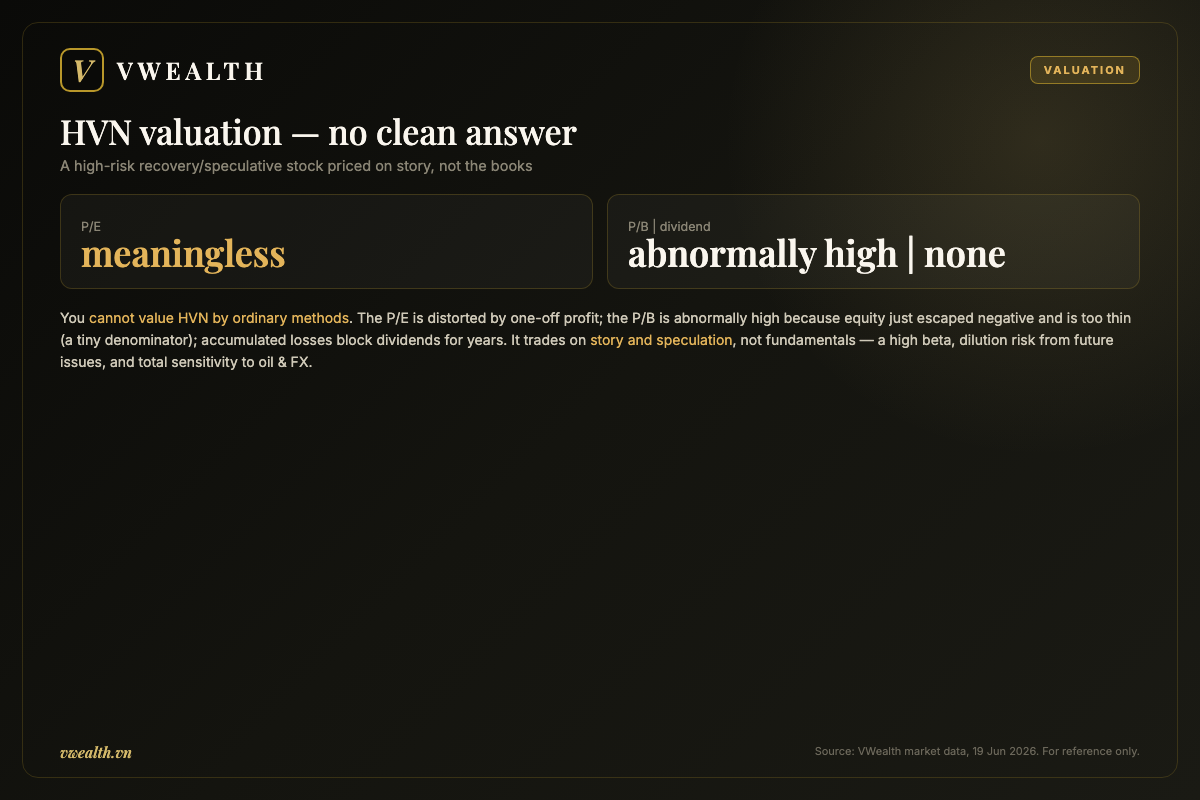
First — the P/E is distorted by one-off profit. HVN reported 2025 parent-company after-tax profit of about 5,509 billion dong — a trillion-scale number that looks very impressive after years of endless losses. But you must ask: where does this profit come from? A significant part of the Vietnamese-aviation recovery-period profit comes from non-recurring factors: debt forgiveness/deferral, renegotiated aircraft leases, provision reversals, favorable FX differences, and restructuring support. When you divide the market price by a profit line with such one-off “seasoning,” the resulting P/E doesn’t reflect the sustainable earning power of core operations. A “beautiful” P/E today can become an infinite P/E next year if the one-off items vanish and the thin core profit shows.
Second — the P/B is abnormally high because equity just escaped negative. This is the key point I want you to carve in. Throughout 2021-2025, HVN carried a huge accumulated loss — at one point exceeding 34,000 billion dong in early 2025, and at end-Q2 2025 equity was still negative by about 3,099 billion dong. Negative equity means, on the books, assets aren’t enough to repay debt — a state that for an ordinary private business means technical bankruptcy. HVN only escaped negative equity thanks to a “lifebuoy”: SCIC disbursing about 7,770 billion dong to buy shares and the 900-million-share offer at 10,000 dong raising up to 9,000 billion.
What’s the consequence? When equity just nudged from negative to slightly positive, the denominator in the P/B formula (Price / Book) becomes extremely small. A fragile equity divided into a market cap of about 70,000 billion dong can produce a P/B above 5-10x — irrationally high versus the industry — or previously incalculable because book value was negative. In other words, HVN P/B doesn’t say “the market values the company assets very highly,” but “this company balance sheet just escaped the collapse zone and is still too fragile to use as a measure.” You can’t compare HVN P/B with Vietjet or a healthy carrier — they’re in two different reference frames.
Third — accumulated losses still hang overhead. Though profiting again, HVN still has accumulated losses not fully erased. This isn’t just a past number; it has very concrete legal and practical consequences I’ll discuss in the dividend part below. A business with accumulated losses is one not truly “cured” — it has just stopped bleeding.
To sum up in one sentence: for HVN, the P/E is almost meaningless because profit has one-off factors, the P/B is abnormally high and misleading because equity just escaped negative and is still too thin, and accumulated losses aren’t fully erased. This is a stock you can’t value by ordinary methods. It trades on story and expectation, not fundamentals. Accept that truth before putting money in.
Price action — the portrait of a classic speculative stock
If fundamental valuation is hopeless, then what really pushes HVN price up and down? The answer is: speculative money and short-term stories. HVN has very high liquidity and is among the most-favored surf stocks for individual investors in the aviation group. When I look at its volatility history, I don’t see the price line of a steadily growing value business — I see steep waves and plunges, ranges measured in multiples, not percentages.
The 8.67% June 2026 rise to 23,200 dong is a vivid example. It didn’t come from HVN suddenly becoming a cash printer, but from the synergy of a few short-term catalysts individual investors are very sensitive to. Specifically, HVN surf money usually reacts strongly to three news groups:
- Aviation-recovery and travel-peak news: each summer, each holiday, each report of surging international arrivals is “bait” for an HVN wave. The summer 2026 peak is part of why June was all green.
- Restructuring and warning-exit news: each step HVN improves equity, escapes negative, escapes control/warning, avoids delisting risk is hailed by the market as a “legal victory.” News of SCIC capital injection, news of a successful issue all push the price.
- Oil-price and FX news: fuel makes up a huge share of aviation cost, while most debt and aircraft-lease costs are in USD. A falling oil price or stable USD/VND immediately improves the profit outlook — and speculative money reacts instantly.
Notice something? All three catalyst groups are macro, cyclical and beyond the business control. That’s exactly the DNA of a speculative stock: its price is governed by expectations about variables the company doesn’t decide. HVN has a high beta — meaning when the broad market moves, HVN moves more; it amplifies both your joy and your pain. Historically, HVN 52-week range stretched from around 19,000 to over 40,000 dong — doubling in value in a year, then correcting deeply. That’s a trader playground, not a value investor.
I want you to be honest with yourself here. If you buy HVN, admit you’re betting on a story, not “investing in a good business at a reasonable price.” Both approaches can make money, but they demand entirely different discipline. The story buyer needs a clear stop-loss, needs to track news closely, needs to take profit while the crowd is still euphoric. The value investor… simply shouldn’t have HVN in the portfolio.
No dividend — a warning for income investors
This is a point I see many new investors completely fail to anticipate. If you’re the kind of investor who likes receiving steady cash dividends — buying a stock then receiving an amount each year like “savings interest” — then HVN is not for you, and won’t be for many years.
The reason is very clear and legal: by regulation, a business can only pay a dividend from profit after fully covering accumulated losses. HVN still has large accumulated losses hanging on the balance sheet. That means, though in 2025 the company reported trillion-scale profit, all that profit must in principle first “fill the hole” of old losses, not yet be allowed to distribute to shareholders. It will take many years of continuous profit — and sustainably continuous, not from one-off items — for HVN to erase all accumulated losses and start thinking about a dividend.
So if HVN pays no dividend, the only profit you can expect is price gains — i.e. you must sell higher than you bought. And price gains, as I analyzed, depend on the story and speculative money. A closed loop: HVN doesn’t suit income investors, only those accepting risk to hunt price gains. Compare this with your own financial goals before deciding.
Catalysts and risks — two sides of the same coin
I won’t be one-sided. HVN has real catalysts, and if they play out as scripted, this stock has upside. But each catalyst has a flip side alongside, and you need to see both to keep a cool head.
Catalysts worth tracking:
- International-tourism recovery: international arrivals to Vietnam rising post-pandemic, high-profit international routes reopening, is the strongest revenue driver. This is HVN most optimistic scenario.
- Escaping control/warning and improving equity: each step strengthening the balance sheet — via SCIC injection, via further issuance — reduces delisting risk and restores financial-institution confidence. Escaping negative equity is seen by analysts as an important milestone.
- Low oil prices and stable FX: reduces fuel-cost pressure and foreign-currency financial cost, directly widening the margin.
Risks to watch:
- One-off profit expiring: this is the biggest risk. When the support, reversals, debt forgiveness/deferral are gone, the thin core profit shows. A trillion-scale profit year from one-off factors doesn’t guarantee the next year.
- Oil price and FX reversing: a double-edged sword. Just as low oil prices help HVN, rising oil or a stronger USD can blow away all profit in a single quarter.
- Dilution from further issuance: HVN plans to raise charter capital by tens of thousands of billions — the 9,000-billion round in 2025 and an expected further ~13,000 billion in 2026. Each low-price issue (10,000 dong, far below market) dilutes existing shareholders and pressures the price. This is a structural risk, not temporary.
Foreigners, the ANA strategic shareholder and the “room” story
Another factor shaping how the market receives HVN is its very distinctive ownership structure. The absolute controlling shareholder is the state, holding over 86% (through the Capital Management Committee and SCIC). The foreign strategic shareholder is ANA Holdings (Japan), which from 2016 bought about 8.77% (over 107 million shares, worth about 2,431 billion dong then) to become a strategic partner.
This structure has a few consequences to understand. First, because the state holds so much, the truly freely tradable shares (free float) are relatively limited versus the market-cap scale — this contributes to HVN price swinging strongly when speculative money floods in or out. Second, ANA presence — a large, methodical Japanese carrier — brings a layer of credibility and technical/operating support, though its ratio isn’t enough to control. Third, HVN “foreign room” story is tightly tied to policy: the current foreign-ownership cap in Vietnamese carriers is 34%, with a proposal to raise it to 49%. If this cap is loosened and the state divests down to around 51%, that could be a big catalyst — opening the way for new foreign capital — but also an uncertain policy variable, which could come early, late, or not at all.
I stress this so you see: even HVN foreign story is a form of policy expectation, not a graspable intrinsic value. It further reinforces my through-line argument — HVN lives on the story.
To close: what is HVN, and who are you in this game
After all the analysis above, I want to leave you with a frank, unvarnished conclusion. HVN is a high-risk recovery/speculative stock. Buying HVN means you bet on two things: the sustainable revival of Vietnamese aviation, and the success of the business restructuring. It’s a bet that can win big — but a bet, in every sense of the word.
You can’t value HVN by P/E or P/B like an ordinary stock, because its financial foundation just escaped collapse and is still too distorted. You can’t count on a dividend, because accumulated losses hang for years. You must accept extreme volatility, high beta, and dilution risk from future issuances. In exchange, if international tourism booms, oil prices are favorable, restructuring succeeds and foreign room is loosened, HVN can deliver significant price gains.
In other words: HVN doesn’t suit value investors, doesn’t suit dividend/income investors. It’s a stock for those who understand clearly they’re betting on the aviation and restructuring story, have risk-management discipline, and are willing to accept losing part of their capital for the chance. If you’re not that type, the green board this June isn’t an invitation for you. And to understand why the “aviation recovery” bet is worth considering — and the drivers and headwinds shaping the whole industry — we need to step into the next section: the aviation-industry context HVN operates in.
Economic and aviation-industry context
To correctly understand HVN stock story, you can’t just look at Vietnam Airlines balance sheet. A carrier is a near-instant mirror of the economy and tourism industry where it operates. When the economy accelerates, people travel more for business, tour more, ship more; when the economy slows, plane seats empty first. So this section places HVN in the proper big picture: where Vietnamese aviation stands after the COVID shock, how intact the long-term drivers are, and no less important — which structural risks keep this whole industry, not just HVN, always fragile to external shocks.
Tourism and aviation recovery after COVID: a spectacular bounce
2025 is the milestone where Vietnam tourism and aviation industry officially not only recovered but surpassed its pre-pandemic peak. International arrivals to Vietnam reached nearly 21.2 million, up over 20% from 2024 and the highest ever — 17.8% above 2019, considered the pre-COVID peak. While global international tourist arrivals rose only about 5%, Vietnam rose four times the world average, entering the group of fastest-recovering destinations, on par with Japan.
Aviation is the backbone of this recovery. Over 84% of international arrivals to Vietnam are by air — i.e. nearly 17.8 million. The whole Vietnamese aviation industry carried a record 83.5 million passengers in 2025, up 10.7% and the highest ever. International passengers alone reached 46.6 million, up 12%, while air cargo surged 22% to about 1.3 million tonnes. Vietnamese carriers now operate 113 international routes, connecting Vietnam with major aviation hubs in Northeast Asia, Southeast Asia, South Asia, Europe and Oceania.
You need to grasp an important nuance here: the recovery driver comes almost entirely from international passengers, while domestic is saturated, even declining. In 2024, Vietnamese airports served 109 million passengers, down 3% from 2023, with international up 26% but domestic down 15%, to about 68 million. The domestic market — traditionally Vietnam Airlines home turf — is hitting its growth ceiling: high fares, slow purchasing-power recovery, and fierce price competition have pushed the domestic margin very thin. This means HVN future profit is almost entirely bet on the international and long-haul segment.
Long-term growth of Vietnamese aviation: the story is still very attractive
Looking beyond one-year numbers, the long-term picture of Vietnamese aviation remains among the region most attractive. Three pillars support this growth argument:
- A booming middle class. Vietnam is one of the fastest middle-class-growing countries in Southeast Asia. As disposable income rises, flying shifts from a “luxury” to a mass need — right in the phase where the aviation-demand curve accelerates most.
- Tourism as a national strategy. Visa-easing policies, visa waivers for many markets, and tourism-promotion coordination with aviation have driven record international arrivals. Tourism is designated by the government as a spearhead economic sector, meaning policy capital will keep flowing this way.
- Geography and the transit role. Sitting right on the Northeast Asia – Southeast Asia – South Asia and Europe flight axes, Vietnam has the potential to become a regional aviation transit point, especially as new airport infrastructure comes online.
In other words, the “pie” HVN is eating is still growing. The question isn’t whether the industry grows — it almost certainly will — but whether HVN has the financial health to grab a deserved slice of that pie, while still carrying the debt and accumulated losses of the past.
The industry structural risks: why aviation is always fragile
This is the part many new investors overlook while enthralled by the “tourism boom” story. Aviation is famously one of the hardest industries to profit sustainably in the world — margins razor-thin and extremely sensitive to shocks beyond the business control. You need to understand these risks thoroughly, because they directly affect HVN true value.
1. Jet fuel price — the most dangerous variable
Jet fuel (Jet A-1) usually makes up about 35-40% of total operating cost for carriers in Vietnam. This is the largest, most volatile, and nearly uncontrollable cost. When world oil prices rise, the carrier profit is eroded immediately.
This variable danger isn’t theoretical. When geopolitical tension pushed Jet A-1 to the 190-230 USD/barrel zone in recent price spikes, regulators estimated carriers costs rose about 40% versus normal conditions. For Vietnam Airlines specifically — with a large fleet and many fuel-hungry long-haul routes — monthly operating cost could swell 50-60% versus pre-shock. To picture it: HVN very record 2025 profit came largely from cooling fuel prices. If the wind reverses, that same leverage will pull profit straight down.
Remember this principle: for a carrier, a swing of a few dozen USD/barrel in oil price can decide a whole year of profit or loss. That’s a risk you can’t ignore when valuing HVN.
2. USD FX risk — a double hit on a foreign-debt-laden business
Most of a carrier large costs — buying/leasing aircraft, buying fuel, maintenance, international landing fees — are in USD, while a significant part of revenue is in dong. More importantly, HVN loans and aircraft-lease debt are mostly in foreign currency. When the VND depreciates against the USD, the carrier both bears more expensive operating costs and takes an FX loss when revaluing foreign-currency debt. This is the “double hit” that debt-intensive carriers like HVN are especially vulnerable to.
3. Aircraft shortage from the Pratt & Whitney engine crisis
A technical but very real-impact risk: the Pratt & Whitney PW1000G (GTF) engine recall crisis. Due to a rare manufacturing flaw in the metal-powder material of the high-pressure turbine and compressor parts, hundreds of engines must go into workshops through 2026. Globally, at one point about a third of the A320neo fleet using GTF engines — over 600 planes — were “grounded” or in storage awaiting engines.
Vietnam isn’t outside this storm. Many A321neos had to stop flying for lack of replacement engines, cutting operating capacity right as demand recovered most strongly. The painful paradox of the industry: passengers at record numbers, but the carrier without enough planes to carry them. Aircraft shortage means lost opportunity revenue, pushes up wet-lease costs, and slows network expansion at exactly the golden moment.
4. Overloaded airport infrastructure — and the way out named Long Thanh
Tan Son Nhat airport has long been severely overloaded, becoming a bottleneck holding back the whole industry growth. The biggest way out is Long Thanh International Airport — a mega-project worth about $12.8 billion, about 40 km from Ho Chi Minh City. The airport had a “technical inauguration” in late 2025 and is expected to operate commercially from mid-2026, with a phase-1 capacity of about 25 million passengers/year and a long-term vision of over 100 million passengers/year when all four phases are complete.
The plan is to move all long-haul routes from Tan Son Nhat to Long Thanh, prioritizing routes from Europe, India, the Middle East and North America. This is both an opportunity and a risk: an opportunity because it relieves the bottleneck, expanding international-flying room right in HVN strength; a risk because the connecting infrastructure (road, rail to the airport) isn’t yet synchronized, and moving operations always brings cost and operational disruption in the transition.
5. Fierce competition with Vietjet
On home turf, HVN faces an extremely efficient rival: Vietjet. This private budget carrier holds about 43% of the domestic share, running a low-cost model with high operating efficiency and a far more flexible balance sheet. Vietjet is ordering a huge number of aircraft (hundreds of Boeing 737 MAX and Airbus A321neo, plus wide-body A330neo) to expand both domestic and international long-haul — i.e. encroaching straight into the “premium territory” HVN considers its fortress. This share battle will keep pressuring both sides fares and margins.
To sum up the context: Vietnamese aviation has a very beautiful long-term growth story, but it’s an industry with inherently thin margins and vulnerability to shocks — oil prices, FX, aircraft-supply ruptures, infrastructure. For a business still carrying large debt and accumulated losses like HVN, each of these industry risks is amplified many times over. That’s the backdrop you must place under every forecast of the stock future.
Trend forecast
Having dissected the finances and industry context, now it’s time to look ahead. Let me say frankly from the start: no one forecasts a stock price precisely, especially a stock as heavily “restructuring-story” as HVN. So instead of a falsely precise target number, this section does something more useful — peeling back the main drivers, then building three scenarios with trigger conditions and corresponding price consequences, for you to assess the probability by your own risk appetite.
The drivers that could push HVN up
- International tourism keeps recovering and growing. This is the number-one driver. International arrivals hit a record 21.2 million in 2025 and the trend has full momentum. The international segment is where HVN has a good margin and is less price-squeezed by Vietjet than domestically.
- Long Thanh airport coming online. Relieving the infrastructure bottleneck and expanding long-haul capacity is a direct catalyst hitting HVN international-network strength.
- A new, modernized fleet. The order of 50 Boeing 737-8 (worth up to $8.1 billion, received from 2030-2032, raising the fleet to about 151 by 2030) helps HVN rejuvenate the fleet, save fuel and raise operating frequency. This is a long-term driver.
- Improving equity and escaping the warning list. The successful issue of 897 million new shares, lifting charter capital to nearly 8,971 billion dong, helped HVN turn equity positive again (about 6,369 billion dong at end-Q3 2025) after negative equity since Q3 2022. This is the key condition for the stock to escape the warning/control list on the exchange — a big psychological boost for money flows.
Three scenarios for HVN
Picture HVN future as a branching tree, with three main forks:
Positive scenario: a fully successful restructuring story
Trigger conditions: International tourism booms beyond expectations + oil prices stay low + FX stable + Long Thanh operates smoothly on schedule + HVN keeps making real profit from core operations strong enough to gradually erode accumulated losses and move toward erasing them all.
Price consequence: In this scenario, HVN is no longer a “recovery stock” but becomes a true “growth stock.” When accumulated losses are erased, the carrier can start thinking about dividends, and the valuation will be re-rated positively. Big money could return, pushing the price to a significantly higher level. This is the most beautiful scenario but requires many stars to align at once.
Base scenario: steady recovery but profit cools
Trigger conditions: Tourism and flight volume keep rising with the industry, oil prices and FX swing at moderate levels, no big shock. But — and this is the key — the 2025 one-off profit items don’t recur, making the next year profit fall from the record even as core operations stay stable.
Price consequence: This is the most likely scenario. The share price may go sideways or swing in a wide range, reacting jerkily to each piece of news (passenger data, oil prices, Long Thanh progress). Investors will constantly have to ask: “What is the real core profit after stripping out the one-off items?” This uncertainty makes the stock struggle for a decisive uptrend.
Negative scenario: the risks compound
Trigger conditions: Oil prices rise strongly again + the VND depreciates against the USD + a tourism downturn (from global economic swings, geopolitics, pandemics) + short-term debt-servicing pressure still large (recall short-term debt makes up nearly 85% of total debt) + the $8.1 billion fleet-investment burden starts to materialize.
Price consequence: In this scenario, the industry thin margin combined with HVN high financial leverage creates a negative synergy. The carrier could return to losses, accumulated losses swell again, and the risk of falling back onto the warning list always hangs. The share price could face strong selling pressure. This is the tail risk you absolutely must not dismiss with a debt-intensive aviation stock.
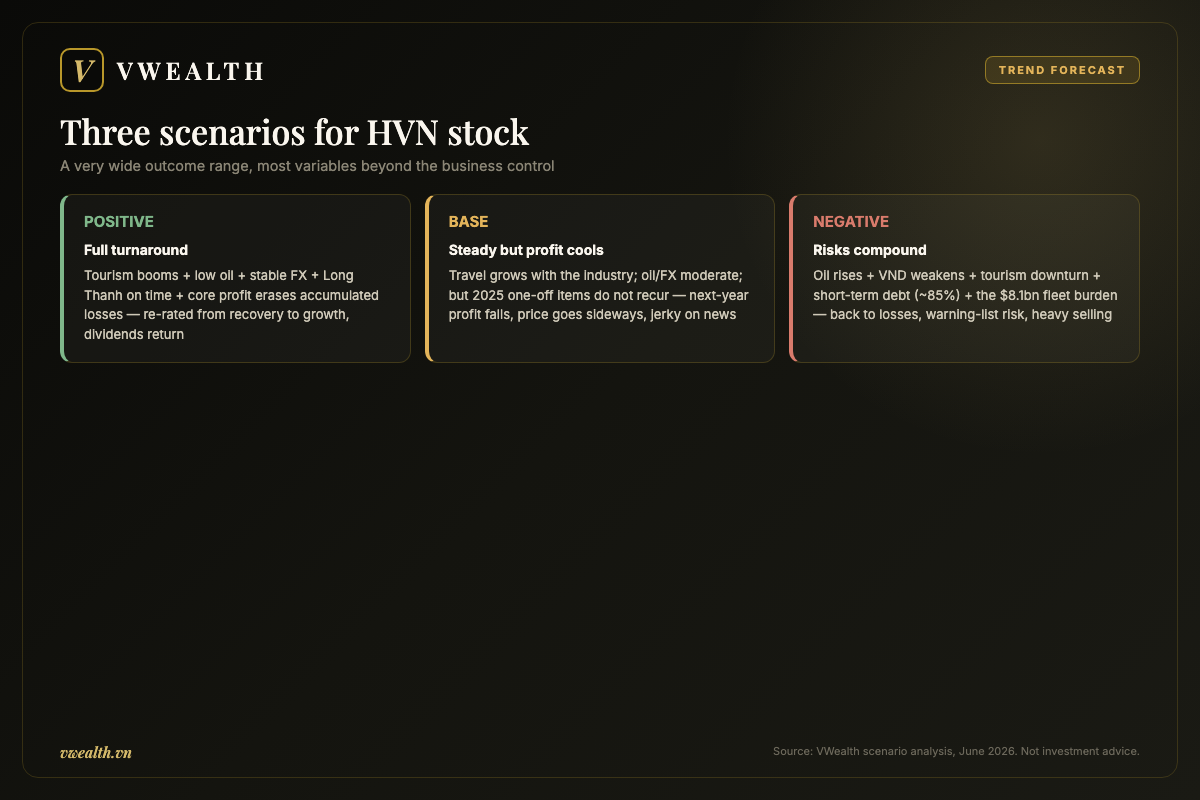
The takeaway from the three scenarios: HVN outcome range is very wide, from very beautiful to very ugly, and most of the deciding variables (oil prices, FX, global tourism health) are beyond the business control. That’s the very nature of an investment that bets on a revival story, rather than an investment based on a solid financial foundation.
Should you buy HVN stock?
Here, the biggest question appears. And as always, the honest answer isn’t a blunt “yes” or “no,” but: it depends on who you are and how much risk you can bear. Let’s put everything analyzed on two scales, then look through the lens of four different investor types.
The PROS scale — why HVN is still attractive to some
- A hard-to-replace national-carrier position. HVN is the national flag carrier, owning the brand, international slots, and a long-haul network no domestic rival can easily copy. This is a real competitive “moat” in the premium international segment.
- Direct beneficiary of tourism recovery and long-term aviation growth. With record international arrivals and full growth momentum, HVN sits right at the center of one of Vietnam most beautiful growth industries.
- Escaped negative equity and record 2025 profit. Consolidated after-tax profit over 7.7 trillion dong, the parent portion about 5,509 billion dong — double the year before; consolidated revenue over 121 trillion, the highest ever. Equity turned positive, the stock has a chance to escape the warning list. This is a big psychological turning point.
- State backing. As a state-controlled business, HVN has an implicit “safety net”: capital-raise plans and liquidity support in crisis have been deployed. This makes the real bankruptcy risk lower than a private business in the same financial state.
- The high-margin service ecosystem. Beyond passenger transport, HVN has an international network, cargo, catering, maintenance, ground services — segments with better and more stable margins than pure air tickets.
- The Long Thanh catalyst. Long Thanh airport coming online is a concrete catalyst with a clear timeline, hitting straight at the carrier long-haul international strength.
The CONS scale — why HVN is extremely risky
- Large accumulated losses remain. Though it eroded over 5,800 billion dong of accumulated losses in the year and turned equity positive, HVN still has significant accumulated losses. The balance sheet is far from “whole.”
- High debt, thin equity. Total debt reached nearly 67,368 billion dong (end-Q3 2025), of which short-term debt is nearly 85% — creating constant debt-servicing and rollover pressure. Equity is only a few thousand billion versus this debt pile, meaning very high leverage and a very thin margin of safety.
- 2025 profit has one-off factors — not sustainable. This is a crucial dark point. Part of the record profit came from one-off items and from cooling fuel prices. You must not take the 2025 profit figure to extrapolate the future. When these items don’t recur, the core profit will be far lower.
- The P/E valuation is almost meaningless, the P/B is high — speculative. Because profit swings extremely and contains one-off factors, HVN P/E doesn’t reflect true value. Meanwhile, the P/B is high due to too-thin equity (a small denominator). Valuing this stock thus depends almost entirely on belief in the “story” — i.e. essentially speculation, not fundamentals-based value investing.
- No dividend. While accumulated losses remain, HVN can’t pay a dividend. Buying HVN gives you no cash flow, only price gains to hope for.
- Extreme sensitivity to oil prices and FX. As analyzed, with fuel at 35-40% of cost and large foreign-currency debt, just one unfavorable move in oil or FX is enough to blow away profit.
- The $8.1 billion fleet investment raises debt and dilution risk. The order of 50 Boeing 737-8 is necessary for growth, but also means more borrowing or capital raising. Each share issue to raise capital dilutes existing shareholders — a very real risk with HVN.
What kind of investor does HVN suit?
To wrap up usefully, let’s view HVN through the lens of four common investor types. Identifying which group you’re in gives you a clearer answer than any “buy/sell” recommendation.
| Investor type | Does HVN suit? | Reason |
|---|---|---|
| Safety investor (capital preservation, risk-averse) | ABSOLUTELY NOT | High debt, thin equity, accumulated losses, unsustainable profit — a financial-risk combination the safety investor must stay far away from. |
| Value investor (good business at a cheap price) | NO | No fundamentals-based “margin of safety.” The P/E is meaningless, the P/B high, the valuation depends on the story not the numbers. The opposite of value-investing philosophy. |
| Dividend investor (needs steady cash flow) | NO | Still has accumulated losses so no dividend. Buying HVN gives no passive income. |
| Speculator / high-risk taker (betting on the story) | MAYBE CONSIDER | If you believe in the tourism-recovery and successful-restructuring story, willing to bear large volatility and significant capital-loss risk, HVN is a bet with a basis. |
Frankly: HVN only suits speculators or high-risk-tolerant investors who believe in the recovery and restructuring story, and should allocate only a small weight — the capital you can truly afford to lose. HVN is absolutely unsuitable for safety investors, value investors, or income seekers.
Closing words
HVN is a stock of paradoxes: a national brand full of stature but carrying a wounded balance sheet; a beautiful revival story told against the backdrop of an industry with the thinnest and most vulnerable margins. The record 2025 profit is a welcome signal, but don’t let that glossy number obscure the core: one-off factors, large debt, accumulated losses still there, and near-total dependence on variables beyond control.
Disclaimer: This article is produced for analytical and informational purposes, and is NOT a recommendation to buy or sell HVN. All figures are compiled from public sources at the time of writing and may change. HVN is a VERY HIGH-RISK stock, with the possibility of losing a significant part or all of your invested capital. The investment decision is your own and you bear full responsibility for it. Research thoroughly and consider consulting a licensed financial advisor before putting money in. Investing in stocks always carries the risk of loss.
Research Vietnamese stocks in English with vwealth. Our AI-powered platform turns Vietnamese market data into full English analysis reports — with international payment support and a free 2-month trial for new accounts. Create your free account and read the latest reports.