There’s a question nearly every investor has asked opening the Vietnamese utility board: if the country still nervously worries about power shortages at the dry-season peak, who steps up to “patch” that gap? The answer, in many cases, is a ticker named POW on HOSE — PetroVietnam Power Corporation (PV Power), the country’s second-largest power producer, only behind the “giant” that monopolizes transmission and most power sources, Vietnam Electricity (EVN).
POW isn’t an ordinary power business. It’s the power-generation arm of Petrovietnam (Vietnam National Industry – Energy Group, abbreviated PVN), the state group holding approximately 80% of its capital. That position turns POW into a two-faced stock: both a defensive utility — selling power to EVN under long-term contracts, with relatively stable cash flow — and a growth story tied tightly to the two hottest keywords in Vietnam’s energy industry right now: power shortage and LNG power.
And right as you read this, that story has just crossed a historic milestone. At the end of 2025, PV Power brought Nhon Trach 3 Power Plant into commercial operation — a piece of the Nhon Trach 3 & 4 cluster, Vietnam’s first LNG power project, capacity about 1,624 MW, total investment around 1.4 billion USD. For the first time a plant running on imported liquefied natural gas generated commercial power on Vietnamese soil, and the one doing it is POW. Also in 2025, the corporation’s profit broke out over 80% — a number big enough to make anyone following this stock stop and look closely.
As of 19 June 2026, POW traded around the 13,900-dong zone. A very “everyday” price for a business holding a national-energy-security role and having just completed a billion-dollar LNG gamble. So the central question of this whole analysis is: should you buy POW, and if so, what kind of investor does it suit? To answer properly, you can’t look only at today’s price. You need to understand how this business was born, what stumbles it went through, and why the Nhon Trach 3 & 4 cluster is a turning point — not just a new project. Let’s start from the roots.
POW market data (updated 19 June 2026)
| Current price | 13,900đ | 2025 revenue | >35,000 bn (+10%) |
| Change (June) | +0.72% | 2025 pre-tax profit | >2,500 bn (+80.7%) |
| Power output | 18.9 bn kWh (+17%) | EV/EBITDA | PVN | ~6.4x | ~80% |
Source: VWealth price data + PV Power 2025 reports. Figures move by session — for reference only.
History and evolution
To understand a power stock, you must first understand what “mission” it was assigned. And for PV Power, that mission was written from birth day: to secure part of the nation’s power supply, based on the fuel strength of the oil-and-gas industry. That’s why PV Power isn’t a child of the power industry, but a child of the oil-and-gas industry.
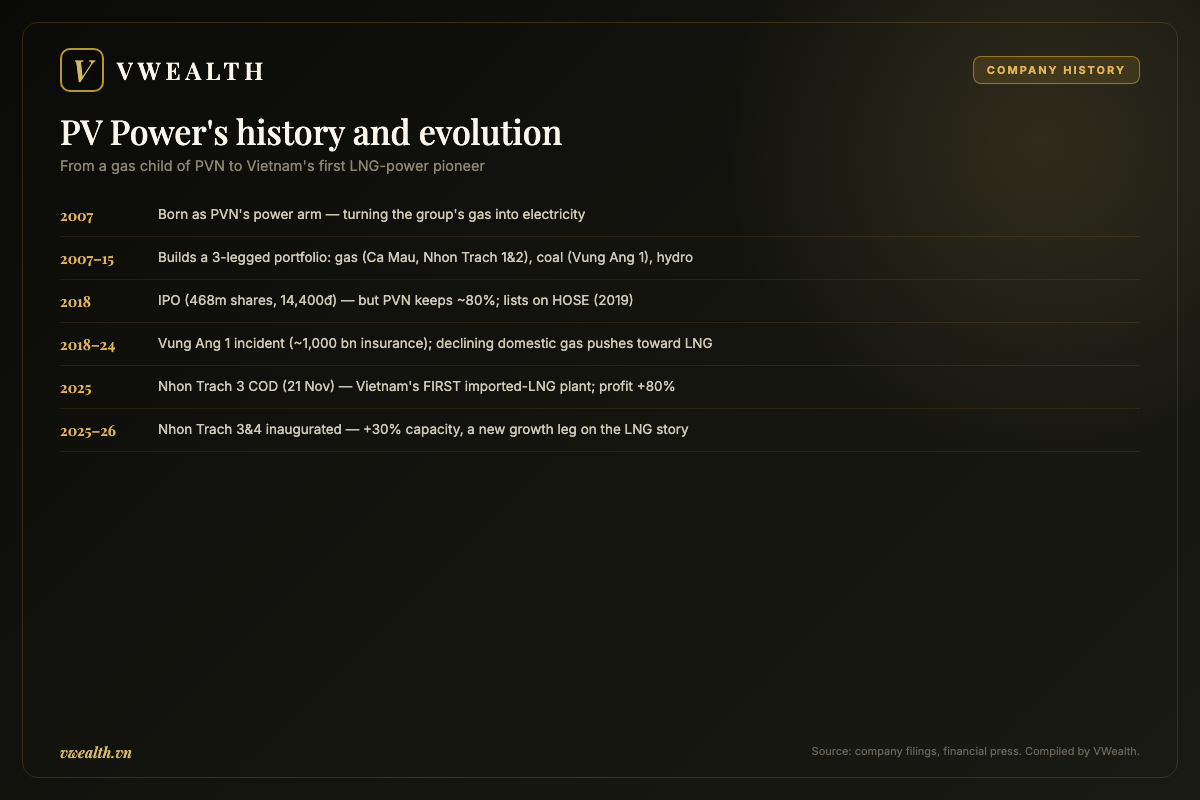
2007 – A child of the oil-and-gas industry is born
PV Power was established in 2007, by decision of the Vietnam Oil and Gas Group (now Petrovietnam). The context then was easy to understand: Vietnam was industrializing fast, power demand surging every year, while PVN held enormous natural gas from offshore fields in the Southeast and Southwest. Instead of selling raw gas, PVN wanted to go one step deeper in the value chain — turning gas into power. PV Power is precisely the instrument to do that.
The point to remember from the start: unlike a pure power company, PV Power was born with a structural fuel advantage. It’s tied to the oil-and-gas ecosystem — from gas sources, pipeline infrastructure, terminals, to the whole group’s technical capacity. This advantage later is both a strength (priority gas, capital and technology backing) and a weakness (dependence on declining gas sources, exposure to gas-price swings). We’ll see both sides revealed clearly through each phase.
In its early years, PV Power dove into building and taking over a series of plants. The focus was gas power — the natural strength: the Ca Mau 1 & 2 cluster in the Southwest (each unit about 750 MW, using gas from the PM3 – Ca Mau pipeline), and the Nhon Trach 1 & 2 cluster in Dong Nai (Nhon Trach 1 about 450 MW, Nhon Trach 2 about 750 MW, using Southeast gas). This is the “backbone” generating most of POW’s output and profit for a decade and a half.
Diversification: not putting eggs in one fuel basket
A wise decision by PV Power in the formation phase was not doing only gas power. This business proactively spread its portfolio across three source types, each with its own role:
- Gas power — the pillar of output and revenue: Ca Mau 1 & 2, Nhon Trach 1 & 2. Flexible, good for baseload and peak-covering, but “eats” gas source and gas price.
- Coal power — adding large baseload capacity: the Vung Ang 1 coal thermal plant in Ha Tinh, capacity about 1,200 MW. This is POW’s largest single plant, helping reduce reliance on gas alone.
- Hydropower — the “clean” and cheap part of the basket: Hua Na (Nghe An, about 180 MW) and Dakdrinh (Quang Ngai/Kon Tum, about 125 MW). Smaller in scale but low cost, good margins when water is plentiful.
Why is this detail important to you — an investor? Because the source mix decides the stock’s defensiveness. When gas prices are high, the gas segment’s margin is squeezed and hydropower and coal carry the load. When hydrology is bad (little rain, empty reservoirs), gas and coal thermal are the fallback. Such a three-legged portfolio makes POW less “boom-and-bust” on a single variable than a pure-hydro or pure-thermal business. This is one of the foundational reasons many see POW as a stable utility stock.
As of the period before the new LNG cluster operated, PV Power managed and operated about 8 plants with total installed capacity around 4,200 MW — enough to rank as the country’s second-largest power producer after EVN. This number isn’t to show off; it means every operating swing at POW has weight at the national power-system level. POW “coughs,” and the national grid can “feel” it.
2018 – Equitization and stepping into the market’s light
For its first ten years, PV Power was a 100%-state business, operating quietly. The transparency turning point came in 2018, when the business carried out equitization per the government’s direction.
In late 2017, the Prime Minister approved the parent company’s equitization plan. On 31 January 2018, PV Power held its first public auction (IPO) of over 468 million shares (equal to 20% of charter capital), at a starting price of 14,400 dong/share. This was one of the largest and most anticipated IPOs on Vietnam’s stock market that year — along with PVN’s famous divestment “trio” of BSR (Binh Son Refining), PV OIL and PV Power. From July 2018, the corporation officially operated on a joint-stock model.
POW shares traded on UPCoM from March 2018, then officially listed on HOSE (trading from January 2019). After the IPO, PVN still held a controlling ~79.94%, that is around 80% to this day.
You should read this ownership figure carefully, because it shapes POW’s nature in two opposing directions:
PVN holding ~80% is both a shield and a shackle. The shield: POW has the backing of a state group for capital, gas source and relationship with the mechanism, with almost no fear of “disappearing.” The shackle: the remaining free float is relatively small, big decisions still follow state direction, and minority shareholders’ interest isn’t always the top priority — proof being that POW went many years without paying cash dividends to concentrate capital for investment.
In other words, buying POW means betting alongside the state on national energy security, not buying a stock that “pleases” shareholders with steady dividends. Understanding this from the start will help you avoid disappointment later.
Stumbles along the way: when running a power business isn’t smooth
If you only read the press releases, you’d think PV Power grew smoothly. Reality is the opposite — and the difficulties are precisely the part that helps you honestly value this stock’s risk. There are four “rough” groups POW has faced and still faces:
First, plant operating incidents. Most notable is the incident at the Vung Ang 1 coal thermal plant — POW’s largest coal plant. A unit suffered a serious incident, having to shut down for a long time to fix, cutting part of the output and profit in that period. The story truly closed only when PV Power received an insurance compensation of about 1,000 billion dong for this incident (actual repair cost around 600 billion), a sum that offset significantly and once made POW “hit the ceiling” on the announcement session. The lesson for investors: for a power business, one large unit sitting idle for a few months can change the whole year’s profit picture. Technical risk is a real risk, not theory.
Second, the problem of declining gas sources and high gas prices. This is the structural weakness of a gas-rooted business. Traditional gas fields in the Southeast and Southwest are entering natural output decline. As cheap gas depletes, POW’s gas plants must use higher-priced supplementary gas, or face the risk of insufficient gas to run at full capacity. Escalating gas prices raise power costs, and if the selling-price mechanism doesn’t keep pace, the gas segment’s margin is compressed. This is also the deep “economic” reason pushing POW to seek a new fuel source — imported LNG — to replace and supplement depleting domestic gas.
Third, the power-pricing mechanism and the “single buyer” role. In Vietnam, POW’s output is nearly concentrated on a single customer: EVN, through power-purchase agreements and the competitive generation market. The revenue structure usually has two parts — a capacity price (paid for readiness to generate) and an energy price (paid by actual output, tied to fuel cost). This creates a relatively certain revenue base, but also means POW can’t freely price its output: efficiency depends heavily on contract negotiation, on system dispatch and on general power-price policy. When you value POW, you’re forced to also value this “mechanism ceiling.”
Fourth, energy-transition pressure and enormous investment capital. Power Plan VIII and the carbon-neutrality commitment require a gradual shift away from coal toward cleaner sources. For POW — heavy in coal and traditional gas power — this is both pressure and opportunity. To not be left behind, POW must spend very large sums on a new generation of plants, most notably the LNG gamble. Precisely because of concentrating on investment, POW chose not to pay cash dividends for many years — a decision that makes “dividend-eating” investors unhappy, but understandable if you look at the scale of capital needed.
The LNG gamble: Nhon Trach 3 & 4 — behind schedule then to the finish
Every difficult road above leads to one project: the Nhon Trach 3 & 4 Power Plant cluster. This isn’t an ordinary new plant — it’s Vietnam’s first LNG power project, and the biggest gamble in PV Power’s history to date.
The idea existed early. Right in 2018, the Prime Minister assigned PV Power as investor of the two gas plants Nhon Trach 3 and Nhon Trach 4, with an initial expectation of operating around 2020–2021. But reality went far slower than plan. A project of ~1,624 MW scale, total capital up to ~1.4 billion USD, and the country’s first LNG project — meaning building while paving the way for the accompanying legal framework and infrastructure — snagged on all sorts of things: site clearance, negotiating power-purchase agreements for the new type, the mechanism to pass LNG gas prices through to power prices, arranging large financing, then the imported-LNG supply chain.
For years, “Nhon Trach 3 & 4 progress” became a constant question each POW AGM season. Leadership repeatedly had to explain the snags and commit to resolution milestones. This was precisely the mettle-testing phase: a billion-dollar project running behind schedule is always a double-edged sword — if it reaches the finish, it’s a new growth driver; if it bogs down, it “buries” capital and erodes investor confidence.
And then POW reached the finish. The final milestones came in rapid succession in 2025:
- 21/11/2025 — Nhon Trach 3 qualified and officially reached commercial operation (COD), becoming Vietnam’s first imported-LNG power plant to generate commercial power onto the national grid.
- 14/12/2025 — PV Power and Petrovietnam held the inauguration of the whole Nhon Trach 3 & 4 cluster, with the Prime Minister attending — a national-level event, marking the first time Vietnam realized an imported-LNG power chain.
The meaning of this milestone is far larger than “one more plant.” Look at the numbers: the 1,624 MW cluster increases POW’s total capacity by about 30% versus the old base (~4,200 MW to nearly 6,000 MW counting all operating plants). For a power business, adding a third of capacity in one go is a step-jump, not gradual growth. Moreover, each unit uses new-generation gas turbines with combined-cycle efficiency exceeding 64% — among the highest in the world — meaning burning the same fuel but producing more power, cleaner than the old plants. This cluster is expected to supply over 9 billion kWh a year.
For the POW investment story specifically, Nhon Trach 3 & 4 is a turning point from “defensive” to “with an added growth leg”. Previously, POW was a stable utility stock but lacking a clear breakout driver. From late 2025, this business both keeps its inherent defensiveness and has an enormous, high-efficiency new power source, tied to the power-shortage story and the whole nation’s long-term LNG trend. That’s why the name POW is mentioned much again on the market in 2025–2026.
2025 – A pivotal year: profit breaks out over 80%
Everything built and endured over nearly two decades crystallized into the 2025 results — and it’s truly impressive. Per corporation-wide estimates:
| 2025 metric (estimate) | Value | vs 2024 |
|---|---|---|
| Total revenue | > 35,000 bn dong | +10% |
| Pre-tax profit | > 2,500 bn dong | +80.7% |
| Power output | ~18.9 bn kWh | ~+17% |
A few points to read carefully after this table. Revenue rose 10%, but pre-tax profit rose over 80% — that is, the margin widened strongly, profit growing many times faster than revenue. This usually comes from the resonance of several favorable factors: high dispatched output (up ~17%, reflecting large power demand and the power-shortage context), controlled costs, extraordinary/compensation items recorded, and initial contribution from the new power source. The nearly 18.9 billion kWh output completed 100% of the PVN-assigned plan — a confirmation of operating capability.
However, a veteran analyst will remind you not to paint it rosy: part of the profit surge came from the low base of the prior year and cyclical factors. The first operating year of a 1.4-billion-USD plant also brings very large depreciation and interest costs, so some projections cautiously believe later-year profit could face pressure before the LNG cluster runs stably and offsets the costs. In other words, the “+80%” of 2025 is both a real achievement and a starting point needing verification through sustainability in the coming years.
Even so, the historical picture is clear enough. PV Power went from a child of the oil-and-gas industry in 2007, built a three-legged gas–coal–hydro portfolio, stepped into the market through a large 2018 IPO, toughed it out through incidents and fuel problems, then at the end of 2025 completed the country’s first LNG gamble and recorded a breakout profit year. That’s a business matured through collisions, not an easy growth story.
But a billion-dollar project doesn’t reach the finish by itself, and a plant portfolio doesn’t run smoothly by itself. Behind each milestone and each “unsnagging” are specific people: PV Power’s leadership and executive apparatus under Petrovietnam’s direction. Who are they, what are their capabilities and management style, and does that state-ownership structure serve or hinder your interest — a small shareholder? That’s what we’ll dissect in the next section: Leadership and corporate governance.
Leadership and state ownership
When you buy a stock, you’re essentially contributing capital alongside other owners and handing your money to an executive apparatus. For POW, this story has a trait you must understand before putting money down: this isn’t a private business built by a founder-owner, but a “child” of Vietnam’s largest state economic group. The entire logic of power, cash flow, dividends and even POW’s share-price prospects revolves around one reality: who really holds power, and where does your interest — a small shareholder — stand in that picture. This is precisely the part many new investors skip, then are surprised when POW profits big but pays no cash.
Ownership structure: one dominant “owner” and the rest
PetroVietnam Power Corporation – JSC (ticker POW, listed on HOSE since 2019) has an extremely concentrated ownership structure. Per the business’s disclosure, the Vietnam Oil and Gas Group (Petrovietnam, abbreviated PVN — now operating under the name Vietnam National Industry – Energy Group) contributed over 18,721.4 billion dong of capital, equal to about 79.94% of POW’s charter capital. This number is nearly unchanged through recent capital increases: in the rights offering to existing shareholders in late 2025 – early 2026, PVN exercised the right to buy over 224 million shares to keep its controlling ratio intact, per financial-press reports.
Picture this number visually: for every 100 POW shares outstanding, about 80 are in state hands through PVN, and only about 20 remaining are split among all other investors — foreign funds, domestic funds, proprietary securities firms, and tens of thousands of individual investors like you. POW has about over 51,000 shareholders, but all of them combined hold only the minority. This is the fundamental difference between POW and a private business with dispersed ownership.
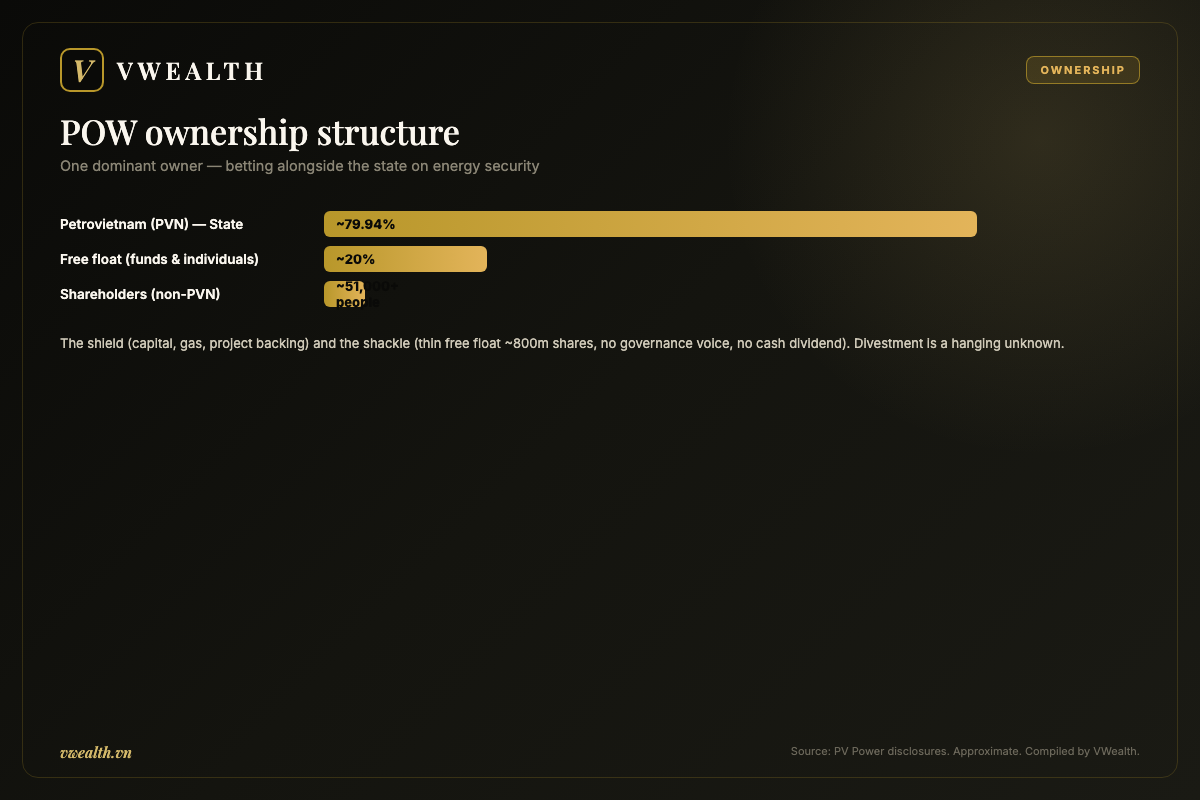
This dominant ownership ratio has two very clear sides, and you need to weigh both before positioning POW in your portfolio.
The bright side: “backed” by the parent group
A national energy group holding nearly 80% isn’t a negative — on the contrary, for a capital-intensive power business like POW, it’s a very real anchor. Think about what a power plant needs to operate and expand: enormous capital, a stable fuel source, and projects approved in the national power plan. PVN can support POW on all three in a way few private businesses can.
On capital, key projects like the Nhon Trach 3 and Nhon Trach 4 LNG power cluster (total investment over 1.4 billion USD, inaugurated December 2025) require financial resources POW’s own cash flow can hardly bear alone. When POW issued more shares to raise capital for Nhon Trach, PVN was the shareholder putting in the most money, while creating a “credit anchor” helping the business borrow from banks more easily. A power project backed by a state group is usually seen by credit institutions as lower default risk.
On gas source, this is the “lifeline.” The gas-power segment — the backbone of POW’s profit — depends directly on the input gas source, and Vietnam’s largest gas supplier is PV GAS, another member of the PVN “big family.” In other words, both the gas buyer (POW) and the gas seller (PV GAS) are under one group roof. In favorable conditions, this relationship gives POW a stronger supply-negotiation position and more stable gas-delivery schedule than a business outside the ecosystem.
POW isn’t an independent company swimming alone in the market. It’s a link in the oil-and-gas – energy value chain coordinated by PVN: PVN provides capital and project direction, PV GAS supplies gas, POW generates power. Understanding this, you’ll understand why POW’s “health” is tied tightly to the whole group’s strategy, not just one power plant’s private matter.
The second bright side is stability. A controlling state shareholder usually pursues long-term goals, prioritizing continuous operation and national energy security over chasing short-term profit. For safety-oriented investors, this trait reduces the risk of the business being taken over, “gutted” by speculative shareholders, or suddenly changing its business strategy recklessly.
The dark side: low free float and small shareholders’ voice nearly “invisible”
But the very structure bringing that stability also creates limits you shouldn’t underrate. With only about 20% floating shares (free float), POW has some traits unfavorable to small shareholders.
First is voting rights. At the AGM, every big decision — from business plans, share-issuance plans, to profit distribution — needs approval by voting ratio. When a single shareholder already holds nearly 80%, the result of nearly every vote is almost predetermined. In practice, POW’s capital-increase plans are usually approved with a very high approval ratio, sometimes up to 99.92%. This reflects a harsh truth: whether you agree or object, the small-shareholder bloc’s vote can hardly make a difference. You participate in POW with the mindset of “going along” with the state’s decision, not to influence that decision.
Second is liquidity and stock volatility. Low free float means the shares actually traded on the exchange are fewer than the nominal cap. This can make POW’s price more sensitive to large flows in/out, especially when ETFs restructure. For individual investors, what to note is that most of POW’s “market story” revolves around macro and project expectations, more than the private-shareholder bloc’s ability to determine its own fate.
Third — and most important for long-term investors — is decisions depending on PVN and policy. Because POW is controlled by a state shareholder, the business’s key decisions aren’t entirely driven by profit-maximizing logic for shareholders, but must also serve larger goals: energy security, stable power prices for the economy, and the industry’s development direction. Two key policy variables — power prices and gas-source allocation — are both beyond the business’s control, decided by regulators and the power-market mechanism. When the state wants to hold down power prices to control inflation, power plants like POW may see their margins narrow, and small shareholders have no tool to resist.
The divestment story: an “unknown” that could reverse
One point many long-term investors watch closely is the possibility of the state partly divesting POW. In theory, if PVN reduces its stake from ~80% to a lower threshold, POW’s free float rises, liquidity improves, the business may be governed more “market-oriented,” and room for strategic investors to participate opens up. Historically, many oil-and-gas businesses saw their stock positively re-rated after state divestment.
However, you need to be very cautious with this expectation. POW is tied to national energy security, so whether the state reduces its stake, by how much and when, depends entirely on macro-level direction — a variable hard to forecast in both content and timing. Recent years show PVN not only didn’t divest but spent money buying more shares to maintain control when POW increased capital. So treat the divestment story as a “potential reward if it happens,” but absolutely don’t take it as the main thesis to buy POW. Investing based on a policy scenario with no clear roadmap is risky.
Leadership: executives rotated within the PVN system
POW’s senior leadership bears the deep imprint of a Petrovietnam-system state business, where personnel are usually rotated and appointed among member units. Per the business’s official disclosure, POW’s senior leadership can be summarized as follows (verify at your reading time, as leadership in the PVN system can change):
| Position | Holder (per disclosure) |
|---|---|
| Chairman of the Board | Mr. Hoang Van Quang |
| CEO | Mr. Le Nhu Linh |
| Board members (representative) | Mr. Nguyen Anh Tuan, Ms. Nguyen Thi Ngoc Bich, Ms. Vu Thi To Nga… plus independent members |
Per financial-press sources, Mr. Hoang Van Quang was elected POW Chairman at the 2023 AGM. Notable on capability: born in 1969, he has a mechanical-engineering background and about two decades of oil-and-gas experience, having held executive positions at PV GAS — precisely the gas segment, the vital input of POW’s gas-power operation. This appointment reflects a fairly typical PVN-system personnel logic: putting someone who understands the gas value chain to lead a gas-power business, to bind fuel supply and generation more tightly.
What you should draw here isn’t each specific name, but the apparatus’s nature: POW’s leadership are people the state/PVN system trusts with management, with technical and management capability in energy, but they operate within the controlling shareholder’s directional framework. They’re good at power engineering and plant operating management, but they aren’t entrepreneurs fully autonomous over capital and profit strategy in a private-company sense. This is a strength on stability, but also a limit on flexibility and breakout-growth appetite.
Governance and the power-pricing mechanism: why this is a survival factor
If you could choose only one factor to understand why POW’s profit swings, look at the power-pricing mechanism. A power plant makes money by: buying input fuel (gas, coal) at one price, then selling output power at another. The spread between these two ends — after operating costs — is the profit. The problem is POW can hardly decide either the input or output price.
On the output, part of POW’s power is sold under a power-purchase agreement (PPA) signed with Vietnam Electricity (EVN). A PPA is a long-term contract fixing terms on output and price, giving the business a partly relatively stable revenue and cash flow, a basis to recover investment. The remaining output is traded on the competitive power market, where prices swing by supply-demand at each moment. So POW’s profit depends heavily on the PPA price-negotiation result, on the ratio between contracted output and market-sold output, and on power-market price movements. An unfavorable PPA clause, or a period of low power-market prices, can erode the margin.
On the input, POW’s largest cost is the fuel price — especially the gas price (and the imported LNG price for new projects like Nhon Trach 3 and 4). Gas and LNG prices depend on the international energy market and geopolitical swings, things entirely beyond the business’s control. When fuel prices surge but power selling prices don’t rise correspondingly, the margin is squeezed. This is precisely the core risk of a gas plant: you’re clamped between two prices you don’t determine.
The pricing mechanism is a survival factor because it decides POW’s entire margin — and both the input price (gas/LNG by international market) and the output price (PPA and power market) are beyond the business’s control. When you invest in POW, you’re betting on contract-negotiation ability and power-price policies, more than on a business’s ability to “sell itself.”
EVN risk: when the “single buyer” hits financial trouble
A distinctive risk you must especially note: most of POW’s power is sold to EVN, meaning EVN is nearly the business’s “dominant buyer.” When EVN’s financial health worsens, it can affect payment to power plants in a chain, including POW — directly impacting cash flow, not just book profit.
Reality in the recent period shows this risk isn’t abstract at all. Per the Ministry of Industry and Trade’s disclosure, in 2023 alone EVN lost nearly 21,800 billion dong from power production and business, because retail power prices were kept below production cost amid surging world coal, gas and oil prices. By 2024, EVN cut the loss streak and reported after-tax profit of over 8,200 billion dong thanks to power-price adjustments, but still had accumulated losses of about 38,688 billion dong. When your “buyer” carries tens of thousands of billions in accumulated losses, their cash-flow pressure can entirely turn into risk of delayed payment or prolonged receivables with power suppliers. For a cautious investor, this is a variable to watch regularly: EVN’s financial health is nearly POW’s “output health.”
Dividends: why POW profits big but you still don’t get much cash
By here, you have enough context to understand one of the most disappointing traits for income-seeking investors: POW pays low and erratic cash dividends. In 2019–2020, POW once maintained a modest cash dividend of about 2–3%, but then dividend payment was interrupted. By 2025, the business returned to paying dividends but in the form of stock at a 4% ratio (shareholders with 100 shares get 4 new shares), from after-tax profit — not cash into your pocket.
The reason lies in the business’s very strategy: POW is concentrating on large investment projects, especially the Nhon Trach 3 and 4 cluster. Instead of distributing profit to shareholders, leadership chooses to retain capital to fund capacity expansion. Paying dividends in stock rather than cash also serves this very goal — it raises charter capital without draining operating cash flow. Even at recent AGMs, POW repeatedly approved plans not to pay cash dividends to concentrate resources on the investment plan.
This is decisive for how you should position POW:
| If you are… | How suitable is POW for you? |
|---|---|
| An investor seeking steady cash-dividend income | Poorly suited. POW prioritizes retaining investment capital, low/erratic cash dividends, can’t be seen as a “steady interest” stock. |
| A long-term growth investor believing in gas-power capacity expansion | Better suited. You accept not receiving cash today in exchange for the expectation of the business growing large through Nhon Trach and LNG projects. |
| An investor betting on the state-divestment story | Speculative on policy. Could have a big reward if it happens, but no certain roadmap — shouldn’t be the main thesis. |
In other words, POW is a stock of the long-term growth and strategic-position-in-power-industry story, not a cash-dividend printing machine. When you see news “POW profit up over 80%,” don’t rush to expect a corresponding sum flowing into your account — most of that profit is being reinvested into new-generation gas turbines at Nhon Trach. You benefit indirectly through increased enterprise value, not through a dividend cash flow.
And to fully understand the asset value you indirectly own — those turbines, plants, cash-generating segments — you need to go deep into the business’s “hardware.” That’s why the next section will dissect POW’s power-plant system and core business segments in detail: from the Ca Mau, Nhon Trach gas units, to hydropower and coal thermal — where the money you contributed truly “generates heat” and “generates power.”
Plant system and business model
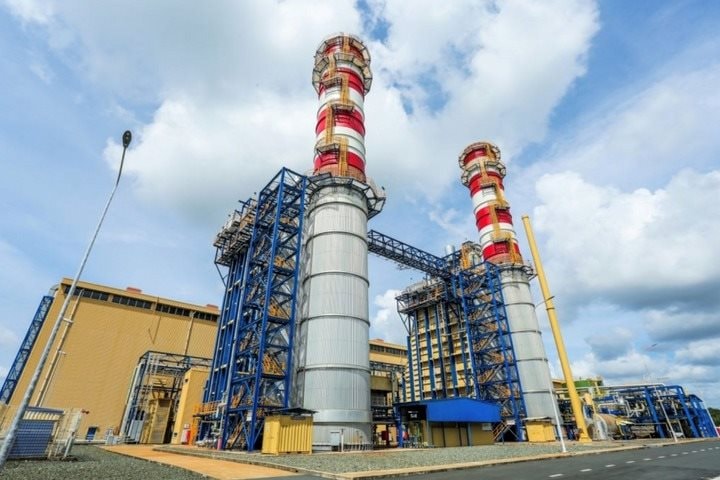
When you look at a power-industry ticker like POW, the first thing to understand isn’t the price chart, but a very everyday question: what does this business actually sell, sell to whom, and where does its profit come from? Because unlike a retailer or a bank, a power-generation corporation like PetroVietnam Power (PV Power) operates on very distinctive economic logic: it owns “power-printing machines” worth billions of dollars, burns fuel to spin turbines, then sells that power to a near-single customer, Vietnam Electricity (EVN). The whole POW investment story revolves around understanding what that “machine” portfolio includes, how cheap or expensive each machine is at producing each kWh, and what pricing mechanism decides the spread between money collected and cost spent. This section peels back each layer so you — even if new to the power industry — can read the business’s “innards” yourself.
How does a power company make money?
Let’s start from the simplest principle. A power plant is essentially a machine turning fuel (natural gas, coal, or falling water) into electricity. Its revenue is calculated by a nearly memorizable formula:
Revenue = Power output (kWh) × Average selling price per kWh.
Profit is a bit more complex, but still easy to picture. Take the power selling price, subtract the largest part which is fuel cost (buying gas, buying coal), subtract depreciation of that expensive machine, then subtract operating costs — maintenance, labor, interest. What’s left is profit. So a power business’s health is nearly decided by two variables: how much it can run (output, depending on whether it’s dispatched) and how wide the spread between the selling price and the fuel price is (margin). A plant can be very modern but if fuel is too expensive, or it’s dispatched little, it still loses money.
The crux to grasp: a power plant can’t decide how much it runs. In the national power system, a “dispatch center” arranges which plant generates when, based on consumption demand and offer prices. Plants offering cheap prices and ready are dispatched first; high-price plants are only called when demand rises high. This is why the fuel mix — gas, coal or hydro — becomes a survival factor, because it decides where a plant sits in the “call queue.”
PPA and the competitive power market: two revenue valves
PV Power sells power through two parallel channels, and understanding these two means you understand over half of POW’s revenue story.
The first channel is the long-term power-purchase agreement (PPA) signed with EVN. Picture a PPA as an offtake commitment: EVN commits to buy a certain ratio of the plant’s output at a pre-agreed price, called contracted output — symbolized Qc. This Qc part is the plant’s “safety net”: however the market swings, the business is sure to sell that much power at a stable price, enough to cover large fixed costs like depreciation and interest. The higher Qc, the more predictable the revenue, the lower the risk.
The second channel is the competitive generation market (CGM). Output beyond Qc is offered by the plant at market prices, swinging by supply-demand each hour. When the system is short of power — for example the southern dry season, hydropower drained — market prices surge, and plants that can run a lot on the spot market enjoy very good margins. Conversely, when there’s a power surplus, market prices drop, and this is when the Qc offtake part plays its insurance role.
So picture POW’s revenue as water flowing through two valves: one open steadily by contract (Qc, fixed price), one opening and closing to the market’s rhythm (CGM, variable price). A good investor always looks at the Qc ratio assigned each year and market-price movements to guess the coming margin, rather than just looking at raw revenue.
Plant portfolio: four very different “power-printing machines”
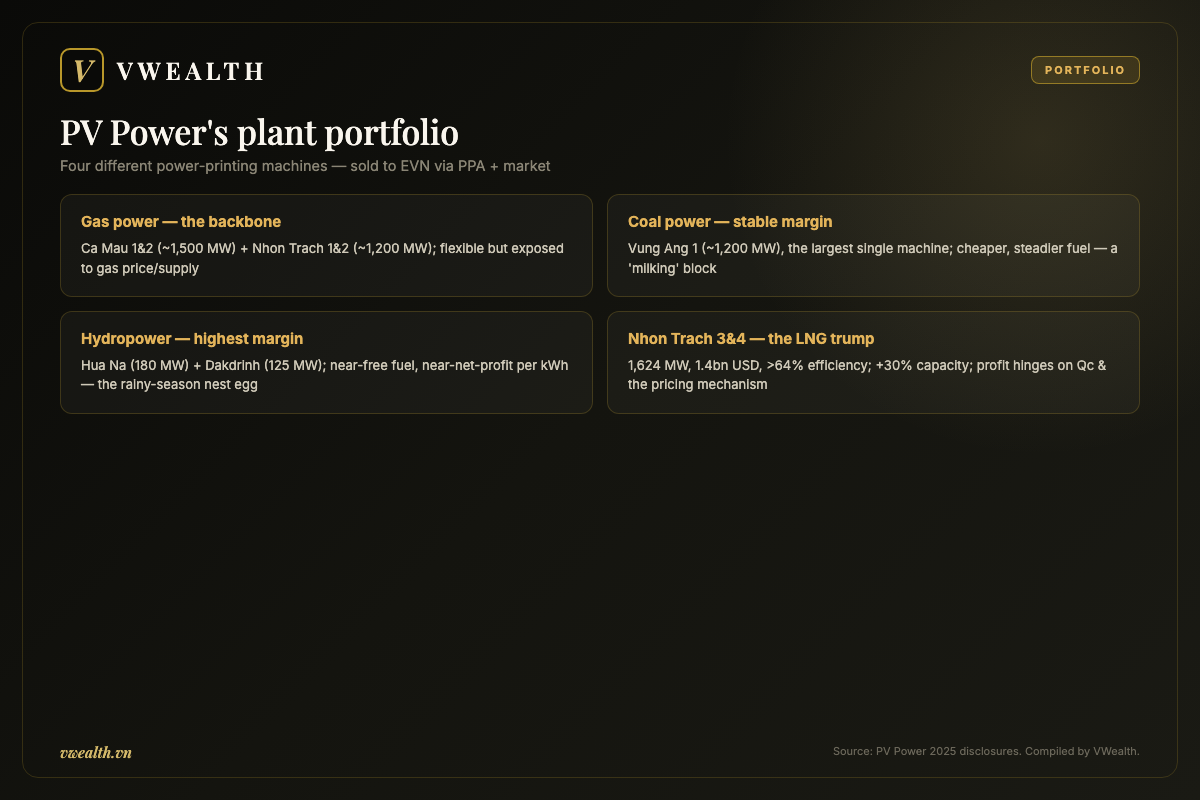
POW’s appeal lies in this business not putting eggs in one basket. As of 2025, PV Power manages and operates a power-source portfolio with total capacity exceeding 5,800 MW, spanning North to South and including all four main source types: gas power, coal power, hydropower and — newest — LNG power. Each has its own “economic character,” and this very mix helps the business reduce risk when one source struggles.
Gas power — the traditional backbone
The two gas-power clusters are PV Power’s historical pillars. The Ca Mau 1 and 2 cluster in the West, each plant 750 MW, totaling about 1,500 MW — this is the largest capacity block and the “cash cow” contributing the most monthly output for the business. In July 2025 alone, the Ca Mau cluster contributed up to 503 million kWh, leading the whole portfolio. The second cluster is Nhon Trach 1 (450 MW) and Nhon Trach 2 (750 MW) in Dong Nai, near the country’s largest load center, the HCMC and Southeast region, totaling about 1,100–1,200 MW.
Gas power’s advantage is fast startup, flexible operation, suitable for peak-covering when demand rises high. But it also has an Achilles’ heel: dependence on domestic gas sources that are gradually declining at old fields, and gas prices anchored to world oil prices. When oil prices are high, fuel costs rise, and gas power’s margin is squeezed.
Coal power — large capacity block, stable margin
The Vung Ang 1 coal thermal plant in Ha Tinh is the portfolio’s largest single machine with capacity about 1,200 MW. Coal power’s trait is that fuel cost (coal) is usually cheaper and more stable than gas, so when the plant runs stably, it generates fairly steady cash flow and margin. In July 2025, Vung Ang 1 contributed 278 million kWh. However, coal power also faces long-term pressure from the global emission-reduction trend and Vietnam’s carbon-neutrality commitment, so strategically, this is a current “milking” block more than a future expansion direction.
Hydropower — the highest margin, the “nest egg” of the rainy season
The two hydropower plants Hua Na (180 MW) in Nghe An and Dakdrinh (125 MW) in Quang Ngai have small capacity versus the rest, but are “gems” on margin. The reason is simple: hydropower’s fuel is water — nearly free. Once most of the works are depreciated, each kWh of hydropower sold is nearly net profit, because the variable cost is extremely low. Hydropower’s weakness is total dependence on weather: rainy years profit big, drought years see output drop sharply. So hydropower in POW’s portfolio plays the role of a “margin cushion” improving overall efficiency when conditions are favorable.
Combining these four sources creates a notably balanced portfolio. When gas is expensive, coal and hydropower carry the load. When drought weakens hydropower, gas and coal fill in. This very diversification is the shield helping POW’s cash flow swing less than a business with only one source type.
Nhon Trach 3 and 4 — the LNG “trump card” and the future gamble
If the old portfolio is the foundation, then the Nhon Trach 3 and 4 LNG power cluster is the most important new chapter, and the reason analysts poured attention on POW throughout 2025–2026. This is Vietnam’s first LNG power project to enter commercial operation, a historic milestone for the whole national power industry.
Its scale is very large. Total design capacity reaches 1,624 MW (each unit 812 MW), with total investment about 1.4 billion USD. This 1,624 MW figure has special meaning: it increases PV Power’s total capacity by about 30–38%, meaning one project expanded the whole business’s generation capacity by nearly a third. When fully operating, this cluster is expected to supply over 9 billion kWh a year — an enormous output stream. On progress, Nhon Trach 3 began commercial operation from 21 November 2025, and the whole Nhon Trach 3&4 cluster officially reached full commercial operation from early 2026. Right from July 2025, the project began contributing test output to the business’s results.
Thanks to this driver, PV Power’s system-wide 2025 output is estimated at nearly 18.9 billion kWh, completing 100% of the plan and up about 17% versus 2024 — a very significant growth rate for a large, mature business like POW.
Why is LNG both an opportunity and a risk?
This is the part you need to read most carefully, because it’s the center of investor debate. Unlike traditional gas power using domestically extracted gas, Nhon Trach 3&4 runs on imported liquefied natural gas (LNG). LNG is gas cooled deep to liquid to ship by sea from abroad, then regasified at a terminal. The problem is: imported LNG is notably more expensive than domestic gas, and the price swings with the world energy market.
This creates a thorny problem. Because input fuel is expensive, the cost per kWh from Nhon Trach 3&4 is also high. If the plant must offer power on the CGM competitive market at such high prices, it will be hard to dispatch — because the dispatch center always prioritizes calling cheap sources first. A 1.4-billion-USD plant that doesn’t run enough will see the depreciation and interest burden “erode” profit very fast.
The key for Nhon Trach 3&4 to profit isn’t the technology — its technology is already very modern — but the pricing mechanism and the offtake output level (Qc) the state allows.
This is why investors watch policies closely. Per the mechanism set in Decree 56/2025, LNG power projects are applied a high minimum contracted output ratio (Qc) — around the 65% threshold — in the early operating period. Understand the meaning of this number: it means EVN commits to offtake at least about 65% of the plant’s design output by contract, regardless of the market. This high offtake level is precisely the “float” helping Nhon Trach 3&4 recover its enormous investment and have a basis to profit, even when expensive LNG fuel makes the plant hard to compete fairly on the spot market.
So when you assess POW’s prospects, always ask: what’s the Qc ratio assigned to Nhon Trach 3&4 this year, and is the mechanism to pass LNG gas prices through to power prices maintained? If the pricing mechanism is favorable and Qc high, this “trump card” will be a strong profit-growth machine. If the mechanism is tightened, the same plant could become a financial burden. This is truly a double-edged sword.
LNG power and renewables — the spearhead of the future
PV Power’s strategic vision doesn’t stop at Nhon Trach 3&4. The business has bet long-term on LNG power as the main development direction, closely following Power Plan VIII — the national plan strongly prioritizing LNG power and renewables to gradually replace coal power. In this vision, POW has been preparing a series of large-scale LNG projects spanning the country: LNG Quang Ninh (about 1,500 MW) in the North, LNG Quynh Lap (Nghe An) and LNG Vung Ang 3 (Ha Tinh) in the Central region, plus a plan to expand the Ca Mau cluster in the South.
If all these projects materialize, POW will become a business holding a chain of LNG power plants from North to South — a near-dominant position in Vietnam’s energy transition. Besides, the business also expressed ambition to enter the renewables field (wind, solar) to keep up with the global greening trend, though this segment is still at the research and exploration stage.
You need to note that the greater the ambition, the more enormous the capital need. Each LNG project devours billions of USD and comes with risks on the pricing mechanism, site-clearance progress, terminal infrastructure. So POW’s financial capacity and ability to arrange capital will be the factor deciding whether these “future bricks” are built successfully.
Summary: a diverse portfolio, a two-sided new driver
In sum, if I had to condense POW’s business model in one line, it’s: a multi-source power-generation business, selling power to EVN through a mix of stable offtake contracts (PPA/Qc) and the competitive market (CGM), with a portfolio spread evenly across gas, coal and hydropower to reduce risk. That diverse foundation gives the business a relatively durable cash flow across weather and fuel-price cycles.
On that foundation, the just-commissioned Nhon Trach 3&4 LNG cluster is the biggest growth driver in years — it raises capacity, raises output and opens a new chapter. But at the same time, it’s also the biggest risk source, because its profit depends heavily on the pricing mechanism and offtake level the state decides. Understanding this tug-of-war between “driver” and “risk” is precisely the key to correctly valuing POW. And to know whether the business is strong enough to bear that billion-dollar ambition, we need to move to the next section: examining PV Power’s market position and financial health.
Position and financial health
If you want to understand a power business like POW, don’t rush to look at the final net-profit number. The power industry is one of heavy assets, large capital, long-term debt and enormous depreciation in the early years — where a “record profit” year and a “profit down two-thirds” year can sit side by side without contradiction. This section helps you look at POW the way a real financial analyst does: dissecting profit quality, measuring balance-sheet health, and most importantly, understanding why for a power business, cash flow is king, not the accounting profit number.
Position: Vietnam’s second-largest power producer, number one in the listed group
Let’s start with what makes POW different: scale. PetroVietnam Power Corporation operates 7 power plants with total installed capacity about 4,205 MW, spread evenly from gas power, coal thermal to hydropower. Each year POW generates about 21 billion kWh onto the national grid, equal to 13–15% of the country’s commercial power output. That number places POW as Vietnam’s second-largest power producer, only behind the “giant” EVN.
What you need to grasp is the difference between “second-largest nationwide” and “largest in the investable group.” EVN is a state group, unlisted, both power buyer and grid operator — you can’t buy EVN shares on the exchange. POW is different: an equitized, HOSE-listed business, and the leading name in the group of listed independent power producers. When a fund wants to “buy Vietnam’s whole power industry” through a leading, liquid stock, POW is nearly the default choice. That position creates a valuation cushion: the stock is rarely dirt-cheap, but also rarely entirely abandoned.
POW’s source mix tilts heavily toward gas power — about 2,700 MW of gas capacity, equal to nearly two-thirds of total capacity. This is both a strength and an Achilles’ heel we’ll dissect closely in the risk section: gas power gives a stable margin when fuel costs are passed through to the selling price, but also makes POW more sensitive to gas prices, LNG prices and the contract mechanism with EVN than any other source group.
The 2025 +80% profit paradox: why a breakout year?
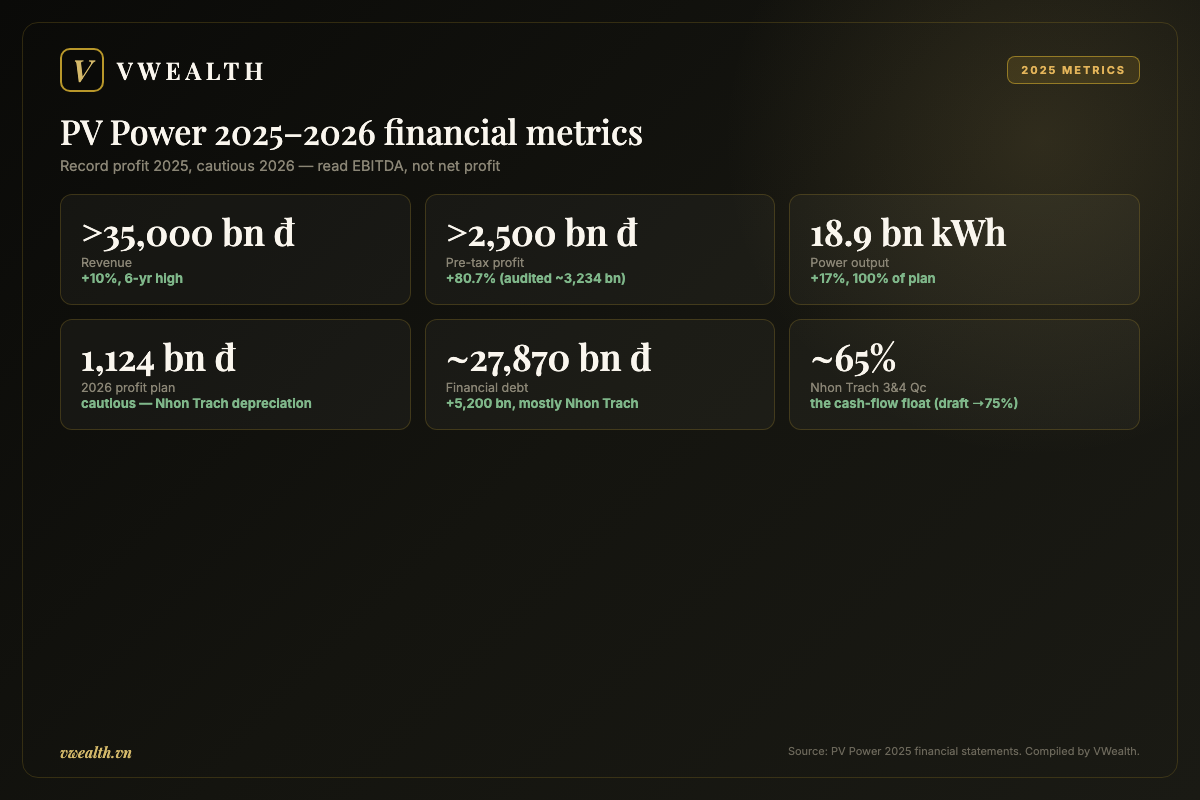
2025 was a special year for POW, and you should understand why before deciding to trust it. Full-year revenue is estimated to exceed 35,000 billion dong, up about 10% and a six-year high. But the shocking number is in profit: pre-tax profit is estimated to exceed 2,500 billion dong per the parent group’s estimate — up as much as 80.7% year on year, far exceeding plan and setting a record. Power output reached 18.9 billion kWh, up about 17% and completing 100% of the PVN-assigned plan. The audited number finalized after was even more impressive, with pre-tax profit approaching 3,234 billion dong.
A clear-headed analyst’s question isn’t “how much profit” but “where does this profit come from, and can it recur?”. When dissected, the 80% growth of 2025 came from three driver groups, and each has very different sustainability quality:
- Favorable hydrology (moderately sustainable). 2025 had much rain, the two hydropower plants Hua Na and Dakdrinh ran well with output up about 4%. Hydropower is POW’s margin gold mine: nearly no fuel cost, low variable cost, so each kWh of hydropower contributes a far higher profit rate than gas or coal power. A good-hydrology year is a year the whole company’s gross margin widens. But this is a variable of the heavens — decided by the El Niño/La Niña cycle, and you can’t rely on it recurring every year.
- Handling receivables, compensation, debts (one-off, non-recurring). A significant part of the profit jump came from resolving outstanding receivables and compensation. This is “one-off” profit quality — good for cash flow and the balance sheet, but you’re not allowed to extrapolate it into later years. When modeling POW, a careful analyst separates this from core profit.
- Stable operation, few incidents (sustainable). This is the highest-quality part. Plants running stably, few unplanned shutdowns, plus improved selling prices while fuel costs stayed stable — helped the gross margin widen substantially. This part reflects real operating capability and can be maintained.
Let me tell you straight: the record 2025 profit is the sum of a “favorable heaven” year (good hydrology) plus “favorable earth” (resolving outstanding debts), on a foundation of genuinely good operation. It’s a joyful record, but not a new profit level you should expect to recur steadily. POW’s leadership itself understands this — and that’s why the 2026 target looks like a “step back,” which we’ll explain right after.
The reverse 2026 paradox: record revenue but cautious profit target
This is where many new investors get confused. Into 2026, POW targets output of 21,615 million kWh, total revenue of 49,887 billion dong — a historic high, up about 41% versus 2025. Yet the planned after-tax profit is only 1,124 billion dong, much lower than the 2025 result. Revenue jumps but profit is set low — it sounds absurd, but for a power business that just brought a billion-dollar plant into operation, it’s normal, even textbook.
The reason is contained in two words: Nhon Trach 3 & 4. This LNG power cluster of about 1.4 billion USD total capital began commercial operation from early 2026. When a project shifts from “construction-in-progress cost” to “fixed asset,” two enormous costs immediately hit the income statement:
- Depreciation. A 1.4-billion-USD plant will book very large depreciation in the early years, “eating” straight into accounting profit though it’s not a real cash outflow.
- Interest. POW borrowed about 1.1 billion USD in foreign currency for the project — including about 200 million USD from SMBC, about 821.5 million USD from Citibank and ING, plus several thousand billion dong from Vietcombank. When the plant operates, all this interest stops being “capitalized” and starts being booked into financial costs.
Adding these two, a power plant’s first-year accounting profit is always compressed — this is a general industry law, not unique to POW. The 1,124-billion profit target should therefore be read as a deliberately cautious number, defensive for a pivotal year, not a sign of the business weakening.
Thin margin, high leverage: why look at EBITDA instead of net profit
This is the most important part if you truly want to correctly value a power business. POW’s margin is inherently thin — gross margin usually swings around single digits to about 13% in good quarters. Power is a standardized commodity, the selling price largely constrained by contracts and the power-market mechanism, so a power generator has no “pricing power” like a consumer brand. Profit comes from scale and operating efficiency, not from a high margin.
On that thin-margin foundation, POW also carries large financial leverage. Outstanding financial debt reached about 27,870 billion dong as of mid-2025, up over 5,200 billion versus year-start, mostly for Nhon Trach 3 & 4. The debt-to-equity ratio is forecast to rise from about 63% (2022) to around over 100% in the peak investment period. This is high leverage, but needs context: for an energy-infrastructure business in a large investment cycle, project finance is normal and acceptable — as long as operating cash flow is strong enough to repay debt.
And this is the core reason you should look at EBITDA and cash flow instead of net profit for a power business:
- Depreciation is an accounting cost, not cash spent. A power plant in its early years books very heavy depreciation, pulling net profit low — even possibly near zero — while actual cash collected from selling power is still abundant. EBITDA (earnings before interest, taxes and depreciation) adds back this “virtual” depreciation, showing you the real operating cash-flow picture.
- Depreciation declines over time, cash flow doesn’t. After the early phase, depreciation and interest decline as debt is repaid, net profit will “bloom” strongly while revenue only moves sideways. An asset-young power business is a cash-printing machine obscured by accounting depreciation.
- Debt-repayment ability is measured by cash flow, not net profit. Banks lending POW billions of dollars don’t look at net profit — they look at EBITDA and operating cash flow to be sure the plant can repay principal and interest.
The correct reading: for POW in 2026–2028, track EBITDA and operating cash flow as the main health indicators. Net profit will look “ugly” because of the Nhon Trach 3 & 4 depreciation burden, but if EBITDA grows well and cash flow is strongly positive, that’s a signal the new plant is running as expected. Accounting profit will improve over time as depreciation and interest recede.
Risk map: four zones to watch
A balanced analysis can’t tell only the pretty story. Here are four real risk groups you need to put into your scenario:
Fuel risk: gas and LNG prices
With nearly two-thirds of capacity being gas power, fuel cost is POW’s survival variable. Imported LNG prices swing strongly — at one point in early 2026 surging to about 19 USD/MMBTU, pushing Nhon Trach 3 & 4’s power-production cost at times near the price ceiling the Ministry of Industry and Trade sets. The consolation: the pass-through mechanism of input gas prices to power selling prices in the PPA helps POW pass most of the fuel risk to the buyer. POW also signed a 25-year long-term contract with PV Gas to stabilize supply. But pass-through only works when output is sufficiently dispatched — if the power price hits the ceiling, the plant may be dispatched less, and that’s when fuel risk turns into output risk.
Power-pricing mechanism and Qc for Nhon Trach risk
This is the most watchable policy risk. Per the current PPA with EPTC, Nhon Trach 3 & 4 is guaranteed a minimum contracted output (Qc) of about 65% for 10 years. The Qc ratio decides how much output is bought at a guaranteed price — the higher Qc, the more certain the cash flow. The positive news is that the draft amendment to Decree 56 proposes raising Qc for LNG power projects from 65% to 75% for 15 years, and POW has sent an official document requesting to apply this new mechanism to both Nhon Trach 3 & 4 and the Quynh Lap super-project. If approved, this is a big boost to the cash-flow certainty of the two new plants. But as long as the policy isn’t finalized, this remains a hanging variable.
EVN debt and cash-flow risk
Receivables from EVN (via EPTC) account for a large share of POW’s receivables. The actual capital-loss probability is low — EVN is a state partner — but delayed payment can squeeze operating cash flow and affect debt-repayment capacity, especially in the period POW just took on billion-dollar debt for Nhon Trach. This is a liquidity risk more than a capital-loss risk, but for a highly leveraged business, liquidity is not to be taken lightly.
FX and interest-rate risk
With about 1.1 billion USD of foreign-currency debt for Nhon Trach 3 & 4, POW bears direct FX risk. If USD/VND rises strongly, an FX loss arises and “erodes” accounting profit — even when the core business is still good. Similarly, a high-interest-rate environment makes the financial cost of this large debt heavier. This is another reason for you to look at EBITDA: the FX loss is a non-cash revaluation item, not reflecting the plant’s real operating health.
Financial-health summary
So is POW strong or weak? The honest answer is: POW is in a pivotal phase — both strong on operation and cash flow, and stretched on the balance sheet. The business has an irreplaceable industry-leading position, abundant operating cash flow, and a billion-dollar project that just reached the finish to open a new revenue-growth chapter. In exchange, you must accept a period of accounting profit compressed by depreciation and interest, leverage in the high zone, and a series of policy, FX and hydrology variables to watch. This isn’t a stock for those seeking fast breakout profit, but for those who understand a power plant’s value is paid gradually through cash flow over many years. With that financial foundation — solid on cash flow, cautious on profit, clear on prospects — it’s not hard to understand why the market receives POW stock the way we’ll analyze right after.
Market reception
If you open the board on any session and scan the highest-liquidity group on HOSE, you’ll almost certainly see POW there. Closing on 19 June 2026 at 13,900 dong, POW is one of the true “national” stocks of Vietnamese individual investors: a price below the historical par, a few-million-dong order buys thousands of shares, matched volume regularly over ten million units per session. This is the stock many market newcomers choose as their life’s “first ticker,” and also the one traders return to whenever a power-shortage or LNG story heats up in the news.
But that very familiarity makes many people value POW wrong. They see the low price and think “cheap,” or look at the P/E and think “expensive,” while both views miss the nature of a power business. In this section, you and I will sit down and dissect how the market actually “prices” POW: what logic it’s valued by, where the trading flow comes from, why the cash dividend is so meager, and how the state-divestment story hanging for years is affecting the mindset of holders.
POW’s P/E: the most misleading number
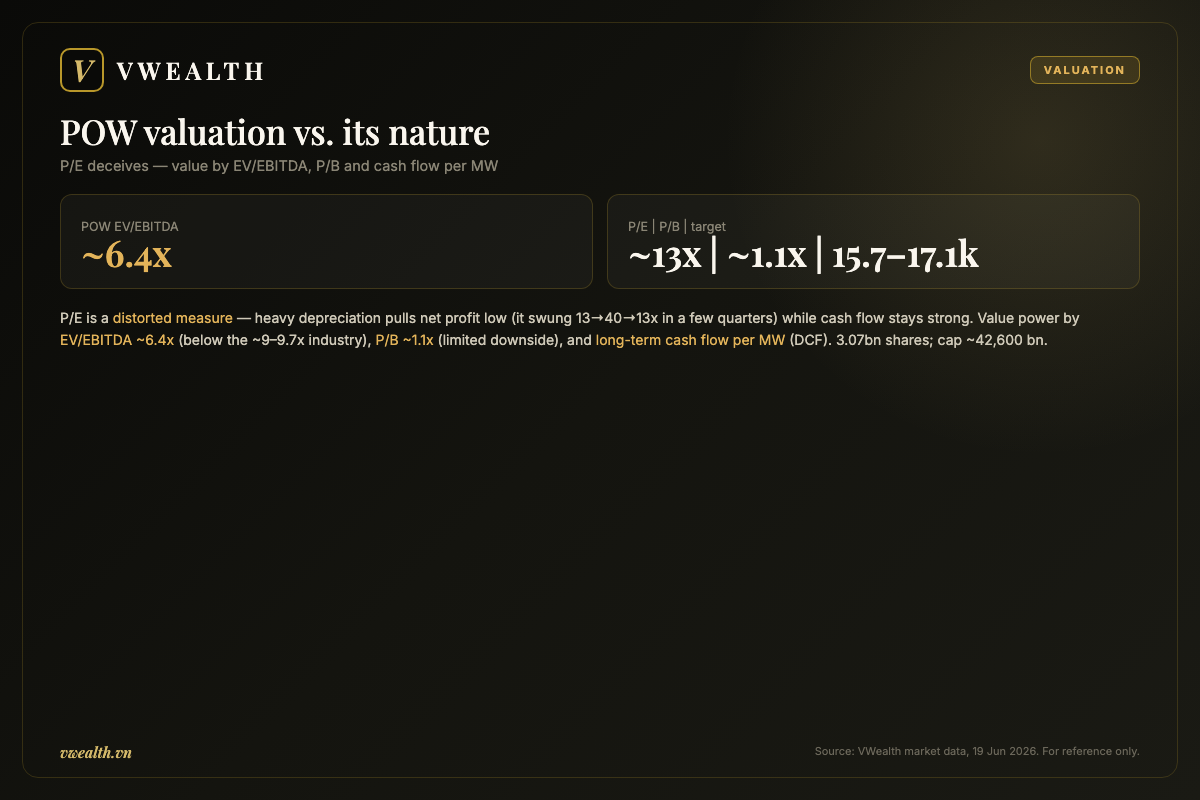
Let’s start with the biggest trap. At 13,900 dong and trailing-4-quarter EPS around 1,036 dong (per Simplize data on 19 June 2026), POW trades at a P/E of about 13–13.4x. This number at first glance is unremarkable, even lower than the VN-Index level. But if you step back a few quarters, you’ll see that at one point in mid-2025 POW’s P/E surged to over 40x, double the industry average. The same business, the same plants, yet the P/E dances from 13 to 40 then back to 13 within a few quarters. That says an important truth: for a power business, net profit is a very “noisy” number, and P/E is therefore a distorted measure.
Why distorted? The answer lies in depreciation. POW operates seven power plants with total capacity over 4,200 MW, and soon the Nhon Trach 3 & 4 cluster with another 1,624 MW. Each plant is an enormous asset block worth tens of thousands of billions of dong. That investment is gradually allocated to costs as depreciation each year, and this very depreciation “eats” a very large piece of accounting profit. A newly operating plant usually bears the heaviest depreciation in the early years, pulling net profit low, even though the real cash the plant generates is still abundant. In other words, depreciation is a book cost but not real cash flowing out of the business.
Remember this principle looking at power stocks: net profit measures what accounting records, while cash flow measures what the business truly earns. For POW, the gap between these two is very large, and that’s precisely why P/E doesn’t reflect value accurately.
This is also why many people’s initial valuation problem (dividing net profit then deriving a P/E of 25–28x) gives such a high number. When net profit is pulled low by depreciation, the denominator shrinks, and P/E inflates artificially. It doesn’t mean the stock is “expensive,” it just means you’re using the wrong measure.
The correct measure for a power business: EV/EBITDA and P/B
So if P/E isn’t reliable, what do professionals use to value POW? The answer is two measures tied to cash flow and assets: EV/EBITDA and P/B.
EBITDA is earnings before interest, taxes and depreciation. By adding back depreciation, EBITDA shows you the plants’ real “cash-generating power” without distortion from how costs are allocated on the books. EV (Enterprise Value) adds debt to the market cap — very important for a power business because they borrow heavily to build plants. The EV/EBITDA ratio therefore says: for the whole enterprise value (both equity and debt), how much are you paying for each dong of cash the plants generate.
As of 19 June 2026, POW trades at an EV/EBITDA of about 6.4x — notably below the power-industry average of about 9–9.7x. The same story, seen through the EV/EBITDA lens, shows POW isn’t “expensive” as P/E suggests, but rather cheaper than the industry level. This is a complete reversal from the P/E view, and shows why choosing the right measure matters so much.
The second measure is P/B — price to book. For a business where most value lies in tangible assets (plants, turbines, power lines), P/B is a way to directly compare the market price with net asset value. POW trades at a P/B of about 1.1x, meaning the market values the stock just slightly above the book value of the asset block. This around-1 P/B is an important psychological anchor: it implies limited deep-drop risk, because you’re buying the business near the real asset value it owns.
Besides these two, analysts also value power by capacity (MW) and long-term cash flow. Each MW of stable generation capacity is a cash-printing machine for 20–30 years, and POW’s value is essentially the sum of the present value of the cash flow that over 4,200 MW (soon nearly 5,900 MW) will generate over its lifetime. This is the DCF (discounted cash flow) valuation that reports by Shinhan, MBS or Vietstock all rely on, and the reason the target prices they set (15,700–17,100 dong) are higher than the current price.
To help you picture the whole valuation picture, I summarize POW’s main metrics in the chart below.
Charter capital, share count and a note to verify
There’s a detail you need to get right, because even many long-term POW holders get it wrong. POW once had charter capital of 23,418 billion dong corresponding to about 2.34 billion shares. However, the business completed additional issuance (a 4% stock dividend and a 15% bonus from the development-investment fund, totaling over 444.9 million shares), raising shares outstanding to about 3.07 billion units and charter capital over 27,800 billion dong.
This 3.07-billion-share figure (not 3.9 billion as some old estimates) is the correct denominator to calculate EPS. At that level, POW’s market cap at 13,900 dong is about 42,600 billion dong, and trailing-4-quarter EPS is around 1,036 dong. The share count rising through additional issuance is also an EPS-diluting factor you need to note: when the denominator swells, earnings per share are thinned even if total profit is unchanged.
Price behavior: a stock of story waves
Now let’s talk about the part traders care about most: what rhythm does POW’s price follow? The short answer is POW moves by story more than by quarterly profit. This is a very distinctive trait of a low-price, high-liquidity stock favored by individual investors.
There are three repeated “stories” creating waves for POW:
- Power shortage and rising power demand. Each dry season, each record heatwave, each time the press mentions shortage risk in the North, money pours into the power group and POW is usually the first “named” thanks to its large liquidity. Vietnam’s power demand growing double-digit for many years is the foundation for this long-term story.
- Gas prices and hydrology. POW is a business with gas and coal thermal as the mainstay, so its margin is sensitive to input gas prices. At the same time, when hydrology is favorable (much rain, hydropower generating strongly and cheaply on the competitive power market), thermal power like POW is dispatched less, and vice versa. Every weather swing, El Niño or La Niña, can become a pretext for a wave.
- Nhon Trach 3 & 4 progress. This is the hottest story of the past two years. Every progress milestone of Vietnam’s first LNG power super-project (investment over 32,400 billion dong, capacity 1,624 MW) creates a price reaction. When this cluster officially reached commercial operation in December 2025, the stock once had a ceiling-hitting wave session.
You need to understand that these very traits — low price, high liquidity, tied to easy-to-understand macro stories — make POW an ideal “playground” for wave-trading individual investors. It’s volatile enough for short-term opportunities, and “safe-feeling” enough as an industry-leading Petrovietnam business. But the downside is POW’s price can move sideways and quiet for a long time between waves, testing the patience of those who buy right at the peak of expectation then must wait for the next story.
Dividends: don’t expect POW to be a “dividend-eating” stock
If you come to POW to enjoy steady cash dividends like a savings deposit, you’ve probably chosen the wrong ticker. POW isn’t a dividend stock, and there’s an entirely valid reason.
POW is in a very capital-intensive expansion-investment phase. Nhon Trach 3 & 4 devoured over 32,400 billion dong, and the business has many LNG and offshore-wind projects in its long-term sights. In that context, leadership prioritizes retaining profit to reinvest rather than distributing cash to shareholders. POW’s recent “dividend distributions” are mainly in stock and bonus shares from the development-investment fund — that is, you get more shares rather than money into your account, and this is essentially recapitalizing retained profit rather than real cash flow.
This capital-allocation approach isn’t wrong, even reasonable for a business growing capacity. But it clearly shapes the suitable investor portrait: POW is for those betting on value growth through capacity expansion, not for those seeking steady dividend income. If your appetite is high cash dividends, hydropower businesses that have finished depreciating their plants or power businesses past their investment cycle would be far more suitable.
Foreigners and the hanging state-divestment story
The final part, and one of the most important factors governing the mindset of long-term POW holders, is the ownership structure. The Vietnam Oil and Gas Group (Petrovietnam, PVN) still holds a very large controlling ratio — around 80% of charter capital. This means the shares truly floating on the market (free float) are only about 800 million units, that is about a quarter of total shares.
This low free float has two sides. On one hand, it makes POW’s price prone to strong swings when individual money pours in or out, because the “real” stock on the exchange isn’t too much versus liquidity. On the other hand, it creates a long-term expectation story POW investors have discussed for years: state divestment. Per the equitization plan, PVN plans to reduce its stake below the controlling level. If that happens, a large amount of stock will be brought to market, room for strategic investors and foreigners expands, and this is usually a strong price catalyst.
The problem is this divestment “east wind” has been awaited for years but still hasn’t appeared. A full six years since POW debuted, the divestment process is still stalled, snagged on issues related to Vung Ang 1 plant debt restructuring and many other procedures. For foreigners, POW is both attractive (power-industry leader, reasonably valued by cash flow) and limited by the thin free float. Treat the divestment story as a “free option” attached to the stock: good if it happens, but don’t build the entire investment thesis on it alone, because the timing is entirely uncertain.
Bottom line: what is the market pricing?
Wrapping it all up, you should understand how the market receives POW this way. This isn’t a stock to value by P/E — that number is distorted because large depreciation pulls net profit low though cash flow is still strong. This is a stock to view through EV/EBITDA (currently cheaper than the industry), P/B around 1 (limited deep-drop risk), and most importantly the long-term cash flow from generation capacity. The 13,900-dong price reflects a balance between still-modest current profit and future expectations: Nhon Trach 3 & 4 contributing profit from 2026, national power demand rising durably, and the LNG story placing POW at the center of the energy transition.
Bluntly, buying POW is a bet on rising power demand and the Nhon Trach LNG plants, valued by cash flow rather than P/E. You don’t buy it to eat dividends, don’t buy it because it’s “cheap” by price, but buy it believing each MW of capacity will generate stable cash flow for many decades ahead, and that the power-shortage story of an accelerating economy will keep being told. To understand why that story has a solid basis — why LNG power is the future and why POW’s industry-leading position is worth it — you need to look at the whole power-industry picture, which is what we’ll dissect in the Industry context section right after.
Economic and power-industry context: why the POW story is tied tightly to Vietnam’s “power thirst”
Before you decide to put money into any power stock, there’s a foundational truth to grasp: a power business doesn’t live on its own product, but on the whole economy’s power demand and on the pricing mechanism the state decides. POW (PetroVietnam Power Corporation — PV Power) is a classic example. You don’t buy POW for an attractive consumer product, you buy it believing Vietnam will be short of power for many years, and that a large power producer with gas and LNG will be the one named to fill that gap. This section dissects that context frankly — both the opportunity and the variables that could break the thesis.
Vietnam’s power demand: a hard-to-reverse upward slope
Let’s start with the number underlying the whole story. Vietnam targets GDP growth above 8% in 2025 and aims for double-digit growth in 2026–2030. To support such a fast-running economy, electricity must grow about 1.5 times GDP. In practice, the revised Power Plan VIII projects power demand rising an average 10.3%–12.5%/year in the coming period — much higher than the 8–10% the market usually cited in prior years. In 2025 alone, the Prime Minister cited a power-demand figure possibly rising up to 12–13%, and total system-wide power produced and imported is expected to reach about 347.5 billion kWh, 12.5% higher than 2024.
What you need to understand is that this pace isn’t a temporary phenomenon. It’s driven by three pulling forces at once, and all three are strengthening rather than weakening:
- Industrial production and FDI: Vietnam continues to be a supply-chain-relocation destination. Each new plant, each expanded industrial park is another baseload power block running nearly 24/7. This is the largest and most stable “power-hungry” part.
- Data centers and AI: This is a newly emerging but very fast-rising pulling force. Vietnam’s data-center market size is estimated at about 630 million USD in 2025 and forecast to exceed 1.1 billion USD by decade’s end. AI-serving data centers have abnormally high power-consumption density, running continuously, tolerating no interruption. There have been warnings that “power could be a bottleneck for Vietnam’s AI-development ambition” — meaning this demand is real and large enough for policymakers to worry.
- Transport electrification (EVs): The spread of electric motorbikes and EVs shifts part of energy from fuel to the grid. Each vehicle is small, but combining millions of vehicles and charging infrastructure is a new demand layer pressing on the system at precisely the already-tense time slots.
Adding these three forces, the picture emerges fairly clear: power demand rises on a slope, while new supply is always slower because building a power plant takes many years. The North is especially tense at the late-dry-season peak, when hydropower is drained and peak load surges. That supply-demand gap is precisely fertile ground for power producers with dispatchable capacity — and POW is in that group.
Remember a simple principle: in a shortage market, the one holding goods has the advantage. For power, the “goods” are stable, dispatchable generation capacity. POW is adding exactly the kind of goods the system most lacks — a flexible baseload source, not weather-dependent like solar and wind.
The revised Power Plan VIII: the map shaping who wins, who loses
If demand is the engine, then the revised Power Plan VIII (Decision 768/QD-TTg of 15 April 2025) is the map showing which power sources are prioritized for capital in the coming decade. This is a document you should read carefully if you want to understand why POW bet big on LNG power.
The revised plan has a few key directions directly affecting POW:
- Strongly pushing LNG power. By 2030, the plan projects 15 more LNG power plants with total capacity about 25,624 MW, about 14% of the country’s total source capacity, consuming about 17 million tons of LNG/year. The 2031–2035 period adds about 10,700 MW more. In other words, LNG is chosen as one of the baseload pillars of the coming decade. POW, with Nhon Trach 3 and 4 as two large-scale LNG power plants just operating, stands right in this policy current.
- Maximum priority for domestic gas. The plan clearly states prioritizing maximum use of domestically extracted gas for power, importing LNG only to supplement when domestic sources decline. This is both an opportunity and a constraint: POW has the gas-ecosystem advantage of the Vietnam Oil and Gas Group (Petrovietnam — PVN), but the imported-LNG part still bears international-price risk.
- Gradually reducing coal power, increasing renewables. Coal power is no longer expanded, while wind and solar are strongly pushed but inherently precarious by weather. The “flexible baseload” gap between shrinking coal and unstable renewables is precisely the place for gas/LNG power to squeeze in. POW positions itself right in this niche.
So if you believe in the reality of the revised Power Plan VIII, then POW is one of few listed businesses directly benefiting from that gas/LNG direction. This is the core anchor of the long-term growth thesis.
The variables that could break the thesis — you must look at them squarely
An honest analyst mustn’t tell only the pretty story. Vietnam’s power industry, especially the gas-power segment, carries a series of variables you need to weigh before believing any future profit number.
| Variable | Why it matters to POW | Impact direction |
|---|---|---|
| Imported gas/LNG prices | LNG fuel cost accounts for up to 75–80% of Nhon Trach 3&4’s operating cost. World LNG prices swing strongly by geopolitics and Europe/Asia’s winter. | Expensive LNG → thinner margin, if it can’t be passed into the selling price |
| Power-pricing mechanism & Qc contract | Contracted output (Qc) is offtaken at a stable price; output beyond Qc must be sold on the volatile competitive power market. Nhon Trach 3&4’s minimum Qc is set no lower than 65% of the multi-year average output. | High Qc + good price → certain cash flow; low Qc → large volatility risk |
| EVN debt | EVN is the main power buyer. When EVN has financial trouble, payment to plants can be delayed, affecting POW’s cash cycle. | Prolonged debt → cash-flow pressure, financial cost |
| Hydrology (El Niño/La Niña) | POW also owns hydropower (Hua Na, Dakdrinh). Wet years, hydropower profits big thanks to near-zero cost; dry years, this segment falls short. | Good hydrology → offsets thermal; drought → lower consolidated profit |
| Non-market power-pricing policy | Retail power prices are still state-regulated, not fully reflecting input costs. This limits the ability to pass rising LNG costs into prices. | The biggest policy risk — squeezes margin when input rises |
The biggest risk in the group above, in my view, is the non-market power-pricing policy. When input LNG prices jump but power selling prices aren’t adjusted correspondingly in time, a gas plant can fall into the situation of “the more it generates, the deeper the loss” or be forced to reduce dispatch. This is a structural bottleneck of the whole industry, not unique to POW, and it’s why gas-power stocks are usually valued cautiously despite the very attractive power-shortage story. You need to weigh the weight of this variable accurately.
Trend prediction: three scenarios for POW and how to read them
Prediction isn’t fortune-telling. It’s building scenarios with clear conditions, then tying each scenario to a consequence for cash flow, profit and — indirectly — the share price. For POW right now, every prediction revolves around one axis: how Nhon Trach 3 and 4 will operate in the first few years. Let’s go through the driver, then the three scenarios.
The main driver: the revenue jump from Nhon Trach 3&4
First, let’s reset the data milestones so you’re not swept along by emotion. In 2025, POW reached output of nearly 18.9 billion kWh (completing 100% of the PVN-assigned plan, up about 17% versus 2024); corporation-wide pre-tax profit is estimated at over 2,500 billion dong, up over 80% year on year; total corporation-wide revenue exceeded 35,000 billion dong. Nhon Trach 3 has operated commercially since 21/11/2025, and the Nhon Trach 3&4 cluster (total capacity 1,624 MW, investment 1.4 billion USD) was inaugurated on 14/12/2025.
This is the pivotal point. This project cluster raises POW’s total capacity by about 30–36%, and when fully operating in 2026, it’s expected to contribute up to about 44% of total revenue. If the two plants run at full capacity and POW signs contracted output (Qc) at a good level with a selling price near the high threshold in the LNG-power price band the Ministry of Industry and Trade announced, corporation-wide 2026 revenue could entirely jump to around 50,000 billion dong — a scale jump few listed power businesses create in one year.
But — and this is the most important “but” of the whole article — surging revenue scale doesn’t mean net profit rising in step immediately. In the early years, Nhon Trach 3&4 bears large depreciation and heavy interest (the 1.4-billion-USD project is mainly debt-funded, partly in foreign currency). Precisely because of this burden, some forecasts even see first-year operating net profit falling versus before, and the project only truly beginning to contribute positive profit from about 2027 onward. Large revenue, thin accounting profit in the early phase — you must separate these two concepts to avoid disappointment reading quarterly reports.
Further out, POW also has a long-term driver layer: the next chain of LNG projects and the ambition to enter wind power, in line with the revised Power Plan VIII direction. This is the “growth option” part — not yet certainly quantifiable, but it explains why many investors are willing to pay a high valuation for POW based on multi-year prospects.
Three scenarios: conditions and consequences
I build the three scenarios below not for you to choose “which to believe,” but for you to watch the conditions in reality then position yourself which way it’s sliding.
| Scenario | Conditions to converge | Profit & price consequence |
|---|---|---|
| Positive | Nhon Trach 3&4 runs at full load, stably, few incidents; signs high Qc with a selling price near the LNG-band top; the power-pricing mechanism is adjusted favorably allowing LNG cost pass-through; good hydrology helps hydropower profit big; imported LNG prices at a comfortable level. | 2026 revenue heads toward the ~50,000-billion zone; profit exceeds expectations earlier than the 2027 mark; the market re-rates on the growth story → the price has room to break out clearly above the ~13,900đ zone. |
| Base | The two plants operate relatively stably but not yet optimized; Qc at a reasonable level; LNG prices and the pricing mechanism in a “livable” state; normal hydrology. This is the most likely scenario. | Revenue rises strongly thanks to Nhon Trach 3&4 but net profit is thinned by depreciation and interest in 2026; profit brightens gradually from 2027. The price moves sideways to slightly up, swinging by quarter. |
| Negative | Imported LNG prices climb high for long; low Qc assigned makes most output sold on the volatile competitive market; the power-pricing mechanism doesn’t allow cost pass-through; depreciation and interest (plus USD FX risk) weigh heavily; add a dry-hydrology year. | Net profit falls deeply, even the gas-power segment loses in the early phase; cash flow stretched by EVN debt. The market disappointed with “big revenue, thin profit” → the price faces downward pressure. |
How to use this table correctly: don’t try to guess which scenario “will” happen. Instead, pick a few indicators to watch each quarter — the Qc level assigned to Nhon Trach 3&4, the average imported LNG price, the gas-power segment’s gross margin, and EVN-debt recovery progress. When these indicators tilt one way, you know which scenario the story is sliding toward, and adjust your expectations accordingly rather than being surprised.
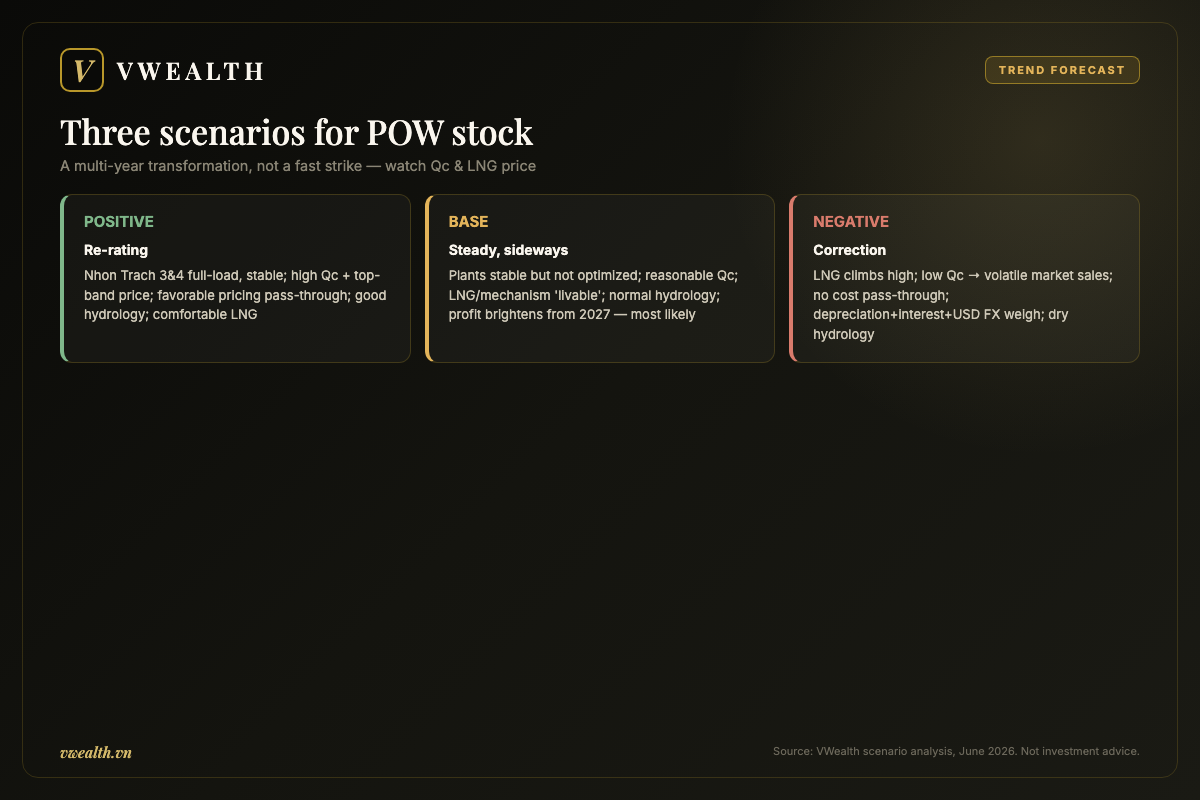
The key takeaway from the three scenarios: POW is a multi-year transformation story, not a fast strike. The big reward lies in the positive scenario extending through 2027–2028, while the price paid is accepting a 2026 phase where accounting profit may look unattractive though the cash-flow strength is still healthy. Understanding the out-of-sync between “revenue — cash flow — net profit” is the key to not dumping right at the bottom or chasing right at the top.
Should you buy POW stock?
We reach the most important part, and the part I want you to read slowest. I won’t tell you “buy” or “sell right away” — no one honest does that with someone else’s money. My job is to put both sides on the scale evenly, then give you a frame to see which investor type you are. The final decision is yours, based on your own risk appetite and vision.
Weighing the PROS — why POW has real appeal
- Vietnam’s #2 power producer, benefiting directly from the “power thirst.” When power demand rises 10–12%/year and the North is tense at peak, a large power producer with dispatchable capacity is a precious system asset. POW stands right in that supply position.
- The revised Power Plan VIII prioritizes gas/LNG. The policy direction choosing LNG as a baseload pillar for the coming decade places POW in a favorable current, while coal power is tightened and renewables are still precarious.
- Nhon Trach 3&4 raises capacity about 30% and is operating. This scale jump is real, not a plan on paper — the two plants have generated commercially and were inaugurated in late 2025, opening large revenue room for 2026 onward.
- Diverse portfolio. POW doesn’t put eggs in one basket: gas, hydropower, and other thermal assets. Good-hydrology years, hydropower offsets gas and vice versa — this natural defensiveness eases volatility.
- Good EBITDA cash flow. This is the subtle point: though net profit is thinned by depreciation and interest in the early phase, POW’s operating cash flow (EBITDA) is still healthy. For an asset-heavy business like power, cash flow and the EV/EBITDA multiple reflect real health better than the accounting profit number.
- Backing from PVN. As a Vietnam Oil and Gas Group member, POW has the advantage of access to gas sources, operating experience and a position in national key projects.
- Low, accessible price. The ~13,900đ/share level makes POW easy to buy for small investors and creates a “cheap” feel in absolute price.
Weighing the CONS — what could disappoint you
- Thin margin, net profit weighed by depreciation and interest. This is the number-one drawback in the next few years. Revenue may swell spectacularly while net profit stays weak because Nhon Trach 3&4 still bears heavy depreciation and interest until about 2027. If you look only at quarterly EPS, you’ll easily get discouraged.
- High P/E valuation. Precisely because net profit is compressed, POW’s profit-based multiples (like P/E) look high and unattractive. A stock “cheap by price” doesn’t mean “cheap by valuation.”
- Dependence on the power-pricing mechanism and imported LNG prices. Two factors beyond this business’s control. LNG accounts for 75–80% of Nhon Trach 3&4’s cost; when LNG is expensive but power prices aren’t adjusted in time, the margin is choked.
- EVN debt. Slow-arriving power-sale money stretches cash flow and generates financial cost.
- Leverage and USD FX risk. The large foreign-currency loan for the 1.4-billion-USD project makes profit sensitive to FX swings — a stronger USD can create an FX loss on the report.
- Low dividends. POW went many years paying no or very low dividends, concentrating on investment. If you need a steady dividend cash flow, this stock doesn’t serve that need.
Which investor type are you? A four-group frame to self-check
The same stock, but suitable for one person and wrong for another. Honestly pick which group you’re closest to:
- Long-term growth investor believing the power-shortage & LNG story. If you believe Vietnam will be short of power for years, believe the revised Power Plan VIII will be realized, and you’re willing to hold through the volatile 2026 phase to wait for Nhon Trach 3&4 to “bear fruit” from 2027 — POW is fairly suitable for you. You need to read this business through the cash-flow and EV/EBITDA lens, accepting that accounting profit will be choppy.
- Value investor who looks at cash flow, not EPS. If you’re used to valuing asset-heavy businesses by cash flow and enterprise multiples (EV/EBITDA) rather than P/E, you’ll find POW much easier to understand and less “fooled” by thin accounting profit. This group may see value that those looking only at P/E miss.
- Investor seeking dividends and short-term safety. If your goal is a steady dividend cash flow and peace of mind in the next 6–12 months, POW is less suitable. Low dividends, volatile net profit, valuation depending on the future story — that’s not a safe short-term haven.
- News-driven trader. POW can create trading rhythm around news on Qc, LNG prices, quarterly results, but the story’s nature is long-term. If you trade waves, be aware that 2026 quarters may show weak profit due to depreciation — accounting bad news can come even when the underlying strength is fine.
Gathered into one line for easy memory: POW suits those who believe the long-term power-shortage and LNG story, know how to read cash flow and EV/EBITDA, and accept volatile accounting profit in the early Nhon Trach 3&4 operating phase. It’s less suited to those seeking steady dividends or short-term safety. Which group you fall into, your “should you buy” answer is already half-revealed.
Final words
POW is a stock of well-grounded faith: the ground lies in irreversibly rising power demand, in a policy direction prioritizing gas/LNG, and in a capacity jump already realized. But coming with that faith is the price of patience — you must bear a phase of unglamorous accounting profit while cash flow quietly strengthens, and live with variables beyond control like LNG prices and the power-pricing mechanism. Weigh both sides evenly, hold yourself up against the four-group frame above, and let the decision come from your own risk appetite, not from the market’s noise.
Disclaimer: This article is produced for informational and reference-analysis purposes, and is not a recommendation to buy, sell or hold any stock, including POW. All figures are cited from public sources at the time of writing and may change. The stock market always carries risk; share prices can rise or fall. You should research carefully, weigh your personal financial situation and consult a licensed investment advisor before making any decision. vwealth.vn and the author are not responsible for any gain/loss arising from the use of information in this article.
Research Vietnamese stocks in English with vwealth. Our AI-powered platform turns Vietnamese market data into full English analysis reports — with international payment support and a free 2-month trial for new accounts. Create your free account and read the latest reports.