Buy a Vietnamese stock and you are really making two investments at once: one in the company, and one in the Vietnamese dong. Your final return in US dollars is the product of both, which means a great stock pick can be quietly trimmed by the exchange rate — and occasionally, a mediocre one can be flattered by it. This guide explains how Vietnam’s managed-float currency regime works in plain words, what the dong’s long-run behavior against the dollar has historically looked like, how currency moves add to or subtract from your equity returns (with clearly labeled hypothetical examples), why hedging is impractical for most retail investors, and how to think about a Vietnamese dong investment in honest, total-return terms.
Two Numbers Decide Your Return, Not One
Most new international investors focus entirely on the stock. Did it go up 15 percent or down 10? That is the natural question, but for a US-dollar-based investor it is only half of the answer. The other half is what happened to the currency the stock is priced in.
Here is the mechanic. When you invest in Vietnam directly, your dollars are converted into Vietnamese dong (VND) on the way in. Your shares live, trade, and pay dividends in dong. When you eventually sell and bring money home, the dong are converted back into dollars. If the dong weakened against the dollar during your holding period, each dong buys fewer dollars on the way out than it cost on the way in — and that difference comes straight out of your return. If the dong strengthened, the conversion adds to your return instead.
The clean way to express this is a simple multiplication. Your total USD return equals (1 + the stock’s return in dong) multiplied by (1 + the currency’s return against the dollar), minus 1. Note that it is a multiplication, not an addition. The two effects compound each other rather than simply stacking.
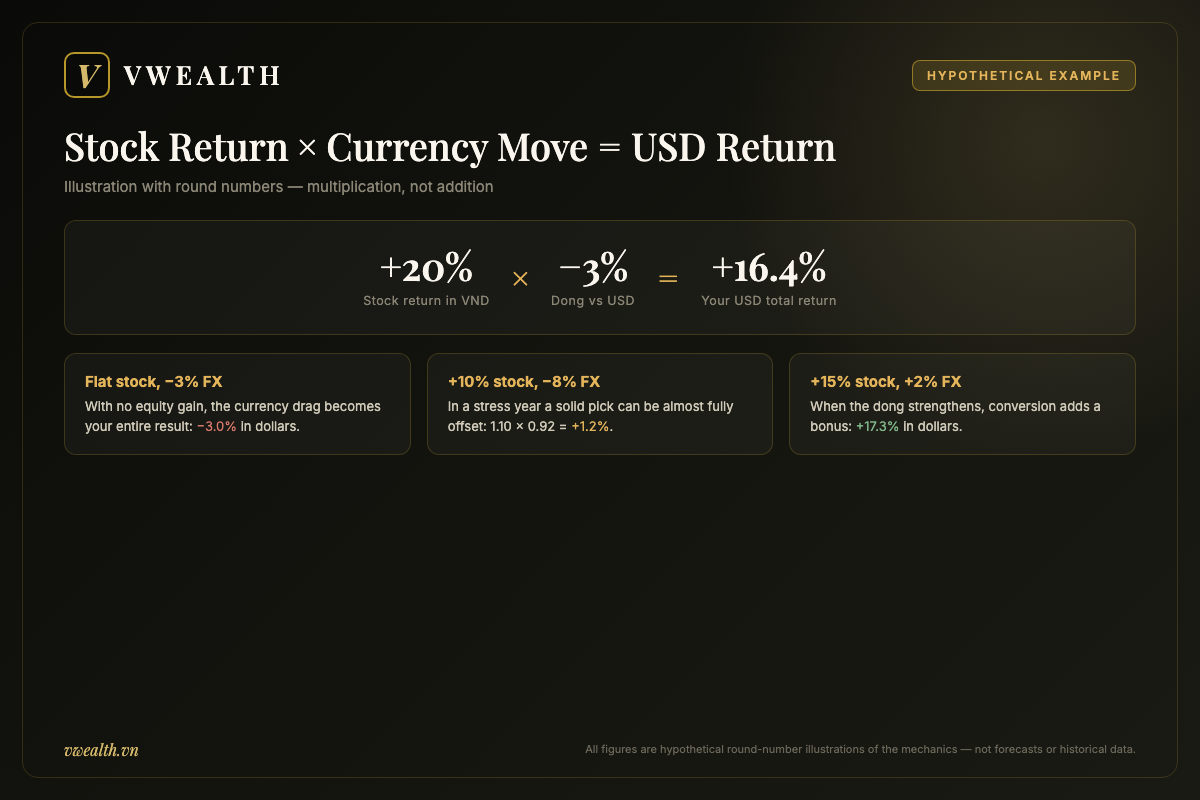
Hypothetical example with round numbers, for illustration only: suppose you invest 10,000 US dollars, your stock rises 20 percent in dong terms, and the dong weakens 3 percent against the dollar over the same period. Your USD return is not 20 minus 3 equals 17 percent. It is 1.20 × 0.97 − 1 = 16.4 percent. The difference between 17.0 and 16.4 is small here, but it grows with bigger moves and longer horizons, and it always works through multiplication. On 10,000 dollars, you end with about 11,640 dollars rather than the 12,000 the stock chart alone would suggest.
This is not a reason to avoid Vietnam. It is a reason to measure your results correctly. Every serious cross-border investor — pension funds, sovereign funds, global equity managers — thinks in exactly these terms. If you are still deciding how to get exposure in the first place, our pillar guide on how to invest in Vietnam’s stock market as a foreigner walks through the two main routes, and this article assumes you understand that basic setup.
What a “Managed Float” Actually Means in Plain Words
Currencies around the world sit on a spectrum. At one end are free-floating currencies like the US dollar, euro, or Japanese yen: their exchange rates are set minute by minute by the open market, and central banks rarely intervene directly. At the other end are hard pegs, where a currency is fixed to another at a set rate. The Vietnamese dong sits in between, in a regime economists call a managed float — sometimes described as a “crawling band.”
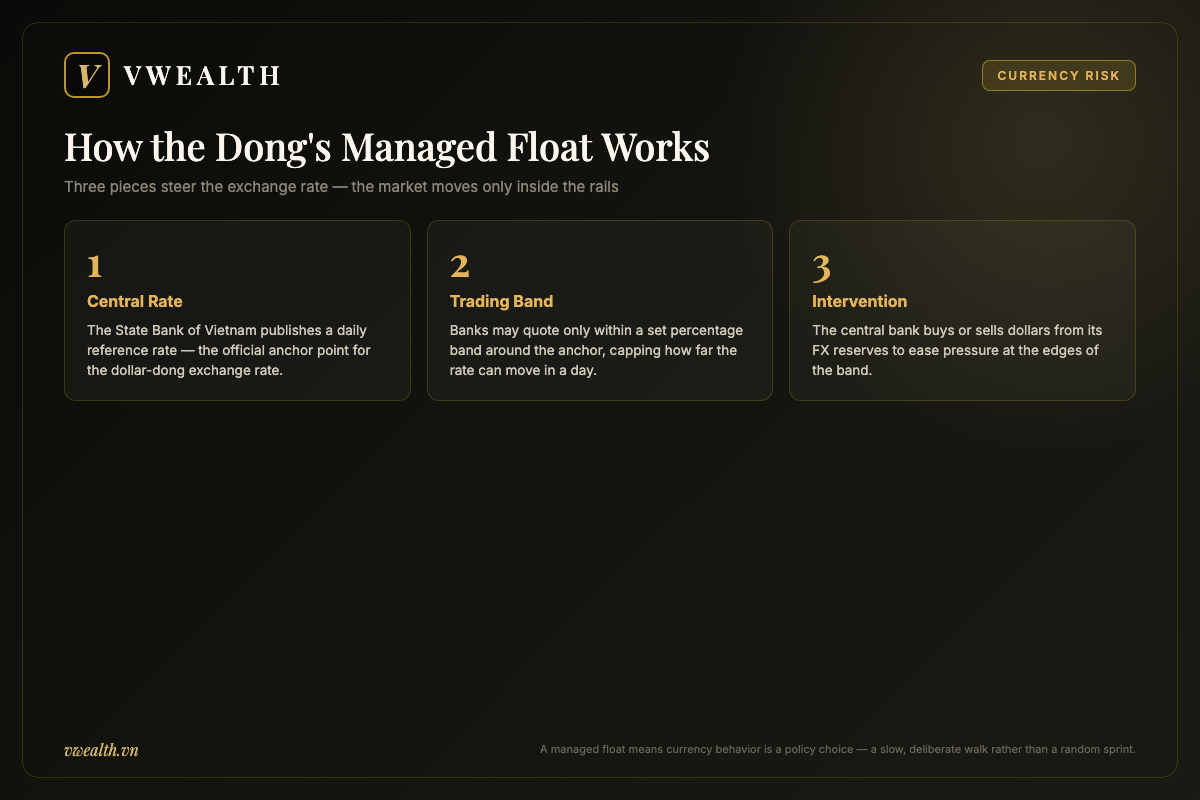
Three pieces make the system work. Understanding them tells you most of what you need to know about how the dong behaves.
The central rate
Each trading day, the State Bank of Vietnam (SBV) — Vietnam’s central bank — publishes a central reference rate for the dong against the US dollar. Think of it as an official anchor point. This daily-reference-rate system has been in place since January 2016, when Vietnam moved away from its older, more rigid peg to a more flexible “central rate” mechanism. The SBV calculates the anchor with reference to recent interbank trading in the dong, movements in a basket of major currencies of Vietnam’s leading trading partners (reported to be a basket of eight currencies), and its own macroeconomic and policy goals. Because the central bank sets the anchor each morning, the dong does not gap around on headlines the way a free-floating currency can.
The trading band
Commercial banks in Vietnam are allowed to quote the dollar-dong exchange rate only within a defined percentage band around that central rate. As of mid-2026 that band is plus or minus 5 percent — the SBV widened it from plus or minus 3 percent in October 2022, when a globally strong dollar was pressing on the currency, and it has stayed at 5 percent since (always confirm the prevailing band, since the SBV can adjust it). In practice this means each morning’s central rate implies a published daily ceiling and floor: for example, a central rate near 25,000 dong implies a ceiling around 26,250 and a floor around 23,750. Inside that band, supply and demand operate normally: if importers need more dollars than exporters are supplying, the market rate drifts toward the weak edge. But the band puts a hard boundary on how far the market rate can move in a single day relative to the anchor. Sharp single-day swings of the kind emerging-market investors fear are structurally constrained.
Intervention and reserves
The third piece is the central bank’s willingness to trade. When the dong presses against the weak edge of its band, the SBV can sell US dollars from its foreign-exchange reserves and buy dong, easing the pressure. When the dong is unusually strong, it can do the opposite and accumulate reserves. Foreign-exchange reserves — the stockpile of dollars and other hard currencies a central bank holds — are the ammunition that makes a managed float credible. A central bank with deep reserves can defend its preferred range; one with thin reserves eventually cannot.
Put together, the managed float means the dong’s path tends to look like a slow, deliberate walk rather than a random sprint. The central bank steers, the band constrains, and reserves back the whole arrangement. Currency behavior is, in effect, a policy choice — which is very different from what a US investor experiences with, say, the euro.
One more consequence matters for stock investors. Currency convertibility — how freely foreigners can change money in and out — is one of the criteria index providers examine when they classify markets. It is part of the story covered in our guide to Vietnam’s road from frontier to emerging-market status, and it is a reason the currency regime gets attention far beyond the FX desk.
The Dong’s Long-Run Character: Gentle, Managed Depreciation
So how has the dong actually behaved? Speaking qualitatively — and any investor should pull up a long-term chart rather than take anyone’s word for it — the dong’s long-run tendency against the US dollar has historically been a gentle, managed depreciation. Not a collapse, not a peg, but a slow downward drift punctuated by occasional larger official adjustments, especially in earlier decades when the regime was more rigid.
The recent record fits that pattern. Through 2023, 2024 and 2025 the dong slid to successive record lows against a strong dollar, trading much of the time near the weak edge of its band; by 2025 it had reached roughly 26,000 to 26,400 per dollar — a fourth consecutive year of depreciation, with a full-year slide widely reported in the low-single-digit-percent range. Into 2026 it was hovering broadly around the mid-26,000s per dollar, and major bank forecasters generally pencilled in another few percent of managed depreciation for the year (as of mid-2026; exact rates move daily, so treat these as approximate reference levels and check a live quote). Vietnamese banking officials have at times signalled comfort with an annual depreciation in the region of 3 to 5 percent — a useful sense of the policy’s tolerance, not a promise. The direction of travel, in short, has been consistently and deliberately downward, but at a walk, not a run.
Why would a country deliberately let its currency weaken slowly? Because Vietnam is an export-driven economy. A gradually cheaper dong keeps Vietnamese factories competitive against regional rivals, supports the manufacturing jobs at the heart of the growth model, and avoids the boom-bust cycles that sharp currency swings can trigger. A violently strong dong would hurt exporters; a violently weak one would import inflation and spook investors. The managed crawl is the policy compromise, and it has been remarkably consistent as a stance.
Three qualitative features of this history are worth internalizing:
- The drift has been slow by emerging-market standards. Investors who lived through free-falling currencies elsewhere in the emerging world have generally not had that experience with the dong in recent decades. The managed float exists precisely to prevent it.
- The moves are asymmetric. The dong has historically been far more likely to weaken modestly against the dollar than to strengthen meaningfully. Planning for a small annual currency headwind, rather than hoping for a tailwind, is the conservative baseline most professionals use.
- Pressure arrives in episodes. Long stretches of near-stability are interrupted by phases of pressure — typically when the US dollar is globally strong or US interest rates are far above Vietnamese rates — during which the dong slides toward the weaker edge of its band and the central bank leans against the move. Between episodes, very little happens.
Two warnings belong next to that history. First, past behavior is a description, not a promise: a managed float is a policy, and policies can change with circumstances. Second, “gentle on average” does not mean “gentle every year.” Individual years can deviate meaningfully from the long-run trend, which matters a great deal if your holding period is short. Currency risk shrinks in relative importance as your horizon stretches; over one year it can dominate your result, while over ten years the compounding of the underlying businesses usually matters far more.
The Math of Currency Drag: Worked Examples You Can Redo Yourself
Let’s make the arithmetic concrete. Everything in this section is a hypothetical illustration using deliberately round numbers — these are not forecasts, and they are not historical exchange-rate figures. The point is the mechanics, which you can then apply to whatever real numbers you observe.
The base formula, one more time
Total USD return = (1 + stock return in VND) × (1 + VND return vs USD) − 1.
A quick note on signs: “VND return vs USD” is negative when the dong weakens (your dong buy fewer dollars) and positive when it strengthens. A 3 percent depreciation enters the formula as −0.03.
Scenario table
Hypothetical scenarios, round numbers, for illustration only:
| Scenario | Stock return in VND | Currency move | USD total return | What it shows |
|---|---|---|---|---|
| Good stock, mild drag | +20% | −3% | +16.4% | The typical case: currency trims, doesn’t destroy |
| Flat stock, mild drag | 0% | −3% | −3.0% | With no equity gain, the drag is your whole result |
| Good stock, bad currency year | +10% | −8% | +1.2% | A strong pick can be almost fully offset in a stress year |
| Falling stock, mild drag | −10% | −3% | −12.7% | Losses compound with the drag, slightly worse than the sum |
| Good stock, currency tailwind | +15% | +2% | +17.3% | Appreciation, when it happens, adds a bonus |
Work through one row by hand to make it stick. Take the third row: 1.10 × 0.92 = 1.012, so your 10 percent stock gain became a 1.2 percent USD gain. That feels brutal, and in a genuinely bad currency year it is. But notice what the table also shows: the currency term is usually the smaller of the two numbers. Stock selection — picking a business that compounds at 15 or 20 percent instead of stagnating — moves your outcome far more than the currency does in a typical year. The currency is a tax on the journey, not the destination.
Entry and exit conversion: the invisible round trip
There is a second, smaller cost that new investors often miss: the conversion itself. When you exchange dollars for dong, your bank or broker applies a spread — a small gap between the rate at which they buy and sell currency. You pay it once on the way in and once on the way out. Hypothetical illustration: if the spread costs you 0.3 percent each way, a full round trip costs roughly 0.6 percent of your capital, regardless of what markets do. For a long-term investor who converts once and stays invested for years, this is trivial when spread across the holding period. For someone who moves money in and out frequently, it quietly compounds into a real drag. The lesson is behavioral: currency friction rewards patience and punishes churn.
Compounding: How a Small Annual Slide Behaves Over a Decade
A 2 or 3 percent annual currency drag sounds ignorable. Over one year, it mostly is. The interesting question is what it does over ten — and the answer cuts both ways.
Hypothetical illustration with round numbers: suppose a portfolio of Vietnamese stocks compounds at 12 percent per year in dong terms for a decade, while the dong slides 2 percent per year against the dollar throughout. The dollar-based growth rate is 1.12 × 0.98 − 1 = 9.76 percent per year. Over ten years, 100 dollars grows to about 311 dollars in dong terms, but to about 254 dollars in dollar terms. The currency quietly consumed a meaningful slice of the final pile.
Now flip the perspective. Even after the drag, 254 from 100 is a strong decade — because the underlying compounding engine was strong. That is the entire investment case for accepting emerging-market currency risk: you are betting that the growth differential of the underlying businesses exceeds the depreciation differential of the currency. Historically, across many fast-growing economies, that trade has often been worth making — but it only works if the equity engine actually delivers. Buy stagnant companies in a gently depreciating currency and you get the worst of both: no growth to outrun the drag.
| Hypothetical 10-year path (round numbers) | VND terms | USD terms (2%/yr drag) |
|---|---|---|
| Annual portfolio growth | 12% | ~9.8% |
| Value of $100 after 10 years | ~$311 equivalent | ~$254 |
| Share of gross gain kept | 100% | ~73% of the gain |
Two practical conclusions follow. First, when you compare your Vietnam results to a US benchmark, always convert to dollars first; comparing a dong-denominated return to an S&P return is comparing apples to mangoes. Second, when you evaluate an individual stock, demand a margin above the currency drag. A business you expect to compound at 5 percent in dong offers you perhaps 2 to 3 percent in dollars under the hypothetical drag above — at which point a boring US bond fund might beat it without the effort or the risk. Currency drag effectively raises your hurdle rate, the minimum return that makes an investment worth making.
Why Hedging Is Hard and Expensive for Retail Investors
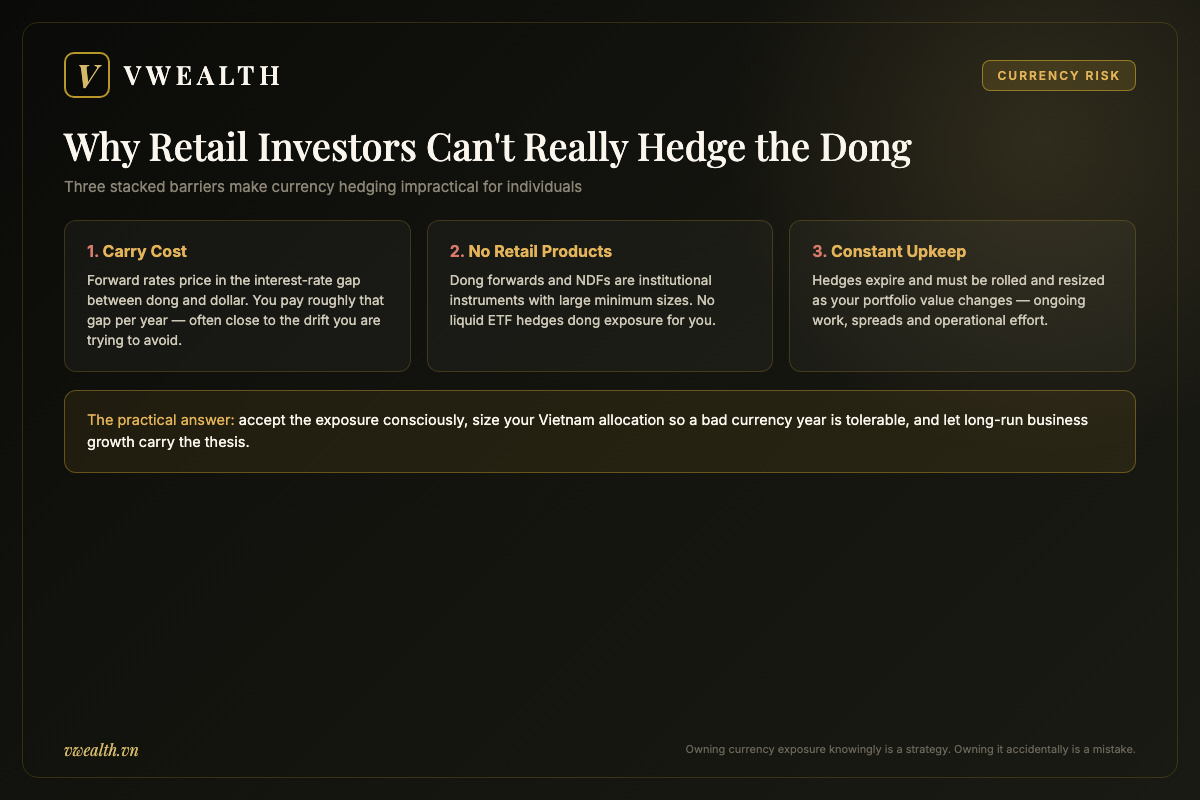
The natural next question: if the currency is a known headwind, why not just hedge it away? Hedging means taking an offsetting position — typically a forward contract, an agreement to exchange currency at a fixed rate on a future date — so that currency moves no longer affect you. Institutions do this routinely. For a retail investor in Vietnamese equities, it is mostly impractical, for three stacked reasons.
Reason one: the carry cost eats the benefit
Forward exchange rates are not a market’s guess about the future; they are set mechanically by the interest-rate difference between the two currencies. This is called covered interest parity, and the intuition fits in one sentence: whoever holds the higher-yielding currency for you during the contract must be compensated, so the forward rate prices the dong cheaper than today’s rate whenever dong interest rates exceed dollar rates. The consequence: when Vietnamese rates are above US rates, hedging the dong costs you roughly that interest-rate gap per year — the “carry cost.” Hypothetical illustration: if the rate gap were 3 percentage points, a hedge would cost about 3 percent per year. If the currency historically drifts down by a similar low-single-digit amount, you are paying roughly the expected loss up front, every year, with certainty, to avoid an uncertain version of the same number. For a long-term holder, that is usually a bad trade. And when US rates are above Vietnamese rates, the carry can flip in your favor — but those windows shift, and timing them is its own speculation.
Reason two: the instruments aren’t built for you
The dong is not a freely convertible international currency, so there is no deep offshore retail market for hedging it. The instruments that exist — onshore forwards through Vietnamese banks, and offshore non-deliverable forwards (NDFs, contracts that settle the difference in dollars without exchanging dong) — are institutional products with institutional minimum sizes, documentation, and counterparty requirements. Your US discount broker does not offer a dong forward. A retail investor with a five- or six-figure Vietnam allocation simply has no practical access, and no liquid exchange-traded fund exists that hedges dong exposure for you.
Reason three: a hedge must be managed
Even if you could hedge, a hedge is not a set-and-forget object. Forwards expire and must be rolled. The hedge size must be adjusted as your portfolio value changes — hedge 100,000 dollars of exposure, watch your stocks rally 30 percent, and you are suddenly 30 percent unhedged. Each roll incurs spreads and operational effort. Professional currency-overlay teams exist precisely because this is genuine ongoing work, not a checkbox.
The honest conclusion for most individual investors: accept the currency exposure consciously, size your Vietnam allocation so that a bad currency year is tolerable, and let the long-run growth thesis carry the weight. Owning the exposure knowingly is a strategy. Owning it accidentally is a mistake. There is one soft, partial exception worth knowing: some Vietnamese companies — exporters that earn dollars, for example — benefit operationally when the dong weakens, while heavy importers or companies with dollar debt are hurt. Your stock selection itself can lean with or against the currency, which is a crude but free form of hedging that costs no carry.
How Dividends Travel From a Vietnamese Company to Your Bank Account
Currency risk does not only apply to your principal. Every cash dividend makes the same journey, and it is worth tracing the route once so nothing surprises you.
Vietnamese companies declare and pay cash dividends in dong. Note that many companies also pay stock dividends — extra shares instead of cash — which involve no currency conversion at all; the discussion here concerns cash payouts. A cash dividend lands in dong in your Vietnamese brokerage account. At that point you hold dong cash, fully exposed to the exchange rate, until you either reinvest it in more shares or convert and repatriate it.
Repatriation — moving money back out of the country — runs through the same channel your money came in on: the dedicated, single-purpose dong bank account that foreign portfolio investors are required to use for all money flowing in and out of the market. This account was long known as the indirect investment capital account (IICA); under Circular 03/2025/TT-NHNN, which took effect on 16 June 2025 and replaced the older Circular 05/2014, it is now formally called the indirect investment account (IIA) — the same single-purpose account, just a renamed and updated framework, so you may still see brokers and older guides use “IICA.” All of a foreigner’s portfolio inflows, dividends, sale proceeds and repatriations must pass through this one account at a single authorised bank. The mechanics of setting this up are covered step by step in our guide to opening a Vietnamese brokerage account as a foreigner. The key point for currency thinking is that conversion happens at the exchange rate on the day you convert, not the day the dividend was declared. Between declaration and conversion, you are running unhedged dong cash. In practice, repatriating income also requires showing the bank that your tax obligations on that income have been met — a documentation step, not a barrier.
This creates a small, recurring decision point that lump-sum investors never face. Each dividend forces a choice:
- Reinvest in dong. No conversion cost now, and you keep compounding inside the market. Sensible if your thesis is long-term and you do not need the income. The dividend simply becomes more of your existing currency exposure.
- Convert and repatriate. You realize the exchange rate of the day and pay the conversion spread, but the cash is home and the currency risk on that slice is closed. Sensible for income-oriented investors.
- Hold dong cash and wait for a better rate. This is currency speculation wearing a patience costume. Occasionally it works; as a habit, it converts an equity strategy into an FX trading strategy you never intended to run.
A useful discipline is to decide your dividend policy once, in advance, and apply it mechanically — reinvest everything, or repatriate everything on receipt. Dividend taxes are withheld in Vietnam before the cash reaches you; the mechanics of that withholding are a separate topic with its own article in this series. For total-return bookkeeping, what matters is that you record dividends at the dollar value you actually realized, not the dong value declared.
Thinking in Total-Return Terms: A Practical Framework
Everything above condenses into one habit: measure and decide in dollars, end to end. Here is a concrete framework you can apply without any special tools.
Step 1: Keep your books in dollars
Record every contribution at the dollar amount you sent, every withdrawal at the dollar amount you received, and mark your portfolio to market by converting its dong value at the current rate whenever you review it. Your true return is computed between those dollar figures. This single habit automatically captures currency effects, conversion spreads, and dividend timing — no separate currency accounting needed.
Step 2: Set a dollar-based hurdle rate
Decide the minimum annual dollar return that justifies the effort and risk of investing in Vietnam rather than in a simple US index fund. Then translate it into a dong-terms target by adding your conservative estimate of annual currency drag. If your dollar hurdle is 10 percent and you pencil in a low-single-digit drag, you are hunting for businesses you believe can compound in the low-to-mid teens in dong terms. That is your screening bar — and it usefully filters out mediocre ideas before you spend a minute on them.
Step 3: Watch a short currency dashboard, quarterly
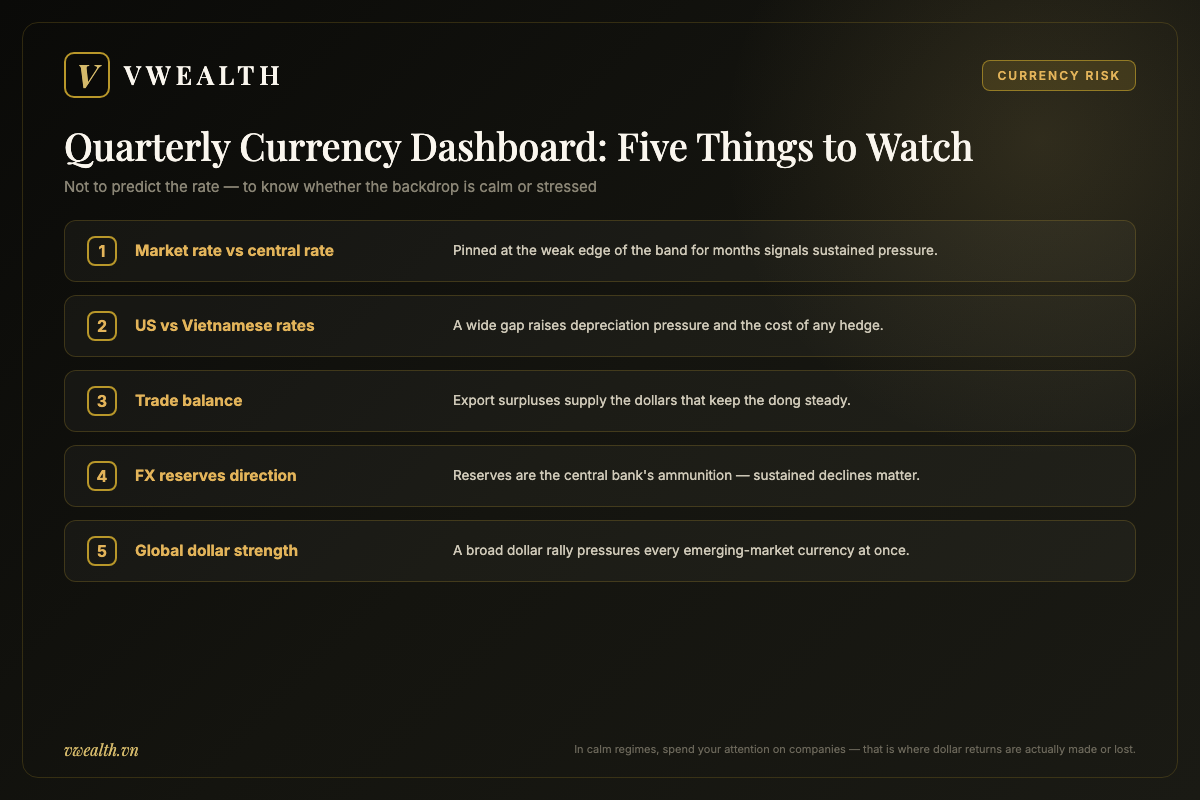
You do not need to follow FX markets daily. A quarterly glance at five indicators tells you whether the currency backdrop is calm or stressed:
| Indicator | What it tells you | Calm sign | Stress sign |
|---|---|---|---|
| Market rate vs central rate | Where the dong sits inside its band | Near the middle | Pinned at the weak edge for months |
| US vs Vietnamese interest rates | The pressure differential and hedging cost | Narrow gap | US rates far above Vietnamese rates |
| Trade balance | Underlying dollar supply from exports | Sustained surplus | Swing into persistent deficit |
| FX reserves direction | The central bank’s ammunition | Stable or rising | Sustained meaningful decline |
| Global dollar strength | External pressure on all EM currencies | Soft or stable dollar | Broad, sharp dollar rally |
None of these predicts the exchange rate — nothing reliably does. What they do is tell you which regime you are in. In calm regimes, currency deserves almost none of your attention and stock research deserves all of it. In stress regimes, it is reasonable to slow new contributions, avoid companies with heavy unhedged dollar debt, and expect your dollar returns to lag your dong returns for a while. Foreign-currency debt is worth a special mention: a Vietnamese company that borrows in dollars but earns in dong sees its debt burden grow every time the dong slips, so check the currency mix of borrowings in the financial statements of leveraged companies — airlines and utilities are classic examples worldwide.
Step 4: Judge outcomes over the right horizon
Grade any single year in dollar terms honestly, but judge the strategy over five to ten years. One bad currency year proves nothing about the thesis, just as one good one proves nothing either. What you are testing over time is a single proposition: that Vietnamese corporate earnings growth, converted to dollars after the drag, beats your alternative. Company-level research is where that proposition is won or lost, and the English-language analysis reports on vwealth are built to do exactly that legwork on individual Vietnamese stocks.
Putting Currency Risk in Proportion
After a full article on currency risk, a corrective is in order: for a diversified, long-horizon investor in Vietnam, the exchange rate is usually not the biggest risk on the list. It is simply the most exotic-sounding one, so it attracts outsized worry.
Consider the relative sizes, qualitatively. Individual Vietnamese stocks can move more in a single week than the managed dong typically moves in a year — daily price limits on the exchanges are wider than most annual currency drifts. Sector cycles in banking, property, or steel can swing earnings by half. Liquidity risk — the difficulty of exiting a mid-cap position quickly — and foreign-ownership-limit dynamics can affect your realized prices more than conversion spreads ever will. Against that backdrop, a slow, policy-managed currency drift is one of the tamer line items, and unlike stock-specific risk, it is at least somewhat predictable in direction and magnitude.
The investors who get hurt by the dong are rarely hurt by the dong itself. They are hurt by not having priced it in: by comparing dong returns to dollar benchmarks and thinking they were winning, by holding dividend cash in dong for years out of indecision, by buying a low-growth stock whose dollar return could never clear a sensible hurdle, or by panicking and converting everything at the weakest point of a stress episode. Every one of those mistakes is behavioral, and every one is avoidable with the total-return habit this article describes.
There is also a genuine long-run consolation. The same policy priorities that produce the gentle depreciation — export competitiveness, macro stability, growth — are the priorities that have driven the corporate earnings growth foreign investors come to Vietnam for in the first place. You are not paying the currency drag for nothing; it is a side effect of the very growth model you are buying into. And should Vietnam achieve emerging-market classification — with the improvements in currency convertibility that upgrade would involve — the structural conditions around foreign investors’ currency operations would likely improve as part of the package. For a broader orientation to the market’s structure beyond currency, our comprehensive guide to the Vietnamese stock market for investors covers the landscape end to end.
Key Takeaways: Own the Exposure Knowingly
Currency risk in Vietnam is real, quantifiable, and — for a prepared investor — entirely manageable. The essentials fit on an index card:
- Your dollar return is (1 + stock return) × (1 + currency return) − 1. Multiplication, not addition. Always compute it.
- The dong runs on a managed float: a daily central rate, a trading band, and central-bank intervention backed by reserves. Its long-run historical character has been gentle, managed depreciation against the dollar — a description of the past, not a guarantee of the future.
- Budget for a modest annual currency headwind in your hurdle rate, and demand stock ideas strong enough to clear it with room to spare.
- Retail hedging is impractical: the carry cost tends to match the drift you are trying to avoid, the instruments are institutional, and hedges require ongoing management. Conscious acceptance plus sensible position sizing beats a bad hedge.
- Dividends arrive in dong and convert at the rate on conversion day. Pick a mechanical policy — reinvest or repatriate — and stop making an FX decision out of every payout.
- Check a five-indicator currency dashboard quarterly; spend the rest of your research time on companies, where the real returns are made or lost.
The exchange rate will do what it does. What you control is whether you measured it, priced it into your decisions, and picked businesses good enough to outrun it. This article is general analysis for educational purposes, not investment advice or a recommendation to buy or sell any security or currency.
Research Vietnamese stocks in English with vwealth. Our AI-powered platform turns Vietnamese market data into full English analysis reports — with international payment support and a free 2-month trial for new accounts. Create your free account and read the latest reports.