Vietnam dividend stocks look irresistible on a screener: headline payout rates of 10%, 20%, even 40% appear next to company names, and income investors from lower-yield markets assume they have found paradise. Most of those numbers are not what they seem. Vietnamese companies quote dividends as a percentage of par value, not market price, they pay in shares as often as in cash, and some of the fattest yields on the board are one-off events that will never repeat. This guide walks through how dividends actually work on the Vietnamese market — the cash-versus-stock distinction, the dilution math, withholding tax for foreigners, screening for payers that can sustain their payouts, the classic yield traps, and the practical mechanics of reinvesting when no automatic reinvestment plan exists.
Why dividend investing in Vietnam starts with a translation problem
Before you evaluate a single Vietnamese dividend, you need to decode how the numbers are quoted, because the local convention is different from what most foreign investors expect — and the difference is large enough to change your entire opinion of a stock.
Nearly every listed Vietnamese share carries a par value of 10,000 dong. Par value is the nominal face value printed on the share when it was first issued; it has nothing to do with the market price, which can be three times par or thirty times par. When a Vietnamese company announces a “10% cash dividend,” it means 10% of par value — 1,000 dong per share — not 10% of the market price. If the stock trades at 50,000 dong, that “10% dividend” is actually a 2% yield on your money. If it trades at 12,000 dong, the same announcement is a yield above 8%.
This single convention explains most of the eye-popping numbers foreigners see in Vietnamese dividend announcements. A “40% dividend” from a company trading at 80,000 dong is 4,000 dong per share — a 5% yield. Respectable, but not the windfall the headline suggests. The first habit of a serious dividend investor in Vietnam is therefore mechanical: convert every announcement into dong per share, divide by the current market price, and only then form an opinion. Yield equals cash dividend per share divided by price you pay — the same formula as anywhere else. The announcements just refuse to do the division for you.
The second translation problem is the payment form. Vietnamese boards routinely declare dividends partly in cash and partly in shares — an announcement might read “15% in cash, 20% in stock.” These are two fundamentally different things. The cash portion is money leaving the company and arriving in your brokerage account. The stock portion is an accounting reshuffle that gives you more pieces of the same pie. Confusing the two is the most common mistake newcomers make, so the next two sections take them apart properly.
If you are still setting up the basics — trading code, brokerage account, how money moves in and out of the country — it is worth reading the complete guide to investing in Vietnam’s stock market as a foreigner first, because everything in this article assumes you can already buy and hold local shares.
Cash dividends in Vietnam: the timeline and the price adjustment
A Vietnamese cash dividend follows a sequence of dates that matters more than the amount, because the sequence determines who gets paid and how the market reprices the stock.
The four dates that govern every payout
First comes the announcement, usually following approval at the annual general meeting or a board resolution. Vietnamese companies often announce a full-year dividend plan at the AGM in the second quarter, then execute it in one or several installments over the following twelve months.
Second is the ex-dividend date (ex-date). Buy the stock before this date and you receive the dividend; buy on or after it and you do not. Because Vietnamese settlement takes two working days, the ex-date sits before the record date — your purchase must settle in time to appear on the shareholder register.
Third is the record date, when the depository takes a snapshot of who owns what. You do nothing on this date; it is administrative.
Fourth is the payment date — and here Vietnam surprises people. The gap between record date and actual cash arriving can stretch from a few weeks to several months. Some companies have historically postponed announced payment dates, sometimes more than once, when cash was tight. A dividend announced is not a dividend received, and the length and reliability of this gap is itself a signal about company quality that we will use in the screening section.
The mechanical price drop on ex-date
On the ex-date, the exchange adjusts the stock’s reference price downward by the dividend amount. This is not the market punishing the stock; it is arithmetic. A company that pays out 2,000 dong per share in cash is worth 2,000 dong per share less the moment the cash leaves. If the stock closed at 42,000 dong the day before going ex-dividend on a 2,000 dong payout, the new reference price is 40,000 dong, and the daily trading band is drawn around that adjusted level.
Why does this matter to you? Because it kills the most tempting beginner strategy in dividend investing: buying just before the ex-date to “capture” the dividend and selling right after. You receive 2,000 dong of cash, your stock instantly re-prices 2,000 dong lower, and you have paid tax and trading fees for the privilege of converting a sliver of your capital into taxable income. Dividend capture is a losing game in any market; in Vietnam, where the reference-price adjustment is explicit and the settlement cycle delays your exit, it is a losing game with extra steps.
The real return from dividends comes from holding businesses that generate cash year after year, so that repeated payouts accumulate while the business (ideally) grows back the value it pays out. That is a multi-year proposition, not a calendar trick.
Stock dividends: the dilution math every investor should do once
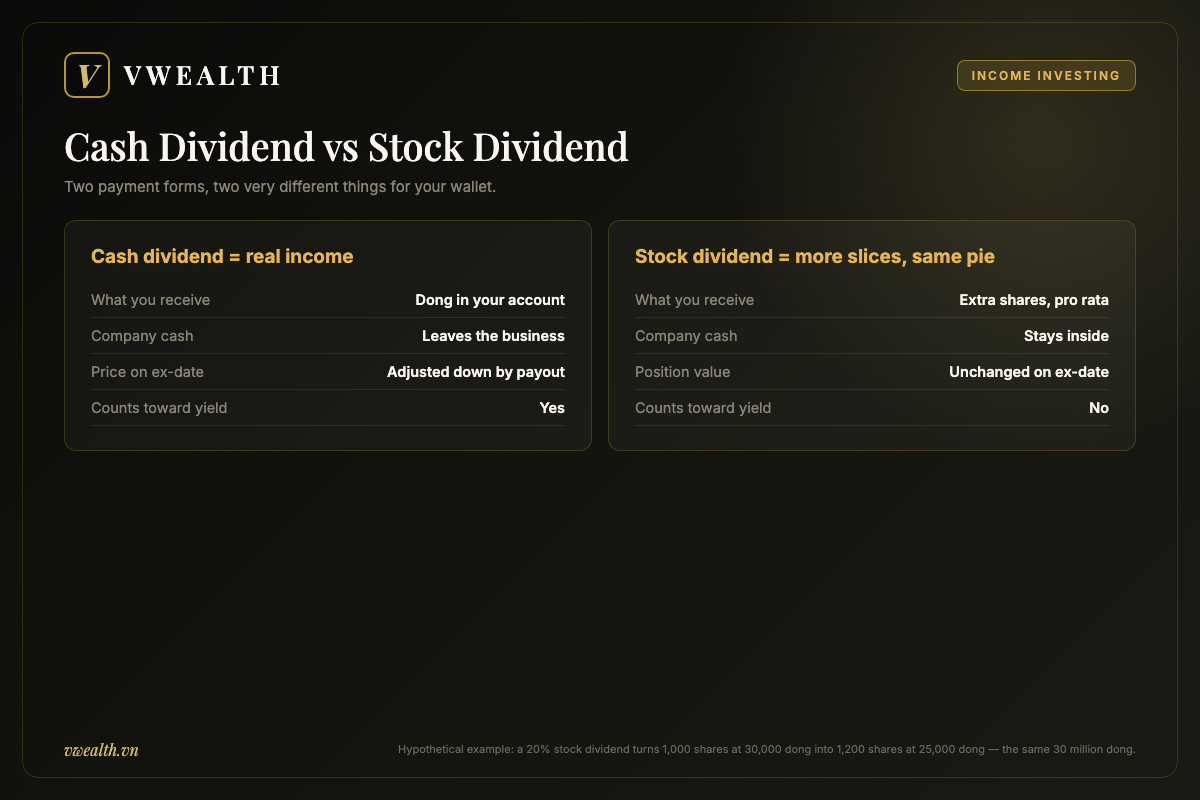
Now for the payment form that dominates Vietnamese corporate announcements and confuses foreigners more than anything else: the stock dividend, also called a bonus share issue. The company gives you additional shares instead of cash — “20% stock dividend” means 20 new shares for every 100 you hold.
Here is the uncomfortable truth stated plainly: a stock dividend gives you nothing of immediate economic value. It increases your share count and decreases the value of each share by exactly the same proportion. You end the day with a bigger stack of thinner slices, and the pie is unchanged.
A worked example with hypothetical round numbers
The following is an illustration with invented, deliberately round numbers — not any real company’s figures.
Suppose Company A has 100 million shares outstanding, trades at 30,000 dong per share, and you own 1,000 shares. Your position is worth 30,000,000 dong. The company earned 300 billion dong last year, so earnings per share (EPS — annual profit divided by share count) is 3,000 dong, and the stock trades at a price-to-earnings ratio of 10.
The board declares a 20% stock dividend. Watch each number move:
| Item | Before stock dividend | After 20% stock dividend | What changed |
|---|---|---|---|
| Shares outstanding (company) | 100,000,000 | 120,000,000 | +20% |
| Your shares | 1,000 | 1,200 | +20% |
| Reference price | 30,000 dong | 25,000 dong (30,000 ÷ 1.2) | −16.7% |
| Your position value | 30,000,000 dong | 30,000,000 dong | Unchanged |
| Company annual profit | 300 billion dong | 300 billion dong | Unchanged |
| EPS | 3,000 dong | 2,500 dong | −16.7% |
| Your ownership stake | 0.001% | 0.001% | Unchanged |
Every economic quantity you actually care about — the value of your position, your percentage ownership, the company’s profit — is identical before and after. The exchange divides the reference price by 1.2 on the ex-date precisely so that no value is created or destroyed. The word “dilution” is worth being precise about here: a stock dividend dilutes per-share figures (EPS, book value per share) but does not dilute you, because every shareholder receives new shares in proportion. Contrast this with a private placement to an outside investor, which increases the share count without giving you anything — that dilutes both the per-share numbers and your ownership stake.
So why do Vietnamese companies love stock dividends?
If bonus shares are economically empty, why are they everywhere on the Vietnamese market? Several reasons, some legitimate and some worth your suspicion.
The legitimate one: growth companies want to retain cash. A bank that must build capital to support lending growth, or a steel producer mid-way through building a new plant, genuinely cannot afford to ship cash out the door. Paying a stock dividend lets the board honor shareholders’ cultural expectation of receiving “something” each year while keeping every dong inside the business. For a company reinvesting at high returns, keeping the cash is exactly what you should want as an owner.
The second reason is optical: a lower per-share price after a bonus issue makes the stock feel more affordable to retail investors, who dominate trading volume in Vietnam. A stock that has run from 40,000 to 120,000 dong can reset to a “cheaper-looking” price through a large bonus issue. Nothing real changed, but liquidity and retail participation often improve.
The third reason deserves suspicion: stock dividends allow a company to advertise a large headline “dividend” — “30% payout this year!” — without any cash leaving the building. If a company pays stock dividends year after year while operating cash flow stays weak, the generous-sounding announcements are marketing, not shareholder return. You can check this yourself: whether cash actually flows out is visible in the financing section of the cash-flow statement, and our guide to reading Vietnamese financial statements under VAS and IFRS shows where to find it and how local presentation differs from what you may be used to.
For an income investor, the practical rule is simple: only the cash portion of a dividend is income. When you compute yield, use cash per share only. Treat the stock portion as what it is — a share split with better publicity — and evaluate it by asking whether the retained cash is being reinvested well.
Withholding tax: what foreign investors actually keep
Dividends in Vietnam do not arrive whole. Understanding the tax treatment matters because it changes the real yield you compare against alternatives — and because the treatment of cash and stock dividends differs in a way that trips people up.
For individual investors, foreign and domestic alike, Vietnam applies a flat personal income tax of 5% on cash dividend income, and it is withheld at source — the company or the securities firm deducts it before the cash reaches your account, so you have no separate annual filing obligation for it in the typical case. This 5% rate flows from Vietnam’s Law on Personal Income Tax and, as of mid-2026, applies to both resident and non-resident individuals on dividends from listed shares; the figure is confirmed in the PwC Vietnam tax summary. A useful contrast to internalize: corporate shareholders pay no withholding tax on the same dividends — the 5% is a rule aimed specifically at individuals — and treaty positions can still vary with your country of residence, so if you are optimizing across borders, confirm your own case with a tax advisor. For an ordinary individual holding listed Vietnamese shares, though, the number to plan around is simple: knock 5% off every cash dividend.
The framework, though, has three features worth internalizing because they shape strategy regardless of the exact rate:
First, withholding is the end of the process for most individuals. Unlike markets where dividends create an annual tax-filing obligation, the Vietnamese model for individual portfolio investors is transaction-based and settled at source. This administrative simplicity is a genuine, underrated advantage of the market.
Second, stock dividends have historically been taxed differently — at the point you sell the bonus shares, not when you receive them. The same 5% dividend PIT applies to the par value of shares received as a stock dividend, but under the old practice it was only collected when you later sold those shares, on top of the normal securities transaction tax on the sale (0.1% of the transfer value for listed shares). That timing is changing. In 2025 the Ministry of Finance circulated a draft decree amending Decree 126/2020/ND-CP (which guides the Law on Tax Management) to require the dividend-paying company to withhold the 5% at the moment bonus shares are distributed, rather than waiting for the eventual sale — a tightening prompted by the fact that, on the tax authority’s own figures, only a sliver of the PIT owed on bonus shares issued between 2016 and 2024 was ever collected. As of mid-2026 the direction of travel is clear even where the mechanics are still settling: Viet Nam News reported the plan to move withholding to the distribution date. The principle either way is the same — bonus shares are not tax-free — so factor the 5% in before celebrating a large stock dividend, and check with your broker whether it now withholds at receipt or at sale.
Third, double-taxation treaties may matter for your home-country filing. Vietnam maintains tax treaties with dozens of countries. Whether you can credit Vietnamese withholding against home-country tax on the same income depends on your residence and your local rules. This is a question for your home-country accountant, but keep the dividend statements your broker issues — you will want the paper trail.
The practical takeaway: when you screen Vietnamese stocks for income, mentally haircut every cash dividend by the 5% withholding, and remember that the stock-dividend portion carries the same 5% cost, deferred to sale under the old practice and moving toward collection at distribution. Comparing a Vietnamese net yield against a net yield at home is the only comparison that means anything.
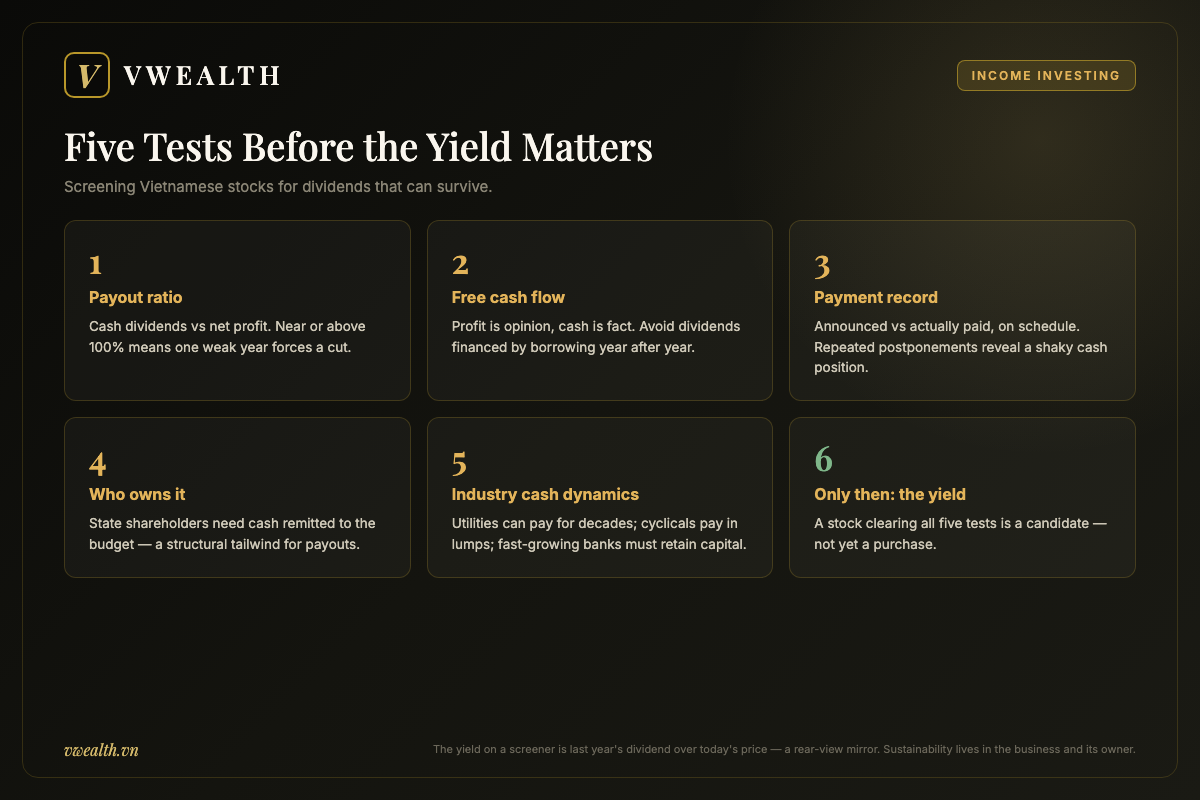
Screening for sustainable payers: five tests before the yield matters
A high yield tells you nothing until you know whether it can survive. The yield printed on a screener is last year’s dividend divided by today’s price — a rear-view mirror number. Sustainability lives in the underlying business, and in Vietnam it also lives in one place foreigners rarely think to look: the identity of the controlling shareholder. Here are the five tests, in the order worth running them.
Test 1: The payout ratio — is the dividend covered by profit?
The payout ratio is cash dividends divided by net profit. A company earning 3,000 dong per share and paying 1,500 dong in cash has a 50% payout ratio: it distributes half its earnings and retains half. As a rough grammar for reading this number: a ratio below about half of profit leaves room for bad years; a ratio persistently near or above 100% means the company is paying out everything it earns — one weak year forces a cut. Compute it yourself from the cash-flow statement (“dividends paid”) rather than from announcements, because announcements mix cash and stock portions, and only cash counts.
Test 2: Free cash flow — is the dividend covered by actual cash?
Profit is an accounting opinion; cash is a fact. Free cash flow — operating cash flow minus the capital spending needed to maintain and grow the business — is what a company can genuinely afford to distribute. A company can report handsome profits while its cash is trapped in unpaid receivables or swelling inventory, and such a company will eventually pay dividends from borrowing, or stop paying them. The pattern to avoid is profit up, operating cash flow down, dividends financed by debt — visible when the financing section of the cash-flow statement shows simultaneous heavy borrowing and dividend payments year after year. One year of that is normal corporate life; five years of it is a dividend running on credit.
Test 3: The payment record — announced versus actually paid, on time
Vietnam-specific and gold: check not just whether the company declared dividends for the past five to seven years, but whether it paid them when it said it would. The disclosure archive of any listed company records dividend announcements — and postponements. A company that has repeatedly pushed payment dates back by months is telling you, in writing, that its cash position is unreliable. A company that has paid on schedule through a full market cycle, including the hard years, has revealed something no ratio can: management treats the dividend as a commitment rather than a press release.
Test 4: The state-owner effect — who needs this dividend?
Here is the distinctly Vietnamese screening insight. A large share of the market’s most reliable cash payers are companies where the state — directly through ministries or through holding vehicles such as the State Capital Investment Corporation (SCIC) — remains a major shareholder. The state has a structural appetite for cash dividends: dividends from state stakes flow to the state budget, so the controlling shareholder actively prefers cash out over cash retained. This creates a class of companies where generous, persistent cash payout is not a board’s whim but the standing policy of an owner who needs the money every single year.
The effect cuts both ways. The same state influence can mean slower commercial decision-making, capital spending shaped by policy rather than returns, and limited float. But if your goal is income specifically, the incentive alignment is real: you and the majority owner want the same thing. Understanding which companies fall into this category, how state ownership is structured, and what divestment plans mean for future payout policy is covered in depth in our guide to state-owned enterprises on the Vietnamese stock market — read it as the companion piece to this section.
The mirror image also matters: in founder-controlled private groups, especially those in expansion mode, the controlling shareholder often prefers retention. Neither preference is wrong; you are simply reading the majority owner’s incentives to predict the dividend’s future, because in a market of concentrated ownership, the majority owner’s preference is the dividend policy.
Test 5: Industry cash dynamics — can this business model pay?
Some industries are structurally suited to paying dividends and some are not, independent of management’s intentions. Businesses with steady demand, modest capital needs and regulated or contracted revenues — utilities, insurance in mature phases, established consumer staples — can pay high ratios of profit for decades. Cyclical businesses — steel, chemicals, shipping — can pay spectacularly at the top of their cycle and nothing at the bottom; their dividends are real but lumpy, and averaging across a full cycle is the only honest way to estimate their yield. Banks sit in a special category: they generate profits reliably but must retain capital to support loan growth and meet capital-adequacy rules, which is why Vietnamese banks have leaned so heavily on stock dividends. A bank promising large sustained cash payouts while growing its loan book fast deserves a skeptical second look, because those two ambitions compete for the same capital.
Yield traps: four ways a fat number lies to you
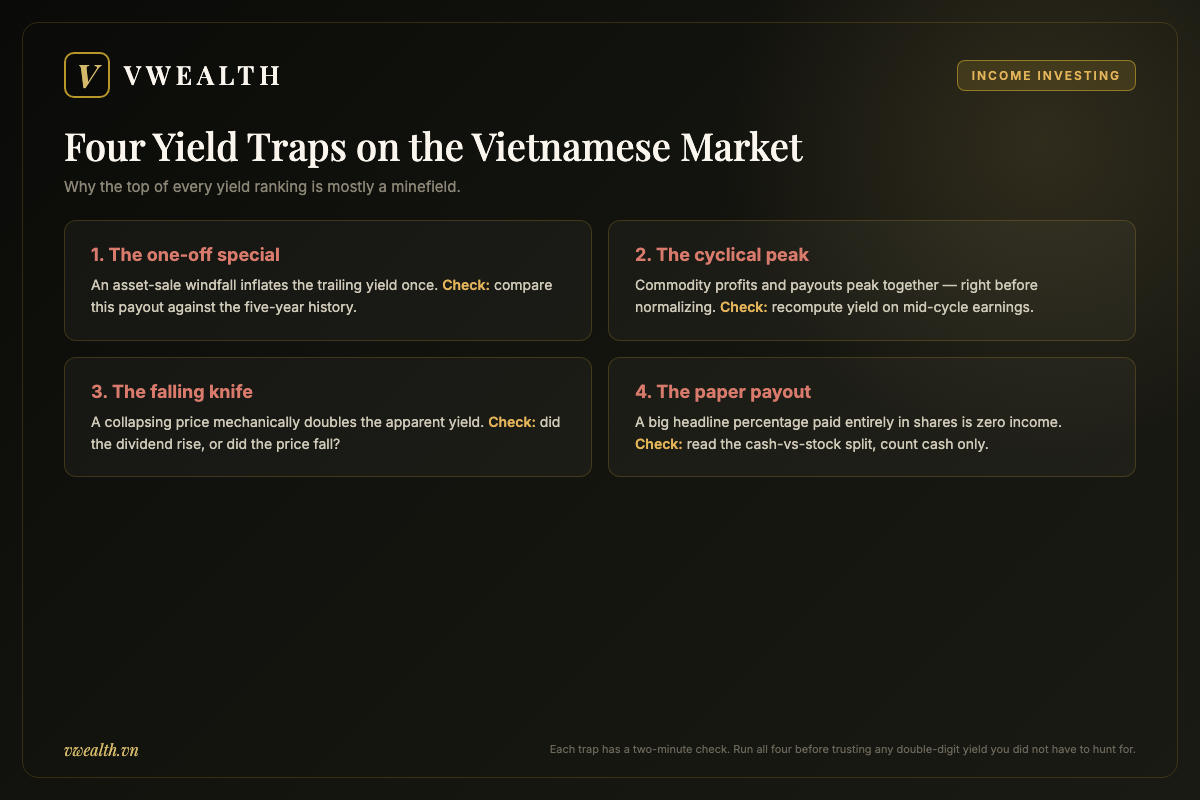
Every screening tool sorts by yield, so every income investor eventually stares at a list topped by double-digit payers. Most of the top of that list is a minefield. Here are the four standard traps on the Vietnamese market, each with the tell that exposes it.
Trap 1: The one-off special dividend
A company sells a subsidiary, a land plot or a stake in an affiliate, and distributes the windfall as an unusually large dividend. The screener then shows a double-digit trailing yield — computed from a payment that will never recur. Vietnamese corporate history includes famous cases of companies paying special dividends amounting to several times their normal annual payout after divesting assets. Investors who bought after the announcement for the yield got the next year’s ordinary dividend — a fraction of what they extrapolated.
The tell: compare this year’s announced dividend with the past five years. A payout several multiples above the historical norm is an event, not a policy. Read the announcement itself: boards state when a distribution is extraordinary. Value the stock on its ordinary, repeatable payout only.
Trap 2: The cyclical peak yield
A commodity producer at the top of its price cycle earns extraordinary profits and pays extraordinary dividends. The trailing yield looks magnificent precisely when earnings are about to normalize downward. This is the dividend cousin of the classic low-P/E trap in cyclicals — the numbers look best at the worst moment to buy. When the cycle turns, the dividend follows profit down, and the share price follows the dividend.
The tell: ask where current profit sits relative to the company’s own ten-year history. If the answer is “at or near record highs” and the business sells a globally priced commodity, assume the current dividend is the ceiling, not the floor. Estimate yield on mid-cycle profit instead: take average profit across the last full cycle, apply the company’s typical payout ratio, and divide by today’s price. The number that survives that calculation is the one you can plan around.
Trap 3: The falling knife yield
Yield equals dividend divided by price, so a collapsing price mechanically inflates yield. A stock that halves while its announced dividend is unchanged doubles its apparent yield — but the market is telling you it doubts the dividend, or the business under it, will survive. Sometimes the market is wrong and this is a genuine bargain; more often, the dividend cut arrives within a year and the “yield” you bought never existed.
The tell: when a yield looks high, check why — did the dividend rise, or did the price fall? If the price fell hard, your job flips from income analysis to distress analysis: leverage, refinancing needs, receivables quality, auditor opinions. The dividend question becomes secondary until you can explain the decline better than the market can.
Trap 4: The paper payout dressed as generosity
The distinctly Vietnamese trap, following directly from the dilution math above: a company announces a “30% dividend” that is entirely in shares, year after year. Screeners and news headlines sometimes conflate announced totals with cash yield. The investor believes they own an income stock; they actually own a growth bet with good publicity, and their income is zero.
The tell: this one takes thirty seconds. Read the announcement’s split of cash versus stock, count only the cash, and recompute. Then ask the follow-up question that separates good retention from bad: is the retained cash earning a decent return? If a company retains everything and its return on equity is sliding, you get neither income nor growth — the worst square of the matrix.
| Trap | What the screener shows | What is really happening | The 2-minute check |
|---|---|---|---|
| One-off special | Double-digit trailing yield | Asset-sale windfall, won’t repeat | Compare payout vs 5-year history; read the board resolution |
| Cyclical peak | High yield, low P/E | Peak profits about to normalize | Where is profit vs own 10-year range? Use mid-cycle payout |
| Falling knife | Yield rising month after month | Price collapsing ahead of a cut | Decompose: dividend up or price down? If price, audit the balance sheet |
| Paper payout | Big headline “dividend %” | All or mostly stock, zero cash income | Read the cash/stock split; count cash only |
Building an income sleeve inside foreign-ownership constraints
Foreign investors face a Vietnam-specific portfolio construction problem that domestic income investors never think about: some of the most attractive dividend payers are hard or expensive for foreigners to buy at all. Vietnamese law caps aggregate foreign ownership in listed companies — the general ceiling is 49% for a company in a sector with no specific restriction, but it drops in regulated industries, with banks the strictest at 30% of charter capital (raised toward 49% only in special restructuring cases decided by the Prime Minister). When foreign holdings hit the applicable cap, the stock is “out of room”: no more foreign buying at the market price. Popular, well-run cash payers are precisely the stocks where foreign room tends to be scarce, and where blocks change hands between foreigners off-exchange at premiums above the listed price.
This reshapes income-portfolio construction in three practical ways.
First, your investable universe is not the full dividend universe. Before you fall in love with a payer, check its remaining foreign room — brokers and data platforms display it, and your order simply will not fill if room is gone. Build your candidate list from stocks foreigners can actually accumulate, and treat full-room stocks as a watchlist for the rare moments room opens up (a foreign seller exits, or the company raises its cap).
Second, paying a foreign premium changes the yield math. If a full-room stock can only be acquired at, say, a meaningful premium to the exchange price in a negotiated deal, your effective yield is the dividend divided by the price you pay — lower than the screen suggests. For most individual investors the honest answer is that negotiated premium deals are institutional territory; the retail response to a full-room favorite is patience or substitution.
Third, diversification needs deliberate effort. The natural gravity of a Vietnamese income portfolio pulls toward a handful of sectors — utilities, insurance, industrial goods, consumer staples, some energy names — because that is where the state-influenced steady payers cluster. That concentration is manageable but should be conscious: spread across at least three or four sectors whose cash flows respond to different forces, so one policy change or commodity swing cannot cut most of your income at once. Many of the durable payers sit among the market’s largest and most established names; our overview of Vietnam’s blue-chip stocks maps that landscape and is a natural hunting ground for the core of an income sleeve.
A sensible structure treats Vietnamese dividend stocks as a sleeve — a defined slice of a broader portfolio — rather than the whole strategy. Within the sleeve: a core of five to eight established payers passing all five screening tests, sized so no single name provides more than a quarter of expected income; plus, if you have the temperament, a small cyclical satellite where you consciously accept lumpy payouts in exchange for higher average yield across the cycle, sized so a payout gap of two years does not hurt.
Reinvestment mechanics: compounding by hand
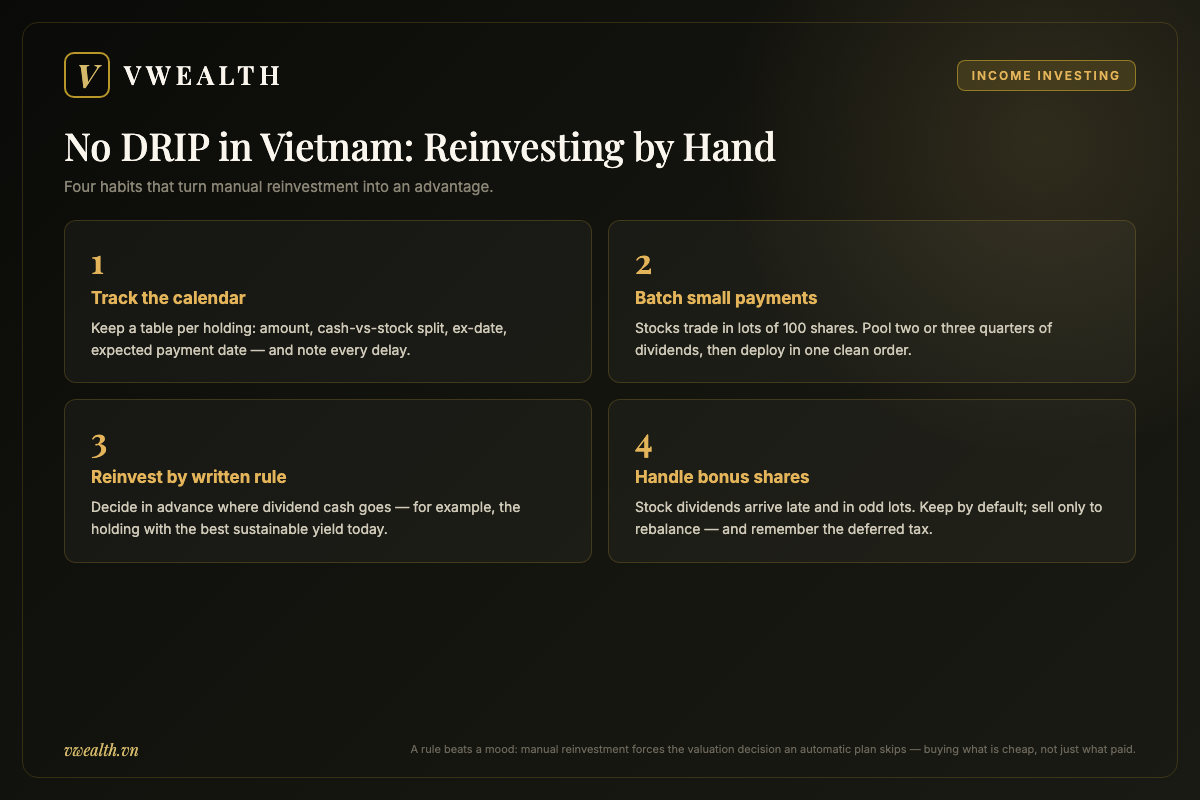
In many developed markets you tick a box and your broker automatically reinvests every dividend into more shares — a dividend reinvestment plan, or DRIP. Vietnam has no such mechanism. Cash dividends land in your brokerage account as idle cash, and if you want compounding — the process where reinvested income buys shares that themselves generate income — you do it manually. This sounds like a chore; done deliberately, it becomes an advantage, because manual reinvestment forces a valuation decision that a DRIP automates away.
The practical workflow
Track the calendar. Vietnamese dividend events are announced through exchange disclosures, and payment dates cluster after AGM season. Keep a simple table of your holdings: announced amount, cash/stock split, ex-date, expected payment date. When cash arrives late — it will, occasionally — the table tells you who owes you what, which is exactly the payment-reliability data Test 3 of the screening section feeds on.
Batch small payments. Vietnamese stocks trade in board lots of 100 shares, and a single dividend payment on a modest position often is not enough to buy a full lot of anything you want. Rather than forcing awkward odd-lot purchases, let two or three quarters of dividends pool, then deploy in one order. The cash drag is trivial; the reduction in friction is not.
Reinvest by rule, not mood. The dangerous freedom of manual reinvestment is that idle cash tempts you into whatever is moving that week — and dividend cash quietly leaks into speculative trades. Write the rule down before the first payment arrives: for example, “dividend cash goes to whichever existing holding currently trades at the highest sustainable yield and still passes all five screens.” That single sentence turns each payout into a disciplined buy-the-cheapest decision — the thing a DRIP cannot do, because a DRIP buys the payer regardless of price.
Handle bonus shares consciously. Stock dividends arrive as new shares in your account, often after a delay of weeks and sometimes as odd lots (a 15% bonus on 500 shares is 75 shares — not a round lot). Decide policy in advance: keep them (your stake is unchanged, so this is the default), or sell them to rebalance if the position has grown beyond its target weight. Remember the deferred tax event on selling bonus shares discussed earlier, and remember that odd lots may need a separate order type or a slightly worse price to exit.
What reinvested dividends actually do — one more set of round numbers
A purely hypothetical illustration, with round numbers chosen for arithmetic clarity rather than realism. Suppose an income sleeve of 500 million dong yields 6% in cash after withholding, and payouts neither grow nor shrink. Spent, the dividends produce 30 million dong a year and the sleeve stays at 500 million forever. Reinvested at the same yield, the sleeve compounds: after one year, 530 million; after five, roughly 669 million; after ten, about 895 million — approaching double, from reinvestment alone, before any price appreciation or dividend growth. The arithmetic is elementary, but seeing it in dong terms explains why the boring workflow above — track, batch, reinvest by rule — is where most of a dividend strategy’s long-run return actually comes from. Compounding is not a market phenomenon; it is a behavioral one.
A worked screening routine you can run in an hour
Pulling the whole article together into a repeatable process — here is a routine you can run on any candidate in under an hour, using only public disclosures and your research platform.
Step 1 — Translate the headline (5 minutes). Take the announced dividend, split cash from stock, convert the cash portion to dong per share (percentage of 10,000 dong par), divide by current price. This is the only yield number you carry forward. If the cash yield is unremarkable, you may stop here — you have saved fifty-five minutes.
Step 2 — History check (10 minutes). Pull five to seven years of dividend history. Is this year’s payout in line with the pattern, or an outlier begging the special-dividend question? Were announced payments made on schedule? Any postponements are a flag worth two extra minutes of reading.
Step 3 — Coverage check (15 minutes). From the financial statements: payout ratio against profit, and — more importantly — against free cash flow. Scan the financing section of the cash-flow statement for the borrow-to-pay pattern. Check that receivables and inventory are not growing dramatically faster than revenue, the classic sign that reported profit is not converting to cash.
Step 4 — Owner check (10 minutes). Who holds the controlling stake, and what do they want? State vehicle needing budget cash: payout tailwind. Founder group funding expansion: retention likely. Recent changes in major ownership can flip dividend policy fast — a divested state stake often means the new owner rethinks the payout.
Step 5 — Cycle check (10 minutes). Is this business cyclical, and where does current profit sit against its own ten-year range? If at a high, recompute yield on mid-cycle earnings before trusting it.
Step 6 — Access check (5 minutes). Remaining foreign room, average daily liquidity in the size you trade, and whether you can realistically accumulate the position over a few weeks without moving the price.
A stock that clears all six steps is a candidate — not a purchase. Position sizing, entry valuation and how the name fits the rest of your sleeve still matter, and no screening routine replaces reading the annual report of a company you intend to hold for years. But six clean steps put you far ahead of every investor who sorted by yield and bought the top row. If running steps 2 through 5 by hand across dozens of candidates sounds like the bottleneck, this is precisely the drudgery an analysis platform should absorb: vwealth’s AI reads each company’s Vietnamese filings and turns the dividend history, cash-flow coverage and ownership structure into English reports, so your hour goes to judgment instead of data collection — you can open a free account and test the workflow on your own candidate list.
The bottom line: income is earned by discipline, not found by screener
Dividend investing in Vietnam rewards investors who do three unglamorous things consistently. First, translate every announcement — percentage-of-par into dong per share, cash separated from stock — so you are always working with the real number rather than the headline. Second, screen for sustainability before yield: coverage by profit and free cash flow, a payment record kept on schedule, an owner whose incentives favor cash out, and a business model that can pay through a full cycle. Third, respect the traps — specials, cyclical peaks, falling knives and paper payouts — because the top of every yield ranking is populated mainly by numbers that lie. Add the Vietnam-specific overlays of withholding tax and foreign-room constraints, run reinvestment as a written rule rather than a mood, and a Vietnamese income sleeve becomes what it should be: a stream of cash that compounds quietly while the market’s attention is elsewhere. Nothing in this article is a recommendation to buy or sell any security; it is an analytical framework for your own research, and dividend policies, tax rules and ownership limits should always be verified against current disclosures before you act.
Research Vietnamese stocks in English with vwealth. Our AI-powered platform turns Vietnamese market data into full English analysis reports — with international payment support and a free 2-month trial for new accounts. Create your free account and read the latest reports.