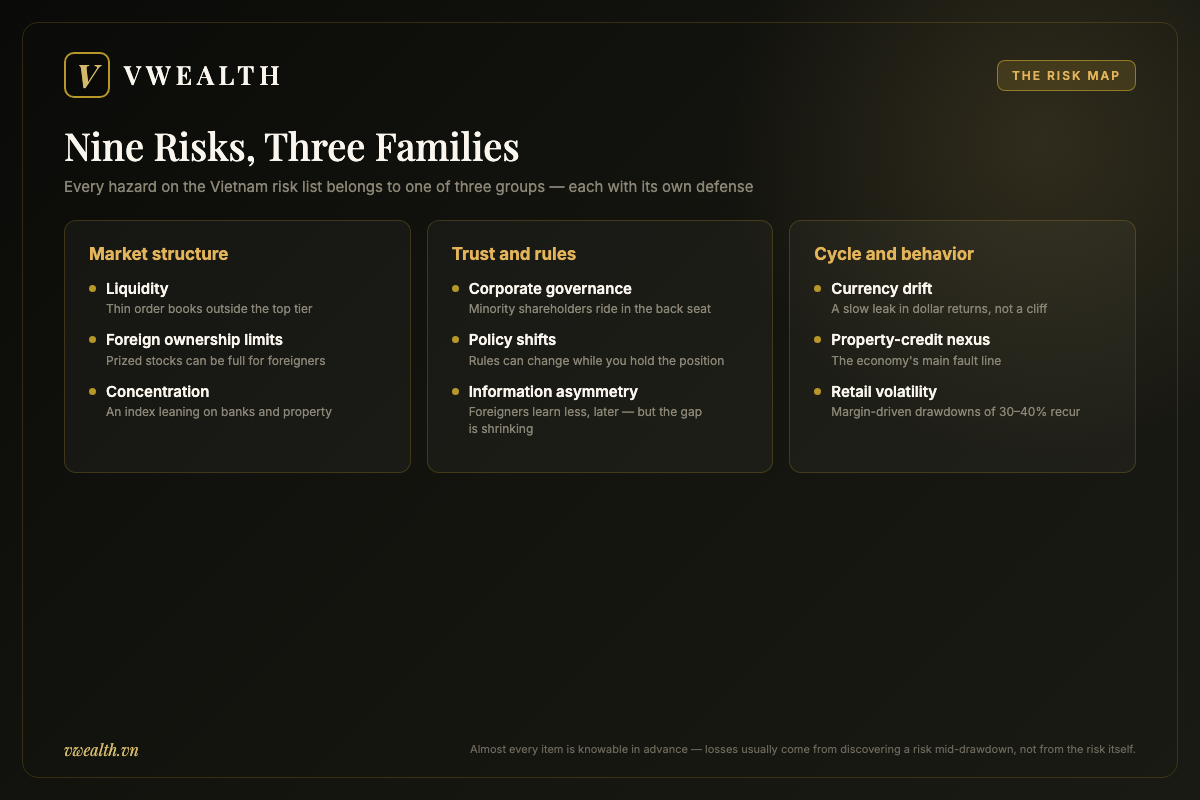
Every emerging market has a sales pitch, and Vietnam’s practically writes itself: young population, factories relocating from China, a growing middle class, decades of strong GDP growth. What the pitch leaves out is the bill. The risks of investing in Vietnam are real, structural, and mostly knowable in advance — a slowly depreciating currency, thin liquidity outside the biggest names, foreign ownership caps that lock you out of the best banks, an index dominated by two sectors, uneven corporate governance, rules that change mid-game, a property-credit knot at the heart of the financial system, retail-driven volatility, and an information gap that puts foreigners a step behind. This guide walks through all nine honestly: how serious each one actually is, how experienced investors manage it, and why, taken together, these risks are not a reason to walk away — they are the reason the growth premium exists at all.
Why You Should Read the Risk List Before the Growth Story
There is a simple test for any investment pitch: does it spend as much time on what can go wrong as on what can go right? Most material about Vietnam fails that test. It leads with GDP charts and demographic pyramids, and treats risk as a footnote. That is a disservice, because the investors who lose money in frontier and emerging markets are rarely the ones who knew the risks and sized their positions accordingly. They are the ones who discovered the risks in real time, usually during a drawdown, and sold at the worst possible moment.
A quick definition before we start. The growth premium is the extra return investors demand for putting money into a faster-growing but riskier market instead of a developed one. It is not free money. It is compensation — payment for accepting currency drift, liquidity gaps, governance surprises, and policy shifts that investors in the United States or Japan mostly do not face. If Vietnam offered American-style investor protections with double-digit earnings growth, its stocks would not trade at frontier-market valuations. The discount and the risk are two sides of the same coin.
This article assumes you already understand the basic mechanics of the market — the exchanges, the trading account, the settlement rules. If you do not, start with our step-by-step guide on how to invest in the Vietnam stock market as a foreigner and come back. Here, the job is different: a sober inventory of what can hurt you, and what to do about each item.
The table below is the map for everything that follows. Each risk gets its own section with the honest version — how real it is, illustrated with history rather than hype — and the first-line mitigation.
| Risk | How real is it? | First-line mitigation |
|---|---|---|
| Currency depreciation | Persistent but gradual; a slow leak, not a cliff | Think in total return; expect a small annual drag |
| Liquidity | Serious outside the top tier of stocks | Stay in liquid names; size positions to daily turnover |
| Foreign ownership limits | Binding in banks and several prized sectors | Know the room before you research; consider ETFs |
| Concentration | High — the index leans heavily on banks and property | Diversify deliberately across sectors; cap single-sector weight |
| Corporate governance | Uneven; improving but with periodic scandals | Red-flag checklist; favor a governance track record |
| Policy and regulation | Rules genuinely change, sometimes abruptly | Never build a thesis on the regulatory status quo |
| Property-credit linkage | Systemic; the economy’s main fault line | Understand your indirect exposure through banks |
| Retail-driven volatility | Large; drawdowns of 30-40% happen | Long horizon, staggered buying, no margin |
| Information asymmetry | Real but shrinking with better tools | Go to primary filings; use translation and analysis platforms |
Currency Risk: The Slow Leak in Dollar Returns
Start with the risk that affects every single position you will ever hold, no matter how well you pick stocks. Vietnamese shares are priced, traded, and paid out in Vietnamese dong. If your wealth is ultimately measured in dollars, euros, or yen, the exchange rate sits between you and every return you earn.
The dong operates under a managed float — the State Bank of Vietnam (SBV) sets a daily central reference rate and allows trading within a band around it (widened to roughly ±5 percent in recent years), intervening with its foreign-currency reserves when the rate drifts too far. In practice, this regime has produced a distinctive long-run pattern: gradual, controlled depreciation against the US dollar. Over the past two decades the dong has drifted from the mid-teens of thousands per dollar to the mid-twenties of thousands — trading around 26,000–26,300 per dollar by mid-2026. Averaged out, that is roughly one to three percent of value lost against the dollar per year — with occasional years of near-stability and occasional years of faster slippage when the dollar is globally strong, as in 2024–2026 when the pair pushed to successive record highs.
Why does this matter so much? Because currency and stock returns multiply rather than add. An illustrative example with round numbers: suppose your Vietnamese stock gains 12 percent in dong over a year, and the dong loses 3 percent against the dollar over the same period. Your dollar return is not 12 minus 3. It is 1.12 × 0.97 − 1, which comes to about 8.6 percent. The currency did not just subtract from your gain; it took a percentage cut of your entire ending position.
How real is this risk? Very real, but honest framing matters: it is a slow leak, not a cliff. The dong has historically avoided the violent devaluations seen in some other developing economies, precisely because it is actively managed and backed by intervention. The risk is not that you wake up to a currency collapse. The risk is that over ten years, a couple of percent of annual drag quietly compounds into a meaningful bite out of your dollar returns — and that most retail investors have no practical way to hedge it, because there are no accessible retail hedging instruments for the dong and the cost of professional hedges tends to eat the benefit.
The mitigation is therefore not a product but a mindset. Underwrite your Vietnam investments in total-return terms: demand enough expected upside from the stocks themselves that a modest annual currency drag still leaves the trip worthwhile. We cover the mechanics, the history, and the honest math in depth in our dedicated guide to Vietnamese dong currency risk for USD-based investors.
Liquidity Risk: The Exit Is Narrower Than the Entrance
Liquidity is the ability to buy or sell an asset quickly without moving its price. It is the risk investors think about least on the way in and most on the way out — because getting into a position is easy when markets are calm, and getting out is hard precisely when everyone else wants out too.
Vietnam’s market has a distinctive liquidity profile. Total daily trading value can look respectable in aggregate, but it is heavily concentrated in a top tier of large, well-known stocks. Step outside that tier and order books thin out fast. A mid-cap stock might trade actively for months during a bull phase and then see volumes shrivel when sentiment turns, leaving you holding a position you cannot exit at any reasonable price.
Two structural features make this sharper than in developed markets. First, daily price limits: a stock on the Ho Chi Minh exchange can move at most about 7 percent from its reference price in a single session (10 percent in Hanoi, 15 percent on the UPCoM board). In a panic, a stock does not crash 30 percent in a day — it goes limit-down with a wall of sell orders and no buyers, and it can do so for several consecutive sessions. During those sessions your sell order simply does not fill. You watch the loss deepen day after day while being mechanically unable to act. Second, settlement runs on a T+2 cycle — since the Ho Chi Minh exchange migrated to the new KRX trading system in May 2025, sold shares and the matching cash typically land in the account around midday on the second business day after the trade (a shift to T+1 is on the official roadmap for later in 2026) — so a successful sale still does not give you same-day cash.
How real is this risk? For large-cap investors, modest — the biggest banks, conglomerates, and consumer names trade enough that ordinary retail positions move through easily. For anyone venturing into small caps, it is one of the most dangerous risks on this list, because it compounds every other risk: a governance scandal or a margin-driven selloff becomes far more damaging when you cannot exit.
The mitigation is mechanical and boring, which is why it works. Stay in liquid names as a foreigner, especially at the start. Before buying, look at a stock’s average daily trading value and size your position so that you could realistically exit within a few sessions without being a large share of the volume — a common rule of thumb among professionals is to hold no more than a small multiple of a stock’s daily turnover. And treat limit-down mechanics as a known feature of the terrain: if you would panic watching a stock locked limit-down for three days, size the position so you will not have to.
Foreign Ownership Limits: When the Best Stocks Are Sold Out
Here is a risk that surprises almost every newcomer: in Vietnam, you can identify a great company, open your account, fund it, place your order — and be told that foreigners are simply not allowed to buy more. This is the foreign ownership limit, usually abbreviated FOL: a legal cap on the combined percentage of a company’s shares that all foreign investors together may hold.
The caps vary by sector. Banks are the tightest, with total foreign ownership capped at 30 percent (a narrow exception lets weak banks under mandatory restructuring take foreign stakes up to 49 percent). Many businesses in so-called conditional sectors default to 49 percent. Some companies in unrestricted industries have lifted their caps toward 100 percent — but plenty of others deliberately keep caps low to protect control. The practical consequence is that many of the most attractive stocks in the market, particularly the well-run banks that foreign institutions favor, are effectively full: the foreign quota is exhausted, and a foreigner can only buy when another foreigner sells.
This creates real distortions. Shares in full stocks sometimes change hands between foreign institutions off-exchange at a foreign premium — a price above the local market price, reflecting the scarcity of foreign room. Retail foreign investors generally cannot access those deals. So the honest version of this risk is not that FOLs will lose you money directly; it is that they shrink your opportunity set and can lock you out of exactly the companies your research points to, pushing you toward second-choice ideas.
How real is it? Binding and daily, but fully knowable in advance — which makes it the most manageable risk on this list. Foreign room is published data; the remaining quota for any stock can be checked before you spend a single hour on research. The two practical mitigations follow directly. First, check the room first and let it filter your research pipeline, not interrupt it. Second, know that fund structures can hold what you cannot: ETFs and certain funds have ways to carry exposure to full stocks, so the indirect route sometimes reaches where a direct order cannot. The full mechanics — which sectors are capped where, how room is calculated, and how funds work around it — are in our guide to Vietnam’s foreign ownership limits.
Concentration Risk: One Index, Two Sectors
Diversification is the closest thing investing has to a free lunch, and Vietnam quietly takes part of it off the table. The VN-Index is not a balanced cross-section of a modern economy. It leans heavily on two interlinked sectors — banking and real estate — with bank stocks alone routinely accounting for around 40 percent of the VN-Index, a weight that would be unthinkable in a developed benchmark, and property adding a large slice on top. Technology, healthcare, and globally competitive manufacturing exist in the economy but are thinly represented among listed companies, partly because some of the economy’s most dynamic firms are foreign-owned factories or unlisted private companies.
Think about what this means in practice. Buy a broad Vietnam index product and you have made, whether you intended to or not, a leveraged bet on the health of Vietnamese banks and the property market they lend to. When credit flows and land prices rise, the index flies. When the property sector seizes up — as it periodically does — the index does not decline politely; it gets hit through the banks, the developers, the brokers, and the steel and construction companies all at once, because they are all exposed to the same underlying cycle.
There is a second layer: single-country concentration. Vietnam is one economy, one currency, one policy regime. A domestic credit squeeze, a bad year for exports, or a regional shock hits everything on the exchange simultaneously. Correlations inside a single frontier market rise sharply during stress — exactly when you want diversification, it evaporates.
How real is this risk? Structural and permanent, at least on a horizon of years. You cannot diversify away what is not listed. The mitigations are honest rather than clever. Inside your Vietnam allocation, diversify deliberately: cap any single sector — including the tempting bank-property complex — at a weight you choose in advance, and own genuinely different business models (consumer staples, utilities, industrials, exporters) even if they are less exciting. Outside it, keep the whole Vietnam position at a size that respects the single-country concentration — a topic we return to in the playbook section below.
Corporate Governance: Minority Shareholders Ride in the Back Seat
Corporate governance is the set of rules and habits that determine whether a company is run for all shareholders or mainly for the people in control. In Vietnam, the honest assessment is: it varies enormously, the average is improving, and the tail risk is still material.
The structural issue is ownership. Many listed companies are controlled by a founding family, a chairman with a dominant stake, or the state. Minority shareholders — which is what you will be — ride in the back seat. Most controlling owners drive responsibly. Some do not, and the ways they extract value are well-catalogued: related-party transactions that shift profits to private companies owned by insiders; dilutive share issuances priced below fair value and placed with friendly parties; shares pledged as loan collateral that get force-sold in a downturn, crashing the price; and, at the criminal end, outright market manipulation.
That last item is not hypothetical, and the recent record is specific. In August 2024 a Hanoi court sentenced Trinh Van Quyet, the former chairman of the FLC Group, over stock-market manipulation and fraud tied to inflating and dumping FLC-linked shares (his terms were partly reduced on appeal in 2025). Larger still, one of the biggest financial fraud cases in the country’s history unfolded around the Van Thinh Phat property group and Saigon Commercial Bank (SCB): chairwoman Truong My Lan was sentenced to death in 2024 — a verdict upheld on appeal in December 2024 — for a scheme centered on illegally controlling SCB, with damages that Vietnamese courts put in the region of 12 billion US dollars, close to 3 percent of the country’s 2022 GDP. The parallel bond-fraud fallout hit tens of thousands of retail bondholders. The lesson is that governance failures in Vietnam are not confined to obscure penny stocks; they have reached companies that were, at the time, household names with large market capitalizations. (See, for example, Al Jazeera’s report on the SCB verdict.)
Now the balance: the trajectory is genuinely positive. Regulators have tightened disclosure rules, criminal enforcement has visibly increased (the convictions above are themselves evidence of enforcement, not just of misconduct), and the push toward an emerging-market upgrade creates sustained official pressure to raise standards. A growing cohort of Vietnamese companies actively courts institutional investors with better boards, English-language disclosure, and international-standard audits.
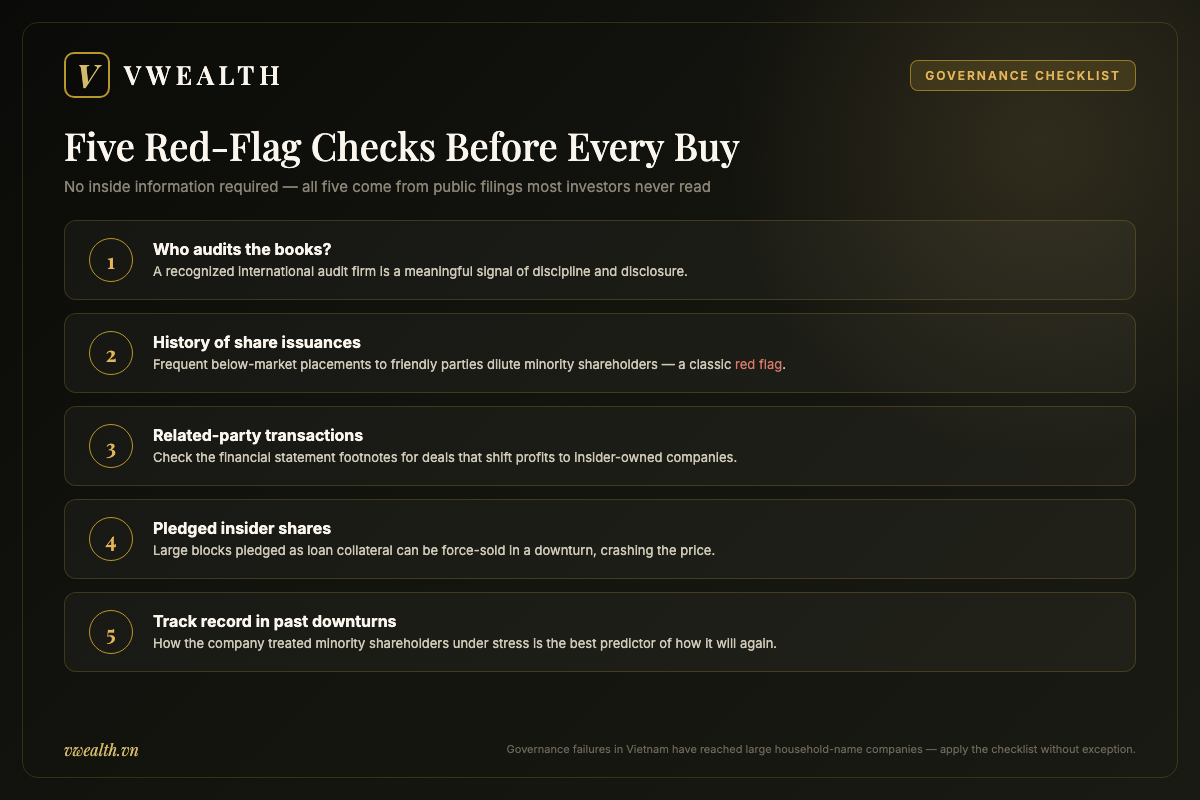
The mitigation is a checklist, applied without exceptions. Before buying, look at: the auditor (a recognized international firm is a meaningful signal); the history of share issuances (frequent below-market placements are a red flag); related-party transactions in the financial statement footnotes; whether insiders have pledged large blocks of shares; and how the company treated minority shareholders in past downturns. None of these checks requires inside information — they require reading filings, which most retail investors skip. We go deeper on each red flag in our guide to corporate governance in Vietnamese listed companies.
Policy and Regulatory Shifts: The Rules Can Change Mid-Game
In developed markets, regulatory change is slow, telegraphed, and litigated. In Vietnam, policy is an active instrument, used quickly and sometimes bluntly. This is not dysfunction — it is how a state-led development model works — but it means the rules of the game you invested under can change while you hold the position.
History offers clean illustrations. In September 2022, the government issued Decree 65/2022/ND-CP, abruptly tightening the rules for private corporate bond issuance after discovering abuses at issuers such as Tan Hoang Minh and Van Thinh Phat. The tightening was justified — real fraud had occurred — but the speed of it froze the corporate bond market almost overnight, cutting off refinancing for property developers and triggering a chain reaction that helped push the VN-Index down roughly 40 percent from its early-2022 peak (from around 1,530 points to below 900 by November that year). Investors who held perfectly legitimate developers and banks took the hit alongside those who held the bad actors. Similarly, credit growth in Vietnam has long been managed through administrative quotas assigned to banks — a lever the state can pull at any time, directly changing bank earnings prospects with a policy memo rather than a market process.
There is a flip side that honesty requires stating: policy risk in Vietnam runs in both directions. The same activist state has spent years driving reforms explicitly designed to help investors. Circular 68/2024/TT-BTC, in force from November 2024, removed the requirement that foreign institutional buyers pre-fund their trades — long the single biggest complaint of global investors. The Ho Chi Minh exchange migrated to the modern KRX trading system in 2025. And that reform push delivered the headline result: on 7 October 2025 FTSE Russell announced it would upgrade Vietnam from Frontier to Secondary Emerging Market status, and after its March 2026 review confirmed the change effective from the market open on 21 September 2026, with index inclusion phased in over 2026–2027. MSCI, the other big index provider, is more cautious: as of its 2026 review Vietnam was still classified as a frontier market and had not even been placed on MSCI’s watch list for a potential upgrade, so a second reclassification is a later-decade prospect at best. Anyone who avoided Vietnam because rules can change also missed the rule changes that improved it — but note that an upgrade cuts both ways for holders, since it re-rates the market while also inviting new foreign flows and new scrutiny. Check the current status of the classification story when you read this; it is still evolving.
How real is the risk? Real, recurring, and impossible to predict in timing. The mitigation is a principle: never build an investment thesis that depends on the regulatory status quo persisting. If your case for a bank requires credit quotas to stay loose, or your case for a developer requires bond rules to stay permissive, you do not have a thesis about a business — you have a bet on a policy, and policies in Vietnam move fast. Prefer companies that would remain solid businesses across a range of plausible regulatory settings, and treat any position whose upside is mostly a hoped-for rule change as speculation, sized accordingly.
The Property-Credit Nexus: Why Real Estate Trouble Becomes Everyone’s Trouble
If you learn one structural fact about the Vietnamese economy, make it this one: real estate and the banking system are joined at the hip, and together they form the market’s main fault line.
The linkage runs through several channels at once. Banks lend heavily to property developers and to households buying property. Land and real estate are the dominant form of loan collateral across the economy — so when property prices fall, the security behind a vast range of loans, even loans to unrelated businesses, weakens simultaneously. Developers borrowed heavily through the corporate bond market, and banks and bank customers hold those bonds. And property is the preferred savings vehicle for Vietnamese households, so a property downturn dents consumer confidence and spending too. Trouble that starts in real estate does not stay in real estate; it flows through the credit system into everything.
The 2022–2023 episode showed the whole mechanism in motion. Bond-market tightening plus rising rates cut developers off from refinancing. Projects stalled. Property transactions dried up. Banks faced rising bad-debt concerns and their shares fell hard even where their direct developer exposure was modest, because investors could not easily tell who was exposed to what. A crisis in one sector repriced the entire index. The government eventually responded with a series of support measures — including a decree that let issuers reschedule bond payments — and the system worked through the stress. But investors lived through a VN-Index drawdown of roughly 40 percent peak to trough along the way, and the episode echoed the property-bank crisis of 2011–2012, when a previous property bust left thousands of real-estate firms loss-making and saddled banks with bad debt that took years to clean up.
How real is this risk today? It is permanent in structure and cyclical in intensity. The property-credit cycle will turn again — the honest question is not whether but when, and nobody reliably knows when. The mitigation is to understand your indirect exposure. Many investors who think they avoided property risk by skipping developer stocks hold large bank positions, which are the same bet one step removed. When you own a Vietnamese bank, ask: how much of its loan book touches real estate, directly or through collateral? What happened to its bad-debt ratio in the last property downturn? You will not get perfect answers, but the exercise itself — thinking of banks and property as one linked exposure — is the protection.
Retail-Driven Volatility: A Market That Trades on Emotion at the Margin
Ask who is on the other side of your trade in Vietnam, and the answer is usually: an individual. Retail investors account for the overwhelming majority of daily trading value — figures reported for 2024 put them at over 80 percent of market turnover, roughly the inverse of developed markets where institutions dominate. Millions of new trading accounts were opened during the 2020–2021 boom alone, many by first-time investors.
This composition changes how the market behaves. Institutions are not saints, but they tend to trade on models, mandates, and long horizons, which dampens swings. A retail-dominated market trades on stories, momentum, social media groups, and — critically — margin loans. Margin lending, where brokers lend investors money against their stock holdings to buy more stock, acts as an accelerant in both directions. In a rally, margin balances swell and buying feeds on itself. Then a shock hits, prices fall, and investors who borrowed receive margin calls — demands to add cash or have their shares force-sold. Forced selling pushes prices down further, triggering the next round of margin calls. This spiral, interacting with the daily price limits described earlier, is how Vietnamese stocks end up locked limit-down for days: a cascade of forced sellers and no bids.
The historical record is unambiguous. The market fell roughly two-thirds in the 2008 crisis. It dropped about a third in early 2020 in the pandemic panic, then more than doubled into 2021 as new retail money flooded in, then gave back roughly 40 percent in 2022 when the bond and margin cycle unwound. These are not once-a-generation anomalies; drawdowns of 30 to 40 percent are a recurring feature of this market’s personality. The upswings can be just as dramatic — the VN-Index closed 2025 up roughly 41 percent as the emerging-market upgrade came into view — which is precisely the point: the same retail-and-margin machinery that manufactures the crashes also powers the melt-ups. Anyone investing in Vietnam should expect to live through at least one severe drawdown per decade, probably more.
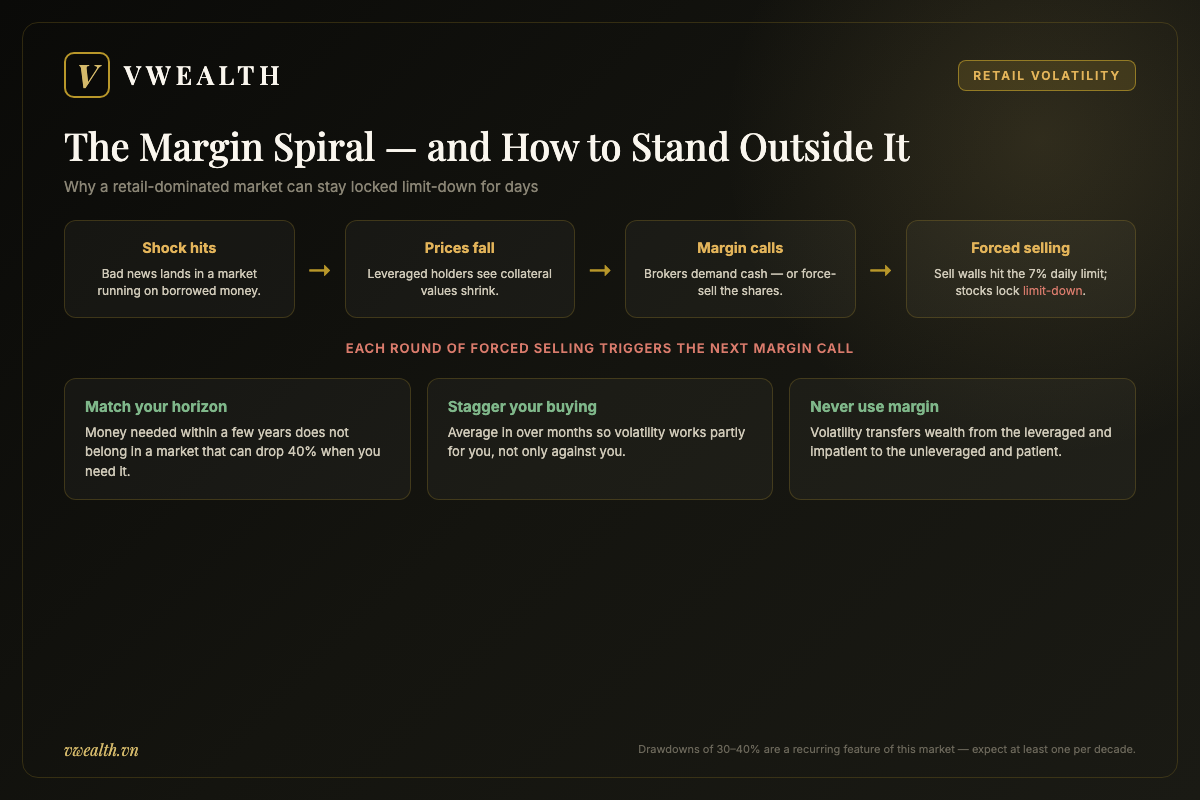
How do you mitigate a risk that is woven into the market’s DNA? Three ways, all behavioral. First, match your horizon to the volatility: money you might need within a few years does not belong in a market that can be down 40 percent when you need it. Second, stagger your buying rather than investing a lump sum at a single moment — averaging in over months means volatility works partly for you instead of only against you. Third, and least negotiable: do not use margin. The retail investors destroyed in 2022 were rarely the ones who merely watched their stocks fall; they were the ones whose leveraged positions were force-sold at the bottom, converting a temporary drawdown into a permanent loss. Volatility only transfers wealth from the leveraged and impatient to the unleveraged and patient. Choose your side of that transfer.
Information Asymmetry: Reading a Market in a Language You Do Not Speak
The final risk is the quietest: as a foreigner, you will usually know less, later, than local investors do. This gap has several distinct layers, and it is worth separating them because they have different fixes.
The first layer is language. Official disclosure is in Vietnamese; English versions, where they exist at all, often arrive later, cover less, and read like rough translations. Analyst coverage in English concentrates on a few dozen large caps, leaving hundreds of listed companies effectively unresearched in your language. The second layer is accounting. Vietnamese companies report under Vietnamese Accounting Standards (VAS), which differ from the international IFRS framework in areas like asset revaluation and provisioning — so ratios you compute from VAS statements are not directly comparable to those of companies elsewhere, and the country’s transition toward IFRS has been a long, gradual project. The third layer is informal: a great deal of market-moving context in Vietnam travels through local news, broker chatter, and social channels in Vietnamese, hours or days before it surfaces in English, if it ever does.
How real is this risk? Real, but it is the one risk on this list that has clearly shrunk over time, and keeps shrinking. Machine translation has become good enough to read Vietnamese filings and news directly. Disclosure requirements have tightened. And a new generation of analysis platforms now processes Vietnamese-language filings and market data into structured English research — closing, at least partly, a gap that a decade ago required hiring a local analyst. That is precisely the problem vwealth was built for: our AI reads Vietnamese financial statements and market data at the source and produces full English analysis reports, so a foreign investor works from the same primary documents a local professional does. You can create a free account and see what that looks like on a company you already know.
Whatever tools you use, the principle of mitigation is the same: move toward primary sources and away from secondhand narrative. An investor who reads actual filings — even through translation — has a durable edge over one who relies on English-language headlines, because headlines about Vietnam are few, late, and written for readers who will never buy a share. In a market where information is unevenly distributed, doing the reading is not a chore; it is the edge.
A Practical Playbook for Managing the Risks of Investing in Vietnam
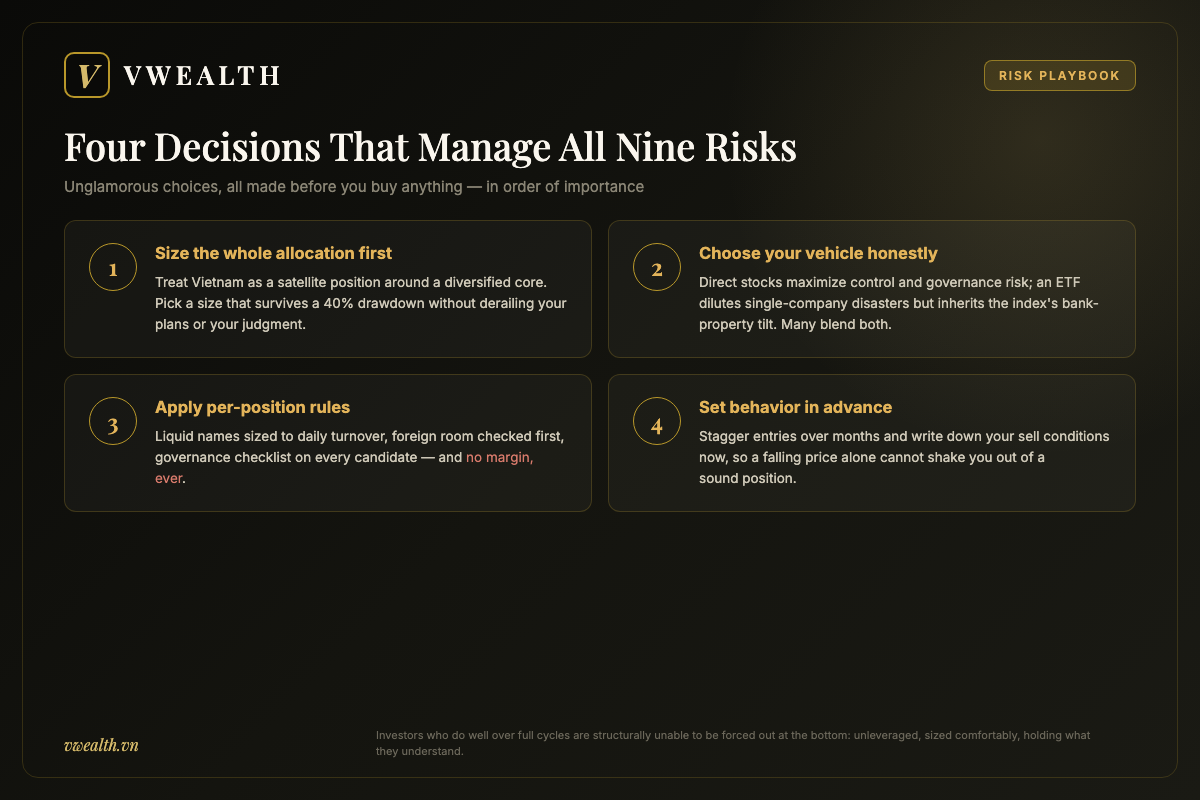
Nine risks make an intimidating list. But notice what they have in common: almost every one is managed by the same small set of unglamorous decisions, made before you buy anything. Here is the playbook, in order of importance.
Size the whole allocation first
The single most protective decision is how much of your total portfolio goes to Vietnam at all. A common approach among international investors is to treat a single frontier or emerging market as a satellite position — a small slice, often in the range of a few percent up to perhaps ten percent of a portfolio, around a diversified core. The test is emotional as much as financial: choose a size such that a 40 percent Vietnam drawdown — which history says you should expect eventually — dents your portfolio without derailing your plans or your judgment. If a bad year in Ho Chi Minh City would keep you up at night, the allocation is too big, regardless of how good the story is.
Choose your vehicle honestly
The second decision is direct stocks versus a fund or ETF — and it deserves more honesty than it usually gets. Direct ownership maximizes control and potential reward, but it also maximizes your exposure to the governance, liquidity, and information risks above. An ETF diversifies away single-company disasters and solves the foreign-ownership-room problem, but it concentrates you in exactly the bank-heavy index profile described earlier, and it keeps the currency and country risks in full. There is no right answer, only an honest match to your time and skills:
| Factor | Direct stocks | ETF / fund route |
|---|---|---|
| Single-company governance risk | Full exposure — your checklist is the defense | Diluted across dozens of holdings |
| Foreign ownership limits | Binding; best banks may be inaccessible | Largely solved via fund structures |
| Liquidity of your position | Depends on each stock you pick | Generally good in major listed funds |
| Sector concentration | You control it deliberately | You inherit the index’s bank-property tilt |
| Currency and country risk | Full exposure | Full exposure — no escape here |
| Research burden | High — filings, translation, monitoring | Low |
| Potential to beat the market | Exists, for those who do the work | None by design |
Many experienced investors blend the two: an ETF core for broad exposure, plus a handful of directly held, thoroughly researched, liquid large caps where they believe they have genuine insight. That structure caps the damage any single mistake can do while preserving the upside of doing real work.
Apply the per-position rules without exception
For the direct portion, the earlier sections compress into five standing rules. Stay in liquid names, sized against daily turnover. Check foreign room before researching. Run the governance red-flag checklist on every candidate — auditor, issuance history, related parties, pledged shares. Cap the bank-property complex at a predetermined share of the allocation. And never, at any point, on any conviction level, buy with borrowed money.
Set behavior in advance
Finally, decide now what you will do in the drawdown, because you will not decide well during it. Stagger your entries over months. Write down the conditions under which you would sell — a governance red flag appearing, a thesis breaking — so that a falling price alone, which in this market often means nothing more than a margin cascade, does not shake you out of a sound position. The investors who have done well in Vietnam over full cycles are, almost uniformly, the ones who were structurally unable to be forced out at the bottom: unleveraged, sized comfortably, and holding companies they actually understood.
Why These Risks Are the Price of the Growth Premium
After nine sections of hazards, a fair question: why invest in Vietnam at all? The answer requires holding two ideas at once, and it is the most important idea in this article.
The risks and the opportunity are not two separate facts about Vietnam that happen to coexist. They are the same fact. Vietnamese stocks have historically traded at valuations well below comparable companies in developed markets — and often below regional emerging-market peers — precisely because of everything described above. The currency drag, the governance uncertainty, the policy surprises, the volatility: each one is a reason some pool of global capital stays away, and every investor who stays away is a buyer the market does not have. Lower demand, lower prices, higher prospective returns for those who do show up. That discount is the growth premium in its raw form. You are not paid extra in Vietnam despite the risks. You are paid extra for carrying them.
This framing has a practical corollary that most commentary misses: risk reduction in Vietnam is itself an investment thesis. Every durable improvement — governance enforcement that puts manipulators in prison, infrastructure that removes pre-funding requirements, the FTSE Russell upgrade to Secondary Emerging status taking effect in September 2026, the longer road toward an MSCI upgrade, IFRS adoption, better English disclosure — shrinks the discount and re-rates the market upward for those who owned it before the improvement was priced in. Investors who waited for Vietnam to become safe will, by definition, buy it after the premium for its unsafety has been paid out to someone else. That is not an argument for recklessness. It is an argument for exactly what this guide has described: enter with eyes open, sized correctly, compensated for risks you understand — rather than either ignoring the risks or being scared off by a list you never examined closely.
And the list deserves one final honest note: it is not static. Two of the nine risks — information asymmetry and market infrastructure-related policy risk — have measurably improved over the past decade. Others, like the property-credit nexus and retail-driven volatility, are as alive as ever. Rereading this list once a year, and asking which items have genuinely changed, is itself one of the better research habits a Vietnam investor can build.
The Bottom Line on the Risks of Investing in Vietnam
Vietnam offers one of the more compelling long-term growth stories available to public-market investors, and it charges for admission in the form of nine identifiable risks: a slowly depreciating currency, thin liquidity outside the top tier, foreign ownership limits on prized stocks, heavy index concentration in banks and property, uneven corporate governance, fast-moving policy, a systemic property-credit linkage, violent retail- and margin-driven cycles, and an information gap for foreigners. None of these is a secret, none is unmanageable, and none is free to ignore.
The management tools are equally identifiable: a satellite-sized allocation, an honest choice between direct stocks and funds, liquid names checked for foreign room, a governance checklist applied without exception, deliberate sector diversification, staggered entries, a total-return view of currency, primary-source research, and zero leverage. Investors who apply that list are not eliminating the risks — nobody can — but they are ensuring the risks they carry are the ones they are being paid for, rather than the ones they never noticed.
This article is a general analysis for educational purposes and is not investment advice or a recommendation to buy or sell any security; always do your own research and consider your personal circumstances.
Research Vietnamese stocks in English with vwealth. Our AI-powered platform turns Vietnamese market data into full English analysis reports — with international payment support and a free 2-month trial for new accounts. Create your free account and read the latest reports.