Vietnam manufacturing is the reason the country grew 8.02% in 2025 and 8.18% in the first half of 2026 — and it is also the part of the economy that the stock market shows you least of. The biggest factories here are owned by unlisted foreign companies. Understanding that gap is the whole game. This guide sets out what Vietnam’s manufacturing sector actually is (share of output, export mix, where the capital is landing), where the factories physically are, and then maps that economy onto the HOSE, HNX and UPCoM sectors and tickers that give a foreign investor tradeable exposure to it. This is an educational mapping of businesses and cash-flow drivers, not a recommendation to buy or sell any security, and it contains no price targets.
Why manufacturing matters more here than almost anywhere else
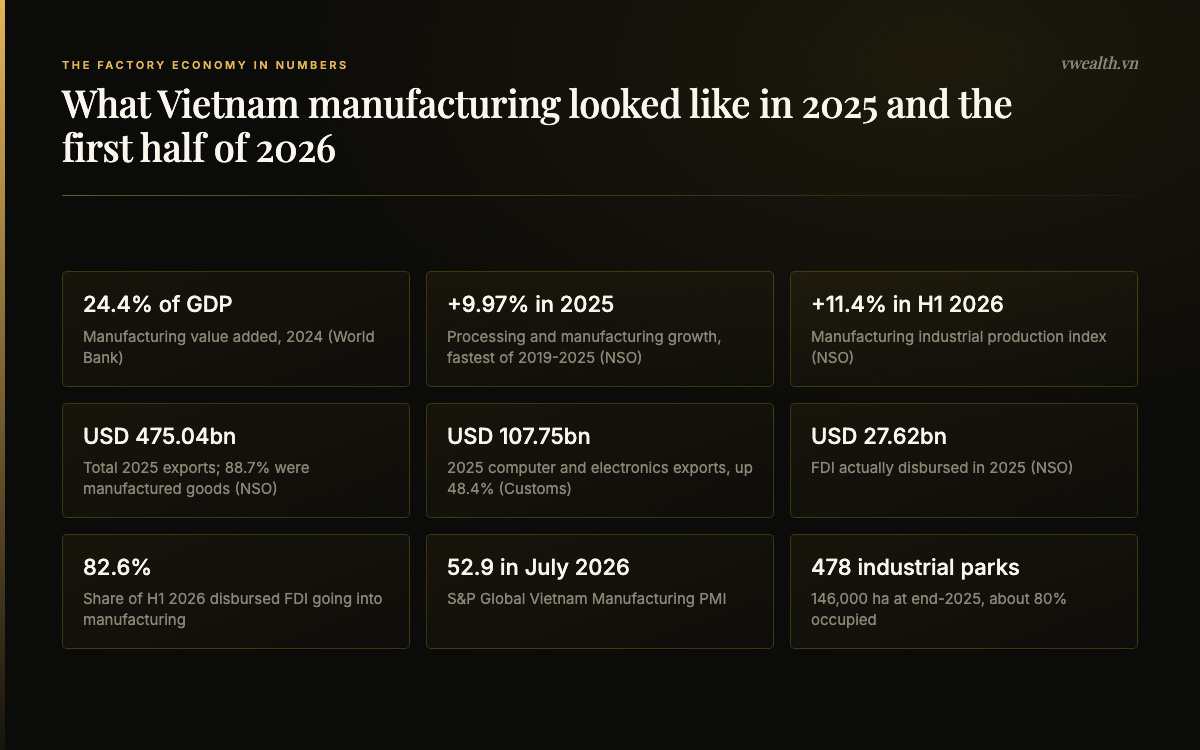
Vietnam is one of the most manufacturing-intensive economies on earth relative to its income level. World Bank data puts manufacturing value added at 24.43% of GDP in 2024 — a share higher than that of Germany, Japan or South Korea at comparable stages, and roughly double the United States (World Bank, Manufacturing value added, % of GDP). Add construction, mining and utilities and the whole industry-and-construction block grew 8.95% in 2025 (National Statistics Office, Q4 and full-year 2025 report).
That concentration cuts both ways. It means Vietnamese growth is unusually legible: you can watch a single monthly survey and a single trade release and know most of what you need to know about the direction of the economy. It also means Vietnamese growth is unusually exposed. When a large trading partner changes its tariff schedule, or a global electronics cycle turns, it hits here faster and harder than it would in a services-led economy. If you want the wider macro frame around this, our companion piece on the Vietnamese economy in 2026 covers the growth model, and how GDP growth translates into stock market returns deals with the transmission mechanism directly — because the link is a lot weaker than most newcomers assume.
The key structural fact, which the rest of this article keeps returning to: the manufacturing economy and the listed equity market overlap only partially. Vietnam’s largest export category is electronics, and its largest exporters of electronics are foreign-invested enterprises with no Vietnamese listing. You cannot buy them on the Ho Chi Minh Stock Exchange. What you can buy are the businesses that serve them, supply them, house them and ship for them — plus the domestic industrial companies operating alongside them. That is a real investment thesis, but it is a different one from “buy Vietnamese manufacturing”.
The size of the factory economy: what the 2025 and 2026 data actually say
Output and growth
Vietnam’s National Statistics Office reported GDP growth of 8.02% for 2025, with processing and manufacturing expanding 9.97% — the fastest rate recorded in the 2019 to 2025 period — and the NSO attributes 31.49% of the whole economy’s value-added growth to that one sub-sector. The broader index of industrial production (IIP) rose 9.2% in 2025, with the manufacturing component up 10.5% and contributing 8.4 percentage points of that total (National Statistics Office).
The momentum carried into 2026. First-half GDP growth came in at 8.18%, ahead of the 7.63% recorded in the same period of 2025, with second-quarter growth of 8.39% (VietnamNet, citing the National Statistics Office). The IIP rose 10.8% over the six months, described as the strongest first-half reading since 2019, with the manufacturing sub-index up 11.4% (Vietnam Briefing, H1 2026 review of NSO data).
The higher-frequency read comes from the S&P Global Vietnam Manufacturing PMI, a monthly survey of purchasing managers where 50 marks the line between expansion and contraction. It stood at 51.8 in June 2026, capping a twelfth consecutive month above the no-change mark (VietnamPlus, citing S&P Global), then rose to 52.9 in July 2026 (Trading Economics, S&P Global series). The series is not a smooth line — it dipped to a seven-month low of 50.5 in April 2026 before recovering — which is a useful reminder that Vietnamese factory demand is order-driven and can turn within a quarter.
Exports: enormous, and enormously concentrated
Total merchandise exports reached USD 475.04 billion in 2025, of which manufactured goods accounted for USD 421.47 billion, or 88.7% of the total (National Statistics Office). Vietnam is, by this measure, an exporter of finished and semi-finished manufactured goods and very little else.
Within that, one category dominates. Exports of computers, electronic products and components hit USD 107.75 billion in 2025, up 48.4% year on year — an increase of USD 35.15 billion that on its own accounted for more than half of the growth in Vietnam’s total export turnover for the year (VietnamPlus, citing Vietnam Customs). Phones and components, machinery and equipment, textiles and garments, and footwear each also cleared USD 10 billion in the first half of 2026 (Vietnam Briefing).
Textiles and garments — the sector most people picture when they think of Vietnamese manufacturing — is now the junior partner. Industry projections put 2025 textile and garment exports at around USD 46 billion, up 5.6%, with the United States the largest single market at more than USD 18 billion (VietnamNet). Large in absolute terms, but less than half the electronics number and growing at a fraction of the pace.
One number in the 2026 data deserves flagging. In the first half of 2026 Vietnam ran a merchandise trade deficit of USD 16.65 billion, against a surplus of USD 7.6 billion in the first half of 2025, on exports of about USD 266 billion and imports of about USD 283 billion (Vietnam Briefing). Import surges in Vietnam are usually input purchases that precede an export wave, because so much of what the country ships out is assembled from imported components. But a sustained deficit also pressures the currency, and currency is a first-order variable for a foreign investor whose returns are ultimately measured in dollars or euros.
Foreign investment: watch what is disbursed, not what is announced
Vietnam attracted USD 38.42 billion of total registered foreign direct investment in 2025 — newly registered capital, adjusted capital and share purchases combined — while USD 27.62 billion was actually disbursed (National Statistics Office). Manufacturing and processing took the dominant share: USD 9.8 billion of newly registered capital, or 56.5% of the total, and USD 18.59 billion, or 59.2%, once capital adjustments to existing projects are included (VietnamPlus, citing the National Statistics Office).
The first half of 2026 was stronger still: total registered FDI of USD 34.65 billion, up 61.0% year on year, of which USD 17.91 billion (63.0%) went to manufacturing and processing. Realised, or disbursed, FDI reached USD 13.03 billion, up 11.2% and the highest first-half figure in five years, with manufacturing accounting for USD 10.76 billion, or 82.6% (Vietnam Briefing, citing NSO data).
The distinction between registered and disbursed capital is not pedantry, and it is the single most useful discipline you can bring to reading Vietnamese FDI headlines. Registered capital is a commitment on paper, revisable and sometimes never drawn. Disbursed capital is concrete poured, machines installed, and — for the listed companies discussed below — land actually paid for and containers actually moved. When the two diverge sharply, believe the disbursement figure.
China plus one: what genuinely moved, and what did not
The phrase “China plus one” describes a decision multinationals began making in earnest after 2018: keep the Chinese production base, but build a second one elsewhere to hedge tariff and geopolitical risk. Vietnam was the most obvious candidate — a long land border with China, a young workforce, a ports network on the main Asia-Europe and Asia-America shipping lanes, and a government willing to grant tax holidays and clear land.
The evidence that it happened is in the corporate footprints. Samsung had accumulated roughly USD 24 billion of investment in Vietnam by the end of 2025 and planned to add about USD 1 billion in 2026 (TNGlobal). In the first seven months of 2026 Samsung’s Vietnamese operations exported around USD 39 billion of goods, equal to 12.2% of Vietnam’s total merchandise exports of USD 319.53 billion over that period (The Investor). One company, an eighth of national exports. Apple’s supplier base in Vietnam grew from 18 firms in 2016 to more than 35 by 2024 (Vietnam Briefing).
Now the qualifications, because the story is routinely oversold.
First, most of the value being added in Vietnam is assembly. Components, chips, displays and specialised materials are still largely imported, much of it from China, Korea and Taiwan. That is exactly why a booming export month produces a booming import month and why the trade balance can swing so violently. It also means the domestic value captured per dollar of exports is lower than the headline figures suggest.
Second, Vietnam is not the only “plus one”. India has been building an Apple supply chain in parallel and overtook Vietnam in the total number of Apple suppliers during 2025 (Business Standard). Mexico, Thailand, Malaysia and Indonesia all compete for the same relocations. The tailwind is real but it is not proprietary to Vietnam.
Third — and this is the point that matters most for a stock picker — almost none of this relocated capacity is listed in Vietnam. Samsung Electronics Vietnam, Samsung Display Vietnam, Foxconn’s Vietnamese subsidiaries, LG’s Hai Phong complex: all are foreign-invested enterprises. Their profits accrue to shareholders in Seoul, Taipei and elsewhere. The correct way to think about this is that the FDI boom is the demand curve, and the listed Vietnamese companies are the suppliers of inputs to that demand.
Where the factories are: Vietnam’s manufacturing geography
Vietnam ended 2025 with 478 industrial parks covering about 146,000 hectares, with average national occupancy around 80% and rates above 90% in Hanoi, Bac Ninh, Binh Duong and Ho Chi Minh City. The national plan targets roughly 600 parks and 181,000 hectares by 2030, alongside an expansion of smaller industrial clusters from about 1,100 to 2,000 (VietnamPlus, reporting remarks by Vietnam Industrial Zone deputy general director Pham Van Nam at IP Forum 2025).
Those parks cluster into three broad belts.
The northern electronics belt
The provinces ringing Hanoi and running out to the port city of Hai Phong form Vietnam’s electronics heartland. Bac Ninh is the anchor: following the July 2025 merger of Bac Ninh and Bac Giang into a single enlarged province, the territory hosts 32 industrial parks with a combined area of more than 10,384 hectares (Cushman & Wakefield). This is where Samsung’s phone assembly, its supplier ecosystem and a large share of Apple’s Vietnamese vendors sit. Hai Phong provides the deep-water port and a second cluster of parks. Proximity to the Chinese border matters here: components can move by road overnight.
The southern industrial core
Binh Duong and Dong Nai, adjacent to Ho Chi Minh City, are the older industrial base — more diversified, more domestically owned, weighted toward furniture and wood products, footwear, food processing, plastics, rubber and general light industry. Binh Duong hosts more than 31 parks across roughly 12,721 hectares with occupancy near 90%, and Dong Nai over 30 operational parks across about 19,000 hectares with occupancy in the 80% to 85% range (Vietnam Briefing). The south’s advantage is the Cai Mep-Thi Vai deep-water port complex in Ba Ria-Vung Tau, which can handle the largest container vessels calling in Southeast Asia.
The central corridor
The stretch from Thanh Hoa through Da Nang to Quang Ngai is thinner but strategically important: heavy industry, refining and steel. Land is cheaper and less contested than in the two main belts, which is why the largest single industrial projects — the kind that need hundreds of hectares and their own port — tend to land here.
The practical takeaway for an investor is that an industrial park developer is a geographic bet as much as a business bet. A landlord with unsold land in a high-occupancy northern province facing electronics demand is in a different position from one holding land in a province with weak infrastructure and no anchor tenant, even though both trade under the same sector label.
Mapping the factory economy onto the listed market
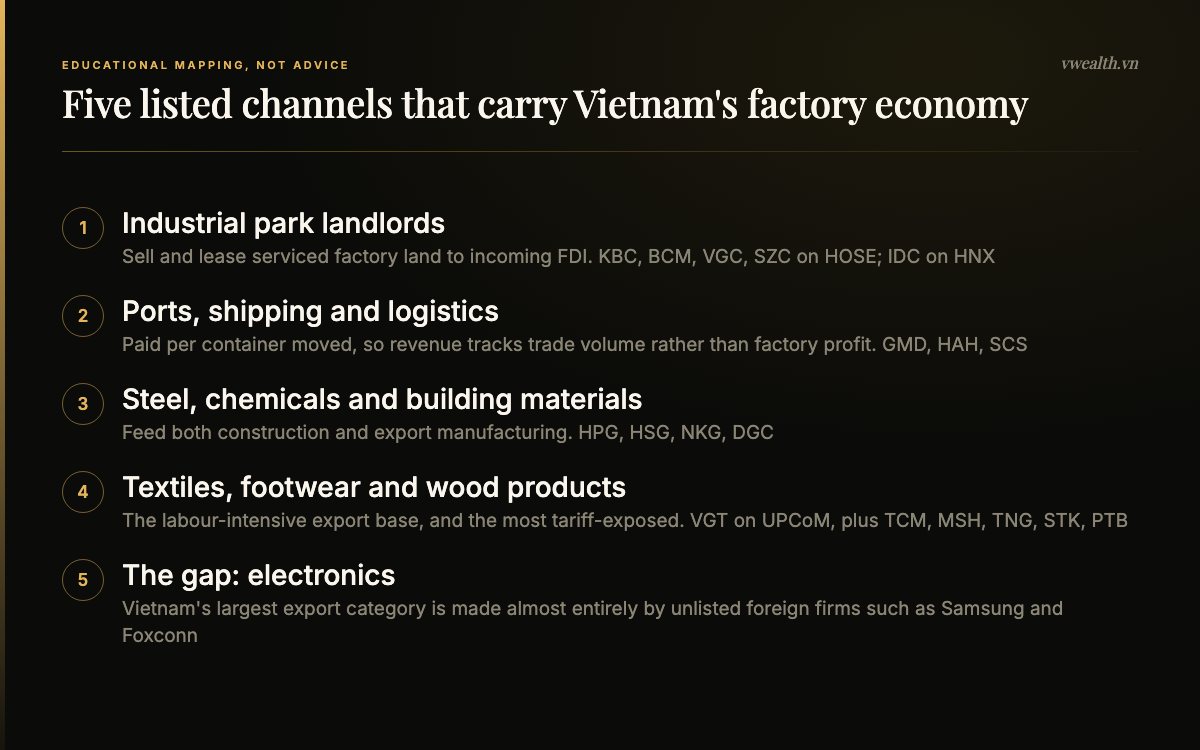
Here is the part that matters for portfolio construction. Vietnam’s manufacturing boom reaches the Ho Chi Minh Stock Exchange (HOSE), the Hanoi Stock Exchange (HNX) and the UPCoM board through four channels, plus one conspicuous gap. If the differences between those three venues are new to you, our guide to HOSE, HNX and UPCoM explains the listing standards and liquidity differences that follow.
Everything below is a factual description of what these businesses do and how they earn. It is not a recommendation, a ranking, or a view on valuation. Listing venues and tickers change; verify current status on the exchange’s own website before acting on anything.
Channel one: industrial park landlords
These companies acquire raw land, obtain permits, build roads, power, water and wastewater treatment, and then sell or lease serviced plots and ready-built factories to incoming manufacturers. They are the most direct listed proxy for the FDI flow, because a foreign manufacturer entering Vietnam has to buy or lease land from someone.
| Ticker | Company | What it does |
|---|---|---|
| KBC (HOSE) | Kinh Bac City Development | Northern-focused developer with parks in the Bac Ninh and Hai Phong electronics belt; historically a landlord to large electronics tenants |
| BCM (HOSE) | Becamex IDC | State-linked developer of the Binh Duong industrial and urban complex in the south; the largest land bank of the listed group |
| IDC (HNX) | IDICO Corporation | Diversified park developer with assets across the south and centre, plus power distribution and construction operations |
| VGC (HOSE) | Viglacera | Dual business: industrial park development alongside a large building-materials operation (glass, tiles, sanitary ware) |
| SZC (HOSE) | Sonadezi Chau Duc | Single-project developer in Ba Ria-Vung Tau, near the Cai Mep deep-water port cluster |
Reported 2025 results for this group show how uneven the sector is. Becamex IDC posted revenue of about VND 6,972.5 billion, up 31.2%, and net profit of VND 3,516 billion, up 46.8%. Kinh Bac reported revenue of about VND 6,687 billion, roughly 2.4 times the prior year, and net profit above VND 2,200 billion. IDICO’s revenue of about VND 8,588 billion and net profit of about VND 1,932 billion were each down around 3%. Viglacera recorded revenue of VND 13,315 billion, up 12%, with pre-tax profit of VND 2,201 billion, up 35%. Sonadezi Chau Duc reported revenue of VND 1,097.95 billion, up 26.1%, and net profit of VND 345.11 billion, up 15.6% (Thuong Gia, February 2026, compiling company filings). Same tailwind, radically different outcomes — which is the argument against treating “industrial parks” as a single trade.
Channel two: ports, shipping and logistics
Every container that leaves a Vietnamese factory passes through a terminal, a trucking network and a shipping line. These businesses are paid per unit moved, which makes them a volume play rather than a margin play on manufacturing itself. When export volumes rise, throughput rises almost mechanically.
Gemadept (GMD, HOSE) is the largest listed port and logistics operator, running terminals from north to south. Its Gemalink deep-water port in the Cai Mep complex passed 2 million TEU of cumulative throughput within two years of opening, and its phase two expansion is designed to roughly double capacity to about 3 million TEU a year; the group’s total port throughput reached over 2.82 million TEU in the first seven months of 2025, up 18.4% year on year (Gemadept). Hai An Transport and Stevedoring (HAH) operates a domestic and regional container shipping fleet plus terminals, giving it exposure to charter rates as well as volumes. Saigon Cargo Service (SCS) handles air cargo at Tan Son Nhat airport, which skews its volumes toward high-value electronics rather than bulk goods.
Channel three: steel, chemicals and building materials
Industrial construction consumes steel, cement and chemicals, and so do many of the export goods themselves. This group is the most cyclical of the four and the most exposed to global commodity prices.
Hoa Phat (HPG, HOSE) is the dominant listed name and Vietnam’s largest steelmaker. Its Dung Quat 2 complex is designed to produce 5.6 million tonnes a year of hot-rolled coil, taking group crude steel capacity toward roughly 15 million tonnes a year on full completion (S&P Global). Hot-rolled coil matters specifically because it is the input for the country’s galvanised steel and steel pipe makers, and because Vietnam has historically imported large volumes of it. Hoa Sen (HSG) and Nam Kim (NKG) sit downstream in coated steel sheet, buying HRC and selling galvanised and colour-coated product into construction and export markets — which means their margins depend on the spread between HRC input cost and finished product price, not on volume alone. Duc Giang Chemicals (DGC) produces phosphorus and phosphate chemicals, some of which feed the electronics supply chain.
Channel four: textiles, footwear and wood products
This is the labour-intensive export base — the sector that built Vietnamese manufacturing before electronics arrived, and the one most directly exposed to United States tariff policy because so much of its output ships there.
Vinatex (VGT) is the state-linked national textile and garment group, trading on UPCoM rather than HOSE. For 2025 it reported nine-month consolidated revenue of VND 13.75 trillion and pre-tax profit of VND 1.04 trillion, more than double the prior-year period, and guided to full-year revenue of about VND 18.89 trillion with profit of about VND 1.355 trillion; its 2026 plan targets VND 20 trillion of revenue and VND 1.2 to 1.5 trillion of profit (Vietstock). Alongside it sit a set of smaller specialist manufacturers: Thanh Cong Textile Garment (TCM), which is vertically integrated from yarn through finished garment; Song Hong Garment (MSH), an original-equipment maker for Western brands; TNG Investment and Trading (TNG); Century Synthetic Fiber (STK) in polyester yarn; and Phu Tai (PTB) in wood products and stone.
The gap: electronics, the largest export category, is barely listed
Vietnam exported USD 107.75 billion of computers and electronic products in 2025. There is no listed Vietnamese equivalent of Samsung Electronics Vietnam or Foxconn Vietnam. The domestic listed electronics names are mostly distributors and retailers — companies that sell devices into the Vietnamese consumer market — rather than manufacturers exporting to the world.
This is the single most important structural limitation of the manufacturing thesis on this exchange, and it is why the four channels above matter so much. If you want exposure to Vietnamese electronics assembly, the honest routes are: the landlords who lease those firms their land, the ports that ship their output, the utilities that power them, and the banks that finance their local suppliers. Those are second-derivative exposures with genuinely different risk profiles from owning the manufacturer.
Indirect channels: banks, power and construction
Two more layers deserve a mention. Vietnamese banks fund the domestic supplier ecosystem, the working capital of exporters and the mortgages of the workers those factories employ, which makes the banking sector a leveraged play on industrial expansion; our guide to the Vietnamese banking system covers how that sector actually earns and what to watch. Power generation and grid construction companies are the other layer: an industrial park cannot operate without reliable electricity, and grid capacity has been a genuine constraint in the northern belt during peak summer demand.
How these businesses actually make money — and what breaks them
Sector labels tell you very little in this part of the market. The four channels have fundamentally different economics, and misreading them is the most common analytical error newcomers make here.
Landlords book lumpy, largely one-off revenue
Under prevailing Vietnamese practice, an industrial park developer that signs a long-term land lease with a tenant paying up front can recognise a large share of that consideration as revenue at once, rather than spreading it evenly over the lease. The consequence is that reported earnings are extremely lumpy: a year with two big signings looks spectacular, the following year can look terrible, and neither necessarily says much about the underlying business. The metric that carries real information is hectares of land absorbed per period, plus the remaining commercial land bank and its location. Treat a landlord’s revenue line as an artefact of contract timing until you have checked the absorption figures behind it.
Ports are paid per box, and boxes follow trade, not profit
Terminal revenue tracks throughput and tariff per container. That decouples it usefully from manufacturer profitability — a factory can be running at thin margins and still ship the same number of containers — but couples it tightly to trade volumes, which are the first thing tariffs hit. Shipping operators add a second variable: charter and freight rates, which are set globally and can swing far more violently than volumes.
Steel is a spread business wearing a volume costume
A coated steel producer’s profit is roughly the difference between what it pays for hot-rolled coil and what it sells finished sheet for, multiplied by tonnes, minus conversion cost. Inventory timing matters enormously: when input prices fall quickly, producers holding expensive coil take losses even with healthy demand. An integrated producer that makes its own HRC has a different exposure again. Reading these companies as simple bets on construction activity misses most of what drives their earnings.
Garment makers are order-takers with thin buffers
Most Vietnamese apparel exporters work on cut-make-trim or original-equipment terms for foreign brands. They do not own the brand, do not set the retail price, and often do not own the design. Their margin is a manufacturing fee. That structure leaves very little room to absorb a tariff increase, a currency move or a raw-material spike, and it means order books can empty within a quarter if a Western retailer decides to destock. It also means customer concentration risk is severe: losing one large brand relationship can remove a double-digit share of revenue.
The risks: tariffs, origin rules, concentration and cost creep
United States tariff treatment is the dominant variable
The United States and Vietnam announced a framework for an Agreement on Reciprocal, Fair, and Balanced Trade in October 2025. Under it, the United States will maintain a 20% reciprocal tariff rate on imports from Vietnam while identifying products from Annex III of Executive Order 14346 to receive a zero percent rate as aligned partner goods; Vietnam, for its part, agreed to remove tariffs on almost all United States goods (Office of the United States Trade Representative).
Two cautions. First, a framework is not a ratified treaty; the USTR fact sheet itself notes that negotiations would continue to finalise the full agreement. Second, a 20% headline rate lands very differently across the four channels above. A garment exporter shipping the majority of its output to American retailers absorbs it directly. An industrial park landlord leasing to an electronics firm serving European and Asian markets barely feels it. Sector-level tariff commentary is close to useless; exposure has to be assessed company by company, market by market.
Transshipment and rules of origin
Alongside the reciprocal rate sits a 40% tariff on goods deemed to have been transshipped — that is, routed through Vietnam with minimal processing to disguise a Chinese origin (TIME). The provision survived into the final framework. Because Vietnamese assembly depends heavily on imported Chinese components, the practical question of how much local transformation qualifies a good as Vietnamese is not academic. Tighter enforcement or a stricter origin test would fall hardest on the sectors with the least local value added.
Concentration risk at the national level
When one foreign company accounts for around 12% of national exports, the country carries idiosyncratic corporate risk in its macro data. A product cycle disappointment at a single handset maker moves Vietnam’s monthly trade figures. Diversification of the manufacturing base is happening, but slowly.
Cost creep: land, wages and power
Industrial land occupancy above 90% in the prime provinces means rents are rising, which is good for incumbent landlords and bad for the cost advantage that drew tenants in the first place. Wages have risen steadily. Grid reliability in the northern industrial belt has been tested during peak summer demand. None of these is an acute threat in 2026, but together they define how long Vietnam’s cost position holds against competing destinations.
Market access and liquidity
Foreign ownership limits, board-lot conventions and settlement mechanics all shape what a foreign investor can actually execute here, particularly in mid-cap industrial names where free float is thin. The FTSE Russell reclassification of Vietnam from Frontier to Secondary Emerging market status, confirmed for 21 September 2026 after the removal of the prefunding requirement for foreign institutional investors, changes the institutional flow picture (The Investor, citing FTSE Russell; the original classification decision was published by LSEG on 7 October 2025). We covered the mechanics, the index weights and the 28-name inclusion list in our piece on Vietnam’s FTSE upgrade. The relevant point here is that passive flows follow index weights, which are dominated by large caps — so an upgrade does not automatically lift a small industrial park developer.
What to monitor
The virtue of this sector is that it is measurable on a fixed calendar. Six data streams carry most of the signal.
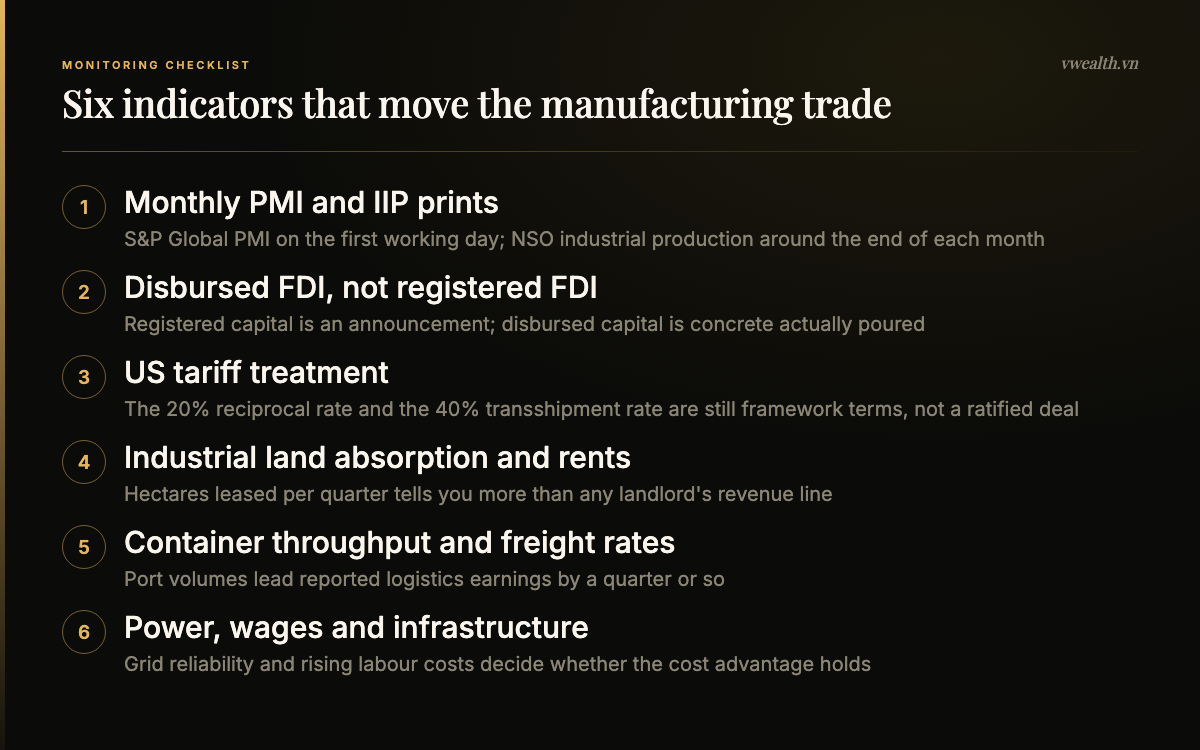
- The monthly PMI and IIP. S&P Global publishes the Vietnam Manufacturing PMI on the first working day of each month; the National Statistics Office publishes industrial production and trade data around month end. Between them you get a near-real-time read on factory demand.
- Disbursed FDI, tracked separately from registered FDI. Registered capital is a press release. Disbursed capital is the number that shows up later in land absorption, port volumes and steel demand.
- Tariff and trade policy developments. The reciprocal and transshipment rates are framework terms, and the Annex III zero-rate product list is still being worked out. Changes here reprice the export-facing channels immediately.
- Industrial land absorption and rents. Published quarterly by the major property consultancies and disclosed by the developers themselves. Hectares leased is the leading indicator; revenue is the lagging one.
- Container throughput and freight rates. Port volumes are reported monthly and tend to lead reported logistics earnings by a quarter or so.
- Input costs: power, wages and infrastructure. Slower-moving, but these determine whether the China-plus-one tailwind persists past this cycle.
Putting it together
Vietnam’s factory economy is real, large and growing at a pace almost no other middle-income country can match. Manufacturing value added at 24.43% of GDP, processing and manufacturing growth of 9.97% in 2025 and 11.4% on the industrial production index in the first half of 2026, exports of USD 475.04 billion of which 88.7% are manufactured goods, and USD 10.76 billion of foreign capital disbursed into manufacturing in six months — the direction is not ambiguous.
What is ambiguous is how much of that shows up in your portfolio. The largest manufacturers are not listed here. The listed exposures are landlords, ports, materials producers and contract manufacturers, each with its own economics and its own failure modes. A portfolio built on “Vietnam is the new factory of Asia” without that distinction is buying a slogan rather than a set of cash flows.
If you are constructing exposure from scratch, our complete guide to the Vietnam stock market covers market structure, access and mechanics, and our comparison of Vietnam ETFs, onshore and offshore sets out the fund route for investors who would rather own the market than pick within it. Note that most Vietnam ETFs are index-weighted, which means they are heavy in banks and real estate and light in the industrial names discussed here — a fund is not a substitute for targeted manufacturing exposure.
Keep the framework and refresh the numbers. The framework — four listed channels, one unlisted gap, four sets of economics, tariff exposure assessed company by company — should hold for years. The numbers in this article are current as of the publication date and will not be. Pull the latest PMI, the latest disbursement figures and the latest company disclosures before you act on any of it.
This article is analytical reference material, not investment advice. It names companies to illustrate how the sector maps onto the exchange, not to recommend them, and it contains no price targets or valuation opinions. Always do your own research and consider your personal risk tolerance before buying any security.
Research Vietnamese stocks in English with vwealth. Our AI-powered platform turns Vietnamese market data into full English analysis reports — with international payment support and a free 2-month trial for new accounts. Create your free account and read the latest reports.
Frequently Asked Questions
How big is manufacturing in Vietnam’s economy?
World Bank data puts manufacturing value added at 24.43% of GDP in 2024, and Vietnam’s National Statistics Office reported that processing and manufacturing grew 9.97% in 2025, the fastest rate in the 2019 to 2025 period. Manufactured goods made up 88.7% of the country’s USD 475.04 billion of exports in 2025.
Can I buy shares in the factories that make iPhones and Samsung phones in Vietnam?
No. Vietnam’s largest exporters of electronics are foreign-invested enterprises such as Samsung Electronics Vietnam and Foxconn’s local subsidiaries, and they are not listed on HOSE, HNX or UPCoM. Listed exposure to that activity is indirect: the industrial park developers that lease them land, the ports that ship their output, and the utilities and banks that serve them.
Which listed Vietnamese sectors benefit most from manufacturing growth?
Four channels: industrial park landlords such as KBC, BCM, VGC and SZC on HOSE and IDC on HNX; ports and logistics such as GMD, HAH and SCS; steel, chemicals and building materials such as HPG, HSG, NKG and DGC; and textiles, footwear and wood products, including Vinatex (VGT) on UPCoM plus TCM, MSH, TNG, STK and PTB. This is an educational mapping of business models, not a recommendation.
What tariff does the United States apply to Vietnamese goods?
Under the framework announced in October 2025, the United States maintains a 20% reciprocal tariff rate on imports from Vietnam, with certain Annex III products identified for a zero percent rate, and a 40% rate applies to goods deemed to have been transshipped. The framework is not yet a finalised agreement, so the terms remain subject to change.
How do I tell a good industrial park developer from a bad one?
Look at hectares of land absorbed per period and the location and size of the remaining commercial land bank, rather than the revenue line. Vietnamese developers can recognise a large share of an up-front long-term lease as revenue at once, which makes reported earnings extremely lumpy and a poor guide to underlying demand.
What are the main risks to Vietnam’s manufacturing story?
United States tariff treatment and rules of origin are the dominant risks, followed by extreme concentration — one foreign company accounted for about 12.2% of national exports in the first seven months of 2026 — and cost creep in industrial land, wages and power. Competition from India, Mexico and other China-plus-one destinations is a slower-burning constraint.
Do Vietnam ETFs give me exposure to manufacturing?
Only partially. Most Vietnam ETFs track market-cap-weighted indices dominated by banks and real estate, so industrial park developers, port operators and textile manufacturers usually carry small weights. A fund is a way to own the market, not a substitute for targeted exposure to the industrial sectors.