Search for a Vietnam ETF list and you will find plenty of names. What you will rarely find is the answer to the two questions that actually determine your outcome: which of them you can buy from where you live, and what you end up owning once the foreign ownership caps have had their say.
Those two questions matter more here than in most markets. A meaningful share of Vietnam’s largest listed companies are at or near their foreign ownership ceiling, which means no fund — however well run — can hold them in full index weight. Two funds tracking the same index can therefore hold noticeably different portfolios.
This piece covers the four routes into Vietnam through a fund, why a tracker does not hold exactly its index here, and six checks before buying. It is the mechanics companion to our comparison of Vietnam ETFs, onshore and offshore.
Which Vietnam ETF can you actually buy?
Short answer: It depends on where your brokerage account is. Funds listed in Vietnam require the full local setup — trading code, capital account, local broker. Funds listed in major international markets are bought like any other listed security, with no Vietnamese paperwork. Availability of specific funds varies by brokerage and jurisdiction.
Four routes into the market
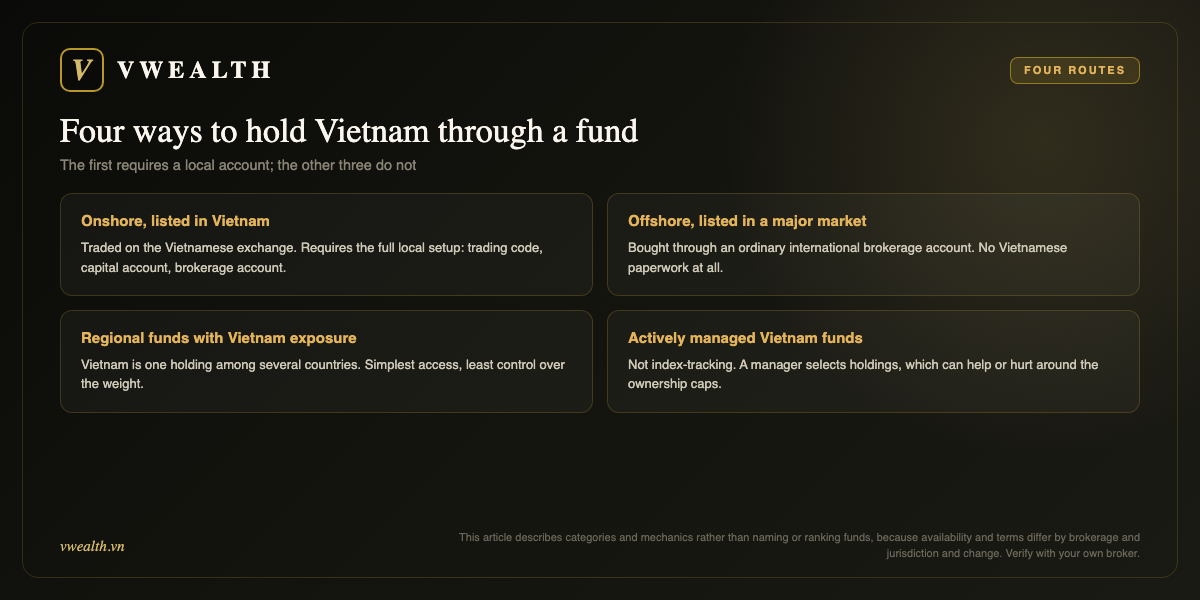
Onshore funds listed in Vietnam
Traded on the Vietnamese exchange, in dong, alongside ordinary shares.
What it requires: the full local setup. Securities trading code, indirect investment capital account, local brokerage account. That process is described in choosing a broker in Vietnam.
What it gives you: the tightest tracking, because the market maker mechanism operates in the same market as the underlying shares. Premiums and discounts to net asset value tend to be smaller.
Offshore funds listed in a major market
Bought through an ordinary international brokerage account, exactly like any other listed security.
What it requires: nothing Vietnamese. This is the route most foreign individual investors take, and it removes weeks of documentation.
What it costs: generally a higher expense ratio, an additional currency layer, and a market maker operating at a distance from the underlying shares — which can widen the gap between the traded price and the fund’s net asset value.
Regional funds with Vietnam exposure
Vietnam is one country weight among several in a frontier or Southeast Asia mandate.
Trade-off: simplest access, least control. You get whatever weight the manager assigns, and it can change without reference to your view.
Actively managed Vietnam funds
Not index-tracking. A manager selects holdings.
Worth noting because of the cap issue: an active manager is not obliged to hold capped names at all and can concentrate where foreign room exists. That is either an advantage or a source of tracking error depending on your objective.
Why a tracker does not hold exactly its index
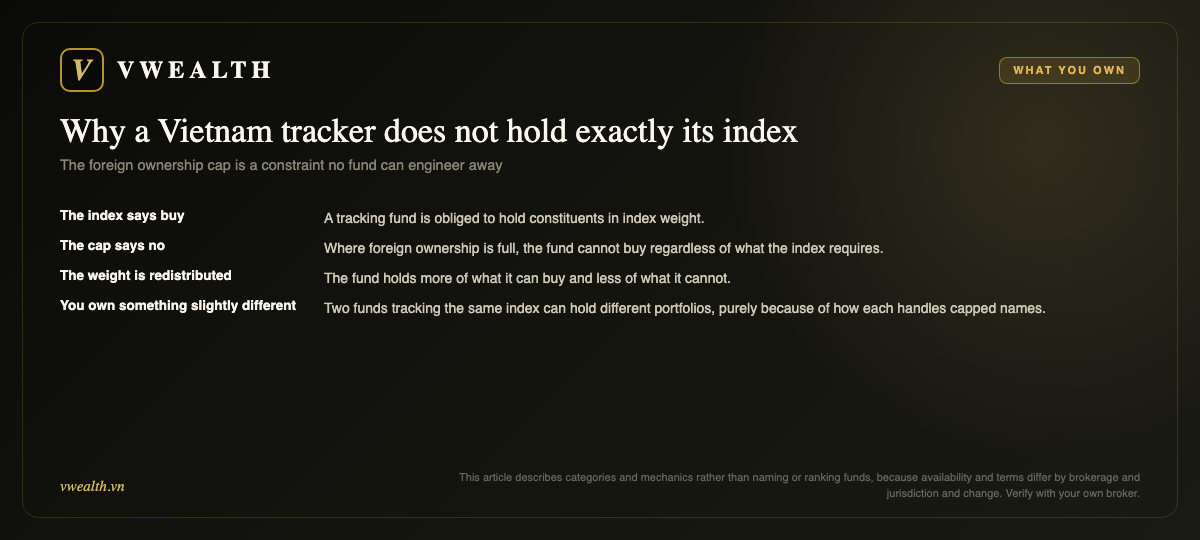
This is the structural feature that makes Vietnam funds different from a tracker on a developed market, and it is worth understanding before comparing performance figures.
A tracking fund is obliged to hold index constituents in index weight. But where a company’s foreign ownership is already at its ceiling, the fund cannot buy — the shares simply are not available to any foreign holder.
The fund therefore holds more of what it can buy and less of what it cannot. Its portfolio drifts from the index by an amount determined by how many capped names the index contains and how the fund handles them.
The practical consequences
Tracking difference is structurally higher. Some of the gap between fund and index performance here is not a quality signal — it is the cap.
Two funds on the same index can differ. Each makes its own choices about redistribution, and those choices compound over time.
Sector exposure shifts. Because banking has the tightest caps and the largest index weight, funds frequently end up underweight banks relative to the index. Whether that helps depends entirely on how banks perform.
The mechanics of the caps themselves are in foreign room and the cap that blocks foreign money.
Six checks before buying
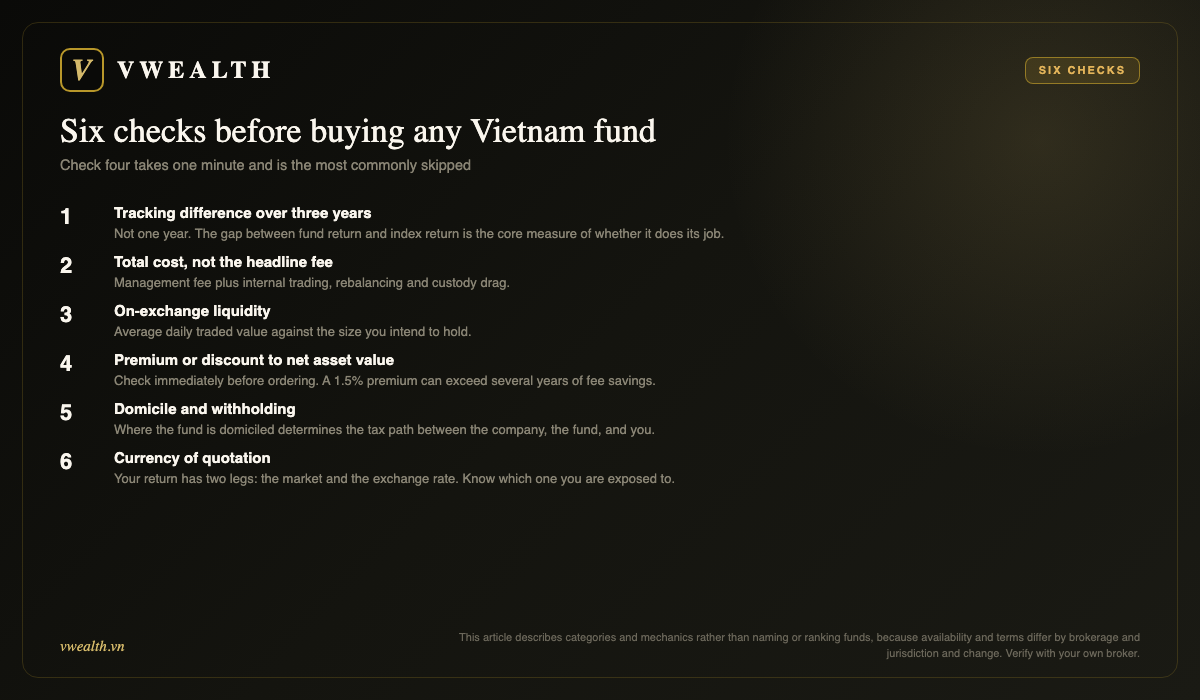
1. Tracking difference over three years
The core measure. One year tells you about market conditions; three years tells you about the fund.
Published in the fund’s periodic reports, alongside the benchmark return.
2. Total cost, not the headline fee
Management fee is the advertised number. Add internal trading costs, rebalancing costs and custody drag. A useful cross-check: if tracking difference substantially exceeds the stated fee, the excess is cost you were not shown.
3. On-exchange liquidity
Average daily traded value against the position size you intend. Thin liquidity widens the spread you pay on entry and exit, and that cost appears on no fee schedule.
4. Premium or discount to net asset value
The check that takes one minute and is skipped most often.
A fund publishes its net asset value daily. Compare it against the traded price before you order. Buying at a 1.5% premium costs more than several years of fee savings between one fund and another.
Premiums tend to widen when a market is in the news — which is exactly when people rush to buy.
5. Domicile and withholding
Where the fund is domiciled determines the tax path from the underlying company, through the fund, to you. It can materially change net return, and it depends on your own residence.
This is a question for a tax adviser rather than an article, and it is worth asking before rather than after.
6. Currency of quotation
Your return has two legs: what the Vietnamese market does, and what the exchange rate does. Some offshore funds quote in one currency while holding assets denominated in another, adding a third layer.
The dong does not float freely, and currency movement can offset an equity gain entirely. Covered in what the dong means for USD returns.
How the premium and discount mechanism works
Since check four is the one that costs money, it is worth understanding why the gap exists at all.
The arbitrage that normally closes it
Funds do not issue units to individual buyers. They deal in large blocks with a small group of institutions known as authorised participants.
When the traded price rises above net asset value, an authorised participant can buy the underlying basket of shares, exchange it with the fund for new units, and sell those units into the market at the higher price. That selling pushes the traded price back toward net asset value.
When the price falls below net asset value, the process runs in reverse.
Why it does not always close in Vietnam
Two frictions specific to this market.
The basket may not be assemblable. If the index contains names at their foreign ownership cap, an authorised participant cannot simply go and buy them. The arbitrage that would close the gap is blocked at the source.
Distance. For an offshore-listed fund, the participant operates in a different time zone from the underlying market. During hours when Vietnam is closed, the fund trades on expectations rather than on a live net asset value, and gaps can widen.
The consequence for a buyer is practical rather than theoretical: premiums in Vietnam funds can persist longer and run wider than in a fund tracking a fully open market.
When gaps are widest
During periods of market attention — index review dates, major policy announcements, sharp moves in either direction. Which is precisely when the most people are trying to trade.
If your purchase is not urgent, an ordinary session is a cheaper entry than a headline day.
A worked cost comparison
Illustrative figures to show the method, not describing any specific fund.
You intend to invest a fixed amount and are choosing between two funds tracking the same index.
Fund A: stated fee 0.6% per year, three-year average tracking difference 0.9% per year.
Fund B: stated fee 0.9% per year, three-year average tracking difference 1.0% per year.
On fees alone, Fund A appears 0.3% per year cheaper. On tracking difference — which is what actually reaches your return — the gap is 0.1%. Most of Fund B’s higher fee is offset by tighter tracking.
Now add the entry cost. Suppose you buy Fund A at a moment when it trades 1.5% above net asset value.
That 1.5% is equivalent to fifteen years of the 0.1% tracking advantage. The entire comparison is decided by a single check that most buyers skip.
This is why the six checks are ordered as they are, and why the fee — the number every comparison leads with — sits second rather than first.
Choosing the index before choosing the fund
A step frequently skipped, and it determines more of your outcome than the fund choice does.
Large-cap indices
A fixed number of the largest and most liquid companies. Easier to track, more liquid, and heavily concentrated in the sectors that dominate the market — which in Vietnam means banking.
Broad market indices
Wider coverage including mid-caps. More diversified by sector, harder to track because some constituents are thinly traded, and typically a larger tracking difference.
Indices screened for foreign room
Some indices are constructed to include only companies where foreign investors can still buy. This directly addresses the cap problem described above.
The trade-off is that the resulting portfolio deliberately departs from the actual structure of the market. You get something buyable rather than something representative — a reasonable choice, but it should be a conscious one.
How to decide
Ask what you want exposure to: the market as it is, the most liquid part of it, or the part that foreign money can actually reach. Each answer points to a different index, and comparing fees across those groups is comparing different products.
Does the index upgrade change the fund question?
Partly, and in a way worth being precise about.
Vietnam moves to Secondary Emerging status under FTSE Russell’s classification effective 21 September 2026, with inclusion phased into 2027. That creates obligated buying from funds tracking the FTSE emerging indices — proportional to Vietnam’s weight, which FTSE estimated at roughly 0.22% of FTSE Emerging and 0.34% of FTSE Emerging All Cap at the April 2026 review.
What changes for a fund investor. Dedicated Vietnam funds do not receive that flow — the flow goes into individual shares. What a Vietnam fund experiences is the price effect of that buying on its holdings.
What also changes. Global emerging market funds will hold a small Vietnam weight for the first time. For an investor who already owns a broad emerging markets fund, some Vietnam exposure arrives automatically, without any decision.
What does not change. The ownership caps, and therefore the tracking constraint described above. Full detail in what actually changes in September.
Three mistakes
Comparing funds on different indices
A fund tracking a large-cap index and one tracking a broad market index will produce different returns for reasons that have nothing to do with fund quality. Choose the index first, compare within that group second.
Treating an ETF as a trading instrument
Each round trip incurs the bid-offer spread, commission and potentially a premium to net asset value. Those costs make frequent trading considerably more expensive than the fee comparison suggests.
Assuming an ETF removes country risk
It diversifies away single-company risk. It does nothing about currency, market-wide drawdowns, or the access constraints that shape this market. Our piece on the risks of investing in Vietnam covers what remains.
Fund or direct shares?
For a foreign investor the choice is genuinely open, and it turns on three things rather than on returns.
Setup burden
Direct ownership requires the trading code, capital account and local broker — a process measured in weeks and dependent on document legalisation in your jurisdiction. A fund requires none of it.
For a smaller allocation, that difference alone often decides the question.
Control over what you own
A fund gives you the index, including the parts you would not choose. Direct ownership lets you avoid sectors, avoid capped names, and concentrate where you have conviction.
It also lets you make mistakes a fund would not make. Control cuts both ways.
The cap problem, from both sides
This is the interesting one. Holding directly, you meet the cap as an execution problem — orders that cannot fill, or fills at a foreign premium.
Holding a fund, you meet the same cap as a tracking problem — a portfolio that drifts from its index because the fund faced the same wall you would have.
Neither route escapes it. What differs is whether it shows up in your order book or inside the fund’s performance.
A reasonable default
Smaller allocations and first exposure: an offshore fund, for the simplicity. Larger allocations, or a view on specific companies: direct ownership, accepting the setup cost.
The middle case — a meaningful allocation with no company-level view — is where a fund usually remains the better answer, because the setup cost buys you control you do not intend to use.
What to review annually
A fund position is not maintenance-free, and four things are worth checking once a year.
Tracking difference against the prior year. A deteriorating trend is worth understanding before it compounds.
Fund size and liquidity. A shrinking fund can face closure, and a forced liquidation is a bad exit at a time you did not choose.
Index changes. Index methodologies get revised. A fund can still be doing its job while the job itself has changed.
Your own weight. If Vietnam exposure has grown into a larger share of your portfolio than intended, that is a rebalancing decision rather than a market view.
Fifteen minutes once a year, and it catches the two failure modes that actually affect fund holders: a fund quietly getting worse, and a position quietly getting bigger.
Reading a fund factsheet properly
Most of what you need sits in a two-page document that few investors read past the first chart.
The performance table
Look for the benchmark row directly beneath the fund row. The difference between them across three and five years is the number that matters. A fund showing only its own return without a benchmark comparison is omitting the most useful information it has.
The holdings list
Usually the top ten by weight. Compare those weights against the index weights, which are published separately. Large divergences in the biggest names are the cap effect made visible.
The sector breakdown
Check the banking weight against the index banking weight. In Vietnam, a fund materially underweight banks is almost certainly showing you the cap constraint rather than a deliberate view.
The costs section
The stated ongoing charge, and where disclosed, transaction costs. If the fund publishes portfolio turnover, high turnover implies trading costs beyond the headline figure.
The dates
Factsheets are produced monthly or quarterly. A holdings list from three months ago describes a portfolio that has since rebalanced, particularly around index review dates.
One thing worth remembering
Every route into this market meets the same wall in a different form.
Buy directly and the cap appears as an order that will not fill. Buy a tracker and it appears as a portfolio that drifts from its index. Buy an active fund and it appears as a manager choosing to own only what is available.
The wall is a policy choice, not a market failure, and it has been moving — the amendment permitting certain restructuring banks up to 49% is evidence of that. But it is the defining feature of investing here from abroad, and any decision that does not account for it is incomplete regardless of which route it takes.
Frequently asked questions
Can I buy a Vietnam-listed ETF from abroad?
Only with the full local setup — trading code, capital account, local broker. If you want exposure without that, an offshore-listed fund is the practical route.
Why do two Vietnam funds perform differently?
Different indices, different costs, and different handling of capped names. The third factor is specific to this market and is often the largest.
Where do I find net asset value?
Published daily by the fund manager, and usually available through your broker’s fund page. Compare it against the traded price before ordering.
Is an active Vietnam fund better than a tracker?
Different, not better. An active manager can avoid capped names entirely, which removes the tracking constraint and introduces manager risk instead.
Do these funds pay distributions?
It varies. Some distribute, some accumulate. Check the fund documentation rather than assuming, and note that the treatment interacts with your own tax position.
Does a Vietnam fund overlap with my emerging markets fund?
From September 2026 it will, in a small way. Broad emerging market funds tracking FTSE indices will carry a Vietnam weight of roughly a fifth to a third of one percent. That is not enough to make a dedicated position redundant, but it is worth knowing you are no longer starting from zero.
How much of a portfolio should this be?
Not a question this article can answer. What it can say is that liquidity and currency argue for sizing the position so that an exit in poor conditions would not force a bad price.
Summary
Working through a Vietnam ETF list usefully means answering two questions first: which route matches your account setup, and what you actually end up owning once the foreign ownership caps have taken effect.
Then six checks — tracking difference over three years, total cost, liquidity, premium or discount, domicile, currency. The fourth takes one minute immediately before ordering and is the one most likely to cost you money if skipped.
And the structural point worth carrying: in this market, a tracker cannot hold its index exactly, because some of the index is not for sale to foreigners at any price.
Further reading: the complete guide to the Vietnamese market, foreign ownership limits explained, and VN-Index and VN30 explained.
This article is for information and education. It is not a recommendation of any fund or security, and it does not constitute tax advice. Availability and terms differ by brokerage and jurisdiction — verify directly. Structural points as of July 2026.