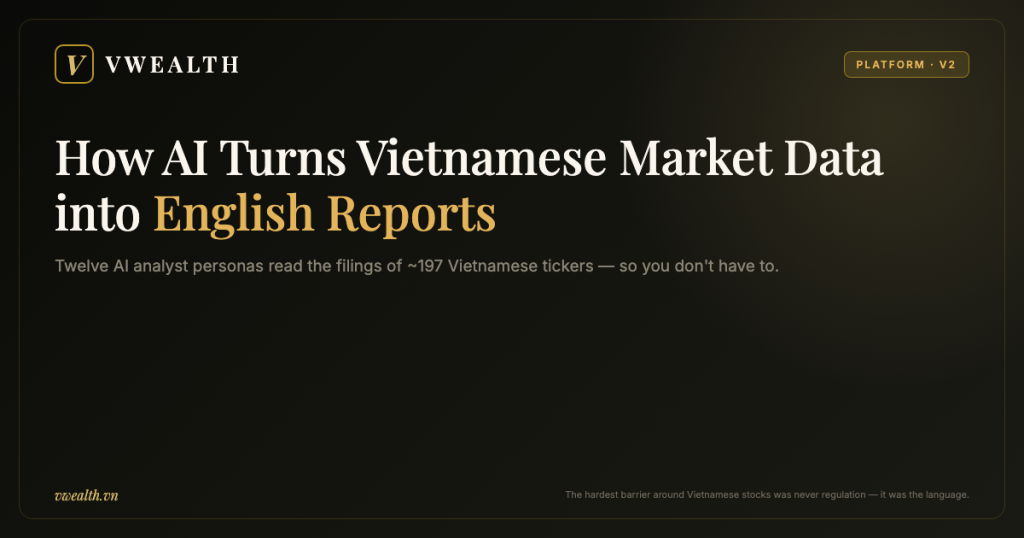
Vietnam is one of the most talked-about frontier markets in the world, yet most of the information that actually moves its stocks is published in Vietnamese — filings, earnings notes, exchange announcements, broker research. If you do not read the language, you are effectively investing with one eye closed. This essay looks at why the language barrier is the single biggest practical obstacle to Vietnam stock analysis in English, why machine translation alone does not fix it, and how vwealth’s V2 platform approaches the problem differently: by ingesting the financial statements and valuation data of roughly 197 Vietnamese tickers and having twelve AI analyst personas turn that raw material into full English research reports, backed by international payment support and a free two-month trial.
The language barrier is the real moat around Vietnamese stocks
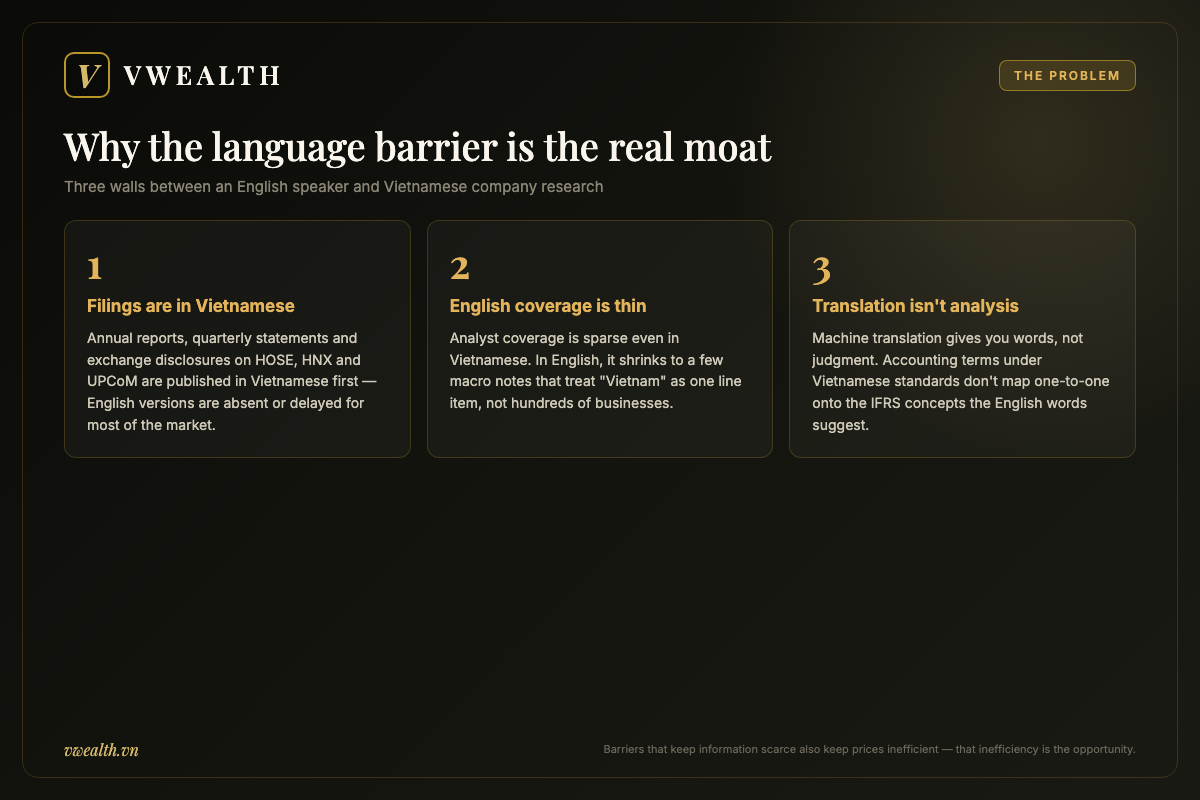
Ask a foreign investor what stops them from buying Vietnamese equities and you will usually hear about foreign ownership limits, settlement rules, or the paperwork of opening a local trading account. Those are real frictions, and we cover them in detail in our guide on how to invest in the Vietnam stock market. But investors solve paperwork problems all the time. The friction that quietly never gets solved is simpler and more stubborn: almost everything worth reading about a Vietnamese company is written in Vietnamese.
Consider what “doing your homework” on a listed company actually requires. You need the annual report, the quarterly financial statements, the notes to those statements, the board’s explanations for unusual items, the resolutions of the annual general meeting, and the running stream of disclosures the company files with the exchange — capital raises, related-party transactions, changes in ownership, dividend decisions. On Vietnam’s three trading venues — HOSE, HNX and UPCoM — companies are required to publish all of this in Vietnamese. English versions are, for most of the market, either absent, delayed, or limited to a glossy summary that skips the parts an analyst would care about most.
Regulators know this is a problem, and they have put a concrete timetable behind fixing it. Under Circular 68/2024/TT-BTC (in force from November 2024), listed organizations and large-scale public companies have had to make their periodic disclosures — annual and quarterly reports and the like — in English as well as Vietnamese from 1 January 2025, with ad-hoc disclosures following from 1 January 2026; smaller public companies come under the same requirements in phases through 2027 and 2028. That is genuine progress, and over time it will narrow the gap. But a rule that mandates English disclosure does not mandate good English disclosure, it does not reach the smaller companies until later in the roadmap, and it does nothing for the years of historical filings that give a company’s numbers their context. A revenue figure means little until you know what the same line looked like across the last five years, what the company said about it each time, and whether management’s past explanations turned out to be honest.
What English-language coverage of Vietnam actually looks like
The second half of the problem is analysis. In large developed markets, a company of any size is followed by dozens of sell-side analysts, financial journalists, newsletter writers and data providers, most of them publishing in English. In Vietnam, professional coverage is thin even in Vietnamese. A handful of the largest banks and blue chips get regular broker notes; move one tier down the market-capitalization ladder and coverage falls off a cliff. The English-language slice of that already-thin coverage is thinner still — typically a few strategy pieces from regional brokers, occasional index-inclusion commentary, and macro notes that discuss “Vietnam” as a single line item rather than as hundreds of individual businesses.
The practical result is an information hierarchy. Local professional investors read the filings the day they drop. Local retail investors read summaries and forum chatter within hours. Foreign investors who do not read Vietnamese often learn about a development weeks later, if a regional publication happens to pick it up — or never, if it does not. We have written before about the raw-data side of this gap in our piece on finding Vietnam stock market data in English; the short version is that prices and index levels are easy to get in English, while the fundamental information underneath them is not.
Why “just use Google Translate” is not a research strategy
The obvious retort is that machine translation is now good enough to read anything. For casual reading, that is broadly true. For financial analysis, it fails in three specific ways.
First, translation tools handle everyday language far better than accounting language. Vietnamese financial statements follow Vietnamese Accounting Standards (VAS), a national framework that differs in structure and terminology from the IFRS format most international investors know. A literal translation of a VAS line item can be technically correct as language and still misleading as accounting, because the line does not map one-to-one onto the IFRS concept the English words suggest.
Second, translation does not scale. Reading one translated annual report is a weekend project. Screening a market, comparing one bank against six competitors, or tracking quarterly results across a whole sector means processing hundreds of documents per quarter. No individual investor translates their way through that volume, which means in practice they simply skip the work — and skipped work is where losses come from.
Third, and most importantly, translation gives you words, not judgment. Even a perfect translation of a cash-flow statement will not tell you whether the pattern it shows is normal for a Vietnamese property developer, alarming for a bank, or typical for a steel producer at this point in the commodity cycle. Context is the product of having read hundreds of similar statements — and that context is exactly what a foreign investor lacks.
What gets lost between a Vietnamese filing and an English headline
It is worth being concrete about the kinds of meaning that leak away when Vietnamese market information passes through casual translation, because these are the leaks a serious research process has to plug.
| What the filing says (Vietnamese concept) | What a literal translation gives you | What an analyst actually needs to know |
|---|---|---|
| Lợi nhuận sau thuế của cổ đông công ty mẹ | “Profit after tax of parent-company shareholders” | This is the earnings line that per-share metrics should be built on — using total consolidated profit instead quietly inflates EPS for companies with large minority interests. |
| Báo cáo tài chính riêng vs. hợp nhất | “Separate” vs. “consolidated” financial statements | Which set you are looking at. Vietnamese companies file both, and headlines sometimes quote the flattering one without saying so. |
| Doanh thu tài chính | “Financial revenue” | Income from deposits, investments or FX — often lumpy and low-quality. A profit “beat” driven by this line is very different from an operating beat. |
| Ý kiến kiểm toán ngoại trừ | “Qualified audit opinion” | A red flag whose seriousness depends entirely on what was qualified and why — detail buried in the Vietnamese audit note. |
| Room ngoại | “Foreign room” | How much foreign ownership capacity remains under the legal cap — a constraint that shapes which stocks foreigners can buy at all and how offshore premiums form. |
None of these distinctions is exotic. Every experienced Vietnamese investor navigates them automatically. But each one is a place where a non-reader of Vietnamese, armed only with a translation tool and good intentions, can walk away with a number that is precisely wrong. Multiply that across a full set of financial statements, four quarters a year, and a portfolio of ten stocks, and the language barrier stops being an inconvenience and becomes a structural disadvantage.
There is a flip side, and it matters for the investment case: barriers that keep information scarce also keep markets inefficient. In a market where most participants are domestic retail investors and English-language analysis barely exists, prices drift further from fundamentals than they would in a heavily analyzed market. For an investor who can close the information gap, that inefficiency is the opportunity. The question has always been how to close the gap without hiring a bilingual analyst.
The timing sharpens the point. In its March 2026 review FTSE Russell confirmed that Vietnam will be reclassified from Frontier to Secondary Emerging Market status, effective from the market open on 21 September 2026 — an upgrade first announced in October 2025 and enabled by reforms such as the removal of the pre-funding requirement for foreign institutional investors (see FTSE Russell’s March 2026 classification review). MSCI, the other major index provider, still classifies Vietnam as frontier and did not even add it to its watch list in its 2026 review, so the country sits mid-transition rather than fully reclassified. But the FTSE move alone is expected to pull passive and active foreign money toward Vietnamese equities as index funds rebalance — which means more capital chasing a market whose company-level information is still, for the most part, locked behind Vietnamese. The information advantage described above is about to be worth more, not less.
How vwealth produces Vietnam stock analysis in English
vwealth was built in Vietnam, for the Vietnamese market, as an AI-powered stock analysis platform. Its starting point is the observation above: the bottleneck in Vietnamese equity research is not the availability of raw information but the labor of reading, structuring and interpreting it. That labor is exactly what modern AI systems are good at absorbing — provided they are pointed at the right data and disciplined by the right process.
Step one: ingest the numbers, not the headlines
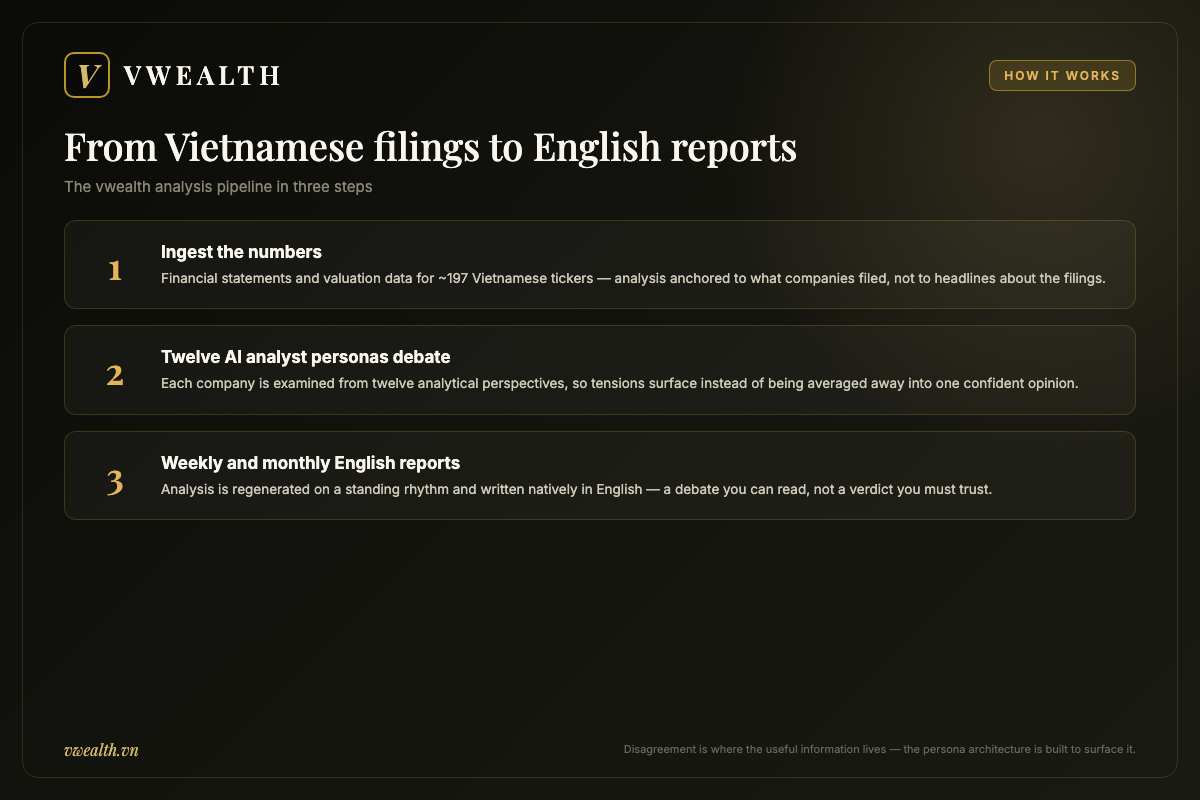
The platform’s foundation is a data layer covering roughly 197 Vietnamese tickers. For each covered company, vwealth ingests the published financial statements — income statement, balance sheet, cash-flow statement — along with valuation data that places those numbers in market context. This is a deliberate design choice: the analysis is anchored to what companies actually filed, not to news commentary about what they filed. When a report discusses a company’s leverage or margin trend, the underlying figures come from the statements themselves.
Anchoring to filings matters for the language problem specifically. A pipeline that started from Vietnamese news articles would inherit all the ambiguity of secondhand reporting and then add translation ambiguity on top. A pipeline that starts from structured financial statements sidesteps most of that: a balance sheet is a balance sheet, and once its line items are mapped correctly into a consistent framework, the analysis built on top of it can be generated in any language without the meaning shifting in transit. The hard, error-prone work — mapping VAS line items into a coherent analytical structure — is done once, systematically, rather than improvised by each reader.
Step two: twelve analyst personas instead of one oracle
The more distinctive design decision is what happens on top of the data. Rather than asking a single AI model for “the answer” on a stock, vwealth runs the same company through twelve AI analyst personas — twelve differently configured analytical perspectives, each examining the evidence with its own emphasis, the way a real research team contains a value skeptic, a growth optimist, a balance-sheet hawk and a technician who barely glance at the same numbers in the same way.
Why bother with twelve perspectives? Because the failure mode of a single AI opinion is the same as the failure mode of a single human opinion: unexamined confidence. A lone analysis gives you a conclusion with no visible disagreement, and disagreement is where the useful information lives. If eleven perspectives on a company are comfortable and one keeps returning to the gap between reported profit and operating cash flow, that tension is the most valuable sentence in the report. A multi-persona structure surfaces tension instead of averaging it away.
This mirrors how careful human investors already work. Nobody sensible buys a stock because one analyst liked it; they read a bull case, hunt for the bear case, and form a view where the two collide. The persona architecture builds that collision into the product, so the reader receives a debate rather than a verdict. What the reader does with the debate — that remains, as it should, their job.
Why valuation context sits next to the financial statements
Financial statements tell you what a business earned and owns; they do not tell you what the market is charging you for it. That is why the data layer pairs the filings with valuation data. A concrete illustration of why the pairing matters: suppose — as a purely hypothetical example — a manufacturer doubles its profit in a year. Read in isolation, that is a spectacular result. But if the market had already priced the stock as though profit would triple, the “great” year is actually a disappointment, and the share price may fall on the news. The reverse is just as common: a mediocre business at a genuinely depressed valuation can be a better proposition than an excellent business priced for perfection.
Neither half of the picture is sufficient alone. Statement analysis without valuation produces admiration lists — wonderful companies you should perhaps never buy at the prevailing price. Valuation without statement analysis produces cheapness traps — stocks that look inexpensive precisely because their fundamentals are quietly rotting. By feeding both into the same analytical process, the platform forces every persona’s argument to confront the two questions that matter in sequence: is this a good business, and is the price asking you to overpay for the answer? For current multiples on any covered company, the numbers in the platform’s reports are the ones to check, because they are regenerated with the analysis rather than frozen in an article like this one.
Step three: reports on a weekly and monthly rhythm
The output of this pipeline is a library of analysis reports generated on a weekly and monthly cadence and published in the platform’s report library. The cadence is a feature, not an afterthought. One-off research decays fast: a report written about a Vietnamese bank two quarters ago describes a company that has since reported twice, perhaps raised capital, perhaps seen its valuation multiple re-rate. A standing rhythm of regeneration means the analysis a reader opens reflects the current filings and the current market context, not a snapshot from whenever an analyst last had time.
For a foreign reader, the rhythm solves a second problem: continuity. The hardest part of following a market from outside is not getting one good report — it is staying current between reports. A weekly and monthly cycle gives an English-speaking investor the same drumbeat of updated fundamental context that a local investor assembles from the daily flow of Vietnamese-language information.
What V2 changed — and the problem each change solves
The original vwealth served Vietnamese-speaking investors in Vietnamese. V2 is the release that turns the platform outward, and its three headline additions are best understood as answers to the three questions any non-Vietnamese user would ask before signing up.
| V2 addition | The question it answers | Why it matters in practice |
|---|---|---|
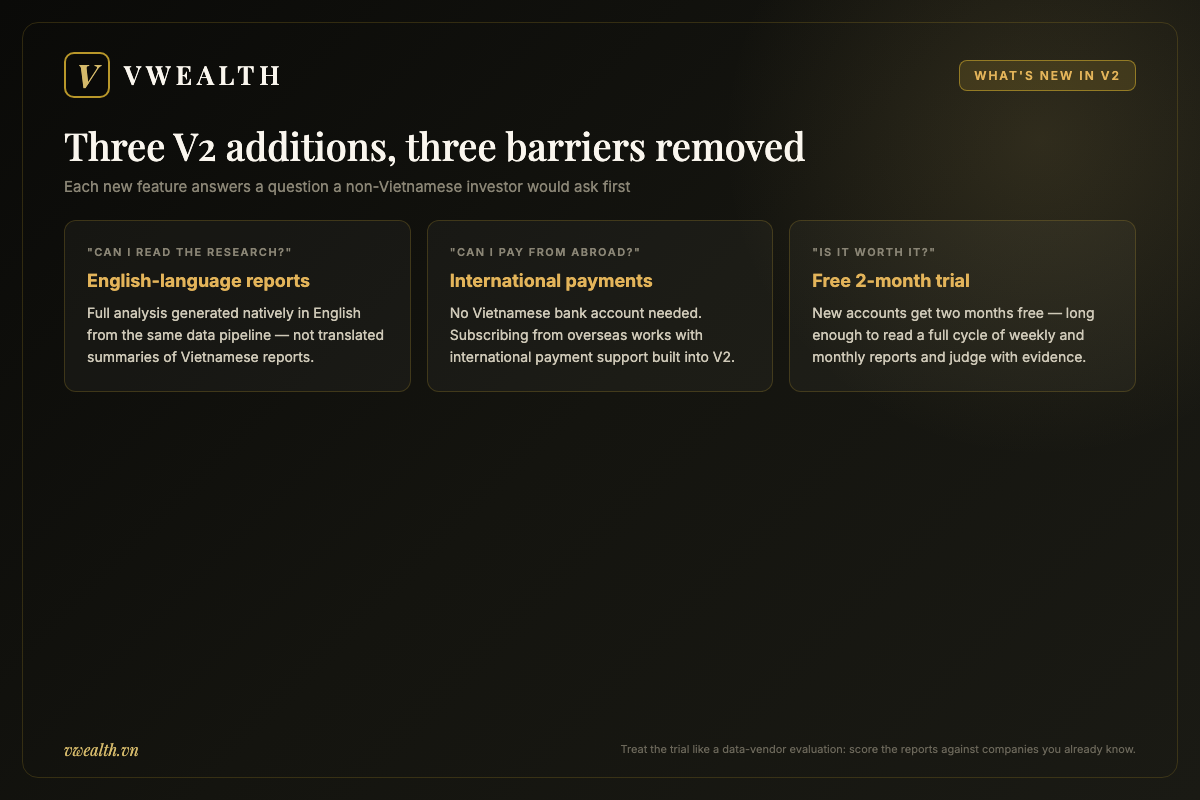
| English-language analysis reports | “Can I actually read the research?” | Full reports generated in English from the same data pipeline — not translated summaries of Vietnamese reports, but native English output of the same twelve-persona analysis. |
| International payment support | “Can I pay from abroad?” | Vietnamese domestic payment rails are hard to use without a local bank account. International payment support removes the last logistical wall between an overseas reader and a subscription. |
| Free two-month trial for new accounts | “How do I know the reports are worth it?” | Research quality cannot be judged from a marketing page. Two months is long enough to read a full cycle of weekly and monthly reports across companies you care about, and decide with evidence. |
English reports as a native output, not a translation layer
The distinction in the first row deserves a moment, because it goes to the heart of the language-barrier argument. There are two ways to offer “English reports.” The shallow way is to write research in Vietnamese and translate it — which reintroduces every translation problem described earlier, one step downstream. The deeper way, which is what V2 does, is to generate the English analysis directly from the structured data. The numbers were mapped from the filings once; the analytical reasoning happens on top of that structure; the English text is a first-class output of that reasoning. The English reader is not receiving a secondhand rendering of a Vietnamese document. They are receiving the analysis itself, in their language.
The trial as a due-diligence period
The two-month trial is worth framing honestly: it is a marketing offer, but it is also the correct way to evaluate a research product. A single free report tells you almost nothing — any provider can polish one sample. What you actually want to know is whether the analysis stays useful across a reporting season: whether the weekly rhythm holds, whether the persona debates stay substantive on companies you know well, whether the reports on your watchlist say things you had not already thought of. Two months spans enough of a quarterly cycle to answer those questions with your own eyes. Treat the trial the way you would treat any data-vendor evaluation: pick a handful of companies you understand, read everything the platform produces on them, and score it against your own knowledge.
Who Vietnam stock analysis in English actually serves
It is tempting to say “foreign investors” and move on, but the audience for English-language Vietnamese equity research is more varied than that, and each group uses it differently.
Overseas Vietnamese managing money in two countries
Millions of people of Vietnamese origin live abroad, and many maintain financial ties to Vietnam — property, family businesses, brokerage accounts opened on visits home. A large share of the second generation speaks conversational Vietnamese but reads financial Vietnamese slowly or not at all. For this group, English reports are not a foreign-investor product; they are the bridge that lets them participate in a market they already have every reason to care about.
Foreign individual investors hunting outside crowded markets
The self-directed investor who has read about Vietnam’s demographics, manufacturing momentum and the “China plus one” supply-chain shift, and wants direct exposure rather than a fund wrapper. This reader’s alternative is not “better research elsewhere” — it is investing on the basis of index-level narratives, which is how people end up owning the story instead of the business. Structured company-level analysis in English is the difference between those two positions. Before acting on any of it, this reader should also spend time with our companion piece on the risks of investing in Vietnam, because enthusiasm for a growth story is not a risk framework.
Expatriate professionals living in Vietnam
People working in Ho Chi Minh City or Hanoi often earn locally, bank locally, and watch the market around them grow — while remaining locked out of it analytically because their Vietnamese is conversational rather than financial. They have better ground-level context than any offshore investor and worse document access than any local one. English reports fix precisely their half of the problem.
Professionals who need a first screen, not a final answer
Analysts at regional funds, family offices with a frontier allocation, finance students studying emerging markets, journalists covering Southeast Asian business. For this group the value is speed of orientation: a structured English report on a mid-cap Vietnamese company compresses days of translation and reconstruction into an hour of reading, after which their own professional process takes over. They will verify everything — as they should — but they start from a map instead of a blank page.
The honest-limits section: what AI analysis is, and what it is not
A product essay that only lists strengths is an advertisement. Here is the part that a careful reader should weigh just as heavily.
AI analysis is a research tool, not investment advice
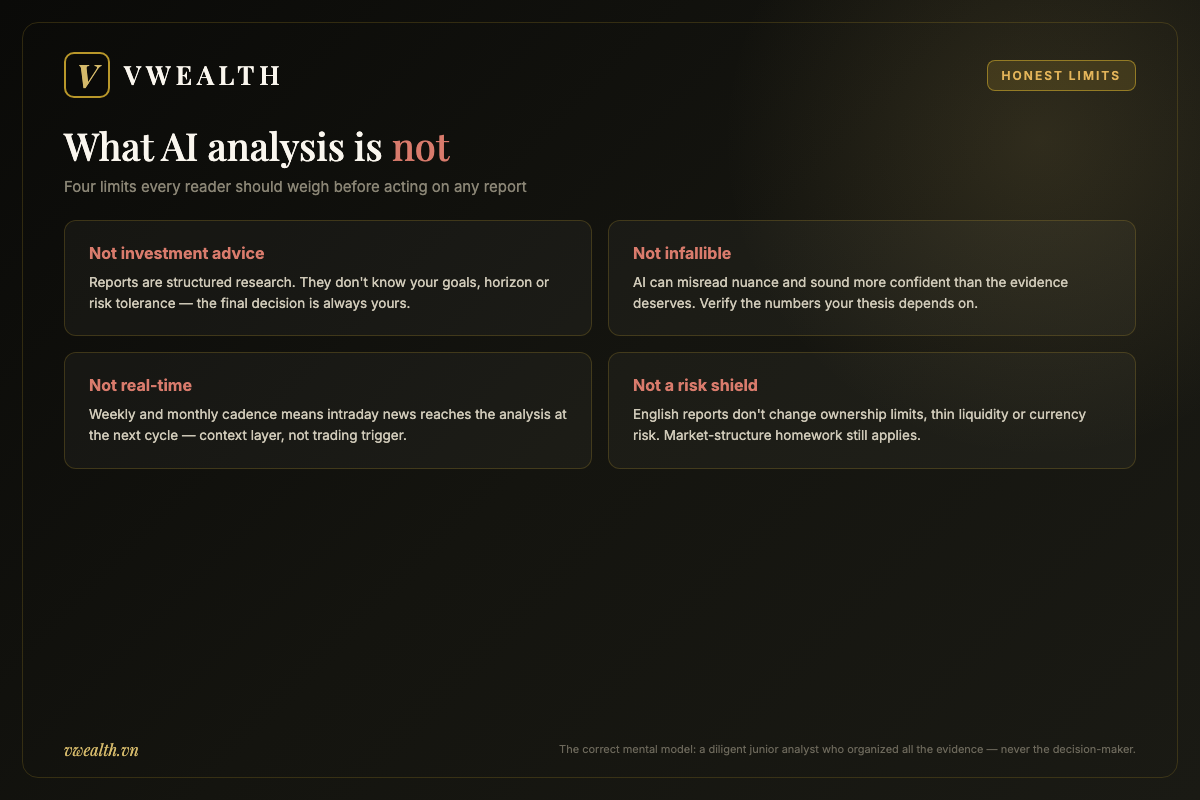
Nothing vwealth produces is a recommendation to buy or sell anything. The reports are structured analysis — a disciplined reading of filings and valuation context from multiple analytical angles. They do not know your financial situation, your time horizon, your tax position or your risk tolerance, and no report that ignores those things can responsibly tell you what to do. The correct mental model is a diligent junior analyst who has read all the filings and organized the evidence: enormously useful, never the final decision-maker. The final decision-maker is you.
AI systems can be wrong, and so can their inputs
Language models can misread nuance, over-weight patterns, and state conclusions with more fluency than the underlying evidence deserves — fluency is, in fact, their most dangerous feature, because polished prose reads as confidence. The multi-persona design exists partly to counter this (twelve perspectives are harder to fool than one), but no architecture eliminates the risk. Upstream, the analysis is only as good as the filings it ingests: if a company’s reported numbers are aggressive or misleading, an honest analysis of dishonest statements will still mislead. Audited statements reduce this risk; they do not remove it, in Vietnam or anywhere else.
Coverage and timing have edges
Roughly 197 tickers is substantial coverage of the market’s investable core, but Vietnam’s three venues — HOSE, HNX and UPCoM — list something on the order of 1,600 tradeable companies between them, far more securities than any focused platform covers. The smallest, least liquid names — often where the strangest mispricings and the worst governance live — may fall outside coverage. And a weekly and monthly cadence, while fresh by research-industry standards, is not a real-time news wire. Intraday developments reach the analysis at the next cycle, not the next minute. If your strategy depends on reacting to announcements within hours, this is a context layer for you, not a trigger.
An English report does not remove market-structure risk
Reading the analysis in your language does not change what you are buying. Foreign ownership limits still constrain access to certain stocks. Liquidity in mid-caps is still thin enough that entry and exit move prices. The currency you eventually convert back to still fluctuates against the dong. Settlement, custody and repatriation still follow Vietnamese rules. And while FTSE Russell’s confirmed upgrade to Secondary Emerging Market status takes effect on 21 September 2026, MSCI still classifies Vietnam as frontier, so the market retains the structural risks of a frontier-to-emerging transition well beyond that date. Research reduces ignorance; it does not reduce those structural risks, which deserve their own homework before any order is placed.
Where AI reports fit in a sensible research workflow
Given both the strengths and the limits, here is a workflow that uses English AI analysis the way it is meant to be used — as leverage for your judgment, not a replacement for it.
Start with allocation, not tickers. Decide what share of your portfolio belongs in a single frontier market at all. No stock-level analysis, human or AI, should be allowed to answer a portfolio-level question. For most diversified individual investors, a single emerging market is a satellite position, sized so that even a severe drawdown is survivable.
Use reports to build a shortlist. This is where AI coverage shines: breadth. Read across sectors in the report library, note which businesses have the economics you like — pricing power, sane leverage, cash flow that tracks reported profit — and let the twelve-persona debates flag the tensions you would have missed. An hour of reading structured English analysis replaces what used to be a week of translation just to reach the same starting line.
Verify the load-bearing facts yourself. For any company you seriously consider, go to the primary sources for the handful of numbers your thesis depends on. English disclosure from the largest companies is improving; where it is missing, even a machine-translated original filing is a useful cross-check now that you know from the report what you are looking for. The report tells you where to dig; the digging is still yours.
Decide with a written thesis. Write down why you are buying, what evidence would prove you wrong, and when you will re-examine the position. Then let the weekly and monthly report cycle serve as your standing re-examination: each new report on a holding is a prompt to check whether your written thesis still survives contact with the updated numbers.
Never outsource the sell decision. Selling is where investors lose the most money and where no tool can carry you. Analysis can tell you a company’s fundamentals have deteriorated; only your pre-written rules can tell you what you promised yourself you would do about it.
A worked example of the workflow, end to end
To make the sequence tangible, imagine — as an illustration only — that you are an investor in Singapore who keeps hearing about Vietnamese retail growth. Old workflow: you find two English macro notes about consumption trends, skim an index factsheet, and either give up or buy a fund. New workflow: you open the report library, read the English analyses of the covered retail-sector names side by side, and notice that the persona debates keep splitting on the same fault line — one chain is growing revenue fast while its inventory grows faster, another is growing more slowly but converting nearly all reported profit into operating cash. That single contrast, visible in an afternoon, is a research agenda. You pick the cash-generative one, pull its latest filing to verify the cash-flow line yourself, write a three-sentence thesis, size the position inside your frontier allocation, and calendar the next monthly report as your checkpoint. Nothing in that sequence required reading Vietnamese, and nothing in it delegated the actual decision.
How to start, in practical order
If the case above matches your situation, the on-ramp is deliberately short. First, create an account — new accounts get the two-month free trial, and V2’s international payment support means a foreign card works when you eventually decide to stay. Second, go to the report library and pull the English reports on three to five companies: ideally at least one you already know well (to calibrate the analysis against your own knowledge) and a couple you have only heard of (to see how much a structured report teaches you from a standing start). Third, read them the way an editor reads, not the way a fan reads — hunt for the persona disagreements, check whether the limitations you would raise are raised, and note anything you can verify independently. By the end of the trial you will know, with evidence rather than impressions, whether English-language AI analysis has earned a place in your process.
From reading about the market to actually researching it
Step back and the shape of the argument is simple. Vietnam offers a genuinely interesting equity market — young, under-analyzed, structurally growing, and on the cusp of an FTSE upgrade to emerging-market status — wrapped in a language barrier that has historically reserved its information advantages for those who read Vietnamese. Translation tools chip at the barrier but cannot carry the analytical load. What changes the economics is a pipeline that does the mapping once — filings in, structured data, multi-perspective analysis out — and speaks its conclusions natively in English.
That is the specific thing vwealth V2 is: the same AI platform that reads the financial statements and valuation data of roughly 197 Vietnamese tickers and argues about them through twelve analyst personas, now writing its weekly and monthly reports in English, accepting international payments, and giving new accounts two free months to judge the output against their own standards. It will not make decisions for you, it will not see everything, and it will not repeal the risks of a frontier market. What it will do is put an English-speaking investor, for the first time, on roughly the same informational footing as a diligent local reader — and in a market this under-covered, that footing is most of the game.
If Vietnam has been sitting in the “interesting, but I can’t read the filings” pile of your investment ideas, the barrier you were waiting on has become considerably lower. Browse a few reports, pick companies you already half-know, and test the analysis against your own judgment for two months. That is not a leap of faith; it is due diligence — which is, fittingly, the whole point.
This article is for informational and educational purposes only. It is analysis for reference, not investment advice or a recommendation to buy or sell any security.
Research Vietnamese stocks in English with vwealth. Our AI-powered platform turns Vietnamese market data into full English analysis reports — with international payment support and a free 2-month trial for new accounts. Create your free account and read the latest reports.