Vietnam blue chip stocks are, for most practical purposes, the thirty companies inside the VN30 index — the banks, property conglomerates, consumer champions, technology exporters and energy groups that account for the bulk of the market’s value and trading volume. If you understand these thirty businesses as five or six sector blocks rather than thirty separate tickers, the whole Vietnamese market suddenly becomes readable. This guide walks through each block, explains how the companies inside it actually make money, and then tackles the two questions foreign investors ask most: what does the heavy concentration in banks mean for an index investor, and how do liquidity and foreign ownership room differ from one block to the next? By the end you should be able to use blue chips the way professionals do — as the core of a portfolio, chosen with open eyes rather than bought blindly.
What “blue chip” actually means on the Vietnamese market
In the United States, “blue chip” is a loose cultural label — people argue about whether a given company qualifies. In Vietnam the term has a much harder edge, because the market has an official shortlist: the VN30. This is the index of the thirty largest, most liquid companies listed on the Ho Chi Minh City Stock Exchange (HOSE), screened for market capitalization, free float (the portion of shares actually available for public trading, as opposed to shares locked up by the state or founding families) and trading liquidity. When Vietnamese brokers, fund managers or journalists say “blue chips,” they almost always mean VN30 constituents, plus a handful of large names that sit just outside the basket.
Membership is not permanent. HOSE reviews the basket on a fixed calendar: twice a year, in January and July, it swaps constituents in and out based on market capitalization, liquidity and free float, with lighter weight adjustments in April and October. Companies drop out when their liquidity fades or their free float shrinks, while rising businesses graduate in. That churn matters more than beginners expect: a stock that was a celebrated blue chip five years ago may today be a mid-cap struggling with debt, and a company nobody discussed a decade ago may now anchor the index. Under the current rulebook — the HOSE-Index Ground Rules Version 4.0, issued in December 2024 and phased in through 2025 — the index also caps how much weight any single name or bloc can carry: no single stock above 10%, no group of related companies above 15%, and, for the first time, no single sector above 40%. If you want the full mechanics of how the basket is built and rebalanced, read the companion piece on how the VN-Index and VN30 are constructed and what their quirks mean for investors — this article takes the basket as given and focuses on what is inside it.
Three features distinguish Vietnamese blue chips from their developed-market cousins, and each one shapes how you should invest in them.
The state is often still in the room
Several of the largest listed companies grew out of state-owned enterprises, and the government retains a large — sometimes controlling — stake. That is common in the banking and energy blocks in particular. State ownership cuts both ways. It usually means implicit backing, conservative management and a durable license to operate. It also means a smaller free float, decisions occasionally driven by policy rather than shareholder return, and a slower pace of change. When you look at a Vietnamese blue chip, one of your first questions should be: who actually controls this company — the state, a founding family, or dispersed shareholders?
Founders and families still dominate the private names
The private-sector blue chips — the big conglomerates, private banks and consumer groups — are mostly first-generation businesses. The founder is frequently still the chairman, still the largest shareholder, and still the strategic brain. This concentration of control means decisions get made fast and ambitions run large, but it also means minority shareholders are along for the founder’s ride, for better or worse. Corporate governance analysis in Vietnam is, to an unusual degree, founder analysis.
Blue chip does not mean slow
In mature markets, blue chips are often synonymous with low growth and dividend income. Vietnam’s blue chips sit inside an economy that has compounded rapidly for decades, so many of them are simultaneously the biggest and among the fastest-growing companies on the exchange. A bank that already dominates the market can still grow its loan book at double-digit rates when credit in the whole economy is expanding that fast. This is the fundamental appeal of the market for foreign investors — size and growth in the same names — and it is covered from the top down in our pillar guide on how to invest in Vietnam’s stock market as a foreigner.
The banking block: the engine room that steers the whole index
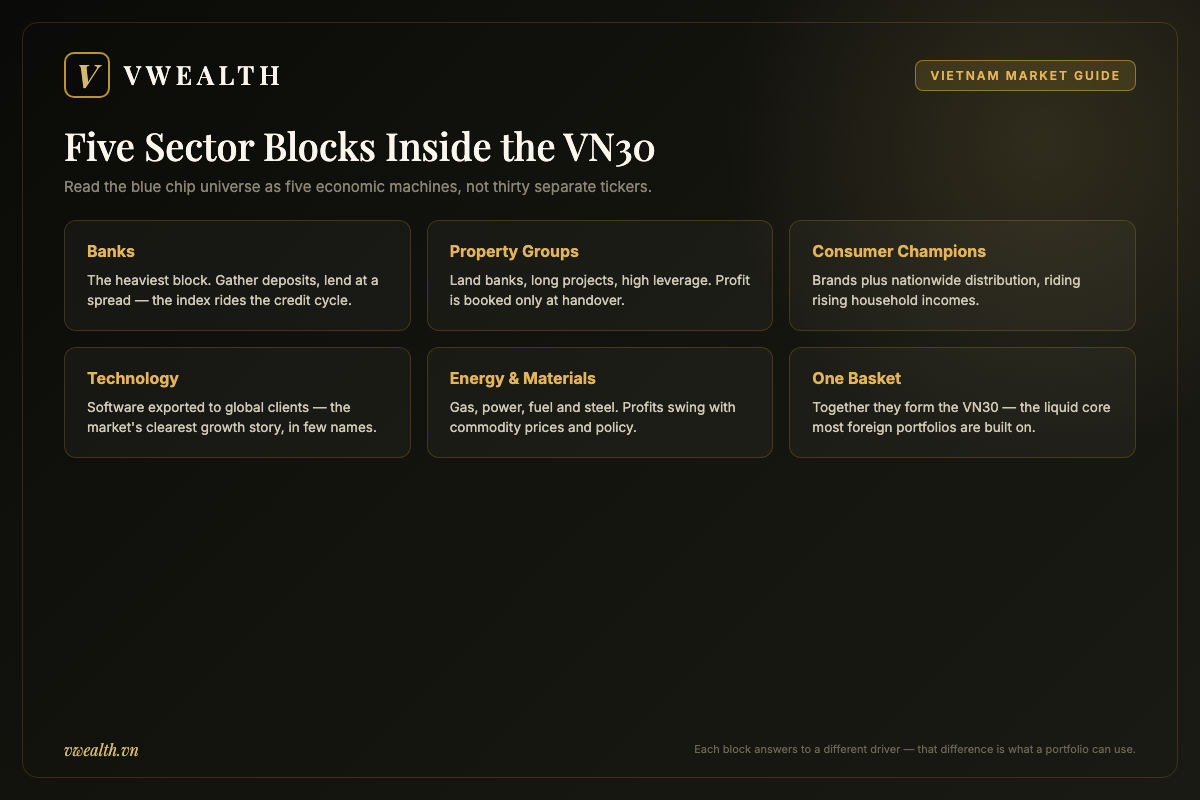
Start with the single most important fact about Vietnamese blue chips: banks dominate. Depending on the rebalancing period, lenders have typically made up somewhere in the neighborhood of a third to forty percent of the VN30’s weight — by far the largest sector block. No other sector comes close. The concentration became heavy enough that when HOSE overhauled its index rules in Version 4.0, it introduced an explicit 40% ceiling on any single sector’s weight, effective with the April 2025 review — a cap aimed squarely at the banks, which had grown large enough to threaten it. In other words, the exchange itself acknowledged that a VN30 investor’s exposure to lenders had reached the point of needing a formal limit. When you buy a VN30 tracker, you are, whether you intend it or not, making a leveraged bet on the health of Vietnam’s credit system. Everything else in this article should be read with that fact in the background.
Why are banks so heavy? Vietnam is a bank-financed economy. Companies raise most of their funding through bank loans rather than bond or equity markets, and households channel most of their savings into bank deposits. The banking system therefore intermediates a huge share of national economic activity, and the listed banks capture that flow as revenue. As the economy has grown, the banks have grown with it — and because many of them listed early and are heavily traded, they naturally fill the top of any size-and-liquidity ranked index.
Two families of banks, two different investments
The banking block splits into two families with genuinely different characters.
The first family is the state-owned commercial banks — the giants where the government remains the controlling shareholder. These institutions bank the largest state enterprises and infrastructure projects, enjoy the cheapest and stickiest deposit bases in the country, and are run with a conservatism that reflects their systemic role. Their appeal is stability and scale; their limitation is that policy objectives sometimes take priority over profit maximization, and their state-heavy ownership leaves a smaller free float for everyone else.
The second family is the private joint-stock banks. These are younger, hungrier institutions that grew by serving the segments the state giants historically neglected: private businesses, consumers, mortgages, credit cards. They compete on technology, service and speed, and the best of them have built impressive low-cost deposit franchises through payroll accounts and digital banking. They tend to grow faster than the state banks and to earn higher returns on equity — the profit a bank generates per unit of shareholder capital — but they also take more credit risk and feel economic downturns more sharply.
How a Vietnamese bank actually makes money
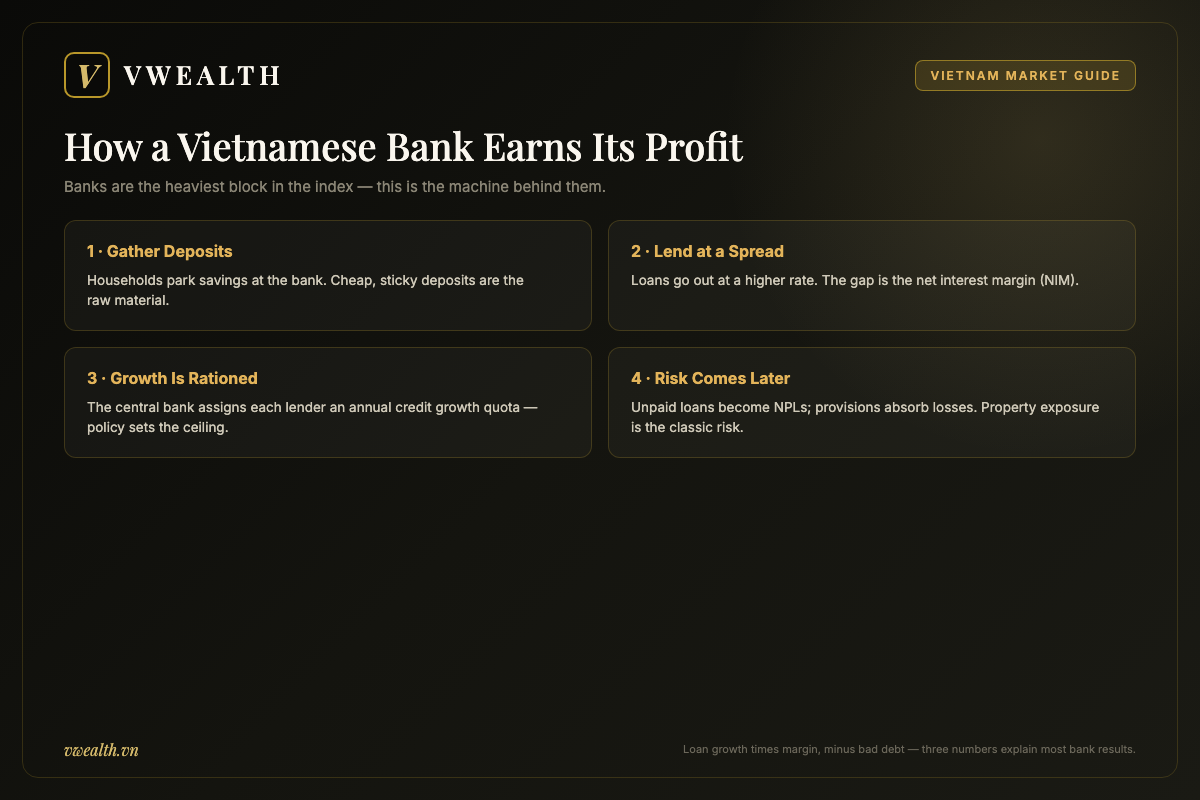
The business model is worth understanding because it explains the entire block’s behavior. A bank gathers deposits at one interest rate and lends the money out at a higher rate; the gap, expressed as a percentage of earning assets, is the net interest margin, or NIM. Multiply NIM by the size of the loan book and you have the core of a Vietnamese bank’s income. Two levers therefore drive earnings: how fast the loan book grows, and how wide the margin is.
Here is the distinctly Vietnamese twist: loan growth is rationed. The central bank assigns each lender an annual credit growth quota — a ceiling on how much its loan book may expand — as a tool for managing inflation and financial stability. A bank’s growth is thus partly a policy variable, not purely a management achievement. Well-run banks with strong capital tend to receive more generous quotas, which creates a quality flywheel: good banks are allowed to grow faster, which makes them bigger and often better.
The risk side of the model is credit quality. When borrowers stop paying, loans become non-performing (the NPL ratio measures these as a share of all loans), and the bank must set aside provisions — money deducted from profit to absorb expected losses. Because Vietnamese banks lend heavily against property, their fortunes are entangled with the real estate cycle described in the next section. A property downturn shows up, with a lag, as rising NPLs and falling bank profits. This is the mechanism through which the two biggest blocks of the index — banks and property — can fall together, and it is the single most important risk linkage a VN30 investor should understand. For the full toolkit — why banks are valued on price-to-book rather than price-to-earnings, how to read NPL coverage, what CASA means — see the dedicated foreign investor’s guide to Vietnam’s banking sector.
The property and conglomerate block: land, leverage and long cycles
The second great block of the blue chip universe is real estate — led by sprawling private conglomerates whose interests stretch from apartment townships to shopping malls, industrial parks and, in some cases, ventures far outside property altogether. This block embodies Vietnam’s urbanization story: a young population moving into cities, forming households, and buying their first formal housing, decade after decade.
The developer business model, in plain words
A residential developer’s economics run on a long conveyor belt. The company assembles a land bank — rights to develop land acquired years before any customer appears — then obtains legal approvals, builds infrastructure, and sells apartments off-plan, collecting progress payments from buyers while construction proceeds. Crucially, under Vietnamese accounting, revenue and profit are booked only at handover, when the finished unit is delivered. Cash comes in early; reported profit arrives years later.
This lag has a practical consequence every blue chip investor should internalize: a developer’s income statement describes the past, not the present. This year’s reported profit reflects apartments sold two or three years ago. The forward-looking indicator is presales — the value of new units customers have committed to buy — which foreshadows the profits of future years. An investor who reads only the profit line will systematically misjudge where a developer stands in its cycle.
The other defining feature is leverage. Land is expensive and approvals are slow, so developers borrow heavily — from banks, from bondholders, and effectively from customers through progress payments. Leverage magnifies both directions of the cycle: in good years it turns rising prices into spectacular profit growth, and in tight years it turns a sales slowdown into a scramble for refinancing. Vietnam’s corporate bond market has already delivered a memorable lesson on this score, and the episode is worth studying as a permanent feature of the block’s risk profile rather than a one-off event.
Not all property is the same business
Within the block, distinguish three models that behave very differently. Residential developers live and die by the conveyor belt just described — cyclical, leveraged, approval-dependent. Retail landlords, which build and operate shopping malls, are a steadier business: they collect rent under multi-year leases, so their revenue looks more like an annuity than a lottery. Industrial park operators lease land to manufacturers and thereby ride a different demand driver entirely — foreign direct investment and the relocation of global supply chains into Vietnam — which can boom even when housing is quiet. When you see “real estate” as one line in an index breakdown, remember it hides these three distinct machines.
The conglomerates deserve one extra note. The largest private groups in this block are controlled by founders with ambitions well beyond property — spanning retail, hospitality, industry and technology ventures. Owning them means owning the founder’s capital-allocation decisions across all of it. That can create value in ways a pure developer never could, and it can also consume the profits of the property business to fund ventures whose payoff is uncertain. Judge these companies as portfolios of bets, not as single businesses.
The consumer block: brands, bottles and the middle-class engine
The third block is the consumer champions — the dairy producers, brewers, food and retail groups, and jewelry chains that sell directly into Vietnamese households. If banks are a bet on the credit system and property is a bet on urbanization, the consumer block is the purest bet on the story that attracts most foreign investors in the first place: roughly a hundred million people, young by global standards, getting richer every year and spending more on branded goods.
Staples: the defensive core
Consumer staples — milk, food, beer, everyday essentials — are the classic defensive businesses. Demand barely moves with the economic cycle, because families keep buying breakfast in a downturn. The great staples companies built their positions over decades through two moats that are brutally hard to replicate. The first is brand: a name a shopper trusts without thinking. The second, arguably more important in Vietnam, is distribution — the physical network that places a product in hundreds of thousands of small family-run shops from Hanoi to the Mekong Delta. A foreign competitor can copy a recipe in months; building relationships with several hundred thousand corner stores takes a generation.
The trade-off is maturity. The most dominant staples franchises have already penetrated most households, so their growth arithmetic depends on premiumization — persuading consumers to trade up to higher-value versions — and on expansion into adjacent categories or export markets. Investors typically pay a valuation premium for the stability, and the recurring debate around this block is whether the premium is justified once growth slows. That debate, along with the staples-versus-discretionary distinction, is explored at length in our guide to investing in Vietnam’s consumer sector and the middle-class boom.
Discretionary and retail: the growth end
The discretionary side of the block — electronics chains, grocery chains, jewelry retailers — is a different machine. These are store-rollout businesses: profit growth comes from opening new locations and from squeezing more revenue out of existing ones. The single most revealing metric is same-store sales growth, which measures revenue growth only in stores open for more than a year, stripping out the flattering effect of new openings. A chain adding stores while same-store sales stagnate is renting growth, not creating it.
Retail economics also explain a pattern that confuses newcomers: rapidly expanding chains often report thin profits precisely because they are expanding. New stores lose money before they mature, and the cost sits on today’s income statement while the payoff arrives later. The consumer block thus spans the entire style spectrum — from bond-like staples to aggressive growth retail — inside a single sector label. A blue chip portfolio can be tilted defensive or aggressive without ever leaving the consumer names.
The technology block: one flagship and a global growth story
The technology block is the smallest of the major groups by number of names, but it punches far above its weight in investor attention — because it contains the market’s flagship growth story: software and IT services exported to the world.
The business model is essentially the export of engineering brainpower. A Vietnamese IT-services company hires and trains large numbers of software engineers at Vietnamese salary levels, then sells their work — application development, system maintenance, and increasingly full digital-transformation programs — to corporate clients in Japan, the United States, Europe and Asia at international prices. The gap between Vietnamese costs and global billing rates is the margin engine, and the model scales by adding engineers and moving up the value chain from simple outsourcing toward higher-fee consulting and, in ambition at least, semiconductor design services.
What makes this block strategically interesting inside a blue chip portfolio is that its revenue comes from abroad. Banks, property and consumer names all sell into the domestic economy; the technology exporters sell into global corporate IT budgets. That gives the block a diversification value beyond its size: a domestic credit squeeze that hurts banks and developers does not directly reduce a Japanese client’s software spending. The flip side is exposure to global tech-spending cycles and to wage inflation in Vietnam’s own engineering talent pool, which gradually erodes the cost advantage if billing rates fail to climb in step.
Valuation works differently here too. Growth companies almost always look expensive on a simple price-to-earnings ratio, because the market is paying today for profits that will only exist in several years. The standard adjustment is the PEG ratio — the P/E divided by the expected earnings growth rate — which asks whether the price is high relative to the growth actually being delivered. The great risk of any growth blue chip is the de-rating double hit: if growth slows, earnings disappoint and the multiple investors will pay for those earnings shrinks at the same time, so the share price falls twice for one piece of bad news. How to monitor that risk quarter by quarter is the subject of our deeper piece on Vietnam’s technology stocks and the software export story.
One caution belongs in every honest discussion of this block: concentration. Listed, liquid, investable technology exposure in Vietnam is dominated by a very small number of names. If you want the theme, you largely have to accept single-company risk alongside it — a very different proposition from buying “the tech sector” in a market with hundreds of listed software firms.
The energy and materials block: cyclical giants with policy in the mix
The final major block gathers the industrial heavyweights: gas and fuel distribution, power generation, steel and basic materials. These companies supply the physical inputs of a fast-industrializing economy, and their common thread is cyclicality — profits that swing with commodity prices and construction activity rather than climbing in a steady line.
Energy: commodity prices filtered through regulation
The energy names each occupy a link in a chain that runs from gas fields to power plants to petrol stations, and each link earns money by a different rule. Upstream and midstream gas businesses have revenues tied to global energy prices, so their profits inhale and exhale with the oil market. Fuel distributors earn a margin on volume that is heavily shaped by state price management of retail fuel. Power generators sell electricity partly under long-term contracts and partly into a competitive market, making them steadier but still exposed to fuel costs and hydrology — a dry year literally changes a hydropower company’s output. The unifying long-term driver is electricity demand, which in a country industrializing at Vietnam’s pace grows relentlessly. The unifying complication is policy: tariffs, price stabilization and energy-transition planning mean the state is a permanent actor in every business model in this group.
Steel: the purest cycle on the exchange
Steel deserves its own paragraph because it is the market’s textbook cyclical. A steelmaker’s profit is a spread: the price of finished steel minus the cost of iron ore and coking coal, multiplied by volume. When construction booms and spreads widen, profits do not merely rise — they multiply, because the industry’s huge fixed costs mean each extra dollar of spread falls almost straight to the bottom line. When the cycle turns, the same arithmetic runs in reverse. This produces the famous cyclical trap: at the top of the cycle, bumper profits make the P/E ratio look deceptively cheap at exactly the wrong moment to buy. A cheap-looking steel stock can be the most expensive mistake in the market. Blue chip status does not soften the cycle; it just means the company is big enough to survive it.
Reading the block as a whole
For a portfolio builder, the energy and materials block plays a specific role: it is where the index keeps its inflation and commodity sensitivity. In years when energy and materials prices surge, this block can carry the index while consumer and property names struggle with cost pressure. In disinflationary years the roles reverse. Understanding that see-saw is more useful than forming a view on any single company in the group.
The five blocks side by side
Before turning to concentration and foreign access, it helps to see the whole map on one page. The table below compares the blocks on the dimensions that actually drive investment outcomes. It deliberately contains no prices or financial figures — those change weekly, while the structural characters below change over decades.
| Sector block | Core business model | Main earnings driver | Cyclicality | Key risk to watch |
|---|---|---|---|---|
| Banks | Gather deposits, lend at a spread (NIM) | Credit growth quotas × margin | High — tied to credit cycle | Bad debt from property exposure |
| Property & conglomerates | Buy land, develop, book profit at handover | Presales and project approvals | Very high, with long lags | Leverage and refinancing squeezes |
| Consumer champions | Brands plus nationwide distribution | Household income growth, premiumization | Low (staples) to medium (retail) | Paying too much for stability |
| Technology | Export engineering talent at global prices | Global IT spending, headcount growth | Medium — global tech cycle | De-rating if growth slows; few names |
| Energy & materials | Commodity spreads and regulated margins | Commodity prices, power demand | Very high (steel most of all) | Buying cyclicals at peak earnings |
Two observations jump out of the table. First, three of the five blocks are strongly cyclical, and the two biggest — banks and property — are cyclical in a correlated way, since banks lend to developers and homebuyers. Second, the genuinely defensive weight in the blue chip universe is modest: mainly the staples half of the consumer block and the contracted portion of power generation. Vietnam’s blue chip basket is a growth-and-cycle basket, not a widows-and-orphans basket. That is neither good nor bad; it is simply what you are buying, and you should size the position accordingly.
Concentration: what the index’s shape means for your money
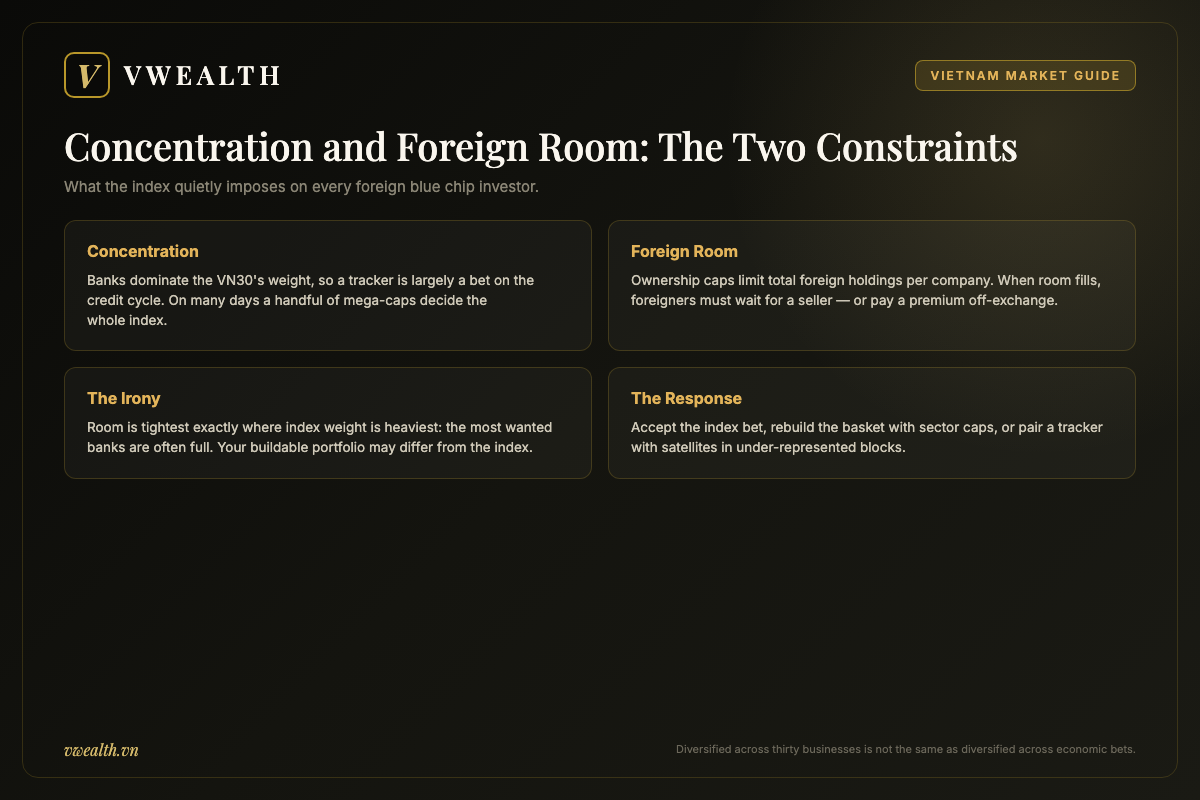
Now to the first big practical question. Because the VN30 is weighted by market capitalization (adjusted for free float), the biggest companies carry the most weight — and as we have seen, the biggest companies cluster in one sector. The result is an index whose fortunes are unusually tied to a single industry: banking.
Think through what that means with a simple illustrative scenario. Suppose — purely as a thought experiment — that bank stocks fall twenty percent while every other blue chip is flat. If banks are around forty percent of the basket, the index drops roughly eight percent even though the median company in it did nothing. Now run it the other way: a banking bull run can lift the index while the average non-bank constituent barely moves. Investors who buy “the market” through a VN30 tracker are, to a first approximation, buying a banking fund with a diversified garnish.
Concentration also stacks vertically, not just by sector. A handful of the largest constituents — a few banks and the biggest conglomerates and consumer names — together dominate the index’s daily movement. On many trading days, the story of the VN-Index is really the story of five or six tickers. This is why experienced observers always check the breadth of a rally: an index rising because two mega-caps jumped is a very different signal from an index rising because twenty-five of thirty constituents advanced.
Three honest responses to concentration
What should an investor actually do about this? There are three defensible answers, and the right one depends on your temperament and time.
First: accept it. The concentration reflects the real structure of Vietnam’s economy — banking genuinely is that central to national growth. If you believe in the country’s long-term trajectory, the banks are a legitimate way to own it, and the index gives them to you automatically. Many long-horizon investors make this choice consciously and simply size their Vietnam allocation so that a rough banking stretch is survivable.
Second: rebuild the basket with different weights. Nothing forces you to hold blue chips in index proportions. An investor can own the same thirty-stock universe but cap any single sector at, say, a quarter of the portfolio, deliberately holding more of the consumer, technology and energy blocks than the index does. You keep blue chip quality and liquidity while dialing down the single-sector bet. The cost is effort — you now have a portfolio to maintain — and periods of watching a bank-led index outrun you.
Third: pair the index with satellites. Hold the tracker as the core but add deliberate positions in under-represented blocks to pull the overall mix toward balance. This is less work than a full custom basket and still meaningfully reduces the concentration.
What you should not do is buy the index while assuming it is diversified in the way an S&P 500 fund is diversified. It is diversified across thirty businesses but not across economic bets — most of the weight answers to the credit cycle. Know that going in, and none of its behavior will surprise you.
Liquidity and foreign room: what you can actually buy, block by block
The second practical question is access, and this is where Vietnam differs most sharply from developed markets. Two frictions decide what a foreign investor can really own: liquidity and foreign ownership limits.
Liquidity: the good news
Liquidity — the ease of buying or selling meaningful size without moving the price — is the blue chips’ great advantage. VN30 names trade actively every session, with banks, brokerages-adjacent names and the big conglomerates typically among the most heavily traded stocks in the market. For any individual investor, and for most funds, position size is simply not a problem in this universe. That statement emphatically does not extend down the capitalization ladder, where daily trading in a small-cap can be thin enough that exiting a position takes weeks. Blue chips are where foreign money can move freely — which is precisely why most foreign portfolios in Vietnam are built on them.
Foreign room: the complication
Foreign ownership limits (FOL) cap the combined stake that all foreign investors may hold in a listed company. The cap varies by industry, and banking is by far the strictest of the major sectors. Total foreign ownership of a Vietnamese commercial bank is capped at 30% of charter capital, with sub-limits stacked underneath it — a single foreign individual may hold no more than 5%, a foreign organization no more than 15%, and a foreign strategic credit institution no more than 20% (rules set out in Decree 01/2014 and amended by Decree 69/2025; the mechanics are laid out in VinaCapital’s explainer on Vietnam’s foreign ownership limits). The only exception is weak banks under an approved restructuring plan, where the Prime Minister may allow foreign ownership up to 49%. Outside banking the picture is far more open: since 2015, when Decree 60/2015 removed the old blanket 49% cap, most listed companies face no general foreign limit at all except in specific conditional sectors. The remaining capacity under whatever cap applies is called “room,” and it is the number a foreign investor must check before placing an order, because when room is exhausted, foreigners can no longer buy on the exchange at the market price. Full room means either waiting for another foreign investor to sell, or negotiating an off-exchange block purchase — historically sometimes at a premium above the listed price, since foreign buyers competing for scarce access have been willing to pay extra for it.
Here is the strategic irony that every new investor in this market eventually confronts: the room problem is most severe exactly where the index weight is heaviest. Banks carry the tightest sector cap and attract the most foreign demand, so the most desirable bank stocks are persistently at or near full room. The consumer, technology and energy blocks are generally more accessible, though an individual popular company in any sector can fill its room. In practice, this means a foreign investor’s buildable blue chip portfolio often looks different from the index — lighter in exactly the banks the index holds most of — not by choice, but by constraint. The mechanics of checking room, and what the foreign premium implies, are covered in the pillar guide to investing in Vietnamese stocks from abroad.
| Block | Trading liquidity | Foreign room reality | Practical note for foreign buyers |
|---|---|---|---|
| Banks | Excellent — market’s most traded group | Tightest caps; favorites often full | Check room first; expect limited access to the best names |
| Property & conglomerates | Very good in the large names | Generally workable | Watch free float — founder stakes shrink tradable supply |
| Consumer champions | Good to very good | Mostly open; select names can fill | Often the easiest quality exposure to actually buy |
| Technology | Good, concentrated in few tickers | Popular names can run tight | Single-stock concentration is the bigger issue |
| Energy & materials | Good in the largest names | Generally workable | State stakes reduce float in some energy names |
One more access note: ETFs exist partly because of this problem. Certain onshore funds were designed around baskets of stocks where foreign room is chronically scarce, giving foreign investors indirect exposure to full-room companies. It is an imperfect instrument — fund structures add their own costs and tracking quirks — but it illustrates how central the room issue is to the way this market actually functions.

Using blue chips as the core of a portfolio
Everything above converges on a practical construction question: how should these thirty companies fit into a real portfolio? The framework most professionals use, and the one we recommend adapting, is core and satellite.
The core-satellite logic
The core is the large, stable majority of your portfolio — the part designed to capture the market’s long-term growth reliably and cheaply in time and attention. The satellites are smaller, deliberate positions where you express specific views. Blue chips are natural core material for three reasons that should now be familiar: they are liquid enough to enter and exit freely, they are researched and audited heavily enough that catastrophic surprises are rarer than in small-caps, and as a group they map onto the main engines of the Vietnamese economy itself. A newcomer’s worst outcomes in this market rarely come from blue chips; they come from illiquid speculative names bought on rumor. Anchoring the portfolio in the VN30 universe is the simplest available defense against the most common ways investors hurt themselves.
Building the core, step by step
A sensible sequence looks like this. First, decide the split: a common starting shape is to hold most of your Vietnam allocation in the core and reserve a strict minority for satellite ideas, with the exact ratio set by how much time you genuinely have for research. Second, choose the core’s vehicle: an index tracker if you accept the banking concentration, or a hand-built basket of blue chips across the five blocks if you want to control the sector weights yourself — one or two quality names per block already produces a reasonably balanced machine, since the blocks respond to different drivers. Third, buy with time diversification: entering gradually on a fixed schedule (the approach known as dollar-cost averaging) removes the impossible task of picking the perfect day, which matters in a market as cyclical as this one. Fourth, rebalance on a calendar — once or twice a year, trim whatever block has swollen beyond its target and top up what has shrunk. Rebalancing quietly forces you to sell what has become expensive and buy what has become cheap, which is the entire discipline of value investing compressed into an administrative habit.
Maintaining the core without living on the terminal
A blue chip core is deliberately low-maintenance, but it is not zero-maintenance, because the basket itself changes. Companies enter and exit the VN30; founders make transformative bets; a defensive name can acquire its way into cyclicality. A quarterly review is enough: check that each holding still does what you bought it to do, read the headline numbers against the sector logic described in this article — presales for developers, credit growth and bad-debt trends for banks, same-store sales for retailers, contract wins for technology, spreads for steel — and resist the urge to react to daily index noise. The specific current figures for every company are exactly the kind of data that goes stale in print, which is why we do not quote them here; pull up the latest analysis in vwealth’s report library when you review, rather than relying on any article’s snapshot.
What blue chips will not do for you
Close the framework with honest expectations. A blue chip core will not make you rich quickly; its constituents are too large and too well-watched to multiply the way an obscure small-cap occasionally does. It will not spare you drawdowns; in a broad market decline the blue chips fall too, and in a credit crunch the bank-heavy index can fall hard. What it will do is keep you invested in the market’s most durable businesses, with positions you can always exit, through the cycles that shake weaker holdings loose. In a young, fast-moving, sometimes turbulent market, that survivability is the real product you are buying. Nothing in this article is a recommendation to buy or sell any security; it is an analytical framework for your own research and decisions.
The bottom line: thirty companies, five machines, one map
Vietnam’s blue chips are best understood not as a list of thirty tickers but as five economic machines. The banking block converts national credit growth into profit and dominates the index’s weight and mood. The property block converts urbanization into long, leveraged development cycles. The consumer block converts rising household incomes into brand and distribution profits, spanning defensive staples and aggressive retail. The technology block exports Vietnamese engineering to global clients and carries the market’s clearest growth story in very few names. The energy and materials block supplies the physical economy and swings with commodity cycles and policy. Concentration means an index investment is chiefly a banking bet; foreign room means your buildable portfolio may differ from the index whether you like it or not; and the core-satellite framework turns all of these constraints into a workable plan. Learn the five machines, decide your weights deliberately, buy with patience, and the blue chip universe becomes what it should be: the sturdy center of a Vietnamese equity portfolio rather than a bundle of unfamiliar symbols.
Research Vietnamese stocks in English with vwealth. Our AI-powered platform turns Vietnamese market data into full English analysis reports — with international payment support and a free 2-month trial for new accounts. Create your free account and read the latest reports.
Frequently Asked Questions
What counts as a blue chip in the Vietnam equity market?
For practical purposes, the thirty companies inside the VN30 index: the banks, property conglomerates, consumer champions, technology exporters and energy groups that account for the bulk of market value and trading volume. Unlike in the United States, where blue chip is a loose cultural label people argue about, Vietnam has an official short list.
How should I read the thirty blue chips?
As five or six sector blocks rather than thirty separate tickers. Once you group them that way the whole Vietnamese market becomes readable, because each block earns money in a recognisably different way and reacts to different drivers.
What does the heavy bank weighting mean for index investors?
It means an index position in the Vietnam equity market is, to a large degree, a position in Vietnamese banking. Anyone buying the index without realising that is taking a concentrated sector bet while believing they bought diversification.
Does liquidity differ across blue chip blocks?
Yes, and so does foreign ownership room. Both vary noticeably from one sector block to the next, which affects how easily a foreign investor can actually build or exit a position — not just whether the business is good.
Should blue chips be the core of a Vietnam portfolio?
They are commonly used that way by professionals — as the core, chosen with open eyes rather than bought blindly. The distinction matters: knowing what each block does and where its liquidity limits sit is what separates using blue chips from just owning them.