Vietnam’s stock market does not trade like New York, London or Sydney, and the differences are not cosmetic. Daily price ceilings and floors replace circuit breakers, shares trade in fixed lots of one hundred, the money from a sale is not instantly reusable, and short selling of individual stocks is simply not part of the menu. This guide walks through the full rulebook of Vietnam stock trading rules — price bands, lot sizes, the settlement cycle, the ATO and ATC auctions, margin and short-selling status — and, more importantly, explains how each rule quietly reshapes the way you should size positions, time entries and manage risk compared with a Western market.
Why Vietnam’s Trading Rulebook Feels So Different
Every stock market’s rules reflect a design philosophy. The United States built its market around institutional liquidity: near-unlimited intraday price movement, instant reuse of capital, easy short selling, and circuit breakers that only trigger in genuine panics. Vietnam built its market around a very different reality — a young exchange, a retail-dominated investor base, and a regulator whose first priority is stability rather than speed.
That single design choice explains almost everything that surprises foreign traders. Instead of letting prices find their level freely and halting the whole market in emergencies, Vietnam caps how far every individual stock can move every single day. Instead of trusting brokers to manage credit risk, the system historically required cash in the account before a buy order and shares in the account before a sell order. Instead of allowing bearish bets on single companies, it channels short exposure into one index futures contract.
None of this makes the market unplayable. Plenty of disciplined investors — local and foreign — compound wealth in Vietnamese equities year after year. But it does mean that strategies imported wholesale from Western markets often break in subtle ways. A day-trading habit collides with the settlement cycle. A stop-loss habit collides with the floor price, where sometimes nobody is bidding. A “buy the dip with margin” habit collides with rules on who may borrow at all. Understanding the rulebook first, before placing a single order, is the cheapest education you will ever get in this market.
One caveat runs through this entire article: trading rules are regulations, and regulations change. Vietnam has been upgrading its market infrastructure for years — a new exchange trading system, shorter settlement, and reforms aimed squarely at an emerging-market upgrade. That campaign reached a milestone in October 2025, when FTSE Russell announced it would reclassify Vietnam from Frontier to Secondary Emerging Market, with the change set to take effect on 21 September 2026 (confirmed at an interim review in early 2026). Several rules described here have already been amended more than once in the past decade. Treat everything below as the durable logic of the system, and always verify the current numbers with your broker or the exchange’s official notices before you rely on them.
Daily Price Bands: The Ceiling and Floor That Rule Everything
The most visible difference between Vietnam and a Western market is the daily price band. Every listed stock has a reference price each morning — normally the closing price of the previous session — and the exchange calculates a maximum price (the ceiling) and a minimum price (the floor) around it. Orders outside that range are rejected by the system. The stock simply cannot trade beyond those bounds until the next day resets the band.
How wide are the bands?
Each exchange sets its own band width, and the pattern has been consistent for years: the main board is tightest, and the less regulated markets are wider. On the Ho Chi Minh exchange (HOSE) the daily band has long been in the region of seven percent either side of the reference price; on the Hanoi exchange (HNX) roughly ten percent; and on UPCoM, the market for unlisted public companies, roughly fifteen percent. These are the widely quoted figures, but band widths are set by regulation and have been adjusted in the past — Vietnam has temporarily narrowed bands during periods of extreme stress before — so confirm the current percentages with your broker rather than treating them as laws of nature.
There is one important exception: a stock’s first day of trading. Because a newly listed company has no market-set reference price, the exchanges allow a much wider band on debut day — historically several times the normal width — so that the market can discover a fair price quickly. The same wider band typically applies when a stock resumes trading after a long suspension. If you see a stock up thirty or forty percent on a single day, check whether it is a first-day listing before assuming something extraordinary happened.
| Market | Typical daily band | First-day band | Character |
|---|---|---|---|
| HOSE (Ho Chi Minh) | Around ±7% | Much wider (historically ±20%) | Large caps, strictest listing standards |
| HNX (Hanoi) | Around ±10% | Much wider (historically ±30%) | Mid and small caps |
| UPCoM | Around ±15% | Much wider (historically ±40%) | Unlisted public companies, lighter disclosure |
Band widths are set by regulation and have changed before — always verify the current figures with your broker or the exchange before trading.
The color code on every Vietnamese price board
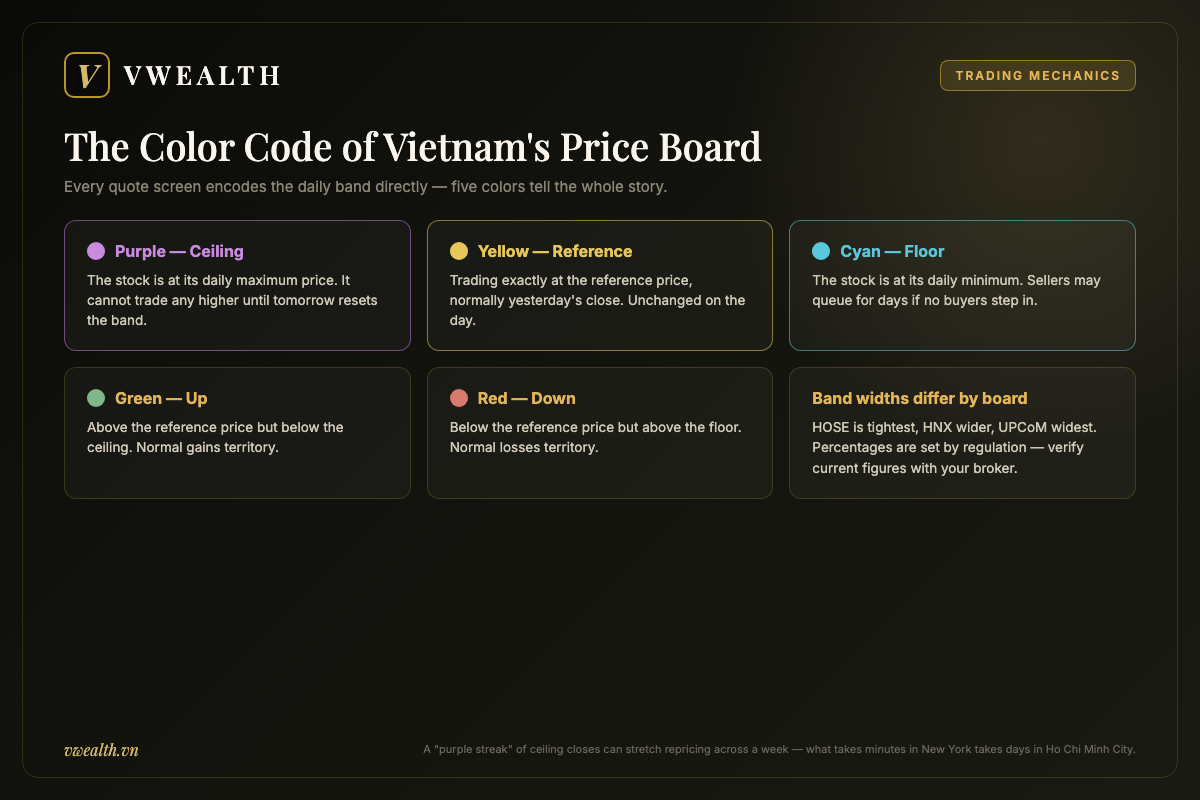
Open any Vietnamese trading app or the electronic boards in a brokerage office and you will see a color scheme that encodes the band directly. Green means the price is above the reference; red means below. So far, so familiar. The two colors that puzzle newcomers are purple and cyan. Purple (often called “tím” locally) means the stock is trading at its ceiling — it literally cannot go higher today. Cyan or light blue means the stock is at its floor — it cannot go lower today. Yellow marks a stock trading exactly at its reference price, unchanged.
Local market slang has grown around these colors. A stock that closes at the ceiling is said to have “hit purple,” and a run of consecutive ceiling closes — entirely possible when a small stock catches a wave of enthusiasm — is a purple streak. The mirror image, a stock locked at its floor with sellers stacked up and no buyers, is one of the most stressful sights in Vietnamese investing, and we will come back to why.
How price bands change actual trading behavior
A Western trader’s first instinct is to think of the band as a minor inconvenience. It is much more than that. The band changes the information content of prices and the availability of liquidity in ways you must internalize.
First, price discovery gets stretched across days. Suppose genuinely transformative news lands — a major foreign partner buys into a mid-cap company. In New York, the stock might open forty percent higher within minutes, and the repricing is done. In Vietnam, the stock hits its ceiling, and everyone who wants shares must queue. If demand is still unfilled at the close, the stock opens the next day, gaps to the new ceiling, and the queue forms again. The repricing that took minutes in New York takes a week in Ho Chi Minh City. During that week, holders enjoy the ride, but buyers face a brutal choice: join the ceiling queue with little chance of a fill, or wait and risk paying far more later.
Second, liquidity evaporates exactly when you need it most. At the floor price, the band prevents the price from falling to a level where bargain hunters would step in. If bad news is severe, buyers simply withdraw, and the stock sits at the floor with millions of shares offered and none traded. A stop-loss order — an instruction to sell automatically once the price falls to a set level, designed to cap your loss — does not guarantee an exit here, because execution requires a counterparty. In a multi-day floor cascade, your practical exit may come only after several sessions, each one taking another band-width slice off the price. This is why experienced Vietnamese investors treat position sizing, not stop placement, as their primary risk control. If a position is small enough that three consecutive floor days would sting rather than wound, the floor mechanism loses most of its terror.
Third, the ceiling and floor act as behavioral magnets. Research on limit systems in other Asian markets documents a magnet effect: as a price approaches its limit, traders rush to transact before the door closes, accelerating the move. You will see this in Vietnam on volatile days — a stock down five percent can slide to the floor with startling speed as holders scramble to sell “while they still can.” Recognizing the magnet effect helps you avoid panicking with the crowd and, occasionally, helps you find good entries when a quality stock gets dragged to the floor by market-wide fear rather than company-specific problems.
If you are still choosing where to focus, it helps to understand how the three venues differ beyond band width — listing standards, disclosure quality and liquidity vary enormously, and our guide to how HOSE, HNX and UPCoM differ and which board suits which investor covers that decision in depth.
Lot Sizes and Odd Lots: Why You Trade in Hundreds
In the United States you can buy a single share of anything, and fractional shares have made even that divisible. Vietnam works differently. On the main exchanges, normal continuous trading happens in board lots of one hundred shares. Your order quantity must be a multiple of one hundred: one hundred shares, three hundred, two thousand five hundred. An order for one hundred fifty shares of a HOSE stock will not enter the regular order book as a single order.
This was not always the rule — HOSE traded in lots of ten until it raised the board lot to one hundred in early 2021, partly to reduce order congestion on an aging trading system. The change matters for a practical reason: it sets the minimum ticket size for a regular trade. For a stock priced at 100,000 dong, one board lot costs ten million dong — roughly four hundred US dollars at typical exchange rates. For most stocks, which trade at lower prices, the minimum ticket is smaller, often under one hundred dollars. Vietnam remains a very accessible market for small investors, but you should check a stock’s price before assuming you can build a finely tuned position with tiny increments.
Where odd lots come from and how to sell them
An odd lot is any holding between one and ninety-nine shares. You rarely create one on purpose; the market creates them for you. The most common source is corporate actions. Vietnamese companies love paying stock dividends and issuing bonus shares — a company might distribute fifteen new shares for every hundred you hold. Own three hundred shares, receive forty-five new ones, and now you hold three hundred forty-five shares: three board lots plus a forty-five-share odd lot.
Odd lots trade through separate mechanisms rather than the main order book. Depending on the venue and current rules, that means either a dedicated odd-lot trading session or facility on the exchange, or selling the odd lot directly to your brokerage, which historically bought odd lots back at a discount — sometimes at the floor price of the day. HOSE added on-exchange odd-lot trading in 2022, which improved pricing considerably, but mechanics and pricing differ by broker and have been revised over time, so ask your broker exactly how they handle odd lots before you accumulate them.
Two practical habits follow. First, when a stock dividend is announced, do the arithmetic in advance and decide whether to round your position so the distribution lands on a clean multiple. Second, do not ignore small odd lots for years; they clutter your portfolio, and their value quietly drifts. Tidying them up once or twice a year is worth the small friction.
The Trading Day: ATO, Continuous Matching and the ATC Close
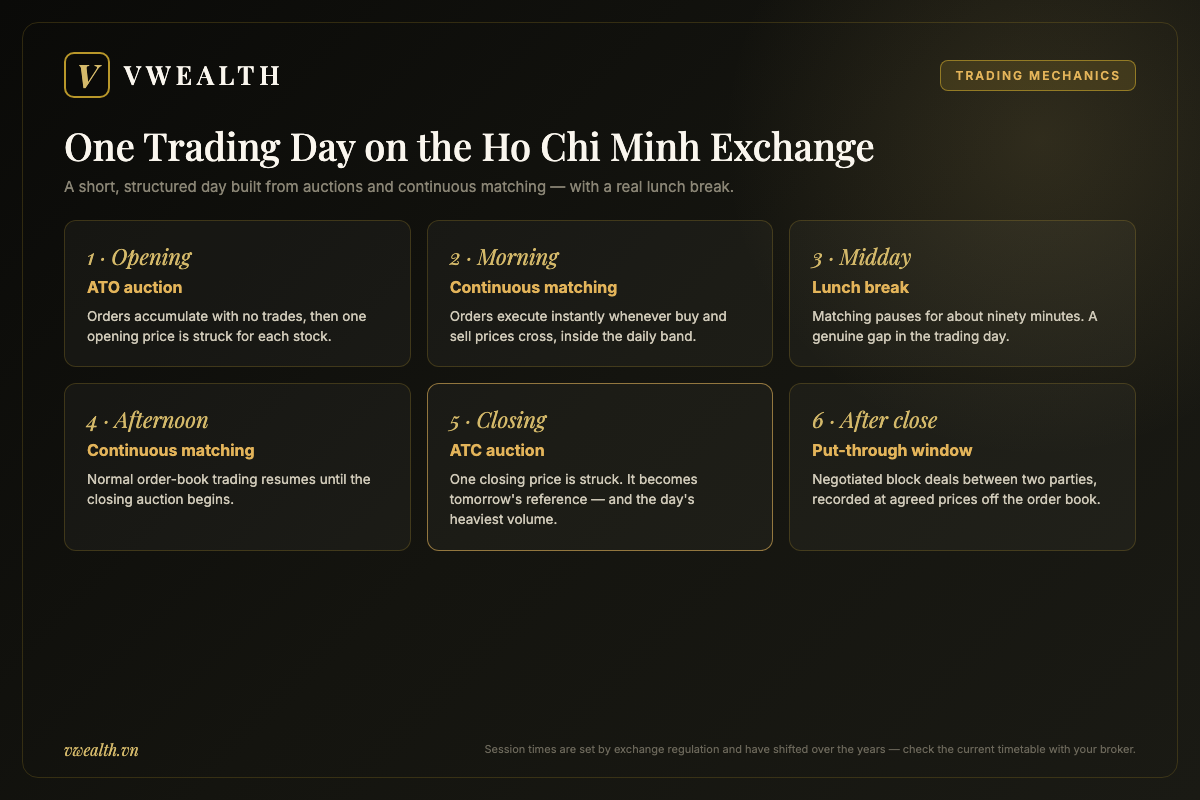
Vietnam’s trading day is short, structured, and includes a genuine lunch break — a rhythm that surprises anyone used to six-and-a-half uninterrupted hours in New York. The day is built from three kinds of sessions: opening and closing call auctions and long stretches of continuous matching in between.
How a call auction works
A call auction (the mechanism behind both ATO and ATC) collects orders for a window of time without executing any of them. At the end of the window, the exchange computes the single price at which the largest number of shares can change hands, and every matching order executes at that one price. ATO stands for “at the open” — an order type that accepts whatever the opening auction price turns out to be. ATC, “at the close,” is the same idea for the closing auction. During the auction window you can see indicative matching information, but no trades print until the window closes.
The ATC auction carries special weight because it sets the official closing price, which becomes tomorrow’s reference price — the anchor for the next day’s ceiling and floor. It is also the price used for index calculations, fund valuations and derivative settlements. As a result, the final fifteen minutes often see the day’s heaviest and most contested volume. Large institutions rebalancing portfolios prefer the ATC because it guarantees execution at the official close. This concentration of size means the ATC can move a stock’s price noticeably in the last print of the day, and seasoned traders watch it closely rather than walking away at two thirty.
The daily timetable
The exact minutes are set by exchange regulation and have shifted over the years, but the structure has been stable. A representative HOSE day looks like this — verify the current timetable on the exchange website or with your broker:
| Time (approx.) | Session | What happens |
|---|---|---|
| 9:00 – 9:15 | Opening auction (ATO) | Orders accumulate; one opening price is struck at 9:15 |
| 9:15 – 11:30 | Continuous matching, morning | Orders match instantly whenever prices cross |
| 11:30 – 13:00 | Lunch break | No matching; a genuine pause in the day |
| 13:00 – 14:30 | Continuous matching, afternoon | Normal matching resumes |
| 14:30 – 14:45 | Closing auction (ATC) | One closing price is struck; becomes tomorrow’s reference |
| 14:45 – 15:00 | Put-through / after-hours window | Negotiated block deals recorded at agreed prices |
HNX historically opens directly into continuous trading without an ATO auction but shares the ATC close, and UPCoM runs continuous matching through the day without auctions. The put-through window deserves a note: it is a negotiated-deal facility where two parties agree a large block trade off the order book, subject to exchange rules. Foreign investors encounter it often, because when a stock’s foreign ownership room is full, foreigners frequently trade blocks between themselves via put-through, sometimes at prices above the on-screen market. If you are curious how ownership caps create that parallel market, the mechanics belong to a different rulebook — the foreign-room system — which interacts with everything described here.
Order types beyond the auctions
During continuous sessions, the workhorse is the limit order (LO) — you name your price and quantity, and the order rests in the book until matched or cancelled at day’s end. Vietnam’s exchanges also offer market-style orders, though the KRX trading system that went live in May 2025 reshuffled them: HOSE’s old MP (market price) order was retired and replaced by the MTL (market-to-limit) order, which sweeps the best available opposite-side prices and automatically converts any unfilled remainder into a limit order, and HNX offers its own market-order variants (MTL, MOK, MAK). Exact order-type menus differ by exchange and evolve with the trading system, so treat the acronyms as broker-app details to learn rather than memorize here. Two universal warnings apply anywhere: market orders in thin stocks can execute at ugly prices, and auction (ATO/ATC) orders accept whatever price the auction produces — never use them casually on illiquid names. One important KRX-era change: ATO and ATC orders no longer jump ahead of limit orders already resting in the auction book, so a well-priced limit order placed early is no longer automatically out-prioritized at the open or close.
One more behavioral wrinkle: order cancellation is restricted during auction windows. Rules have varied, but the general principle is that you cannot freely spoof and pull orders in the closing auction the way you might in a Western dark pool era. Place auction orders deliberately.
The Settlement Cycle: Why Your Money and Shares Arrive Later Than You Think
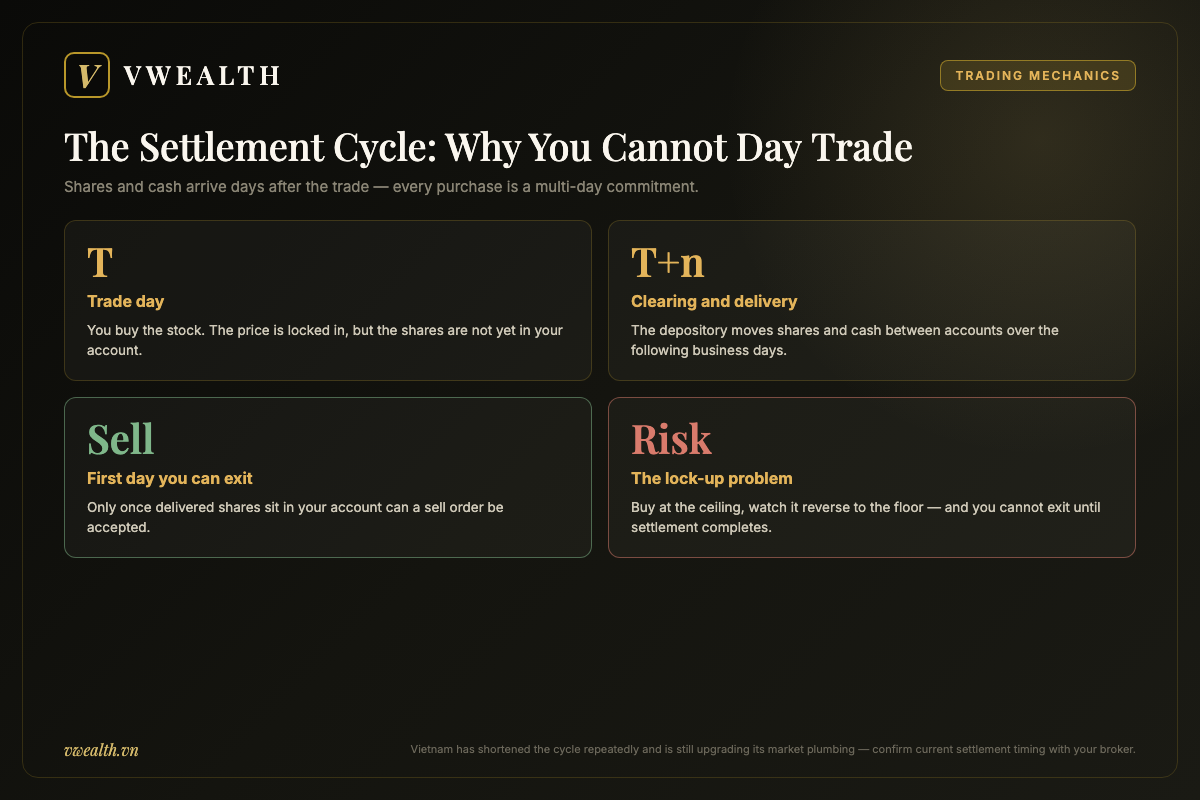
Settlement is the unglamorous plumbing that trips up more newcomers than any other rule. When you buy a stock, two things must happen after the trade: the shares must move into your securities account, and your cash must move to the seller. The gap between trade date and completion is the settlement cycle, written as T+n — trade date plus n business days.
What the cycle means in practice
Vietnam’s equity settlement cycle has shortened over the years — from T+3 in the earlier days of the market to T+2, with a further refinement that moved the delivery of shares to earlier in the day on T+2, so that investors could sell newly received shares that same afternoon. The market’s infrastructure keeps evolving: the long-awaited KRX trading system, built by Korea Exchange, finally went live on HOSE on 5 May 2025 after years of delay; Circular 68/2024/TT-BTC (effective 2 November 2024) removed the strict cash-prefunding requirement for qualifying foreign institutional investors; and a central counterparty (CCP) clearing model — the technical key to shorter settlement — has been rolling out in phases, with regulators targeting a move toward T+1 settlement around the second half of 2026 once the KRX system’s later phases and depository upgrades are complete. Any of these can change the fine print of settlement timing. The number that matters — exactly when purchased shares become sellable and when sale proceeds become withdrawable — should come from your broker on the day you ask, not from an article.
The durable lesson is the behavioral one: in Vietnam you cannot buy a stock in the morning and sell those same shares in the afternoon. The shares are not yet in your account. Intraday round-trip trading of a single position — the bread and butter of Western day traders — is structurally impossible in the cash equity market. You can sell shares you already held and buy something else the same day, and brokers typically let you reuse pending sale proceeds for new purchases before the cash formally settles (an advance facility that may carry a small fee or interest). But the newly bought shares themselves are locked until settlement delivers them.
How the cycle reshapes strategy
Think through what this does to a fast-trading style. Suppose you buy a stock at the ceiling on Tuesday amid great news. On Wednesday the mood reverses and the stock goes to the floor. You cannot exit — the shares have not arrived. By the time you can sell, the stock may have fallen by two full band-widths from your purchase price. The settlement cycle converts every purchase into a mandatory multi-day commitment, which is precisely why chasing ceiling-price momentum is so much more dangerous in Vietnam than chasing breakouts in a T+1 Western market.
The flip side: the cycle rewards investors who decide slowly and act deliberately. If your holding period is measured in months, a settlement lag of a couple of days is irrelevant. The rule punishes only those who need to reverse decisions within hours. Many experienced participants argue this is a feature, not a bug — it forces a cooling-off period on a retail-heavy market prone to emotional reversals. Either way, plan your liquidity: keep a cash buffer for opportunities, because money from a sale is not instantly redeployable everywhere, and never buy expecting to flip the same shares before settlement.
A note for foreign investors on prefunding
For most of the market’s history, foreign investors faced a strict prefunding rule: cash had to be sitting in the account before a buy order was accepted. This was one of the loudest complaints from international funds, since global custody workflows assume you commit at trade time and deliver cash at settlement. Reform in this area has been central to Vietnam’s market-upgrade campaign, and non-prefunded trading has been opened to qualifying foreign institutions. Retail foreign investors should assume cash-in-advance remains the default at most brokers and confirm their specific broker’s requirements. If you have not yet set up local access, our step-by-step guide to opening a Vietnamese brokerage account as a foreigner walks through the trading code, the capital account and the documents involved, and our broader primer on how to invest in Vietnam’s stock market as a foreigner compares the direct route with ETF alternatives if the paperwork feels heavy.
Margin Lending: Available, Regulated, and Mostly Local
Margin — borrowing money from your broker to buy more stock than your cash allows — exists in Vietnam and is heavily used by domestic retail investors. But it is fenced in by rules on three sides, and foreign investors largely sit outside the fence.
The three fences around margin
First, not every stock is marginable. The exchanges maintain an approved margin list, recalculated periodically. To qualify, a stock generally needs a sufficient listing history, profitability, and freedom from warning or supervision status. Speculative small caps and newly listed names are typically excluded — exactly the stocks where leverage would be most dangerous. When a stock is removed from the margin list (after an audit problem, say), forced selling by leveraged holders often follows, which is itself a tradable pattern worth understanding even if you never borrow a dong.
Second, leverage ratios are capped by regulation. The classic ceiling has been an initial loan of no more than half the position’s value — one-to-one leverage at most, with brokers free to be stricter per stock. Brokers publish their own margin ratios per ticker and adjust them with risk appetite. There is no Vietnamese equivalent of the unbounded leverage available through Western derivatives on single stocks.
Third, margin calls in a banded market are uniquely brutal. Recall the floor mechanism: when a leveraged stock falls, the broker demands additional collateral, and if none arrives, force-sells the position. But at the floor there may be no buyers, so the forced selling rolls into the next session, pressing the stock to the next floor, triggering more margin calls across other holders — a cascade. Vietnam’s sharpest market-wide drawdowns have been amplified by exactly this loop. Even as an unleveraged investor you feel it, because cascades drag quality stocks down with the junk; knowing the mechanism helps you recognize when a selloff is about margin mechanics rather than fundamentals — historically some of the best buying windows the market has offered. When evaluating whether the broad market itself is stretched, index-level tools help; our explainer on the VN-Index versus the VN30 and what each actually measures is the place to start.
Where foreigners stand
Foreign investors have generally not been permitted to use domestic margin lending — the regulatory framework ties margin to domestic accounts, and the historical prefunding requirement pointed the same direction: foreigners trade with cash. Rules evolve, and some structures (or offshore brokers offering leverage on Vietnamese exposure through their own books) blur the line, but the safe planning assumption for a foreign individual is cash-only investing. Verify with your broker; do not build a strategy that depends on leverage you may not legally obtain.
Short Selling: Effectively Off the Menu for Single Stocks
Ask a Vietnamese broker to short a stock — sell shares you do not own, hoping to buy them back cheaper — and the answer is no. Covered short selling of individual equities has a legal framework on paper, but the securities-borrowing-and-lending infrastructure for regular investors has never been switched on in practice. The prohibition is enforced structurally: the system requires shares in your account before accepting a sell order, so naked shorting is impossible by construction. This is an active reform frontier, however. The KRX platform launched in 2025 is technically built to support covered short selling, and Vietnam’s Ministry of Finance has tasked the State Securities Commission, the depository (VSDC) and the exchanges with researching and piloting a controlled short-selling and securities-borrowing-and-lending mechanism over roughly the 2026–2028 window. Until that pilot is actually switched on for ordinary investors, assume single-stock shorting remains unavailable and confirm the current status with your broker.
This has three consequences worth internalizing. First, prices can stay irrational longer. In markets with active short sellers, overvalued stocks attract bearish capital that pushes back. In Vietnam, if you think a stock is absurdly priced, your only expression is to not own it. Overheated names can therefore levitate for extended periods, and valuation discipline — knowing what a business is worth and refusing to overpay — matters more, not less. Fundamental research does the work that short sellers do elsewhere; a systematic reading of financial statements, of the kind covered across the comprehensive English guide to the Vietnamese stock market, is your main defense against buying stories instead of businesses.
Second, hedging runs through the index, not the stock. Vietnam’s derivatives market offers VN30 index futures — contracts on the basket of the thirty largest HOSE stocks — which can be sold short freely. A foreign or local investor holding a portfolio of large caps can hedge market risk by shorting futures, but cannot hedge single-name risk. Covered warrants, issued by securities companies mostly as calls, add leveraged upside instruments but no meaningful shorting tool. If your strategy depends on pair trades or single-stock shorts, Vietnam’s cash market will not accommodate it.
Third, sentiment indicators read differently. Western analysts watch short interest as a gauge of skepticism. Vietnam has no short interest to watch. Instead, local analysts track margin debt balances at brokerages (published quarterly), foreign net buying and selling (published daily), and the breadth of ceiling versus floor closes — the local dialect of sentiment analysis.
Market-Wide Safeguards: Bands Instead of Circuit Breakers
American markets rely on circuit breakers: if the S&P 500 falls seven percent, trading halts market-wide for fifteen minutes; deeper falls trigger longer halts. Vietnam has no equivalent market-wide circuit breaker. It does not need one in the same way, because the per-stock daily band already caps the worst-case single-day decline of every component — and therefore, mechanically, of the index itself.
The band system is Vietnam’s shock absorber, and it produces distinctive crash dynamics. In a Western flash crash, prices collapse and rebound within minutes. In a Vietnamese selloff, the decline is rationed: the market falls by roughly the band width, closes, reopens lower, falls again. The 2022 correction played out this way — a grinding sequence of floor-locked sessions rather than one cathartic plunge. The rationing has a psychological cost (dread accumulates over days) but also a benefit: there is time to think, add cash, and act between sessions. Panic in Vietnam is a marathon, not a sprint, and investors who prepare watchlists and orders the evening before have a genuine edge over those improvising at the open.
Individual stocks face additional supervision states worth recognizing on your broker’s screen. Depending on violations — late financial reports, audit qualifications, sustained losses — a stock can be placed under warning or control status, have its trading restricted to certain sessions, be suspended outright, or be moved from HOSE down to a lower board. These statuses are marked on trading apps with letter codes. Before buying any unfamiliar ticker, check its supervision status; a cheap-looking stock under control status is cheap for a reason, and its exit liquidity can vanish entirely during a suspension.
Vietnam Versus Western Markets: The Same Game With Different Physics
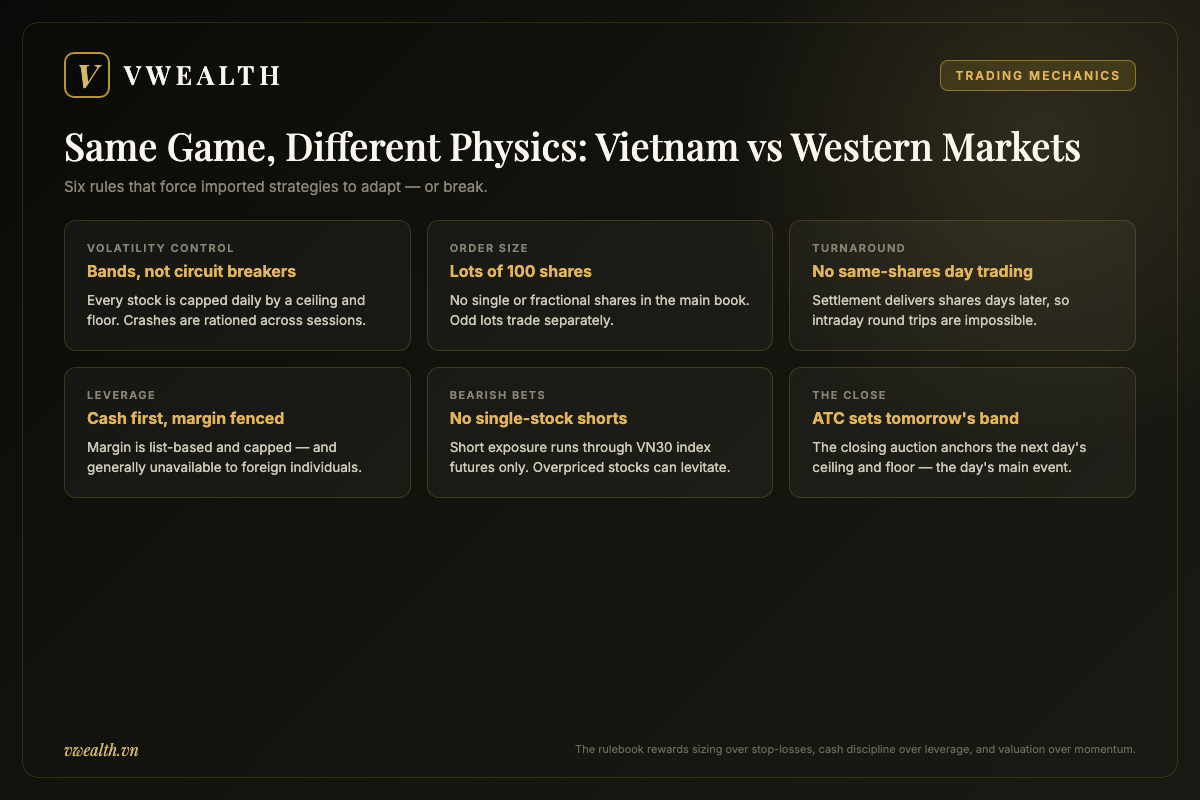
It helps to see the whole rulebook side by side. None of these rules is exotic in isolation — Japan, Korea, Taiwan, Thailand and China all use variants of price limits, board lots and deferred settlement — but the combination defines how Vietnam actually trades.
| Mechanic | Typical Western market (US) | Vietnam |
|---|---|---|
| Daily price movement | Unlimited; market-wide circuit breakers in panics | Capped per stock by ceiling/floor bands each day |
| Lot size | Single shares, fractional shares common | Board lots of 100; odd lots via separate mechanism |
| Settlement | T+1 | Multi-day (T+2 era mechanics; verify current rule) |
| Same-shares day trading | Routine (pattern day trader rules aside) | Structurally impossible in the cash market |
| Margin | Broadly available, broker-set terms | Regulated list and ratio caps; generally unavailable to foreign individuals |
| Short selling single stocks | Routine via stock borrow | Not available in practice; index futures only |
| Opening/closing price | Auctions (NYSE/Nasdaq crosses) | ATO/ATC call auctions; ATC sets next day’s reference |
| Foreign participation | Unrestricted for most stocks | Ownership room caps; put-through trades between foreigners |
| Trading hours | Continuous 6.5 hours | Shorter day with a lunch break; auction windows |
What the physics means for your playbook
Position sizing replaces stop-losses as the primary risk tool. In a market where the exit door can jam shut at the floor for days, the only risk control that always works is the one applied before entry. A common local discipline: size every position so that a three-floor-day sequence — a loss of twenty percent or so on that position — would not force you to change your plan.
Momentum entries carry embedded lock-up risk. Every buy commits you until settlement delivers the shares. Buying strength is fine; buying a ceiling-locked frenzy means accepting that you cannot exit through the first reversal. Experienced traders here scale into strength across days instead of lunging at purple screens.
The close is the main event. Because the ATC sets the reference for tomorrow’s band, end-of-day price action carries more signal (and more manipulation risk on small caps) than intraday noise. Reviewing closing auctions across your watchlist takes ten minutes and teaches you more than watching ticks all day.
Cash management is strategy, not admin. With no shorting, limited leverage and settlement lags, your cash buffer is your optionality. The investors who bought the great floor-cascade bargains in past corrections were, without exception, the ones holding cash beforehand.
Valuation discipline substitutes for market efficiency. Without short sellers to correct excess and with retail flows dominating, prices detach from value more often and for longer than in developed markets. That is a hazard if you chase, and a gift if you can independently value companies — which is precisely the gap that systematic, data-driven research is meant to fill.
A First-Month Checklist for Trading Under Vietnamese Rules
Rules become instinct only through use. Here is a practical sequence for your first month of live orders, assuming your account is open and funded.
Week one — observe the mechanics. Pick three liquid VN30 stocks and watch them for a week without trading. Note the reference, ceiling and floor prices each morning. Watch the ATO auction form the open and the ATC form the close. Find the supervision-status codes and the foreign-room display on your broker’s app. You are learning to read the board, which in Vietnam carries far more encoded information than a Western quote screen.
Week two — place small structural trades. Buy one board lot of a liquid stock with a limit order during continuous trading. Note the exact day and time the shares appear in your account and the first moment you are able to sell them — you have now measured the settlement cycle empirically rather than trusting hearsay. Sell with a limit order, and note when the cash becomes reusable and when it becomes withdrawable.
Week three — experience the auctions. Place a small ATC order and watch how the indicative price shifts in the final minutes. Try a put-through quote screen just to see how negotiated deals display. Do not use market orders on anything illiquid yet.
Week four — write your personal rulebook. Document your position-sizing cap, your rule for ceiling-chasing (most sensible: don’t), your cash buffer floor, and your process for checking margin-list membership and supervision status before any buy. Rules written in calm weeks are the ones that hold in floor-cascade weeks.
Throughout, keep a note of every rule your broker confirms — band widths, settlement timing, odd-lot handling, prefunding requirements — with the date you confirmed it. Vietnam’s market infrastructure is mid-upgrade, and the fine print will keep improving; your notes will tell you when an article like this one has aged.
Summary: Learn the Rules Once, Benefit Every Trading Day
Vietnam stock trading rules form a coherent system once you see the design intent. Daily ceilings and floors ration volatility instead of halting it, which stretches price discovery across days and makes floor liquidity the market’s real danger zone. Board lots of one hundred set your minimum ticket, and corporate actions will hand you odd lots that need occasional housekeeping. The ATO and ATC auctions bookend a short trading day, with the closing auction setting tomorrow’s band and hosting the day’s most meaningful volume. The multi-day settlement cycle bans same-shares day trading and turns every purchase into a deliberate commitment. Margin is regulated, list-based and largely local; short selling of individual stocks is effectively unavailable, leaving VN30 futures as the only short instrument. And in place of circuit breakers, the band system itself absorbs shocks — slowly, session by session.
For an investor coming from a Western market, the adaptation is less about learning restrictions than about shifting weight: from stops to sizing, from intraday timing to end-of-day auctions, from leverage to cash discipline, from momentum to valuation. The rules reward exactly the habits that long-term investing rewards anyway. Master the rulebook, verify the current numbers with your broker, and the market’s quirks become your edge rather than your tuition.
This article is educational analysis for reference only, not investment advice or a recommendation to buy or sell any security.
Research Vietnamese stocks in English with vwealth. Our AI-powered platform turns Vietnamese market data into full English analysis reports — with international payment support and a free 2-month trial for new accounts. Create your free account and read the latest reports.