Vietnam does not have one stock exchange — it has three trading boards, and the differences between them will shape almost every decision you make as an investor. HOSE hosts the blue chips and absorbs most of the money. HNX runs a smaller equity board alongside the country’s bond and derivatives markets. UPCOM is the sprawling waiting room where roughly 860 companies (as of mid-2026) trade with looser rules and wilder price swings. And the map is being redrawn as you read: a new trading engine went live on HOSE in May 2025, all share trading is scheduled to consolidate onto HOSE by the end of 2026, and FTSE Russell’s upgrade of Vietnam to emerging-market status takes effect in September 2026. This guide explains what each board is, who lists there and why, how the trading day actually works, and why most foreign investors quietly ignore two of the three. By the end, terms like ATO, ATC, ceiling price and “moving up to HOSE” will make complete sense.
Why one country ended up with three trading boards
Most developed markets consolidated their exchanges decades ago. Vietnam’s structure looks fragmented by comparison, but it makes sense once you know the history. The market is young — the first trading session in Ho Chi Minh City took place in July 2000, with exactly two listed companies. Everything you see today was built in roughly a quarter of a century, and each board was created to solve a specific problem at a specific stage of that build-out.
The Ho Chi Minh City Stock Exchange, universally called HOSE, came first. It was designed as the showcase: the venue for the country’s largest, most established corporations. Five years later, in 2005, a second trading center opened in Hanoi. It eventually became the Hanoi Stock Exchange, or HNX, and took on the role of hosting smaller companies that could not yet meet the standards of the southern board, along with government bonds and, later, derivatives.
The third board arrived in 2009 and is the one that confuses newcomers the most. UPCOM stands for Unlisted Public Company Market. It is technically not a listing venue at all — it is a registration venue. Vietnamese law requires public companies (companies with many shareholders, often created when the state sold stakes in state-owned enterprises) to put their shares somewhere the public can trade them. Many of these companies were not ready, or not willing, to meet full listing standards. UPCOM gave them a legal home. Think of it as the difference between a stall at a licensed street market and a shop in a regulated mall: both sell to the public, but the mall inspects its tenants far more strictly.
Since 2021, all three boards have operated under a single parent, the Vietnam Exchange (VNX), a state-owned holding company established under Decision 37/2020/QD-TTg and formally launched in December 2021. For years the consolidation was administrative rather than practical, but it now has teeth. Under the reorganization roadmap in Circular 57/2021/TT-BTC, as amended by Circular 69/2023/TT-BTC, all share listing and trading is being concentrated on HOSE while HNX specializes in bonds and derivatives: HNX stopped accepting new share-listing applications on July 1, 2025, and both HNX listings and UPCOM registrations are scheduled to migrate onto HOSE’s systems by December 31, 2026. As of mid-2026 that migration is still in progress, so the three-board structure of stocks (HOSE listings, HNX listings, UPCOM registrations) remains the mental map you need — just know that it is a map with an expiry date printed on it.
If you are completely new to this market, it helps to read this article alongside our complete guide to investing in Vietnam’s stock market as a foreigner, which covers account opening, foreign ownership rules and taxes. Here we go deep on just one piece of the puzzle: the venues themselves.
HOSE: the main board where the real money trades
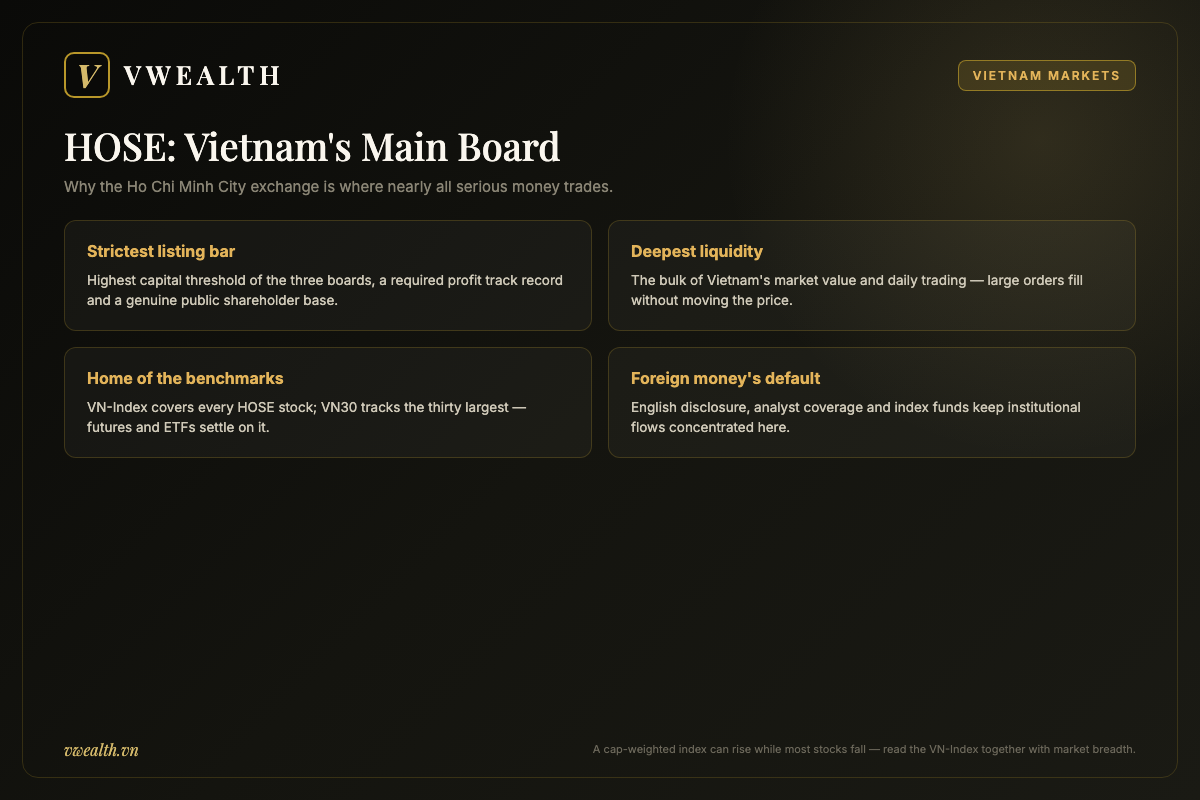
HOSE is Vietnam’s primary equity market and the only board many foreign institutions will ever touch. It hosts the companies you have probably heard of if you have read anything about Vietnamese business: the dominant banks, the largest property developers, the leading technology exporter, the biggest retailers and consumer brands. When international media quote “the Vietnamese stock market,” they are quoting the VN-Index, which is calculated exclusively from HOSE-listed stocks.
What it takes to list on HOSE
HOSE maintains the strictest entry requirements of the three boards. The current framework is set out in Decree 155/2020/ND-CP, the decree implementing Vietnam’s 2019 Securities Law, and its shape tells you a lot about the board’s character. A company applying to HOSE must generally demonstrate:
- Meaningful scale. A minimum level of charter capital — the registered equity capital of the company — set high enough to exclude small businesses. Under Decree 155/2020, the HOSE threshold is 120 billion dong (roughly US$4.5–5 million) versus 30 billion for a Hanoi listing — four times higher.
- A profit track record. Two consecutive profitable years before listing, with return-on-equity of at least 5 percent in the most recent year, and no accumulated losses sitting on the balance sheet.
- A real shareholder base. A minimum percentage of shares must be held by a minimum number of non-insider shareholders. This prevents a founder from “listing” a company he still owns 99 percent of, where the free float — the portion of shares actually available for public trading — would be an illusion.
- Clean governance paperwork. Audited financial statements, disclosure of insider shareholdings, and commitments from management to lock up their shares for a period after listing.
None of this guarantees quality. Companies that passed every test have still blown up, in Vietnam as everywhere else. But the standards act as a filter: the average HOSE company is larger, older, more profitable and more scrutinized than the average company on the other two boards.
Size and liquidity: why HOSE dominates
The practical gap between HOSE and the rest is bigger than the rulebook suggests. As of mid-2026, HOSE’s market capitalization stood at roughly US$330 billion, against about US$15 billion for HNX’s equity board and US$25 billion for UPCOM — close to ninety percent of the total, and an even larger share of daily trading value. On a normal day, the busiest single stock on HOSE can trade more value than the entire HNX equity board combined.
Liquidity — the ease of buying or selling without moving the price against yourself — matters more than beginners realize. Suppose you want to invest the equivalent of 50,000 US dollars in a single stock. In a heavily traded HOSE blue chip, your order is a drop in the ocean; it fills within seconds at the prevailing price. Try the same order in a thinly traded UPCOM name that trades a few thousand dollars’ worth of shares per day, and you become the market: your buying pushes the price up as you accumulate, and when you later try to exit, your selling pushes it down. You can be right about the company and still lose money to your own footprint. This is the single most important reason large investors concentrate on HOSE, and it compounds: liquidity attracts analysts, analyst coverage attracts more investors, and more investors deepen the liquidity further.
The indices that live on HOSE
Several benchmarks are calculated from HOSE stocks, and you will meet them constantly:
- VN-Index — the headline number, covering every stock listed on HOSE, weighted by market capitalization (bigger companies move the index more). When someone says “the market rose one percent today,” this is what they mean.
- VN30 — the thirty largest and most liquid HOSE stocks, screened for free float. This is the institutional benchmark: index futures settle against it, and several exchange-traded funds track it. An exchange-traded fund, or ETF, is a fund that holds a basket of stocks and itself trades on the exchange like a single share.
- VNMidcap and VNSmallcap — the tiers below the VN30, useful for tracking whether smaller companies are outperforming or lagging the giants.
- VNDiamond — a specialized index built around stocks where foreign ownership room is scarce, designed so foreigners can get exposure to otherwise hard-to-buy names through tracking funds.
One quirk worth knowing early: the VN-Index is concentrated. A handful of mega-cap banks and conglomerates carry so much weight that the index can rise on a day when most stocks fall, simply because two or three giants had a good session. Experienced investors read the index alongside market breadth — the count of advancing versus declining stocks — rather than trusting the headline number alone.
HNX: the second board and the market’s plumbing
The Hanoi Stock Exchange plays two roles that are easy to conflate. The first is visible: it runs a listed equity board for companies that meet real listing standards, just lower ones than HOSE’s. The second is structural and mostly invisible to stock pickers: HNX operates Vietnam’s government bond market and its derivatives market, including the VN30 index futures that institutions use to hedge. Even if you never buy a single HNX-listed share, the exchange’s infrastructure touches your portfolio indirectly.
The equity board: a smaller pond
HNX-listed companies passed genuine gatekeeping — audited accounts, profitability requirements, minimum shareholder spread — but at thresholds a fraction of HOSE’s. The result is a board populated by mid-sized and smaller companies: provincial construction firms, niche manufacturers, mid-tier financial companies, local utilities. Some are excellent businesses that simply never needed the prestige or cost of a HOSE listing. Others are companies on their way up, using HNX as a proving ground before applying to the senior board — though that pipeline has now formally closed: since July 1, 2025, HNX no longer accepts new share-listing applications, and its roughly 330 existing listings (as of mid-2026) are scheduled to transfer to HOSE by the end of 2026 as the exchange refocuses on bonds and derivatives.
The board has its own benchmarks: the HNX-Index covering the whole board, and the HNX30 tracking its thirty most liquid names. Both behave differently from the VN-Index. Because HNX stocks are smaller and more retail-driven — individual investors dominate the trading, rather than funds — the HNX-Index tends to swing harder in both directions. In euphoric phases it can outrun the VN-Index dramatically; in downturns it usually falls further. Watching the two indices diverge is a quick way to read the market’s risk appetite: when HNX massively outperforms, speculative money is running hot.
Why serious money mostly passes through
For foreign and institutional investors, HNX equities present a practical problem rather than a quality problem: order sizes. A fund managing hundreds of millions of dollars cannot deploy meaningful positions into stocks that trade modestly, for the liquidity reasons described above. Analyst coverage is thin, English-language disclosure is rare, and index-tracking products focus on HOSE benchmarks. So institutional flows skip the board almost entirely, which keeps its liquidity low, which keeps institutions away — the mirror image of HOSE’s virtuous circle.
For individual investors willing to do their own research, this neglect cuts both ways. Neglected corners of any market occasionally hide genuinely mispriced companies, precisely because nobody is looking. But the same darkness hides governance problems, and exit doors are narrow when something goes wrong. If you fish here, position sizing — deliberately keeping each holding small relative to the stock’s daily trading volume — is not optional.
UPCOM: the waiting room with a thousand doors
UPCOM is the board most likely to be misunderstood, so let us be precise about what it is. Companies on UPCOM are registered for trading, not listed. The distinction sounds bureaucratic but has teeth. A listed company (HOSE or HNX) passed an exchange’s quality review and submits to ongoing listing obligations. An UPCOM company has merely fulfilled the legal requirement that public companies must make their shares tradable somewhere. The bar to enter is dramatically lower, disclosure obligations are lighter, and enforcement is looser. Around 860 companies traded there as of mid-2026, and under the same reorganization roadmap that is emptying HNX’s equity board, UPCOM registrations are slated to move onto HOSE’s systems by the end of 2026 — a change of operator, not a promotion: a registered company does not become a listed one by switching venues.
Who trades on UPCOM, and why
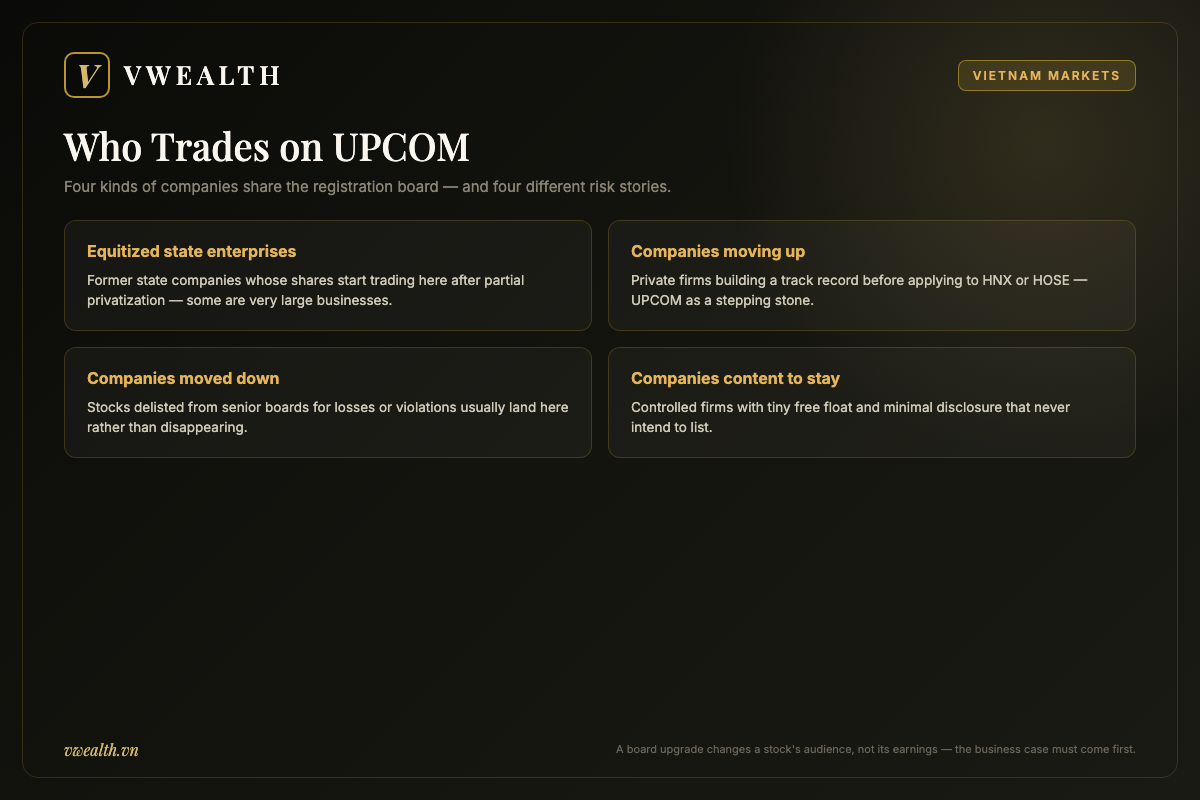
The board is a genuine mixture, which is what makes it both dangerous and interesting. Broadly, you will find four kinds of companies there:
- Equitized state-owned enterprises. When the Vietnamese state converts a state company into a joint-stock company and sells a stake to the public, the shares typically start trading on UPCOM. Some of these are large, real businesses — airports, utilities, industrial groups — parked on UPCOM for years while full listing plans mature slowly.
- Companies preparing to move up. Ambitious private firms often trade on UPCOM for a period to build a track record and shareholder base before applying to HNX or HOSE. For them, UPCOM is a stepping stone, and the announcement of an approved move to a senior board is often treated by the market as good news.
- Companies that moved down. Stocks delisted from HOSE or HNX — for sustained losses, audit failures or disclosure violations — usually land on UPCOM rather than vanishing. This matters for risk management: holding a stock through a forced delisting does not mean losing everything, but it usually means much worse liquidity and a damaged price.
- Companies content to stay. Some businesses simply never intend to list. Their controlling shareholders keep public disclosure to the legal minimum, float is tiny, and the shares trade by appointment.
The stepping-stone pattern in practice
The upgrade path — UPCOM to HNX or straight to HOSE — is one of the market’s recurring stories, and it is worth understanding the mechanics rather than the hype. Moving to a senior board does not change a company’s earnings by one dong. What it changes is the stock’s audience. A HOSE listing makes the stock eligible for index inclusion, visible to foreign funds, easier to margin at brokers, and subject to stricter disclosure that lowers the risk premium investors demand. Those effects are real, which is why the market often re-rates a stock — assigns it a higher valuation multiple — around a board move.
But the pattern is well known, which means it gets front-run. Speculators buy on rumors of a listing application, and the actual approval sometimes marks the short-term top rather than the beginning. The durable question is always the same one you should ask about any company: is the underlying business worth owning? A board upgrade can add a tailwind to a good business; it cannot rescue a bad one. Our comprehensive guide to the Vietnamese stock market walks through the fundamental analysis that has to come before any listing-story speculation.
The risk profile, stated plainly
UPCOM’s looser rules produce three concrete hazards. First, information risk: financial statements may be less complete, published later, and audited less rigorously than on the listed boards, so you are analyzing companies through fog. Second, liquidity risk: many UPCOM stocks trade tiny values daily, and some barely trade at all, so exiting a position can take days or force painful price concessions. Third, volatility by design: UPCOM allows the widest daily price movements of the three boards, which we will quantify in the trading-rules section. None of this makes the board uninvestable — some of Vietnam’s most interesting situations trade there — but it makes UPCOM a venue for experienced, patient investors sizing positions carefully, not a place to learn.
The three boards side by side
Here is the structural comparison in one view. Details like exact thresholds change with regulations, so treat the specifics as indicative and verify current rules; the relationships between the boards — which is stricter, deeper, wilder — are stable.
| Dimension | HOSE | HNX | UPCOM |
|---|---|---|---|
| Status of companies | Listed — strictest standards | Listed — moderate standards | Registered for trading only |
| Typical company profile | Large caps, blue chips, market leaders | Mid and small caps | Mixed: equitized SOEs, pre-listing firms, delisted stocks |
| Entry bar | High capital, profit record, shareholder spread | Lower capital and profit thresholds | Minimal — public company status suffices |
| Liquidity | Deepest by a wide margin | Modest | Thin to nonexistent for many names |
| Main indices | VN-Index, VN30, VNDiamond | HNX-Index, HNX30 | UPCOM-Index |
| Daily price limit | ±7% (±20% on first trading day) | ±10% (±30% on first trading day) | ±15% (±40% on first trading day) |
| Opening/closing auctions | ATO and ATC sessions | ATC session; no ATO | Continuous matching only |
| Foreign institutional interest | Concentrated here | Limited | Selective, situation-driven |
| Disclosure quality | Highest, most timely | Good | Variable, often minimal |
Read the table vertically and each board has a coherent personality. HOSE trades safety of process for a higher price of admission. HNX occupies the middle in every column. UPCOM maximizes access and accepts the chaos that comes with it.
Why most foreign investors stay on HOSE
If you scan the portfolios of foreign funds investing in Vietnam, the concentration on HOSE is striking — often the entire equity book, with perhaps a handful of large UPCOM names as exceptions. This is not herd laziness; it follows from four hard constraints, and understanding them will save you from puzzling over why “cheap” off-board stocks stay cheap.
Liquidity is the binding constraint. A foreign fund must be able to enter and exit positions of institutional size. Only HOSE offers enough daily trading value to absorb such orders routinely. This alone eliminates most of HNX and UPCOM from consideration, regardless of how attractive individual companies might be.
Mandates and benchmarks point there. Most foreign vehicles are measured against HOSE-based indices — VN30, VNDiamond or broad Vietnam indices dominated by HOSE constituents. A manager paid to track or beat those benchmarks has little professional incentive to wander onto boards the benchmark ignores. Passive products have no discretion at all: an ETF tracking the VN30 mechanically buys only those thirty HOSE stocks.
Information is available in English. Large HOSE companies increasingly publish English financial statements, host investor calls and meet foreign shareholders. On the junior boards, research means reading Vietnamese-language filings — a real barrier if you lack the language or local analyst support. This information gap is exactly the problem vwealth was built to close: the platform generates full English-language analysis from Vietnamese-language market data, so the disclosure barrier stops dictating your investable universe. You can create a free account and see how a Vietnamese company’s numbers read when translated into a proper English report.
Operational simplicity compounds. Custody banks, compliance departments and risk committees all prefer instruments that are liquid, well-disclosed and index-tracked. Every step away from HOSE adds friction inside an institution, and friction has to be justified by exceptional expected returns.
The pull toward HOSE is also about to strengthen dramatically. In October 2025, FTSE Russell announced Vietnam’s reclassification from Frontier to Secondary Emerging Market status, and its March 2026 interim review confirmed the upgrade takes effect from September 21, 2026, implemented in tranches. The reforms that unlocked it were aimed squarely at institutional access: Circular 68/2024/TT-BTC removed the requirement for foreign institutional investors to pre-fund share purchases from November 2024, and the KRX trading system (more on it below) went live in May 2025. Brokerage estimates of the foreign inflows the upgrade could bring run into the billions of dollars — and virtually all of that money is benchmarked to indices built from HOSE-listed stocks. MSCI, the other major index provider, still classifies Vietnam as a frontier market and left it off its upgrade watchlist in the June 2026 review, so the FTSE event is the one reshaping flows for now.
For an individual foreign investor, these constraints loosen — your order sizes are small, you answer to no benchmark committee — but the information constraint remains, and the safest default is the same: build your core on HOSE, and treat the junior boards as an advanced elective, entered deliberately with research done, not stumbled into chasing a cheap-looking ticker.
Reading tickers and boards: the practical conventions
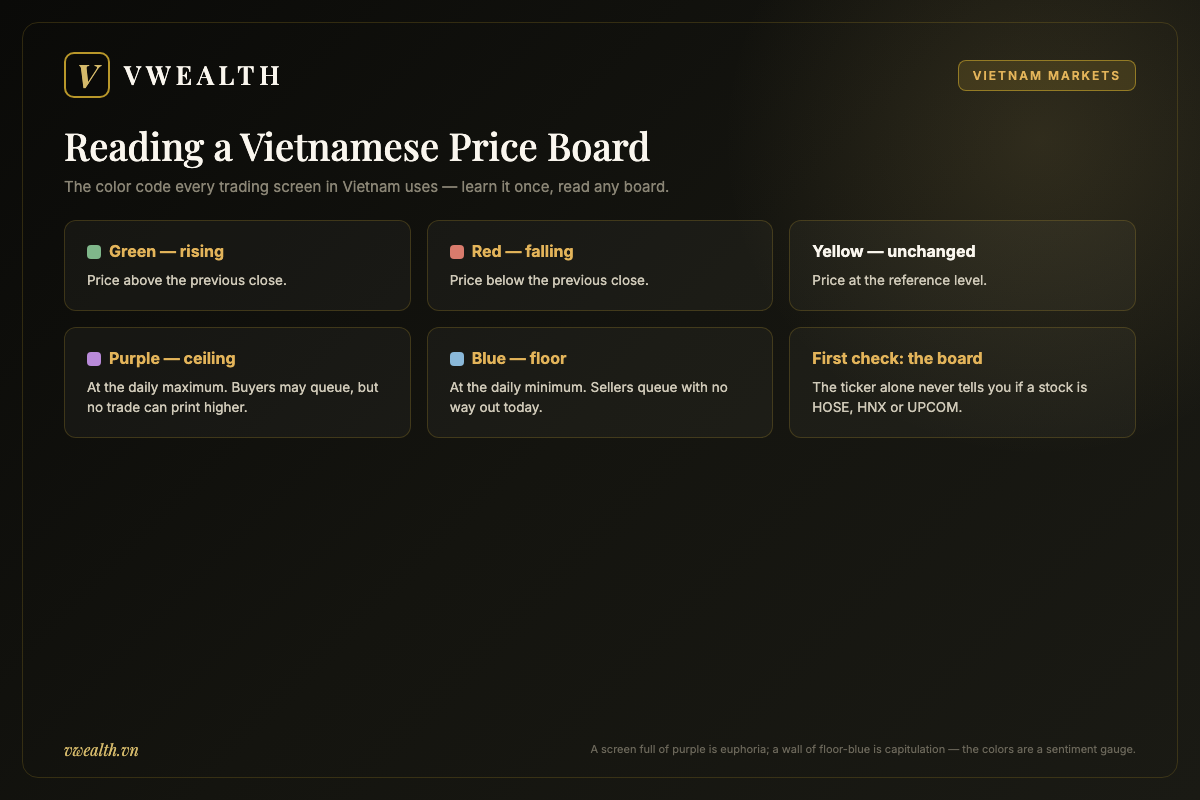
Vietnamese stock tickers are three-character codes, usually letters: the symbols compress the company name or brand into a memorable stub. The convention matters for a subtle reason: the ticker itself does not tell you which board the stock trades on. Two three-letter codes can look identical in format while one belongs to a heavily analyzed HOSE bank and the other to an UPCOM shell that trades twice a week. Before researching any Vietnamese stock, your literal first check should be: which board is this on? Every data platform displays it, and it instantly frames the liquidity, disclosure and volatility you should expect.
A few adjacent conventions will make data screens less cryptic:
- Prices are quoted in Vietnamese dong, and because the dong is a small-denomination currency, share prices look large to foreign eyes — tens of thousands of dong rather than tens of dollars. Many platforms quote in thousands of dong to keep the numbers readable; check which convention your screen uses before you misread a price by a factor of a thousand.
- Board lots. Stocks trade in standard multiples — 100 shares is the standard lot on the main boards. Quantities below one lot are “odd lots” and match in a separate, less liquid order book; since the KRX system went live on HOSE in May 2025, odd-lot limit orders can at least be placed continuously through the trading day rather than only in narrow windows.
- Color coding is standardized nationwide. On Vietnamese price boards, green means up, red means down — but two extra colors matter: purple (or violet) marks a stock at its ceiling price and light blue marks the floor. A screen full of purple is a euphoric market; a wall of floor-blue is capitulation. Once you know the code, a Vietnamese trading screen reads like a weather map.
- Foreign-room columns. Most boards display remaining foreign ownership room per stock — how many more shares foreigners may legally buy. When that number hits zero, foreigners can only buy from other foreigners, often at a premium negotiated off-exchange. The mechanics deserve their own article, but the column is worth noticing from day one.
The trading day: sessions, auctions and what ATO/ATC really mean
Vietnam’s trading day runs on the morning-break-afternoon rhythm common across Asia, but the session structure differs by board, and the auction mechanisms confuse nearly every newcomer. Let us walk through a HOSE trading day from open to close, then note how HNX and UPCOM differ.
One infrastructure note first. On May 5, 2025, HOSE switched its trading engine to the long-awaited KRX system, built with the Korea Exchange after more than a decade of delays. The session timetable did not change, but several mechanics did: ATO and ATC orders lost the priority they used to enjoy over previously entered limit orders in the auctions; odd lots — quantities below the standard 100-share lot — can now be traded by limit order continuously from 9:00 to 14:45 instead of only in restricted windows; and the new engine is the technical foundation for the reforms regulators are studying next, including same-day trading and central counterparty clearing. If you read older guides describing pre-2025 mechanics, this changeover is why some details no longer match.
The opening auction: ATO
HOSE begins the day with a fifteen-minute opening auction, from 9:00 to 9:15, called the ATO session — “At The Open.” During an auction session, no trades execute in real time. Instead, the system collects every buy and sell order into a book, and at the end of the window it computes the single price at which the largest volume of shares can change hands. Every matched order executes at that one price, regardless of the limits traders typed in (as long as their limit is compatible).
Why bother with this ritual instead of just starting continuous trading? Because overnight, news accumulates while the market cannot react — earnings released after the close, global market moves, macro announcements. If trading simply switched on at 9:00, the first seconds would be a chaotic scramble where the fastest orders exploit the slowest. The auction lets all overnight information settle into one fair opening price discovered collectively. You can place an “ATO order” — an order with no price limit that accepts whatever the auction price turns out to be — but understand what you are signing: on a volatile morning, that price can be far from yesterday’s close. Beginners are usually better served by limit orders, which specify the worst price they will accept.
Continuous matching, the lunch break, and the afternoon
From 9:15 until 11:30, HOSE runs continuous order matching: orders execute the moment a buyer’s and seller’s prices cross, which is how most people imagine a stock market working. At 11:30 the market stops for lunch — a genuine ninety-minute halt, standard across Vietnamese boards and startling to anyone used to New York’s uninterrupted session. Continuous trading resumes at 13:00 and runs until 14:30.
The lunch break has a practical consequence: news released around midday lands on a closed market, and the 13:00 reopen can gap — jump discontinuously from the morning’s last price — just like a morning open. Position sizes that felt comfortable in continuous trading should account for the fact that the market closes on you twice a day, not once.
The closing auction: ATC
From 14:30 to 14:45, HOSE holds its closing auction, the ATC session — “At The Close.” Mechanically it mirrors the ATO: orders accumulate for fifteen minutes, then one price clears the maximum volume, and that price becomes the official close. The closing price matters more than any other print of the day: index values are computed from it, funds value their portfolios at it, and the next day’s price limits are calculated from it. Because so much hangs on the close, the ATC session concentrates volume — funds tracking indices must trade at the closing price to match their benchmark — and it is where end-of-day battles between buyers and sellers play out. A stock that drifts all day and then lurches in the ATC is telling you something about who needed to transact before the bell.
After the ATC, a brief put-through window runs until 15:00, in which large pre-negotiated block trades between two parties are recorded on the exchange. Ordinary investors rarely use it, but block-trade data is worth watching: it is where major shareholders quietly transfer large stakes.
How HNX and UPCOM differ
HNX skips the opening auction entirely: continuous matching starts at 9:00 with no ATO, though the board does run an ATC closing auction from 14:30 to 14:45, followed by a short post-close window (14:45 to 15:00) in which so-called PLO orders execute at the day’s closing price. UPCOM is simpler still — continuous matching all day, with the afternoon session running until 15:00, no auctions at either end, and put-through trades available alongside. The practical implication: on HNX and UPCOM, the day’s first prints come from raw continuous matching, so early-morning prices on thin stocks can be noisy and easily nudged by small orders. On UPCOM especially, never judge a stock by one print; check the actual traded volume behind any price move before believing it.
Price limits: the daily speed bumps
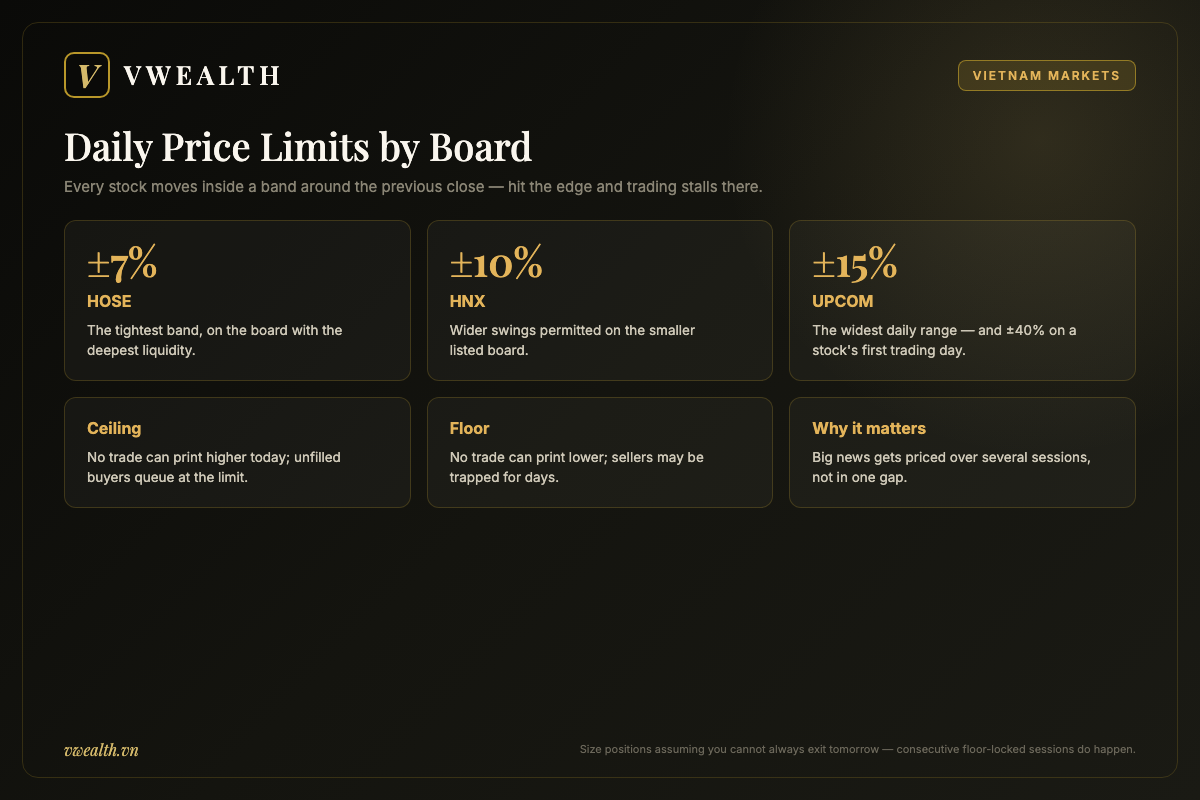
Vietnam does not use market-wide circuit breakers the way US markets do. Instead, every stock has a daily price band around its reference price — the previous day’s closing price on HOSE and HNX, and, a detail worth knowing, the volume-weighted average price of the previous session on UPCOM. On HOSE the band is ±7 percent; on HNX, ±10 percent; on UPCOM, ±15 percent. Newly traded stocks get wider bands on their first day (±20 percent on HOSE, ±30 percent on HNX and ±40 percent on UPCOM) so the market can discover a fair level for a stock with no trading history.
The top of the band is the ceiling; the bottom is the floor. Once a stock hits its ceiling, no trade can print higher that day — buyers can queue at the ceiling price, but if no one sells, nothing trades. The queue itself becomes information: a stock “stuck at ceiling” with millions of shares bid and none offered signals demand that could not express itself in price, and the pressure often carries into the next session. The floor works symmetrically, and a stock locked at floor with heavy sell queues and no buyers is one of the market’s grimmest sights — holders who want out simply cannot exit that day.
Price limits change market behavior in ways worth internalizing. Big news gets digested over several sessions instead of one violent gap: a development that would move a US stock 30 percent in a minute might take a Vietnamese stock four consecutive limit-up days to price in. This slows panic but also traps capital — during sharp selloffs, consecutive floor-locked sessions can prevent you from cutting a loss for days. Risk management in Vietnam must respect this: position sizes should assume you cannot always exit tomorrow, and the wider bands on UPCOM (±15 percent daily) mean a bad week there can be brutal arithmetic.
Settlement, indices and the machinery behind your trades
A few pieces of market machinery sit just behind the boards and complete the picture. Vietnam settles equity trades on a T+2 basis: under rules the Vietnam Securities Depository (now VSDC) put in place in August 2022, the shares you buy on Monday arrive in your account before 13:00 on Wednesday and can be sold in that afternoon’s session. For traders accustomed to instant re-trading, this imposes a rhythm: you cannot buy this morning and sell this afternoon; a round trip takes days, which mechanically dampens day-trading of the sort common elsewhere. Regulators have said publicly that intraday and same-day trading are under study now that the KRX system provides the plumbing for it, but as of mid-2026 the T+2 rhythm still applies. Intraday short-selling of individual stocks by retail investors is likewise not part of the standard toolkit, so the primary way to profit is the old-fashioned one — buy, wait, sell higher.
Each board publishes its own family of indices, and the attachment matters because index inclusion drives passive flows. A stock promoted into the VN30 gets bought automatically by every fund tracking that index; a stock dropped gets sold with equal indifference to its fundamentals. Watching index review dates — the scheduled reconstitutions when index committees add and remove members — is a standard part of the local calendar. The UPCOM-Index exists and is quoted, but almost nothing tracks it, so it functions as a thermometer rather than a benchmark anyone is paid against.
Derivatives, for completeness, live on HNX’s infrastructure: the flagship contract is a futures contract on the VN30 index, which allows hedging and leveraged directional bets on the market’s thirty biggest names. Foreigners researching Vietnam will meet the VN30 futures mainly as a sentiment indicator — the futures’ premium or discount to the underlying index hints at where leveraged traders think the market is heading.
What the board structure means for your strategy
Everything above condenses into a few practical rules of thumb. They are not investment advice; they are the structural logic of the venues applied to portfolio construction.
Start on HOSE, and possibly end there too. For a foreign investor building a first Vietnamese portfolio, HOSE’s large caps offer the full package: liquidity to enter and exit cleanly, English-language disclosure, analyst coverage, index membership and the strictest oversight the market offers. There is no strategic cost to ignoring the junior boards entirely; hundreds of listed companies on the main board give you every sector of the economy. Our walkthrough of how to invest in Vietnam’s stock market builds its entire beginner path on this premise.
Treat HNX as a research-intensive extension, not a default. The board rewards genuine homework on individual companies and punishes casual tourism. If you cannot read Vietnamese filings or access translated analysis, you are structurally disadvantaged against local investors who can. Size positions to the stock’s liquidity, not to your conviction.
Approach UPCOM as special-situations territory. The interesting UPCOM cases are specific: a large equitized state enterprise with a credible path to full listing, or a solid business temporarily orphaned on the board. Each case needs a thesis about the company and a thesis about why the market’s structural neglect will end. Without both, cheapness alone is a trap — stocks with no natural buyers can stay cheap indefinitely.
Let the board tell you the risk before the chart does. The single fact “this stock trades on UPCOM” already tells you: wider daily swings are permitted, disclosure may be thin, and exits may be slow. Bake that into position size before you have analyzed a single financial statement.
Use the session structure deliberately. Avoid unlimited-price ATO/ATC orders until you understand auction dynamics; respect the fact that the close is the day’s most contested price; remember the lunch break exists when sizing intraday risk; and never chase a ceiling-locked stock without asking what you know that the queue of buyers ahead of you does not.
Frequently asked questions
Is UPCOM a stock exchange?
Functionally you trade UPCOM stocks through the same brokerage account and similar order screens as listed stocks, so it feels like an exchange. Legally, it is a market for registered — not listed — public companies, operated under the Hanoi exchange’s umbrella, with lighter standards. The practical differences are wider price limits, thinner disclosure and lower liquidity.
Can foreigners trade on all three boards?
Yes. A foreign investor with a Vietnamese trading code and brokerage account can place orders on HOSE, HNX and UPCOM alike, subject to the foreign ownership limits that apply per company. The concentration of foreign money on HOSE is a choice driven by liquidity and information, not a legal restriction on the other boards.
Why do Vietnamese stocks sometimes rise or fall exactly 7 percent?
That is the HOSE daily price limit at work. A stock closing exactly at its ceiling (+7 percent) or floor (−7 percent) did not coincidentally move that amount — it hit the maximum allowed and likely had unfilled demand or supply left over. On HNX the magic numbers are ±10 percent, on UPCOM ±15 percent.
Does moving from UPCOM to HOSE make a stock a better investment?
It improves the stock’s trading environment — liquidity, visibility, disclosure obligations, index eligibility — and the market often pays up for those improvements. It does not change the underlying business. Evaluate the company first; treat the board move as a catalyst, never as the thesis itself.
Will HNX and UPCOM stocks really move to HOSE?
That is the official plan. Under Circular 57/2021/TT-BTC as amended by Circular 69/2023/TT-BTC, HNX stopped accepting new share-listing applications on July 1, 2025, and all share trading — HNX listings and UPCOM registrations alike — is scheduled to consolidate onto HOSE by December 31, 2026, leaving HNX to run the bond and derivatives markets. The move changes which exchange operates the trading; it does not automatically turn an UPCOM registration into a full listing or change a company’s disclosure obligations, so check the migration status and each stock’s board classification at the time you trade.
Which index should I follow day to day?
The VN-Index for the overall market, with a glance at the VN30 for what institutions and derivatives traders are focused on. Add the HNX-Index if you hold Hanoi-listed names or want a read on speculative appetite. Watch breadth alongside all of them, because cap-weighted indices can be steered by a few giants.
The bottom line: three boards, one market, very different rules of engagement
Vietnam’s three-board structure is not trivia — it is a filing system for risk. HOSE is where scale, scrutiny and liquidity concentrate, and where the VN-Index, the VN30 and virtually all foreign institutional money live. HNX hosts the smaller listed companies plus the market’s bond and derivatives plumbing, trading depth for opportunity in its neglected corners. UPCOM is the wide-open registration market — home to future blue chips, fallen angels and everything between, with the widest price bands and the thinnest information. The trading day adds its own local grammar: opening and closing auctions, a real lunch break, daily price ceilings and floors, and T+2 settlement that slows the whole game down relative to Western markets. And the structure is mid-renovation: the KRX trading engine went live on HOSE in May 2025, all share trading is scheduled to consolidate onto HOSE by the end of 2026, and FTSE Russell’s emerging-market upgrade takes effect from September 21, 2026 — so expect the details, though not the logic, to keep evolving. Learn the structure once and every Vietnamese market headline, price board and ticker screen becomes legible. This article is one chapter of a larger story — the comprehensive investor’s guide to the Vietnamese stock market covers the rest, from ownership limits to sector dynamics.
This article is educational analysis for reference only, not investment advice or a recommendation to buy or sell any security.
Research Vietnamese stocks in English with vwealth. Our AI-powered platform turns Vietnamese market data into full English analysis reports — with international payment support and a free 2-month trial for new accounts. Create your free account and read the latest reports.