Walk through the largest names on Vietnam’s stock exchange and you will keep bumping into the same shareholder: the state. Vietnam state owned enterprises — companies where the government holds a controlling or significant stake — anchor the banking, energy, telecom and aviation sectors, and many of the market’s biggest listings were born through a uniquely Vietnamese process called equitization. This guide explains where these companies came from, how state ownership changes the game for minority shareholders, why the gradual sale of state stakes is one of the market’s most important structural themes, and how to judge an SOE against a private competitor before you put money into either.
What State-Owned Enterprises Are and Why They Anchor Vietnam’s Economy
A state-owned enterprise, or SOE, is a company in which the government owns all or part of the equity. In Vietnam the term covers a wide spectrum. At one end sit wholly state-owned groups that have never sold a single share to the public — the national electricity utility and the state oil and gas group are classic examples. At the other end sit listed companies where the state holds a large but partial stake, trades alongside private and foreign investors, and answers to a shareholder meeting like any other public company.
For an investor, the second group is the interesting one. These partially privatized companies include some of the most liquid and heavily weighted stocks in the VN-Index. State-controlled banks, the gas monopoly, the dominant fuel distributor, the flagship airline, the airport operator — all are listed, all are tradable, and all carry the fingerprints of their government parent in how they pay dividends, invest capital and manage risk.
Why does the state own so much? History supplies most of the answer. Vietnam ran a centrally planned economy until the Doi Moi reforms of 1986 began opening the country to markets. Under central planning, virtually every formal enterprise was state property: factories, banks, trading companies, even barbershops in some periods. When the economy liberalized, the government faced a question every transition economy faces — what to do with thousands of state enterprises, many of them small, inefficient and loss-making.
Vietnam’s answer was gradual, pragmatic and deliberately different from the shock privatizations tried in parts of Eastern Europe. Rather than selling everything quickly, the state kept control of sectors it deemed strategic — energy, banking, telecommunications, defense-adjacent industries — while slowly converting other enterprises into joint-stock companies and selling portions of them to employees, domestic investors and foreigners. That slow conversion process is equitization, and it is the origin story of a large share of the stocks you can buy in Vietnam today. If you are new to the market itself, our complete guide to investing in Vietnam’s stock market as a foreigner covers the account setup, trading rules and market structure that this article assumes as background.
The scale matters. SOEs are not a niche corner of the Vietnamese market the way government-linked companies are in some economies. They occupy the commanding heights: credit, fuel, power, air transport, water, ports. A portfolio built from Vietnam’s largest listed companies will almost inevitably contain several firms where the state is the biggest shareholder. Understanding how that shareholder behaves is therefore not optional homework — it is central to understanding the market.
Equitization: How Vietnam’s State Companies Became Listed Stocks
From Doi Moi to the IPO Wave
Equitization — co phan hoa in Vietnamese, literally “share-ization” — began as a pilot program in the early 1990s. The idea was simple: convert a state enterprise from a government department into a joint-stock company with shares, a charter, a board of directors and audited accounts, then sell part of those shares to outside investors while the state kept the rest.
The early rounds involved small enterprises: local trading companies, food processors, transport cooperatives. Through the late 1990s and 2000s the program accelerated and moved up the size ladder. Thousands of small and medium state enterprises were converted, merged or dissolved, shrinking the SOE population from the tens of thousands that existed at the start of the reform era to a far smaller, more concentrated group.
The landmark moment for stock market investors came in the second half of the 2000s, when the government began equitizing its crown jewels. The initial public offering of Vietcombank on 26 December 2007 was the emblematic deal — Vietcombank was the first state-owned commercial bank the government selected for equitization, and its auction sold roughly 6.5% of the bank at an average price near 107,860 dong per share, drawing enormous domestic attention close to the peak of Vietnam’s first great bull market. The bank converted to joint-stock form in 2008 and listed on the Ho Chi Minh Stock Exchange (HOSE) in 2009; the State Bank of Vietnam still held around three-quarters of the equity as of late 2024, illustrating how “equitization” leaves the state firmly in control. Other giants followed over subsequent years: more state banks, the gas monopoly (PV Gas), fuel distribution (Petrolimex), power generation, the national airline (Vietnam Airlines), the airport operator (ACV). Each conversion added a heavyweight to the exchange and gave outside investors their first chance to own a piece of infrastructure that had been purely governmental for decades.
A second wave of excitement came from divestments — the state selling down stakes in companies that were already equitized. The most famous example remains the December 2017 sale of a majority stake in Sabeco, the country’s largest brewer, to a Thai-linked investor group. In an auction on 18 December 2017, a ThaiBev affiliate, Vietnam Beverage, acquired a 53.59% stake for roughly 110 trillion dong (about US$4.8 billion) — a record M&A deal for Vietnam at the time. It demonstrated to global investors that Vietnam would, at least sometimes, sell real control of a prized asset at a full price. (Notably, the buyer used a domestically incorporated vehicle to work around the sector’s foreign-ownership cap — a structural wrinkle worth remembering when you read about foreign “room,” discussed later.)
Why Vietnam Says “Equitization” Instead of “Privatization”
The vocabulary is deliberate. Privatization implies the state exits and private owners take over. Equitization only means the ownership structure changes from single-owner state enterprise to multi-shareholder joint-stock company. In many equitized firms the state remains the controlling shareholder with well over half the equity, sometimes far more. The company gains a stock listing, outside shareholders and market discipline at the margin — but strategic control stays with the government parent.
This distinction is the single most important thing to internalize about Vietnam state owned enterprises as investments. Buying shares in an equitized SOE usually does not mean betting on a fully commercial company. It means becoming a minority partner of the state, with all the protections and frustrations that partnership implies. The upside cases are real: professionalized management, better disclosure, and the possibility that the state sells down further over time, releasing value. The constraints are real too, and we will spend much of this article on them.
How the Equitization Process Actually Works
The mechanics follow a recognizable sequence, and knowing the steps helps you interpret news about future deals:
First comes valuation. Advisors determine the enterprise’s value, including land use rights — historically the most contentious item, because state enterprises often sit on prime urban land carried on the books at values far below market reality. Disputes over how to value land have delayed many equitizations for years.
Second comes the share sale structure. A portion of shares is typically offered to the public through an auction, a portion reserved for employees at preferential terms, and sometimes a block offered to a strategic investor — a large domestic or foreign company expected to bring expertise, not just money.
Third comes the initial auction or IPO, often conducted on an exchange’s auction platform. Results vary enormously: some auctions are oversubscribed many times, others sell only a sliver of what was offered when pricing or sentiment disappoints.
Fourth comes registration for trading. Newly equitized companies commonly appear first on UPCOM, the lightly regulated registration market, before eventually meeting the standards for a full listing on HOSE or HNX. Some spend years on UPCOM; the airport operator ACV is a famous example of a giant that has traded there since November 2016, long after its equitization, and only moved to arrange a full HOSE listing in 2025 — a reminder that this stage can persist for the better part of a decade.
Finally, and optionally, comes further divestment — the state selling additional tranches over time, either through the exchange, through auctions, or through negotiated block sales to strategic buyers.
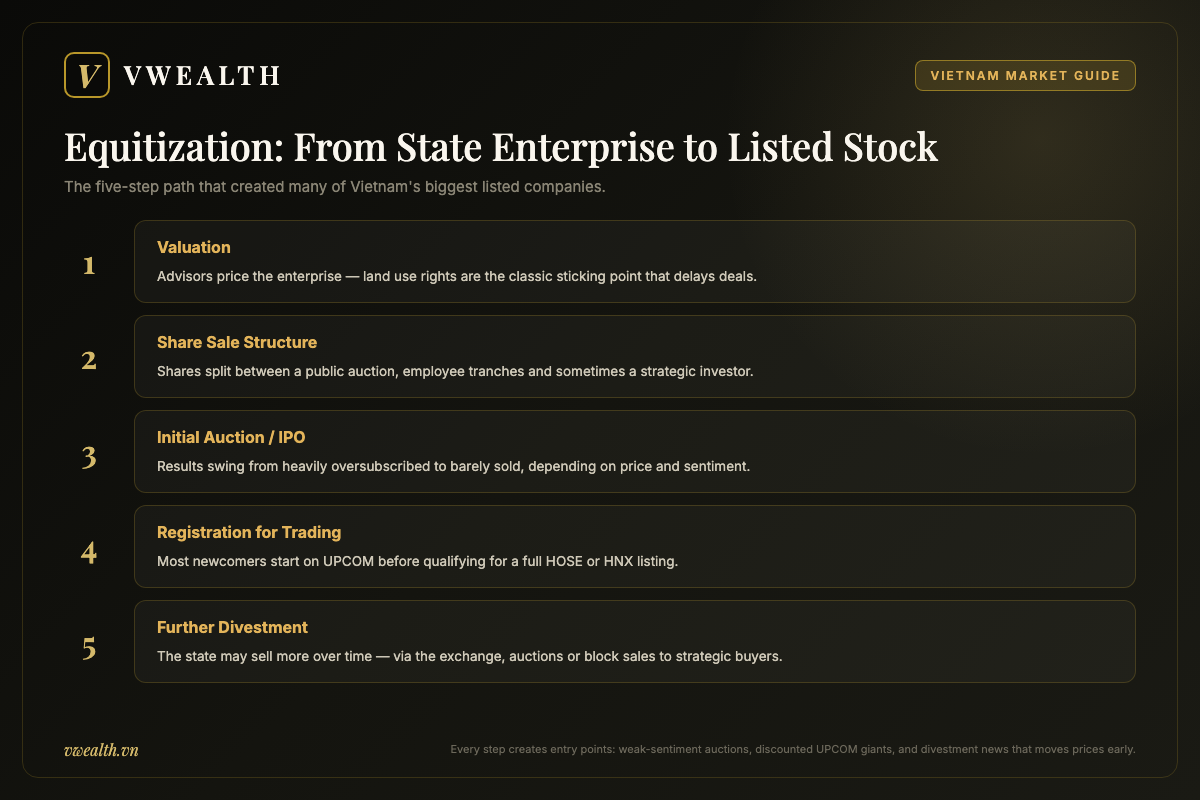
Each step creates opportunities and traps. Auction pricing can be attractive when sentiment is weak. UPCOM-stage giants can trade at discounts because many institutional mandates exclude that board. And divestment announcements can move prices violently in both directions, long before any shares actually change hands.
Where SOEs Sit in Today’s Market: A Sector Map
State ownership is not spread evenly across the exchange. It concentrates in sectors the government designates as strategic, while consumer-facing and export-oriented industries are dominated by private firms. The rough map looks like this:
| Sector | State presence among listed companies | What it means for investors |
|---|---|---|
| Banking | Heavy — the largest banks by assets are state-controlled, alongside a vibrant private tier | State banks prioritize system stability and policy lending; private banks chase growth and fee income |
| Energy and utilities | Dominant — gas, fuel distribution, most listed power generators trace to state parents | Regulated pricing and state-directed investment shape margins more than management skill |
| Aviation and infrastructure | Heavy — flag carrier, airport operator, many ports | National-service obligations can override profit logic in downturns |
| Telecommunications | Dominant, but largely unlisted — the biggest operators remain wholly state-owned | Limited direct exposure available on the exchange |
| Consumer goods and retail | Light — mostly private founders, though the state retains stakes in some legacy names | Fully commercial behavior; SOE analysis rarely needed |
| Technology and exports | Minimal — private companies lead software, seafood, textiles | Standard growth-stock analysis applies |
This distribution explains a quirk foreign investors notice quickly: the sectors with the strongest structural growth stories in Vietnam — consumption, technology, manufacturing exports — are mostly private, while the sectors with the heaviest index weights and the deepest liquidity include many state names. A market-cap-weighted portfolio of Vietnam’s blue-chip stocks therefore carries meaningful SOE exposure whether you choose it or not, which is exactly why the analysis in this article matters even to investors who never intended to “buy the government.”
Banking deserves special mention because it dominates the index. The state-controlled banks are among the largest companies in the country, and their behavior differs measurably from private joint-stock banks — in dividend policy, in capital raising, and in how aggressively they grow. Our guide to Vietnam’s banking sector unpacks those differences in detail; here we will treat banks as the clearest illustration of a general SOE pattern.
What State Ownership Means for You as a Minority Shareholder
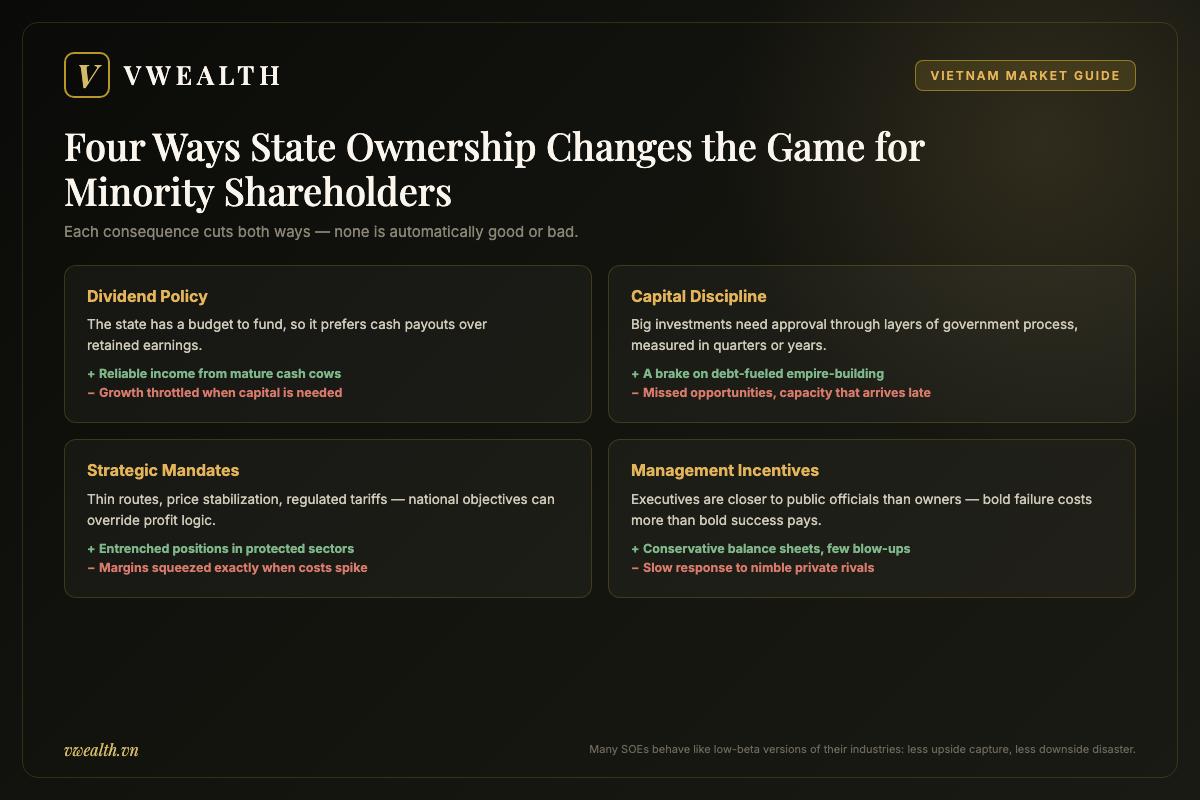
When the state owns the majority of a company you hold shares in, four practical consequences follow. None of them is automatically good or bad — each cuts both ways — but all four should be part of your analysis before buying.
Dividend Policy: The State Likes Cash
The government, as a shareholder, has a budget to fund. State stakes in listed companies are a source of fiscal revenue, and the state has historically shown a strong preference for cash dividends over retained earnings, wherever the company’s capital position allows it. For income-oriented investors this is a feature: several mature SOEs have long records of paying out a large share of profits in cash, because their controlling shareholder wants the money.
The flip side appears when a company needs to retain capital to grow. State-controlled banks have repeatedly faced this tension: growing loan books require growing capital, but paying dividends in shares rather than cash — the natural solution — reduces the cash flowing to the state budget. The result has sometimes been slow, bureaucratic capital-raising processes in exactly the companies that most needed capital, with growth constrained in the meantime. When you evaluate an SOE, ask which side of this tension it sits on: a mature cash cow whose payouts the state happily collects, or a growth business whose expansion is throttled by its shareholder’s preference for cash today.
Capital Discipline: Slower, but Sometimes Safer
Major investments by state-controlled companies typically require approval through layers of government process. A private company’s board can approve a factory, an acquisition or a fleet order in a single meeting; an SOE may need sign-off from ministries, state capital management bodies and sometimes higher political levels, a process measured in quarters or years.
The cost of this is obvious: missed opportunities, delayed capacity, projects that arrive late to the demand they were meant to serve. The benefit is less obvious but real: state approval processes act as a brake on empire-building. During speculative booms, private Vietnamese companies have sometimes leveraged themselves into property side-ventures and aggressive expansion that later turned into distress. SOEs, whatever their inefficiencies, rarely blow themselves up with borrowed money on non-core adventures — their constraint is inertia, not recklessness. In risk terms, many SOEs behave like low-beta versions of their industries: less upside capture, less downside disaster.
Strategic Mandates: Profit Is Not Always the Mission
An SOE in a strategic sector serves two masters: shareholders who want returns, and a state that wants national objectives met. The flag carrier maintains socially important but commercially thin routes. The fuel distributor absorbs pricing decisions made with inflation control in mind. Power generators sell into a market where end-user electricity tariffs are a politically sensitive, state-administered price. Utilities may be asked to hold prices down precisely when input costs spike — compressing margins at the worst moment.
You cannot model these companies as pure profit maximizers, because they are not. The practical technique is to identify, for each SOE you analyze, the specific mechanism through which policy touches its income statement: a regulated tariff, a mandated service, a price stabilization role. Then track that mechanism the way you would track a commodity price for a steel producer. Sector-level context helps here — our overview of Vietnam’s energy sector walks through how gas, fuel distribution and power generation each earn money under different regulatory arrangements, which is essential background for valuing any state-linked energy name.
Management Incentives: Administrators Versus Owners
Senior executives at state-controlled companies are, in career terms, closer to public officials than to entrepreneur-owners. Their compensation is modest by private-sector standards, rarely tied to the share price, and their downside risk is asymmetric: a bold decision that fails can end a career or worse, while a bold decision that succeeds brings limited personal reward. Rational people respond to those incentives with caution — decisions get escalated, deferred or avoided.
Again, two-sided: this produces conservative balance sheets and few scandals of the aggressive-accounting variety, but it also produces slow responses to competitive threats. When a nimble private competitor attacks an SOE’s market, the SOE’s counterattack tends to arrive late. Watch for the exceptions — some equitized companies have imported genuinely commercial management cultures, often after a strategic investor took a meaningful stake — because those exceptions can be excellent investments: SOE stability with private-sector energy.
The Divestment Pipeline: A Structural Theme, Not a Calendar
The Vietnamese government has stated, repeatedly and across many planning cycles, its intention to continue reducing state ownership in businesses outside a core strategic list. The most recent formal blueprint was Decision 360/QD-TTg, signed in 2022, which set out a plan to restructure, equitize and divest state enterprises over the 2021–2025 period. Officials publish classification lists sorting enterprises by how much state ownership is deemed necessary; companies outside the strategic core are, in principle, candidates for further sell-downs. This is the divestment pipeline, and it is one of the most discussed structural themes in the Vietnamese market.
How is that plan actually going? Slowly — which is itself the most important fact to internalize. According to reporting on Ministry of Finance data, no enterprise was equitized in 2023, 2024, or the first quarter of 2025, even though roughly 30 companies were still on the target list for the 2024–2025 window. Divestment has likewise lagged the numbers announced at the start of each cycle. The lesson is not that the program is dead — deals still close — but that official timelines have almost never been met, and future target dates (which you should treat qualitatively, not as commitments) deserve the same skepticism.
Here is the honest way to think about it. Treat the direction as credible and the timing as unknowable.
The direction is credible because the logic is durable. Selling state stakes raises budget revenue, deepens the capital market, attracts foreign capital, and aligns with Vietnam’s broader integration into the global economy — the same trajectory that runs through its trade agreements and its pursuit of an emerging-market upgrade. That upgrade is no longer hypothetical: in September 2025 FTSE Russell announced Vietnam would be reclassified from Frontier to Secondary Emerging market, with an effective date set for September 2026 subject to an interim review — a shift expected to draw fresh foreign inflows into exactly the large, liquid names where the state is often the biggest shareholder. Divestment has actually happened, repeatedly: the brewer sale, sell-downs in dairy (SCIC has moved to sell down its Vinamilk holding), in banks through strategic placements, in dozens of mid-sized companies through auctions. This is not a theoretical promise; it is a program with a track record.
The timing is unknowable because the process has consistently run slower than announced — across many years and many plans. Valuation disputes, especially over land; fear among officials of being blamed for selling state assets too cheaply; market conditions; administrative reshuffles of which body manages which stake — all of these have delayed deals for years at a time. Investors who bought a stock purely because a divestment was “scheduled” have often waited through multiple postponements. Some deals eventually arrived and rewarded the patient handsomely; others remain pending years later.
The practical rules follow directly:
Never make a promised divestment date the core of your thesis. Own the company because the business is worth owning at the current price. Treat any state sell-down as a potential accelerant of value recognition, not as the value itself.
Understand why divestment can re-rate a stock. A state sell-down can increase free float (the shares actually available to trade), which improves liquidity and index weight; it can bring in a strategic investor who improves operations; and it can remove the governance discount that markets apply to state-controlled firms. These are real mechanisms, which is why credible divestment news moves prices sharply.
Watch actions, not announcements. Concrete signals — an approved valuation, a hired advisor, a published auction notice — carry information. General statements of intent, which appear regularly, carry very little, because intent has never been the bottleneck.
Beware the speculation cycle. Divestment rumors periodically inflate candidate stocks well beyond business fundamentals. When the deal delays, the froth deflates. If you hold a divestment candidate that has run far ahead of its operating results on deal speculation, recognize that you are no longer holding an investment in a business — you are holding a bet on an administrative process with a documented history of postponement.
How to Evaluate an SOE Against a Private Peer
Sooner or later you will face a direct choice: a state-controlled company and a private company in the same industry, both listed, both liquid. A state bank versus a private bank. A state-linked power generator versus a private one. The comparison requires adjusting your normal toolkit, because several standard metrics mean different things under state ownership.
Here is a framework, organized as the six questions that most often separate the two:
| Dimension | Ask about the SOE | Ask about the private peer |
|---|---|---|
| Growth capacity | Is growth constrained by capital-raising bureaucracy or investment approvals? | Is growth funded by dilution or debt that shareholders will regret? |
| Profitability | Are margins suppressed by policy roles — and is that priced in? | Are margins inflated by risk-taking that a downturn will expose? |
| Dividends | Does the state’s cash preference support a reliable payout? | Does the founder prefer reinvestment, buybacks or empire-building? |
| Governance | Is the discount for state control justified, shrinking or growing? | Is a dominant founder-shareholder a different flavor of the same risk? |
| Balance sheet | Conservative by mandate — is hidden asset value (land, licenses) recognized anywhere? | Leveraged by choice — can it survive a credit squeeze? |
| Catalysts | Divestment, strategic investor entry, re-listing from UPCOM to HOSE | Earnings execution, market share gains, capital return |
A few of these deserve expansion.
Return on Equity Comparisons Need Context
Return on equity, or ROE — profit divided by shareholder capital — is the workhorse metric for comparing companies in the same industry. But comparing a private firm’s ROE against an SOE’s raw number can mislead in both directions. The SOE’s returns may be suppressed by policy burdens that a partial divestment or regulatory reform would lift — meaning normalized earning power is higher than reported. Or the SOE may earn its returns from a protected market position — a license, a monopoly network, land granted decades ago — that inflates ROE without reflecting management skill, and that could erode if the sector liberalizes. Before comparing the numbers, decompose them: how much of each company’s return comes from operations anyone could run, and how much from position?
Valuation Discounts: Justified or Opportunity?
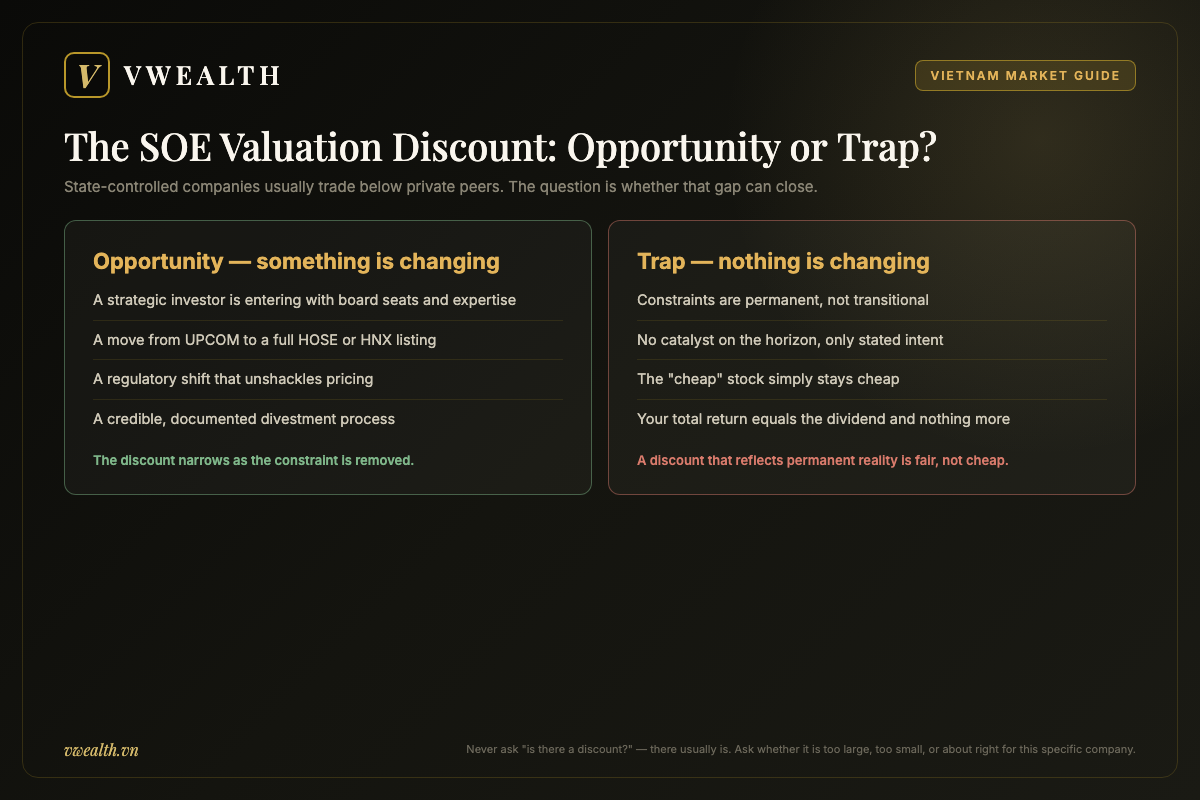
Markets typically price state-controlled companies at a discount to comparable private firms — lower price-to-earnings ratios, lower price-to-book multiples. The discount compensates minority shareholders for the constraints described above: slower growth, policy interference, weaker incentives. The analytical question is never “is there a discount?” — there usually is — but “is this discount too large, too small, or about right for this specific company?”
A discount is an opportunity when something is about to change: a strategic investor entering, a move from UPCOM to a full listing, a regulatory shift that unshackles pricing, a credible divestment process. A discount is a trap when nothing is changing and the constraints are permanent — then the “cheap” stock simply stays cheap, and your return equals the dividend and nothing more. Distinguishing the two cases requires reading the company’s specific situation, not applying a sector-wide rule. This is exactly the kind of work where systematic tools help: vwealth’s AI analysis reports translate Vietnamese-language disclosures, shareholder structures and financial statements into English so foreign investors can do this evaluation without a translator — you can browse the latest company reports to see how state and private peers in the same sector actually compare on current numbers.
The Hidden-Asset Question
Equitized enterprises often carry assets at historical cost that bear no relation to market value — urban land above all. A transport SOE’s depot in central Ho Chi Minh City, booked at a 1990s valuation, can be worth multiples of the company’s entire market capitalization on paper. Investors have long hunted such situations. Two warnings from experience: first, hidden value only matters if a mechanism exists to unlock it, and land conversion by state-linked companies is legally and politically fraught; second, the same asset can turn from treasure to liability if questions arise about how it was valued during equitization. Count hidden assets as a margin of safety, never as the reason to buy.
Governance Signals: Reading an SOE Before You Buy
Because you cannot interview management or attend ministry meetings, judge an SOE by its public trail. Six signals, all checkable from disclosures, separate the investable state companies from the rest:
1. Who manages the state’s stake. Vietnam’s state holdings are managed by different bodies, and the map changed materially in 2025 — so check it fresh rather than relying on older write-ups. For years the largest groups (including EVN, Petrovietnam, VNPT and the airport operator) sat under a dedicated “super-committee,” the Commission for the Management of State Capital at Enterprises (CMSC), set up in 2018 to oversee 19 major state groups. As part of a sweeping government reorganization, the CMSC ceased operations in late February 2025 and was formally dissolved on 21 March 2025, with its portfolio transferred into the Ministry of Finance (which absorbed both the CMSC and the former Ministry of Planning and Investment). Separately, the State Capital Investment Corporation (SCIC) is the professional investment arm whose explicit mandate includes divesting non-core holdings — and stakes held by SCIC have historically been likelier candidates for orderly sale. The holder’s identity tells you how commercially the stake is likely to be managed; the information is public in every annual report’s shareholder structure section. (As of 2025, SCIC was itself being reshaped toward a government investment-fund model, with divestments continuing alongside a growing investment role — a transition worth tracking for anyone following the pipeline.)
2. The size and trend of the state stake. A state holding just above a control threshold suggests the sell-down has already gone as far as intended for now. A stake far above it leaves room for reduction — or signals the company is considered strategic and will stay controlled. Compare the current stake with five years ago: direction of travel is more informative than level.
3. Presence of a strategic investor. A foreign bank holding a meaningful stake in a state bank, a global industrial firm partnered into a manufacturer — strategic investors negotiate information rights, board seats and operational involvement that ordinary minorities never get. Vietnam’s state banks supply the clearest examples: Japan’s Mizuho took a 15% strategic stake in Vietcombank (completed in 2011 for roughly US$570 million), and South Korea’s KEB Hana Bank became BIDV’s foreign strategic shareholder with a 15% stake (2019). Their presence means someone with deep pockets and inside access has already done due diligence, and their ongoing involvement pressures the company toward commercial behavior — technology transfer, risk-management upgrades and governance discipline. Their exit, conversely, is a signal worth respecting.
4. Disclosure quality. Some SOEs publish detailed, timely, even English-language reports; others do the legal minimum, late. Disclosure quality correlates with how seriously the company takes its minority shareholders in every other respect. A simple test: can you find last year’s audited annual report, with full notes, on the company website without effort? If not, price in the opacity.
5. History of treatment of minorities. Look back through past capital raises and dividends. Were rights issues priced fairly? Were dividend promises kept? Did the company ever dilute minorities through placements at questionable prices? An SOE’s track record with small shareholders is the best predictor of your future experience as one.
6. Related-party gravity. Equitized companies often live inside an ecosystem of sibling companies under the same state parent, trading with each other constantly. Read the related-party transactions note in the financial statements. Some flows are normal and operational; a pattern of the listed company carrying costs, or receivables, for unlisted siblings is a wealth transfer away from you.
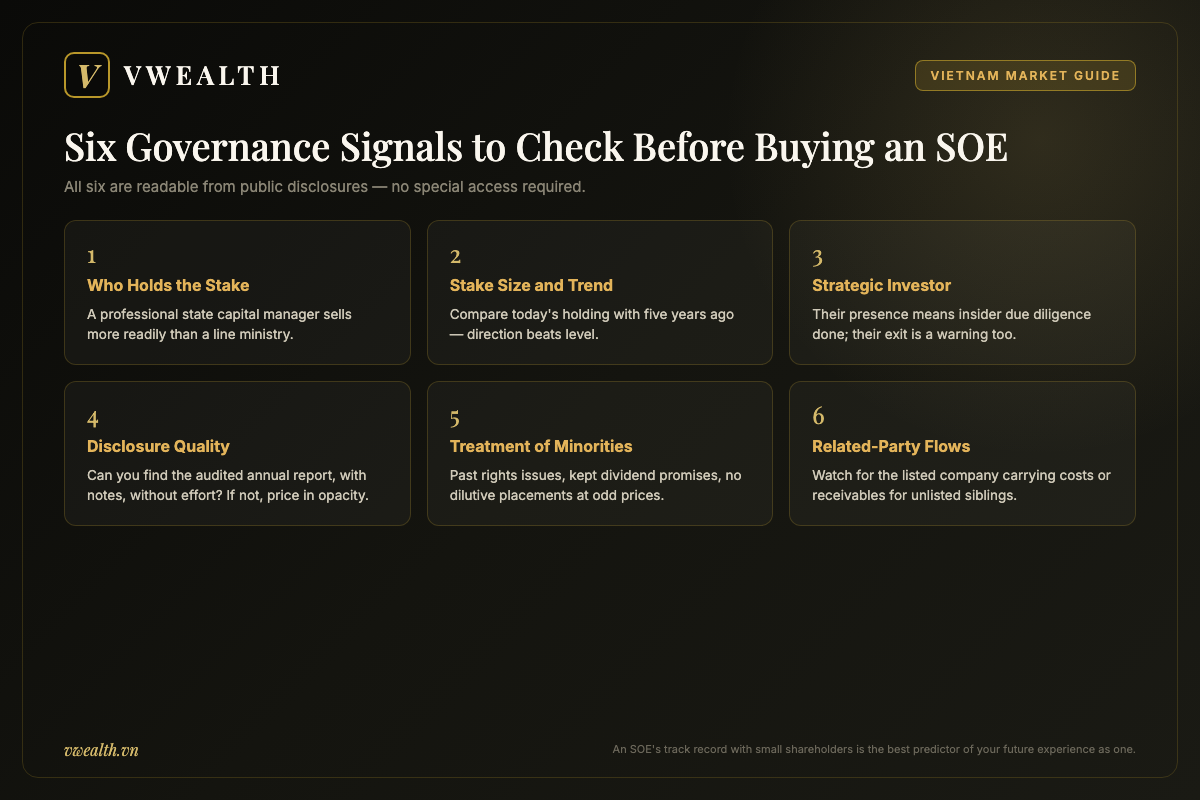
None of these checks requires special access. All of them require reading documents that are mostly published in Vietnamese — which is, frankly, the main practical barrier for foreign investors, and the gap that translation-plus-analysis platforms exist to close.
Risks Specific to Vietnam State Owned Enterprises
Every stock carries market risk. SOEs add several risks of their own that deserve explicit listing:
Policy reversal risk. A tariff formula changes, a stabilization duty is imposed, a strategic designation shifts — and the earnings model you built becomes obsolete overnight. Mitigation: prefer SOEs whose policy exposure is transparent and long-established over those whose profitability depends on a recent, possibly temporary, regulatory kindness.
Anti-corruption campaign exposure. Vietnam has run a sustained, high-profile anti-corruption drive for years. It is, in the long run, unambiguously positive for market integrity. In the short run, investigations touching a company’s current or former leadership can freeze decision-making, delay projects and hit the share price regardless of the company’s operational health. This risk is hard to predict and impossible to eliminate; diversification across names is the only honest answer.
Equitization-era accounting ghosts. Valuations performed during conversion, especially of land, occasionally resurface as legal disputes years later. Companies have been asked to revisit transactions long considered closed. When evaluating a recently equitized firm, treat the cleanliness of its conversion process as a genuine due-diligence item.
Liquidity and float traps. When the state holds the great majority of shares, the free float can be tiny relative to the company’s headline size. Small floats mean volatile prices, wide spreads, and index treatment that lags the company’s true scale. Check the float, not the market cap, before sizing a position.
Foreign ownership limits. Many SOE-heavy sectors — banking above all — carry caps on total foreign ownership. In banking the general ceiling is 30% of a bank’s charter capital (with sub-limits for individual and strategic holders), and popular state banks routinely trade with little or no “room” left for additional foreign buyers, forcing purchases at premiums through off-exchange arrangements or making them impractical entirely. Always check the current rules, since caps and exceptions are periodically adjusted. This interacts directly with the divestment theme: state sell-downs sometimes come with adjustments to foreign access, which is part of why divestment news matters so much to offshore investors.
Slow-motion disruption. The gravest long-term risk is quiet: a protected incumbent losing relevance one year at a time to private and foreign competitors, while its stock stays optically cheap the whole way down. Guard against it by tracking market share, not just earnings. An SOE holding share in a growing market is a fortress; an SOE bleeding share behind a regulatory moat is a melting ice cube with a dividend.
Practical Steps: Researching and Buying SOE Stocks as a Foreigner
Pulling the threads together into a working process:
Step one: map the state’s presence in your target sector. Before comparing companies, know which are state-controlled, which are private, and which are former SOEs where the state has fully exited. Shareholder structures are disclosed in annual reports and on exchange websites. Sector guides — like our walkthroughs of the banking sector and energy names — shortcut this mapping.
Step two: classify the SOE. Is it a mature cash-distributor (state milks dividends, low growth, judge it as a bond-like income holding)? A constrained grower (good business throttled by capital bureaucracy — the divestment/strategic-investor angle matters most here)? A policy instrument (utility-like, regulated returns, judge the regulatory framework rather than management)? Or a restructuring story (troubled SOE where the thesis is turnaround)? Each class needs different metrics and different patience.
Step three: run the six governance checks from the previous section. An hour with the annual report answers most of them.
Step four: value it against a private peer with adjustments. Apply the framework table above. Expect a discount; interrogate its size. Ask what specific event could close it, and what you earn — usually the dividend — while waiting.
Step five: check the plumbing before ordering. Free float, average daily traded value, foreign room remaining, and which board the stock trades on (UPCOM names carry different disclosure standards and, for some brokers, different access). Mechanics that surprise investors after purchase should have been checked before it. Our foreigner’s guide to the Vietnamese market covers these operational details step by step.
Step six: monitor the right variables. For SOEs, quarterly earnings are only part of the watchlist. Add: changes in the state stake, announcements from the state capital manager, regulatory pricing decisions in the sector, strategic investor moves, and progress (or silence) on any pending divestment. These state-side variables drive SOE share prices at least as much as operations do.
The Bottom Line: Partner With the State on Your Terms
State-owned enterprises are not a detour on the way to investing in Vietnam — they are a substantial share of the destination. The equitization program that began as a cautious experiment in the early 1990s built much of today’s stock exchange, and the state’s gradual, halting, but persistent withdrawal from non-strategic businesses remains one of the market’s defining long-term currents.
The investment logic reduces to three sentences. SOEs offer scale, entrenched market positions, conservative balance sheets and often generous dividends — priced, usually, at a discount that reflects their constraints. That discount is an opportunity precisely when a specific, checkable mechanism exists to narrow it, and a trap when it merely reflects permanent reality. Your job is to tell those two situations apart company by company, using the state’s own paper trail: shareholder structures, disclosure quality, capital history and the behavior of the government as your co-owner.
Do the reading, respect the risks that are genuinely different here — policy, governance, float, foreign room — and never let a rumored divestment date substitute for a business worth owning. Investors who treat Vietnam’s state sector with informed skepticism, rather than blanket avoidance or naive enthusiasm, have historically found some of the market’s most rewarding opportunities hiding inside its least glamorous shareholding structures.
This article is educational analysis for reference only and does not constitute investment advice or a recommendation to buy or sell any security.
Research Vietnamese stocks in English with vwealth. Our AI-powered platform turns Vietnamese market data into full English analysis reports — with international payment support and a free 2-month trial for new accounts. Create your free account and read the latest reports.