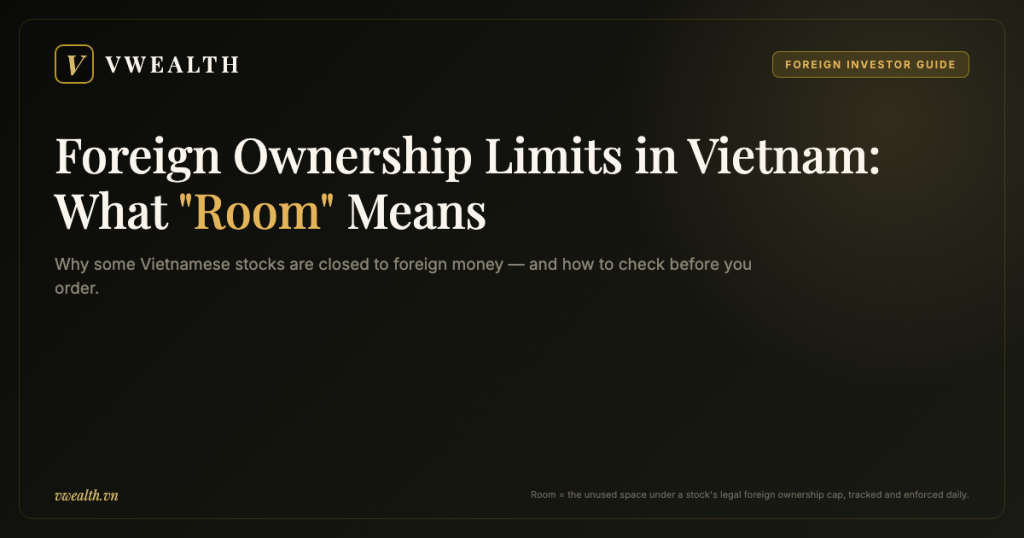
Every foreigner who buys Vietnamese stocks eventually runs into a wall that domestic investors never see: the Vietnam foreign ownership limit, known locally as “room.” Some of the best companies on the Ho Chi Minh Stock Exchange are effectively closed to new foreign money, while others are wide open. This guide explains why the limits exist, how the caps differ by industry, what happens when room runs out, how the famous “foreign premium” works, and the practical steps to check room before you place a single order. If you plan to build a portfolio in Vietnam, understanding room is not optional — it decides which stocks you can actually own.
What a foreign ownership limit actually is
A foreign ownership limit (FOL) is a legal cap on the percentage of a listed company’s shares that all foreign investors, added together, are allowed to hold. It is not a limit on any single investor. It is a ceiling on the combined stake of every non-Vietnamese shareholder — individuals, funds, banks, corporations — counted as one group.
Vietnamese market participants almost never say “foreign ownership limit” in conversation. They say room. The word borrowed from English has become standard Vietnamese market slang, and it refers specifically to the remaining space under the cap. If a company’s limit is 49% and foreigners currently hold 45%, the stock has 4% of room left. When foreigners hold the full 49%, traders say the stock is “out of room” or “full room” — hết room in Vietnamese.
The three numbers that define room
For any Vietnamese stock, three numbers tell you everything about foreign access:
- The cap — the maximum percentage foreigners may collectively own. This is set by law for the sector, and sometimes set lower by the company itself in its own charter.
- Current foreign holdings — the percentage foreigners actually own today. This number moves every trading day as foreigners buy and sell.
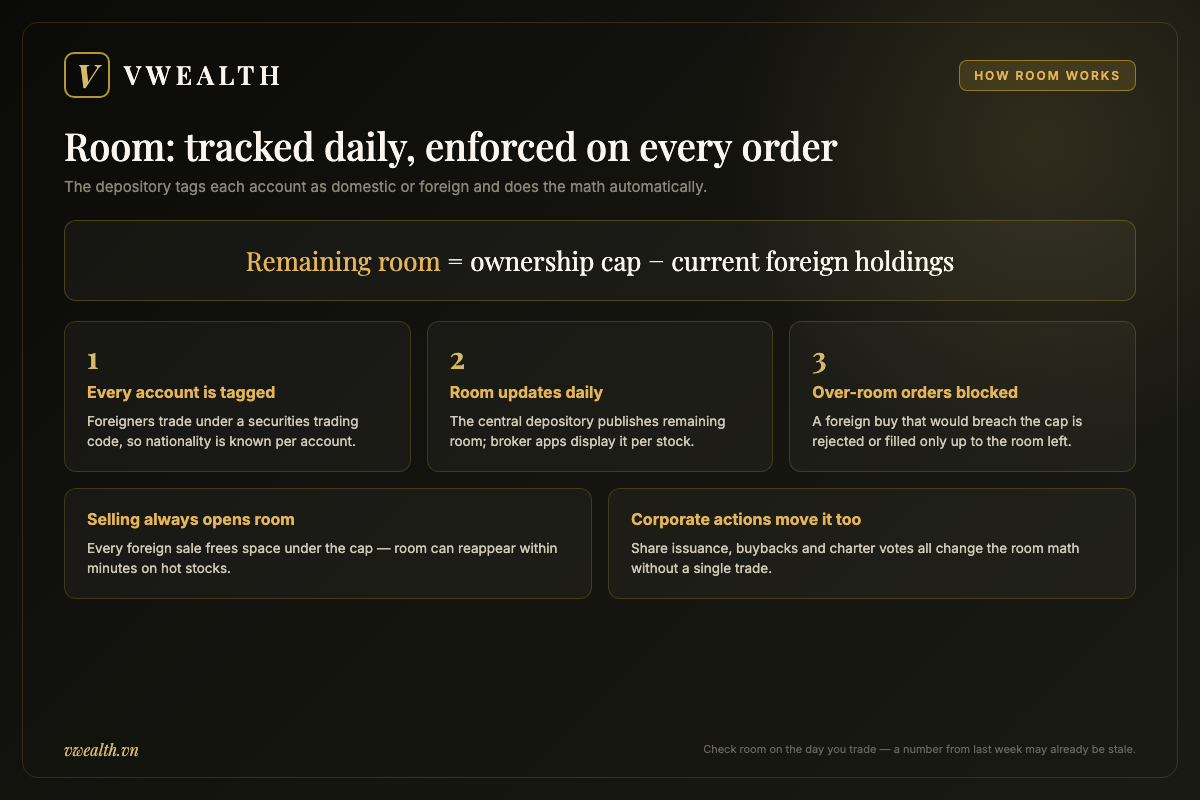
- Remaining room — the cap minus current foreign holdings. This is the space available for new foreign buying.
A worked illustration makes the mechanics concrete. Suppose Company A has 100 million shares outstanding and a 49% foreign ownership cap. The maximum number of shares foreigners can hold is 49 million. If foreign investors currently hold 46 million shares, remaining room is 3 million shares, or 3% of the company. A foreign fund that wants to buy 5 million shares cannot do it on the exchange — the order for the last 2 million shares would be rejected, because filling it would push the foreign total past the legal ceiling. The depository system tracks this automatically and blocks over-limit foreign buy orders in real time.
Notice what the limit does not do. It does not stop foreigners from selling — selling always creates room rather than consuming it. It does not restrict domestic investors in any way; a Vietnamese individual can buy a full-room stock freely. And it does not cap any single foreign investor below the group ceiling, except in specific sectors like banking where individual sub-limits also apply, which we will cover below.
If you are new to the market’s structure, it helps to first understand how trading works across the country’s venues — our guide to Vietnam’s three trading venues, HOSE, HNX and UPCoM, explains where stocks list and how orders are matched. Foreign ownership limits apply on all three venues, because the limit attaches to the company, not to the exchange it trades on.
Why Vietnam caps foreign ownership
Foreign ownership limits are not unique to Vietnam. Thailand, the Philippines, Indonesia, China and many other emerging markets restrict foreign stakes in some or all listed companies. The reasons are broadly the same everywhere, but Vietnam’s version has its own history.
The policy logic
Three motivations drive the caps. First, control over strategic sectors. Governments generally do not want banks, telecom networks, airlines, ports, energy infrastructure or defense-linked businesses controlled from abroad. A shareholding cap is the bluntest and most enforceable way to guarantee that control stays domestic, because ownership above 50% — or even a large minority stake — can translate into board seats and veto power.
Second, financial stability. Foreign portfolio money is fast money. It can flood in during optimistic years and rush out during a crisis, amplifying booms and busts. Caps limit how much of the market’s ownership base can evaporate in a single wave of foreign selling. Whether this protection is worth the cost is debated endlessly, but it is a real consideration for regulators who remember the 1997 Asian financial crisis and the 2008 global one.
Third, negotiating leverage in trade agreements. Vietnam’s caps trace partly to its World Trade Organization accession commitments in 2007 and to bilateral trade deals. Sector-by-sector foreign access was a bargaining chip: Vietnam opened some industries fully, opened others partially, and kept a list of “conditional” business lines where foreign participation is restricted. The FOL on a listed company is the stock-market expression of those treaty schedules.
How the limits evolved
The general cap has loosened in stages over the market’s life. In the market’s early years after the first trading session in July 2000, foreigners could hold only a small slice of any listed company — the initial general limit was 20%. It was lifted to 30% in 2003, then to 49% under Decision 238/2005 in September 2005, and 49% remained the default ceiling for a decade. The watershed came in 2015, when Decree 60/2015 (signed in June, effective 1 September 2015) allowed public companies outside conditional sectors to raise their foreign ownership limit to 100%, subject to shareholder approval and regulatory filings. The framework was then restated under Decree 155/2020 (effective 1 January 2021), which keeps that architecture: full openness is the default, and restrictions are the exception that must be justified by sector rules or international commitments. The newest layer arrived in September 2025, when Decree 245/2025 amended Decree 155 as part of the market-upgrade reform push — most notably by abolishing a company’s right to impose a foreign ownership cap lower than the legal maximum, a change covered in detail below.
That history matters for a practical reason: many investors who learned the market years ago still assume “49% everywhere.” That assumption is now wrong in both directions. Plenty of companies are open to 100% foreign ownership, while banks are capped far below 49%. You have to check each stock individually.
Foreign ownership caps by industry: banks are strictest, many sectors are open
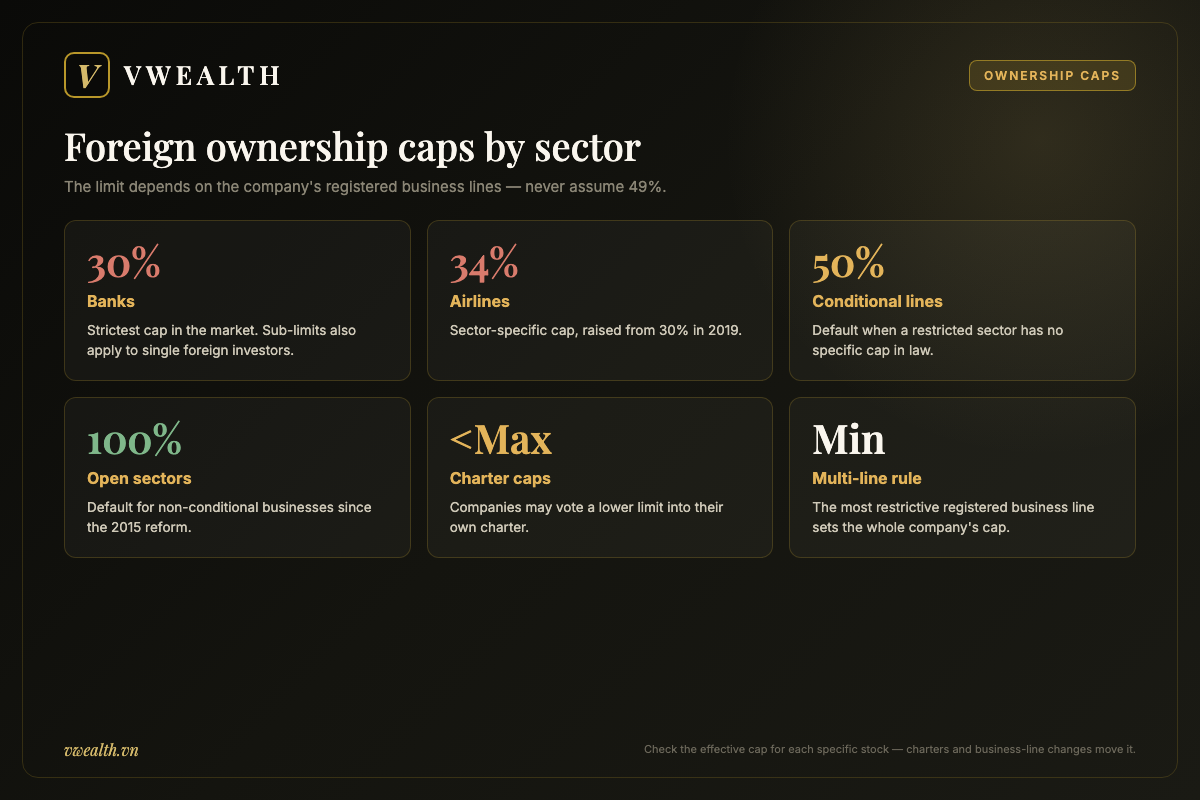
The cap that applies to a given company depends on which business lines it is registered for. Here is the general map of the terrain.
| Category | Typical foreign ownership cap | Notes |
|---|---|---|
| Commercial banks | 30% total | Set by Decree 01/2014, with sub-limits per investor type; since Decree 69/2025 (effective 19 May 2025), banks that take over a weak bank under a mandatory transfer plan may go up to 49% |
| Airlines | 34% | Raised from 30% by Decree 89/2019, effective January 2020 |
| Conditional business lines without a specified cap | 50% | Applies under Decree 155/2020 when a sector is on the conditional list but no law names a specific number |
| Sectors with treaty or sector-law caps | Varies | The specific number in the treaty or specialized law applies |
| Non-conditional sectors | Up to 100% | Open by default |
| Company-notified caps below the legal maximum | Legacy only | Decree 245/2025 abolished the right to set new lower caps; ratios notified before September 2025 may be kept or raised, not lowered |
Banking: the tightest room in the market
Banks deserve special attention because they are among the largest, most liquid and most foreign-demanded stocks in Vietnam — and they carry the strictest cap. Total foreign ownership in a Vietnamese commercial bank is limited to 30% under Decree 01/2014. Within that total, additional sub-limits apply: a single foreign individual is capped at 5%, a single foreign organization at 15%, and a foreign strategic investor at 20% — with room for the Prime Minister to approve higher stakes case by case in weak banks under restructuring. The practical result is that most major bank stocks run at or near full foreign room almost permanently. When a sliver of bank room opens — for example, after a foreign fund trims a position — it is often absorbed within days.
The 30% bank cap is also the single most discussed number in Vietnam’s market-liberalization debate. Banks make up a large share of the total market capitalization, so as long as foreign access to banks is throttled, foreign access to “the Vietnamese market” as an index concept is throttled too. A first crack in the ceiling appeared in 2025: Decree 69/2025, effective 19 May 2025, allows total foreign ownership of up to 49% in commercial banks that took over a weak bank under the central bank’s mandatory transfer program — a carve-out that in practice concerns the handful of private acquirer banks named in those restructuring plans, and excludes banks where the state holds a majority. Once the restructuring period ends, foreign investors cannot add shares until the aggregate falls back under 30%. It is a targeted exception rather than general liberalization, but analysts read it as a signal of direction, which is why every further policy hint on the bank cap is tracked so closely.
The multi-line company trap
Here is a subtlety that surprises many investors: a company’s cap is determined by the most restrictive business line it is registered for, not its main revenue source. A retailer that also registered a small logistics or distribution line on the conditional list can find its entire listed equity capped at 50%, even though the restricted activity is a rounding error in its income statement. Some companies have deliberately dropped minor registered business lines specifically to qualify for a 100% foreign ownership limit. When you research a stock, check the currently effective FOL rather than guessing from the industry label.
Companies that capped themselves — and the 2025 rule that ended the practice
For a decade, the law set the ceiling but a company’s charter could set a lower one. Some founders and boards preferred to keep foreign ownership below the legal maximum — to protect control, to keep the shareholder register manageable, or for strategic reasons of their own. A company legally eligible for 100% foreign ownership might write 49% into its charter, and that self-imposed cap was just as binding at the depository level as a legal one.
That option no longer exists for new decisions. Decree 245/2025, issued and effective 11 September 2025 as part of the market-upgrade reforms, abolished the provision of Decree 155/2020 that let a general meeting of shareholders write a below-maximum foreign ownership cap into the charter. The transition works one way: companies that had already notified a lower ratio before the decree may keep it or move it upward toward the statutory level, but cannot tighten it further, and public companies that never completed the formal notification of their maximum foreign ownership ratio must do so within 12 months of the decree taking effect. For investors, the practical meaning is twofold. First, the population of self-capped stocks is now a closed, shrinking legacy list. Second, each legacy cap that gets lifted toward the legal maximum is a room-creation event — and since the direction of travel is now mandated to be one-way, watching that list is a genuine source of trade ideas. A vote to raise a legacy cap on a foreign-demanded stock still releases pent-up buying, exactly as charter-cap removals always did.
How room works day to day: tracking, order blocking, and checking before you trade
Understanding the caps is half the picture. The other half is the plumbing — how the limit is enforced trade by trade, and how you check it before ordering.
Who keeps score
Foreign ownership is tracked centrally at the Vietnam Securities Depository and Clearing Corporation (VSDC), the institution that records who owns every share in the market. Each investor account is tagged as domestic or foreign when it is opened — foreigners must obtain a securities trading code from VSDC before they can trade at all. Because every account has a nationality tag, the system knows the aggregate foreign holding of every stock at every moment, and it publishes the remaining room daily. Your broker’s app shows the same number, usually on the stock’s detail screen as “foreign room” or “room remaining.”
What happens to an over-room order
Enforcement is automatic and unforgiving. When a foreign account submits a buy order, the system checks whether filling it would push total foreign ownership past the cap. If yes, the order is rejected outright or can only fill up to the remaining room. There is no queue for room, no waiting list managed by the exchange, and no partial exception. If room is zero, a foreign buy order on the regular order book simply cannot execute.
Room is also a moving target within a single day. Every foreign sell creates room; every foreign buy consumes it. On a stock trading close to its cap, room can appear and vanish repeatedly during one session. Foreign investors who want a nearly-full stock often set alerts or keep standing orders ready, because the window between “a foreign fund just sold” and “another foreign buyer took the room” can be minutes.
Corporate actions quietly move room too
Trading is not the only thing that changes room. Corporate events do as well, and they catch inattentive investors off guard:
- New share issuance. A rights issue or private placement increases shares outstanding. If foreigners do not take up their full pro-rata share, foreign ownership as a percentage falls and room opens up. Conversely, a placement made entirely to a foreign strategic investor can consume years of room in a single transaction.
- Treasury share operations. Under the Securities Law of 2019, when a public company buys back shares it must cancel them and reduce charter capital (with a narrow exception for employee share programs), reducing shares outstanding. Fewer total shares with unchanged foreign holdings means a higher foreign percentage — buybacks can mechanically shrink room.
- Charter changes. A shareholder vote to raise the company’s self-imposed cap creates room overnight. A vote to add or remove a registered business line can change the applicable legal cap entirely.
- Convertible instruments. Convertible bonds held by foreigners consume room upon conversion, and the prospect of conversion is part of room arithmetic for companies that issue them.
The practical rule: check room on the day you trade, not from memory or a week-old screenshot. Numbers that looked stable can shift after an earnings-season dividend, an issuance, or a single large block trade.
How to check room in practice
Before placing an order, run this quick sequence. First, open the stock in your broker’s app and find the foreign room figure — nearly all Vietnamese brokers display current room and the percentage cap. Second, confirm the cap itself from the exchange or depository disclosures, especially for companies that recently changed their charter. Third, compare the room to your intended order size and to the stock’s average daily volume: 2% of room sounds comfortable until you realize it equals twenty days of typical foreign net buying. A platform-based workflow helps here — a research tool that surfaces ownership data alongside financials saves you from juggling three websites. You can create a free vwealth account to read company analysis in English with the relevant ownership context included, instead of reconstructing it manually from Vietnamese-language disclosures.
When room runs out: the foreign premium and off-exchange block deals
Now for the part that makes Vietnam genuinely unusual among markets: what happens to a stock once foreigners have bought every share they are legally allowed to own on the exchange.
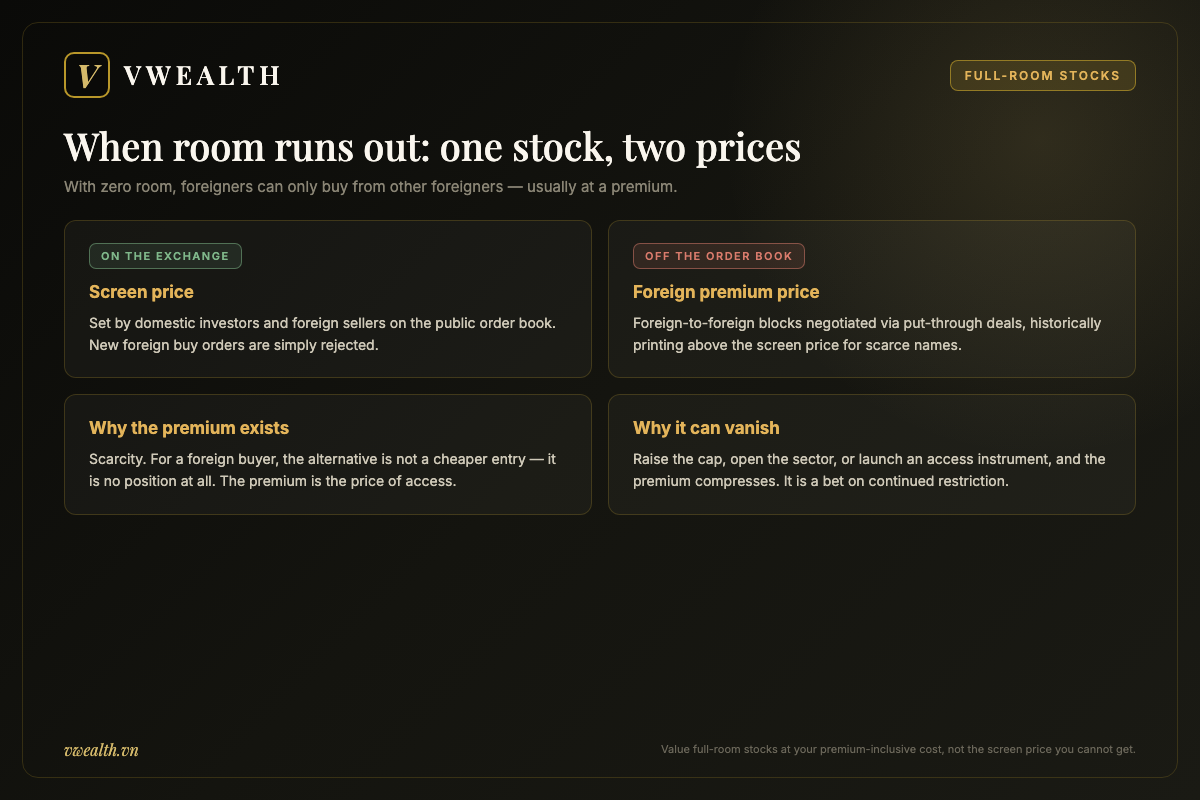
Two prices for one stock
When a stock is out of room, a foreign investor who wants in has exactly one source of supply: another foreign investor willing to sell. Domestic shares are useless to the foreign buyer — buying them on the order book is impossible, since the purchase would breach the cap. This splits the market in two. The on-exchange price reflects supply and demand among domestic investors plus foreign sellers. Meanwhile, foreign-to-foreign transactions happen through negotiated block trades — called put-through or thỏa thuận deals — executed through the exchange’s negotiation facility rather than the public order book.
Because foreign demand for full-room stocks typically exceeds foreign supply, these negotiated deals often price above the on-screen market price. That gap is the famous foreign premium. Historically, premiums on the most sought-after full-room stocks — top retailers, technology firms, and consumer names — have commonly run in the range of roughly 7% to 30% over the exchange price, and in extreme cases far higher: fund manager VinaCapital documented a premium of about 45% on retailer Mobile World (MWG) in August 2020, when that stock was the market’s most extreme full-room case. There is a mechanical wrinkle worth knowing: an on-exchange put-through must still print within the day’s permitted price band (±7% on HOSE), so a premium larger than the band cannot simply be paid on the exchange — deals at wider premiums have to be structured off-exchange, with heavier documentation. Either way, a foreign fund might pay meaningfully more than the screen price simply for the right to own the shares at all.
Why anyone pays the premium
To a newcomer the premium looks irrational: why pay extra for the identical share a domestic investor buys at screen price? The answer is scarcity economics. For the foreign buyer, the alternative to paying the premium is not “buy cheaper” — it is “do not own the stock.” If a fund’s mandate or conviction requires exposure to a specific full-room company, the premium is the market-clearing price of foreign access. The premium is effectively a second, parallel valuation: the price of the share plus the price of the scarce foreign slot it occupies.
The premium also carries information. A wide premium signals intense foreign demand and confidence in the company. A shrinking premium can mean foreign enthusiasm is cooling, or that room is expected to open — through issuance, a charter change, or regulatory reform. Watching premium trends on full-room names is a niche but genuinely useful sentiment gauge that most retail investors ignore.
The premium’s dark side: it can vanish
Here is the risk that every buyer of premium-priced blocks must underwrite: the premium exists only because access is scarce, and scarcity is a policy variable. If the company raises its cap, if the sector is liberalized, or if a mechanism like non-voting depositary receipts ever gives foreigners another route in, the premium can compress toward zero. An investor who paid a 15% premium — as an illustrative figure — could see the stock’s exchange price rise while their position still loses relative value, because the access right they overpaid for stopped being scarce. Foreign premiums are a bet on continued restriction as much as on the company itself.
Accounting for the premium in your valuation
If you value a full-room stock with a discounted cash flow model or a multiples comparison, remember which price you are testing. The screen price is what domestic marginal buyers pay; the premium price is your actual entry cost as a foreigner. A stock that looks fairly valued at the screen price may be expensive at screen-plus-premium. Build the premium into your entry math explicitly: expected return = (target value − premium-inclusive cost) / premium-inclusive cost. It sounds obvious written down, yet premium-blindness is a recurring error in foreign investors’ Vietnam post-mortems.
How foreign ownership limits shape what foreigners actually buy
Room does not just constrain individual trades. It quietly architects the entire pattern of foreign investment in Vietnam — which stocks foreigners crowd into, which products exist, and how index providers judge the market.
The two-tier investable universe
From a foreign portfolio manager’s chair, Vietnamese stocks sort into two tiers. Tier one: stocks with ample room, freely buyable, tradable at screen prices. Tier two: full-room stocks, accessible only via premium-priced blocks or not at all. The perverse result is that some of the country’s most admired companies are the hardest for foreign money to reach, and foreign flows get redirected into the subset of large caps that happen to have room. This distorts relative valuations: a company can trade at a persistent discount to a full-room peer of similar quality simply because it is the “buyable proxy” that absorbs redirected foreign demand — or at a persistent structural premium on-screen because domestic investors front-run expected foreign flows into it.
Products built around the room problem
Financial engineering abhors a vacuum, and Vietnam’s fund industry built a product directly on top of the room problem: exchange-traded funds tracking indexes composed of stocks at or near full foreign room. The flagship example is the VN Diamond index family on HOSE, created specifically to bundle full-room stocks into a wrapper foreigners can buy — tracked most prominently by the DCVFM VNDiamond ETF (ticker FUEVFVND), which became one of the market’s largest domestic ETFs on the strength of foreign demand for exactly this access. The mechanism is elegant — the ETF is itself a domestic fund, so it can hold domestic shares of full-room companies, while its fund certificates trade without a foreign cap. Foreigners who cannot buy the underlying stocks buy the ETF instead, gaining economic exposure to companies whose direct shares are sealed off. These products attracted substantial foreign inflows within their first years precisely because they monetized the access gap. The trade-offs are real, though: you accept the whole basket rather than your preferred stock, you pay a management fee, and the ETF price can itself drift to a premium over its net asset value when foreign demand surges — the room scarcity leaks into the wrapper.
Room and the market-upgrade story
Foreign access is central to how index providers such as FTSE Russell and MSCI classify markets — the frontier-versus-emerging distinction that determines whether trillions of dollars of benchmark-tracking capital can flow in. Their criteria explicitly assess foreign ownership limits, the size of the market open to foreigners, and the fairness of foreign access. Vietnam’s reform agenda of 2024–2026 was substantially aimed at these criteria, and it delivered a sequence of concrete legal changes worth knowing by name. Circular 68/2024, effective 2 November 2024, removed the pre-funding requirement for foreign institutional investors — they can now place buy orders without having the full cash on deposit first, with the broker assuming settlement responsibility — and the same circular phased in mandatory English-language disclosure for listed and large public companies, periodic disclosures from 1 January 2025 and ad-hoc disclosures from 1 January 2026. Decree 245/2025 then dismantled the charter-based room caps described earlier and shortened the IPO-to-listing gap from 90 days to around 30. In early 2026, Circular 08/2026 (issued 4 February 2026) opened the door for foreign investors to route trades through global brokerage intermediaries rather than only through direct Vietnamese brokerage relationships.
The payoff came quickly. On 7 October 2025, FTSE Russell announced the reclassification of Vietnam from Frontier to Secondary Emerging market status, effective 21 September 2026, explicitly crediting the removal of pre-funding and the new failed-trade handling process. An interim review in March 2026 checked progress on global broker access, and in April 2026 FTSE Russell confirmed the upgrade remained on track. Brokerage estimates of the resulting inflows — passive index-tracking money plus active emerging-market funds — cluster in the several-billion-dollar range, with commonly cited figures between roughly US$3 billion and US$10 billion, and Vietnam expected to enter the FTSE Emerging index at a weight of around 0.5%. MSCI, the larger index provider, still classified Vietnam as a frontier market as of mid-2026; getting onto MSCI’s watchlist for emerging-market reclassification is the next milestone the same reforms are aimed at. For a long-term investor, the lesson of this episode generalizes: progress on foreign-access reform tends to be rewarded with re-rating and inflows, and room policy sits near the center of that story. Our comprehensive guide to the Vietnamese stock market covers the market-classification journey and what upgrades historically meant for comparable markets.
What this means for a domestic or small foreign investor
Even if you are Vietnamese, or a foreigner too small to negotiate block deals, room dynamics affect your portfolio. Foreign flows are a major marginal force in Vietnamese large caps, and room determines where those flows can land. When a stock’s room opens — after an issuance or a charter change — foreign buying can arrive in size, moving the price. When index rebalancing forces foreign funds to trim a position, the room they release can be a signal in itself. Reading room data is a way of reading the map of future foreign flows, whoever you are.
Workarounds and the NVDR debate
Whenever a rule creates a wall, markets look for doors. Several exist in Vietnam, each with trade-offs, and one long-debated mechanism — the non-voting depositary receipt — would change the game if fully implemented.
What an NVDR is
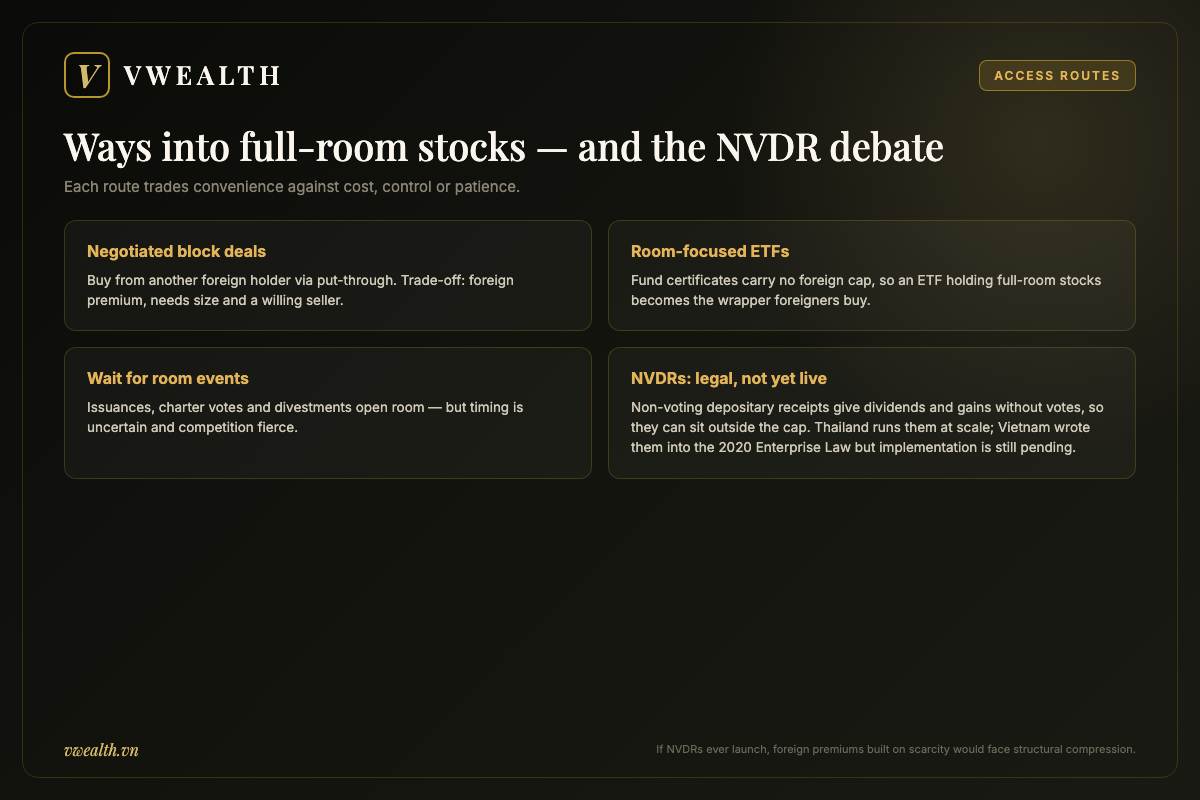
A non-voting depositary receipt (NVDR) is a security that gives the holder all the economic rights of a share — dividends, capital gains, rights-issue entitlements — but no voting rights. The votes stay with a depositary institution, which typically abstains. Because the foreign ownership limit exists to prevent foreign control, and an NVDR holder cannot vote, NVDRs can be exempted from the cap without touching the policy goal. Foreigners buy unlimited economic exposure; control stays domestic.
Thailand is the proof of concept. The Stock Exchange of Thailand launched NVDRs in 2000 through a dedicated subsidiary, and they became a standard channel for foreign investment in Thai stocks that are near their foreign limits. The Thai experience showed the mechanism can operate at scale for decades without destabilizing corporate governance — and it is the model Vietnamese policymakers cite.
Where Vietnam stands
Vietnam wrote the legal foundation for NVDRs into its Enterprise Law of 2020 (Law 59/2020, effective 1 January 2021), which recognizes non-voting depositary receipts issued against ordinary shares. But a legal definition is not a functioning market. Implementation requires detailed regulations, a designated issuer, depository and settlement plumbing, and tax clarity — and the rollout has been slow and repeatedly discussed rather than delivered. The obstacles are structural: securities regulations contain no detailed NVDR framework, and the exchanges were not permitted to set up the kind of dedicated issuing subsidiary Thailand uses, so delivering the instrument requires coordinated amendments across the securities, enterprise and investment laws rather than a single ministry-level fix. NVDRs have appeared in draft amendments to the securities legislation, and market participants regularly cite them as a necessary step for the eventual MSCI upgrade — but as of mid-2026, no NVDR has traded in Vietnam. Check current status before assuming either way; this is exactly the kind of fact that can change with one decree.
The debate itself is instructive. Proponents argue NVDRs would attract large foreign inflows, dissolve the foreign-premium distortion, and boost the market-upgrade case, all without ceding control. Skeptics raise governance questions — a large pool of non-voting shares weakens the alignment between economic ownership and oversight — and note that companies might resist an instrument that adds shareholders who cannot be courted for votes. There are also technical puzzles: how NVDRs interact with takeover thresholds, rights issues and index weightings. None of these are unsolvable, as Thailand demonstrated, but they explain why “legal since 2020” has not meant “trading since 2020.”
Other routes foreigners actually use
While the NVDR question idles, practitioners use a familiar toolkit:
| Route | How it works | Main trade-off |
|---|---|---|
| Negotiated block deals | Buy from another foreign holder via put-through at a negotiated price | Foreign premium; needs size and a willing seller |
| Room-focused ETFs | Buy fund certificates of an ETF holding full-room stocks | Basket exposure, fees, possible premium to net asset value |
| Open-ended local funds | Invest through a domestic fund manager’s products | Fees, less control over stock selection |
| Offshore derivatives (swaps, participatory notes) | A bank holds the exposure and passes the economics offshore | Counterparty risk, cost, regulatory gray zones; institutional-only |
| Waiting for room events | Position for issuances, charter votes, or divestments that open room | Timing is uncertain; competition is fierce when room opens |
A note of caution on the exotic end of that table: synthetic exposure through offshore structures involves legal and counterparty complexity that puts it beyond prudent reach for individual investors. For most readers, the realistic menu is direct purchase where room exists, ETFs where it does not, and patience elsewhere.
A practical pre-order checklist for room
Here is a repeatable routine that folds everything above into the sixty seconds before you place an order on a Vietnamese stock. It assumes you already know the basics of account opening and order types; if not, start with our step-by-step guide on how to invest in the Vietnam stock market and come back.
- Identify the effective cap. Not the sector stereotype — the actual current limit for this specific company, reflecting its registered business lines and any charter cap. Company disclosures and depository data are the source of truth.
- Read today’s remaining room. Your broker’s app shows it. Express it two ways: as a percentage of shares outstanding, and as a number of shares.
- Compare room to liquidity. Divide remaining room in shares by average daily foreign net buying volume. Room worth many months of typical flow is comfortable; room worth a few days of flow means you are trading a bottleneck, with rejection risk on size orders.
- Check for pending room events. Scan recent announcements for share issuance plans, buyback programs, charter amendments on foreign limits, or large strategic placements. Any of these can redraw the room picture between your analysis and your execution.
- If room is zero, price the premium. Get an indication of where foreign-to-foreign blocks are printing relative to the screen. Then re-run your valuation using the premium-inclusive cost as your entry price, and ask whether you would still buy. Also ask the reverse question: what happens to your entry premium if room opens?
- If you are domestic, use room as a flow signal. You face no cap, but note whether the stock’s foreign room is opening or closing, because that tells you whether the foreign marginal buyer can show up tomorrow.
Steps one through four take a minute once you know where the data lives. The discipline pays for itself the first time it stops you from building a position plan around shares you were never allowed to buy.
Common mistakes and quick answers
Mistake 1: assuming every stock is capped at 49%
The old default died in 2015. Today the honest answer to “what is the foreign limit?” is always “it depends on the company”: 30% for banks (49% for the mandatory-transfer exceptions), 34% for airlines, 50% for unspecified conditional lines, up to 100% for open sectors — plus a shrinking set of legacy company-notified caps grandfathered under Decree 245/2025. Check, do not assume.
Mistake 2: confusing foreign room with free float
Free float is the portion of shares actually available for public trading — excluding locked-in state, founder and strategic holdings. Room is the portion foreigners may legally hold. A stock can have huge room but tiny float (the state owns most of it, so there is nothing to buy), or full room and a big float (foreigners hold their maximum, and the rest trades among domestic investors). You need both numbers to understand a stock’s true accessibility.
Mistake 3: confusing foreign limits with state divestment
News about the state selling down its stakes in listed companies is related but distinct. State divestment increases the supply of shares and sometimes coincides with raising foreign caps, but a divestment does not automatically create foreign room, and a foreign-cap increase does not require the state to sell anything. Treat them as separate variables that occasionally move together.
Mistake 4: treating the foreign premium as free arbitrage
Newcomers spot the gap — same share, two prices — and smell arbitrage. There is none, because the two prices apply to two different buyer populations that cannot substitute for each other. A domestic investor cannot capture the premium by selling to a foreigner at the block price and rebuying on-screen at scale without becoming, in effect, a dealer in a thin negotiated market. The premium is a persistent structural feature, not a mispricing awaiting correction — until policy changes it.
Mistake 5: ignoring room in position sizing
A foreign fund that builds a 3% portfolio position in a stock with 1% of room remaining has a problem it will only discover on the way in — or worse, has assumed exit liquidity from foreign buyers on the way out that the cap structure cannot guarantee. Size positions against room and liquidity jointly, not against conviction alone.
Quick answers
Can a foreigner ever exceed the cap? Not by buying. Rare situations — inheritance, corporate restructuring, a cap being lowered after purchase — can leave foreign holdings above the limit, in which case the excess is typically grandfathered but new foreign buying is frozen until ownership falls back under the ceiling.
Do foreign limits apply to government bonds or fund certificates? The equity-style room mechanism described here is about shares in companies. Fund certificates of public funds are generally not capped, which is precisely why ETFs work as an access route.
Where does the room number come from? The central depository calculates it from the nationality tags on every securities account and publishes it daily; brokers relay it in their apps. It is official data, not an estimate.
Does room matter for small orders? Usually only near the boundary. If a stock has 10% room and you want a hundred shares, you will never notice the cap. The mechanics bind exactly where foreign demand is strongest — which is why the stocks where room matters most are so often the stocks you most want.
Key takeaways: room is the map of foreign access
The Vietnam foreign ownership limit system looks like bureaucratic trivia until the first time it rejects your order or hands you a two-tier price. Then it reveals itself as one of the market’s load-bearing structures. To compress this guide into five sentences: every listed company has a cap on combined foreign ownership, set by sector law — under the framework of Decree 155/2020 as amended by Decree 245/2025 — ranging from 30% for banks to 100% for open industries, with legacy company-notified caps now frozen or moving only upward. The unused space under the cap — room — is tracked centrally at VSDC, published daily, and enforced automatically against every foreign buy order. When room hits zero, foreign access moves off the order book into negotiated blocks that often trade at a premium, and that premium is both a sentiment signal and a risk you must price. Room dynamics channel foreign flows, spawned ETFs built on full-room stocks, and sat at the heart of the reform push that won Vietnam its FTSE Russell upgrade to Secondary Emerging status, effective September 2026. And mechanisms like NVDRs, legally recognized but slow to arrive, could one day redraw the whole map — so verify the current rules before you rely on them.
Vietnam rewards investors who do this structural homework. The market’s inefficiencies — the premiums, the proxy trades, the room-opening events — are exactly where informed investors find edges that pure stock-picking skill cannot reach. If you are building your Vietnam knowledge base systematically, continue with our full investor’s guide to the Vietnamese stock market for the big picture, and the practical walkthrough of opening an account and making your first investment in Vietnam when you are ready to act.
This article is educational analysis for reference only and is not investment advice or a recommendation to buy or sell any security.
Research Vietnamese stocks in English with vwealth. Our AI-powered platform turns Vietnamese market data into full English analysis reports — with international payment support and a free 2-month trial for new accounts. Create your free account and read the latest reports.