
Every long-term case for Vietnam eventually comes back to one image: a hundred million people getting richer, younger than almost any comparable market, and spending more each year on milk, phones, gold jewelry, beer and groceries. Vietnam consumer stocks are the most direct way to own that story on the stock exchange. But the sector is not one trade — it splits into staples and discretionary businesses that behave in opposite ways, it trades at persistent valuation premiums that are sometimes justified and sometimes not, and it faces real threats from e-commerce and volatile input costs. This guide walks through the structural thesis, the main business models, where the moats actually sit, how to think about paying up for quality, and the questions to ask before you buy.
Why the Consumer Sector Is Vietnam’s Signature Long-Term Story
When fund managers pitch Vietnam to their investment committees, the slide that does the heavy lifting is rarely about steel output or port volumes. It is about the consumer. Three structural forces sit behind that slide, and understanding each one matters because they support different kinds of companies in different ways.
A young population that is still forming households
Vietnam’s average population reached about 102.3 million in 2025 according to the National Statistics Office, and its demographic profile is markedly younger than the developed markets most foreign investors come from — the median age sits around 34, with roughly two-thirds of the population of working age, a window officials describe as the country’s “demographic dividend.” A young population is not just a talking point — it changes what gets bought. Young adults form new households, and new households are the single most powerful engine of consumer demand. A couple setting up their first apartment buys a refrigerator, a washing machine, cookware, a television and furniture in a compressed window of a few years. They then have children, which triggers a second wave of spending on infant formula, dairy, education and healthcare products. A country where millions of people pass through this life stage every year generates a level of first-time demand that a mature market simply cannot match, no matter how wealthy it is. In a mature market, most appliance sales are replacements; in Vietnam, a large share are first purchases, which is a fundamentally faster-growing category.
Rising incomes change the shape of the shopping basket
The second force is income growth, and the key insight is that consumer spending does not rise in a straight line with income — it changes shape. Economists describe this with the concept of income elasticity: how much demand for a product rises when income rises by one percent. Necessities like rice have low elasticity; once you eat enough, extra income does not buy more rice. But products like fresh milk, branded coffee, imported cosmetics, jewelry and smartphones have high elasticity — demand for them grows faster than income itself. As a household moves from a low income to a middle income, it does not simply buy more of the same things. It trades up: from loose tea to branded bottled drinks, from a feature phone to a smartphone, from an unbranded gold bar at a neighborhood shop to a designed piece from a chain jeweler with a certificate. Companies positioned on the receiving end of this trade-up can grow revenue much faster than the overall economy grows, because they capture both volume growth and a shift toward higher-priced products. This is why the middle-class narrative matters more than the GDP number alone. The scale of the shift is concrete: GDP per capita reached roughly US$5,000 in 2025 (up from about US$3,550 in 2020), and Vietnam is widely reckoned to have crossed into the upper-middle-income band, with the middle class projected to approach a quarter of the population by 2026. Every step up that ladder pulls more of the shopping basket toward the high-elasticity categories that listed consumer companies sell.
Formalization: the shift from street trade to organized retail
The third force is the least discussed and arguably the most powerful for listed companies specifically. A large share of Vietnamese commerce still happens through what analysts call traditional trade: wet markets, family-run street shops, small kiosks. These businesses are mostly unlisted, informal and impossible for a stock investor to own. As the economy modernizes, spending migrates from these informal channels into organized, branded, tax-paying chains — supermarkets, mini-marts, pharmacy chains, electronics retailers, branded jewelry stores. This process is called formalization, and it means listed consumer companies can grow faster than total consumption itself, because they are taking share from a huge informal pool rather than only fighting each other. Think of it this way: even if Vietnamese people spent exactly the same amount of money every year, listed retailers could still grow for a decade simply by capturing purchases that used to happen at market stalls. The migration is measurable and still early: as of 2024, traditional trade (wet markets, street shops) still accounted for roughly 61% of retail revenue, with organized modern trade at about 29% and e-commerce near 10% — a marked shift from 2020, when traditional channels held closer to three-quarters of the market. That gap between 61% informal and a modern-trade sector still under a third of sales is, in one number, the runway that listed retailers are climbing. When you combine formalization with rising incomes and household formation, you get the triple engine that makes the sector a pillar of nearly every Vietnam portfolio. If you are new to the market’s overall structure, our complete guide to investing in Vietnam’s stock market as a foreigner sets the scene before you go sector by sector.
Staples vs Discretionary: Two Very Different Machines
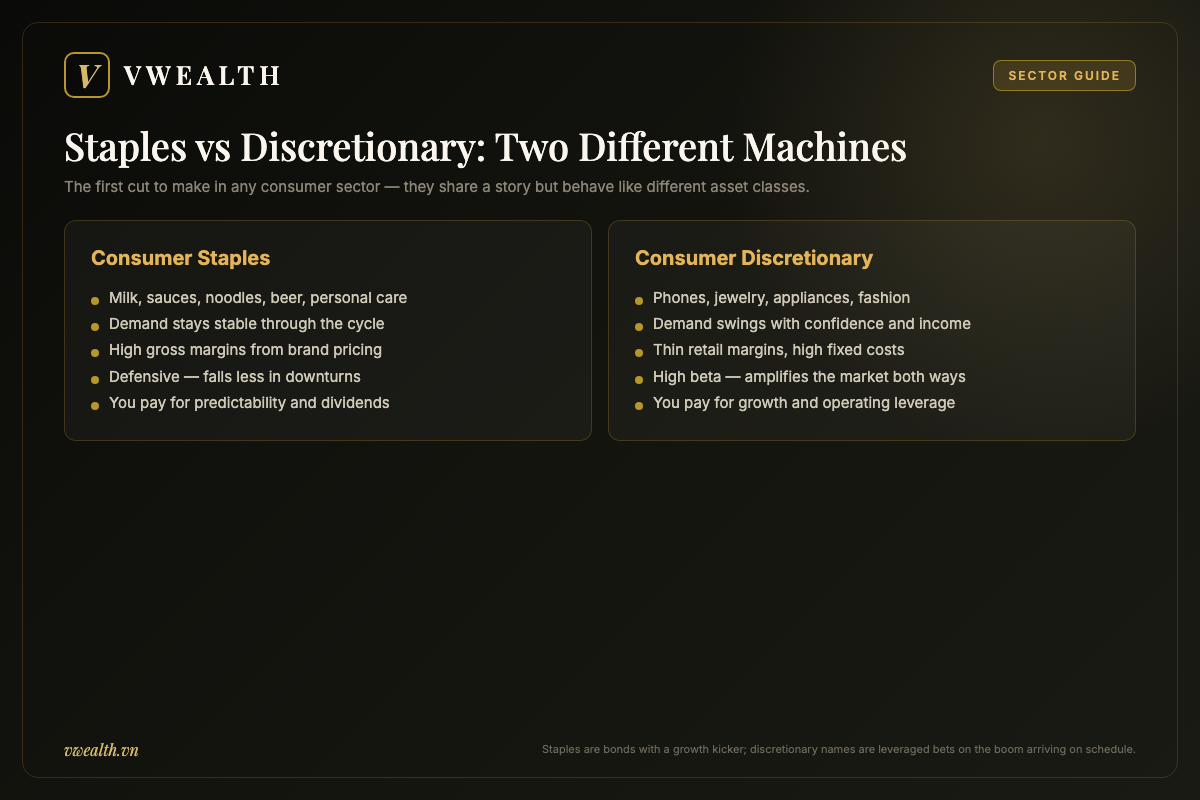
The first analytical cut you should make in any consumer sector is the split between staples and discretionary. These two groups share a narrative but behave like different asset classes, and confusing them is one of the most common mistakes newcomers make.
Consumer staples are products people buy regardless of how the economy is doing: milk, cooking sauces, instant noodles, personal care items, and — in Vietnam’s classification quirk — beer, which behaves partly like a staple because of its deep cultural role. Demand for staples is stable, which makes revenue predictable, which in turn makes these stocks defensive: they typically fall less than the market during downturns. The price of that safety is slower growth. A dairy company serving a market where most households already buy milk cannot double its volume; it grinds out growth through pricing, premium products and new categories.
Consumer discretionary covers what people buy when they feel confident: smartphones, laptops, jewelry, home appliances, dining out. These purchases are postponable — a family can delay replacing a phone by a year without hardship — so demand swings with the economic cycle, consumer confidence and even the property market, since people who feel wealthy spend more. Discretionary stocks therefore amplify the economy in both directions: they can grow revenue explosively in good years and see profits collapse in bad ones, because retail chains carry heavy fixed costs (rent, staff) that do not shrink when sales do.
| Dimension | Consumer staples | Consumer discretionary |
|---|---|---|
| Typical products | Dairy, sauces, noodles, beer, personal care | Electronics, jewelry, appliances, fashion |
| Demand pattern | Stable through the cycle | Swings with confidence and income |
| Revenue growth | Slow but steady | Fast in booms, can turn negative in busts |
| Gross margins | High (brand pricing power) | Thin at retailers (reselling others’ brands) |
| Behavior in downturns | Defensive, falls less than the index | High beta, falls more than the index |
| What you pay for | Predictability and dividends | Growth and operating leverage |
| Key risk | Paying too much for slow growth | Cycle timing and expansion missteps |
Beta, if the term is new to you, measures how much a stock moves relative to the overall market — a high-beta stock exaggerates the index’s swings. A useful mental model: staples are bonds with a growth kicker, discretionary names are leveraged bets on the middle-class boom actually arriving on schedule. Most investors want some of both, but you should always know which one you are buying and why, because the correct valuation approach, holding period and position size differ for each.
The Business Models Behind the Tickers
“Consumer sector” is an umbrella over at least four distinct business models. Each earns money through a different mechanism, is measured by different numbers, and fails in different ways. Walking through them one by one is the fastest route to genuine understanding.
Dairy and packaged food: the brand-and-margin model
Vietnam’s flagship staples businesses — dairy being the classic example, with Vinamilk as the household name — operate the model global investors know from Nestlé or Danone. The company owns brands, formulas and factories; it manufactures products with a large gap between production cost and shelf price. That gap is the gross margin: revenue minus the direct cost of goods, expressed as a percentage of revenue. Branded staples companies typically enjoy high gross margins because the brand, not the raw material, is what customers pay for. A mother buying formula for her child does not experiment to save a few percent; she buys the name she trusts. That trust took decades and enormous advertising spend to build, and it lets the company raise prices roughly in line with costs over time. Vinamilk illustrates the endpoint of this model: industry estimates put its share of the domestic dairy market near half, with an especially commanding position in infant formula — the kind of entrenched leadership that is precisely what makes both the brand moat and the maturity problem so visible in a single company.
The flip side is maturity. When a staples company already reaches most households in its home market, volume growth fades, and management must look for growth in premium versions of existing products, adjacent categories, exports or acquisitions — each progressively harder and riskier than the core business. When you analyze this model, the questions that matter are: Is market share stable or eroding? Is the gross margin holding when input costs move? Is the company converting profit into dividends or burning it on empire-building? Because these firms generate more cash than they can reinvest, they are often the sector’s dividend anchors, which appeals to income-oriented investors.
Beer and beverages: culture as a demand floor
Beer occupies a special place in Vietnam’s consumer landscape — the country is among Asia’s most enthusiastic beer markets relative to income, and drinking together is woven into business and social life. Brewers, with Sabeco as the best-known listed name, combine staple-like demand stability with sensitivity to regulation: rules on drink-driving enforcement, alcohol taxation and advertising can shift consumption meaningfully, as the industry has experienced. The clearest case study is Decree 100/2019, effective 1 January 2020, which imposed a near zero-tolerance limit on drink-driving with steep penalties; combined with the pandemic, it pushed the beer industry into its first double-digit volume decline in years. The competitive consequences were real: Sabeco, which had led the market with roughly 42% share in 2018, was overtaken by Heineken, and by 2023 industry estimates had Heineken in front near 43% with Sabeco closer to a third. The episode is a live demonstration that even a “staple” brewer’s demand floor can be moved by a single regulation. The business model itself resembles packaged food — brands, breweries, national distribution — with one twist: beer is heavy and cheap per kilogram, so transport costs make regional brewery networks and dense distribution a structural advantage that a new entrant cannot quickly replicate. When you study a brewer, focus on volume trends, premium-segment mix (craft and premium lagers carry fatter margins than mainstream brands) and the regulatory climate, rather than obsessing over any single quarter.
Jewelry: retail with a commodity core
Branded jewelry — PNJ being the listed archetype — is a hybrid model that confuses newcomers. Part of revenue comes from trading gold bars, which is a high-volume, near-zero-margin commodity business that inflates the revenue line without adding much profit. The valuable part is branded retail jewelry: designed pieces sold in stores, where the markup over raw gold reflects design, certification and brand trust. This is why revenue growth at a jeweler can be misleading — a surge in gold-bar trading during a gold-price frenzy balloons revenue while barely moving profit. The number to watch is the retail segment’s share of profit and the gross margin trend. The structural story is the trade-up: as incomes rise, buyers shift from viewing gold purely as savings (bars bought by weight) to jewelry as fashion and gifting (pieces bought by design), which moves purchases from street gold shops into branded chains — formalization in miniature. Jewelry demand is discretionary and also entangled with gold prices and even wedding seasons, so expect lumpier results than dairy.
Electronics and grocery chains: the volume-and-turnover model
The final model is the retail chain — Mobile World (electronics, appliances and groceries) being the most studied example on the exchange. Retailers do not own the brands they sell; they buy products from manufacturers like Samsung or Apple and resell them, keeping a thin slice. Gross margins here are structurally low, so the model lives or dies on turnover: how many times per year the company sells through its inventory. A chain that turns inventory rapidly can earn attractive returns on capital despite thin margins, the way a busy noodle stall out-earns a quiet luxury boutique. The critical metric is same-store sales growth (SSSG): revenue growth from stores open at least a year. It isolates genuine demand growth from growth bought by opening new outlets. A chain can report impressive total revenue growth while existing stores quietly decay — a pattern that has preceded trouble in retail worldwide. During expansion phases, reported profits are also depressed, because new stores lose money at first while rent and staff costs arrive before customers do; investors who only look at the bottom line can misjudge the underlying engine. We cover this chain-economics toolkit in more depth in our dedicated retail sector guide, but the short version is: SSSG first, store payback period second, total store count last.

Brand and Distribution: Where the Moats Actually Are
A moat, in investing language, is a durable competitive advantage that protects a company’s profits from competitors — the term evokes the water around a medieval castle. In Vietnam’s consumer sector, the two moats that matter are brand and distribution, and it is worth being precise about why each one is hard to copy.
Brand is a promise stored in the customer’s head. In categories where the cost of a bad choice is high — infant nutrition, food safety, gold authenticity — customers pay a premium for certainty and rarely switch to save small amounts. Vietnam adds a local layer to this: episodes of food-safety scandals across Asia have made verified provenance genuinely valuable, and a brand that has kept its promise for thirty years holds an asset no marketing budget can quickly replicate. The test of a real brand moat is pricing power: can the company raise prices with inflation without losing share? If yes, the brand is doing economic work. If price increases trigger immediate share loss to cheaper rivals, the “brand” is just a familiar logo.
Distribution is the physical moat, and in Vietnam it is arguably the stronger one. The country’s retail landscape still includes hundreds of thousands of small independent shops spread across cities, towns and countryside. Getting your sauce bottle or milk carton onto the shelves of that fragmented universe requires an army of sales representatives, a web of wholesalers, delivery logistics and — crucially — relationships built over decades. A multinational entering Vietnam can buy advertising overnight but cannot conjure a nationwide distribution network; that takes years and enormous cost. This is why some global giants have chosen to acquire or partner with local players rather than build from scratch, and why conglomerates like Masan have invested heavily in owning retail touchpoints: whoever controls the shelf controls which brands reach the customer. Masan’s retail arm, WinCommerce, shows the scale that pursuit has reached — by mid-2025 it ran thousands of WinMart supermarkets and WinMart+ mini-marts spanning nearly every province, and passed 5,000 WinMart+ stores as it pushed into rural markets. That physical footprint is the modern-trade version of a distribution moat: costly to build, and directly in the path of the formalization migration.
For discretionary chains, the moat is different and franker: location and scale. The best street corners are finite; a chain that locked up prime locations early enjoys traffic its competitors cannot access. Scale adds purchasing power — a retailer selling a large share of all smartphones in the country negotiates better terms from manufacturers than a two-store shop — and that cost edge compounds. But note the asymmetry: brand moats tend to strengthen with time, while retail location moats can be disrupted by a channel shift, which is exactly what e-commerce represents. That asymmetry belongs in your valuation, and we will return to it in the risk section.
The Formalization Trade: A Slow Migration You Can Own
Because formalization is the force most specific to frontier and emerging markets, it deserves its own analytical treatment. The migration from traditional to modern trade follows a recognizable sequence that has already played out in Thailand, China and Indonesia, which gives Vietnamese investors something rare: a rough map of the future drawn from neighbors’ history.
The sequence usually starts with categories where trust and authenticity matter most. Pharmacies formalize early — counterfeit medicine is a life-and-death issue, so branded pharmacy chains take share quickly once they appear. Electronics formalize early too, because warranties and genuine products matter for expensive purchases. Groceries formalize last and slowest, because wet markets are genuinely competitive on freshness and price, and shopping there is a cultural habit, not just an economic choice. Understanding this sequence helps you judge which listed chains are swimming with the current and which are fighting it.
Two practical implications follow. First, the formalization runway differs by category: a category that is mostly informal offers listed players years of share gains, while a category that has already consolidated offers only the fight for each other’s customers. When you evaluate a chain, ask what share of its category still sits in traditional trade — the bigger that share, the longer the tailwind. Second, formalization is not a straight line. Economic downturns can temporarily reverse it, as price-sensitive consumers drift back to cheaper informal channels. A modern-trade chain reporting weak numbers during a downturn may be experiencing a cyclical pause in a structural trend — or the early signs of a broken model. Distinguishing the two requires watching whether the chain’s share of its category keeps rising even when the category itself shrinks. That is the signature of a healthy formalizer.
It is also worth connecting this to the property sector: modern retail needs modern retail space, and mall operators and retail landlords are an indirect play on the same migration. If that angle interests you, our guide to how Vietnam’s real estate sector really works explains the retail-landlord model alongside residential developers.
Valuing Consumer Stocks: What Is a Stability Premium Worth?
Here is the uncomfortable truth every newcomer to this sector meets on day one: quality Vietnamese consumer stocks almost never look cheap. The market’s favorite staples names habitually trade at price-to-earnings multiples well above the market average, and they have done so for years. The P/E ratio — share price divided by earnings per share, effectively the number of years of current profit you are paying for the business — is the standard yardstick, and by that yardstick the sector looks permanently expensive. The real question is whether the premium is justified, and the honest answer is: sometimes.
Why stability deserves a premium at all
Imagine two businesses that each earned the same profit last year. Business A is a food company whose earnings have grown steadily every year for a decade. Business B is a steel producer whose earnings doubled last year but halved the year before. Would you pay the same multiple for both? Clearly not. A’s next decade of earnings is far more predictable, and predictability has monetary value — the same logic that makes a government bond yield less than a corporate bond. Stable earners also compound quietly: a company growing profits reliably at a moderate rate, decade after decade, often ends up out-returning flashier names that alternate between spectacular and disastrous years. This is the intellectual foundation of the quality-premium argument, and it is legitimate.
When the premium stops being justified
The premium breaks in two ways. The first is decelerating growth. A stock priced for steady double-digit growth that delivers low single digits suffers twice: earnings disappoint, and the multiple the market pays for those earnings contracts. Analysts call this double hit a de-rating, and it is the signature risk of every richly valued quality stock — the share price can fall substantially even while the company remains profitable and well-run. Mature staples companies in saturated categories are the classic candidates: the brand remains excellent, but the growth that justified the multiple has quietly left.
The second break is category disruption. A premium assumes the moat holds. If e-commerce erodes a retailer’s location advantage, or a new competitor cracks the distribution puzzle, the stability that justified the premium was an illusion, and the multiple compresses toward that of an ordinary business.
A practical framework: three questions before paying up
Rather than memorizing multiples, run every premium-priced consumer stock through three questions. First: is growth intact? Check whether volume (not just revenue inflated by price increases) is still rising, and whether market share is stable. Second: is the moat doing work? Look for pricing power — gross margins that hold or expand through input-cost swings. Third: what growth does the current price assume? A rough tool here is the PEG ratio: the P/E divided by the expected annual earnings growth rate, which asks whether the premium is proportionate to the growth. A high P/E with high, durable growth can be a fair deal; the same P/E with fading growth is an expensive mistake. We deliberately quote no current multiples in this article — they change monthly and would date the analysis; pull up the live figures and peer comparisons in the vwealth screening reports when you evaluate a specific name. And a comparison worth internalizing: the banking sector, which dominates Vietnam’s index, is analyzed with an entirely different toolkit (price-to-book, asset quality) — our foreign investor’s guide to Vietnamese banking stocks shows how differently the market’s other pillar must be valued, and why importing consumer-sector logic into banks (or vice versa) leads to bad conclusions.
| Question | What to check | Green flag | Red flag |
|---|---|---|---|
| Is growth intact? | Volume growth, market share trend | Volumes rising, share stable or gaining | Revenue growth driven only by price hikes |
| Is the moat working? | Gross margin through cost cycles | Margins hold when input costs spike | Margins compress and share slips together |
| What does the price assume? | P/E vs realistic growth (PEG logic) | Premium proportional to durable growth | Peak multiple on decelerating earnings |

The Risks: E-Commerce, Input Costs and the Growth Trap
A sector this loved needs its risks stated bluntly. Four deserve your attention before any purchase.
E-commerce is a moat acid
Vietnam has one of Southeast Asia’s most dynamic e-commerce scenes, with regional platforms competing fiercely on price and logistics. The scale is no longer a rounding error: the market was estimated at roughly US$28 billion in 2025, growing around a quarter year on year, and the top platforms are consolidating fast — Shopee and TikTok Shop together commanded the overwhelming majority of platform sales, with TikTok Shop’s social-commerce model surging to challenge Shopee’s lead in barely two years. A channel that can grow that quickly, and reshuffle its own leaders that fast, is exactly the kind of force that can erode a physical retailer’s advantages faster than a five-year plan assumes. For brand owners, e-commerce is double-edged: it is a new shelf to sell from, but it also makes price comparison instant, which pressures the premium a brand can charge, and it lowers the barrier for small challenger brands that once could never afford national distribution. For physical retail chains, the threat is sharper: their moat is location, and e-commerce makes location matter less with every passing year. The chains’ response — omnichannel retail, meaning integrated online and offline operations where stores double as showrooms and delivery points — is credible but expensive, and it compresses the margins that made the store network valuable. When you analyze any retailer, ask specifically: what fraction of this category’s purchases could move online in ten years? Electronics scores high on that question; fresh groceries and fitted jewelry score lower, which is part of why not all chains face equal disruption.
Input costs squeeze from the other side
Staples companies buy commodities — milk powder, sugar, wheat, aluminum for cans, plastic for packaging — many of them imported and priced in dollars. When global commodity prices or the exchange rate move against them, production costs rise immediately, but raising shelf prices takes time and risks losing price-sensitive customers to cheaper alternatives. The result is margin compression: profit falling even while revenue grows. This is the routine, recurring stress test of every brand’s pricing power, and watching how a company’s gross margin behaved through past commodity spikes tells you more about its moat than any annual-report rhetoric. The pattern repeats often enough that experienced investors treat input-cost cycles as buying-opportunity generators for the strongest brands — the companies whose margins recover fastest once costs normalize.
The growth trap: expansion as a vanity metric
Discretionary chains face a self-inflicted risk: over-expansion. Store count is the easiest number for management to grow and the easiest for investors to applaud, but every new store adds rent and payroll ahead of revenue, and beyond some point new stores cannibalize existing ones — the tenth store in a district steals customers from the other nine, not from competitors. The warning signs are visible in public numbers if you look: same-store sales growth turning negative while total store count keeps climbing, and inventory growing faster than revenue. Chains, and their shareholders, have been burned by this pattern in markets everywhere; Vietnam’s listed retailers have themselves gone through cycles of aggressive expansion followed by painful pruning of underperforming outlets. Treat announced store-opening targets as promises to fund losses first and maybe earn profits later — then check the SSSG line to see whether the existing estate justifies the ambition.
Competition is global, and saturation is real
Finally, remember that Vietnam’s consumer promise is the world’s worst-kept secret. Multinationals compete in every attractive category, regional giants arrive through acquisitions, and local challengers multiply. High returns attract capital; capital competes returns away. The structural tailwinds are real, but they accrue to consumers with certainty and to shareholders only selectively. The sector rewards discrimination between companies, not blanket faith in the theme — which is precisely why the research process in the next section matters more here than in sectors where a rising tide lifts every boat.
A Practical Research Checklist for Foreign Investors
Suppose the thesis convinces you and you want to move from reading to researching specific names. Here is a workable sequence, adapted to the practical realities foreigners face in this market.
Start by classifying the company: staple or discretionary, brand owner or retailer? This single classification tells you which metrics matter — gross margin and market share for brand owners, same-store sales growth and inventory turnover for chains — and what behavior to expect from the stock in a downturn. Trying to analyze a jewelry chain with a dairy company’s toolkit produces confident nonsense.
Second, check foreign ownership room before falling in love. Vietnam caps foreign ownership in listed companies, and popular consumer names are exactly the stocks where that room fills up. When a stock’s foreign limit is full, foreigners can often only buy from other foreigners, sometimes at a premium above the local market price — a real, practical constraint that belongs at the start of your process, not the end, because there is little point perfecting a thesis on a stock you cannot buy at a sensible price.
Third, read the numbers with the traps in mind. For a brand owner: is volume growing, or only revenue-through-pricing? Has the gross margin survived past input-cost spikes? Is the dividend funded by operating cash flow rather than debt? For a retailer: is SSSG positive? How long does a new store take to reach profitability? Is inventory turning as fast as it used to? For a jeweler: separate the gold-bar revenue from retail-jewelry profit before drawing any conclusion. These checks are mechanical once you know to run them, and they filter out most value traps before valuation even enters the picture.
Fourth, put the valuation in context. Compare the multiple against the company’s own history and against regional peers in the same category, not against the Vietnamese market average — a premium to the index is normal for this sector, so the index is the wrong benchmark. Then run the three-question framework from the valuation section: growth intact, moat working, price assumptions realistic.
Fifth, decide what job the stock does in your portfolio. A staples name is a stabilizer: size it as a core holding you barely trade. A discretionary chain is a cyclical growth bet: size it so that a bad cycle is survivable, and define in advance what evidence — say, several consecutive quarters of negative same-store sales — would make you exit. Writing the exit condition before you buy is the cheapest discipline in investing.
The honest friction for English-speaking investors is that much of the primary material — annual reports, analyst briefings, exchange disclosures — is published in Vietnamese first, and sometimes only in Vietnamese. Larger consumer companies with foreign shareholders do provide English investor relations, but coverage is uneven, and machine translation of accounting footnotes is a risky habit. This is the gap vwealth was built to close: the platform’s AI reads Vietnamese filings and market data and produces full English analysis — financial statement breakdowns, valuation context and scoring — so you can run exactly the checks described above without reading Vietnamese. You can open a free account and browse the report library to see how a Vietnamese consumer company looks through that lens before committing any research time of your own.

The Bottom Line: Own the Story, but Price It Like an Analyst
Vietnam’s consumer sector is the purest listed expression of the country’s most durable advantage: a large, young population climbing the income ladder while its commerce migrates from street stalls to organized chains. That triple engine — household formation, trade-up spending, formalization — is real and measured in decades, not quarters. But the sector demands more discrimination than its comfortable narrative suggests. Staples and discretionary names are different machines: one sells predictability at a premium price, the other sells cyclical growth with expansion risk attached. The moats are brand and distribution, and they must be verified through pricing power and share trends, not assumed from familiarity. The persistent valuation premium is sometimes the fair price of quality and sometimes a de-rating waiting to happen — the difference lies in whether growth is genuinely intact. And the risks are concrete: e-commerce dissolving location advantages, dollar-priced input costs squeezing margins, and store-count growth masquerading as health while existing shops decay.
Approach it, then, the way a professional would: classify the business model first, check the foreign-room constraint early, run the volume-margin-cash checks, benchmark the valuation against category peers rather than the index, and assign each holding a defined job in your portfolio. Do that, and the middle-class boom stops being a slogan and becomes what it should be — a set of specific, analyzable businesses, some of which deserve your capital at the right price. This article is a framework for analysis and reference, not investment advice; always do your own research and consider your personal circumstances before investing.
Research Vietnamese stocks in English with vwealth. Our AI-powered platform turns Vietnamese market data into full English analysis reports — with international payment support and a free 2-month trial for new accounts. Create your free account and read the latest reports.