You cannot invest in Vietnam without forming a view on its banks. Vietnam banking stocks routinely make up the single largest slice of the VN-Index, they are the tightest squeeze under foreign ownership rules, and they operate under a credit quota system that has no real equivalent in developed markets. This guide explains how the sector is structured, how Vietnamese banks actually earn their money, which metrics matter (hint: P/B, not P/E), and how a foreign investor can research a Vietnamese bank properly in English — without getting lost in translated footnotes.
Why banks are the backbone of the Vietnamese stock market
Open any snapshot of the Vietnamese stock market and the first thing you notice is how bank-heavy it is. Banks have historically accounted for roughly a third of the VN-Index by market capitalization — the exact weight moves around with prices and new listings, so check the current sector breakdown before you size a position — and they regularly occupy a large share of the slots in the VN30 basket of blue chips. If you are not yet familiar with how those two indices are built and why the distinction matters, read our explainer on the VN-Index versus the VN30 first, because almost everything in this article plays out through those benchmarks.
Why do banks dominate? Three structural reasons.
First, Vietnam is a bank-financed economy. In markets like the United States, companies raise most of their long-term capital through bond and equity markets. In Vietnam, the corporate bond market is still young and the equity market, while growing fast, is small relative to the economy. That leaves bank credit as the main artery of corporate funding. When the economy grows, credit grows faster, and the banking system captures a toll on nearly every đồng of that expansion.
Second, banks were among the earliest large enterprises to list. Vietnam’s equitization program — the process of converting state-owned enterprises into joint-stock companies and selling shares to the public — put several giant banks onto the Ho Chi Minh Stock Exchange in the late 2000s and 2010s. Their sheer size at listing anchored the index, and subsequent listings of large private banks reinforced the pattern.
Third, banking is one of the few sectors in Vietnam where scale compounds visibly. A retail chain has to open stores one by one; a bank that wins a low-cost deposit franchise can grow its balance sheet year after year with comparatively little incremental physical footprint. Over a decade, that compounding shows up as market capitalization.
The practical consequence for you: any index fund, ETF, or diversified Vietnam portfolio is, to a meaningful degree, a bet on Vietnamese banks. Even if you never buy a single bank share directly, the sector’s credit cycle will drive a large part of your returns. Understanding it is not optional. And if you are still at the stage of setting up access to the market — brokers, custody, money flows — our step-by-step guide on how to invest in the Vietnam stock market as a foreigner covers that groundwork so this article can stay focused on the sector itself.
The two families: state-owned giants and private joint-stock banks
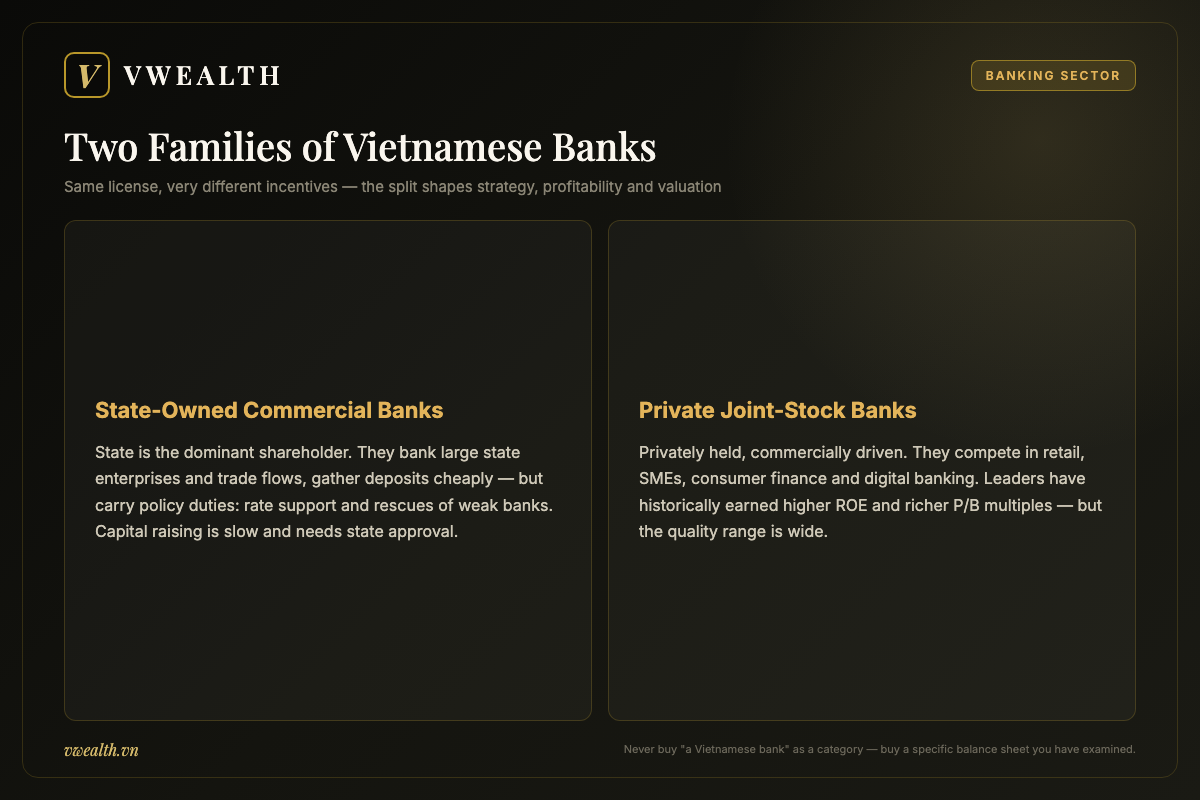
Vietnamese banks are usually sorted into two families, and the split matters more than it does in most markets because it shapes strategy, profitability, and even valuation.
The state-owned commercial banks
The so-called “Big Four” state-owned commercial banks — Vietcombank, BIDV, VietinBank, and Agribank — grew out of the old mono-bank system, in which a single state bank handled everything and was later split into specialized lenders. Three of the four are listed on the Ho Chi Minh Stock Exchange (Vietcombank/VCB, BIDV/BID, and VietinBank/CTG); Agribank remains 100% state-owned and unlisted as of mid-2026, with its long-promised equitization and IPO repeatedly deferred. In all four, the state remains the dominant shareholder — the government’s stake in the three listed names sits well above 60% (around 74.8% at Vietcombank, 80.9% at BIDV, and 64.5% at VietinBank as of 2025), which is itself part of why their free float and foreign room are so tight.
State ownership brings a specific character. These banks bank the largest state-owned enterprises, handle a large share of trade finance and government-linked flows, and enjoy an implicit perception of safety that helps them gather deposits cheaply. The trade-off is that they carry policy responsibilities: when the government wants lending rates lowered to support the economy, or wants a weak bank rescued, the state-owned banks are typically first in line to help. Policy duty can compress margins in ways a purely commercial bank would never accept.
A second trade-off is capital. Raising fresh equity requires state approval and can dilute the state’s stake below thresholds it wants to keep, so state-owned banks have historically run tighter capital buffers relative to their growth ambitions. Capital constraints then feed directly into how much credit growth the regulator will allow them — a mechanism we will unpack in the next section.
The private joint-stock banks
The second family is the private joint-stock commercial banks — names like Techcombank, VPBank, ACB, MB, HDBank, Sacombank, and a long tail of smaller lenders. “Joint-stock” simply means a shareholding company; in Vietnamese banking vocabulary it has come to mean “not majority state-owned.”
These banks compete on segments the giants historically underserved: retail lending, mortgages, small and medium enterprises, consumer finance, and digital banking. The best of them have built genuinely differentiated franchises — some around affluent retail customers and transaction banking, others around mass-market consumer credit, others around specific ecosystems of corporate clients. Because they are free of most policy obligations and can raise capital more flexibly, top private banks have often posted returns on equity well above the state-owned group. Higher profitability, in turn, has usually earned them higher price-to-book multiples.
The spectrum within this family is wide, though. A large, conservatively run private bank and a small, aggressive lender funding property developers are entirely different investments that happen to share a sector label. Never buy “a Vietnamese private bank” as a category; buy a specific balance sheet you have examined.
| Dimension | State-owned commercial banks | Private joint-stock banks |
|---|---|---|
| Ownership | State is the dominant shareholder | Private and institutional shareholders; some have foreign strategic partners |
| Core clients | Large state enterprises, trade finance, government-linked flows | Retail, SMEs, consumer finance, private corporates |
| Policy role | Significant — rate support, rescues of weak banks | Limited, mostly commercial |
| Capital raising | Slow, needs state approval | More flexible, market-driven |
| Typical profitability | Steadier, often lower ROE | Wider range; leaders historically post higher ROE |
| Typical valuation | Premium for the safest franchise; discount where capital is tight | Multiple tracks profitability and asset-quality trust |
One nuance worth flagging: the safest state-owned franchise has often traded at one of the richest price-to-book multiples in the whole sector, while other state-owned banks traded much cheaper. The families are a useful map, not a pricing rule. The market prices each bank on its own mix of profitability, capital, and credibility.
How Vietnamese banks make money — and why the credit quota changes everything
A bank’s business model is simple to state: gather money cheaply, lend it out at a higher rate, don’t lose too much of it, and collect fees along the way. What makes Vietnam distinctive is a regulatory layer sitting on top of that model.
The credit growth quota: Vietnam’s defining mechanism
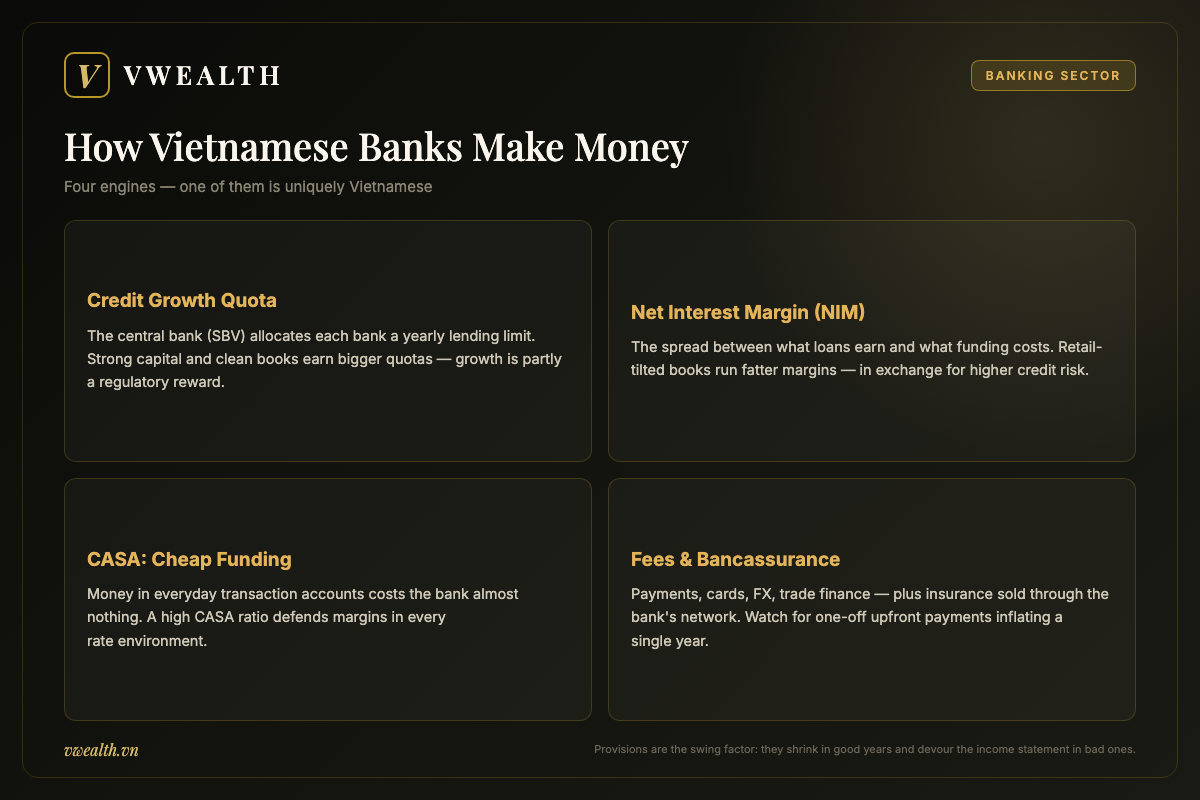
The State Bank of Vietnam — the country’s central bank and banking regulator, commonly abbreviated SBV — has for over a decade set an annual target for how fast total credit in the economy should grow, then allocated growth limits (“room”) to individual banks. A bank could not simply lend as much as it liked; it lent up to the quota it had been granted. Quotas were typically reviewed mid-year and raised for banks in good standing.
This system exists because Vietnam learned a hard lesson. The SBV first imposed credit growth caps in 2011, after the late-2000s boom sent credit expanding explosively — much of it into speculative property — and produced hyperinflation. The hangover arrived in 2011–2012: bad debts surged, several banks became effectively insolvent, and the government created the Vietnam Asset Management Company (VAMC) in 2013 (under Decree 53/2013/ND-CP) to warehouse non-performing loans while banks rebuilt capital. The credit quota is the institutional memory of that episode — a throttle on system-wide leverage.
A pivotal change is now underway, and it is exactly the kind of live regulatory shift an investor must track. In August 2025, Prime Minister Pham Minh Chinh directed the SBV to design a roadmap and pilot the removal of the credit growth quota mechanism starting in 2026, replacing administrative caps with a criteria-based, market-driven system that classifies banks by governance quality, financial health, and compliance with safety indicators (see Vietnam News, “Banking industry to remove credit quota policy from 2026”). The SBV has said full removal will be phased to fit Vietnam’s conditions, so as of mid-2026 the quota is being dismantled rather than abolished overnight. For investors the implication is sharp: if lending capacity is set by capital strength and asset quality rather than a fixed allocation, the strongest, best-capitalized banks stand to widen their lead — and the analytical premium on CAR and asset quality (below) only grows.
For an investor, the quota changes the questions you ask. In most markets you ask, “How much loan demand can this bank capture?” In Vietnam you also ask, “How large a quota will the regulator grant this bank?” Quota allocation tends to favor banks with strong capital ratios, good asset quality, and cooperation with policy goals. That creates a distinctive flywheel: well-capitalized, well-run banks receive larger quotas, grow faster, earn more, retain more capital, and receive larger quotas again. Growth in Vietnamese banking is partly a regulatory reward.
It also means sector-wide credit growth is a headline number worth tracking. The SBV announces its annual credit growth orientation publicly; financial media report it every year. When the target is generous and quotas are released early, bank earnings tailwinds follow. When the regulator tightens, even excellent banks hit a ceiling.
Net interest margin: the price of the toll road
The core profit engine is the net interest margin, or NIM: the difference between what a bank earns on its loans and investments and what it pays for deposits and other funding, expressed as a percentage of earning assets. A hypothetical illustration: suppose Bank A earns an average 8% on its loan book and pays an average 4.5% on its funding. Its spread is 3.5 percentage points; after adjusting for the mix of earning assets, its NIM lands in a similar zone. On a balance sheet of 500 trillion đồng of earning assets, each 0.1 percentage point of NIM is worth 500 billion đồng of annual revenue — which is why analysts obsess over basis points.
Two levers drive NIM in Vietnam. The first is funding cost, and the star variable here is CASA — the share of deposits sitting in current accounts and low-rate savings accounts. Money in a customer’s everyday transaction account costs the bank close to nothing, whereas term deposits must be paid competitive interest. A bank whose customers keep their salaries, business flows, and daily payments inside its app enjoys structurally cheaper funding. High-CASA banks defend their margins in every rate environment; low-CASA banks must buy deposits with rate promotions whenever money gets tight.
The second lever is asset mix. Retail and consumer loans carry higher rates than loans to blue-chip corporates, so a bank tilted toward retail lending typically runs a fatter NIM — along with higher expected credit losses. NIM is never free; it is compensation for risk taken. When you see an unusually wide margin, your next question should always be about the loan book behind it.
Fees, bancassurance, and the non-interest line
Beyond lending, Vietnamese banks earn non-interest income: payment and card fees, trade finance and foreign exchange, settlement services, and — a major theme of the past decade — bancassurance, the practice of selling insurance policies through the bank’s branch network and app, usually under an exclusive distribution agreement with an insurer. Some of those agreements came with large upfront payments that boosted reported earnings in the year they were signed. When you compare bank profits across years, check whether a one-off bancassurance payment or a divestment gain is inflating the base year; a bank’s report will disclose it, and stripping it out gives you the cleaner underlying trend. Regulatory scrutiny of how insurance is sold has tightened sharply: after a wave of mis-selling complaints, the Ministry of Finance issued Circular 67/2023/TT-BTC restricting how banks act as insurance agents, and the Law on Credit Institutions 2024 (in force from 1 July 2024) went further, banning banks from tying the sale of non-mandatory insurance to the provision of loans in any form. Bancassurance income across the sector fell after these rules landed, so treat past bancassurance earnings as a line that can bend, not a fixed annuity.
Put together, a simplified income statement of a Vietnamese bank reads: net interest income (the bulk), plus fee and other income, minus operating costs (branch network, salaries, technology), minus provisions — the expense a bank books to cover expected loan losses — equals pre-tax profit. Provisions are the swing factor. In good years they shrink and profits soar; in bad years they devour the income statement. Which brings us to the metrics that actually tell you whether a bank’s earnings are real.
The metrics that matter: P/B over P/E, and the asset-quality trio
Why P/B beats P/E for banks
For most companies, the price-to-earnings ratio is a reasonable first lens. For banks it is a trap. A bank’s reported earnings depend heavily on provisioning choices — management has real discretion over how aggressively to recognize likely loan losses in any given quarter. A bank that under-provisions looks cheap on P/E right up until the losses it deferred arrive all at once. Earnings are an opinion; the balance sheet is closer to fact.
That is why bank analysts anchor on the price-to-book ratio: market capitalization divided by shareholders’ equity (book value). Book value represents the capital cushion that absorbs losses, and for a lender, capital is the raw material of the business itself. The companion metric is return on equity (ROE): net profit divided by that same equity. The two form a natural pair — a bank that sustainably earns a high ROE deserves to trade at a premium to book, while a bank earning less than its cost of capital deserves a discount.
A hypothetical illustration of the logic: suppose Bank A sustainably earns an 18% ROE and investors demand roughly a 13% return for holding Vietnamese bank risk. Equity that compounds at 18% when the market requires 13% is worth more than its accounting value — a price-to-book multiple meaningfully above 1x is justified. Bank B, earning 9% against the same 13% requirement, destroys a little value each year and logically trades below book. When you see two banks at 1.9x and 0.8x book, the market is not being inconsistent; it is pricing different profitability and different trust in the reported numbers. Where Vietnamese banks trade on these measures today is exactly the kind of live data you should pull fresh — the sector’s P/B range has historically swung widely between credit-cycle troughs and peaks, and any specific number printed here would age badly. The framework is permanent; the numbers are not.
If you want a refresher on how P/B and ROE interact with valuation more generally, the same logic we apply to banks appears across the analytical reports in the vwealth report library, where each covered bank’s current multiples are recalculated as new financials land.
NPL ratio: the headline of asset quality
The non-performing loan (NPL) ratio is the share of a bank’s loans that are seriously overdue. Vietnamese regulation classifies loans into five groups by delinquency and risk: groups 1 and 2 are performing and “special mention” (early warning), while groups 3, 4, and 5 — substandard, doubtful, and loss — count as non-performing. When a bank reports an NPL ratio, it is groups 3 through 5 as a share of gross loans.
Read the NPL ratio with three cautions. First, watch group 2 as a leading indicator: loans migrate down the ladder, so a swelling special-mention bucket today is often next year’s NPL. Second, remember the denominator effect: a bank growing loans at 20% a year mechanically dilutes its NPL ratio, because new loans take time to go bad. Fast growth plus a low NPL ratio can mean excellent underwriting — or simply young loans. Third, restructured loans (loans whose terms were softened so the borrower can keep paying) may sit outside the NPL count under forbearance rules that appear in stressed periods. The footnotes of a bank’s financial statements disclose restructured balances; diligent readers check them.
Coverage ratio: how honestly are losses funded?
The loan-loss coverage ratio answers a blunt question: for every đồng of bad loans, how many đồng of provisions has the bank already set aside? Coverage of 150% means the bank has reserved 1.5 đồng per đồng of NPLs — a fortress stance that lets it absorb write-offs without denting future earnings. Coverage of 50% means half of every recognized bad loan will still have to be paid for out of tomorrow’s profits.
Coverage is where conservative and aggressive banks reveal themselves. Two banks with the same NPL ratio and the same headline profit are not the same investment if one carries double the coverage: the well-covered bank has effectively pre-paid its future losses, and its earnings are higher quality. In sector downturns, high-coverage banks can even release provisions later, cushioning the recovery. When you screen Vietnam banking stocks, put NPL, group-2 loans, and coverage side by side — the trio together tells you far more than any one number alone.
CAR: the regulatory floor under everything
The capital adequacy ratio (CAR) measures a bank’s capital against its risk-weighted assets — total assets adjusted so riskier exposures count more heavily. Vietnam ran most banks on Basel II standards (an international framework for bank capital regulation) with a minimum CAR of 8% under Circular 41/2016/TT-NHNN. That floor is now moving up. On 30 June 2025 the SBV issued Circular 14/2025/TT-NHNN, effective 15 September 2025, which begins Vietnam’s shift toward Basel III. It keeps the 8% minimum CAR but adds Basel III-style building blocks: a Common Equity Tier 1 (CET1) minimum of 4.5%, a Tier 1 minimum of 6%, and phased-in capital buffers that lift the total requirement toward 10.5% by 2033. Banks can register for the new standardised approach during a transition period, with Circular 14 becoming the unified basis for capital calculation from 1 January 2030. CAR matters to you for a very Vietnamese reason: it feeds lending capacity. Under the old quota system a bank near the minimum could not expect generous growth allocations; under the market-based regime now being piloted, capital strength becomes even more directly the license to grow. Either way, a thin-CAR bank may need to issue new shares — diluting you — to keep expanding, while a bank with a thick capital buffer holds a growth option the market usually rewards.
| Metric | What it tells you | How to read it | Common trap |
|---|---|---|---|
| P/B (price-to-book) | Price paid per đồng of capital | Pair with sustainable ROE; premium to book requires ROE above cost of equity | Cheap P/B on an under-provisioned book is not cheap |
| ROE | Profitability of shareholder capital | Look for stability across a full credit cycle | One-off gains (e.g., bancassurance upfronts) flatter a single year |
| NIM | Core lending spread | Compare against funding mix (CASA) and loan mix | Wide NIM often equals higher-risk lending |
| NPL ratio | Recognized bad loans | Track alongside group-2 loans and loan growth | Fast growth dilutes the ratio; restructured loans hide outside it |
| Coverage ratio | Provisions per đồng of NPLs | Higher = earnings pre-shielded from write-offs | Falling coverage can silently subsidize reported profit |
| CAR | Capital vs. risk-weighted assets | Buffer above 8% minimum supports quota and growth | Thin CAR foreshadows dilutive share issuance |

Foreign ownership limits: nowhere tighter than in banking
Vietnam caps how much of a listed company foreigners may own in aggregate, and banking is the sector where the cap bites hardest. Under the long-standing framework — set by Decree 01/2014/ND-CP — total foreign ownership in a Vietnamese bank is capped at 30% of charter capital, far below the levels allowed in most other industries. Inside that ceiling sit sub-limits: a single foreign individual may hold at most 5%, a single foreign institution at most 15%, and a foreign strategic investor (a long-term partner approved to take a larger stake, transfer technology, and typically hold a board seat) up to 20%.
The headline change investors need to know is that this ceiling is no longer uniform. Decree 69/2025/ND-CP, in force from 19 May 2025, lets a commercial bank that is not majority state-owned and that takes over (“mandatory transfer”) a weak credit institution raise its aggregate foreign ownership cap from 30% to as much as 49% of charter capital for the duration of the approved restructuring plan (see VietnamNet coverage). In practice this immediately applied to three private banks that absorbed weak lenders — MB, HDBank, and VPBank — whose foreign room ceiling rose to 49%. Separately, the Prime Minister retains discretion to approve foreign stakes above the statutory caps on a case-by-case basis where systemic stability requires it. So the “30% for banks” shorthand is now a starting point with important exceptions; our dedicated guide to Vietnam’s foreign ownership limits keeps the mechanics and the practical workarounds in one place, and you should always verify a specific bank’s current ceiling before assuming it is 30%.
What matters here is the investment consequence. Because banks are simultaneously the largest sector and the most tightly capped, the foreign “room” — the remaining quantity of shares foreigners are still allowed to buy — in popular banks is often exhausted. Three effects follow.
First, the foreign premium. When room is full, a foreign investor who wants in must buy from another foreigner, and such blocks frequently change hands above the on-screen domestic price. The listed price you see is the domestic market clearing price; the price a foreign fund actually pays for a full-room bank can be higher. Conversely, if you already hold shares in a full-room bank, your stake carries scarcity value.
Second, index and product distortions. Global index providers discount a stock’s weight by its investable foreign room. A giant bank with zero room may be heavily under-represented in foreign-tracking products relative to its true economic size. This is one reason foreign investors’ Vietnam exposure often tilts away from the very sector that dominates the local index — and why some access products (participatory notes, swap-based structures) exist specifically to synthesize exposure to full-room banks. Each workaround adds cost and counterparty considerations you should understand before using it.
Third, the strategic-stake dynamic. Because a foreign bank or fund cannot take control, foreign participation in Vietnamese banking usually takes the form of minority strategic stakes with technical-cooperation agreements. Announcements of a new strategic investor — or of a bank reserving room for a future private placement to one — are significant price events. A bank that deliberately locks part of its foreign room for a future capital raise is telling you something about its plans; sector followers track these reservations closely.
The room situation of every bank changes with each foreign trade, so always check live foreign-ownership data before planning an entry. The number is published daily and any decent market data platform, vwealth included, shows remaining room per ticker.
The risk map: property, credit cycles, and concentration
Every lever that makes Vietnamese banks compelling has a shadow side. Four risks deserve permanent seats in your analysis.
Real estate exposure — direct and disguised
Property is the collateral of choice across Vietnamese lending, and property developers are major borrowers. That gives the banking system a double exposure: direct loans to developers and construction firms, and a much larger book of loans collateralized by real estate — mortgages, business loans secured on the owner’s land. When the property market freezes, developer loans sour first, but collateral values under the whole book weaken at the same time, so recoveries on any defaulted loan shrink. Bank disclosures break out lending by industry; the construction-and-real-estate share of the loan book, plus the bank’s holdings of corporate bonds issued by developers, is the first table to read in any Vietnamese bank report. Corporate bonds matter because in stressed periods some property lending migrated into bond form — same risk, different label — and episodes of bond-market stress in the past decade showed how quickly that channel can transmit trouble back to banks and to the banks’ wealthy deposit customers who bought the bonds.
The credit cycle itself
Banking is a leveraged bet on the economy. Vietnamese banks commonly run balance sheets many times the size of their equity, so a small percentage of loans going bad translates into a large percentage of capital at risk. A hypothetical illustration: a bank with assets ten times its equity that loses 2% of its loan book has lost roughly 20% of its capital — before earnings offset. This is not a design flaw; it is what a bank is. It means bank stocks amplify the cycle: in credit booms their earnings and multiples expand together, and in busts both compress together. The 2011–2012 NPL crisis and the VAMC cleanup that followed remain the sector’s reference trauma, and the credit quota system exists to prevent a repeat. Position sizing should respect the amplification: banks are rarely the place for the money you cannot afford to see drawn down in a recession.
Policy and regulatory discretion
The same regulator that grants growth quotas can also cap lending rates, direct support packages, ask strong banks to absorb weak ones, or tighten the rules on funding structure — for example, limits on how much short-term funding may finance long-term loans. Policy in Vietnam is generally pragmatic and telegraphed, but it is discretionary, and earnings forecasts built on the assumption that this year’s quota generosity repeats forever will eventually be wrong. Follow SBV announcements the way you would follow central-bank meetings in any market: they are the sector’s weather system.
Transparency and the limits of the reported number
Vietnamese bank disclosure has improved dramatically — listed banks publish quarterly statements, audited annual reports, and Basel disclosures — but the honest reading is that reported asset quality is a floor, not a ceiling. Forbearance rules during stress periods, collateral valuations that lag the market, and cross-holdings between banks and corporate groups all argue for a margin of safety. This is precisely why the coverage ratio and the quality of a bank’s ownership structure carry so much weight with experienced investors: they are proxies for how conservatively the institution behaves when no one is watching.
How to research a Vietnamese bank in English: a working process
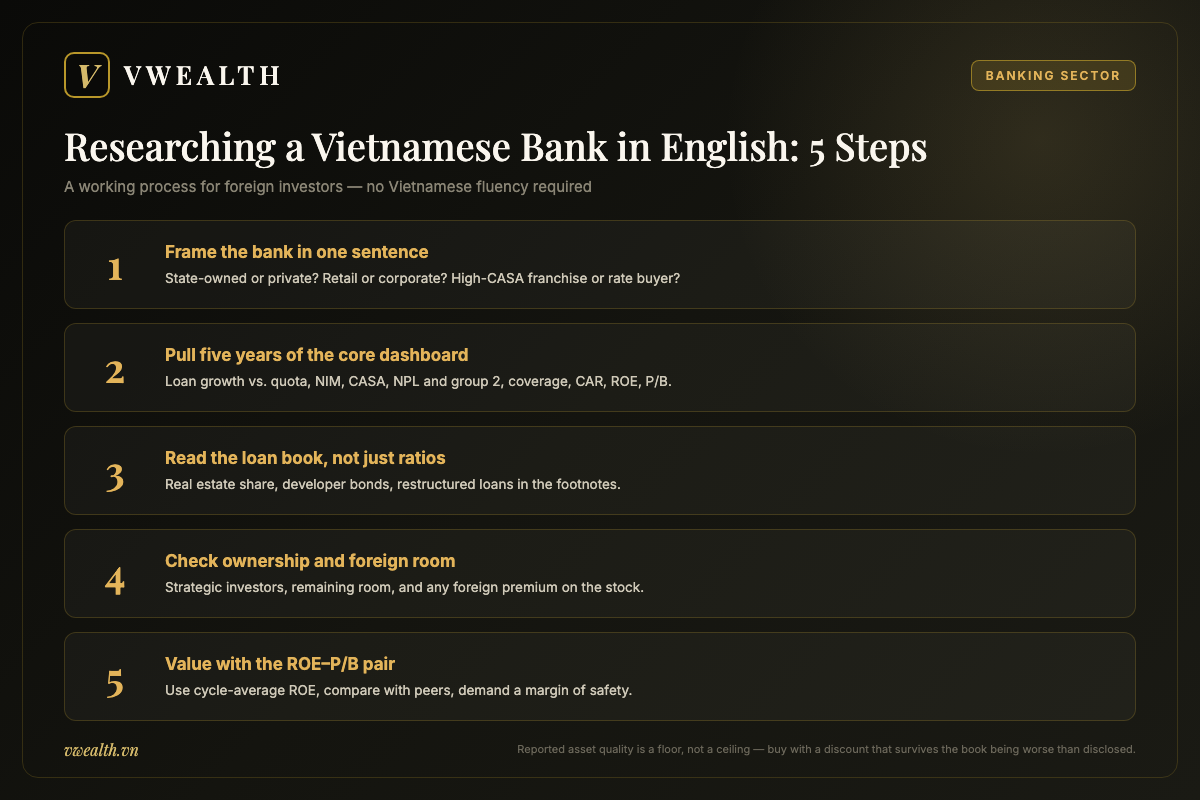
Language is the practical barrier. Original disclosures are in Vietnamese; large banks publish English annual reports, but often with a lag, and quarterly detail is thinner in translation. Here is a workflow that gets a foreign investor to a real view without reading Vietnamese fluently.
Step 1 — Frame the bank in one sentence
Before any numbers, classify the bank: state-owned or private, retail-tilted or corporate-tilted, high-CASA transaction franchise or rate-buying deposit taker, property-heavy or diversified. Investor presentations (usually available in English on the bank’s investor-relations page) give you this in a few slides. If you cannot state what the bank is good at in one sentence, you are not ready to value it.
Step 2 — Pull the five-year trend of the core dashboard
Assemble five years of: loan growth versus granted quota, NIM, CASA ratio, NPL and group-2 ratios, coverage, CAR, ROE, and P/B. One year tells you nothing in a cyclical sector; five years shows you how management behaves across conditions. Trends matter more than levels — coverage rising while NPLs fall is a bank cleaning house, while coverage falling to protect reported profit is a yellow flag even at a high absolute level.
Step 3 — Read the loan book, not just the ratios
In the financial statements (or a good English summary of them), find the loan breakdown by industry and the corporate bond holdings. Compute construction plus real estate as a share of loans, and note related-party disclosures. Then read the NPL footnotes for restructured loan balances. This single step separates investors from ratio-screeners.
Step 4 — Check the ownership and room situation
Who are the major shareholders? Is there a foreign strategic investor, and is one being courted? How much foreign room remains, and does the stock historically trade with a foreign premium? A planned private placement can be a catalyst; exhausted room can mean your only exit later is to another foreign buyer.
Step 5 — Value it with the ROE–P/B pair, then demand a margin of safety
Estimate the ROE the bank can sustain through a full cycle — not its best year — and ask what multiple of book that justifies against a Vietnam-appropriate cost of equity. Compare with the current P/B and with peers of similar quality. Because reported asset quality is a floor, buy with a discount that survives the balance sheet being somewhat worse than disclosed. Patience is a genuine edge here: bank multiples reset dramatically at credit-cycle turns, and the sector rewards investors who did their homework before the turn rather than after it.
This is also where tooling earns its keep. Doing steps 2 through 5 manually means wrestling with Vietnamese-language quarterly filings across a dozen banks. vwealth’s AI reads the original Vietnamese financial statements and produces full English analysis reports — the five-year dashboards, loan-book composition, valuation context, and peer comparison — updated as each quarter’s numbers land, so the framework in this article can be applied in minutes instead of weekends.
Pulling it together: a sector you must understand, on its own terms
Vietnam banking stocks sit at the intersection of everything that makes this market distinctive: they are the index’s backbone, the tightest test of the foreign ownership regime, and the clearest expression of a policy-guided growth model. The analytical rules are different here — credit quotas rather than pure demand, P/B and ROE rather than P/E, coverage ratios as truth serum for reported earnings, and foreign room as a market within the market. None of this makes the sector unanalyzable; it makes it analyzable by people willing to learn its specific grammar.
Keep the permanent framework and refresh the perishable numbers. The framework: two families of banks with different incentives; profit built on quota, NIM, CASA, and fees; health measured by the NPL–coverage–CAR trio; valuation anchored on the ROE–P/B pair; risk concentrated in property exposure and cyclical leverage. The perishables: this year’s credit growth target, each bank’s current multiples, remaining foreign room, and the latest quarter’s asset quality — all of which you should pull fresh rather than trust to memory or to any article, this one included.
This article is analytical reference material, not investment advice; always do your own research and consider your personal risk tolerance before buying any security.
Research Vietnamese stocks in English with vwealth. Our AI-powered platform turns Vietnamese market data into full English analysis reports — with international payment support and a free 2-month trial for new accounts. Create your free account and read the latest reports.