You can open a Vietnamese brokerage account as a foreigner without ever setting foot in Ho Chi Minh City — but the process looks nothing like opening an account with a Western online broker. Instead of one signup form, you are really opening three things at once: a securities trading code from the national depository, a brokerage account with a licensed securities company, and a special bank account called an indirect investment capital account that all your money must flow through. This guide walks you through every step in order: the documents to prepare, how to choose a broker when you cannot read Vietnamese, how remote onboarding works, how to wire money in and get it back out, and what your first order actually looks like on a Vietnamese trading screen. Budget a few weeks for paperwork, not a few minutes — and by the end of this article you will know exactly where each of those weeks goes.
Why opening a brokerage account in Vietnam involves three separate registrations
If you have only ever opened accounts with app-based brokers in the US or Europe, your mental model is: download app, photograph passport, answer a questionnaire, deposit money, trade within a day. Vietnam does not work that way for foreign investors, and understanding why will save you a lot of frustration.
Vietnam classifies money that foreigners put into listed stocks as indirect investment — you are buying securities, not building a factory. The State Bank of Vietnam, the country’s central bank, wants to be able to see this money enter, move, and leave. The stock market regulator wants to know exactly which foreign person or institution owns which shares, partly because foreign ownership limits cap how much of each company foreigners may collectively hold. A cap can only be enforced if every foreign holder is individually identified.
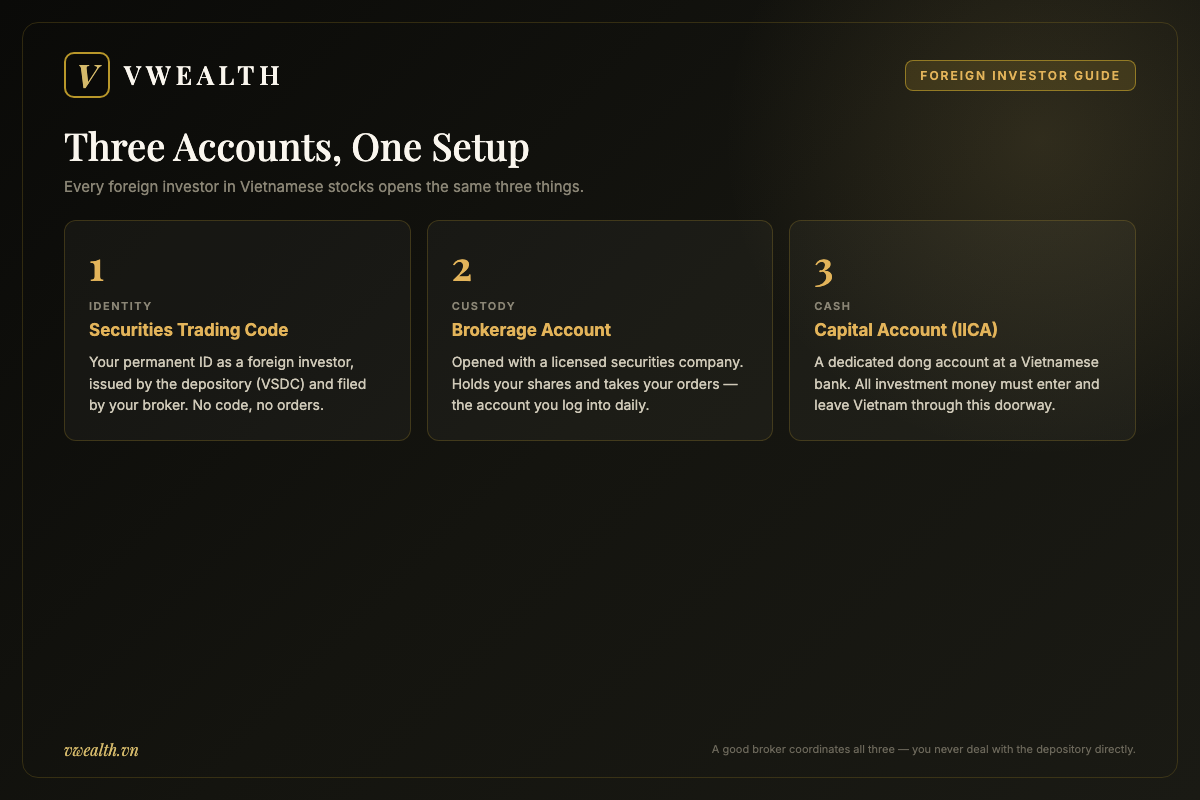
The result is a three-part structure that every foreign investor — from a retiree in Melbourne buying her first ten million dong of shares to a hedge fund in Singapore — must complete:
| Component | Issued or opened by | What it does |
|---|---|---|
| Securities trading code (STC) | Vietnam Securities Depository and Clearing Corporation (VSDC), applied for via your broker | Your permanent ID as a foreign investor in the Vietnamese market. Required before you can place any order. |
| Brokerage (securities) account | A licensed Vietnamese securities company | Where your shares are held and your orders are placed — the account you actually log into. |
| Indirect investment capital account (IICA) | A licensed commercial bank in Vietnam | A dedicated Vietnamese dong account that all investment money entering or leaving Vietnam must pass through. |
Think of it as identity, custody, and cash — three doors, three keys. The good news: you do not have to chase three institutions yourself. A decent broker coordinates all of it, and many banks and brokers belong to the same financial group, so the IICA and the brokerage account can often be arranged in one package. The trading code application, in particular, is always filed by your broker on your behalf; you cannot apply to the depository directly as a retail investor.
One reassuring point before we dive into steps: none of this is exotic anymore. Vietnamese brokers have onboarded foreign clients for two decades, the big firms have dedicated foreign-client desks, and the process — while paper-heavy — is well-trodden. If this is your first look at the market itself rather than the paperwork, start with our complete guide to investing in Vietnam’s stock market as a foreigner and come back here when you are ready to act.
Step 1: Decide whether direct ownership is right for you at all
Before you gather a single document, make sure the direct route matches your situation, because there is a simpler alternative: Vietnam-focused ETFs listed on exchanges you already have access to. An ETF (exchange-traded fund) is a basket of stocks that trades like a single share, and several track Vietnamese indices from listings in the US, Europe, and Asia.
The direct brokerage route makes sense when at least one of these applies to you:
- You want to pick individual companies. ETFs give you the index, including the parts of it you may not want. Direct ownership lets you own three banks and a retailer and nothing else.
- You plan to invest a meaningful amount for years. The fixed cost of the setup — mostly your time and some document fees — amortizes over a long holding period. It is poorly spent on a small, one-off punt.
- You want dividends and corporate actions directly. Vietnamese companies pay cash and stock dividends into your accounts; ETF investors receive whatever the fund passes through, minus its own frictions.
- You care about the foreign-room game. Some of Vietnam’s best companies are perpetually full to foreigners, and blocks change hands in negotiated deals. You can only participate in that world with your own trading code.
If none of those apply — you just want broad exposure with minimum effort — the ETF route may serve you better, and the rest of this article is something you can bookmark for later. If you are still reading, let’s get your paperwork in order.
Step 2: Gather your documents before contacting anyone
Document preparation is the single biggest source of delay in the whole process, so front-load it. Requirements differ between individuals and institutions, and each broker has its own form pack, but the core set is stable across the industry.
For individual investors
- Your passport, with a validity period comfortably beyond six months. This is the anchor document; the name on every other paper must match it exactly, letter for letter.
- A certified copy of the passport. Here is where foreigners hit their first surprise: a plain photocopy or a selfie with your passport is usually not enough for the trading code application. You typically need a copy that has been notarized, and in many cases legalized — meaning an authority in your country (often via a Vietnamese embassy or consulate, or through the apostille process where applicable) certifies that the notarization itself is genuine. Ask your broker precisely which form of certification they need before you pay for anything, because requirements vary and over-certifying wastes money while under-certifying wastes weeks.
- The broker’s account-opening forms and a power of attorney (POA). The POA authorizes the broker to apply for your trading code at the depository and, often, to handle routine depository paperwork later. It is standard, limited in scope, and every foreign client signs one.
- Bank details for your home account, used later when you repatriate money, and sometimes proof of address depending on the broker’s own compliance rules.
For institutional investors
Companies, funds, and family-office vehicles face a heavier stack: certificate of incorporation, charter or equivalent constitutional documents, a board resolution authorizing the investment, documents identifying the authorized signatories and ultimate beneficial owners, and legalization of the lot. Institutions should budget noticeably more calendar time than individuals — the depository checks corporate papers more carefully, and any inconsistency (an expired representative’s mandate, a name abbreviated differently across documents) bounces the application back.
The golden rules of Vietnamese investment paperwork
- Names must match everywhere. If your passport says “NGUYEN THI MAI ANH” and a form says “Mai Anh Nguyen,” expect a rejection. Middle names, hyphens, and diacritics all count.
- Signatures must match the specimen. Vietnamese financial institutions compare signatures visually against the specimen you registered. Pick one signature style on day one and never improvise. A scrawl that drifts over time is a genuine, recurring cause of blocked withdrawals.
- Ink matters. Many forms still require wet-ink signatures, sometimes in blue ink specifically, and some brokers will courier physical form packs to you abroad. Factor international courier time into your plan.
- Dates expire. Certified documents are often only accepted if issued within a recent window (commonly a few months). Do not get everything certified and then sit on it for half a year.
Step 3: Choose your broker — the decision that shapes everything downstream
Vietnam has dozens of licensed securities companies, ranging from large full-service houses with international shareholders to small domestic outfits. As a foreigner you are not choosing on price alone; you are choosing the institution that will file your trading code application, custody your shares, answer your emails in English, and stand between you and every administrative process for years. Choose deliberately.
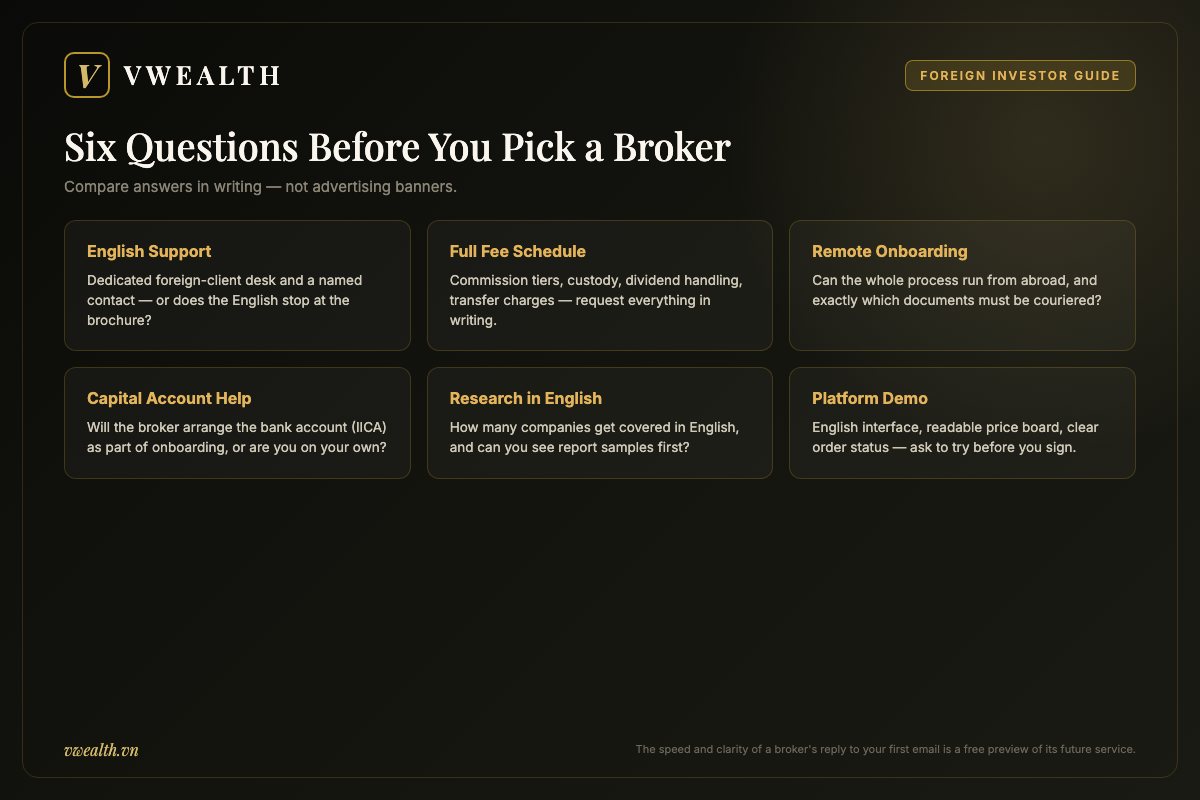
We deliberately do not quote specific commission numbers here — brokers revise their schedules, run promotions, and tier their pricing, so any number printed today misleads you tomorrow. What matters is knowing which questions to ask. Here is the comparison framework:
| Criterion | What to actually ask | Why it matters for foreigners |
|---|---|---|
| English support | Is there a dedicated foreign-client or institutional desk? Can I get a named contact person? Is the trading app fully translated, including corporate-action notices? | Every problem you will ever have gets solved by email or phone. A broker whose English ends at the marketing brochure becomes a wall exactly when you need a door. |
| Fee structure | Request the full schedule in writing: trading commission (and whether it tiers by volume or channel — online orders are often cheaper than broker-assisted ones), custody or account fees, dividend-handling fees, cash-transfer fees, and any charge for the trading code application itself. | Headline commission is only one line. Foreigners transact across borders, so transfer and FX-related costs can outweigh trading commission for a buy-and-hold investor. |
| Remote onboarding capability | Can the entire process be completed from abroad? Which documents must be couriered physically? Do they accept apostilled documents from my country? | Some brokers have a polished remote pipeline; others quietly assume you will drop by a branch. Ask before you start, not after. |
| IICA arrangement | Which partner bank do they work with? Will they open the capital account for me as part of onboarding, or must I approach the bank separately? | A broker that packages the bank account removes the most confusing third party from your setup. |
| Research quality | Do they publish English-language research? On how many companies? Can you see samples? | Most Vietnamese corporate disclosure is in Vietnamese. Your broker’s research may be one of your few professional English windows into your own holdings — though independent platforms now fill this gap too, as we cover below. |
| Platform and tools | Ask for a demo of the web and mobile trading platforms. Check: English interface, price-board readability, order-status clarity, statement exports. | You will live in this software. Vietnamese price boards use color conventions (more on this in step 7) that a good platform makes intuitive. |
| Size and stability | Is the broker among the market’s larger firms by client assets? Who are its shareholders? | Client securities are held at the central depository, which protects you structurally, but a large stable broker means fewer service disruptions and better odds your contact person still works there in three years. |
A practical tip: email two or three brokers’ foreign-client desks with the same short list of questions and compare not just the answers but the response time and clarity. The onboarding experience is a free preview of the service you will get as a client. A desk that takes two weeks to answer a prospect’s email will not get faster once it already has your money.
Step 4: Remote versus in-person onboarding — what each path really looks like
Ten years ago, opening a Vietnamese brokerage account essentially required a trip to Vietnam or an expensive chain of legalized documents. Today both paths work, and the right one depends on your circumstances.
The remote path
Fully remote onboarding is now realistic with the larger brokers and generally runs like this:
- You contact the broker’s foreign-client desk and receive the form pack and document checklist by email.
- You have your passport copy certified and legalized in your home country — through a notary plus consular legalization, or an apostille where accepted. This is usually the slowest single step, so start it first.
- You print, sign (wet ink), and courier the forms and certified documents to the broker in Vietnam. Some brokers accept scans for a preliminary review so errors are caught before you pay for international shipping — take advantage of that.
- The broker runs its own compliance checks, files your trading code application with the depository, and coordinates the capital account opening with its partner bank.
- You receive your account credentials and, once the trading code is issued and the bank account is live, you can fund and trade.
End to end, patient investors should think in terms of several weeks: certification and courier time in your country, processing queues at the broker and bank, plus the trading code issuance itself (which, once filed correctly, is usually the fast part — the depository processes clean individual applications quickly).
The in-person path
If you visit Vietnam anyway — for work, travel, or a look at the market you are about to buy — onboarding in person compresses the timeline dramatically. You walk into the broker’s head office or a foreign-client branch with your physical passport, sign everything on the spot with staff checking each field as you go, and often visit the partner bank the same day to open the capital account. Document legalization requirements can be lighter when staff can sight your original passport themselves. What took weeks remotely can be reduced to one or two office visits, with the trading code following days later.
In-person onboarding has a second, underrated benefit: you meet your future point of contact face to face, and small ambiguities — how your name should be rendered on forms, which signature you will use — get resolved in minutes rather than in email round-trips across time zones.
Which should you choose?
| Remote | In person | |
|---|---|---|
| Typical elapsed time | Several weeks | Days, given a planned visit |
| Document certification burden | Higher — notarization and legalization abroad | Lower — originals sighted on the spot |
| Cost | Certification and courier fees | Marginal, if you were traveling anyway |
| Error risk | Higher — mistakes surface after mailing | Lower — staff check as you sign |
| Best for | Investors who will not visit Vietnam soon | Anyone with a trip planned within a few months |
If you have a Vietnam trip on the calendar within the next quarter and you are not in a hurry to deploy, waiting to open in person is often the smoother experience. If capital is ready and no trip is planned, start the remote process now — specifically, start the document certification today, because everything else waits on it.
A newer path: trading through a global broker
One reform worth knowing about, even if it does not yet change the standard retail route, is the “global broker” mechanism. Under Circular 08/2026/TT-BTC, issued by the Ministry of Finance on 3 February 2026 as part of the reforms preparing Vietnam for its market-status upgrade, foreign investors can place orders directly through an approved global broker — using their depository account number — without necessarily opening a trading account at a domestic Vietnamese securities company. A separate draft circular circulated in 2026 goes further, building out electronic identification (eKYC), digital onboarding, and electronic contracts so that non-resident foreigners can operate accounts fully by electronic means.
In practice, this route is aimed first at large foreign institutions already served by global custodians and brokers, and it is rolling out in stages rather than replacing the domestic model overnight. For most individual foreign investors reading this in mid-2026, the three-part setup described in this guide — trading code, domestic brokerage account, and dong investment account — remains the practical path, and the fully-digital experience is still maturing. But the direction of travel is clear: Vietnam is deliberately dismantling the friction that once made foreign onboarding painful, so it is worth asking your broker what electronic and global-broker options they already support before you assume you must courier a stack of legalized paper.
Step 5: The securities trading code — your permanent market identity
The securities trading code deserves its own section because it is the piece with no Western equivalent, and because everything else can be ready while you wait for it.
The code is issued by the Vietnam Securities Depository and Clearing Corporation — VSDC, the institution that records who owns every share of every listed company and settles every trade. (You may still see its former name, VSD, in older documents.) Every foreign investor, individual or institutional, must hold exactly one trading code for life; it identifies you across brokers, so if you later switch securities companies, your code moves with you rather than being reissued.
The biggest recent change here works in your favour. Under Decree 245/2025/ND-CP, issued by the Government on 11 September 2025 to amend the securities-law rules, the trading-code step was moved to a registration-and-confirmation model rather than a slow paper approval. In practice VSDC now issues an electronic securities trading code (ESTC) confirmation to your broker or custodian within roughly one working day of a complete declaration, and a foreign investor can begin trading immediately once the ESTC comes through — in line with how major international markets work. This reform is one of several Vietnam pushed through specifically to smooth foreign access ahead of its market-status upgrade (more on that at the end). The lesson for your planning: as of mid-2026 the trading code itself is no longer the bottleneck — your own document certification and courier time are. Get those moving and the code tends to be the fast part.
Key things to understand about the process:
- Your broker files it; you cannot. The application goes through a depository member — your securities company — using the POA you signed. This is why broker choice comes before code registration in this guide’s ordering.
- It is an approval, not a formality. The depository checks your identity documents against its standards. Clean applications for individuals pass quickly; the rejections that happen are almost always document problems — the name mismatches and certification gaps described in step 2.
- It is the gate to everything. No code, no orders. Your brokerage account can exist in a pending state, and your bank account can hold funded dong, but the first buy order waits for the code.
- It is also how the system enforces foreign limits. When you buy shares, the depository knows the purchase is by a foreign holder and counts it against the company’s foreign room. The mechanics of that system — and what it means when a stock’s room is full — are covered in our dedicated guide to foreign ownership limits in Vietnam.
There is nothing for you to do during this step except respond quickly if your broker asks for a corrected document. Use the waiting time to set up the money pipeline — the next step.
Step 6: The indirect investment capital account — how money gets in and out
The IICA is the piece of the puzzle that confuses foreigners the most, so let’s build it from the ground up.
What it is and why it exists
Vietnam maintains a managed currency. The dong is not freely convertible the way the dollar, euro, or yen are, and the central bank monitors capital flows across the border. The rule for portfolio investors is simple in concept: all money you invest in Vietnamese securities must enter through one dedicated account, stay traceable while in the country, and exit through that same account. That dedicated account is the indirect investment capital account — a Vietnamese dong account opened in your name at a licensed commercial bank in Vietnam.
You cannot substitute a regular personal bank account, and you cannot wire money directly to your broker from abroad. The IICA is the single doorway, and its purpose is to give the authorities a clean record showing that the money leaving Vietnam as your eventual proceeds corresponds to money that properly entered as investment capital.
The rules for this account were refreshed recently. The State Bank of Vietnam replaced the old 2014 framework with Circular 03/2025/TT-NHNN, effective 16 June 2025, which governs how the dong indirect-investment account is opened and used. Two practical points from it are worth knowing. First, the regulation now formally calls this an “indirect investment account” (IIA) rather than the older “indirect investment capital account” (IICA) — you will hear both terms, and brokers and banks still widely say IICA, but the account and its purpose are the same thing. Second, the new circular lets a foreign investor hold more than one such account when they hold more than one trading code (relevant mainly to funds running separate portfolios), and it widened the list of cash movements the account may handle — including flows tied to the non-prefunding trading model that Vietnam introduced for foreign institutions. For a typical individual investor, the takeaway is simpler: you still open one dong account at a Vietnamese bank, and everything flows through it — but the legal ground under it was modernized in 2025, so treat any pre-2025 walkthrough you find online with caution.
How funding works in practice
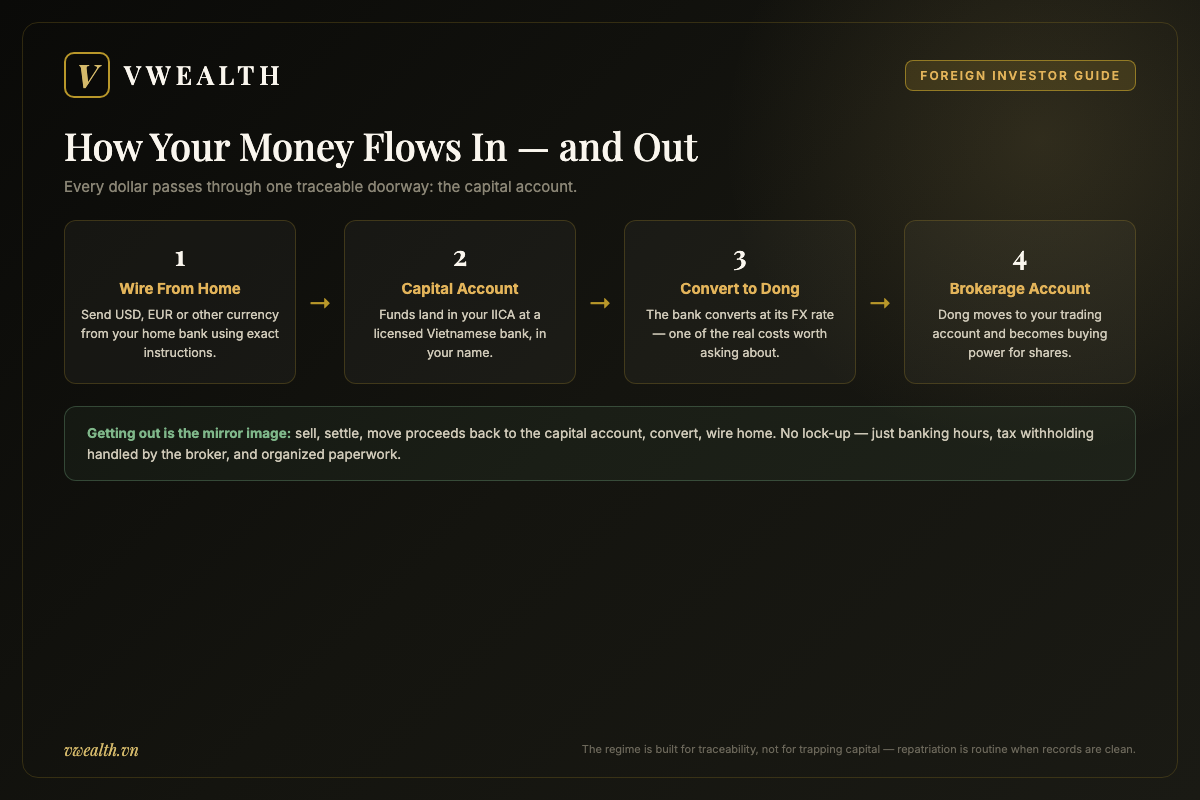
- You wire foreign currency from your home bank — dollars, euros, yen — to your IICA at the Vietnamese bank, using wire instructions the bank provides. Use the exact beneficiary name and account references given; international wires with fuzzy details get parked in limbo while the bank queries the sender.
- The Vietnamese bank converts the funds into dong. The stock market trades only in dong, so conversion happens at this doorway. The exchange rate applied is the bank’s rate at conversion time — worth a quick comparison question to the bank, since FX spread is one of the real costs of investing in Vietnam that never appears on a brokerage fee schedule.
- You (or the broker, on your instruction) move dong from the IICA to your brokerage account. Now it is buying power on the trading platform.
How repatriation works
Exit is the mirror image: sell shares, let the sale settle, move the dong proceeds from the brokerage account back to the IICA, instruct the bank to convert to your chosen foreign currency, and wire it home. Two practical notes deserve emphasis:
- Documentation is checked at exit. When converting and remitting outward, the bank verifies that applicable taxes on your transactions have been handled and that the flow matches the capital-account record. This is normally routine — brokers withhold transaction taxes automatically when you sell — but it is a reason to keep your statements organized from day one.
- There is no lock-up on portfolio investment. The regime is about traceability, not trapping capital. Foreign portfolio investors routinely move money out; the process just runs on banking hours and paperwork rather than a single tap in an app.
Dividends and corporate actions flow through the same pipe
Cash dividends from your Vietnamese shares arrive in dong and join the same traceable pool — you can reinvest them or repatriate them through the IICA like any other funds. Stock dividends and rights issues, which Vietnamese companies use enthusiastically, simply add shares to your depository holdings via your broker. When a rights issue asks for new money, that money, too, enters through the capital account.
Step 7: Your first order — a walkthrough of a Vietnamese trading screen
Your trading code is issued, your account is funded, and the platform login works. Before you place the first order, spend ten minutes learning the local mechanics, because a Vietnamese price board makes several assumptions a Western investor will not share.
Know which board your stock trades on
Vietnam has three trading venues: HOSE in Ho Chi Minh City hosts most large companies, HNX in Hanoi lists smaller ones, and UPCOM is the platform for unlisted public companies. The venues differ in listing standards, liquidity, and — importantly for your order — the width of daily price limits. Most foreign investors spend nearly all their time on HOSE, but confirm where your target trades; our comparison of HOSE, HNX and UPCOM explains how the three boards differ and why it matters.
Understand the price-board color language
Vietnamese stocks trade within daily price bands around a reference price — roughly seven percent each way on HOSE, wider on the other boards. The whole market reads prices through a color code that your platform will use everywhere: green means the price is up from reference, red means down, yellow means unchanged, purple (or violet) means the stock has hit its ceiling — the maximum allowed gain for the day — and cyan/blue means it has hit the floor. A stock pinned at its ceiling with thin sell orders may be nearly impossible to buy that day; the band simply postpones the move to tomorrow. This is a fundamentally different rhythm from markets where a hot stock can gap up thirty percent in a morning.
Respect the lot size
Orders on the main boards are placed in board lots of 100 shares. You buy 100, 500, 1,000 shares — not 37. Smaller quantities, called odd lots, trade through a separate, less liquid mechanism. Practical consequence: your minimum sensible position in any stock is 100 shares times its price, so very high-priced shares set a floor on position size that a small portfolio must plan around.
Choose your order type and session
The trading day is divided into sessions: an opening auction (ATO — at the open), continuous matching through the day with a midday break, and a closing auction (ATC — at the close). An auction here means orders collect for a window and then match at one single price. As a beginner, the workhorse is the plain limit order (LO) during continuous hours: you state your maximum buy price, and you cannot be filled above it. Market-type orders exist but deserve caution in thinner names, where the visible order book can be shallow.
Check foreign room before you click buy
One extra pre-flight check applies specifically to you: does the stock have foreign room left? Your platform shows the remaining foreign-ownership capacity for each ticker. If room is zero, your buy order cannot execute on the exchange no matter what you bid — foreigners can then only acquire shares from other foreigners in negotiated deals, often at a premium over the on-screen price. Checking room takes two seconds and belongs in your routine.
Know the settlement rhythm
Trades settle on a T+2 cycle — shares and cash change hands two business days after the trade. Vietnam shortened the timing within that cycle a couple of years ago, so on settlement day the securities and cash typically land in your account before midday (around 1 p.m.), making them available in the afternoon session of T+2 rather than only the next morning. The binding consequence for you is unchanged, though: shares bought today cannot be sold today. Day-trading in the Western sense does not exist for a cash account, and freshly bought shares become sellable only when they land in your account after settlement. Confirm the current cycle details with your broker rather than assuming they match another market you know — settlement rules are among the things Vietnam has been steadily modernizing.
A worked first-order example
An illustrative example — assume a hypothetical HOSE-listed company trades around 40,000 dong per share and you want roughly a 40-million-dong position (call it about $1,500–1,600 at an assumed rate of roughly 25,000 dong per dollar; check the live rate when you convert). That is 1,000 shares — ten board lots. You check the ticker’s foreign room: plenty remaining. You place a limit order for 1,000 shares at 40,000 dong during continuous trading. The platform immediately shows the order as pending, then filled; commission is deducted per your broker’s schedule; and two business days later the shares sit settled in your account, visible in your depository-linked holdings. Your first Vietnamese position is live.
Common friction points — and how experienced investors avoid them
Every step above can go smoothly, and for most people it broadly does. But a handful of snags recur so often among foreign investors that they are worth naming explicitly. Forewarned is genuinely forearmed here.
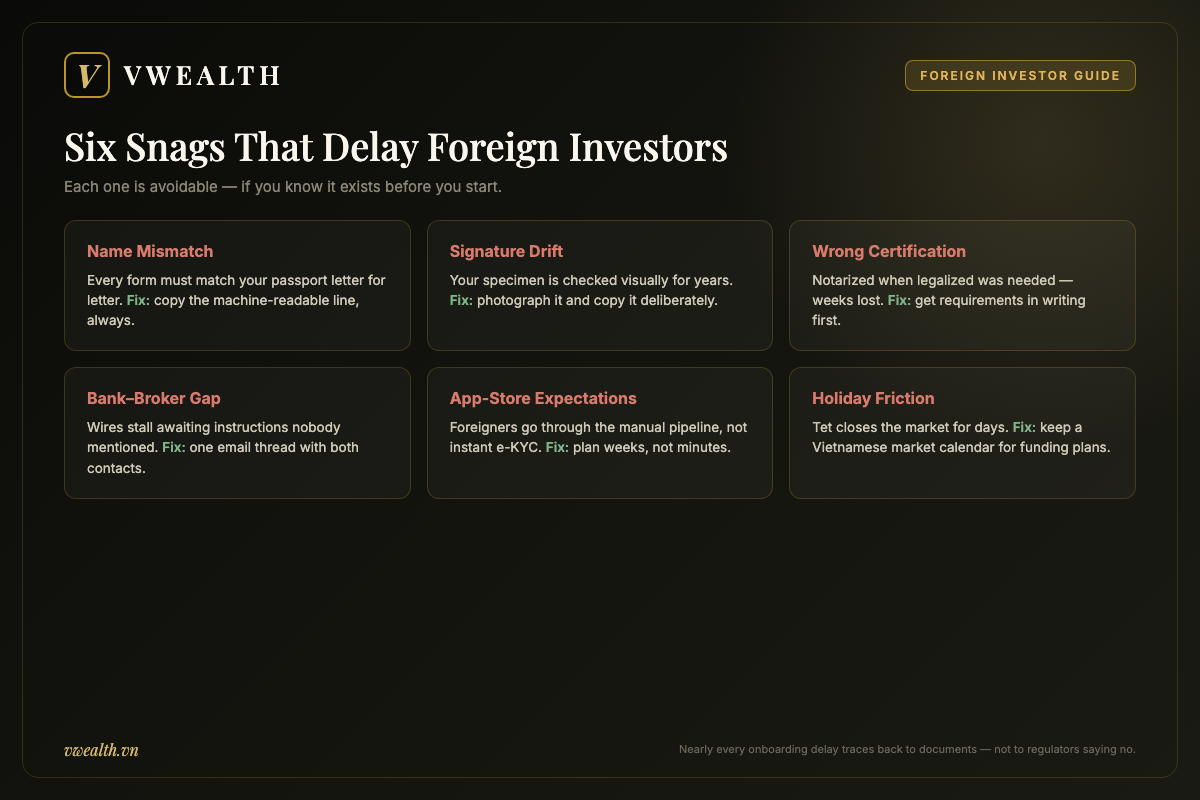
- The name-consistency trap. The single most common delay. Your passport, POA, bank forms, and broker forms must render your name identically. Investors with long names, multiple middle names, or names that their home documents abbreviate differently are most at risk. Fix: write your name exactly as the passport’s machine-readable line shows it, everywhere, always.
- Signature drift. The signature you register becomes a specimen checked visually for years. A withdrawal instruction signed with today’s lazier version of your 2026 signature can be rejected. Fix: keep a photo of your registered specimen and copy it deliberately when signing anything Vietnamese.
- Under- or over-certified documents. Getting a passport copy notarized when the broker needed consular legalization costs you a courier round-trip; getting full legalization when a simple certification would do costs money and weeks. Fix: get the requirement in writing from your specific broker before visiting any notary.
- The bank–broker coordination gap. Your money pipeline involves two institutions that do not always talk fast. A wire can sit at the bank awaiting a conversion instruction you did not know you had to give. Fix: when funding, email both your broker contact and the bank contact in one thread, and ask explicitly who does what next.
- Expecting app-store onboarding. Vietnamese brokers offer slick apps to domestic clients who verify with national ID — foreigners go through the manual pipeline described here. The app comes after the paperwork, not instead of it. Fix: adjust expectations and timelines accordingly.
- Time-zone and holiday friction. Vietnam’s market runs on Indochina Time and closes for local holidays, most notably the multi-day Lunar New Year (Tet) break. Fix: keep a Vietnamese market calendar; do not plan funding or repatriation across Tet week.
- Forgetting the research problem until after buying. Owning shares is step one; following them is the ongoing work, and most Vietnamese disclosure — earnings releases, shareholder-meeting documents — is published in Vietnamese first and sometimes only. Fix: solve your information supply deliberately, which brings us to the next section.
After the account: solving the English-language research problem
Here is the part most step-by-step guides skip. The mechanical barrier to entry — the account — is a one-time cost. The informational barrier is permanent: you now own shares in companies that report in Vietnamese, hold shareholder meetings in Vietnamese, and are covered mostly by Vietnamese-language media and research.
Foreign investors typically assemble their information supply from several sources. Broker research in English covers the large caps, though depth varies and smaller companies often get no coverage at all. Company investor-relations pages sometimes offer English financial statements, with a lag and uneven quality. International financial media covers Vietnam at the macro level but rarely at the individual-company level you now need.
This gap is exactly what vwealth was built to close: the platform’s AI reads Vietnamese financial statements, filings, and market data at the source and produces full analysis reports in English — valuation, financial-health scoring, and business commentary on Vietnamese listed companies, kept current as new numbers are published. For an investor who has just spent weeks setting up market access, it is the missing piece that makes the access usable: you can browse the library of English-language stock reports before your trading code is even issued, and shortlist your first positions while the paperwork cooks. A free account gets you into the reports, and new users get an extended trial — a sensible parallel track to run during the onboarding weeks.
The full timeline at a glance
Pulling every step together, here is the realistic sequence for a remote individual investor, expressed in phases rather than promised dates — your broker, your country’s certification process, and courier schedules set the actual pace:
| Phase | What happens | Who drives it | Your action items |
|---|---|---|---|
| 1. Research | Choose the direct route over ETFs; shortlist and contact 2–3 brokers | You | Email foreign-client desks with your question list |
| 2. Documents | Certify and legalize passport copy; complete and sign form pack | You + notary/consulate | Get exact certification requirements in writing first |
| 3. Submission | Courier documents; broker compliance review | You, then broker | Send scans for pre-check before couriering |
| 4. Registration | Broker files trading code application with VSDC; bank opens IICA | Broker + bank | Respond fast to any document queries |
| 5. Funding | Wire foreign currency to IICA; convert to dong; transfer to brokerage account | You + bank | Use exact wire instructions; confirm conversion |
| 6. First trade | Check foreign room, place limit order, wait for settlement | You | Learn price-band colors and lot sizes first |
| 7. Ongoing | Monitor holdings, handle dividends, keep records for repatriation | You | Set up your English research supply |
Frequently asked questions
Can I open a Vietnamese brokerage account without visiting Vietnam?
Yes. Fully remote onboarding is standard practice at brokers with foreign-client desks. The trade-off is heavier document certification — notarized and typically legalized passport copies — plus courier time, so remote onboarding measures in weeks where in-person onboarding measures in days.
Do I need to be a resident of Vietnam?
No. The entire framework described here — trading code, brokerage account, indirect investment capital account — exists precisely for non-resident foreign investors. Residents with Vietnamese work permits have some simpler options for parts of the process, but non-residents are fully catered for.
How many brokerage accounts can I have?
Your securities trading code is unique and permanent, but it can be associated with accounts at more than one securities company if you later want a second broker. Most individual investors keep life simple with one.
Is my money safe if the broker has problems?
Your shares are recorded at the central depository (VSDC) rather than existing only on the broker’s books, which is the key structural protection: custody of listed securities is centralized. Cash held at the broker and the bank sits within those regulated institutions. Choosing a large, well-capitalized broker and bank remains sensible, but the ownership record of your shares does not depend on your broker’s balance sheet.
Can I trade on margin or sell short?
Assume no. Margin lending is generally not extended to foreign individual investors, and short-selling is not part of the ordinary retail toolkit in Vietnam. Plan as a cash, long-only investor — which, for a foreigner underwriting a long-term growth story, is usually the right posture anyway.
What taxes will I pay when I sell?
Vietnam applies a small transaction-based tax on the sale value of listed shares for individuals, withheld automatically by the broker, and a withholding on dividends — a materially simpler model than annual capital-gains filing. Rates and rules can change and treaty positions vary by country, so verify the current figures with your broker or a tax adviser before acting; treat any number you read online, including here, as a prompt to check rather than a fact to rely on.
The bottom line: slow doorway, wide market
Opening a brokerage account in Vietnam as a foreigner is a paperwork project, not a technology product. You are registering an identity with the national depository, opening custody with a broker, and building a traceable money pipeline through a Vietnamese bank — three deliberate steps designed for a market that manages its currency and its foreign ownership carefully. The process rewards preparation: exact-match names, properly certified documents, a broker chosen for its foreign-client service rather than its ad banner, and realistic expectations about timing.
The timing is also more interesting than it was even a year ago. In October 2025 FTSE Russell announced it would reclassify Vietnam from Frontier to Secondary Emerging market status, and after an interim review in early 2026 it confirmed that upgrade, with an effective date of 21 September 2026. Much of the reform blitz described in this guide — the one-working-day electronic trading code, the modernized capital-account rules, the removal of pre-funding for foreign institutions, and the global-broker mechanism — was pushed through precisely to satisfy the access conditions that upgrade required. So a foreigner opening an account in mid-2026 is arriving just as the market crosses that threshold, with the onboarding process meaningfully lighter than the version older guides describe.
And the payoff is real: direct ownership in one of Asia’s most watched growth markets, access that ETFs only approximate, and a seat at the table for the market’s long journey from frontier status toward the emerging-market mainstream. The weeks of setup are the toll; the market on the other side is the point. Prepare your documents this week, email two brokers today, and let the trading code application run while you do the more interesting work — deciding what to buy.
This article is general information about account-opening procedures, not investment, legal, or tax advice; verify current requirements with your chosen broker and adviser before acting.
Research Vietnamese stocks in English with vwealth. Our AI-powered platform turns Vietnamese market data into full English analysis reports — with international payment support and a free 2-month trial for new accounts. Create your free account and read the latest reports.