Every few decades, the map of world manufacturing gets redrawn, and a handful of countries capture most of the prize. The “China Plus One” strategy — multinationals keeping their Chinese factories but adding production in one more country — is the current redrawing, and Vietnam has captured a disproportionate share of it. Factories, however, are not stocks. Between a foreign investor’s press release and a Vietnamese company’s income statement sits a long chain of land leases, construction contracts, container fees, electricity bills and payroll deposits, and each link of that chain is owned by a different listed sector. This guide explains why the china plus one Vietnam story happened, how foreign direct investment actually flows into corporate earnings, which sectors sit first and second in line, where the thesis can break, and how to express the theme through listed equities without overpaying for a narrative everyone already knows.
What “China Plus One” Actually Means — and What It Does Not
Start with the phrase itself, because it is widely used and widely misunderstood. “China Plus One” describes a corporate supply-chain policy: a multinational keeps its existing production base in China and adds at least one additional manufacturing location in another country. The term is usually credited to Japanese companies in the mid-2000s, who were the first to worry, at scale, about having concentrated their entire production footprint in a single country. The key word is “plus,” not “minus.” Companies pursuing this strategy are not abandoning China. They are buying insurance against it.
Three separate forces turned a cautious Japanese idea into a global stampede, and it matters that they are separate, because each one has a different life expectancy.
The first force is cost. Chinese manufacturing wages rose relentlessly for two decades as the country grew richer — which is exactly what is supposed to happen when development succeeds. A factory location chosen in 2003 because labor was cheap stopped being cheap. For labor-intensive work such as garments, footwear, furniture and final electronics assembly, the math of staying put quietly broke long before any politician said a word. This force is structural and essentially permanent: China will not become a low-wage country again.
The second force is tariffs. The trade conflict between the United States and China that began in 2018 put import taxes on broad categories of Chinese-made goods. A tariff changes factory economics instantly and bluntly: the same product, made by the same company with the same machines, costs the American buyer more if it ships from a Chinese port and less if it ships from a Vietnamese one. Tariffs are political, which means they can intensify, soften or mutate with every election cycle — but the direction of travel for over half a decade has been toward more trade friction between the two largest economies, not less.
The third force is resilience. The pandemic years demonstrated to every chief executive what “single point of failure” means: one country’s lockdowns could halt global product lines regardless of cost or tariffs. After that experience, boards began treating geographic diversification of production the way investors treat diversification of a portfolio — not as an optimization, but as a survival requirement.
Why should a stock investor care about any of this? Because of the time scale. A factory is not a trade; it is a twenty-to-thirty-year commitment involving land, buildings, customs relationships, supplier ecosystems and trained workers. When thousands of companies make that commitment in the same direction over the same decade, the result is not a news cycle. It is a structural reallocation of global capital — and structural reallocations create earnings streams that last long enough for patient equity investors to participate in them.
Why Vietnam Captured a Disproportionate Share
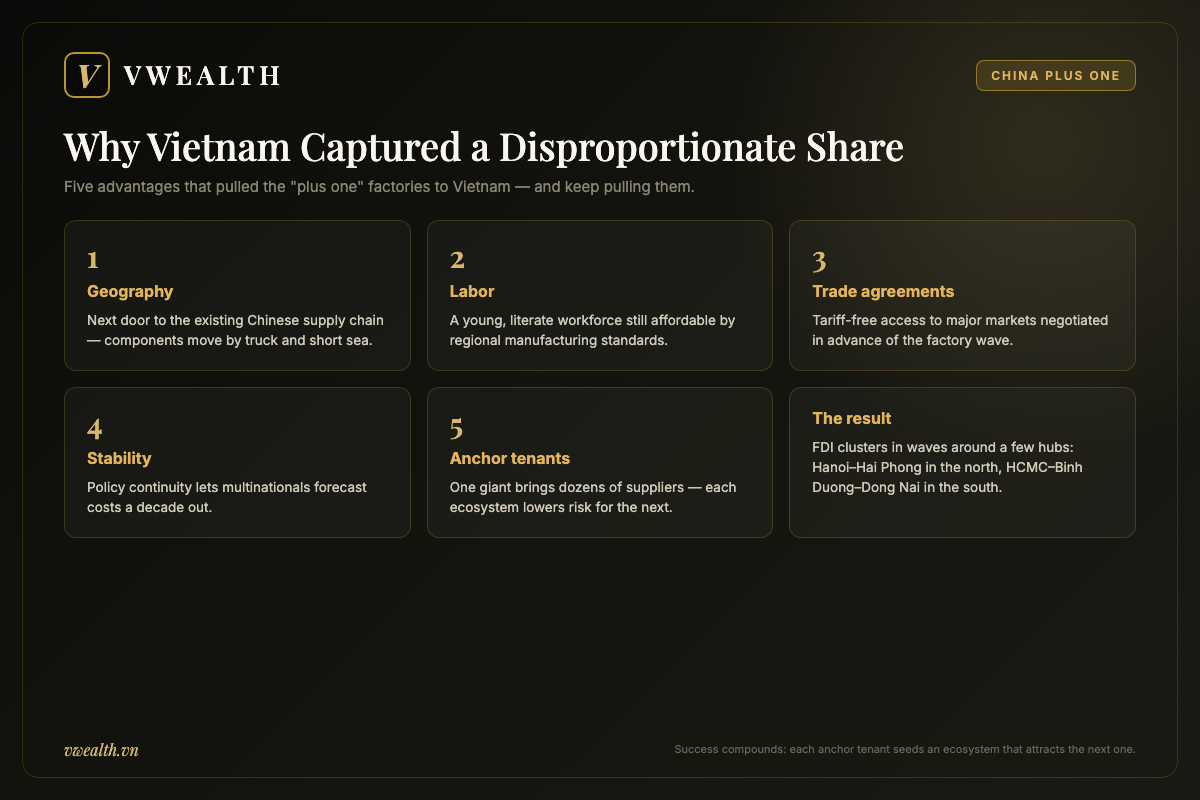
Dozens of countries competed for the factories leaving or bypassing China. Vietnam won far more than its economic size would predict. That outcome was not luck; it came from an unusual stack of advantages that reinforce each other.
Geography: next door to the world’s supply chain
Vietnam shares a land border with China and sits directly on the shipping lanes connecting Northeast Asia to Europe and the Middle East. This matters more than it first appears. A factory that leaves coastal China does not leave its suppliers behind — the components, molds, machinery and specialist technicians it depends on are still largely in China. Northern Vietnam is close enough that inputs can arrive by truck in days rather than by ship in weeks. A phone assembled near Hai Phong can pull parts from Guangdong on a schedule no factory in South America or Africa can match. In practice, “China Plus One” often means “China plus somewhere I can still reach China from,” and Vietnam is the most literal answer to that requirement. The country’s long coastline, dotted with ports along its entire length, then handles the outbound journey to end markets.
Labor: young, literate and still affordable
Vietnam entered the China Plus One era with a large, young workforce, high basic literacy, and manufacturing wages at a fraction of those in coastal China. Just as important is trainability: electronics assembly requires workers who can follow precise processes and adapt to new product cycles, and Vietnam’s labor force built that reputation through the earlier waves of garment and footwear manufacturing. A generation of workers who learned industrial discipline sewing sneakers became the recruiting pool for companies soldering circuit boards. Each wave of foreign investment effectively trains the workforce for the next, slightly more sophisticated wave.
Trade agreements: tariff-free access sold in advance
Here is Vietnam’s least appreciated advantage. A free trade agreement, or FTA, is a treaty in which countries agree to cut or eliminate tariffs on each other’s goods, provided those goods genuinely originate in the member countries. Vietnam spent two decades systematically signing them: the CPTPP linking it with Japan, Canada, Australia and others; the EVFTA with the European Union; the RCEP covering most of Asia-Pacific; plus a web of bilateral deals. The result is that a factory in Vietnam ships into more major markets at low or zero tariffs than a factory in almost any competing location. For a manufacturer choosing where to build, this is not an abstraction — it is a permanent discount on every container the factory will ever ship. Vietnam effectively pre-sold tariff-free market access to the world’s manufacturers before most of them knew they would need it.
Stability and policy continuity
Factory investments are decades long, so investors price political risk heavily. Vietnam offers an unusual combination: a one-party state that delivers policy continuity across decades, paired with an explicit, consistent national strategy of courting export manufacturing. Provinces compete with each other to attract foreign projects. Industrial zones come with corporate income tax incentives — typically reduced rates and multi-year tax holidays for qualifying projects — and licensing procedures that, while bureaucratic, are predictable in their direction. The currency has been managed with a bias toward stability against the US dollar, which exporters value because their contracts are priced in dollars. None of this makes Vietnam frictionless, but it makes it legible: a company can model its costs ten years out with reasonable confidence.
The anchor-tenant effect
Finally, success compounds. When one giant electronics group — Samsung being the most famous example — concentrates a major share of its global smartphone production in Vietnam, it does not arrive alone. Dozens of its component suppliers must build factories nearby, because just-in-time manufacturing cannot tolerate an ocean between the screen maker and the assembly line. Those suppliers attract their own suppliers. Each anchor tenant seeds an ecosystem, and each ecosystem lowers the cost and risk for the next multinational deciding where to put its “plus one.” This is why foreign direct investment tends to cluster in waves around a few hubs — around Hanoi and Hai Phong in the north, around Ho Chi Minh City, Binh Duong and Dong Nai in the south — rather than spreading evenly across the country. The scale one anchor can reach is not abstract: Samsung’s Vietnamese operations have at times assembled roughly half of the group’s global smartphone output, and in 2024 they generated on the order of US$54 billion of exports — by themselves close to a seventh of everything Vietnam shipped abroad that year. A single anchor tenant, in other words, can move a national export statistic, which is exactly why the ecosystem it seeds matters to equity investors.
Following the Money: How FDI Becomes Somebody’s Revenue
Foreign direct investment, or FDI, means a foreign company building or buying productive assets in another country — factories, warehouses, offices — as opposed to merely buying its stocks or bonds (which is called portfolio investment). Vietnam’s statistics agencies publish FDI figures monthly, and the headlines usually quote them breathlessly. Before you invest a single dong based on those headlines, you need to understand one crucial distinction and one longer chain of events.
Registered versus disbursed: promises versus money
FDI is reported in two flavors. Registered FDI is the value of investment licenses granted — essentially, promises. A conglomerate announces a multi-billion-dollar project, receives its certificate, and the full headline amount enters the registered statistics immediately, even though construction may take years or, occasionally, never happen at all. Disbursed (or implemented) FDI is money actually spent in the country during the period. Disbursed figures are smaller, smoother and far more honest. When you track the theme, track disbursement: it is the cash that actually reaches Vietnamese landlords, contractors and workers. A spike in registered FDI is a mood; a rising trend in disbursed FDI is a fact. The full-year 2025 figures make the distinction vivid: Vietnam registered about US$38.4 billion of FDI (barely changed from the prior year) but actually disbursed roughly US$27.6 billion — up around 9 percent and the highest level in five years, with processing and manufacturing taking well over half of newly registered capital. The disbursed line, not the registered headline, is the money that reached Vietnamese landlords, contractors and workers.
The life cycle of a factory, and who gets paid at each stage
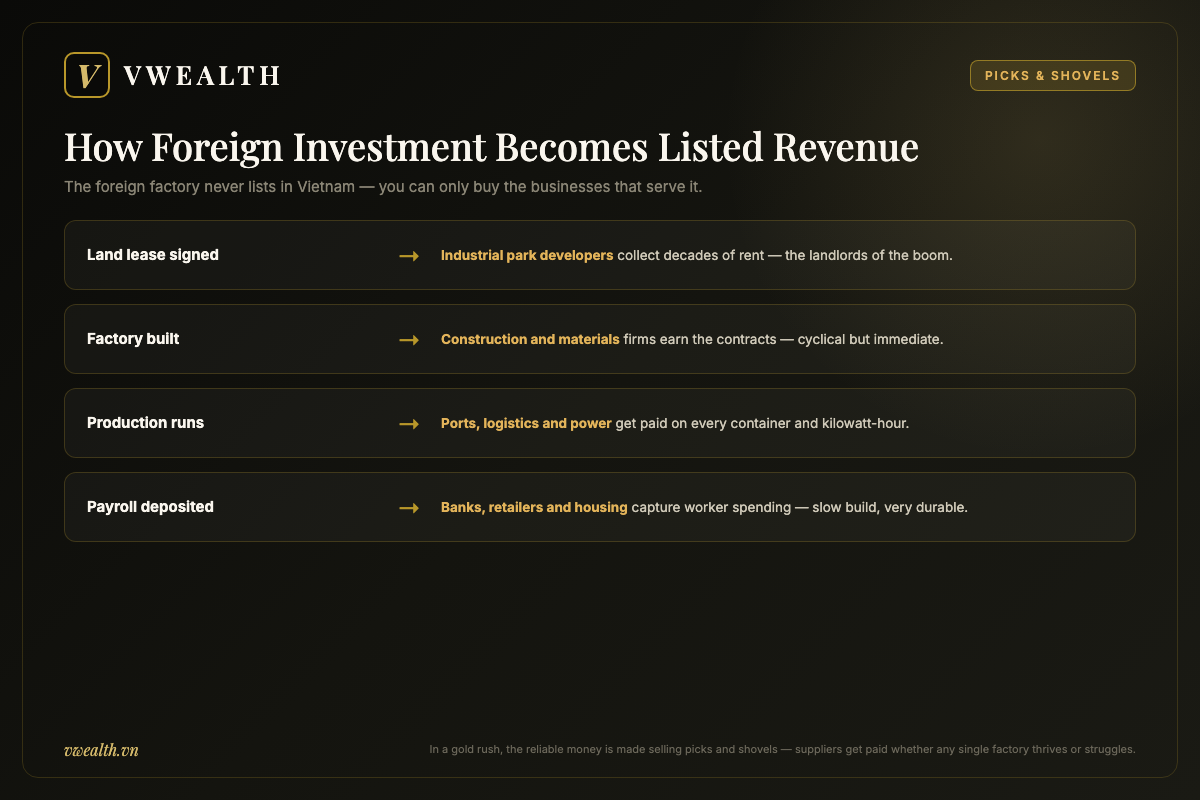
Now follow a single foreign manufacturing project from decision to full operation, and watch where the money lands. The sequence below is the entire investment thesis of this article in miniature.
First comes site selection and the land lease. In Vietnam, foreign manufacturers almost never buy raw land; they lease serviced plots inside industrial parks — planned zones where a developer has already secured land rights, leveled the ground, built roads, and connected power, water and wastewater treatment. The industrial park developer collects lease payments, often for terms running as long as the park’s own land tenure (industrial land in Vietnam is typically held under leases of up to about half a century). This is the first Vietnamese revenue line the project creates.
Second comes construction, usually one to two years. Contractors pour concrete, erect steel-framed factory buildings and fit them out. Steel producers, cement and building-materials companies, and construction firms all bill during this phase.
Third comes equipment and setup. Machinery arrives — almost all of it imported — flowing through seaports and airports, generating handling fees for port operators, customs brokerage and trucking for logistics firms.
Fourth comes operation. The factory hires thousands of workers, signs a long-term electricity contract, consumes water and telecom services, and begins shipping finished goods out through the same ports its machines arrived through — but now in far greater, recurring volume. Simultaneously it imports components each month, so trade flows run in both directions. Every container, in and out, pays a port and a logistics chain.
Fifth, and least visibly, comes payroll. Wages land in bank accounts. Workers rent rooms, buy groceries, take out motorbike loans, and eventually mortgages. This is where the money leaves the industrial economy and enters the consumer economy — the slowest, broadest and longest-lasting stage of the whole chain.
The table below maps each stage to the listed sectors that invoice it.
| Stage of an FDI project | Who gets paid | Listed sector exposure | Revenue pattern |
|---|---|---|---|
| Land lease in an industrial zone | Industrial park developer | Industrial real estate | Lumpy, contract-driven; long tail of service fees |
| Factory construction | Contractors, steel, cement, materials | Construction and materials | Project-based, cyclical |
| Equipment import and setup | Ports, customs, trucking, warehousing | Ports and logistics | One-off surge per project |
| Ongoing production and export | Ports, logistics, power, telecom | Ports, logistics, utilities | Recurring, volume-linked |
| Payroll and worker spending | Banks, retailers, consumer companies, housing | Banks, consumer, residential property | Slow build, very durable |
Notice something important about this table: the foreign factory itself never appears on the Vietnamese stock exchange. Samsung, LG, Foxconn and their peers are listed in Seoul, Taipei or New York, not Ho Chi Minh City. A Vietnamese equity investor cannot buy the factory — only the businesses that serve it. This is the classic “picks and shovels” structure, named for the observation that during a gold rush, the reliable money is made selling picks and shovels to the miners rather than digging for gold. The entire china plus one Vietnam equity thesis is a picks-and-shovels thesis, and that is a feature, not a bug: the suppliers get paid whether any individual factory thrives or struggles.
First-Order Winners: Industrial Parks, Ports, Construction and Power
First-order winners are the companies whose revenue line responds directly and quickly to FDI flows. They are the easiest part of the thesis to understand — and, for exactly that reason, often the part where valuations run ahead of reality fastest.
Industrial park developers: landlords of the boom
The purest expression of the theme is the industrial park developer. The business model is beautifully simple to describe: acquire land-use rights over large tracts (often former agricultural land) at low cost, spend years navigating approvals and compensation, invest in leveling, roads, drainage, power and water, and then lease serviced plots to manufacturers at a multiple of the all-in cost. On top of the land margin sits a quieter annuity: monthly fees for utilities, water treatment, maintenance and management that continue for the life of every tenant.
Two accounting realities make these stocks tricky, and you should understand both before ever glancing at a price-to-earnings ratio. A P/E ratio, if you are new to the term, is simply the share price divided by earnings per share — a rough gauge of how many years of current profit you are paying for. First, revenue recognition is lumpy: depending on contract structure, a developer may book a huge portion of a fifty-year lease upfront in the quarter it hands over the land, or amortize it in small slices over decades. Two developers with identical economics can report wildly different profits in the same year. Second, the single most important number in the business appears nowhere on the income statement: the remaining bank of leasable, legally cleared land. A developer that has leased out nearly everything is a melting ice cube regardless of last quarter’s record earnings; one sitting on a large cleared land bank in a high-demand province holds years of future profit that current earnings do not show. Industrial parks are one segment of a broader property sector with very different dynamics across segments — the residential and commercial side runs on an entirely different cycle, which we cover in our guide to Vietnamese real estate stocks.
Ports and logistics: the theme’s odometer
If industrial parks are the landlords of China Plus One, ports are its toll booths. Every imported component and every exported finished product passes through a gate that charges by the container, which makes container throughput the single best real-time odometer of the entire thesis. Port economics reward scale and depth: deepwater ports that can berth the largest vessels capture the premium intercontinental routes, while smaller river and feeder ports fight for transshipment scraps at thinner margins. Around the ports sits the wider logistics complex — trucking, bonded warehouses, cold chain, freight forwarding, and increasingly air cargo for high-value electronics, where a single freighter can carry more export value than a ship. The competitive structures, pricing power and pitfalls of this whole complex deserve their own analysis, which you will find in our breakdown of Vietnamese aviation and logistics stocks.
Construction and materials: the cyclical middle
Every factory begins as a steel frame on a concrete slab, so construction firms and materials producers enjoy a direct, if project-based, share of FDI. The caveat is that these are deeply cyclical businesses whose fortunes also hinge on residential construction, public infrastructure spending, and — for steel producers especially — global commodity prices that no Vietnamese company controls. A wave of factory building can lift them powerfully, but it is one demand stream among several, and the commodity cycle can drown it. Before treating a steel producer as a China Plus One play, read how the underlying cycle actually works in our playbook on Vietnamese steel and industrial stocks — buying a cyclical at the wrong point of its cycle can lose you money even when the demand thesis is perfectly correct.
Power and utilities: the quiet constraint
Factories are voracious electricity consumers, and manufacturing growth translates almost mechanically into power demand growth. Listed power generators and the industrial-utility arms of park developers capture some of this. But electricity in Vietnam is also the theme’s binding constraint — a point important enough that it reappears in the risks section below. Regulated tariffs mean generators do not simply harvest demand growth as profit; policy sets the price. Treat utilities as a stability play on the theme, not a growth play.
Second-Order Winners: Banks, Consumers and the Paycheck Economy
The second-order effects begin where the payroll lands. They are slower, harder to trace to any single FDI project, and — precisely because of that — more durable and more broadly spread across the listed market.
Banks: the toll collectors of rising incomes
A common mistake is to imagine Vietnamese banks profiting by lending to the multinationals themselves. Mostly, they do not: global manufacturers typically finance themselves through global banks at global rates. The real banking exposure is one step removed and far larger. Millions of factory workers receive wages into Vietnamese bank accounts — payroll accounts are often the first formal banking relationship a rural migrant ever has. Deposits swell. Then comes consumer credit: motorbike loans, appliance installment plans, credit cards, and eventually mortgages as workers settle near industrial hubs. Meanwhile, thousands of domestic firms — the local suppliers, contractors, transporters and service providers orbiting each foreign factory — borrow working capital from local banks. Trade finance, foreign-exchange services and payment processing for an export economy add fee income on top. A bank in an industrial province is, in effect, a leveraged bet on the formalization of the local economy that FDI drives.
Consumer companies: from wages to shopping baskets
Factory wages may look modest by rich-country standards, but they are formal, predictable and typically higher than the agricultural incomes they replace. Predictable income changes spending behavior: households shift from subsistence purchases to branded food, packaged dairy, modern pharmacies, convenience stores and consumer electronics. Whole retail formats become viable in provinces where they previously were not. The listed beneficiaries range from food-and-beverage producers to pharmacy and electronics chains — businesses whose connection to FDI never appears in any project announcement, yet whose customer base is being manufactured, quite literally, by the manufacturing boom.
Housing and urbanization around the hubs
Industrial clusters pull population. Workers need rooms, then apartments, then schools and clinics; engineers and managers need mid-tier housing; and the whole cluster needs commercial space. Residential developers with land near industrial corridors ride a demand wave that is demographic rather than speculative — though, as always in property, the gap between riding demand and surviving a credit cycle is wide.
The strategic takeaway: first-order winners give you speed and purity of exposure but concentration risk; second-order winners give you breadth and durability but dilution — a bank or retailer benefits from FDI among many other forces. A sensible expression of the theme usually blends both layers rather than betting everything on the most obvious names.

The Limits of the China Plus One Vietnam Story
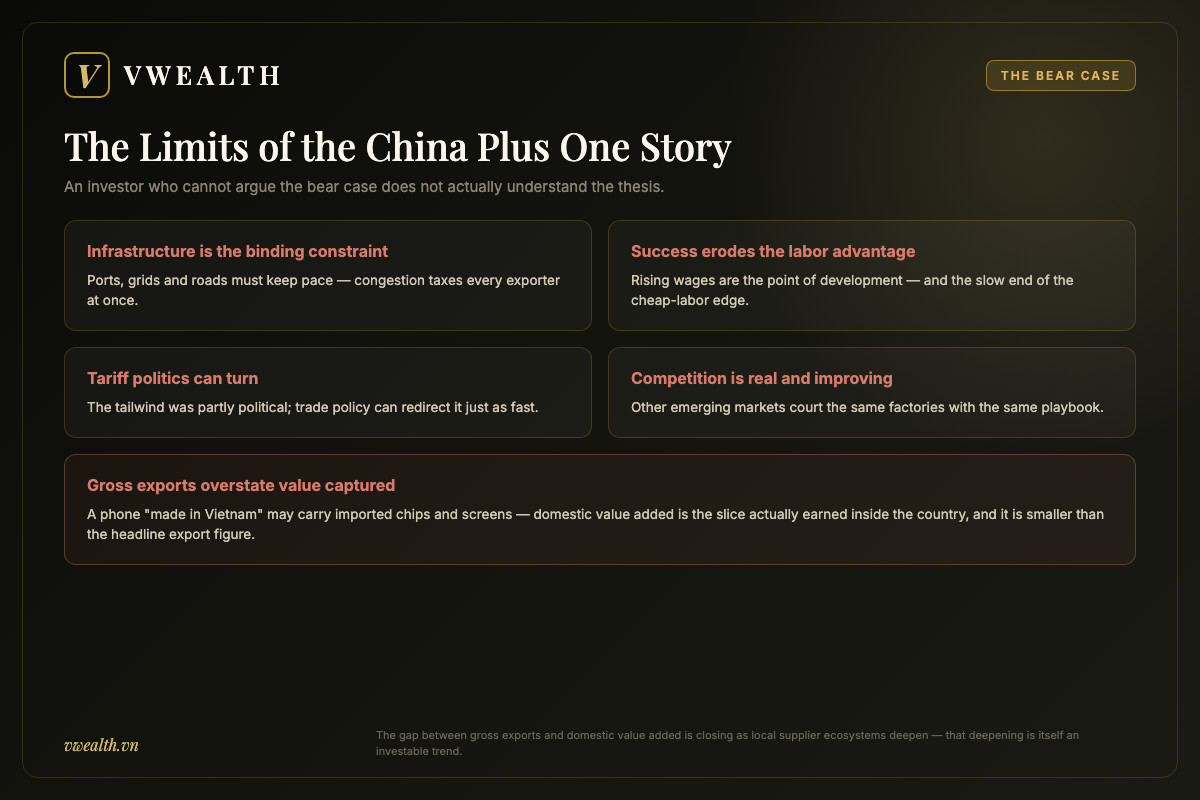
No thesis this popular survives contact with reality unbruised. An investor who cannot argue the bear case does not actually understand the bull case. Here are the five pressure points that deserve permanent space in your monitoring routine — presented qualitatively, because the specifics shift year to year while the categories endure.
Infrastructure is the binding constraint
Vietnam is attempting to absorb, in a couple of decades, the kind of industrial buildout that took other countries several. The strain shows. Electricity is the sharpest example: manufacturing hubs have experienced episodes of power shortages and rationing during peak seasons, and for a semiconductor-adjacent or precision manufacturer, unreliable power is not an inconvenience — it is a dealbreaker that shapes where the next factory goes. This is not theoretical. In the summer of 2023 the northern industrial provinces suffered genuine rationing — Foxconn reportedly trimmed power use at its northern plants by around 30 percent, and factories in Bac Giang faced scheduled curbs — an episode that rattled investors precisely because it hit the electronics heartland. The government’s response was tangible: in August 2024 it energised a new 500-kilovolt transmission line (the roughly US$876 million “Circuit 3”) that roughly doubled the power-carrying capacity from central to northern Vietnam, and it avoided comparable outages that year. Roads, bridges and port access corridors congest as volumes grow, keeping logistics costs high relative to the economy’s size. The government’s answer is a heavy public investment program — itself an earnings stream for construction and materials companies — but infrastructure is built in years while demand arrives in months. Watch this gap: it determines whether the next wave of FDI lands in Vietnam or leaks to a competitor.
Success is eroding the labor advantage
The same dynamic that pushed factories out of China operates inside Vietnam. Wages in the established hubs rise steadily; recruiters in peak seasons struggle to fill lines; younger workers increasingly prefer services jobs to assembly lines. None of this is a crisis — it is what development looks like — but it sets a clock. Vietnam’s response must be to climb the value chain: from final assembly toward components, from labor-intensive toward automated, from garments toward electronics and beyond. The stock-market implication is subtle: the winners of the next decade may not be the winners of the last one, as the type of factory arriving changes from ten thousand sewing machines to a thousand robots and five hundred engineers.
Tariff politics can turn the tailwind
Vietnam’s export boom exists partly because of trade friction between larger powers, which means it lives partly at their mercy. Two specific risks matter. First, transshipment scrutiny: rules of origin are the criteria that determine which country a product legally “comes from,” and if goods are found to be substantially Chinese with only cosmetic Vietnamese processing, importing countries can penalize them — and tar legitimate Vietnamese exports in the process. Second, Vietnam’s own large trade surplus with the United States periodically attracts political attention, raising the possibility of tariffs aimed at Vietnam directly. These risks are inherently political and unforecastable, which is precisely why the thesis should never be a single-country, single-sector, all-in position.
These are no longer hypotheticals, and the timeline is worth stating precisely because it is still moving. Vietnam’s goods trade surplus with the United States hit a record of roughly US$123 billion in 2024, making it one of the largest single sources of the American trade deficit. In early April 2025 the US administration named Vietnam in its “reciprocal” tariff package with a headline rate of 46 percent — among the steepest applied to any country — before pausing it for negotiation. On 2 July 2025 the two governments announced a framework setting a 20 percent baseline tariff on Vietnamese goods and a 40 percent rate on goods judged to be transshipped (substantially made elsewhere, chiefly China, and merely routed through Vietnam); the 20 percent rate took effect on 7 August 2025, and a follow-on US–Vietnam framework announced by the USTR in October 2025 kept the 20 percent rate while carving out zero-rate treatment for certain products, in exchange for Vietnam removing tariffs on almost all US imports. Notice what this does to the two abstract risks above: it makes both of them live policy at once — the transshipment penalty and the direct-surplus tariff are now written into rates rather than debated in theory. Two lessons follow. First, the specifics are a moving target — as of this writing the agreement was still being finalized — so treat any single rate as a time-stamped snapshot and verify the current state before acting on it. Second, the structural point survives whatever the exact number turns out to be: Vietnam’s export model now carries an explicit, negotiated US tariff line where only a few years ago it carried almost none, and that reprices — at the margin — every factory-location decision the china plus one Vietnam thesis depends on.
The competition is real and improving
Vietnam won the first rounds of China Plus One, but the tournament continues. India offers scale and aggressive production incentives; Indonesia offers commodities and a huge domestic market; Mexico offers proximity to the American consumer that no Asian country can match. Each competitor is studying what Vietnam did right. Vietnam’s edge — the FTA network, the ecosystem density, the geography — remains formidable, but edges must be defended with infrastructure and workforce upgrades. For a comparative view of how Vietnam stacks up on growth, valuations and market access against its rivals for global capital, see our analysis of Vietnam versus other emerging markets.
Gross exports overstate value captured
A final, humbler limit: a large share of the value of Vietnam’s exports consists of imported components — a phone “made in Vietnam” may contain a screen, chips and camera modules made elsewhere, with Vietnam contributing assembly labor and logistics. Economists distinguish gross exports (the sticker value of what ships out) from domestic value added (the slice actually earned inside the country). The gap between them is closing as local supplier ecosystems deepen — that deepening is itself an investable trend — but it means headline export figures overstate, sometimes dramatically, how much wealth the boom currently deposits inside the domestic economy. Temper the enthusiasm accordingly.
How to Invest in the China Plus One Theme Through Vietnamese Stocks
Understanding the theme is the easy half. Converting it into a portfolio without overpaying is the half that determines your returns. Here is a practical framework.
Choose your layer deliberately
The table below summarizes the trade-offs across the three layers of exposure. No layer is “best” — they answer different questions about how much purity, speed and volatility you want.
| Exposure layer | Sectors | Link to FDI | Earnings pattern | Key metric to watch | Main risk |
|---|---|---|---|---|---|
| Pure play | Industrial parks | Direct and immediate | Lumpy, contract-driven | Remaining cleared land bank; new lease signings | Land exhaustion; approval delays; paying peak multiples |
| Picks and shovels | Ports, logistics, construction, power | Direct, volume-linked | Recurring (ports) or cyclical (construction) | Container throughput; project backlog | Capacity competition; commodity and regulation swings |
| Second order | Banks, consumer, residential property | Indirect via wages and credit | Smooth, compounding | Deposit and retail-credit growth in industrial provinces | Diluted exposure; credit cycles overwhelm the theme |
Respect the accounting quirks of each sector
Each layer punishes a different kind of laziness. With industrial parks, never take a single year’s P/E at face value — lumpy revenue recognition means a “cheap” year may simply be the year a big lease was booked, with nothing comparable behind it. Value them on land bank, signing pipeline and the recurring service annuity instead. With ports, think in volumes and capacity: throughput growth against berth capacity tells you when pricing power arrives or evaporates. With construction and steel, always locate the commodity cycle first and the FDI story second. With banks, remember you are buying a loan book whose quality you must assess independently — FDI-driven deposit growth does not immunize a bank against its own underwriting mistakes.
Verify the story with numbers you can actually track
The beauty of this theme is that it leaves a public data trail. Five indicators, all freely published, let you check the thesis’s pulse without any insider knowledge: disbursed (not registered) FDI trends; container throughput at the major ports; occupancy and lease rates at industrial parks in the key provinces; the manufacturing purchasing managers’ index, a monthly survey where readings above 50 signal expansion; and electricity output growth, which is hard to fake and tracks industrial activity closely. When the narrative and these numbers diverge, trust the numbers. For company-level verification — margins, land banks, debt loads, valuation history of the listed names in each sector — a screening platform saves you from digging through Vietnamese-language filings by hand; you can create a free vwealth account and read AI-generated English analysis of the specific companies in each of these sectors, with figures that update as new reports drop.
Position sizing: a theme, not a lottery ticket
Finally, treat China Plus One as what it is: one powerful, decade-scale tailwind among the several that drive the Vietnamese market — alongside domestic consumption, infrastructure spending, and the market’s own potential reclassification from frontier toward emerging status. A sensible portfolio expresses the theme across two or three layers and several companies, sized so that a tariff shock or an industrial-park scandal bruises rather than breaks it. The investors who lose money on true stories are almost always the ones who bought the purest, most crowded expression of the story at its loudest moment.
The Bottom Line: A Real Shift, Captured One Invoice at a Time
The china plus one Vietnam thesis is that rare thing in markets: a story that is both widely told and substantially true. The forces behind it — Chinese costs, geopolitical friction, and the corporate demand for resilience — are structural, and Vietnam’s advantages in geography, labor, trade agreements and policy continuity are genuine and compounding. But the stock market does not pay you for knowing a true story; it pays you for buying the right claim on that story at the right price. The claims run in a chain — industrial parks lease the land, contractors build the shells, ports move the boxes, utilities keep the lights on, and banks and retailers harvest the paychecks — and each link carries its own accounting quirks, its own cycle and its own valuation trap. The risks are equally concrete: infrastructure strain, rising wages, tariff politics, hungry competitors and the gap between gross exports and value truly captured. Follow the disbursed money rather than the announcements, respect the sector-specific pitfalls, spread your exposure across layers, and this theme can be a patient investor’s ally for years. This article is analytical commentary for reference and education, not investment advice or a recommendation to buy or sell any security.
Research Vietnamese stocks in English with vwealth. Our AI-powered platform turns Vietnamese market data into full English analysis reports — with international payment support and a free 2-month trial for new accounts. Create your free account and read the latest reports.