There are two completely different ways to own a Vietnam ETF, and most investors only ever hear about one of them. You can buy an offshore fund listed in New York, Frankfurt, Taipei or Seoul, or you can buy an onshore fund listed directly on the Ho Chi Minh Stock Exchange. Both give you a basket of Vietnamese stocks in a single trade, but they differ in what they track, how closely they follow it, what they cost, how dividends reach you, and who is even allowed to buy them. This guide compares the two families side by side, explains why Vietnam’s foreign ownership limits quietly distort ETF returns, and gives you a practical framework for deciding whether an ETF — or a portfolio of individual stocks — is the right way for you to buy the Vietnamese market.
What a Vietnam ETF actually is, and why the wrapper matters more here than elsewhere
An ETF, or exchange-traded fund, is an investment fund whose shares trade on a stock exchange just like an ordinary stock. Instead of picking companies one by one, you buy one ticker and the fund holds a whole basket for you — usually the constituents of a published index. When you buy a Vietnam ETF, you are buying a claim on a slice of that basket: dozens of Vietnamese banks, property developers, retailers, steel makers and technology firms, wrapped into a single tradable unit.
In large developed markets, the wrapper is almost boring. An S&P 500 fund from one provider behaves nearly identically to one from another, and the main comparison point is a fraction of a percent in fees. Vietnam is different, for three structural reasons.
First, Vietnam caps how much of many listed companies foreigners can own. These caps — known as foreign ownership limits, or FOLs — mean that some of the market’s best companies are effectively sold out to foreign buyers. An index fund that cannot buy its own index constituents at market prices has a problem, and different ETFs solve that problem in different ways. We cover this in depth below, and there is a full explainer on how Vietnam’s foreign ownership limits work and why they exist if you want the regulatory background first.
Second, Vietnam is right now crossing the boundary between “frontier” and “emerging” market status in the eyes of global index providers. A market’s classification decides which global funds are allowed to hold it and how much passive money flows in or out. On 7 October 2025, FTSE Russell announced that Vietnam will be reclassified from Frontier to Secondary Emerging market status, and after an interim review it confirmed in April 2026 that the upgrade goes ahead: Vietnam enters the FTSE Global Equity Index Series from the market open on 21 September 2026, implemented in multiple tranches, with an advance list of 28 Vietnamese stocks slated for the first wave of inclusion. MSCI, the other major classifier, still lists Vietnam as a frontier market — its June 2026 annual review once again left Vietnam off even the upgrade watchlist, citing work still to be done, so the two providers will disagree about Vietnam for a while yet. The structural point holds regardless of the calendar: reclassification events move Vietnamese large caps as a group, and ETFs, which hold exactly those large caps, feel it first.
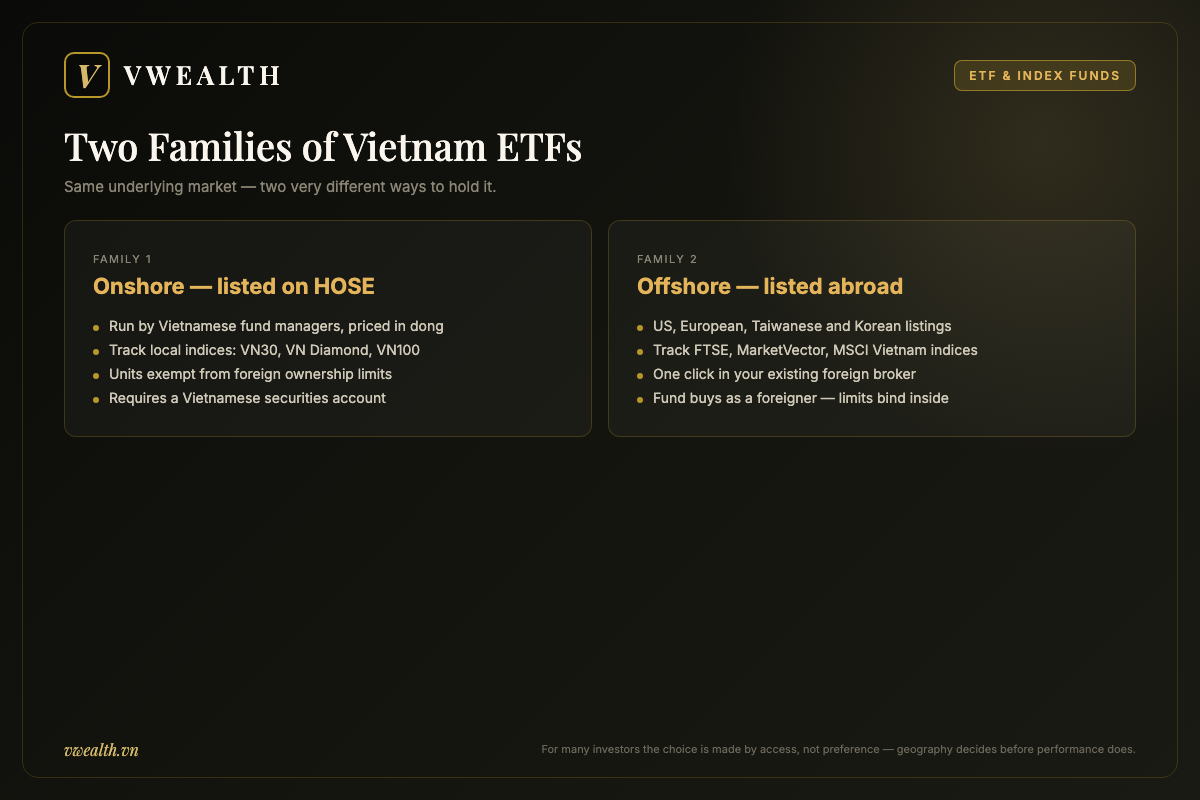
Third, access is genuinely split. A retail investor in Hanoi cannot easily buy a US-listed fund, and an investor in London cannot buy a HOSE-listed fund without opening a Vietnamese brokerage account. So the choice between onshore and offshore is not just a preference — for many people, geography and paperwork decide it before performance ever enters the picture.
The two families: onshore ETFs on HOSE versus offshore ETFs listed abroad
Onshore ETFs: domestic funds trading on the Ho Chi Minh Stock Exchange
Onshore Vietnam ETFs are created by Vietnamese fund management companies, regulated by Vietnam’s State Securities Commission, denominated in Vietnamese dong, and listed on HOSE, where they trade in board lots of 100 units during Vietnamese market hours. The two flagships come from Dragon Capital’s fund arm DCVFM: the DCVFMVN30 ETF (ticker E1VFVN30), which tracks the VN30 index, and the DCVFMVN Diamond ETF (ticker FUEVFVND), licensed in April 2020, which tracks the VN Diamond index; DCVFM also runs a mid-cap fund, the DCVFMVNMIDCAP ETF (FUEDCMID). Other managers fill out the shelf: SSIAM runs funds tracking the VNFIN LEAD financials index (FUESSVFL), VN30 (FUESSV30) and VNX50 (FUESSV50); Mirae Asset runs a VN30 fund (FUEMAV30); KIM Vietnam runs the KIM Growth VN30 ETF (FUEKIV30) and a KIM Growth VN Diamond ETF (FUEKIVND); and VinaCapital runs a VN100 fund (FUEVN100). That means four separate onshore ETFs track the VN30 alone. Lineups change over time — funds have launched and merged in this niche — so treat any list of tickers as a starting point and verify what currently trades on HOSE.
Buying an onshore ETF requires a Vietnamese securities account. For domestic investors that is trivial — the same account they already use for stocks. For foreign investors it means a trading code, a local custodian or broker, and dong currency conversion, the same setup described in our step-by-step guide on how to invest in the Vietnam stock market as a foreigner. That setup effort buys you something valuable, though: onshore ETF units themselves are generally not subject to foreign ownership limits, which is precisely why one family of onshore funds — the Diamond funds — became a favorite tool for foreign institutions. More on that shortly.
Offshore ETFs: foreign-domiciled funds listed in the US, Europe and Asia
Offshore Vietnam ETFs are created by international asset managers, domiciled outside Vietnam, and listed on foreign exchanges. As of mid-2026 the main names are: the VanEck Vietnam ETF (ticker VNM) and the Global X MSCI Vietnam ETF (VNAM), both US-listed; the KraneShares Dragon Capital Vietnam Growth Index ETF (KPHO), which listed on the NYSE in December 2025; the Xtrackers Vietnam Swap UCITS ETF listed in Europe (launched 2008, formerly named “Xtrackers FTSE Vietnam Swap” before a 2025 index change we cover below); the Fubon FTSE Vietnam ETF (00885) listed in Taiwan since April 2021; the Premia Vietnam ETF (2804) in Hong Kong; and Korean-listed funds such as the ACE Vietnam VN30 ETF (formerly KINDEX, run by Korea Investment Management since 2016), which tracks the VN30 synthetically. Each trades in its local market’s currency — US dollars, euros, Taiwan dollars, Korean won — during that market’s hours, and settles through that market’s infrastructure.
For most investors outside Vietnam, this is the low-friction route. If you already have a brokerage account in New York, London, Singapore or Taipei, you can own Vietnamese equity exposure in one click, with no Vietnamese paperwork, no trading code, and no dong bank account. The trade-off is a longer chain between you and the underlying stocks — extra layers of fees, index licensing choices made abroad, and structural workarounds for the ownership-limit problem that can pull the fund’s returns away from the market you think you are buying.
The comparison at a glance
| Dimension | Onshore ETFs (HOSE-listed) | Offshore ETFs (listed abroad) |
|---|---|---|
| Who can buy easily | Anyone with a Vietnamese securities account | Anyone with access to the listing exchange (US, EU, Taiwan, Korea…) |
| Trading currency | Vietnamese dong | USD, EUR, TWD, KRW and others |
| Typical benchmarks | VN30, VN Diamond, VN100, VNX50, VNFIN LEAD, mid-cap indices | FTSE Vietnam 30, STOXX Vietnam, MarketVector Vietnam Local, MSCI Vietnam Select, S&P Vietnam Core, VN30 |
| Trading hours | Vietnamese market hours | Listing market’s hours — often while HOSE is closed |
| FOL exposure | Units generally exempt from foreign ownership limits | Fund itself buys as a foreign investor, so FOLs bind at the portfolio level |
| Regulator | Vietnam’s State Securities Commission | SEC, European regulators, Taiwan FSC, etc., depending on domicile |
| Main hidden cost | Local account setup, dong conversion for foreigners | Tracking difference, time-zone premiums/discounts, FX layers |
What these funds actually track: VN30, VN Diamond, and the offshore index families
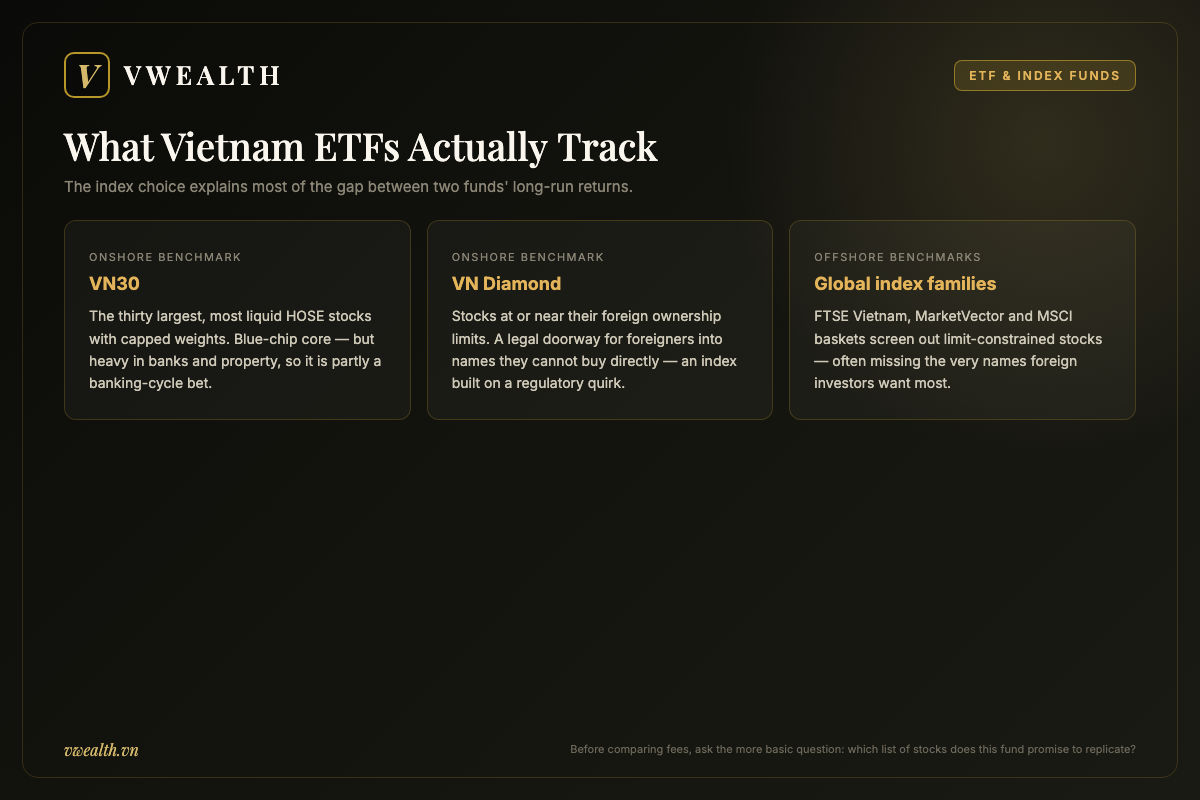
“Vietnam exposure” is not one thing. Two Vietnam ETFs can hold noticeably different baskets, and the index choice explains most of the long-run performance gap between funds. Before comparing fees or spreads, ask the more basic question: what list of stocks does this fund promise to replicate?
VN30: the blue-chip core of the market
The VN30 index contains roughly the thirty largest and most liquid stocks on HOSE, screened for free float — the portion of shares actually available to trade rather than locked up by the state or founders — and with a cap on any single stock’s weight so one giant cannot dominate the basket. It is the closest thing Vietnam has to a headline blue-chip index, heavy in banks, real estate and consumer conglomerates. Most onshore ETF assets and the Korean-listed Vietnam funds track it. If you want “the big end of the Vietnamese market, no more and no less”, VN30 is the default. Its concentration is also its weakness: financials often make up a very large share of the basket, so a VN30 fund is partly a bet on the Vietnamese banking cycle whether you intend that or not. Our comprehensive guide to the Vietnamese stock market walks through how the VN-Index, VN30 and the exchange structure fit together if those distinctions are new to you.
VN Diamond: the index built around the ownership-limit problem
The VN Diamond index is a uniquely Vietnamese invention, launched by HOSE in November 2019. It selects stocks that are at or near their foreign ownership limits — under the original rules, names with roughly 95% of their foreign room already filled, with caps on single-stock and sector weights; HOSE has since revised the methodology more than once (a version 3.0 rulebook now applies), so read the current index rules rather than an old summary. In other words, it holds the companies foreign investors most want but often cannot buy directly at scale. Because onshore ETF units are themselves exempt from those limits, a foreign institution that cannot buy a fully-owned bank stock on the exchange can instead buy units of a Diamond ETF that holds it. The fund becomes a legal doorway into FOL-constrained names. This is why the DCVFMVN Diamond ETF drew heavy foreign inflows after its launch: it solved an access problem, not just a diversification problem. The flip side is that the Diamond basket is defined by a regulatory quirk rather than by economic logic, so its sector mix can look odd, and if Vietnam ever relaxes ownership limits broadly, the index’s whole reason for existing weakens. That is not a prediction — it is a reminder that this index carries policy risk in its very design.
The offshore index families: FTSE, STOXX, MarketVector, MSCI, S&P
Offshore funds usually track indices built by global providers rather than by HOSE — and those benchmarks have been unusually restless lately, which is itself a lesson. The Fubon fund follows the FTSE Vietnam 30 Index, the thirty largest HOSE companies with a 10% cap per stock. The Xtrackers fund followed an FTSE Vietnam index for years, then switched its reference index to the STOXX Vietnam Total Market Liquid index in October 2025 and dropped “FTSE” from its name. The VanEck fund has tracked the MarketVector Vietnam Local Index since March 2023, which holds only companies incorporated in Vietnam — its older benchmark famously included foreign-listed companies with Vietnam revenue, which diluted the “pure Vietnam” exposure. The Global X fund follows the MSCI Vietnam Select 25-50 Index, and Hong Kong’s Premia fund swapped its MSCI benchmark for the S&P Vietnam Core Index in May 2024. Three of the six flagship offshore funds changed benchmarks within about three years — so re-read the index name on the factsheet even for a fund you think you know. These global indices apply their own liquidity screens and, crucially, their own treatment of foreign ownership limits: a stock with little room left under its FOL may be excluded or held at a reduced weight, because the index provider knows a foreign fund cannot realistically buy it in size. The practical consequence: an offshore Vietnam ETF often underweights or entirely misses some of the most sought-after Vietnamese companies, while an onshore Diamond fund overweights exactly those names. The one offshore exception proves the rule: the US-listed KraneShares KPHO fund, launched in December 2025, reaches FOL-constrained stocks indirectly — by holding units of the onshore Dragon Capital Diamond ETF inside its portfolio. Same country, very different baskets.
Foreign ownership limits and tracking difference: why your ETF may not match “the market”
Tracking difference is the gap between an index’s return and the fund’s actual return over a period. Tracking error, a related term, measures how volatile that gap is day to day. Every ETF has some tracking difference — fees alone guarantee it — but Vietnam adds mechanisms that make the gap wider and less predictable than in developed markets. Understanding them will save you from blaming a fund manager for what is really market structure.
The FOL premium problem
When a stock’s foreign ownership limit is fully used, foreigners who still want it must buy from other foreigners, often in negotiated off-exchange deals at a premium above the on-screen price. An offshore ETF that receives inflows must buy its index constituents as a foreign investor. If a constituent is FOL-full, the fund faces a painful menu: pay the premium, buy a substitute stock, hold extra cash, or use derivatives. Each choice pulls realized returns away from the index. Onshore funds do not face this at the portfolio level for domestic flows, which is one structural reason an onshore VN30 fund can track its index more tightly than an offshore fund tracks a similar basket.
Synthetic replication: tracking by contract instead of by ownership
One elegant workaround deserves its own explanation. The Xtrackers Vietnam fund is a swap-based, or synthetic, ETF: instead of holding all the Vietnamese stocks directly, it holds a basket of collateral and enters a swap — a contract with a bank that agrees to pay the fund the index’s return. The Korean-listed ACE Vietnam VN30 fund uses synthetic replication too. The fund’s tracking can be excellent because the bank contractually delivers the index performance, ownership limits and all. The cost is counterparty risk: you are relying on the swap provider honoring the contract, a risk that physical ETFs do not carry in the same form. European UCITS rules cap and collateralize this exposure, but you should know which type you own. The fund’s factsheet states it plainly — “physical/full replication” versus “synthetic/swap-based”.
Premiums and discounts: the time-zone effect
An ETF’s market price can drift above or below its net asset value (NAV) — the per-unit value of everything the fund holds. Specialized traders called authorized participants normally arbitrage this gap away by creating or redeeming ETF units. But a US-listed Vietnam fund trades while Ho Chi Minh City sleeps. Its price during US hours is the market’s live guess about where Vietnamese stocks will open next, not a mirror of their last close. So apparent premiums and discounts on offshore Vietnam ETFs are partly genuine price discovery and partly noise. Practical rule: judge an offshore fund’s premium or discount over weeks, not on a single day’s snapshot, and check the fund provider’s own premium/discount history page before assuming something is broken.
Cash drag, rebalancing friction and dividend timing
Smaller frictions pile on. Funds hold some cash for redemptions, and cash earns nothing when the market rallies — that is cash drag. Index rebalances force funds to trade on known dates in a market where liquidity is thin outside the top names, so rebalancing costs are higher than in developed markets. And dividends take time to travel from a Vietnamese company through custodians to the fund and finally to you, during which they are out of the market. None of these is scandalous; all of them are reasons to compare a fund’s five-year tracking difference — published in factsheets — rather than assuming the index return is what you will get.
Fees and costs: what to check instead of memorizing numbers
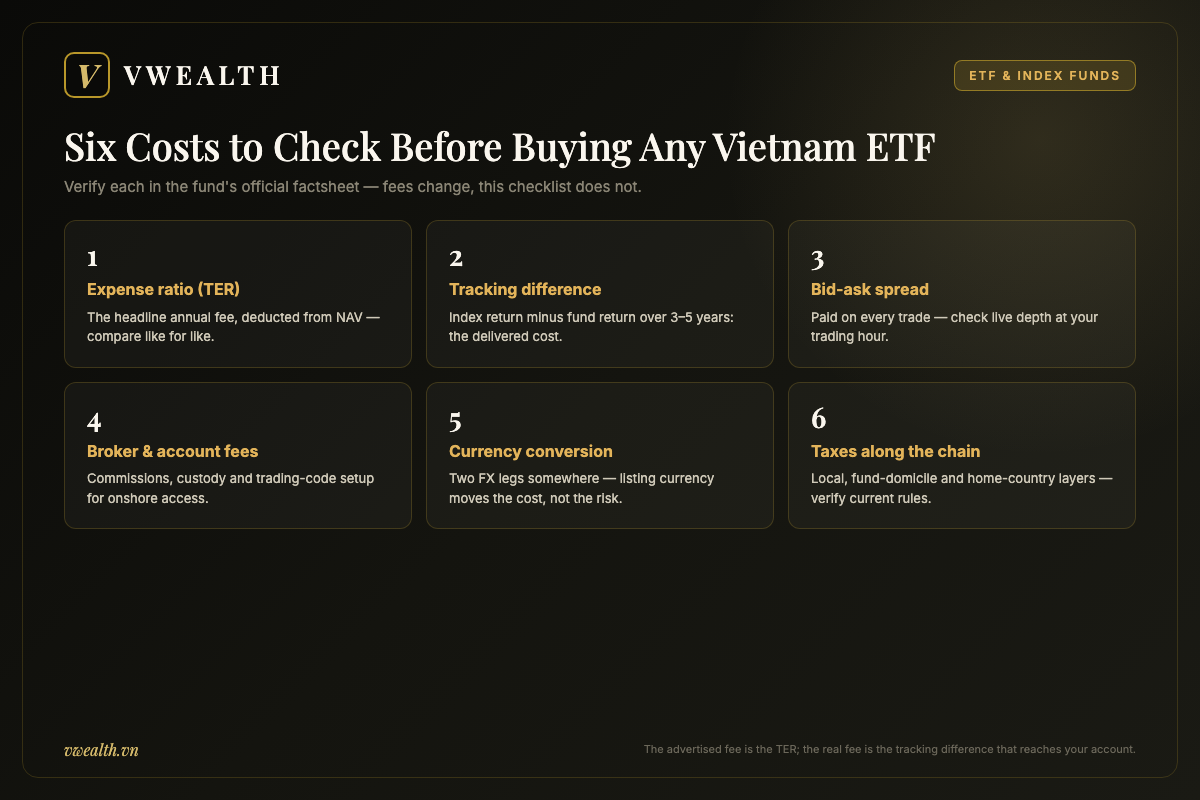
We deliberately do not quote specific expense ratios here. Fees change, share classes differ, and a number that was right when this article was written could be wrong when you read it. What does not change is the checklist of where costs hide. Work through these six items for any fund you shortlist, using the fund provider’s official factsheet and key information document as your source.
1. The total expense ratio (TER). This is the headline annual fee, expressed as a percentage of assets, deducted automatically from the fund’s NAV. Expect emerging-market single-country funds to cost meaningfully more than broad developed-market funds — that is normal — but compare like for like: an onshore VN30 fund against other onshore funds, an offshore fund against its offshore peers.
2. Tracking difference, the real fee. The TER is the advertised cost; tracking difference is the delivered cost. A fund with a higher TER but tighter tracking can leave you richer than a cheap fund that lags its index badly. Look up index return minus fund return over three and five years in the factsheet. This single number quietly aggregates fees, FOL frictions, rebalancing costs and cash drag.
3. Bid-ask spread. The gap between the price at which you can buy and the price at which you can sell, paid every time you trade. Thinly traded ETFs — including some smaller onshore funds and some offshore listings outside their home market — can have spreads that dwarf a year’s TER for an active trader. Check the live order book depth, not just reported volume.
4. Brokerage commissions and account costs. A Vietnamese brokerage account has its own fee schedule; so does your international broker. For foreigners buying onshore, add custodian fees and the cost of the trading-code setup to your mental math.
5. Currency conversion. Buying onshore means converting your money into dong and eventually back — two FX transactions whose spreads are a real cost. Buying offshore means your broker or you convert into the listing currency instead. Note carefully: the listing currency does not change your underlying exposure. A USD-listed Vietnam fund still rises and falls with the dong’s value against your home currency, because the assets inside are dong assets. The listing currency only determines where you pay the conversion cost, not whether you carry the currency risk.
6. Taxes on your side and inside the fund. Vietnam taxes securities transactions and dividends at the local level; your country of residence taxes your gains and income; and the fund’s domicile determines what withholding happens in between. These rules change and depend on your personal situation, so verify current rates with your broker or a tax adviser rather than relying on any article. The structural question to ask is simply: how many taxing points sit between a Vietnamese company’s dividend and my pocket, and does one route have fewer than the other?
Liquidity: why on-screen volume is not the whole story
ETF liquidity has two layers, and beginners usually only see the first. The visible layer is on-screen trading volume — how many units change hands daily. The invisible layer is the creation and redemption mechanism: authorized participants can manufacture new ETF units by delivering the underlying stocks to the fund, or dismantle units back into stocks. Because of this mechanism, an ETF’s true liquidity is closer to the liquidity of its underlying basket than to its own trading volume. A fund that trades quietly can still absorb a large order if its underlying stocks are liquid, because a market maker will simply create the units.
In Vietnam this cuts both ways. The top VN30 constituents are liquid by regional standards, so ETFs holding them inherit workable depth. But mid-cap constituents of broader indices can be thin, which makes unit creation costlier and shows up as wider spreads exactly when markets are stressed. Three practical liquidity checks before you buy any Vietnam ETF:
First, look at the spread at the time of day you actually trade, not the daily average. Spreads on cross-listed Asian ETFs often widen when the home market is closed. Second, for offshore funds, prefer trading during hours that overlap with Vietnamese trading when possible — for European listings that overlap exists in the morning; for US listings it never does, so use limit orders (orders that specify the maximum price you will pay) as a matter of routine. Third, for onshore funds, remember HOSE mechanics apply: 100-unit board lots, daily price bands that halt movement beyond a set percentage, and the local settlement cycle. These are the same mechanics covered in our walkthrough of opening an account and placing your first order in Vietnam, and they apply to ETF units just as they do to stocks.
One more structural note for large buyers: because onshore Diamond-style funds are the standard access route for foreign institutions blocked by ownership limits, their unit prices can themselves trade at premiums to NAV when foreign demand surges. You may find yourself paying an access premium for the fund exactly when everyone else wants the same door. Checking the fund’s live indicative NAV (iNAV) against the market price before ordering takes thirty seconds and can save you from overpaying by more than a year of fees.
Dividends and distributions: how cash actually reaches you
Vietnamese companies pay dividends in cash, in shares, or sometimes both, and the market has historically included generous cash payers among banks, utilities and consumer firms. What happens to those dividends inside an ETF depends on the fund’s distribution policy, and the two policies suit different investors.
An accumulating fund reinvests dividends back into the basket automatically. Your unit count stays the same but each unit quietly gets more valuable. This is administratively painless and compounds without effort, which suits long-term builders. A distributing fund pays dividends out to you as cash on a schedule. This suits income-focused investors but creates reinvestment homework and, in many jurisdictions, a taxable event on each payment.
Check three things in the fund documents. First, the policy itself — accumulating or distributing — which for European UCITS funds is usually written into the share-class name (the Xtrackers Vietnam fund’s main share class, for instance, is accumulating). Second, the benchmark type: some funds track a price index (which ignores dividends) while holding real stocks that pay real dividends, and the treatment of that dividend stream is a meaningful part of the fund’s economics. A fund can beat a price index simply because it pockets dividends the index ignores — that is not manager skill, it is index arithmetic. Third, withholding: dividends leaving Vietnam pass through local tax rules, and what survives the journey depends on the fund’s domicile and applicable treaties. Again, verify the current numbers; the durable lesson is that two funds tracking similar baskets can deliver noticeably different after-tax income streams purely because of plumbing.
Which route fits which investor: five common profiles
Abstract comparisons only go so far, so here are the five investor profiles we see most often, and how the onshore/offshore split typically resolves for each. Treat these as starting points, not verdicts.
The Vietnam-based retail investor
You live in Vietnam, earn dong, and already have or can easily open a local brokerage account. Onshore ETFs are the natural home: no currency conversion, familiar trading hours, local tax treatment, and direct exposure to the indices your financial news already discusses. The main reason you might add an offshore holding is the reverse of everyone else’s logic — to diversify away from Vietnam, not into it.
The foreign investor who wants one-click exposure
You have a brokerage account in the US, Europe or elsewhere in Asia, believe in Vietnam’s long-term growth story, and want exposure without paperwork. Offshore ETFs listed in your home market are the pragmatic answer. Accept the wider tracking difference as the price of convenience, choose between physical and synthetic replication deliberately, and use limit orders around the time-zone gap.
The committed foreign investor building a Vietnam allocation
You are willing to open a Vietnamese account — a process measured in weeks, not hours — because Vietnam is a core allocation for you, not a satellite. The onshore route rewards the effort: tighter tracking, access to Diamond-style funds that hold the FOL-constrained names offshore indices underweight, and the option to mix ETFs with direct stock positions later. The setup steps are covered in our guide to investing in the Vietnamese market from abroad.
The income-focused investor
Your priority is cash flow. Distribution policy now leads your comparison: you want distributing share classes, a clear dividend history, and a hard look at the withholding chain. You should also seriously compare ETFs against a hand-built basket of established Vietnamese dividend payers, because a direct portfolio lets you tilt toward payout quality in a way no broad index fund will.
The trader
You care about intraday liquidity, tight spreads and clean exposure to short-term moves in Vietnamese risk appetite. Offshore listings with active options markets or deep order books, and the largest onshore VN30 fund, are your candidates. TER barely matters at your holding period; spread and slippage are everything.
ETF or direct stocks? A decision framework in four questions
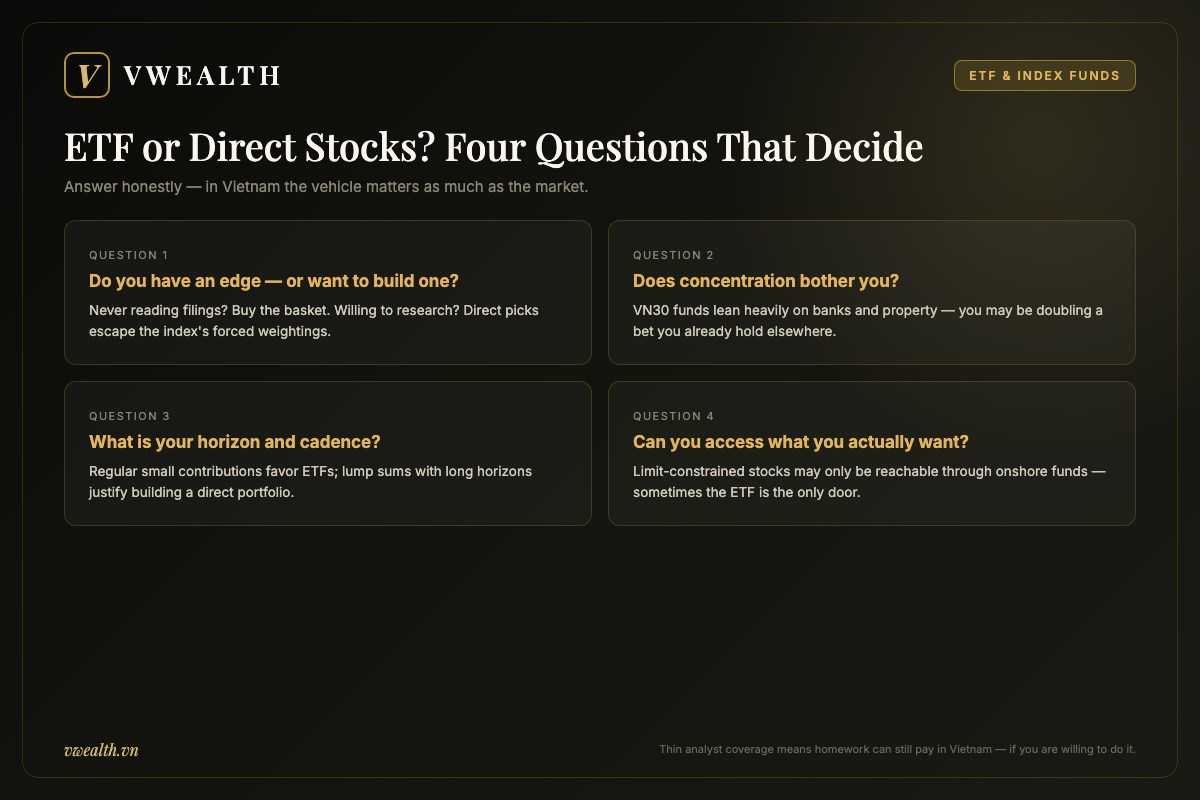
The deepest question is not which Vietnam ETF to buy, but whether an ETF is the right vehicle at all. Vietnam is a market where index funds carry unusual structural baggage — concentration in financials, FOL distortions, thin mid-cap liquidity — and where careful stock selection has real room to add value precisely because research coverage is thinner than in developed markets. Answer these four questions honestly.
Question 1: Do you have an edge, or want to build one? If you will never read a Vietnamese company’s financial statements, buy the basket and be done — a low-maintenance ETF beats neglected stock picks. If you are willing to learn to read reports, screen companies and value them, direct ownership lets you avoid the index’s forced weightings. Modern tools have collapsed the language barrier that used to make this impractical for foreigners: vwealth’s platform, for instance, turns Vietnamese-language filings and market data into full English analysis reports, which changes the calculus for question one entirely.
Question 2: How much does concentration bother you? A VN30 fund is heavily weighted to banks and property. If you already have emerging-market financials exposure elsewhere, adding a Vietnam ETF may double a bet you did not mean to make. Direct stocks — or a sector-specific onshore fund — let you shape the exposure.
Question 3: What is your time horizon and contribution pattern? Regular small contributions favor ETFs, where one trade buys the whole market and rebalancing is automatic. Lump-sum investors with long horizons can justify the fixed effort of building a direct portfolio.
Question 4: Can you access what you actually want? Sometimes the decision is made for you. The stocks foreign investors most want are often FOL-constrained, reachable only through onshore Diamond-style funds or negotiated premium purchases. If your target exposure lives behind the ownership limit and you cannot open a local account, the ETF is not just convenient — it is the only door. Our explainer on foreign ownership limits and the workarounds investors use maps those doors in detail.
| Your situation | Leaning | Why |
|---|---|---|
| No time for research, want market exposure | ETF (either family) | Diversification and discipline without maintenance |
| Abroad, no local account, satellite position | Offshore ETF | One click in your existing broker; accept tracking gap |
| Abroad, core allocation, willing to do paperwork | Onshore ETF, then stocks | Tighter tracking, Diamond access, upgrade path to direct picks |
| In Vietnam, starting out | Onshore ETF core + learning | Local access is free; build stock skills alongside |
| Research-driven, wants to beat the index | Direct stocks | Thin analyst coverage leaves room for homework to pay |
A pre-purchase checklist for any Vietnam ETF
Whichever family you choose, run this ten-point checklist against the fund’s official documents before you place the order. It takes under an hour and covers every failure mode discussed in this article.
1. Read the factsheet’s index name exactly — VN30, VN Diamond, FTSE Vietnam 30, STOXX Vietnam, MarketVector Vietnam Local, MSCI Vietnam Select, S&P Vietnam Core — and look up that index’s current top-ten holdings and sector weights; remember that three offshore Vietnam funds changed benchmarks between 2023 and 2025, so an old factsheet may describe a fund that no longer exists in that form. 2. Check replication method: physical or synthetic. 3. Compare fund return versus index return over three and five years — the tracking difference — rather than trusting the TER alone. 4. Check the current TER in the key information document, since fees change. 5. Look at the live bid-ask spread at your intended trading time. 6. Check the premium/discount history against NAV, especially for offshore listings. 7. Confirm the distribution policy — accumulating or distributing — and the dividend treatment of the benchmark. 8. Map the tax chain for your residency: local Vietnamese taxes, fund-domicile withholding, home-country treatment. 9. Confirm the fund’s size and age; very small or very new funds carry closure risk, and single-country fund lineups genuinely do change — products in this niche have closed before. 10. Decide your order type in advance: for anything with a wide or unstable spread, use limit orders, never market orders.
If a fund fails one item, that is a discussion; if it fails three, keep looking. The Vietnam ETF shelf is small enough that you can realistically run this checklist on every candidate in an afternoon.
Key takeaways: choosing your door into the Vietnamese market
Vietnam offers two genuinely different ETF families rather than one commoditized product. Onshore funds on HOSE track local indices tightly, sidestep foreign ownership limits at the unit level, and reward investors willing to open a Vietnamese account — but demand that setup effort and dong conversion. Offshore funds in New York, Europe and Asia offer one-click convenience through your existing broker, at the price of wider tracking differences, time-zone premiums and index methodologies that underweight the very stocks foreigners most want. The index choice — VN30’s bank-heavy blue chips, VN Diamond’s FOL-constrained favorites, or the global providers’ filtered baskets — matters more than small fee gaps. Hanging over all of it is the FTSE Russell upgrade: Vietnam formally joins FTSE’s emerging-market indices from 21 September 2026, a one-off structural event that passive money has been positioning around since the October 2025 announcement, even as MSCI keeps Vietnam in its frontier bucket for now. And for investors willing to do real research, the honest answer may be that the best Vietnam “fund” is the one you build yourself from individual companies, now that language and data barriers have largely fallen.
Whatever route you take, verify the current numbers — fees, holdings, premiums, tax rates — in the fund’s own documents, because in this market the details move. This article is analysis for educational reference only, not investment advice or a recommendation to buy any security.
Research Vietnamese stocks in English with vwealth. Our AI-powered platform turns Vietnamese market data into full English analysis reports — with international payment support and a free 2-month trial for new accounts. Create your free account and read the latest reports.