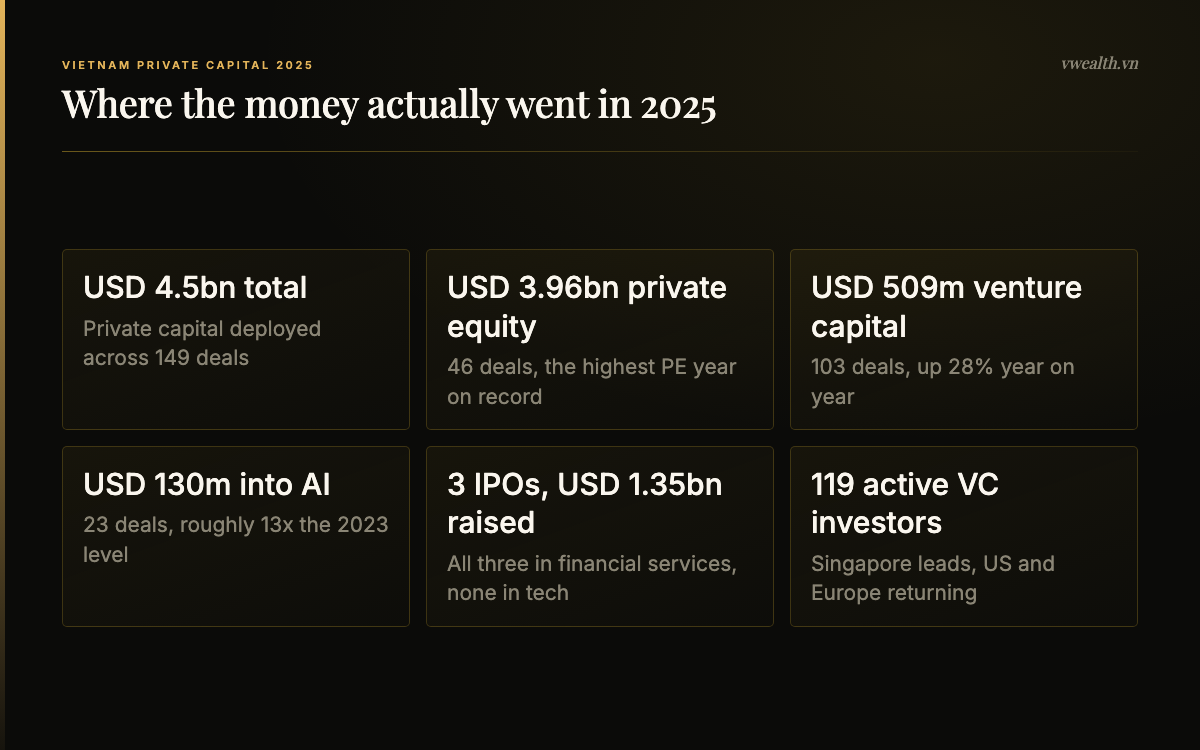
Venture capital in Vietnam is a small, concentrated, and rapidly professionalising market: roughly USD 509 million was deployed across 103 venture deals in 2025, up 28 per cent year on year, inside a total private capital market of USD 4.5 billion across 149 deals, according to the Vietnam Innovation & Private Capital Report produced by the National Innovation Center, the Vietnam Private Capital Agency and BCG. The money is arriving faster than the exits are, which is why almost every serious conversation about Vietnamese venture eventually becomes a conversation about the public market. This guide covers the real numbers, who is writing cheques, which sectors are hot, how a foreign investor can legally get money in, and how the exit door actually works.
The size of the market: what the 2025 numbers really say
Start with the headline. Vietnam’s private capital market rebounded hard in 2025 after two years of correction. Total deployment reached USD 4.5 billion across 149 deals, of which private equity accounted for USD 3.96 billion across 46 transactions — the highest PE year Vietnam has ever recorded, with deal volume doubling from 23 transactions in 2024. Venture capital, the part most foreign founders and early-stage investors care about, came in at USD 509 million across 103 deals, a 28 per cent increase in value even though the deal count fell from 122. These figures come from the Vietnam Innovation & Private Capital Report, compiled by the National Innovation Center (NIC), the Vietnam Private Capital Agency (VPCA) and Boston Consulting Group, with Do Ventures as research partner, and reported in detail by TNGlobal.
Read that split carefully, because it is the single most important structural fact about Vietnamese venture right now. Nearly 88 per cent of the private capital deployed in Vietnam in 2025 was private equity, not venture. Vietnam is not, at this stage of its development, primarily a venture market. It is a growth-and-buyout market with a venture layer attached. That has consequences for everything downstream, from valuation discipline to exit timing.
Why two credible data sets disagree
If you research this market for more than an afternoon you will find a second, much smaller number. A report by VinVentures, summarised by The Investor in February 2026, counted roughly 41 venture deals in 2025 with total disbursed capital of about USD 215 million, with the top ten transactions capturing USD 154 million, or 72 per cent of the total. That is less than half the NIC/VPCA/BCG figure.
Both can be right. The gap is methodology, not honesty. The wider number includes deals that the narrower one excludes: rounds into companies with Vietnamese founding teams but offshore domiciles, undisclosed or estimated round sizes, some corporate venture activity, and transactions at the blurry border between late-stage venture and growth equity. The narrower number counts confirmed, disclosed, Vietnam-domiciled venture disbursements.
The practical lesson for a foreign investor is simple and worth internalising before you read any Vietnam market statistic again: always ask what was counted. In a market this small, a single USD 50 million round moves the annual total by ten per cent. Trend direction is far more reliable than level, and both data sets agree on direction — capital is coming back, and it is concentrating.
Concentration is the defining feature
Whichever data set you use, a handful of deals dominate. The top ten funded Vietnamese startups of 2025, per The Investor’s summary of the VinVentures data, were Coolmate (direct-to-consumer fashion, USD 22.34 million), Manabie (education technology, USD 22.26 million), Dat Bike (electric motorbikes, USD 22 million), CME Solar (USD 20 million), OKXE Vietnam (USD 14.5 million), Orochi Network (USD 12 million), Ephyra/GameBeast (USD 10.5 million), AI Hay (USD 10 million), Galaxy Education (USD 10 million) and Kyna English (USD 10 million).
Notice what is missing from that list: there is no USD 100 million round. Vietnam’s largest venture cheques in 2025 sat in the USD 10–25 million band. If your fund model requires deploying USD 40 million into a single Series C in a single country, Vietnam will frustrate you. If you are writing USD 1–15 million cheques into Series A and B, this is a market where your money still buys meaningful ownership.
The stage mix tells you where the ecosystem actually is
Inside that USD 509 million, the NIC/VPCA/BCG data breaks down into roughly 70 pre-Series A deals, 23 Series A deals, and six Series C or later — the highest late-stage count since 2022. Read from the bottom up, that is a healthy seed layer. Read from the top down, it is a market where fewer than ten companies a year reach genuine scale financing.
That shape produces the characteristic Vietnamese founder complaint: the Series B gap. There is enough seed capital, a reasonable amount of Series A capital, and then a cliff. Companies that need USD 20–40 million to consolidate a category often have to look to Singapore, Japan, Korea or the United States for the round, which in turn reinforces the offshore holding structures discussed below.
Why capital came back: the macro case
Vietnamese venture did not recover because venture investors suddenly rediscovered their courage. It recovered because the underlying economy gave them a reason.
Vietnam’s GDP grew an estimated 8.02 per cent in 2025, with fourth-quarter growth of 8.46 per cent, according to the National Statistics Office — the second-highest annual growth rate in the 2011–2025 period. That is the kind of nominal growth that lets a mediocre company look like a good one and a good company look extraordinary, which is exactly the environment in which venture returns are manufactured.
The digital economy underneath it is scaling too. The e-Conomy SEA 2025 report from Google, Temasek and Bain, published in November 2025, put Vietnam’s digital economy gross merchandise value at USD 39 billion for 2025, up from USD 34 billion in 2024, with e-commerce at USD 25 billion (up 17 per cent), online media at USD 6 billion, transport and food at USD 5 billion, and online travel at USD 4 billion. Vietnam ranked as the second-fastest-growing digital economy in Southeast Asia.
And then there is the public market, which had an extraordinary year. Per the NIC/VPCA/BCG report as summarised by Vietnam News, the VN-Index delivered a roughly 41 per cent return in 2025, the strongest equity performance in ASEAN. Public-market strength is not a side note for venture investors. It resets the valuation anchor for every private round, it revives the IPO conversation, and it makes limited partners more willing to fund the asset class. If you want the underlying mechanics of that index and how the exchanges are organised, our explainers on how the Vietnam stock market works and on HOSE, HNX and UPCoM cover the plumbing.
Who is actually writing cheques
The NIC/VPCA/BCG report counted 119 active venture investors in Vietnam in 2025 and 48 active private equity investors, the highest PE participation in nearly a decade. Singapore-based investors held the largest share of venture activity, American and European investors returned after a quiet stretch, and Japanese investors resumed participation. The domestic private equity base held steady at around ten firms.
Domestic venture funds
The homegrown layer has thickened considerably since 2020. Do Ventures, founded by Le Hoang Uyen Vy — who also chairs the VPCA — is the most visible domestic early-stage firm and a research partner on the national private capital report. ThinkZone Ventures, Touchstone Partners, Ascend Vietnam Ventures and VIC Partners occupy adjacent seed-to-Series-A territory. These firms matter to a foreign investor for a reason that has nothing to do with cheque size: they do diligence in Vietnamese, on the ground, on companies whose real operating history is not written down in English anywhere.
Domestic funds also face a structural constraint. VietnamNet reported in 2024, citing ThinkZone data, that around 40 domestic investment funds had been established under Decree 38/2018 with combined charter capital of just over VND 100 billion — roughly USD 4.1 million in total. The onshore fund vehicle exists, but almost nobody uses it for meaningful capital. Domestic firms of any scale raise offshore.
Corporate and state-backed capital
Corporate venture has become a real force. Vingroup launched VinVentures in October 2024 with USD 150 million under management — USD 100 million inherited from Vingroup’s existing portfolio and USD 50 million to be deployed over three to five years — targeting artificial intelligence, semiconductors and cloud infrastructure at seed and Series A. The strategic pitch is access to Vingroup’s ecosystem as a testing ground, which in a market where distribution is the hard part is not a trivial offer.
The state has also stepped in, though at modest scale so far. A national venture capital fund was created under Decree 264/2025/ND-CP, issued in October 2025, with an initial VND 500 billion (about USD 19.1 million) from the state budget and a charter capital target of at least VND 2 trillion, as reported by DealStreetAsia. The Ministry of Science and Technology has separately proposed a USD 100 million national venture fund for 2026–2028, explicitly modelled on Israel’s Yozma programme, per TNGlobal.
At city level, Ho Chi Minh City is establishing a VND 500 billion (about USD 19.7 million) venture fund due to begin operating in 2026, with VND 200 billion from the city budget and VND 300 billion from private investors. Founding investors committed to the vehicle include Sovico Group, Vingroup, VinaCapital, Becamex IDC, VNG Corporation, CT Group, Hoa Sen Group, Lotte Ventures Vietnam and FPT Corporation, according to VnExpress International. By 2030 the fund aims to attract at least VND 1.5 trillion in private capital and help expand Vietnam’s venture market to USD 1.5 billion.
Treat these public vehicles as signalling rather than as a source of capital you will compete with. Twenty million dollars does not move a market. A government publicly committing to co-invest alongside private funds does change how domestic corporates and family offices think about the asset class.
Regional and international funds
Most of the actual money is regional. Singapore-headquartered and pan-Southeast Asian firms — Golden Gate Ventures, Jungle Ventures, Openspace Ventures, Wavemaker Partners, East Ventures, Monk’s Hill Ventures — treat Vietnam as one country allocation inside a regional mandate. Japanese and Korean investors, including Genesia Ventures, CyberAgent Capital, Nextrans and Lotte Ventures, have been consistently present, often with a corporate-strategic angle. Global platforms such as 500 Global and Peak XV Partners appear in larger rounds.
The practical implication for a founder or a co-investor: a Vietnamese company that wants an institutional Series A is almost always raising from someone whose fund is domiciled outside Vietnam, whose LPs are outside Vietnam, and whose legal template assumes a Singapore or Cayman holding company. That is not a preference. It is the market’s default, and it shapes the legal structuring discussed next.
Hot sectors: where the money is going
Artificial intelligence
AI is the clearest trend in the data. The NIC/VPCA/BCG report recorded USD 130 million into AI across 23 deals in 2025, roughly thirteen times the USD 10 million level of 2023. The prior year’s edition of the same report had already flagged an eight-fold jump from USD 10 million to USD 80 million. AI Hay, a Vietnamese-language AI search product, raised USD 10 million; NamiTech raised a Series A; LEXengine, MovianAI, Dutycast and Fastrak AI were among the other named AI and AI-adjacent rounds.
Be sceptical in the right way here. A large share of what is labelled AI in Vietnam is applied AI on top of existing workflows — document processing, customer service, logistics optimisation — rather than model development. That is not a criticism. Applied AI in a market with 100 million people and low white-collar automation penetration is a perfectly good business. But do not price it as if it were foundation-model research.
Healthcare, business automation and consumer
Healthcare drew USD 170 million in venture funding in 2025, the largest single venture sector by value. Business automation took USD 122 million, retail USD 67 million (up 81 per cent year on year), and climate technology USD 35 million (up 52 per cent). On the private equity side the sector mix was different again: consumer staples took USD 1.2 billion, the largest in a decade; healthcare USD 877 million, up 63 per cent; real estate USD 673 million after receiving essentially nothing in 2024; and consumer discretionary USD 279 million.
One sector went to zero. Financials received no private equity investment in 2025 after taking USD 852 million in 2024 — not because the sector became unattractive, but because Vietnamese financial institutions raised in the public market instead. That is a preview of the IPO discussion below, and it is also why anyone serious about Vietnam should understand how the banking sector works, since banks and brokers are where a large share of Vietnam’s formal capital formation happens.
Climate technology and e-mobility
Climate is small in absolute terms but structurally interesting. Dat Bike raised USD 22 million for electric motorbikes, CME Solar USD 20 million for business-to-business solar under a power purchase agreement model, and Alterno and Stride were among the other climate rounds. Vietnam has 100 million people, a motorbike-first transport culture, high and rising electricity demand, and a manufacturing base. The thesis writes itself; the difficulty is that hardware and infrastructure businesses need far more capital than Vietnam’s venture layer can currently supply, which pushes them toward strategic and development-finance money.
Legal structure basics for foreign investors
This section is orientation, not legal advice. Vietnamese investment law changes frequently and the details matter enormously; retain Vietnamese counsel before you commit capital. What follows is the map you need in order to ask counsel the right questions.
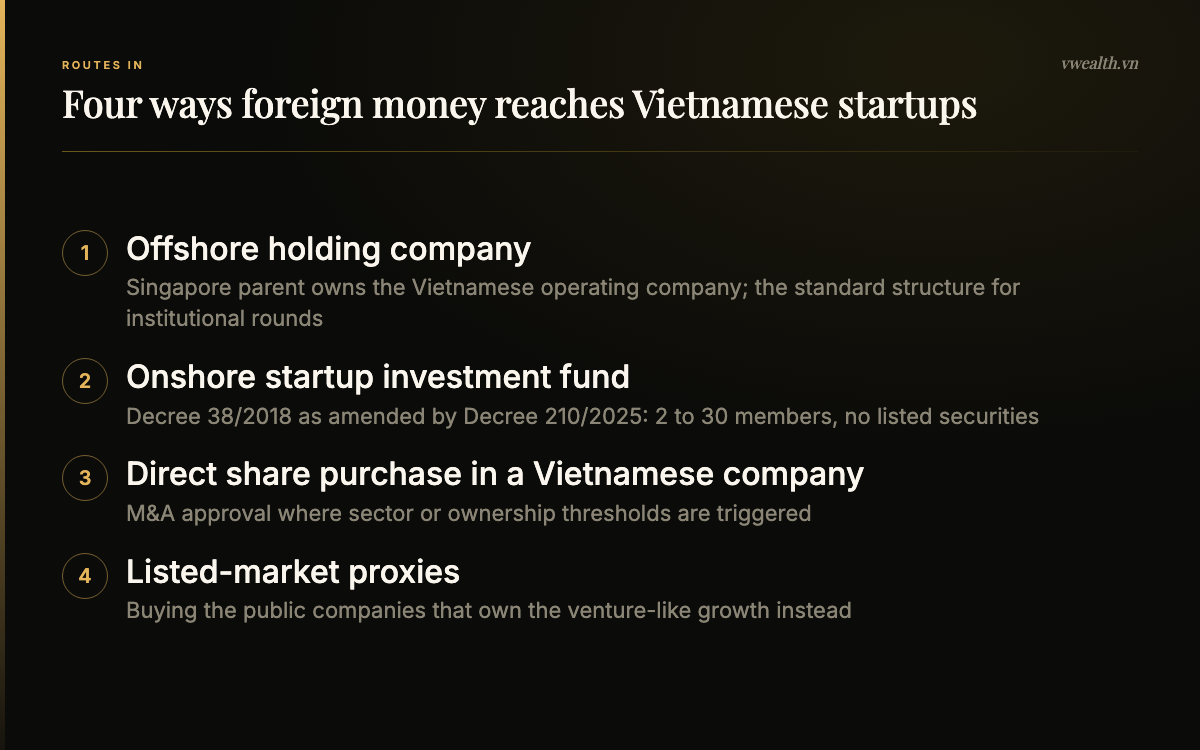
The offshore holding company: the market default
The dominant structure for institutional venture rounds is an offshore parent, usually incorporated in Singapore, which owns the Vietnamese operating company. VietnamNet reported in June 2024, citing ThinkZone, that about 90 per cent of venture capital going into Vietnamese innovative startups is foreign capital from foreign funds, and that foreign investors typically require Vietnamese founders to restructure and establish a parent company abroad before investing.
The reasons are prosaic. Offshore holding structures give investors familiar preferred-share mechanics, liquidation preferences, drag-along and tag-along rights, and convertible instruments that are cleanly enforceable under a legal system their LPs already understand. They simplify multi-round cap tables, they make a future offshore trade sale or listing feasible, and they avoid repeated Vietnamese regulatory filings each time the ownership changes.
The costs are equally real. The restructuring itself requires Vietnamese founders to complete outbound investment procedures — a process that takes time and creates its own compliance obligations. Transfer pricing between the offshore parent and the Vietnamese operating entity has to be defensible. And the structure does nothing to change the fact that the operating risk, the customers and the regulators are all in Vietnam.
The onshore route: Decree 38/2018 as amended by Decree 210/2025
Vietnam does have a domestic venture fund vehicle. Decree 38/2018/ND-CP created the innovative startup investment fund, formed from contributed capital of private investors, capped at 30 members, and required to be managed by a fund management company established or hired by the investors.
Decree 210/2025/ND-CP amended that framework with effect from 15 September 2025, and the changes are worth knowing. As summarised by ATA Legal, the amended decree sets a minimum of two members and retains the maximum of 30; broadens permitted capital contributions to include cash, gold, land use rights, intellectual property, technology and technical know-how; and, for the first time, allows investors to use borrowed funds for capital contributions. Funds may now invest in convertible instruments and share purchase rights, not only direct equity and deposits.
The prohibitions are equally instructive. An onshore startup investment fund may not use fund capital or assets to invest in listed shares, shares registered for trading, bonds or fund certificates. It may not invest in itself, may not conduct commercial lending, and may not guarantee returns. In other words: this is a pure private-company vehicle, deliberately walled off from the securities market.
Buying directly into a Vietnamese company
The third route is a straightforward share purchase or capital contribution into a Vietnamese joint-stock company or limited liability company. Foreign investors have that right, but it comes with a conditional-sector and market-access overlay: certain lines of business restrict foreign ownership, and certain transactions require prior M&A approval from the provincial licensing authority before the share transfer can be registered.
Vietnam overhauled this framework with the Investment Law 2025 (Law No. 143/2025/QH15), which took effect on 1 March 2026. According to Mori Hamada & Matsumoto, it is the most significant revision of the foreign investment regime in a decade: it liberalises several conditional sectors, permits foreign investors to establish an enterprise before obtaining an investment registration certificate for a project, and shifts parts of the regime from pre-approval to post-registration oversight. Sector caps on foreign ownership have not disappeared — banking, telecommunications and transport all retain limits — and if you are also looking at listed companies, our explainer on foreign room in Vietnamese stocks covers how those caps behave in practice.
The policy tailwind: Resolution 57, Resolution 68 and the digital technology law
Vietnam passed the Law on Digital Technology Industry on 14 June 2025, effective 1 January 2026 — the first standalone national law anywhere dedicated exclusively to the digital technology industry, covering semiconductors, artificial intelligence and digital assets across six chapters and 51 articles. Per Vietnam Briefing, it offers domestic startups subsidies of up to 50 per cent on technology acquisition and prototype development, grants tax incentives comparable to those available in specially disadvantaged areas, and sets a target of 150,000 digital technology businesses by 2035. The law sits alongside Resolution 57-NQ/TW on science, technology and innovation and Resolution 68-NQ/TW on private sector development.
Policy tailwinds are real but slow. Do not underwrite a deal on the assumption that a subsidy will arrive on schedule. Underwrite the business, and treat the policy as optionality.
The exit landscape: the genuinely hard part
Vietnam’s entry problem is solvable with lawyers. Its exit problem is structural, and it is the single most common reason experienced emerging-market investors pass.
IPOs on HOSE: open for finance, closed for technology
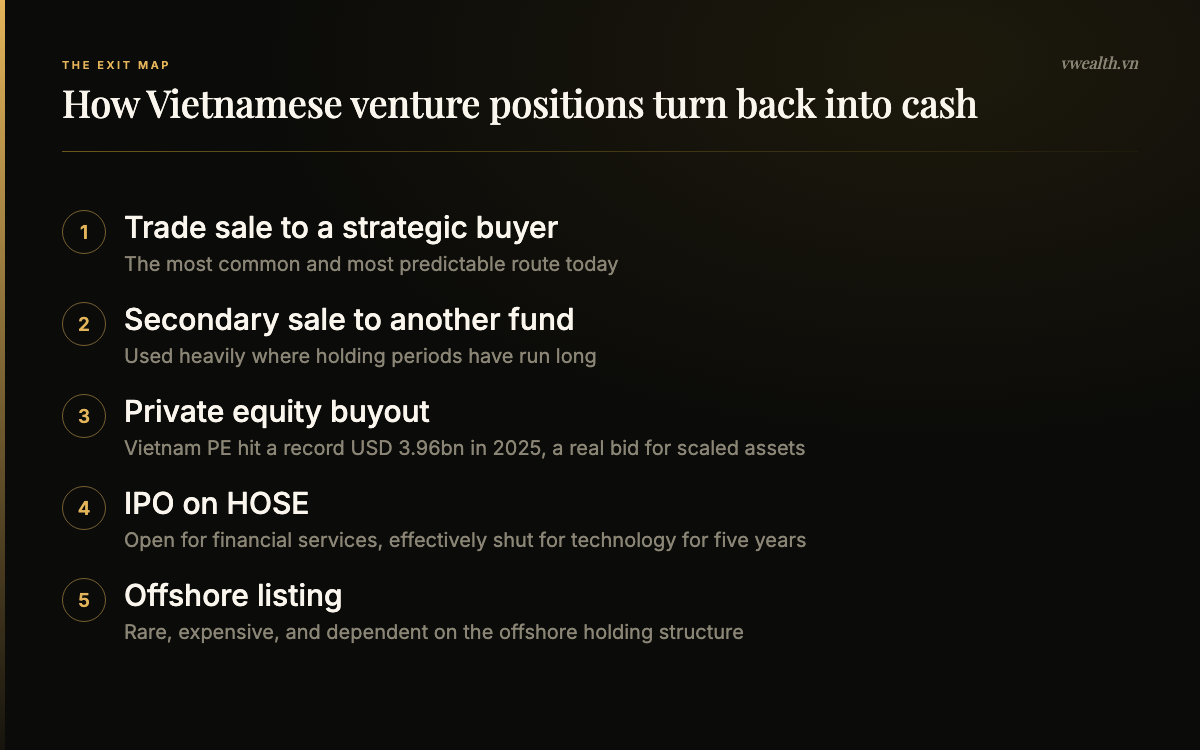
2025 was a genuinely strong year for Vietnamese IPOs — if you were a financial institution. Three IPOs raised USD 1.35 billion, up from a single IPO raising USD 37 million in 2024, and all three were in financial services. The largest was Techcom Securities (TCBS), which raised roughly USD 525 million and listed on the Ho Chi Minh Stock Exchange on 21 October 2025, with more than 2.3 billion shares beginning trading at a reference price of VND 46,800 and an initial market capitalisation of about VND 108 trillion, according to YKVN, which advised on the transaction. VPBank Securities followed, selling 375 million shares at VND 33,900 to raise more than VND 12.71 trillion, about USD 483 million, per The Investor.
And technology? Zero technology company IPOs in 2025 — and, according to the NIC/VPCA/BCG report, consistently zero for five years. That is the central fact of Vietnamese venture. You can fund a technology company in Vietnam. You cannot currently list one there. The report projects an IPO pipeline of USD 3–5 billion for 2026–2027, which would be a step change if it materialises, but a projected pipeline is not an exit.
Trade sales and secondaries do the real work
In the absence of a technology IPO market, Vietnamese venture exits happen through trade sales to strategic buyers and secondary sales to other funds. Tracxn’s half-year 2025 report on the Vietnamese technology ecosystem counted 76 all-time exits — 52 acquisitions and 24 IPOs — against all-time funding of USD 3.2 billion and six all-time unicorns: VNG, VNLife, VNPAY, MoMo, Sky Mavis and Tiki.
Seventy-six exits over the entire history of the ecosystem is a small number, and it explains the behaviour you will observe in Vietnamese cap tables: long holding periods, frequent secondary transfers between funds, and structured downside protection in term sheets that would look aggressive in a market with reliable liquidity.
The record private equity year is genuinely good news on this front. USD 3.96 billion of PE deployment across 46 deals, with 12 mid-market transactions between USD 100 million and USD 300 million absorbing USD 2.3 billion, means there is now a real bid for scaled Vietnamese assets. For a venture investor, a growing PE market is an exit market.
Why public-market liquidity matters even to a private investor
Here is the connection that most Vietnam venture write-ups skip. A functioning public market does three things for private investors, none of which require anyone to actually go public.
First, it sets the terminal valuation. Every discounted cash flow and every comparable-multiple analysis on a private Vietnamese company eventually references what similar listed companies trade at. When the VN-Index rises 41 per cent, private valuation expectations rise with it. When it falls, term sheets get re-cut.
Second, it creates the strategic buyer. The most likely acquirer of a Vietnamese growth company is a larger Vietnamese listed company, and that buyer’s ability to pay depends on its own share price and its access to equity issuance. A strong public market funds acquisitions.
Third, it opens the eventual IPO door. The financial-services listings of 2025 demonstrated that HOSE can absorb billion-dollar offerings. The question is whether that capacity extends to technology issuers with loss-making histories and unconventional share structures. That will require both regulatory accommodation and investor appetite.
How Vietnamese venture connects to the listed market
For most international investors reading this, the honest answer is that the listed market, not the venture market, is the practical way to own Vietnamese growth. Three reasons.
The first is capacity. Vietnam’s entire venture market absorbed about half a billion dollars in 2025. A single mid-sized global emerging-market fund cannot deploy meaningfully into that without becoming the market.
The second is the FTSE Russell reclassification. On 7 October 2025, FTSE Russell announced that Vietnam would be upgraded from Frontier to Secondary Emerging market status, and the change takes effect from the open on Monday 21 September 2026 following the March 2026 semi-annual review, as confirmed by FTSE Russell. The upgrade followed the removal of the prefunding requirement for foreign institutional investors and the establishment of a formal failed-trade process. The NIC/VPCA/BCG report suggests the reclassification could unlock USD 5–8 billion in new inflows — an order of magnitude more than the entire venture market. We cover the mechanics and the likely beneficiaries in our note on the FTSE Russell market upgrade.
The third is that the listed market already contains much of the growth story. Vietnam’s largest technology, consumer, retail and financial platform businesses are listed, not private. If your thesis is Vietnamese consumption, digitalisation or financial deepening, you can express it in liquid, custodied, daily-priced securities. Our guides to what foreign funds actually hold in Vietnam and to the best Vietnam ETFs show what that exposure looks like in practice.
None of this argues against venture investment in Vietnam. It argues for clarity about what you are buying. Venture here is a concentrated, illiquid, relationship-driven allocation with a long and uncertain exit horizon. The listed market is the liquid expression of the same macro thesis. Most investors should size the first as a satellite and the second as the core.
Risks you should price explicitly
Exit risk. Five consecutive years with no technology IPO is not a temporary anomaly, it is the base rate. Underwrite trade sale and secondary exits as your primary path and treat any listing as upside.
Structure risk. The offshore holding structure that makes your investment enforceable also puts a legal layer between you and the operating assets. Understand exactly what the Singapore entity owns, how the Vietnamese subsidiary is capitalised, and whether intercompany arrangements would survive scrutiny.
Data risk. As the 41-deals-versus-103-deals gap shows, even headline market statistics vary by a factor of two depending on methodology. Company-level data is worse. Verify revenue independently, and be careful with gross merchandise value as a metric.
Regulatory change risk. The Investment Law 2025, Decree 210/2025 and the Law on Digital Technology Industry all took effect within roughly six months of each other. The direction of travel is liberalising, but the pace of change means that structures set up under the old regime may need review.
Concentration risk. When ten deals account for over 70 per cent of annual venture funding, the market is a handful of companies plus a long tail. Portfolio construction assumptions built on deeper markets will not transfer.
Currency and repatriation risk. Returns are earned in dong and, for most foreign LPs, measured in dollars. Confirm the profit-repatriation path and the tax treatment of your exit at the point of investment, not at the point of exit.
Governance risk. Related-party transactions, informal shareholder arrangements and incomplete historical records are common in fast-growing private Vietnamese companies. Diligence budgets that would be adequate in a developed market are not adequate here.
Pulling it together
Venture capital in Vietnam in 2026 is a real, growing, but small and structurally unusual market. The permanent features are worth committing to memory: private equity dwarfs venture; venture cheques cluster in the USD 1–25 million range; the seed layer is healthy and the Series B layer is thin; AI, healthcare, business automation and climate are where growth capital is going; the offshore holding company is the default legal structure and the onshore fund vehicle is deliberately walled off from securities; and the exit door is trade sales and secondaries, not IPOs.
The perishable numbers — this year’s deal count, this year’s totals, the current state of the IPO pipeline, the post-upgrade foreign flow data — should be pulled fresh from primary sources rather than trusted to memory or to any article, this one included. The 2025 figures cited here come from the NIC, VPCA and BCG report, the VinVentures data as reported by The Investor, FTSE Russell’s own classification notices, Vietnam’s National Statistics Office, and the Google, Temasek and Bain e-Conomy SEA report. Each publishes on its own cycle, and each will have updated by the time you act.
This article is analytical reference material, not investment advice; always do your own research and consider your personal risk tolerance before committing capital to any private or public security.
Research Vietnamese stocks in English with vwealth. Our AI-powered platform turns Vietnamese market data into full English analysis reports — with international payment support and a free 2-month trial for new accounts. Create your free account and read the latest reports.
Frequently Asked Questions
How big is the venture capital market in Vietnam?
Venture capital investment in Vietnam reached about USD 509 million across 103 deals in 2025, up 28 per cent year on year, inside a total private capital market of USD 4.5 billion across 149 deals, according to the Vietnam Innovation & Private Capital Report from the National Innovation Center, the Vietnam Private Capital Agency and BCG. A narrower count by VinVentures, which excludes offshore-domiciled and undisclosed rounds, put 2025 venture disbursement at about USD 215 million across 41 deals.
Which sectors attract the most venture capital in Vietnam?
In 2025 healthcare led venture funding by value at USD 170 million, followed by artificial intelligence at USD 130 million across 23 deals, business automation at USD 122 million, retail at USD 67 million and climate technology at USD 35 million. AI was the fastest-growing category, up roughly thirteen times from the USD 10 million recorded in 2023.
Can a foreign investor invest directly in a Vietnamese startup?
Yes, but most institutional rounds are done through an offshore holding company, usually in Singapore, which owns the Vietnamese operating entity. Direct share purchases into a Vietnamese company are permitted and can require prior M&A approval where sector conditions or ownership thresholds apply. Vietnam also has an onshore startup investment fund vehicle under Decree 38/2018, amended by Decree 210/2025, which allows two to 30 members but prohibits investing in listed shares, bonds or fund certificates.
Why do Vietnamese startups set up holding companies in Singapore?
Foreign funds generally require it. An offshore parent gives investors familiar preferred-share mechanics, liquidation preferences and convertible instruments that are cleanly enforceable, simplifies multi-round cap tables, and keeps a future offshore trade sale or listing feasible. VietnamNet, citing ThinkZone, reported in 2024 that about 90 per cent of venture capital going into Vietnamese innovative startups is foreign capital, and that investors typically ask founders to restructure offshore before a round closes.
How do venture investors exit in Vietnam?
Mainly through trade sales to strategic buyers and secondary sales to other funds, with private equity buyouts an increasingly viable third route after a record USD 3.96 billion PE year in 2025. IPOs are the exception: Vietnam recorded three IPOs raising USD 1.35 billion in 2025, all in financial services, and no technology company has listed domestically for five years.
What does the FTSE Russell upgrade mean for Vietnam?
FTSE Russell announced on 7 October 2025 that Vietnam would move from Frontier to Secondary Emerging market status, effective from the open on 21 September 2026 after the March 2026 review, following the removal of prefunding requirements for foreign institutional investors. The NIC, VPCA and BCG report suggests the reclassification could unlock USD 5 to 8 billion in new inflows, which is an order of magnitude larger than Vietnam’s entire annual venture market.
Is venture capital or the listed market the better way to access Vietnam?
For most international investors, the listed market is the practical route. Vietnam’s whole venture market absorbed roughly half a billion dollars in 2025, so meaningful institutional deployment is difficult, while the listed market offers daily liquidity, custody and index inclusion, and already contains many of the country’s largest consumer, financial and technology businesses. Venture is best treated as a concentrated satellite allocation alongside a liquid core.