If you want to invest in Vietnam from abroad, you face a choice that most articles skip past: should you buy an ETF, build a portfolio of individual Vietnamese stocks, or combine the two? The answer is not the same for everyone. It depends on how much capital you are deploying, how many hours a month you can realistically give to a market that trades while you sleep, and what your broker will actually let you buy. This guide gives you a decision framework built on those three constraints, then walks through three model approaches — an ETF-only core, a core-satellite mix, and a fully direct portfolio — with the honest pros, cons and failure modes of each. By the end you should know which route fits your situation, not just which one sounds most sophisticated.
Why Investing in Vietnam from Abroad Is a Different Problem
Building a Vietnam position is not like adding another US or European holding to your account. Three structural features of the market change the math before you have picked a single stock or fund.
First, access is fragmented — though it is opening up. Vietnam spent years classified as a frontier market, but that is changing: FTSE Russell confirmed in its March 2026 review that Vietnam will be reclassified from Frontier to Secondary Emerging Market status, with an effective date of 21 September 2026 and index inclusion phased into 2027. MSCI still lists Vietnam as a frontier market as of mid-2026. The upgrade is expected to pull passive money in gradually, but it does not change the retail plumbing overnight: many mainstream Western brokers still do not offer direct access to the Ho Chi Minh Stock Exchange (HOSE) or the Hanoi Stock Exchange (HNX). Your realistic menu might be an offshore ETF listed in New York, Taipei or Frankfurt, an onshore account with a Vietnamese broker, or both. What you can buy shapes what strategy you can run — there is no point designing a ten-stock direct portfolio if your only practical access is a US-listed fund.
Second, foreign ownership limits distort the market for outsiders. Vietnamese law caps the share of many companies that foreigners can collectively own — the general ceiling for commercial banks is 30 percent of charter capital (raised to as much as 49 percent only for specific banks taking part in an approved restructuring under Decree 69/2025), while many other public companies allow foreigners up to 49 percent, and some conditional sectors less. The exact caps vary by industry and change over time. When a popular stock’s foreign quota — its “room” — is full, new foreign buyers either cannot buy it at all or must pay a premium to another foreigner willing to sell. This is a real, recurring feature of the market, and it hits direct stock buyers harder than fund buyers, because fund managers have institutional workarounds that retail investors do not. One friction has eased for institutions: Circular 68/2024, effective from November 2024, scrapped the requirement for foreign institutional investors to pre-fund trades, and Circular 08/2026 (effective 3 February 2026) added a global-broker trading model — both were central to the FTSE upgrade — but neither removes the ownership caps themselves.
Third, the time zone works against most foreign investors. Vietnam’s exchanges operate on Indochina Time (UTC+7), with a morning session (roughly 9:15 to 11:30 on HOSE), a lunch break, and an afternoon session that ends around 14:30 local time, plus a closing auction. If you live in New York, the entire trading day happens overnight. If you live in London, it happens in your early morning. Only investors in Asia-Pacific can watch the market during their own working hours. This matters less than beginners fear and more than experienced traders admit: it does not stop you from investing, but it quietly pushes you toward strategies that need fewer live decisions.
None of these features make Vietnam uninvestable — the country’s long-run growth story is precisely why you are reading this. But they mean the vehicle question deserves as much thought as the market question. A structure that works beautifully for a Singapore-based investor with an onshore account can be an administrative nightmare for someone in Toronto with only a mainstream retail broker. Before comparing ETFs and direct stocks in the abstract, you need to place yourself on three dimensions: capital, time and access. That is the framework we build next. And whichever route you end up choosing, it pays to first understand the specific risks of investing in Vietnam — currency, liquidity, disclosure and concentration — because every route carries them in a different mix.
The Decision Framework: Three Questions Before You Buy Anything
Strip away the marketing and the choice between ETFs and direct stocks comes down to three questions. Answer them honestly and the right structure usually picks itself.
Question 1: How much capital are you deploying?
Size changes the economics of each route in opposite directions. ETFs have costs that scale as a percentage — the expense ratio charges the same fraction whether you hold one thousand dollars or one million. Direct investing has costs that are partly fixed: opening an onshore account, obtaining a securities trading code, paying wire fees to move money in and out, and spending your own hours on research. Fixed costs are brutal on small portfolios and trivial on large ones.
Run the arithmetic on your own numbers. As an illustrative example: suppose the total fixed overhead of the direct route — international wire fees, currency conversion spreads, and account paperwork — comes to a few hundred dollars in year one. On a five-thousand-dollar allocation, that overhead alone can eat several percentage points of your capital before you have bought anything, which likely exceeds many years of ETF expense ratios. On a two-hundred-thousand-dollar allocation, the same overhead is a rounding error, while an ETF’s annual percentage fee compounds into real money. There is no universal crossover point because fees differ by broker and country, but the direction is constant: small allocations favor funds, large allocations increasingly justify direct access.
Question 2: How much time can you actually give this market?
Be pessimistic here, because everyone overestimates. A direct Vietnamese stock portfolio requires you to read financial statements that are published in Vietnamese first and translated (if at all) later, follow corporate actions like rights issues and stock dividends that are more frequent in Vietnam than in developed markets, and monitor foreign-ownership-room changes in the names you hold. A realistic minimum for a concentrated portfolio of five to ten stocks is several hours per month, every month, indefinitely — and materially more during earnings seasons. If you can only spare an hour a month, a direct portfolio will decay into a neglected list of positions you no longer understand, which is the most common way foreign investors lose money in any emerging market.
An ETF, by contrast, asks for almost nothing after the initial selection: an occasional check that the fund still tracks its index acceptably and still suits your allocation. The time cost is front-loaded into choosing the right fund — which, in Vietnam’s case, genuinely takes effort, because onshore and offshore Vietnam ETFs differ far more than their names suggest.
Question 3: What access do you actually have?
This question often answers the other two for you. There are three tiers of access. Tier one: your existing broker offers Vietnam-focused ETFs listed on exchanges you can already trade — this is nearly universal. Tier two: your broker offers onshore Vietnam-listed securities through a global trading desk — rare and usually expensive. Tier three: you open an account directly with a Vietnamese brokerage as a foreign individual investor, which involves a trading code, an indirect investment capital account for moving currency, and notarized paperwork. The process for foreigners opening a Vietnamese brokerage account is entirely doable and thousands of foreign individuals have done it, but it takes weeks rather than minutes and adds ongoing administrative duties.
Put your three answers together and a picture forms:
| Your situation | Capital | Time budget | Access | Route that usually fits |
|---|---|---|---|---|
| First Vietnam allocation, testing the thesis | Small | Low | Foreign broker only | ETF-only core |
| Convinced long-term holder, some research appetite | Medium | Moderate | Willing to open onshore account | Core-satellite |
| Enthusiast treating Vietnam as a main market | Medium to large | High, sustained | Onshore account established | Full direct |
| Large allocation, no time | Large | Low | Any | ETF core, possibly multiple funds |
The rest of this guide takes each route in turn and stress-tests it: what it does well, where it disappoints, and how it typically fails in practice.
Route 1: The ETF-Only Core
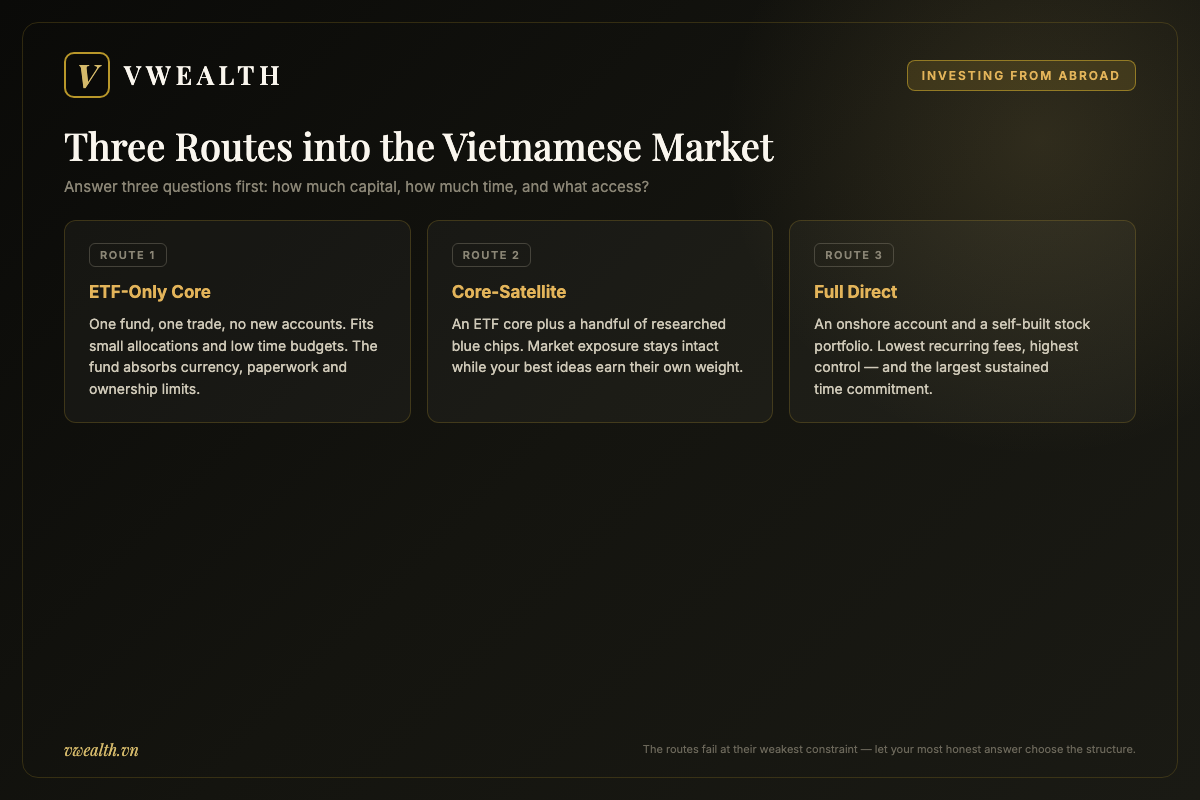
The simplest way to invest in Vietnam from abroad is to buy one exchange-traded fund and stop. An ETF (exchange-traded fund) is a listed fund that holds a basket of stocks and trades on an exchange like a single share, so one purchase gives you exposure to dozens of Vietnamese companies at once.
What the ETF-only route does well
Its first virtue is that it neutralizes almost every Vietnam-specific friction in one stroke. Foreign ownership limits? The fund manager deals with them, and where a stock is inaccessible the index methodology or the manager’s replication strategy routes around it. Currency conversion into and out of Vietnamese dong? Handled inside the fund; you trade in dollars, euros or your home currency. Paperwork? None beyond your existing brokerage account. Time zone? Irrelevant for a position you rebalance once or twice a year. For an investor whose Vietnam allocation is five or ten percent of a global portfolio, this is not laziness — it is proportionality. A position that size does not justify a second brokerage relationship in a foreign jurisdiction.
Its second virtue is diversification you could not cheaply build yourself. Replicating even a thirty-stock index directly would require thirty purchases, thirty positions to monitor, and constant attention to ownership-room constraints on the popular names. The fund does this at institutional scale and cost.
What it costs you
It also helps to know the actual products, because they split cleanly into two families. Offshore funds trade on foreign exchanges in a foreign currency: the largest is the VanEck Vietnam ETF (ticker VNM, listed in New York, with a net expense ratio around 0.66 percent as of its 2026 prospectus); the Fubon FTSE Vietnam ETF (ticker 00885, listed in Taipei and tracking the FTSE Vietnam 30 index of the 30 largest HOSE names) is another of the biggest; and the Xtrackers FTSE Vietnam Swap UCITS ETF (from DWS, listed in Europe) uses a swap to replicate the FTSE Vietnam index synthetically. Onshore funds trade on HOSE in dong and are open to foreign investors: the DCVFM VN30 ETF (ticker E1VFVN30, run by Dragon Capital’s fund arm since 2014, tracking the VN30) and the DCVFM VNDiamond ETF (ticker FUEVFVND, which deliberately holds stocks whose foreign room is full or nearly full) are the reference names. Which family you can buy depends entirely on your access tier.
The price of that convenience comes in three layers, and only the first is printed on the factsheet. Layer one is the expense ratio — the annual percentage fee the fund charges. Layer two is tracking difference: Vietnam ETFs, especially offshore ones, often lag their index by more than the fee alone because of ownership-limit workarounds, cash drag and replication constraints; a swap-based fund like the Xtrackers product also carries counterparty risk in exchange for tighter tracking. Layer three is index concentration: most Vietnam indices are heavily weighted toward a handful of large banks, conglomerates and consumer companies, so your “diversified” fund may behave like a bet on ten large caps plus noise. None of these layers is a scandal; all of them are reasons to read what the fund actually tracks rather than assuming “Vietnam ETF” means “the Vietnamese economy.”
The deeper limitation is philosophical. Vietnam is one of the least analyst-covered markets of its size in Asia. Thin coverage is exactly the environment where stock-picking can, in principle, add value — mispricings persist longer when fewer professionals are hunting them. An ETF deliberately forfeits that opportunity in exchange for simplicity. Whether that trade is good depends entirely on whether you have the time and skill to exploit the alternative, which is what Question 2 of the framework was really asking.
Who should stop here
If your Vietnam allocation is small relative to your net worth, if your honest time budget is under a couple of hours a month, or if opening a foreign brokerage account is unattractive for tax or residency reasons, the ETF-only route is not a compromise — it is the correct answer. Choose the fund deliberately, check its index, its tracking record and its total cost, and then let it run. The most successful ETF-only investors are the ones who treat fund selection as the entire job and do it once, well.
Route 2: Core-Satellite — An ETF Plus a Handful of Direct Blue Chips
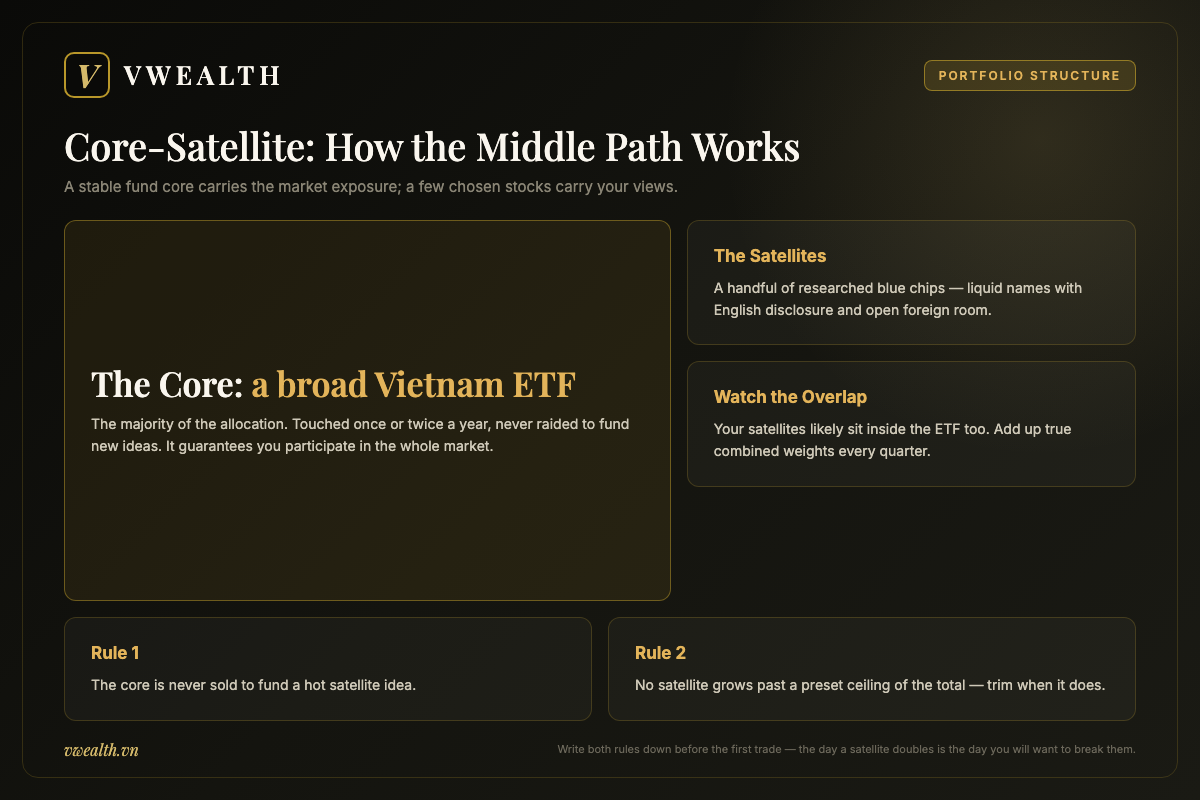
The core-satellite structure is the pragmatic middle path, and for many committed foreign investors it is the destination rather than a stepping stone. The idea: hold a Vietnam ETF as the stable core of the allocation — commonly the majority of it — and add a small number of individually chosen stocks as satellites around it. The core guarantees you participate in the market’s overall movement; the satellites express your specific views where you believe you have insight.
Why this structure suits Vietnam specifically
Core-satellite is a generic strategy, but Vietnam’s quirks make it unusually apt. The market’s indices are concentrated in large caps, so an ETF core already gives you the banks and conglomerates; your satellites can then target what the index underweights — mid-caps, sector specialists, or dividend payers. Conversely, if your conviction is precisely in the largest names, satellites let you overweight them beyond their index weight. Vietnam’s blue-chip stocks — the large, liquid names that dominate the VN30 — are the natural satellite candidates for a foreigner, for a mundane reason: they are the companies with the best English-language disclosure, the deepest liquidity, and the most stable foreign-ownership situations. A satellite position you cannot research or cannot exit is not a satellite; it is a liability.
The structure also fits the time-zone reality. A core you touch twice a year plus three to five satellites you review monthly is a workload measured in hours per month, not per week. You get most of the intellectual engagement of direct investing — reading annual reports, forming views, being right or wrong about specific companies — at a fraction of the monitoring burden of a full direct portfolio.
The honest costs
You now carry both routes’ administrative overhead. To hold satellites onshore you need the Vietnamese brokerage account, the trading code and the capital account, with all the paperwork that entails — the full setup burden of direct investing, incurred for only a minority of your allocation. You also carry both routes’ fee structures: the ETF’s expense ratio on the core and trading, transfer and conversion costs on the satellites.
There is a subtler cost: overlap. Your satellite blue chips are almost certainly also top holdings inside your ETF core. Buy a large bank as a satellite and you may find your true exposure to that bank is your satellite position plus several percent hiding inside the fund. This is not fatal — overweighting a name you believe in is the whole point — but you must measure your combined exposure, or your portfolio is concentrated in ways you have not chosen. A simple habit fixes it: once a quarter, list the ETF’s top ten holdings next to your satellites and add up the true weights.
An illustrative shape, not a prescription
As an illustrative example only: an investor allocating twenty percent of a global portfolio to Vietnam might hold three-quarters of that in a single broad ETF and split the remaining quarter across three or four blue chips they have researched individually. The exact ratio matters less than the discipline that comes with it: the core is never raided to fund a hot satellite idea, and no single satellite grows — through purchase or through appreciation — beyond a preset ceiling of the total. Write those two rules down before you start, because the moment a satellite doubles is exactly the moment you will want to abandon them.
Route 3: Full Direct — Building the Whole Portfolio Yourself
The full direct route means no fund at all: you open an onshore account, wire in capital, convert to dong, and construct a portfolio of individual Vietnamese stocks that you research, weight, monitor and rebalance yourself. This is the maximalist option, and it is genuinely right for a specific kind of investor — but far fewer people than attempt it.
The case for going fully direct
The strongest argument is the one made earlier in reverse: Vietnam’s thin analyst coverage means diligent independent research can find things the market has not priced. A patient investor reading mid-cap annual reports is competing against far fewer professionals than they would be in developed markets. If you have the language tools, the accounting literacy and the temperament, the informational playing field is unusually level.
The second argument is cost at scale. Once the fixed setup is paid, holding stocks directly incurs no annual percentage fee. On a large, low-turnover portfolio held for a decade, the compounded saving versus an ETF’s expense ratio is substantial — this is the same arithmetic that makes index funds cheap for small investors, running in the opposite direction for large ones.
The third argument is control over what you own. Index construction has quirks — concentration, inclusion of names you dislike, exclusion of names you want. Direct ownership lets you tilt however you like: toward Vietnamese dividend payers with long payout histories if income is the goal, toward smaller companies if growth is, away from any sector you distrust. You can also manage the foreign-ownership-limit problem deliberately, favoring companies with ample foreign room so you are never forced to pay a foreign-premium price or locked out of adding to a winner.
The case against — read this part twice
Everything above assumes sustained execution, and sustained is the word that kills most direct portfolios. The work is not hard the way mathematics is hard; it is hard the way exercise is hard — easy to do once, difficult to do every month for ten years. Vietnamese disclosure has improved enormously, but primary documents still appear in Vietnamese first, English translations lag or do not exist for smaller companies, and corporate actions arrive frequently: stock dividends, rights issues, private placements. Each one requires a decision, and each decision arrives on Vietnam’s schedule, not yours.
You also inherit every operational friction the ETF was absorbing: currency conversion timing, wire fees each way, ownership-room checks before every purchase of a popular name, and the tax and reporting duties described later in this guide. And you take on a psychological burden that is easy to underestimate from a distance: when the market falls hard — and Vietnam’s history includes drawdowns that would test anyone — an ETF holder rides an index down, but a direct holder watches specific companies they chose, with names and stories, lose value one by one. Selling discipline is harder when every position is personal.
The full direct route is right for you if all three framework answers point the same way: capital large enough that fixed costs vanish, a time budget you have already proven you can sustain (ideally by running satellites for a year or two first), and established onshore access. If any leg is missing, core-satellite gives you most of the benefit with far less fragility.
Rebalancing a Vietnam Portfolio Across Time Zones
Whatever route you choose, you will eventually need to rebalance — to trim what has grown and top up what has shrunk so the portfolio still matches your intended weights. Rebalancing is where the time-zone problem stops being an inconvenience and becomes a design constraint, so it deserves its own section.
Know when the market is open in your hours
Vietnam’s exchanges trade on Indochina Time, UTC+7, in a morning session and an afternoon session separated by a lunch break — on HOSE, roughly 9:15 to 11:30 and 13:00 to 14:30 local time, closing with an at-the-close auction in the mid-afternoon. Translate that into your own clock and the picture is stark. For an investor in Western Europe, the Vietnamese afternoon session overlaps with early morning. For the US East Coast, the whole trading day runs through the night — the market closes around the time New Yorkers are having breakfast is a common misconception; in fact it closes while they are asleep, hours before their morning. Australia and East Asia get the only comfortable overlap. Check the exact session times against your own time zone before you design any process that assumes you can watch a price live.
Design for absence, not presence
The correct response is not heroic 3 a.m. trading sessions; it is a process that does not require you to be awake. Three principles do most of the work.
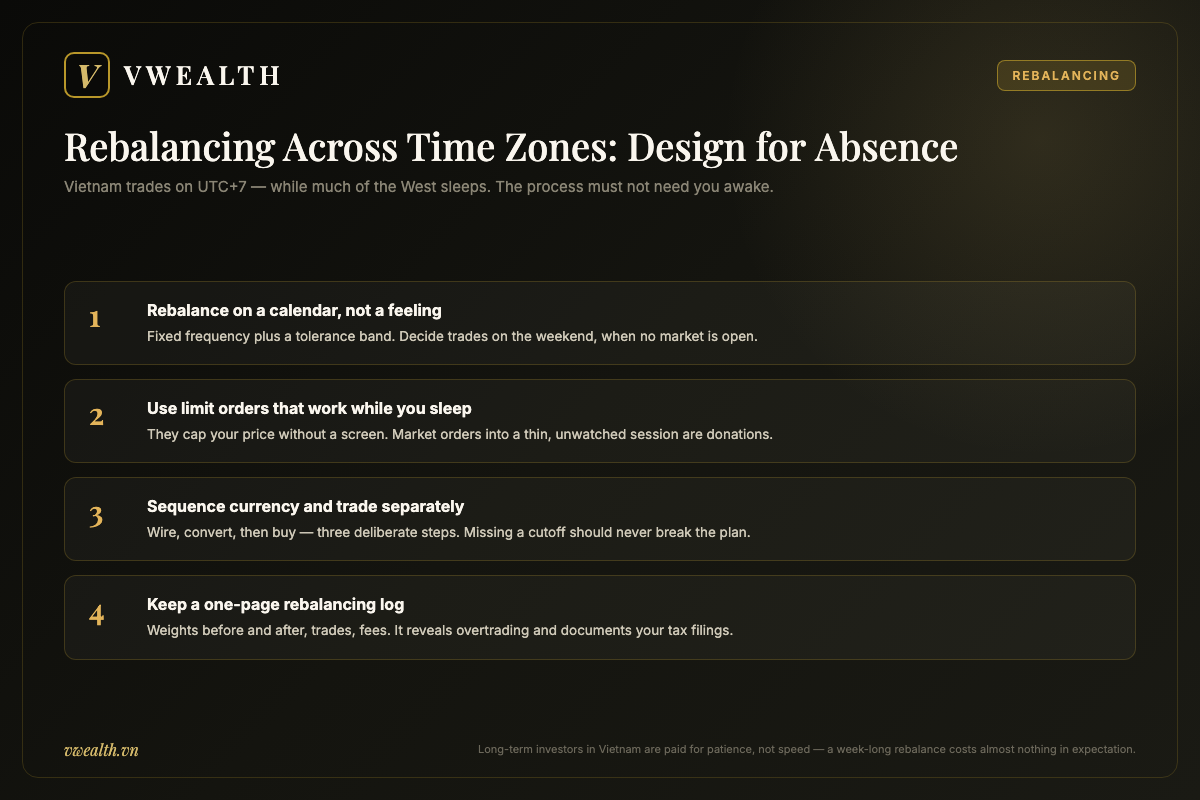
First, rebalance on a calendar, not on a feeling. Pick a frequency — semi-annual is common for long-term foreign holders, quarterly for more active ones — and a tolerance band, for example: act only when an asset’s weight drifts more than a fixed number of percentage points from target. The band matters because it prevents the expensive habit of micro-rebalancing every month across international wires. Decide the trades on the weekend with a clear head, when no market is open anywhere.
Second, use order types that work while you sleep. Limit orders — instructions that execute only at your specified price or better — are your default tool, because they cap the price you pay without requiring you to watch the screen. Market orders placed into a session you are not watching are how foreigners donate money to thin order books. Note one Vietnam-specific detail: daily price movement is capped by band limits — on HOSE a stock can move at most about seven percent from the prior close in a single session, versus roughly ten percent on the Hanoi exchange (HNX) and fifteen percent on UPCoM — which changes how fast-moving days behave. An order can simply go unfilled for days while a stock sits locked at its ceiling or floor. Settlement is also worth knowing: since the KRX-built trading system went live on HOSE in 2025, cash equities settle on a T+2 basis, so shares and cash arrive two business days after the trade, not instantly. Build that patience into the plan.
Third, sequence the currency and the trade separately. For onshore holders, rebalancing that involves new money means a wire, a conversion into dong, and then the purchase — three steps in two time zones. Do them as three deliberate actions rather than one rushed chain. Wires and conversions have their own cutoffs and settlement delays; a trade planned for Tuesday that misses the currency cutoff becomes a Thursday trade, and that is fine if — and only if — your plan never depended on precision timing. Long-term investors in Vietnam are paid for patience, not speed; a rebalancing process that takes a week to complete costs you almost nothing in expectation.
One more habit repays itself: keep a one-page rebalancing log — date, weights before, trades made, weights after, fees paid. Across years it becomes the record that tells you whether your process is disciplined or whether you have been quietly overtrading, and it doubles as documentation for the tax filings discussed next.
Paperwork, Taxes and Overhead: The Comparison Nobody Advertises
Fees get all the attention, but for a foreign investor the administrative overhead — accounts, codes, filings, taxes — often shapes the experience more than the expense ratio does. Here is how the routes compare, with a standing caveat: tax rules change and interact with your home country’s system, so treat this section as a map of what to check, not as advice on any specific number.
The ETF route’s paperwork
Minimal, which is the whole point. You buy the fund through an account you already have, and your home broker’s usual tax reporting covers it. The Vietnamese-side taxes on the underlying stocks are handled inside the fund; what you owe personally is your home country’s treatment of the fund’s dividends and capital gains, plus any withholding applied by the fund’s domicile. One genuine trap deserves a mention: fund domicile determines withholding-tax treatment on distributions, and two ETFs tracking the same Vietnamese index but domiciled in different countries can leave different amounts in your pocket. Checking domicile takes one minute on the factsheet and is worth doing before you buy.
The direct route’s paperwork
Substantially more, in three phases. Phase one is setup: as a foreign individual you need a securities trading code issued by the Vietnam Securities Depository and Clearing Corporation (VSDC), an indirect investment capital account (a dedicated dong bank account at a licensed Vietnamese bank through which all your investment money must legally flow in and out of the country), and a brokerage account — a process involving notarized and often consularized identity documents. Each foreign investor is issued a single trading code, typically within a few business days once documents are in order. It is bureaucratic but well-trodden; the step-by-step is covered in our guide to opening a Vietnamese brokerage account as a foreigner.
Phase two is ongoing Vietnamese-side tax, which for foreign individual investors has historically been refreshingly mechanical: as of mid-2026, a flat 0.1 percent of sale proceeds is withheld on every sell transaction (charged on the transaction value, not the profit — you pay it even on losing trades, which quietly punishes overtrading), and a 5 percent withholding applies to cash dividends, per Vietnam’s personal income tax rules (summarized by PwC). Vietnam issued a wave of tax decrees and circulars in early 2026, so verify the current rates before filing anything. Phase three is home-country reporting: many jurisdictions require you to declare foreign brokerage accounts and foreign income separately, sometimes on dedicated forms with meaningful penalties for omission. This last item is the one foreign investors most often discover late.
Side by side
| Overhead item | ETF-only | Core-satellite | Full direct |
|---|---|---|---|
| New accounts to open | None | Onshore broker + capital account | Onshore broker + capital account |
| Setup time | Minutes | Weeks | Weeks |
| Recurring percentage fee | Fund expense ratio | Expense ratio on core only | None |
| Per-trade friction | One exchange trade | Wires + conversion on satellites | Wires + conversion on everything |
| Vietnamese tax handling | Inside the fund | Yours, on satellites | Yours, on everything |
| Home-country reporting | Standard brokerage reporting | Foreign account declarations likely | Foreign account declarations likely |
| Ongoing research hours | Near zero | Moderate | High, sustained |
Read the table with your framework answers in hand and a pattern emerges: the direct routes front-load pain (setup, learning) and reward scale and longevity; the ETF route spreads a smaller pain evenly across time. Neither is free. The mistake is paying the direct route’s setup costs and then running it with an ETF investor’s time budget — full overhead, none of the edge.
How Each Route Fails: The Predictable Mistakes
Every route has a characteristic way of going wrong. Knowing the failure mode of your chosen structure in advance is cheap insurance, because these mistakes are boring, repetitive and therefore avoidable.
How ETF-only portfolios fail
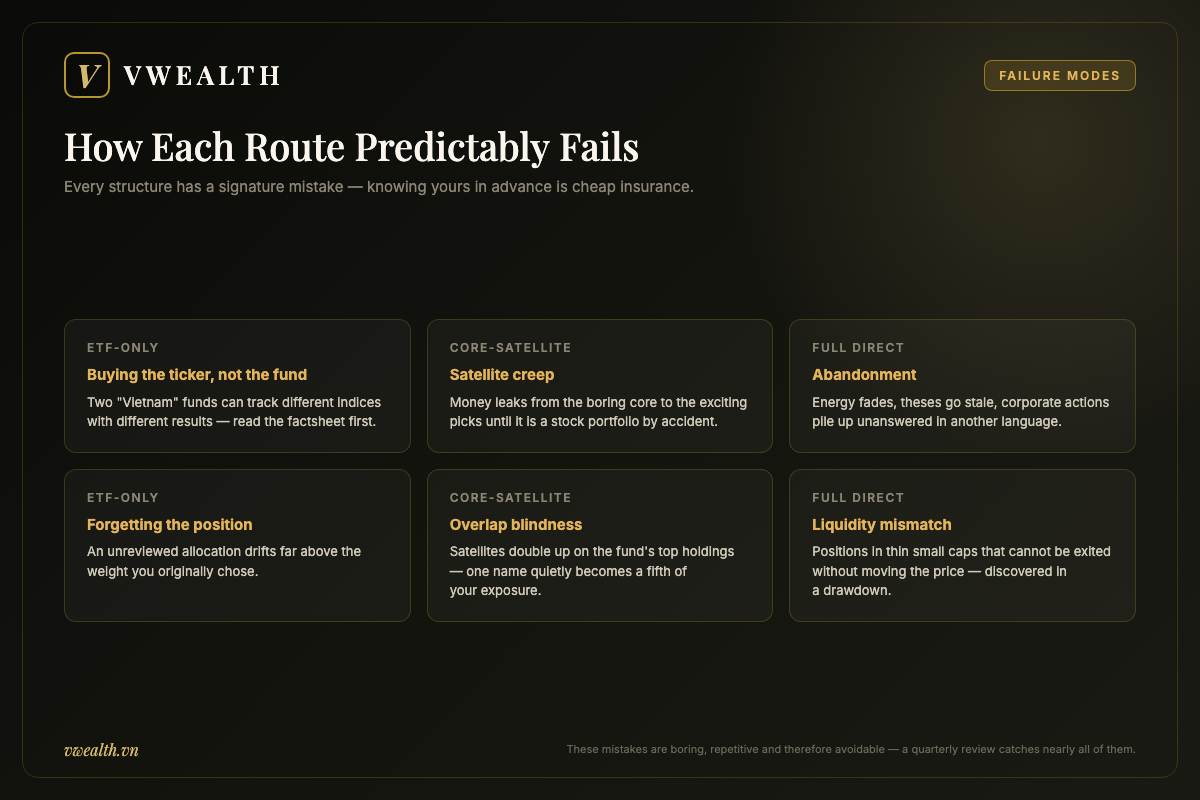
The classic failure is buying the ticker, not the fund. Two products with “Vietnam” in the name can track different indices with different sector concentrations, different treatment of ownership-limited stocks and persistently different returns. Investors who picked their fund in five minutes discover the difference after several years, in the least pleasant way. The second failure is performance-chasing between funds — switching from the fund that lagged last year to the one that led, paying spreads and taxes to arrive just in time for the leadership to rotate back. The third is subtler: forgetting the position exists. An allocation made in an enthusiastic moment and never reviewed can drift from five percent of your portfolio to twelve after a strong run, leaving you with more frontier-market risk than you ever chose. The fix for all three is the same single habit: a scheduled annual review of what the fund tracks, what it costs and what it now weighs in your portfolio.
How core-satellite portfolios fail
The signature failure is satellite creep. The satellites are the fun part — they involve stories, conviction and the pleasure of being right — so money leaks from the boring core toward them, one small purchase at a time, until the portfolio is satellites with a vestigial core. At that point you have a concentrated stock portfolio with an ETF ornament, carrying full direct-route risk without ever having decided to. The second failure is the overlap blindness described earlier: satellite blue chips doubling up on the fund’s top holdings until one bank or one conglomerate is a fifth of your true exposure. Both failures are measurement problems, and both die under a quarterly spreadsheet that lists true combined weights against your written targets. If you do not enjoy maintaining that spreadsheet, that itself is information — it says the ETF-only route fits you better than you wanted to believe.
How full direct portfolios fail
Direct portfolios fail through abandonment more than through bad picks. The investor starts with energy — ten researched positions, a monitoring routine — and life intervenes; eighteen months later the portfolio is unwatched, theses are stale, and corporate actions have accumulated unanswered. In a market where disclosure arrives in another language and another time zone, a neglected portfolio decays faster than it would at home. The second failure is liquidity mismatch: buying thinly traded small caps in position sizes that cannot be exited without moving the price, discovering this only during a drawdown when everyone else is selling too. The third is ownership-room negligence — building a plan around adding to a stock whose foreign quota then fills, leaving the plan unexecutable. Each failure traces back to the same root: running the most demanding route on a maintenance budget that could not sustain it. The honest pre-commitment test: if you cannot name the last three quarters’ developments for every stock you hold today in any market, do not build a direct portfolio in Vietnam.
Putting It Together: A Decision Path You Can Actually Follow
Frameworks are only useful if they end in an action, so here is the whole guide compressed into a sequence you can run this week.
Step one: score yourself on the three questions. Capital — is your intended Vietnam allocation small, medium or large in absolute terms, and what percentage of your total portfolio is it? Time — how many hours per month have you actually spent on investment research in the past year (not how many you intend to)? Access — can you, and do you want to, open an onshore account, or is your existing broker the boundary?
Step two: let the weakest answer set the route. This is the rule most people resist. If your capital is large and your enthusiasm high but your honest time budget is an hour a month, the time answer wins and you belong in the ETF-only route regardless of how intellectually appealing direct ownership sounds. The routes fail at their weakest constraint, not their strongest.
Step three: whichever route you choose, start one size simpler than you think you deserve. Future direct investors should run a core-satellite structure for at least a year first; aspiring core-satellite investors should hold the ETF core alone for a quarter or two while their onshore paperwork processes. Upgrading a structure that works is easy and cheap. Downgrading one that failed — unwinding ten direct positions across wires and tax filings — is neither.
Step four: write the rules down before the first trade. Target weights, rebalancing calendar and tolerance bands, a ceiling on any single position, and the review schedule. One page is enough. The document is not for normal times; it is for the day the market falls twenty percent or a satellite triples, when the person reading it will not be thinking clearly and needs instructions from the person who was.
Step five: revisit the framework annually, because the answers move. Capital grows, careers free up or consume time, brokers add markets, and Vietnam’s own rules — ownership limits, market classification, tax rates — evolve. The investor who correctly chose an ETF core at thirty may correctly run a direct portfolio at forty. The framework is not a personality test; it is a measurement you retake.
However you structure the position, remember what all three routes share: they are all long Vietnam. The vehicle decides how efficiently and how sustainably you hold the exposure, but the exposure itself — a fast-growing, still-maturing frontier market with real currency, liquidity and governance risks alongside its genuine promise — is the same underlying bet. Vehicle selection manages the frictions; it does not remove the risk. Position sizing does that, and no ETF wrapper or research edge substitutes for it.
This article is a general analysis for educational purposes and is not investment advice or a recommendation to buy or sell any security.
Research Vietnamese stocks in English with vwealth. Our AI-powered platform turns Vietnamese market data into full English analysis reports — with international payment support and a free 2-month trial for new accounts. Create your free account and read the latest reports.